

Antheia Botanis's Arc
15 Chapters
Antheia Botanis's dream is cultivating a legendary garden where every plant species from myth grows together in bloom..

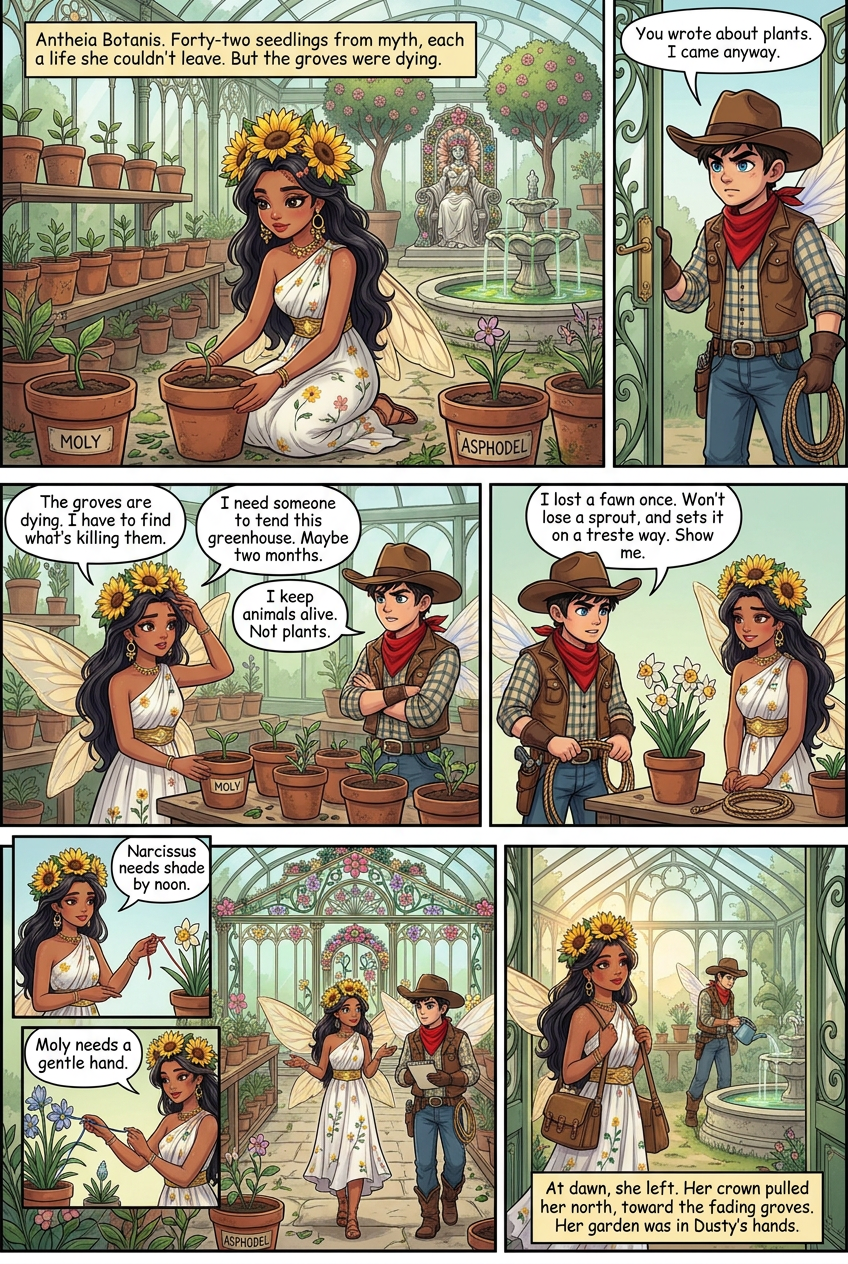
Antheia Botanis knelt in the wet soil of her greenhouse and counted the sprouts that would die if she left tomorrow. Forty-two seedlings sat in clay pots along the trestle. Moly, asphodel, the pale narcissus from the Cocytus bank. Each one pulled from a myth she had chased across three countries. Her sunflower crown still carried a brown scar where three petals had fallen near Artemis's grove. That grove was going black. Others were following. She could not stay here watering pots while ancient trees turned to ash, but she could not leave the seedlings to wither either. Every plant in this greenhouse was one bloom closer to the garden she meant to build, the garden that would hold every myth-plant alive in one place. She stood and walked the length of the glass house. Vines climbed the iron ribs. A stone fountain ran in the center, its water tinted green from the moss she fed it. Beyond the fountain, her carved throne sat under a cluster of potted trees she had grown from cuttings taken outside Thebes. The trees needed misting twice a day. The narcissus needed shade by noon. The moly needed a hand that knew not to bruise the root. She had no such hand. She had come to Greece alone. No god had sent her. No temple had opened its door. A knock rattled the greenhouse frame. A short man in a brown hat stood at the door, wings folded flat against his back, a coiled rope on his belt. Dusty Thornwing. She had sent word to the animal fairies three days ago, asking if any of them knew a keeper. She had not expected the leader himself. "You wrote about plants," Dusty said. "I came anyway." "I need someone to tend this greenhouse for a month. Maybe two. I have to ride north." She pointed at her crown. "The groves are dying. I have to find what's killing them before the rest go black." Dusty looked at the seedlings. He looked at the fountain. He looked at the throne under the potted trees. "I keep animals alive. Not plants. I lost a fawn once because I got there late. Won't lose a sprout the same way." He unhooked the rope from his belt and set it on the trestle. "Show me what dies first without water. Show me what dies first with too much. I'll write it down. I'll stay till you're back or till you send word you're not coming." Antheia felt her crown lift a half inch on her head. She walked him down the row and named each plant and each need. She marked the narcissus with a red thread and the moly with a blue one. By dusk he could recite the schedule back to her without pause. At dawn she packed a satchel and left the greenhouse in his hands. Her crown had already begun to tug north, toward the next black grove, and now she was free to follow it.
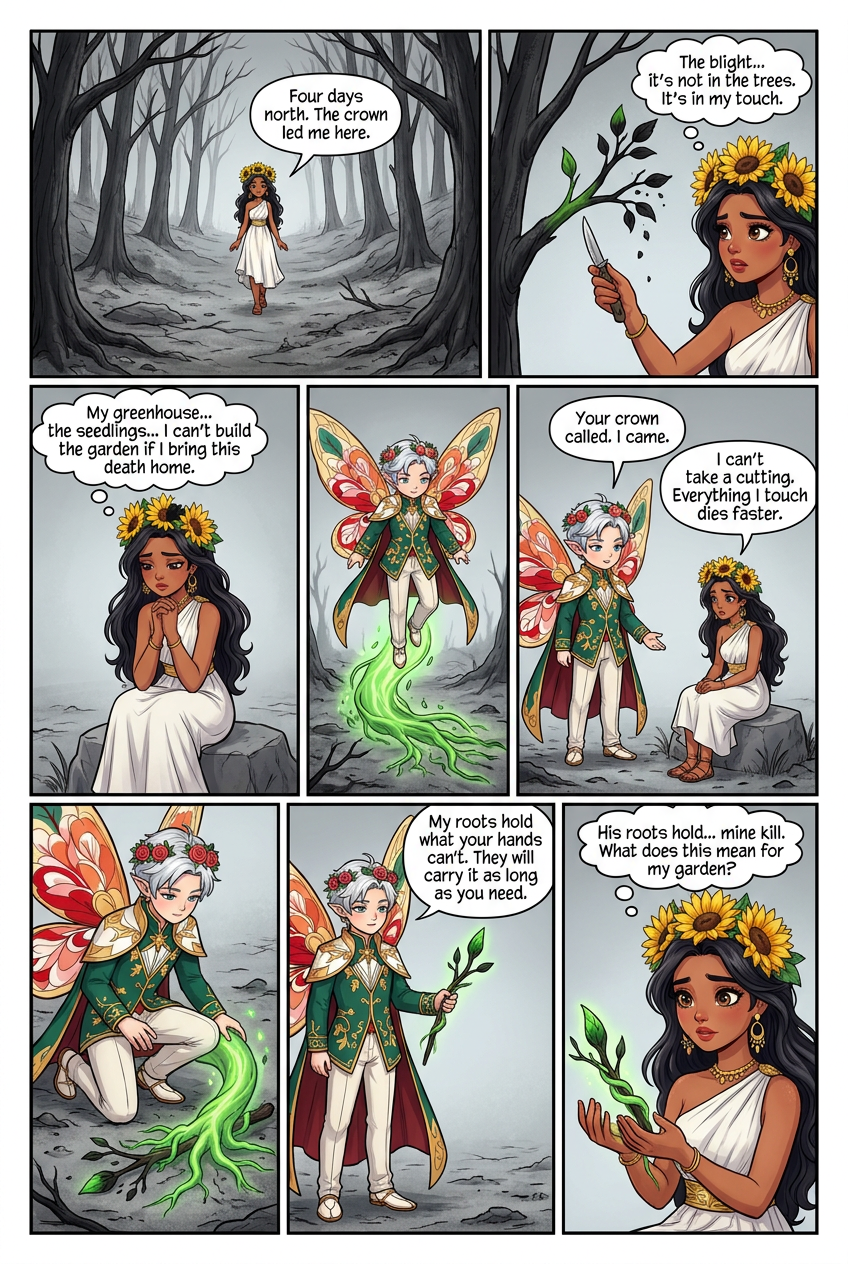
Antheia rode north for four days before her crown pulled her off the road. The petals bent hard to the left, toward a slope where the pines gave way to a hollow of black trunks. She dismounted and walked in. The bark was not burned. It was the color of wet ash, and it flaked when the wind touched it. The ground crunched under her boots. Nothing sang. She needed a living cutting to take back and study. If she could name the sickness, she could fight it. If she could not, more groves would fall. She found one branch at the edge of the hollow that still held green at its tip. She drew her small knife and cut. The green leaves shivered black before the branch left the tree. She dropped it. She tried a sapling further in, wrapping her hand in linen first. The linen turned gray. The sapling folded in on itself and crumbled. She stepped back and counted her failures. Four cuttings. Four deaths in her palm. The blight was not in the trees. It was in the touch that took them. She sat on a stone and pressed her hands flat against her knees. Her crown had lost another petal. She could feel the gap above her ear. She thought of her greenhouse, of the forty-two seedlings she had left with the animal fairy, and of the throne under the potted trees where she used to sit and plan the garden that would hold every myth in one bloom. She could not build that garden if she carried this sickness home in her hands. A rustle came from the ridge. A man landed lightly on the black soil. Silver hair, rose crown, wings that trailed a thin green line behind him as he walked. Roots pushed up through the ash where his feet had passed. Small white roots, curling toward the light. Roswell Petalion. She had heard of him. She had never asked him for help. "Your crown called," he said. "I came." "I can't take a cutting. Everything I touch dies faster." He knelt by the green-tipped branch she had dropped. He set his palm on the soil beside it. A root pushed up through the ash and wound around the base of the branch. The root drew the branch into itself, wrapping it in living wood. He lifted the whole bundle and held it out. The green tip was still green. "My roots hold what your hands can't," he said. "They will carry it as long as you need." Antheia took the root-wrapped cutting. The green tip did not blacken. She had her sample. She also had a debt to a prince she did not know, and a new question pressing under her ribs — why his roots held where hers killed, and what that meant for the garden she still meant to build.
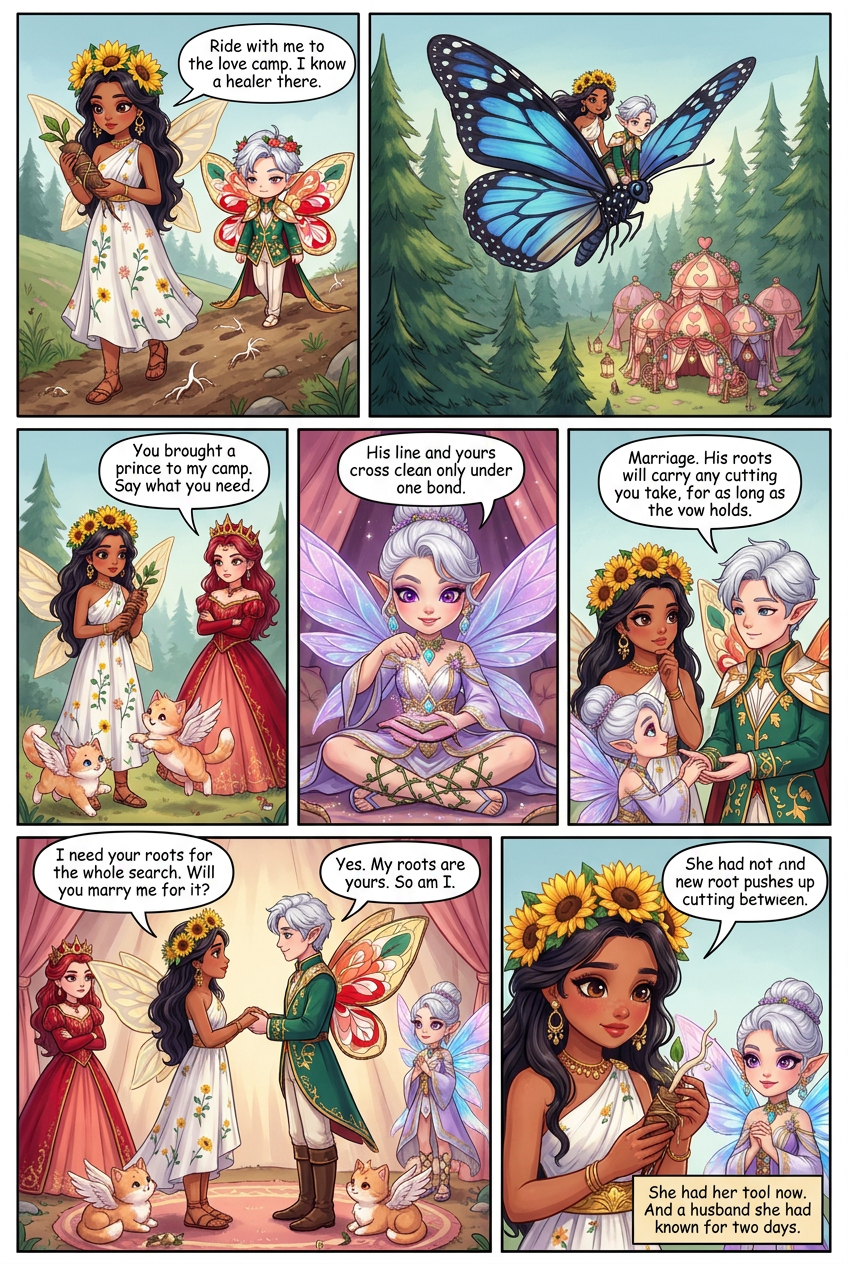
Antheia carried the root-wrapped cutting down the slope to the road, and Roswell walked beside her. Small white roots pushed up in his footprints and curled toward the sun. She kept her eyes on the green tip in her hands. It had not blackened. Her hands could not do that. She needed to know why. "Ride with me to the love camp," she said. "I know a healer there. She may read what my hands cannot." Roswell nodded once. He whistled, and a blue-marked monarch the size of a pony came down through the pines and folded its wings for them to mount. They landed at a cluster of pink and rose tents strung with lanterns and flower ropes. Two winged kittens tumbled out to greet them, bumping heads against Antheia's boots. Rosalind Emberheart met them at the center tent. She wore a red crown and did not smile. "You brought a prince to my camp," she said. "Say what you need." Antheia held out the cutting. "His roots hold what my hands kill. I want to know why. I need a reader." Rosalind studied the green tip, then Roswell, then Antheia's crown with its missing petals. "Luminara is here through morning," she said. "She reads with star-dust. She will want a price." Luminara Starwhisper sat cross-legged inside the tent, silver hair pinned up, purple eyes bright. She sprinkled dust over the cutting and over Roswell's open palm. The dust settled in patterns. She looked up. "His line and yours cross clean only under one bond," she said. "Marriage. His roots will carry any cutting you take, for as long as the vow holds. Break the vow and the roots let go." Antheia's throat tightened. She thought of the greenhouse, the forty-two seedlings, the throne under the potted trees. She thought of every myth-plant she still needed to find, and every grove going black while she stood still. She turned to Roswell. "I need your roots for the whole search. Years, maybe. Will you marry me for it?" Roswell did not look away. "Yes," he said. "My roots are yours. So am I. Say the vow." They said it in front of Rosalind and Luminara, plain words, no feast. The kittens curled at Antheia's feet. When she took the cutting back, a new root pushed up between her fingers on its own and wrapped tighter around the branch. She felt the bond settle in her chest like a second pulse. She had her tool now. She also had a husband she had known for two days, and a knowledge she had not asked for: Luminara had watched her face while she said yes, and Luminara had seen that Antheia meant every word about the garden and none of them about the man.
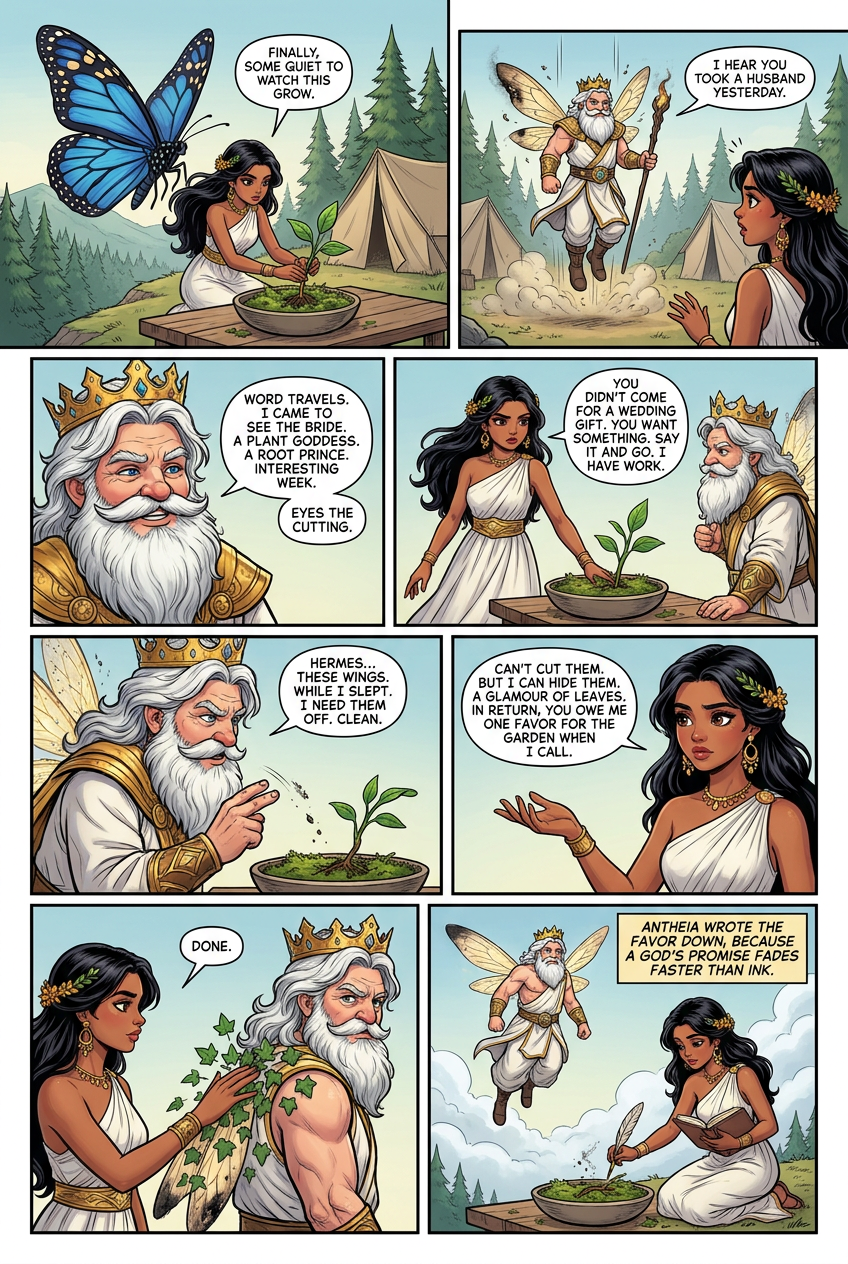
Antheia and Roswell rode the blue monarch back to her small camp on the ridge above the pines. She set the cutting in a shallow bowl of damp moss and let his roots hold it steady. The green tip was still green. She wanted a full day of quiet to watch it. She did not get an hour. A shape dropped from the clouds and landed hard between the tents. Small moth-sized wings buzzed at his back, one edge black and curled. He wore a gold crown and carried a scorched staff. Antheia knew the face from every temple painting north of the sea. Zeus straightened his robe and pretended the wings were not there. "I hear you took a husband yesterday," he said. "Word travels. I came to see the bride." He looked at Roswell, then at the cutting, then at her crown with its missing petals. "A plant goddess. A root prince. Interesting week." Antheia stepped between him and the bowl. The cutting sat exposed on the moss, no cloth over it, no shield. One careless spark from the singed staff and a year of work would be ash. "You didn't come for a wedding gift," she said. "You came because you want something. Say it and go. I have work." Zeus's mouth twisted. He glanced at the sky, then at her, and lowered his voice. "Hermes put these on me while I slept. I need them off before the others notice. You grow living things. Cut them off. Clean." He turned his shoulder to show her. The singed wing shed a fleck of ash onto the moss beside the cutting. Roswell's roots pulled the cutting back an inch on their own. She thought fast. He would not leave until he had a trade. She could not send the king of the gods away empty and keep her cutting safe from the next spark. "I can't cut them," she said. "They're grown into you now. But I can hide them. A glamour of leaves over your shoulders until they fall on their own. No one sees wings. You walk out looking like yourself." She held out her hand. "In return, you leave now, and you owe me one favor for the garden when I call." Zeus considered. He did not like debt. He liked exposure less. "Done," he said. She laid her palm on his back, and small ivy leaves spread across the wings and pinned them flat under green. He rolled his shoulders, nodded once, and rose into the clouds without another word. Antheia knelt by the bowl. The cutting was still green. The ash fleck sat on the moss beside it, a finger's width from the root. She brushed it off and covered the bowl with a cloth. Then she wrote the favor down in her book, because a god's promise fades faster than ink.
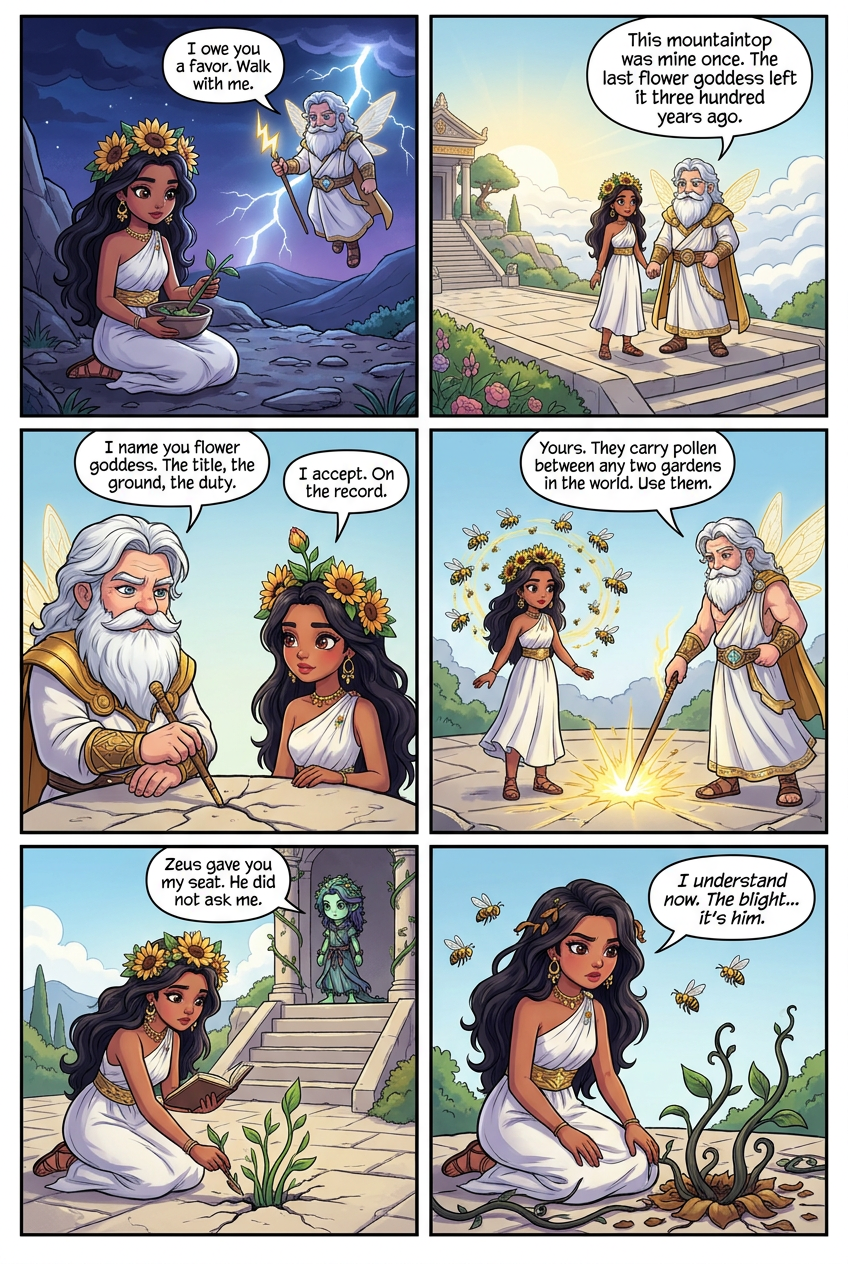
Antheia watched the cutting through the night. The root held. The green tip stayed green. At dawn, thunder rolled without clouds, and Zeus dropped into the camp again. The ivy still covered his shoulders. He looked calmer, and that worried her more than the ash had. "I owe you a favor," he said. "I'm paying it now, on my terms. Walk with me." He tapped the scorched staff on the ground. The air folded. Antheia stepped through with the covered bowl in her arms and came out on a stone terrace high above cloud. Layered gardens climbed toward a shrine at the peak. Fountains ran between pruned trees. No one else stood on the steps. "This mountaintop was mine once," Zeus said. "The last flower goddess left it three hundred years ago. No one filled the seat. The groves are dying because no one holds the office." He turned to face her. "I name you flower goddess. The title, the ground, the duty. Plant your first grove here. The blight will slow where you root." Antheia set the bowl on the stone. Her crown, which had shed three petals near the black groves, pushed out a new bud along the rim. She felt the office settle into her shoulders like weight added to a pack. "I accept," she said. "On the record. Witnessed by your staff." Zeus struck the stone once. The terrace hummed. A swarm of gold bees with peacock markings poured out of a hive she had not seen and circled her head. "Yours," he said. "They carry pollen between any two gardens in the world. Use them." He left the way he came. Antheia knelt and pressed Roswell's cutting into a crack in the terrace stone. Root took soil in a breath. A second shoot came up beside it, then a third. She had a place now. She had a name that gods had to honor. She reached for her book to write the grant down. A figure stood on the top step of the shrine. Small, green-skinned, leaves in the hair, eyes flat. Antheia had not heard the steps. Verdis Thornheart came down two stairs and stopped. "Zeus gave you my seat," they said. "He did not ask me." A vine crept out from under their heel and reached toward the new shoot. It moved by inches, patient. "I've been the flower goddess for three hundred years. Quietly. He forgot." Antheia's crown wilted a full ring of petals at once. Brown, curled, and dropped on the stone between them. The bees went still in the air. The new shoot leaned away from the crawling vine on its own. Antheia understood then where the blight came from, and who she had just been set against. She closed the book without writing.
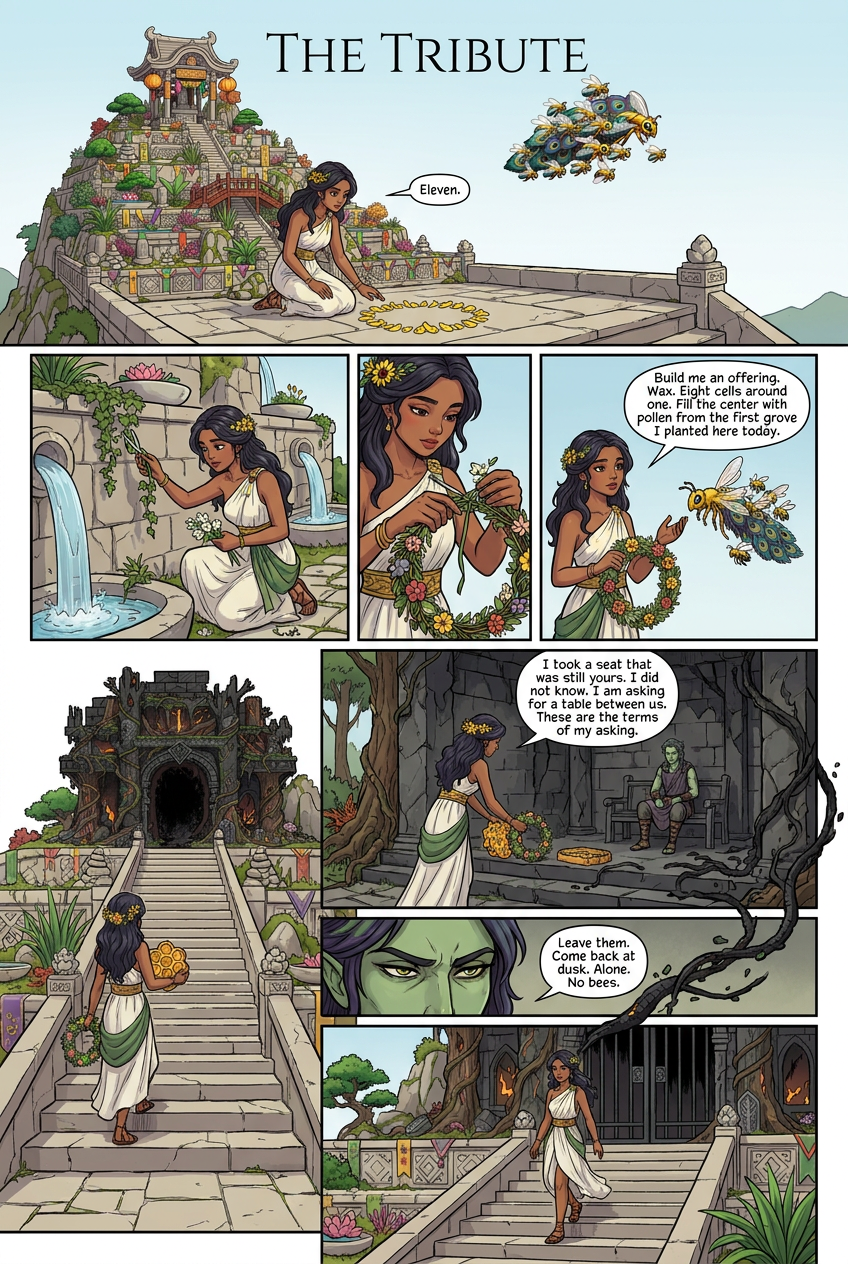
The bees settled on the terrace stones after Verdis walked back up the shrine steps and did not turn around. Antheia stayed on her knees by the new shoot until the vine at the top of the stair pulled back on its own. Her crown had dropped a full ring of petals. She counted them. Eleven. She swept them into the fold of her book and stood. She could not chase Verdis up those steps. Verdis had held the office three hundred years. She had held it an hour. She needed a way to stand in front of Verdis without dying in the first minute. Force would not work. Argument would not work. She had taken the seat, and no words could undo that. What she could offer was tribute. A gift shaped like respect, made by her own hands, carried by something Verdis could not refuse to look at. Antheia went down to the lowest terrace where the fountains ran. She cut stems from the plantings Zeus had left: white blossoms, seed heads, a strand of ivy the shrine had grown itself. She wove them into a ring the size of a plate. She did not use her power on any of it. The crown of seasons had to be plain work, or Verdis would read it as a claim. Then she called the bees down. They came in a gold cloud and hung above her hands. She spoke to them without ceremony. "Build me an offering. Wax. Eight cells around one. Fill the center with pollen from the first grove I planted here today." The swarm moved onto the stone and began. In an hour they left behind a hexagon comb, the outer cells sealed pale gold, the center cell open and bright with fresh dust. She lifted it. It weighed almost nothing. She climbed the steps with the wreath in one hand and the comb in the other. The shrine at the top opened onto a second garden she had not seen from below. Charred trunks stood in rows. Stone arches leaked slow fire at the seams. Small flowers pushed out of the cracks and leaned toward the center, where Verdis sat on a low bench. Nothing behind Verdis looked alive, and nothing looked fully dead. Antheia stopped at the arch and set both gifts on the threshold stone. She did not step across. "I took a seat that was still yours," she said. "I did not know. I am asking for a table between us. These are the terms of my asking." Verdis looked at the wreath. Looked at the comb. Did not stand. "Leave them. Come back at dusk. Alone. No bees." A vine slid out from under the bench and drew the offerings across the threshold without Verdis moving a hand. The gate to the burnt garden closed on its own. Antheia walked back down the steps with her hands empty and a meeting she had bought but not yet survived.
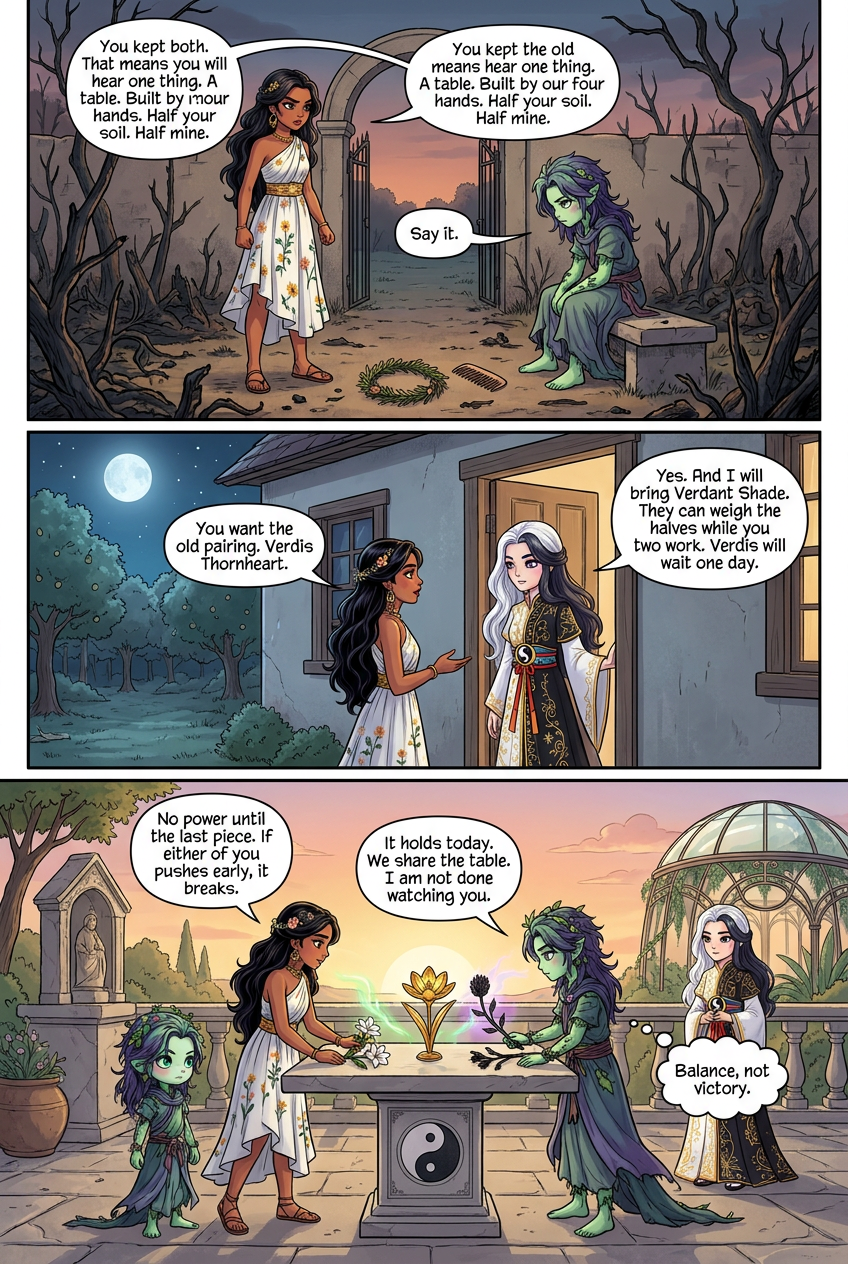
Antheia came back to the burnt garden at dusk with empty hands and a plan she had not yet spoken aloud. Verdis sat on the same low bench. The wreath and the comb rested at their feet, untouched. Antheia stopped at the arch. "You kept both," she said. "That means you will hear one thing." Verdis did not look up. "Say it." "A table," Antheia said. "Built by our four hands. Half your soil. Half mine. Living plants on one side. Rotting on the other. Balanced. If it holds, the blight stops. If it fails, I leave the seat." Verdis lifted their head. Green eyes, flat. "Who taught you the pairing?" "No one yet," Antheia said. "I know who did teach it. I will bring her." She rode south through the night and found Lily Duskdawn in a plain house at the edge of a walled orchard. Lily opened the door before Antheia knocked. "You want the old pairing," Lily said. "Verdis Thornheart. I heard three hours ago." "Will you come." "Yes. And I will bring the one who tends both sides at once. Verdant Shade holds a garden like the one you are trying to build. They can weigh the halves while you two work." Antheia said, "How long do I have." "Verdis will wait one day. No more." They met at the shrine at first light. Verdant Shade set a plain stone pedestal on the terrace between the two gardens, marked with a flowing yin-yang. "The table goes on this," Verdant Shade said. "Not on soil. Soil takes a side." Lily laid out the rule. "One plant from her. One from you. Alternating. No power until the last piece. If either of you pushes early, it breaks." Antheia cut a white blossom from the lower terrace and placed it on the north edge of the pedestal. Verdis lifted a charred stem from the burnt garden and set it beside the blossom. They worked without speaking. Living, dead, living, dead. Antheia's hands shook once. She did not touch the dead pieces. Verdis did not touch the living. Verdant Shade watched the weights shift and moved a stem a finger's width when the balance leaned. At the center, Antheia laid a golden crocus Zeus had left in her camp. Verdis laid a black seed head beside it. The pedestal held. "Now," Lily said. Antheia and Verdis set their hands on opposite edges. Antheia felt her power run down into the wood and meet Verdis's coming up. The joint held. A slow warmth crossed the table both ways. The charred stems put out one green node. The white blossoms browned at the tips and stopped. Balance, not victory. Verdis pulled their hands back first. "It holds today," they said. "Move it under glass by nightfall. Sun and shade both. If it sits in open weather, it will tip." Lily named the place before Antheia asked. "The half-eclipse dome. Built for this." Verdis stood, finally, and looked at Antheia straight. "The blight stops at the groves it has already taken. I keep my garden. You keep the seat. We share the table." Then, flat: "I am not done watching you." Verdis walked back up the shrine steps. This time, at the top, they turned around.
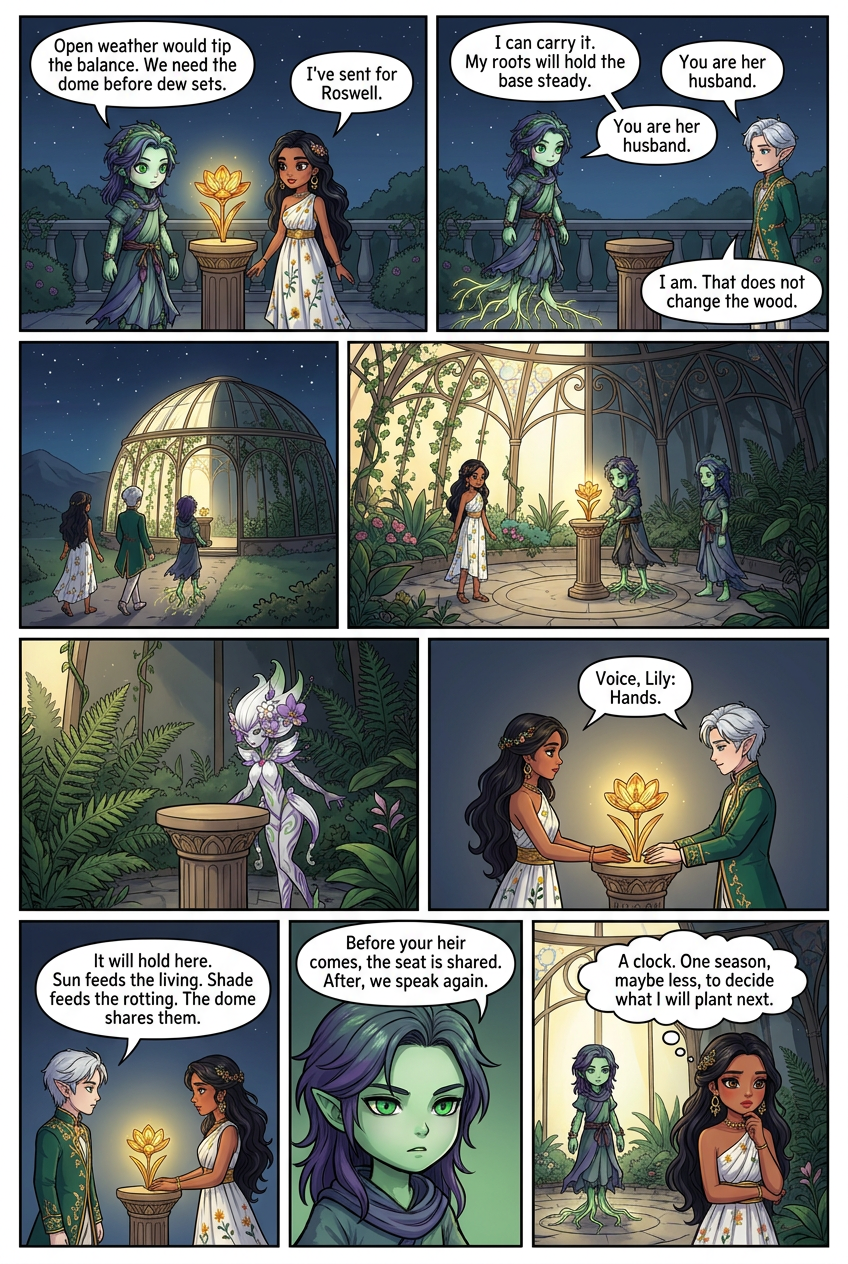
By nightfall the balanced table had to be moved under glass. Antheia stood at the shrine terrace with the pedestal between her and Verdis, and the plants held their arrangement in a thin, humming quiet. Verdis had named the danger already. Open weather would tip the balance. They had one place built for both light and shade, and they had to reach it before the dew set. Antheia sent word to Roswell. He came within the hour, roses on his shoulders, roots trailing behind him wherever his feet landed. He looked at the pedestal, then at Verdis. "I can carry it," he said. "My roots will hold the base steady. They do not care what side a plant is on." Verdis's flat green eyes moved over him. "You are her husband." "I am," Roswell said. "That does not change the wood." They walked the pedestal down the terrace path to the half-eclipse dome. The dome sat where the ridge cut the sky in two, one side always bright, one side always dim. Living vines climbed the glass on the sunlit half. Dark ferns filled the shaded half. A stone floor ran between. Verdant Shade had marked the center already, a small circle where light and shadow met. Roswell set the pedestal on the circle. His roots crept out from his heels and sank into the seam of the stones, bracing the base without touching the plants. Antheia watched the golden crocus at the table's center. It did not flare or dim. It held. Verdis crossed to the shaded side and knelt at the ferns. Antheia crossed to the bright side and stood among the vines. Between them, a pale orchid nymph drifted out from behind a fern, luminous, marked with faint poison lines. She did not speak. She circled the pedestal once, tasted the air, and settled at its foot as a witness. "Hands," Lily said from the doorway. Antheia and Verdis set their palms on the pedestal edges again. The bond woke. Warmth ran both ways through the wood. Charred stems kept their one green node. White blossoms kept their browned tips. Neither side pushed. The orchid nymph did not move. Verdis lifted their hands first, as before. "It will hold here," they said. "Sun feeds the living. Shade feeds the rotting. The dome shares them." They looked at Roswell, then at Antheia. "Before your heir comes, the seat is shared. After, we speak again." Antheia felt the words land. Not a threat. A clock. Roswell drew his roots back into his heels. Antheia stepped away from the vines. The blight had stopped at the groves already taken. The table held under glass. Her sister-goddess had named a term she had not asked for, and Antheia had one season, maybe less, to decide what she would plant next.
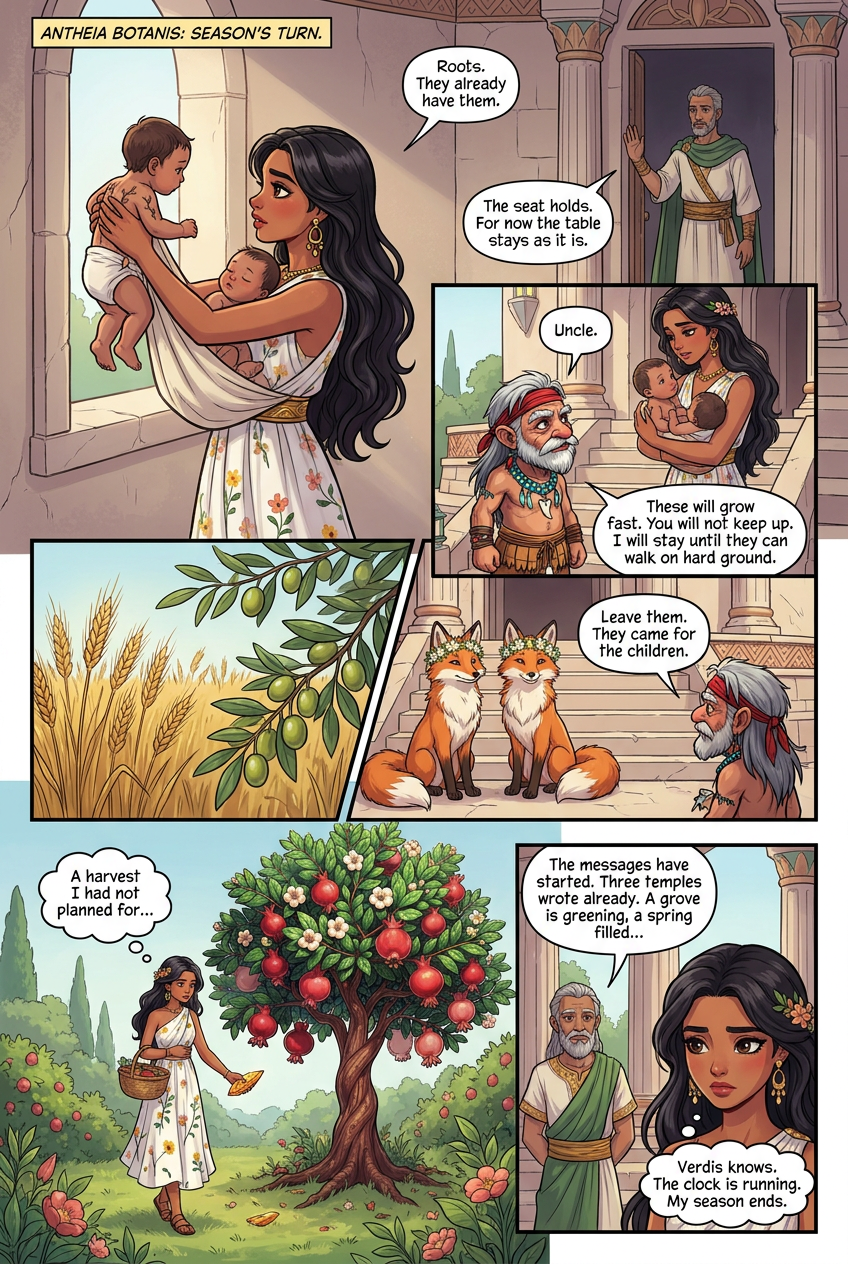
The season turned before Antheia expected it. She had gone to the hilltop temple to rest one afternoon and did not leave for three days. The twins came at dawn on the third day, a boy and a girl, both small, both quiet. Roswell caught them in cloth. Verdis stood at the door and did not enter. When Antheia lifted the babies to the window light, she saw the marks on their backs: two vine shapes, each a mirror of the other, drawn in fine dark lines across the shoulder blades. Roswell touched one mark with his thumb and drew his hand back. "Roots," he said. "They already have them." Verdis crossed the threshold then. She looked at each child in turn and set a hand on the boy's foot. The foot did not blacken. She lifted her hand. "The seat holds," she said. "For now the table stays as it is." She left before noon. Antheia sent for a teacher. Not a Greek one. She wrote to her homeland and asked for the old medicine man who had taught her grandmother to read the ground. He came within the week, small and gray, a knife of shell at his throat. "Uncle," she said, and he nodded once. He looked at the twins and at the marks and said, "These will grow fast. You will not keep up. I will stay until they can walk on hard ground." He did not ask for a room. He slept on the temple step. The fields answered the twins before the twins could speak. Wheat that had come up thin thickened in a night. The olive rows below the ridge set fruit out of season. A pair of red foxes wandered up from the low country wearing jasmine at their necks, sat at the temple stair, and would not be chased off. Uncle Jaguar watched them and said, "Leave them. They came for the children." Antheia left them. On the seventh day she walked the mountaintop garden with a basket. The pomegranate she had planted at the center in her first week as goddess stood twice its height. Fruit hung heavy on every branch, split and red. Blossoms opened on the same wood as the fruit. She cut one pomegranate and it bled clean juice. Beside it, on the ground, she found a piece of honeycomb turned to amber, hard as glass, dropped by one of Zeus's bees. She put it in the basket. Roswell met her at the gate. "The messages have started," he said. Three temples had written already. A grove near the coast was greening again. A dry spring had filled. A village wanted to know what god to thank. Antheia set the basket down. The twins had brought a harvest she had not planned for, and every field for a day's walk would know it by morning. Verdis would know it too. The clock Verdis had set was running now, and the season Antheia had asked for was spending itself in a week.
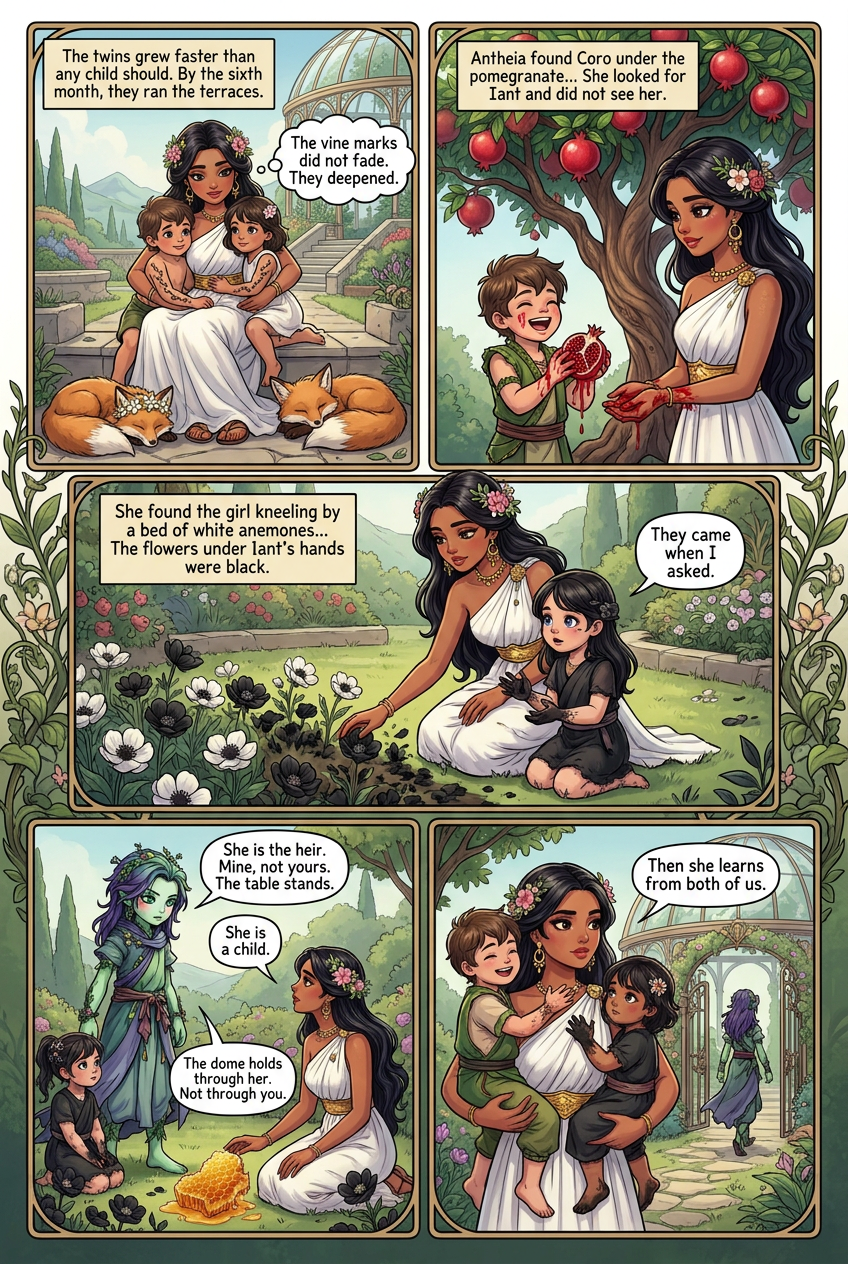
The twins grew faster than any child should. By the end of the first month they crawled. By the third they walked. By the sixth they ran the terraces of the mountaintop garden barefoot, and the grass bent up behind them where their feet had pressed it flat. Antheia counted seasons on one hand. Uncle stayed on the temple step and watched. Roswell kept the roots of the pomegranate at the center trimmed back so the tree would not swallow the paths. She named the girl Iant and the boy Coro. The vine marks on their backs did not fade. They deepened. Antheia checked them each bath, one against the other, and saw the mirror hold. Both marks lived. Both children fed the fields for a day's walk. The foxes with jasmine at their throats followed them room to room and slept across their doorways at night. On the morning of the first true summer, Antheia found Coro under the pomegranate with his hands full of fruit and blossom together. He laughed and gave her a split pomegranate. The juice ran red down her wrist. She looked for Iant and did not see her. She found the girl in the lower row of the garden, kneeling by a bed of white anemones. The flowers under Iant's hands were black. Not dying. Black the way the sacred groves had gone black. Iant looked up. Her eyes were clear. She had not cried. She lifted a handful of the black petals and let them fall. "They came when I asked," she said. Antheia knelt. She touched one petal. It held. It did not spread. The girl had called the rot and stopped it at the bed's edge. Verdis was already at the gate. Antheia had not sent for them. Verdis crossed the path in three steps and stood over the black bed and did not kneel. They looked at Iant a long time. Then at Antheia. "There it is," Verdis said. "The other half." Antheia stood. "She is a child." "She is the heir," Verdis said. "Mine, not yours. The table stands." Verdis reached into a fold of their sash and set a piece of amber honeycomb on the ground beside the black flowers. Light and dark. Balanced. "The dome holds through her," Verdis said. "Not through you." Antheia understood then what she had made. Two children. One green. One black. The balance she and Verdis had built on the pedestal now walked on two small pairs of feet, and one of those pairs would answer to Verdis, not to her. The garden would live. The groves would keep healing. But the seat had split. She lifted Iant onto her hip. The girl put her black-stained hand against Antheia's neck. Coro ran up with the pomegranate. Antheia held both children and did not look at Verdis again. "Then she learns from both of us," she said. Verdis nodded once and left through the gate.
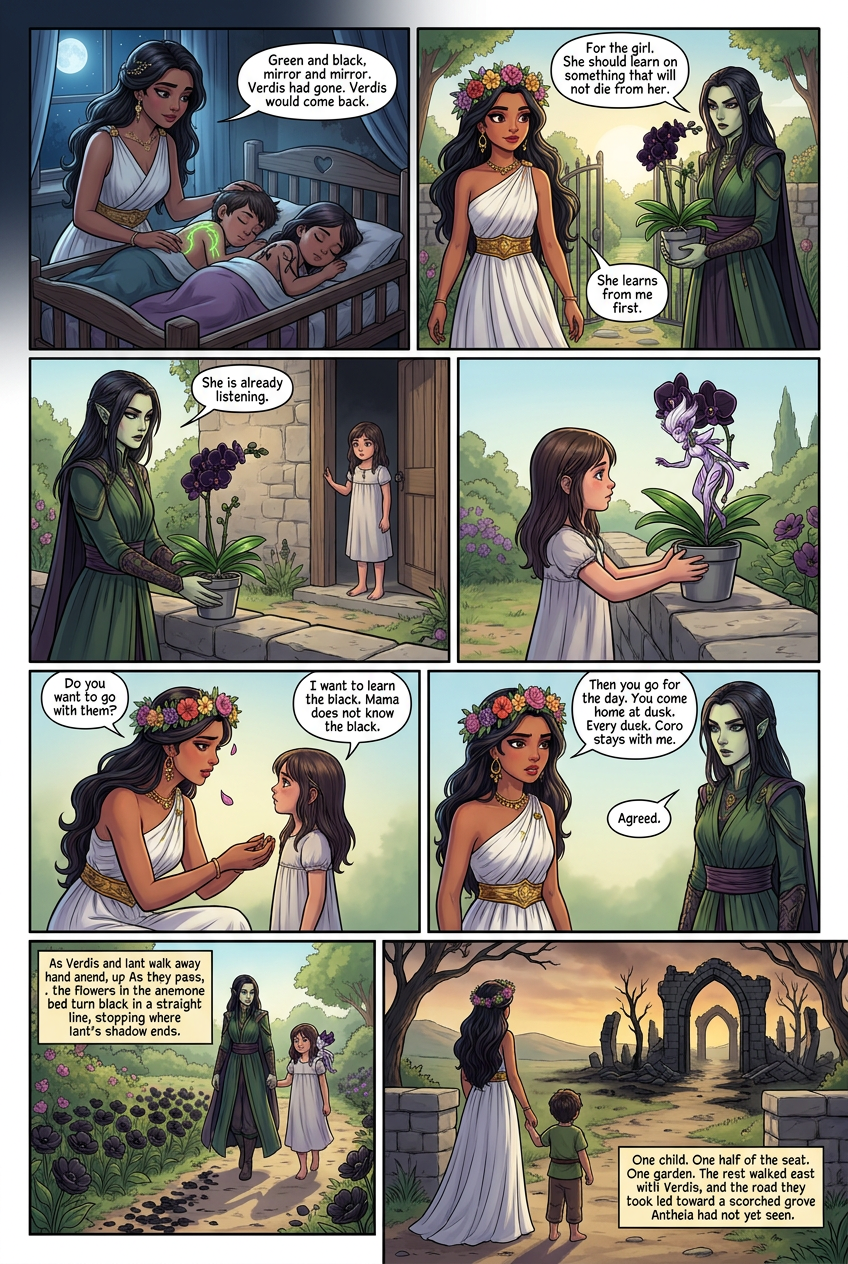
Antheia held Iant on her hip until the girl slept. She laid her in the cot beside Coro and stood over both children. Coro's vine mark rose and fell with his breath. Iant's mark was darker now, the leaves inked deep against her skin. Antheia set a hand on each small back and felt the two currents run under her palms, green and black, mirror and mirror. Verdis had gone. Verdis would come back. At dawn Verdis came through the gate with a pot in their hands. Inside the pot sat an orchid with petals the color of a moonless sky. Verdis set the pot on the low wall by the anemone bed. "For the girl," Verdis said. "She should learn on something that will not die from her." Antheia stepped between the wall and the house. "She learns from me first." Verdis looked past her at the doorway where Iant stood barefoot in her nightshift. "She is already listening." Iant walked out to the wall. She put one hand on the pot. The dark petals lifted toward her palm. A shimmer moved along the leaves, and a small figure uncurled from between the blooms, no taller than Antheia's hand. An orchid nymph, pale-limbed, marked with purple stripes. The nymph bowed to Iant. Not to Antheia. Not to Verdis. To the child. "That is not a gift," Antheia said. "That is a claim." Verdis did not answer. Antheia knew the shape of it then. Verdis had not come to teach. Verdis had come to take. The heir, the nymph, the bond, the rest of the balance Antheia had thought she still held. Verdis meant to gather it into their own hand while Antheia stood watching. Antheia knelt at Iant's level. "Do you want to go with them?" she asked. Iant looked at the nymph. Iant looked at Verdis. Iant looked at Antheia. "I want to learn the black," the girl said. "Mama does not know the black." The words landed flat and true. Antheia's crown lost one petal at her feet. She stood. She did not lift Iant this time. "Then you go for the day," she said. "You come home at dusk. Every dusk. Coro stays with me." Verdis inclined their head once. "Agreed." They lifted Iant by the hand. The nymph climbed to the girl's shoulder. They walked out through the gate together, and the anemones along the path went black in a clean line and stopped where Iant's shadow ended. Antheia stayed at the wall until the gate closed. Coro came out and pushed his hand into hers. She looked down at her son and counted what she still held. One child. One half of the seat. One garden. The rest walked east with Verdis, and the road they took led toward a scorched grove Antheia had not yet seen.
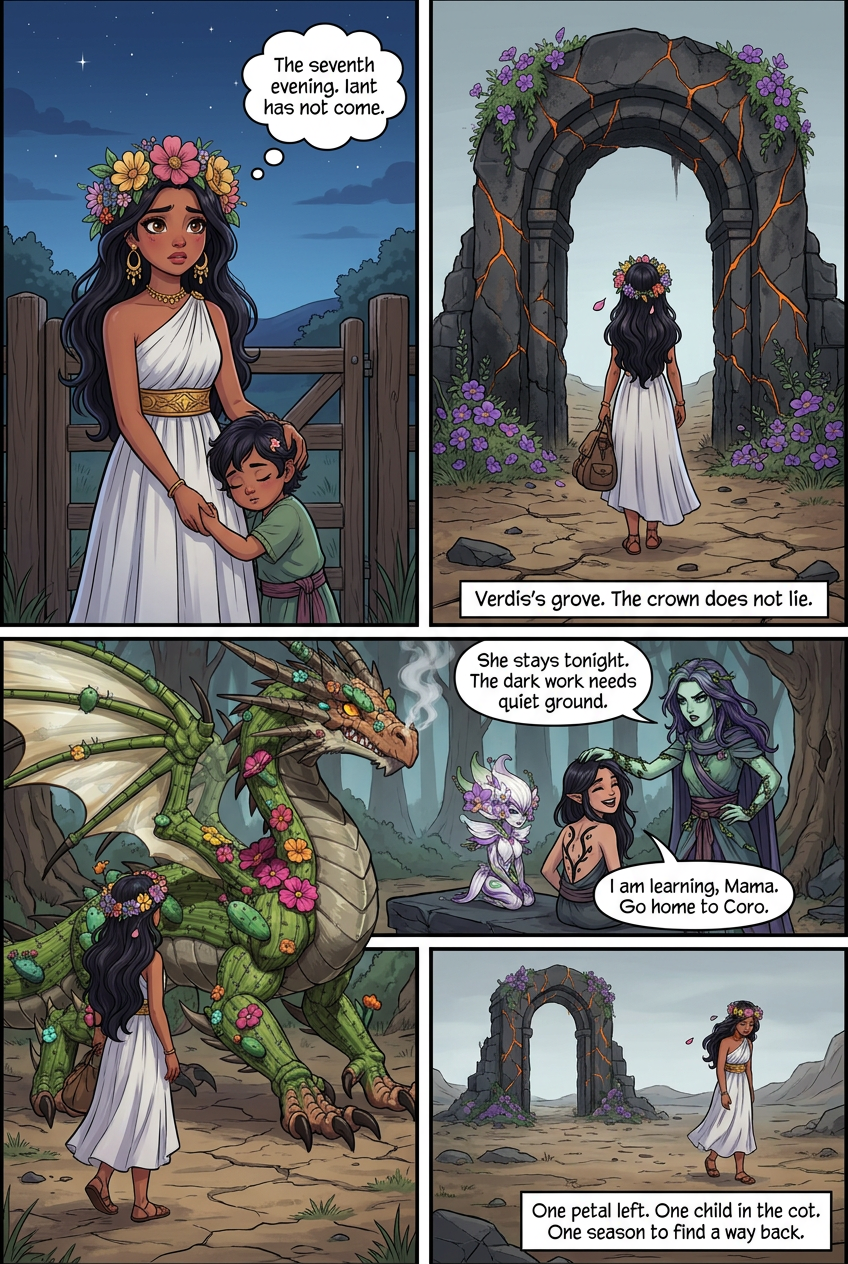
Antheia held Coro's hand at the gate every dusk for six evenings, and every dusk Iant walked back through it with the orchid nymph on her shoulder. On the seventh evening the girl did not come. Antheia waited until the stars showed. She waited until Coro fell asleep against her leg. Then she carried him inside, laid him in the cot, and packed a satchel with water, bread, and one clean cutting. She followed the black line east. The anemones had died in a narrow track along the road Verdis took, and the track held. It led her over dry hills and down into a valley she had not walked before. At the valley's mouth stood a burnt arch of stone and wood, veined with slow fire. Scorched trunks braced the walls. Purple flowers grew from the cracks. This was Verdis's home ground, the grove they had kept for three hundred years. Antheia stopped at the arch. Her crown pulled tight on her head. Two petals shook loose and fell inside the grove, past the threshold, out of her reach. The crown did not lie. Iant was in there, and the ground beyond the arch belonged to Verdis. A shape moved between the trunks. Not Verdis. A dragon the size of a horse, ribbed with cactus plates, flowers open along its flanks, spines bristled at the joints. It set one clawed foot on the stone and watched her. Behind it, deeper in, Antheia saw Iant sitting cross-legged on a black slab. The nymph knelt at the girl's ear. Verdis stood over both, one hand on the child's hair. Iant was laughing. "She stays tonight," Verdis said. Their voice carried without effort. "She stays every night now. The dark work needs quiet ground. Your garden is too bright for it." Antheia stepped forward. The dragon lowered its head and breathed out. The air went hot. Her wings folded flat against her back on their own. She looked past the beast at her daughter. The twin vine mark on Iant's back showed through the thin shift, and the leaves along its curve had gone from green to black ink. The mirror on Coro's back was still green. Antheia understood then. The bargain she had made at the gate, day only, home by dusk, had been a bargain Verdis meant to break the moment the girl was ready. The girl was ready. "Iant," Antheia said. The child looked up. The child did not stand. "I am learning, Mama," Iant said. "Go home to Coro." Antheia turned and walked back through the arch. She did not run. She did not weep until the black track ended under her feet and the living road began. She had lost the daughter to the grove. One petal left on her crown. One child in the cot. One season, at most, to find a way to take Iant back before the black on the girl's spine reached her heart.
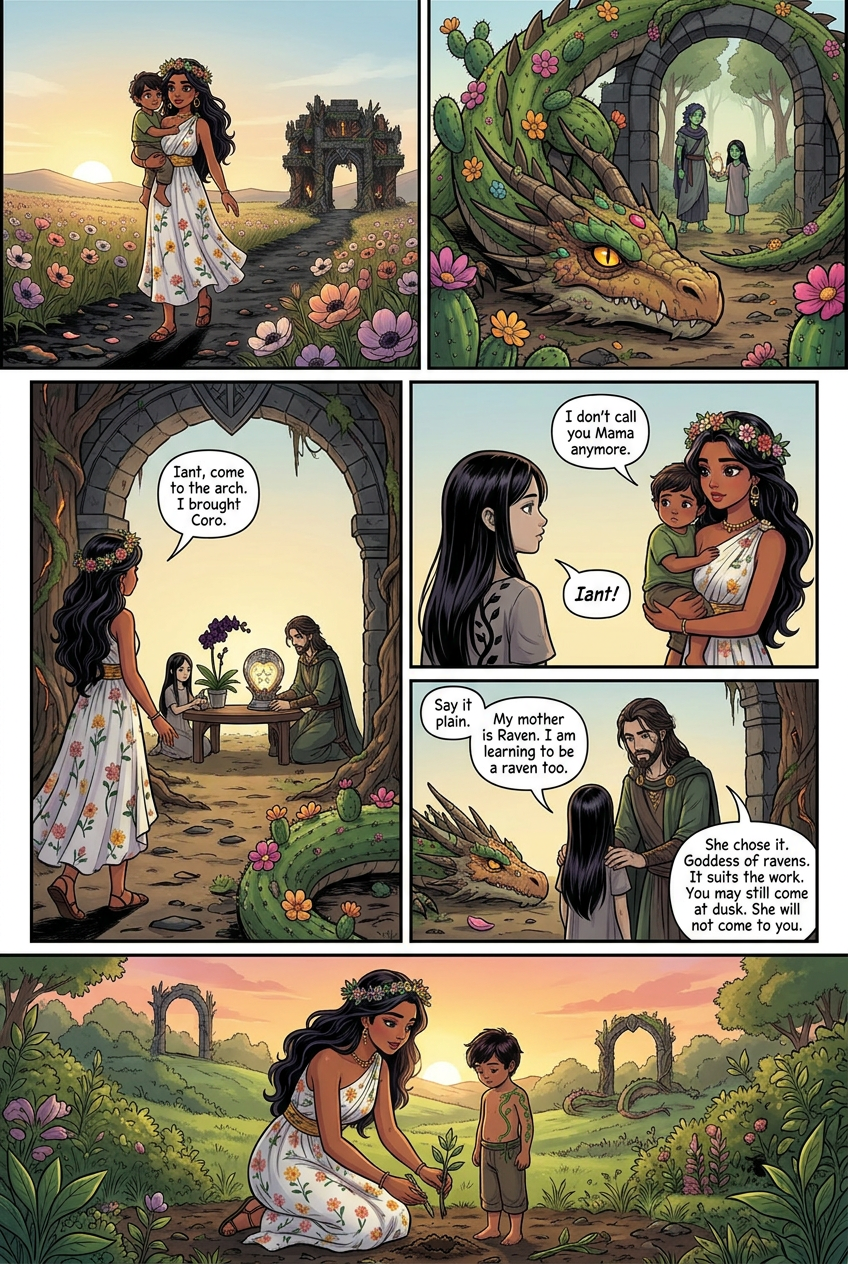
Antheia went back to the arch at first light with Coro on her hip and one clean cutting in her satchel. She meant to call Iant home by name. She meant to remind the girl of the cot, the milk cup, the brother who slept with his hand on her back. She walked the black track until the anemones ended and the burnt stones began. She stopped at the threshold. She would not step across. The cactus dragon lay across the arch this morning, coiled like a dog on a doorstep. Flowers opened along its ribs. It watched her with one yellow eye and did not move. Beyond it, in the grove, Verdis knelt beside Iant at a low table. A dark orchid stood in a plain pot between them. A small lamp shaped like a bulb sat next to the pot, lit from inside with soft gold, stars cut through its shell. The orchid nymph held the lamp steady while Verdis spoke. "Iant," Antheia called. "Come to the arch. I brought Coro." The girl looked up. Her face was calm. The black vine on her back showed dark through the shift. She stood, walked halfway to the arch, and stopped out of reach. Coro leaned forward in Antheia's arms and said his sister's name. Iant did not answer him. She looked at Antheia and said, "I don't call you Mama anymore." Verdis rose behind her and set a hand on the child's shoulder. "Say it plain," Verdis said. Iant said, "My mother is Raven. I am learning to be a raven too." Antheia felt the last petal on her crown lift and fall. It landed inside the arch, beyond the dragon's tail, on Verdis's ground. The crown sat bare on her head. She did not reach for the petal. She looked at Verdis and understood the new name for what it was. Not a joke. Not a game. A claim, spoken in front of the child until the child said it back. "You took her name too," Antheia said. "She chose it," Verdis said. "Goddess of ravens. It suits the work." Verdis did not smile. "You may still come at dusk. She will not come to you." Antheia carried Coro back down the black track. She did not weep this time. At the edge of her own garden she set the boy down and knelt beside him. The green vine on his back moved under her palm, warm and whole. One child left. No petals. A daughter who answered to another mother's name. She opened her satchel, took out the cutting, and pressed it into the living soil. It would root here or it would not. She had a season to build a garden loud enough to call a raven home.
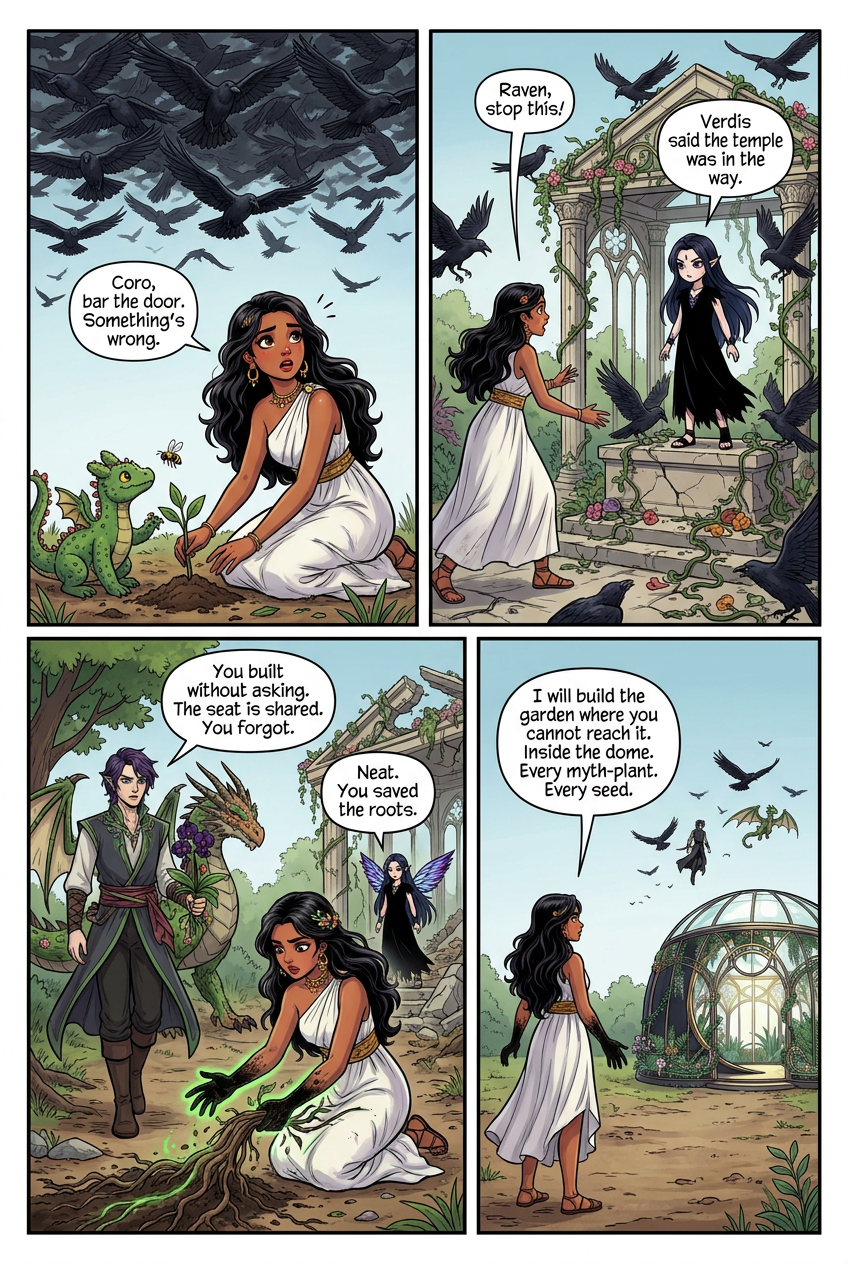
Antheia set the cutting in the soil and stood up. Coro reached for a bee on a low bloom. Then a shadow crossed the beds. She looked up. Ravens poured over the ridge in a black line, too many to count. They flew west toward the small flower temple she had raised at the edge of her land, a stone circle where villagers left offerings of milk and seed. Her twin's black vine mark was in that flock. She felt it the way she felt her own pulse. She carried Coro to the door and set him inside with the orchid nymph who tended the pots. "Bar it," she said. She ran the path to the temple with the bare crown light on her head. Wings passed over her. The sky went dark in patches. She reached the temple as the first birds struck. They tore petals from the offering bowls. They pulled ivy from the columns and dropped it in shreds. A girl stood on the altar stone. Black shift, bare feet, hair loose. The child who used to answer to Iant lifted one hand and the ravens turned as one body. The columns cracked. The stone circle split down the middle. Milk ran into the dirt. "Raven," Antheia said. "Stop this." The girl looked at her without heat. "Verdis said the temple was in the way." Behind her, Verdis stepped out from the tree line with the dark orchid in one hand and the cactus dragon at their heel. Flowers still opened along its ribs while it walked over broken stone. Verdis set the orchid on the split altar. "You built here without asking," they said. "The seat is shared. You forgot." Antheia knelt and pressed both palms to the ground. She did not fight the ravens. She fought for the roots. She pulled every living thread under the temple toward her greenhouse and the half-eclipse dome, drawing sap, seed, and bulb through the soil like water down a channel. The columns fell. The bowls broke. But the ground beneath went quiet and clean. She had moved the life out before the ravens finished the shell. The temple was gone. What it held was not. Verdis watched her work and said nothing for a long moment. Then, "Neat." The girl on the altar tilted her head. "You saved the roots," she said. "Not the walls." Antheia stood. Her hands were black to the wrists. "I will build the garden where you cannot reach it," she said. "Inside the dome. Every myth-plant. Every seed I have. Come home when you are ready." The ravens lifted and flew east. Verdis followed with the child and the dragon. Antheia walked back through the broken circle with dirt drying on her arms. She had lost the temple. She had kept the living things. One season left, and now a place to plant them all at once.
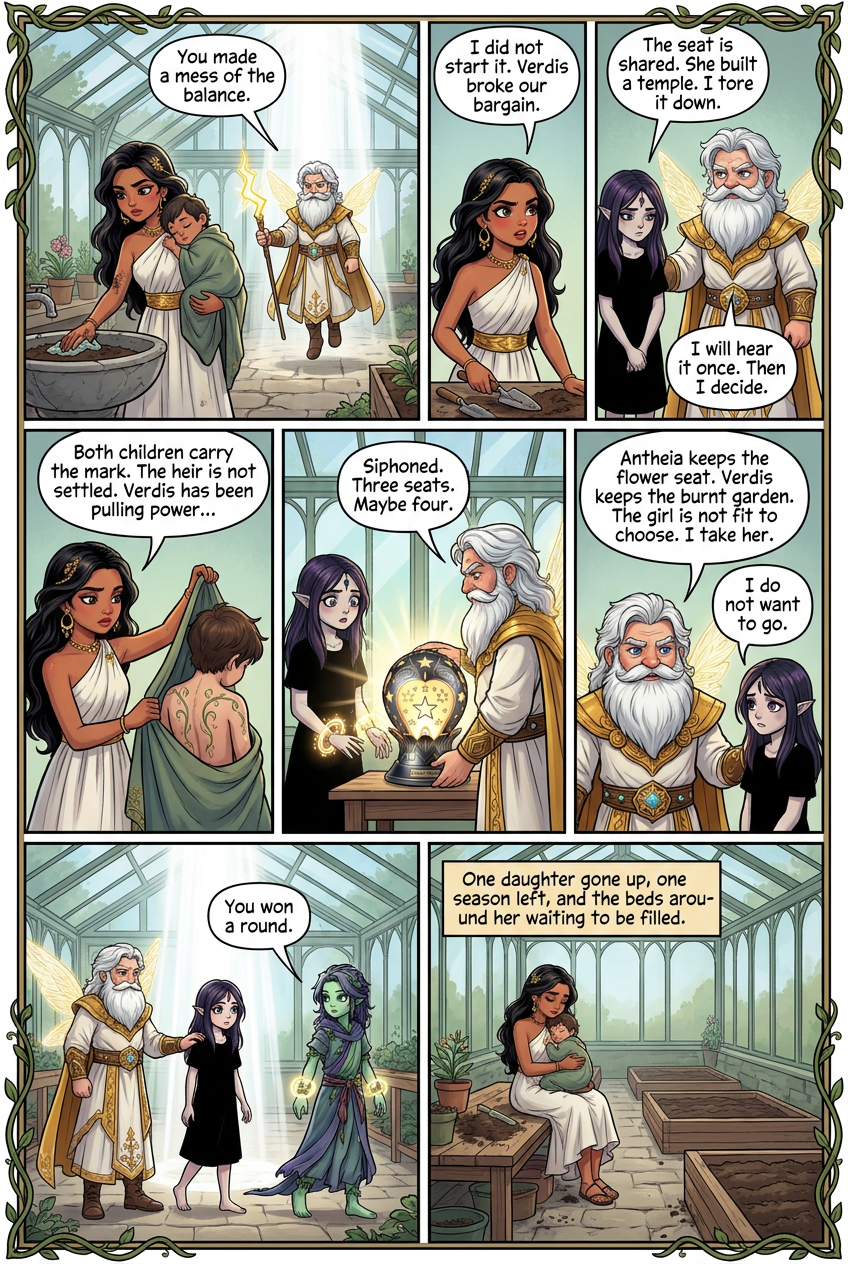
Antheia washed the dirt from her arms at the greenhouse basin. Coro slept against the orchid nymph's shoulder inside the dome. She was pulling the moved roots into fresh beds when the light changed. A white column dropped through the glass roof without breaking it. Zeus stood in the aisle between the seedling rows, his small wings folded flat under his cloak. He had come without warning. "You made a mess of the balance," he said. "Two seats, one blight, one child on the wrong side. I gave you the office. I did not give you a war with your own twin." "I did not start it," Antheia said. She set down the trowel. "Verdis broke our bargain when the girl was ready." Verdis stepped in behind him. The cactus dragon was not with them this time. The child called Raven walked at their hip in the black shift, bare feet on the tile. Raven kept her eyes on the seedlings, not on Antheia. Zeus raised one hand and both goddesses went quiet. "I will hear it once," he said. "Then I decide." Verdis spoke first, flat as always. "The seat is shared. She built a temple. I tore it down. The girl chose me." Antheia lifted the hem of Coro's blanket where he lay and showed the green vine mark curling down his back. "Both children carry the mark," she said. "Not one. The heir is not settled. Verdis has been pulling power from other seats to hold Raven. Check the ledger." Zeus looked at Verdis a long moment. He drew a small bulb from inside his cloak, dark metal with stars cut through it, and set it on the potting bench. Light spilled from the star-shapes and settled on Verdis's hands. The glow ran up their wrists and stopped at the elbows in bright rings. "Siphoned," Zeus said. "Three seats. Maybe four." Verdis said nothing. Raven's mouth opened once and closed. "Here is the ruling," Zeus said. "Antheia keeps the flower seat clean. Verdis keeps the burnt garden and nothing more until the ledger balances. The girl is not fit to choose while the mark is still moving. I take her to the heavens for training. Real training. She comes back when she is her own." Raven's chin came up. "I do not want to go," she said. Zeus looked down at her. "I did not ask." He put one hand on the child's shoulder. The column of light rose again through the glass. Raven went with it. Verdis stood in the aisle with the bright rings still on their arms. "You won a round," they said, and walked out. Antheia sat down on the bench. Coro breathed against the nymph's shoulder. One daughter gone up, one season left, and the beds around her waiting to be filled.
Play your story to life
Storycraft is a mobile game where you create AI characters, craft items and locations to build their world, then discover what direction your story takes. Download the iOS game for free today!
Download for free