

Arista Wildheart's Arc
3 Chapters
Arista Wildheart's dream is cultivating the legendary moonbloom mushroom said to grant a witch communion with the old gods of the Hollow..

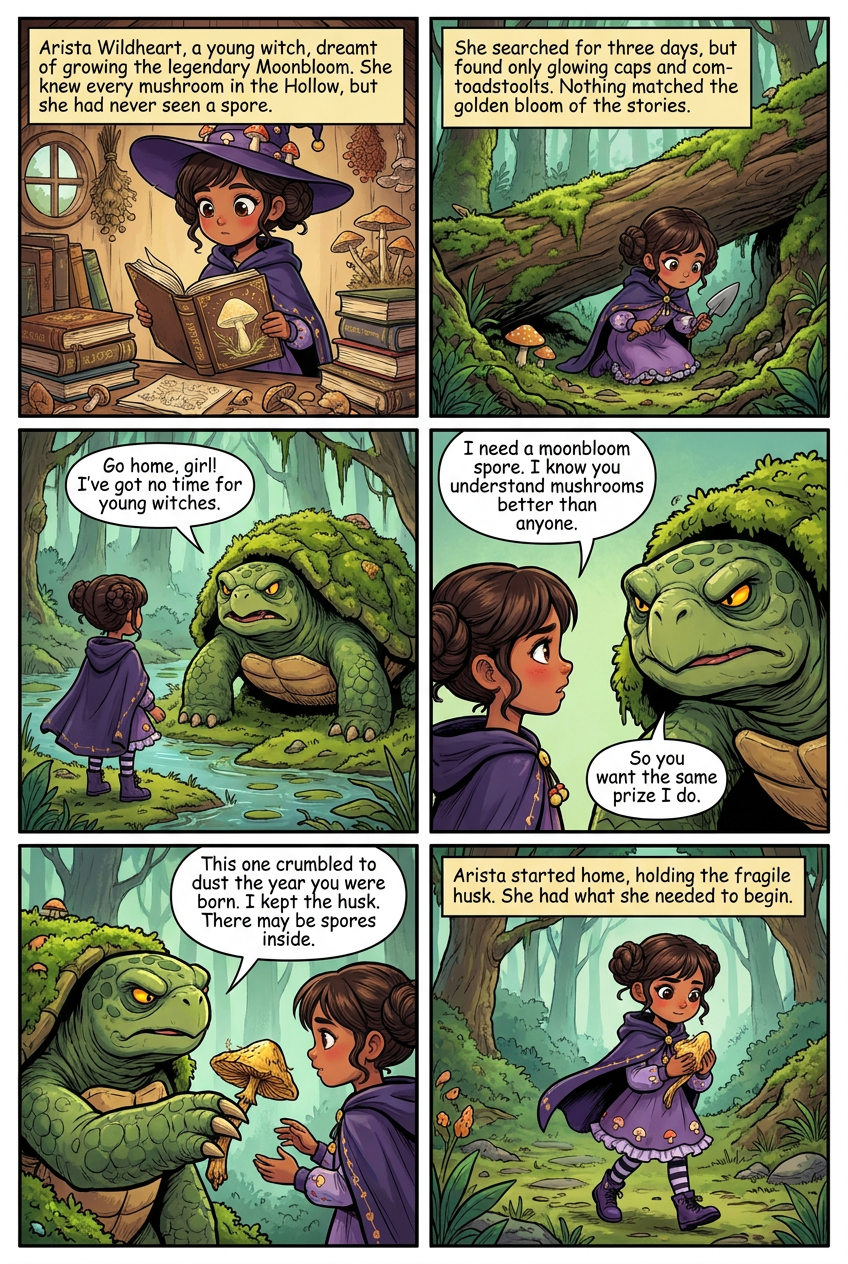
Arista Wildheart wanted to grow a mushroom that no witch had grown in fifty years. The moonbloom, the old stories said, could open a door to the gods of the Hollow. She had studied every page in her cottage, dried every kind of cap on her shelves, and coaxed strange fungi from rot and shadow. But she had one problem she could not solve. She had never seen a moonbloom seed. She had never even seen a spore. Without one, all her skill was worthless. She searched the woods for three days. She turned over logs and split old stumps. She found glowing caps and blue toadstools, but nothing that matched the golden bloom in the stories. On the fourth morning, she stopped searching alone. She went to find the one creature who might know. Grizzleshell was a turtle older than the willows. Mushrooms grew across his massive shell in every color, a living garden he had gathered over centuries. Witches said he collected every mushroom that mattered. Arista also knew he wanted a moonbloom as badly as she did. He might help her. He might race her to the spores instead. She found him half-buried in moss, chewing a fern. "Go home, girl," he grumbled before she spoke. "I've got no time for young witches and their questions." "I need a moonbloom spore," Arista said. "Just one. I know you understand mushrooms better than anyone alive." Grizzleshell's yellow eyes narrowed. "So you want the same prize I do. And you expect me to hand you the map." "I'm not asking for the moonbloom," she said. "Only where to begin. I can grow it. You can't. Look at your shell. Every cap but that one." The turtle went quiet. His slow breath stirred the moss. Arista saw the truth land on him. He had gathered mushrooms for hundreds of years, and the one he craved had always slipped away. "You'd share it," he said at last. "If I helped you grow it." "Half of every spore it makes," Arista said. "My word." Grizzleshell studied her a long moment. Then he shifted his heavy body. Behind him, half-hidden in the dirt, sat a dried mushroom she had never seen. Its cap was pale gold, thin as paper, marked with tiny crescent shapes. "A moonbloom drops its spores once each generation," he said. "This one crumbled to dust the year you were born. I kept the husk." He nudged it toward her with one clawed foot. "There may be spores inside. There may be nothing. I never dared try." Arista lifted the husk with shaking hands. It weighed almost nothing. Somewhere inside its brittle folds might sleep the only moonbloom spores in the Hollow. Or only dust. "If you fail," Grizzleshell said, "there won't be another for a generation." Arista held the husk to her chest and started home. She had what she needed to begin. Now she had to open it without destroying it.
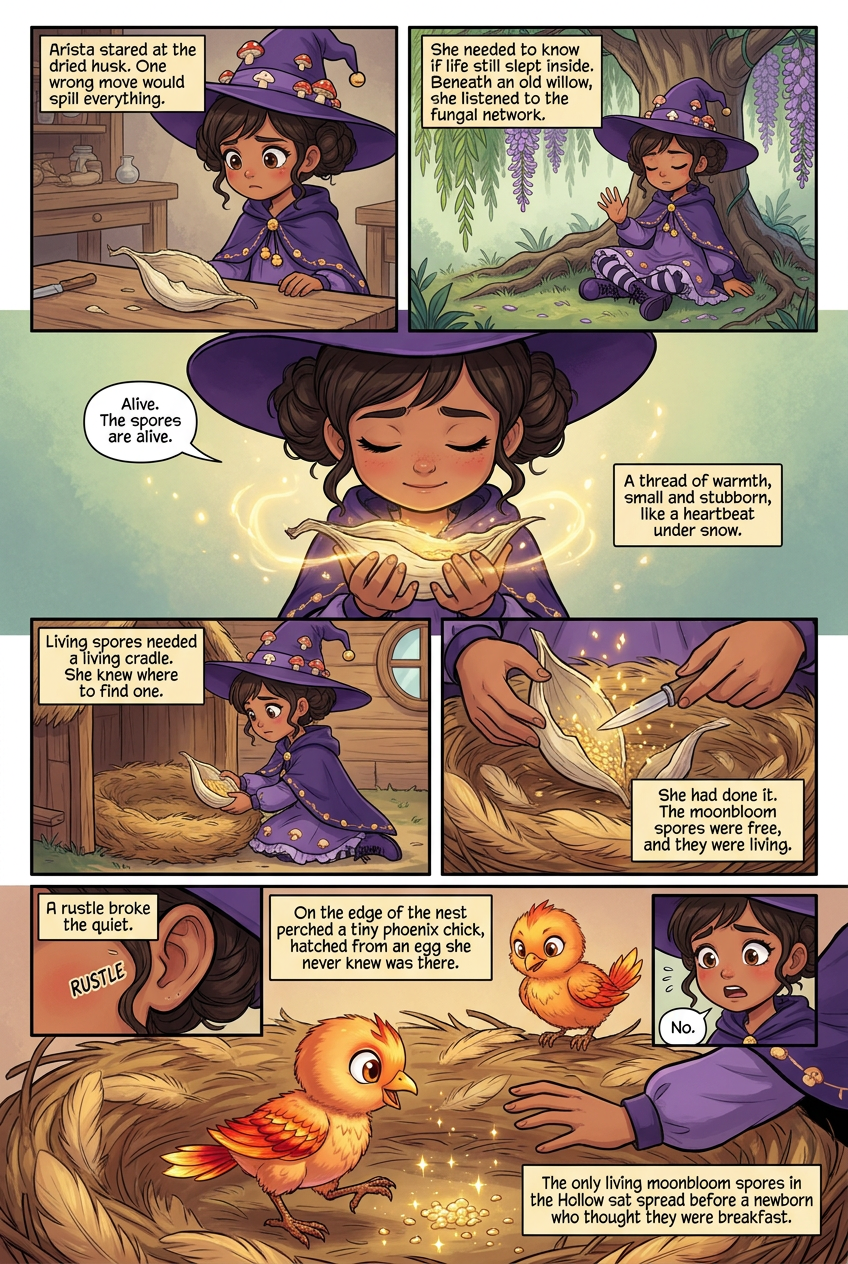
Arista set the dried husk on her workbench and stared at it. One wrong move would spill everything. If the spores inside had turned to dust, cracking the husk would scatter her only chance to the wind. She needed to know if life still slept inside before she opened it. But the husk gave no sign. It sat pale and silent, thin as a dead leaf. She carried it outside to think. Near her cottage stood an old willow, its long fronds trailing over curling wisteria. She sat beneath it and pressed her palm to the ground. This was her gift. Fungi threaded the soil in a vast living web, and she could feel it. She reached down through the roots and the damp earth, searching for the faint hum that meant life. Then she understood. She didn't need to open the husk to test it. She could listen to it the way she listened to the network. Living spores would answer. Dust would stay quiet. Arista cupped the husk in both hands and closed her eyes. She let her magic flow into the brittle folds, gentle as breath. For a long moment she felt nothing. Her chest tightened. Then, deep inside the papery cap, something stirred. A thread of warmth, small and stubborn, like a heartbeat under snow. Alive. The spores were alive. Her hands shook. She could open the husk now with confidence. But warmth without care would still kill them. Living spores needed a living cradle, warm and safe, the moment they touched the air. She knew where to find one. Behind her cottage sat a small thatched shed. Inside rested a woven nest of twigs and soft feathers, shaped to hold a young phoenix. It was empty and warm, built for something newborn and fragile. It would serve. Arista laid a clean cloth in the nest and set the husk in its center. With a thin blade she scored the cap along one crescent mark. She peeled it back, slow, holding her breath. Golden dust drifted out. But it did not blow away. It settled into the soft nest and caught the light, alive and glinting, thousands of tiny spores nestled in the feathers. She had done it. The moonbloom spores were free, and they were living. A rustle broke the quiet. Arista turned. On the edge of the nest perched a tiny phoenix chick, downy and orange, hatched from an egg she never knew was there. Its bright eyes fixed on the golden dust. Its small beak opened. "No," Arista breathed. The chick took one hungry step toward the spores. This nest was its cradle, not hers. And now the only living moonbloom spores in the Hollow sat spread before a newborn who thought they were breakfast.
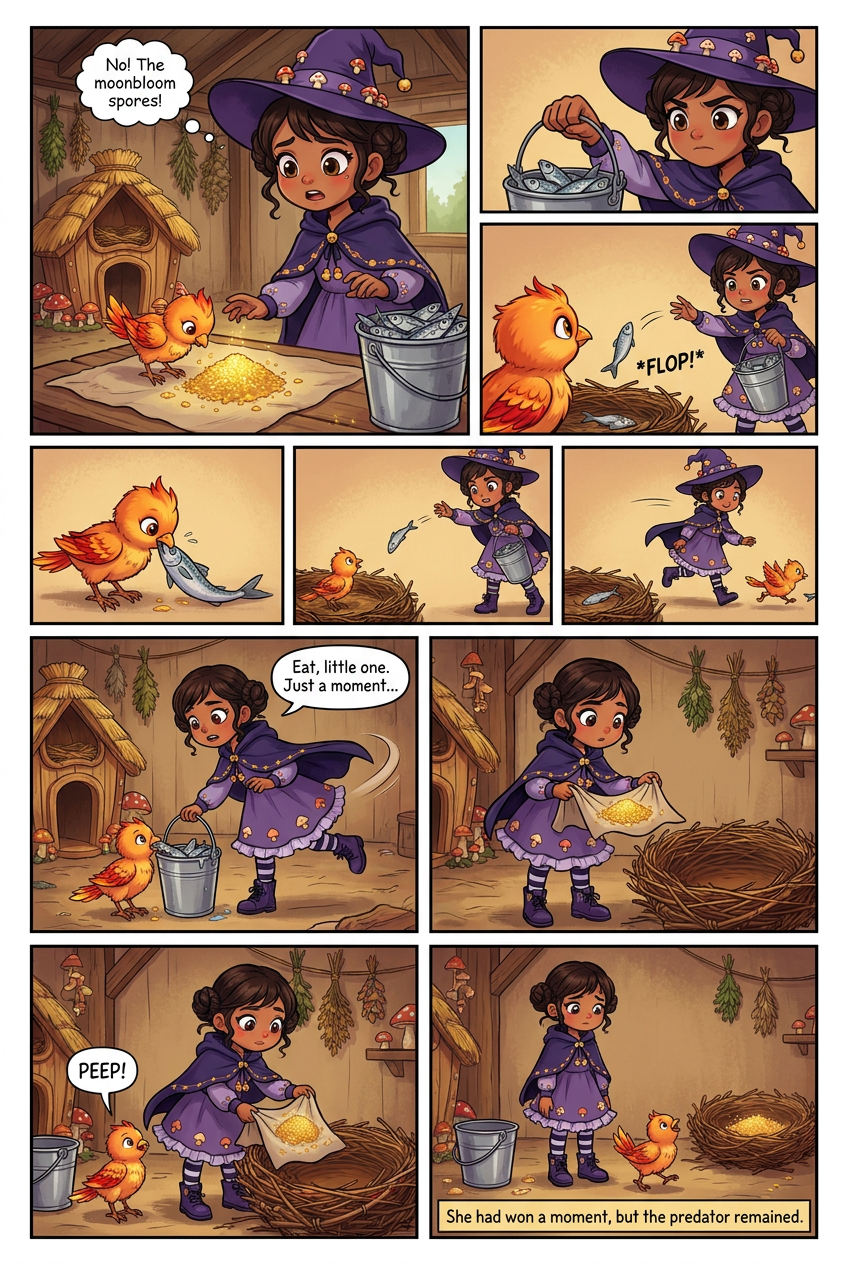
The chick took another step. Its beak hovered over the golden dust. Arista's mind raced. She had no lure, no treat, nothing to pull the hungry bird away from her spores. One more peck and a generation of moonblooms would vanish down a newborn's throat. She scanned the shed. Twigs. Feathers. Bare shelves. Then she remembered the bucket by the door. She kept it for the day the phoenix hatched, brimming with tiny silver fish. She lunged for it, slow enough not to spook the chick, fast enough to matter. Her fingers closed on the handle. The chick's beak dipped toward the spores. Arista pinched a fish and tossed it onto the cloth, just past the golden dust. The chick froze. Its bright eyes swung to the wet, glinting fish. It hopped, ignored the spores, and swallowed the fish whole. Arista breathed again. She tossed a second fish farther from the nest. The chick chased it. A third, farther still. Step by step, she drew the hungry bird across the shed floor, away from the moonbloom dust. Each fish bought her a few feet. When the chick stood a safe distance off, Arista set the bucket down beside it. The chick plunged its beak in and gorged. It forgot the spores entirely. Now she had to move fast. A full chick was a calm chick, but not forever. She needed the spores out of this nest before the bird finished eating. Against the far wall sat the other cradle, the empty one. Woven twigs, soft fibers, a warm hollow shaped for something newborn. She had built it as a spare. It would hold the spores now. Arista lifted the cloth by its four corners, gentle as carrying water. The golden dust pooled in the center, thousands of living spores held in the fold. She carried it across the shed and lowered it into the empty cradle. She smoothed the cloth flat so no spore spilled. The moonblooms were safe. Separated from the phoenix. Cradled and warm. But when she turned back, the bucket lay empty. The chick had eaten every fish. It looked up at her, blinked, and let out a thin, hungry cry. Then it waddled straight toward the new cradle, toward the golden dust, its beak already open. Arista stared at the empty bucket. She had no more fish. The chick would not stop being hungry. It would hunt the spores again in an hour, and the next hour, and the one after that. She had won the spores a home, but she had also fed a predator that now lived beside them. She could not guard the cradle forever. She could not starve the chick. To save the moonblooms, she would have to solve the phoenix itself.
Play your story to life
Storycraft is a mobile game where you create AI characters, craft items and locations to build their world, then discover what direction your story takes. Download the iOS game for free today!
Download for free