

Artemisia Moretti's Arc
7 Chapters
Artemisia Moretti's dream is becoming a master seamstress who can stitch strangers from the future into Valserra, giving them a new life in her time.

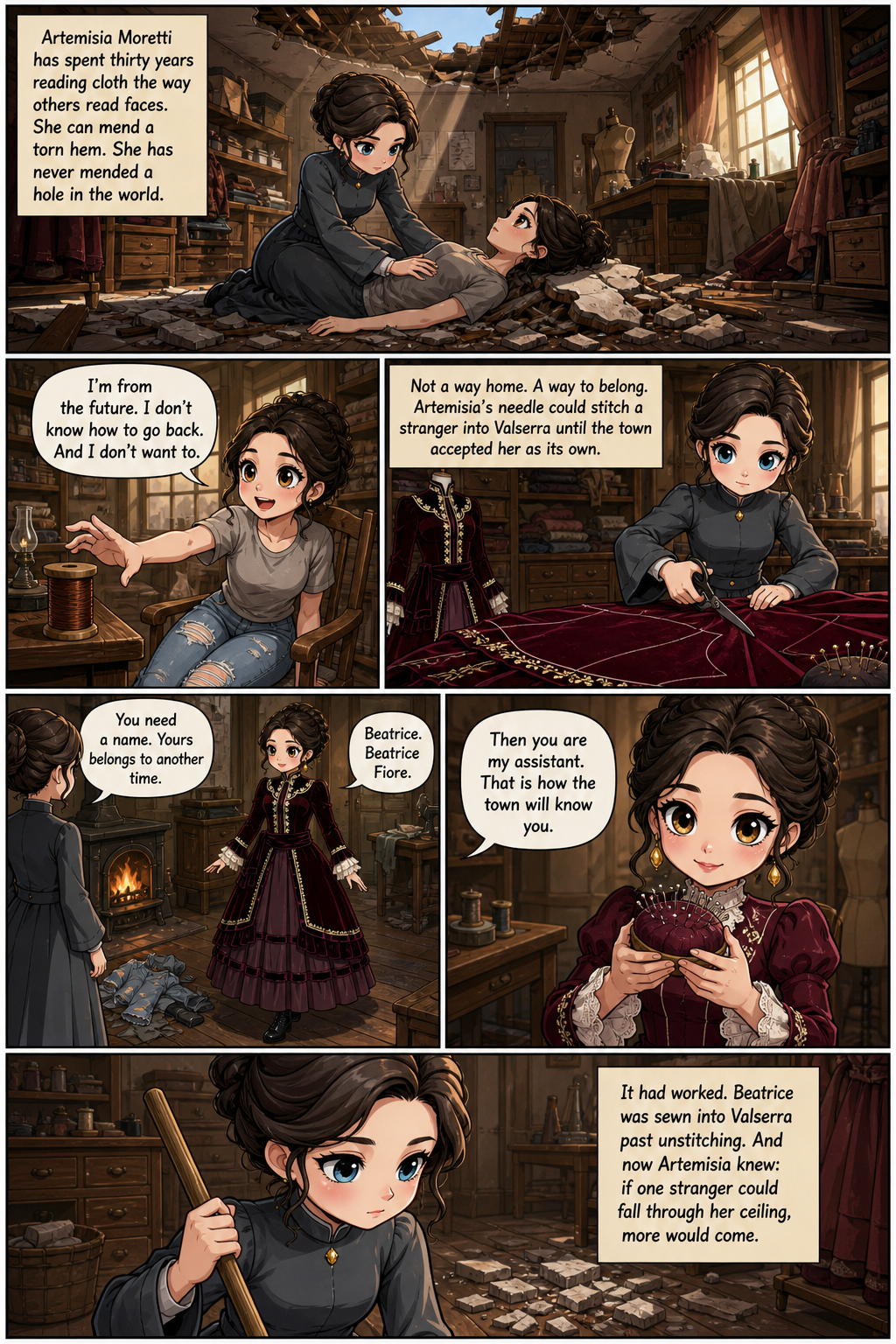
Artemisia Moretti had mended a hundred torn hems, but never a hole in the world. The stranger lay on her workshop floor at dawn, tangled in plaster and broken lath. Above them, the ceiling gaped where the woman had fallen through. Artemisia pressed a hand to the stranger's chest and felt a heartbeat. Then she looked at the clothes. They were wrong. The fabric was thin, machine-woven, printed with tiny letters no loom in Valserra could make. Artemisia had spent thirty years reading cloth the way others read faces. This cloth came from no year she knew. "I'm from the future," the stranger said, sitting up. She did not sound afraid. She sounded thrilled. "1890s. I study this. I've read about your street, your gas lamps. I never thought I'd stand in them." She reached out and touched the wooden thread-spool on the table like it was treasure. Artemisia helped her to a chair. "You cannot walk out there dressed like that. People will stare. They will ask questions you cannot answer." "Then send me back," the stranger said. Her voice caught. "But I don't know how. And I don't want to. I want to stay here." Artemisia understood, then, what the woman needed. Not a way home. A way to belong. And Artemisia's needle could alter more than seams. It could alter a person into this place, stitch a stranger into the weave of Valserra until the town accepted her as its own. She had never tried it on someone from another time. She rose and pulled her finest bolt of cloth from the shelf. Deep burgundy velvet, dark as garnet. She worked through the morning without stopping. She cut the bodice fitted and high-collared. She trimmed the cuffs with cream lace and embroidered small pale flowers down the front. She wound a velvet sash at the waist. With every stitch, she sewed the woman deeper into her own century. The stranger stepped into the finished dress. She stood straighter. The thin, wrong clothes lay in a heap, and Artemisia burned them in the stove. When she turned back, the woman looked like she had been born on this street. "You need a name," Artemisia said. "Yours belongs to another time." The stranger thought. "Beatrice. Beatrice Fiore." "Then you are Beatrice Fiore, and you are my assistant." Artemisia handed her a pincushion. "You will learn the trade. That is how the town will know you." Beatrice pressed the pincushion to her chest and beamed. By afternoon it was done. Beatrice belonged to Valserra now, sewn in past unstitching. But as Artemisia swept the last plaster from the floor, a cold thought settled. She had proven she could do this. If one stranger could fall through her ceiling, more could come. And now she knew exactly how to keep them.
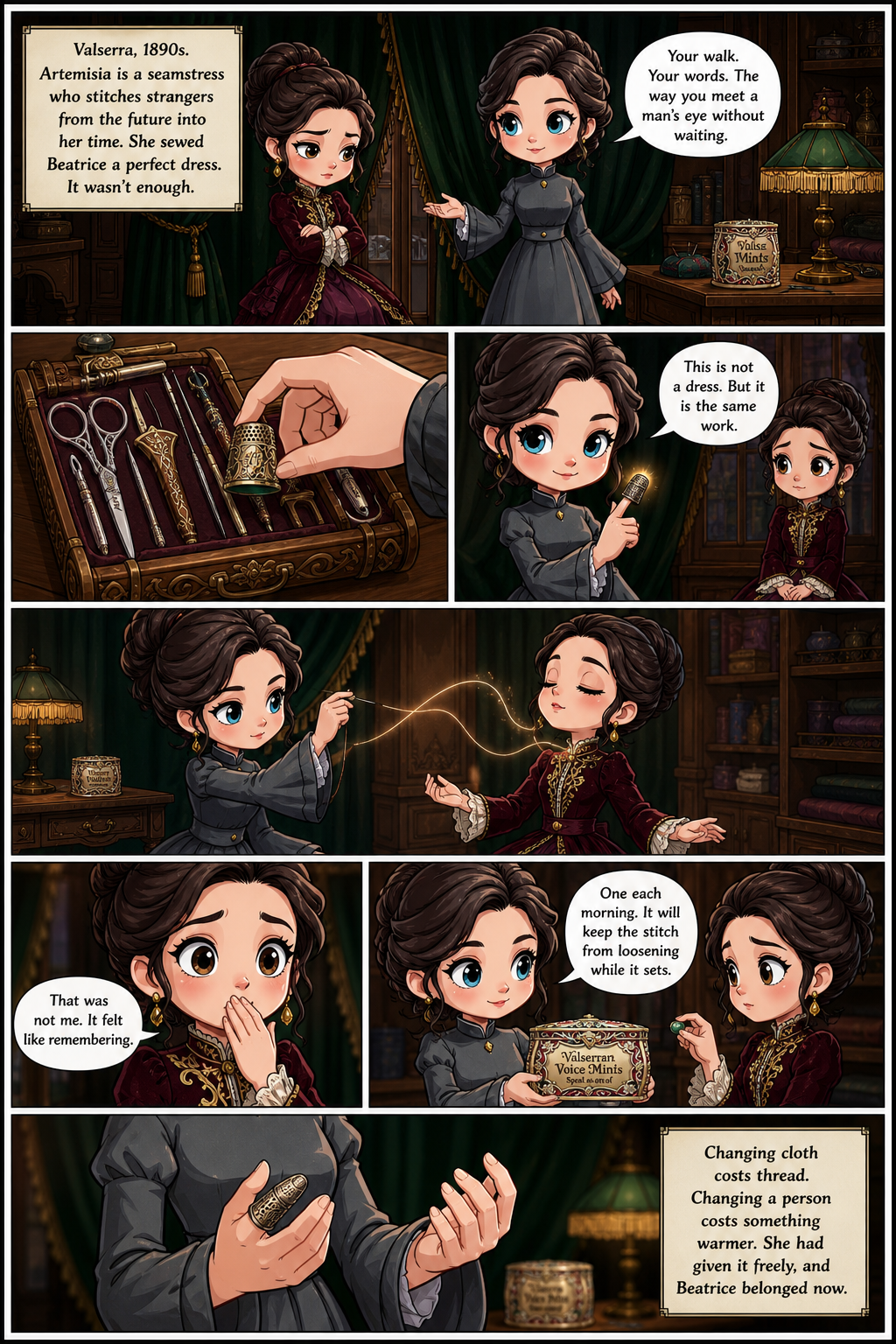
A week after the ceiling swallowed a stranger, Beatrice Fiore looked the part but did not sound it. She wore the burgundy dress well. Then she opened her mouth, and the wrong century fell out. At the market she called a shilling "cheap," swung her arms too wide, and asked the baker how his week was going, plain as a woman from a time not yet born. The baker frowned. Artemisia steered her home and drew the velvet drapes shut behind them. "They stared," Beatrice said. She dropped onto a stool. "I know I did something wrong. I couldn't tell what." "Everything," Artemisia said gently. "Your walk. Your words. The way you meet a man's eye without waiting." She had sewn the dress true. But a person was more than cloth. Habits held a shape too, and Beatrice's shape belonged to another age. Artemisia opened her seam kit on the table. Scissors, awls, a silver hook, and the thimble marked with her initials in fine script. She had altered fabric all her life. Tonight she would try to alter a manner. She slid the thimble onto her finger. It warmed against her skin. "Sit still," she said. "This is not a dress. But it is the same work." She took a needle and threaded it. Then she reached toward Beatrice and stitched the air near her throat, her wrists, the set of her shoulders. With each pass she pictured what she wanted: the measured Valserran voice, the small steps, the eyes that lowered at the proper moment. The thread caught on nothing Artemisia could see, yet it pulled. Beatrice's breath slowed. Her spine straightened on its own. "Speak," Artemisia said. Beatrice's lips moved. The old flat words tried to come. Artemisia pushed the needle once more, and the words changed in the woman's mouth. "Good evening," Beatrice said. The vowels rounded. The rhythm settled into the town's own cadence. She pressed a hand to her lips, startled. "That was not me. That was— it felt like remembering." To hold it, Artemisia offered a small tin of mints from the shelf, the kind sold to lend a speaker Valserra's refined voice. "Take one each morning. It will keep the stitch from loosening while it sets." Beatrice took a mint. When she spoke again, the market woman was gone. In her place sat a soft-voiced seamstress's assistant who had always lived here. Then Artemisia noticed her hands. The thimble had cooled, but her fingers trembled. Changing cloth cost thread. Changing a person had cost something warmer, drawn straight from her. She flexed her hands and felt the tiredness sit deep in the bone. But the cost of fatigue seemed worthwhile for Artemisia. Beatrice belonged now, in word and manner both.
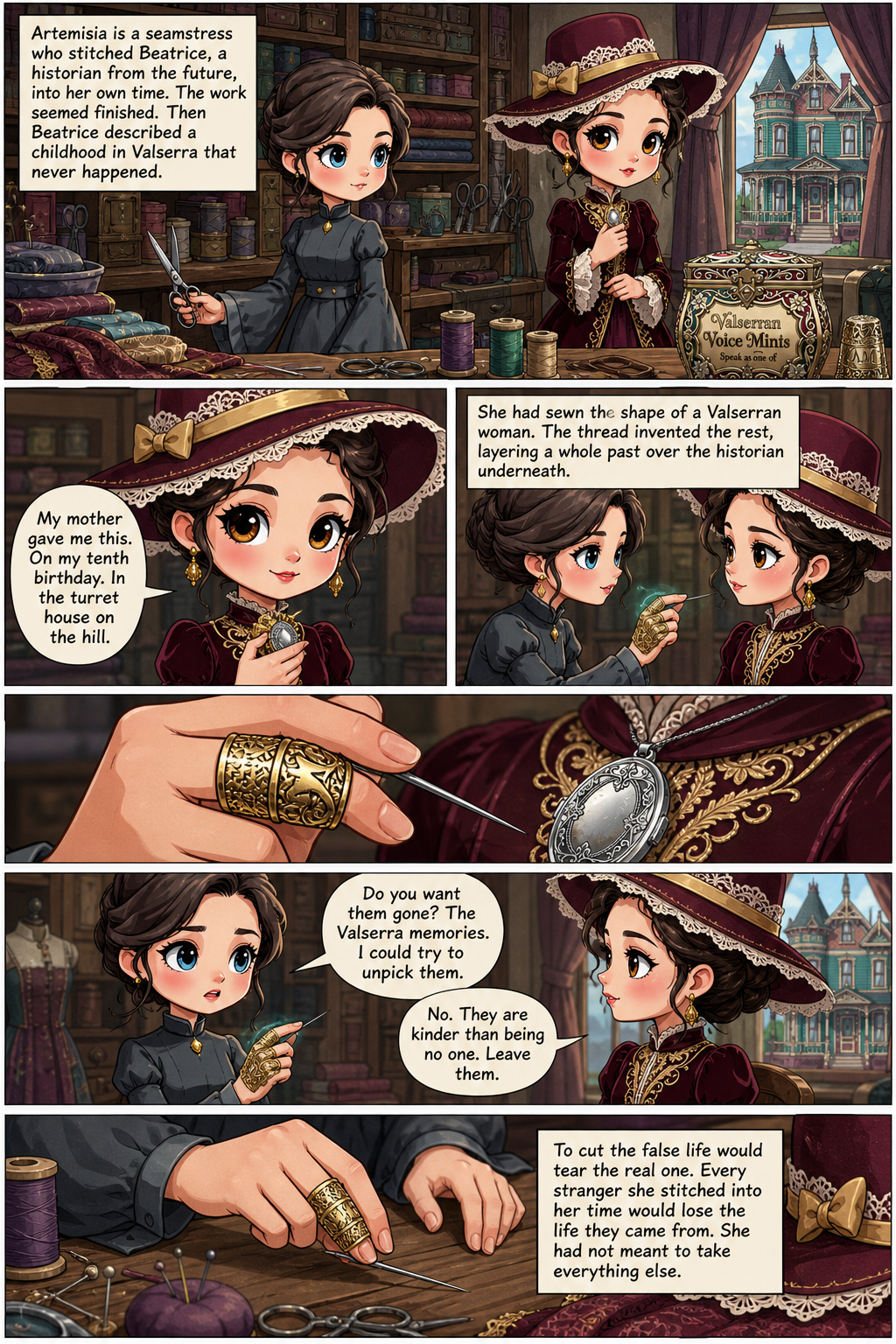
A week after the stitching set, Beatrice moved through the workshop like a woman born to it. She took her mint each morning. Her voice held the town's cadence. Artemisia had begun to believe the work was finished. Then Beatrice mentioned the bakery on the corner where she had bought bread as a girl. Artemisia set down her scissors. "You never bought bread there." "I did." Beatrice frowned, as if the memory surprised her too. "The old woman kept a striped cat. It slept in the window." She touched a silver locket at her throat, one Artemisia had never seen before. "My mother gave me this. On my tenth birthday. In the turret house on the hill." Artemisia's hands went cold. There was no mother. There was no turret house. Beatrice had fallen through her ceiling a fortnight ago from a century not yet born. Yet she spoke of a childhood in Valserra with plain certainty. The stitch had not only changed her manner. It was growing her a past. "Beatrice." Artemisia kept her voice steady. "What did you study, before you came to me?" Beatrice opened her mouth. She stopped. Her eyes lost focus, then found it. "I... wrote papers. Three of them." She said it slowly, like reciting a fading dream. "On this time. On these houses. I had a letter. I meant to send it." She pressed the locket. "But I grew up here. Both are true. I cannot make them stop being true." Artemisia understood then. The magic filled every gap she left open. She had pictured a Valserran woman and sewn that shape onto Beatrice. The shape needed a history, so the thread invented one, thread by thread, until it swallowed the woman underneath. She had to know how deep it ran. She slid on her thimble. It warmed at once. "Hold still. I need to look at the stitch." She threaded her needle and reached toward Beatrice's throat, near the locket. She did not pull. She only followed the seam she had made, feeling where it caught. Under her fingers the false memories lay thick as new cloth, layered over the historian like lining over a coat. She could not tell the two apart. To cut one would tear the other. Her hands trembled before she finished. She lowered the needle. "Do you want them gone?" Artemisia asked. "The Valserra memories. I could try to unpick them." Beatrice was quiet a long moment. "No." She looked down at the locket. "They are kinder than being no one. Leave them." Artemisia nodded and put the needle away. But her stomach turned. The stitch that hid a traveler did more than hide. It rewrote them, and she could not control how much. Every stranger she sewed into her time would lose the life they came from. She had wanted to give them a place here. She had not meant to take everything else.
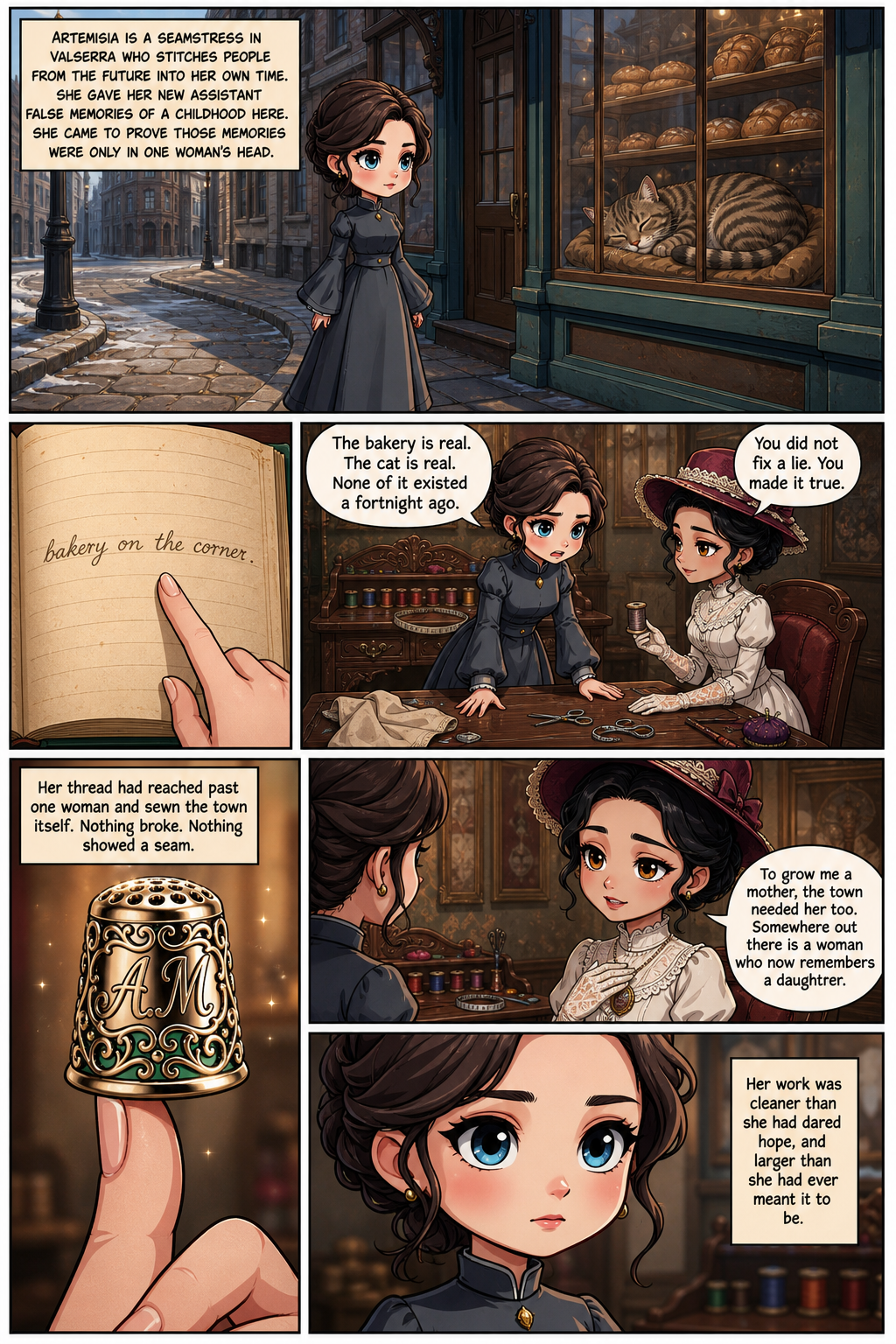
Three days after Beatrice chose to keep her false memories, Artemisia went looking for proof they were only in Beatrice's head. She had written the town's history in the front of an old ledger years ago. She meant to check it against Beatrice's talk of a striped cat and a turret house. She expected to find the memories nowhere but inside one woman's mind. She was wrong. The ledger listed a bakery on the corner. Artemisia had never written that line. The ink was old and faded like her own. She walked to the corner in the morning cold and found the shop standing there. An old woman sold her a loaf. A striped cat slept in the window. The baker said her family had run the place for forty years. Artemisia had passed that corner a thousand times. Until this week it had been an empty lot. Her hands shook worse than any stitch had left them. The memories were not trapped in Beatrice. They were leaking into the world. The thread had reached past one woman and begun to sew the town itself. She hurried back and found Beatrice at the workbench, sorting spools by color. Beatrice wore her burgundy lace hat, though they were indoors. She had taken to wearing it while she worked. "The bakery is real," Artemisia said. "The cat is real. None of it existed a fortnight ago." Beatrice set down a spool. "I know the cat's name. I did not, until now." She did not sound afraid. She sounded like a woman who had solved something. "You did not fix a lie. You made it true." Artemisia sat down hard. She had feared her magic tore lives apart. Now she saw it did the opposite. It did not paper over gaps. It filled them, all the way through, until the story held from the person to the street to the ledger. Nothing broke. Nothing showed a seam. She took her enchanted thimble from the kit and turned it in the light. Her initials caught the sun. For weeks she had touched her tools like a woman handling a knife she did not trust. Now her fear drained out of her. Her work was cleaner than she had ever dared hope. A stranger sewn into Valserra would not merely hide here. They would belong, backward and forward, root and branch. "Then there is nothing to undo," Artemisia said. She almost smiled. "No," Beatrice said. "There is only more to make." She touched the locket at her throat. "But think what it took. To grow me a mother, the town needed her too. Somewhere out there is a woman who now remembers a daughter." Artemisia's smile faded. She had not thought of that. Her stitch did not add a person quietly. It reshaped everyone the new past touched. She had wanted to give strangers a place. She had not counted the strangers her thread would rewrite to make room.
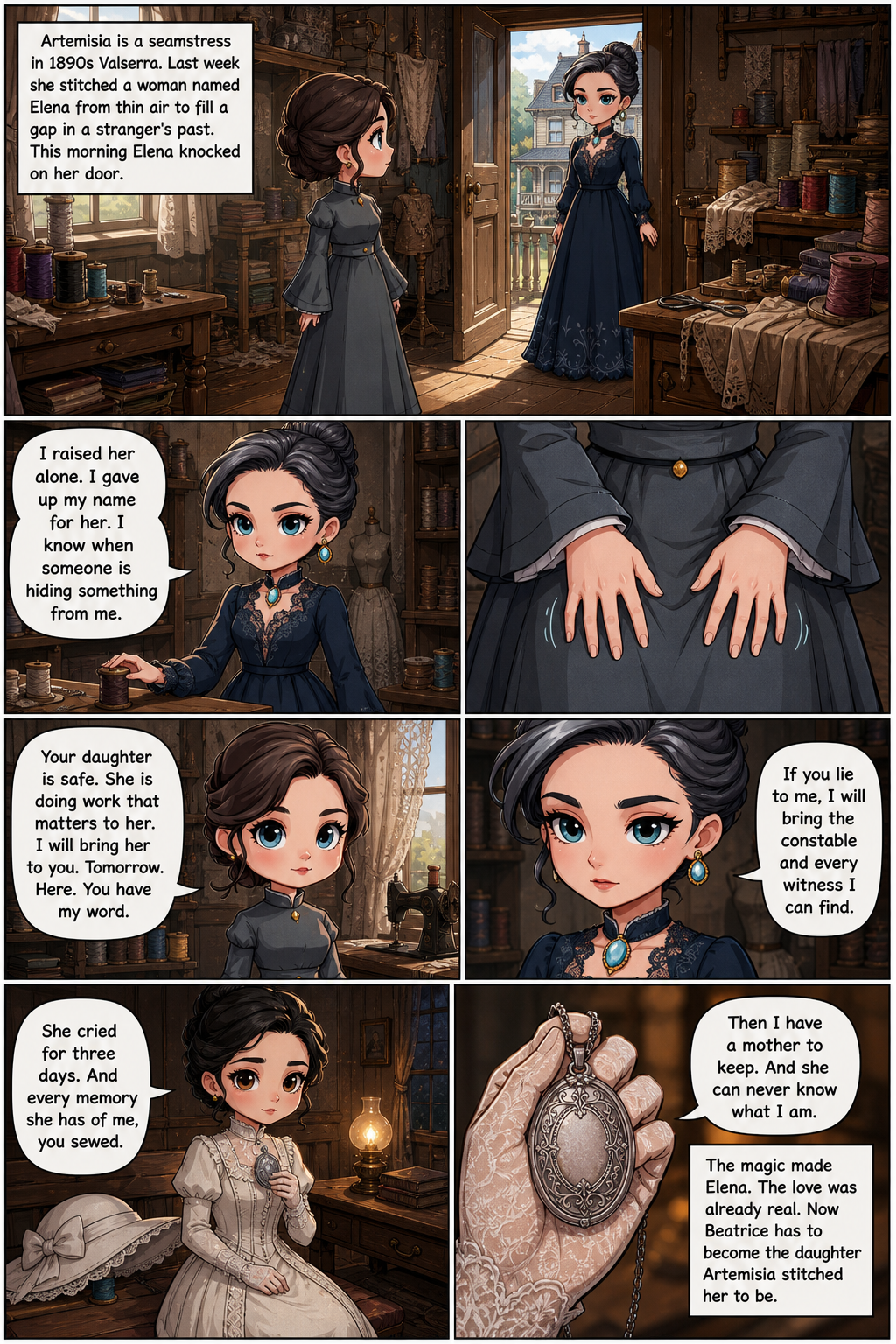
Beatrice's words about the invented mother stayed with Artemisia all week. She had told herself the woman was a rumor, a name in a false memory. Then, on a gray morning, someone knocked. Artemisia opened the door and knew at once she had been wrong. A woman in a navy dress stood there. She was fifty-five, straight-backed, elegant. Her eyes were the same warm brown as Beatrice's. This was the mother Artemisia had stitched from nothing. And she was here, breathing, real. "I am Elena Fiore," the woman said. "I am looking for my daughter. Beatrice." She did not smile. "She has been gone three days. This shop was the last place anyone saw her." Artemisia's hands went cold. She had made this woman to fill a gap in Beatrice's past. She had not planned for the mother to come searching. "Please," Artemisia said. "Come in." Elena stepped inside. She scanned the room once, quick and hard. Her gaze stopped on Artemisia's hands, which had begun to tremble. "You are shaking," Elena said. "Why?" "The cold," Artemisia said. It was a poor lie and she knew it. Elena crossed to the workbench. She lifted a spool, set it down. "People tell me they are searching too. I trust none of them." She turned. "I raised her alone. I gave up my name for her. I know when someone is hiding something from me." Artemisia understood then. She could not make this woman leave with force or with lies. Elena would return. She would bring others. But there was one thing the magic could not create: the love. That was real. Elena's grief was real. Artemisia decided to give her the only thing that would satisfy her. "Your daughter is safe," Artemisia said. "She is well. She is doing work that matters to her. I will bring her to you." Elena's face did not soften, but her shoulders dropped an inch. "When." "Tomorrow," Artemisia said. "Here. You have my word." Elena studied her a long moment. Then she nodded once. "Tomorrow. If you lie to me, I will bring the constable and every witness I can find." She walked to the door. "I have counted every hour she has been gone. Do not make me count more." She left. Artemisia sat down hard on the stool. That evening Beatrice came in from the manor, lace hat in hand. Artemisia told her. Beatrice was quiet a long time. Her hand went to the silver locket at her throat. "She's real," Beatrice said. "You built her and she's real, and she loves me." Her voice went low. "I have a mother who cried for three days. And every memory I have of her, you sewed." "You will meet her tomorrow," Artemisia said. "You must be her daughter. Truly. The stitch will hold only if you let it." Beatrice put the hat down. "Then I have a mother to keep," she said. "And she can never know what I am."
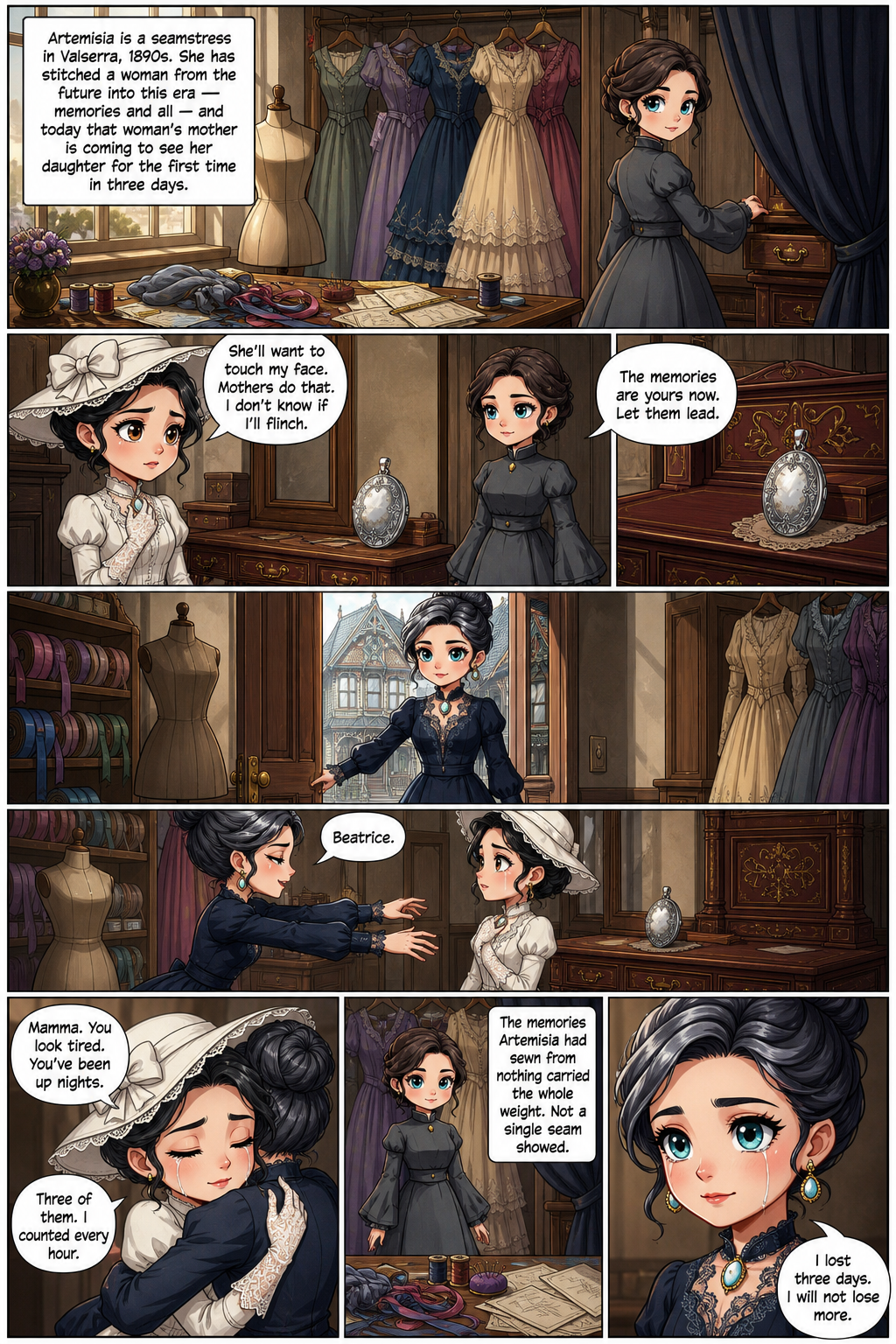
Artemisia woke before dawn and looked at her shop with fresh fear. Elena had promised the constable. A woman who searched this hard would keep searching after she saw her daughter. She needed the shop to look like nothing but honest work. So she made a plan. By the time light filled the windows, she had covered the strange measurements. She hung finished dresses on the walls. She set out ribbon, patterns, a wooden dress form. A seamstress business. A place with nothing to hide. She pulled a bolt of muted blue cloth across the front table. She pinned a hem for show. Behind the curtain, the odd threads stayed folded away in a drawer. If Elena looked, she would see a shop that fit its era exactly. Beatrice arrived first, in her lace hat. Her hand went to the silver locket at her throat and stayed there. "She'll want to touch my face," Beatrice said. "Mothers do that." Her voice dropped. "I don't know if I'll flinch." "You won't," Artemisia said. "The memories are yours now. Let them lead." The knock came at nine. Artemisia opened the door. Elena stood in her navy dress, straight-backed, jaw set. She did not step in. Her eyes swept the room once, hard and fast, over the hanging dresses, the ribbon, the dress form. Looking for the lie. Then she saw Beatrice. Something broke open in Elena's face. She crossed the room in three steps and took her daughter's shoulders. "Beatrice." And Beatrice did not flinch. Her whole body loosened. "Mamma," she said, and the word came out easy, like she had said it ten thousand times. "You look tired. You've been up nights." "Three of them." Elena pressed a hand to Beatrice's cheek. Beatrice leaned into it. "I counted every hour." "I know that dress," Beatrice said softly. "You wore it the day I turned twelve." Elena's eyes filled. "You remember." "I remember everything." Artemisia stood by the table and watched the stitch hold. It held perfectly. Elena wept into her daughter's hair, and her daughter wept back, and the memories Artemisia had sewn from nothing carried the whole weight without a single seam showing. When Elena finally straightened, she wiped her eyes and looked around the shop again. This time her gaze was different. She saw the honest work. The hems. The ordinary cloth. "You keep her here," Elena said to Artemisia. "As your assistant." "She is the best I have ever trained." Elena nodded slowly. "Then I will come often." It was not a question. "To see my daughter. To sit while she works." She took Beatrice's hand. "I lost three days. I will not lose more."
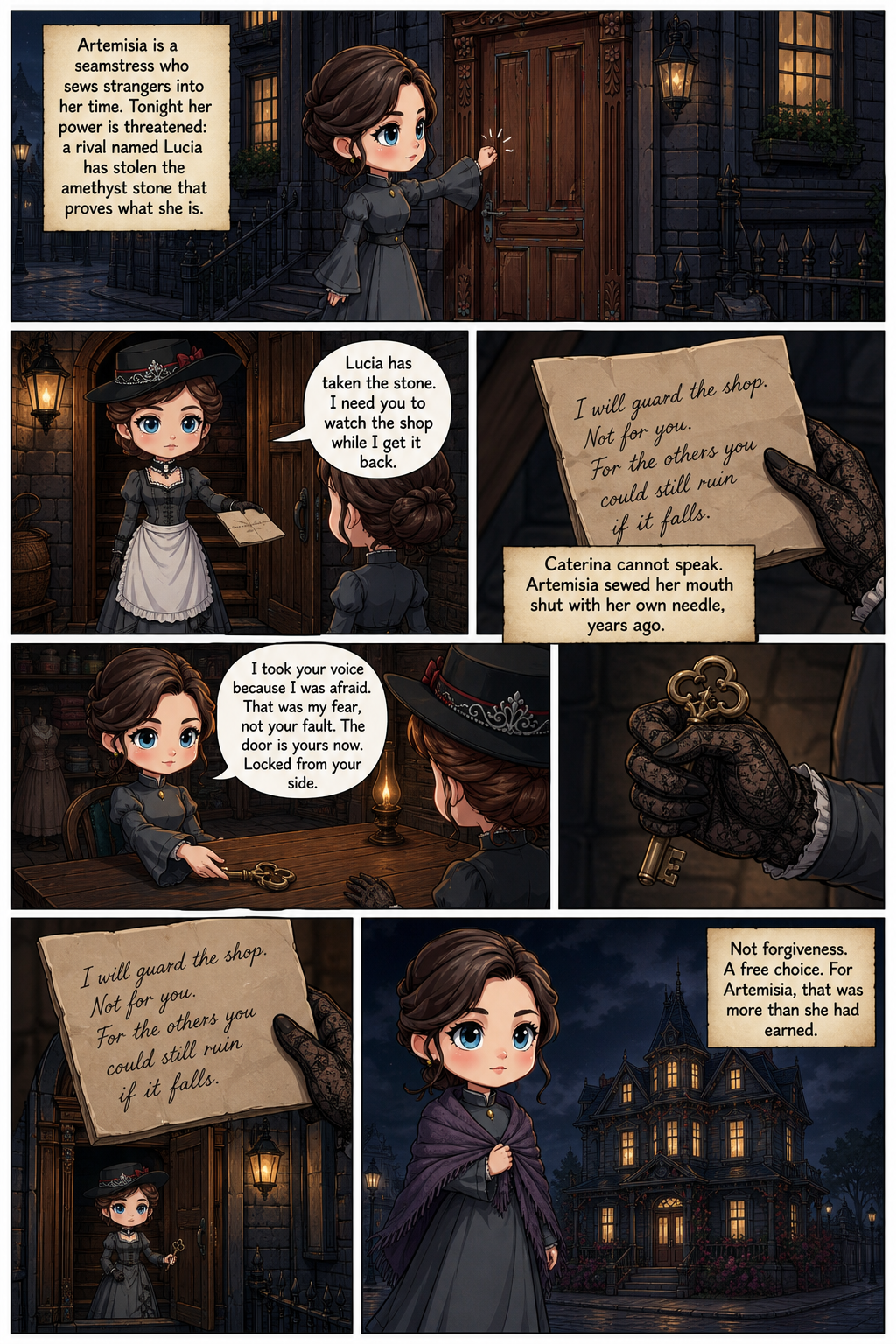
After Elena left, the shop went quiet. Artemisia should have felt safe. Instead she felt the cold place behind her ribs where her power lived. Something was wrong. The amethyst in the forest had moved. She had known it the night before, a wrongness in her hands. Now she needed the one person who knew the shop's secrets to stay loyal. She went to the carved cellar door and knocked twice. Caterina came up slow. She was the mute girl Artemisia had kept below since childhood, the girl whose voice Artemisia had sewn shut with her own needle. Caterina wiped her hands on her apron and looked at Artemisia without warmth. She had learned to say much with a flat stare. "I need your help," Artemisia said. "Lucia has taken the stone. She means to prove what I am. I have to get it back tonight. Watch the shop while I go." Caterina did not move. She reached into her apron and drew out a folded paper. She held it out. Artemisia read the plain, hard script. *You seal my mouth. You ask my hands. I am not your dog.* "I know," Artemisia said. Her voice stayed soft. "I did a cruel thing to you." Caterina took the paper back. She wrote again, pressing hard. *Lucia already asked me to help her. She was kind. You were not.* The words landed like a slap. Here was the turn Artemisia had feared. If Caterina walked next door, every secret walked with her. The measurements. The threads. The truth of the stitching. Artemisia felt her plan crack. She did not reach for her needle. She had used the needle on Caterina once, and it had made this hatred. More magic would only deepen it. So she chose the harder thing. "Then go," Artemisia said. "If Lucia is kinder, go to her. I will not stop you. But hear me first." She sat down at the work table, small and plain. "I took your voice because I was afraid. That was my fear, not your fault. I have no right to your loyalty. I am asking, not ordering." She slid the cellar key across the table. "The door is yours now. Locked from your side, not mine." Caterina stared at the key. For a long moment she did not touch it. Then she picked it up and closed her fist around it. She wrote one last line and turned the paper so Artemisia could read. *I will guard the shop tonight. Not for you. For the others you could still ruin if it falls.* It was not forgiveness. It was a choice made freely, and that was more than Artemisia had earned. She rose and pulled her shawl from its hook. "Thank you," she said, and meant it. Caterina did not answer. She walked to the door, key in hand, and took her post. Artemisia stepped into the dark toward Lucia's house, and the stolen stone that waited there.
Play your story to life
Storycraft is a mobile game where you create AI characters, craft items and locations to build their world, then discover what direction your story takes. Download the iOS game for free today!
Download for free