

Benny Stitch's Arc
10 Chapters
Benny Stitch's dream is opening his own little tailor shop on the muddy main lane of Phloxara.

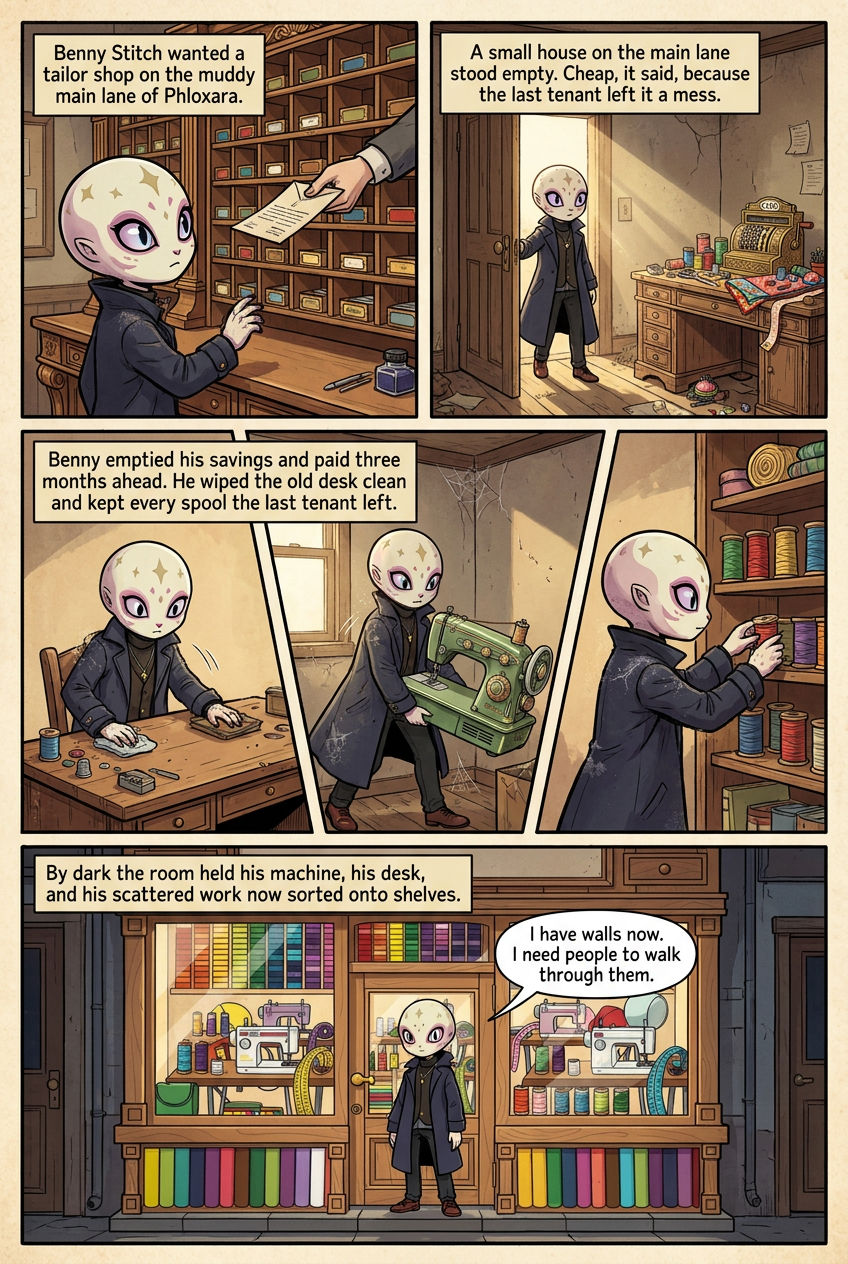
Benny Stitch wanted a tailor shop on the muddy main lane of Phloxara. Right now he had only a borrowed sewing machine and no place to put anything down. His finished seams lay in a bag by the machine. His scraps sat in his coat pockets. His measuring tape hung around his neck because he had nowhere to hang it. Six eyes and ink-stained fingers, and still nothing he made stayed in one spot long enough to be seen. He had taught himself on this machine over many long weeks. He had left one crooked seam on purpose, then fixed it, and understood at last whose impatience lived in his hands. He had written to that person about the thread and the humming machine. No reply came. So Benny stopped waiting and made a decision. He needed his own four walls. That morning he walked to the postal desk to collect any mail. The desk spanned a whole wall, its wooden compartments packed with tiny colored envelopes. The clerk slid one slot open and passed Benny a folded notice. A small house on the main lane stood empty. Cheap, it said, because the last tenant left it a mess. Benny went straight there. The door stuck. He shoved it and stepped inside. Dust covered a heavy old seamstress desk shoved against the wall. A vintage cash register sat on top, its brass gone dull. Beneath the dust lay scissors, thimbles, and spools of thread in every color. Someone had sewn here before and left it all behind. Benny ran a finger along the desk. The wood was solid. The drawers still slid. He counted the room the way he once counted numbers in his reports. One corner for the machine. Shelves for fabric along both walls. A tiny cooking corner in the back for long nights. The space was small and filthy, but it was walls. It was a floor that was his. He found the owner by asking a neighbor. The rent was low. Benny emptied his savings and paid three months ahead. His sleek city coat gathered cobwebs as he worked, and he did not take it off. He hauled the borrowed machine over that same afternoon and set it in the corner he had chosen. He wiped the old desk clean and kept every spool the last tenant left. By dark the room held his machine, his desk, and his scattered work now sorted onto shelves. His seams were no longer hidden in a bag. They hung where anyone passing could look in and see them. Benny stood in the doorway and stepped back into the lane. The house had no sign. No customer knew his name. An empty room full of thread was not yet a shop, and the rent was already spent. He had walls now. He needed people to walk through them.
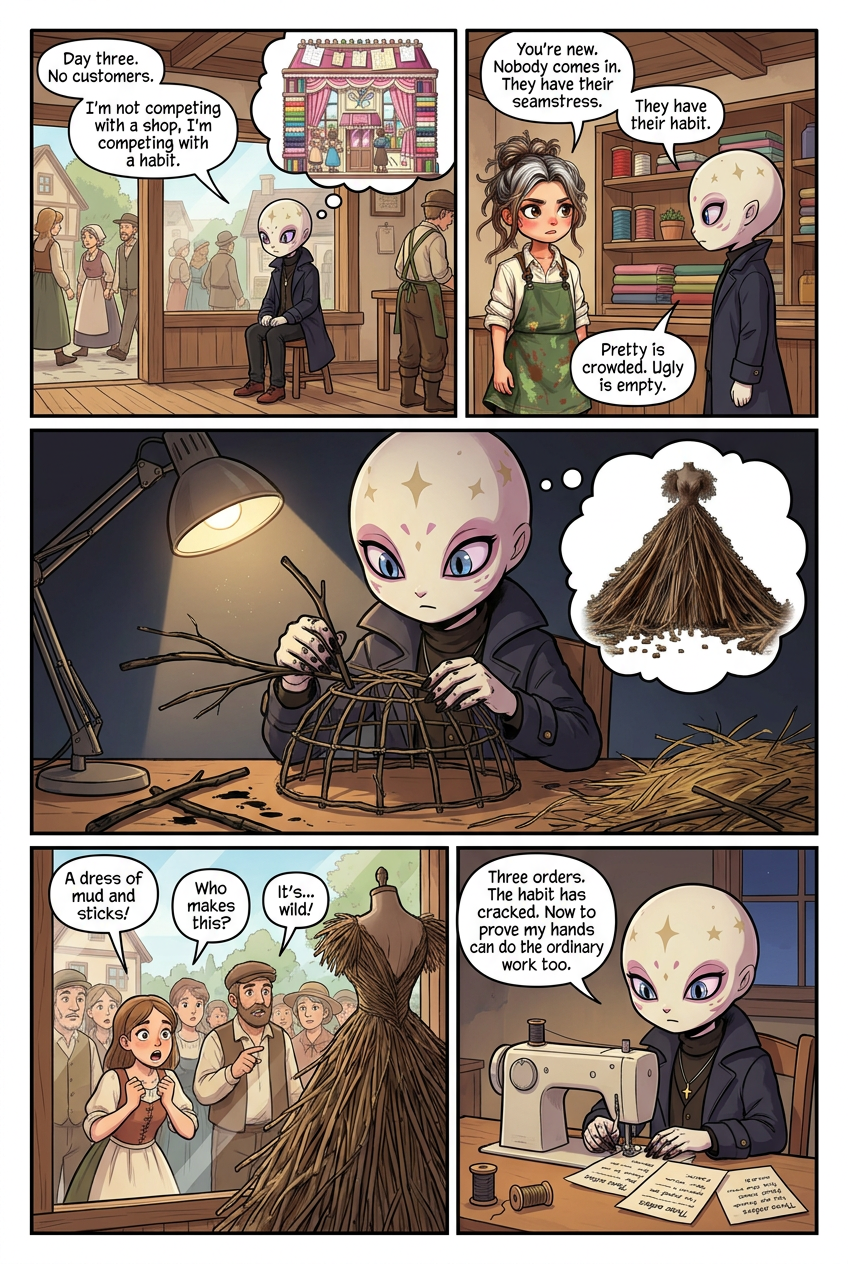
Benny opened his shop each morning and waited. Passersby glanced through the window at his hanging seams, then walked on. He heard the same thing from every mouth. The seamstress up the way already made their clothes. She had for years. Her dresses each held some small magic, they said, and nobody needed a stranger in a city coat. By the third day Benny understood the truth. He was not competing with a shop. He was competing with a habit. A woman with a paint-stained apron stopped at his window. She did not look at his seams. She looked at him. Aster Bella. Benny knew her only by sight, the painter who kept to herself and sold pictures of rot. "You're new," she said. Short. Flat. No greeting. "Nobody comes in," Benny said. "They have their seamstress." Aster stepped inside. She studied his shelves, then his hands. "The old maker makes pretty things. Everyone makes pretty things." She stopped herself, jaw tight. "I paint what people won't look at. It took me seven years to sell one." Benny waited. "Pretty is crowded," she said. "Ugly is empty." She left without buying. Benny stood alone with her words. He looked at his neat seams, each one clean and correct. Correct was the habit he was losing to. He thought of the mud outside his door, the sticks in the hedges, the dry hay heaped by the lane. Nobody sewed with those. Nobody could. He worked three days without sleeping much. He gathered stalks and stems and bundled hay. He wove them onto a wire frame he bent by hand. His ink-stained fingers bled from the sticks. He built a gown from the ground itself, wild and raw, the skirt a spray of dried reeds, the shoulders bristling like a hedge. He set it in his window facing the lane. By noon a crowd stood outside. They pointed. They laughed, then stopped laughing. A dress made of mud and sticks. No one had seen such a thing. A young shopkeeper pressed her face to the glass and would not leave. People came to gawk and stayed to ask his name. "Who makes this?" a man asked at the door. "Benny," he said. "Benny Stitch." By dark he had three orders written on his old desk. None were for stick gowns. They wanted plain hems and mended coats. But they wanted them from him now. They knew his name. They had a reason to open his door. Benny sat at his machine that night, not laughing, not resting. Three orders meant three deadlines. He had won the town's eyes with one strange dress. Now he had to prove his hands could do the ordinary work too, and do it faster than a maker they had trusted for years. The habit had cracked. Keeping the customers would be harder than getting them.
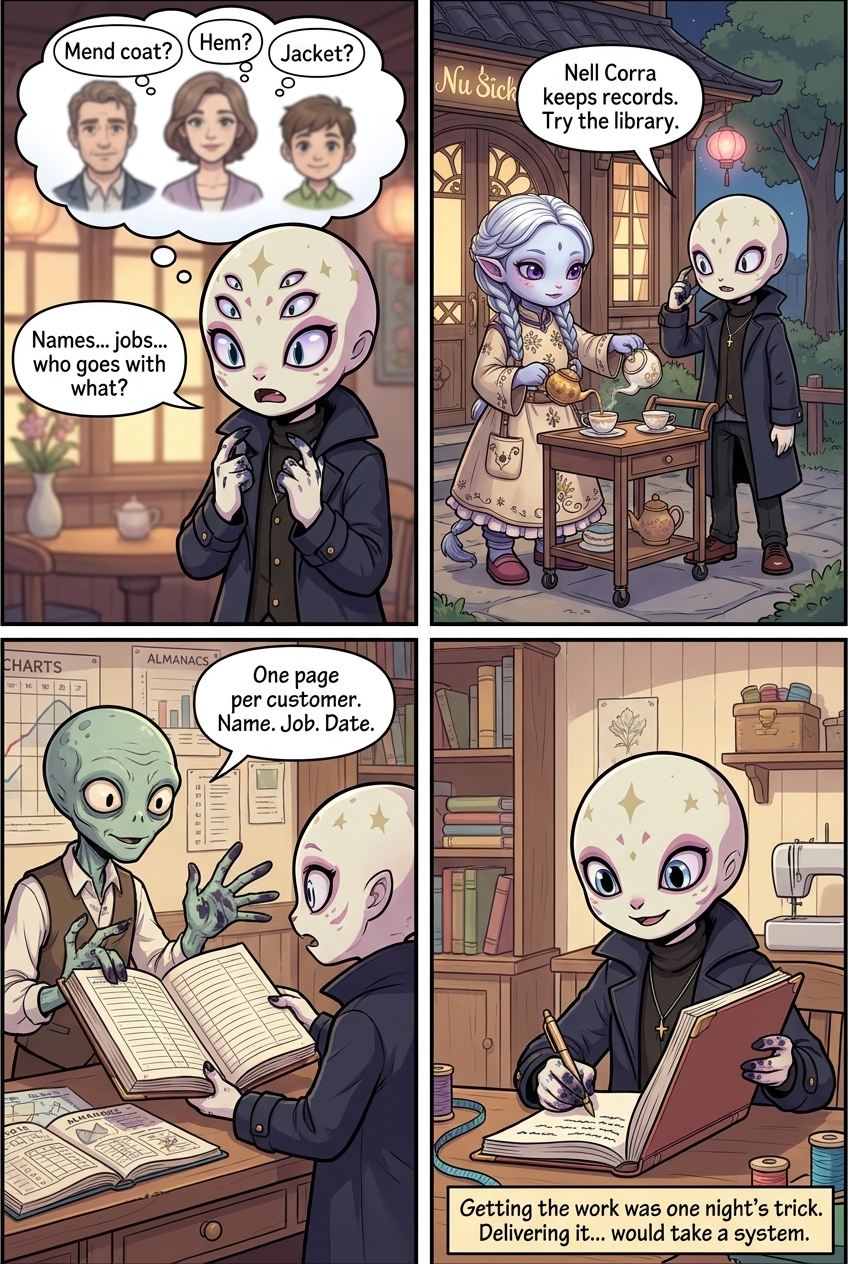
Benny stared at the three names in his head and none of them held still. A man wanted a coat mended. A woman wanted a hem. Someone else wanted a jacket taken in. But which face went with which job? He had taken the orders too fast, riding the thrill of the crowd, and written nothing down. Now the thrill was gone. Mix them up, and the trust he had earned tonight would crack by morning. He knew who kept things straight. Benny grabbed his coat and walked to the tea cart, where Elara Ponds poured for a late customer. She never forgot a face. He asked if she remembered the three who ordered from him. "I saw them," Elara said. "The tall one with the torn cuff. The braided woman. A boy in a green vest." She set down her kettle. "But I don't know what each one asked you for. I only heard the tall one. He said Thursday." It was not enough. Benny needed a system, not a memory. Elara studied him with her middle eye, then spoke. "Nell Corra keeps records for a living. Try the library." Benny found Nell at a reserved desk in the Petal Library, an elder with eight ink-stained fingers, bent over a thick almanac. Charts covered the desk, sorted in tidy stacks. Nell numbered a page, blew on the ink, and slid it into place without looking up. "I take weather," Nell said. "Four hundred miles a year. Every day counted." He capped his pen. "You lost three orders. Elara sent word ahead." Benny nodded. "I have the names in my head. I don't trust my head." Nell pulled a large binder from the shelf, its cover lined and labeled in neat squares. Sewing Records. Projects. Patterns. "Made this on the walk over," he said. "One page per customer. Name. Job. Date. Cloth." He set it in front of Benny. "A head forgets. A page does not." They worked backward together. Nell asked one plain question at a time. What did the tall man wear? A torn cuff, so the coat was his. The braided woman held her sleeve up, showing the hem she wanted shortened. That left the boy in the green vest with the jacket to take in. Elara's fragment locked the last piece. Thursday belonged to the coat. Benny wrote each order on its own page. Name, job, date, cloth. His ink-stained fingers moved sure now. Three tangled promises became three clean lines. "Bring it every day," Nell said. He closed his almanac. "I keep mine so the wind can't lie to me. You keep yours so your customers can't say you forgot." Benny carried the binder home. The three orders were safe. But holding it, he understood the harder truth. Getting the work was one night's trick. Delivering all three, on time, with hands the town had never tested, would take more than a good record.
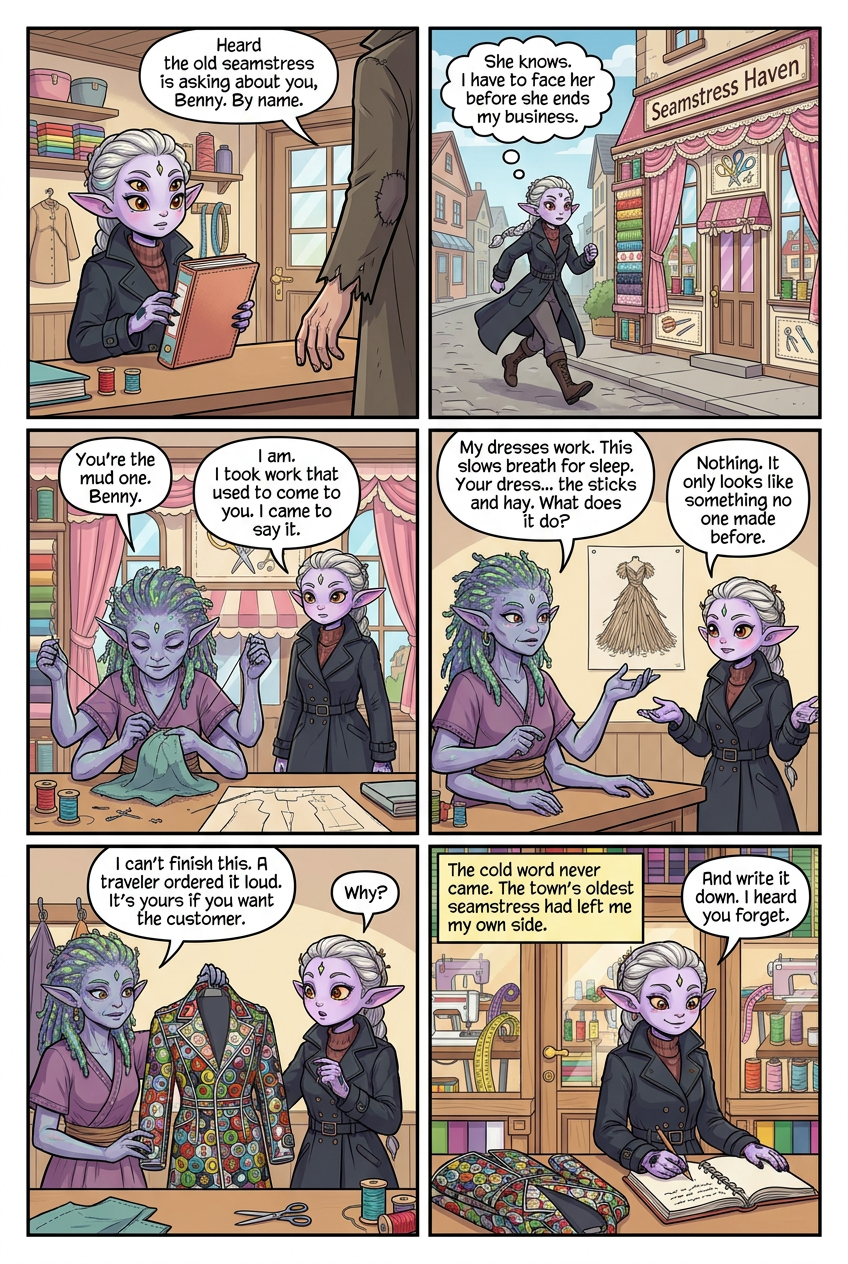
The binder sat on Benny's counter, three orders written clean. He should have felt safe. Then a customer came in, the tall man with the torn cuff, and paused at the door. "Heard the old seamstress is asking about you," he said. "By name." He left without leaving his coat. Benny understood at once. The town's established seamstress had learned he took her regulars. One cold word from her could empty his shop by Thursday. Benny closed early and walked to Seamstress Haven. He had never met the woman who ran it. He only knew her dresses were famous, and that his three orders had once been hers. Inside, an elder with four arms bent over a table, stitching without looking up. Iridescent moss braided her hair. She had a poppy-dyed sash across her chest. Two of her hands held cloth still while the other two drove the needle. She did not stop when the bell rang. "You're the mud one," she said. "Benny." "I am." He made himself stand straight in his city coat. "I took work that used to come to you. I came to say it before you heard it worse." Sable Fern set down her needle. She studied him with steady eyes. "My dresses do a thing. This one slows the breath for sleep. That one held back a woman's tears too well, so she returned it." She tilted her head. "Your dress. The sticks and hay. What does it do?" The question caught him. "Nothing," Benny said. "It only looks like something no one made before." Sable was quiet. Then she pulled a coat from a hook and laid it on the table. Its whole surface glittered with pop caps and game discs, layered like scales. "A traveler ordered this. Wanted it loud. I sew what works, not what shouts." She pushed it toward him. "I can't finish it. It's yours if you want the customer." Benny stared at the coat. She was not threatening him. She was handing him work. "Why?" he asked. "Three orders won't feed you long." Sable picked her needle back up. "You make the loud things. I make the working things. The town is big enough." She turned back to her cloth. "I told the tall man you sew honest. That's the word I gave." Benny lifted the coat. It was heavy, glossy, half-finished. His fingers found the raw seam where she had stopped. He could finish it. He knew he could. "Thank you," he said. "Don't ruin it," Sable said, not unkindly. "And write it down. I heard you forget." Benny walked home carrying the coat and a fourth order. The cold word he had feared never came. Instead the town's oldest seamstress had drawn a line between them and left him his own side of it. He set the coat on his counter and opened the binder to a fresh page.
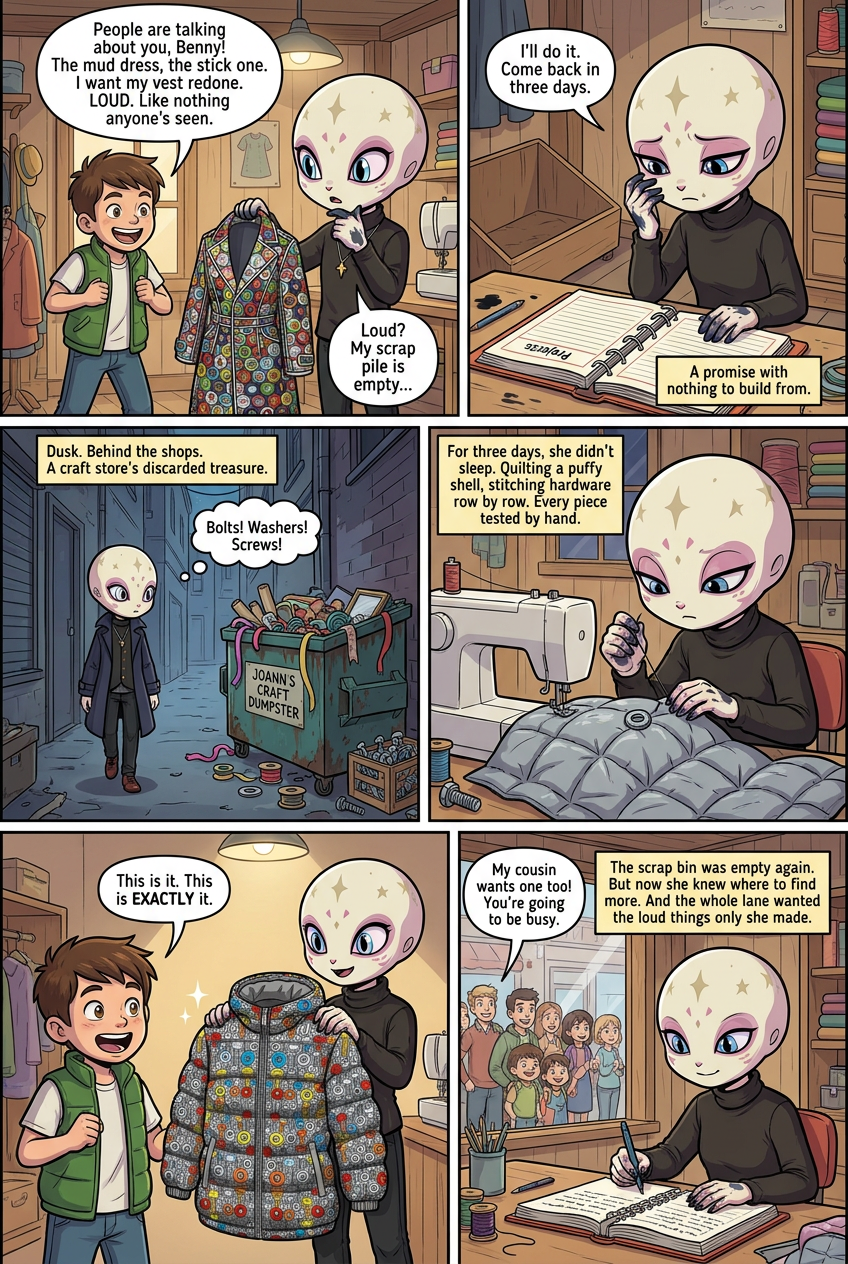
Benny had just finished the pop-cap coat when the bell rang again. A boy in a green vest stepped inside. Benny knew him. This was one of his three orders, the jacket that needed taking in. But the boy carried no jacket. He wore it, and he was grinning. "People are talking about you," the boy said. "The mud dress. The stick one. They say you make clothes out of things nobody uses." He tugged his green vest. "I don't want it taken in anymore. I want it redone. Loud. Like nothing anyone's seen." Benny opened his binder and looked at the clean line where the old order sat. He should have felt proud. Instead his stomach dropped. His scrap pile was empty. He had used every reed, every cap, every disc on the two dresses and the traveler's coat. He had nothing left to build from. "I'll do it," Benny said, because a no would end the talk that was feeding him. "Come back in three days." The boy left happy. Benny stood alone with an empty bin and a promise he could not keep. He walked the lane at dusk, scanning for anything discarded. Nothing. Then, behind the closed shops, he found a battered dumpster shoved against a wall. Ribbon spilled over its lip. Spools of thread, cracked frames, tangled cord, and a crate of bolts and screws sat piled inside. Someone had thrown out a craft store's dead stock. Benny dug in with ink-stained hands. He lifted out a fistful of nuts and washers and turned them in the light. They clicked together. They caught the glow like small mirrors. He filled his coat pockets until they sagged, then carried two more armloads home. For three days he did not sleep well. He quilted a puffy shell first, round and soft. Then he stitched hardware across it in rows. Bolts down the sleeves. Bright washers scattered like buttons. Screws lined the hood. Every piece had to hold without ripping the cloth. He tested each seam by hand, tugging until he trusted it. The boy returned on the third day. Benny held up the finished coat. Metal covered it end to end, gray and red and yellow, quilted into soft ridges. The boy went silent. Then he pulled it on and spun. It rattled and shone. "This is it," the boy breathed. "This is exactly it." He paid, then stopped at the door. "My cousin runs the toy shop. She wants one too. And she'll tell others." He grinned. "You're going to be busy." Benny wrote the new order in his binder. Under it he wrote three more names the boy called back from the street. His hands were sore. His scrap bin was empty again. But now he knew where to find more, and now the whole lane wanted the loud things only he made. His shop had a line forming. He needed to prove he could keep up.
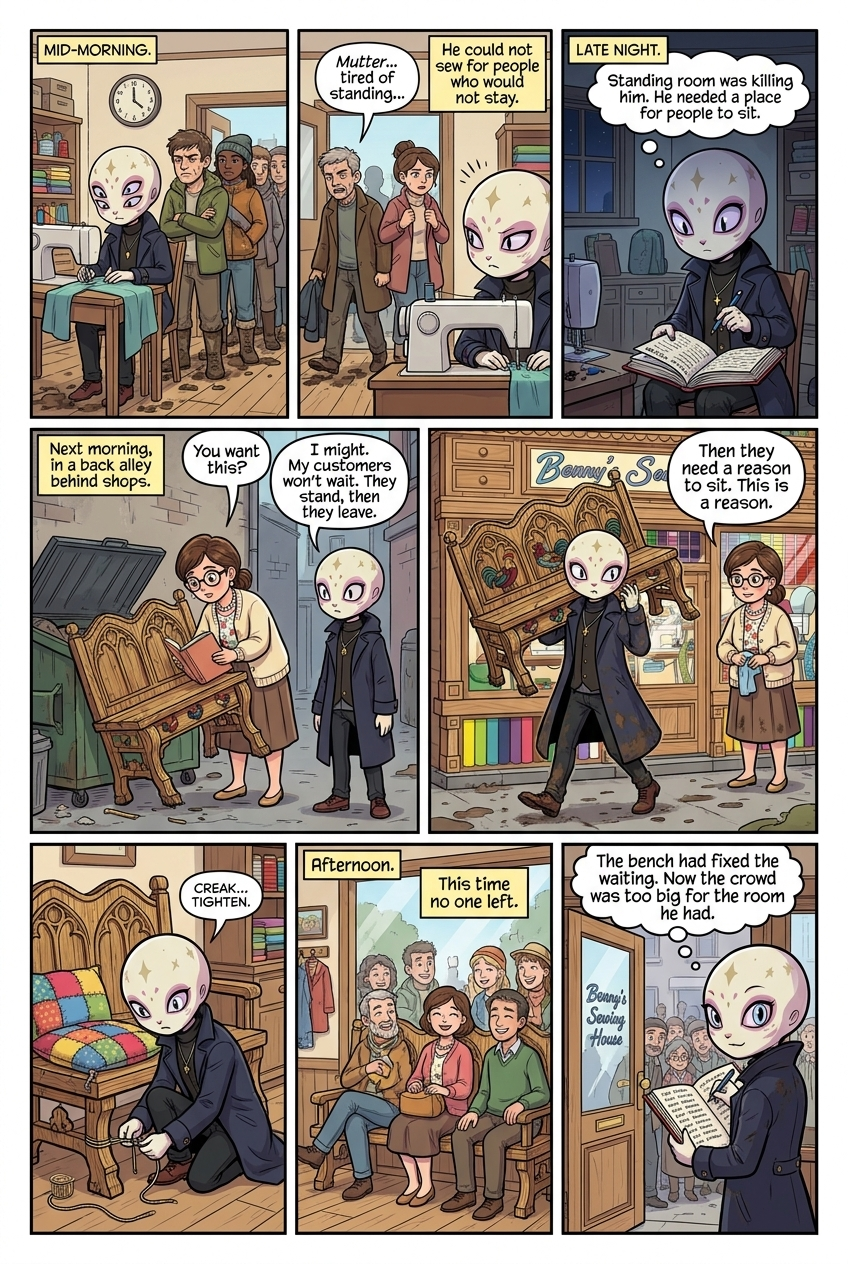
The line reached the door by mid-morning. Six customers wanted the loud coats only Benny made. But his shop held one chair, and he needed it to work. The waiting neighbors shifted their muddy boots on his floor. Two grew tired of standing. They muttered, turned, and walked out. Benny watched two orders leave with them. He could sew fast. He could not sew for people who would not stay. He worked all day with his jaw tight. That night he counted the lost names in his binder. Standing room was killing him. He needed a place for people to sit. The next morning he searched behind the closed shops again, where he had found the metal scraps before. Someone else was already there, bent over the dumpster. A woman in a neat cardigan, pearls at her ears, pulled a broken carving into the light. She turned it over in her hands like she was reading it. Benny knew her. Fiona Ballard kept records the way he now kept his binder. She had once helped a customer of his track a lost receipt. She did not waste words. "You want this?" she asked, not looking up. It was a bench. Carved wood, long enough for three. Chickens marched across the back in painted rows, silly and bright. One leg wobbled. The seat held. "I might," Benny said. "My customers won't wait. They stand, then they leave." Fiona set the bench upright and pressed the loose leg. "Then they need a reason to sit." She stepped back. "This is a reason." "It's broken." "One leg. You fix seams all day." She said it flat, no push behind it. Then she wiped her hands on her skirt. "Take it. I have no room for it." Benny carried the bench home on his shoulder. The chickens knocked against his neat city coat, and mud smeared the carved feet. He set it by the front window and studied the wobble. He had no wood glue. But he had thread, wire, and patience. He wrapped the split joint tight with waxed cord, looping it the way he anchored a hard button. He pulled each turn until the leg stopped moving. Then he stitched a cushion from his brightest scraps and tied it to the seat. By afternoon the line returned. This time no one left. Three customers crowded onto the bench, laughing at the painted birds. A fourth leaned on the arm. They talked while Benny worked, and the talk pulled more people to the window to see what the noise was. He filled his binder with six new orders and lost none. But the bench sat four, and by dusk eight people wanted in. They spilled onto the lane outside his door. Benny wrote the names, then looked at his one small shop. The bench had fixed the waiting. Now the crowd was too big for the room he had.
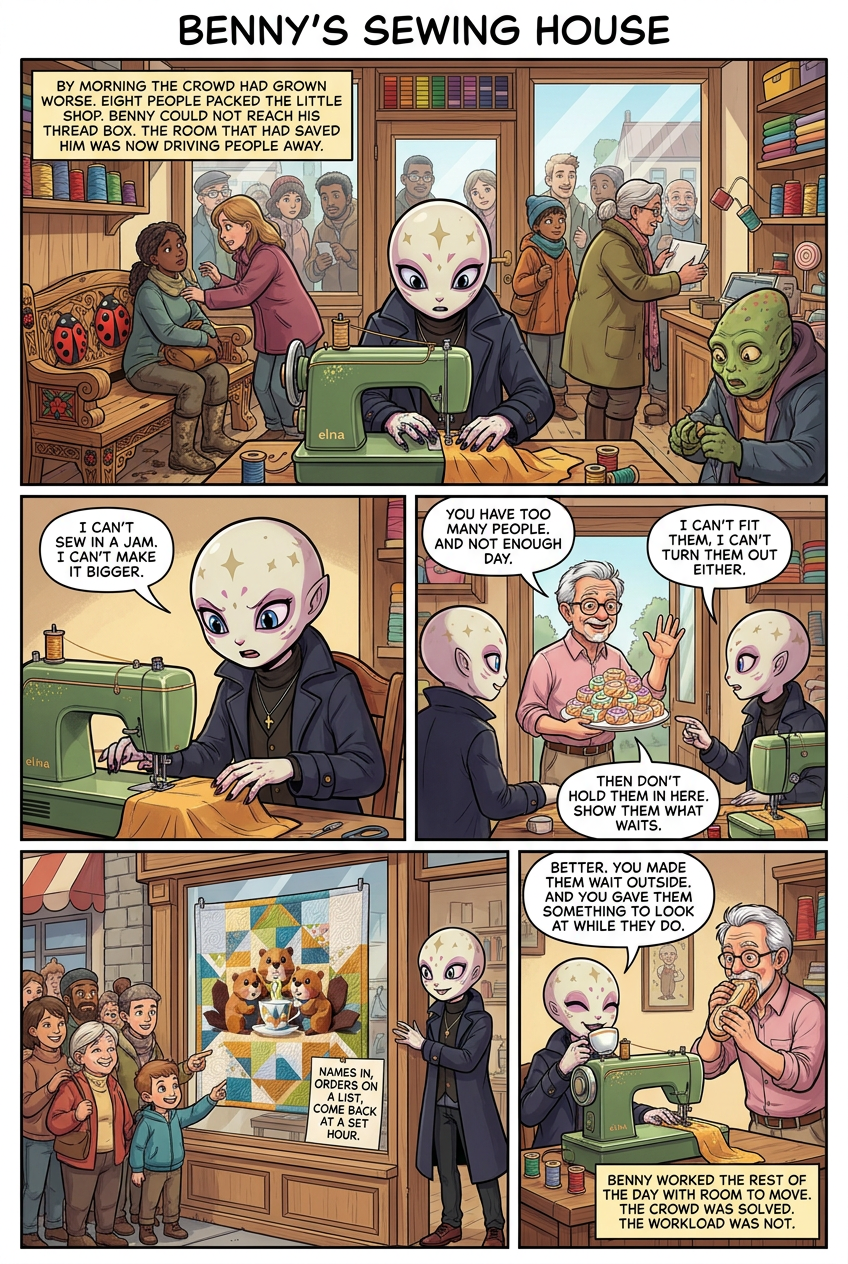
By morning the crowd had grown worse. Eight people packed the little shop. Their muddy boots crowded the bench with the painted birds. Two more waited on the lane, peering through the glass. Benny bent over his machine, elbows pinned to his sides. He could not reach his thread box. A woman pressed against the shelf and knocked a spool loose. He watched a fresh customer glance at the wall of bodies, then walk on. The room that had saved him was now driving people away. He set down his work. He could sew fast. He could not sew in a jam. The shop had one room. He could not make it bigger. Cosmo Fenn came through the door with a tray of frosted rolls. Benny's friend waved at every crowded face, calm as always. He set the tray on the bench. "You have too many people," Cosmo said. "And not enough day." "I can't fit them," Benny said. "I can't turn them out either." Cosmo looked at the wall. He looked at the shelves stacked with folded quilts and bright cloth. "Then don't hold them in here." He pointed a roll at the window glass. "Show them what waits. Let them come back for it." Benny understood. The crowd came to watch him work. They did not need to stand inside to do that. He needed the space, not the audience. He pulled a finished piece from the shelf. It was a quilt, pieced tight with small beavers gathered around a steaming cup. He hung it in the front window where all could see. Beside it he tacked a card: names in, orders on a list, come back at a set hour to collect. Then he stepped to the door. "I'll take every name," he called to the crowd. "But not with you standing on my thread. Give me your order at the window. I'll set your time." The crowd grumbled. Then the woman near the shelf shrugged and stepped outside. She read the quilt through the glass and smiled at the tea-drinking beavers. Others followed. They lined up at the window instead of the room. Benny wrote each name, each job, each pickup hour. The shop emptied. His machine sat clear again. Cosmo poured two cups from a kettle he'd carried in and handed one over. "Better," he said. He bit into a roll. "You made them wait outside. And you gave them something to look at while they do." Benny worked the rest of the day with room to move. By dusk his list held eleven names, and not one had left. The quilt in the window pulled walkers close. The bench held four who came only to eat rolls and watch. But eleven orders was more than one man could finish alone. He looked at his single machine and his own two hands. The crowd was solved. The workload was not.
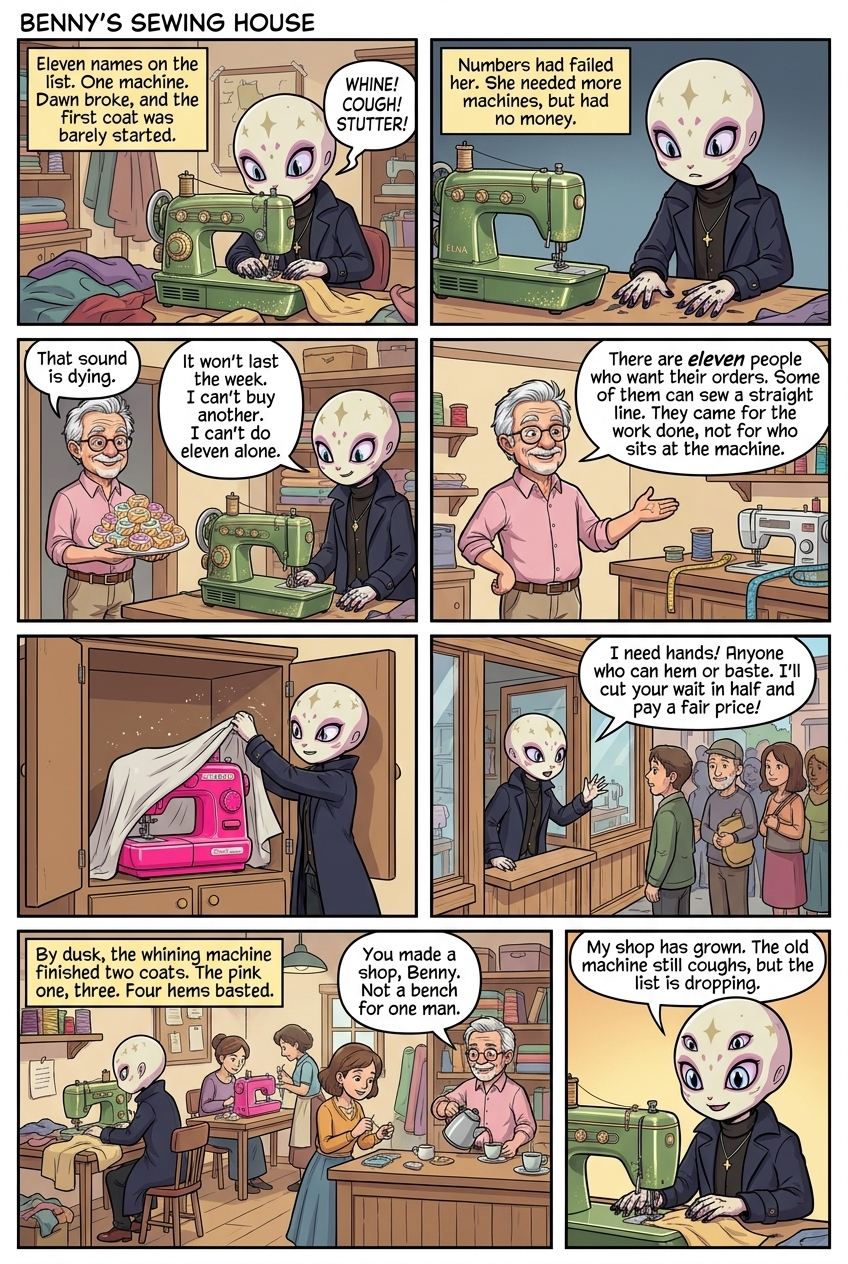
The list held eleven names. Benny had one machine and two hands. He sat down at dawn and started the first coat. By the third seam the machine whined. The needle slowed. It stuttered on thick cloth and dragged the thread into a knot. He oiled it and pushed on. It coughed again. He counted the orders and counted the hours. The math did not work. One machine could not finish eleven jobs, and it might die before it finished one. He stopped and set both palms flat on the table. His fingers still carried old ink stains from a life of numbers. Numbers had left him nothing to hold. He would not let this shop end the same way. He needed more machines. He had no money for more machines. He had paid three months of rent ahead. Cosmo Fenn came in with a plate of frosted rolls. His friend set them by the whining machine and listened. "That sound is dying," Cosmo said. "It won't last the week," Benny said. "I can't buy another. I can't do eleven alone." Cosmo looked around the room. He looked at the shelves, the cloth, the built-in cabinets the last seamstress had left. "You keep saying alone." He bit a roll. "There are eleven people who want their orders. Some of them can sew a straight line." Benny stared at him. "They came for me to do the work." "They came for the work done," Cosmo said. "Not for who sits at the machine." Benny thought about the old cabinets. He opened the tall one against the back wall. Inside sat a second machine, hot pink, left under a sheet by the last seamstress. He wiped the dust off. He plugged it in. The needle ran clean and fast. He had two machines now, not one. He went to the window and called the waiting line inside. "I need hands," he said. "Anyone who can hem, who can baste, who can turn a straight seam. I'll cut your wait in half and cut a fair price for the help." Three stepped forward. A woman with steady fingers took the pink machine. Two more sat at the bench and threaded needles by hand. Benny showed each one the seam he wanted. He kept the hard cuts and the shaping for himself. He passed the simple runs down the line. By dusk the whining machine had finished two coats. The pink one had finished a third. The hand-sewers had basted four hems. The list dropped from eleven to four. No order had been dropped. No customer had walked off. Cosmo poured two cups from his kettle. "You made a shop," he said. "Not a bench for one man." Benny looked at the three new workers bent over cloth. His shop had grown past his own two hands. But now he paid three people, and four orders still waited, and the old machine still coughed with every seam.
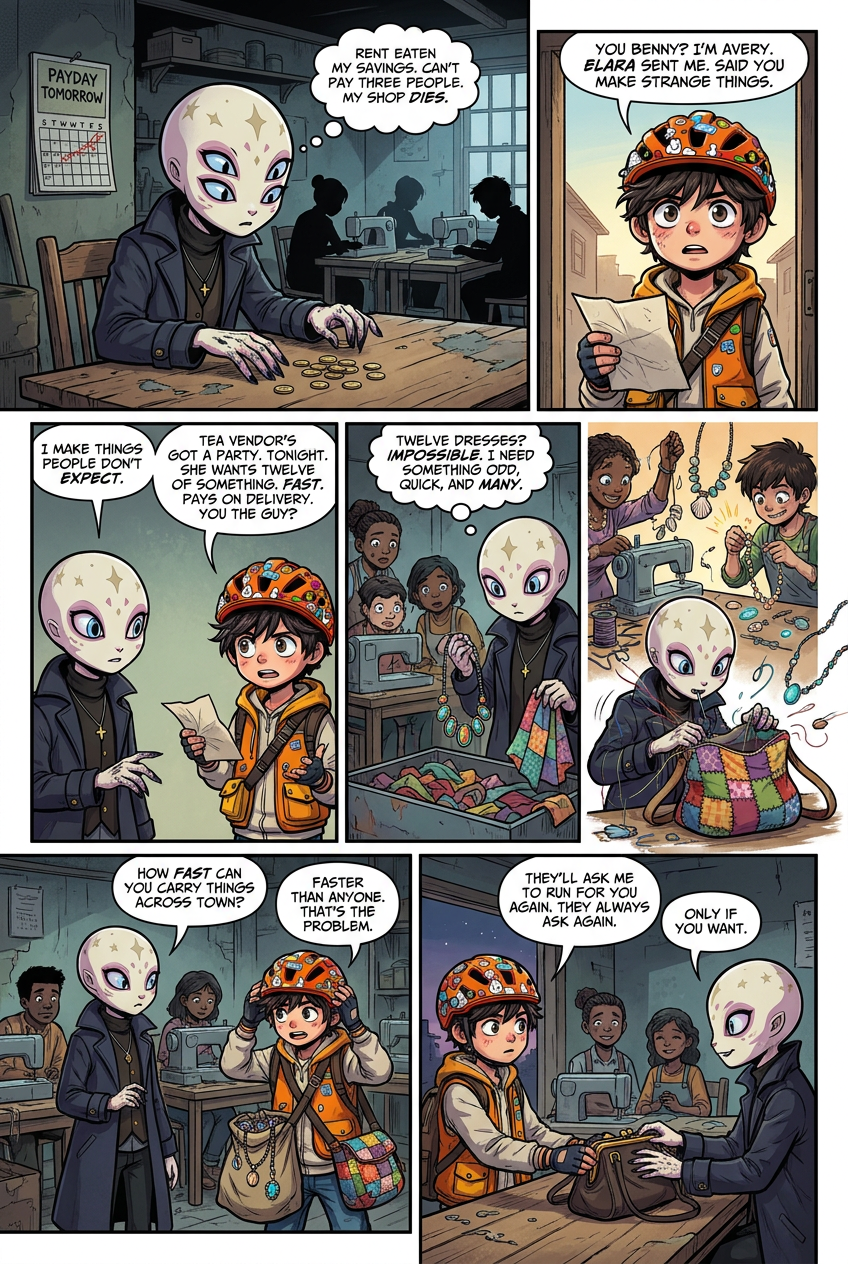
By dusk the list held four orders. But three workers looked up from their machines and one of them asked, plainly, when payday came. Benny checked the calendar. Payday was tomorrow. He counted his coins on the table and counted them again. The rent had eaten his savings. He could not pay three people. If they left, the four orders died, and his shop with them. He worked past midnight and found no answer in the math. Numbers had always failed him this way. He needed cash by morning, and he had cloth, thread, and two tired machines. He had no buyer waiting. A knock came at first light. A teenager stood on the step in a bright orange vest, a cracked helmet covered in stickers pushed back on his head. Benny had seen him tearing through the lane on his bike, dodging carts. People called him when things went wrong. He looked like he hated being called. "You Benny?" the boy said. "I'm Avery. Elara sent me. Said you make strange things." "I make things people don't expect," Benny said. Avery pulled a wrinkled paper from his vest. "Tea vendor's got a party. Tonight. She wants twelve of something. Fast. Pays on delivery." He shrugged. "Everyone keeps saying you're the guy. So. You the guy?" Benny looked at his workers, then at the boy. Twelve dresses by tonight was impossible. But he did not need dresses. He needed something odd, quick, and many. "How fast can you carry things across town?" Benny asked. "Faster than anyone," Avery said. "That's the problem." Benny went to the scrap bins. He pulled out shell buttons, bright thread, small stones left in a drawer. He set his three workers to strand and knot them into necklaces, shell against orange stone, quick work for steady hands. He himself sewed a wild bag from patches, every square a different cloth, buttons and ribbons hanging loose. Twelve small things, not twelve dresses. By afternoon they had eleven necklaces and one patchwork bag. Avery loaded them, weaving between the machines, and rode out. He came back near dark with a full purse and dropped it on the table without a word. Benny counted it in front of his workers. It covered payday, with a little over. He paid all three from the purse, coin into each hand. Nobody walked out. The four orders stayed. Avery lingered at the door. "They'll ask me to run for you again," he said. "They always ask again." "Only if you want," Benny said. Avery didn't answer. He put his helmet on and left. Benny sat with the empty purse. He had made payroll for one day. But the four orders still waited, his old machine still coughed, and now three people counted on next week's coins too. He had bought himself one morning. The shop had grown a new mouth to feed.
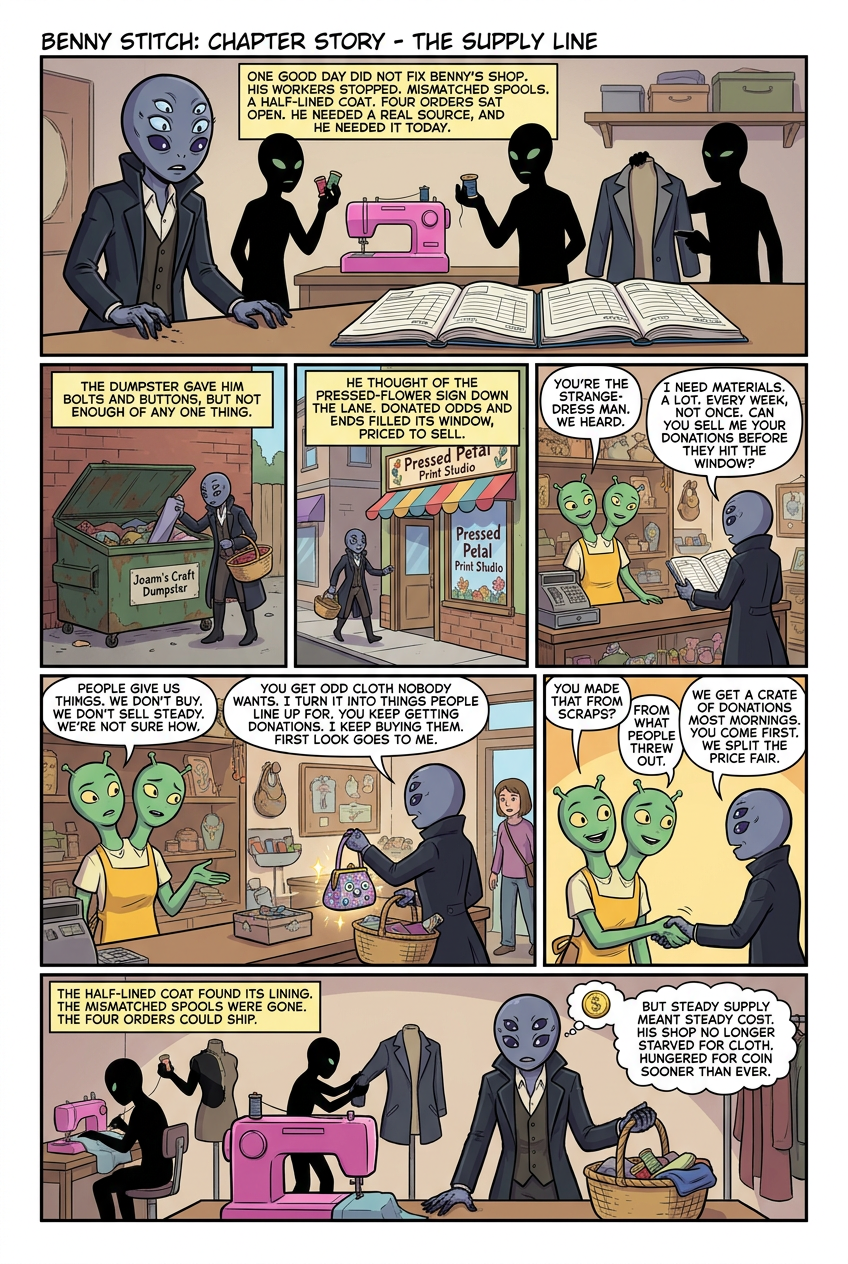
One good day did not fix Benny's shop. He still worked from scrap. The dumpster behind the closed craft store gave him bolts and buttons, but not enough of any one thing. His three workers stopped mid-morning. One held up two thread spools that did not match. Another had a coat half-lined and no more cloth to finish it. Four orders sat open. Without a steady supply, none would ship. Benny needed a real source of materials, and he needed it today. He thought of the shopfront with the pressed-flower sign down the lane. He had passed it many times. Donated odds and ends filled its window, priced to sell. He grabbed his empty basket and went. Inside, a two-headed alien in a sun-yellow apron looked up from a table of trinkets. Both heads smiled at once. This was Wren Riddle, who ran the little studio and took in whatever the town discarded. Benny had bought a spool here once and never thought much of it. Now he saw shelves stacked with cloth, ribbon, and thread, all cheap. "You're the strange-dress man," Wren said. Both heads nodded. "We heard." "I need materials," Benny said. "A lot. Every week, not once. Can you sell me your donations before they hit the window?" Wren went stiff. Both heads went quiet. Benny waited. "People give us things," Wren said slowly. "We don't buy. We don't sell steady." A pause. "We're not sure how." Benny opened his ledger binder. He showed the four orders, the names, the dates. "You get odd cloth nobody wants. I turn it into things people line up for. You keep getting donations. I keep buying them. First look goes to me." Wren picked up a battered spool from the pile and turned it over. "Both of us like odd," one head said. The other added, "But we'd want proof it works." Benny reached into his basket. He pulled out a mirrored ball purse he had stitched from dumpster glass, scattered with googly eyes. He set it on the table. It caught the light and threw sparks across the room. A customer near the door stopped and stared. "You made that from scraps?" Wren asked. "From what people threw out," Benny said. Wren looked at both heads, the way they did when deciding together. "We get a crate of donations most mornings," Wren said. "You come first. We split the price fair." They shook on it, Wren's hand and Benny's ink-stained fingers. Benny filled his basket with cloth and matched thread and paid on the spot. He carried it back and set his workers going. The half-lined coat found its lining. The mismatched spools were gone. Benny had a supplier now. The four orders could ship. But steady supply meant steady cost, and every crate would want paying for before the finished work sold. His shop no longer starved for cloth. It only hungered for coin sooner than ever.
Play your story to life
Storycraft is a mobile game where you create AI characters, craft items and locations to build their world, then discover what direction your story takes. Download the iOS game for free today!
Download for free