

Blake Pitch's Arc
2 Chapters
Blake Pitch's dream is portraying Marshwood as a safe haven.

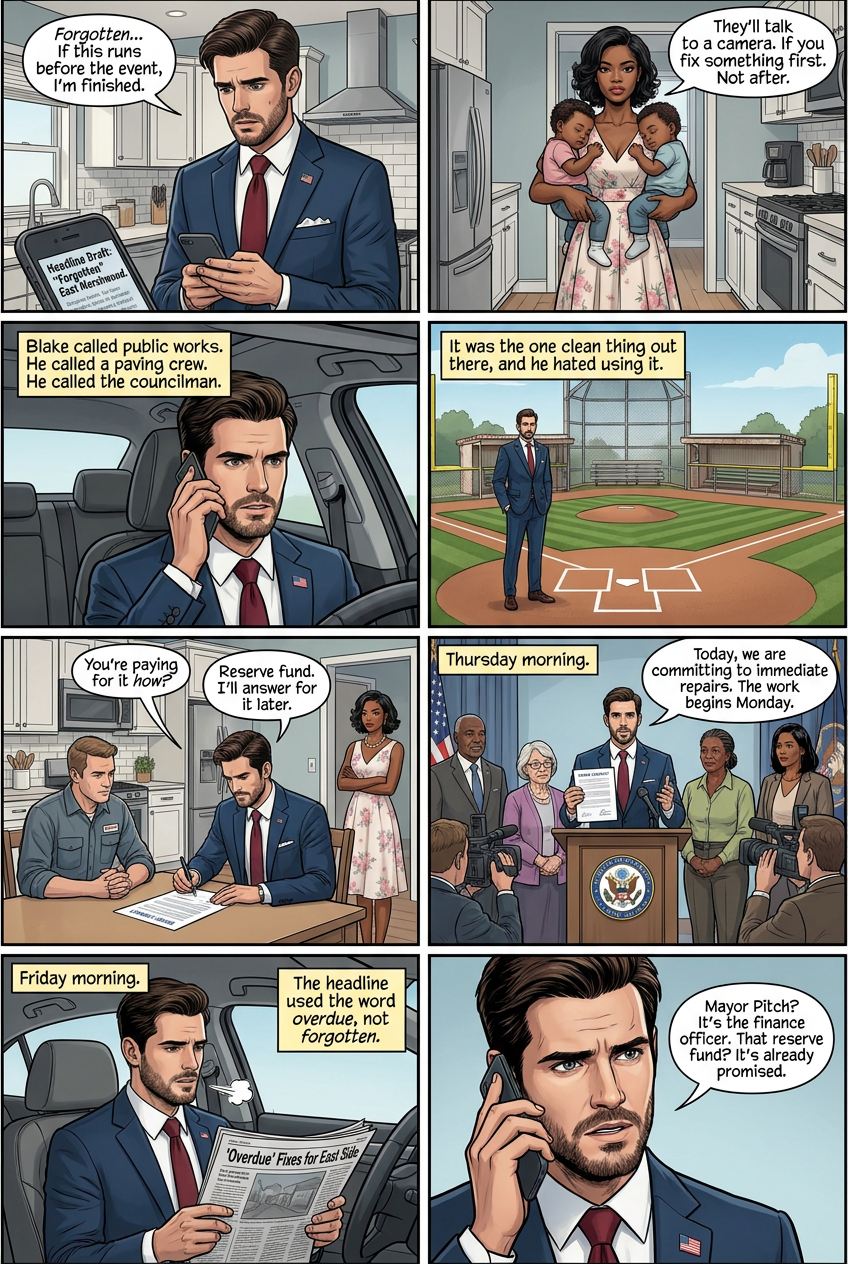
Blake Pitch read the email twice and set his phone face-down on the kitchen counter. A regional paper had a reporter on the east side of Marshwood. She was filing Friday. The headline draft used the word forgotten. If it ran before his event, every promise he was about to make would sound like a cover-up. He had been mayor of Marshwood four years. He was forty-four, a former soldier, and he used to drive the long way around the east side so he wouldn't see the potholes. That stopped after a councilman buried a child killed at one of those intersections. Now Blake wanted the town, and the state, and anyone reading a paper, to call Marshwood a safe haven. He had two days. Lovelie came in from the porch with the twins asleep against her shoulders. Her floral dress was creased from carrying them. She had spent the morning on the east side again and come back with a list of names in her phone. "They'll talk to a camera," she said. "If you fix something first. Not after." "Friday," Blake said. "Then fix something by Thursday." He called the public works director from the car. He called a paving crew he had used for a school lot. He called the councilman who had lost the child and asked him to stand at a podium with him. Then he drove to the little league field on the east side, the one a booster club had restored last spring. Crisp baselines. Fresh paint on the dugouts. A backstop that didn't sag. It was the one clean thing out there, and he hated using it, and he used it. By Wednesday night, a contractor sat at his kitchen table with a repair contract. Six intersections. New signals at two. Sidewalks on the block where the boy had died. The contractor initialed each page. Blake signed at the bottom. Lovelie watched from the doorway and did not smile. "You're paying for it how?" she asked. "Reserve fund. I'll answer for it later." "You will." Thursday morning, Blake stood at home plate with the councilman beside him and the signed contract in his hand. Lovelie had brought three east-side residents she trusted. A grandmother. A shop owner. The mother of the boy from the intersection. They spoke first. He spoke second, and shorter than he wanted to. He held up the contract and named the start date. Cameras ran. The regional reporter stood in the third row and wrote fast. Her story ran Friday morning. The headline used the word overdue, not forgotten. It quoted the grandmother. It quoted the mother. It quoted him last. Blake read it in the car and exhaled once. Then his phone rang. It was the city finance officer, and her voice was tight. The reserve fund he had just committed was already promised somewhere else.
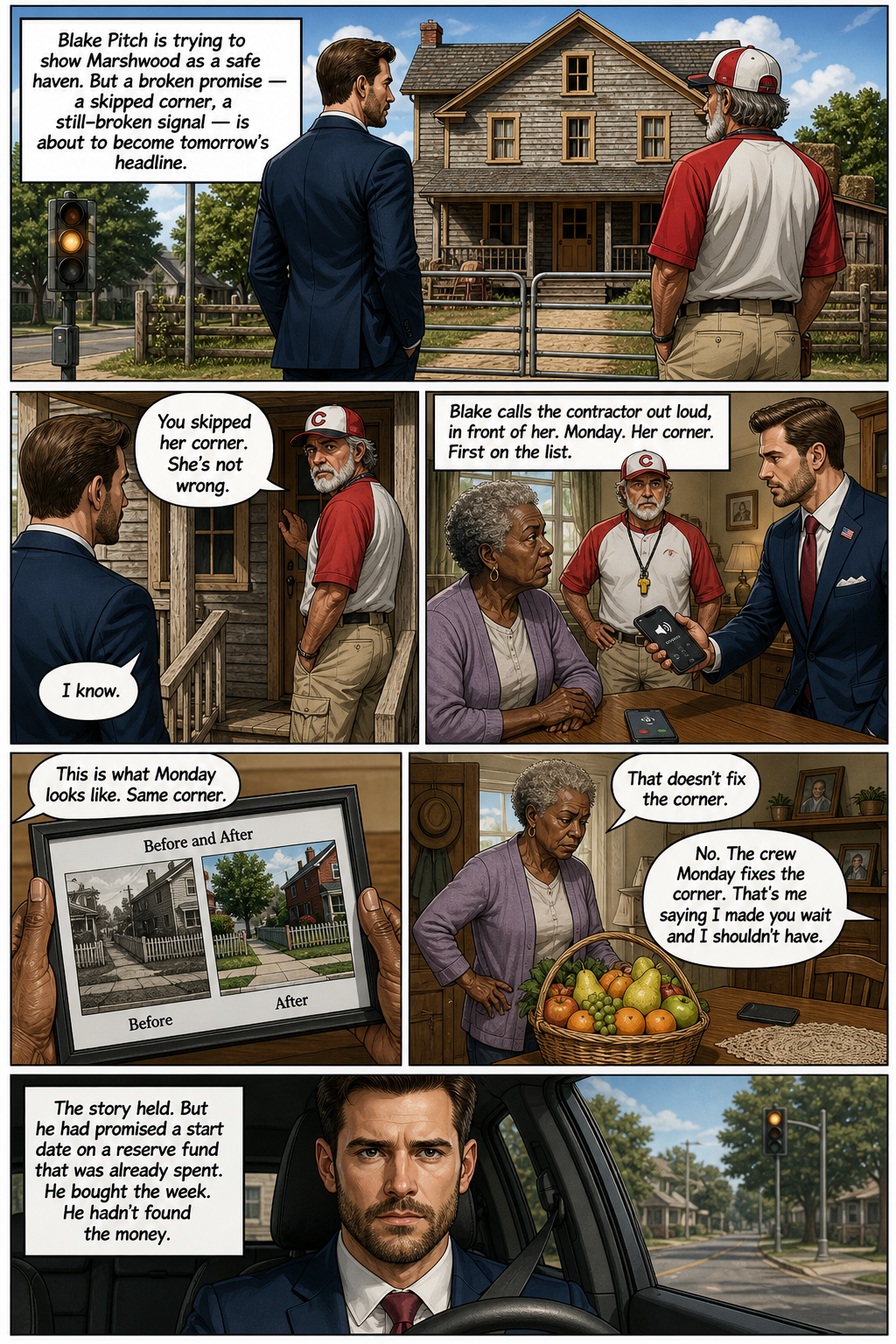
Blake was still holding the finance officer's call in his head when Lovelie showed him her phone. The grandmother who had spoken at home plate was talking to the reporter again. A fresh complaint. The signal at her corner still blinked yellow. The crew had skipped her block for the next job. If it ran, the story would flip from overdue to broken promise overnight. "She won't take my call," Blake said. "She'll take his," Lovelie said. "Send someone she believes." Blake thought of the Little League coach from the east side. The man had run the same team for years and never missed a season. Half the block had played for him. Blake called him first. Coach Mike Henderson met him at the grandmother's gate an hour later. He wore a cap and a whistle he hadn't taken off. He studied Blake a moment before he spoke. "You skipped her corner," Henderson said. "She's not wrong." "I know." "Then don't tell her she's wrong." Henderson went up the steps and knocked. The grandmother opened the door, saw the cap, and let them both in. The reporter's number sat open on the table beside her. Blake didn't make an excuse. He pulled out his phone and called the contractor on speaker, in front of her. He moved her signal to the top of the list. Start date Monday. The contractor confirmed it and read the corner back. The grandmother listened. She didn't soften yet. "I heard that before," she said. Henderson spoke once. "He fixed my field. The lights work now. He did it before he needed the vote." He didn't say more. Blake set a framed photo on her table. Two pictures, side by side. Her corner last year, cracked and dark. Her corner next to it after a crew painted and paved, taken from a block that had already been done. "This is what Monday looks like," he said. "Same corner." She picked it up and held it a long time. Then Blake carried in the basket he'd brought from the car, fruit and greens stacked high, grown off a farm outside town. It was small and he knew it. He set it by the door anyway. "That doesn't fix the corner," she said. "No. The crew Monday fixes the corner. That's me saying I made you wait and I shouldn't have." She set her phone face-down. She didn't call the reporter. "Monday," she said. "I'll be watching from that window." Outside, Henderson stopped at the gate. "You bought one block," he said. "There's forty more like her." Blake drove home with the save intact and the reporter quiet. The story held. But the contractor's confirmation ran through his head. He had just promised another start date, on the same reserve fund the finance officer swore was already spent. He had bought the week. He had not found the money.
Play your story to life
Storycraft is a mobile game where you create AI characters, craft items and locations to build their world, then discover what direction your story takes. Download the iOS game for free today!
Download for free