

Bogart the Boat Salesman's Arc
10 Chapters
Bogart the Boat Salesman's dream is keeping everyone safe while boating on the waters.

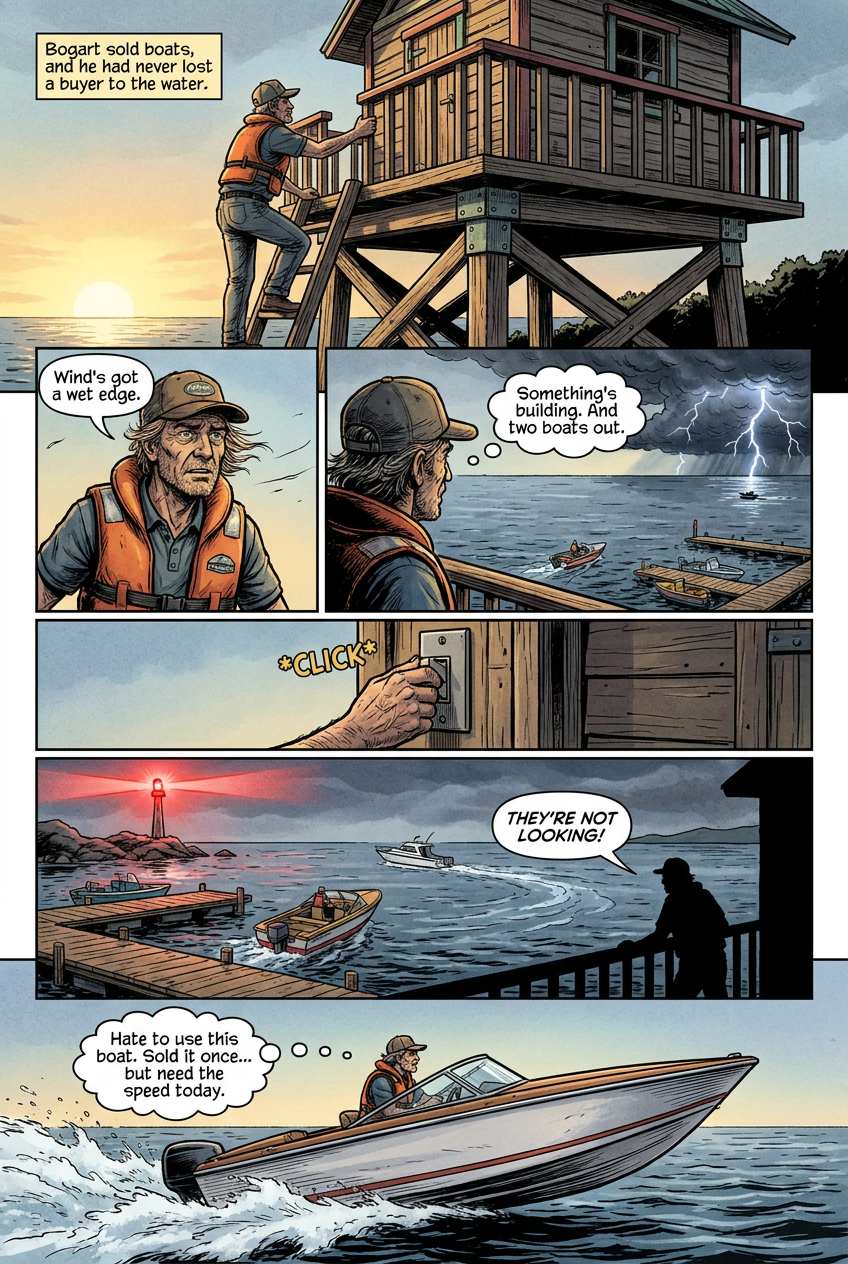
Bogart sold boats, and he had never lost a buyer to the water. He kept that record by climbing the wooden lookout at the edge of his lot three times a day. He wore his life jacket buckled tight, the same one he clipped on in front of every customer before he handed over keys. He climbed the ladder now because the air had changed. The wind had a wet edge to it, the kind that meant something was building past the far shore. From the platform he saw the cloud. It rose over the north water in dark stacked layers, and lightning forked inside it. The lake under it had already turned slate gray. Two boats were still out. One sat near the reeds, close enough to wave in. The other was a white speck pointed the wrong way, north, straight at the storm. He slid down the ladder so fast his palms burned. At the rock that broke the surface a hundred yards off his dock, he had bolted a red warning lamp to a steel pole. He hit the switch on the wall of his shed. The lamp began to flash across the water in hard red pulses. The boat near the reeds turned at once and started back. The white speck kept going. They were not looking behind them. Bogart ran to the far end of his lot, where the boat he hated to sell sat covered under a tarp. He had sold that boat once, and he thought about that buyer every morning. Today he needed the speed. He ripped the tarp off, threw his canvas bag of spare jackets and flares onto the seat, and turned the key. The engine caught on the first try. He shoved the throttle forward and the bow lifted clear of the dock chop. Fifteen minutes later he was close enough to read the name on the stern of the white boat. A woman and a boy sat in the cockpit, hunched against spray, still pointed at the wall of cloud. He cut across their bow and forced them to stop. He threw two life jackets over the rail and shouted at them to buckle. The boy fumbled the straps; Bogart leaned over and snapped the clip himself. The first heavy wave hit while he was still aboard their boat. Water came over the side and soaked his shoes. He got them turned, tied a short tow line to their cleat, and ran both boats south toward his lot at half throttle. The red lamp on the rock guided them in. By the time they bumped against his dock, the rain had started, and the woman was crying. Everyone was breathing. Bogart tied off the lines and looked north. The cloud was still coming, and there was one boat he had not seen yet.
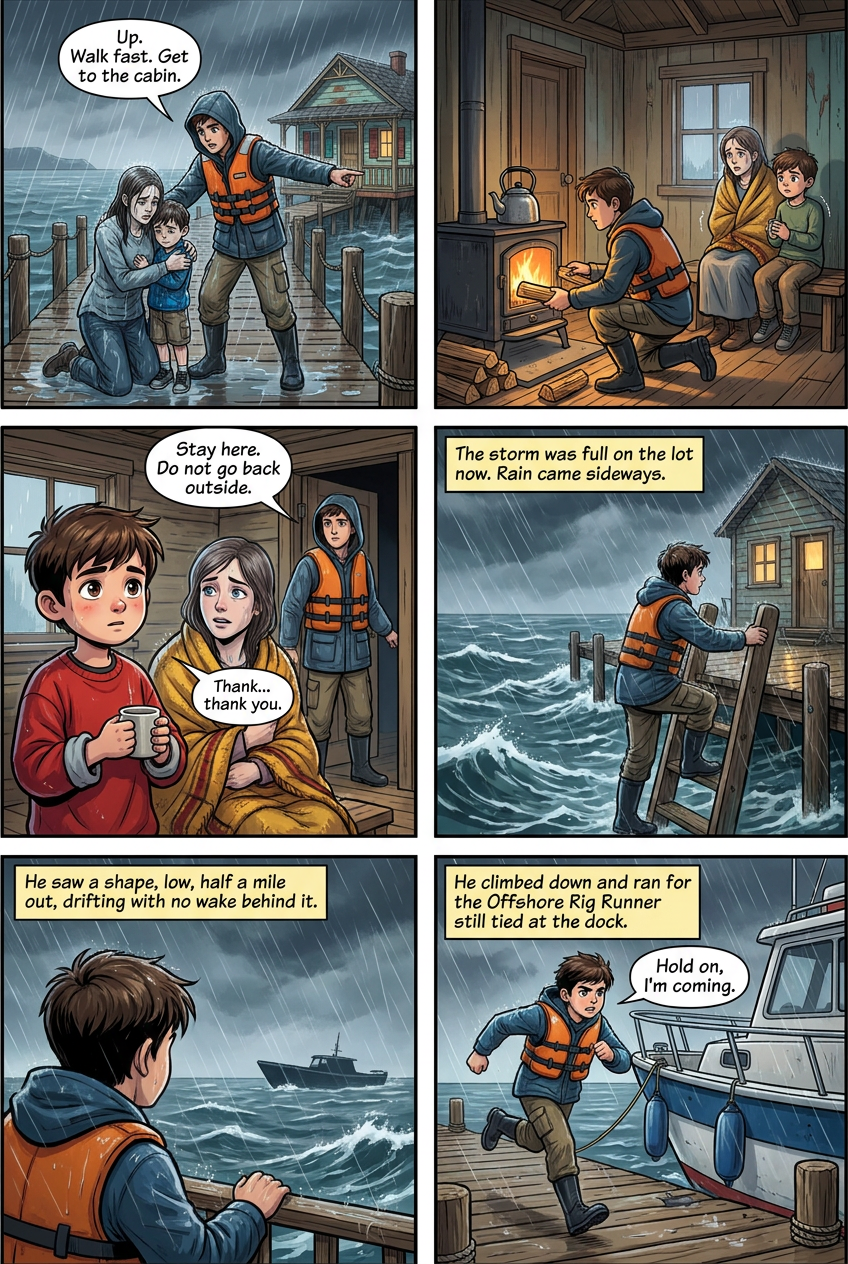
The rain came down harder now. The woman sat on the dock with her arms around the boy, both of them soaked through and shaking. Bogart tied off the last line and looked at them. Their lips were going pale. The wind pushed cold water across the planks. He needed them warm, and he needed it in the next few minutes. He looked down the dock. Past the row of small boats tied along the mooring posts sat the little cabin he used as an office. It had a woodstove inside and a kettle on top. He hooked the woman under the elbow and lifted the boy against his hip. "Up," he said. "Walk fast." They stumbled with him past the moored boats, past the coiled lines, up the three steps to the cabin porch. He shoved the door open with his shoulder. Inside, he sat them on the bench by the stove and opened the iron door. Coals still glowed from that morning. He fed in two split logs and worked the damper. Then he crossed to the wooden chest under the window. He pulled out a folded wool blanket, thick and heavy, and wrapped it around the woman. From the shelf above he grabbed a red sweatshirt, oversized and soft, and pulled it down over the boy's head. The sleeves swallowed the boy's hands. Bogart rolled them back twice. The kettle started to tick as the stove caught. The woman's shaking slowed. The boy leaned against her side and closed his eyes. Bogart poured hot water over two tea bags and pressed the mugs into their hands. "Stay here," he said. "Do not go back outside." The woman nodded. She tried to say thank you and her voice broke. Bogart stepped onto the porch and pulled the door shut behind him. The storm was full on the lot now. Rain came sideways. He walked back to the end of the dock and climbed halfway up the lookout ladder, one hand on the wet rail. From there he could see the north water. Whitecaps rolled under the black cloud. He scanned for the third boat. He saw a shape, low, half a mile out, drifting with no wake behind it. No running lights. He climbed down and ran for the Offshore Rig Runner still tied at the dock, its engine cold now, its bow already knocking hard against the fenders.
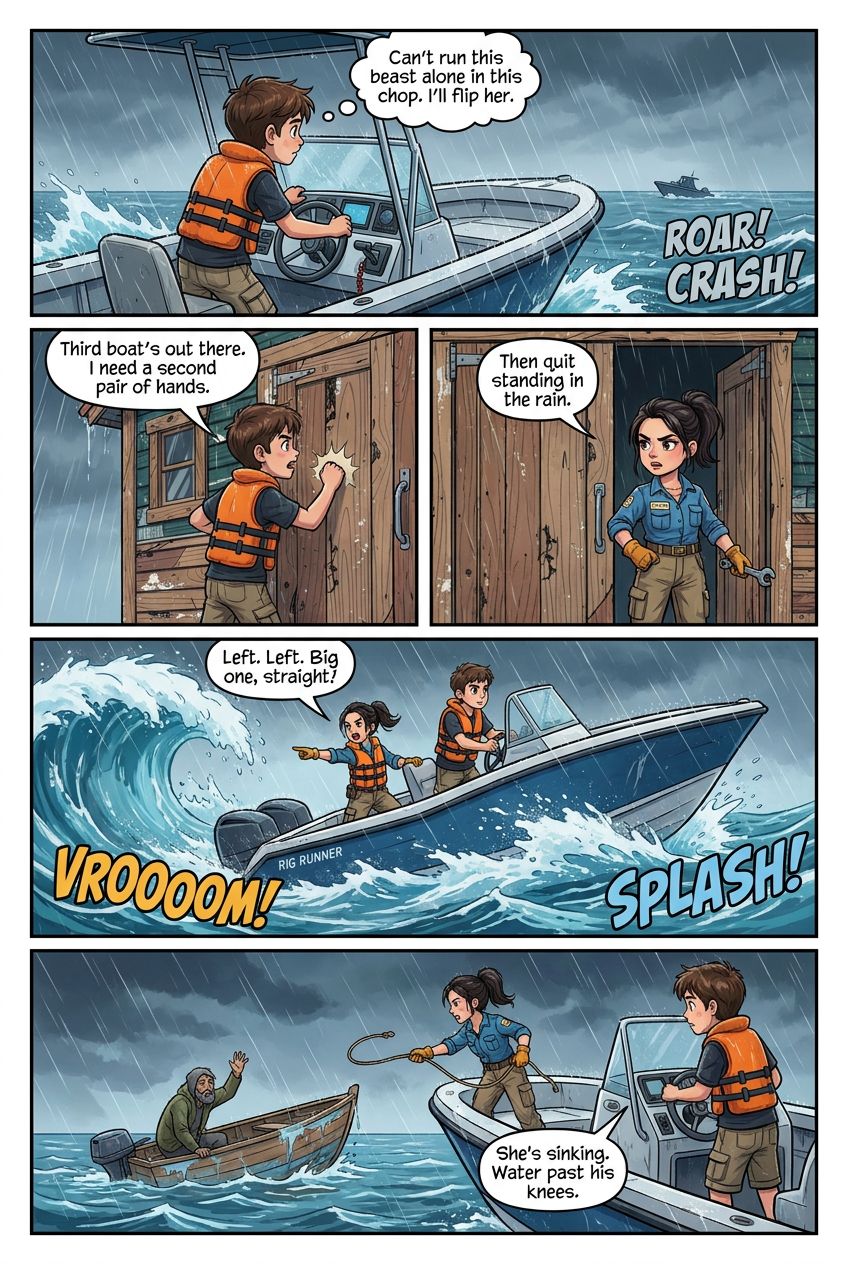
Bogart jumped onto the deck of the Offshore Rig Runner and grabbed the wheel. The boat bucked hard against the fenders. Rain hammered the windshield. He turned the key and the twin engines coughed, caught, roared. He looked at the empty co-pilot seat and knew the truth. The Rig Runner threw eighty knots on flat water. In this chop, alone, he would flip her before he cleared the breakwater. He killed the throttle and stared at the drifting shape on the black water half a mile out. He needed a second pair of hands, and he needed them now. He ran back down the dock toward the weathered boathouse at the end of the row. The peaked roof shed sheets of rain. He pounded on the dockside doors. Diane Harborson pulled one open, work gloves already on, a wrench in her other hand. She ran the repair slip and owed him for a winter of stored fuel he never billed. "Third boat is out there," Bogart said. "I can't run the Rig Runner alone." Diane looked past him at the water. Her jaw set. She dropped the wrench in a bucket, grabbed a life jacket off a hook inside the boathouse, and buckled it across her chest before she stepped out. "Then quit standing in the rain," she said. They ran back together. Bogart buckled his own jacket tight and pulled a spare over Diane's shoulders as backup. She took the co-pilot seat and braced her boots against the console. Bogart cut the lines. He eased the throttle forward, then pushed harder as the bow lifted. Diane called the swells before they hit. "Left. Left. Big one, straight." He carved the wheel with her voice. The Rig Runner climbed a wall of water, dropped, climbed again. Twice the hull slammed sideways and Diane's hand shot to the throttle beside his, easing them down before he could roll. They cleared the breakwater. The drifting boat came into view, low in the water, one figure hunched at the stern waving both arms. Bogart brought the Rig Runner alongside and held her steady against the wind while Diane threw the line. It caught. The figure lashed it to the cleat. Bogart exhaled once, then looked at the hull of the drifting boat. Water sloshed inside past the man's knees. She was sinking, and the tow back would be slower than the storm coming down on top of them.
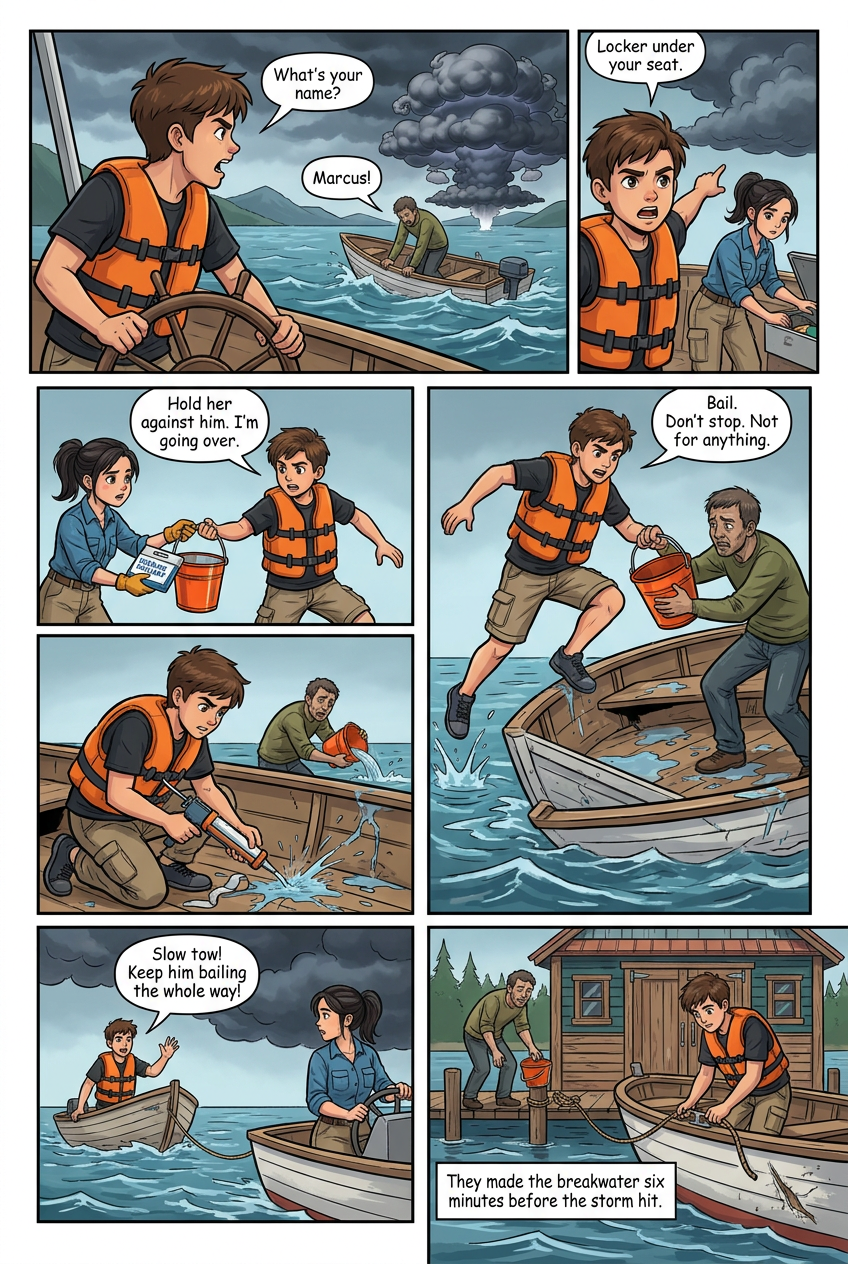
Bogart held the Rig Runner steady against the wind and stared at the water climbing the drifting boat's hull. The tow line was set, but the moment he throttled up, the drag would pull that stern down and take his own with it. He shouted across the gap at the hunched figure. "What's your name?" The man cupped his hands. "Marcus!" Bogart pointed at the water sloshing past the man's knees. "You have to stay on that boat and keep her floating till we reach the dock. Can you do that?" The man nodded, quick and scared. Bogart looked east. The next cell rolled toward them in a black wall, lightning stitched through the belly of it. Twenty minutes, maybe less. He could not tow a sinking hull that far. "Locker under your seat," he said to Diane. She yanked it open. Inside sat the sealant case he kept for hull work on the lot and the orange bucket he clipped to every demo boat before a test run. Bogart grabbed both. "Hold her against him. I'm going over." Diane took the wheel without a word. Bogart timed the swell, stepped onto the gunwale, and jumped. He landed hard in ankle-deep water on the sinking deck. The man caught his arm. Bogart shoved the bucket into his hands. "Bail. Don't stop. Not for anything." The man started scooping and dumping over the side. Bogart dropped to his knees and ran his palm along the inside of the hull until he felt the crack, a jagged split near the waterline behind the seat mount. Cold water pushed through it in a steady rope. He cracked the case open on the wet deck. He loaded a tube into the gun, jammed the nozzle against the split, and squeezed. Gray paste piled into the crack. He dragged the bead the length of the split, then again, thicker. He tore off a strip of waterproof tape with his teeth and pressed it over the sealant, smoothing it flat with his thumb. The rope of water thinned to a trickle. He found a second seep at the transom and hit it the same way. The man kept bailing. The level in the boat dropped an inch, then two. Bogart climbed back to the gunwale and waved to Diane. "Slow tow! Keep him bailing the whole way!" She eased the throttle. The line went tight. The sinking boat lifted, held, and followed. Bogart stayed aboard with the bailer, one hand on the sealed crack, watching the black cloud swell behind them. They made the breakwater six minutes before the storm hit. Diane brought them alongside the dock. The man climbed off on shaking legs. Bogart tied the boat off himself and checked the seal one more time. It was holding. Three people back, three boats accounted for. He looked at the Rig Runner's transom and saw a fresh gouge in the fiberglass where the tow line had dug in.
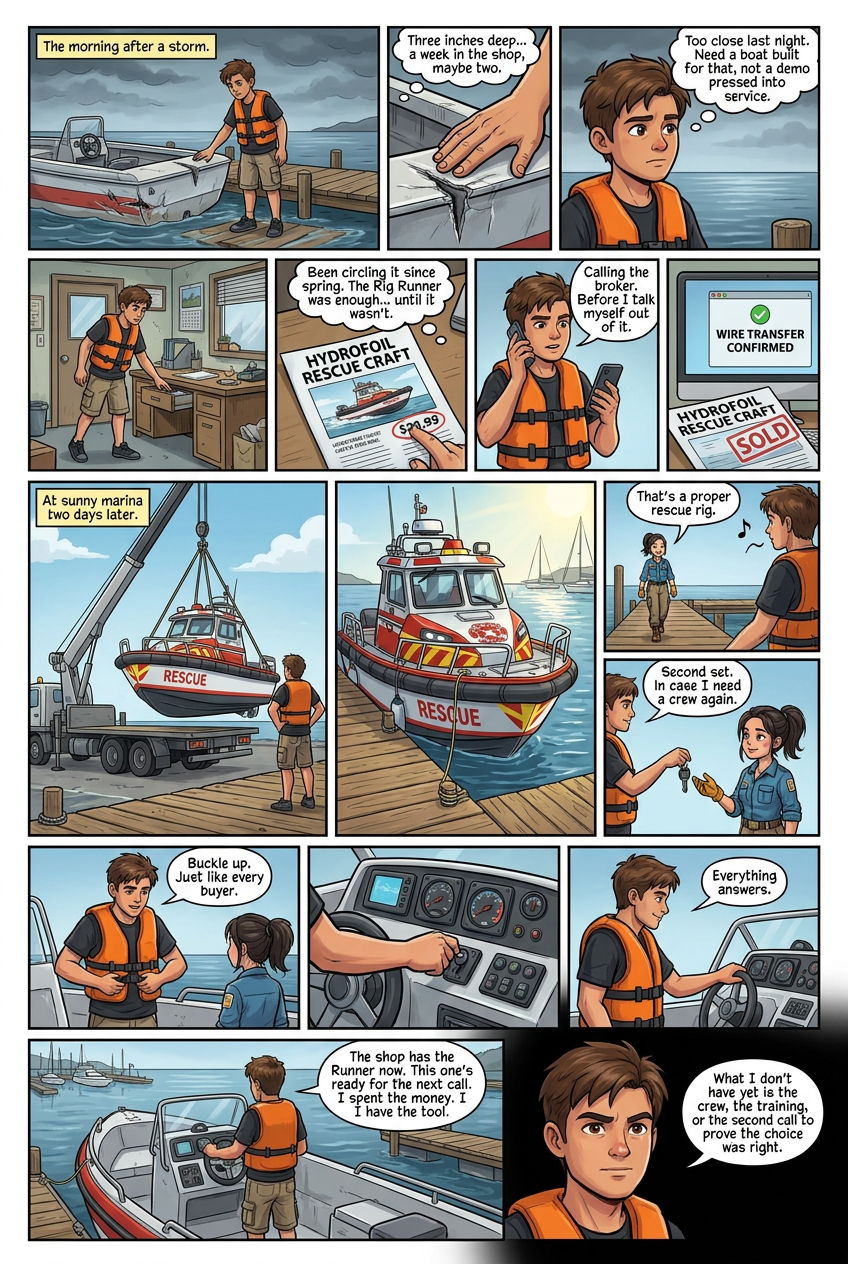
The storm passed by morning. Bogart stood on the dock and ran his hand over the fresh gouge on the Rig Runner's transom. The fiberglass was split three inches deep. He could patch it, but the boat would sit in the shop a week, maybe two. He thought about the sinking hull from the night before, about how close the tow had come to failing. He needed a boat built for that work, not a demo boat pressed into service. He walked up to the office and opened the folder he had kept in the desk drawer for six months. Inside was a printed listing for a hydrofoil rescue craft with a raised helm, twin engines, and grab rails welded along the gunwales. The price was steep. He had been circling it since spring, telling himself the Rig Runner was enough. He picked up the phone and called the broker before he could talk himself out of it. He wired the deposit that afternoon. The boat arrived two days later on a flatbed. Bogart met the driver at the harbor and watched the crane lower the hull into the slip alongside the tidy row of small boats tied at the mooring posts. The red and white paint was clean. The rescue detailing on the bow caught the sun. Diane Harborson walked down from the boathouse with her gloves tucked in her belt and stopped at the edge of the dock. She whistled once. "That's a proper rescue rig," she said. Bogart handed her a set of keys. "Second set. In case I need a crew again." She looked at the keys, then at him, and closed her hand around them without a word. Bogart buckled his life jacket in front of her, the way he did for every buyer, and stepped aboard. He ran the engines and checked the helm. Everything answered. He tied her off, climbed back onto the dock, and looked at the empty slip where the Rig Runner used to sit. The shop had it now. The new boat sat in its place, ready for the next call. He had spent the money. He had the tool. What he did not have yet was the crew, the training, or the second call to prove the choice was right.
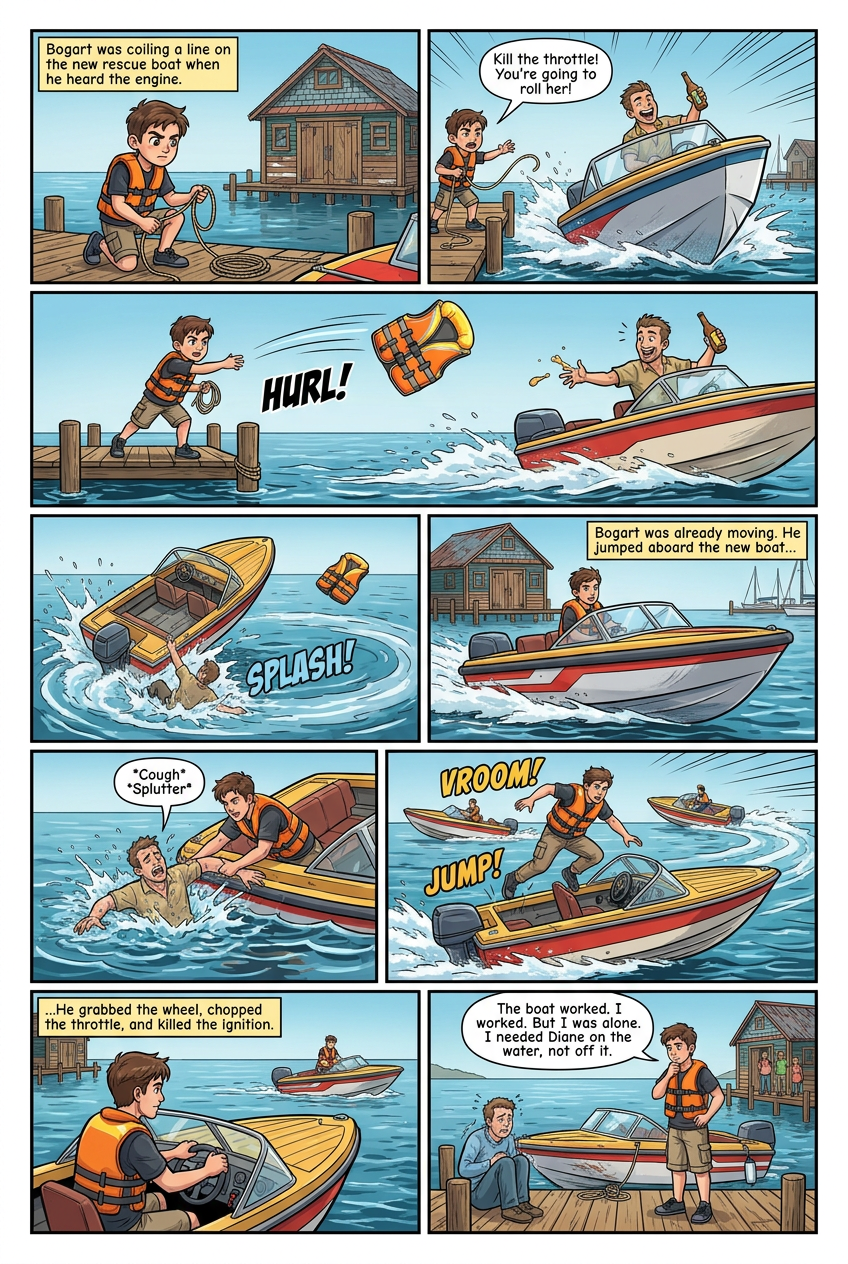
Bogart was coiling a line on the new rescue boat when he heard the engine. A small runabout ripped across the harbor at full throttle, throwing a wake that slapped the mooring posts of the marina. The driver stood at the wheel with a beer in one hand. No life jacket. No spotter. He cut hard between two moored boats and the hull skidded sideways. Bogart dropped the line. He knew that turn. One more like it and the boat would flip. He ran to the boathouse and pulled an inflatable vest off the wall peg. He shouted up toward the boathouse loft for Diane. No answer. Her truck was gone from the gravel. He was alone on the dock with a boat he had never run in a real call. The runabout came around again, closer to shore this time. Bogart cupped his hands. "Kill the throttle! You're going to roll her!" The driver laughed and raised the beer. Bogart measured the distance. Thirty yards, maybe less on the next pass. He grabbed the vest by its straps, wound up, and hurled it out over the water. It landed square in the boat's path. The driver saw it late, jerked the wheel, and the runabout heeled hard. The beer flew. The driver went over the low side and hit the water. The runabout kept going, circling on its own, engine screaming. Bogart was already moving. He jumped aboard the new boat, keyed the engines, and threw off the lines with one hand. The twin motors caught. He eased out of the slip, then opened the throttle once he cleared the marina. The driver was thrashing thirty yards out. No vest. The tossed one bobbed past him, out of reach. Bogart brought the hydrofoil around upwind and cut power. He killed his engines so the props wouldn't drag near the man, then leaned over the gunwale and caught his wrist on the second try. He hauled him up onto the deck. The man coughed water and swore. Bogart pushed him flat and looked for the runaway boat. It was still circling, faster now, arcing toward the moored line where a family stood watching from a dock. Bogart restarted the engines. He caught the runabout on the outside of its arc, matched its speed, and jumped across. His water shoes slipped on the wet deck. He grabbed the wheel, chopped the throttle, and killed the ignition. The boat coasted to a stop fifty feet from the moored line. Back at the dock, Bogart tied both boats off. The driver sat on the planks, shivering, ticketed by his own stupidity. Bogart looked at the new rescue boat. The paint was scraped along one rail where the runabout had rubbed. The boat had worked. He had worked. But he had been alone. If the man had gone under, he could not have driven and pulled at the same time. He needed Diane on the water, not off it.
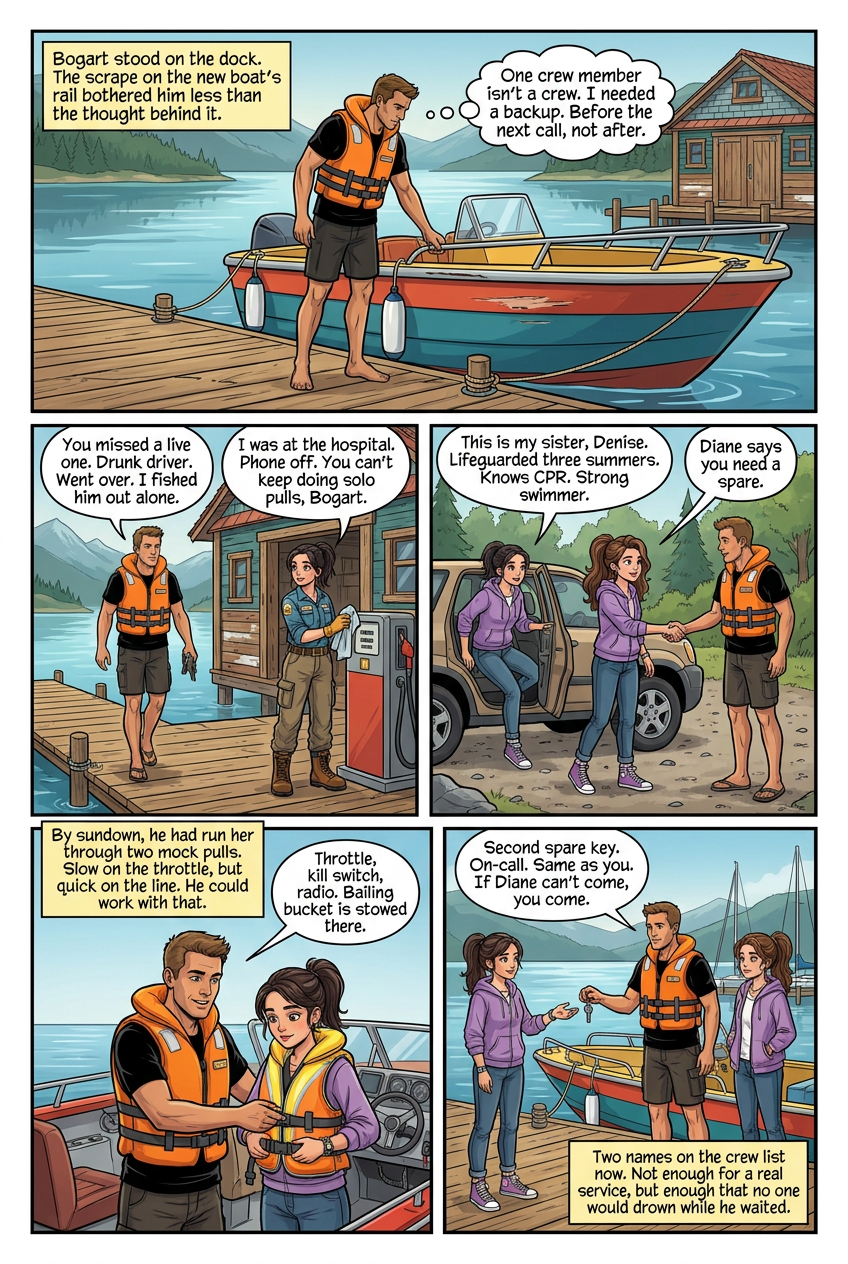
Bogart tied the runabout off and stood on the dock for a long minute. The scrape on the new boat's rail bothered him less than the thought behind it. One crew member was not a crew. He needed a backup, and he needed one before the next call, not after. He walked up to the boathouse and found Diane at the fuel pump, wiping grease off her hands with a rag. She wore her work shirt and heavy boots. Her hair was pulled back tight. She had been his one favor, then his one partner, and she was still only one person. "You missed a live one," Bogart said. "Drunk driver. Went over. I fished him out alone." Diane grimaced. "I was at the hospital with my mother. Phone was off." She looked at the scrape on the rail. "You can't keep doing solo pulls, Bogart." "That's why I'm asking. Is there anyone you'd trust on that deck if you couldn't be there?" Diane thought about it. Then she pulled her phone from her pocket and made a call. Twenty minutes later a small SUV parked on the gravel and a young woman climbed out. Purple hoodie, jeans, sneakers already wrong for a dock. She had Diane's eyes and about half her weight. "My sister," Diane said. "Denise. She lifeguarded three summers at the town pool. She knows CPR and she can swim better than I can." Denise stuck her hand out. "Diane says you need a spare." Bogart shook her hand. It was smaller than he wanted, but the grip was steady. "I need someone who won't freeze when a man goes under. Can you drive a boat?" "Not like her," Denise said, nodding at her sister. "But I can learn the helm. And I can pull a body out of the water. I've done it twice." Bogart looked at Diane. Diane nodded once. He took Denise down to the slip. He put a vest on himself and buckled it in front of her, the way he did with every buyer. Then he handed her one and watched her clip it right the first time. Good sign. He walked her through the throttle, the kill switch, the radio, the boarding ladder. She asked where the bailing bucket was stowed before he pointed to it. By sundown he had run her through two mock pulls off the dock. She was slow on the throttle and quick on the line. He could work with that. Bogart handed Diane a second spare key and told her to give it to her sister. "On-call," he said. "Same as you. If Diane can't come, you come." Denise pocketed the key. Bogart looked at the new boat in its slip. Two names on the crew list now. Not enough for a real service, but enough that no one would drown while he waited for Diane to answer her phone.
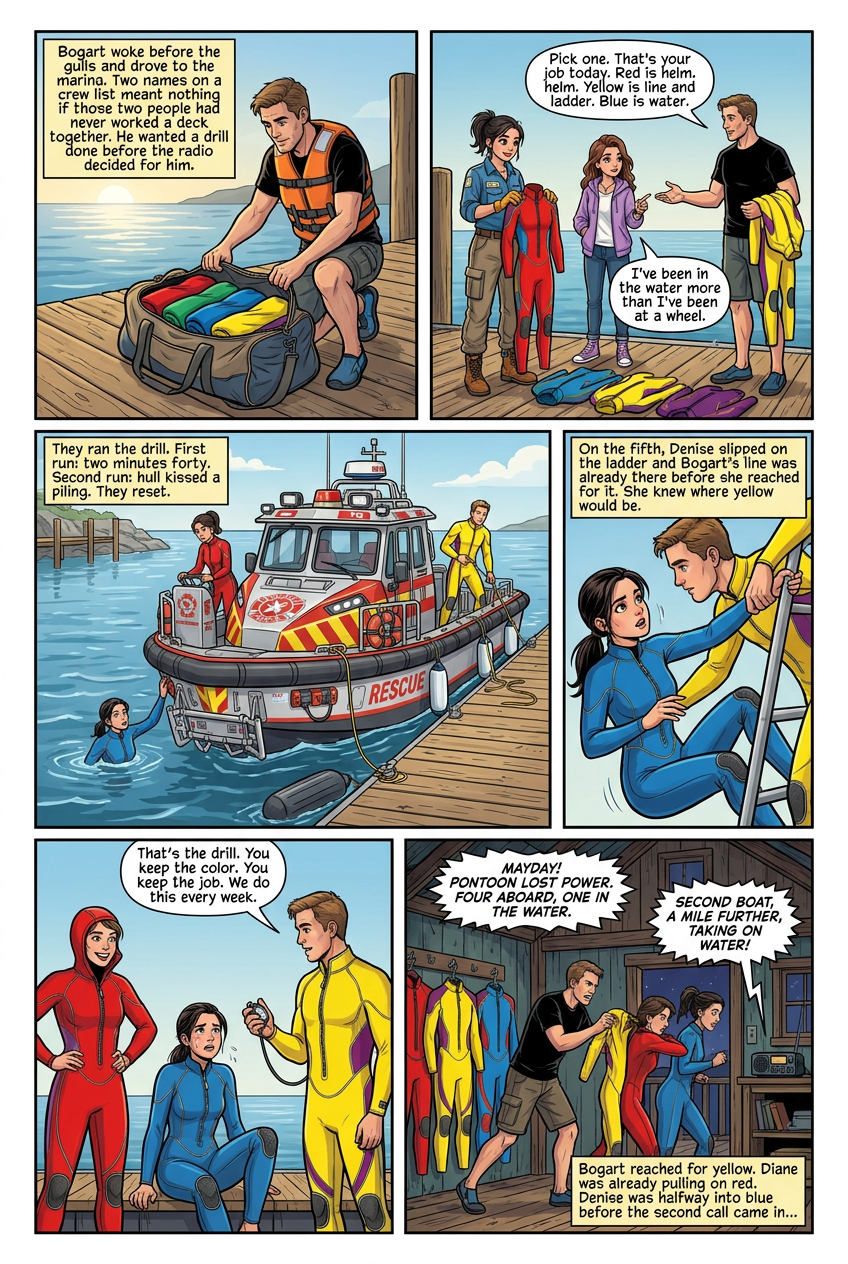
Bogart woke before the gulls and drove to the marina with a duffel bag on the passenger seat. Two names on a crew list meant nothing if those two people had never worked a deck together. If a call came in tonight, Diane and Denise would be strangers reaching for the same line. Someone would trip. Someone in the water would go under while they figured it out. He wanted a drill done before the radio decided for him. He unzipped the bag on the dock. Inside were five wetsuits, each a different color. Red, green, blue, yellow, purple. He had ordered them the week the new boat arrived and never opened the box. He laid three out on the boards. Diane came down the ramp first, boots loud on the wood. Denise followed in her purple hoodie and sneakers, a coffee in her hand. She stopped when she saw the suits. "Pick one," Bogart said. "That's your job today. Red is helm. Yellow is line and ladder. Blue is water — you go in if we need a swimmer." Diane grabbed red without asking. Denise looked at yellow, then blue. "I've been in the water more than I've been at a wheel," she said, and took blue. Bogart pulled the yellow suit on over his shorts. "Then I'm line today. You call the colors on the radio. Not names. Colors. Names get confused when someone's screaming." They ran the first drill off the dock. Bogart threw a fender into the slip and started the clock on his watch. Diane brought the rescue boat around clean. Denise went in cold and had the fender at the ladder in under a minute. Bogart worked the line and pulled her up. Two minutes forty. They ran it again. Diane came in too hot and the hull kissed a piling. She swore. They reset. By the fourth run Denise was climbing the ladder without help and Diane was feathering the throttle like she'd been doing it for years. Two minutes ten. Bogart called a fifth anyway. On the fifth, Denise slipped on the ladder and Bogart's line was already there before she reached for it. She didn't have to look. She knew where yellow would be. He stopped the clock. "That's the drill. You keep the color. You keep the job. We do this every week." Diane peeled the hood back and grinned. Denise sat on the dock, breathing hard, and looked at the blue suit like it belonged to her now. Bogart hung all three suits on hooks inside the boathouse, in order. Red, yellow, blue. Ready. That night the radio crackled at nine forty. A pontoon had lost power two miles out, four people aboard, one in the water. Bogart reached for yellow. Diane was already pulling on red. Denise was halfway into blue before the second call came in — a second boat, a mile further, taking on water.
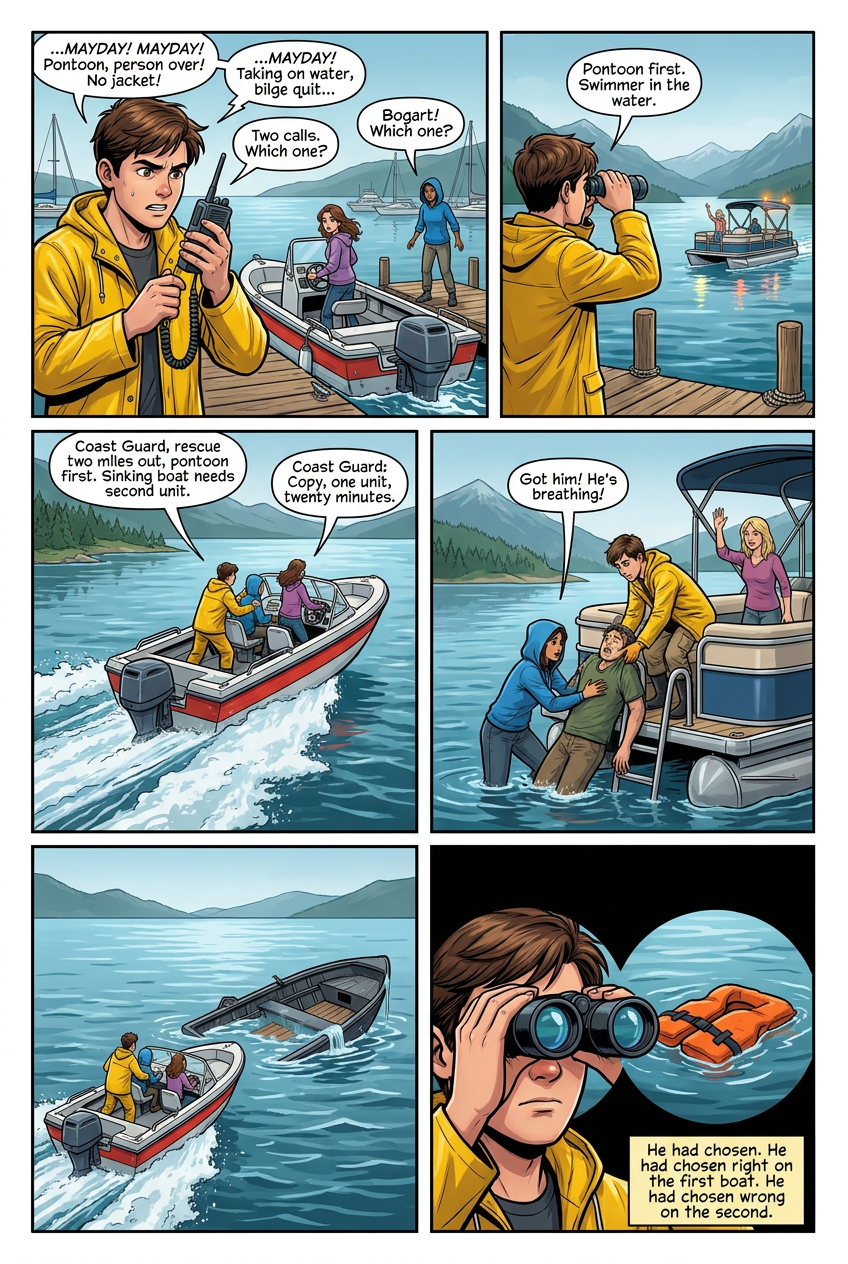
The second call came in on top of the first. Bogart froze with the yellow suit half on. A pontoon two miles out, one person in the water. A sinking boat a mile past that. Two boats. One crew. He had to choose which one they ran to first, and the wrong choice meant a body. He grabbed the scanner off the counter and turned the squelch down. Both mayday channels bled through the speaker. The pontoon caller was a woman, shouting. Her husband had gone over the rail. He wasn't wearing a jacket. The sinking boat was a man, calm, saying his bilge pump had quit and the water was at his knees. Diane was already at the wheel of the rescue boat, engine warm. Denise stood on the dock in blue, hood up. They watched him. "Which one?" Diane called. Bogart ran to the end of the dock and lifted the binoculars. He found the pontoon first. Its running lights were on. He saw a woman waving both arms above her head. He couldn't see anyone in the water near her. He swung the glasses further out. The second boat sat low, no lights, just a shape against the dark water. No one on deck that he could see. He lowered the binoculars. A man in the water without a jacket had minutes. A boat taking on water slow had longer, unless it rolled. "Pontoon first," he said. "Swimmer in the water, no jacket. We grab him and run to the second boat after." Diane nodded once. Denise stepped onto the deck and clipped in. "Call the coast guard on the second," Bogart told the scanner mic. "Rescue crew is two miles out, pontoon first. Sinking boat needs a second unit if you have one." A voice came back. One unit, twenty minutes out. That was all. Diane pushed the throttle forward. The hydrofoil lifted and the marina fell behind them. Bogart braced against the rail with the line coiled at his boot. Denise crouched at the gunwale, watching the black water ahead. They found the pontoon in four minutes. The woman was still waving. Denise was over the side before Diane cut the engine. She came up with the husband under one arm, coughing but breathing. Bogart pulled them both to the ladder. Two minutes on deck, jacket on the man, blanket around him. Diane already had the boat turning. They ran for the second boat at full speed. They saw it from a hundred yards out. The deck was empty. The cabin was dark. Water was over the gunwale on the low side. Bogart lifted the binoculars again. He saw an orange jacket in the water, twenty yards off the stern, face down. He had chosen. He had chosen right on the first boat. He had chosen wrong on the second.
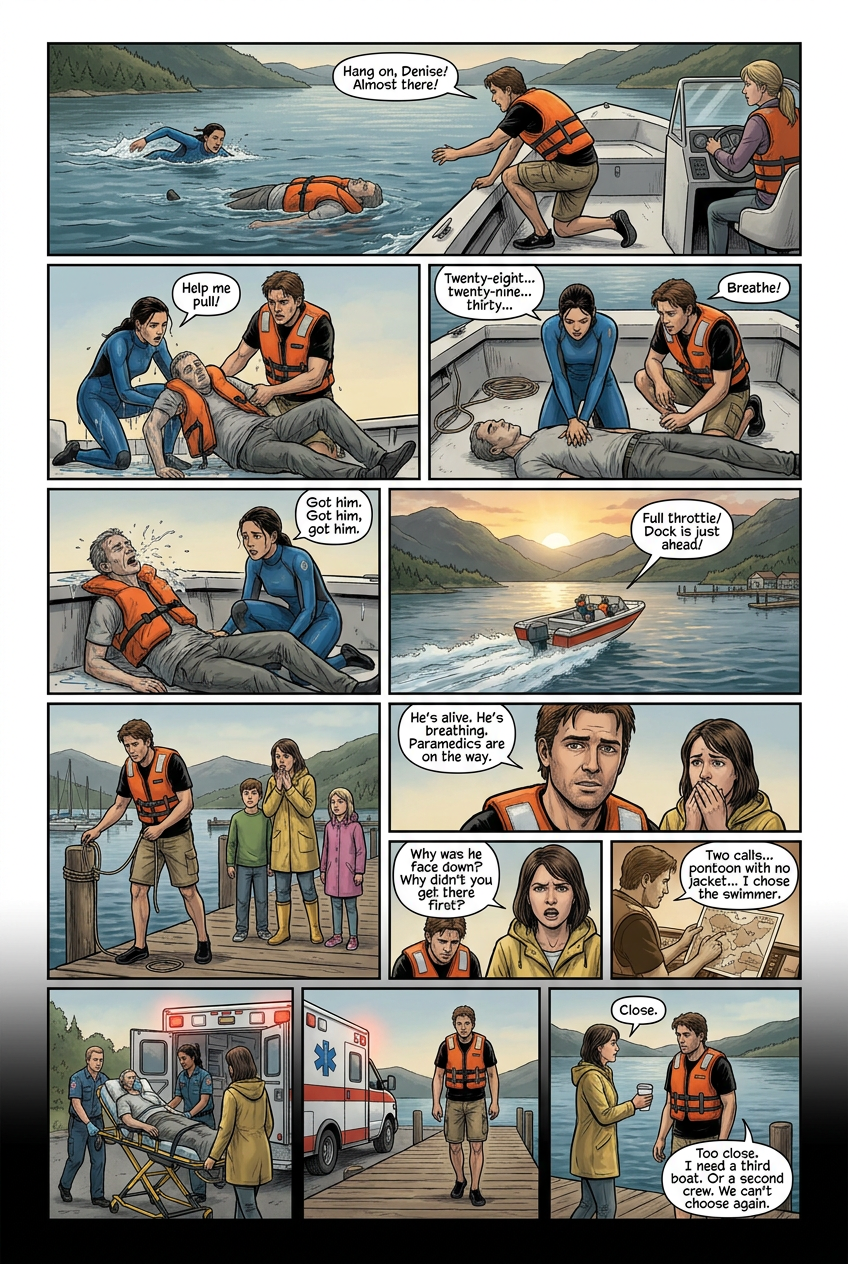
Denise was over the side before the boat stopped. She hit the water in her blue suit and swam hard for the orange jacket. Bogart watched her flip the man over. She got an arm under his chin and started kicking back toward the hull. Diane threw the ladder. Bogart went down on his knees at the gunwale and reached. The man was gray. His lips were blue. Bogart hauled him up by the jacket straps and laid him flat on the deck. Denise came up the ladder streaming water and dropped beside him. She put her ear to his mouth, then her hands on his chest. "No breath," she said. She started compressions. Bogart counted for her. At thirty she tilted the head and gave two breaths. Water came out of his mouth. She turned him on his side. He coughed. He coughed again and pulled a long ragged breath. "Got him," Denise said. Her voice shook. "Got him, got him." Diane already had the throttle down. The hydrofoil lifted and ran for the dock. Bogart held the man's shoulder and kept the jacket clear of his throat. The man's eyes opened halfway. He looked at Bogart and closed them again. The dock lights were on when they came in. A small group waited at the end of the boards. A woman in a raincoat. Two grown children. Someone older behind them, holding the rail. Word had traveled on the scanner. They had come for a body. Bogart tied off himself. He walked down the dock to meet them before anyone else could. His legs felt loose. "He's alive," he said. "He's breathing. The paramedics are on the way." The woman put both hands over her mouth. The daughter grabbed her mother's arm. The son stepped past Bogart and ran to the boat. Denise was still on her knees beside the man, keeping him on his side. "Why was he face down?" the woman said. "Why didn't you get there first?" Bogart had known the question was coming. He had rehearsed nothing. "There were two calls," he said. "A man in the water off a pontoon with no jacket. Your husband had his jacket on. I sent my crew to the swimmer first. I made that call. It cost him minutes. I'm sorry." She looked at him a long time. Then she nodded once and walked past him to the boat. The ambulance came. They took the man on a stretcher with an oxygen mask over his face. He lifted one hand as they wheeled him off the dock. His wife walked beside him and did not look back. Bogart stood on the boards until the lights were gone. Diane came up beside him with two coffees and put one in his hand. "Close," she said. "Too close," Bogart said. "I need a third boat. Or a second crew. We can't choose again."
Play your story to life
Storycraft is a mobile game where you create AI characters, craft items and locations to build their world, then discover what direction your story takes. Download the iOS game for free today!
Download for free