

Borin Ironforge's Arc
20 Chapters
Borin Ironforge's dream is training an apprentice worthy of inheriting the hammer and carrying the craft into the next age..

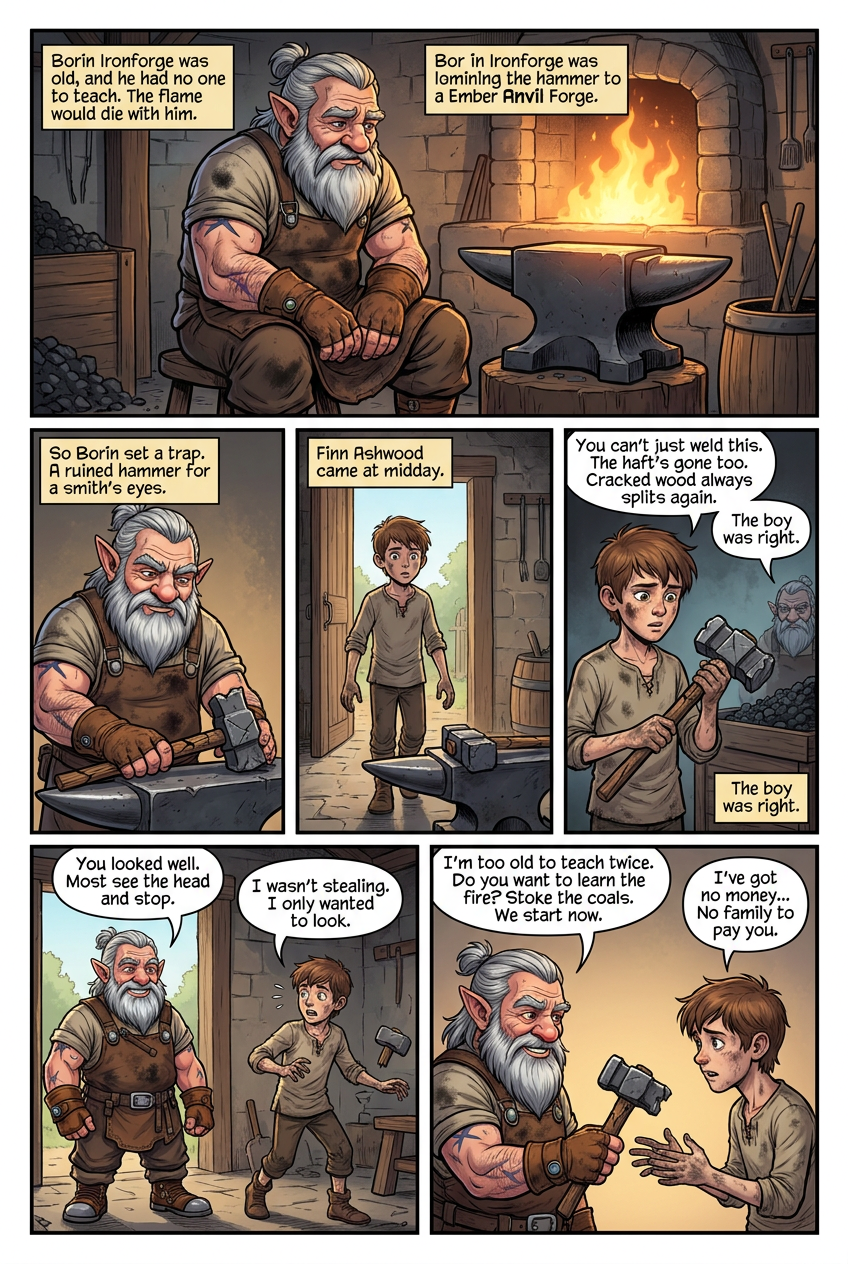
Borin Ironforge was old, and he had no one to teach. That truth sat heavier than any anvil. He was sixty years past his first hammer stroke, grey now, with hands still hard as the iron he beat. His forge glowed hot every dawn, but the fire meant nothing without a boy to carry it forward. When Borin died, the flame would die too. No dwarf's son had come. No village father had sent a child. Craft this old should not end with one stubborn man. So Borin set a trap. He dragged a broken warhammer onto his workbench and left it where any visitor would see. The head was split. The haft was cracked halfway through. Anyone could see it was ruined. Borin wanted to see who might try to fix it anyway. He propped the door open, banked the fire low, and waited near the coal bin, out of sight. The boy came at midday. Borin knew him, the orphan who mucked stalls two doors down. Finn Ashwood, thin, quick-eyed, with a shock of brown hair and dirt under his nails. The boy had no father to speak for him and no coin to offer. He stepped inside slow, like a stray dog testing a warm room. Finn saw the hammer first. He picked it up and turned it over. Borin held his breath. A fool would swing it. A dreamer would set it down. Instead the boy ran his thumb along the split head and frowned. "You can't just weld this," Finn said aloud, to no one. "The haft's gone too. Cracked wood always splits again." Borin's chest tightened. The boy was right. Finn found a scrap of oak by the wood pile. He measured it against the broken haft, hand to hand. Then he studied the anvil, the tongs, the cold coals, working out an order in his head. He never noticed the smith watching from the shadows. Borin stepped out. His boots scraped the stone. Finn spun, dropped the hammer, and backed toward the door. "I wasn't stealing," the boy said fast. "I only wanted to look." "You looked well," Borin said. His smile broke wide across his grey beard. "You saw the haft. Most see the head and stop." Finn stared, unsure whether to run. "I'm too old to teach twice," Borin said. "So I'll only ask once. Do you want to learn the fire?" The boy's mouth opened. He looked at the anvil, then the forge, then his own dirty hands. "I've got no money," he said. "No family to pay you." "I didn't ask for money." Borin held out the broken hammer. "Stoke the coals. We start now." Finn took it. His hands shook, but he gripped the haft the way a smith should. Borin turned to the fire and felt something ease in his chest. The craft had a boy now. The forge would outlive him. But the boy knew nothing yet, and Borin had little time to teach him everything.
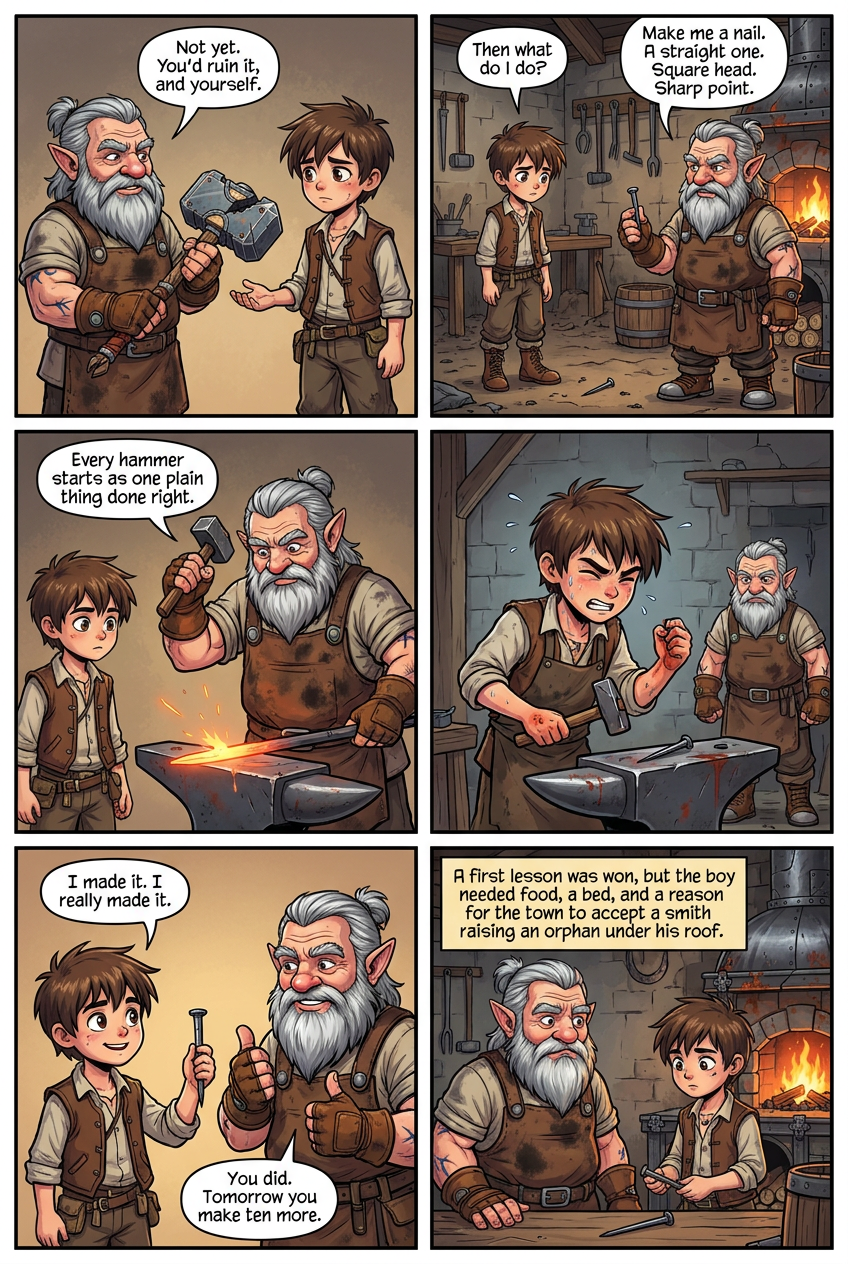
The next morning Finn stood at the anvil with the broken hammer in his hands. Borin watched the boy's shoulders. Finn wanted to fix the great warhammer today. Borin knew the truth. That work would break the boy's spirit before it built his skill. A first lesson had to be small enough to finish and hard enough to matter. Borin's forge held no such task ready. Borin took the hammer from Finn's hands and set it on a high shelf. "Not yet," he said. "You'd ruin it, and yourself." Finn's face fell. "Then what do I do?" Borin looked around the smithy for an answer. Tongs. Files. A bucket of scrap iron by the coal. His eye stopped on a bent nail in the dirt. He picked it up and held it to the light. "Make me a nail," Borin said. "A straight one. Square head. Sharp point." Finn stared. "A nail? That's all?" "That's all," Borin said. "Every hammer starts as one plain thing done right." He showed the boy how to stoke the coals until they glowed white. He set a thin iron rod in the fire and waited. When the tip turned orange, he laid it on the anvil and struck. Three blows drew the point. He turned the rod, cut it, and shaped the head with quick taps. Then he dropped the finished nail hissing into water. "Now you," Borin said. Finn's first try bent under the hammer. His second cooled too fast and cracked. Sweat ran down his face. He gripped the tongs too tight and burned his knuckle on the hot iron. He hissed but did not quit. Borin said nothing. He only watched the boy's hands learn the rhythm. On the sixth try Finn drew the point clean. He turned the rod the way Borin had shown him. He tapped the head square. He dropped the nail into the water and lifted it out. The nail was straight. The head was even. The point would bite wood. Finn held it up. His hand shook, and this time not from fear. "I made it," he said. "I really made it." Borin took the nail and tested the point against his thumb. It was true work. Not perfect, but honest. The boy could learn. The craft would hold. "You did," Borin said. His smile broke wide. "Tomorrow you make ten more." But Borin's ease did not last. He watched Finn set the nail on the bench like a treasure and knew a plain nail could not feed the boy. Finn had no coin and no home. He had slept in a stable last night. A first lesson was won, but the boy needed food, a bed, and a reason for the town to accept a smith raising an orphan under his roof.
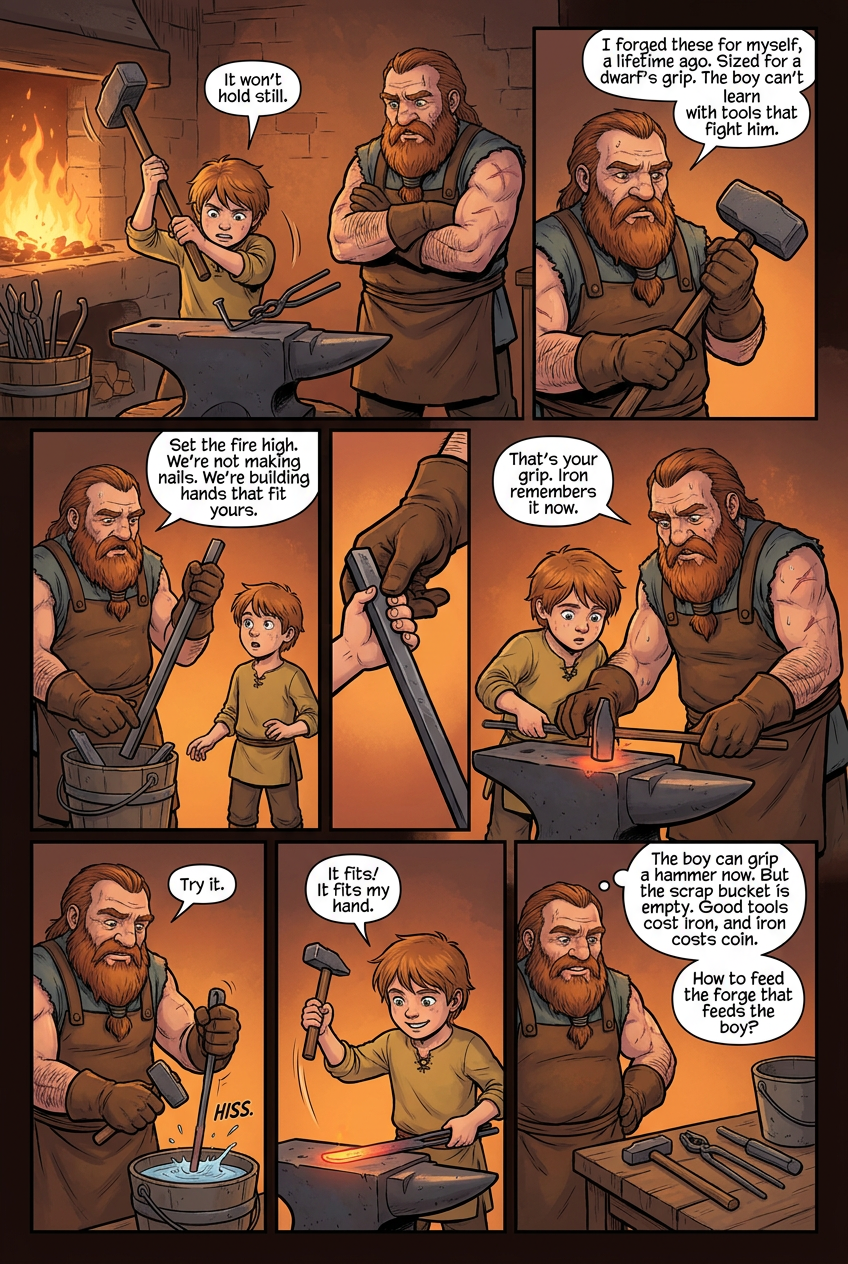
The next morning Finn came early, ready to make his ten nails. Borin handed him the tongs and the hammer. But the boy's hand swallowed neither well. The tongs were made for Borin's thick fingers. The hammer haft was as wide as Finn's wrist. Finn gripped it, and the head wobbled on the downswing. His first nail bent sideways. His second slipped from the tongs and rolled into the coals. "It won't hold still," Finn said. He shook out his aching hand. Borin took the hammer back and turned it in the firelight. He had forged these tools for himself, a lifetime ago. Every one was sized for a dwarf's grip. The boy could not learn the craft with tools that fought him. Skill meant nothing if the hand could not close on the handle. "Set the fire high," Borin said. "We're not making nails today." Finn stared. "Then what?" "Your own tools." Borin pulled a bar of iron from the scrap bucket. "A smith who can't hold a hammer is no smith. So we build hands that fit yours." He heated the bar until the tip glowed. Then he wrapped Finn's fingers around the cold end and had the boy squeeze. He marked where each finger fell. "That's your grip," Borin said. "Iron remembers it now." They worked through the morning at the old forge. The fire roared behind its scorched stone arch. Borin drew a thin haft on the anvil, half the width of his own. He let Finn hold each piece and say if it sat right. When the boy shook his head, they heated it again. Sweat ran down both their faces. By midday they had a small hammer. The head was light. The haft was thin and smooth. Borin dropped it hissing into the water and lifted it out. "Try it," he said. Finn closed his hand around the new haft. His fingers met clean, no gap, no strain. He raised it and brought it down on a scrap of hot iron. The blow landed square. He struck again. The rhythm held. "It fits," Finn said. His smile broke wide. "It fits my hand." They shaped tongs next, narrow at the grip, and a punch the boy could hold without pain. By dusk Finn had a full set on the bench, each one sized for him alone. He ran his thumb along the small hammer like it was made of gold. Borin watched and felt the craft settle a little deeper into the boy. But a new weight pressed on him. Good tools cost iron, and iron cost coin. He had spent a day's stock on this set and would spend more as the boy grew. The scrap bucket sat near empty now. Finn could grip a hammer at last. Feeding the forge that fed the boy was the next problem, and Borin had no answer for it yet.
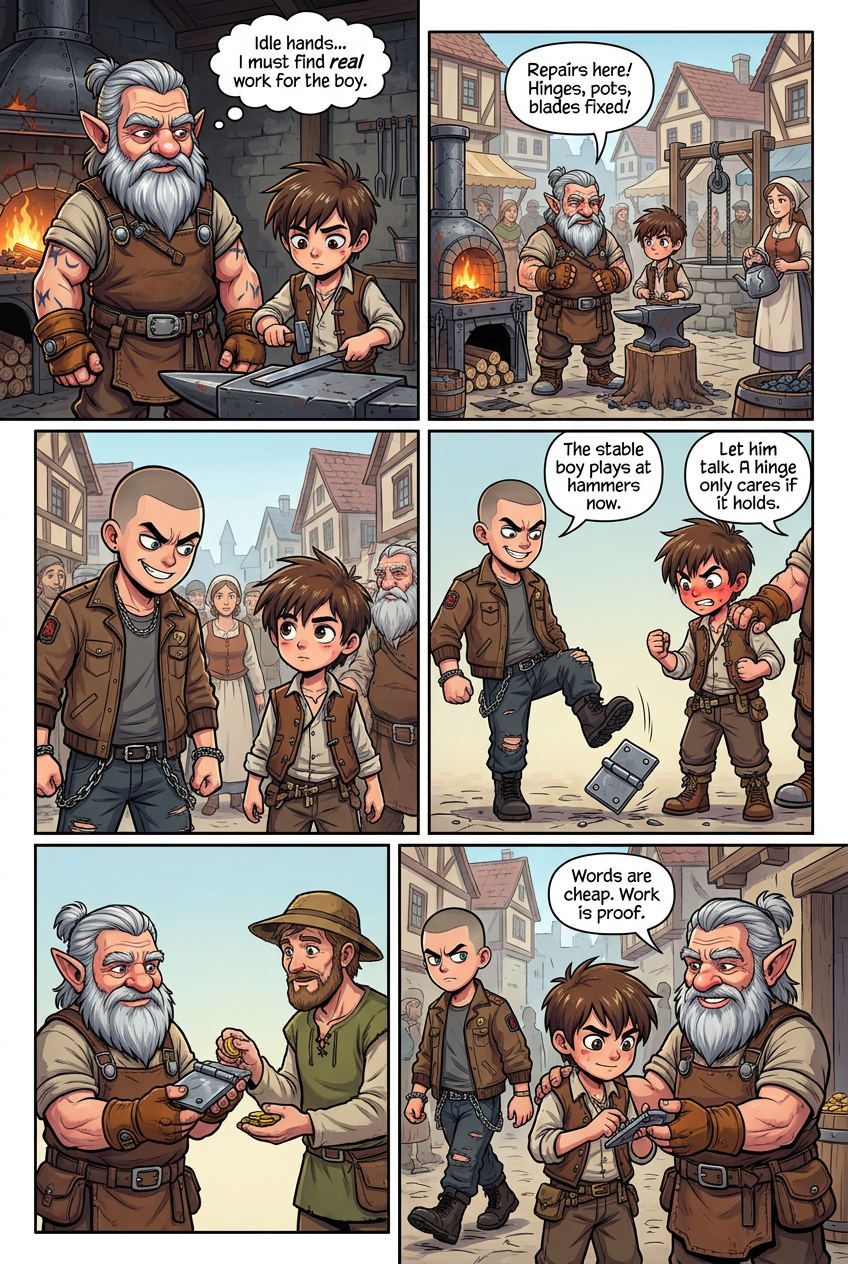
The new tools lay clean on the bench. Finn came each morning and gripped his small hammer, but there was little to strike. Borin had no orders, no work to set before the boy. He watched Finn tap at cold scrap, then set the hammer down. A smith learns by doing real work, not by fiddling. Idle hands would let the boy's raw skill fade before it ever set. Borin knew this town held no rush of customers for a poor smith and a stable boy. So he decided to make the work himself. He would take Finn to the market square and offer repairs on the spot. People always broke hinges, pots, and blades. If Borin found jobs, Finn would have iron to shape and reasons to swing. They set up near the well with a small brazier and the anvil hauled on a cart. Borin called out. A woman brought a cracked kettle. A farmer needed a bent plow point straightened. Finn worked beside him, holding tongs, learning the heat. By noon coins clinked in the pouch, and the boy's hands moved surer with each fix. Then a shadow fell across the anvil. Derek Malone stood over them, a broad-shouldered boy with a shaved head and a chain looped at his belt. He was the town bully, and every child near the well drifted back when he came. He looked at Finn and grinned without warmth. "The stable boy plays at hammers now," Derek said. He kicked the cart. A finished hinge rolled into the dirt. "Should be shoveling dung, not pretending you're a craftsman." Finn's face went red. His hand tightened on the small hammer. Borin set a heavy palm on the boy's shoulder and held him still. "Let him talk," Borin said, low. "A hinge doesn't care who mocks it. It only cares if it holds." He picked the hinge from the dirt, blew it clean, and passed it to the waiting farmer. The man paid and nodded thanks. Derek's grin cracked. He had no answer for coin changing hands. Derek spat near the fire and shoved off through the crowd. Finn let out a shaking breath. "He's not wrong," the boy muttered. "They all think it." "They watched you fix that plow," Borin said. "Words are cheap. Work is proof." He handed Finn the next job, a snapped latch. The boy took it and set it in the coals. By dusk the pouch was full and the cart empty of broken things. Borin had his answer now. The forge did not need to wait for work to come. He would carry the work to the square each week, and Finn would learn on real iron, paid for by real hands. The boy had steady practice at last. But Derek had walked off angry, shamed before the crowd. Borin knew that kind of boy. The insult was settled. The grudge was not.
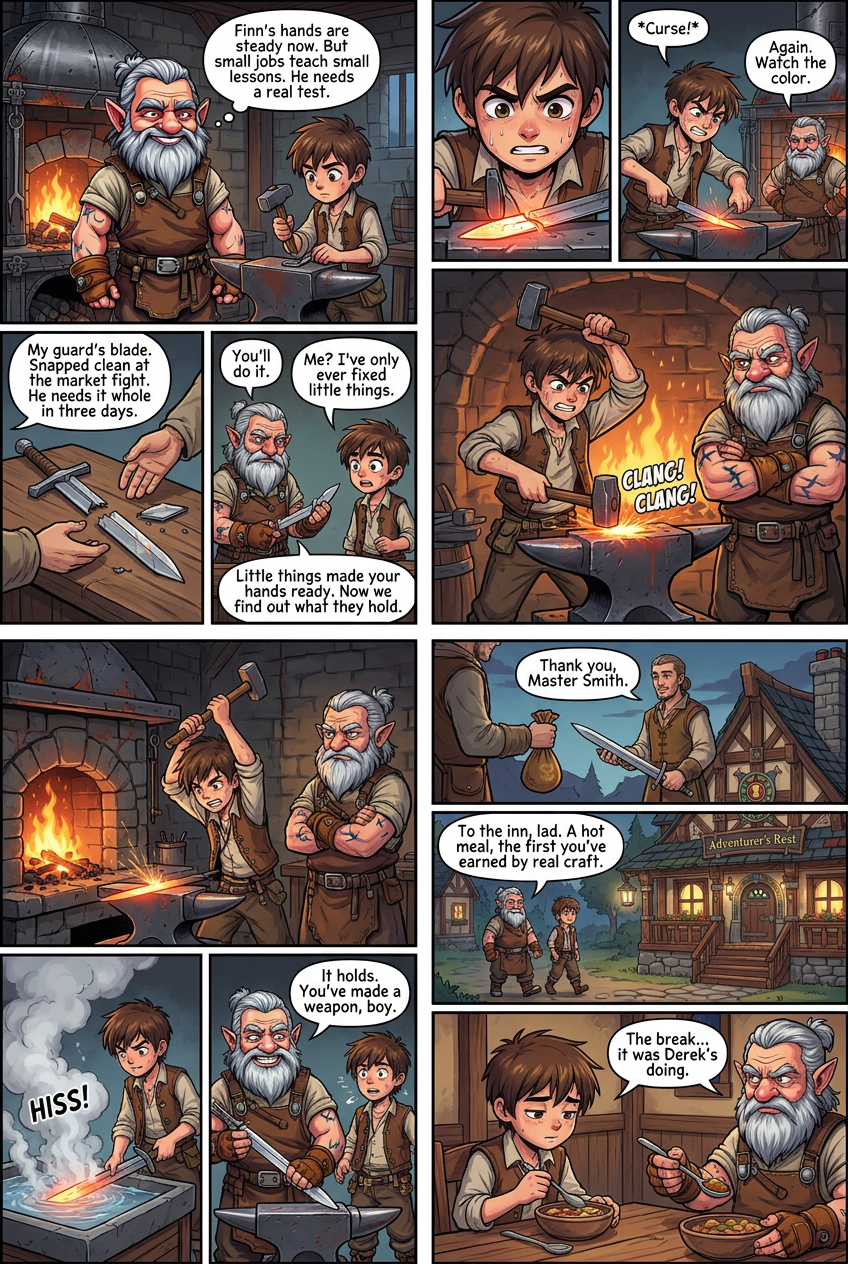
The weekly market trips gave Finn steady work, but Borin saw the truth by the fourth trip. Every job was small. Hinges, kettles, bent latches. The boy fixed them fast now. His hands no longer shook at the coals. But small jobs teach small lessons. Borin knew a smith needed one hard task to prove he could carry the craft. He had none to give. His iron stock ran thin, and no such work walked through his door. Then it did. A traveler stopped by the forge one gray morning. She led a tired horse and carried a man's sword across both arms. "My guard's blade," she said. "Snapped clean at the market fight last week. He rides for the coast in three days. He needs it whole." Borin took the sword. The break ran ugly through the middle of the blade. This was no hinge. Reforging a broken blade meant heat control, hammer rhythm, and patience across long hours. It could break a young smith's nerve. Borin looked at the coals glowing red in his forge. He looked at Finn. "You'll do it," Borin said. Finn stared. "Me? I've only ever fixed little things." "Little things made your hands ready. Now we find out what they hold." Borin set the two pieces on the anvil. "I'll stand beside you. But you swing the hammer." The day was long. Finn buried the steel in the coals and drew it out white-hot. His first weld failed. The seam split cold, and the boy cursed under his breath. Borin said nothing. He only nodded at the fire. Finn heated it again. He watched the color the way Borin had taught him. This time he struck true, folding the metal into itself with steady blows. Sweat ran down the boy's face. His arms shook by the tenth heat. But he did not set the hammer down. He worked the seam, drew the edge, and cooled the blade in the trough. Steam hissed to the rafters. When the steel came clear, the join held. The line of the weld showed faint but solid. Borin ran his thumb along it. He tested the flex. The blade sang. He had watched many smiths in his years. Few finished their first blade without quitting. "It holds," he said. His grin broke wide across his gray beard. "You've made a weapon, boy." The traveler returned at dusk. She paid without a word of complaint and rode off with the mended sword. That night Borin walked Finn to the inn for a hot meal, the first the boy had earned by real craft. But over stew, Finn spoke low. "The break came from the market fight," he said. "That was Derek's doing." Borin set down his spoon. The blade was mended. Yet the boy who broke it walked free, and now he knew Finn's name carried weight.
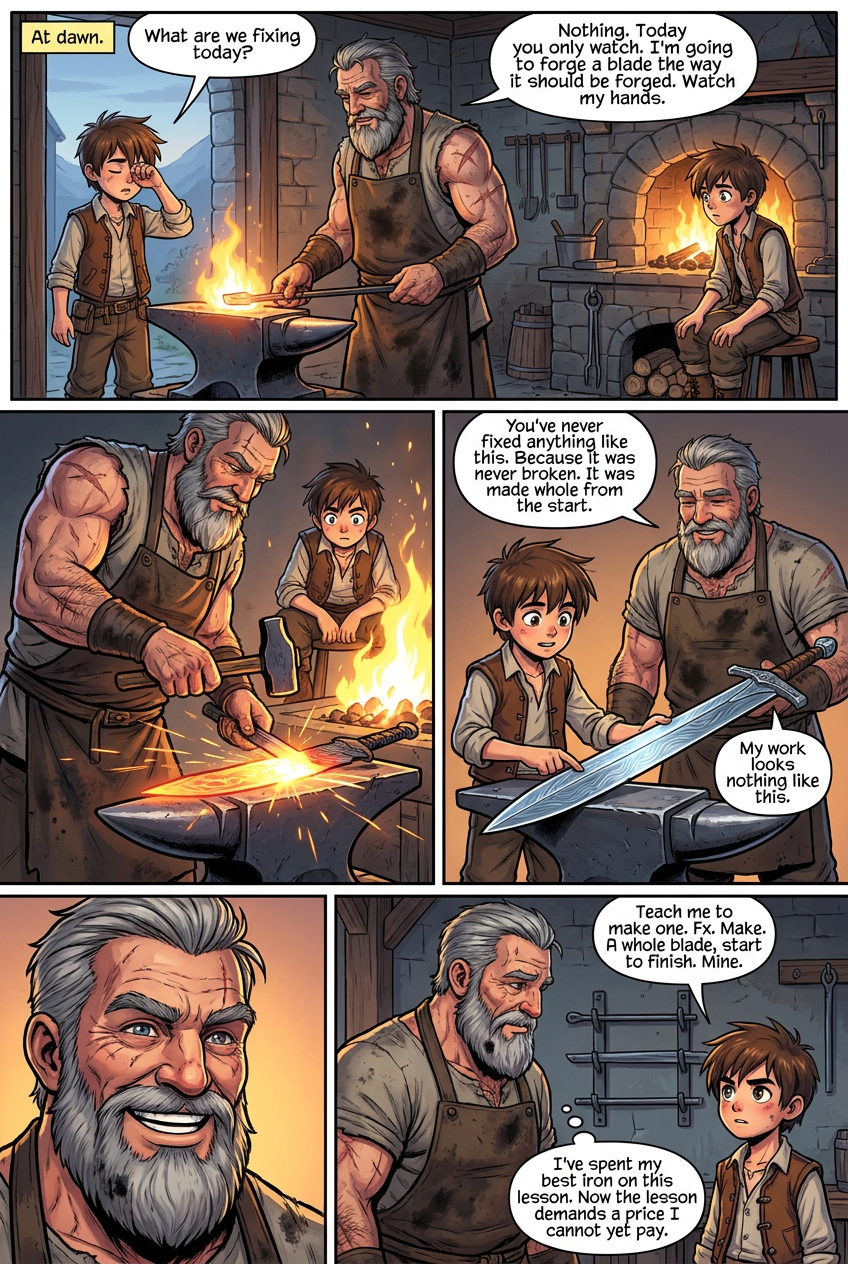
The mended sword rode off to the coast, but Borin could not sleep that night. Finn's hands were ready for small work and even a broken blade. Yet the boy had never seen a true masterwork take shape. Borin knew the truth. A smith who never watches a master forge has nothing to reach for. He himself had learned that way, long ago, standing at his own teacher's shoulder. He decided to show the boy what a hammer could really do. At dawn he set out his best iron and the old worn hammer. Finn came in rubbing sleep from his eyes. "What are we fixing today?" he asked. "Nothing," Borin said. "Today you only watch." He nodded at the coals in the forge. "I'm going to forge a blade the way it should be forged. Watch my hands. Watch the color of the steel. Every part of it." Finn sat on a stool by the anvil. Borin buried the iron in the fire and worked the bellows. The coals climbed from red to yellow to white. He drew the metal out and struck. His arm moved without waste. Each blow fell where the last one led. He folded the steel and heated it again, over and over, building layers no repair job ever needed. Hours passed. Borin did not speak. He did not need to. The boy leaned closer with each heat. Borin drew the edge thin and true. He shaped the tang. He watched the color hold exactly where it should. When the blade cooled in the trough, the steam rose and cleared. A pattern rippled down the steel like water. Finn stood without a word. He touched the flat of the blade with one finger. "You've never fixed anything like this," Borin said. "Because it was never broken. It was made whole from the start. That's the difference." Finn's eyes moved along the blade, then up to Borin's hands. "My work looks nothing like this," he said. His voice was low. Not defeated. Hungry. "Not yet," Borin said. "But now you know the mark. Now you know how far you have to go." That was what Borin wanted. The boy had a benchmark at last. He could see the peak and measure himself against it. Borin's grin broke wide across his gray beard. Then Finn spoke again, and the grin faded. "Teach me to make one," the boy said. "Not fix. Make. A whole blade, start to finish. Mine." Borin's stomach dropped. He had shown the boy the mountain. Now the boy wanted to climb it. A first masterwork took more iron than Borin had, more steel than his thin stock held. He looked at the empty racks along the wall. He had spent his best iron on this one blade to teach the lesson. Now the lesson demanded a price he could not yet pay.
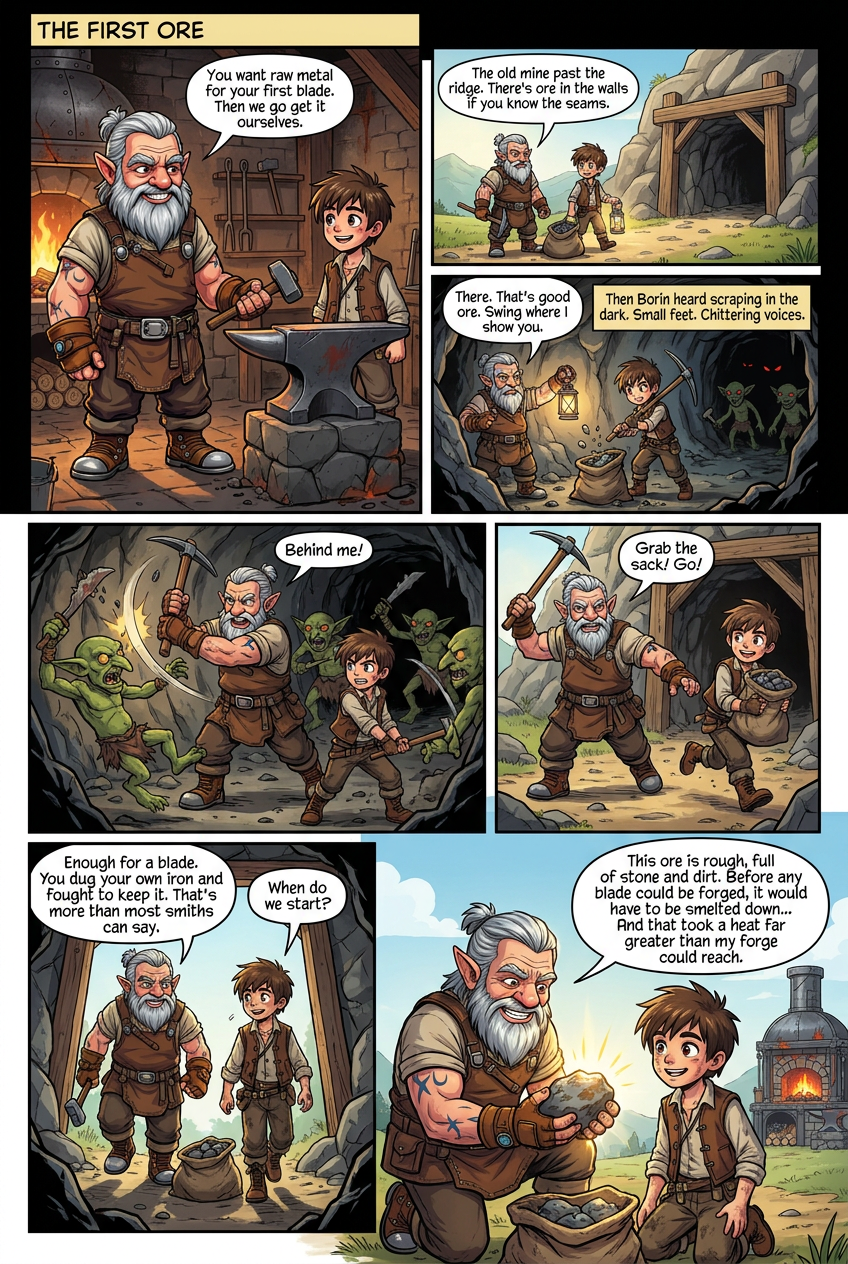
Borin looked at the empty racks again. Finn still stood by the anvil, waiting, the masterwork blade cooling between them. The boy wanted to forge his own. Borin had no iron left to give. He set down his hammer and made a choice. "You want raw metal for your first blade," he said. "Then we go get it ourselves." Finn's face lit up. "Where?" "The old mine past the ridge. There's ore in the walls if you know the seams." Borin gathered a pick, a sack, and a lantern. "I mined my first iron as a boy. So will you." They reached the mine by midday. Its mouth gaped between broken timbers, propped by beams gone soft with rot. Lanterns hung dead on rusted hooks. A dank smell rolled out of the dark. Borin lit his lantern and stepped inside. Finn followed close. Borin ran his fingers along the stone. He found a seam of gray rock threaded with dull metal. "There," he said. "That's good ore. Swing where I show you." Finn swung the pick. Chips flew. The boy worked fast, filling the sack with each strike. Then Borin heard scraping in the dark. Small feet. Chittering voices. Shapes moved at the edge of the lantern light. Goblins. Three of them, then five, creeping from a side tunnel. They bared their teeth and clutched crude spikes of stone. "Behind me," Borin said. He raised his pick like a hammer. The goblins rushed. Borin swung and cracked one across the shoulder. It squealed and fell back. Another darted past him toward Finn. Finn did not run. He swung his own pick at the goblin's legs and dropped it. "Grab the sack!" Borin shouted. The boy hauled it up. Borin drove the pack back with wide swings, keeping himself between the goblins and Finn. They retreated toward the mine mouth step by step. Daylight broke over them. The goblins hissed and would not follow into the sun. Borin and Finn stumbled out onto open stone, chests heaving. The sack lay heavy at Finn's feet, packed with raw ore. Borin knelt and opened it. He turned a lump over in his hand. The metal caught the light. "Enough for a blade," he said. "Maybe two." He grinned wide through his gray beard. "You dug your own iron and fought to keep it. That's more than most smiths can say of their first steel." Finn wiped grime from his face. He was still breathing hard, but he smiled. "When do we start?" "Tomorrow." Borin closed the sack. The obstacle was gone. Finn had iron now, ore he had pulled from the rock with his own hands. But Borin's smile faded as he looked back at the mine. This ore was rough, full of stone and dirt. Before any blade could be forged, it would have to be smelted down to clean metal. And that took a heat far greater than his forge could reach.
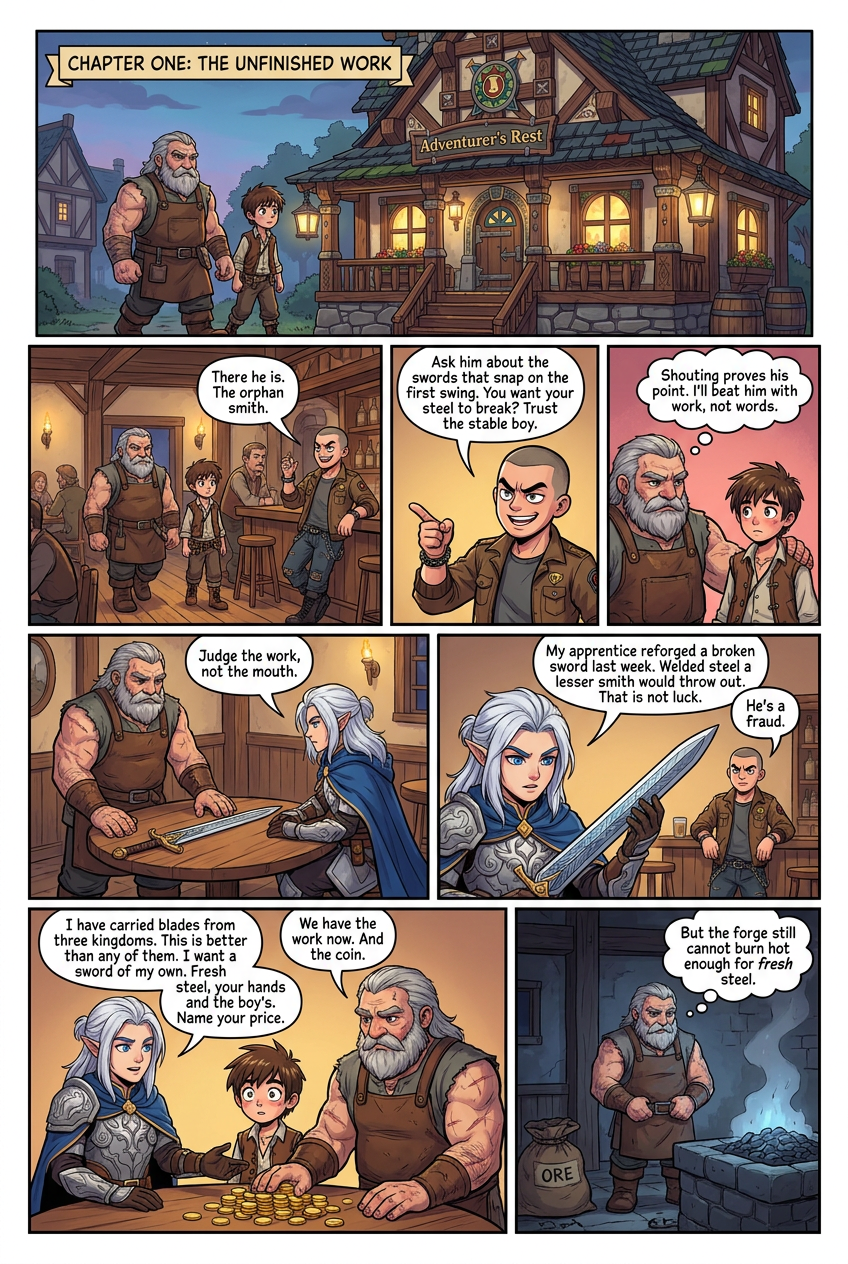
The sack of ore sat in the corner of the forge, useless. Borin needed a hotter fire to smelt it, and hotter fires cost coin. That coin came from paying customers. So Borin took Finn to the village inn to drum up work. But when they stepped through the door, the room went quiet. A few faces turned away. One farmer set down his cup and left without a word. Borin knew that look. Someone had been talking. Derek Malone leaned against the bar, grinning. He was the town bully who had mocked Finn at the market square. Now he swirled his drink and spoke loud enough for the whole room. "There he is. The orphan smith. Ask him about the swords that snap on the first swing." He looked at the innkeeper. "You want your steel to break when you need it? Trust the stable boy." Finn's face went red. Borin felt heat rise in his own chest, but he did not shout. Shouting would prove Derek's point. He had beaten Derek once before with finished work, not words. He could do it again. A silver-haired stranger sat at a corner table. His armor was scored from real fighting, and a blue cloak hung from his shoulders. He watched the whole thing with sharp eyes. This was a traveling hero, the kind who paid well for good steel. Borin walked to the stranger's table and set the masterwork blade down. The one he had forged himself. The steel showed a pattern like moving water. "Judge the work, not the mouth," Borin said. The hero lifted the blade. He tested the balance. He ran a thumb along the edge and pressed the flat against the table. It did not bend. His eyebrows rose. "My apprentice reforged a broken sword last week," Borin said. "Welded steel that a lesser smith would throw out. That is not luck." Derek pushed off the bar. "He's a fraud." The hero did not look up. "I have carried blades from three kingdoms," he said. "This is better than any of them." He turned to Borin. "I want a sword of my own. Fresh steel, your hands and the boy's. Name your price." The room shifted. The farmer who had left came back through the door. Derek's grin fell. He stood alone now, and his words meant nothing against a hero's judgment. He spat on the floor and walked out. Borin named a price. The hero paid half in gold on the spot, more coin than a month of repairs. Finn stared at the pile on the table. "We have the work now," Borin said quietly. "And the coin." But his eyes went to the door, then to the sack waiting at the forge. The hero wanted fresh steel. That meant smelting the raw ore. And Borin's forge still could not burn hot enough to melt it.
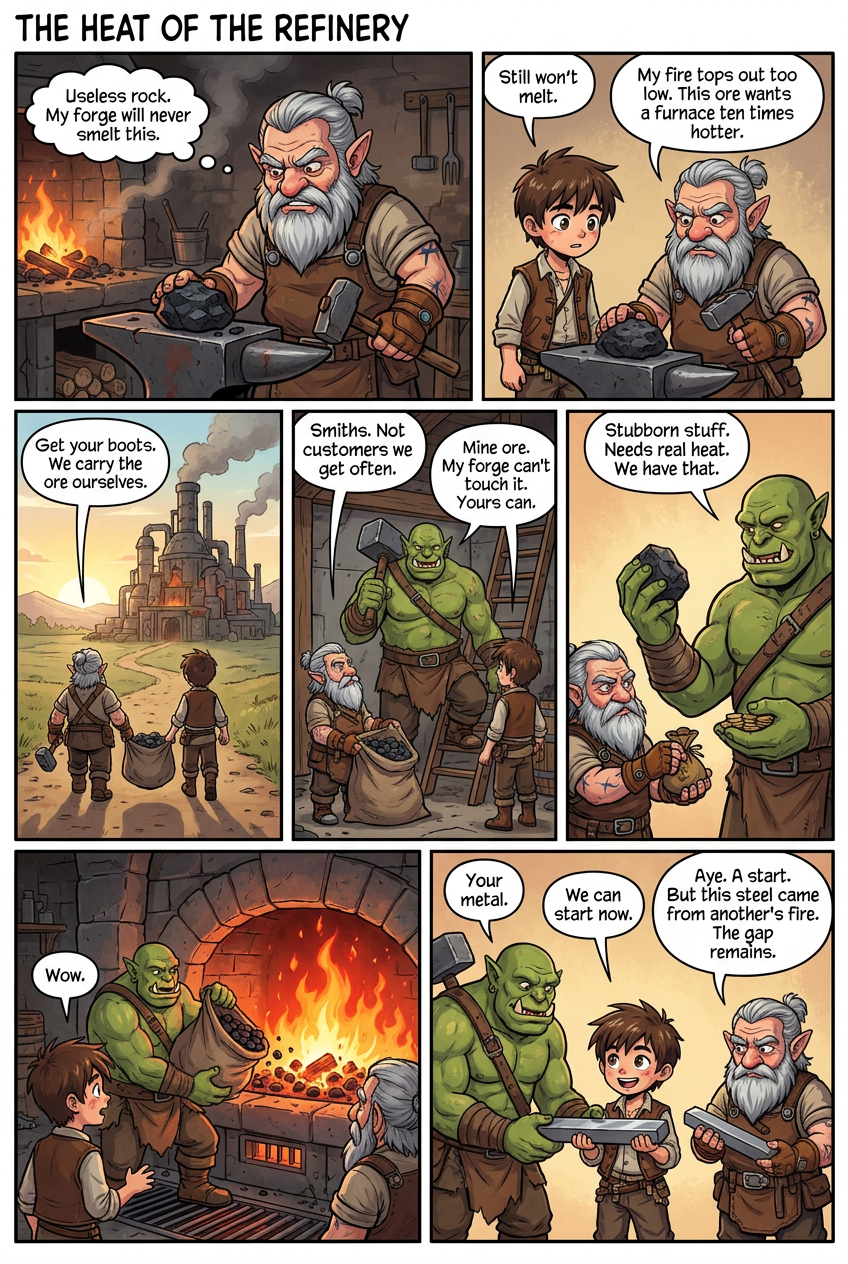
The gold sat in Borin's pouch, but the ore still mocked him from the corner. He had the work and the coin. He did not have the fire. All night he stoked his forge until the coals glowed white. He shoved a lump of ore into the hottest part and waited. The lump held its shape. It would not soften. Borin cursed and let the fire die. His forge would never smelt this rock. He needed a furnace built for it. At dawn Finn came in and saw the failed lump on the anvil. "Still won't melt," the boy said. It was not a question. Borin nodded. "My fire tops out too low. This ore wants a furnace ten times hotter." Finn frowned at the sack. "Then who has one?" Borin remembered a place at the edge of the valley. A refinery run by orcs, tall stacks pouring smoke, furnaces burning day and night. He had passed it once and never gone near. Most men crossed the road to avoid it. "Get your boots," Borin said. "We carry the ore ourselves." They found the building humming with heat. Chutes clanked. Furnaces roared behind iron grates, their fire orange and endless. A broad orc stepped down a ladder to meet them, a heavy hammer resting on one shoulder. His tusks showed when he grinned. "Smiths," he said, eyeing Borin's scarred hands. "Not customers we get often." He was not what Borin expected. His voice was warm, almost glad. Borin set the sack down and opened it. "Mine ore," he said. "My forge can't touch it. Yours can." The orc knelt and rolled a lump between two fingers. He held it to the light. "Stubborn stuff," he said. "Needs real heat. We have that." He named a price for the smelting. It was fair. Borin counted out coin from the hero's gold. The orc waved them onto the platform to watch. He dumped the ore down a chute into the biggest furnace. The fire swallowed it. Finn pressed close to the grate, his face lit orange, his mouth open. Borin watched the boy more than the fire. Hours passed. The orc drew off the melt and poured it into molds. It cooled into clean gray bars. He lifted one and passed it to Finn. "Your metal," he said. Finn held it in both hands. It was warm and heavier than iron. Real steel, from the ore he had dug himself. "We can start now," Finn said. His voice shook. Borin took a bar and turned it over. The metal was good. The hero's blade could finally begin. But this steel had not come from his own fire. He had solved the heat by paying another smith to do what he could not. The forge back home still could not smelt. That gap would stay until he closed it himself. For now, he had bars, and a boy ready to shape them.
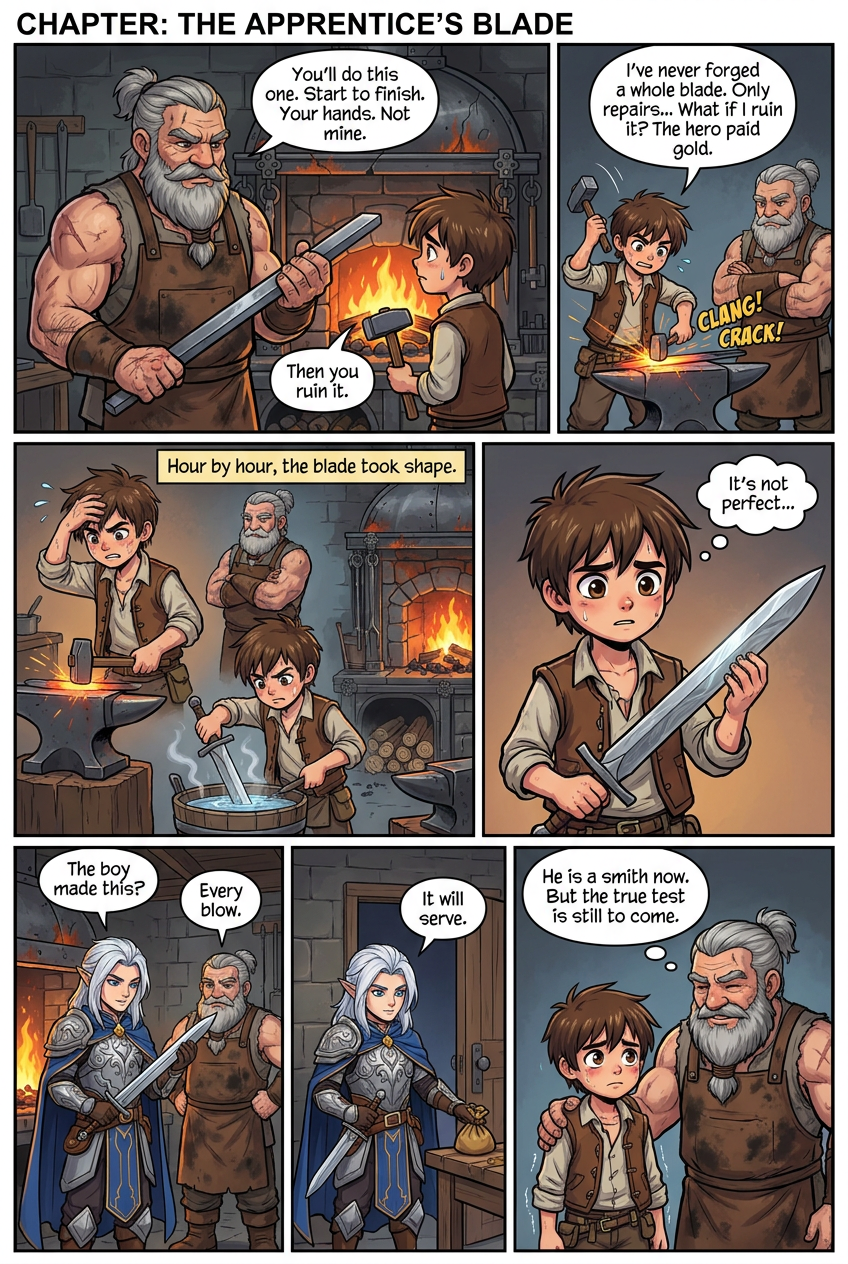
The steel bars lay cold on the workbench. Borin picked one up and turned it in his scarred hand. The metal was good. His forge back home could not smelt this ore, but it could shape it. He set the bar down and looked at Finn. The boy stood ready with his own hammer, the one sized for his grip. This was the hero's commissioned sword. And Borin had made a decision on the walk home. He would not touch the steel. Finn would forge it alone. "You'll do this one," Borin said. "Start to finish. Your hands. Not mine." Finn's smile dropped. "I've never forged a whole blade. Only repairs." His voice went thin. "What if I ruin it? The hero paid gold." "Then you ruin it," Borin said. "But if I guide your hands, the blade is mine, not yours. A smith who cannot forge alone is no smith." He stepped back from the anvil and folded his arms. Finn stared at the fire. Then he fed the coals and buried the first bar deep. He worked the bellows until the steel glowed yellow. Borin's fingers itched to reach in. He kept them still. The boy drew the bar out and struck it. The first blows landed crooked. He cursed and reheated it. Borin said nothing. Hour by hour the blade took shape. Finn folded the steel, hammered, folded again. Sweat ran down his neck. Twice he glanced back for help. Twice Borin only nodded. When Finn drew the bevels, his strikes finally fell even and sure. Borin saw his own teacher in the boy's shoulders and had to look away. At dusk the blade was done. Finn quenched it, then ground the edge and set the hilt. He held it up. The steel showed a faint wavering pattern from the folds. It was not perfect. One bevel ran slightly wide. But it was a true sword, and Finn had made every inch of it. A knock came at the door. The elven hero stepped in, silver hair catching the forge light, blue cloak dusty from the road. Aelindor Starweaver had commissioned this blade and paid half in gold. He looked at Borin, expecting the master's work. Borin pointed at Finn. "He forged it. Not me." Aelindor's brow tightened. He took the sword and tested its balance. He swung it once, twice. He ran a thumb along the edge and studied the pattern in the steel. The forge went quiet. "The boy made this?" Aelindor asked. "Every blow," Borin said. The hero was silent a long moment. Then he sheathed the blade at his belt. "It will serve." He counted the second half of the gold onto the bench and left. Finn stood shaking, staring at the door. Borin gripped his shoulder. The boy had forged a hero's sword alone. He was a smith now. And Borin knew the true test was still coming: whether the boy could someday do without him.
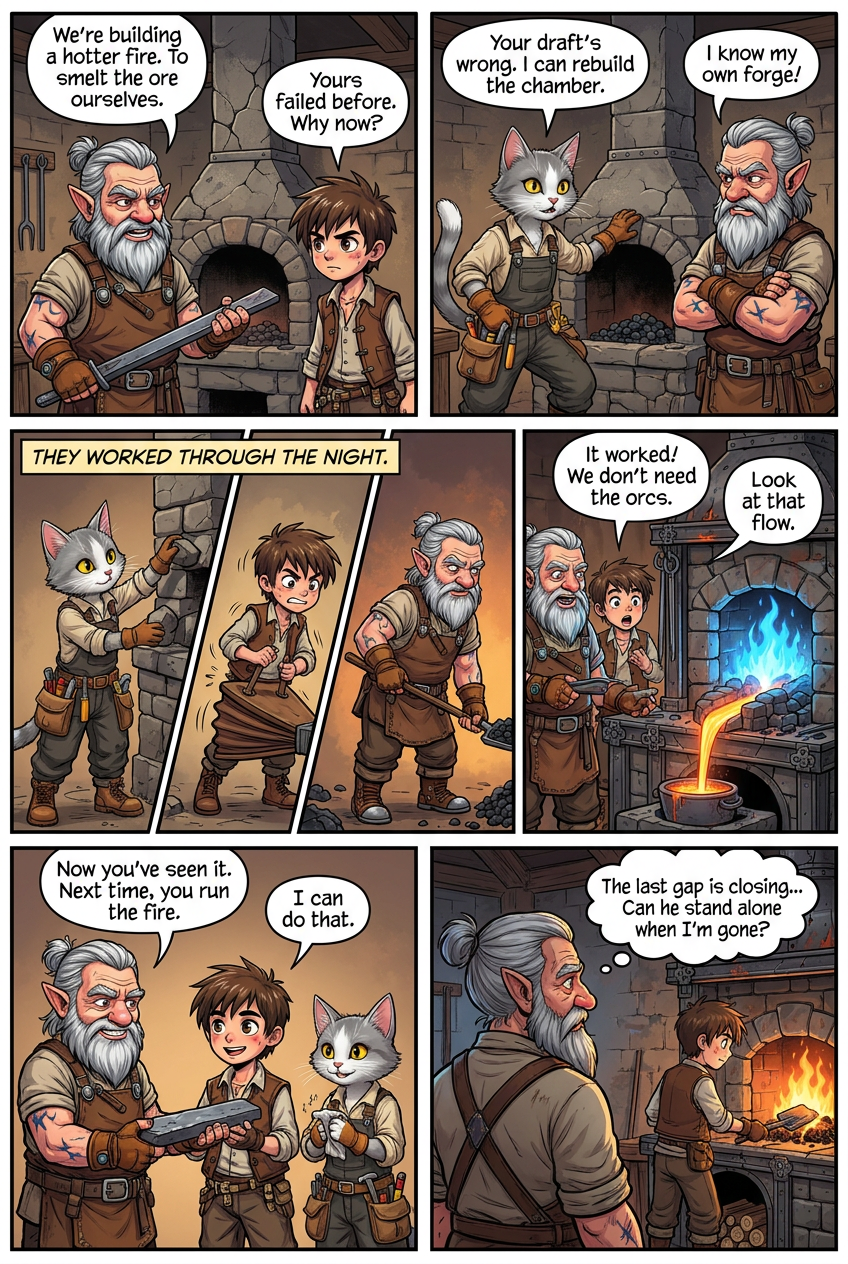
The hero's gold sat heavy in Borin's pocket, but it gave him no peace. Finn could forge a blade alone now. Yet the boy had never smelted a single scrap of ore. Every bar of steel in the forge had come from the orcs at the valley's edge. Borin gripped a cold bar and turned it. A smith who could not free metal from stone was only half a smith. He would not leave Finn that gap. "We're building a hotter fire," Borin said. "One that can melt the mine's ore ourselves." Finn frowned at the old forge. Its stone arch was scorched black, the chimney cracked near the top. "Yours already failed at this. Why would it work now?" "Because we rebuild it right," Borin said. But he did not know how. He had tried before. The heat had never come. A knock rattled the door. Maple Thornwhisker stepped in, the grey-furred cat who raised half the village's walls. A hammer and a folded measure hung from her belt. Her yellow eyes swept the cracked chimney at once. "Your draft's wrong," she said. "That flue chokes your air. No air, no heat." Borin bristled. He had shaped iron sixty years. "I know my own forge." "Then you know it can't smelt." She tapped the stone. "I don't shape metal. I shape what holds the fire. Let me rebuild the chamber." Finn looked between them. "We've got nothing to lose but the ore." Borin swallowed his pride. "Show me." They worked through the night. Maple tore out the choked flue and laid a tighter chamber of packed stone. She narrowed the throat so the air ran fast and hard. Finn pumped the bellows until his arms shook. Borin fed charcoal, then more charcoal, watching the coals climb from orange to white. By dawn the fire roared blue at its heart. Borin had never seen it so hot in his own forge. He buried the last of the mine's raw ore deep in the coals. The three of them watched. The rock hissed. It glowed, then softened. A bright trickle ran from the stone and pooled beneath. Metal. Freed by his own fire, in his own forge, at last. Finn stared, mouth open. "It worked. We don't need the orcs." Borin poured the molten metal into a mold. It cooled into a rough, honest bar. He set it in Finn's hands. "Now you've seen it done. Next batch, you run the fire alone." Finn closed his fingers around the warm bar. "I can do that." Maple wiped soot from her paws and grinned. "Fire's yours now. Don't let it die." Borin looked at the glowing forge and the boy beside it. Finn no longer depended on any other hand for his steel. The last gap was closing. Only one question remained, and it pressed harder than before: whether the boy could stand alone when Borin was gone.
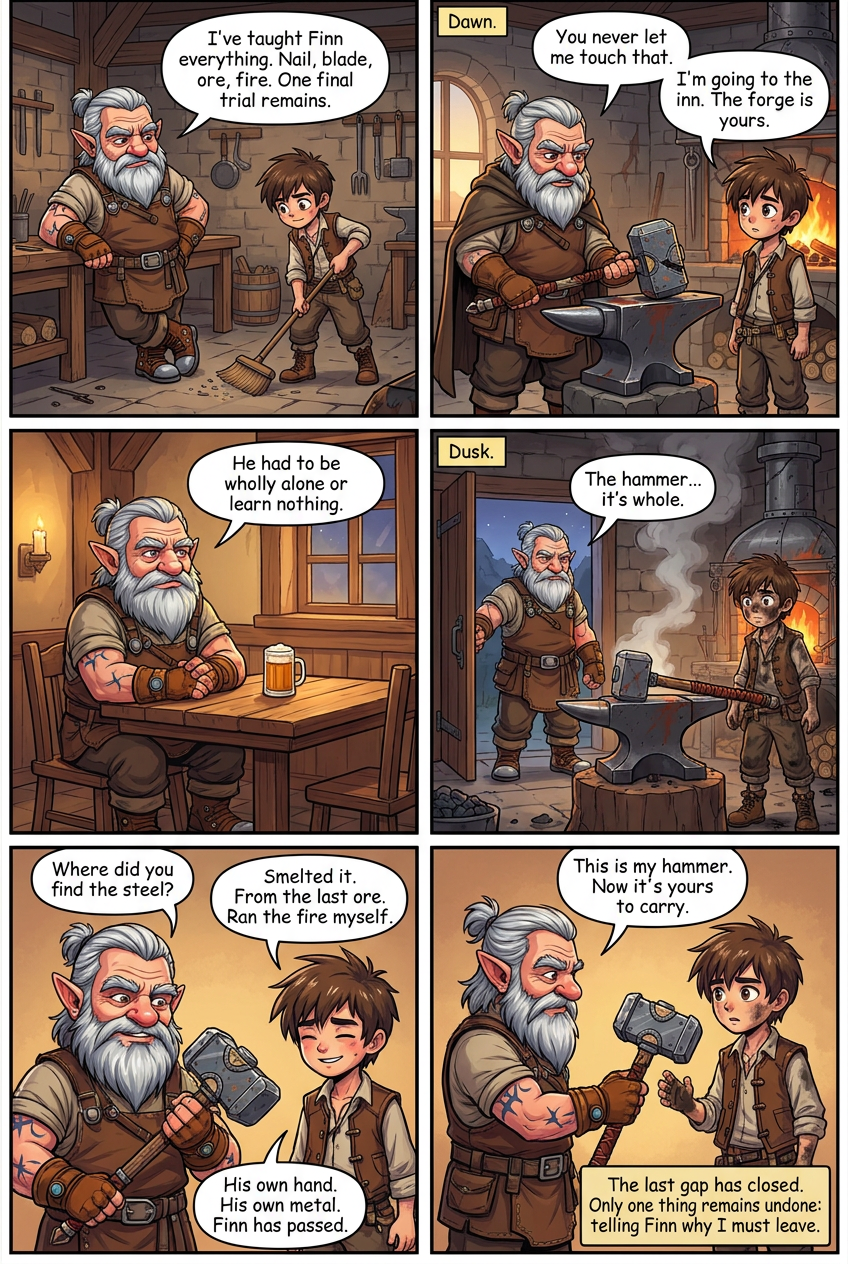
The new fire had proven itself. Finn could smelt ore, shape steel, forge a blade from raw stone. Borin watched the boy sweep ash from the anvil and felt an old fear tighten. He had taught Finn everything. Nail, blade, ore, fire. Nothing was left to teach. But teaching was not the same as knowing. Borin needed one last test, one true trial, to see if the boy could stand alone. He had no idea what that trial should be. He searched the forge that night. His eyes found the broken warhammer on a high shelf. Its head was split. Its haft was cracked through. Finn had named both flaws the day he first walked in. Borin had forbidden the boy from touching it. It would break his spirit, he'd said. That was years of skill ago. At dawn Borin set the warhammer on the anvil. He said nothing. He gathered his cloak and stopped at the door. "I'm going to the inn for the day," Borin said. "The forge is yours." Finn looked at the ruined hammer, then at the old dwarf. "You never let me touch that." "I'm not letting you now. I'm leaving." Borin stepped out and shut the door. He walked to the inn and sat where the warm windows let no soot in. He drank one ale and did not taste it. He counted the hours by the light. He did not go back to check. If he watched, it was his hand guiding the work, not the boy's. He had to leave Finn wholly alone or learn nothing. At dusk Borin returned. Smoke still rose from the chimney. He pushed the door open. The warhammer lay on the anvil, whole. The split head was welded clean, the seam faint as a hair. A fresh haft ran straight and true through the eye, wrapped tight in leather. Finn stood beside it, soot to the elbows, arms shaking. Borin lifted the hammer. He turned it in the low light. He swung it once. The head held. The haft held. He struck the anvil hard. The ring came back clean, no rattle, no give. "Where did you find good steel for the weld?" Borin asked. "I smelted it," Finn said. "From the last ore. Ran the fire myself." Borin set the hammer down. His chest ached in a way that was not grief. The broken thing that started it all was fixed by the boy's own hand, with the boy's own metal, from stone the boy had freed. There was nothing left to teach. Finn had passed. "This is my hammer," Borin said. "The one I carried before you were born." He pressed it into Finn's hands. "Now it's yours to carry." Finn gripped the haft. He could not speak. Borin looked at the boy holding his life's tool. The last gap had closed. Only one thing remained undone, and it would not wait much longer: telling Finn why he had to leave.
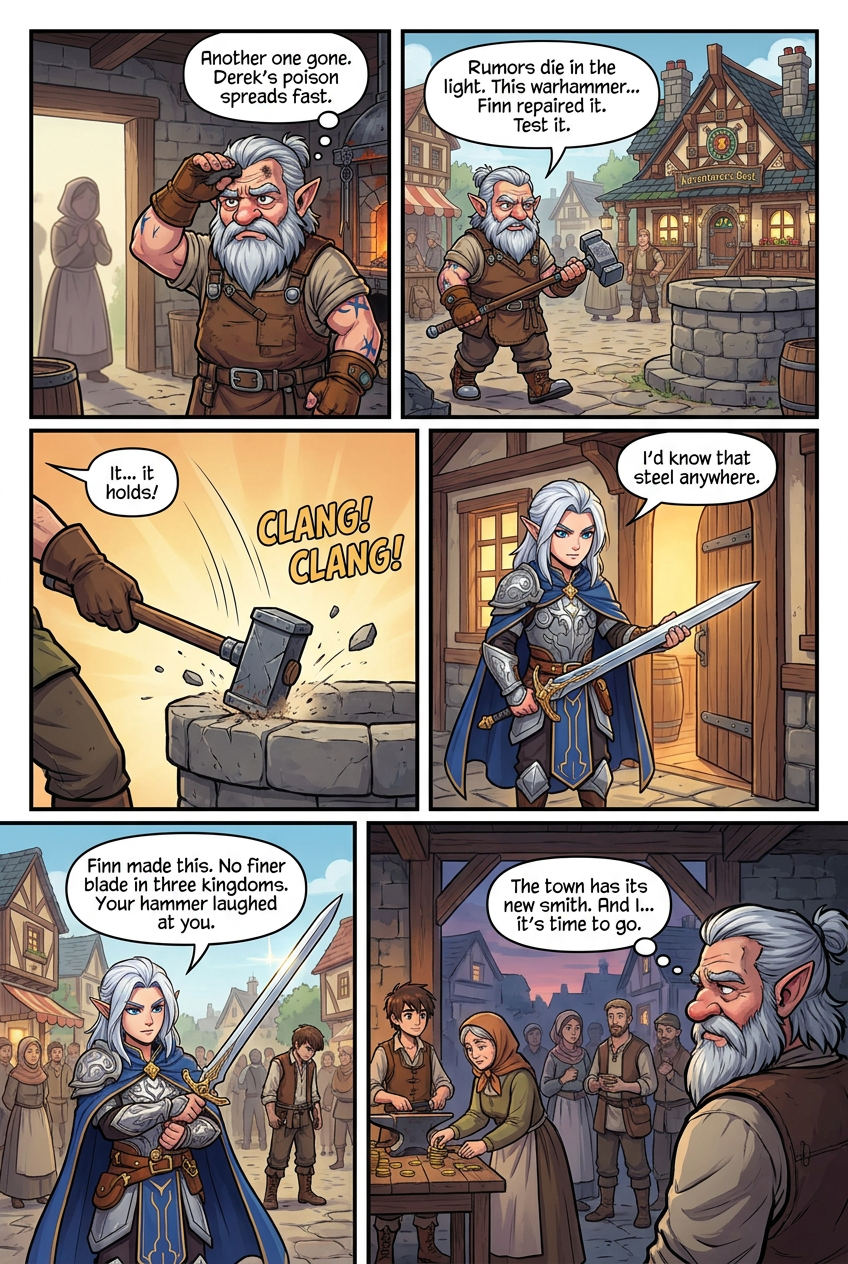
The next morning a farmwife came to the forge for a new plow blade. She stood in the doorway and would not step in. Someone had told her the old dwarf let a stable boy ruin good iron. Two more customers turned away by noon. Borin knew the source. Derek Malone had been talking again, poisoning the town before Finn could ever stand alone. The boy had passed every trial in the fire. Now he would fail out here, in the square, over words. Borin gripped his beard and made a choice. Rumors died in daylight. He would drag them there. He walked Finn to the market square, where Derek held court by the well. Derek was a broad young man with a loud mouth and a crowd that laughed on cue. He saw them coming and grinned. "There he is," Derek said. "The stable boy who plays at smithing. Tell them, old man. Tell them a real hammer would break in his soft hands." Borin said nothing. He set the repaired warhammer on the well's stone lip. Its split head was welded smooth. Its haft ran straight and new. "This was broken clean through," Borin said to the crowd. "Head split. Haft snapped. My boy smelted the steel, welded the seam, cut the haft. Alone. No hand of mine on it." He looked at Derek. "You say his work fails. Test it." Derek snatched the hammer. He swung it hard against the well stone, twice, meaning to shatter it in front of them all. The head held. The haft held. The ring came back clean. Derek swung a third time, red in the face. The stone chipped. The hammer did not. A cold voice cut the square. "I'd know that steel anywhere." Aelindor Starweaver stepped from the inn's warm doorway, the elven hero who had bought a blade here weeks past. He wore the sword at his hip. He had learned the boy forged it and had taken it gladly. "That sword saved my life on the pass," Aelindor said. He drew it and let the crowd see the pattern in the steel. "Finn Ashwood made it. I carry no finer blade in three kingdoms." He pointed the tip at Derek. "You beat that hammer with all your weight. It laughed at you." The crowd laughed then, at Derek. He dropped the hammer and pushed through them, gone. By dusk the farmwife returned. She placed her coin on the anvil and asked Finn, not Borin, to forge her blade. Two others waited behind her. Borin watched the boy take the orders in his own name. The rumors were dead. The town had its new smith. And that was the trouble. Finn no longer needed him here. The last reason to stay had just walked out the door with Derek. It was time to tell the boy the truth.
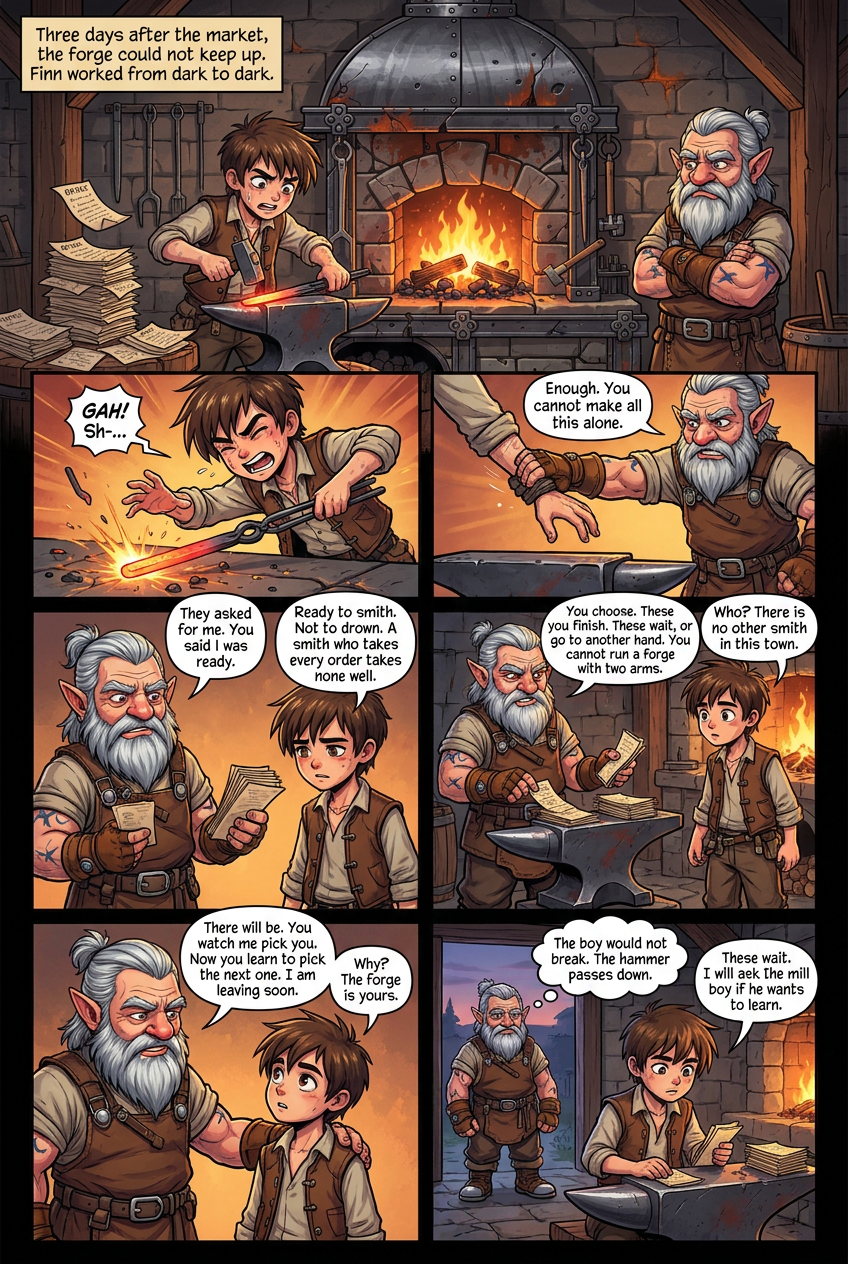
Three days after the market, the forge could not keep up. Orders stacked on the anvil like firewood. A hinge, two plow blades, a scythe, a set of nails for the mill. Every note asked for Finn by name. The boy worked from dark to dark and slept on the floor beside the coals. Borin watched him fumble the tongs at dawn, hands shaking from no sleep. The town wanted its new smith. It would burn him out before winter. And Borin still had not told the boy he meant to leave. Finn dropped a red-hot bar. It hissed against the stone. He swore and grabbed it wrong, then hissed himself. "Enough," Borin said. He caught the boy's wrist. "You cannot make all this alone." "They asked for me." Finn pulled free. His bright smile was gone, worn thin. "You said I was ready. So I work." "Ready to smith. Not to drown." Borin swept the notes off the anvil into his palm. "A smith who takes every order takes none well. You want your name on good iron, not fast iron." Finn stared at the empty anvil. "Then what do I do?" Borin split the notes into two piles. "You choose. These you can finish this week. These wait, or go to another hand." He set the second pile down. "And you find that hand. You cannot run a forge with two arms." Finn frowned. "Who? There is no other smith in this town." "There will be." Borin thought of a farmer's daughter who lingered at the market, watching the fire too long. Of the mill boy who asked how the flue drew air. "You watched me pick you from a broken hammer. Now you learn to pick the next one. That is the last thing a master does. He makes himself unneeded." The boy went quiet. He looked at his master a long moment. "You are leaving." Borin did not lie. "Soon." "Why?" Finn's voice cracked. "The forge is yours. The town is yours." "The forge is yours now. My name kept customers away with you in it. Yours brings them." Borin gripped the boy's shoulder. "A hammer passes down. It does not stay in two hands." Finn wiped his face with a sooty arm. He did not argue. He turned to the two piles and set to sorting, slow and careful, the way he once forged his first nail. He pushed three notes aside. "These wait," he said. "I will ask the mill boy if he wants to learn." Borin nodded. The flood was cut. The boy would not break. But the words were out now, and they could not go back in the fire. Finn worked the rest of the day without looking at him. By dusk the anvil held one order, not ten. And Borin knew he had days left here, no more.
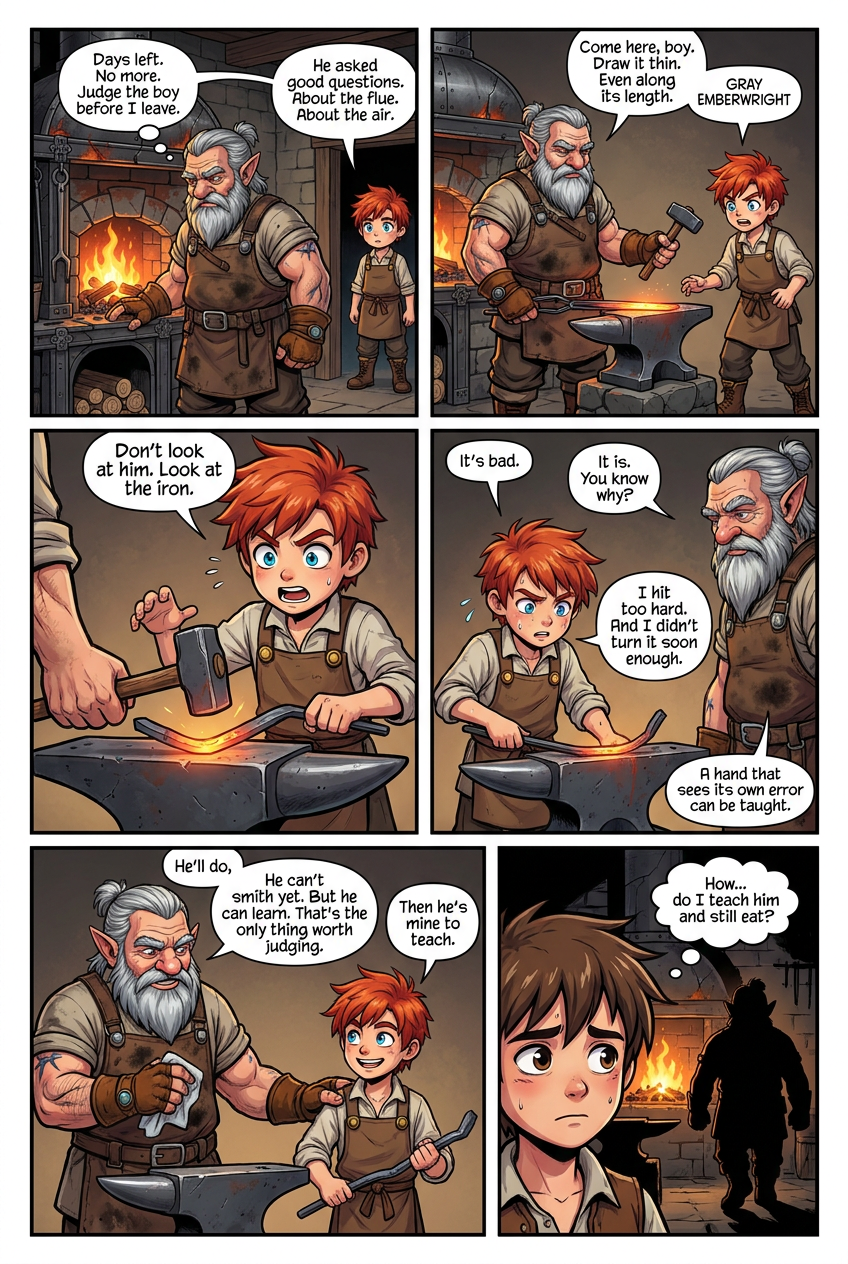
Finn brought the mill boy to the forge the next morning. Borin knew he had days left, no more. He wanted to judge the boy before he left, so Finn would not train the wrong hand. The mill boy stood in the doorway. Red hair, a farm apron, bright blue eyes fixed on the coals. His name was Gray Emberwright, and he had never touched a forge in his life. "He asked good questions," Finn said. "About the flue. About the air." Borin grunted. Questions were not hands. He had picked Finn from a broken hammer in one afternoon. But that trial rested on judgment a boy could show cold. Craft was different. It lived in the fingers, and fingers took years to read. He had a morning. "Come here, boy," Borin said. Gray crossed the floor too fast and stopped short of the anvil. His hands hung open, ready. Borin heated a bar of iron until it glowed. He set it on the anvil and gave Gray the small hammer, the one sized for a young grip. "Draw it thin," Borin said. "Even along its length." Gray struck. The first blow landed flat and true. The second bent the bar sideways. He froze, eyes wide, then looked to Finn. "Don't look at him," Borin said. "Look at the iron." Gray looked at the iron. He turned the bar himself, the way no one had shown him, and struck the high side down. The bend eased. He kept working, wrong and slow, but he read each mistake and answered it. The bar cooled. He stopped and looked at the crooked thing he had made. "It's bad," Gray said. "It is," Borin agreed. "You know why?" "I hit too hard. And I didn't turn it soon enough." Borin said nothing. That was the whole test. Not the bar. The boy had named his own flaws without help, the way Finn once named the cracked haft and split head. A hand that sees its own error can be taught. A hand that hides it cannot. Borin set the hammer down. "He'll do," he told Finn. "He can't smith yet. But he can learn. That's the only thing worth judging." Finn let out a breath he'd held all morning. Gray grinned wide, the crooked bar still in his fist. "Then he's mine to teach," Finn said. He said it slow, testing the weight of it. "He's yours," Borin said. And there it was. The forge had a master. The master had an apprentice. The chain held one more link. But Borin watched Finn's face fall as the truth landed. Teaching Gray meant hours at the fire, and the orders still stacked on the bench. Finn could not train a raw boy and fill every note by winter. He had gained a student and lost his last free hands at once. "How," Finn said quietly, "do I teach him and still eat?"
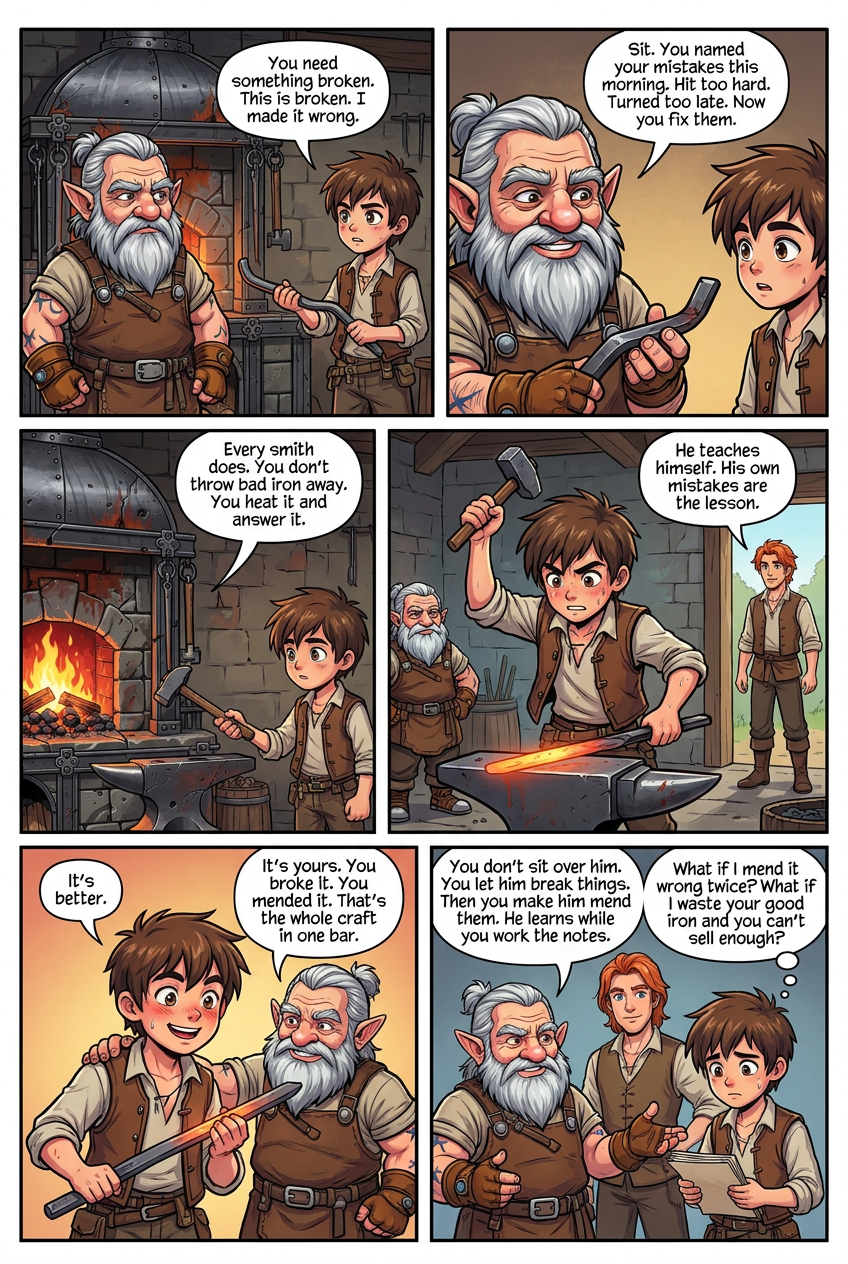
Borin heard Finn's question and had no clean answer. He would leave soon. He wanted to leave the boy Gray one lesson that lasted longer than any spoken word. Borin had taught Finn from a broken warhammer. He needed a broken thing now, something simple enough for a hand that could barely swing straight. He searched the forge with his eyes. Every tool held true. Nothing on the bench was worthy of a first test. Gray stood by the anvil, gripping the crooked bar he had made. His blue eyes tracked Borin around the room. "You need something broken," Gray said. It was not a question. He held out the bar. "This is broken. I made it wrong." Borin took the bent iron and turned it in his thick fingers. The boy was right. He had been hunting for a ruined object when one already sat in Gray's fist. A first test did not need to come from someone else's failure. It could come from the boy's own. "Sit," Borin said. He set the bar on the anvil. "You named your mistakes this morning. Hit too hard. Turned too late. Now you fix them." Gray's grin dropped. "Fix my own bar?" "Every smith does. You don't throw bad iron away. You heat it and answer it." Borin pushed the bar into the coals. He waited until it glowed orange. Then he pulled it out and handed Gray the small hammer. Gray struck. Soft this time. He turned the bar before the bend could set. He worked slow, reading each blow, the way he had read his errors that morning. The crooked line eased straight. Sweat ran into his red hair. When the iron cooled, he held up a bar that was nearly true. "It's better," Gray said, breathless. "It's yours," Borin said. "You broke it. You mended it. That's the whole craft in one bar." Finn watched from the doorway. He understood before Borin spoke it. "He teaches himself," Finn said slowly. "His own mistakes are the lesson." Borin nodded. This was the tool he had wanted to leave behind. Not a hammer. Not a broken hammer waiting on the bench. A method. Gray would ruin iron for years. Each ruined piece was now a lesson he could fix alone, without stealing Finn's hours from the order stack. "You don't sit over him," Borin told Finn. "You let him break things. Then you make him mend them. He learns while you work the notes." Finn's shoulders loosened. The winter stack no longer meant choosing between eating and teaching. The boy could grow between his blows. Borin stepped back from the anvil. The lesson was planted. But he saw Gray glance at the order stack, then at Finn, and heard the boy ask the next hard thing. "What if I mend it wrong twice? What if I waste your good iron and you can't sell enough?"
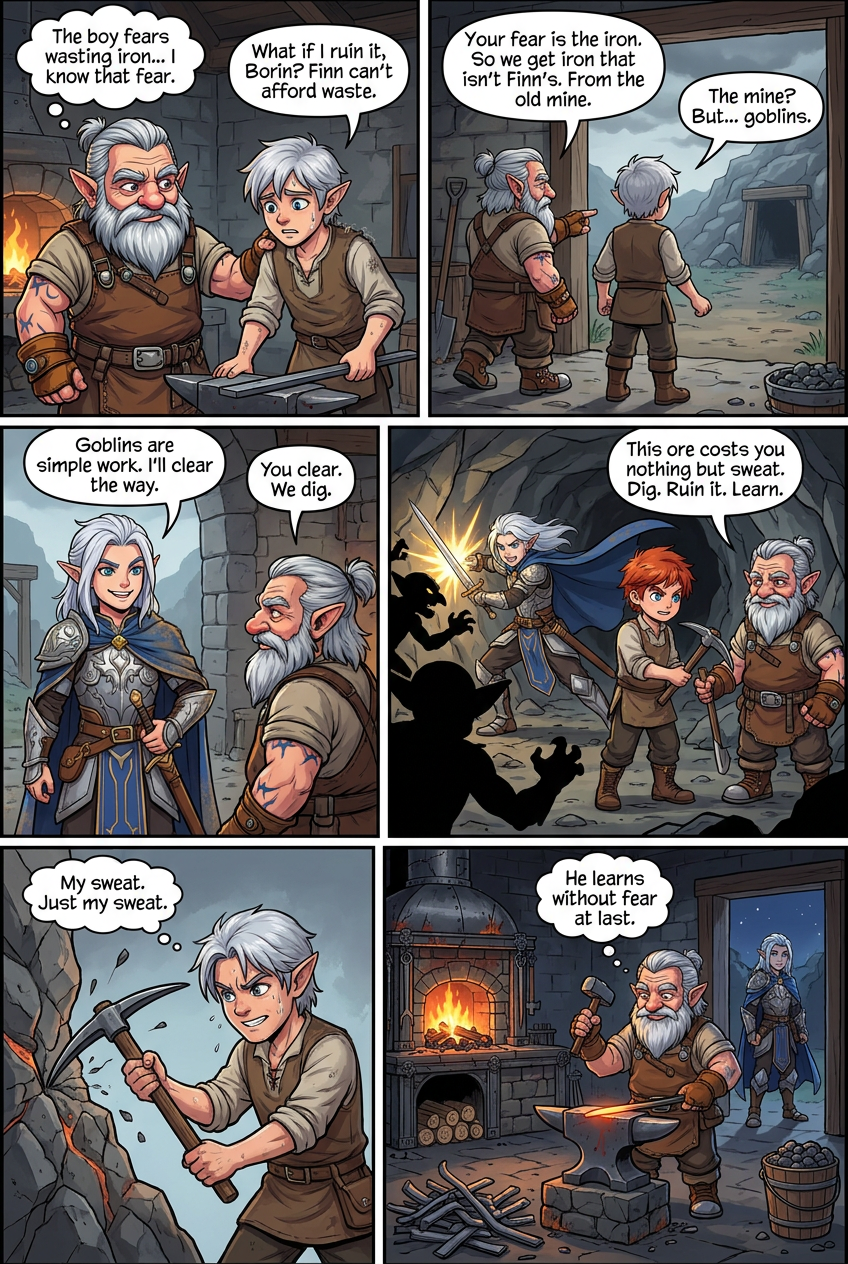
Gray's question hung in the hot air. What if he wasted good iron and Finn couldn't sell enough? Borin saw the fear settle into the boy's shoulders. The bar Gray had just mended trembled in his grip. He would not swing again. Not while every ruined piece felt like food stolen from Finn's table. Borin knew this fear. It had frozen his own hands as a young smith. He could not fix it with words. He needed to give the boy iron that cost nothing to spoil. "Set the hammer down," Borin said. Gray obeyed. Borin walked to the door and looked out at the ridge where the old mine sat. Its timber mouth leaned over a black passage. Goblins lived inside, but so did seams of raw ore, thick in the walls. "Your fear is the iron," Borin said. "So we get iron that isn't Finn's." Finn frowned. "The mine's dangerous. Goblins." A cool voice cut in from the yard. "Goblins are simple work." Aelindor stepped through the gate, cloak dusty, one hand raised in greeting. The elf had vouched for Finn before the whole town once. He owed this forge a debt, and he grinned like a man ready to pay it. "I heard the boy needs ore. I've fought worse than goblins for less." Borin studied him. Pride told him to refuse help. But Gray's frozen hands mattered more than pride. "You clear the way. We dig," Borin said. Aelindor drew his sword and nodded. They climbed to the mine at dawn. Aelindor went first through the dank passage, blade flashing. Two goblins rushed and fell. The rest scattered into the dark. Borin set Gray at a raw seam and pressed a pick into his hands. "This ore costs you nothing but sweat. Dig. Ruin it. Learn." Gray struck the wall. Stone cracked. A chunk of ore, gold-flecked and heavy, dropped into the bucket. He struck again, faster. The fear was gone from his face. He filled the bucket, then a second one, red hair matted with grime. Back at the forge, Borin fed the raw ore into the rebuilt chamber. The redesigned flue pulled the fire white-hot. The ore softened and ran. Gray watched metal pour that he had torn from the mountain himself. "It's mine," he said. "I can waste all of it and it's still just my sweat." "Now you'll try," Borin said. Gray took the hammer. He heated a fresh bar of his own smelting and swung without flinching. He bent it wrong. He heated it and mended it. He ruined the next and mended that too. He worked until dark, and not one piece came from Finn's stock. Borin watched the boy learn without fear at last. The obstacle was broken. But a full bucket of raw ore still sat by the door, and Aelindor lingered, restless, his eyes drawn back toward the black passage and whatever waited deeper in.
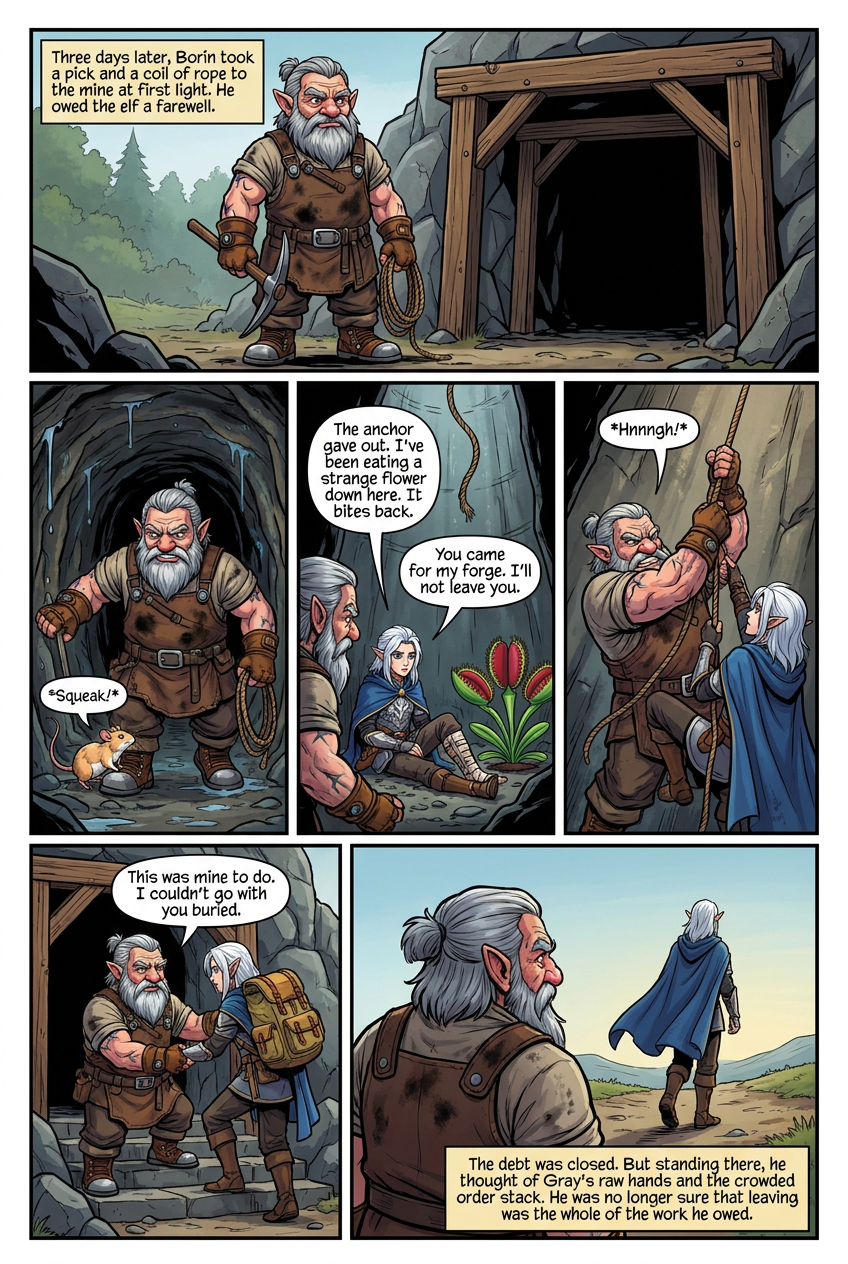
Three days after the mine, the ore bucket still sat by the forge door. Gray hammered his own steel without fear now. But Aelindor had not come back. The elf had gone deeper into the old passage that first night, chasing whatever pulled at him, and no word had followed. Borin owed the man a farewell. He would not pack his own bags and leave town with that debt open. Borin took a pick and a coil of rope to the mine at first light. The timber mouth leaned crooked over the black passage. Cold, damp air breathed out of it. He climbed down past the seams Gray had cut and followed the tunnel where it narrowed. Water dripped. A tiny thing scampered across his boot, a rodent with a goat's soft face and two small horns. It squeaked and vanished into a crack. Borin kept walking. He found Aelindor at the bottom of an air shaft. The elf sat against the wall, one leg splinted with a broken pick handle. A frayed rope hung from far above, snapped at the root that once held it. "The anchor gave out," Aelindor said. He tried to grin, but pain caught it. "I've been eating a strange red flower down here. It bites back." He nodded at a plant near his hand, glossy green traps fringed with teeth. Borin knelt and checked the leg. "You came to pay a debt to my forge," he said. "I'll not leave you rotting for it." He anchored his own rope to a stone spur, tested it twice, and hauled the elf up hand over hand. His grey arms shook. His breath tore. But he did not stop until Aelindor lay in the daylight at the mouth. They rested on the stone steps. Aelindor pulled a worn pack from the rubble, a folded map still buckled to its front. "I planned this trip careful," he said. "Planned everything but the rope." He laughed, then winced. "You could have sent the boy." "The boy has a forge to run," Borin said. "This was mine to do." He helped the elf stand and set the pack on his own shoulder. "I'm leaving town soon. I couldn't go with you buried in my mountain." Aelindor gripped his arm. "Then we're square. Go teach the next age, smith." He limped toward the ridge road, map in hand, already looking past the town. Borin watched him go. The debt was closed. His conscience was clear. He could leave now. But standing there, catching his breath, he thought of Gray's raw hands and Finn's crowded order stack. He had freed himself to walk away. He was no longer sure that leaving was the whole of the work he owed.
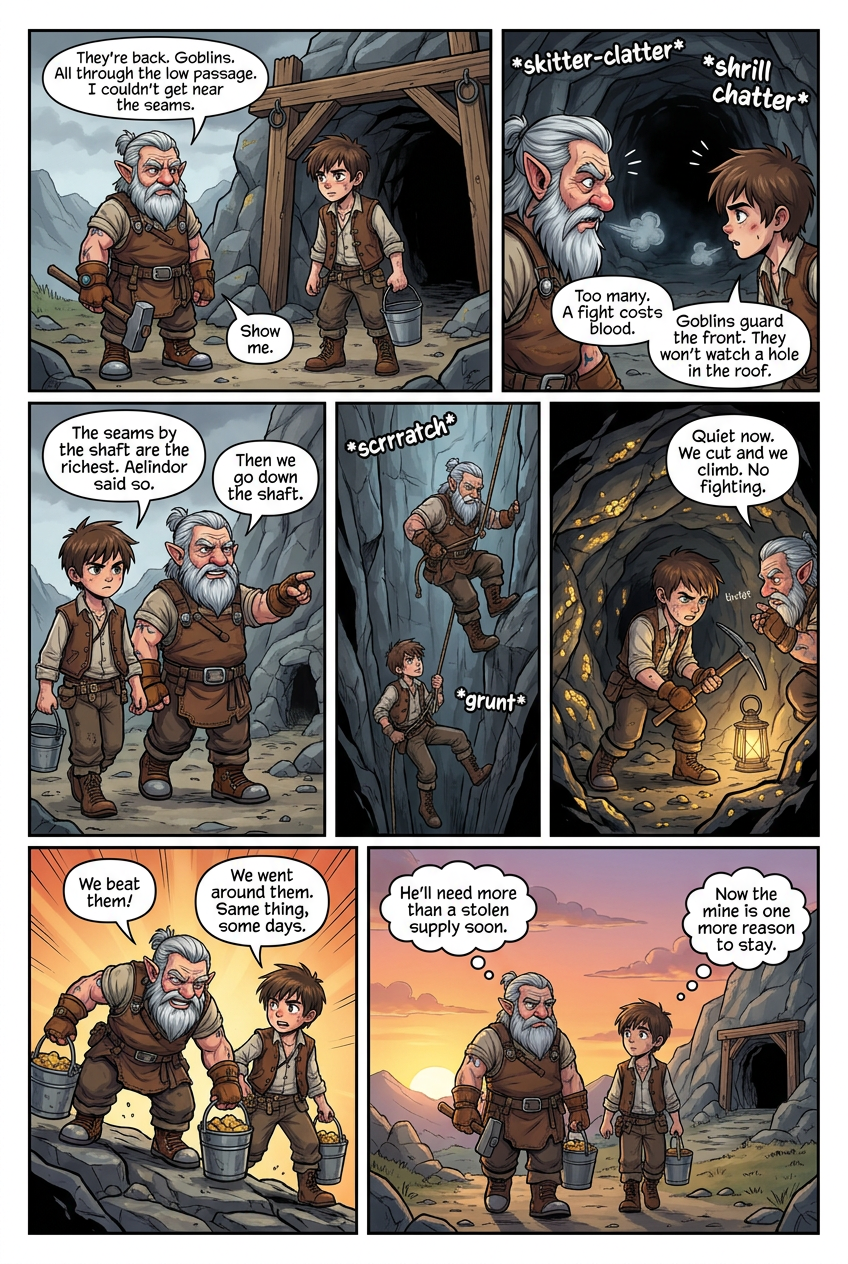
Gray came back from the mine with an empty bucket. His face was pale, his knuckles scraped. "They're back," he said. "Goblins. All through the low passage. I couldn't get near the seams." Borin set down his hammer. The boy had been mining his own ore for weeks, learning without fear of wasting Finn's iron. Now the mine was closed to him again. Without fresh ore, the boy went back to flinching at every ruined bar. "Show me," Borin said. They walked to the leaning timber mouth together. Cold air breathed out of the black passage. Borin listened. He heard the clatter of small feet on stone, then a shrill chatter deeper in. Too many for one dwarf and a boy with scraped hands. Fighting through would cost blood, and Aelindor was gone with his map, no hero left to clear the way. Borin studied the ground instead. He remembered the air shaft where he'd hauled the elf up. A second way in. "Goblins guard the front," he said. "They won't watch a hole in the roof." Gray frowned. "The seams by the shaft are the richest. Aelindor said so." "Then we go down the shaft." Borin fetched rope and two picks. He anchored the line to a stone spur far from the frayed root that had failed before. He tested it three times, hauling his full weight against it. It held. He went first, down into the dark, boots braced on the shaft wall. Gray followed. They reached the bottom silent. The rich seams glinted in the lantern light, gold threads in gray rock. The goblin chatter stayed far off at the front passage. The little beasts never turned toward the roof. "Quiet now," Borin whispered. "We cut and we climb. No fighting." Gray swung his pick. Ore broke loose. He caught himself before it clattered, then grinned. He worked fast and clean, filling the bucket the way Borin had taught him. Sweat ran down the boy's face. His scraped hands did not shake. He was not thinking of wasted iron now. He was stealing metal from under the noses of the enemy. They filled the bucket twice. Borin tied it to the rope and hauled it up first. Then the boy climbed, then the dwarf, arms burning. They rolled onto the stone at the top with two loads of raw ore between them. Gray laughed, breathless. "We beat them." "We went around them," Borin said. "Same thing, some days." He looked at the ore. Enough for weeks of practice. But the shaft trip was slow and dangerous, and the goblins would breed and spread. The front would never open on its own. Sooner or later the boy would need a steady supply, not a stolen one. Borin could not go down that rope forever. And he had meant to leave town. Now the mine was one more reason to stay.
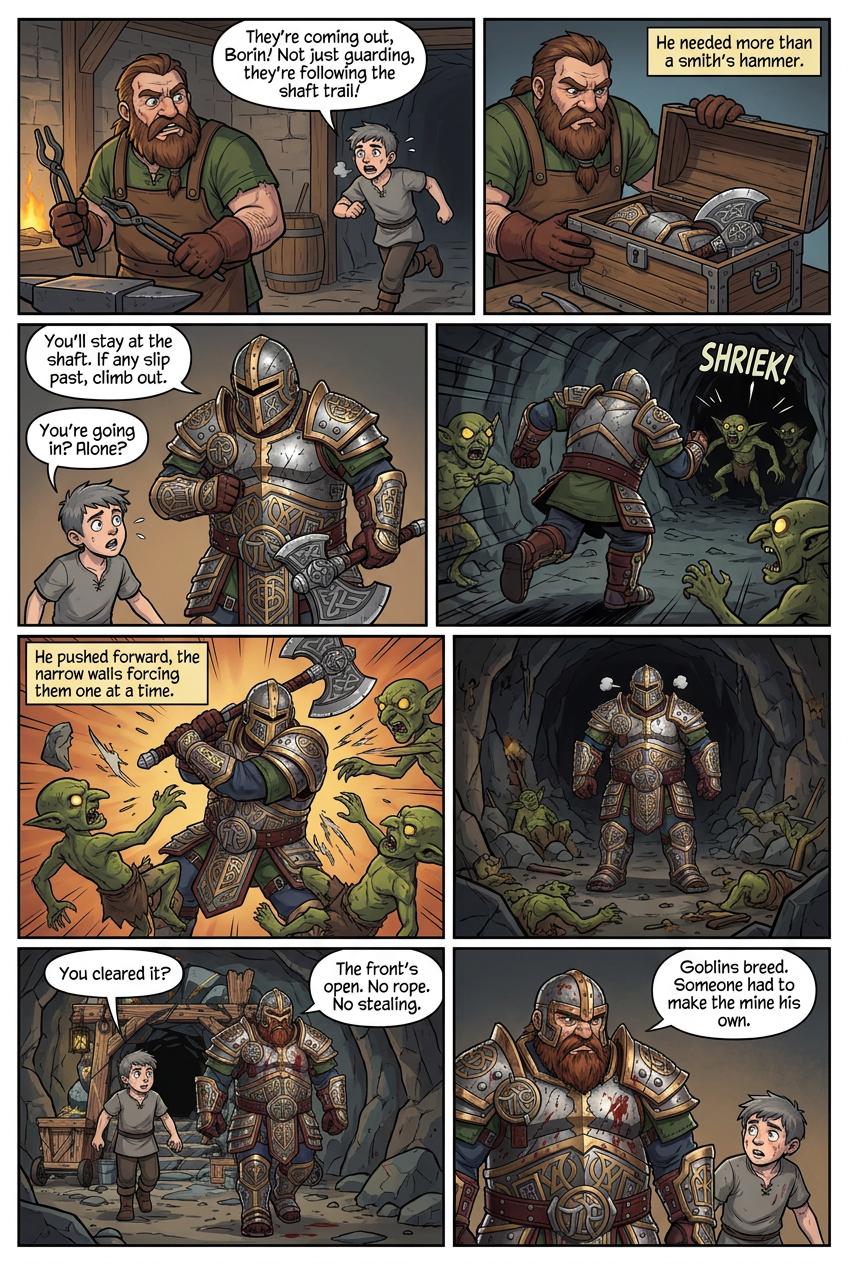
The next morning Gray came running from the mine mouth. "They're coming out," he gasped. "Not just guarding the front. They're following the shaft trail toward town." Borin dropped his tongs. If the goblins learned the shaft route, the only clear path to ore was gone. And a boy who could not mine could not learn. Borin walked to the mine himself. He stood at the leaning timber mouth and listened. The chatter was louder than before, and closer. Small feet scraped up the passage toward daylight. He counted the sounds. A dozen, maybe more. Going down the rope one more time would not fix this. The goblins would find the shaft and swarm it. He had to stop them at the front, once, for good. But one dwarf could not fight a dozen goblins in a narrow tunnel with a smith's hammer. He needed more. Borin went home and pulled open the old chest he had carried since his mountain days. Inside lay his war gear. A stout set of plate armor, dented and scarred from battles long past. Beside it, a double-headed battle axe, its edge still keen. He had not worn the steel in thirty years. His hands remembered the weight. Gray watched him buckle the heavy plates. "You're going in? Alone?" "You'll stay at the shaft with the rope," Borin said. "If any slip past me, you climb out and pull it up. Don't fight." He lifted the axe. His arms burned under the armor, but the burn felt right. He entered the passage. The lantern light caught eyes in the dark. The goblins shrieked and rushed. Borin set his boots and swung. The axe took two at once. Claws scraped his plates and found no gap. He pushed forward, step by step, the narrow walls forcing the goblins to come one at a time. He cut them down as they came. The tunnel filled with their screeching, then with silence. Borin reached the low passage where the seams waited. The last goblins fled deeper, past a fresh cave-in that had crushed their nest. No swarm remained. He stood among the fallen, chest heaving, armor slick with sweat. Gray met him at the mouth when he came out. The boy's eyes went wide at the blood on the plates. "You cleared it?" "The front's open," Borin said. He set the axe down and leaned on it. "You can walk in now. No rope. No stealing." Gray grinned, then his face changed. "But there'll be more. Goblins breed." Borin nodded slowly. The mine was open today. In a month the little beasts would crawl back from the deep tunnels. Clearing it once was not the same as holding it. A boy could not mine safely if the enemy always returned. Someone had to make the mine his own. Borin looked at the armor on his body and knew the fight for a steady supply had only started.
Play your story to life
Storycraft is a mobile game where you create AI characters, craft items and locations to build their world, then discover what direction your story takes. Download the iOS game for free today!
Download for free