

Bram Möller's Arc
63 Chapters
Bram Möller's dream is completing the impossible winter delivery route no courier has ever survived to earn legendary status among sky pilots..

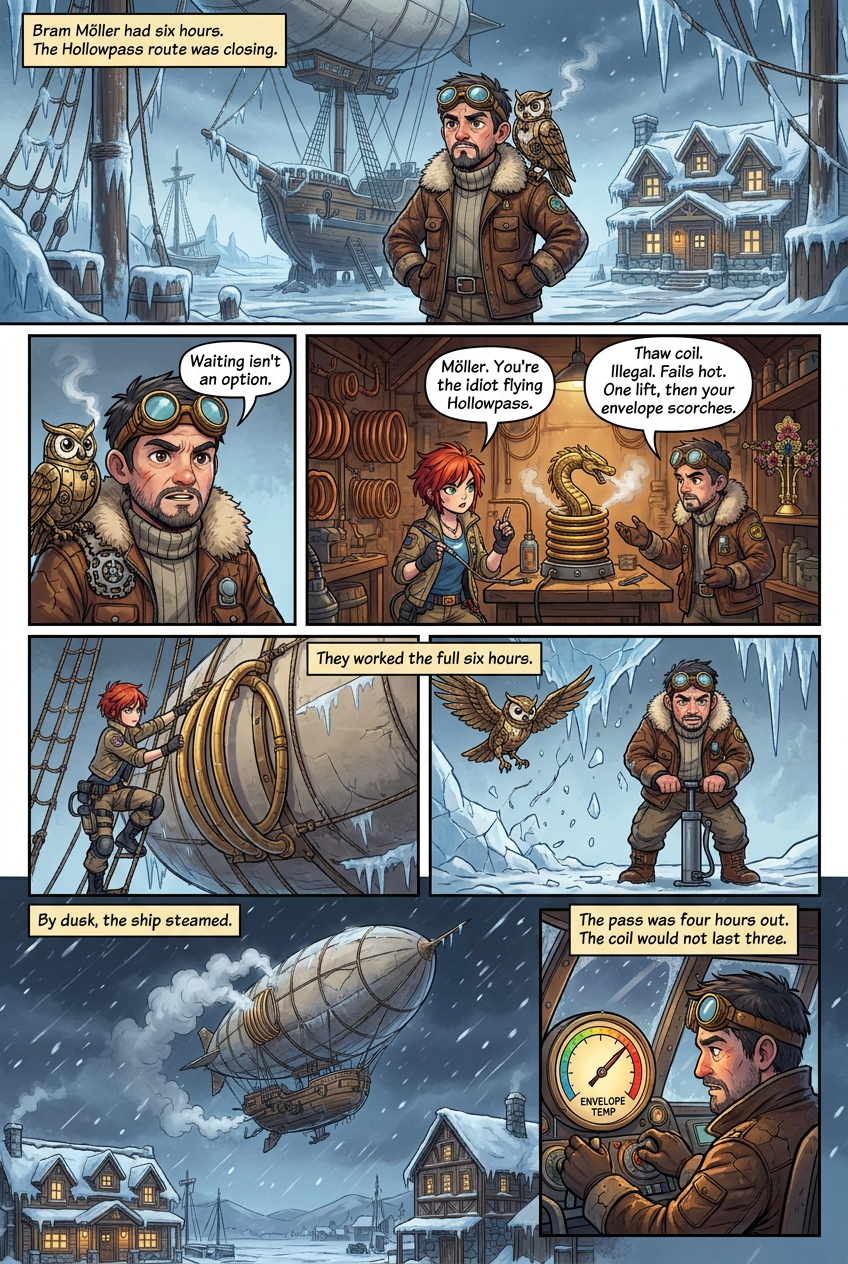
Bram Möller had six hours to leave, or the Hollowpass route closed until spring. No courier had ever finished it in winter. He meant to be the first. Ice sheeted the depot in a single night. Rigging lines snapped under the weight. Mooring masts wore glass sleeves an inch thick. Every airship on the field sat pinned to the ground like a bug under a jar. Bram stood on the loading apron in his cracked flight jacket, frost building on his fur collar, and watched his season die in front of him. His mechanical owl clicked on his shoulder, brass feathers ticking as it turned its head. A thin curl of steam left its beak. The manifest strapped to its leg was still warm. Sealed cargo. Paid in advance. No refund clause. "Waiting isn't an option," he said. The owl blinked once. He crossed the yard to the engineer's shed. He had been told not to go there. Everyone had been told not to go there. Dr. Cassandra Vex opened the door before he knocked. She was small, redheaded, and holding a soldering iron like she'd been in the middle of an argument with it. The depot had fired her twice. She was still on the property both times. "Möller," she said. "You're the idiot flying Hollowpass." "I need lift in six hours." "In this?" She jerked her chin at the ice. "Your envelope will crack before you clear the mast." "Then fix it." She studied him. Then she stepped back and let him in. The shed was hot. Copper coils ran floor to ceiling. On the bench sat a coiled brass shape as thick as his thigh, scales polished, head raised. Vapor slid from its jaws in a slow white rope. The heat in the room came from that. "Thaw coil," she said. "Illegal in three districts. I wrap it around your gasbag, we bleed the mist through the rigging, the ice sheds in about forty minutes." "What's it cost me?" "Half your fee. And when it fails, it fails hot. You'll have maybe one lift before the envelope scorches." "One lift is all I need." She grinned like he'd said something funny. "You haven't asked what happens if the coil ruptures over the pass." "I don't need to." They worked the full six hours. Vex climbed the rigging in fingerless gloves and lashed the brass serpent around the envelope while Bram pumped ballast. The owl carried her tools between them, wings hissing. Ice fell from the hull in slabs. By dusk the ship steamed on its mooring like a kettle. Bram cut the lines at the last legal minute. The airship rose, groaning, into a black sky still spitting sleet. Below, the depot shrank to a smear of lamplight. On the gauge above his head, the envelope temperature was already climbing past safe. The pass was four hours out. The coil would not last three.
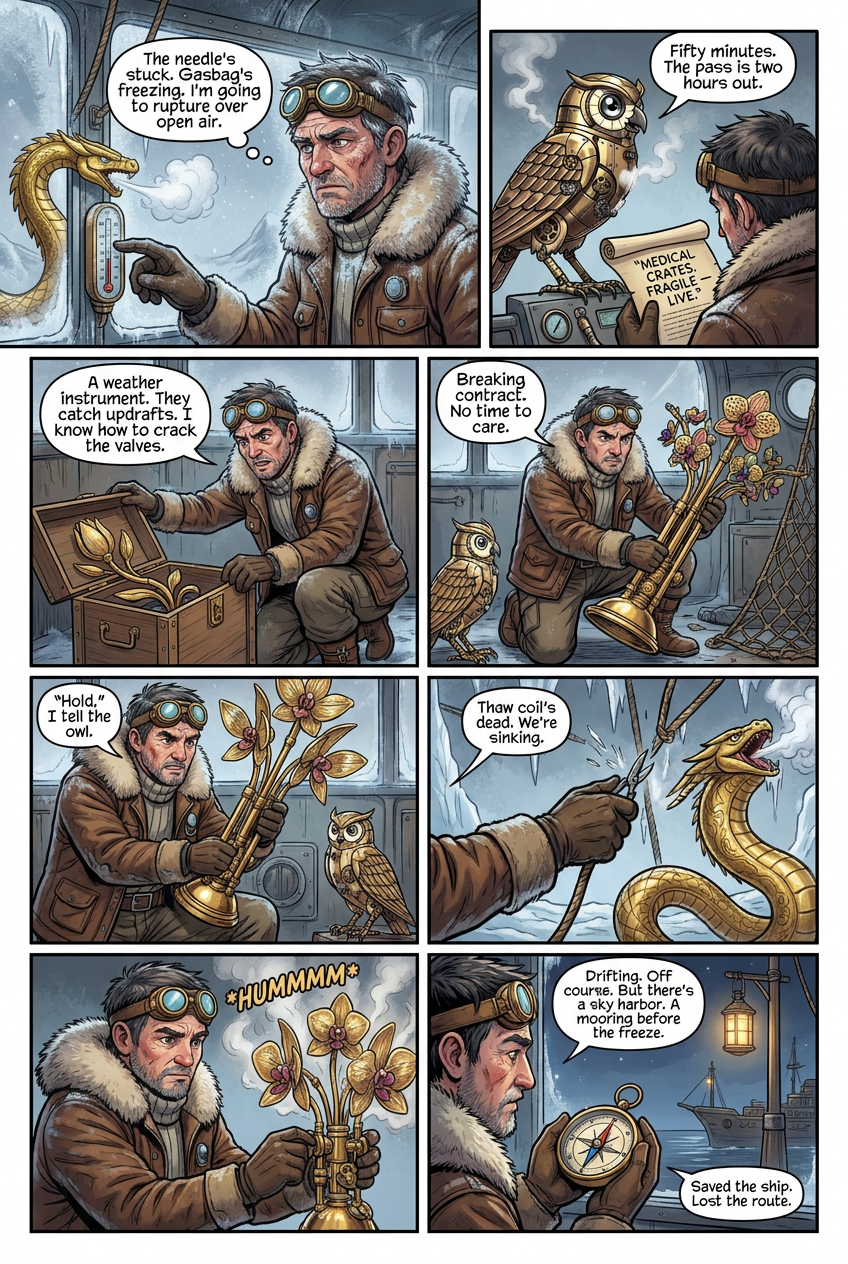
The temperature gauge climbed another notch. Bram tapped the glass. The needle did not fall. Below, the last lamps of the depot were gone. Above, the brass serpent wrapped around his envelope hissed white vapor through the rigging, and every hiss meant the coil was eating his gasbag faster. He checked his pocket watch. Fifty minutes, maybe less. The pass was still two hours out. The math had not changed since launch. He was going to rupture over open air. His mechanical owl clicked on the console rail, steam curling from its vents. Bram unlatched the manifest tube on its leg and read the cargo list again. Medical crates. A sealed case marked FRAGILE — LIVE. He unstrapped that one from the cargo net and pried the lid. Inside sat a brass orchid on a polished base, its tubing coiled like a small pipe organ, its bloom-heads shut tight. A weather instrument. He had carried three of them last spring for a mountain observatory. They vented pressure. They also caught updrafts and held altitude in thin air, if you knew how to crack the valves. He knew how to crack the valves. Bram cut the cargo net and hauled the orchid to the rail. He was breaking his contract. He did not have time to care. He twisted the base coupling and screwed it into the ballast port under the gondola. The tubes shivered. The bloom-heads opened one by one, each petal a thin brass fan. "Hold," he told the owl. The owl blinked. He cut the thaw coil's feed line. The brass serpent stopped breathing. Steam sagged out of the rigging in a long white sheet and fell away below him. The envelope groaned. Ice, still clinging in patches, began to build back along the seams almost at once. The temperature gauge dropped. The rupture warning eased. The airship also began to sink. Bram opened the orchid's valves. Warm air pushed up through the brass tubing and into the belly of the gondola. The petals sang a thin note. The ship's descent slowed. Slowed more. Then held. He was not flying now. He was drifting. The wind carried him sideways, off the pass line, toward the lower ridges. The envelope would last the night at this heat. It would not last a climb. Bram looked at the compass. The needle swung toward the foothills. There was a sky harbor down there, an inn with a mast. Not his destination. Not even close. But solid ground under a warm roof, and a mooring he could reach before the envelope froze shut for good. He throttled the orchid down a quarter turn and let the wind take him. The owl clicked once. Bram did not answer. He had saved the ship. He had lost the route. Somewhere ahead, in the dark, a lantern on a mast came into view.
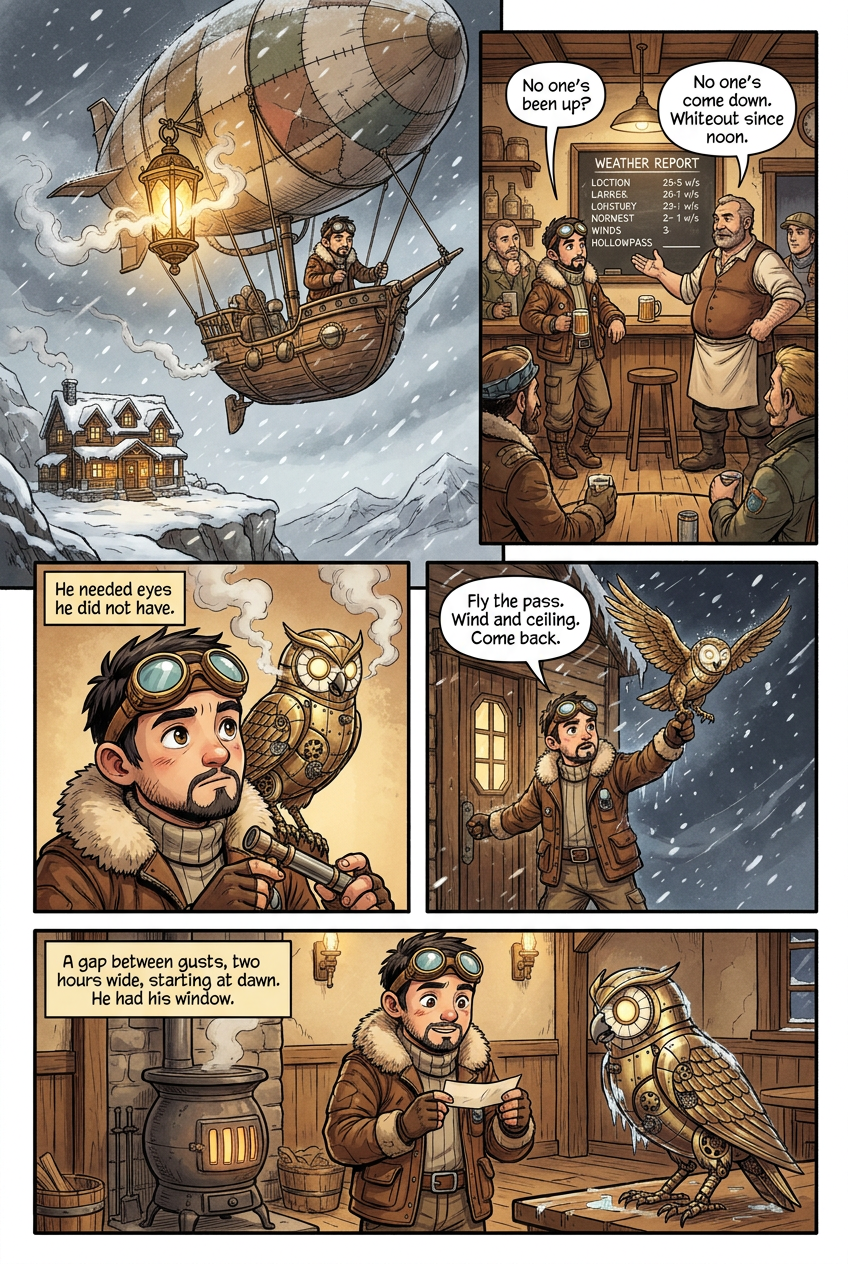
The lantern on the mast grew from a spark to a steady flame. Bram trimmed the orchid's valves and let the wind push him the last half mile. The envelope creaked. Ice fed on the seams. He needed the mooring before the gasbag stiffened past use. The inn crouched on a shelf of rock, low roof heavy with snow, a single mast bolted to the ridge behind it. Two ground hands stumbled out with hooks and caught his trailing line on the third throw. The gondola scraped stone. Bram killed the orchid. The petals folded. The ship settled and stayed. He climbed down onto ice. His legs were shaking. The owl clicked from the console, then hopped to his shoulder, vents puffing warm against his neck. He walked past the ground hands without speaking and pushed through the inn door. The common room smelled of wet wool and coal. A pot-bellied stove burned in the corner. Six or seven pilots looked up from their cups, then looked back down. He knew what they saw. A courier who had run for shelter. He went to the bar and asked for the weather board. The keeper jerked his chin at a slate nailed by the stove. Bram read it. Wind readings from the last three hours. Nothing from the pass itself. The line marked HOLLOWPASS was blank. "No one's been up?" he asked. "No one's come down," the keeper said. "Whiteout since noon. Two didn't make it back yesterday." Bram stared at the blank line. He could not fly the pass without a read on the wind inside it. Blind flight would tear his patched envelope open in the first hard gust. He needed eyes he did not have. He looked at the owl on his shoulder. Steam curled from its vents. The bird was built for cargo notes and short hops, not storms. Its plating was thin. Its gears would seize in that cold. He unlatched the manifest tube on its leg and emptied it. He pulled a strip of oiled paper from his jacket and clipped it to the ring. Then he carried the owl to the door. "Fly the pass," he said. "Wind and ceiling. Come back." The owl blinked its glass eye. He threw it into the dark. The wings caught, steam trailed, and it climbed toward the ridge. In four beats it was gone. Bram shut the door and leaned against it. The pilots watched him now. He did not look back at them. He counted seconds by the stove. An hour later the door thumped. He opened it. The owl was on the step, one wing bent, plating scored by ice. The paper strip was still clipped to its leg. He unrolled it. Wind readings in a shaking hand. Ceiling. A gap between gusts, two hours wide, starting at dawn. He had his window.
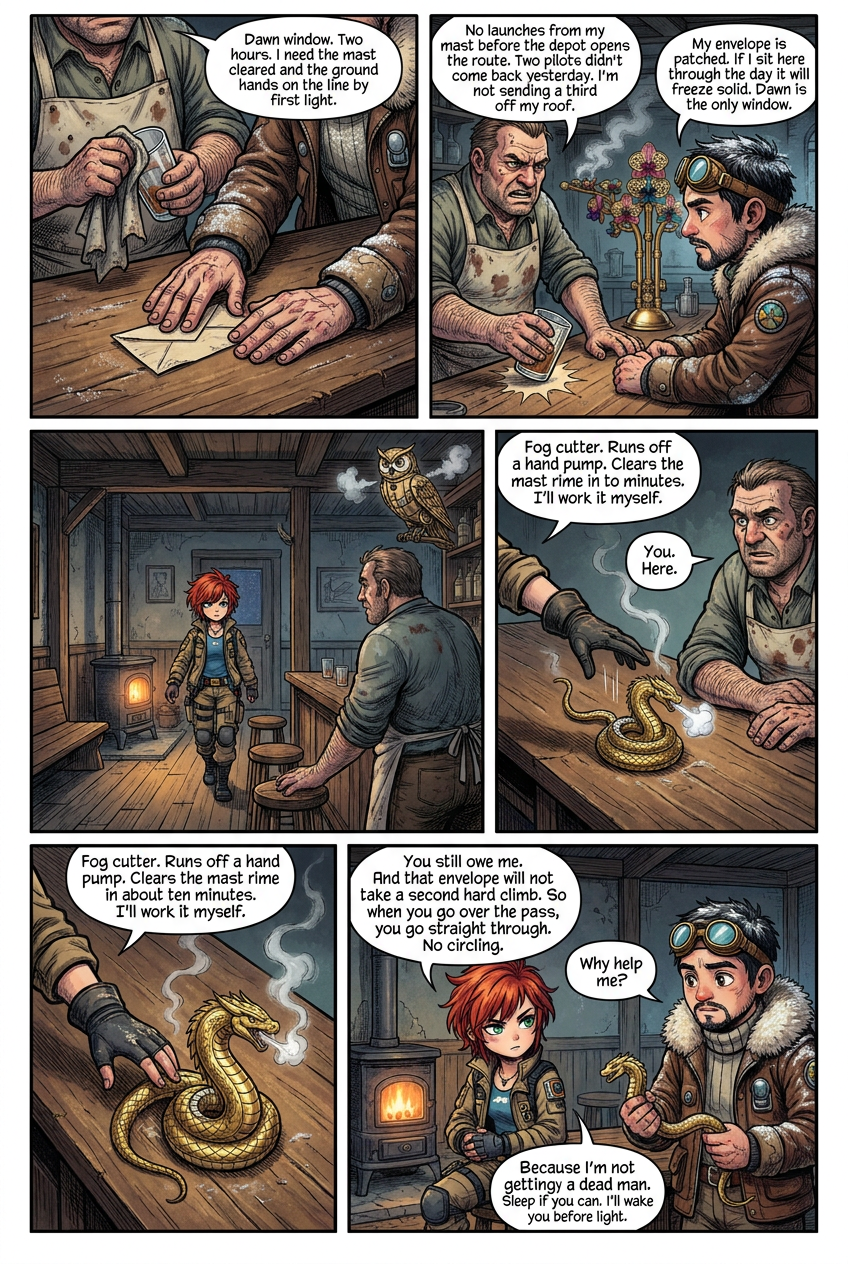
Bram folded the paper strip into his jacket and turned back to the bar. The keeper was wiping a glass with a rag that had seen better winters. Bram set the strip on the counter and smoothed it flat so the man could read the shaking numbers. "Dawn window," Bram said. "Two hours. I need the mast cleared and the ground hands on the line by first light." The keeper did not look at the paper. He looked at Bram. "No launches from my mast before the depot opens the route. Depot's closed the pass. That means closed." "The pass is closed to blind flight. I have a read now." "You have a scrap of paper from a broken owl." The keeper set the glass down. "Two pilots didn't come back yesterday. I'm not sending a third off my roof so his widow can shout at me in spring." Bram put both hands on the bar. "My envelope is patched. If I sit here through the day it will freeze solid on your mast and I'll never lift it. Dawn is the only window." "Then you should have landed somewhere else." A chair scraped at the stove. A woman stood up from the bench behind it. Bram had not seen her come in. Red hair cut short, engineer's jacket, gloves cut at the fingers. Dr. Cassandra Vex. The woman who had bolted the illegal coil to his gasbag two days ago and taken half his fee in coin. She walked to the bar without hurrying. She dropped a small brass shape onto the counter between Bram and the keeper. A coiled serpent, hollow, vents at the mouth. Steam ghosted from its jaw in the warm air. "Fog cutter," she said to the keeper. "Runs off a hand pump. Clears the mast rime in about ten minutes. I'll work it myself. Your hands don't have to touch his line." The keeper stared at her. "You. Here." "Weather held me too," she said. She did not look at Bram. "I want the other half of my fee. He can't pay me from a mast in your yard." The keeper's jaw worked. Bram waited. The room had gone quiet behind them. "Off my roof by sunrise," the keeper said. "You crash, it's on her, not the inn." "Agreed," Vex said. The keeper walked away down the bar. Vex finally turned to Bram. Her eyes were flat. "You still owe me. And that envelope will not take a second hard climb. So when you go over the pass, you go straight through. No circling. No second try." Bram picked up the brass serpent. It was warm. "Why help me?" "Because I'm not getting paid by a dead man." She sat back down by the stove. "Sleep if you can. I'll wake you before light."
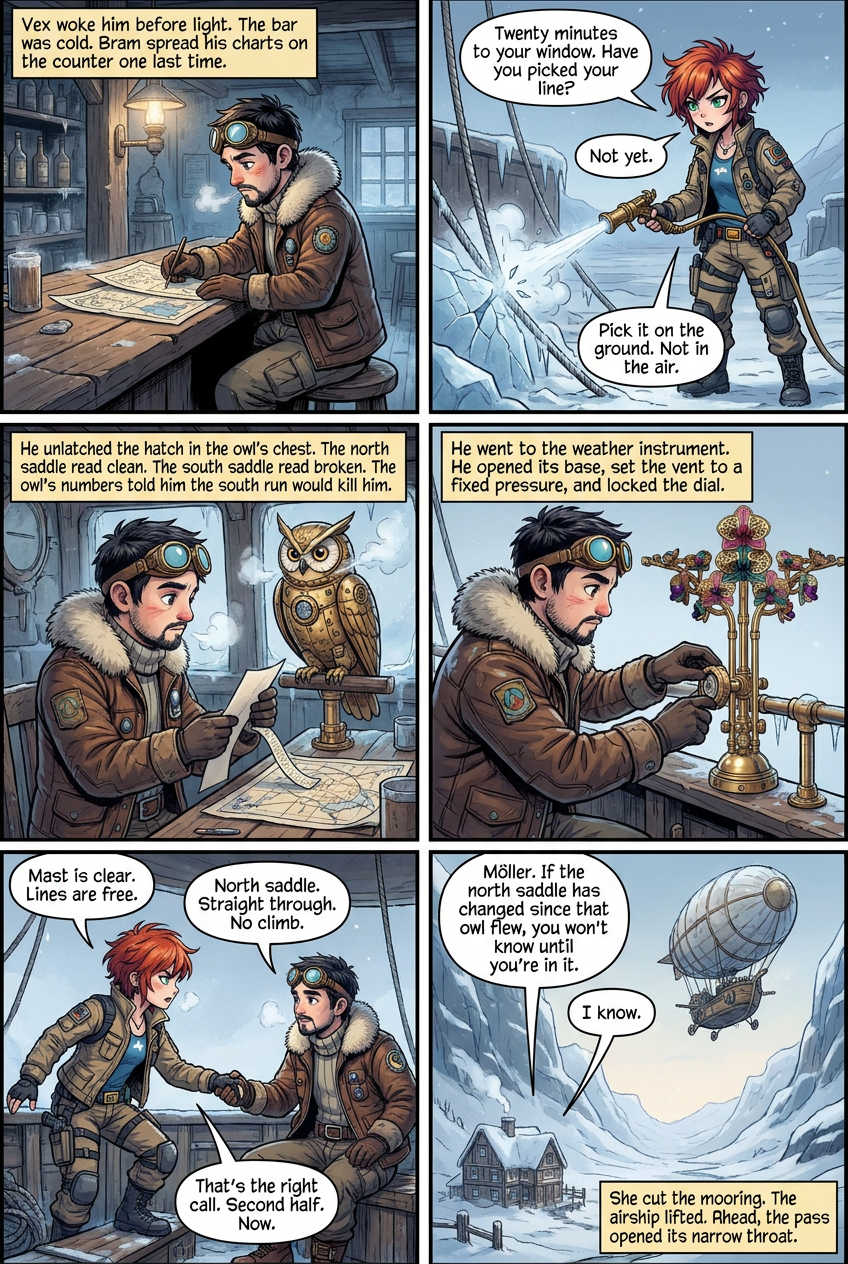
Vex woke him before light with a hand on his shoulder. The bar was cold. She had already gone to the mast. Bram pulled on his jacket, took his charts from the inside pocket, and spread them on the counter one last time. The charts showed Hollowpass as a knot of gray lines. Two saddles. Three false openings that ended in cliff. His father's route ran the north wall, but the north wall meant a climb the envelope could not take. The south run was lower. It also bent twice around blind rock. One wrong turn there and he would smear the gasbag across a face he could not see coming. He rolled the charts and went out to the mast. Vex was working the hand pump on the brass serpent. Steam poured from its mouth onto the frozen lines. Ice cracked and slid off in sheets. She did not look up. "Twenty minutes to your window. Have you picked your line?" "Not yet." "Pick it on the ground. Not in the air." He climbed into the gondola. The mechanical owl sat on its perch, vents ticking as it warmed. He unlatched the small hatch in its chest and pulled the paper strip from last night. Wind numbers, saddle by saddle. He laid the strip beside the chart and matched them. The north saddle read clean. Steady wind, no cross gust. The south saddle read broken — two crosswinds against the blind turns. He had been staring at the south run for a day because the south run was lower. The owl's numbers told him the south run would kill him. He would have to take the north. That meant no climb. That meant flying the pass at the height he entered it, threading the north saddle straight, trusting that the envelope held level. He went to the weather instrument bolted to the gondola rail. The brass orchid had saved him once by venting pressure. It could hold him at altitude now if he set it before the pass and did not touch it. He opened its base, set the vent to a fixed pressure, and locked the dial. Vex climbed up beside him, breath white. "Mast is clear. Lines are free." "North saddle," he said. "Straight through. No climb." She looked at the chart, then at the orchid's locked dial. "That's the right call." She held out a gloved hand. "Second half. Now." He counted the coins into her palm. She closed her fingers and stepped down off the gondola. "Möller." She waited until he looked at her. "If the north saddle has changed since that owl flew, you won't know until you're in it." "I know." She cut the mooring. The airship lifted. Below him the inn dropped away, and ahead the pass opened its narrow throat against a pale sky.
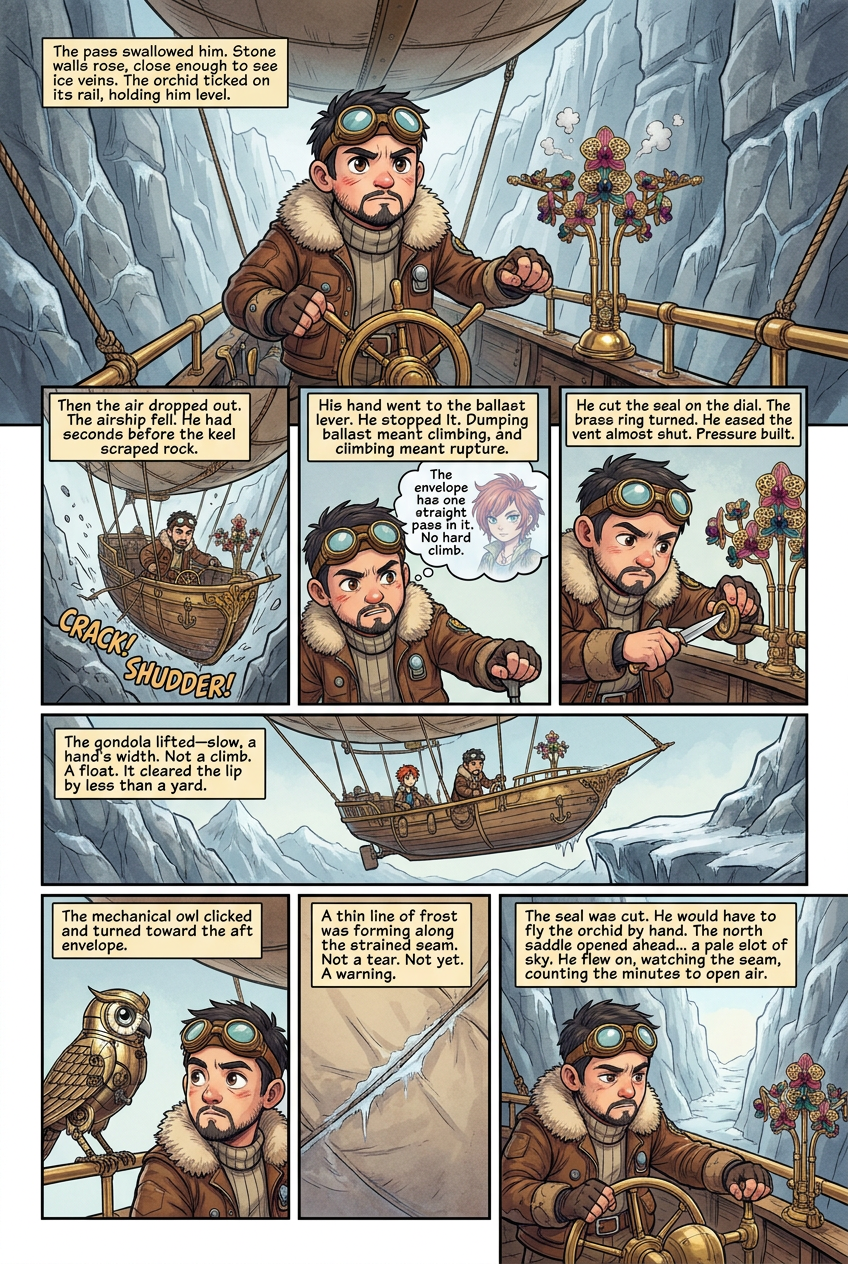
The pass swallowed him in the first minute. Stone walls rose on both sides, close enough that Bram could see ice veins in the rock. He held the wheel steady and watched the horizon line against the north saddle's notch. The orchid ticked on its rail, venting small breaths of steam, holding him level. Then the air dropped out from under the gondola. The airship fell. Not far — a body length, maybe two — but the envelope shuddered and the ropes cracked like whips. A downdraft off the north wall had punched him below his line. Ahead, the saddle's lower lip rose toward him. He had seconds before the keel scraped rock. His hand went to the ballast lever. He stopped it. Dumping ballast meant climbing, and climbing meant rupture. Vex's warning sat in his ear as plain as if she were beside him. The envelope has one straight pass in it. No hard climb. He looked at the orchid. Its dial was locked at a fixed vent. That lock was keeping him level — and level was now too low. He pulled his knife and cut the seal on the dial. The brass ring turned under his fingers. He eased the vent almost shut. Pressure built in the tubing. The bloom-shaped valves hissed and stiffened. The gondola lifted — slow, slow, a hand's width, then another. Not a climb. A float. He watched the saddle lip crawl back down below his boots. The envelope groaned above him. He heard a seam creak near the aft ribs. He held his breath and did not touch the wheel. The airship cleared the lip by less than a yard. He opened the vent again, one careful notch at a time, and settled back onto his line. The orchid resumed its ticking. The seam above him quieted. He was through the downdraft. But the dial would not lock again. The seal was cut. From here to the far side of the pass, he would have to fly the orchid by hand, reading pressure and adjusting on every gust. He could not look away from it. He could not rest. On its perch, the mechanical owl clicked and turned its head toward the aft envelope. Bram followed its gaze. A thin line of frost was forming along the strained seam where the gondola had lifted. Not a tear. Not yet. A warning. He wiped his goggles and set both hands back on the controls — one on the wheel, one on the orchid's ring. The north saddle opened ahead of him, a pale slot of sky between black rock. He had bought himself the pass. He had spent the margin that was supposed to carry him out the other side. He flew on, watching the seam, and counted the minutes to open air.
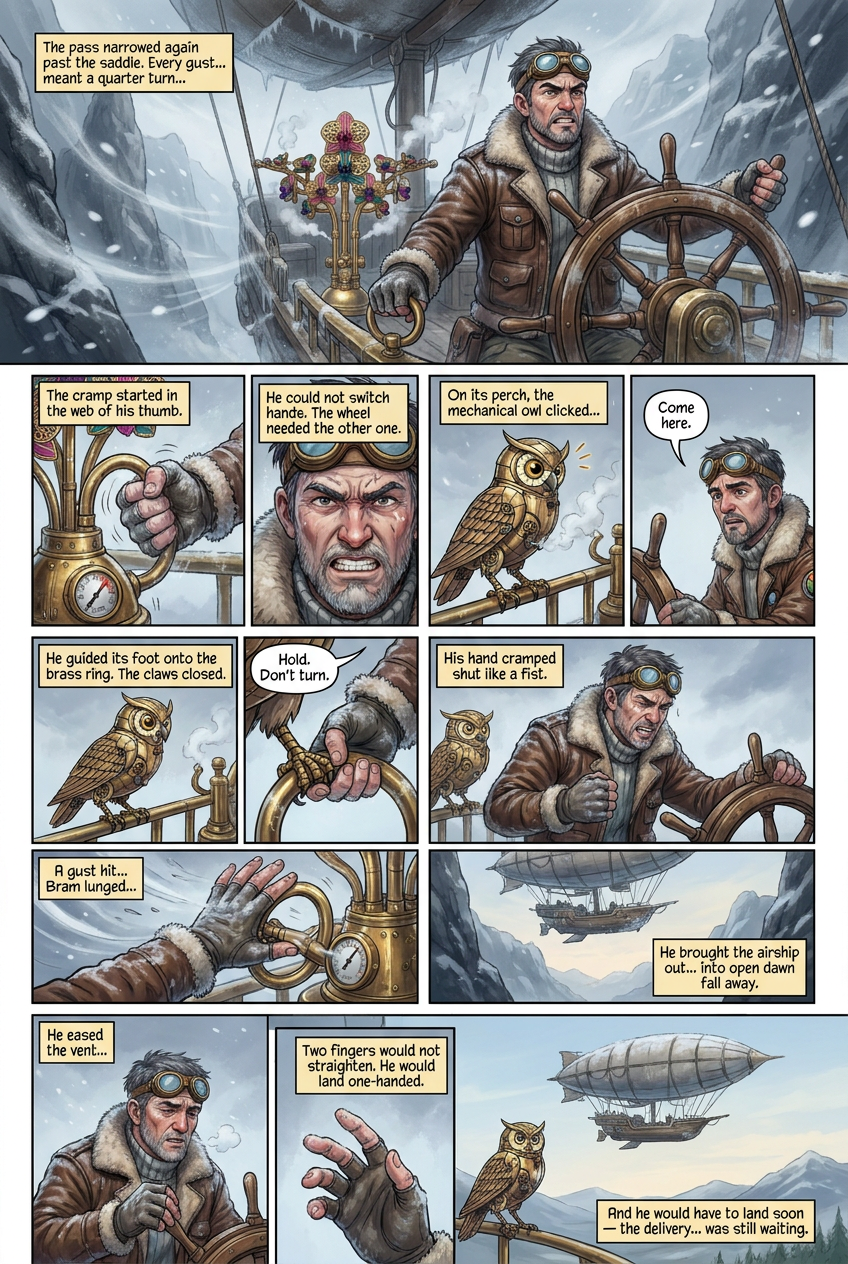
The pass narrowed again past the saddle. Bram kept his left hand on the brass ring of the orchid and his right on the wheel. The vent hissed under his thumb. Every gust off the rock walls shifted the pressure in the tubing, and every shift meant a quarter turn one way or the other. He had been holding the ring for twelve minutes. His fingers had begun to shake. The cramp started in the web of his thumb. It climbed into his palm and locked the tendons. He tried to flex his hand without letting the ring move. The ring moved. The orchid coughed a hard jet of steam and the gondola dipped a foot. Above him, the frost line along the strained seam widened by a finger's width. He could not switch hands. The wheel needed the other one. A crosswind was pushing him toward the north wall, and if he let go of the wheel for even a breath the airship would kiss rock. On its perch, the mechanical owl clicked and turned its head. Its brass eye caught his. The bird was built for wind readings, not for work. But it had a grip. Small, precise, clockwork claws. "Come here," Bram said. The owl opened its wings and hopped down onto the rail beside the orchid. Steam curled from the vents in its chest. Bram guided its foot onto the brass ring. The claws closed. He felt the ring steady under the owl's weight. "Hold," he said. "Don't turn." He let go. His hand cramped shut like a fist. He shook it against his thigh, teeth clenched, watching the pressure needle on the orchid's base. The needle held. The owl held. He worked his fingers open. Blood came back into them in slow, burning waves. Ahead, the pass began to widen. Pale sky showed between the walls. He could see the far mouth now, two minutes out, maybe three. A gust hit the envelope broadside. The pressure needle jumped. Bram lunged and put his hand back on the ring over the owl's foot. He turned the vent a hair. The gondola steadied. The owl did not let go. Together they held the line as the walls fell away on either side. He brought the airship out of Hollowpass into open dawn air. The seam above him was cracked along four inches and rimed white, but it had not torn. He was through. He eased the vent to a slow, even bleed and finally looked at his hand. Two fingers would not straighten. He would land one-handed, wherever he landed. And he would have to land soon — the envelope would not survive a second pass, and somewhere ahead of him, past the foothills, the delivery he had been paid to make was still waiting.
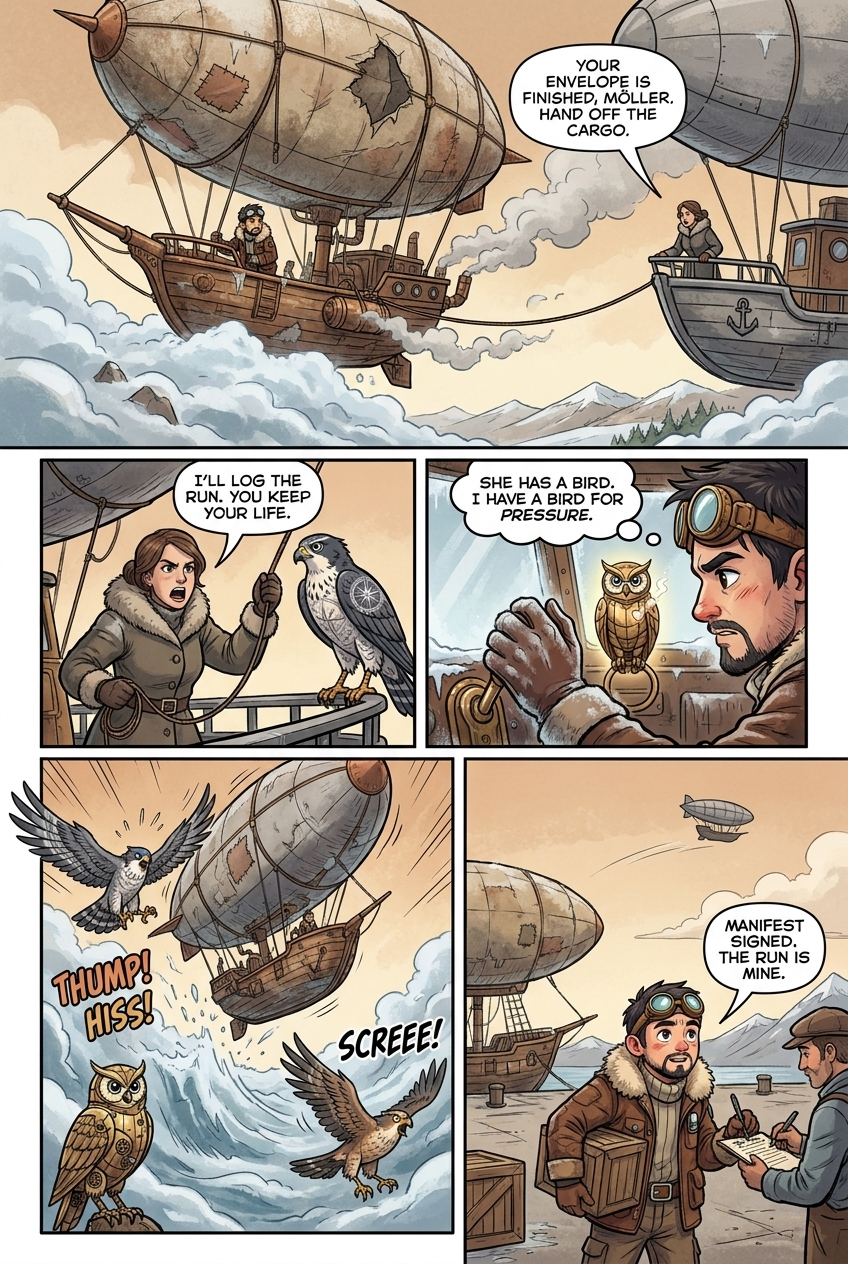
Bram cleared the last of the pass and let the foothills open beneath him. His envelope hissed above, the seam still holding by a thread. He set course for the low sky harbor where his delivery was waiting. Then he saw the other airship. It came in fast off the south ridge, smaller than his, painted the flat gray of a private courier. He knew the cut of the hull. A rival out of the depot who worked the same winter contracts and lost most of them to Bram. The rival had been sitting up here watching the pass. Waiting for scavenge. The other ship pulled alongside within a hundred yards. A woman stood at its rail in a heavy coat, one arm braced on a grapple line. Beside her rode a hawk on a wooden perch, gray feathers marked with pale rings like the face of a compass. The bird watched Bram with the same still attention as its handler. She had used it to track the storm and find him. "Your envelope is finished, Möller," she called across the gap. "Hand off the cargo. I'll log the run. You keep your life." Bram did not answer. He looked at his cracked seam, then at his hand. Two fingers still would not close. He could not outclimb her. He could not outrun her. If she threw a grapple, he would either tear his envelope pulling free or lose the cargo trying to hold it. The brass orchid vented at his elbow. The mechanical owl still gripped the ring. Bram thought about the wind. He had crossed the pass on wind data no one else had. He had a bird for it. She had a bird for it too. But her hawk read storms. His owl read pressure, close and exact. He eased the vent open a hair and dropped. Not a climb. A controlled fall into the trough of cold air pooling along the foothills. The rival ship followed and hit the shear line he had felt the owl flinch at. Her envelope shuddered and yawed hard to starboard. She fought her wheel. The hawk screamed and lifted off its perch. Bram leveled out below the shear, ten yards off the tree line, and ran flat toward the harbor. When he looked back, her ship was still climbing to clear the turbulence, minutes behind him now. He brought the airship down onto the harbor apron one-handed. A dock crew ran out. He unlashed the crate himself, one strap at a time, and signed the manifest with his off hand. The delivery was logged before the rival's shadow crossed the field. He had kept the run. But his envelope was done. Whatever came next on the route, he would not fly out on this ship. He stood on the apron and watched the gray hull circle once overhead, then turn back toward the pass.
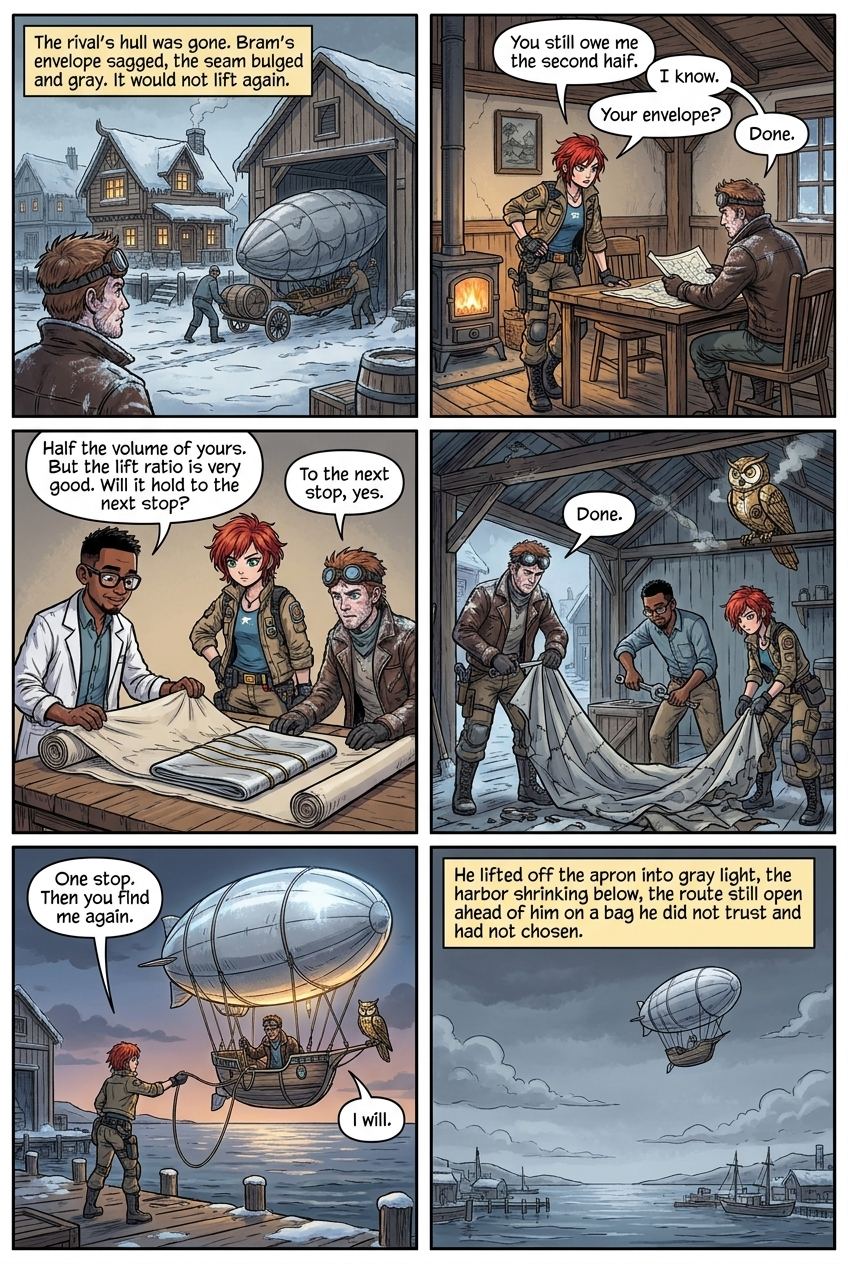
The rival's gray hull was gone from the sky when Bram finally looked up from the manifest. The dock crew rolled his airship into the lee of the harbor shed. His envelope sagged against its lines, the seam bulged and gray. It would not lift again. The next leg of the route left at dusk, and he had nothing to fly. He walked the apron until he found the harbor's small inn, timber walls dark under frost, lamps burning in the windows. He took a table near the stove and spread his chart flat. Two more stops on the route. No airship. No time to buy one. The door banged. Dr. Cassandra Vex came in first, red hair wet with melt, fog cutter slung on her hip. She dropped into the chair across from him without asking. "You made it," she said. "You still owe me the second half." "I know." "Your envelope?" "Done." She nodded once, unsurprised. "Then you're done too. Unless you find a bag." A second man followed her in, tall, thin, a white coat under a heavy parka. He knocked his shoulder on the door frame and caught his glasses before they fell. Vex did not turn. "This is Omondi," she said. "He owes me a favor. He builds test envelopes at the university depot. Small ones. Prototype work." Dr. Kamau Omondi set a canvas roll on the table and unrolled it with careful fingers. Inside lay a folded silver skin, thin as paper, ribbed with fine brass wire. "Half the volume of yours," he said. His voice was quiet and pleased. "But the lift ratio is very good. Very good. I have not flown it in weather like this." "Will it hold to the next stop?" Bram asked. "To the next stop, yes. After that I do not know." Bram looked at Vex. "Price." "What you owe me. Nothing more. He wants flight data. Your owl gives it to him at every landing." He thought about it for a breath. His hand still would not close. His route was not finished. "Done." They worked through the afternoon in the shed. Omondi checked seams and knocked a wrench off the gondola twice. Vex rigged the harness herself. Bram cut the old envelope free and watched it collapse onto the boards like a wet sheet. The mechanical owl watched from a rafter, brass eyes tracking every move, steam ticking from its vents. At dusk the new skin filled. It was smaller. It was strange. It rose. Bram climbed into the gondola and clipped the owl to its perch. Vex tossed him the mooring line herself. "One stop," she said. "Then you find me again." "I will." He lifted off the apron into gray light, the harbor shrinking below, the route still open ahead of him on a bag he did not trust and had not chosen.
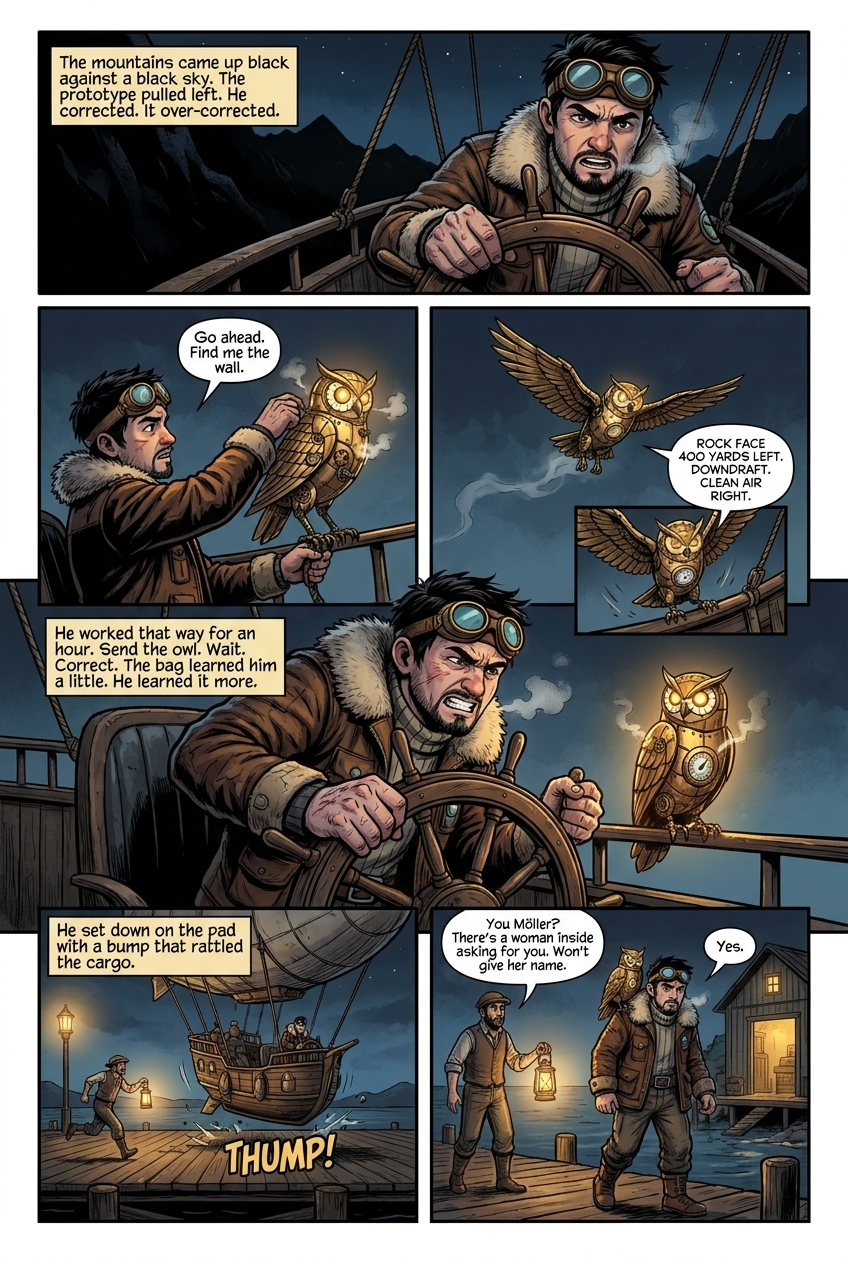
The harbor lights fell away behind him and the mountains came up black against a black sky. Bram had flown this range a hundred times in daylight. He had never flown it at night in a bag he did not know. The prototype pulled to the left when he leaned on the wheel. He corrected. It over-corrected. He eased off and the gondola swung under him like a bucket on a short rope. He throttled down and let the ship find its own trim. The smaller envelope rode higher on the wind than his old one. Every gust hit it harder. He could not see the ridgelines. He could only see where the stars stopped. He reached back and unclipped the mechanical owl from its perch. "Go ahead. Find me the wall." The owl's brass eyes brightened. Steam ticked from its vents. It dropped off the rail and vanished into the dark. Bram tightened the collar of his cracked leather jacket against the cold and waited, counting his own breath. The owl came back inside three minutes and landed hard on the rail. Its readings scrolled across the small dial at its breast. Rock face, four hundred yards left. Downdraft under it. Clean air to the right for maybe half a mile. Bram put the wheel over. The prototype answered late, then all at once. He almost overshot. He caught it with a shorter pull than he wanted to make and felt the envelope shudder above him. Nothing tore. He held course. He worked that way for an hour. Send the owl. Wait. Correct. Send the owl. The bag learned him a little. He learned it more. It liked a light hand. It hated a hard climb. He remembered Vex's warning about hard climbs and did not test it. The next stop's beacon showed up low on the horizon, a single yellow point below the stars. He brought the ship down toward it in a long shallow line, the owl on the rail, his good hand on the wheel, his bad hand tucked inside the jacket to keep warm. He set down on the pad with a bump that rattled the cargo. A dock hand ran out with a lantern. Bram killed the burner and sat a moment in the gondola, listening to the envelope settle. It had held. He had flown a strange bag through mountains in the dark and put it down whole. The dock hand stopped at the gondola and looked up. "You Möller?" "Yes." "There's a woman inside asking for you. Says she came a long way. Won't give her name." Bram unclipped the owl and stepped down onto the pad. His legs shook once and steadied. He had one stop left after this one. He walked toward the light of the shed, the owl on his shoulder, and did not yet know who was waiting.
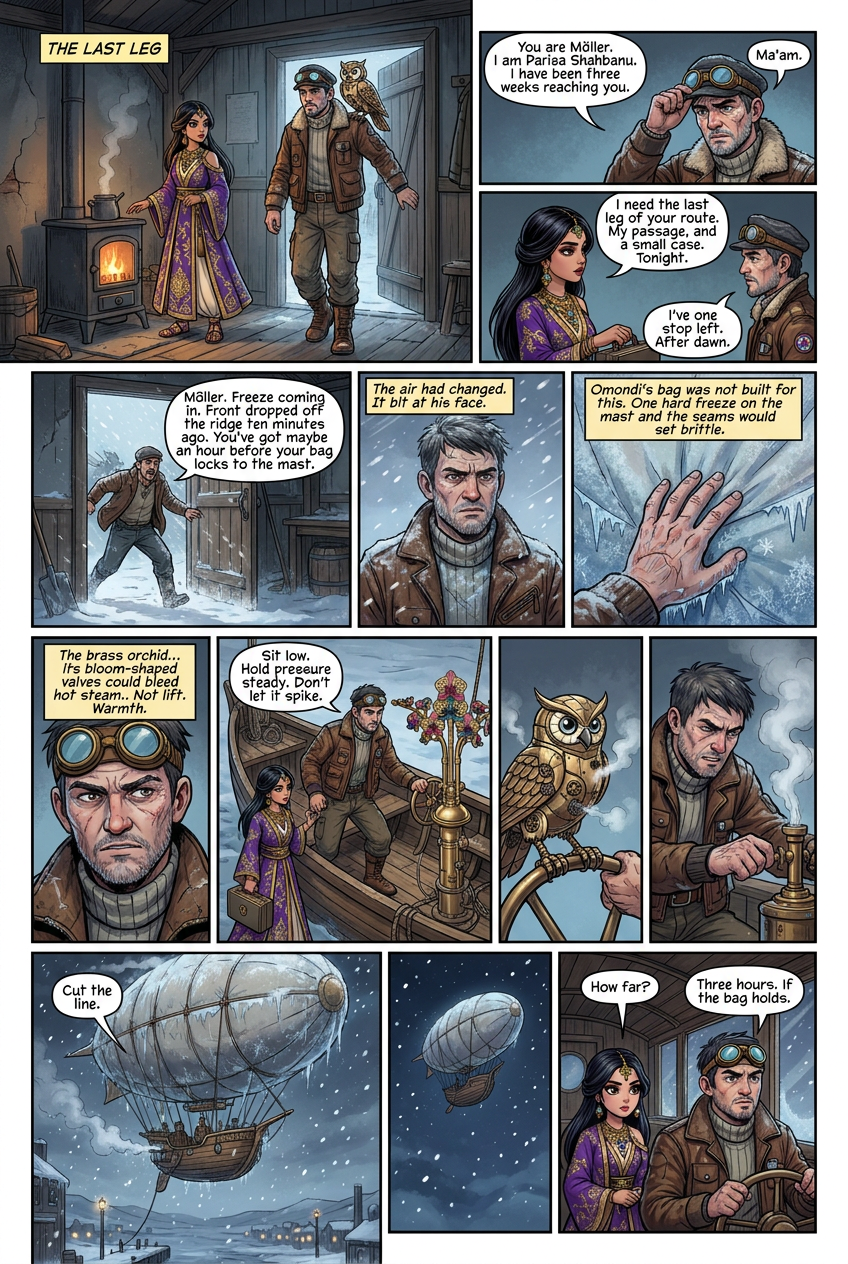
Bram stepped into the shed with the owl on his shoulder. A stove burned low in the corner. A woman stood beside it in a purple travel coat stitched with gold thread, her dark hair loose from the road. She was not dressed for this country. She turned when the door closed. "You are Möller," she said. Her voice was even. "I am Parisa Shahbanu. I have been three weeks reaching you." He touched his cap. "Ma'am." "I need the last leg of your route. My passage, and a small case. Tonight." "I've one stop left," Bram said. "After dawn." "Now," she said. "By dawn the pass behind you closes again. I cannot be here when it does." Before he could answer, the dock hand shoved the door open and stamped snow off his boots. "Möller. Freeze coming in. Front dropped off the ridge ten minutes ago. You've got maybe an hour before your bag locks to the mast." Bram went back out. The air had changed. It bit at his face through the collar of his cracked jacket. Frost was already forming a white skin on the prototype's envelope. He put his bare hand on the fabric. It was stiffening under his palm. Omondi's bag was not built for this. One hard freeze on the mast and the seams would set brittle. He would lose the envelope. He would lose the route. He thought fast. He still had the brass orchid rigged to the vent line from the pass. Its bloom-shaped valves could bleed hot steam from the burner up through the piping if he reversed the feed. Not lift. Warmth. Enough to keep the skin above freezing until he was airborne. He climbed into the gondola. The princess followed without asking. She set a small locked case at her feet and gripped the rail. "Sit low," he said. He unclipped the owl and set it on the control ring. "Hold pressure steady. Don't let it spike." The owl's brass claws closed on the ring. Steam ticked from its vents. Bram reversed the orchid's feed and cracked the burner wide. Hot steam climbed the brass tubing and hissed into the envelope's underskin. The frost on the fabric beaded and ran. He worked the manual valve with his good hand, watching the skin soften above him. "Cut the line," he called to the dock hand. The mooring dropped. The prototype lifted slow, heavy with cold, then found the air and climbed clean into the dark. Behind them the waystation lights blurred through drifting snow. Ahead lay one stop, a passenger he had not agreed to carry, and a locked case he had not agreed to move. The bag was airborne. The route was still open. Parisa looked at him across the gondola. "How far?" "Three hours," Bram said. "If the bag holds."
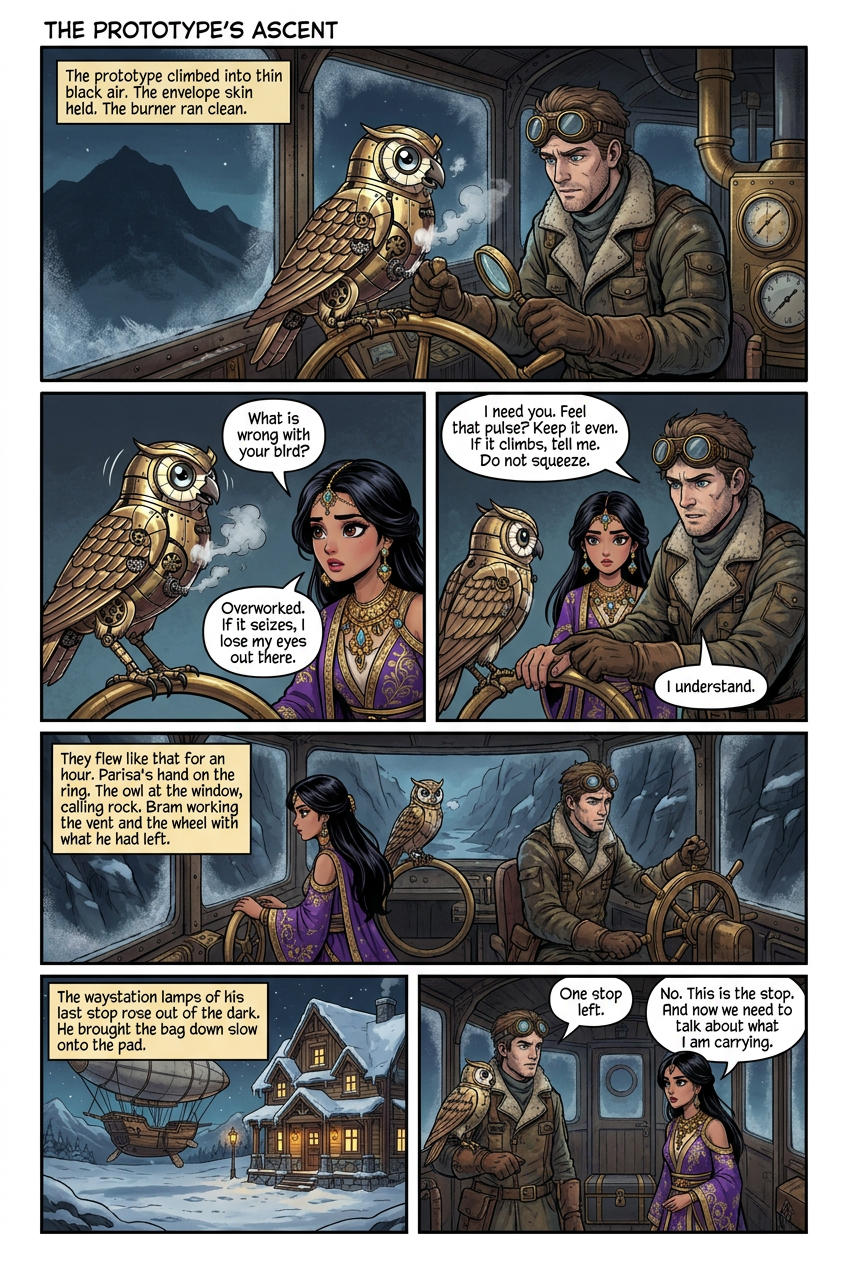
The prototype climbed into thin black air. Bram leveled off above the ridge line and watched his instruments settle. The envelope skin held. The burner ran clean. For a moment he let himself believe the hard part was behind him. Then the owl chirped wrong. It sat on the brass control ring where he had set it, claws locked, steam ticking from its side vents. But the ticking had gone uneven. One vent puffed twice, skipped, puffed again. Its head jerked toward the window, then back to the ring, then toward the window again. The bird was trying to do three jobs at once. Grip the ring. Read the wind. Watch the rock faces sliding past in the dark. Bram knew the machine. He had wound it a thousand times. It could hold any one task for hours. Two, on a good night. Three was breaking it. Parisa saw his face. "What is wrong with your bird?" "Overworked," Bram said. "If it seizes, I lose pressure control and I lose my eyes out there." He nodded at the black glass. Without the owl calling distances, he would fly the prototype into a cliff inside ten minutes. He thought it through. He could not free the owl from the ring, because his own hand was needed on the manual vent the broken orchid demanded. He could not fly blind. He could not land here. He looked at the locked case at Parisa's feet, then at her hands. Steady hands. No gloves. "I need you," he said. "Come here." She crossed the gondola without asking why. He guided her palm onto the brass ring beside the owl's claws. "Feel that pulse? Keep it even. If it climbs, tell me. Do not squeeze." "I understand." He lifted the owl free. Its claws opened. He set it on the sill and tapped the plate above its eye. "Wind and rock. Only that." The owl's head steadied. One job. Its vents evened out. It called the first distance in a clean two-tone chirp. Left face, forty yards. Bram turned the wheel. They flew like that for an hour. Parisa's hand on the ring. The owl at the window, calling rock. Bram working the vent and the wheel with what he had left. The prototype held. The waystation lamps of his last stop rose out of the dark. He brought the bag down slow onto the pad. The skids kissed snow. He cut the burner. The owl hopped down onto his wrist and folded in. Its vents were quiet now. He had not lost it. Parisa took her hand off the ring and flexed her fingers. She did not look at him. She looked at the case. "One stop left," Bram said. "No," she said. "This is the stop. And now we need to talk about what I am carrying."
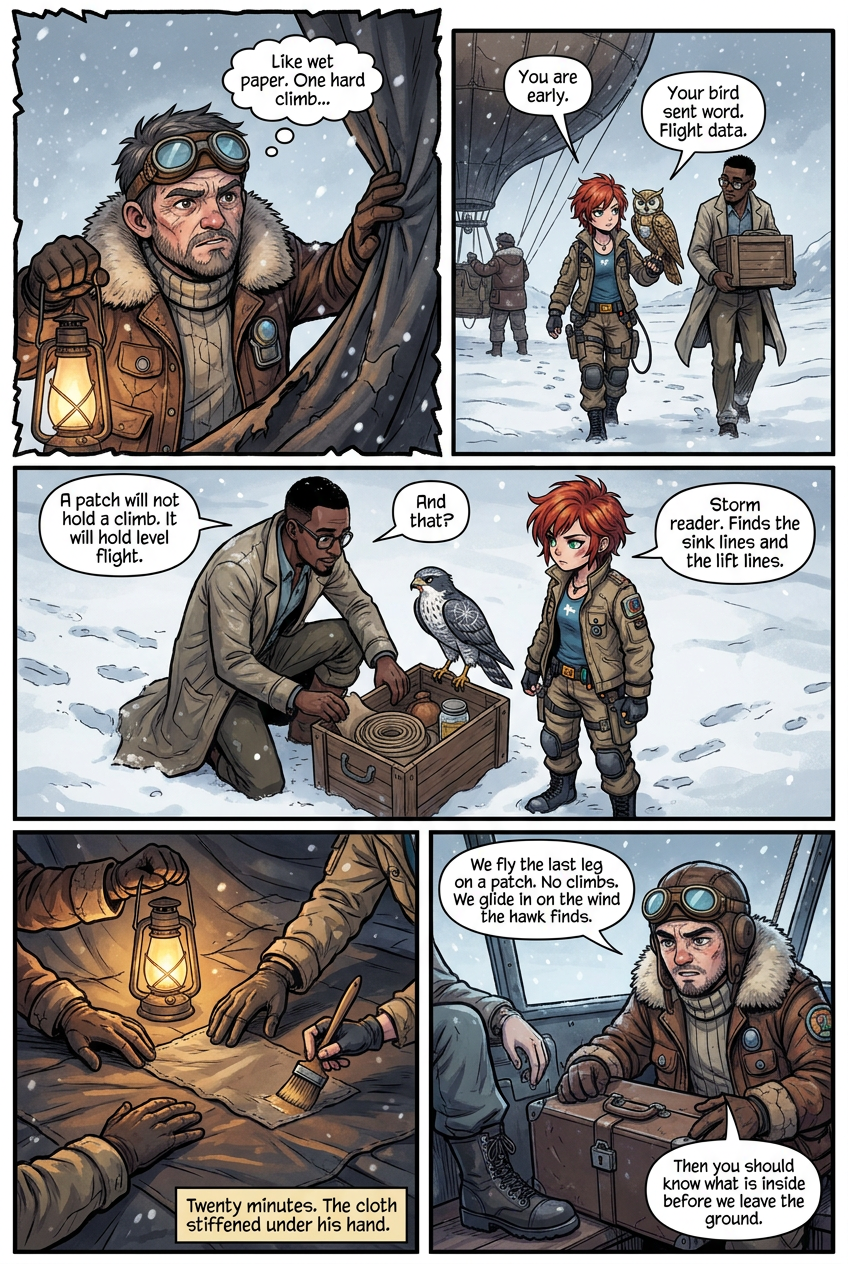
Parisa's hand still rested on the case. Bram let her wait. He climbed out onto the pad and walked the length of the prototype envelope with a lantern raised. He had to see the damage before he heard anything else. The steam heat had saved the fabric from the freeze, but the reversed vent had cooked it. Along the crown seam, the weave had gone slack and dark. He pressed a thumb to it. The cloth gave like wet paper. One hard climb would open it top to bottom. He would not reach the last stop. He would not reach anywhere. Behind him, boots crunched snow. A short figure in a scarred canvas jacket came up the pad, red hair stiff with frost. Dr. Vex. The engineer who had put him in the air to begin with, and taken cash for it twice. Behind her, tall and stooped in a coat too thin for the altitude, came Dr. Omondi, the man whose prototype was rotting over Bram's head. Omondi carried a wooden crate against his chest and nearly went down on the ice. Vex caught his elbow without looking. "You are early," Bram said. "Your bird sent word," Vex said. She nodded at the owl on his wrist. "Two stations back. Flight data. He read the numbers and we came." Omondi set the crate down and knelt by it. "The heat exchange. I did not test it long enough. I am sorry, I am sorry." He opened the lid. Inside sat coiled patch cloth, a jar of resin, and a hawk. Grey and white, wings folded, compass rings printed across the feathers. Its eyes tracked Bram. "A patch will not hold a climb," Bram said. "It will hold level flight," Omondi said. "Resin cures in the cold. Twenty minutes. The seam becomes stiff, not strong. You cannot climb on it. You can only glide." Bram looked at the hawk. "And that?" "Storm reader," Vex said. "Finds the sink lines and the lift lines. You ride the air down instead of pushing through it. Your owl cannot do that job and the pressure job both. You saw that already." He had. He flexed the hand that had cramped on the vent for two days. They worked on the crown seam together. Omondi laid the patch. Vex brushed resin. Bram held the lantern close and counted minutes. The cloth stiffened under his hand. When they climbed back into the gondola, Parisa had not moved. The case sat between her boots. "We fly the last leg on a patch," Bram told her. "No climbs. We glide in on the wind the hawk finds. If the wind is wrong, we go down where it puts us, not where you want." She studied him. Then she lifted the case onto her lap and thumbed the lock. "Then you should know what is inside before we leave the ground."
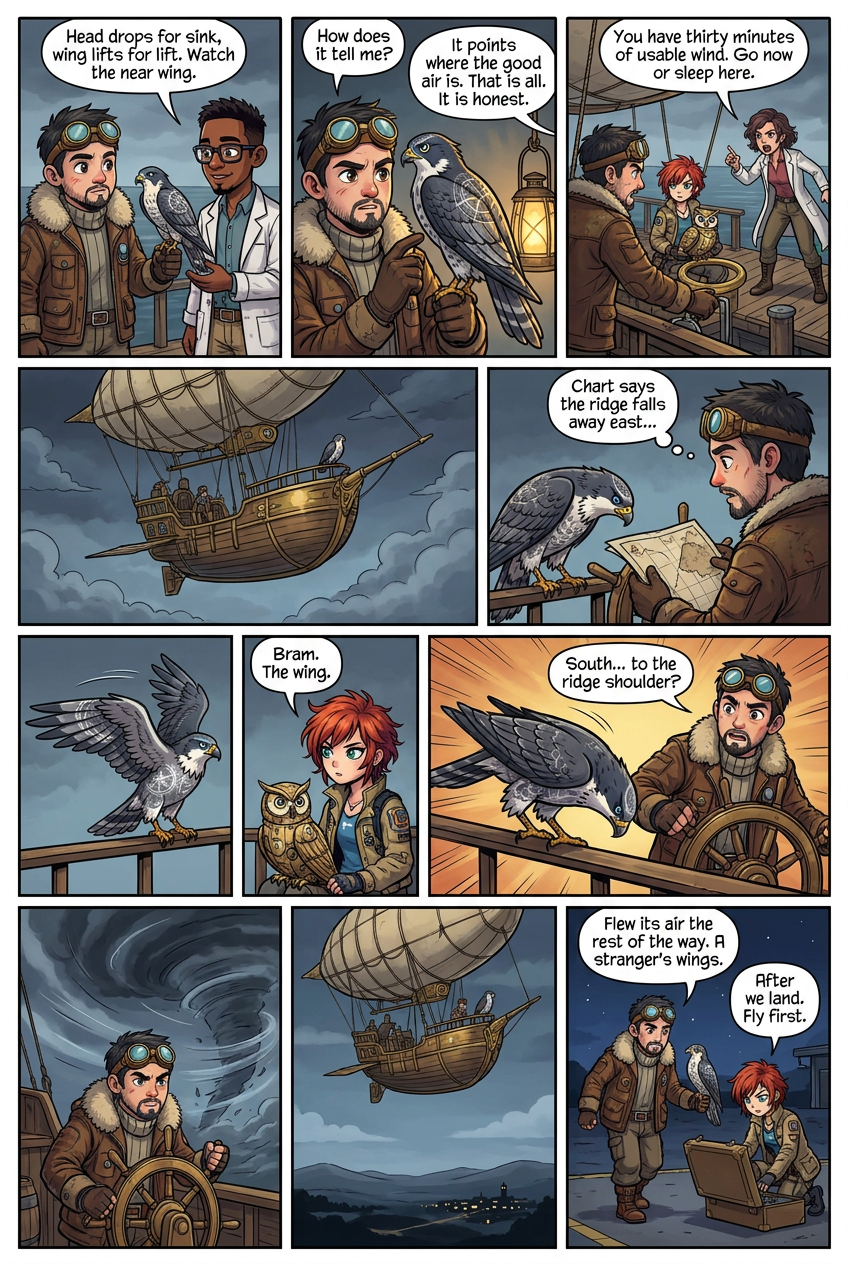
Parisa lifted the case lid an inch, then closed it again. "After we land," she said. "Fly first." Bram did not argue. The patch on the crown seam had cured stiff. The wind outside was rising. He had one glide left in this bag and a bird he had never flown with reading the air for him. Omondi passed the hawk through the gondola door. It stepped onto the rail and settled. The compass rings on its wings caught the lantern light. Bram had trusted his own owl for six years. He had never seen this hawk work. "How does it tell me?" Bram asked. "Head drops for sink," Omondi said. "Wing lifts for lift. Watch the near wing. It points where the good air is." "That is all?" "That is all. It is honest. You must learn its honest." Vex was already at the mooring. "You have thirty minutes of usable wind. Go now or sleep here." Bram cut loose. The prototype slid off the pad and dropped into the valley air. He kept the vent almost closed. The patched seam held. Parisa braced her hand on the brass ring without being asked. The owl sat quiet in her lap, one wing still twitching. The hawk faced forward. Its head stayed level. Bram eased the wheel a quarter turn east, where the chart said the ridge fell away. The hawk's head dropped. He pulled the wheel back. The head came up. He held course. The hawk stayed level for a count of ten, then the near wing lifted, pointing south of his line. He did not turn. His own charts said south was the ridge shoulder. Turning that way meant flying at rock in the dark. "Bram," Parisa said. She was watching the hawk. "The wing." "I see it." The hawk's head dropped again. Hard. The whole body tipped forward on the rail. Bram turned south. He turned because he had asked for a storm reader and there was no point bringing one if he flew his old lines. The prototype banked. He waited for the rock face to come out of the dark. It did not. The air under the bag firmed. The envelope lifted a foot on its own without a breath from the vent. The patch held. The hawk settled its wings and faced forward again. A downdraft roared past his old line, north of them, loud enough to hear through the hull. If he had held course, it would have put him on the slope. He flew the hawk's air the rest of the way in. Twenty minutes later the waystation lamps rose out of the dark where the bird had pointed. He set the prototype down soft on a patched seam and a stranger's wings. On the pad, Parisa opened the case.
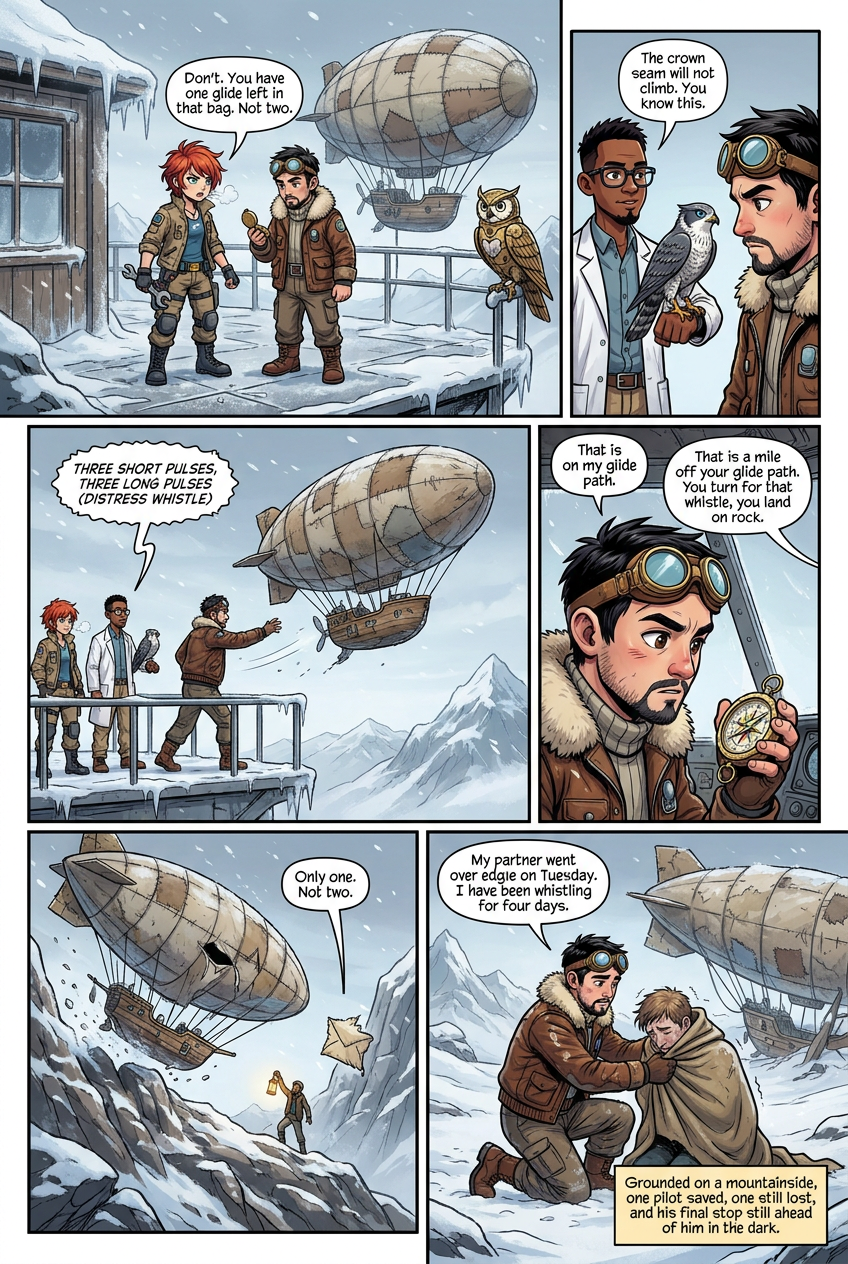
Parisa lifted the case lid on the pad. Inside lay a dented brass pocket compass, its lid weathered, its face still bright. "It belonged to one of the missing pilots," she said. "His wife paid me to bring it out. She thinks he is still up there." Bram closed the case. Two pilots had vanished in Hollowpass at the start of the week. He had flown past their silence for days. Now their names sat in his hand. Vex came off the mooring line with a wrench in her fist. Her red hair was crusted with frost. She had cleared his mast for launch once, taken his coin twice, and warned him every time. "Don't," she said. She had read his face. "You have one glide left in that bag. Not two." Omondi stood behind her, lab coat buttoned wrong against the cold. He held the hawk on his wrist. "The crown seam will not climb," he said. "You know this." "I am not climbing," Bram said. "I am gliding down." A thin sound came through the wind then. Three short pulses, then three long. A distress whistle from a pilot's kit, carried on the updraft from the slope below the waystation. It cut across the line he had planned for his last delivery. "That is on my glide path," Bram said. Vex swore. "That is a mile off your glide path. You turn for that whistle, you land on rock." Bram looked at the compass. He looked at the patched envelope shifting on its lines. He thought of the courier who had never survived this route, and how legends were only ever the pilots who came back. "Give me the hawk," he said. "Keep the owl here. Parisa stays with you." Parisa did not argue. She set the compass on the rail beside him. "Bring him back if he is there." Bram cut loose alone. He kept the vent almost closed and let the prototype fall down the valley. The hawk faced the whistle. Its near wing lifted, pointing him off his line, out over the scree. He followed the wing. The whistle grew. He saw a torn envelope hooked on a spur, and one man beside it, waving a lantern. Only one. Not two. Bram could not climb back to the waystation with a passenger aboard. The crown seam would split. He knew this before he chose it. He brought the prototype down hard on the scree in a long skid, tore the belly fabric, and stopped ten yards from the man. The pilot climbed in shaking. "My partner went over the edge on Tuesday," he said. "I have been whistling for four days." Bram tucked him under a blanket. The prototype would not lift again. He was grounded on a mountainside, one pilot saved, one still lost, and his final stop still ahead of him in the dark.
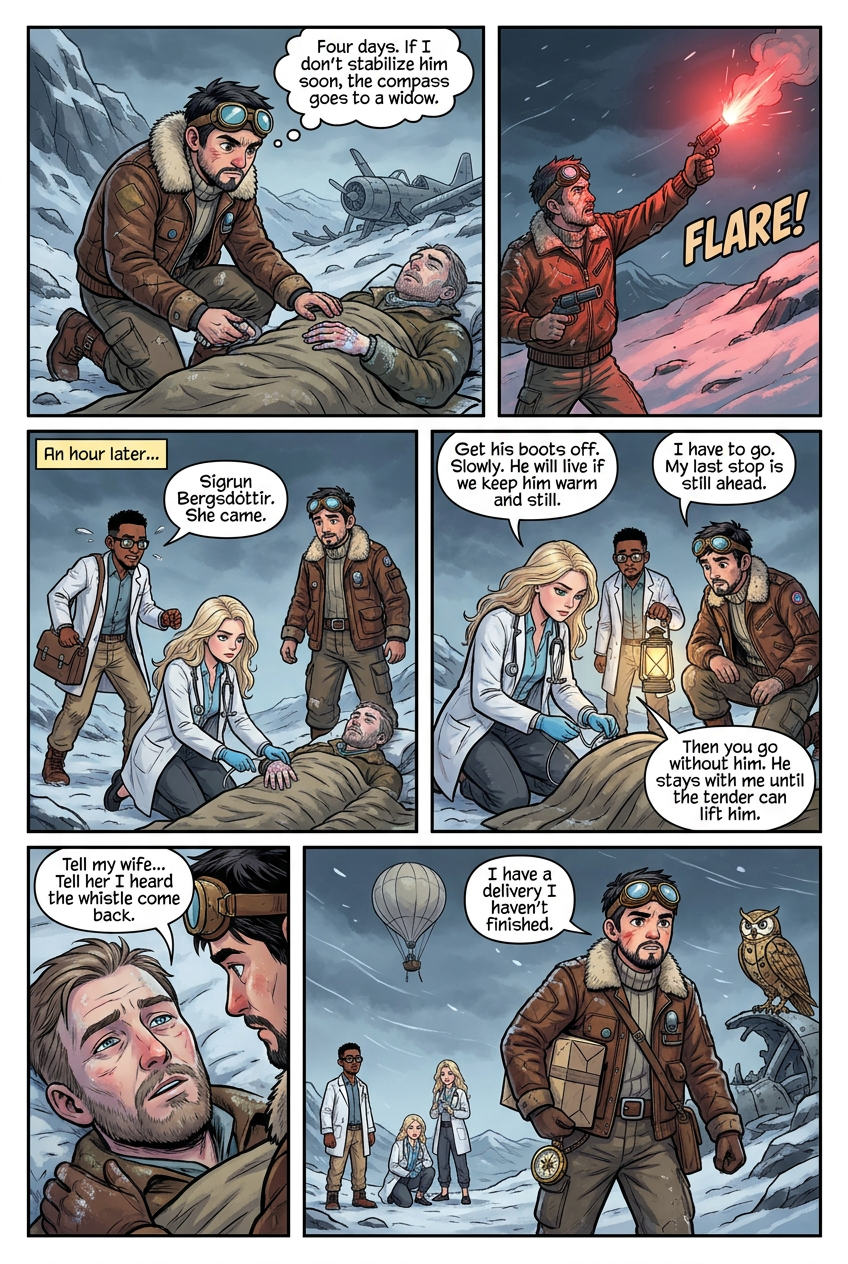
The prototype lay dead on the scree. Wind pushed grit against the torn belly fabric. Bram knelt beside the rescued pilot and pulled the blanket back. The man's lips were gray. His breath came shallow and quick. Frostbite had blackened two fingers on his right hand. A crust of dried blood matted his hair above the ear. Four days on the mountain had almost finished him. If Bram did not stabilize him soon, the compass in Parisa's case would go home to a widow, not a wife. Bram fired the distress flare from his kit. Red light climbed above the ridge and burst. He counted to sixty and fired a second. Then he waited beside the pilot and rubbed warmth into the man's good hand. An hour later he heard the drone of Omondi's small tender balloon coming down the valley. The scientist had followed the flare on foot after landing on the flat above. He arrived slipping on the scree, lab coat flapping, medical satchel banging his hip. Behind him came a woman Bram had never seen. She wore a heavy wool coat over a doctor's blouse. A stethoscope hung at her throat. Her blonde hair was tied back hard against the wind. "Sigrun Bergsdóttir," Omondi said, breathing hard. "She was at the waystation when the flare went up. She came." Sigrun did not waste words. She knelt by the pilot and pressed two fingers to his neck. "Pulse thready. How long exposed?" "Four days," Bram said. "He was whistling the whole time." She opened her bag. "Get his boots off. Slowly. Do not rub the feet." Bram worked the frozen laces while she cut the man's jacket open and slid warming packs against his chest. Omondi held a lantern close and dropped it twice before Sigrun took it from him without looking. She threaded an IV line into the pilot's arm on the first try. Warm saline ran down the tube. "He will live if we keep him warm and still," she said. "Not if you carry him out over rock." "I have to," Bram said. "My last stop is still ahead." Sigrun looked at him. Her eyes were the color of shallow ice. "Then you go without him. He stays with me until the tender can lift him at first light." Bram looked at the pilot. Color was already returning to his mouth. The man's eyes opened a slit and found Bram's face. He tried to speak. Bram leaned close. "Tell my wife," the pilot whispered. "Tell her I heard the whistle come back." Bram nodded. He stood. Vex's patch kit still sat in the prototype's locker, and the last package for his route was strapped under the pilot's seat. He had a survivor, a doctor to hold the line, and a delivery he had not yet finished. He pulled the package free and started up the scree toward Omondi's tender.
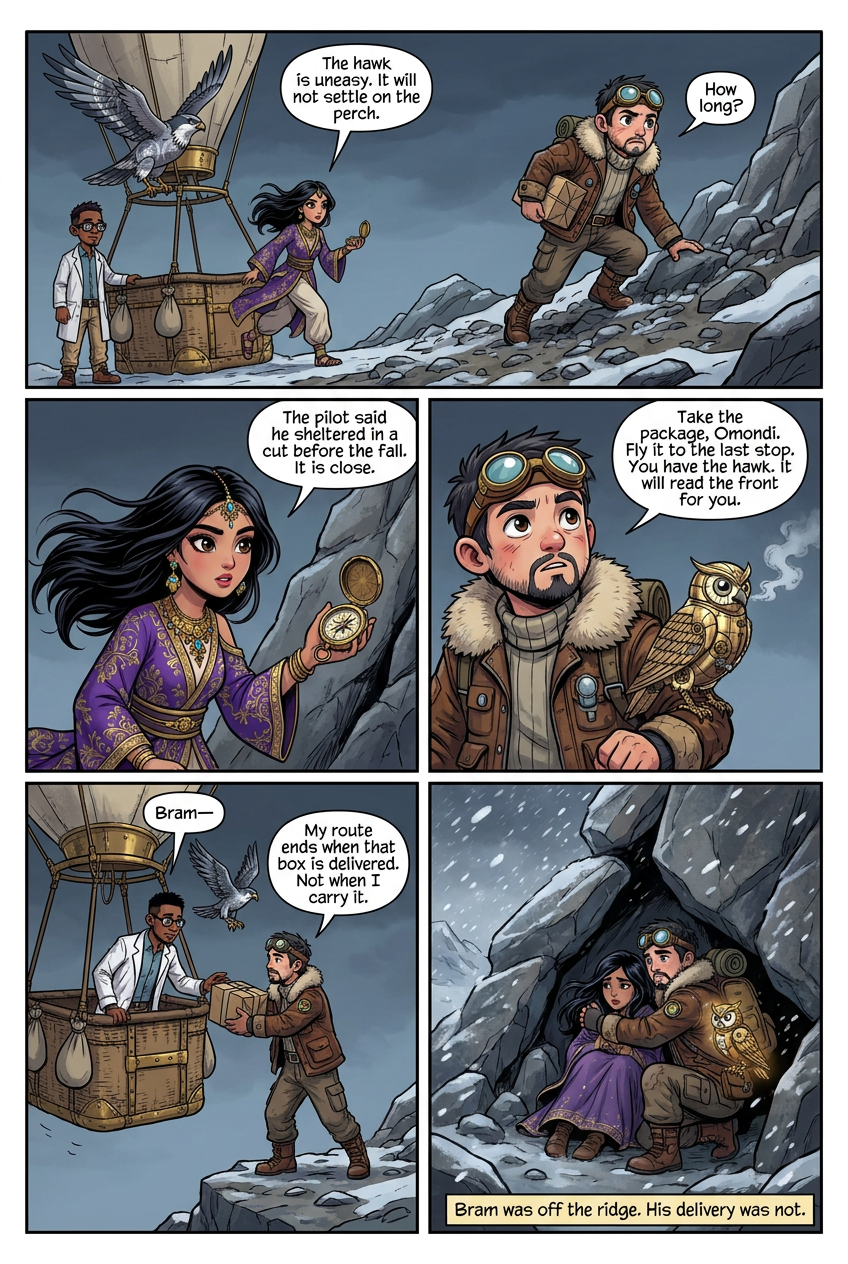
Bram climbed the scree to Omondi's tender with the last package under his arm. The wind had shifted while he worked over the pilot. It came harder now, from the north, and it carried the smell of wet iron that meant snow. He looked up. The sky above the ridge had gone the color of slate. The storm that had killed the missing pilots was coming back. Omondi met him at the tender's basket, pushing his glasses up with a gloved thumb. "The hawk is uneasy," he said. "It will not settle on the perch." Behind him the storm-tracking hawk gripped a strut, wings half-open, head snapping toward the ridge. Its compass-marked feathers ruffled against the wind. "How long?" Bram asked. "Forty minutes. Maybe less." Omondi glanced at the ridge line. "You will not walk out in that. No one walks out in that." Parisa stepped down from the tender basket, coat pulled tight, dark hair whipping across her face. She had refused to stay at the waystation. She held the dented brass compass in her palm, lid open, needle steady. "You brought her," Bram said. "She would not stay," Omondi said. "She said the compass points somewhere useful." Parisa held the compass out. The needle did not swing to north. It pointed along the ridge, southeast, toward a dark seam in the rock Bram had passed on the way up. "The pilot said he sheltered in a cut before the fall," she said. "He drew it for Sigrun. It is close." Bram looked at the seam. Then at the sky. The tender could not lift three of them and outrun the storm. He had seen Omondi's basket labor with two. "Take the package," he told Omondi. "Fly it to the last stop. You have the hawk. It will read the front for you." Omondi's mouth opened. "Bram—" "You can fly it. Light load, tailwind ahead of the storm. Land and stay down." Bram pressed the package into his arms. "My route ends when that box is delivered. Not when I carry it." Omondi held the package against his chest. He nodded once, then climbed into the basket and vented ballast. The tender lifted. The hawk shrieked and beat after it. Bram turned to Parisa. "Show me the cut." They ran the ridge with the wind at their backs. Snow began before they reached the seam—fine, then thick. The cut opened between two slabs, deeper than it looked, floored with dry gravel. Bram pulled her in after him. He wedged his pack against the mouth to break the wind. The mechanical owl, still clipped to his belt, hissed steam and folded its wings against his hip. The storm hit the ridge above them and roared over the slabs. Inside the cut it was cold, and quiet, and alive. Bram was off the ridge. His delivery was not.
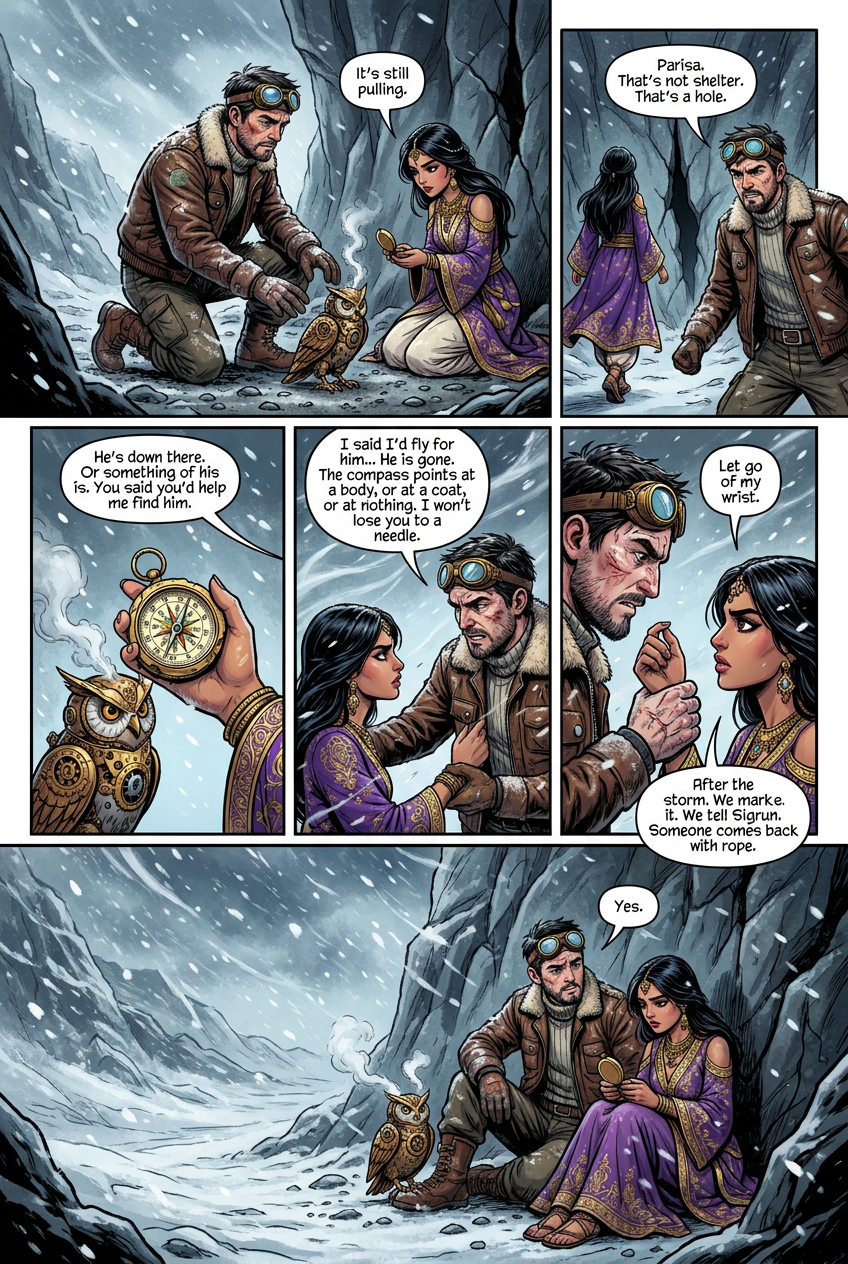
The storm sealed the cut like a shut door. Inside, the light went gray-blue. Bram unclipped the mechanical owl from his belt and set it on the gravel, where it folded and hissed. Parisa knelt by the pack, still holding the dented brass compass. The needle had not moved since they came in. It pointed past the back wall of the cut, deeper into the mountain. "It's still pulling," she said. She stood and walked toward the rear of the cut. The gravel gave way to a narrow crack in the rock, black and cold, wide enough for a person. "Parisa." Bram got up. "That's not shelter. That's a hole." "He's down there. Or something of his is." She turned the compass in her hand. The needle held on the crack. "You said you'd help me find him." "I said I'd fly for him. He fell four days ago. He went over the cliff. Sigrun has the one who lived." "Then whose compass is this?" She lifted it. "It knows where he is. It has been right every time." He stepped closer. The wind above the slabs sounded like an engine. "If you go in there and the storm holds three hours, I can't dig you out. I don't have rope. I don't have light past what's in my pack. I have a bird that can't fly in this." "Then come with me." "No." She took one step toward the crack. He caught her wrist. He felt her go still under his hand, and he knew he had one sentence before she pulled away for good. "Listen to me." He kept his voice low. "I flew off a route to find him. I put a prototype into rocks. I did what you paid for. He is gone. The compass points at a body, or at a coat, or at nothing. I won't lose you to a needle." Her eyes did not move from his. "Let go of my wrist." He let go. She did not step forward. She looked at the crack for a long moment. Then she closed the compass lid. The click was small and clear in the cut. "After the storm," she said. "We mark it. We tell Sigrun. Someone comes back with rope." "Yes." She sat down against the rock. Her hands were shaking. She pressed the compass flat against her knee to stop them. Bram sat beside her. The owl vented steam onto his boot. Outside, the storm dragged snow across the slabs and did not let up. He had held her back. He still had her. The compass was closed in her lap, and the crack in the wall waited, and his last package flew south without him. When the wind broke, he would have to choose again: finish the route, or go into the mountain with her.
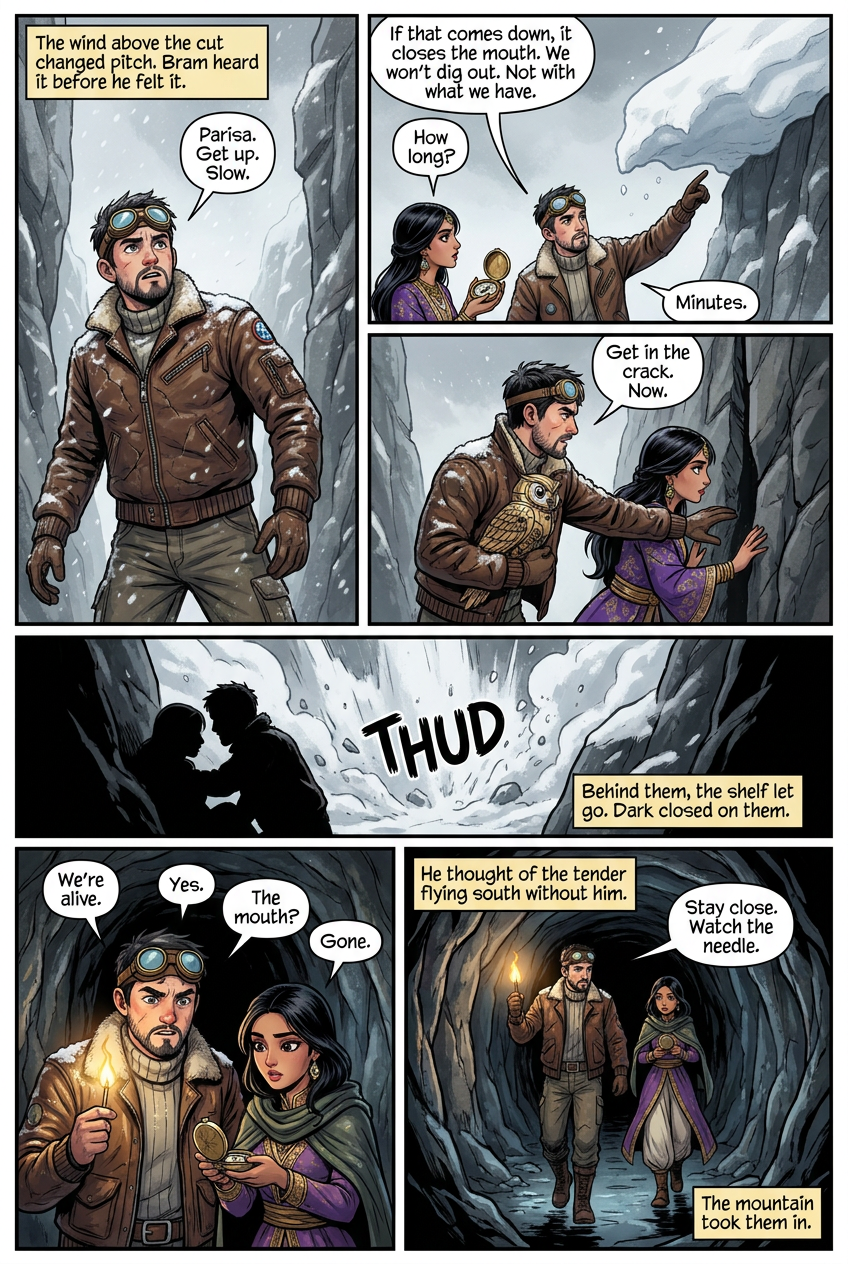
The wind above the cut changed pitch. Bram heard it before he felt it. A low grinding sound came from the slope over their heads, not the storm itself but something the storm had built. He stood up. Snow sifted down through the gap in the slabs and landed on his sleeve. It was fresh, dry, and light. Not blown snow. Loose snow, sliding. "Parisa." He kept his voice flat. "Get up. Slow." She looked at him and stood. The compass was still in her hand. He stepped to the mouth of the cut and looked up. He could not see far in the whiteout, but he could see enough. A shelf of new snow had built on the rock lip above them. It bulged out over the cut like a lid. The grinding was the shelf shifting on itself. "If that comes down, it closes the mouth," he said. "We won't dig out. Not with what we have." "How long?" "Minutes." He looked at the back of the cut. The crack she had wanted to enter was still there, black and narrow. Cold air moved out of it against his face. That meant it opened into something wider behind the wall. He hated it. He said it anyway. "Get in the crack. Now." Her eyes went to his. She did not ask why he had changed. She grabbed the pack. He scooped up the mechanical owl. It folded against his ribs, warm through the cracked leather of his jacket. He pushed Parisa ahead of him toward the crack. She turned sideways and slid in. He followed. The rock scraped his shoulders. His jacket caught, tore, freed. Behind them, the shelf let go. The sound was not loud. It was heavy. A soft thud that shook the floor, then a long hiss as tons of snow packed against stone. The gray-blue light at the mouth of the cut went out. Dark closed on them. Bram stopped moving. He listened. No more sliding. The pack had set. He reached forward and found Parisa's shoulder. She was breathing hard but steady. "We're alive," she said. "Yes." "The mouth?" "Gone." He struck a match from his pack. The flame showed her face, the wet rock, and the passage bending down and away from them. The compass in her hand had opened on its own. The needle pointed forward, into the dark, steady as a held breath. She looked at him. She did not smile. She did not need to. He thought of the tender flying south without him. He thought of the final package he would not sign for. The route was finished. Someone else would land it, or no one would. He shook the match out before it burned his fingers and lit another. "Stay close," he said. "Watch the needle." He went first. She followed. The mountain took them in.
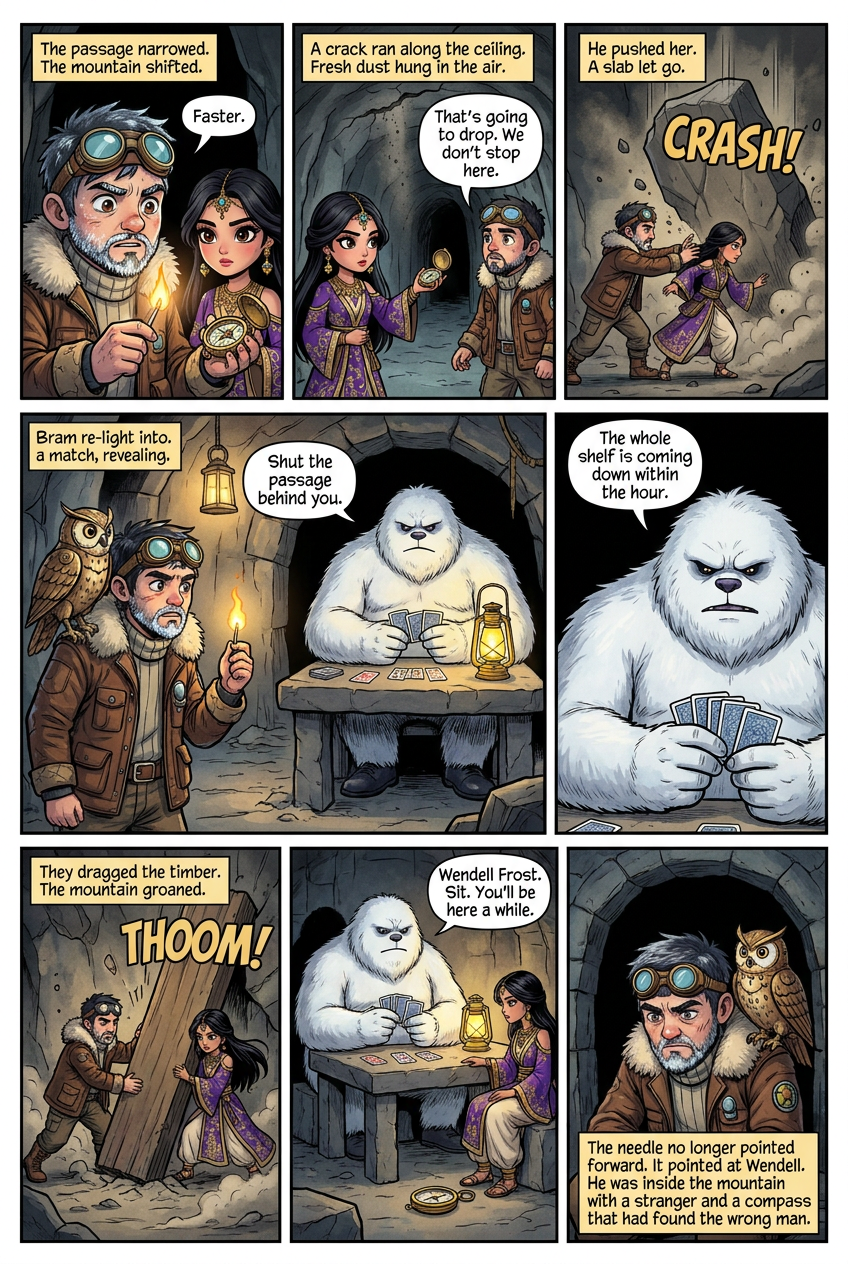
The passage narrowed as they went. Bram held the match low. The walls sweated cold water. Every few steps he heard the mountain shift above them, a dull knock passed through stone. The avalanche had settled the slope, but the slope was still moving. He could feel it in his boots. "Faster," he said. Parisa kept the compass flat on her palm. The needle held forward. She stepped over a rib of rock and stopped. "It bends here." He reached past her. The passage split. One fork went down and left, wet and tight. The other climbed slightly to the right, dry, wider. The needle pointed at the right fork. A crack ran along the ceiling above the split. Bram lifted the match. The crack was new. Fresh dust hung in the air below it. He could see grit still falling. "That's going to drop," he said. "We don't stop here." He pushed her into the right fork. Behind them a slab let go and hit the floor with a sound like a struck bell. Cold air punched past them. The match went out. He lit another. His hand shook. Parisa was against the wall, breathing through her teeth. The compass had not moved. "Keep going," she said. They went. The passage widened. The ceiling lifted. Then the match showed something that was not rock. A lantern. Yellow, low, set on a stone shelf. Behind it, a wide chamber. Behind the chamber, a figure. He was huge. White fur, a red coat, dark eyes set deep. He sat on a folded blanket with a deck of cards in one broad hand. He did not stand. He looked at them the way a man looks at weather he has been expecting. "Shut the passage behind you," he said. His voice was low and even. "The whole shelf is coming down within the hour. I've been listening to it." Bram stared. The mechanical owl stirred inside his jacket. "There's a door?" The stranger nodded at a slab of timber braced against the wall. "Drag it across. Wedge the pin." Bram moved. Parisa helped. The timber was heavy, cut to fit. They dropped it into the groove and drove the iron pin home. A minute later the mountain groaned. Dust fell from the ceiling in a sheet. The floor jumped once. Then stillness. Bram set his hand on the timber and felt it hold. The stranger dealt three hands on the blanket without looking up. "Wendell Frost," he said. "Sit. You'll be here a while." Parisa lowered herself onto the stone. She turned the compass face up between them. The needle no longer pointed forward. It pointed at Wendell. Bram looked at the sealed passage. The route was gone. The sky was gone. He was inside the mountain with a stranger and a compass that had found the wrong man. He sat down.
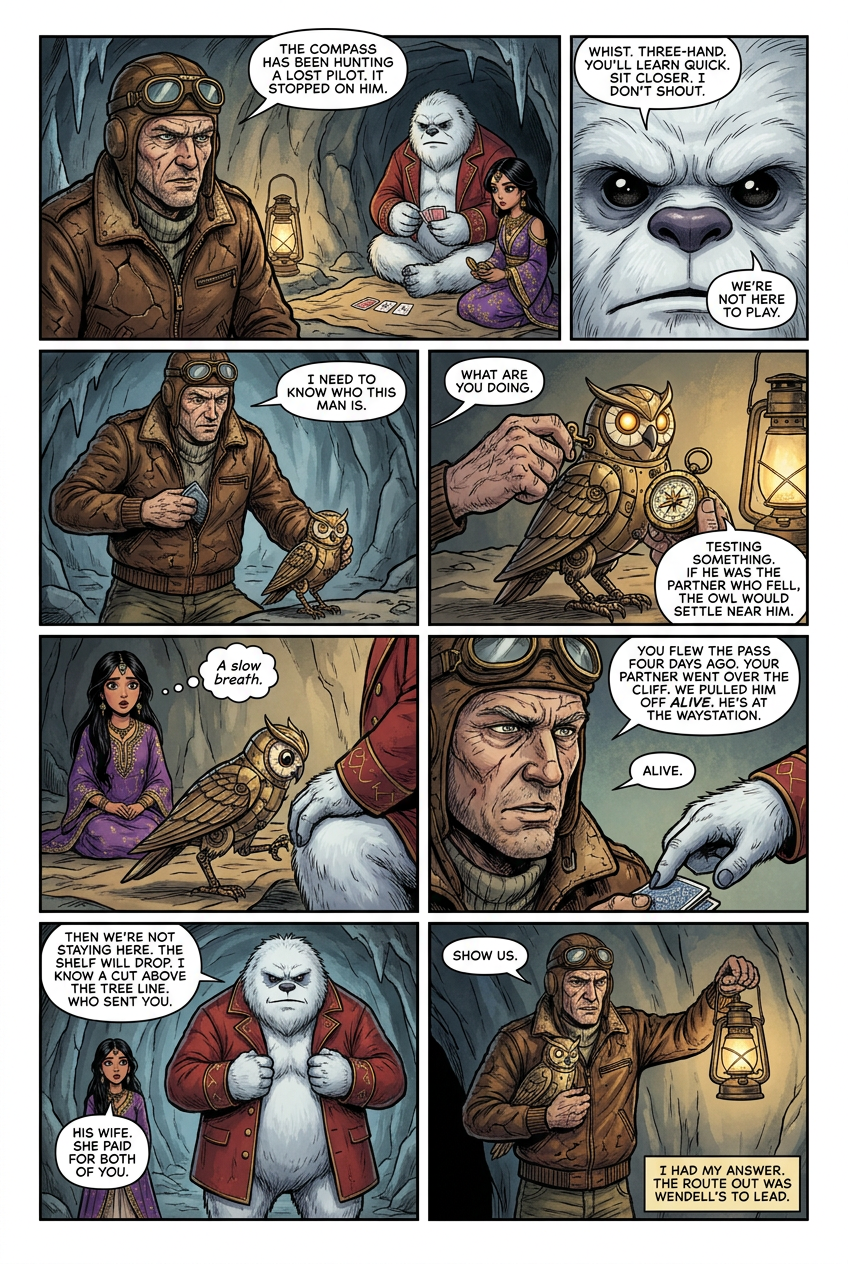
Bram sat across from the stranger and studied him. White fur matted at the shoulders. A red coat with brass buttons, cut for a body no tailor in the foothills had ever measured. Dark eyes, patient. The man dealt cards on the blanket as if the mountain above them was not sliding into itself. Parisa's compass still pointed at him. She held it flat on her knee. She did not speak. "Whist," Wendell said. "Three-hand. You'll learn quick." "We're not here to play," Bram said. "You're here until the shelf settles. That's an hour, maybe two." Wendell tapped the third hand. "Sit closer. I don't shout." Bram did not move. He needed to know who this man was before he followed him one step further into the rock. The compass had been hunting a lost pilot. It had stopped on Wendell. That meant Wendell was the pilot, or the compass was broken, or something else was true that Bram could not see. He reached into his jacket and set the mechanical owl on the stone. Its brass eyes caught the lantern. He wound the small key at its neck twice. "What are you doing," Wendell said. Not a question. "Testing something." Bram lifted the dented brass pocket compass from Parisa's knee. He held it near the owl's chest plate. The owl carried a trace of the missing pilot's coat oil on its claws from the rescue days ago. If Wendell was the partner who fell, the owl would settle near him. If he was not, it would not. The owl stepped off Bram's palm. It walked three paces across the blanket. It stopped at Wendell's knee. It folded its wings and sat. Parisa drew a slow breath. Wendell looked down at the owl. He did not touch it. "That's a clever bird." "You flew the pass," Bram said. "Four days ago. Your partner went over the cliff. We pulled him off the slope alive. He's with a doctor at the waystation." Wendell's hand stopped over the cards. For a long moment the only sound was water on stone. "Alive," he said. "Alive." Wendell set the deck down. He pulled the red coat straight at the shoulders. "Then we're not staying here." "The shelf—" "Will drop. I know a cut that comes out above the tree line. Two hours if we move now. I wasn't going alone because I couldn't carry him. I can carry myself." He looked at Parisa. "Who sent you." "His wife," Parisa said. "She paid for both of you." Wendell nodded once. He stood. The chamber felt smaller with him upright. Bram picked up the owl. He tucked the compass into Parisa's hand and closed her fingers over it. The needle no longer mattered. He had his answer. Wendell was the second pilot. The route out was Wendell's to lead. "Show us," Bram said. Wendell lifted the lantern from the shelf and started walking.
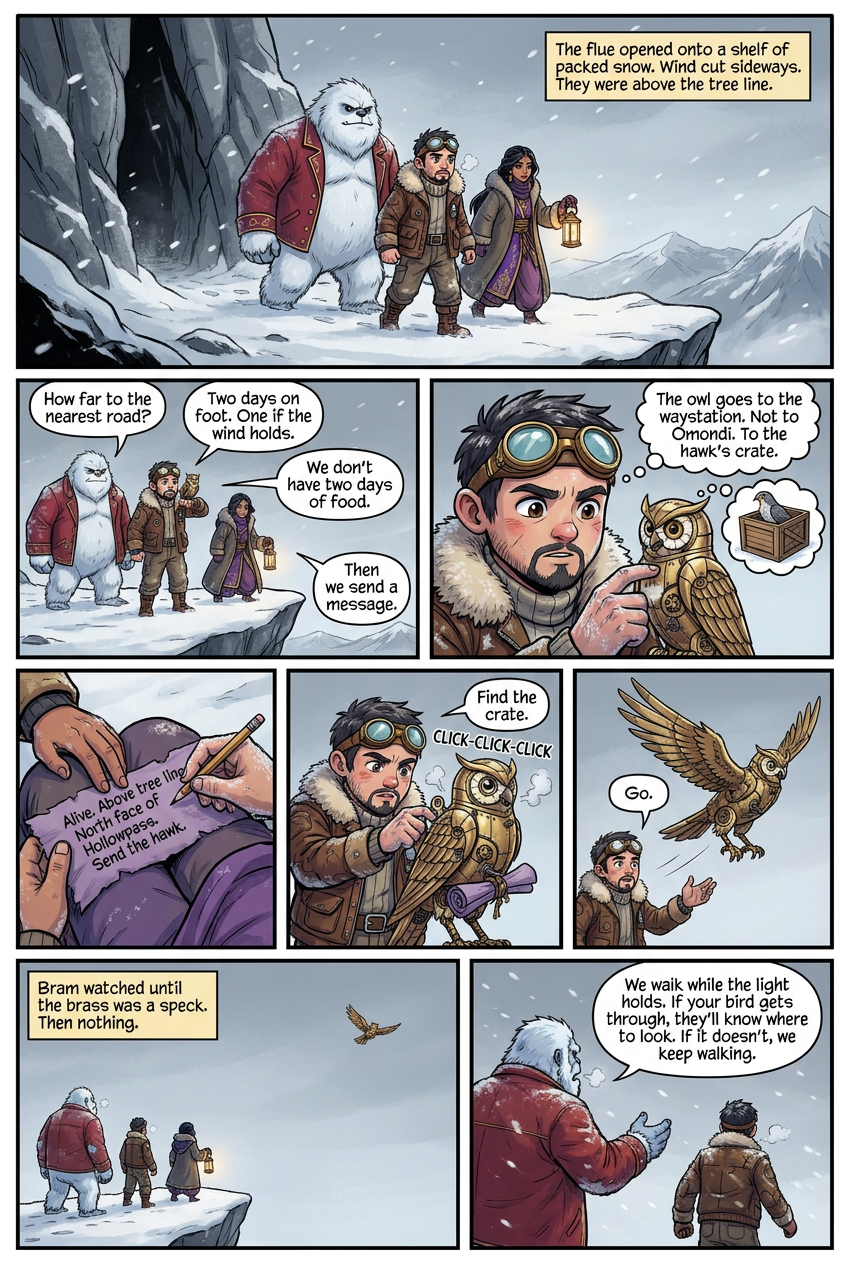
Wendell led them up a narrow flue in the rock. The air grew colder with every step. Bram counted turns and kept one hand on the wall. Parisa followed with the lantern. The compass sat closed in her pocket now. It had done its work. After an hour the flue opened onto a shelf of packed snow. Wind cut sideways. Above them the sky showed grey, and the pass ran clear between two ridges. They were above the tree line. No trees meant no fuel, no shelter, and no way for a courier below to see a signal fire. Bram stopped at the shelf's edge. He worked the math in his head. His last drop had gone ahead with Omondi in the tender. Vex and Omondi would be at the far waystation by now, waiting on word. If he walked out of the pass on foot with no signal, he would freeze before he reached them. Even if he did not freeze, no airship would meet him. They did not know he was alive. "How far to the nearest road," Bram said. "Two days on foot," Wendell said. "One if the wind holds." "We don't have two days of food." Parisa pulled her coat tighter. "Then we send a message." Bram looked at the mechanical owl on his shoulder. Its brass eyes tracked the wind. The bird could carry a note, but it needed a target it knew. It had never been to the waystation Omondi flew to. It would fly in circles and burn its coal. He thought of the hawk. Omondi's storm-tracking bird. He had left it in a crate at the last waystation before the crash. The hawk knew Omondi's scent and Omondi's tender. If the owl could reach that crate, the keeper there would open it, and the hawk would find Omondi anywhere within a day's flight. "The owl goes to the waystation," Bram said. "Not to Omondi. To the crate." Parisa understood at once. She tore a strip from the inside of her sleeve and held it flat on her knee. Bram wrote with a pencil stub. Alive. Above tree line. North face of Hollowpass. Send the hawk. He rolled the strip and tied it to the owl's leg. He wound the key at its neck three full turns. He set it on the shelf facing down the ridge. The owl opened its wings, tested the wind, and lifted. It cleared the shelf and dropped below the ridge line. Bram watched until the brass was a speck. Then nothing. Wendell was already moving. "We walk while the light holds. If your bird gets through, they'll know where to look. If it doesn't, we keep walking." Bram turned his back on the empty sky and followed him into the wind.
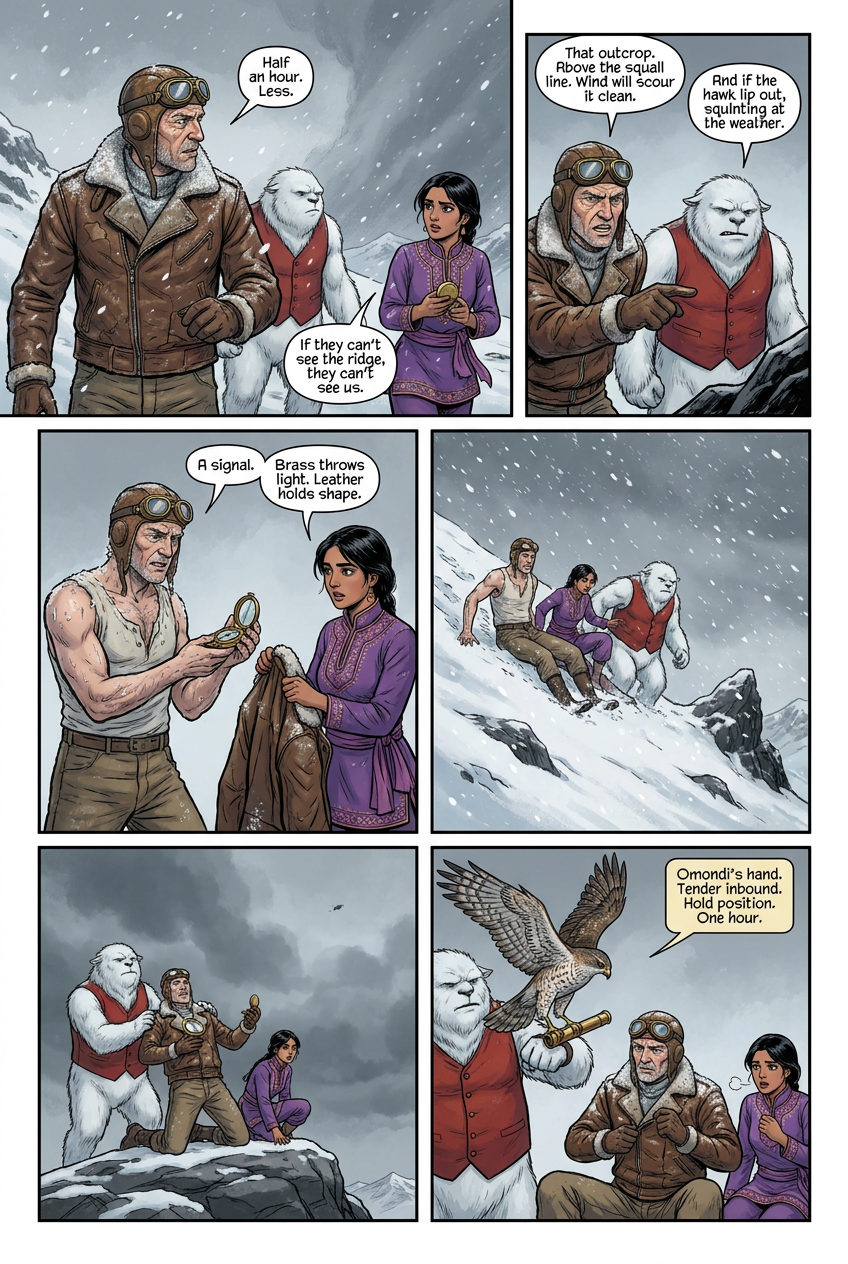
They had been walking an hour when Bram felt the wind change. He turned. A grey wall was climbing the ridge behind them, thick with snow. A squall, moving fast. It would fill their tracks in minutes and bury the shelf where the owl had lifted off. Any flyer sent to find them would see only white. He stopped Wendell with a hand on his sleeve. Wendell was the pilot they had pulled from the mountain, wrapped now in a pale fur coat and a red waistcoat scavenged from his hidden chamber. He squinted at the weather and pushed out his lower lip. "Half an hour," he said. "Less." Parisa caught up, cheeks raw. She was the woman who had hired Bram to find the compass, and she still carried it in her coat. "If they can't see the ridge, they can't see us." "Then we don't stay on the ridge," Bram said. He looked down the slope. A rock spur jutted from the snow fifty yards below, dark and broad. "That outcrop. Above the squall line. Wind will scour it clean." "And if the hawk misses it," Wendell said. "We give the hawk something to fix on." Bram pulled off his cracked leather flight jacket. The cold bit through his shirt at once. He handed the jacket to Parisa. "Hold it open." He took the dented brass compass from her palm and pried the lid back on its hinge until the polished inner disc caught the grey light. He wedged the compass into the jacket's chest pocket, lid out, mirror facing the sky. "A signal," Parisa said. "Brass throws light. Leather holds shape against the wind." He shrugged the jacket back on and started down toward the spur. "Come on. Before the snow hits." They half-slid to the outcrop as the first flakes came sideways. Bram climbed onto the highest stone. He unzipped the jacket and spread it against his chest so the open lid faced up the valley. Wendell braced him from behind. Parisa crouched beside him and watched the sky. The squall closed on the ridge above and swallowed the shelf they had left. Their footprints went with it. Below them the air stayed clear for another minute, then two. A speck banked out of the south. It rose, cut across the wind, and came straight for the spur. The storm-tracking hawk. It circled twice and dropped onto Wendell's outstretched arm, talons finding purchase in the fur. A brass tube was strapped to its leg. Bram unrolled the strip inside. Omondi's hand. Tender inbound. Hold position. One hour. Parisa let out a breath she had been keeping. Wendell smoothed the hawk's feathers with one thick white finger. Bram looked up the ridge. The squall had taken the pass. It had not taken them. He zipped the jacket shut over the compass and sat down to wait.
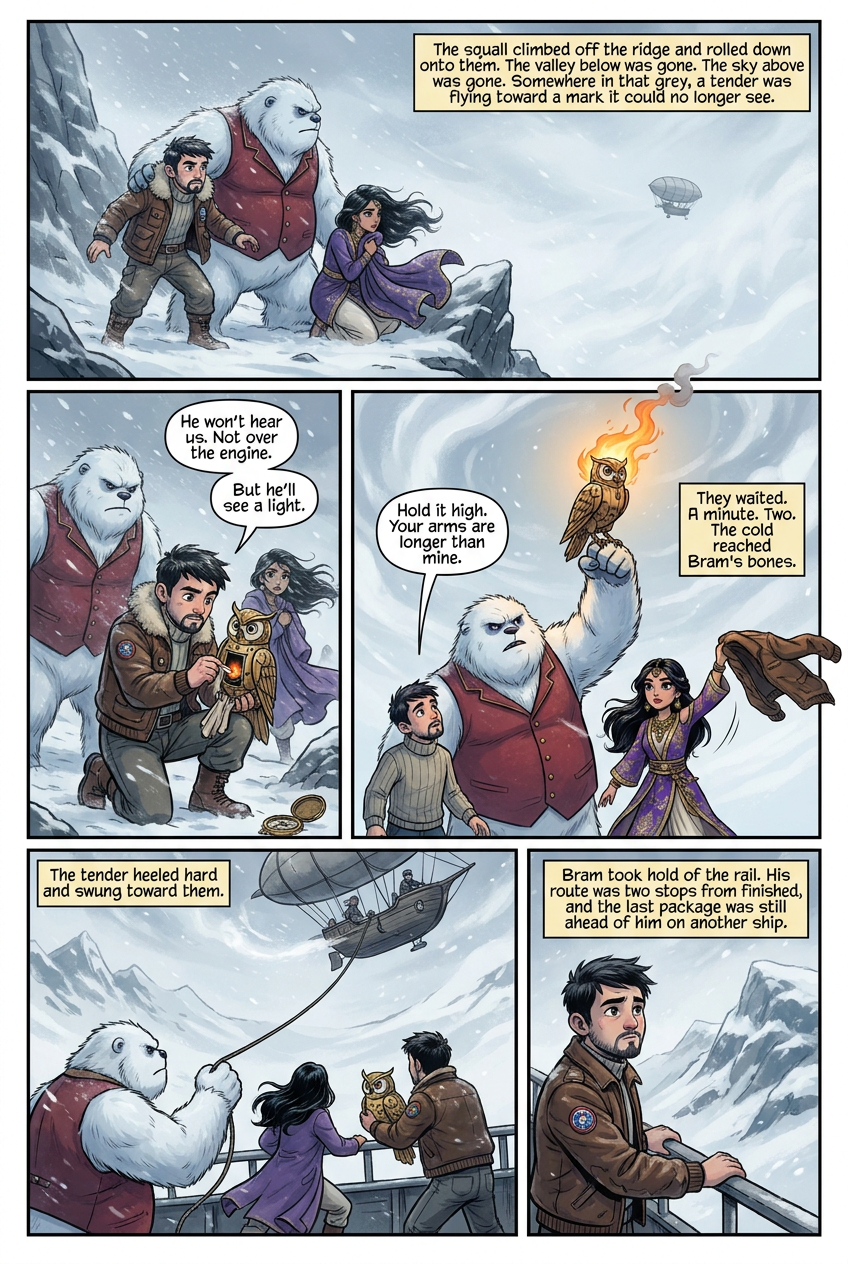
The squall climbed off the ridge and rolled down onto them. In ten minutes the spur went from clear rock to a shelf of blown white. Bram could barely see Wendell at arm's length, and Wendell was a wall of pale fur in a red waistcoat. The valley below was gone. The sky above was gone. Somewhere in that grey, a tender was flying toward a mark it could no longer see. Bram pulled the compass from his jacket pocket. The lid mirror was useless now. No sun, no line of sight. He shoved it back and thought. "The pilot will overshoot," Wendell said. His voice was flat. He had flown this range. He knew. "He'll pass us and hit the north wall before he knows he missed." Parisa crouched against the rock, holding her coat closed at the throat. "Then we make noise he can hear through it." "He won't hear us," Bram said. "Not over the engine." He looked at the mechanical owl clipped to his belt. Its brass plates were cold. One wing hinge was bent from the last flight. He unclipped it and set it on the stone. "But he'll see a light." He opened the owl's belly plate. The little firebox still held a red coal from the morning. He fed it a strip torn from his shirt cuff, then a splinter pried from the compass lid's leather backing. The coal took. Smoke curled up, then a small flame. "Hold it high," he told Wendell. "Your arms are longer than mine and steadier than hers." Wendell lifted the owl above his head on one broad hand. The flame guttered, then leaned into the wind and held. A single point of orange in the white. Bram pulled off the flight jacket again. He gave it to Parisa. "Wave it. Slow. Big arcs. Dark against the snow." She stood and swung the jacket over her head. They waited. A minute. Two. The cold reached Bram's bones. An engine note cut through the squall, high and to the west. Too far west. Passing them. Bram cupped his hands. "Higher," he told Wendell. Wendell stretched, and the flame climbed another foot. The engine note shifted. It banked. It came back. The tender broke through the grey fifty yards off the spur, a small dark shape with a single gasbag, sliding sideways against the wind. The pilot saw the flame. Bram saw his face turn. The tender heeled hard and swung toward them, and the mooring line dropped. Wendell caught it in one white fist and pulled. The tender bumped against the rock. Parisa scrambled aboard first. Wendell handed the owl back to Bram, its firebox already going out, and climbed in after her. Bram took hold of the rail. His route was two stops from finished, and the last package was still ahead of him on another ship. He pulled himself up.
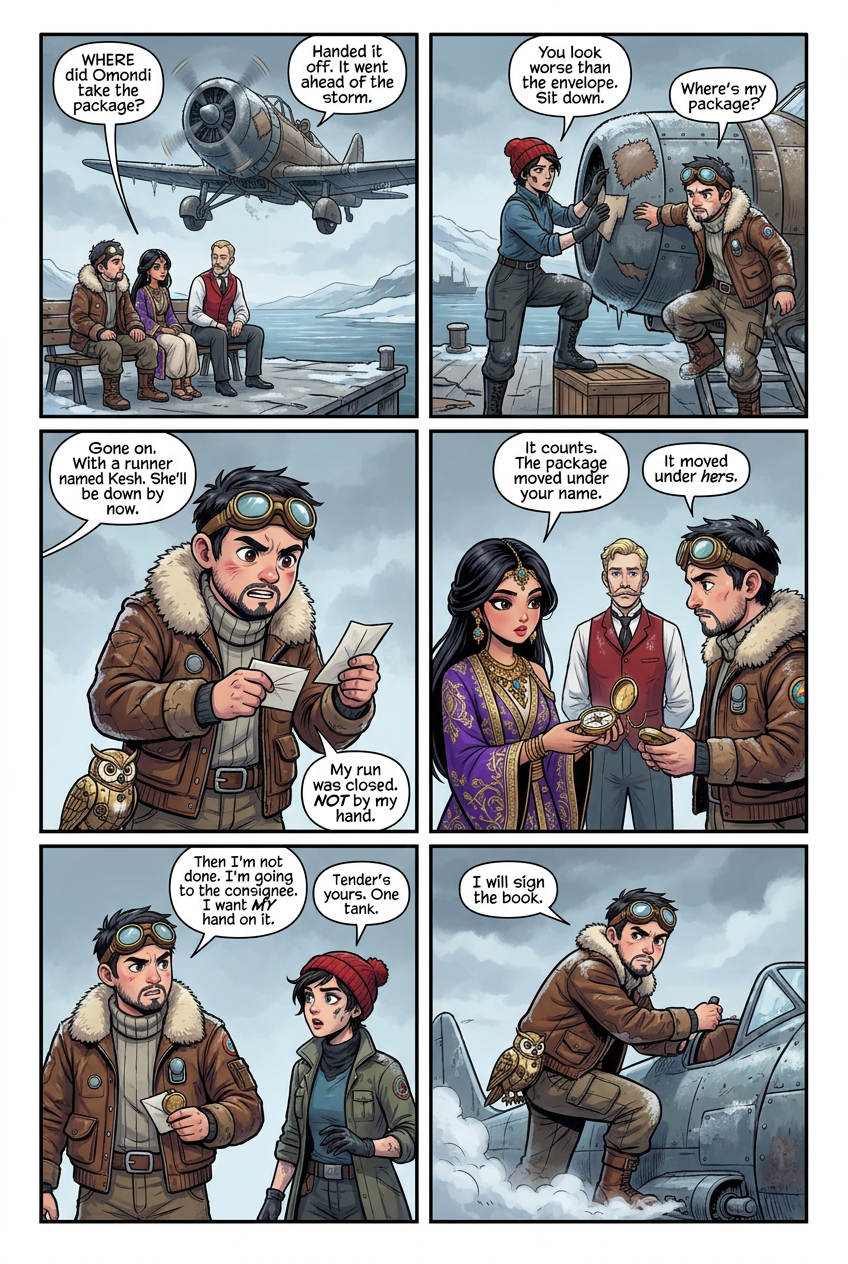
The tender leveled out below the squall and the pilot pointed east. Bram sat on the bench beside Parisa. Wendell filled the rear, knees against the cargo rail, red waistcoat stiff with frost. The pilot was one of Omondi's men. Bram leaned forward and asked where Omondi had taken the package. "Not with him," the pilot said. "He handed it off at the foothill harbor and turned back for you. The tender that carried it went on ahead of the storm." "To where?" The pilot shrugged. "Depot manifest. Ask him." Omondi was waiting on the harbor apron with Dr. Vex. Bram climbed down before the tender had stopped rocking. Vex met him first, red hair flat under a wool cap, hands black with grease from the tender's cowling she had been patching in the wind. "You look worse than the envelope," she said. She did not smile, but her shoulders dropped when she saw him upright. "Sit down before you fall down." "Where's my package?" Bram said. Omondi came around the tail. "Gone on. I put it with a runner named Kesh. She had a fresh bag and a clear window west." "West where?" "The last stop on your sheet. She'll set it on the platform and log it under your seal." Omondi held out a folded slip. "Her mark. Time out was two hours ago. She'll be down by now." Bram read the slip. Kesh's initials. His route number. The consignee stamp at the bottom, inked clean. His run was closed. Not by his hand. Parisa stepped up beside him. She had the compass in her palm, lid open, needle steady on Wendell now that Wendell stood behind her. "It counts," she said quietly. "The package moved under your name." "It moved under hers," Bram said. Vex took the slip from him and looked at it. "Seal's yours. Log's yours. Depot won't care whose hand set it down." "I will," Bram said. Omondi folded his arms. "You were inside a mountain, Möller. I made a call. The cargo made its window. That's the job." Bram looked at the tender, at the frayed patch on its cowling, at the mechanical owl clipped to his belt with its bent hinge and cold firebox. He had not landed the last package. Someone else had. The route was finished on paper and unfinished in the only place it mattered to him. He put the slip in his jacket pocket next to Parisa's compass. "Then I'm not done," he said. "I'm going to the consignee. I want my hand on it before I sign the book." Vex looked at Omondi. Omondi looked at the sky, where the squall was climbing off the ridge behind them. "Tender's yours," Omondi said. "One tank. That's what I've got." Bram climbed back aboard.
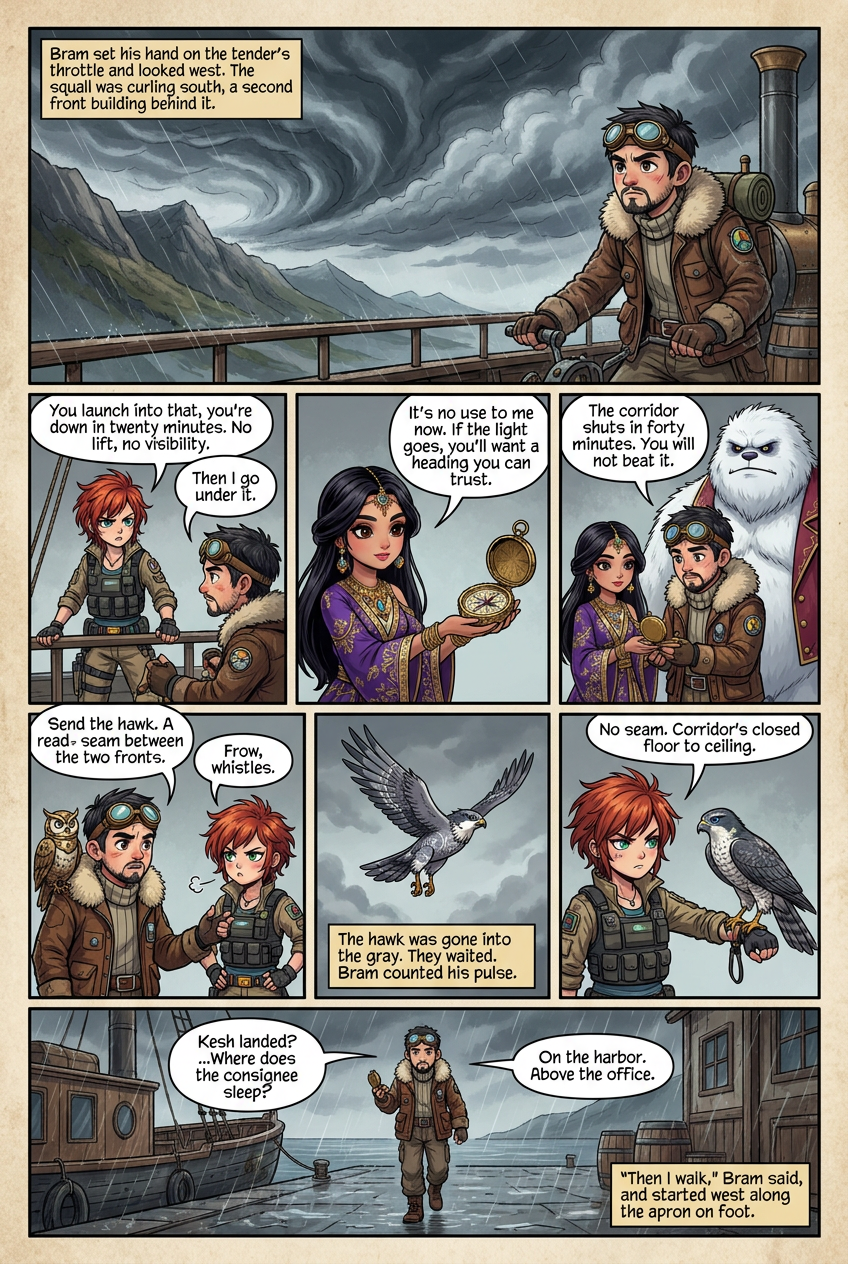
Bram set his hand on the tender's throttle and looked west. The squall that had chased them off the ridge was already curling south, and a second front was building behind it, low and gray along the western corridor. That was the way to Kesh. The runner had two hours on him and a fresh bag. He had one tank and a closing sky. Vex climbed onto the rail before he could push the lever. "You launch into that, you're down in twenty minutes. No lift, no visibility, no fuel to climb back out." "Then I go under it," Bram said. "You go under it, you hit the foothill line blind." She jabbed a finger at the western horizon. "That front's got a floor. I've read it twice this week." Parisa stepped up beside the cowling. She held out the dented brass pocket compass, lid open. The needle sat quiet on north. "It's no use to me now," she said. "Take it. If the light goes, you'll want a heading you can trust in your palm." Bram closed his fingers around the case. The brass was warm from her hand. Wendell moved up behind her, red waistcoat dark with melt. The tender rocked under his weight. He did not speak often, and when he did the pilots listened. "The corridor shuts in forty minutes," he said. "I watched it shut from inside the rock for four days. You will not beat it." "Then I don't fly the corridor," Bram said. He looked at Vex. "Send the hawk." Vex frowned. "For what?" "A read on the seam between the two fronts. If there's a gap along the south face, I ride it low and come up on the harbor from beneath." Vex whistled once. The storm-tracking hawk lifted off the tender's mast, banked west, and was gone into the gray. They waited. Bram counted his pulse against the throttle. Omondi said nothing. The mechanical owl on Bram's belt clicked its cold firebox. The hawk came back inside six minutes. It landed hard on Vex's wrist and shook water from its patterned wings. Vex read the band on its leg, then read it again. "No seam," she said. "The two fronts already kissed. Corridor's closed floor to ceiling." Bram let his hand fall off the throttle. "Kesh landed?" he asked Omondi. "Kesh landed. Signed the book. I had word on the last tender." Bram climbed down onto the apron. He put the pocket compass in his jacket next to the folded slip with Kesh's mark. His run was closed on paper, and now closed by weather too. He would not lay his hand on that package tonight. "Where does the consignee sleep?" he asked. Omondi looked at him. "On the harbor. Above the office." "Then I walk," Bram said, and started west along the apron on foot.
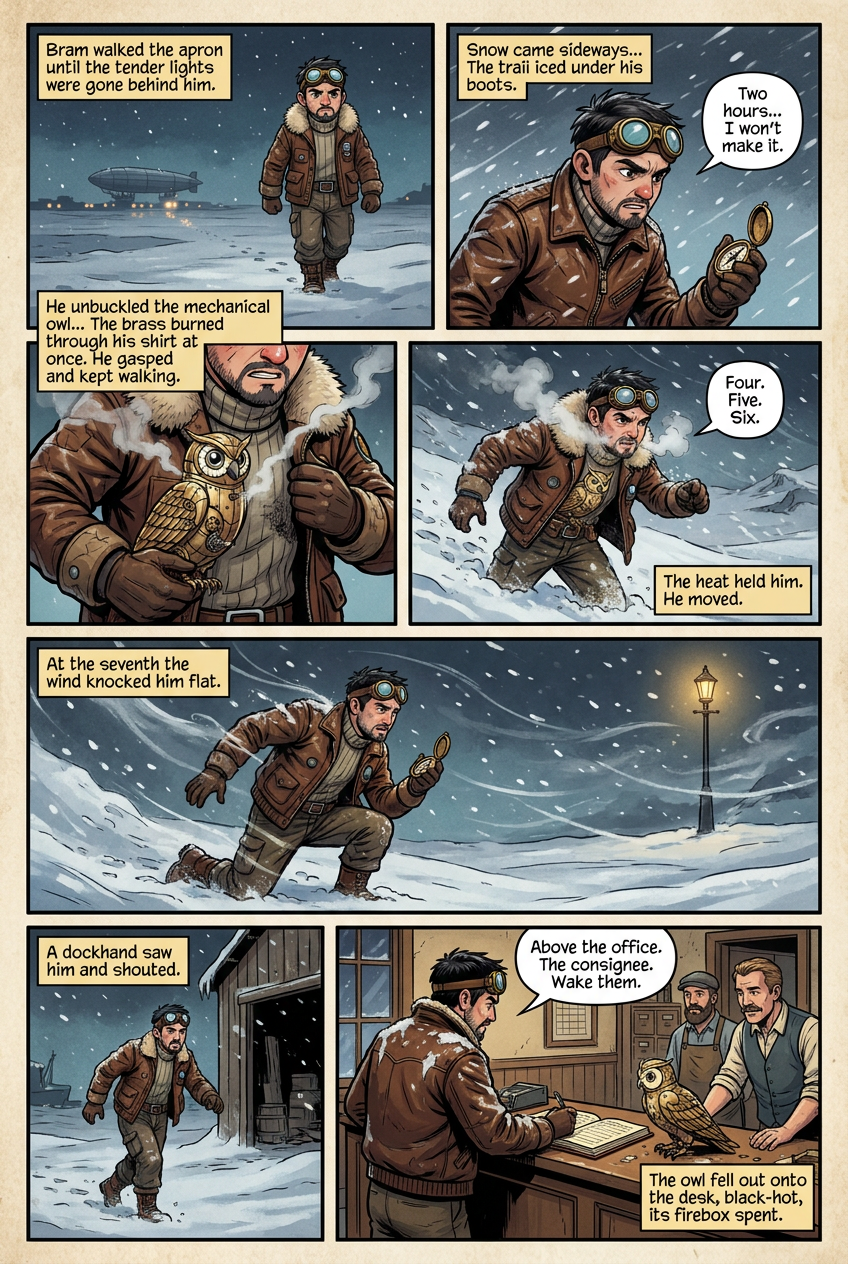
Bram walked the apron until the tender lights were gone behind him. The foot trail down the ridge began at a broken cairn and dropped through scrub pine toward the harbor lamps far below. He had walked worse. He had not walked worse in a courier's jacket meant for a heated cockpit, with a storm front already sliding down the slope behind him. Wind hit his back before he was fifty yards down. Snow came sideways in hard grains that stung the neck. The trail iced under his boots inside minutes. He counted the harbor lamps and lost three of them to the white. He stopped at a bend and did the arithmetic he had been avoiding. Two hours to the harbor at a good pace. He would not have a good pace. The jacket was cracked leather over wool, good to freezing on a mast, useless against a wet wind that found every split seam. His hands were already stiff. He would go down before the last switchback. He turned into the lee of a rock and opened the pocket compass Parisa had pressed on him. The needle held north. Not magic anymore. Just a tool. He set a bearing off the lowest visible lamp and closed the lid. Then he did the thing he had been putting off since the tender lifted. He unbuckled the mechanical owl from his belt. The owl clicked. Its firebox was warm through the plating. He had one coal left in its belly and a bird built to carry heat. He opened the front of his jacket, set the owl against his chest inside the wool lining, and zipped the leather shut over it. The brass burned through his shirt at once. He gasped and kept walking. The heat held him. He moved. The owl's vents ticked steam against his collarbone. He talked to it under his breath to keep his jaw working. He named the switchbacks as he found them. Four. Five. Six. At the seventh the wind knocked him flat. He got up on one knee, checked the compass, corrected two points east, and went on. The harbor lamps grew. He could smell coal smoke off the water now, and pitch. He came off the trail behind a fuel shed with his fingers locked around the compass case and could not open his hand to put it away. A dockhand saw him and shouted. Two men caught him under the arms. Inside the harbor office they cut the jacket open at the zip. The owl fell out onto the desk, black-hot, its firebox spent. The brass had scorched a red print across Bram's chest. He did not feel it yet. "Above the office," he said. "The consignee. Wake them." The dockhand went up the stairs. Bram stayed on his feet at the counter, snow melting off him onto the ledger, and waited to put the package in a hand that would sign for it in front of him.
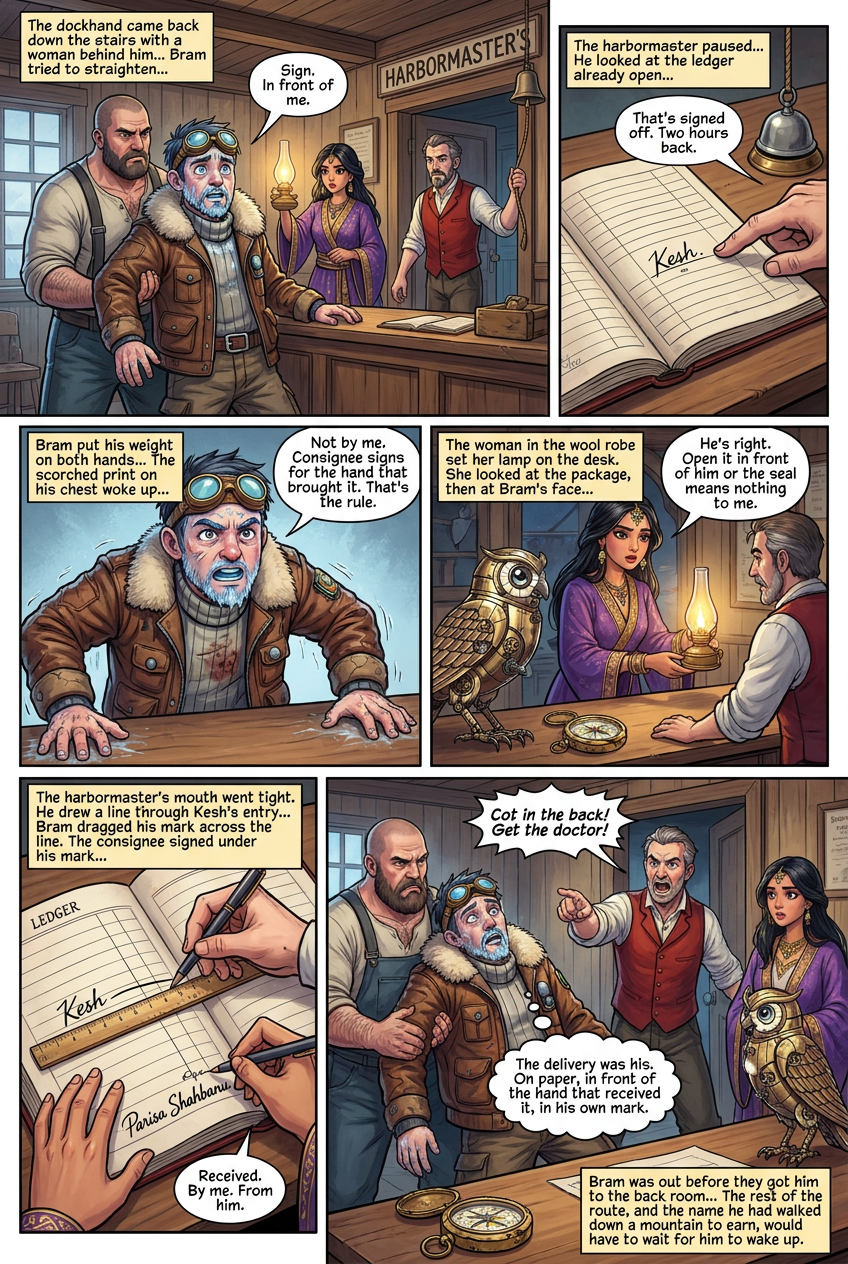
The dockhand came back down the stairs with a woman behind him in a wool robe pulled over a nightdress. She held a lamp. Bram tried to straighten at the counter and his knees folded a half inch before he caught the ledge. His teeth cracked together. He could not shape the consignee's name. "Sit him down," the woman said. "He's blue." "No." Bram got the word out. He pushed the package flat on the desk with a hand he could not feel. "Sign. In front of me." The harbormaster came out of the back room in shirtsleeves. He saw Bram shaking against the counter and reached for a bell. "Cot in the back. Get the doctor up from the inn." "No," Bram said again. His jaw locked. He forced it open. "Route number. Check it. My seal." The harbormaster paused with his hand on the bell rope. He looked at the package. He looked at the ledger already open on the desk, where a line had been closed out earlier under Bram's seal by a runner named Kesh. "That's signed off," the harbormaster said. "Two hours back." "Not by me." Bram put his weight on both hands. The scorched print on his chest woke up and he almost went down. He held. "Consignee signs for the hand that brought it. That's the rule. Or it's not delivered." The woman in the wool robe set her lamp on the desk. She looked at the package, then at Bram's face, then at the harbormaster. "He's right," she said. "Open it in front of him or the seal means nothing to me." The harbormaster's mouth went tight. He drew a line through Kesh's entry with a ruler and a pen. He wrote a new line under it. He turned the ledger toward Bram. Bram could not close his fingers on the pen. The dockhand wrapped Bram's hand around it and held it there. Bram dragged his mark across the line. The consignee signed under his mark in a clean, awake hand. "Received," she said. "By me. From him." Bram let go of the pen. The counter came up fast. Two men caught him again. He heard the harbormaster shout for the cot and for blankets and for the doctor from the inn. On the desk the mechanical owl sat cooling, its firebox black, one wing tipped open where the coal had burned through. The dented brass compass lay beside it with its lid still open, the needle steady on north. Bram was out before they got him to the back room. The delivery was his. On paper, in front of the hand that received it, in his own mark. The rest of the route, and the name he had walked down a mountain to earn, would have to wait for him to wake up.
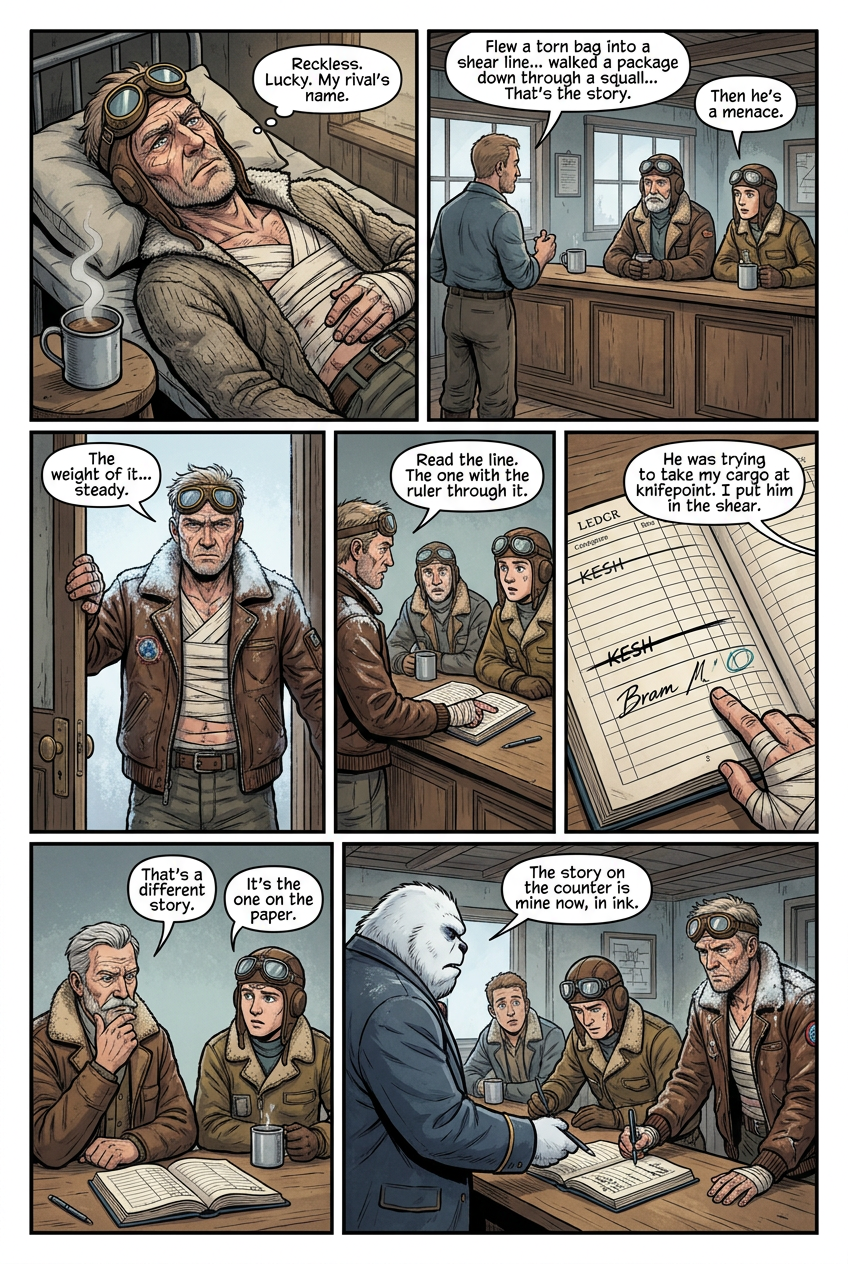
Bram woke on a cot in the harbormaster's back room under three blankets and a coat that was not his. Gray light came through the window. His chest was bandaged. His hands were bandaged. A tin cup of broth sat cooling on a stool by his head. He heard voices in the front office and a name he knew. The dockhand who had held his hand around the pen was talking. Not to him. To two pilots at the counter with mugs. The dockhand was repeating something he had been told. Bram heard the word reckless. He heard the word lucky. He heard his rival's name, and then his own, in the same breath. "Flew a torn bag into a shear line on purpose," the dockhand said. "Ditched a prototype on a slope. Walked a package down through a squall like a man with nothing left to lose. That's the story going around. From a courier who was there." One pilot laughed short. "Then he's a menace. I wouldn't fly his freight." Bram put his feet on the floor. He got the coat around his shoulders. His cracked leather jacket was folded on a chair, the collar still white with old frost. He picked it up. The weight of it steadied him. He walked out to the counter holding the doorframe. The harbormaster's ledger was still open where he had signed. Bram set the jacket on the counter beside it. He turned the ledger toward the two pilots. "Read the line," he said. His voice came out flat and low. "Read the one above it too. The one with the ruler through it." The older pilot leaned in. His mouth moved as he read. He looked at the voided entry under Kesh's name. He looked at Bram's mark under it, and the consignee's clean signature beneath that. "He signed off my run without me," Bram said. "My rival told you the shear line. He didn't tell you why he was in it. He was trying to take my cargo off my deck at knifepoint. I put him in the shear. Then I finished the route on foot." He tapped the ledger once with a bandaged finger. "Every stop. In front of the hand that received it. Ask the harbormaster. Ask the consignee upstairs. Ask the doctor who's coming down to yell at me." The younger pilot set his mug down. The older one drew a slow breath through his nose. "That's a different story," the older pilot said. "It's the one on the paper," Bram said. The harbormaster came in from the back with a fresh pen. He turned the ledger a quarter turn and offered it to the two pilots as witnesses. Both signed under the consignee's line. Bram watched their hands move. His own were shaking again, but the story on the counter was his now, in ink, in front of men who would carry it out.
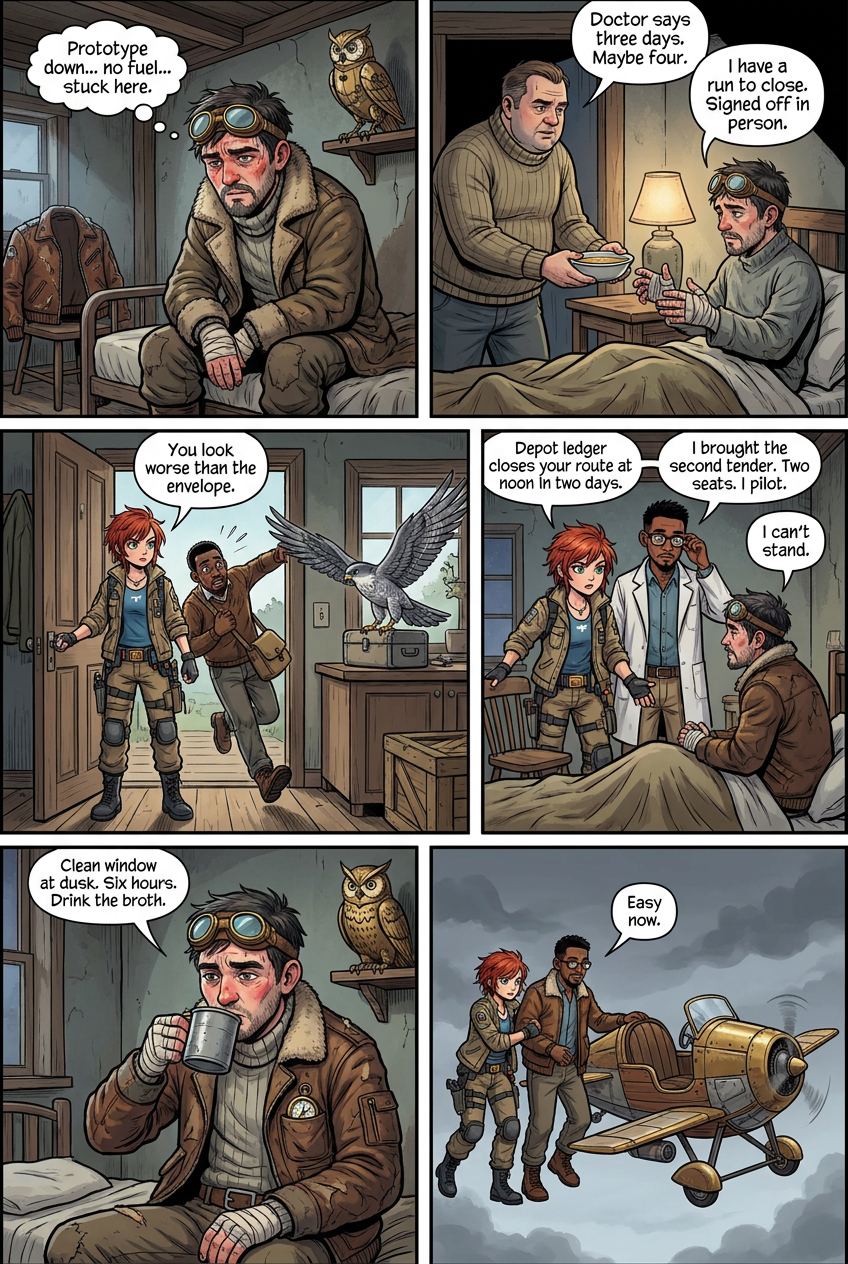
The two pilots left with the story on their tongues. Bram sat back down on the cot. The room tilted once and settled. His skin ran hot under the bandages. He pulled the borrowed coat tighter and tried to think past the fever. His prototype was a broken shell on a slope two ridges east. His tender was empty at the foothill strip. He had no bag, no fuel, and no way out of this room under his own weight. The harbormaster brought fresh broth and set it down. "Doctor upstairs says you stay put three days. Maybe four." "I have a run to close on paper at the depot," Bram said. "Signed off in person or it doesn't count." "Then it doesn't count for three days." Bram lay back. The ceiling beams doubled and slid. He was still trying to hold them still when the front door banged open and boots crossed the boards. Dr. Cassandra Vex came in first, red hair damp under her hood, tool belt clacking against the counter. Behind her came Dr. Kamau Omondi, glasses fogged, a canvas satchel clutched to his chest. He caught his toe on the threshold and stumbled two steps into the room before he found his footing. Vex looked at Bram once and set her jaw. "You look worse than the envelope." "You came fast," Bram said. "We came slow," Omondi said. He set the satchel down and unbuckled it. "The corridor opened for one hour at dawn. The hawk read it clean." He lifted the storm-tracking hawk from a padded crate. The bird ruffled its gray, compass-marked feathers and settled on the counter. Vex pulled a chair to the cot. "Depot ledger closes your route at noon in two days. Omondi filed a delay slip. It buys you until then. No longer." "I can't stand," Bram said. "You don't have to fly," Omondi said. "I brought the second tender. Two seats. I pilot. You sign at the depot counter in person. That is the only part they need from you." Bram found his jacket on the chair and dragged it into his lap. The cracked leather was cold. His mechanical owl sat quiet on the shelf where the dockhand had put it, one wing still soot-dark from the coal. "The hawk says a clean window at dusk," Vex said. "Six hours. You drink the broth. You keep the fever down. You come with us at dark." Bram nodded. He picked up the tin cup with both bandaged hands and drank. The broth burned going down and he did not spill it. At dusk they walked him out between them. Omondi steadied the tender's rail. Vex lifted Bram's boot to the step. The dented brass compass in his coat pocket knocked once against the frame as he climbed aboard, and the tender lifted into the gray.
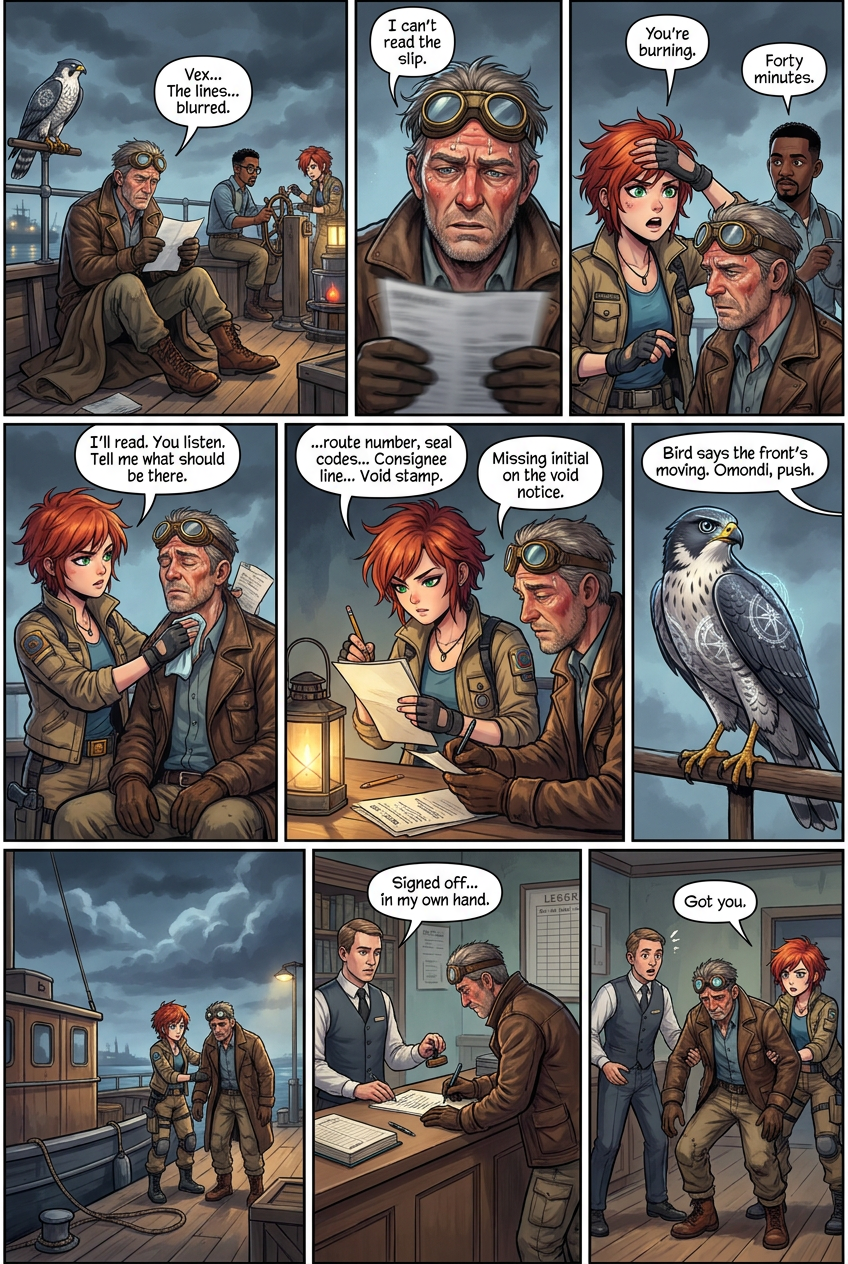
The tender rose out of the harbor lights and climbed into the dusk. Bram sat wedged against the rail with the borrowed coat over his knees. Omondi worked the wheel with both hands, glasses sliding down his nose. Vex crouched by the burner and watched the gauge. The storm-tracking hawk rode a perch bolted to the mast, feathers ruffled against the wind. Bram had two hours to the depot and one job left: sign the run closed in his own hand at the counter. He pulled the paperwork from the inside pocket of his jacket. Route slip. Consignee stub. The harbormaster's void notice for the runner's fraudulent entry. He had to check every line before landing. The depot clerk would reject a smudged sheet or a missing seal. He held the pages against his thigh and squinted. The lines blurred. He blinked and they stayed blurred. His face ran hot under the wrap on his hand. He tried to read the route number and saw only gray marks on white. "Vex," he said. She turned. She put the back of her fingers against his forehead and swore. "You're burning." "I can't read the slip. I need it clean before the counter." She pulled her glove off with her teeth and dug in her belt for a tin. She thumbed it open and pressed a wet cloth to the side of his neck. The cold ran down his collar. "Omondi," she said. "How long?" "Forty minutes," he said, without turning. Vex took the papers from Bram's lap. "Read them to me. I'll check your reading." "I can't see them." "Then I'll read. You listen. You tell me what should be there." She held the top sheet close to the lantern. She read the route number, the seal codes, the consignee line, the void stamp. Bram closed his eyes and listened. He knew the run by heart. He caught a missing initial on the void notice and told her. She marked it with a pencil from her belt. The hawk shifted on its perch and clicked its beak. Vex glanced up. "Bird says the front's moving. Omondi, push." Omondi pushed. The tender leaned. Bram gripped the rail with his bandaged hand and kept his eyes shut while Vex read the second sheet. She caught a smudge on the seal and blotted it with the cloth's dry corner. She read the third sheet twice. She folded them all back into the pocket over his chest. "Signed off in your head," she said. "Now just your mark on the counter." The depot lights showed under the cloud line. Omondi brought the tender down onto the mooring rail. Vex lifted Bram's boot to the step. The clerk was already at the door with the ledger open. Bram walked to the counter between them and made his mark. The clerk stamped it. The run closed on paper, in his own hand, before the deadline. Then his knees gave and Vex caught his elbow.
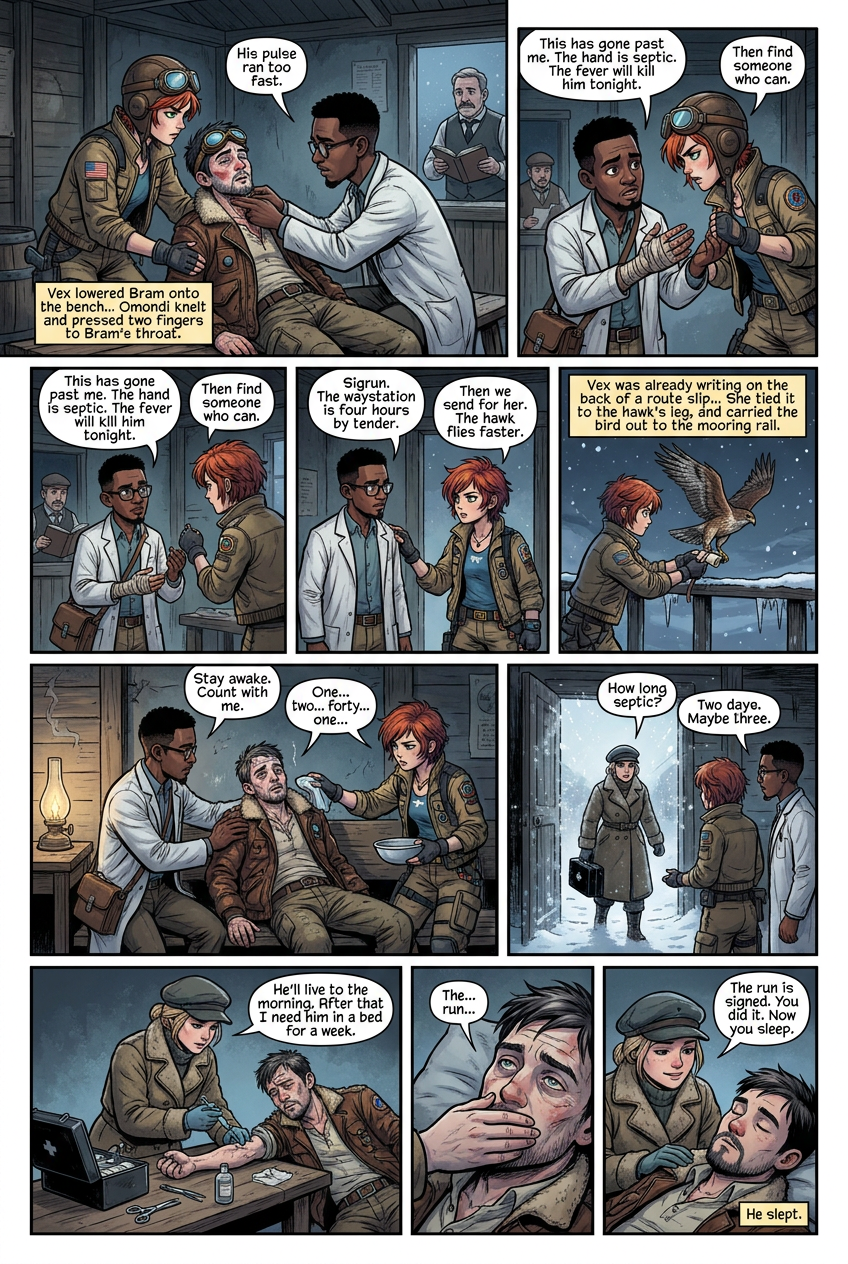
Vex lowered Bram onto the bench along the depot wall. His head rolled against the plank. The clerk stared at the mark on the ledger, then at Bram, then shouted for the depot medic. Omondi knelt and pressed two fingers to Bram's throat. His pulse ran too fast. The medic came with a lamp and a satchel. He was an older man with ink on his cuffs. He peeled the wrap off Bram's hand and sniffed the wound. He shook his head. "This has gone past me," the medic said. "The hand is septic. The fever will kill him tonight. I have willow bark and spirits. Nothing that touches this." Vex grabbed the medic's collar. "Then find someone who can." "There is no one at this depot who can." Omondi stood. "Sigrun." Vex let the medic go. "The waystation is four hours by tender." "Then we send for her," Omondi said. "The hawk flies faster than we do. She has the drugs. She treated the pilot on the mountain." Vex was already writing on the back of a route slip. She wrote small and fast. She rolled the slip, tied it to the hawk's leg, and carried the bird out to the mooring rail. She threw it up into the dark. The hawk climbed and turned west toward the waystation and the doctor with the pale hair who had kept Wendell's partner alive. Bram shivered under the borrowed coat. Omondi took the cracked leather flight jacket off the hook by the door and laid it over Bram's chest. The leather was cold. Bram gripped the collar with his good hand and held it there. "Stay awake," Omondi said. "Count with me." Bram counted. He lost the number at forty and started again at one. Vex kept a wet cloth on his neck. She changed it every few minutes from a bowl the clerk brought. Time went strange. The lamp hissed. An hour passed. Then another. The door banged open and cold air came in with a woman in a wool coat carrying a black case. Her hair was pinned back under a cap. She smelled of the tender's burner. "How long septic?" Sigrun said. "Two days," Vex said. "Maybe three." Sigrun opened her case on the bench. She cut the old bandage off with scissors. She flushed the wound with something that stung and made Bram cry out. She pushed a needle into the meat of his arm and pressed the plunger slow. "He'll live to the morning," she said. "After that I need him in a bed for a week. Not two days. A week." Vex looked at Omondi. Omondi looked at the floor. Bram opened his eyes. The depot ceiling swam. He tried to speak and Sigrun put her hand on his mouth. "The run is signed," she said. "You did it. Now you sleep." He slept.
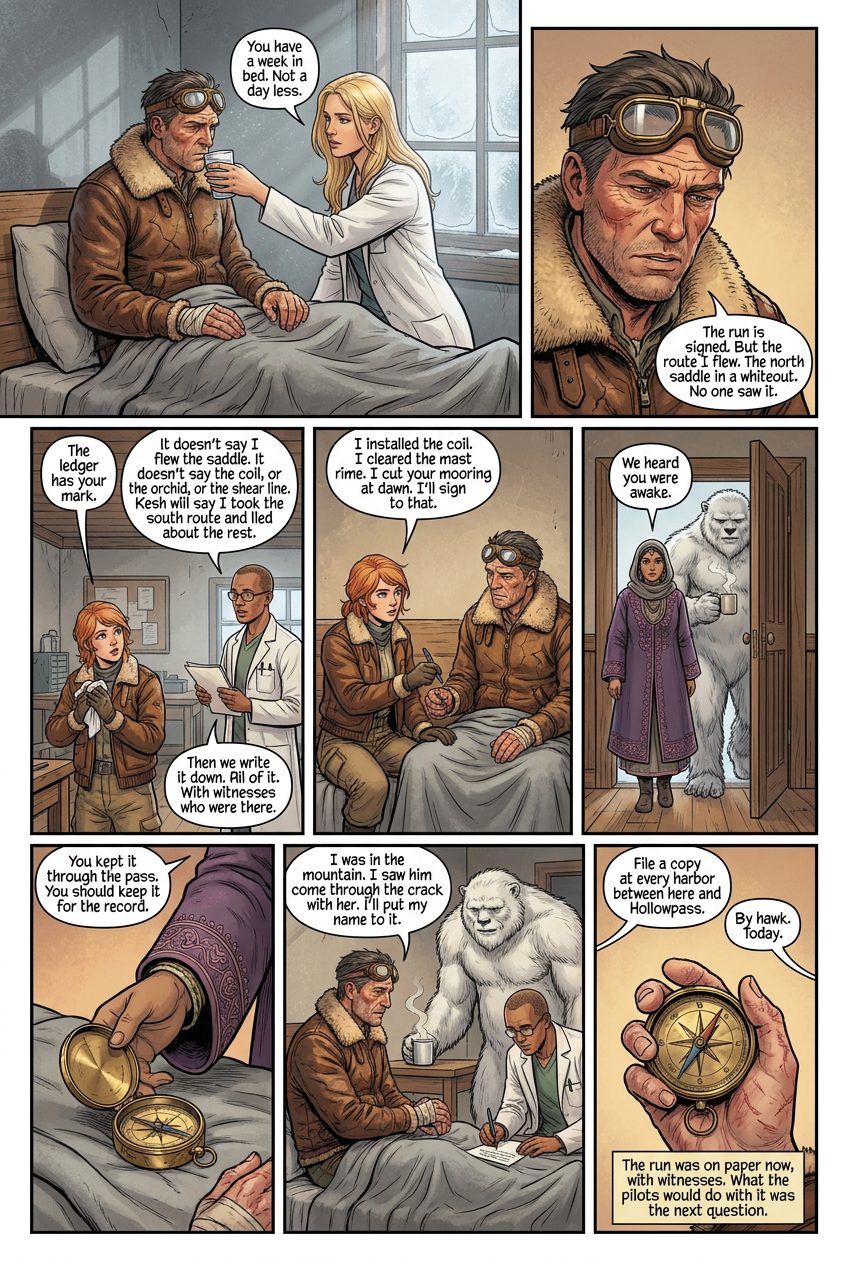
Bram woke to gray light through the depot window. The fever had broken. His hand throbbed but the skin around the wound looked pink instead of black. Sigrun sat by the bench with her medical case open, her pale hair loose around her shoulders. She saw him blink and pressed a cup of water to his lips. "You have a week in bed," she said. "Not a day less." "The run is signed," Bram said. His voice cracked. "But the route I flew. The north saddle in a whiteout. No one saw it." Vex looked up from the far bench where she was cleaning grease from her hands. "The ledger has your mark." "The ledger has a signature," Bram said. "It doesn't say I flew the saddle. It doesn't say the coil, or the orchid, or the shear line. Kesh will say I took the south route and lied about the rest. Every courier who hears the story will call it a tall tale." Omondi pushed his glasses up his nose. He had been writing at the clerk's counter. He walked over with a stack of paper. "Then we write it down. All of it. With witnesses who were there." Vex sat on the bench beside Bram. "I installed the coil. I cleared the mast rime. I cut your mooring at dawn." She took the pen from Omondi. "I'll sign to that." The door opened. Parisa stepped in wearing a heavy traveling coat, her jewelry muted under wool. Behind her came Wendell, ducking under the frame, his white fur brushing the lintel. He carried a mug of something steaming in one broad hand. "We heard you were awake," Parisa said. She crossed to the bench and set the dented brass pocket compass on the blanket beside Bram's good hand. The lid was open. The needle spun once and settled. "You kept it through the pass. You should keep it for the record." Wendell set the mug down. "I was in the mountain. I saw him come through the crack with her. I'll put my name to it." Omondi laid the paper flat on the bench. He wrote in his careful hand. Bram spoke and Vex corrected the dates. Parisa described the compass shifting to Wendell in the chamber. Wendell described the pass above the tree line. Sigrun added her account of the pilot she still kept at the waystation, alive because Bram had crashed the prototype to reach him. They signed in order. Five names below Bram's. Omondi rolled the sheet and sealed it with the depot's wax. "File a copy at every harbor between here and Hollowpass," Bram said. Omondi nodded. "By hawk. Today." Bram closed his good hand around the compass. The run was on paper now, with witnesses. What the pilots would do with it was the next question.
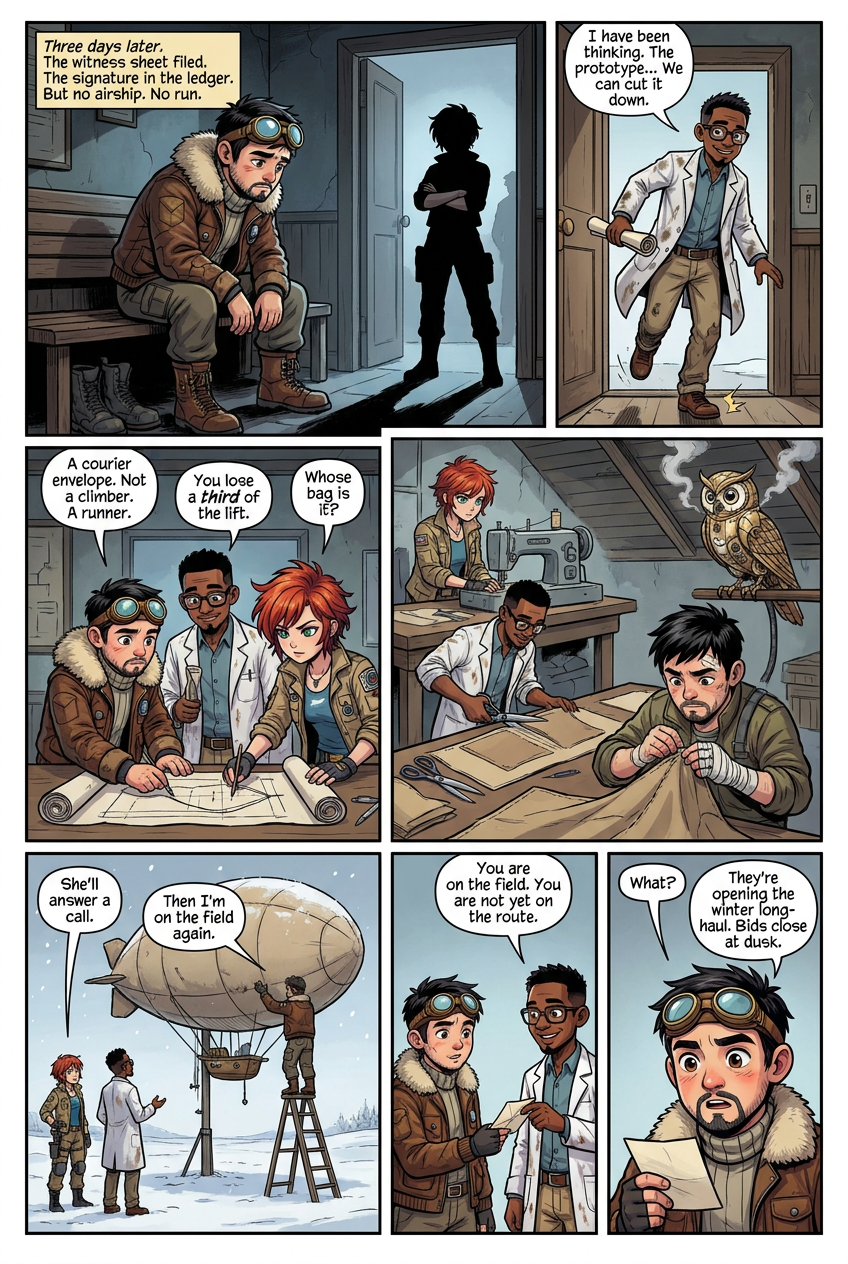
Three days later Bram sat up on the depot bench and put his boots on the floor. Sigrun watched him from the doorway with her arms crossed but did not stop him. The witness sheet was filed. The signature was in the ledger. What he did not have was an airship. The prototype lay grounded on the mountainside. His own envelope was scrap. Without a bag over his head on the field, the next impossible run would go to someone else, and his name would stop where the ink had dried. Omondi came in from the yard with grease on his cuffs and a rolled drawing under his arm. He tripped on the door sill, caught himself on the counter, and set the drawing down flat. "I have been thinking," he said. "The prototype's crown seam is finished. But the lower panels are intact. The gores are good. If we cut it down and re-stitch to a smaller bag, you have a courier envelope. Not a climber. A runner." Vex leaned over the drawing. Her red hair was still flattened from her cap. She traced the seam lines with one gloved finger. "You lose a third of the lift." "He does not need to climb passes," Omondi said. "He needs to answer a call and land on time." Bram looked at the sketch. The shape was squat, tight, built for weather rather than altitude. "Whose bag is it?" "Mine," Omondi said. "The data you brought me is worth more than the fabric. Consider the salvage yours." Vex snorted. "He means he wants his name on the tail." "I want my name on the tail," Omondi agreed. They worked in the depot loft for two days. Vex ran the stitching frame. Omondi cut the panels and dropped his shears twice. Bram sat at the bench with his bandaged hand and fed the seams straight, checking every stitch by eye. The mechanical owl perched on the rafter above them, steam curling from its vents, and clicked whenever a gore ran crooked. On the third morning they carried the folded envelope out to the field and inflated it against a test mast. The fabric filled. The seams held. It was smaller than any bag Bram had flown, and it sat low and tight on its lines like a fist. He climbed the ladder one-handed and put his palm on the crown. No hiss. No give. "She'll answer a call," Vex said from the ground. Bram came down the ladder. He shrugged into his cracked leather jacket and buttoned the fur collar up against the wind. "Then I'm on the field again." Omondi grinned and pushed his glasses up. "You are on the field. You are not yet on the route." A runner came across the yard from the depot office with a folded slip in his hand. He held it out to Bram without a word. Bram broke the seal and read it once. Then he read it again. "What?" Vex said. "They're opening the winter long-haul," Bram said. "Bids close at dusk."
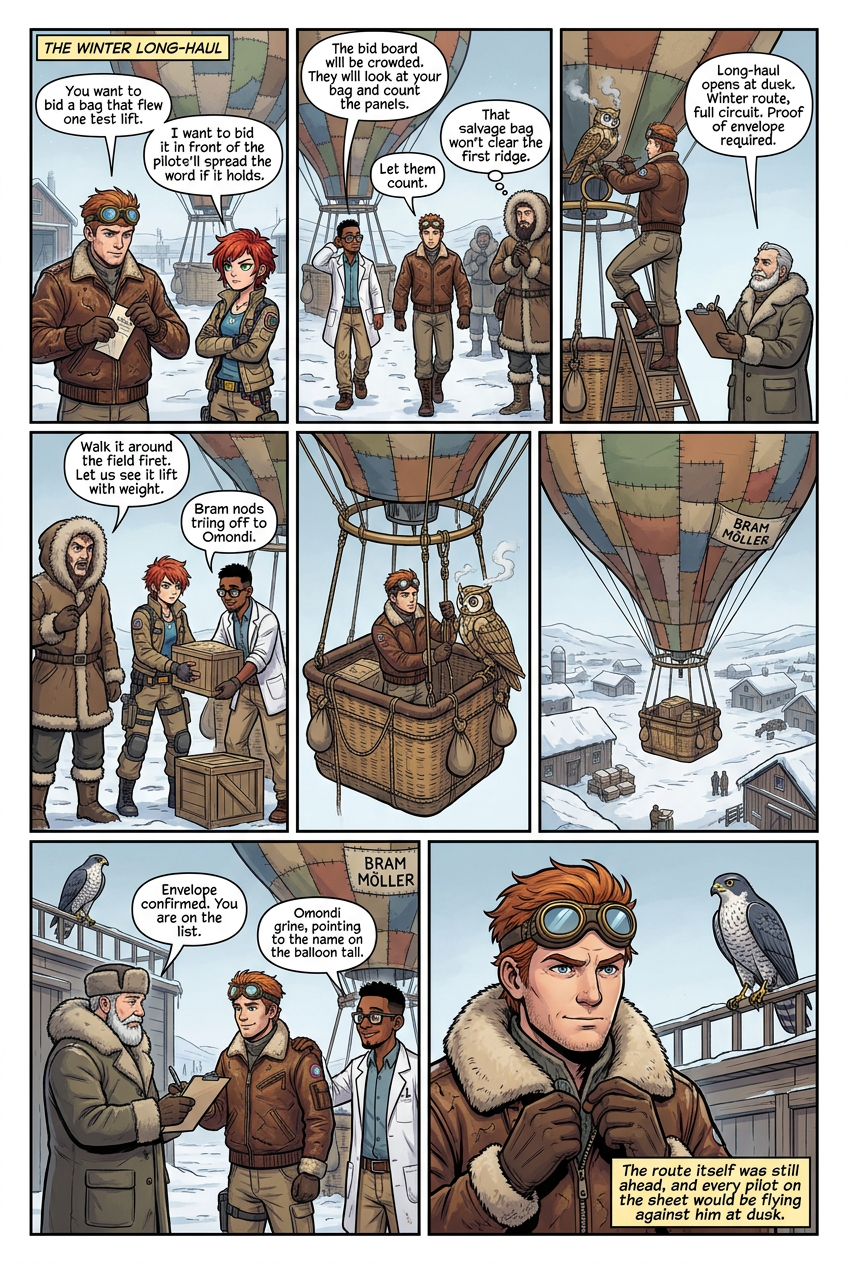
Bram folded the bid notice into his jacket pocket. The winter long-haul was the run he had chased for years. It was also the run that would decide whether his new bag was a courier's tool or a scrap sale. Vex read his face and stopped smiling. "You want to bid a bag that flew one test lift." "I want to bid it in front of the pilots who'll spread the word if it holds," Bram said. "Otherwise the small bag is a rumor and I'm the pilot who lost his envelope on the mountain." Omondi rubbed the back of his neck. "The bid board will be crowded. Every long-haul courier in the district will be there. They will look at your bag and count the panels." "Let them count." They walked the bag across the yard to the depot field. Two crews stopped work to watch. A tall courier with a fur hood spat into the snow and said the salvage bag would not clear the first ridge. Another said Bram had lost his last envelope and was flying a patch. Bram did not answer. He climbed the ladder one-handed and set his palm on the crown seam. It held cold and firm. The depot master came out with the bid sheet. "Long-haul opens at dusk. Winter route, full circuit. Proof of envelope required. Any pilot without a live bag on the field walks off the sheet." Bram signed. The tall courier laughed. "Walk it around the field first. Let us see it lift with weight." It was a fair test and Bram had expected it. He nodded to Omondi. Omondi loaded two crates of sand into the basket, tripped on the last one, and caught the rope before the crate hit his foot. Vex tied off the lines. Bram unclipped his mechanical owl from the rafter perch and set it on the brass ring. The owl gripped. Steam curled from its vents. He cut the mooring and lifted. The small bag rose slow and level. Bram took her twice around the field at mast height, then higher, into the crosswind above the depot roofs. The fabric drummed but did not give. He worked the vent by hand and brought her down soft on the mark. The sand crates thumped and stayed. When he climbed out the tall courier was gone. The depot master wrote a line on the bid sheet and turned it to Bram. "Envelope confirmed. You are on the list." Vex clapped him once on the shoulder. Omondi grinned and pointed at the tail, where his name was stitched in black thread. Above the yard a storm-tracking hawk circled once and settled on the loft rail, watching. Bram buttoned his fur collar. He was on the list. The route itself was still ahead, and every pilot on the sheet would be flying against him at dusk.
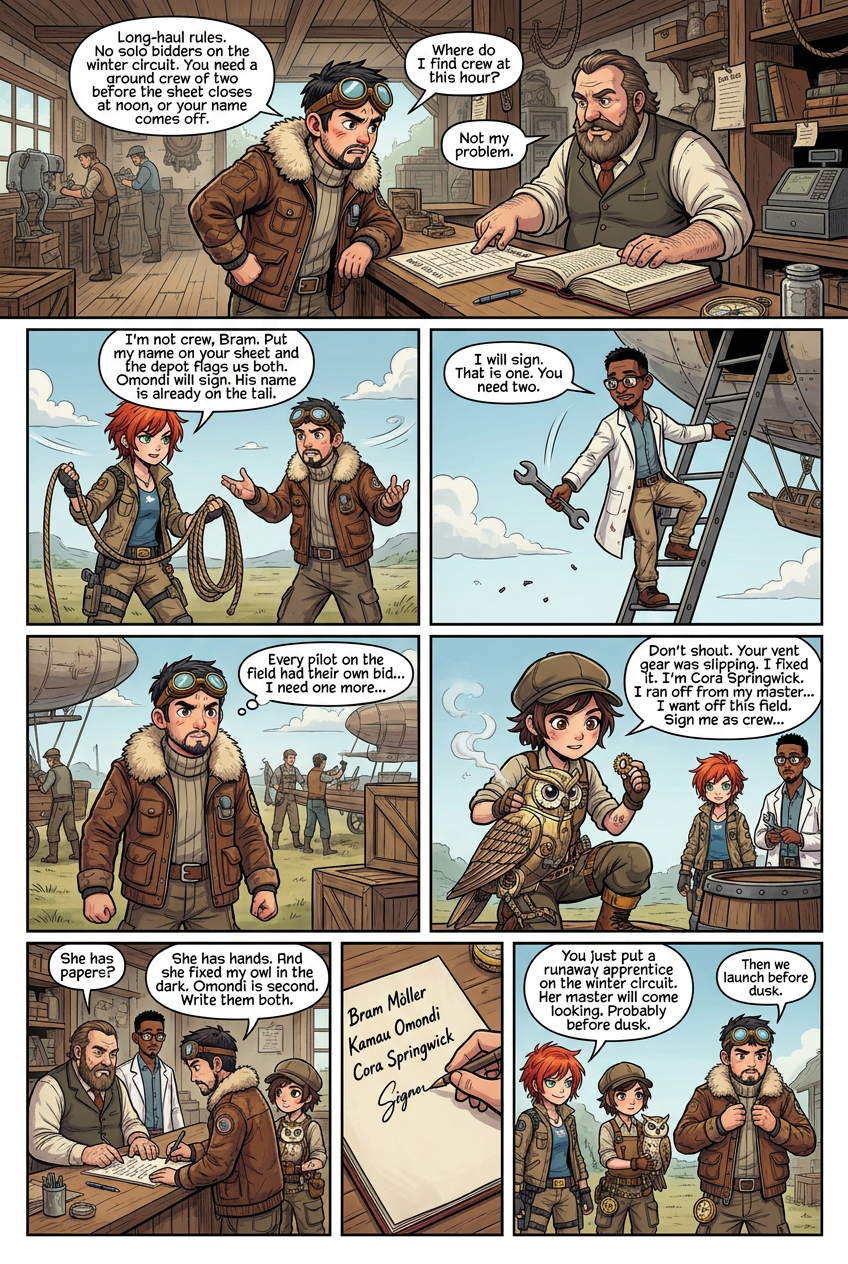
The bid sheet was signed, but by morning Bram learned the sheet meant nothing without a crew. The depot master found him at the loft rail and tapped a line in the rulebook. "Long-haul rules. No solo bidders on the winter circuit. You need a ground crew of two before the sheet closes at noon, or your name comes off." Bram read the line twice. He had chased the winter route for years, and now a clerk's rule stood between him and the launch. "Where do I find crew at this hour?" "Not my problem," the master said, and walked back inside. Vex was already at the field, coiling line around her forearm. She heard him out and shook her head. "I'm not crew, Bram. I'm the engineer who installed your illegal coil. Put my name on your sheet and the depot flags us both." "I know." "Omondi will sign. His name is already on the tail." Omondi came down the ladder holding a wrench in the wrong hand and nearly dropped it. "I will sign. That is one. You need two." Bram counted the pilots on the field. Every long-haul courier there had their own bid in. None would crew for a rival. He turned toward the loft to think, and almost stepped on a girl crouched behind the mooring drum. She was small, maybe fifteen, in a canvas apron heavy with gears. A clockwork apprentice's tool belt hung off her hip. She held Bram's mechanical owl in her lap and had its chest plate open. A brass gear turned slowly between her fingers. "Don't shout," she said before he could. "Your vent gear was slipping. I fixed it." She closed the plate and the owl blinked, steam curling clean from its vents. "Cora Springwick. I ran off from my master three towns back. I sleep in your loft. I eat what the crews drop." Vex laughed once, sharp. Omondi pushed his glasses up his nose and stared. Bram crouched. "You know steam rigs?" "Better than the man who trained me." She met his eye. "I want off this field. Sign me as crew and I'll work your circuit. No pay till the first stop." He looked at the owl in her hands. It sat calm. He looked at Omondi, who nodded once. Bram walked her to the counter. The depot master looked up from his ledger and frowned at the girl. "She has papers?" "She has hands," Bram said. "And she fixed my owl in the dark. Omondi is second. Write them both." The master wrote. He turned the sheet. Bram signed under both names. Cora tucked the owl into the crook of her arm. Vex was watching her, not smiling now. "You just put a runaway apprentice on the winter circuit," Vex said quietly. "Her master will come looking. Probably before dusk." Bram buttoned his cracked jacket to the throat. "Then we launch before dusk."
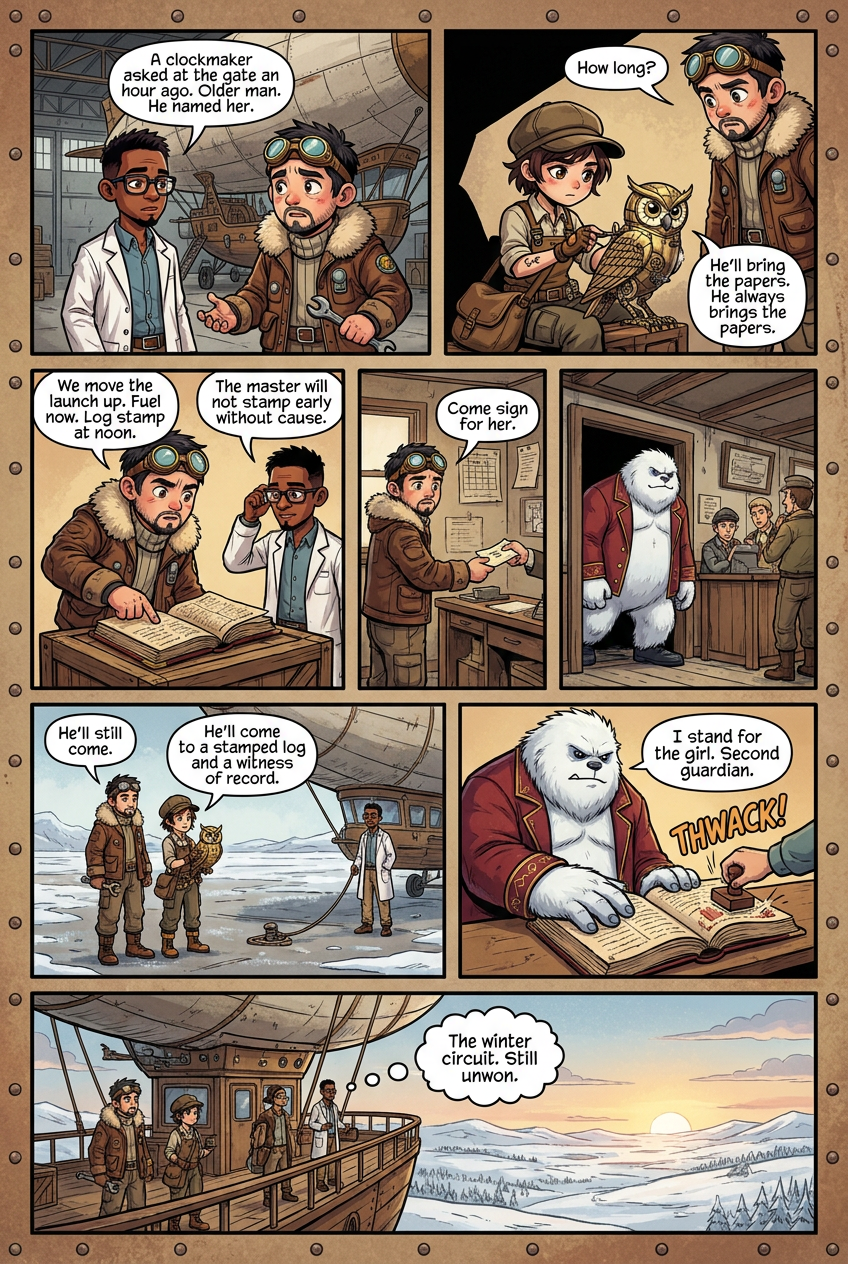
By mid-morning the field crews were already whispering about the girl in Bram's loft. Omondi found him at the tender with a wrench in his good hand and worry in his face. "A clockmaker asked at the gate an hour ago. Older man. Leather apron. He named her." Bram set the wrench down. "How long?" "He is walking the district first. He will reach the depot before dusk. If he files a claim on her indenture, the master strikes her name. Your sheet goes with it." Cora sat cross-legged inside the courier bag's shadow, tightening a screw on the owl's leg. She had heard. Her hands did not stop. "He'll bring the papers. He always brings the papers." "Then we launch before he gets here," Bram said. "Rules say the crew must sign the log at the launch counter in person," Omondi said. "Both of us. Together. If we leave the field before the log is stamped, the bid voids the same way." Bram opened his route journal on the crate. The pages were soft at the edges from years of weather. He ran a finger down the winter schedule and found the launch window. Two hours from now. The clockmaker would still be three towns off at that mark, if Omondi's count was right. "We move the launch up," Bram said. "Fuel now. Log stamp at noon. Wheels up ten minutes after." Omondi pushed his glasses up. "The master will not stamp early without cause." Bram thought of the witness statements filed at every harbor between here and Hollowpass. One name on those pages carried weight the depot could not argue with. He walked to the office and asked the clerk to send a hawk to the waystation. The message was four words. Come sign for her. Wendell Frost arrived by tender ninety minutes later, ducking under the doorframe, red coat buttoned wrong. Pilots at the counter went quiet. He was not a man they knew how to read. He set a broad white hand on the log and looked at the master. "I stand for the girl," he said. "Second guardian. My mark beside her name until her indenture is heard by a proper clerk, not a runner with a grudge." The master studied him, then the co-signed witness pages Wendell laid down beside the log. He stamped the sheet. Bram brought Cora out to the field. She carried the owl against her ribs. Omondi was already at the mooring line. The bag stood full and steady above them. "He'll still come," Cora said. "He'll come to a stamped log and a witness of record," Bram said. "That's a court fight, not a claim. We'll be three harbors out by then." He climbed in. Omondi cut the line. The field dropped away, and the winter circuit opened ahead of them, still unwon.
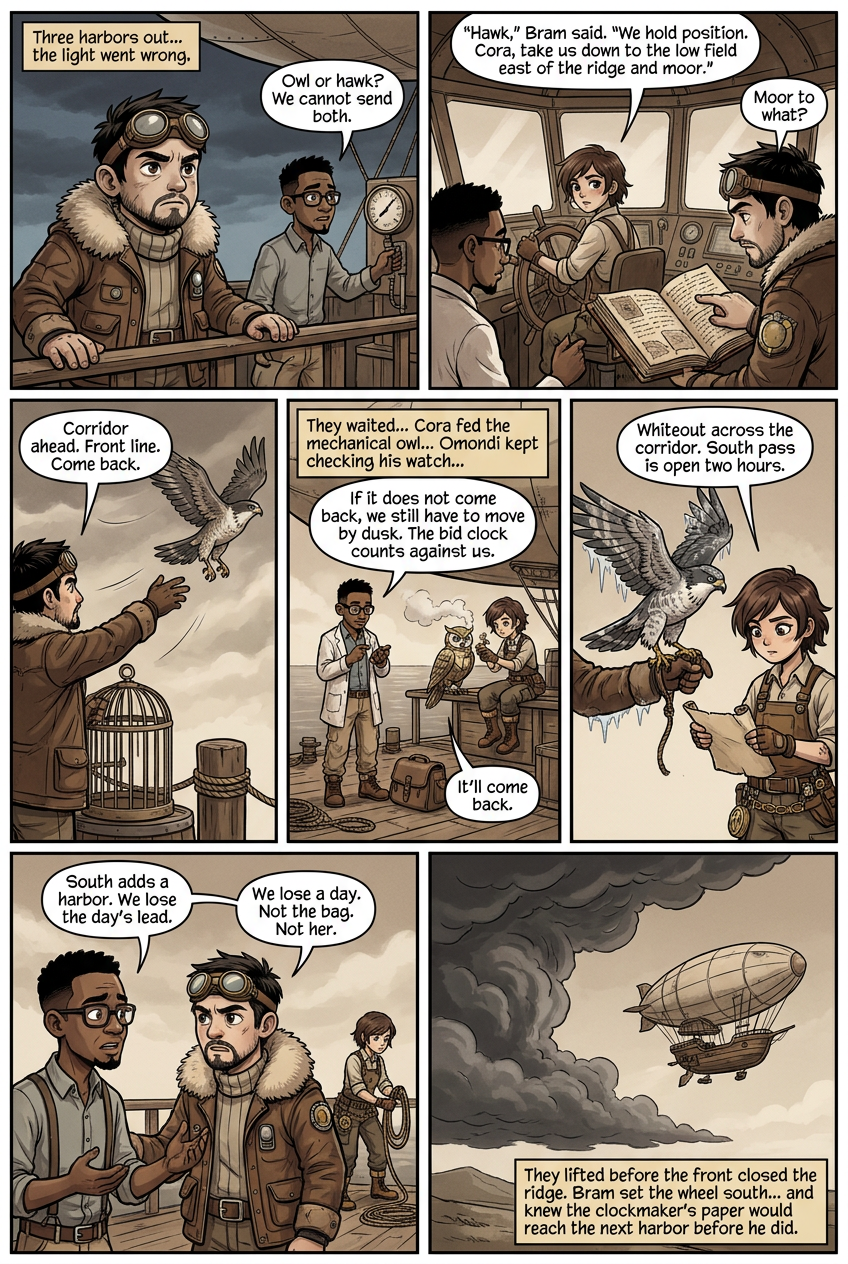
Three harbors out from the depot, the light went wrong. Bram watched the western sky turn the color of wet slate. He had launched the courier bag with Omondi at the ropes and Cora tucked against the cargo, and the winter circuit had opened clean under him for four hours. Now the air smelled like iron. A front was coming across the corridor ahead, and he had no reading on it. "Owl or hawk?" Omondi asked. He was hunched over the pressure gauge, one glove off, squinting like the numbers might rearrange. "We cannot send both. The owl will not read weather that far out. The hawk will not come back to a moving bag." "Hawk," Bram said. "We hold position. Cora, take us down to the low field east of the ridge and moor." Cora climbed to the vent line without being told twice. She had grown quiet in flight, watching everything. "Moor to what?" "Rock pins. I marked them in the journal last winter." Bram pulled the worn book from his jacket and flipped to a dog-eared page. Two ink crosses. A note in his own hand: pins hold two tons, wind from north. They set down in ten minutes. Omondi tied off with the clumsy speed he brought to every knot, checking each twice. Bram opened the hawk's cage on the mooring post. The bird stepped onto his wrist and eyed the western sky like it already knew. "Corridor ahead," Bram told it. "Front line. Come back." He threw his arm up. The hawk climbed hard and vanished west. They waited on the ground with the bag rocking above them. Cora fed the mechanical owl a fresh coal and set it on the cargo rail, where it puffed small ghosts of steam into the cold. Omondi kept checking his pocket watch and putting it away wrong. "If it does not come back," he said, "we still have to move by dusk. The bid clock counts against us." "It'll come back," Bram said. The hawk returned in forty minutes with ice on its wing feathers and a scrap of oiled paper tied at its leg. Cora untied it with clockmaker's fingers. Bram read the mark: a line drawn straight through the corridor and crossed out. Below it, a curved arrow bending south along the low pass. "Whiteout across the corridor," Bram said. "South pass is open two hours." Omondi looked at the journal, then at the sky. "South adds a harbor. We lose the day's lead." "We lose a day. Not the bag. Not her." Bram nodded at Cora, who was already coiling the mooring line. They lifted before the front closed the ridge. Bram set the wheel south, watched the clean air open ahead, and knew the clockmaker's paper would reach the next harbor before he did.
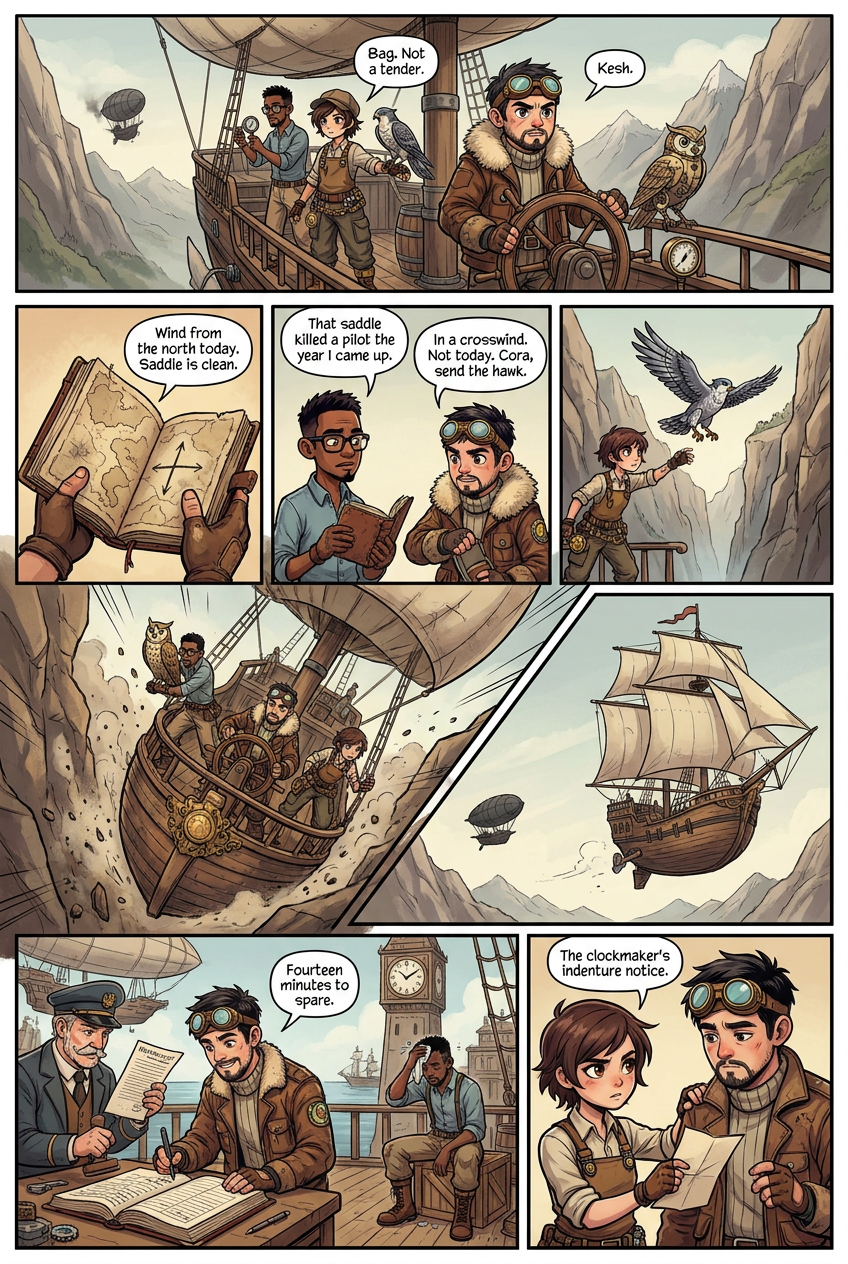
The southern pass held clean air for the first hour. Bram set a steady line above the tree line and let the courier bag find its rhythm. Cora watched the horizon with the mechanical owl on her forearm. Omondi kept one hand on the pressure gauge and one on his watch. They had lost a day to the detour. Bram meant to take back what he could. Cora spotted the smudge first. A dark shape trailing them low against the ridge, maybe two miles back. "Bag," she said. "Not a tender." Bram brought the glass up. A courier envelope, painted dark, riding the same corridor. He knew the cut of it before he saw the mark. Kesh. His rival had taken the southern detour too, and Kesh was closing. "He'll beat us to the next harbor," Omondi said. "If he signs the ledger first, the circuit board reads him ahead. We lose the lead for the whole round." "How far to the harbor?" Cora asked. "Forty minutes at this speed," Bram said. "He'll make it in thirty." Bram opened the worn journal against the wheel and turned to the southern pages. He had flown this line twice, years ago. He found the notation he wanted: a narrow saddle east of the marked route, faster by six minutes, unsafe in crosswind. He pressed his thumb on the ink cross. "Wind from the north today," he said. "Saddle is clean." Omondi looked at the page. "That saddle killed a pilot the year I came up." "In a crosswind. Not today." Bram put the journal in his jacket. "Cora, send the hawk ahead to read the saddle throat. If it comes back inside ten minutes, we cut through." Cora opened the cage. The hawk with the compass-mark feathers stepped onto her wrist and eyed the eastern ridge. She threw it up. It climbed and vanished. They held the main line and watched the dark bag grow behind them. Bram counted breaths. At nine minutes the hawk came back with a clean scrap of paper. No mark. Open air. Bram cut the wheel east. The courier bag tipped and slid toward the saddle throat. Cora braced against the cargo rail. Omondi held the pressure ring steady while the mechanical owl gripped the brass beside his hand. The rock walls narrowed, then opened. Bram felt the bag shed drag and pick up speed. They cleared the saddle in eleven minutes. When Bram looked back, Kesh's envelope was still tracking the long line, small against the ridge. They moored at the harbor with fourteen minutes to spare. Bram signed the ledger himself and watched the harbormaster stamp the time. Omondi exhaled and sat down on a crate. Cora tugged Bram's sleeve. She held out a folded paper the harbormaster had passed her without a word. The clockmaker's indenture notice, filed that morning, waiting for her name.
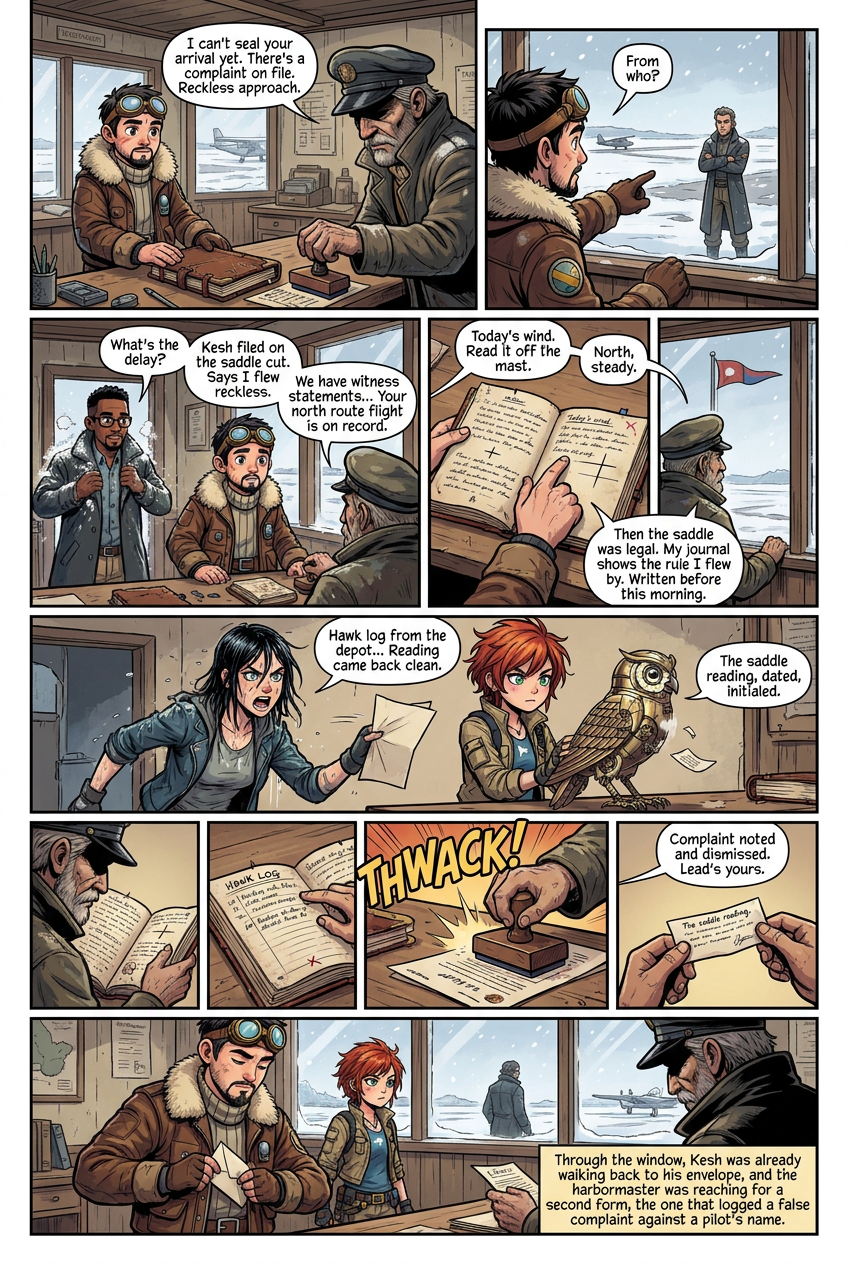
Bram carried the ledger book back to the harbormaster's counter with the indenture notice folded inside it. The stamp lay on the blotter, untouched. The harbormaster set both palms flat on the wood and would not meet Bram's eyes. "I can't seal your arrival yet," he said. "There's a complaint on file. Reckless approach. Endangering the harbor." "From who?" "The second bag in. He signed a statement ten minutes ago." Bram looked out the window. Kesh stood on the field beside his dark envelope, arms crossed, watching the office. Without the stamp, Bram's lead meant nothing. The circuit board would read them as tied, or worse, read Kesh ahead once the complaint went up the line. Omondi came in from the field brushing snow off his coat. He caught a boot on the door sill and steadied himself against the counter. "What's the delay?" "Kesh filed on the saddle cut," Bram said. "Says I flew reckless." Omondi pushed his glasses up. "We have witness statements filed at every harbor between here and Hollowpass. Your north route flight is on record." "Different run," the harbormaster said. "This is today's complaint. I need today's proof." Bram opened his jacket and set the worn journal on the counter. He turned to the southern pages and pressed the spine flat. The ink cross sat on the saddle notation, north-wind clean, crosswind unsafe. Beside it, in his own hand years old, a bearing and a wind rule. "Today's wind," he said. "Read it off the mast." The harbormaster glanced at the pennant outside. "North, steady." "Then the saddle was legal. My journal shows the rule I flew by. Written before this morning. Before Kesh." Vex came through the door then, red hair wet, a folded sheet in her fist. She had ridden in on a tender an hour behind them, chasing the bid paperwork Bram had left unfinished at the depot. She dropped the sheet on the counter without slowing. "Hawk log from the depot," she said. "His girl sent a scout ahead of the cut. Reading came back clean. Time-stamped." Cora stepped up beside her and set the mechanical owl on the counter. She popped a small brass plate on its chest and slid out a slip of paper. The saddle reading, dated, initialed. The harbormaster took it between two fingers. He read the journal. He read the hawk log. He read the owl's slip. Then he inked the stamp and brought it down on Bram's line. The sound carried across the office. "Complaint noted and dismissed," he said. "Lead's yours." Bram folded the indenture notice out of the ledger book and put it in his pocket. Cora watched him do it. Through the window, Kesh was already walking back to his envelope, and the harbormaster was reaching for a second form, the one that logged a false complaint against a pilot's name.
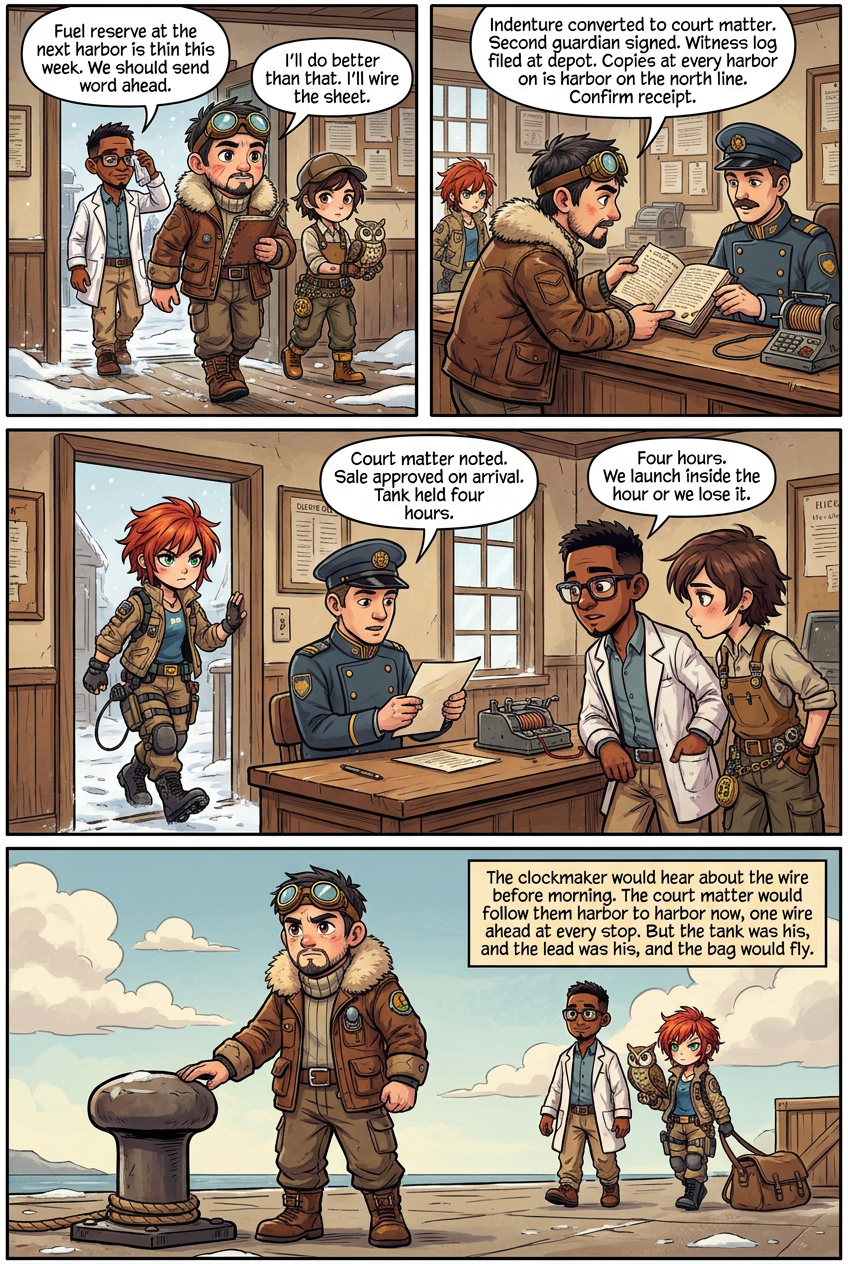
Bram left the harbormaster's office with the stamp fresh on his page and the indenture notice heavy in his pocket. Outside, the wind had shifted west. He walked toward the courier bag with Cora and Omondi following. The next harbor was six hours out, and he needed to know if he could fuel there before he committed the crew to the leg. Omondi caught up first, wiping snow off his glasses and nearly tripping on a coil of rope. "Fuel reserve at the next harbor is thin this week. I heard it from the tender pilot. We should send word ahead." "I'll do better than that," Bram said. He pulled the worn journal from his jacket and turned to the harbor's page. He'd flown this stop a dozen times. The harbormaster there ran a tight ledger and would not sell a drop without a valid crew sheet on file. "I'll wire the sheet. If he holds a tank for us, we go. If not, we route around." Cora set the mechanical owl on a crate and rewound its spring while she listened. She was quieter than she'd been at the depot loft. She kept touching her pocket where Bram had folded the indenture notice back into her hand an hour ago. Bram sent the wire from the harbor office. He listed his bid number, his aircraft, and his crew: Dr. Kamau Omondi and Cora Springwick. He paid for a reply. The reply came back in twenty minutes. The clerk read it aloud. Fuel available. Crew sheet flagged. Springwick indenture on record. No sale until cleared. Cora looked at the floor. Omondi opened his mouth and closed it. Bram unfolded the notice on the counter. Below the clockmaker's claim, in the margin, Wendell Frost's signature sat as second guardian. The witness log copy was clipped behind it. He asked the clerk for a fresh wire form. He wrote it short. Indenture converted to court matter. Second guardian signed. Witness log filed at depot. Copies at every harbor on the north line. Confirm receipt. He paid again and waited. Vex came in stamping snow off her boots and read over his shoulder without speaking. The reply took forty minutes. Court matter noted. Sale approved on arrival. Tank held four hours. Bram folded both wires into the journal and closed it. "Four hours," he said. "We launch inside the hour or we lose it." Omondi was already moving for the field. Cora picked up the owl and followed, faster now. Outside, Bram stopped at the mooring pin and looked west. The clockmaker would hear about the wire before morning. The court matter would follow them harbor to harbor now, one wire ahead at every stop. But the tank was his, and the lead was his, and the bag would fly.
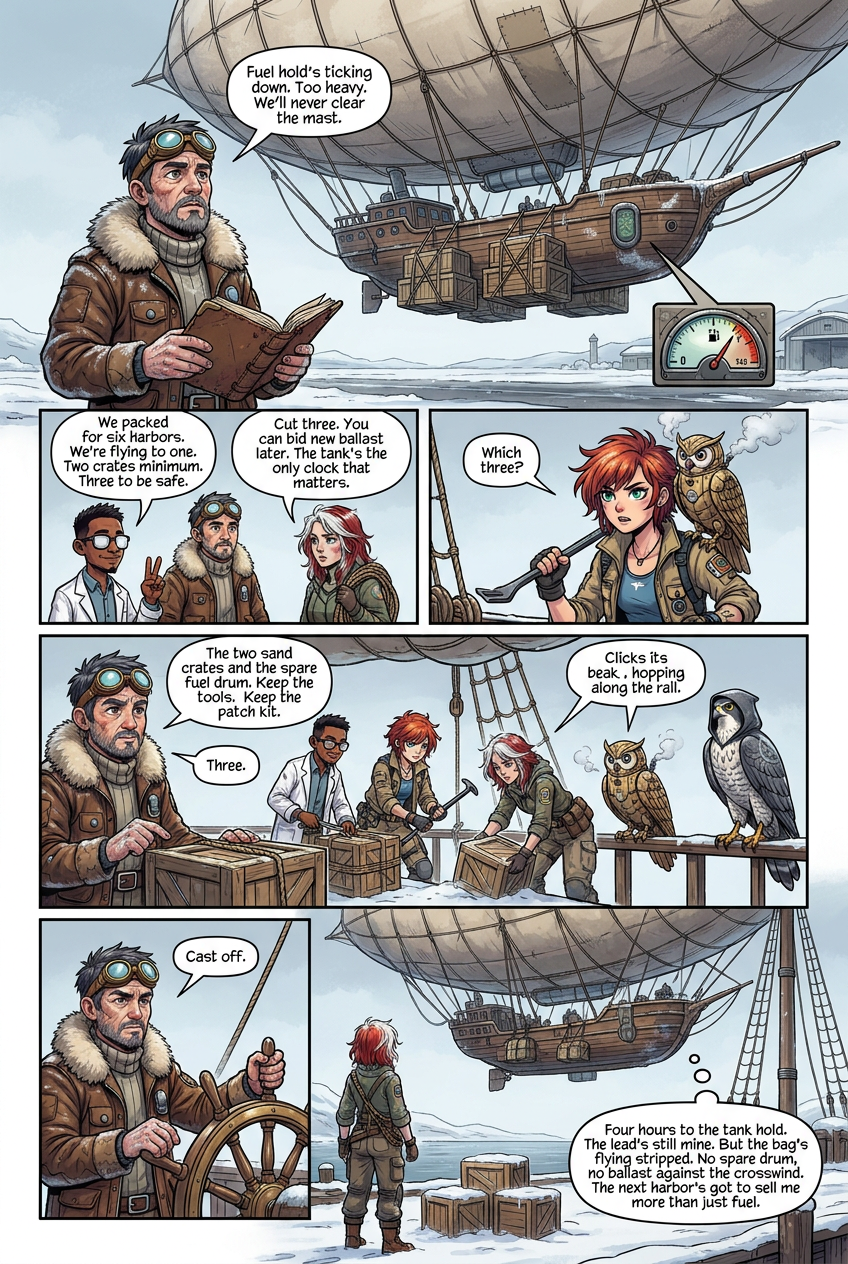
Bram stepped back onto the field with the wire folded in his journal and the fuel hold ticking down. The bag sat on the pins, envelope taut, cargo tied fast. He climbed the rope ladder and looked at the courier bag's belly. The ballast crates were still lashed for a full circuit run. Loaded this heavy, the bag would never clear the harbor mast. He had less than an hour. Omondi came up behind him with his glasses fogged, tripping once on the ladder rung. "We packed for six harbors," he said. "We're flying to one. We need to pull weight before we lift or we clip the mast." "How much?" Bram asked. Omondi wiped his glasses and did the math on his fingers. "Two crates minimum. Three to be safe with the west wind." Vex climbed up behind him with a rope over her shoulder. She was not crew, but she had walked out to see them off. Her red hair was already white with snow. "Cut three," she said. "You can bid new ballast at the next harbor. The tank's the only clock that matters." Bram looked at the crates. Three crates meant leaving supplies he'd paid for at the depot. It also meant a lighter bag that could actually clear the mast and reach the tank hold in time. He nodded once. "Three." Cora was already on the deck with the mechanical owl on her shoulder. She had a pry bar in her hand before he asked. "Which three?" "The two sand crates and the spare fuel drum," Bram said. "Keep the tools. Keep the patch kit." They worked fast. Omondi cut the lashings while Cora levered the crates to the edge. Vex caught them below and rolled each one clear of the pins. The owl clicked its beak and hopped along the rail, watching Cora's hands. The compass hawk sat hooded on its perch and did not move. Bram checked the mast line. The bag rode higher now, straining at the pins. He climbed to the wheel and put his hand on the brass ring. "Cast off." Vex pulled the pin at the bow. Omondi pulled the stern. The bag lifted clean. Bram watched the mast pass under the keel with two yards to spare. Cora let out a breath he could hear from the wheel. Below, Vex raised one gloved hand and stepped back from the pins. The three sand crates sat in the snow beside her, already dusted white. Bram set the course west. The tank was held for four hours. The lead was still his. But the bag was flying stripped now, with no spare drum and no ballast to trim against a hard crosswind. The next harbor would have to sell him more than fuel.
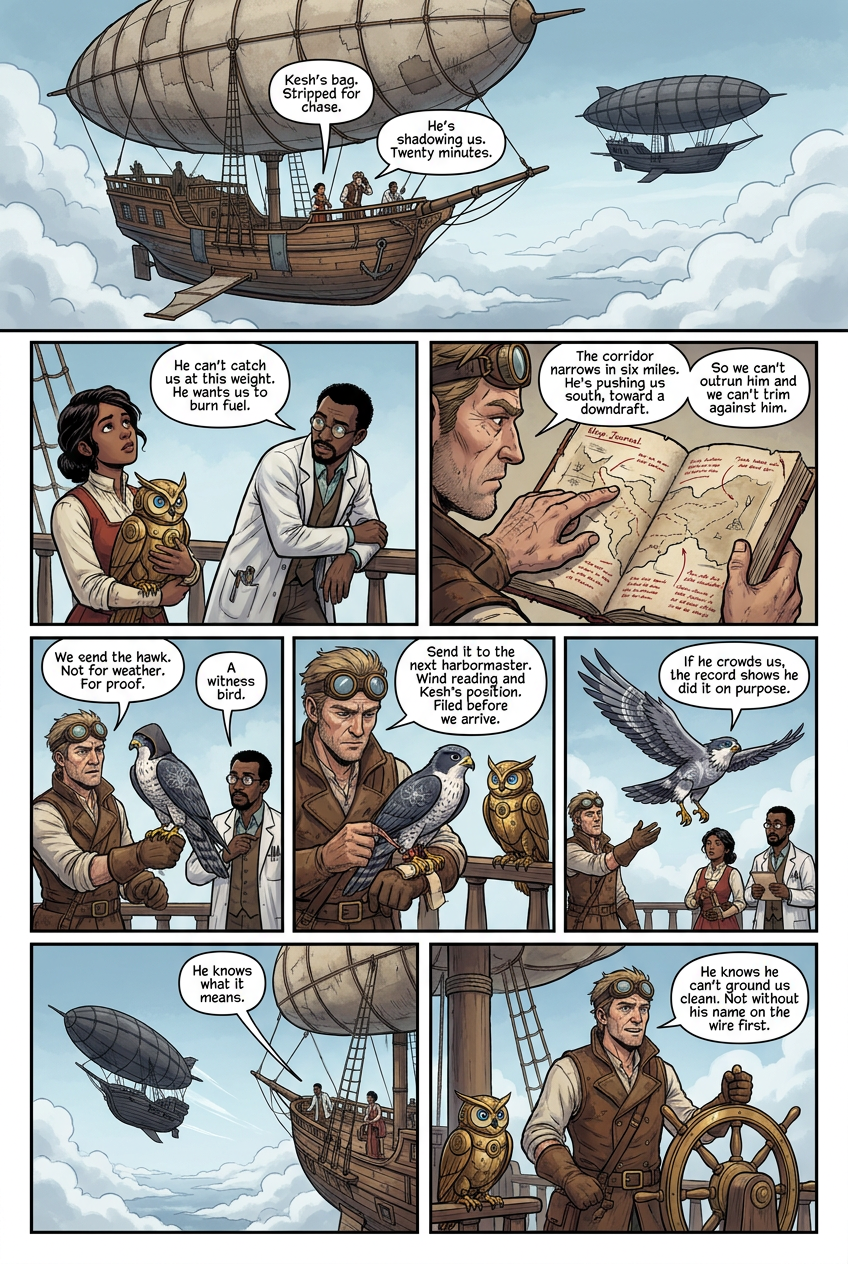
An hour west of the harbor, Cora spotted a dark shape holding station above them on the north flank. Bram tilted his goggles up and squinted. A second airship rode the ridge line at their altitude, matching their speed. It carried no harbor colors. It carried no cargo hooks. It was Kesh's bag, stripped for chase. "He's shadowing us," Cora said. She held the mechanical owl against her chest. Its brass vents ticked warm through her glove. "He's been up there twenty minutes." Omondi wiped his glasses and leaned over the rail. His hip bumped the compass hawk's perch and the bird shook out its wings. "He can't catch us at this weight," Omondi said. "He wants us to burn fuel dodging him. Or he wants us to cut a corner and clip a ridge." Bram pulled the journal from his coat. He flipped to the wind rules for this stretch and read the margin notes he had written last winter. The corridor narrowed in six miles. Kesh would push them south there, toward a downdraft line Bram had marked in red ink. If Bram trimmed hard to hold course, the stripped bag would yaw. With no ballast, one bad gust would spin them. "He knows we dumped the crates," Bram said. "He watched the launch." Cora looked up from the owl. "So we can't outrun him and we can't trim against him." "We send the hawk," Bram said. He unhooded the compass hawk and set his hand under its feet. "Not for weather. For proof." Omondi caught up a beat late. "A witness bird." "Every harbor on this circuit knows the hawk's band," Bram said. "Send it to the next harbormaster with a wind reading and Kesh's position. Filed before we arrive. If he crowds us into the downdraft, the record shows he did it on purpose." Cora tied a strip of paper to the hawk's leg while Omondi read out the bearing. Bram wrote the time, the altitude, and Kesh's heading in a clean hand. He tore the page and rolled it small. The hawk took it and lifted off the rail in one push. They watched the shadow above them. For six minutes nothing changed. Then the second bag banked north and climbed, pulling off the ridge. Kesh had seen the hawk go east. "He knows what it means," Omondi said. "He knows he can't ground us clean now," Bram said. "Not without his name on the wire first." Cora let out a breath and set the owl on the rail. The corridor opened ahead, clear and cold. Bram kept his hand on the brass ring and did not look up again. The lead was still his. But Kesh had learned the trick, and the hawk was gone until the next harbor. The bag flew west with no scout ahead and no drum in the hold.
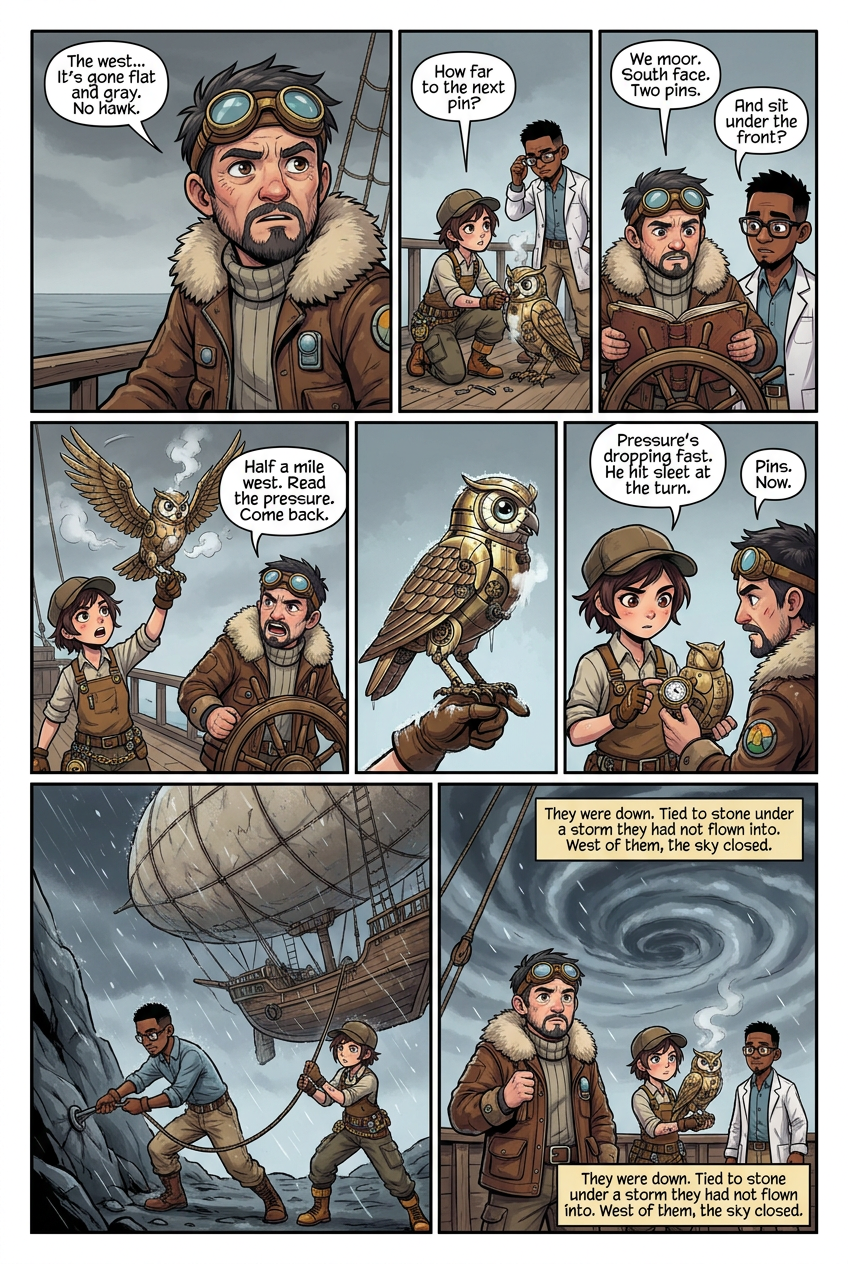
The corridor stayed clear for twenty minutes. Then the light changed. Bram watched the west go flat and gray, the way it did before a front dropped. He had no hawk to send ahead. The compass hawk was east with the harbormaster, filing paper against Kesh. Without a scout, one bad squall could ice the bag and put them on the rocks. Cora crouched by the rail with the mechanical owl in her lap. She had the belly plate open and was tightening a gear with the small driver from her belt. The brass vents ticked steam against her sleeve. She looked up when Bram did not answer her first question. "How far to the next pin?" she asked again. "Forty minutes," Bram said. "The front's closer than that." Omondi bumped the rail and caught his glasses before they slid. He squinted west. "That's a hard line. We can't fly through blind." Bram opened his journal on the wheel. He read the margin notes for this stretch. There were two marked rock pins six miles ahead on the south face. He had used them once, four winters back, to wait out a front. "We moor," Bram said. "South face. Two pins." "And sit under the front?" Omondi said. "Under it, not in it." Cora closed the owl's belly plate. "Send him," she said. She held the owl out on both hands. "He can fly a short line. Half a mile. He comes back with wind." Bram looked at the owl. Its right wing joint was still stiff from the last repair. A long flight would break it. A short one might not. "Half a mile west," Bram said. "Read the pressure. Come back." Cora wound the key three turns and set the owl on the rail. It lifted off with a soft cough of steam and cut west low over the ridge. Bram counted. At ninety seconds the owl banked and came back hard, riding a push of air that hit the bag a breath later. The gust shoved them south. Bram fought the wheel and held course. The owl landed on Cora's glove. She read the dial in its chest. "Pressure's dropping fast," she said. "He hit sleet at the turn." "Pins," Bram said. "Now." He cut the throttle and let the bag slide south toward the face. Omondi worked the mooring lines. Bram brought them in low along the rock. Cora threw the first line and it caught. Omondi got the second on the third try. The bag pulled hard against both pins as the front's edge crossed above them. Sleet rattled the envelope. The pins held. They were down. Not landed, not moving, but tied to stone under a storm they had not flown into. Bram set his hand on the brass ring and let his shoulder unlock. The owl steamed on Cora's glove, wing joint stiff but whole. West of them, the sky closed.
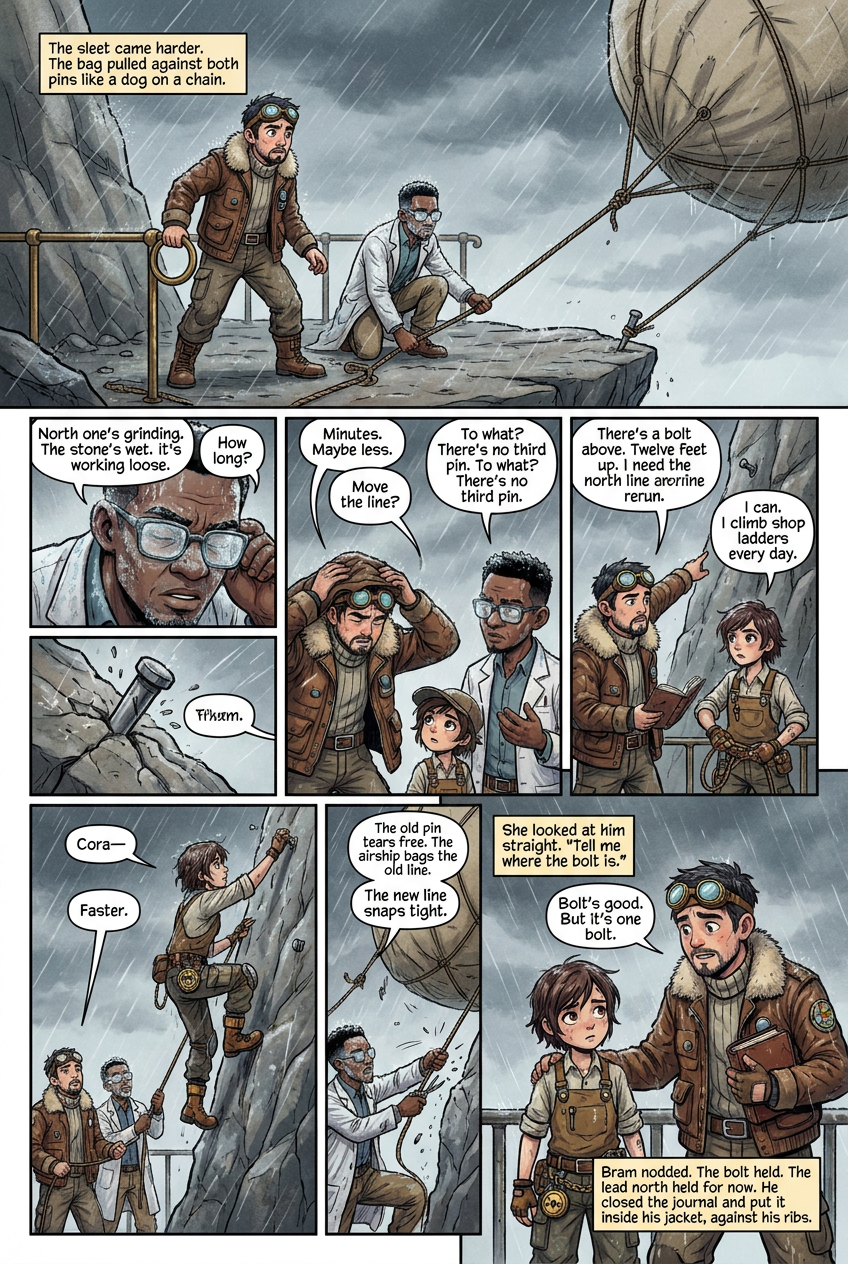
The sleet came harder. Bram stood at the rail with one hand on the brass ring and one on the south line. The bag pulled against both pins like a dog on a chain. He could hear the ropes creak through the wind. If either pin tore, the wind would slam the bag down the rock face and drag them with it. Omondi crouched by the north line, squinting through frozen glasses. He put his ear near the pin and listened. "North one's grinding," he said. "The stone's wet. It's working loose." Bram checked the south pin. Its collar was iced but seated deep. The north pin sat in a softer seam. He had chosen it four winters ago in dry weather. He had not thought about wet rock. "How long?" Bram asked. "Minutes," Omondi said. "Maybe less." Cora had the mechanical owl open on her knee, wing joint splinted with a strip of tin. She looked up. "Move the line?" "To what," Omondi said. "There's no third pin." Bram opened his journal on the rail and shielded it with his jacket. Sleet ran down the cracked leather sleeve. He turned to the page for this face. His own margin note read: south pin true, north pin fair, third anchor at cleft twelve feet above north pin, use ring bolt. He had forgotten the ring bolt. He had set it himself, one winter, and never used it. "There's a bolt above," Bram said. "Twelve feet up. I need the north line rerun to it before the pin goes." Omondi looked at the wall. "I can't climb that in sleet." "I can," Cora said. She was already tying the tail of the north line to her belt. "Cora—" Bram said. "I'm lighter. I climb shop ladders every day." She looked at him straight. "Tell me where the bolt is." Bram showed her the sketch. She nodded once and went over the rail. Omondi fed the slack. Bram held the brass ring with one hand and the south line with the other and watched her set her boots in the seam. The north pin ground in its socket. A thin crack ran out from the collar. "Faster," Omondi said, low. Cora found the bolt. She looped the line, cinched it, tested it with her weight. She looked down and lifted her hand. Omondi cut the tail from the north pin. The pin tore free a breath later and swung on the old line. The bag lurched. The new line snapped tight against the bolt above. It held. Bram let his shoulder unlock. Cora climbed back down, hands raw, cap gone. Sleet plastered her hair. "Bolt's good," she said. "But it's one bolt." Bram nodded. They were tied to stone under a storm they had not flown into. The south pin held. The bolt held. The lead north held for now. He closed the journal and put it inside his jacket, against his ribs.
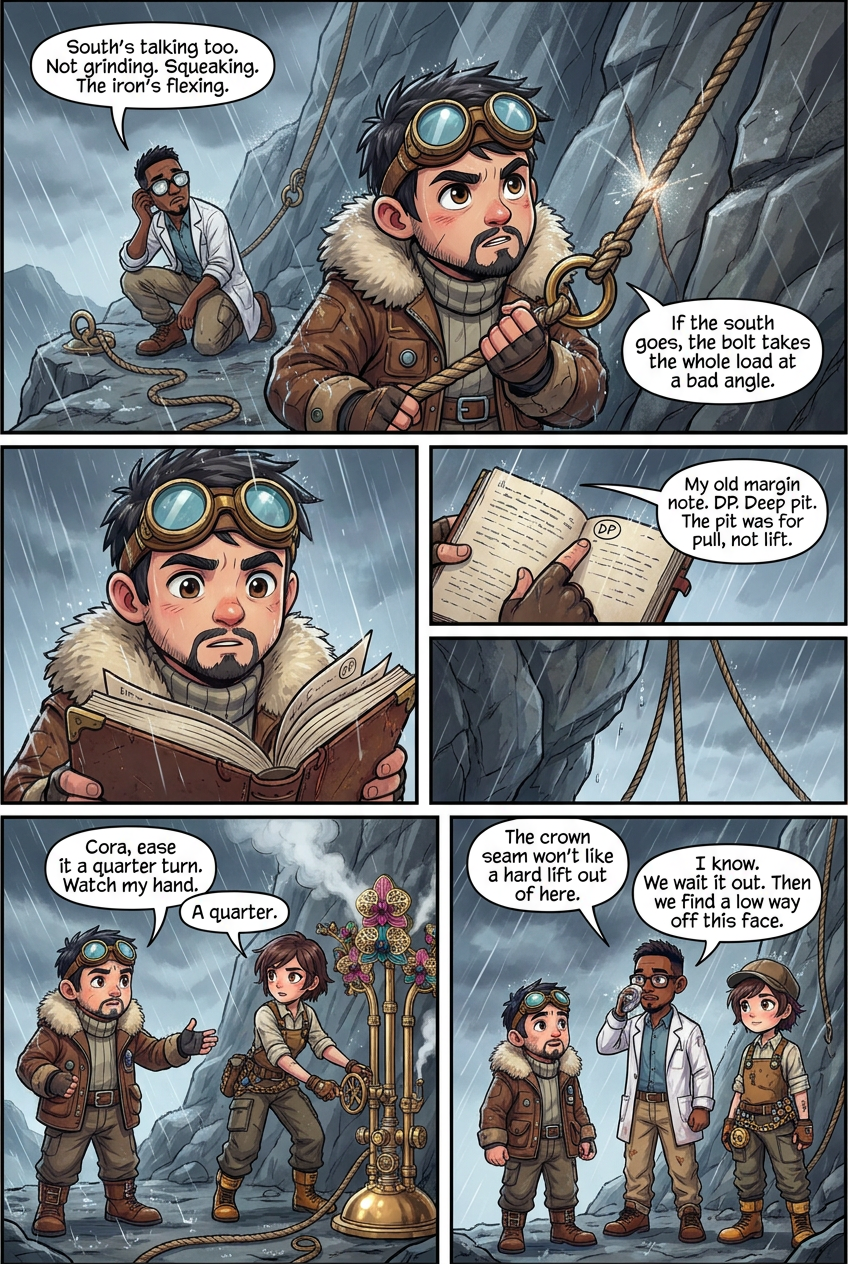
The storm did not ease. It leaned harder on the bag. Bram kept one hand on the brass ring of the orchid at the rail and one on the south line. Sleet raked the fabric above him. The bag bucked with each gust, and every buck ran down the two lines into stone. Omondi crouched by the south pin now, ear near the collar. He looked up through fogged glasses. "South's talking too. Not grinding. Squeaking. The iron's flexing in the seat." Bram followed the line up with his eyes. The north line ran to the ring bolt twelve feet above. The bolt held, but the line sawed against the lip of rock each time the bag pitched. He could see a bright scar where the rope had already skinned itself. "If the south goes, the bolt takes the whole load at a bad angle," Bram said. "It'll shear the line on that lip before we get another rope up." "So we take load off both," Omondi said. "Vent the bag down." "We vent, we lose lift. If the pins hold, we still can't launch after." "If the pins don't hold, we don't launch at all." Bram opened his journal against his chest. Water beaded on the page. His old margin note for this face showed the south pin with a small circle and two letters: DP. Deep pit. He had cut a pit under the pin one summer to seat it against a downhill pull. The pit was for pull, not lift. The storm was lifting the bag, and the pin was rocking in its socket the wrong way. "Cora," he said. "Tie off the owl. I need you on the ring." She set the mechanical owl in the lee of the rail and came. He put her hand on the brass ring of the orchid. "When I say, ease it a quarter turn. Not more. Watch my hand." "A quarter," she said. Bram nodded to Omondi. Omondi braced the south line. Bram raised his hand and dropped it. Cora eased the vent. Steam hissed. The bag settled half a yard. The south pin stopped squeaking. The north line went slack against the lip, then took weight clean off the scar. "Hold there," Bram said. They held. The storm kept coming. The bag rode lower now, closer to the rock, but the load on both anchors had dropped. The scar on the north line stopped growing. Omondi wiped his glasses. "You've spent your climb margin. The crown seam won't like a hard lift out of here." "I know," Bram said. Cora kept her hand on the ring. Sleet ran off her sleeve. "We wait it out?" "We wait it out," Bram said. "Then we find a low way off this face." The pins held. The bolt held. The bag rode the wind at half height, and the route went on without them for another hour.
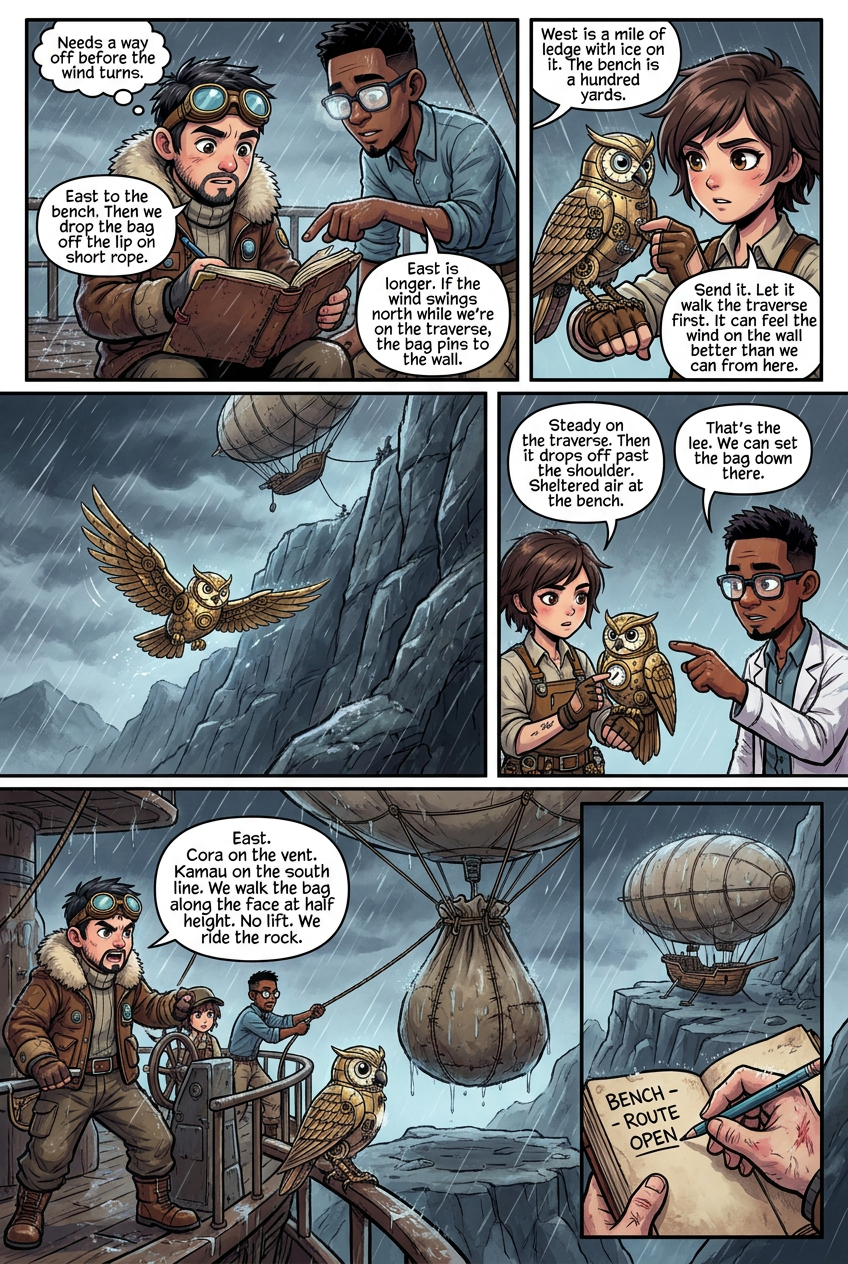
The storm thinned near dusk. Sleet slackened to a hard drizzle. The bag rode low against the face, and the two lines held. Bram wiped his goggles and looked down the rock for the first time in hours. He needed a way off before the wind turned again. He opened the journal against his knee. The page for this face had three descent notes in his own hand. The direct chute below them was fastest, but he had drawn a slash through it two winters back. Loose scree over ice. The second was a traverse east to a bench, then a low drop. The third went west along a ledge to a saddle. He tapped the second line. "East to the bench. Then we drop the bag off the lip on short rope." Omondi leaned over the page. His glasses were fogged again. He wiped them on his shirt and squinted. "East is longer. If the wind swings north while we're on the traverse, the bag pins to the wall." "West is a mile of ledge with ice on it," Bram said. "The bench is a hundred yards." Cora stood at the rail with her mechanical owl on her wrist. Its brass plates ran with water. She had wound its wing joint tight with waxed thread that morning. "Send it," she said. "Let it walk the traverse first. It can feel the wind on the wall better than we can from here." Bram thought about the owl's damaged wing. He thought about guessing. "Go," he said. Cora set the owl on the rail and pointed east. It stepped off and glided low along the face, brass gears clicking under the sleet. It vanished around a shoulder of rock. They waited. Bram kept one hand on the brass ring of the orchid. The bag pulled and settled. Pulled and settled. The owl came back on foot along the ledge, walking hunched against the wind. It landed on Cora's wrist and clicked once, then twice. She read the pressure needle on its chest. "Steady on the traverse. Then it drops off past the shoulder. Sheltered air at the bench." "That's the lee," Omondi said. "We can set the bag down there." Bram closed the journal. "East. Cora on the vent. Kamau on the south line. We walk the bag along the face at half height. No lift. We ride the rock." They cut the north line first and payed out the south. Bram fed the vent by hand as they crept east, the bag scraping the wall on each gust. At the shoulder the wind fell off, as the owl had said. The bench opened below them, flat and dry in the lee. Bram vented the last of the lift and the bag sank onto the stone. Omondi tied the collar to a boulder. Cora sat down hard and laughed once, a short surprised sound. Bram wrote the bench into the journal in wet pencil. The bag was down. The route was still open.
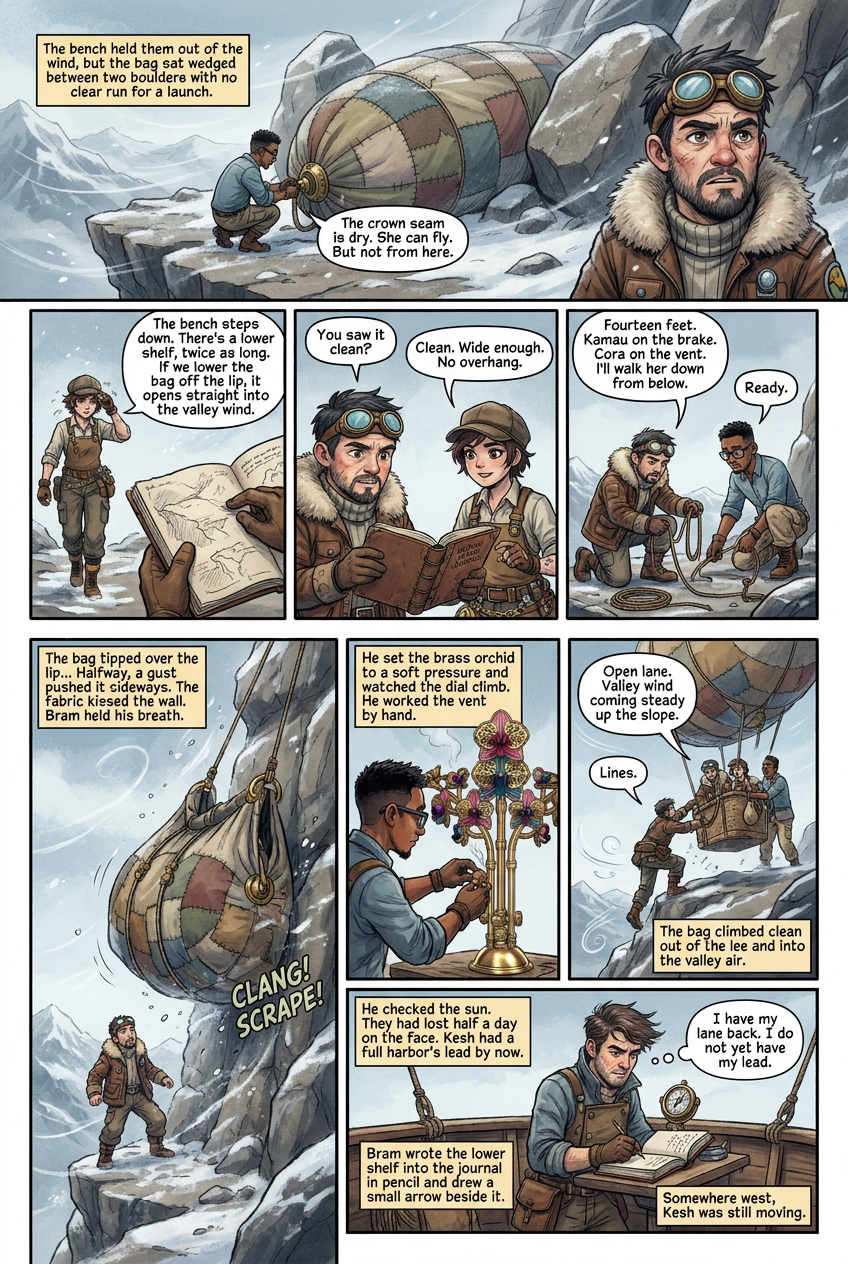
The bench held them out of the wind, but the bag sat wedged between two boulders with no clear run for a launch. Bram walked the ledge and measured with his eye. Twenty paces of flat stone, then a drop. Rock walls closed both sides. He needed a lane long enough to lift before the wall, or the bag would smear against the face. Somewhere west, Kesh was still moving. Every hour on this bench put Kesh closer to the next harbor stamp. Omondi crouched by the collar and checked the fabric. "The crown seam is dry. She can fly. But not from here." Cora walked to the drop and leaned over. She came back wiping sleet off her cap. "The bench steps down. There's a lower shelf, twice as long. If we lower the bag off the lip, it opens straight into the valley wind." Bram opened the journal on a boulder and turned to the face page. He had sketched this bench years back. He had not drawn the lower shelf. He tapped the page. "You saw it clean?" "Clean," Cora said. "Wide enough. No overhang." Bram measured the drop with a coil of line. Fourteen feet. He tied a bridle to the collar and rigged a slow lower off a horn of rock. "Kamau on the brake. Cora on the vent. I'll walk her down from below." Omondi set his boots against the horn and wrapped the line twice. "Ready." Bram climbed down first and stood on the lower shelf. He waved. The bag tipped over the lip and eased down, brass fittings knocking on stone. Halfway, a gust pushed it sideways. The fabric kissed the wall. Bram held his breath. Omondi checked the brake with a grunt. The bag steadied and dropped the last six feet onto the shelf. Cora slid down the line after it. She landed and ran her hands along the seam where it had touched rock. "Scuffed. Not torn." Bram looked west along the shelf. Open lane. Valley wind coming steady up the slope. He set the brass orchid to a soft pressure and watched the dial climb. He worked the vent by hand. The bag filled and lifted a foot off the stone, then two. "Lines," he said. Omondi cast off. Cora scrambled aboard. Bram pulled himself over the rail as the shelf slid past his boots. The bag climbed clean out of the lee and into the valley air. He checked the sun. They had lost half a day on the face. Kesh had a full harbor's lead by now. Bram wrote the lower shelf into the journal in pencil and drew a small arrow beside it. Then he set the wheel west and pushed the orchid up a quarter turn. The bag answered. He had his lane back. He did not yet have his lead.
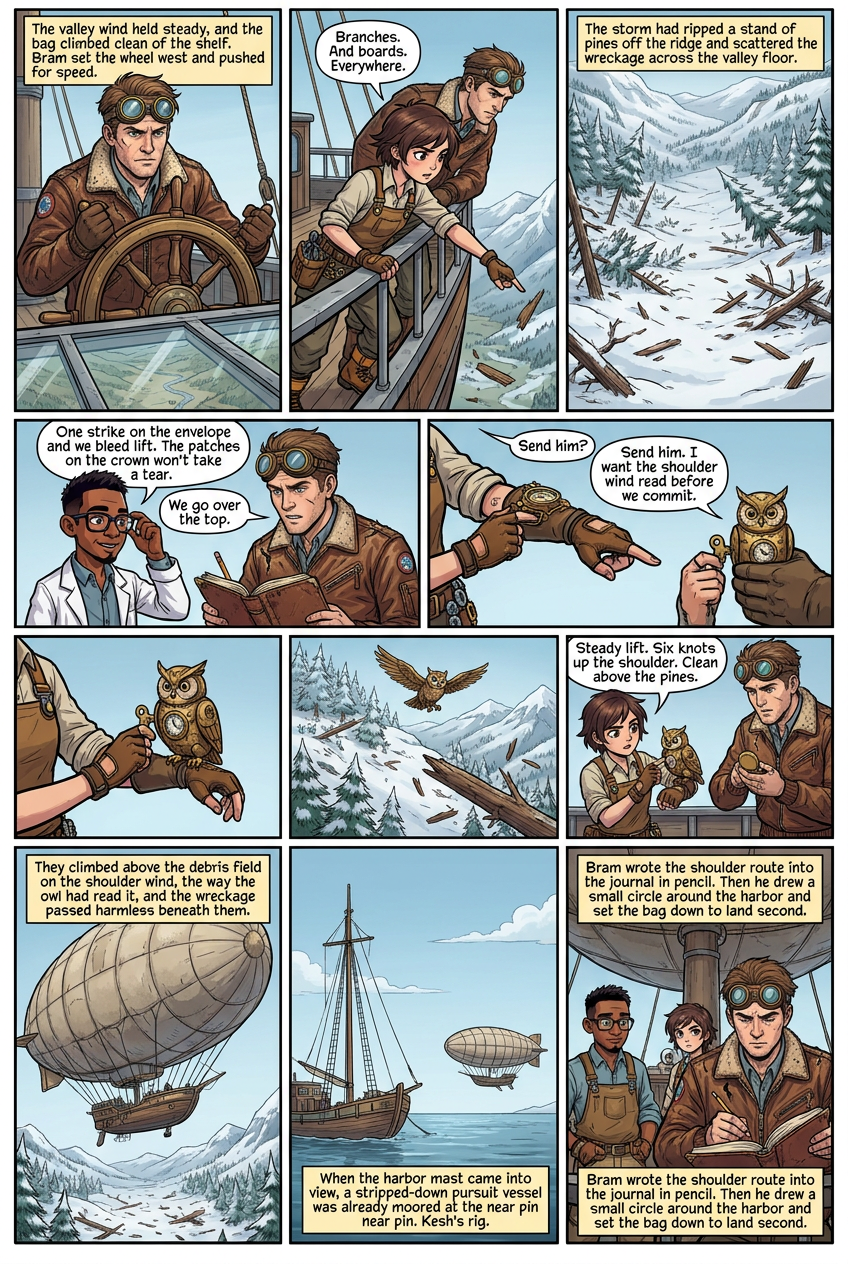
The valley wind held steady, and the bag climbed clean of the shelf. Bram set the wheel west and pushed for speed. Then Cora leaned over the rail and pointed down at the snowfield below. "Branches," she said. "And boards. Everywhere." Bram looked. The storm had ripped a stand of pines off the ridge and scattered the wreckage across the valley floor. Splinters of timber stood upright in the drifts. Rope and canvas from some other pilot's cargo lay tangled in the brush. The approach lane to the next harbor ran straight through it. Some of the debris rose thirty feet on the updrafts, tumbling like knives. Omondi pushed his glasses up his nose and squinted. "One strike on the envelope and we bleed lift. The patches on the crown won't take a tear." Bram opened the journal on the rail and flipped to the valley page. He had marked two approach lanes. The main lane cut low along the river. The second ran high along the north shoulder, longer by twenty minutes, but above the tree line. He tapped the second line. "We go over the top." "That climb," Omondi said. "The crown seam." "Not a hard climb. A slow one. We ride the shoulder wind up." Cora already had her mechanical owl on her wrist. One brass wing hung stiff from the sleet run, but the eyes still tracked. "Send him?" "Send him. I want the shoulder wind read before we commit." She wound the key and whispered to the owl. It lifted off her glove and beat north up the slope. Bram held the bag steady at low pressure and watched the debris churn below. A length of broken spar spun up on a gust and passed twenty feet under the hull. Cora flinched. The owl came back inside ten minutes and landed hard on her wrist. She read the dial on its chest. "Steady lift. Six knots up the shoulder. Clean above the pines." Bram pulled the compass from his jacket and checked bearing. Then he eased the orchid vent a quarter closed. The bag answered slow. The crown seam creaked once and held. They climbed above the debris field on the shoulder wind, the way the owl had read it, and the wreckage passed harmless beneath them. The long lane cost them the twenty minutes he had counted on. When the harbor mast came into view, a stripped-down pursuit vessel was already moored at the near pin. Kesh's rig. The ledger stamp would be his. Bram set the wheel for the far pin and did not speak. Omondi looked at him and said nothing. Cora put the owl back in her belt. Bram wrote the shoulder route into the journal in pencil. Then he drew a small circle around the harbor and set the bag down to land second.
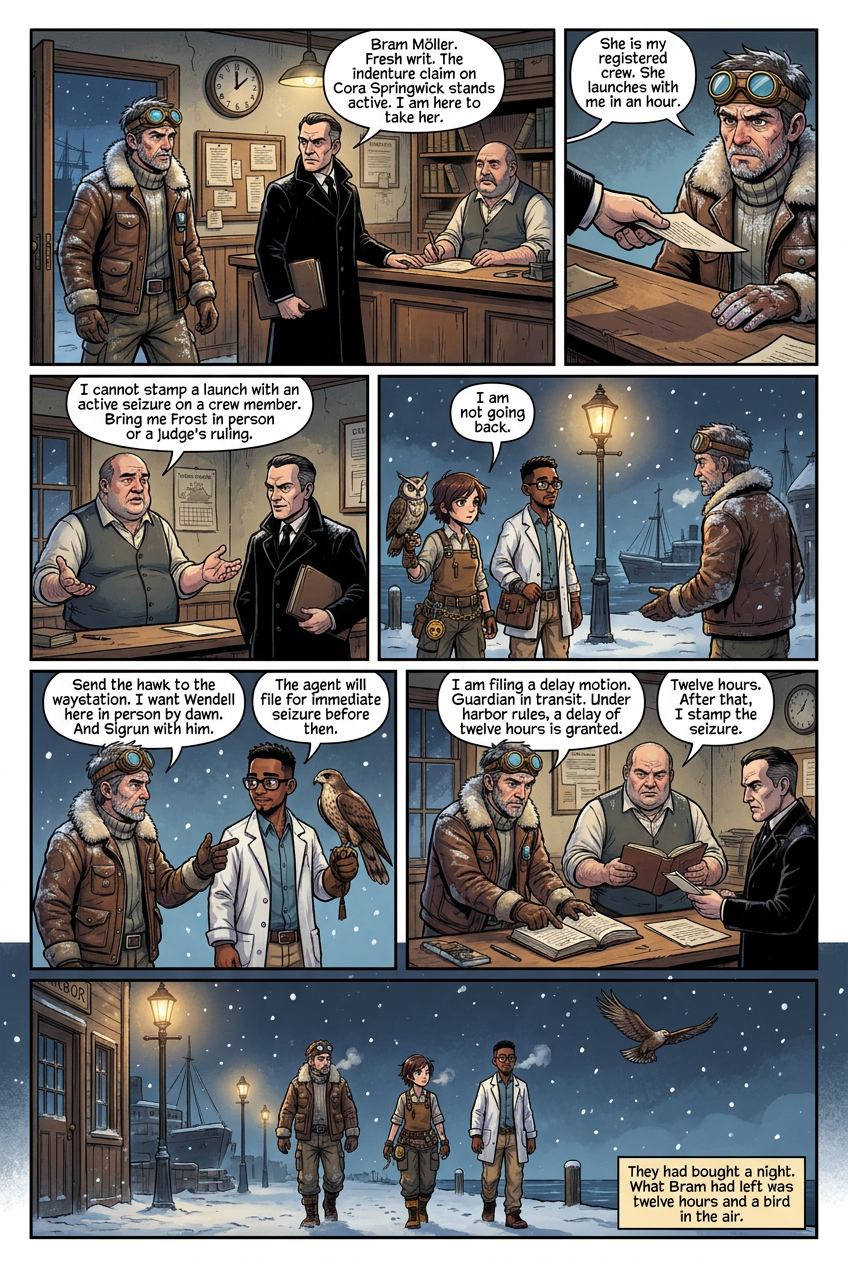
Bram tied off at the far pin and climbed down to the harbor office to file his second-place stamp. A man in a black coat stood at the counter with a folio under his arm. He turned when Bram stepped inside, and Bram knew him from the description Cora had given at the depot. The clockmaker's agent. He had ridden ahead on a faster ship and beaten them here by an hour. "Bram Möller," the agent said. He slid a paper across the counter. "Fresh writ. The second guardian signature on your witness log is challenged. Wendell Frost's mark is under review at the district court. Until the review clears, the indenture claim on Cora Springwick stands active. I am here to take her." Bram read the writ. The agent had filed a challenge that Wendell was not a lawful guardian, only a witness. If the challenge held, Cora's conversion to a court matter dissolved, and the clockmaker could seize her at any harbor before she launched again. "She is my registered crew," Bram said. "She launches with me in an hour." "Not with this writ on the counter." Bram looked at the harbormaster. The harbormaster spread his hands. "I cannot stamp a launch with an active seizure on a crew member. Bring me Frost in person or a judge's ruling. That is what the writ requires." Bram stepped outside. Omondi was already down from the bag with the tool roll. Cora stood behind him, small under the mast lamp, one hand on the owl in her belt. She had heard. "I am not going back," she said. "You are not," Bram said. He turned to Omondi. "Send the hawk to the waystation. I want Wendell here in person by dawn. And Sigrun with him to sign a physician's affidavit that he is fit to appear." "The waystation is six hours by tender," Omondi said. "The agent will file for immediate seizure before then." "Then we stall the counter." Bram went back inside. He set his journal on the wood and opened it to the witness page. "I am filing a delay motion. Guardian in transit. Physician escort confirmed. Under harbor rules, a delay of twelve hours is granted when a named guardian is en route with proof of travel." The harbormaster read the rule Bram had pointed to. He looked at the agent. The agent's jaw set. "Twelve hours," the harbormaster said. He stamped the delay. "After that, I stamp the seizure." Bram walked out with Cora at his elbow. The hawk was already lifting off Omondi's glove, climbing hard for the east. They had bought a night. They had lost the harbor stamp for the leg, and Kesh's pursuit vessel was already loading for the next launch. The winter circuit lead was gone. What Bram had left was twelve hours and a bird in the air.
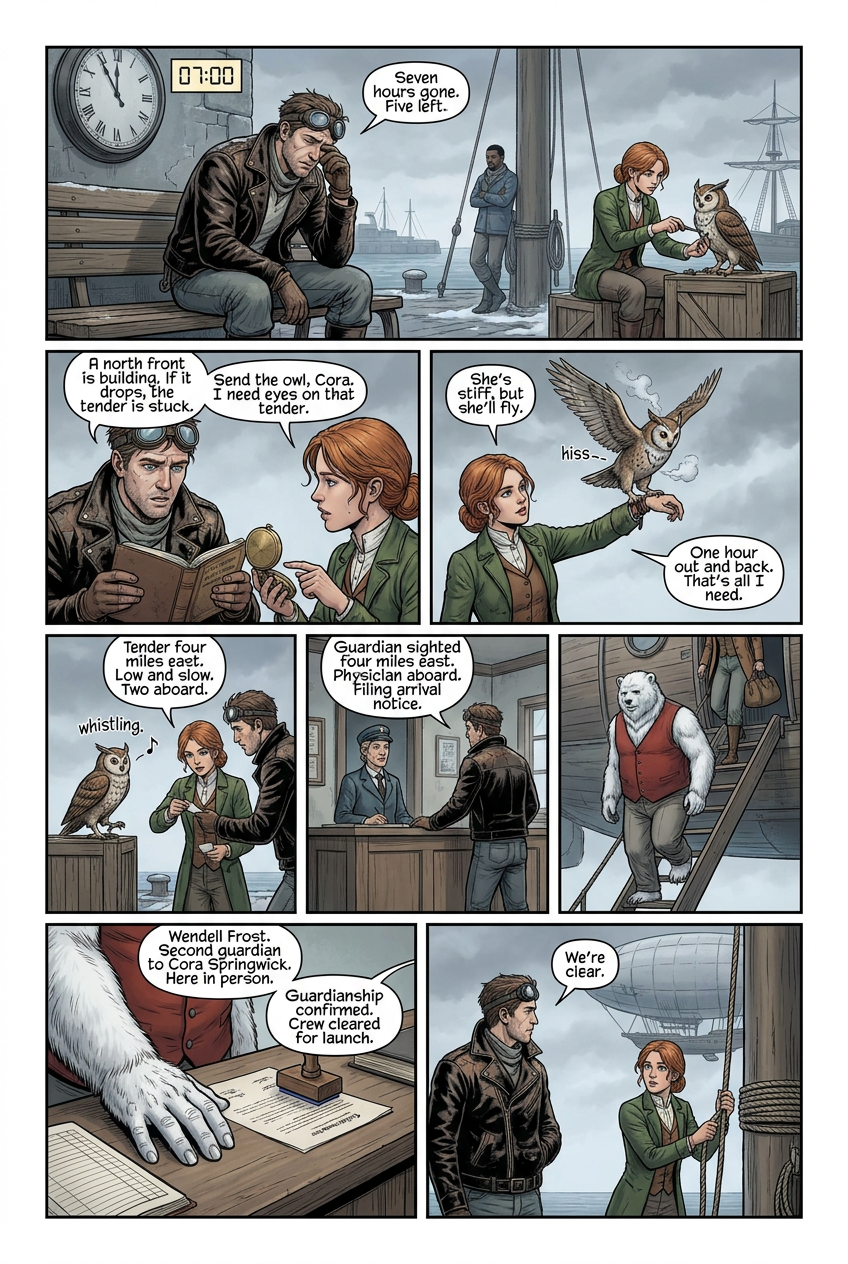
Bram slept two hours on the harbormaster's bench and woke to grey light on the window. The delay clock read seven hours gone. Five left. He went outside. Omondi stood at the mast with a mug in his hand, watching the eastern sky. Cora sat on a fuel crate beside him, working at her mechanical owl with a small screwdriver. She had not slept. "Any sign of the hawk?" Bram asked. "Nothing yet," Omondi said. "Six hours by tender is the fair-weather number. Wendell weighs what he weighs. Sigrun will not fly him fast." Bram opened his journal on the crate and checked the wind notes he had made at dusk. A north front had been building over the ridge. If it dropped early, the tender would be pinned at the waystation and Cora would be gone by noon. "Send the owl east," he said to Cora. "I want eyes on that tender. If she is behind schedule, I need to know before the agent does." Cora clicked the plate shut on the owl and set it on her wrist. "Wing joint is stiff. She can fly an hour, maybe two." "One hour east and back. That is all I need." The owl lifted with a hiss of steam and cleared the mast. Cora watched it climb until it was a speck against the cloud. Then she sat down and put her hands under her arms. "He will come," Bram said. "He is a mountain man in a wool coat," Cora said. "He does not fit in a tender." The owl came back inside the hour. It landed hard on the crate and vented a thin whistle. Cora pulled the reading slip from its leg. "Tender four miles east," she read. "Low and slow. Two aboard." Bram went inside to the counter. The agent was already there, folio open, watching the clock on the wall. The harbormaster looked up. "Guardian sighted four miles east," Bram said. "Physician aboard. I am filing arrival notice." The agent's mouth tightened. He said nothing. The tender came in forty minutes later. Wendell climbed down first, slow on the ladder, his wool coat pale against the dark wood. Sigrun followed with a leather bag. Wendell walked straight to the counter and set his broad hand on the witness log. "Wendell Frost," he said. "Second guardian to Cora Springwick. I am here in person, as the writ requires." Sigrun laid her affidavit beside his hand. The harbormaster read both, then the challenge writ, then the delay motion. He took his stamp and pressed it down twice. "Guardianship confirmed," he said. "Indenture claim returns to court matter. Crew member cleared for launch." The agent gathered his folio and left without a word. Bram stepped outside. Cora was already at the mast, untying the north line. The winter circuit lead was still gone, but Cora was crew, and the bag was cleared to fly.
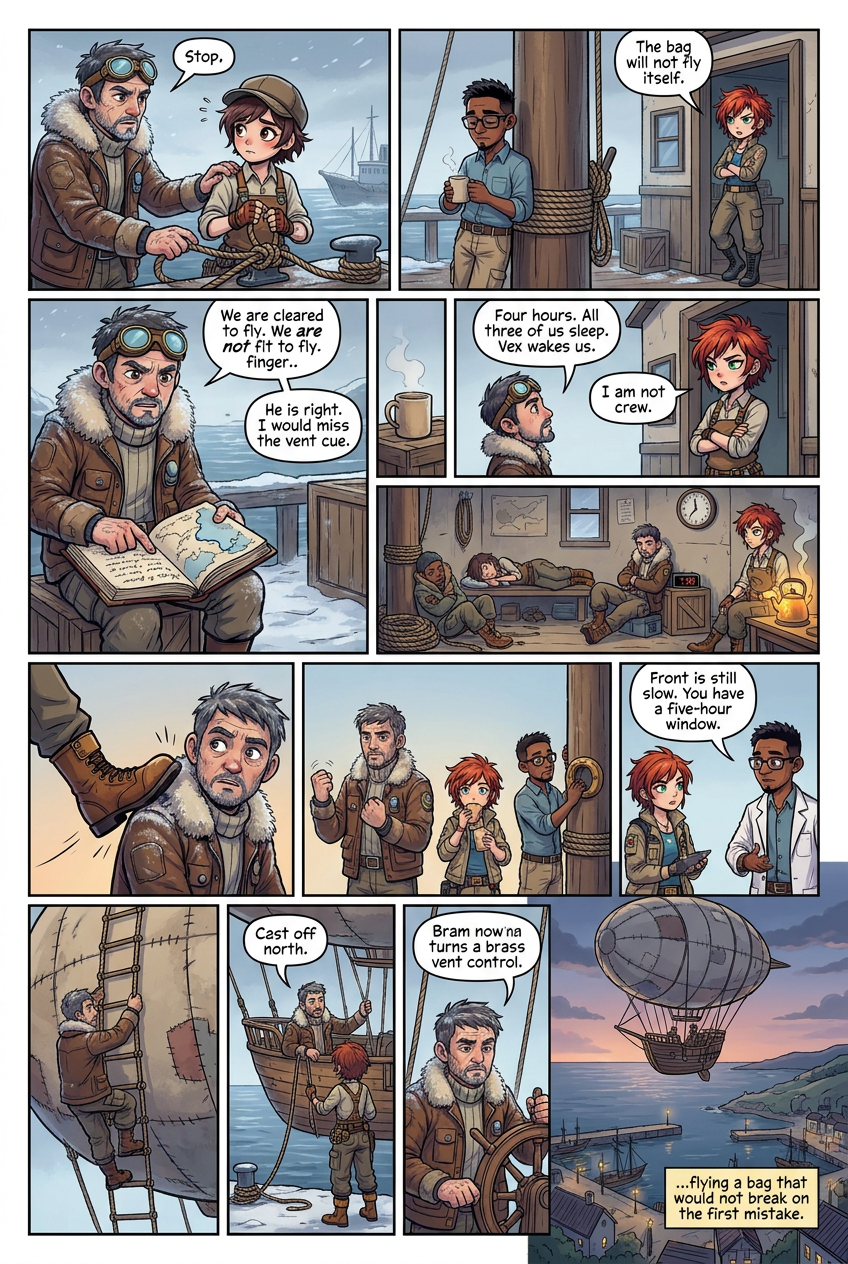
Cora had the north line half free when Bram stopped her. Her hands were red and shaking on the knot. Omondi stood at the mast with the mug still in his hand, blinking at the rope as if he had forgotten what it was for. Vex leaned in the harbor office doorway, arms crossed, watching them the way she watched a bad seam. "Stop," Bram said. "Tie it off." Cora looked up. "We are cleared. The stamp is dry." "We are cleared to fly. We are not fit to fly." He pointed at her hands. "You have not slept. Omondi is holding a cold mug. I signed a witness log an hour ago and cannot remember what I wrote." Omondi looked at the mug. He set it down on the crate. "He is right. I would miss the vent cue." Cora tied the line off. She did not argue. Vex pushed off the doorframe. "The bag will not fly itself, and Kesh is two harbors ahead. Every hour you sit here he stretches the lead." "He stretches it whether we launch tired or rested," Bram said. "Tired we wreck the bag on the first pass. Then he wins the circuit and we lose the aircraft." He opened his journal on the crate. The wind notes from dusk still held. North front building, but slow. He turned to the page where he had drawn the coastal lane out of this harbor. A blind turn at the second headland. A crosswind at the third. He tried to picture the second headland and saw only the harbormaster's stamp coming down twice. "Four hours," he said. "All three of us sleep. Vex wakes us." Vex uncrossed her arms. "I am not crew." "You are a clock with a voice. Wake us at eleven." She almost smiled. "Eleven." Cora went into the office and lay down on the bench Bram had used. Omondi folded himself onto a coil of rope beside the mast and was out inside a minute. Bram sat with his back to the fuel crate and closed his eyes. He heard Vex go inside and set a kettle on. He woke to her boot against his knee. The light had shifted. His hands felt like his own again. Cora came out of the office chewing bread, eyes clear. Omondi stood at the mast checking the vent ring, steady. "Front is still slow," Vex said. "You have a five-hour window." Bram climbed to the bag. He ran his hand along the crown seam and found it tight. He set his journal on the console and opened to the coastal lane. "Cast off north," he said. Cora freed the line clean. The bag lifted. Bram eased the vent a quarter turn and felt the answer come up through the wheel, exact. They cleared the mast with room to spare and turned west, four hours behind Kesh, and flying a bag that would not break on the first mistake.
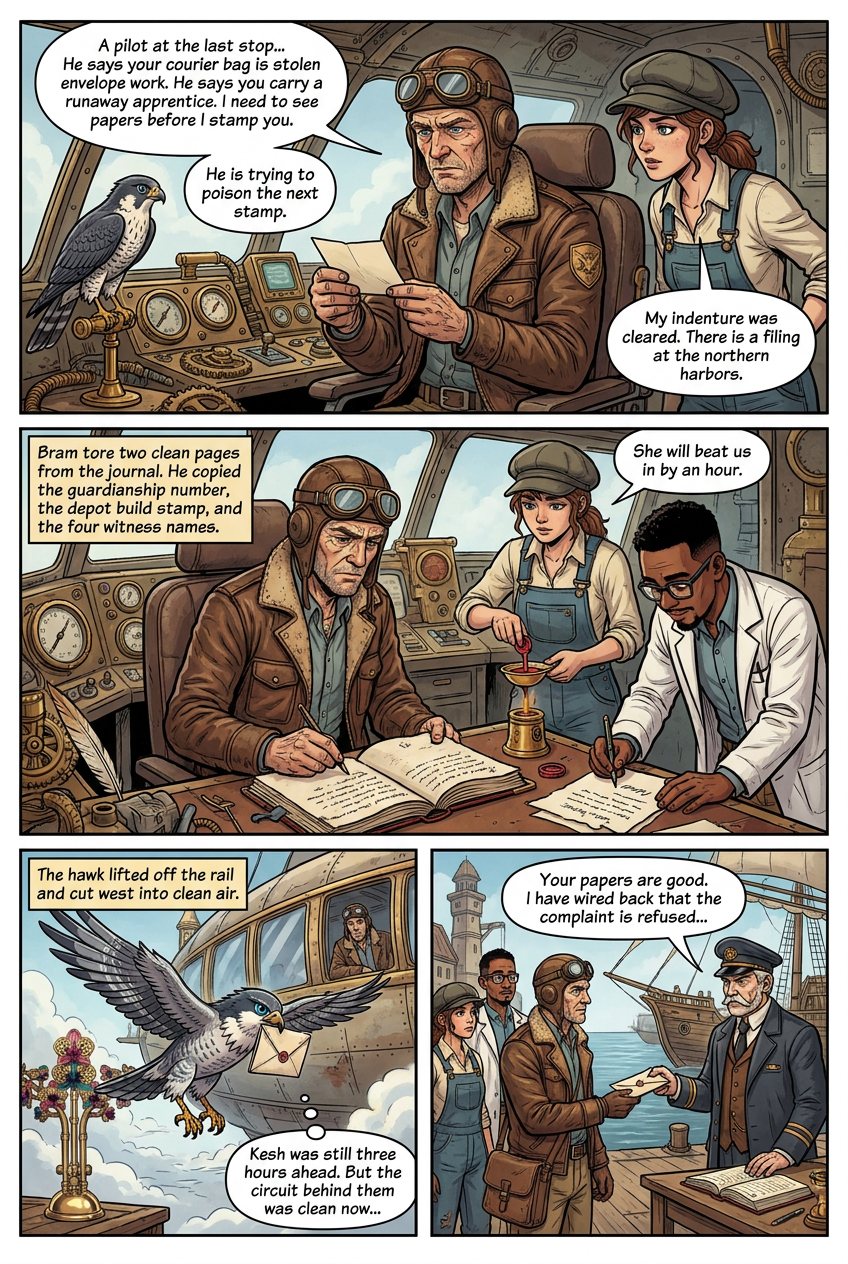
Two hours west of the harbor, Cora's hawk came back with a slip of paper in its beak. Bram unfolded it on the console. The note was short, block letters, from the next harbormaster: A pilot at your last stop wired ahead. He says your courier bag is stolen envelope work. He says you carry a runaway apprentice. I need to see papers before I stamp you. Bram set the note down. He knew the handwriting the pilot had used at the last harbor. He had seen the man leaning at the counter while Cora slept on the bench. A friend of Kesh's. He had recognized the salvaged bag by the crown seam and started wiring rumors up the circuit. "He is trying to poison the next stamp," Bram said. "If we land without proof, we sit for a day while they wire back. Kesh gets another harbor on us." Cora looked at the note. "My indenture was cleared. There is a filing at the northern harbors." "They have not read it yet. Rumor moves faster than paper." Bram opened his journal and turned to the depot pages. The witness log was folded inside, signed by Vex, Parisa, Wendell, and Sigrun. The build sheet for the bag was tucked behind it, Omondi's name inked at the crown. Omondi bent over the console. "We send the papers ahead. Not us. The papers." Bram tore two clean pages from the journal. He copied the guardianship number, the depot build stamp, and the four witness names. He signed the copy and pressed his ring seal into the wax stub Cora heated over the vent. Omondi added his own mark under the build line. Cora fitted the packet to the hawk's leg. "She will beat us in by an hour." "Tell the harbormaster to wire back to the last stop that our papers are on file. Tell him the pilot who wired him is Kesh's man. Name him." Bram wrote the name in block letters at the bottom of the sheet. He had gotten it from the harbor ledger before they launched. The hawk lifted off the rail and cut west into clean air. They flew two more hours before the harbor came up under the bow. Bram eased the orchid vent a quarter turn and set the bag down at the far pin. The harbormaster walked out with the packet already open in his hand. "Your papers are good," he said. "I have wired back that the complaint is refused and logged under the wiring pilot's name." He stamped the ledger. "He will answer for a false wire at his own harbor by morning." Bram signed under the stamp. Kesh was still three hours ahead. But the circuit behind them was clean now, and the next harbormaster down the line would read the same wire before the rumor reached him.
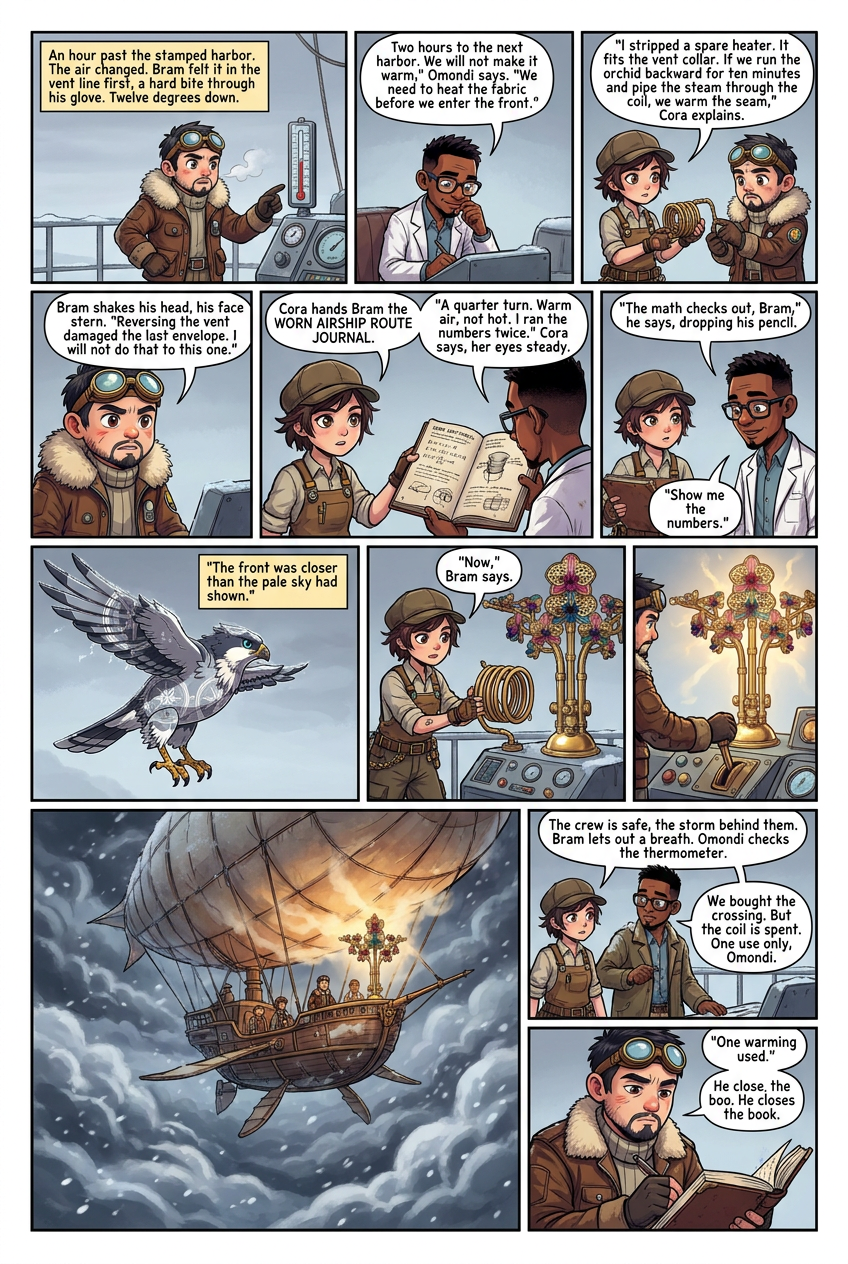
An hour past the stamped harbor, the air changed. Bram felt it in the vent line first, a hard bite through his glove. He checked the thermometer clipped to the console. The needle had dropped twelve degrees since the last reading. He looked west. The sky ahead was pale and flat, the kind of pale that meant a cold snap was settling in over the ridge. "We fly into that with the bag as it is, the patch panels crack," Bram said. The salvaged crown seam was the weakest part of the envelope. Cold that hard would stiffen the fabric, and the first hard gust would open it like paper. Omondi bent over the console, glasses fogging. He wiped them on his coat and squinted at the gauge. "Two hours to the next harbor. We will not make it warm." He fumbled the pencil and caught it against his knee. "We need to heat the fabric before we enter the front. Not during." Cora pulled her mechanical owl from its perch. She unclipped the wing panel and showed Bram the small brass coil inside. "I stripped a spare heater out of the depot kit. It fits the vent collar. If we run the orchid backward for ten minutes and pipe the steam through the coil, we warm the seam from the inside." Bram shook his head. "Reversing the vent damaged the last envelope. I will not do that to this one." "Not the full reverse," Cora said. "A quarter turn. Warm air, not hot. I ran the numbers twice." He looked at her. Fifteen years old, grease on her wrist, steady eyes. She had been right about the anchor pin. She had been right about the traverse. "Show me the numbers." She pulled his worn journal from the console pocket and opened it to a blank page. She drew the vent, the coil, the collar. She marked the pressure limit at the crown seam and stopped a full mark below it. Omondi checked the math, nodded once, and dropped the pencil again. Bram sent the compass hawk ahead to log the front's edge. It came back inside twenty minutes with a strip of sleet frozen to its leg feathers. The front was closer than the pale sky had shown. "Now," Bram said. Cora fitted the coil to the collar. Bram eased the orchid a quarter turn back. Warm steam moved through the fabric above them. He watched the crown seam. It stayed slack. It did not stiffen. After ten minutes he closed the vent and turned the orchid forward again. They crossed into the cold ten minutes later. The bag held. The seam held. Bram let out a breath he had been keeping in his teeth. Omondi checked the thermometer. "We bought the crossing. But the coil is spent. One use only." Bram wrote it in the journal. One warming used. The next front would find them cold.
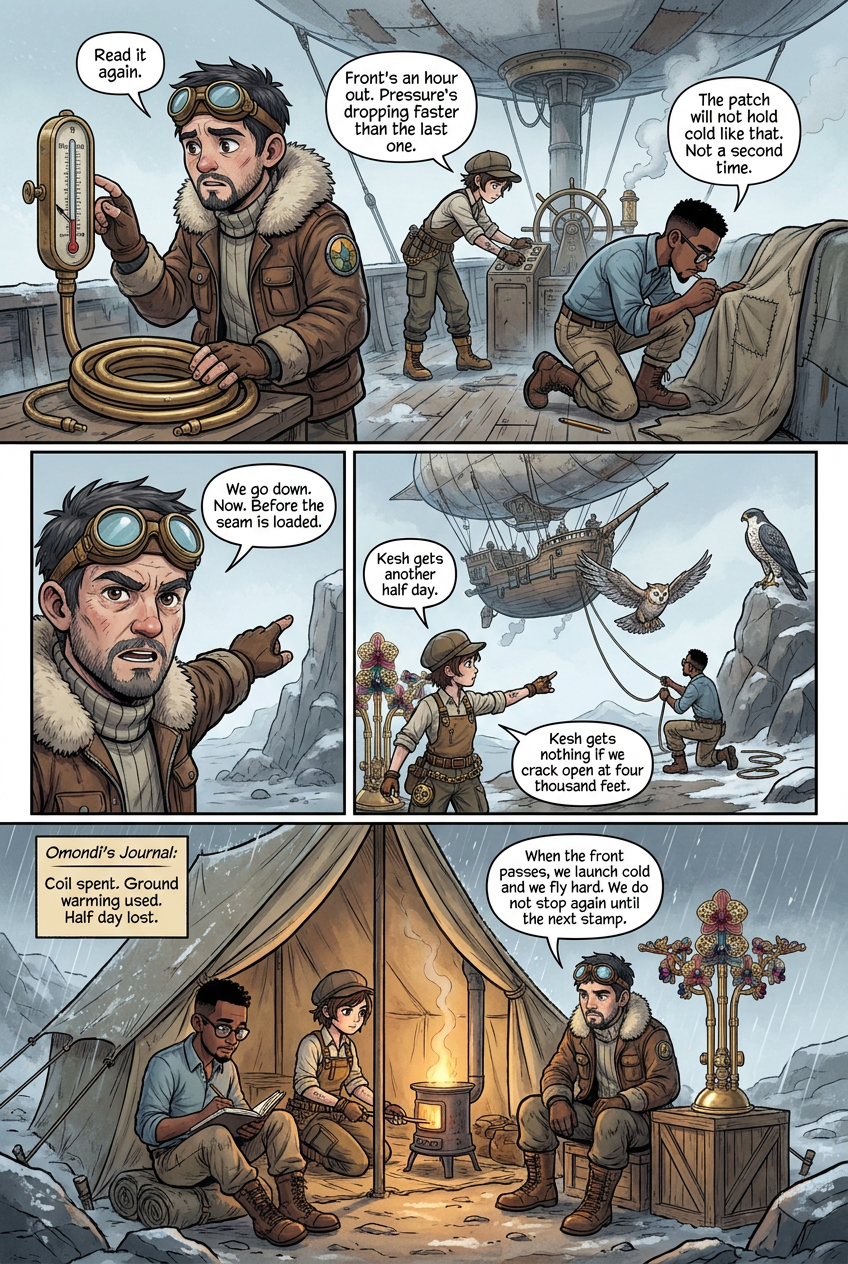
An hour past the warm crossing, the wind shifted. Bram felt the bag settle wrong under his hand. He tapped the thermometer. The needle was climbing down again, steady and mean. A second cold front was rolling in behind the first, and the coil that had saved them was empty brass now. "Read it again," Bram said. Cora leaned over the console. She wore her cap low against the wind, grease still on her wrist from the last repair. "Front's an hour out. Maybe less. Pressure's dropping faster than the last one." Omondi checked the crown seam through his glasses, nose almost against the fabric. His pencil slipped from his fingers and skittered across the deck. He caught it against his boot. "The patch will not hold cold like that. Not a second time. The panel is already tired." Bram looked west. The sky was the same pale flat. He had one warming used and none left. He would not reach the next harbor before the front closed on them. "We go down," Bram said. "Now. Before the seam is loaded." Omondi blinked. "Down where?" Bram pointed at a bare rock shoulder a mile ahead, two dark pins already driven into the stone from a prior route. He had marked them in his journal two winters back. "Moor there. Ride it out on the ground. Warm the bag with a fire under a canvas tent, not with the coil." Cora frowned. "Kesh gets another half day." "Kesh gets nothing if we crack open at four thousand feet." He brought the bag down in a long slow glide, hand on the orchid vent the whole way. The brass tubing hissed under his glove. Cora sent the owl ahead to test the wind at the shoulder. It came back with steady readings. Omondi rigged the mooring lines while Bram held the wheel one-handed. They caught both pins on the first pass. Bram vented the bag a quarter turn and it settled onto the rock. The front hit six minutes later. Sleet, then hard cold. The seam creaked once and held, slack and unloaded, the way Bram wanted it. Under the canvas tent they lit a small stove. Cora fed it slow. The fabric above them warmed by inches, not by steam. It would take four hours instead of ten minutes, but it would not spend anything they could not replace. Omondi wrote it in the journal for him. Coil spent. Ground warming used. Half day lost. Bram watched the sleet run off the canvas. Kesh was ahead again. The bag was whole. He would take whole over ahead every time now. "When the front passes," he said, "we launch cold and we fly hard. We do not stop again until the next stamp." Cora nodded and fed the stove.
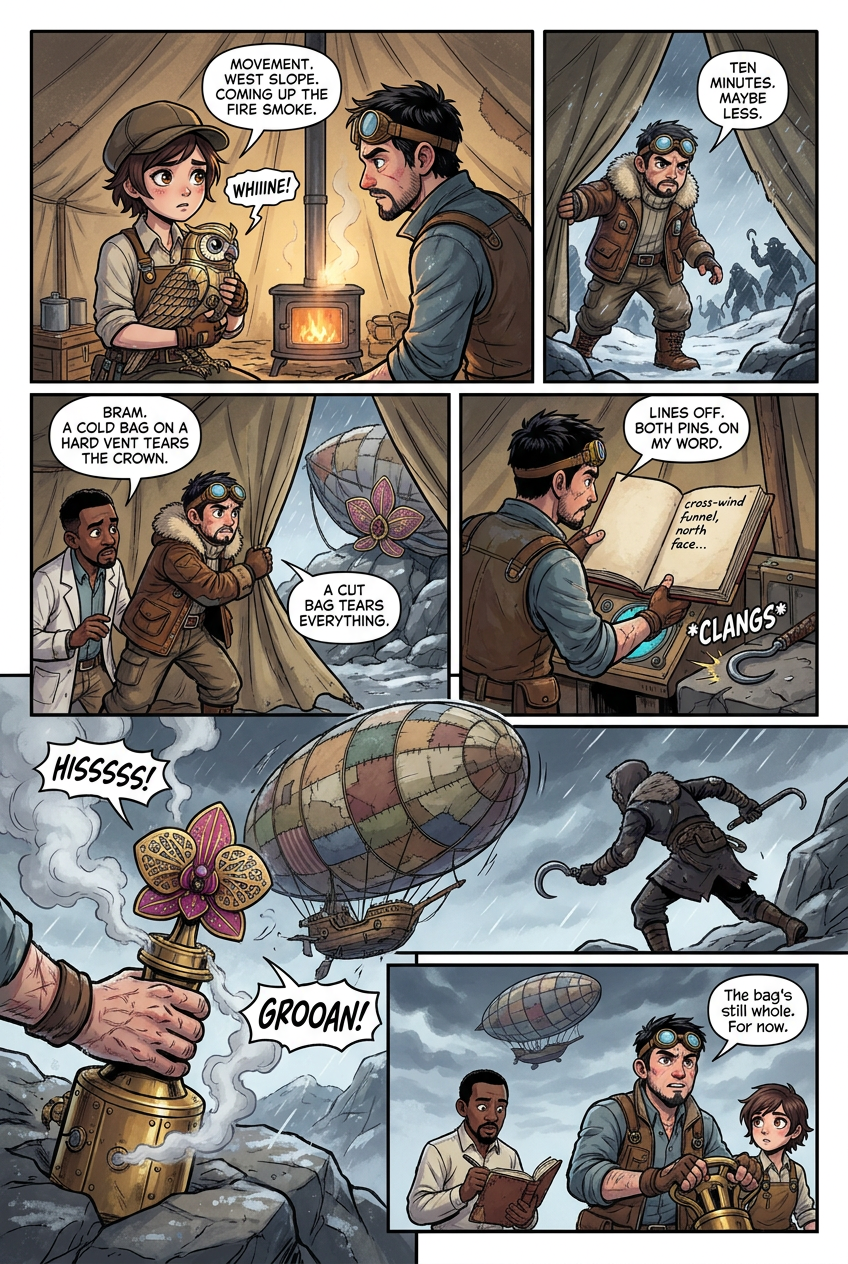
The stove had been burning under the canvas tent for two hours when Cora's owl came in fast and hard, gears whining. She caught it against her chest. Its beak scraped a warning tone Bram had heard only twice before. "Movement," Cora said. "West slope. Coming up the fire smoke." Bram stepped out from under the canvas. The sleet had thinned. Below the shoulder, dark shapes moved between the rocks. He counted four, maybe five. Scavengers. Drawn by the smoke like he had feared they might be. They carried hooks and cutters. If they reached the tent, they would slit the bag for the fabric and take the brass off the console before he could get a line in the air. Omondi came up beside him with his glasses fogged. "How long?" "Ten minutes. Maybe less." "The bag is still cold. It will not lift." "I know." Bram turned to Cora. "Kill the stove. Pull the canvas." She stared at him. "The seam—" "Pull it." She pulled it. The tent came down in a wet sag. The bag sat half-warmed on the rock, slack in its skin. Bram opened his journal on the console and found the page he wanted. Two winters back he had marked a second anchor pin on the ridge above them, and beside it a note in his own hand: cross-wind funnel, north face, lifts cold on a hard vent. "Cora. Send the owl up the ridge. I want the wind at that pin, now." She wound the owl and threw it. It climbed and vanished into the grey. Omondi caught his sleeve. "Bram. A cold bag on a hard vent tears the crown." "A cut bag tears everything." The owl came back inside a minute. Cora read the dial. "Steady lift. Nine knots up the funnel." "Lines off," Bram said. "Both pins. On my word." Omondi went to the south pin. Cora took the north. Below, a hook clanged against stone. Closer than he had counted. Bram set his hand on the orchid vent and cracked it hard, the way the note said. Steam hissed. The bag shuddered, half-full and stubborn. "Now." The lines slipped. The bag scraped sideways across the rock and caught the funnel. It rose, ugly and crooked, ten feet, twenty. A scavenger reached the tent site and swung a cutter at empty air. The crown seam groaned. Bram heard it clearly above the wind. He eased the vent a quarter back. The groan settled to a hum. They cleared the shoulder at thirty feet and the funnel carried them west into flat air. Omondi wrote it in the journal without being asked. Launched cold. Crown seam strained. Anchor site lost. Bram kept his hand on the vent. Kesh was still ahead. The bag was still whole, for now. He would fly it that way as long as it held.
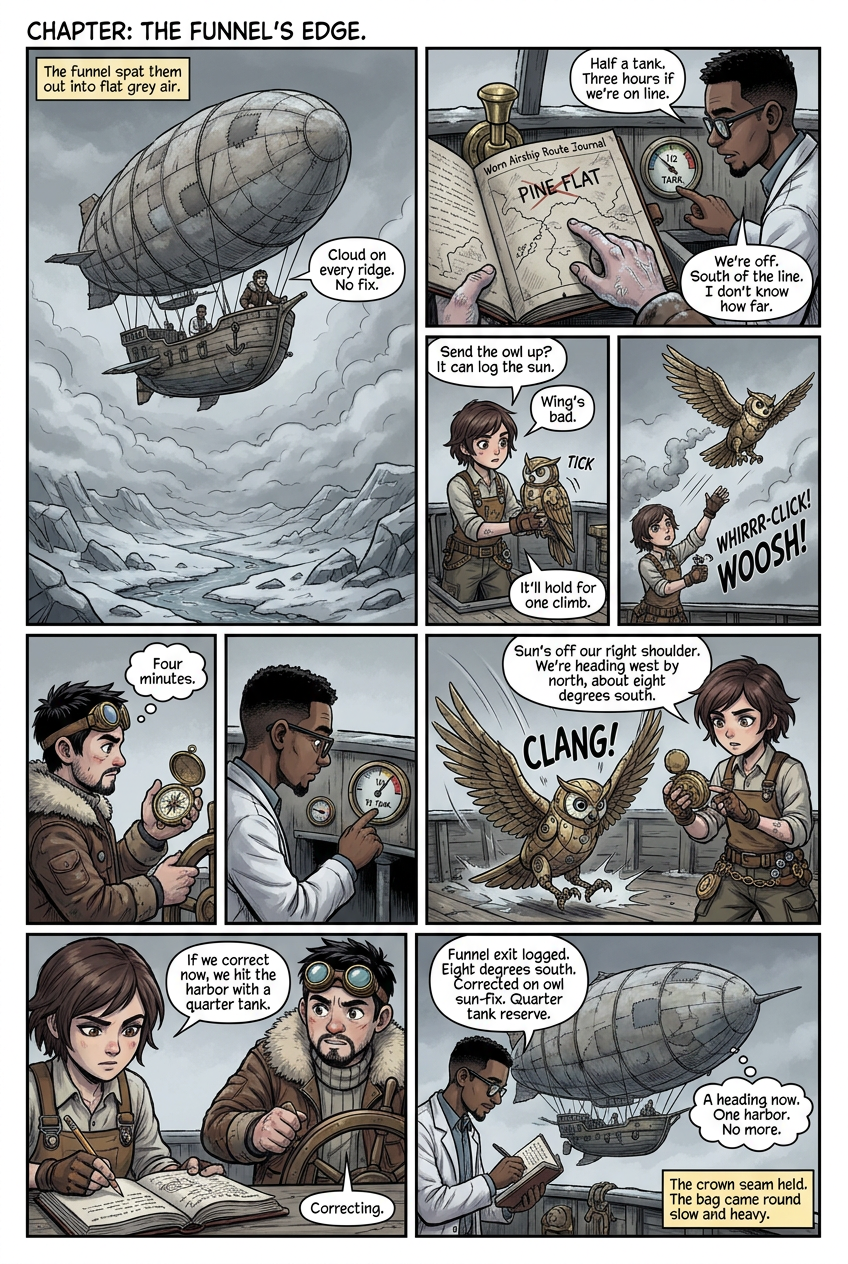
The funnel spat them out into flat grey air and the bag steadied at a hundred feet above a valley Bram did not recognize. He kept his hand on the vent and squinted west. Cloud sat low on every ridge. He had launched blind off a hard vent, and the funnel had thrown them clear, but he had no fix on which way it had thrown them. The compass in his pocket would give him north. It would not tell him where the harbor was from here. Omondi wiped his glasses on his coat and looked at the fuel gauge. "Half a tank. Maybe a little under." "How long to the next harbor if we're on line?" "Three hours. If we're off line, longer than we have." Bram opened the journal one-handed on the console. He turned to the winter pages until he found the funnel note. Under it, in smaller writing, he had marked the funnel's exit heading two winters back: bears west-southwest, drops you over the pine flat. He looked down. No pine flat. Only broken rock and a frozen stream running the wrong way. "We're off," he said. "South of the line. I don't know how far." Cora came up from the stern with her mechanical owl cradled against her chest. One of its wing joints ticked out of time. She had been the runaway apprentice in his loft a month ago. Now she read a pressure dial faster than Omondi. "Send the owl up?" she said. "It can log the sun through the cloud and give us a bearing off the pin note." "Wing's bad." "It'll hold for one climb." Bram nodded. She wound it and threw. The owl climbed hard, favoring one side, and vanished into the ceiling. They flew west by the compass while they waited. Omondi watched the gauge and said nothing. Bram counted minutes against the fuel. At four minutes the owl came back low and hit the rail hard. Cora caught it. She read the dial on its belly and then read it again. "Sun's off our right shoulder. We're heading west but we should be heading west by north. We're about eight degrees south of the funnel note." "Distance?" She worked it on her fingers against the journal's margin scale. "Twelve miles south of the pine flat. If we correct now, we hit the harbor with a quarter tank. If we don't correct in the next ten minutes, we don't hit it at all." Bram turned the wheel and brought the nose up-right until the compass card settled on the bearing she gave him. The bag came round slow and heavy. The crown seam held. Omondi wrote in the journal. Funnel exit logged. Eight degrees south. Corrected on owl sun-fix. Quarter tank reserve. Bram kept his hand on the vent. He had a heading now. He had fuel for one harbor and no more.
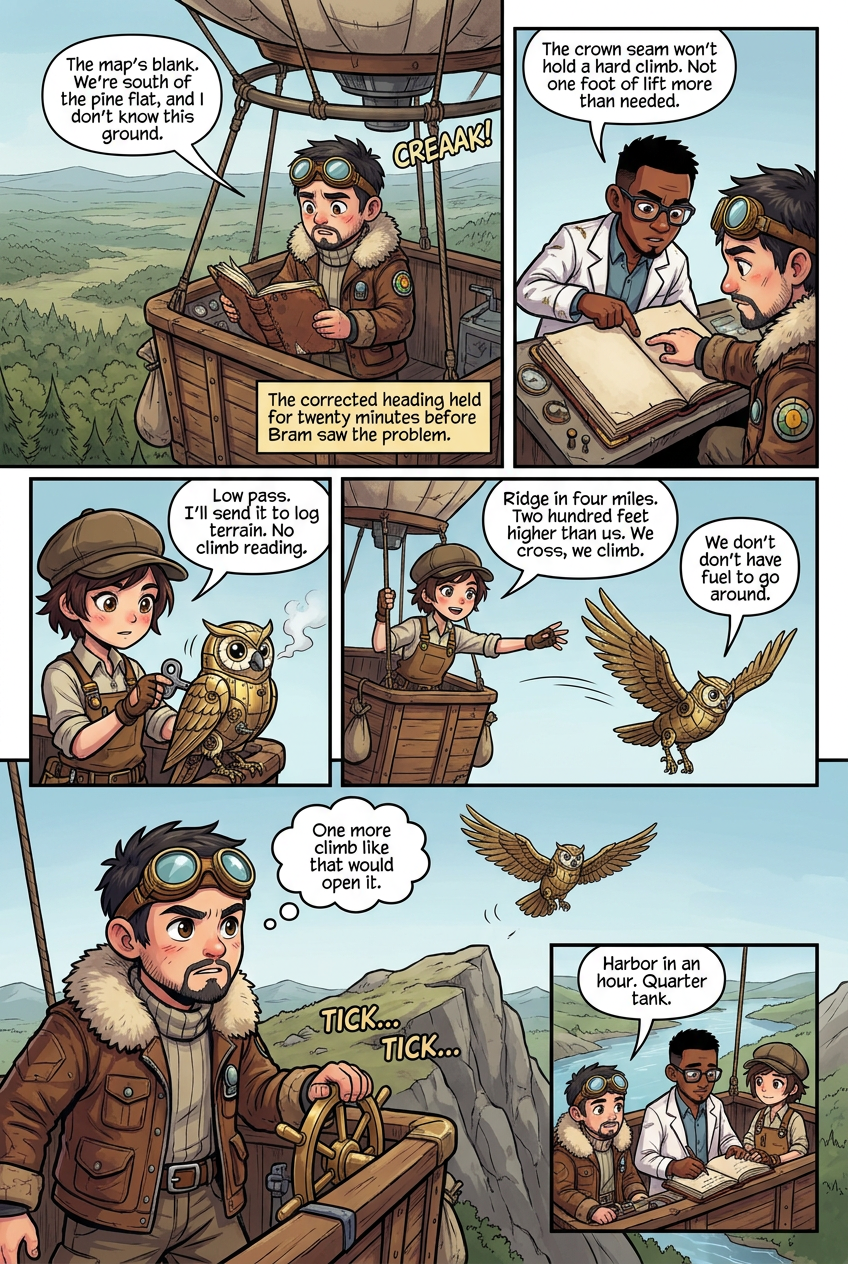
The corrected heading held for twenty minutes before Bram saw the problem. The land under them was wrong. His journal showed no pages for the country south of the pine flat, only a blank spread where a chart should have been. The bag was flying over ground he had never mapped, and above him the crown seam creaked every time a gust pushed the envelope up. He kept his hand loose on the vent. A hard climb here would open the seam. A hard drop would put them into rock he could not read. Omondi leaned over the console and tapped the empty page. He was the engineer who had built the bag with Bram in the depot loft; he knew the seam better than anyone. "We can't climb over anything. Not one foot of lift more than we need." "I know." "Then we need a ground read. What's ahead, how high." Cora was already winding the owl. Her hands moved fast even with the wing joint ticking. "Low pass," she said. "I'll send it low and slow. It logs terrain height off the pressure floor. No climb reading. Nothing that makes it work hard." "Wing won't like a long run." "It'll like a crash less." Bram nodded. She threw the owl underhand off the rail. It dropped, caught, and skimmed west a hundred feet below them. They flew straight and level. Bram held the vent by feel. Every rise in the ground pushed warm air up against the envelope and he felt the seam tick above his head. He kept the nose down a hair each time, trading altitude for the seam. The owl came back at eight minutes. It hit Cora's glove hard and one feather-plate popped loose. She read the belly dial with her thumb. "Ridge in four miles. Two hundred feet higher than us. After that it drops into a river cut. If we go around south, we add twenty minutes and lose the harbor on fuel. If we cross it, we climb two hundred feet." Omondi did not look up from the gauge. "We don't have twenty minutes of fuel to spare." Bram set his hand on the vent wheel. Two hundred feet was a slow climb if he took it long. He turned the nose five degrees off the ridge line and began to feed the vent closed a quarter turn at a time. The bag rose. The seam ticked once, twice, then held. He watched the ridge come up under them and slide past below the basket by less than a spear length. The ground fell away into the river cut. Cora let out a breath. Omondi wrote in the journal. "Harbor in an hour," Bram said. "Quarter tank." The seam had held. But he felt the give in it now under his hand, softer than yesterday. One more climb like that would open it. He would reach the harbor. He would not leave it in this bag without a repair.
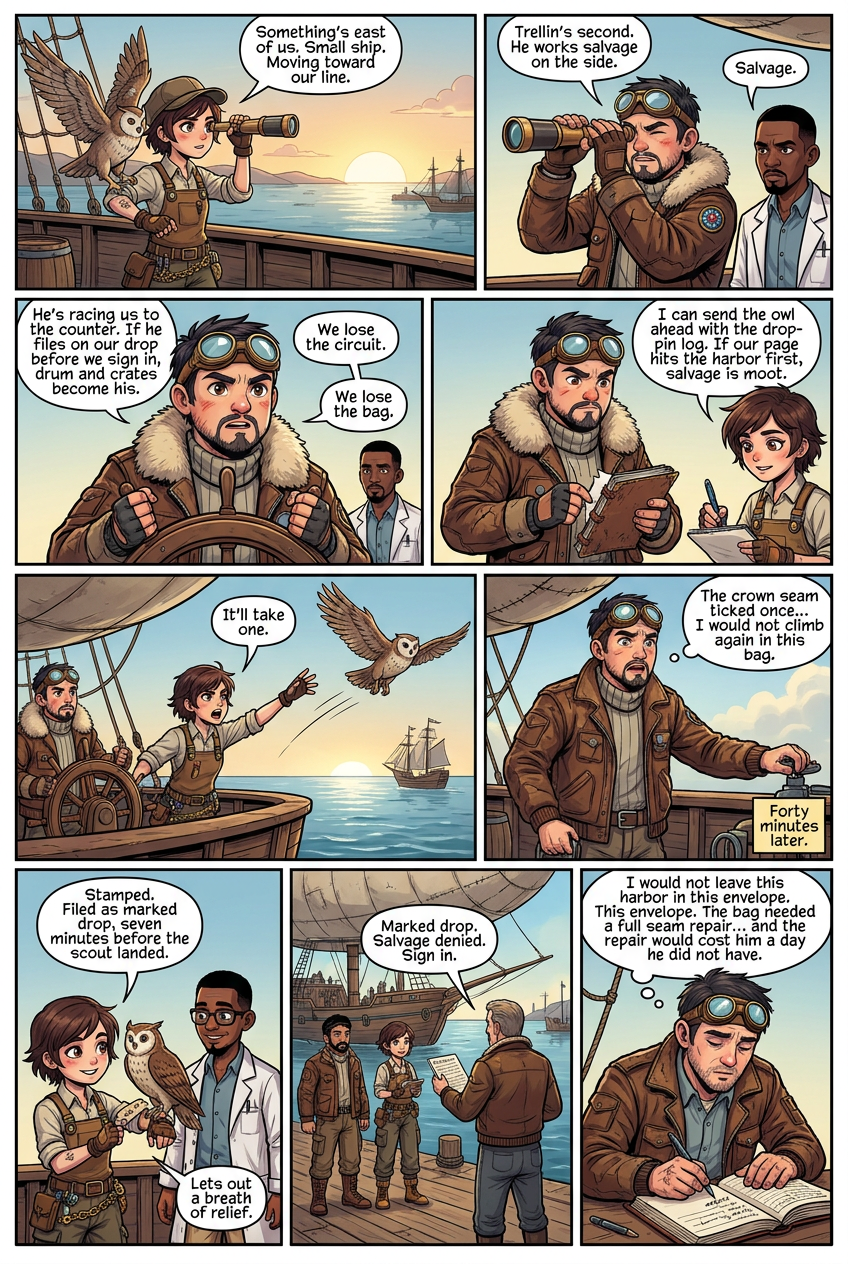
The harbor sat an hour off when Cora spotted the scout. She had the owl out for a routine wind check and it came back fast, wing joint ticking hard. She read the belly dial, then looked up. "Something's east of us. Small ship. Moving toward our line." Bram took the glass and found it. A stripped courier scout, single tank, running low over the ridge shoulder. Not Kesh. The paint was wrong. "Whose colors?" Omondi asked. "Trellin's second." Bram lowered the glass. "He works salvage on the side." Omondi's face changed. "Salvage." Bram had dropped three crates two harbors back to clear a mast. Sand crates and a fuel drum. He had marked the drop pins on a page of his journal and moved on. A courier bag lying off-course in unmapped country looked like a down. Salvage rights went to whoever filed first at the next harbor. "He's racing us to the counter," Bram said. "If he files on our drop before we sign in, the drum and crates become his. Any bag matching the drop line becomes contested. He can hold our stamp for a week while it clears." "We lose the circuit," Omondi said. "We lose the bag." Cora was already writing. "I can send the owl ahead with the drop-pin log. If our page hits the harbor first, salvage is moot. It's not a down. It's a marked drop." "Wing won't take another long run." "It'll take one." Bram tore the drop page from his journal. He signed the margin, stamped it with the depot seal he kept in his jacket pocket, and folded it into the owl's carry clip. The leather cracked where he bent it. He had folded that jacket around too many papers this month. Cora threw the owl underhand. It dropped, caught wind, and cut east and low toward the harbor line. The scout was closer to the counter by miles. The owl was faster than the scout by a hair, if the wing held. They flew straight. Bram kept the vent by feel. The crown seam ticked once when a warm updraft lifted them and he fed the vent open a quarter turn to lose the lift. He would not climb again in this bag. Forty minutes on, the owl came back empty-clipped. Cora read the return tag with her thumb. "Stamped. Filed as marked drop, seven minutes before the scout landed." Omondi let out a breath. Bram did not. They moored at the far pin. The harbormaster met them on the boards with the drop page in his hand and the scout pilot behind him, still arguing. The harbormaster lifted the page. "Marked drop. Salvage denied. Sign in." Bram signed. His hand shook on the down-stroke. The seam above the bag ticked once in the wind and went quiet. He would not leave this harbor in this envelope. The bag needed a full seam repair before another climb, and the repair would cost him a day he did not have.
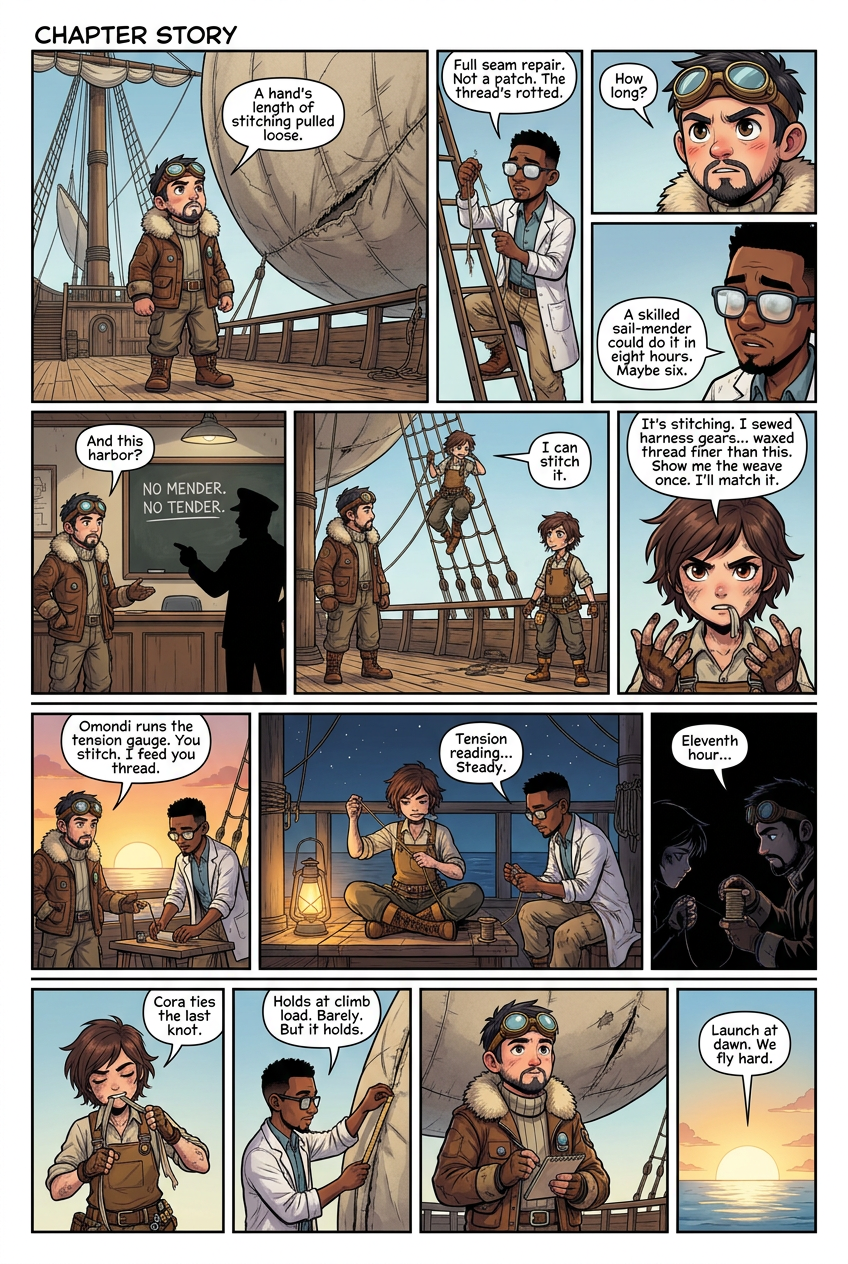
Bram stood on the boards under the mast and looked up at the crown seam. A hand's length of stitching had pulled loose along the top curve. The bag sagged where the tension had gone out of it. Every hour he stood here, Kesh moved another mile west toward the next stamp. Omondi climbed down from the inspection ladder with his glasses fogged and a strip of frayed thread pinched between two fingers. He nearly missed the last rung and caught himself on the mast rope. "Full seam repair," he said. "Not a patch. The thread's rotted where the heat ran through it back at the cold front." "How long?" "A skilled sail-mender could do it in eight hours. Maybe six." "And this harbor?" Omondi shook his head. "The harbormaster says their mender broke his hand last week. The next one is two harbors east." Bram walked to the office and asked anyway. The harbormaster shrugged and pointed at a chalkboard. No mender listed. No tender available to fetch one. Kesh had signed in twelve hours ahead and left at first light. Cora was already up in the rigging when Bram came back. She had a strip of the loose seam in her teeth and a lash knife in her hand. She dropped down and landed hard on the boards. "I can stitch it," she said. "It's not clockwork." "It's stitching. I sewed harness gears back at the shop with waxed thread finer than this." She held up the strip. "Show me the weave once. I'll match it." Bram looked at her. Sixteen years old, hat pushed back, hands already black with pitch from the mast line. She had climbed a sleet-covered face for him. She had run the owl through three storms. "Omondi runs the tension gauge," Bram said. "You stitch. I feed you thread." They worked through the afternoon and into the dark. Omondi rigged a bench lamp and burned his sleeve twice adjusting the wick. Cora sat cross-legged on the crown platform and pulled each stitch through with her whole shoulder. Bram fed her waxed cord from a spool at her knee and read the tension off Omondi's gauge every fourth pass. At the eleventh hour she tied off the last knot and cut the tail with her teeth. Omondi ran the gauge along the full length and read the numbers twice. "Holds at climb load," he said. "Barely. But it holds." Bram signed the repair log himself and stamped it. He had lost the day. Kesh was a full harbor ahead now, maybe more, with clear weather on the western circuit. He rolled the log and put it in his jacket pocket. The seam above him ticked once in the mast wind and went quiet. "Launch at dawn," he said. "We fly hard."
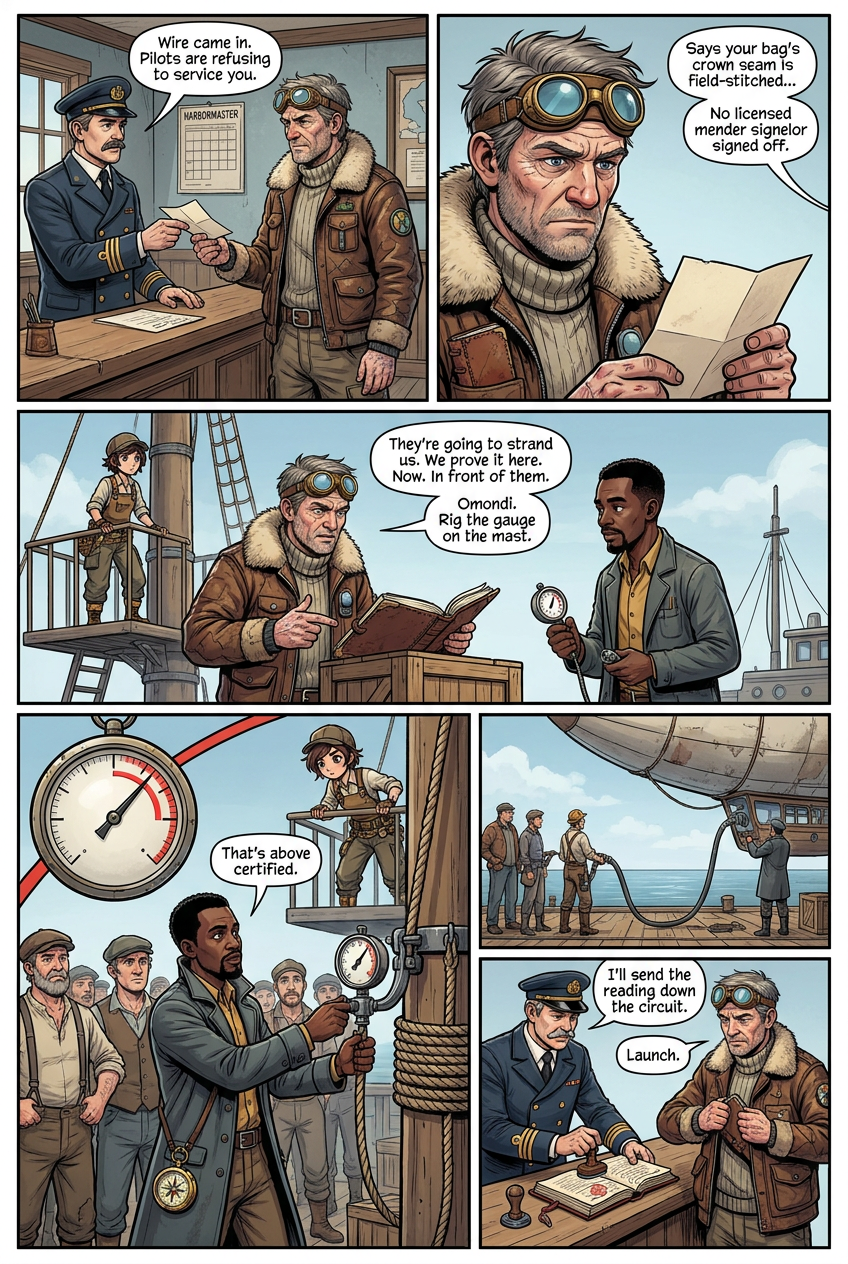
Bram woke before dawn to find the harbor already talking. Two dock hands went quiet when he passed the coal shed. A tender crew turned their backs at the fuel pump. By the time he reached the office, the harbormaster had a folded note waiting on the counter. "Wire came in at four," the harbormaster said. "From the west harbor. Says your bag's crown seam is field-stitched by an apprentice. Says no licensed mender signed off. Pilots on the circuit are refusing to service you until it's inspected." Bram read the wire twice. Kesh's name wasn't on it, but the phrasing was his. Reckless. Unfit. A runaway girl's stitching. If the next three harbors turned him away, the crew would sit on the ground until the bid clock ran out. "Who signs off an inspection here?" "No one. Nearest licensed mender is two harbors east. You'd have to fly to him. And no one will sell you fuel to fly." Bram walked back to the mast. Cora was on the crown platform already, checking her own stitches with a bent finger. Omondi stood at the tension gauge with his coat buttoned wrong. "They're going to strand us," Bram said. He pulled the journal from his jacket and set it flat on a crate. "So we prove it here. Now. In front of them." He turned to the page where he'd logged the repair, then to the pages behind it: Vex's build stamp, Omondi's tension readings from the depot loft, the two test flights with sand crates. He tore clean copies and stamped each with his depot seal. "Omondi. Rig the gauge on the mast. Full climb load, cold. In the open where they can watch." Omondi blinked once, then moved. He clamped the gauge to the crown line and cranked the load bar up notch by notch. A small crowd gathered at the rail. The harbormaster came out with his hands in his pockets. Cora climbed down and stood beside Bram. She didn't speak. She watched the seam. The gauge needle climbed past cruise, past climb, past the red line Omondi had painted at the depot. The seam ticked once. Held. Omondi read the number aloud. Twice. The harbormaster wrote it in his own log and stamped it. "That's above certified," the harbormaster said. He walked to the wire office and sent the reading down the circuit himself. By noon the fuel line was open. Two pilots who'd turned their backs that morning helped load the tank. The rumor didn't die everywhere, Bram knew. It would follow them west. But the harbors ahead now had a stamped number to weigh against Kesh's wire. Bram closed the journal and put it in his jacket. Kesh was still a full harbor ahead. "Launch," he said.
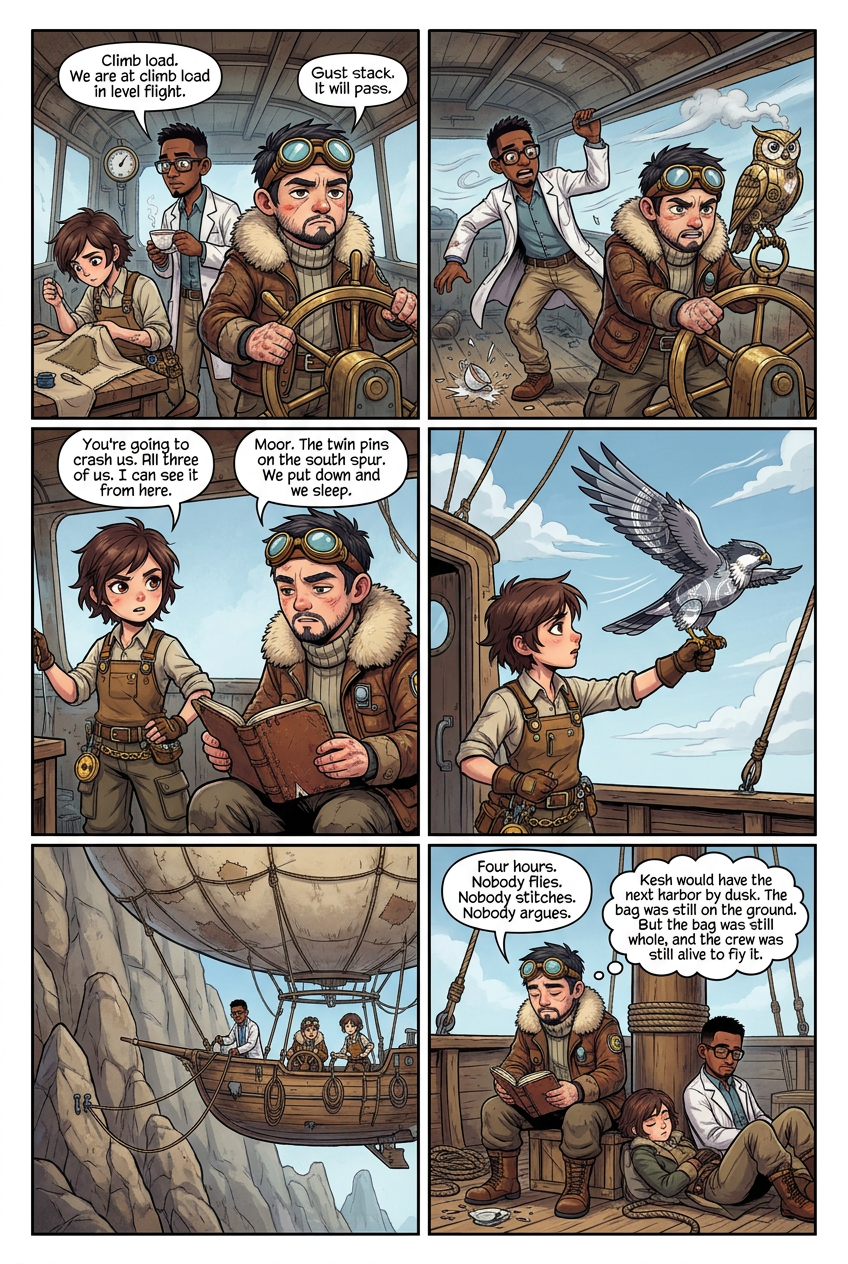
The bag climbed off the harbor mast with the fuel gauge at half and the crew running on the fumes of one bad night. Bram had slept two hours in the office chair. Cora had slept less, hunched over her seam with a needle until dawn. Omondi had not slept at all. He stood at the tension gauge now with a cup of black tea in his hand and a small tremor in his wrist. Bram watched the tremor and did not say anything about it. An hour west, the wind turned. Cross gusts hit the bag from the north face and pushed them off line. Bram corrected with the wheel and felt the vent handle slip a half turn in his cramping fingers. The bag yawed. The crown seam creaked once above them. "Hold the ring," Bram said. Cora set the mechanical owl on the brass ring and locked its claws. The owl gripped. Steam pressure steadied. But the wheel still fought Bram's hand and his eyes had started to blur at the edges. Omondi read the gauge and read it again. "Climb load. We are at climb load in level flight." "Gust stack," Bram said. "It will pass." It did not pass. The next gust hit and Omondi's tea cup jumped off the crate and shattered. He grabbed for the tension bar and missed it and grabbed it on the second try. Cora saw the miss. She looked at Bram. "You're going to crash us," she said. Not loud. Flat. "All three of us. I can see it from here." Bram opened his mouth to argue and could not find the words fast enough. That was the answer. He leaned on the wheel and scanned the ridge line for the marks in his journal. Two miles ahead, a rock spur with twin pins. He had used it once, years back, to wait out a front. "Moor," he said. "The twin pins on the south spur. We put down and we sleep." Omondi released the tension bar and his shoulders dropped an inch. Cora sent the compass hawk ahead to check the wind at the spur. It came back inside ten minutes with steady readings and a clear approach. Bram brought the bag in slow. Omondi ran the north line to the upper pin. Cora ran the south. Both pins took. The bag settled against the rock and the crown seam stopped creaking for the first time all morning. Bram sat down on the crate where the tea cup had broken. He looked at Cora and at Omondi and at the empty sky ahead where Kesh was pulling further away by the hour. "Four hours," he said. "Nobody flies. Nobody stitches. Nobody argues." Cora nodded and lay down under the mast with her coat over her face. Omondi was already asleep against the anchor rope. Bram closed the journal on his knee and let his eyes shut. Kesh would have the next harbor by dusk. The bag was still on the ground. But the bag was still whole, and the crew was still alive to fly it.
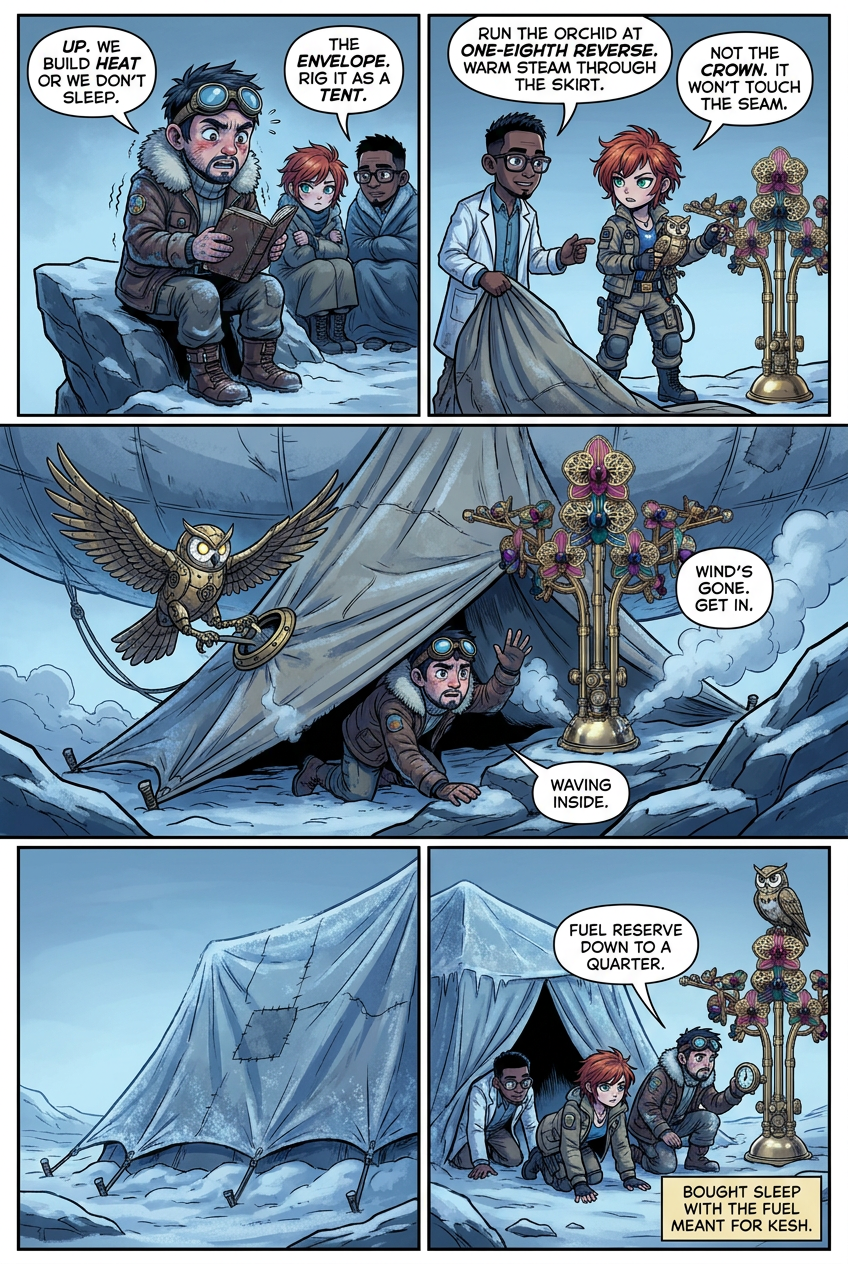
Bram woke after twenty minutes because the cold had reached his bones. The spur was bare rock. No overhang, no windbreak, no cut for a fire. The wind came straight off the ridge and pulled heat out of his coat faster than his body could make it. Cora was shivering under her coat with her knees pulled up. Omondi's lips had gone gray. Four hours here and the crew would wake worse than they had lain down. Bram opened the worn journal on his knee and thumbed through the pin notes. He had marked this spur years back for a summer wait, not a winter one. There was no shelter listed because there had never been one. He closed the book. The problem was not the plan. The problem was the ground. "Up," he said. "We build heat or we don't sleep." Omondi sat up slow. His hands were shaking. "The envelope," he said. "We rig the envelope as a tent. Vent a quarter into the fabric and lay under it." "The crown seam won't take pressure," Bram said. "Not pressure. Warm gas, low fill. We drop the bag half onto the rock and crawl under the skirt." Omondi pushed his glasses up with a knuckle. "The fabric holds body heat if we cut the wind." Cora was already on her feet. She pulled the mechanical owl from its perch and set it on the vent ring. "I can run the orchid at one-eighth reverse," she said. "Warm steam through the skirt hem. Not the crown. It won't touch the seam." Bram looked at her. She had done the math already, in her head, in the cold. He nodded. They worked fast. Omondi slacked the north line and let the bag settle sideways against the rock. Cora reversed the orchid a hair and steam breathed into the lower fabric. The skirt puffed out along the ground and made a low tent against the spur. The owl gripped the ring and held the pressure steady with its brass claws. Bram crawled under the skirt first to check the heat. The air inside was still cold but the wind was gone. That was enough. He dragged in the tea crate for a floor and waved the others in. They lay down three in a row under the warm fabric. Omondi's shivering slowed within minutes. Cora fell asleep with one hand on the owl's back. Bram stayed awake long enough to watch the gauge. The orchid held. The seam held. The skirt kept the wind off. He slept. Four hours later the owl clicked its wake tone and the crew crawled out into a still, cold dawn. Omondi's hands were steady. Cora's color was back. The bag had held its shape. But the orchid's fuel reserve was down to a quarter. They had bought sleep with the fuel that was meant to catch Kesh.
Play your story to life
Storycraft is a mobile game where you create AI characters, craft items and locations to build their world, then discover what direction your story takes. Download the iOS game for free today!
Download for free