

Bram Wolfe's Arc
5 Chapters
Bram Wolfe's dream is igniting a citywide uprising that topples the regime's ration control in Zeroline..

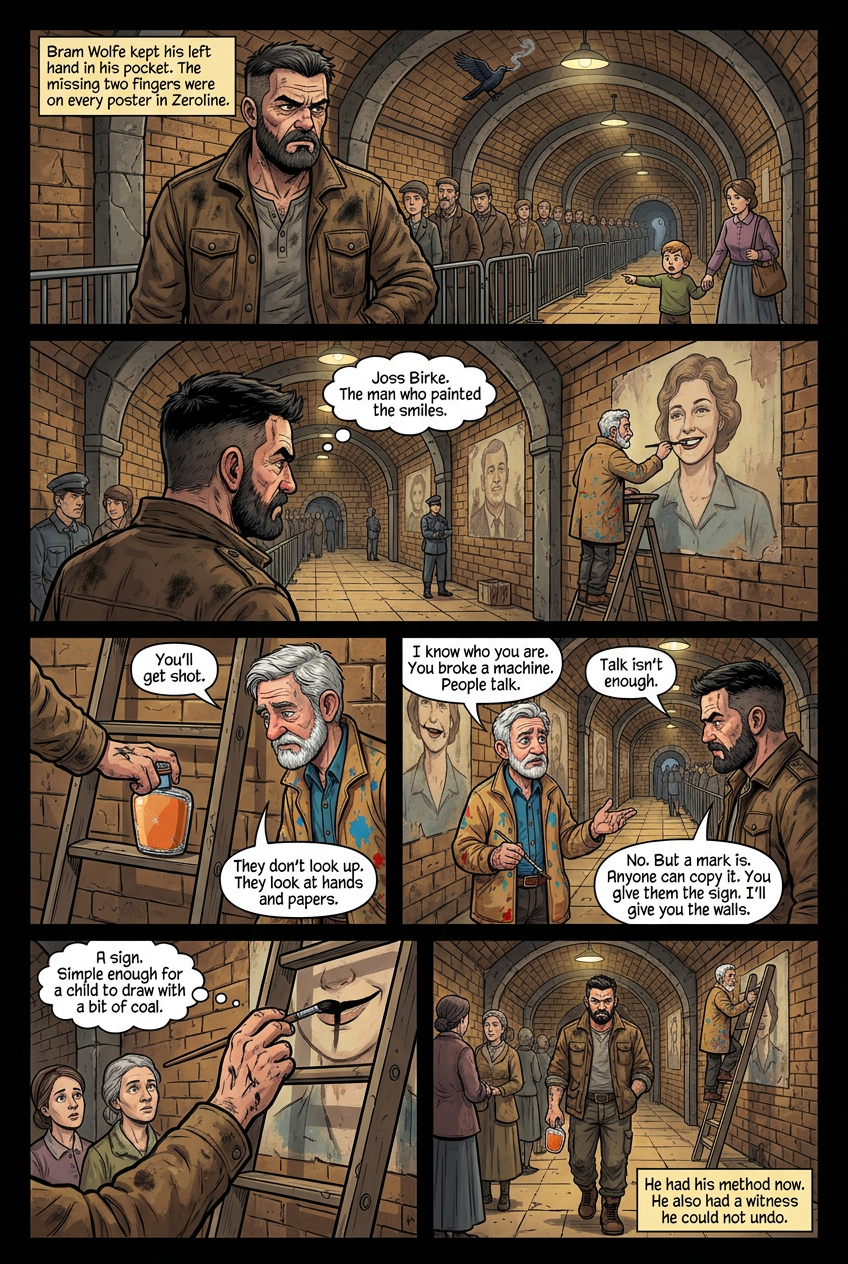
Bram Wolfe kept his left hand in his pocket because the missing two fingers were on every poster in Zeroline. He stood in the ration line under the low brick arches, third from the front, and watched a boy point at him and then look away fast. Two weeks ago Bram had smashed a ration machine with a pipe wrench. The regime had printed his face. Now strangers pressed bread into his coat and called him a hero, and any one of them could sell him for a month of coupons. He wanted the whole city to riot with him. He had no way to say so without hanging himself. The line moved. Bram took his tin, half the weight it should have been, and stepped aside. That was when he saw the painter working the far wall. Joss Birke was the man who had covered these tunnels in smiling farmers and grateful mothers years ago. Bram had passed those murals a thousand times. Tonight Joss stood on a short ladder with a narrow brush, and he was painting a thin black line straight through a painted woman's smile. He worked quickly, glancing at the guards, then adding another stroke to the next face, and the next. Bram walked over slow. He set his flask on the ladder's bottom rung so Joss would have to look down. "You'll get shot," Bram said. "They don't look up," Joss said. His voice was soft, almost apologetic. He did not stop painting. "They look at hands and papers." "How long have you been doing this?" "Six months. Nobody's noticed." Joss finally glanced down. His eyes caught on Bram's pocketed hand, then on his face. He didn't flinch. He dipped the brush again. "I know who you are." Bram's stomach dropped. He measured the distance to the stairs. "Easy," Joss said. "If I wanted the coupons I'd have taken them." He climbed down one rung. "You broke a machine. People talk about it in the queue. Quiet. But they talk." "Talk isn't enough." "No." Joss wiped the brush on his coat, adding another smear to a hundred others. "But a mark is. One line, one wall. Anyone can copy it. Nobody has to say your name." Bram looked down the tunnel. Six murals. Six black strikes through six painted mouths. Simple enough for a child to draw with a bit of coal. "A sign," Bram said. "A sign," Joss said. "You give them the sign. I'll give you the walls." Bram took the brush from Joss's hand. He climbed the ladder. He drew one black line across the next smiling face, slow, so his shortened hand would remember the shape. When he climbed down, two women in the queue were watching. Neither spoke. One of them nodded once, and turned back to the line. Bram gave the brush back. He had his method now. He also had a witness he could not undo.
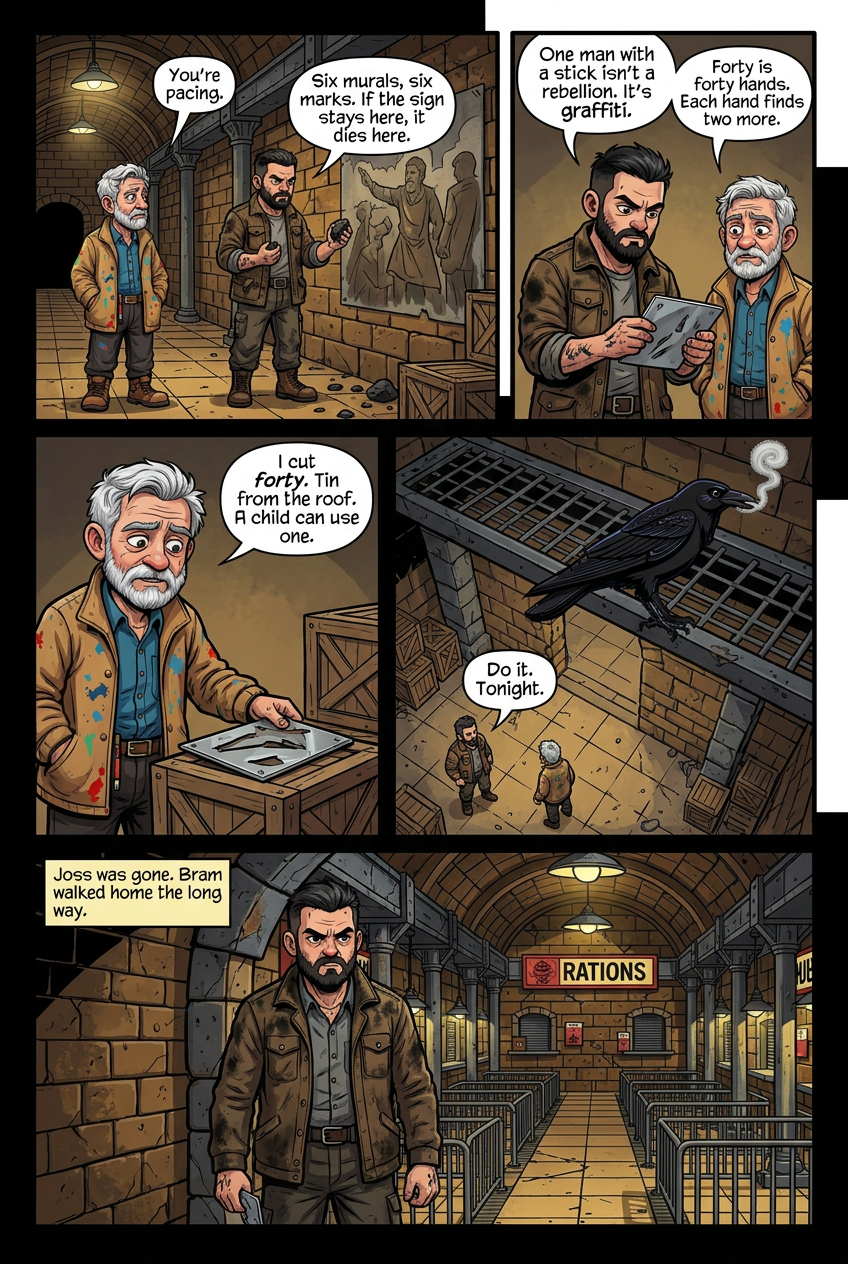
Bram came back to the tunnel the next night with a scrap of coal in his pocket and a plan that already felt too small. He drew another black line through a painted farmer's teeth. Then another. Six murals, six marks. When he stepped back, the tunnel looked exactly as it had the night before. The same handful of workers shuffled past the same handful of walls. If the sign stayed here, it would die here. One tunnel. One story guards could scrub in an hour. Joss found him at the last mural. The painter carried his brushes in a belt loop and a jar of black under his coat. Paint flecks covered his sleeves like a rash he'd stopped scratching. He was the only man in Zeroline who had watched Bram draw the first line, and Bram still hadn't decided if that made him safe. "You're pacing," Joss said. "Six months you painted alone," Bram said. "Nobody copied you." "Nobody knew what it meant." "They still don't. And they won't, past this tunnel." Bram held up the coal. "One man with a stick isn't a rebellion. It's graffiti." Joss looked at the mural a long moment. Then he reached under his coat and pulled out a folded square of butcher paper. He opened it on a supply crate near the ration gate. Inside lay a flat tin stencil, cut clean: one straight black bar, the length of a hand. "I cut forty of these last week," Joss said. "Tin from the roof of the queue. A child can use one. Press it, brush across, lift. One second. No skill." Bram picked the stencil up. The edges were sharp. He thought of the boy who had pointed at him in the ration line. He thought of the women who had nodded and turned away. "Forty isn't a city." "Forty is forty hands," Joss said. "Each hand finds two more. I know which painters. I know which queue boys. You give me a night, I put a stencil in every district by dawn." Bram set the tin down. Above them, on the archway, a crow watched from a vent grate, thin smoke curling from a scrap of something in its beak. It tilted its head and did not fly. "Do it," Bram said. "Tonight." Joss gathered the stencils. He was gone through the side passage before Bram counted to ten. Bram walked home the long way. He slept four hours. When he came up for the morning shift, the wall beside the factory gate had a black bar through the regime crest. Two blocks on, another. On the tram bridge, a girl in a school coat pressed a tin to the rail and lifted it clean. She saw Bram's face and did not know it. She ran. The sign had left the tunnel. So had the witness who could name him, and now that witness held the map of every hand that carried it.
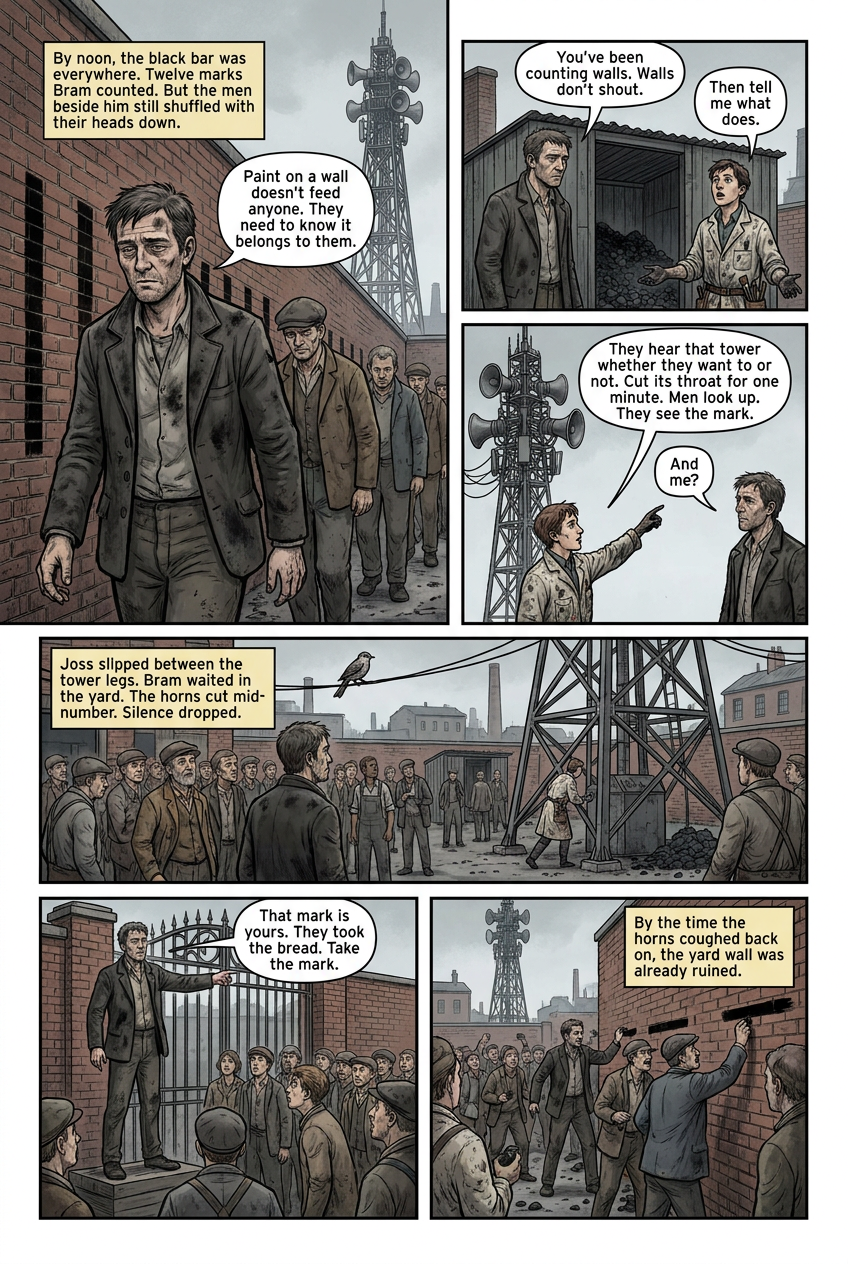
By noon the black bar was everywhere and nowhere. Bram counted twelve marks on his walk to the factory gate. Twelve marks, and the men beside him still shuffled through the ration line with their heads down. The symbol had spread. The anger had not. Paint on a wall did not feed anyone. He needed the crowds in the factory districts to see the mark and know it belonged to them, and he had no way to reach those crowds without showing his own face on every poster in the city. Joss found him behind the coal sheds at shift change. The painter still wore the same flecked coat, brushes in his belt, hands stained black to the wrist. He was the only man alive who had watched Bram draw the first line, and Bram still stood a half step back from him out of habit. "You've been counting walls," Joss said. "Walls don't shout." "Then tell me what does." Joss looked up. Above the sheds, past the wire, the broadcasting tower rose over the district. Speakers ringed its neck like a collar. Twice a day it pushed the ration numbers into every street. Bram had grown up under that voice. "They hear that tower whether they want to or not," Joss said. "Cut its throat for one minute. One minute of dead air over the districts. Men look up. They see the mark on the wall beside them. They put the two things together." "You can't climb it. Guards at every leg." "I don't climb. The junction box on the south leg feeds the horns. A wrench on the right coupling kills the feed for as long as it takes them to send a man down." "And me?" "You stand in the yard where the shift lets out. When the horns go quiet, you say one sentence. Not your name. One sentence about the bar. Then you walk." Bram thought of the boy who had pointed at him in the ration line. He thought of his own face on the posters at the tram gate. Then he took the wrench Joss held out. They went at the change of guard. Joss slipped between the tower legs like a man who had painted its base a hundred times. Bram waited in the yard among two hundred workers filing out under the horns. A small soot-dusted sparrow sat on the wire above him and did not move. The horns cut mid-number. Silence dropped on the yard like a dropped tray. Two hundred faces lifted. Bram stepped up on the loading block. He pointed at the black bar sprayed across the gate crest. "That mark is yours," he said. "They took the bread. Take the mark." He stepped down. The crowd did not disperse. A man near the front tore a strip of coal from the bin and drew a black line down the wall beside him. Then another man did. Then a woman. By the time the horns coughed back on, the yard wall was already ruined.
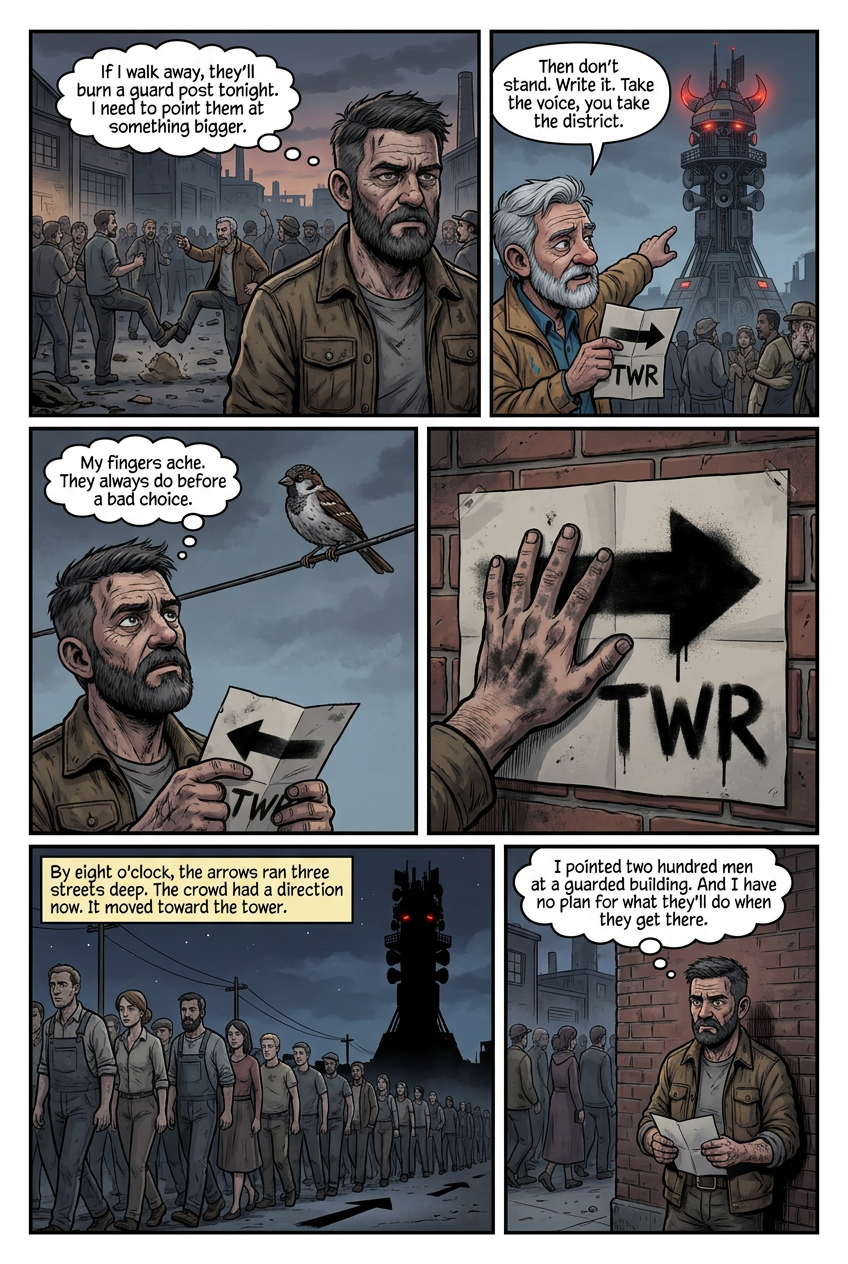
By dusk the yard wall was black with marks, and Bram could feel the crowd waiting for the next word. They had drawn their lines. Now they stood in loose knots near the gate, watching him without watching him, hands empty. A boy kicked a broken crate. Two men argued over a stripped bolt. The anger had lit, but it had nowhere to go. If he walked away now, they would burn a guard post tonight and hang for it by morning. He needed to point them at something bigger than a wall. Joss stepped in beside him, brushes still in his belt, palms still black. He kept his voice low. "They'll scatter in ten minutes. Then they'll smash the first window they see." "I know." "Tell them where to go." "I can't stand up there twice. The second time, someone matches me to the poster." Joss looked at the tower over the sheds. The horns had come back on. The ration numbers droned above the district again, steady as a clock. "Then don't stand," Joss said. "Write it." He pulled a folded stencil from his coat. It was a fresh one, cut that afternoon. Not a bar this time. An arrow, and under the arrow, three letters: TWR. "Paint it on every wall between here and the tower," Joss said. "They'll follow it. The tower is the voice. Take the voice, you take the district." Bram turned the tin in his good hand. His two missing fingers ached the way they always did before a bad choice. "They'll die on the fence." "They'll die in the ration line either way. At least this way the horns go quiet for good." Bram looked past him. A small sparrow sat on the wire above the sheds, feathers grey with ash, the same one from that morning or one just like it. It watched the yard without fear. It had lived its whole life under the horns and did not care. He took the stencil. He worked the yard first. Arrow, arrow, arrow, three letters, low on the brick where a man's eye would catch them. The workers saw him painting and did not stop him. A woman took a second tin from Joss and started on the far wall. Two men followed her out the gate with a bucket of pitch. By the time the horns pushed the eight o'clock numbers, the arrows ran three streets deep. Men Bram had never spoken to were walking the line, quiet, looking up at the antenna array against the sky. The crowd had a direction now. It moved toward the tower. Bram lowered the stencil. He had pointed two hundred angry men at a guarded building, and he had no plan for what they would do when they reached its legs.
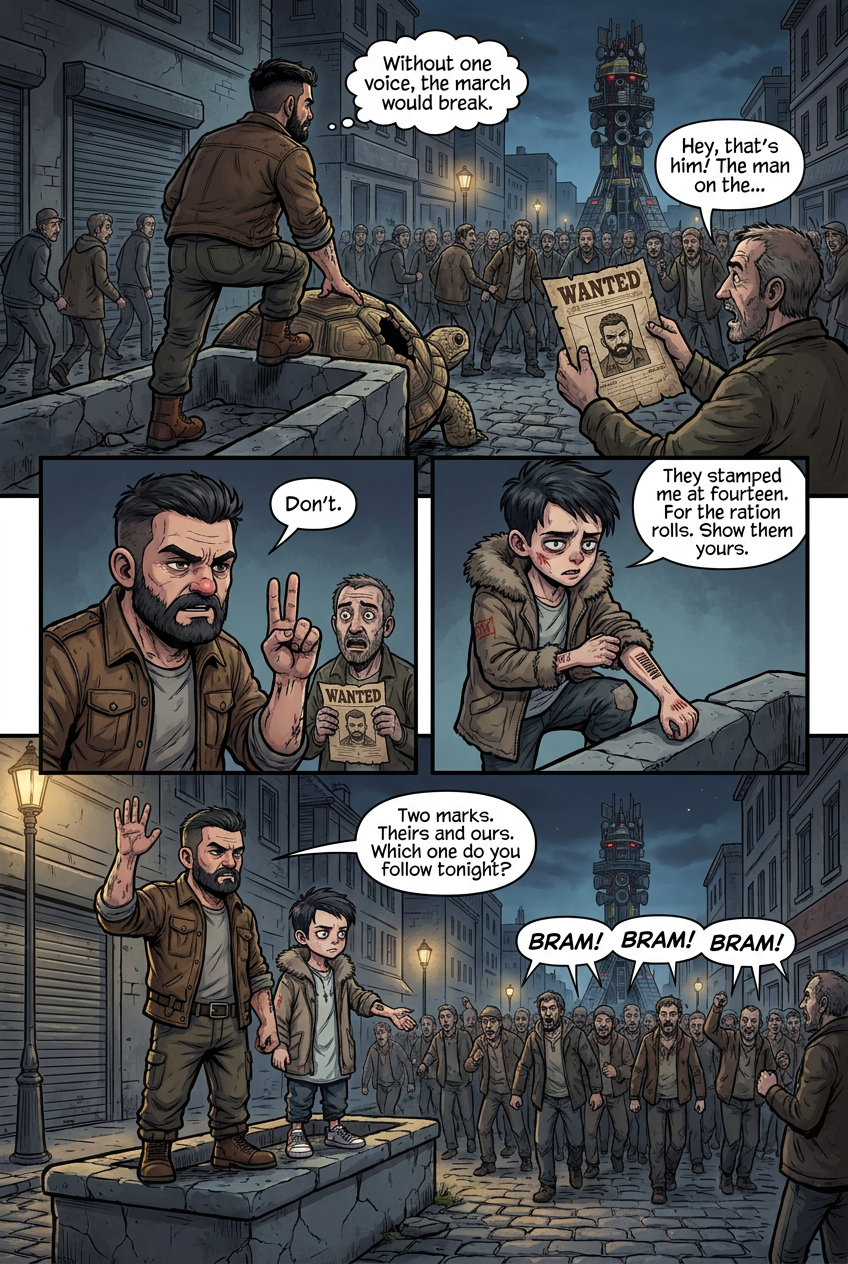
Bram caught up with the front of the march three streets from the tower. The arrows had done their work. Two hundred men filled the road, boots loud on the stones, but the sound was ragged. Some chanted the letters. Some cursed the horns. Some just walked with pipes in their hands. At the next corner the line split. Half went left toward a shuttered depot. Half kept toward the tower. Bram saw it and knew Joss was right. Without one voice, the march would break into small fires the troops could stamp out one by one. He pushed to the front and looked for something to stand on. A cracked stone drinking trough sat by the curb, shaped like the long shell of a tunnel tortoise, moss in its seams. He climbed it. He opened his mouth and nothing came. Two hundred faces turned. One of them held a wrinkled wanted poster, folded and refolded, his own face worn nearly off the paper. The man near the front squinted from the poster to Bram's left hand, to the two missing fingers, and his mouth opened. "Don't," Bram said. It came out flat. Not a speech. The man stopped. But the split at the corner kept spreading. Men drifted. Bram had no chant to give them. He had smashed a ration machine once. He had never led anything. A hand caught his sleeve from below. A gaunt young man in a stolen fur coat, hospital gown showing at the collar. A fresh cut ran down his cheek and closed itself as Bram watched, skin knitting like wet cloth pulled tight. The boy pushed back the coat's cuff. A bar code was burned into his left forearm. Bram had heard the rumors in the tunnels. He had not believed them until now. "They stamped me at fourteen," the boy said. Loud enough for the front rows. "For the ration rolls. Show them yours." Bram understood. He raised his left hand. Four fingers. The stumps clear in the lamplight. He did not speak. He did not need to. The boy climbed up beside him and held out his marked arm to the crowd. Bram held out his hand. "Two marks," the boy called. "Theirs and ours. Which one do you follow tonight?" The men at the split turned back. The depot group came jogging. Someone started the letters again and this time the whole street took them, three syllables in step with the boots. The march closed into one body. It moved toward the tower. Bram climbed down. His hand was shaking. Oryn Rask walked beside him now, the cut on his cheek already gone, and Bram had gained a second witness who could name him, and a weapon he did not know how to aim. Ahead, the tower's speakers pushed the nine o'clock numbers into the dark. The march did not slow.
Play your story to life
Storycraft is a mobile game where you create AI characters, craft items and locations to build their world, then discover what direction your story takes. Download the iOS game for free today!
Download for free