

Briar Willowshade's Arc
9 Chapters
Briar Willowshade's dream is restoring the dying moss groves of Quietmoss by awakening the slumbering heart-spring beneath them..

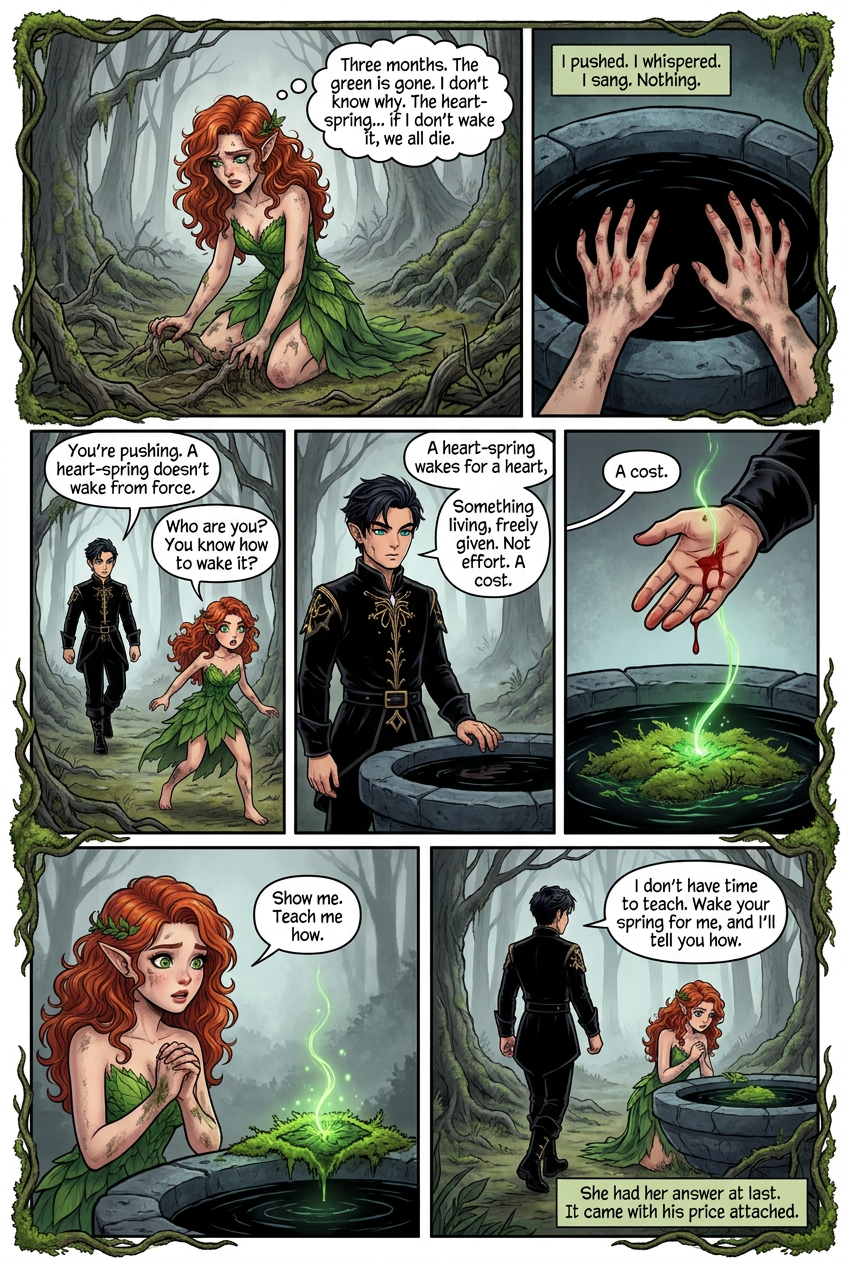
For three months Briar Willowshade had watched the moss groves of Quietmoss lose their color, and for weeks she had knelt in the dead roots, clawing at them alone. She knew every inch of these groves. She had learned to tend them by watching, season after season, with no one to teach her. Now the green had drained from the moss, and she still didn't know why. Beneath the roots lay a buried heart-spring. If she could wake it, the groves would live. So would she. She refused to think about the other ending. Today she reached the spring itself. Her fingers tore the last roots away, and she pressed both hands to the cold stone basin. She pushed. She whispered. She sang the way she sang to new moss. Nothing stirred. The water below stayed dark and still. Briar sat back in the dirt. Her hands were raw. All these weeks she had believed the only problem was the roots. Now the roots were gone, and the spring slept on. She had no idea how to wake it. She had never even heard how such a thing was done. A shape stepped from the tree line. He was young, dressed all in black, with a thin scar over his lip. His topaz eyes moved over the dead moss, then to her hands, then to the black water. Briar rose fast. She did not know this stranger, and she did not like how quietly he had come. "You're pushing," he said. "A heart-spring doesn't wake from force." "Who are you?" "Oberon Nightshade." He gave the name like a door closing. "King of the Court of Dusk." Briar had heard of that court, far off and cold. She had never expected its king in her ruined grove. "Then you know how to wake it." He knelt at the basin without asking. He didn't push. He didn't sing. He drew a small cut across his own palm and let one drop of blood fall into the water. "A heart-spring wakes for a heart," he said. "Something living, freely given. Not effort. A cost." The water shivered. A single thread of green light rose through it and touched the nearest moss. That patch turned bright again, alive. Briar's breath caught. For the first time in three months, something had changed. "Show me. Teach me how." Oberon stood. He pressed his cut hand shut and looked at the moon behind the trees. "I don't have time to teach." He paused. "But I need something that grows in soil like this. Wake your spring for me, and I'll tell you how." He walked back toward the trees before she could answer. Briar looked at the one living patch of moss, then at the sleeping water that had swallowed his blood. She had her answer at last. It came with his price attached.
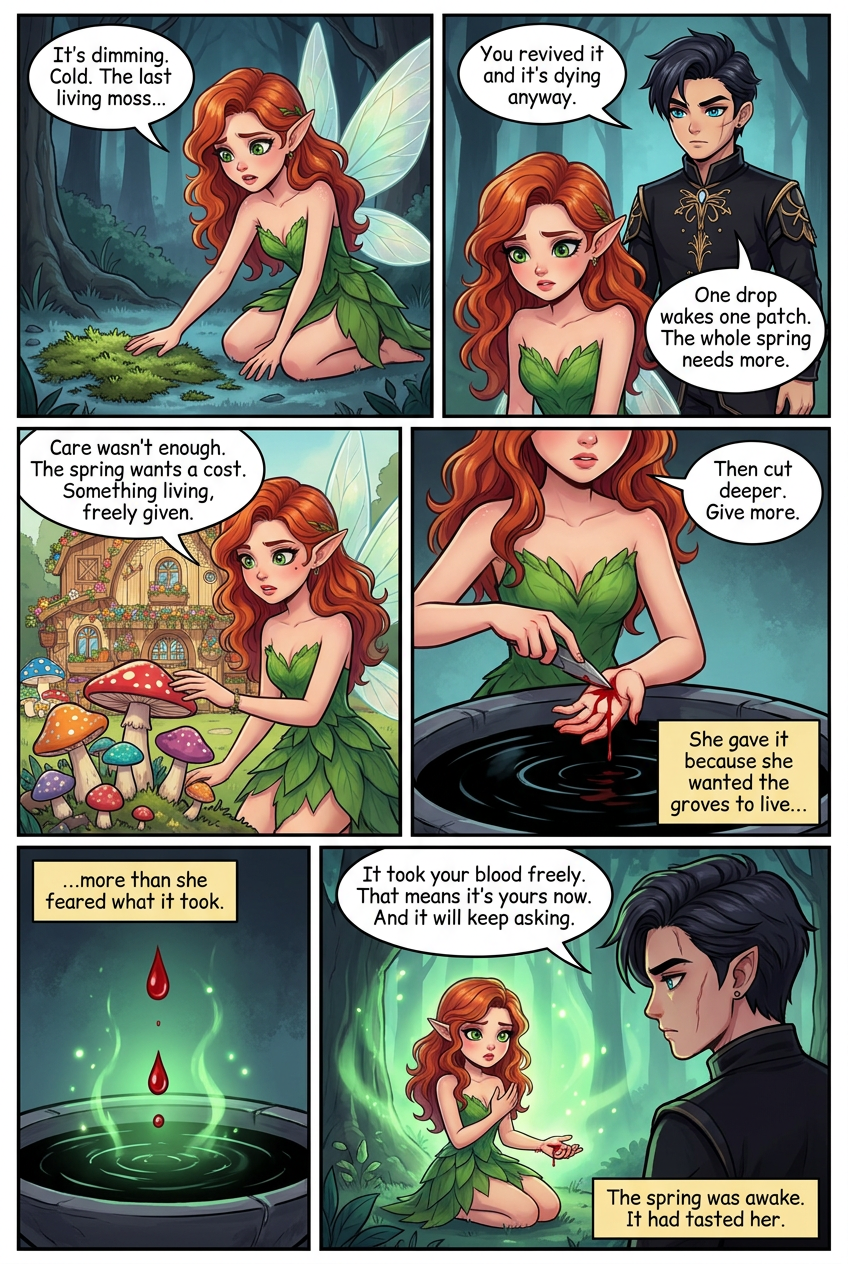
The green in the moss was already fading. Briar knelt over the one bright patch Oberon's blood had woken. When he cut his palm, the color had flared. Now it dimmed again, sliding back toward gray. She pressed her fingers to it. Cold. She had hours, maybe less, before the last living moss died with the rest. She ran to the small farm at the edge of the grove. Its beds held everything she had coaxed from this soil. She tore through them. A cluster of fungi with wide caps. A shrub thick with blossoms. She had grown all of it by giving it care, day after day. Care wasn't enough now. Oberon had been clear. The spring wanted a cost. Something living, freely given. A branch cracked behind her. Oberon stepped from the trees again. He had not gone far. His topaz eyes moved from her raw hands to the fading patch. "It's dying," she said. "You revived it and it's dying anyway." "One drop wakes one patch. For a moment." He looked at the black water. "The whole spring needs more." "Then cut deeper. Give more." "No." The word landed flat. "My blood isn't free. It's owed elsewhere." He shut the topic like a door. Briar looked at her farm, then at her own hands. She understood. He had shown her the rule. He would not pay it for her. This was hers to answer. She walked back to the basin. She knelt. The bright patch was nearly gray now. She thought of the roots she had clawed for weeks, believing effort would be enough. Effort had never been the price. She drew a shard of stone across her palm. It bit. Blood welled dark. She held her hand over the water and did not push, did not sing. She let it fall. One drop. Two. She gave it because she wanted the groves to live more than she feared what it took. The water shivered. Then it moved on its own. Green light climbed through it, wider than before, and spread across the dead moss in a slow tide. Color returned to the patch under her knees, then past it, up the roots of the grove. Not all of it. But more than a moment's worth. The tide held. Briar sat back, cradling her cut hand. The spring had answered her, not just Oberon. She had woken it herself. Oberon watched the green spread. Something crossed his face and vanished. "It took your blood freely," he said. "That means it's yours now. And it will keep asking." The light dimmed to a steady glow, not dead, not full. Briar felt the pull under her ribs, faint and certain. The spring was awake. It had tasted her. And it was not finished.
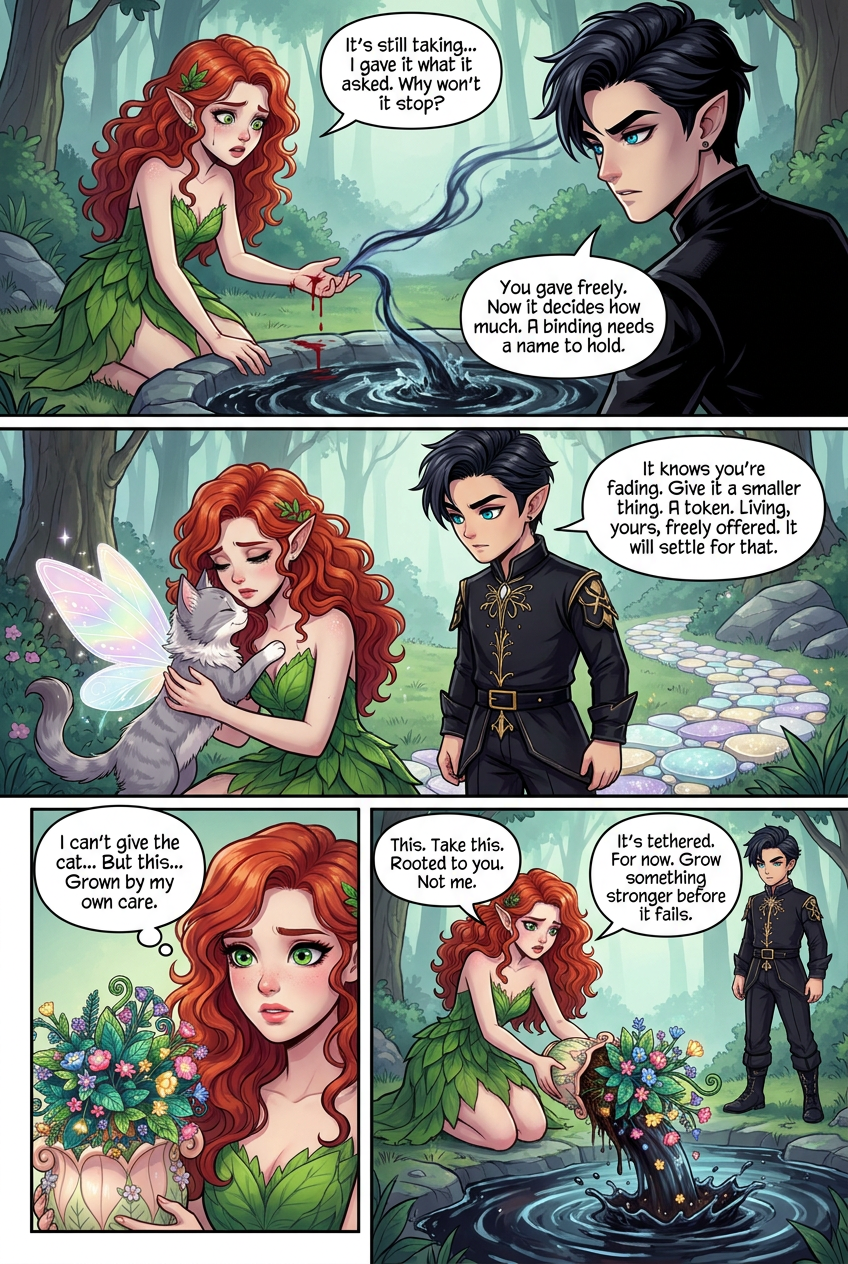
The green held across the grove, but the pull under Briar's ribs grew worse. She knelt by the spring and watched dark water lick at the cut on her palm. The wound would not close. Each time she pressed cloth to it, the blood rose again, drawn toward the basin like a thread being reeled in. Her fingers went cold. Her sight blurred at the edges. The spring was awake, and it wanted more of her. "It's still taking," she said. Her voice came thin. "I gave it what it asked. Why won't it stop?" Oberon crouched across the water from her. The young fae king had not left. His black clothes were still, but his topaz eyes moved fast, reading her gray face, her shaking hand. "Because you never told it when to stop," he said. "You gave freely. Now it decides how much." "Then tell me how to end it." She swayed. A drop of her blood fell without her lifting her hand. "You made this bargain to teach me. Teach me now." He weighed it. She watched him do it, the pause where he counted the cost of helping her. A soft chime broke the quiet. A small cat stepped from the moss, gray-furred, with faint wings that caught light like wet glass. It walked to Briar and pressed its head against her cold wrist. Warmth moved up her arm. The pull eased for one breath, then returned. "It knows you're fading," Oberon said. He looked at the cat, then at her. "The spring binds through blood. But a binding needs a name to hold. You gave blood and no name. So it grips the whole of you." He reached across the water. "Give it a smaller thing to hold. A token. Living, yours, freely offered. It will settle for that." Briar looked at the winged cat leaning into her hand. She could not give the cat. She looked at her farm, at the row of fairy-shaped planters near the beds. In one grew a shrub she had raised from a single cutting, blossoms open, roots strong. Hers. Living. Grown by her own care. She crawled to the planter. Her hands barely gripped it. She carried it to the basin and tipped the shrub, roots and soil, into the black water. "This," she said. "Take this. Rooted to you. Not me." The water pulled the roots down. The shrub's blossoms flared bright, then sank. The thread in Briar's chest snapped loose. Her palm closed over. The blood stopped. She fell back onto the moss and breathed. The spring glowed steady, fed now by the shrub's living roots instead of her veins. The cat curled against her side. Oberon stood. "It's tethered," he said. "For now. Roots die. When it does, it will look for you again." He turned toward the shimmering stones that led away through the grove. "Grow something stronger before then."
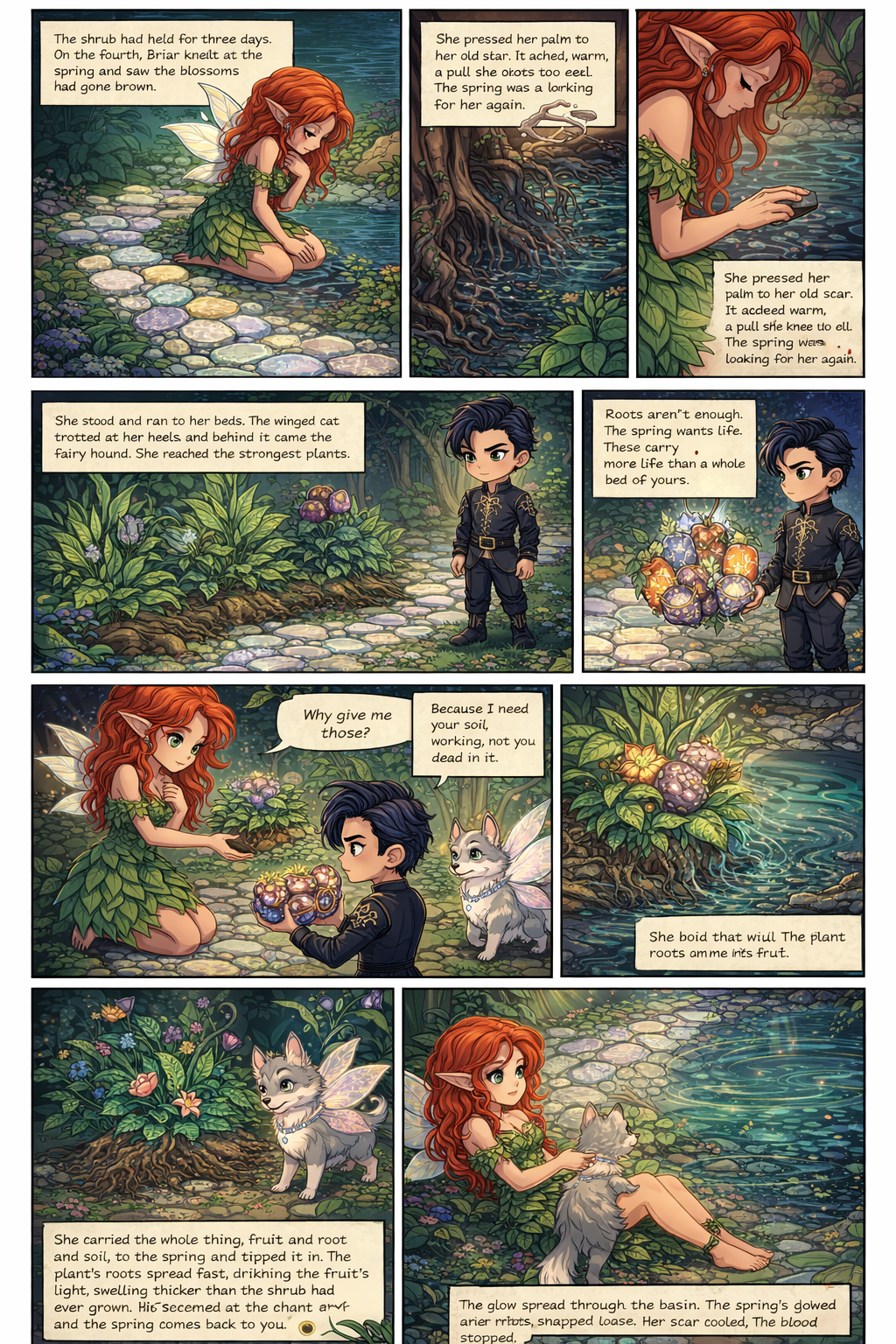
The shrub had held for three days. On the fourth, Briar knelt at the spring and saw the blossoms had gone brown. The roots under the black water had shrunk to threads. She pressed her palm to her old scar. It ached, warm, a pull she knew too well. The spring was looking for her again. She stood and ran to her beds. The winged cat trotted at her heels, and behind it came the fairy hound, gray and quick, its butterfly wings folding as it ran. Both animals had stayed close since the binding first drained her. She reached the strongest plants she owned, five of them, thick-stemmed, their leaves marked with faint runes. Their roots gripped the soil like fists. Living. Hers. Strong enough, maybe, to hold what a shrub could not. She dug the first one free. The pull under her ribs sharpened. Blood beaded at her scar. She had minutes now, not hours. A shadow fell across the bed. Oberon stood on the shimmering stones that led into the grove, his black clothes still, his topaz eyes on her bleeding hand. He had taught her the bargain and warned her the shrub would fail. Now he watched her scramble. "That won't hold either," he said. "It has to." She lifted the plant toward the basin. "Roots aren't enough." He crossed the stones. From his cloak he drew a cluster of fruit, round and glowing, each one veined with light. "The spring wants life. Not just a body. These carry more life than a whole bed of yours." Briar stared at the fruit. "Why give me those?" "Because I need your soil working, not you dead in it." He held them out. "Feed one to the plant. Root the fruit with it. Then offer both." She did not have time to weigh it. She split a fruit and pressed the halves against the plant's roots. The glow sank into the stem. The runes on the leaves flared bright. She carried the whole thing, fruit and root and soil, to the spring and tipped it in. The black water pulled it down. The plant's roots spread fast, drinking the fruit's light, swelling thicker than the shrub had ever grown. The glow spread through the basin. The pull under Briar's ribs snapped loose. Her scar cooled. The blood stopped. She fell back on the moss, breathing hard. The cat pressed to her side. The hound lay across her legs. The spring glowed steady, fed now by something that would not wither in days. Oberon looked at the four fruits left in his hand, then closed his fingers over them. "That will hold longer," he said. "Weeks, not days." He turned toward the stones. "But it's still borrowed life. When the fruit burns out, the plant dies with it. And the spring comes back to you." He walked into the grove. "Find something that lives on its own."
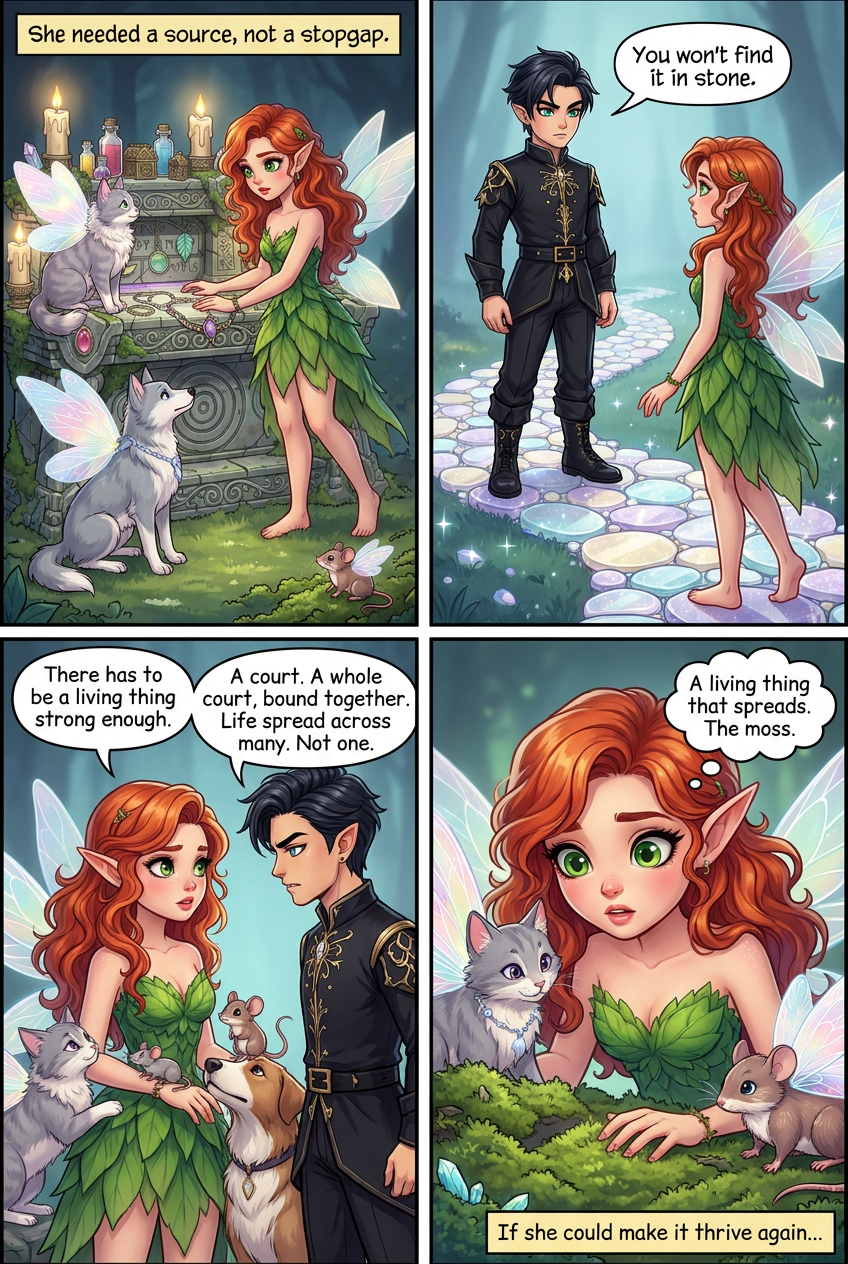
The fruit-fed plant held for a week. Then Briar counted the four fruits Oberon had left her and knew the truth. Even with those, she had weeks. No more. She needed something that lived on its own, and she knew of nothing strong enough to feed the spring forever. She needed a source, not a stopgap. So she went looking for the old altar at the edge of the grove, where the first fairies of Quietmoss had once made their bargains. The altar was stone, cracked and mossy, crowded with candles and small charms. She had passed it a hundred times without touching it. Now she brushed the dust from its runes. Among the trinkets sat a cluster of tangled fairy relics, gold and silver braided with gems. She lifted them. They hummed against her scar. She hoped they held some old answer. The winged cat leapt onto the altar. The fairy hound sat below, ears up. From the moss crept a tiny mouse, wings folded, watching her with black eyes. All three had followed her here. They had stayed close since the binding first bled her. "You won't find it in stone." Oberon stood on the shimmering path. He was the fae king who had taught her the bargain and never softened a word of it. His black clothes swallowed the candlelight. His topaz eyes moved from the relics to her face. "There has to be a living thing strong enough," Briar said. "Something that renews itself. The relics remember. I can feel it." "They remember a cost. Not a cure." He climbed the stones. "A spring lives on life. Life dies. That's the trap." "Then tell me what doesn't die." He said nothing for a moment. His jaw tightened. "A court," he said at last. "A whole court, bound together, feeds a spring without draining any one thing dry. Life spread across many. Not one." Briar stared at him. "You have a court." "I do." He looked away. "And it's already promised elsewhere." He would not say more. She saw the line close in his face. But he had given her the shape of it. Not one life. Many. She set the relics down. The mouse crept onto her hand. The cat pressed her arm. The hound leaned into her leg. Small living things, all of them tied to her already, all still breathing. "Not one body," she said slowly. "A living thing that spreads. That makes more of itself." She thought of the moss itself, thick across the whole grove once, one plant that grew forever if it lived. Oberon watched her understand. "Now you're asking the right question." Briar's chest ached, but not from the scar. She had been feeding the spring dying things. She needed to feed it something that grew. The moss. If she could make it thrive again, it might sustain the spring on its own. She had weeks to find out.
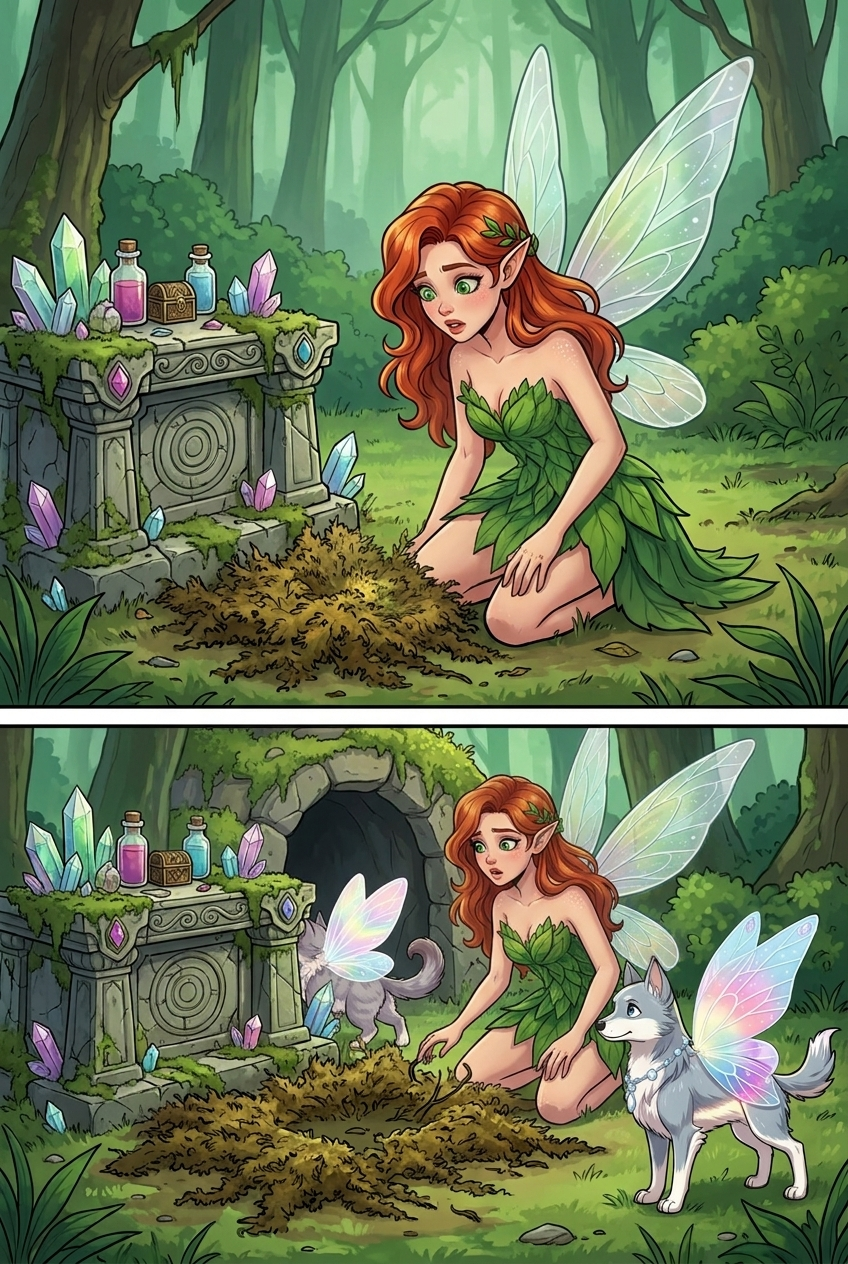
Briar knew the moss could feed the spring forever. But she couldn't regrow it yet. Three months ago its color had drained overnight, and she still didn't know why. If she seeded new moss into the same soil, the same sickness would kill it again. She needed the cause before she planted a single spore. She knelt where the moss had died first, near the old altar. She dug her fingers into the soil and pulled up a handful. It smelled wrong. Sour, like rot under water. She traced the dead patch to its edge and found a seam in the ground, a low mouth of stone wrapped in old moss. A cave. She had never gone inside. The winged cat slipped past her ankles into the dark. The hound followed, wings folded. Briar crawled after them. Inside, water dripped down the walls. Her fingers touched something slick. She lifted a strand of dead root to the cave's faint light and saw a black film clinging to it. She scraped it. The film smeared, oily and cold. The same rot she'd smelled in the soil above. "It runs under everything." Oberon stood at the cave mouth, blocking the daylight. The fae king who had taught her every hard rule of the spring. He did not offer to help. He watched her hands. "The blight is in the water, not the moss." Briar sat back. "The spring's water?" "When it slept, its water went stagnant." He crouched at the edge of the dark. "Stagnant water breeds rot. The rot rose through the roots. It killed your moss from below. Three months ago the spring went quiet enough to poison itself." Briar's breath caught. She had blamed the moss. She had blamed the air, the season, herself. The killer was the very thing she was trying to save. "Then the spring did this." "Its sleep did." He stood. "You woke it. The water moves now. Feel it." She pressed her palm to the cave floor. Faint, cold, a pulse under the stone. Living water again, not stagnant. The blight had started when the spring stalled. Now the spring ran, and the rot had nothing to feed it. She scraped the last black film from the root and let it fall. Then she reached into her pouch and drew out a cutting of dense, resilient moss she had saved from the healthiest patch. She pressed it into the wet soil at the cave's edge, above the moving water. By morning it had not curled. It had not paled. The film did not return. Small green fronds had pushed up beside it, soft and unafraid. Briar sat back on her heels. She knew now. The rot was gone with the stagnant water. She could regrow the moss without losing it again. But the spring's water ran because she kept it running, on borrowed fruit, weeks from empty. The moss would take longer than that to spread grove-wide. She was racing her own dwindling supply.
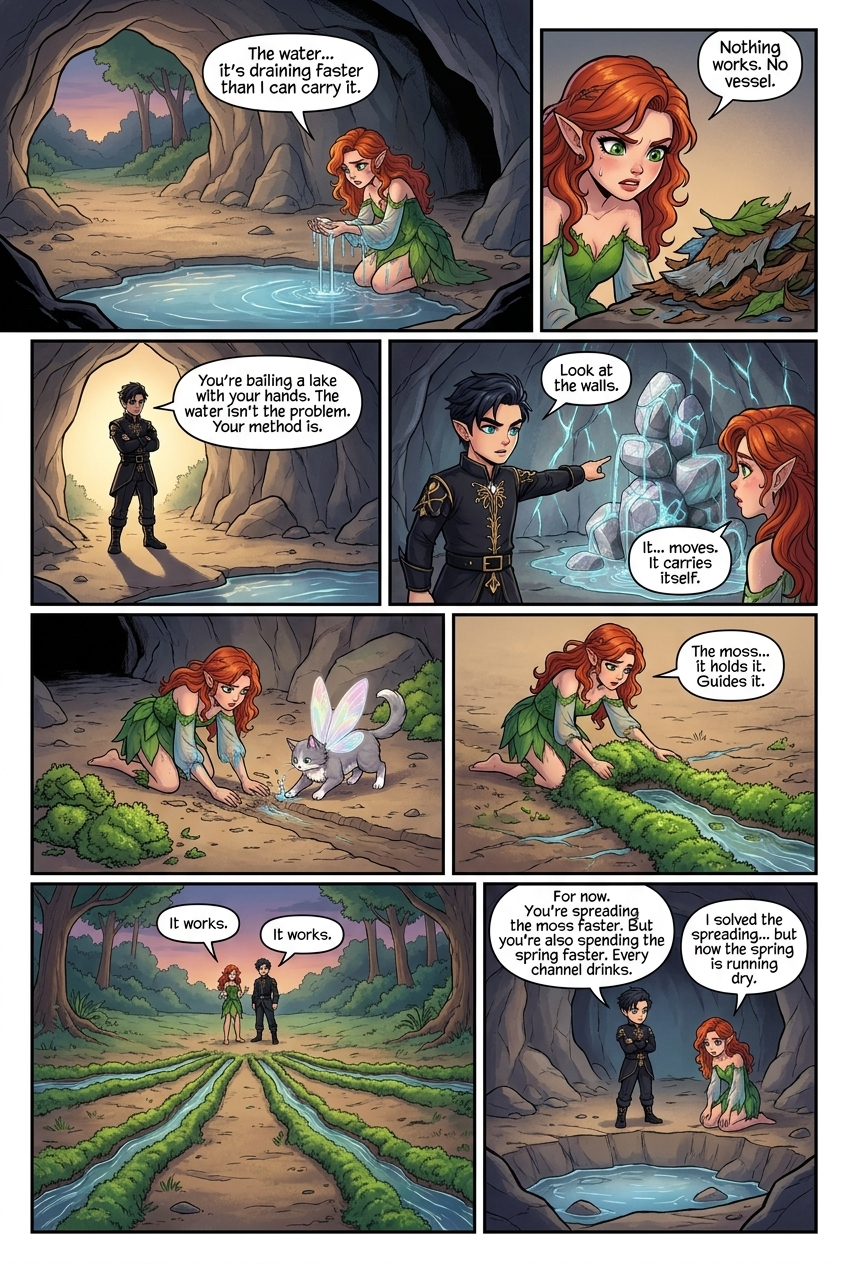
The new moss had taken root at the cave's edge. But the spring's water ran low. Briar knelt at the cave mouth and watched the pool inside. Yesterday it had covered the stone. Today bare rock showed at the rim. The water she needed to spread the moss grove-wide was draining faster than she could use it. She dipped her hands and lifted what she could. Half of it slid through her fingers before she reached the dry soil outside. She tried a leaf, then a curl of bark. Both leaked. By the third trip her arms shook and the dry patches drank her handfuls without a trace. She sat back, wet to the elbows, and stared at the shrinking pool. She had no vessel. Nothing to carry water in. The moss would die dry while the spring emptied. "You're bailing a lake with your hands." Oberon stood at the cave mouth, black against the daylight. The fae king had taught her every hard rule of the spring, and never once softened one. He did not step in to help. He looked at the pool, then at her ruined sleeves. "The water isn't the problem. Your method is." "Then tell me," Briar said. "No." He crouched. "Look at the walls." She looked. Water threaded down the cracked stone in bright, glassy lines, gathering, spilling, gathering again. It did not pool and sit. It moved. It carried itself along the rock without a single hand to lift it. Briar understood. She had been fighting the water. She should follow it. She scraped a shallow channel in the wet soil from the cave mouth outward, toward the nearest dead patch. The winged cat padded beside her, tail flicking at the trickle that began to run. The first channel reached the dry soil and sank in too fast. The water vanished before it spread. She lined the next channel with the resilient moss she carried, the dense kind that held water in its body like a sponge. This time the water crept along the green, slow and held, and soaked out sideways into the dead ground on both banks. By dusk she had four channels running from the cave. Green threads followed each one. She had stopped carrying water and started guiding it, and it reached ground her hands never could. Oberon watched the last channel fill. "It works." "It works," Briar said. "For now." He stood. "You're spreading the moss faster. You're also spending the spring faster." He nodded at the pool, lower than when he'd come. "Every channel drinks. The more grove you cover, the sooner the water runs out. Before your moss can renew what you take." Briar looked at the four bright lines feeding the grove, then at the sinking pool that fed them. She had solved how to spread the moss. Now the spring itself was running dry beneath her.
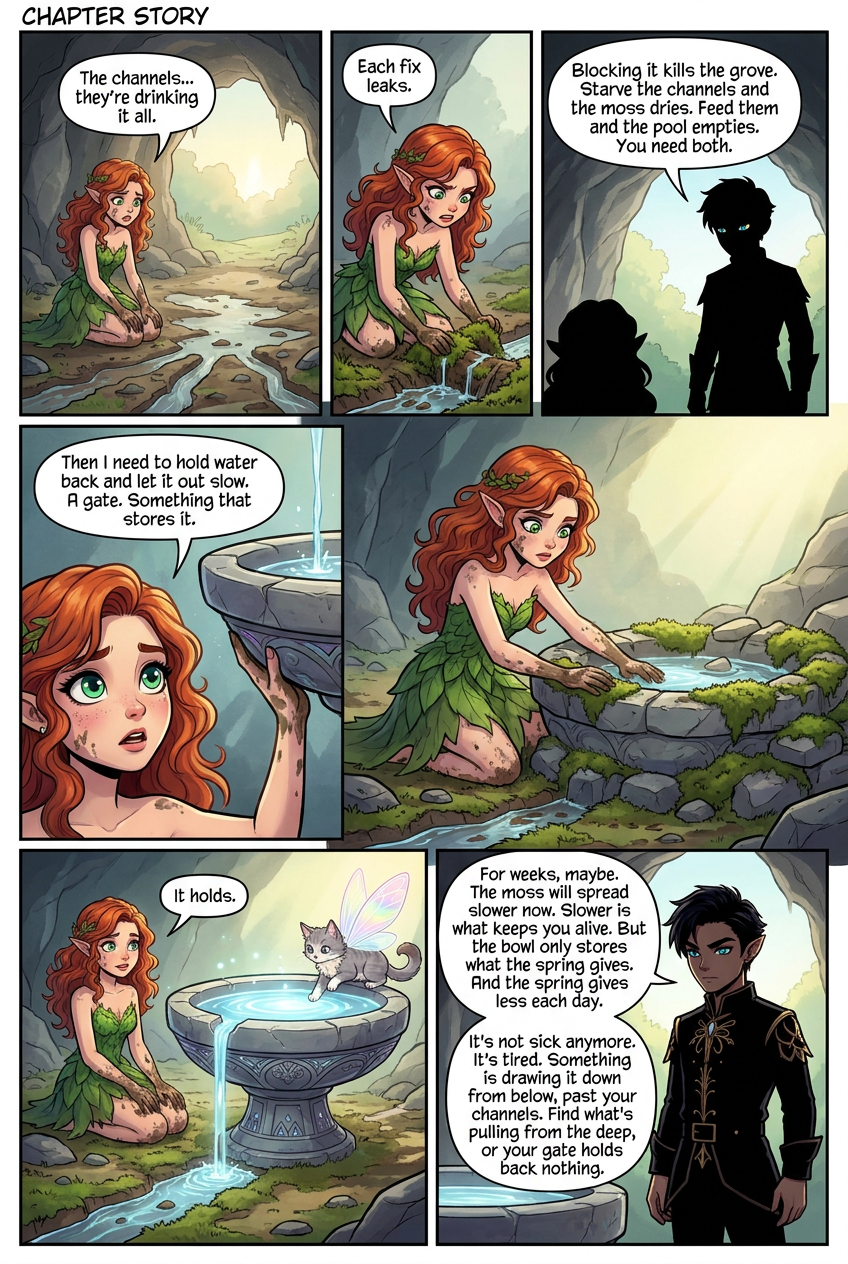
By dawn the four channels had drunk the pool down to mud. Briar knelt at the cave mouth and stared at the bare stone. The spring bubbled up through cracks, but the channels pulled it away faster than it rose. She had spread the moss. Now the water that fed it was nearly gone. If she couldn't slow the flow, the pool would empty by night. Then the new moss would die, and the spring's claim would swing back to her. She tried to dam the channels with clumps of moss. The water pushed through and around them. She scraped soil into the first channel. The current carried it off. Each fix leaked. The pool sank another finger's width while she worked. "Blocking it kills the grove," Oberon said. The fae king stood at the cave mouth, black against the light. He had taught her every rule of the spring and softened none. "Starve the channels and the moss dries. Feed them and the pool empties. You need both." "Then I need to hold water back and let it out slow," Briar said. "A gate. Something that stores it." Oberon said nothing. He watched. Briar looked at the trickle threading down the wall. Above the channel mouths, the stone dipped into a wide shallow bowl. Water gathered there before it spilled over. It held, then released. She pressed her palm to the lip of the bowl and felt the slow overflow. She carried stones from the cave floor and built up the bowl's broken rim. She packed the gaps with the dense moss that swelled with water. The bowl deepened. Water pooled inside it instead of running straight to the channels. It rose to the mended lip, then dribbled over in a thin, steady sheet. The channels no longer roared. They sipped. Briar knelt and watched the pool below. It stopped sinking. The spring's slow rise now matched the trickle she let through. The bowl caught the spring, held it, and fed the grove a measured share. The winged cat leapt to the bowl's rim and dipped a paw. Water spilled over its edge in bright drops. "It holds," Briar said. Oberon studied the standing water in the basin. "For weeks, maybe. The moss will spread slower now." He looked at her scar, then at the pool. "Slower is what keeps you alive. The spring drinks less. So does its claim on you." Briar sat back, hands muddy, and let out a long breath. She had stopped fighting the water twice now. First she followed it. Now she caged it. "But the bowl only stores what the spring gives," Oberon said. He turned toward the light. "And the spring gives less each day. It's not sick anymore. It's tired. Something is drawing it down from below, past your channels." He stepped out. "Find what's pulling from the deep, or your gate holds back nothing."
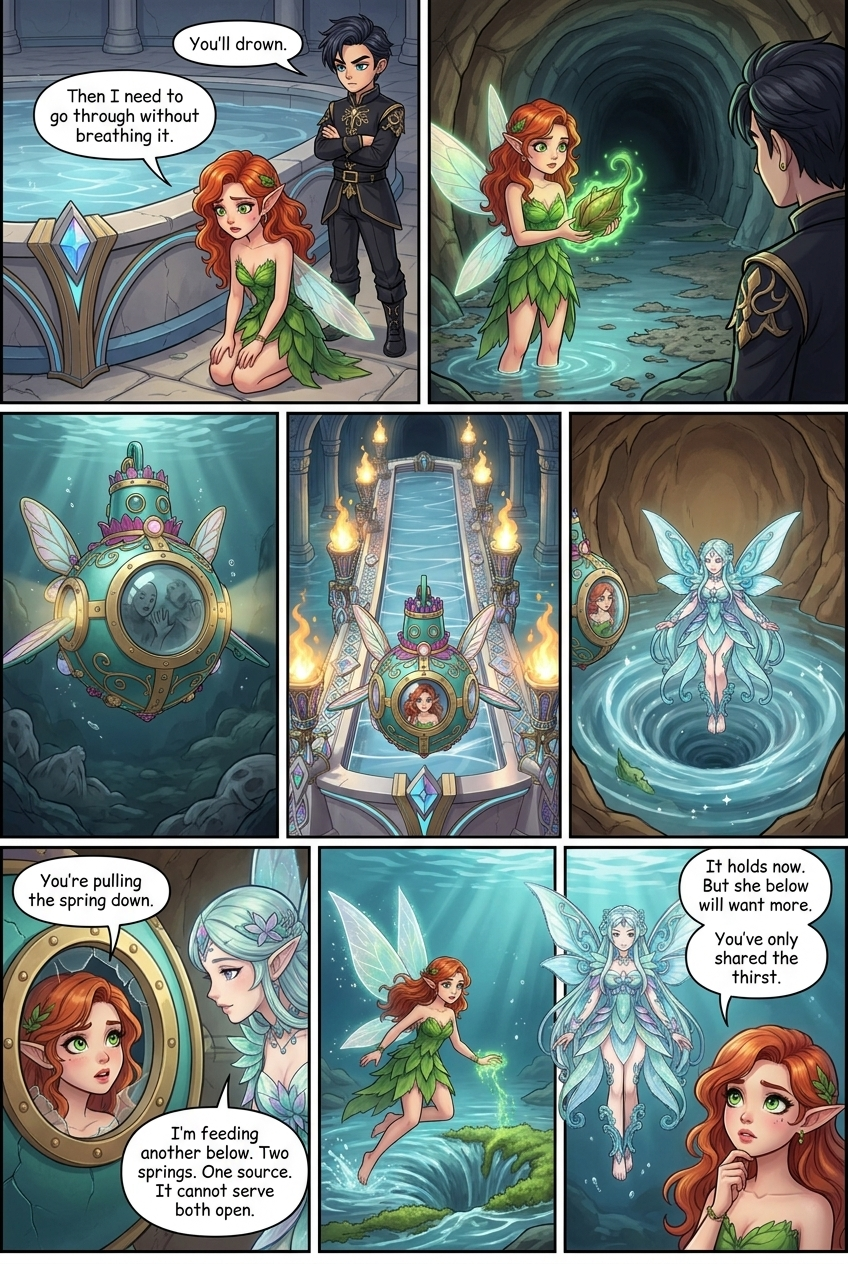
The basin held the pool steady, but the water still dropped. Briar watched it fall a finger's width by noon. Oberon was right. Something below the channels drank the spring dry. She could balance the flow all she liked. If the deep drain kept pulling, the grove would die anyway. She had to go down and find it. The deepest passage ran below the pool, flooded to the roof. Beyond it the water turned black. Rot floated on the surface in gray sheets. The blight-killed water had choked the far tunnels, and Briar could not swim through it and breathe. She knelt at the edge and stared into the dark. Somewhere past that fouled water, something was stealing the spring. "You'll drown," Oberon said. He stood at the tunnel mouth, black against the stone. He never touched the water. He only watched her fail and told her why. "Then I need to go through without breathing it," Briar said. She remembered the winged cat batting at the basin days ago, riding its own reflection on the water. A shell that floated. A shell that held air. Briar gathered a hard seed-pod she had dried for planting and worked it in her hands. She fed it a drop of spring water and her own breath. It swelled and rounded. Portholes formed where her fingers pressed. Small fins unfurled like wings. She had grown a shell she could ride inside, sealed against the rot. She climbed in and sealed the pod. It sank. The fouled water pressed gray against the glass. She could not see. Then a light bloomed ahead. Torches lined a carved channel deep in the rock, their flames burning underwater, throwing gold across the flow. Someone had built this long ago. Briar steered the shell down the lit channel, following the current where it pulled hardest. The channel opened into a round chamber with smooth earthen walls. The water here spun in a slow drain, sucking down through a gap in the floor. That gap was the thief. But she was not alone. A water fairy floated in the chamber, pale and calm, her hair drifting like weed. She held the drain open with both hands. Briar cracked the pod. Clean air from the shell let her speak. "You're pulling the spring down." "I'm feeding another below," the fairy said. Her voice moved like current. "Two springs. One source. It cannot serve both open." Briar looked at the gap, then at the fairy's steady hands. She could not close it by force. But she could split what flowed. She grew a moss lip across half the gap, the way she had lined her channels. Water still fell through. Just less. Enough for both. The fairy let go. The chamber's spin eased. Above, Briar knew the pool would rise again. "It holds now," the fairy said. "But she below will want more. You've only shared the thirst."
Play your story to life
Storycraft is a mobile game where you create AI characters, craft items and locations to build their world, then discover what direction your story takes. Download the iOS game for free today!
Download for free