

Charlie Morrison's Arc
14 Chapters
Charlie Morrison's dream is becoming the first mortal welcomed into the hidden court that rules the enchanted woods around Beam Hollow..

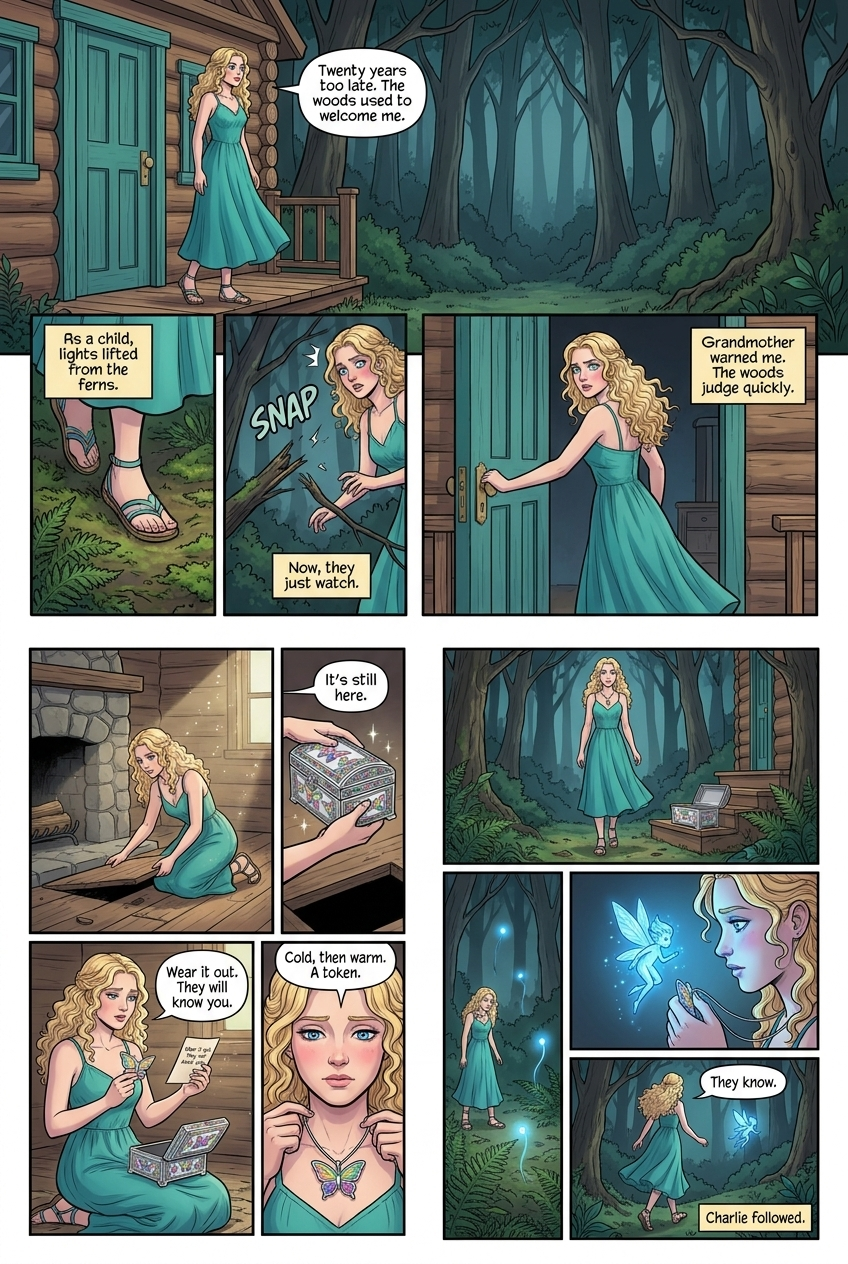
Charlie Morrison stood on the porch of her grandmother's cabin and watched the tree line refuse to greet her. She was thirty years old, tall in a teal sundress, and twenty years too late. When she was a child, the moment her sandals touched the moss, small lights had lifted from the ferns like startled fish. Now the woods held still. A deed sat folded in her pocket. The lawyer had called the place hers on Tuesday. The fae, apparently, had not been informed. She stepped down onto the path. A branch snapped somewhere she could not see. Something small and fast moved between two trunks, then stopped. She felt watched the way a trespasser feels watched. Her grandmother's voice came back to her in pieces on the porch swing, warning that the woods judged strangers quickly and forgave them slowly. Charlie backed up the steps and pushed through the teal door. Inside, the log walls were studded with the same blue and green crystals that crowned the roof. She had come looking for tea. She stayed looking for proof. Her grandmother had told her, more than once, that a token made the difference between friend and foe out there. A gift the fae themselves had given, so they would know their own mark when they saw it. She searched the bedroom first. Quilts, dried lavender, a hymnal. Nothing. In the sitting room she knelt at the hearth and pulled up a loose floorboard she remembered prying at as a girl. Beneath it sat a silver jewelry box, tarnished at the hinges, its lid worked with rainbow butterflies that still caught the light. Her hands remembered the weight before her mind did. She opened it. Inside, on a bed of faded velvet, lay a thin silver chain and a butterfly pendant the size of a thumbnail. The wings held the same shifting colors as the box. A folded scrap of paper sat under the chain in her grandmother's handwriting: Wear it out. They will know you. Charlie fastened the clasp at the back of her neck. The pendant settled cold against her collarbone, then warmed. She carried the box outside and set it on the top step, lid open, so whatever watched could see it too. She walked to the edge of the moss and stopped. For a long moment nothing happened. Then a single blue light rose from the ferns at her knee. Another lifted behind it. A third drifted down from a low branch and hovered a hand's width from her face. It was small enough to sit in a teaspoon and bright enough to throw her shadow onto the trunk behind her. It studied the pendant. It studied her. Then it turned and flew deeper into the trees, slowing once to look back. Charlie followed.
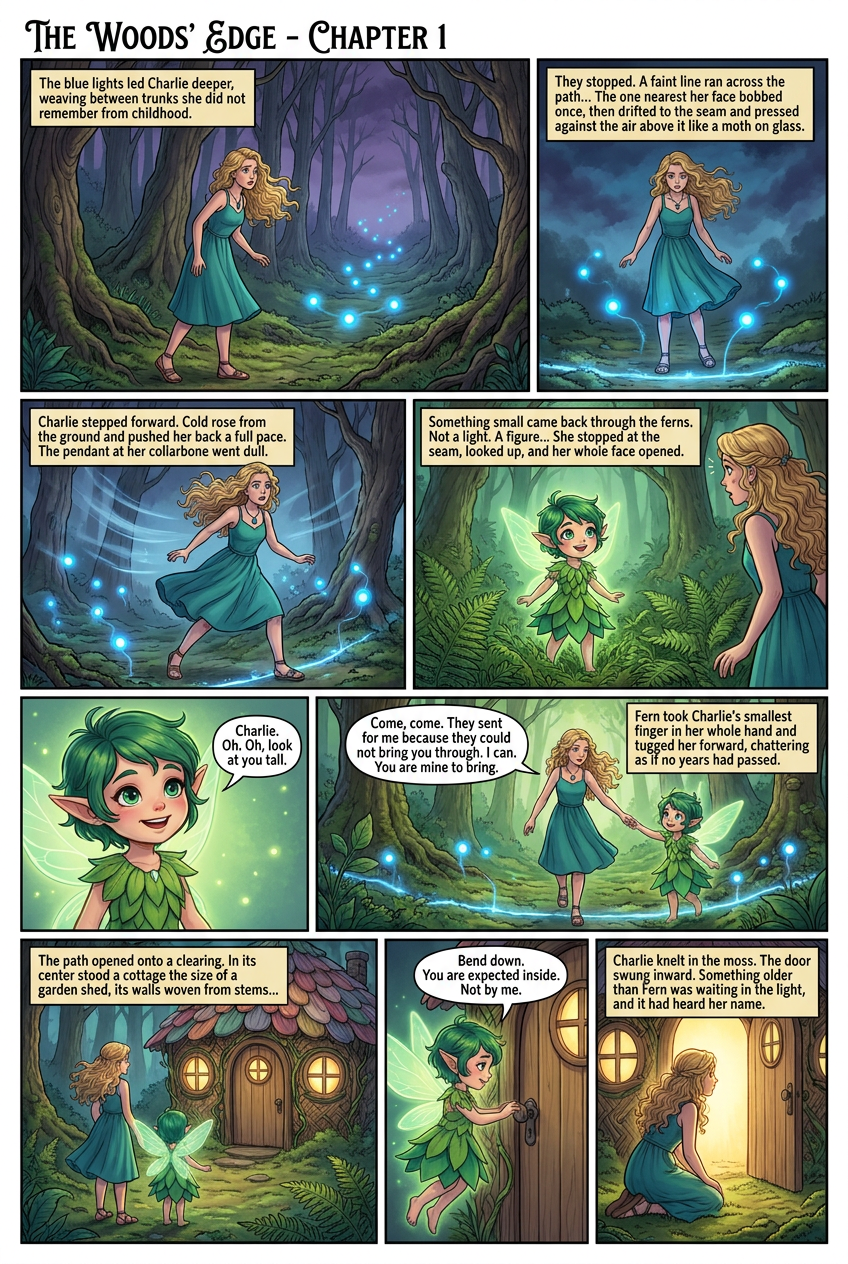
The blue lights led Charlie deeper, weaving between trunks she did not remember from childhood. Then they stopped. A faint line ran across the path, no more than a seam in the moss, but the lights would not cross it. They hovered, blinking, and turned back to her. The one nearest her face bobbed once, then drifted to the seam and pressed against the air above it like a moth on glass. Charlie stepped forward. Cold rose from the ground and pushed her back a full pace. The pendant at her collarbone went dull. She understood without being told. The token had bought her the woods. It had not bought her whatever lay past this line. The lights circled, agitated, and one of them shot ahead into the dark. The others held their places around her knees. Above the trees, the sky had gone the color of a bruise. Charlie could feel the hour turning against her. If nothing changed soon, the lights would leave, and she would be a stranger alone in a wood that had already refused her once. Something small came back through the ferns. Not a light. A figure. She stood no taller than Charlie's hand, barefoot in a dress of stitched leaves, green hair cut short around sharp ears. A soft green glow moved with her like breath. She stopped at the seam, looked up, and her whole face opened. "Charlie," she said. "Oh. Oh, look at you tall." Charlie's throat closed. A memory surfaced without permission: a summer afternoon, a flat stone by the creek, a tiny green friend teaching her to fold a boat from a birch leaf. She had not thought of it in twenty years. She had believed she had made it up. "Fern," Charlie said. The name came before she chose it. Fern Willowgleam laughed, and the sound was too big for her size. She waved a hand across the seam. The cold in the ground went out like a snuffed candle. "Come, come. They sent for me because they could not bring you through. I can. You are mine to bring." Charlie stepped over the line. Nothing pushed back. The blue lights lifted at once and streamed ahead, freed. Fern took Charlie's smallest finger in her whole hand and tugged her forward, chattering as if no years had passed. The path opened onto a clearing. In its center stood a cottage the size of a garden shed, its walls woven from stems, its roof shingled in overlapping petals of every color. Warm light burned in two round windows. A wooden door, no higher than Charlie's waist, stood closed. Fern let go of her finger and flew up to the latch. "Bend down," she said. "You are expected inside. Not by me." Charlie knelt in the moss. The door swung inward. Something older than Fern was waiting in the light, and it had heard her name.
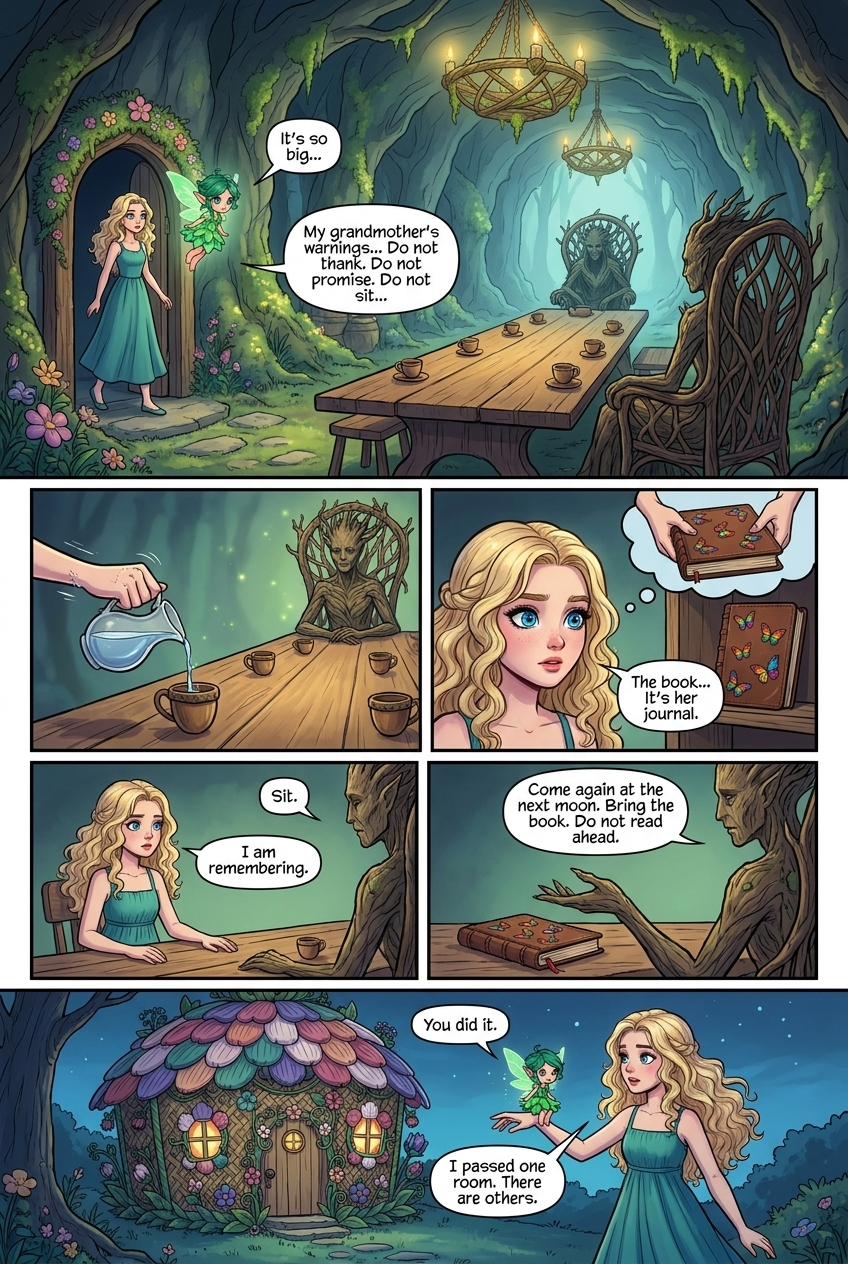
Charlie ducked through the low doorway and the cottage swallowed her whole. Inside was bigger than outside. The ceiling lifted to hold her. A long table ran down the center, set with cups no larger than acorns and one cup sized for her. At the far end, a figure sat in a high-backed chair of woven root. Not old the way a person is old. Old the way a hill is old. Fern hovered at Charlie's shoulder and went very still. Charlie's knees locked. This was not a friendly neighbor in the woods. This was a court. Her grandmother's warnings came back in pieces. Do not thank them. Do not promise. Do not sit before you are asked. She could not remember the rest. Her mouth went dry. One wrong word would end this, and Fern would have to walk her back through the barrier with nothing. Then she saw the book. It lay open on a side shelf, brown leather, rainbow butterflies stitched across the cover. Her grandmother's journal. She had last seen it on a quilt in a summer bedroom, being read aloud. The stories. The girl who curtsied wrong. The boy who said thank you and lost his name. The traveler who offered water first and was let stay. Not stories. Lessons. The figure in the chair lifted one hand a finger's width. An invitation. Charlie stayed standing. She reached to the pitcher on the table, poured a thin measure of water into the small cup nearest the host, and set it down without touching the rim. She stepped back. She did not speak. The room held its breath. Fern's glow steadied. "Sit," the figure said. The voice was low and even, like water under stone. Charlie sat. She kept her hands flat on the table. She did not thank them. She waited to be addressed. "You were taught," the figure said. "I was read to," Charlie said. "I am remembering." Something passed across the long face that might have been a smile. "Your grandmother sent water first, also. For sixty years. We accepted her at this table. We did not accept her past it." A pause. "You will be considered." Fern's wings gave a small, glad flick against Charlie's ear. "Considered by whom?" Charlie asked, and heard her voice hold. "By those not in this room." The figure folded long hands. "Come again at the next moon. Bring the book. Do not read ahead." Charlie understood she had been dismissed. She stood, stepped back three paces before turning, and followed Fern to the door. Outside, the clearing had gone dark blue. Fern landed on her wrist, light as a moth. "You did it," Fern whispered. "You did not fail." "I passed one room," Charlie said. She looked back at the cottage. "There are others."
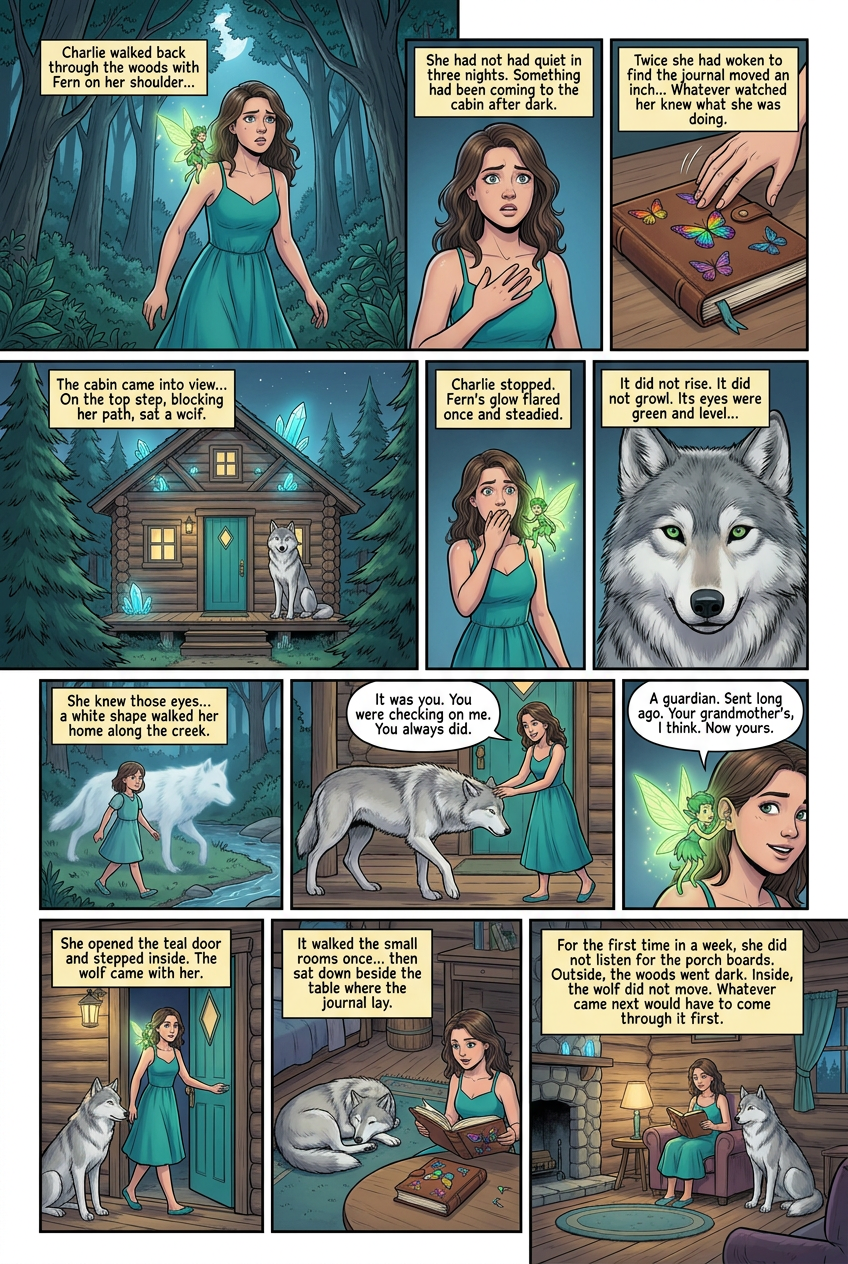
Charlie walked back through the woods with Fern on her shoulder and the taste of court water still in her mouth. One room passed. Others waiting. She had a moon to prepare, and the journal to study, and a case to build for a table full of listeners she could not see. She needed the cabin quiet. She needed to think. She had not had quiet in three nights. Something had been coming to the cabin after dark. She heard breath at the door. She found prints in the dirt below the porch swing. Twice she had woken to find the journal moved an inch on the table, its ribbon shifted. Whatever watched her knew what she was doing. If she carried tampered pages to court, she would fail before she spoke. The cabin came into view between the pines. Blue and green crystals along the roof caught the last light. The teal door glowed. On the top step, blocking her path, sat a wolf. Charlie stopped. Fern's glow flared once and steadied. The wolf was large, white along the chest, grey down the back. It did not rise. It did not growl. Its eyes were green and level and fixed on her face. She knew those eyes. She had known them at seven, when she wandered too far and a white shape walked her home along the creek. She had known them at ten, when she fell asleep in the ferns and woke with warm fur against her spine. "It was you," Charlie said. The wolf's ears twitched forward. "At the door. At the window. Every night this week." The wolf stood. It stepped down off the porch and came to her, slow, until its head was under her hand. The fur was warm. She felt the ribs move. "You were checking on me," she said. "You always did." Fern flew a small circle around the wolf's ears and landed again on Charlie's shoulder. "A guardian," Fern whispered. "Sent long ago. Your grandmother's, I think. Now yours." Charlie's shoulders dropped. The knot behind her ribs let go. Not a spy. Not a saboteur. A watcher who had been watching since she was small. She opened the teal door and stepped inside. The wolf came with her. It walked the small rooms once, nose low, then sat down beside the table where the journal lay. Its tail settled over its paws. It looked at the door. Charlie sat across from it and opened the book. For the first time in a week, she did not listen for the porch boards. She read. Outside, the woods went dark. Inside, the wolf did not move. Whatever came next would have to come through it first.
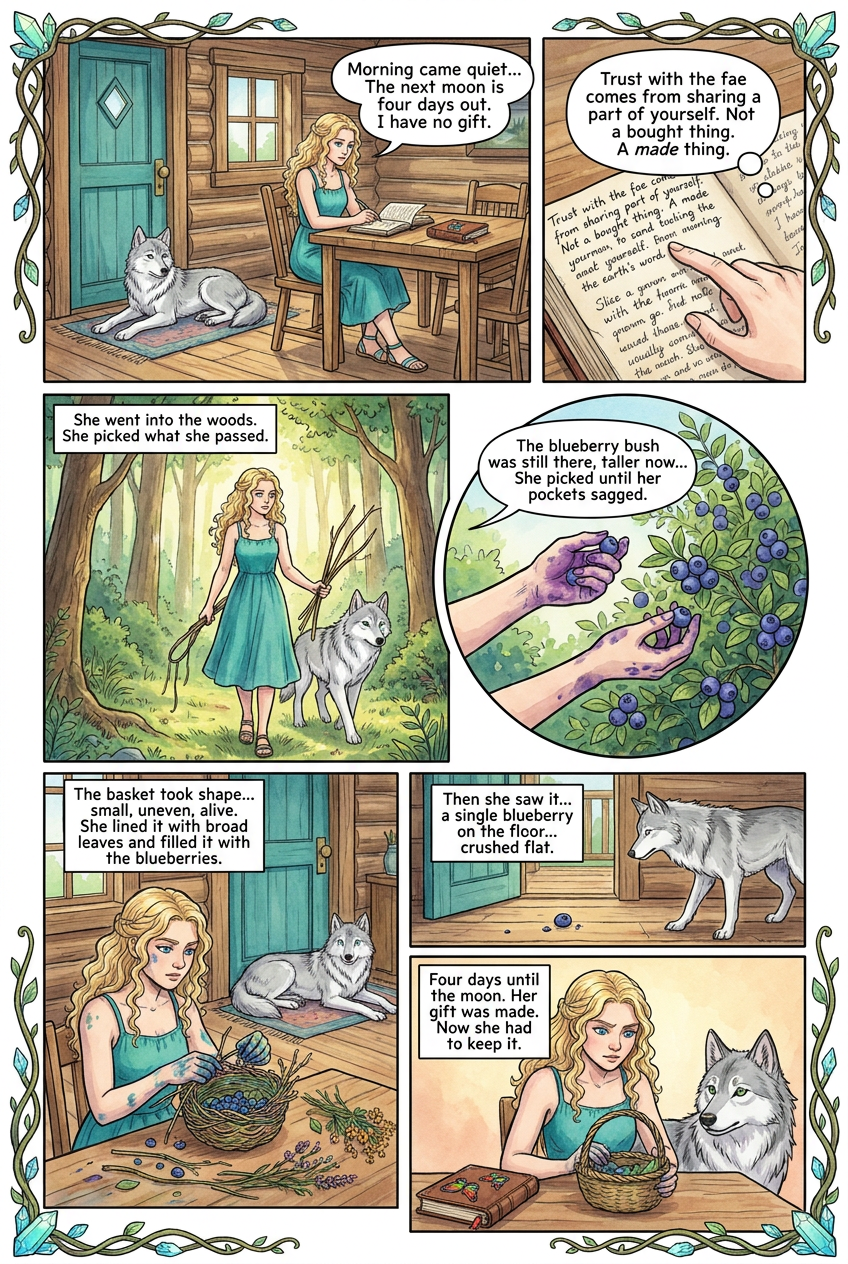
Morning came quiet. The wolf lay by the door. Charlie sat at the table with the journal open, tracing her grandmother's small handwriting with one finger. She had read past midnight and started again at dawn. The next moon was four days out. She had no gift. The court expected one. The journal said so on the third page, in a line Charlie had missed before. Arrive at the table with empty hands and you leave the table for good. She had crossed the barrier, offered water, been named for consideration. All of it undone by a missing basket at the door. She turned another page. Her grandmother had written a note in the margin, ink faded to brown. Trust with the fae comes from sharing a part of yourself. Not a bought thing. A made thing. Charlie read it twice. She thought of the court cottage she had stood inside a week ago — walls woven of living blossoms, roof soft with petals. They built with what grew around them. They would know a store-bought ribbon on sight. She closed the journal. The rainbow butterflies on the cover caught the light. "I need to go out," she said. The wolf lifted its head. It stood when she stood. She went into the woods with the wolf at her hip. She picked what she passed. White yarrow near the creek. Blue chicory by the stumps. Long grass she could split for weaving. She stripped a young willow of three green whips and coiled them under her arm. The wolf watched the trees while she worked. Nothing came near them. On the path back she stopped. The blueberry bush was still there, taller now, heavy with fruit. She had eaten from it at eight years old with purple hands. She set her flowers down and picked until her pockets sagged. At the cabin she cleared the table. The wolf lay across the doorway. She bent the willow into a round frame and tied it with grass. She wove the yarrow and chicory through the ribs, tucking stems, doubling the weak spots. Her fingers learned the pattern by the third pass. The basket took shape under her hands, small, uneven, alive. She lined it with broad leaves and filled it with the blueberries. The berries darkened the green. She set the basket beside the journal. Her hands were stained blue and green. Her back ached. The gift was ready. Then she saw it. A single blueberry on the floor by the porch door — crushed flat. She had not dropped one. The wolf was watching the door, ears forward, still as stone. Something had come to the porch while she wove, and stood close enough to leave a print, and gone again without a sound. Four days until the moon. Her gift was made. Now she had to keep it.
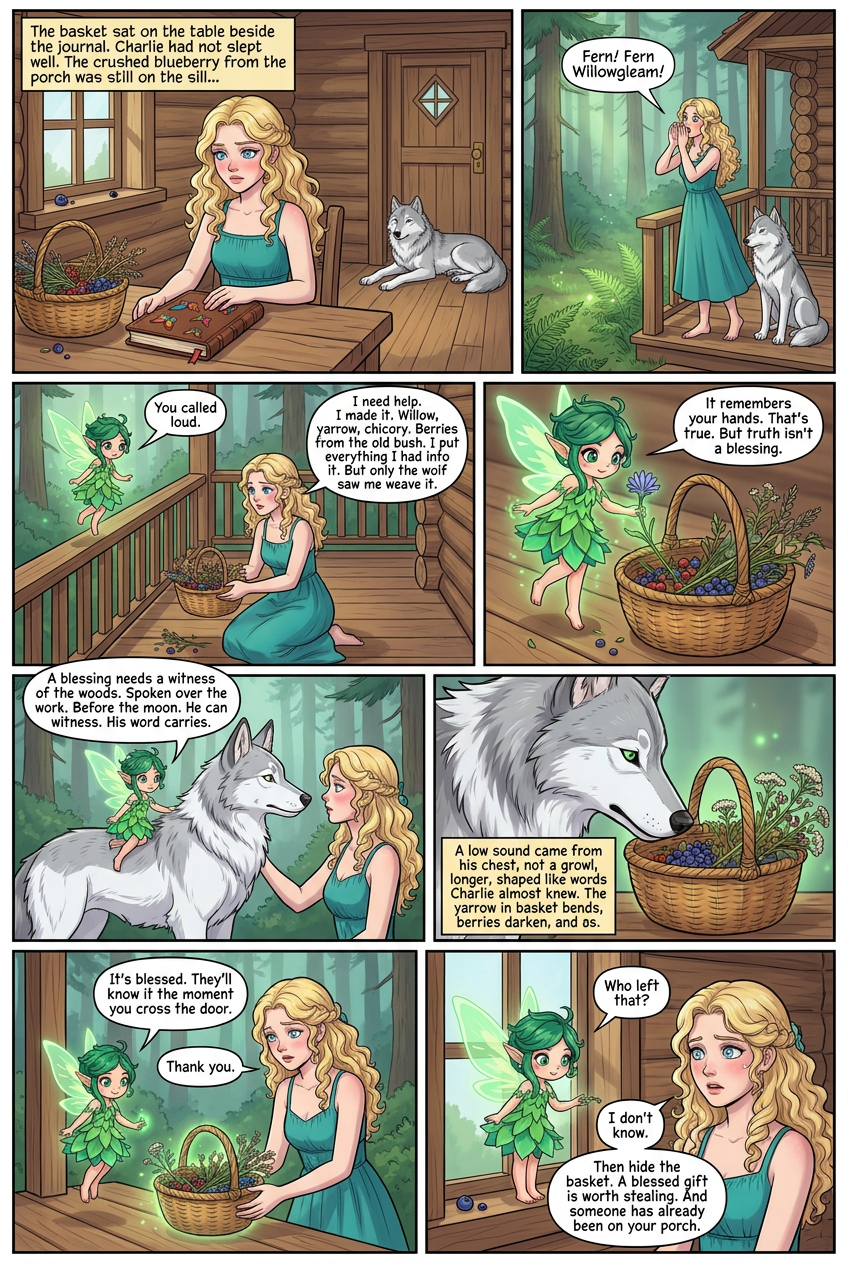
The basket sat on the table beside the journal. Charlie had not slept well. The crushed blueberry from the porch was still on the sill where she had set it as a warning to herself. Three days left. The gift was made, but the journal said a made thing wasn't enough on its own. On the next page, in her grandmother's hand, was a single line she had missed twice: A gift comes to the table blessed, or it comes as bread and string. She read it again. Blessed. Not by her. She had woven the basket alone with only the wolf watching from the door, and a wolf's witness would not count at a fae table. She needed someone of the woods to name it true. Charlie went to the porch. The wolf followed and sat at her heel, green eyes fixed on the tree line. She cupped her hands and called Fern's name into the pines, the way she had as a child at this same rail. She waited. She called again. A green light came through the ferns and stopped at the step. Fern Willowgleam landed on the porch post, leaf dress bright, wings still. She was no taller than Charlie's hand. She had guided Charlie past the barrier once. Charlie hoped she would guide her again. "You called loud," Fern said. "I need help." Charlie brought the basket out and set it on the boards between them. "I made it. Willow, yarrow, chicory. Berries from the old bush. I put everything I had into it." Her voice caught. "But only the wolf saw me weave it. At the table they'll say I could have bought it and lied." Fern walked around the rim of the basket. She touched a chicory stem, then a berry. Her glow deepened where her fingers passed. "It remembers your hands," Fern said. "That's true. But truth isn't a blessing." She looked up. "A blessing needs a witness of the woods. Spoken over the work. Before the moon." "Will you do it?" Fern went still. The wolf stood. "I can witness," Fern said. "I can't bless. I'm too small a name for their table." She flew to the wolf's shoulder and set a hand on his fur. "He can. He was given to your grandmother by one older than me. His word carries." Charlie looked at the wolf. The wolf looked back. Fern lifted the basket in both arms, barely. She held it under the wolf's muzzle. "Say her work is her own," she told him. "In our tongue, if you have it." The wolf lowered his head. A low sound came from his chest, not a growl, longer, shaped like words Charlie almost knew. The yarrow in the basket bent toward him. The berries darkened one shade. The willow ribs held a faint green light after he stopped. Fern set the basket down. "It's blessed," she said. "They'll know it the moment you cross the door." Charlie's hands shook. "Thank you." Fern's wings flicked. She was looking past Charlie now, at the sill, at the crushed blueberry. "Who left that?" "I don't know." "Then hide the basket," Fern said. "A blessed gift is worth stealing. And someone has already been on your porch."
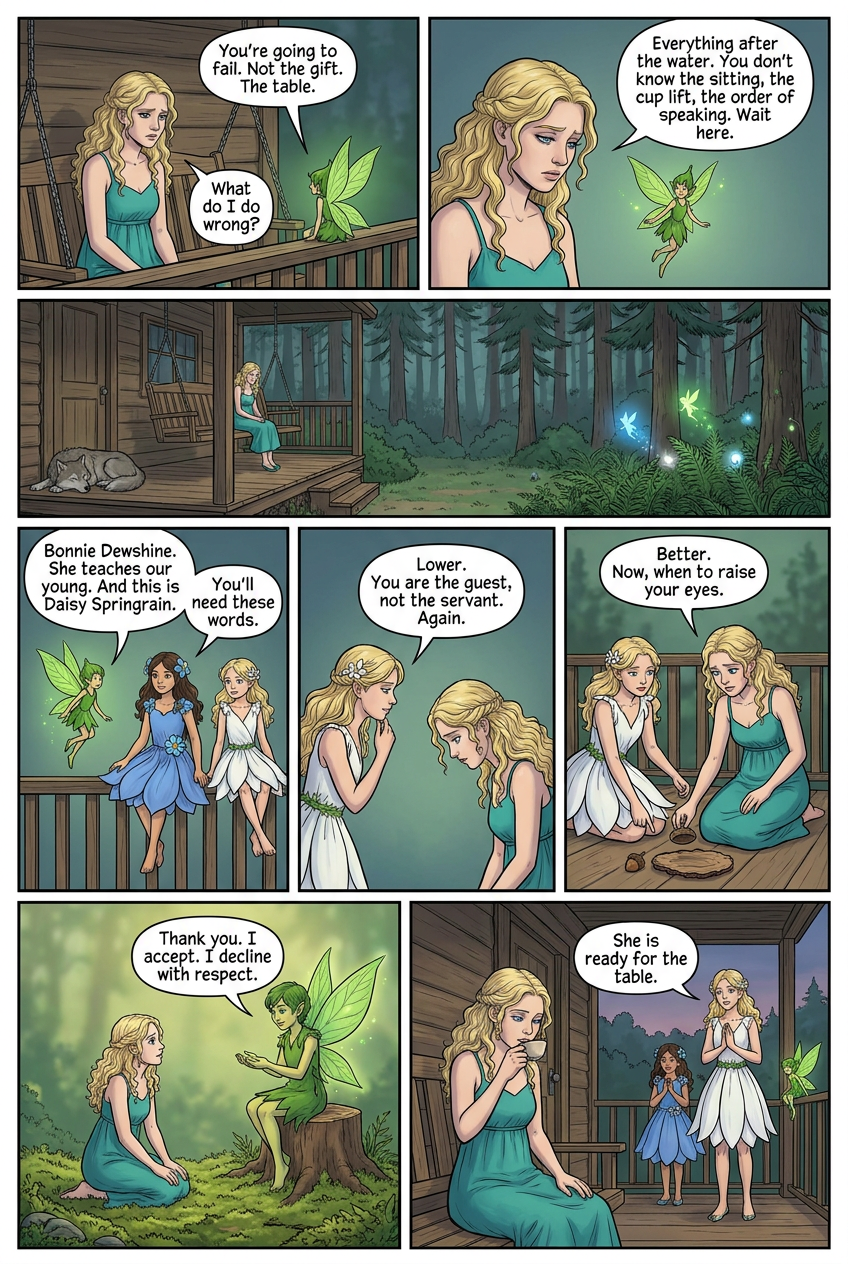
Charlie hid the basket in the cedar chest at the foot of her bed and latched it. When she came back to the porch, Fern had not left. The fairy sat on the rail with her knees drawn up, watching Charlie's face like she was reading a page. "You're going to fail," Fern said. "Not the gift. The table." Charlie sat down on the swing. "What do I do wrong?" "Everything after the water. You know the greeting. You don't know the sitting, the cup lift, the order of speaking. If you reach before you're named, they'll send you home for good." Fern flew up and hovered at eye level. "Wait here." She was gone before Charlie could answer. Charlie waited. The wolf lay across the doorway. The pines went quiet the way they did when something was moving inside them. Then two lights came through the ferns, one blue, one white, with Fern's green between them. They landed on the porch rail together. The blue one wore a dress of small blue flowers and carried herself like a woman used to a classroom. The white one stood a step ahead, hands folded, spine straight, every petal of her white dress in place. "Bonnie Dewshine," Fern said, pointing to the blue. "She teaches our young. And this is Daisy Springrain. No one at the table sits better than she does." Daisy tipped her chin the exact degree of a greeting. Charlie tried to copy it and knew at once she had gone too far. "Lower," Daisy said. "You are the guest, not the servant. Again." Charlie tried again. Daisy nodded once. "Better." They worked on the porch boards. Daisy set out an acorn cap for a cup and a chip of bark for a plate. She showed Charlie how to lift the cup with two fingers, where to set it down, when to keep her eyes on the table and when to raise them. Charlie stumbled at the third pass and Daisy made her start over. She did not soften her voice. Bonnie waited until Charlie's hands stopped shaking. Then she stepped forward with a list of words. "You'll need these," she said. "Thank you. I accept. I decline with respect. May I speak. Say them after me." Charlie opened her mouth and the sounds came out clean. She said the next word before Bonnie gave it. Then the next. Bonnie tilted her head. "Who taught you?" "No one," Charlie said. Then she remembered. A summer clearing. Fern on a stump, small hands cupped, feeding Charlie words one at a time while Charlie repeated them into the moss. She looked at Fern. Fern looked back and did not smile, but her wings lifted. "You already know it," Fern said. "You only forgot." By dusk Charlie could take a seat, lift a cup, and ask leave to speak without a single wrong move. Daisy stepped back and folded her hands. "She is ready for the table," Daisy said. "If she is not stolen from first."
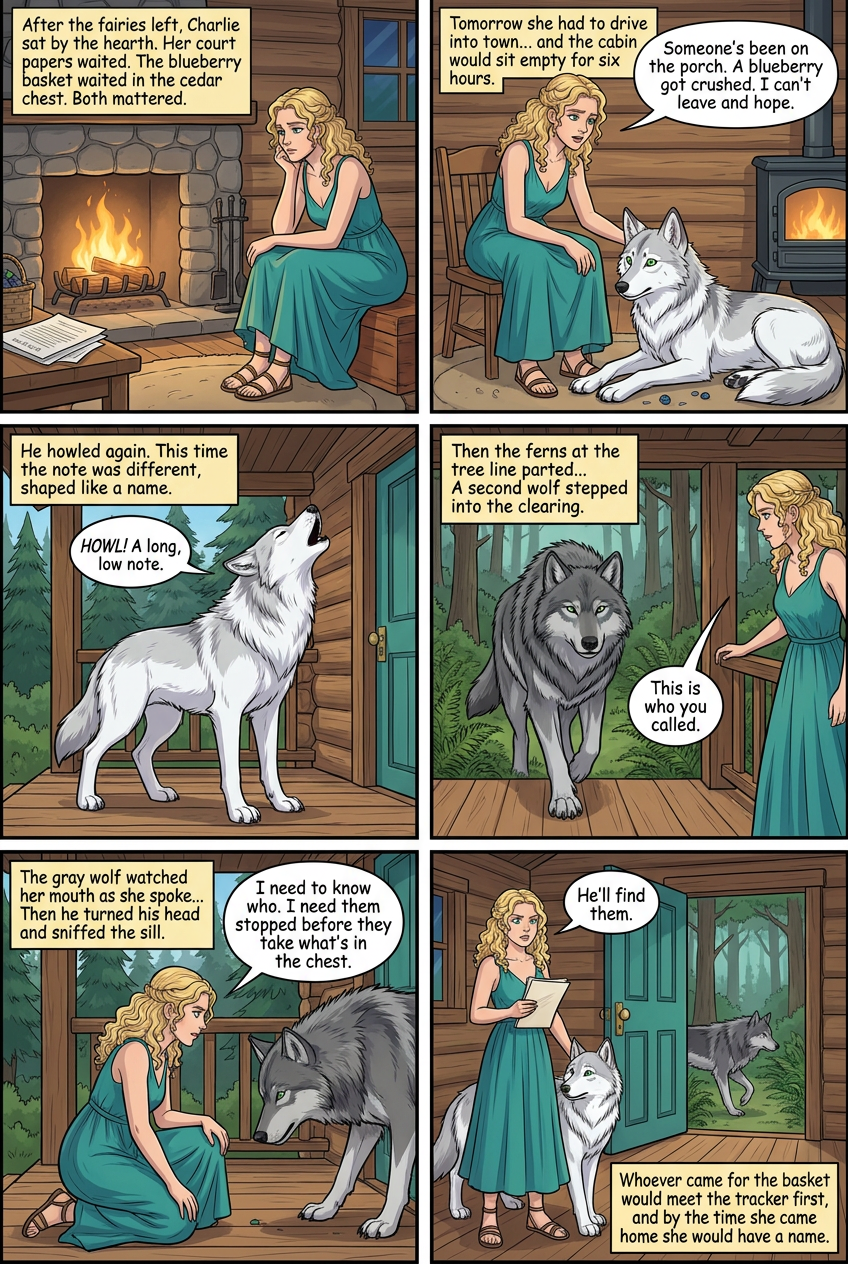
After the fairies left, Charlie sat by the hearth with the fire low. Her court papers waited on the table for morning. The blueberry basket waited in the cedar chest. Both mattered. She could not carry both at once. Tomorrow she had to drive into town for the hearing, and the cabin would sit empty for six hours. The wolf lay across her feet. His green eyes were open. He had heard everything Fern said about being stolen from first. "Someone's been on the porch," Charlie said. "A blueberry got crushed. Fern saw it. You saw it." She leaned forward. "I don't know who. I can't leave and hope." The wolf lifted his head. He looked at the door, then back at her. He stood, shook out his thick coat, and walked to the front of the cabin. Charlie followed and opened the teal door for him. On the porch, the wolf braced his paws on the boards. He tilted his muzzle up past the crystal-studded eaves and howled once, long and low. The pines took the sound and passed it on. Charlie felt it in her ribs. He howled again. This time the note was different, shaped like a name. Charlie waited beside him. Minutes passed. The porch swing did not move. Then the ferns at the tree line parted without wind. A second wolf stepped into the clearing. He was bigger than her guardian, dense gray from shoulder to tail, with dark green eyes that fixed on Charlie and did not blink. He came up the steps slowly and stopped one board from her feet. "This is who you called," Charlie said. Her wolf dipped his head. The gray wolf did not. Charlie knelt down so her face was level with the newcomer's. Her hands shook and she pressed them flat on her knees. "I have to be gone tomorrow. Someone comes onto this porch when I'm not here. I need to know who. I need them stopped before they take what's in the chest." The gray wolf watched her mouth as she spoke, as if reading each word off her lips. Then he turned his head and sniffed the sill where the blueberry had been crushed. He sniffed the boards. He sniffed the step. His lip lifted once and settled. He looked at her guardian. Something passed between them that Charlie could not hear. The gray wolf padded off the porch and vanished into the ferns without a sound. "He'll find them?" Charlie asked. Her wolf leaned his weight against her leg. That was the answer. Charlie went back inside and picked up her court papers. Her hands were steady now. She would drive to town at dawn. The porch would not be empty. Whoever came for the basket would meet the tracker first, and by the time she came home she would have a name.
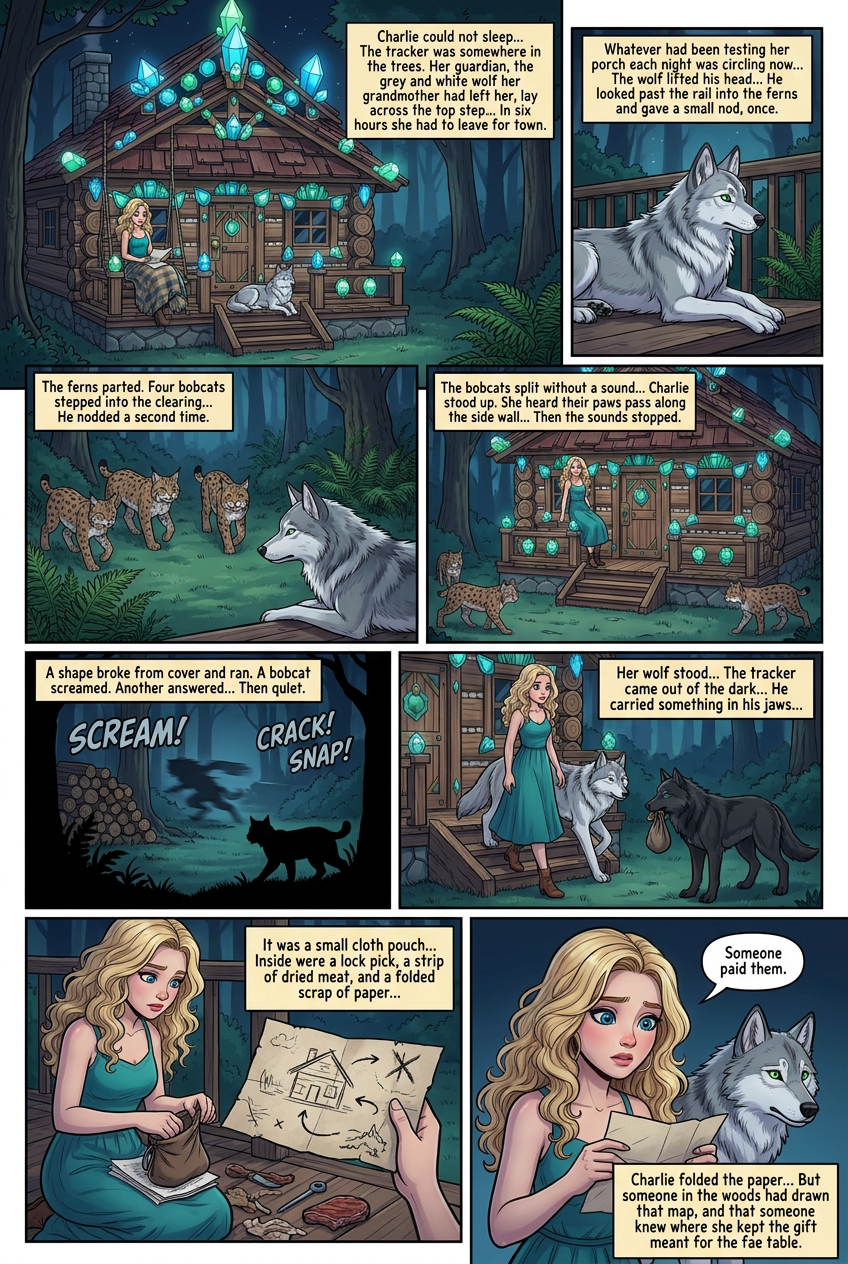
Charlie could not sleep. She sat on the porch swing with a wool blanket over her knees and her court papers in her lap. The tracker was somewhere in the trees. Her guardian, the grey and white wolf her grandmother had left her, lay across the top step with his chin on his paws. His green eyes were half open. The cabin behind her held the cedar chest, and the chest held the blessed basket. In six hours she had to leave for town. The crystals along the eaves caught the moonlight and threw small blue shapes onto the boards. Charlie watched the tree line. Something moved out there. Not close, not yet. A branch cracked to the east. Another cracked to the west. Whatever had been testing her porch each night was circling now, bolder, closer than before. The wolf lifted his head. He did not growl. He looked past the rail into the ferns and gave a small nod, once. The ferns parted. Four bobcats stepped into the clearing in a loose line. Their coats were spotted brown and grey, their ears tipped black. They stopped at the base of the steps and looked up at the wolf. He nodded a second time. The bobcats split without a sound. Two went left around the cabin. Two went right. Charlie stood up. She heard their paws pass along the side wall, under the window, around the back. Then the sounds stopped. They had taken positions. Something heavy shifted in the trees behind the woodpile. A shape broke from cover and ran. A bobcat screamed. Another answered from the far side. Charlie heard branches snap, a body hit the ground, a low choked sound cut short. Then quiet. Her wolf stood. He walked down the steps into the yard. Charlie followed with the blanket still around her shoulders. The tracker came out of the dark from the north, his grey coat wet at the shoulder. He carried something in his jaws and dropped it at Charlie's feet. It was a small cloth pouch. Charlie knelt and opened it. Inside were a lock pick, a strip of dried meat, and a folded scrap of paper with a rough drawing of her cabin, an arrow pointing to the cedar chest, and a mark she did not recognize. "Someone paid them," she said. The tracker huffed once through his nose. Her guardian pressed his shoulder against her hip. Charlie folded the paper and put it in her pocket with her court papers. The intruder would not reach the basket now. But someone in the woods had drawn that map, and that someone knew where she kept the gift meant for the fae table. She looked at the mark again in the porch light. She did not know it. Someone at court might.
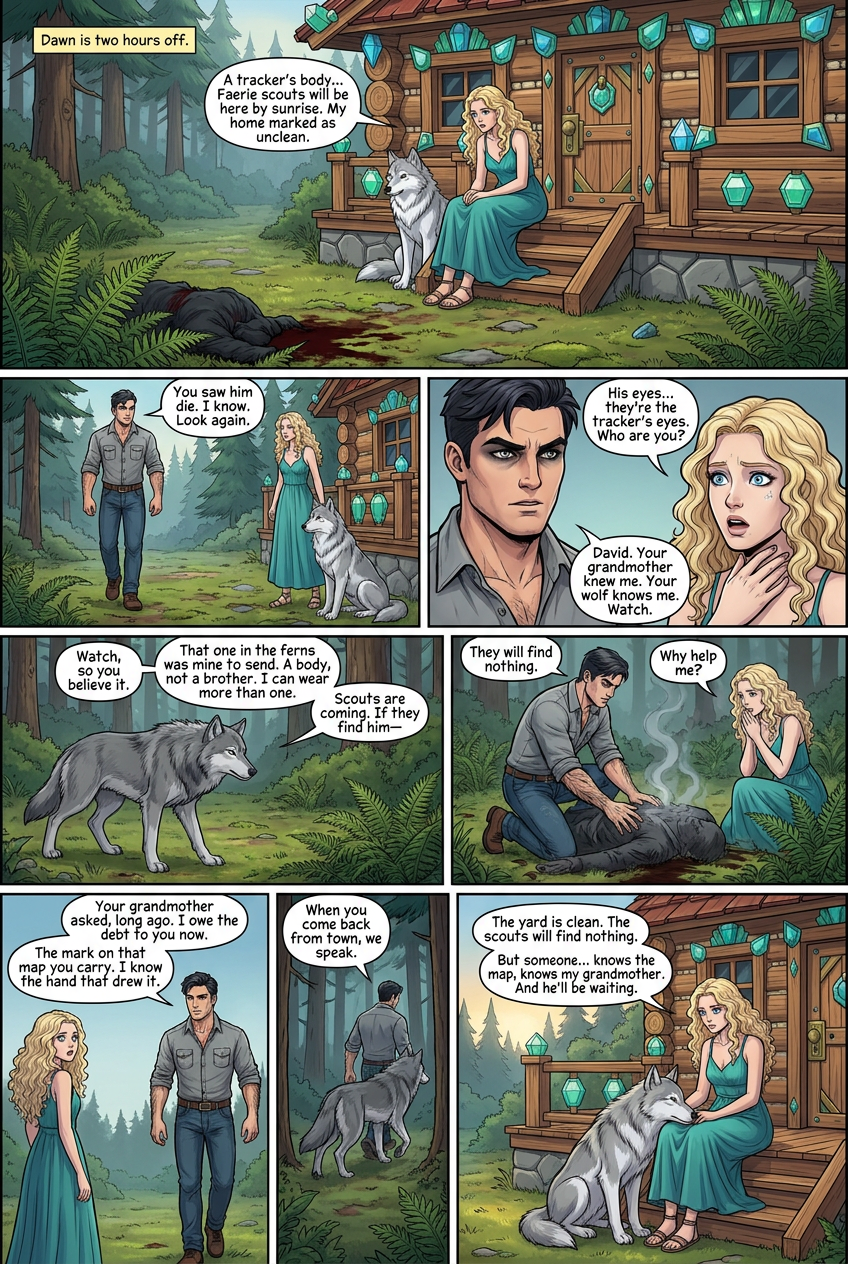
Charlie sat on the porch steps and looked at the body in the ferns. The tracker's blood had soaked into the moss at the edge of her yard. Dawn was two hours off. Fern had warned her that fae scouts walked the tree line before sunrise, and a corpse on her land would mark her home as unclean. The court would not favor a house that could not keep its own ground. She had no shovel deep enough, no time, no plan. Her guardian lay beside her, calm, watching the trees. A man walked out of the pines and into the clearing. He was tall, muscular, in jeans and a button-down shirt. Charlie stood up. Her guardian did not move. He did not lift his head, did not growl. He watched the man cross the yard the way he watched Fern. Charlie looked at the man's face and stopped breathing. His eyes were the tracker's eyes. Grey, ringed dark, wolf eyes in a human face. The tracker was dead in the ferns behind her. She could see the wet shoulder from here. "You saw him die," the man said. "I know. Look again." "Who are you?" "David. Your grandmother knew me. Your wolf knows me." He nodded at her guardian. "Watch, so you believe it." He stepped back onto the grass and dropped to one knee. His shape folded. Fur came up along his arms. His shoulders pulled forward. In three breaths a grey wolf stood where the man had been, the same wolf that had guarded her porch, the same wolf now cooling in the ferns. Then he rose again as a man, brushing his sleeves down. "That one in the ferns was mine to send," he said. "A body, not a brother. I can wear more than one." Charlie's mouth was dry. "Scouts are coming. If they find him—" "They will find nothing." David walked past her to the ferns. He knelt beside the corpse and set both hands on its chest. He spoke three words she did not know. The body sank. The moss closed over it. The blood on the leaves lifted as a thin grey smoke and was gone. The ground was only ground. Charlie stared at the clean earth. "Why help me?" "Your grandmother asked, long ago. I owe the debt to you now." He looked at her. "The mark on that map you carry. I know the hand that drew it. When you come back from town, we speak." He walked to the tree line. Before he reached the pines he was the grey wolf again, and then he was gone. Charlie sat down on the steps. Her guardian pressed against her knee. The yard was clean. The scouts would find nothing. But someone she had never met knew the mark, knew her grandmother, and would be waiting for her when she came home.
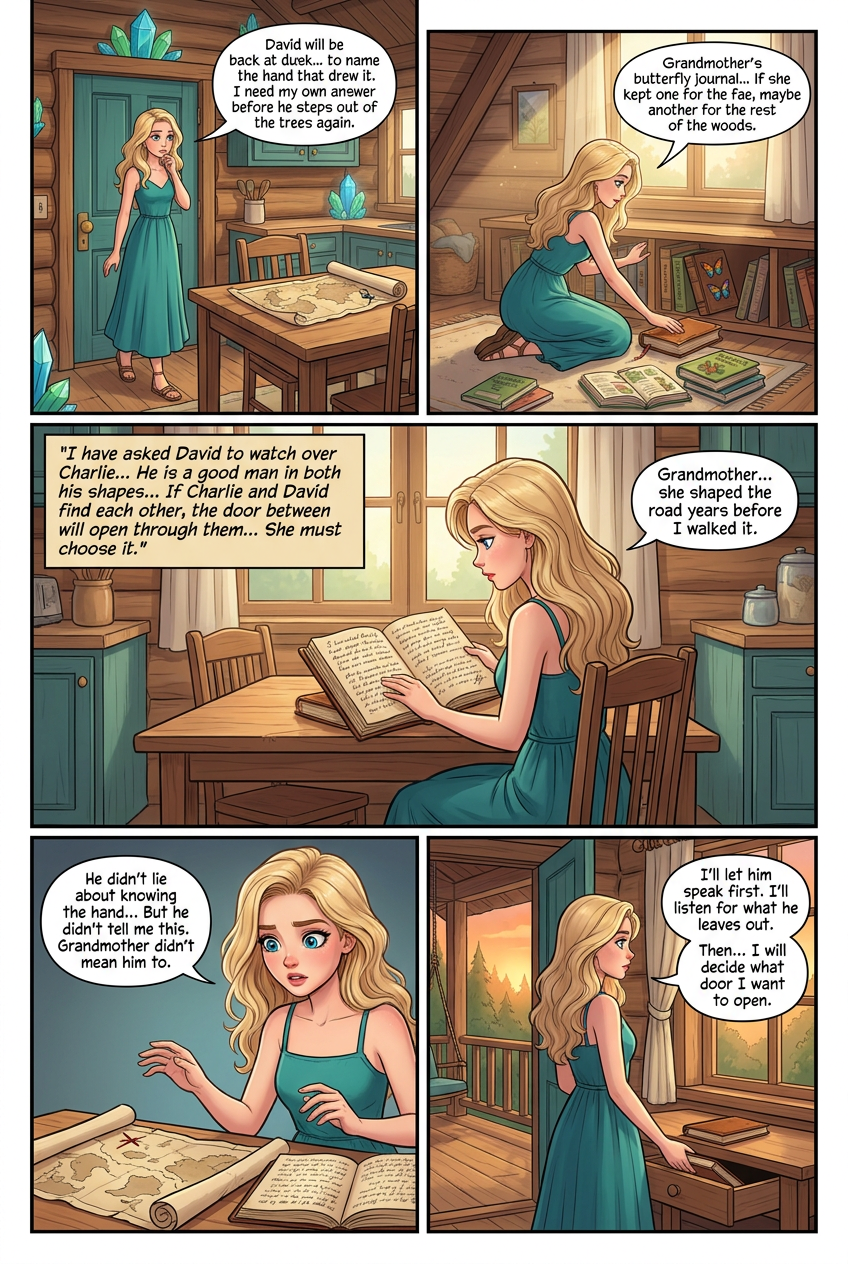
Charlie went back inside the cabin and locked the teal door behind her. The map lay on the kitchen table where she had left it. The mark in the corner watched her like an eye. David would be back at dusk to name the hand that drew it. She could not wait that long, and she could not let him tell her first. If he lied, she would have no way to catch the lie. She needed her own answer before he stepped out of the trees again. She thought of the butterfly journal upstairs, the one full of fae etiquette and pressed leaves. Her grandmother wrote everything down. If she kept a book for the fae, she might have kept another for the rest of the woods. Charlie climbed to the loft and knelt at the low bookshelf under the window. She pulled every book off the shelf. Behind a row of gardening manuals, pushed flat against the wall, was a worn caramel leather journal she had never seen. She carried it to the table and opened it. Her grandmother's handwriting filled the pages. It was not about fairies. It was a ledger of others. Shifters. Wolf-men. Names, debts, favors owed. Charlie turned pages until she saw the name David. There were three entries. The first was forty years old. Her grandmother had pulled a shifter boy out of an iron trap and paid the trapper to forget. The second, twenty years later, a winter loan of the cabin's back room. The third entry was dated the summer before her grandmother died. Charlie read it twice. "I have asked David to watch over Charlie when she returns. He is a good man in both his shapes. I have told him her route through the woods and the days she will come home. My hope is small and old. Two worlds have kept themselves apart too long. If Charlie and David find each other, the door between will open through them. I will not tell her. She must choose it, or it is not a door." Charlie set the journal down. Her grandmother had placed David in her path. Not as a guard. As a match. The mark on the map, the debt, the wolf that walked out of the pines — her grandmother had shaped the road years before Charlie walked it. She turned the map over and looked at the mark again. David had not lied about knowing the hand. He might not have lied about anything. But he had not told her this, and her grandmother had not meant him to. Charlie closed the caramel journal and slid it into the drawer under the table. When David came at dusk, she would let him speak first. She would listen for what he left out. Then she would decide what door, if any, she wanted to open.
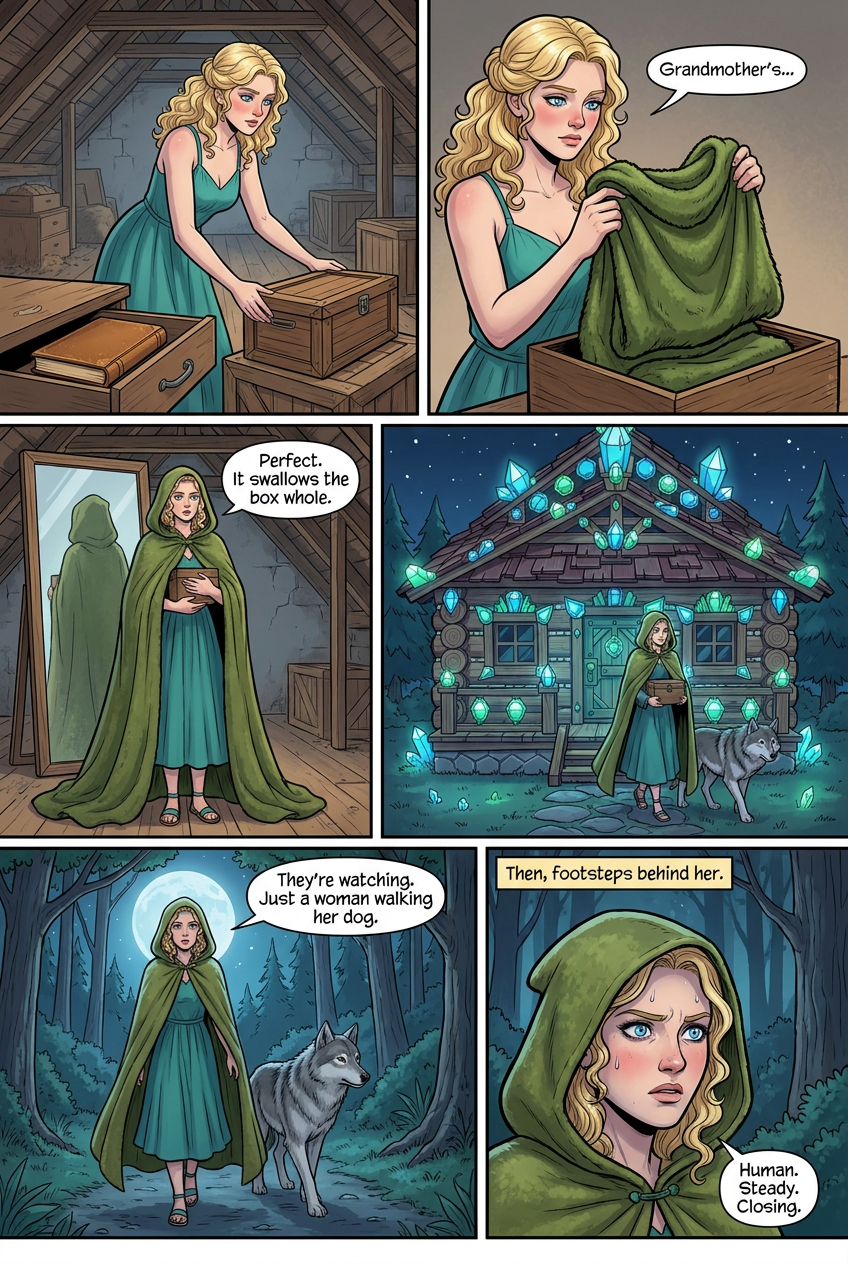
Charlie shut the drawer on the caramel journal and looked at the map one more time. The moon would rise in a few hours. She still had to carry the blessed basket through the trees, and someone with money had already sent one tracker to take it. A second try would come. If they saw her on the path with the basket in her hands, they would not miss twice. She needed the basket hidden before she stepped off her porch. She climbed to the attic. The rafters smelled of cedar and dust. She dragged trunks aside until she found a sturdy wooden box wedged behind a crate of canning jars. The lid fit tight. The inside was lined with old wool. She lifted it down and set it on the floor. Under the box lay a folded bundle. She shook it out. A plush cloak, deep and heavy, the color of moss in shadow. Her grandmother's, she guessed. She pulled it around her shoulders. It fell past her knees and pooled at her feet. When she held the box against her chest, the cloak swallowed it whole. No shape showed. No corner poked through. She went down to the main room of the cabin, unlocked the cedar chest, and lifted the basket out. The willow and yarrow still held the darkened glow from the wolf's blessing. She set it inside the wooden box. It fit as if the box had been cut for it. The blueberries did not shift. She closed the lid. She practiced. She stood in front of the window with the box against her ribs and drew the cloak forward. In the reflection she saw a tall woman in a long hood, arms folded like she was cold. Nothing more. Her teal sundress showed only at the hem. The box was gone. Charlie stepped onto the covered porch of the crystal-studded cabin and locked the teal door behind her. The wolf rose from the swing where it had been lying. It looked at the cloak, then at her face, and fell in at her heel without a sound. She kept the box tight under her left arm and one hand free at her side. She walked the path slow. Twice she heard movement in the brush. Once, a low branch cracked to her right. She did not turn her head. The wolf's ears did the turning for her. Nothing came out of the trees. Whatever watched saw a hooded woman on a night walk with a big dog, and let her pass. At the edge of the fae woods she stopped and breathed. The basket was still hidden. She was still whole. Ahead, past the barrier, the moon court was waiting for her to arrive. Then she heard footsteps behind her on the path. Human. Steady. Closing.
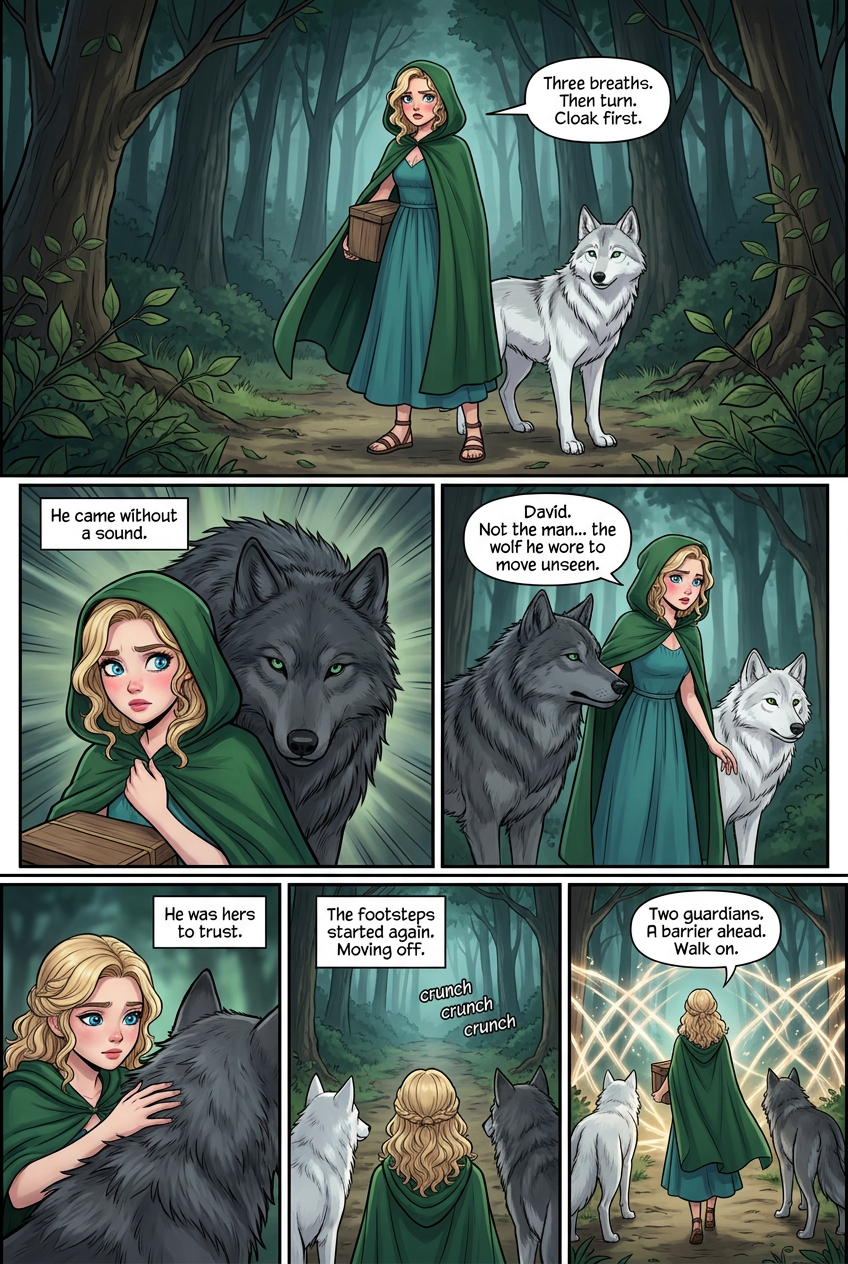
Charlie kept her back to the path and listened. The footsteps stopped a dozen paces behind her. Boots, not paws. Heavy, but careful. She tightened her arm around the wooden box under the cloak and thought through what she had at hand. No phone would reach out here. No neighbor would hear a shout. The wolf could fight, but a fight before the barrier meant blood on the ground, and blood on the ground meant a home marked unclean before she ever reached the court. She needed a signal she could send fast, and she had none. No horn. No flare. No word Fern had given her for danger on the path. Her guardian pressed against her left leg. Its shoulder came up past her hip, warm through the sundress. Its ears were flat. Green eyes fixed on the trees behind her. She felt her own pulse in the pad of her thumb where it braced the box. She made herself count. Three breaths. Then she would turn, cloak first, and see who had come. Before she reached the third breath, something moved on her right. She flinched and looked. A second wolf stood at her elbow, close enough to touch. Bigger than her guardian. Dense gray fur, dark down the spine, pale at the throat. Green eyes, sharper than the first pair. He had come out of the brush without a sound. No branch had cracked. No leaf had turned. She knew him before her mind caught up. David. Not the man in the button-down shirt now. The wolf shape he wore when he wanted to move unseen. He did not look at her. He looked past her, at the path, at whatever had followed. His lip lifted once, then settled. He stepped forward half a pace, so his shoulder was ahead of hers, and stopped there. Charlie waited for the debt to show in him. The old debt to her grandmother. The reason he gave for everything. She watched his ribs move. She watched the set of his head. There was no ledger in it. He had not come because she called. She had not called. He had not come to pay anyone. He had come because he had decided, alone, that she should not walk to the barrier without a second body between her and the trees. She felt it land in her chest, quiet and certain. He was hers to trust. Behind her, the footsteps started again, moving off. Whoever had followed had counted the wolves and chosen not to try two. Charlie let out the breath she had been holding. She did not need a signal now. She had two guardians at her sides and a barrier ten steps ahead. She shifted the box under the cloak, set her hand lightly on the gray wolf's shoulder, and walked on.
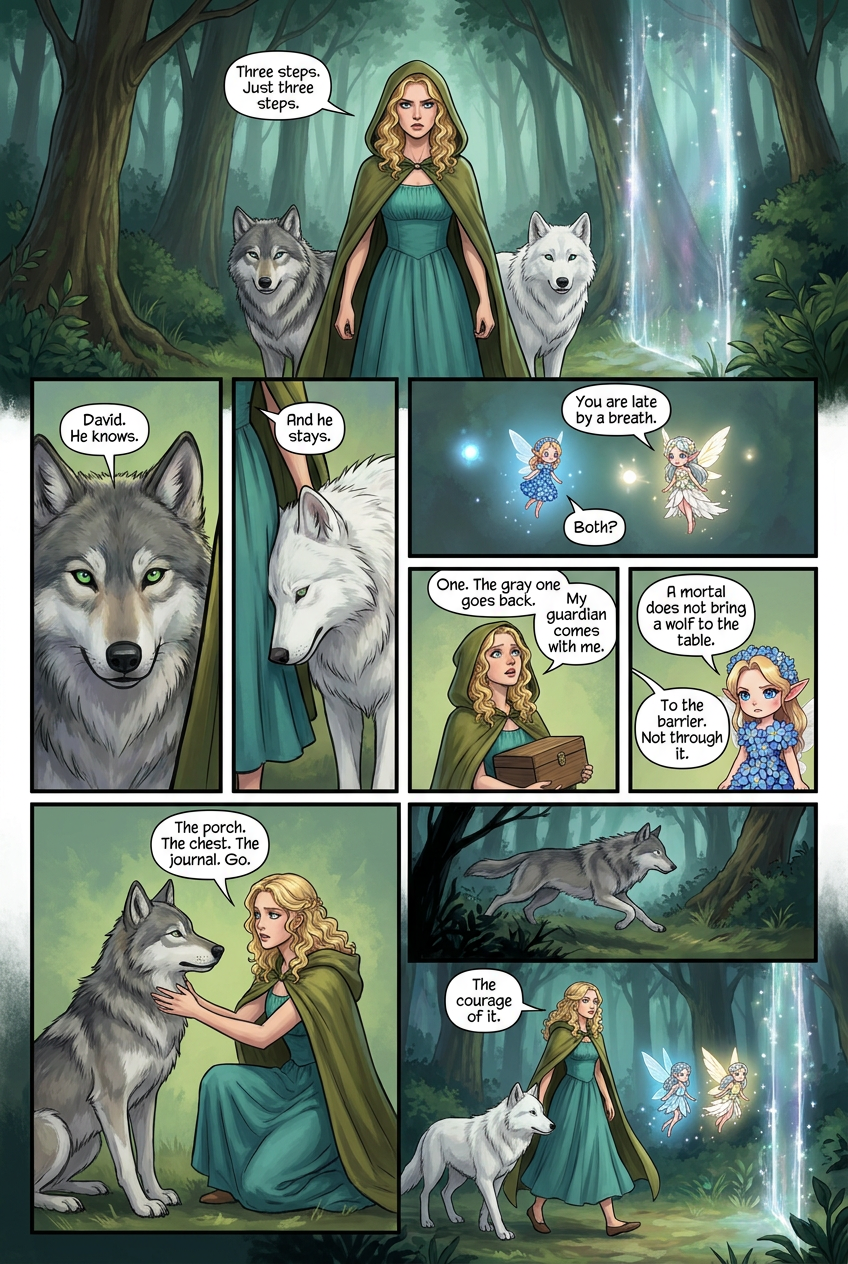
Charlie stopped three steps short of the barrier. The wooden box pressed against her ribs under the moss-colored cloak. The blessed basket inside was the only thing that mattered to the court, and she was about to carry it across a line she could not step back through quickly. The follower on the path had run, but a hired hand always reported back. Whoever sent that tracker would send another. Her cabin sat empty behind her. The porch, the cedar chest, the journal. All of it open. She stood with two wolves at her sides and felt the pull of the wrong direction. She looked down at her guardian, then at the gray wolf beside him. David's green eyes met hers. He did not blink. He tipped his head once toward the path she had come from, then set his weight square on his front paws. He was telling her he would go back. He would hold the porch. She would not have to ask. Her guardian pressed his shoulder against her thigh and held there. He would stay with her. Between them they had split the problem in half without a word. A blue glow lifted through the ferns ahead, and a white glow beside it. The lights slowed and settled into shape. Bonnie Dewshine, in her dress of blue flowers, hovered at eye level. Daisy Springrain drifted down beside her, white petals bright against the dark trees. They were the two who had drilled Charlie in the table words and the sitting and the lifting of the cup. Their faces were not warm now. They were working faces. "You are late by a breath," Daisy said. "Not late enough to fail. Come." Bonnie looked at the wolves. "Both?" "One," Charlie said. Her voice came out steady. "The gray one goes back to guard my cabin. My guardian comes with me to the barrier." Daisy's small mouth tightened. "A mortal does not bring a wolf to the table." "To the barrier," Charlie said. "Not through it. He walks me to the line. Then I walk in with you." Bonnie nodded once. Daisy waited a beat, then dipped her chin. Approved. Charlie knelt. She put her hand flat on the gray wolf's shoulder. The fur was warm under her palm. "The porch. The chest. The journal." She did not thank him. He had told her already that debts were not the reason. "Go." David turned and was gone into the brush without sound. Charlie stood. Her guardian pushed his head against the back of her knee, then stepped forward, nudging her toward the two fae and the line of air that shimmered between the trees. She felt the courage of it move up her spine. She shifted the box under the cloak, lifted her chin, and walked to the barrier with the wolf at her heel and the two small lights leading her in.
Play your story to life
Storycraft is a mobile game where you create AI characters, craft items and locations to build their world, then discover what direction your story takes. Download the iOS game for free today!
Download for free