

Cherriese's Arc
13 Chapters
Cherriese's dream is founding a hidden grove where every exiled fairy can finally live in peace.

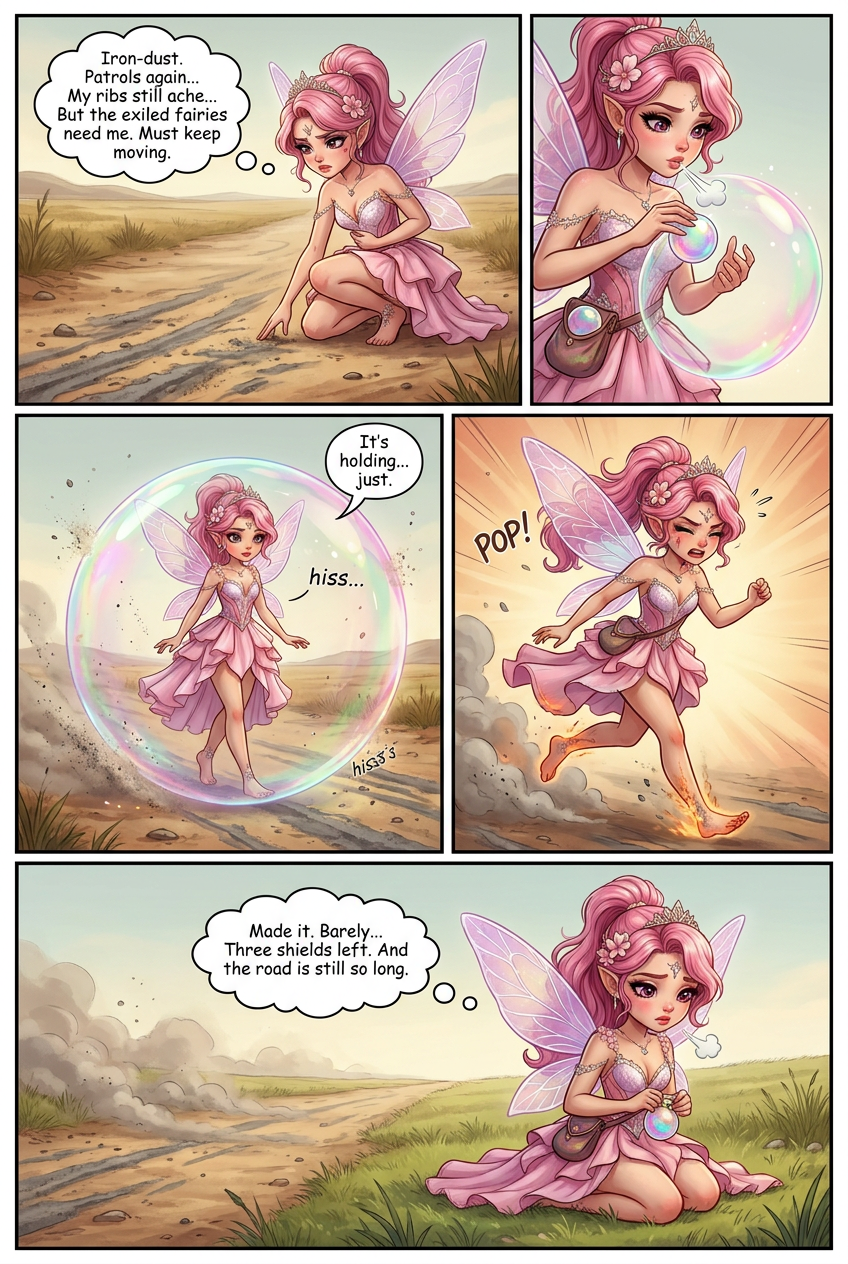
Cherriese crouched at the edge of the road and counted the gray streaks in the dirt. Iron-dust. The patrols had been through again. She pressed a hand to her ribs, where the last crossing had left a deep ache, and reminded herself why she kept moving. Somewhere ahead waited a place with safe water and borders she could hold. The exiled fairies counting on her did not have time for her to be careful. She pulled the little bubble from her pouch and breathed on it. It bloomed around her in a shimmer of pink and green, thin as a soap film. She stepped onto the road. The dust hissed against the shield but did not touch her skin. Halfway across, the bubble popped with a small wet sound, and the burning bit her ankles. She ran the last stretch and collapsed in the grass on the other side. The shield had worked, barely. She had three left, and the road ahead was long.
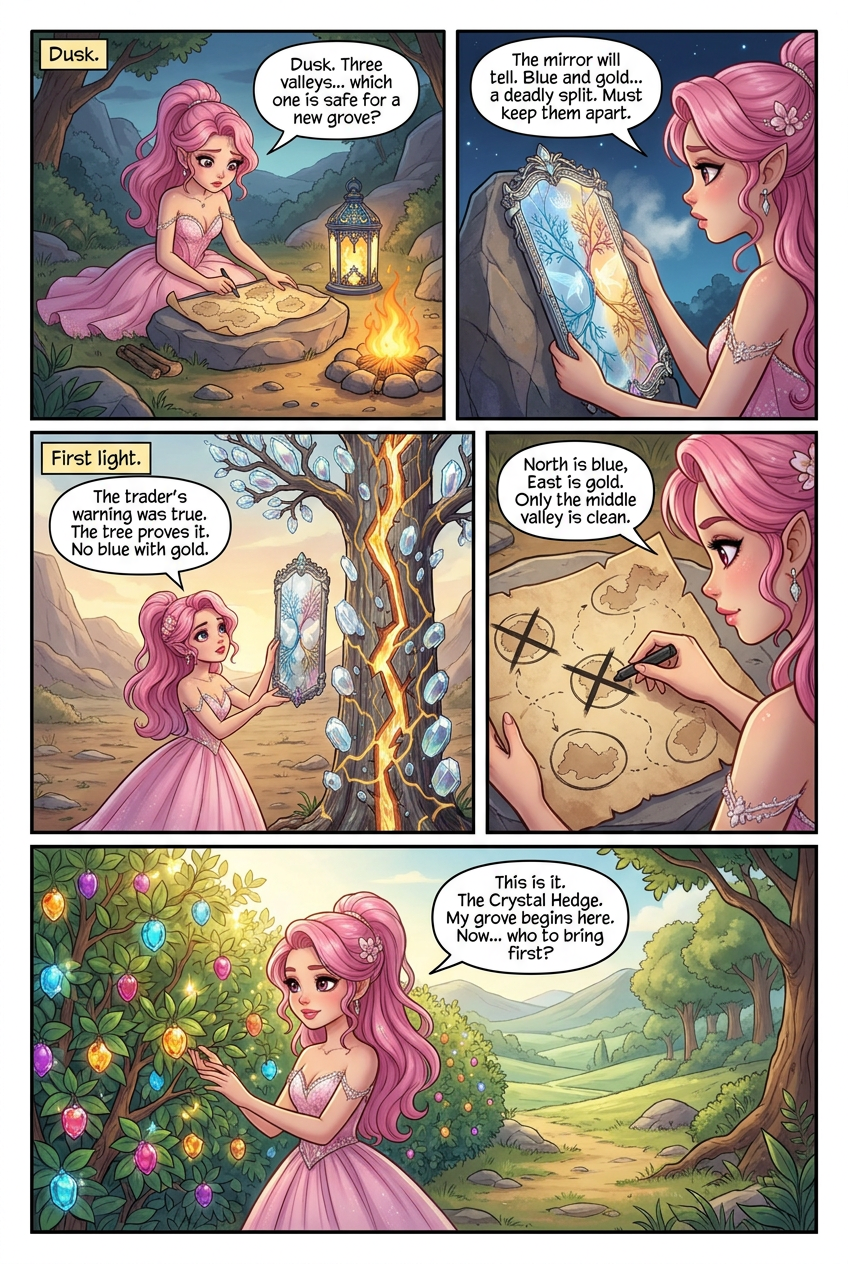
By dusk Cherriese had walked far enough from the iron-dust road to risk a small fire. She unrolled her map on a flat stone and stared at the three valleys she had circled. Each one had safe water. Each one had ridges she could defend. But she did not yet know which exiled fairies she could place inside the same borders without killing them. Some bloodlines burned through each other on contact. If she chose wrong, the grove would tear itself apart before the first winter. She needed proof, not guesses. She pulled the prism mirror from the bottom of her pack and set it upright against the stone. The crystal was cracked across its face in thin, branching lines. When she breathed on it, the cracks lit up in different colors. Blue veins ran one way. Gold ran the other. Where the two colors met, the glass had split clean through. She traced the fractures with her finger and started writing the pairings in the dirt. Blue and gold: no. Pink and gold: safe. Green and blue: safe only with distance. She worked until the fire burned low and her hand cramped. The mirror could only show her so much. To trust it, she needed to see the damage in the world. She remembered a place the traders had warned her about, half a day's walk north, where a tree had split itself apart for no reason anyone could name. At first light she went to find it. She found the tree in a clearing where nothing else grew. Its trunk was cracked from root to crown, and bright sap still leaked from the seam like a wound that would not close. Blue crystals studded one half of the bark. Gold crystals studded the other. She held the mirror up beside it. The fractures matched. She sat down in the dead grass and accepted what the tree told her. Two of her three valleys were lost. The northern one had blue-line families already sheltering near its springs. The eastern one was gold-line country. She could not invite both. The middle valley was the only one where she could start clean, because no bloodline had claimed it yet. It was also the smallest, and the hardest to reach. She marked the other two off her map with a charcoal stub. On the walk back she passed a long hedge of woody stalks hung with small bright fruits, the kind that grew only where the soil had been undisturbed for a hundred years. She stopped and pressed her palm against the branches. This was the edge of the middle valley. This was where the grove would have to begin, and where she would have to keep every bloodline she brought in carefully apart from the next. She had her place. Now she had to decide who arrived first, and who would have to wait longer than they could afford.
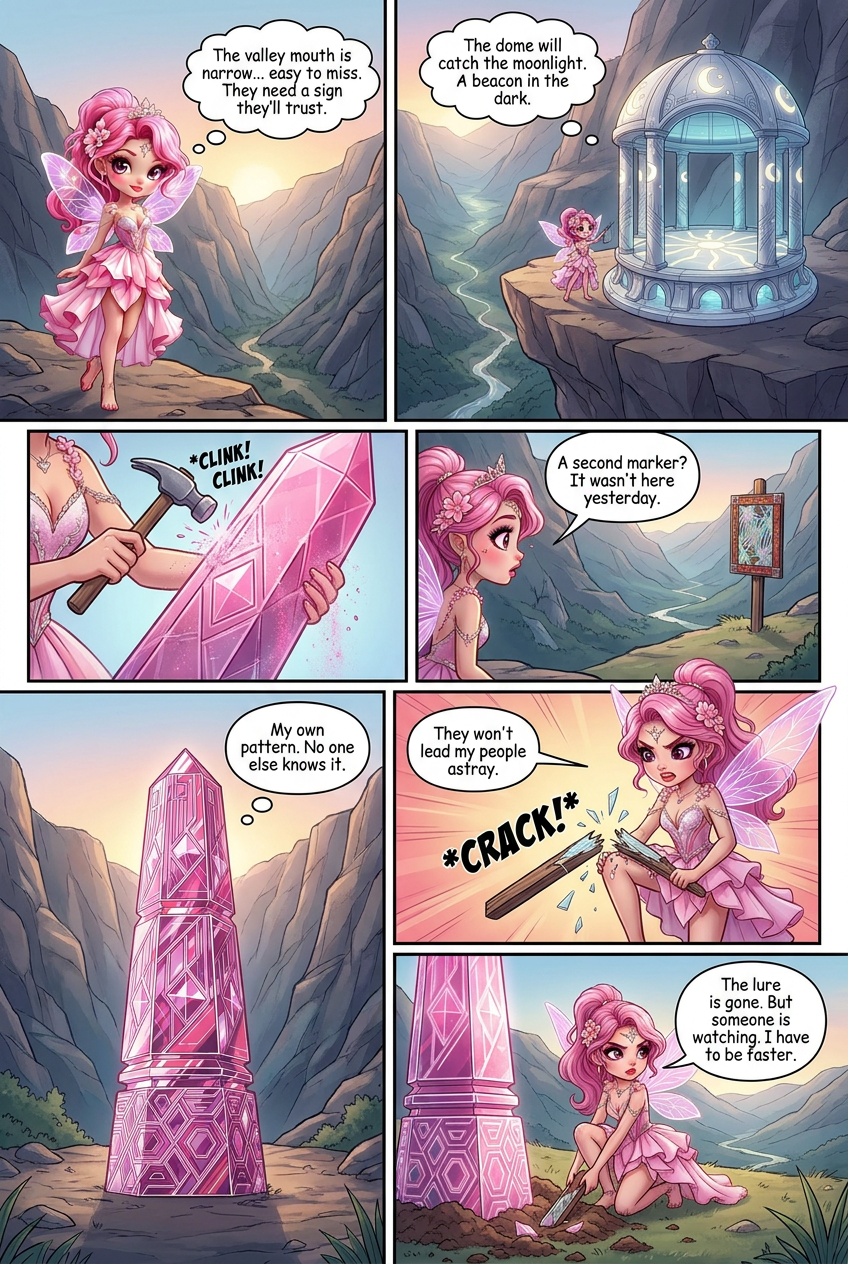
Cherriese walked the edge of the middle valley at first light and counted the ways a lost fairy could miss it. The valley mouth was narrow. Two side gullies branched off before it, and both looked more inviting from the air. Any exile flying in tired and scared would take the easy turn and end up in blue-line or gold-line country. She needed a sign at the entrance that her people would trust, and that no one else could copy. She found her stone in a dry creek bed: a tall pink crystal, taller than she was, with flat faces clean enough to carve. She dragged it upright against the slope at the valley mouth and pulled the small hammer from her pack. She worked through the morning. She cut her own pattern into the crystal in sharp, exact strikes — the geometric mark she had used since she was a child, the one no one else had ever bothered to learn. Each strike rang. Pink dust fell at her feet. By midday the obelisk stood at the gate, etched on every face with a pattern only her hand made. The mark was hers, but a mark alone would not guide a frightened flock through the dark. She walked back along the ridge and chose a flat shelf above the valley mouth, visible from a long way off. There she raised a small domed pavilion of pale stone, low and round, its floor traced with glowing lines that pointed straight down into the valley. At night the dome would catch the moon and throw its light onto the path. An exile lost in the air would see the glow first, then the obelisk below it, and know which gully to take. She was tying off the last beam when she saw the second marker. It stood at the mouth of the western gully, half a mile off. A cracked glass frame on a post, etched with symbols that read backward. It had not been there yesterday. Someone had set it during the night, angled to catch the eye of anyone coming in from the north. She climbed down and walked to it. The glass was fresh. The post was still damp at the base. Whoever placed it knew exiles were coming and meant to pull them into the wrong valley before she could meet them. Cherriese pried the marker out of the dirt and broke the frame across her knee. She carried the pieces back to her own gate and buried them under the obelisk, where her pattern would sit on top of them. The lure was gone for now. Her sign was up. But someone was watching the valley already, close enough to plant a trap overnight, and that meant her next problem was not finding her people. It was reaching them before the next false marker did.
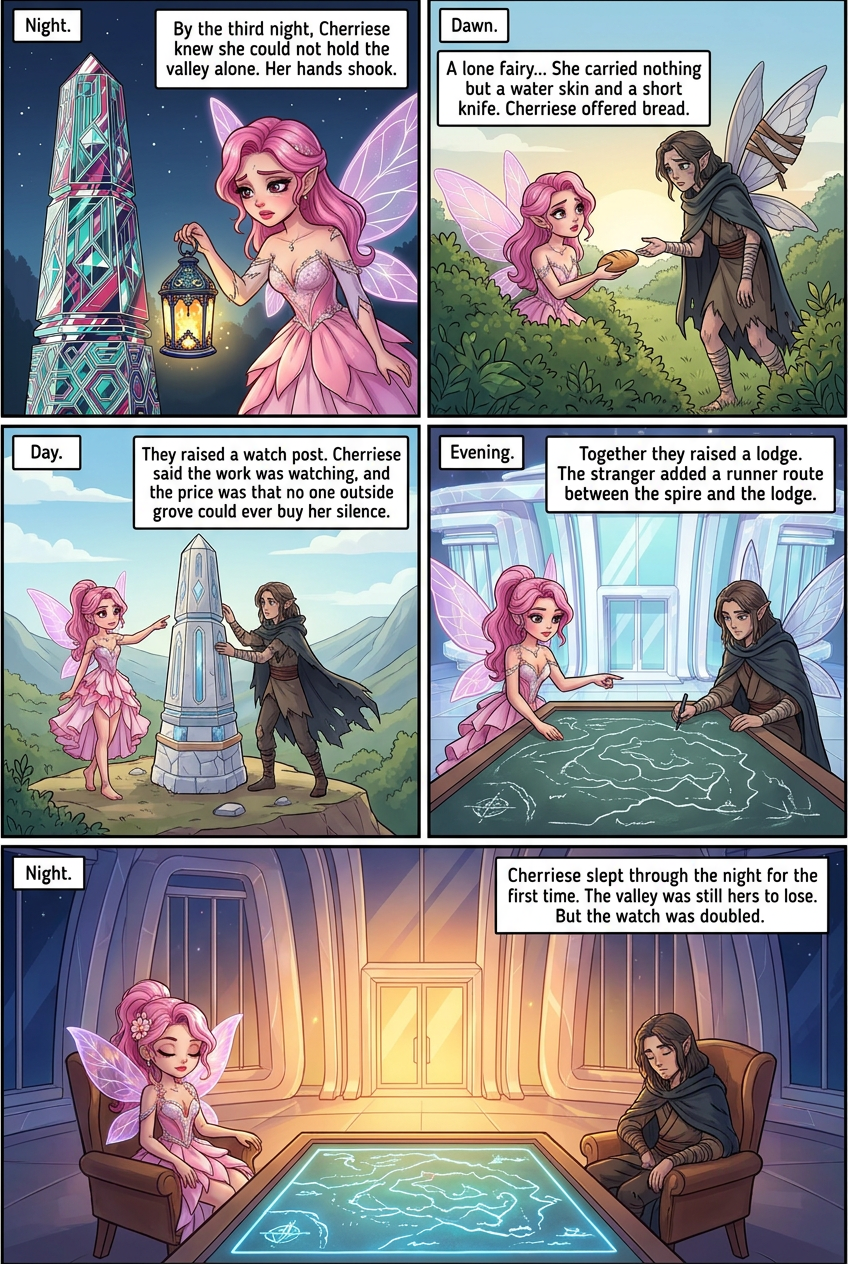
By the third night Cherriese knew she could not hold the valley alone. She had walked the ridge twice between dusk and dawn, checked the obelisk, checked the beacon dome, and slept in pieces against the cold stone. Her hands shook when she lit her lantern. The first families were days out, maybe less, and whoever planted the false marker would plant another. One pair of eyes was not enough. She needed a second guardian before the first exile reached the gate, and she needed one she could trust without a contract. She came down the ridge at dawn and watched the north road from cover. A lone fairy was walking it, limping, one wing bound flat against her back with strips of bark. She carried nothing but a water skin and a short knife. Cherriese stepped out and offered bread. The stranger split the loaf in half and handed the larger piece back. Then she pointed at Cherriese's torn sleeve, sat down in the dirt, and started tearing her own cloak into bandages. She had been walking two days. She had not asked Cherriese's name. She was binding a stranger's arm with the cloth off her own back. Cherriese took her up the slope and showed her the valley. She did not promise safety. She said the work was watching, and the price was that no one outside the grove could ever buy her silence. The stranger asked one question — where to stand — and Cherriese answered by climbing to the far ridge above the western gully. There they spent the morning raising a tall watch post of pale crystal stone, narrow at the base, wide at the crown, with a railed platform that looked down on both gullies and the north road at once. From that platform a single guard could see a false marker go in the ground before the dirt was tamped. They came back down before dark and cleared a flat patch near the obelisk for the second build. Cherriese laid the floor stones herself. Together they raised a low round lodge with curved walls and broad glass panels, bright enough inside to work by at any hour. They set one table in the center and two chairs. On the table Cherriese drew the valley in chalk: the gate, the beacon, the new spire, the two gullies, the north road. She marked which watch each of them would take and when. The stranger added a mark Cherriese had not thought of — a runner route between the spire and the lodge, in case the beacon failed. Cherriese slept through the night for the first time since the obelisk went up. The valley was still hers to lose. But the watch was doubled, the lodge had two chairs at its table, and the next false marker would be seen before it caught anyone. In the morning the first family would come, and she would not meet them alone.
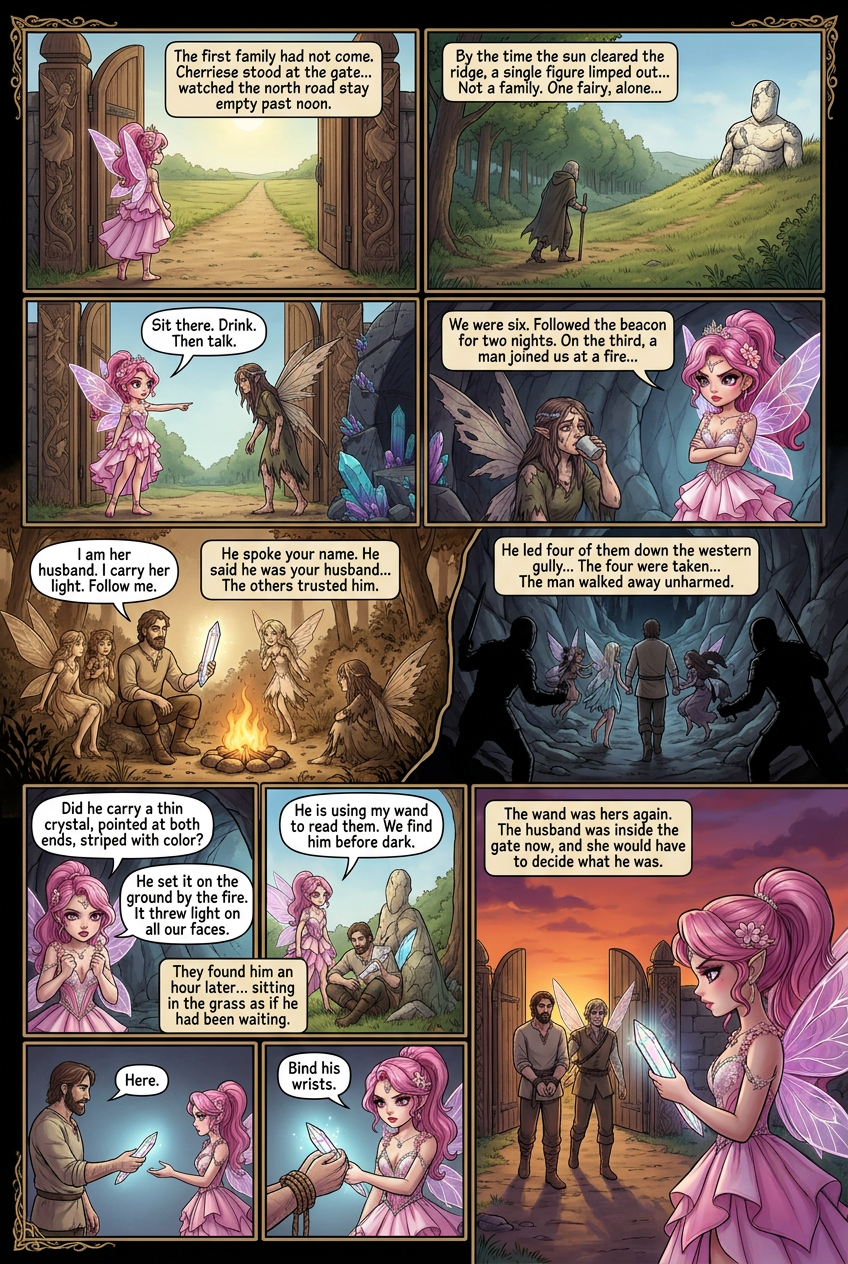
The first family had not come. Cherriese stood at the gate with her partner at the lodge door and watched the north road stay empty past noon. By the time the sun cleared the ridge, a single figure limped out of the tree line below the western slope. Not a family. One fairy, alone, leaning on a stick. Behind that figure, on the high shoulder of the slope, stood a weathered stone shape Cherriese had not built. It was a pale, pitted figure with a humanoid silhouette, half sunk in the grass, marking the spot where the stranger had first come into view of the valley. Cherriese went down to meet the exile at the gate and made the exile stop there. The fairy was thin, wing-torn, mouth cracked from thirst. Cherriese pointed to a curved stone alcove cut into the rock beside the path, its floor smooth from old water, its mouth ringed with blue and purple crystal. "Sit there," she said. "Drink. Then talk." The exile sat. Cherriese stayed standing. Until she knew what had happened on the road, she could not send her partner out, and she could not let anyone in. The exile said they had traveled in a group of six. They had followed the beacon light down the correct path for two nights. On the third night a man joined them at a fire. He was not a fairy. He spoke Cherriese's name. He said he was her husband and that he carried something of hers. The others trusted him. He led four of them down the western gully toward the false marker. The exile in the alcove had not gone. The exile had hidden in the brush and walked the rest of the way alone. The four were taken by iron-dust patrols before dawn. The man had walked away unharmed. Cherriese's hands went cold. She had felt him near for two days and told herself it was nerves. Now she knew. He had used her name to sort the trusting from the careful, and the trusting were gone. She asked the exile one question. "Did he carry a thin crystal, pointed at both ends, striped with color?" The exile nodded. "He set it on the ground by the fire. It threw light on all our faces." Cherriese turned to her partner at the lodge door. "He is using my wand to read them. We find him before dark." They found him an hour later at the foot of the pale stone figure on the slope, sitting in the grass as if he had been waiting. The wand lay across his knees, faceted and bright, chipped at one end but whole. He stood when Cherriese came up the rise. He held the wand out to her by the dull end. She took it. Her hand closed around it and the light steadied. She did not thank him. She told her partner to bind his wrists. The wand was hers again. The husband was inside the gate now, and she would have to decide what he was.
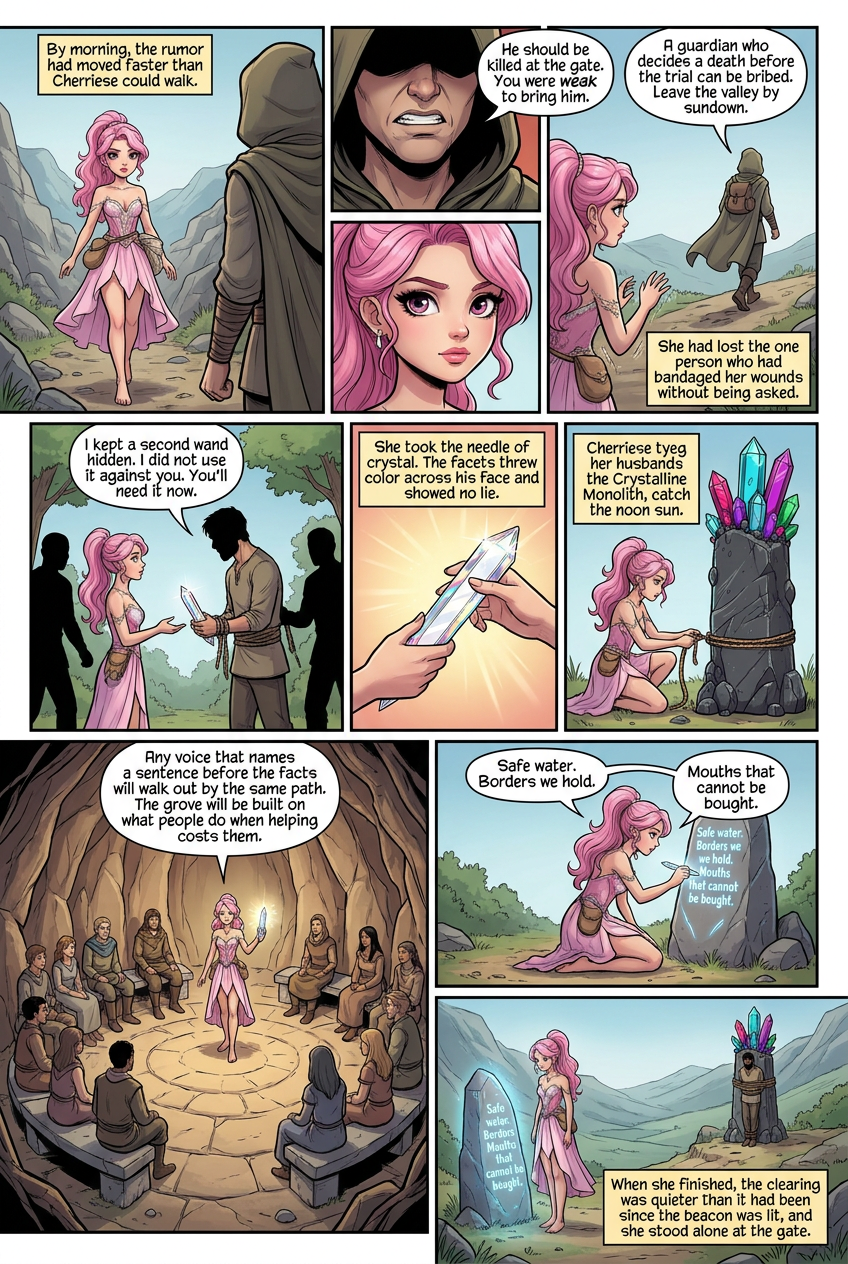
By morning the rumor had already moved through the valley faster than Cherriese could walk it. The lone exile had spoken to two newcomers at the water line. The newcomers had spoken to her partner. By the time Cherriese came down from the lodge with the wand wrapped in cloth at her belt, her partner met her on the path with a hard face and a harder mouth. The partner said the husband should be killed at the gate before he spoke a word. The partner said Cherriese had been weak to bring him in. Cherriese listened until the partner was done. Then she told the partner to leave the valley by sundown. The partner stared. Cherriese did not raise her voice. She said a guardian who decided a death before the trial was a guardian who could be bribed to decide the next one. She said she would not build a grove on that. The partner spat on the stones and went up the slope to gather a pack. Cherriese watched until the figure was past the ridge. Her hands shook only after. She had lost the one person who had bandaged her wounds without being asked, and she had lost her at the worst hour. That was when her husband came down the path between two of the newcomers, wrists still bound, and held out the thin striped crystal to her a second time. He said he had kept a second wand hidden in his coat lining. He said he had not used it against her. He said she would need it now that she stood alone at the gate. Cherriese took the needle of crystal from his bound hands and turned it in the light. The facets threw color across his face and showed no lie she could read. She did not thank him. She walked him to the jagged stone pillar at the center of the clearing, its crown of sharp crystals catching the noon sun, and tied his rope to its base. He would stand there until she decided what he was. Then she rang the lodge bell and called the valley in. They gathered inside the hollow trunk shelter, on the stone benches under the crystal-studded bark. Sixteen faces. She told them what her husband had done on the road. She told them what her partner had demanded and why she had sent the partner away. She held up the second wand so every face caught its light. She said any voice that spread a rumor before the trial, any voice that named a sentence before the facts, would walk out of the valley by the same path her partner had taken. The grove would be built on what people did when helping cost them, not on what they whispered when it was easy. She walked them out to the tall carved stone at the clearing's edge and cut her three rules into the soft band beneath the crystal inlays with the point of the new wand. Safe water. Borders we hold. Mouths that cannot be bought. The valley read the lines as she carved them. No one spoke. When she finished, the clearing was quieter than it had been since the beacon was lit, and she stood alone at the gate with two wands and a husband tied to stone.
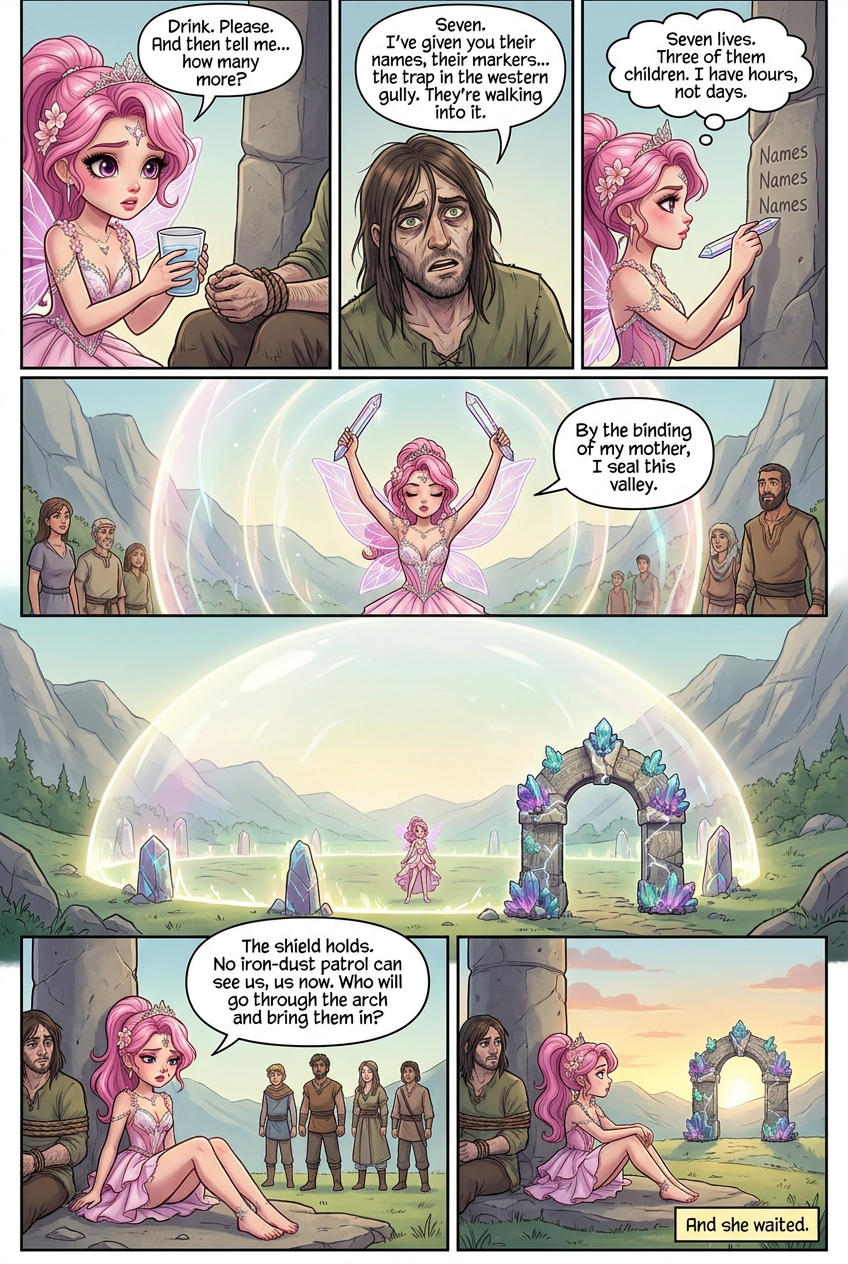
At first light Cherriese came down to the pillar with bread and water for her husband. He had not slept. The rope had cut a red band into his wrists. She set the cup against his mouth and waited until he drank. Then she asked him the only question that mattered now. How many more were still on the road, and did he know their names. He answered without pause. Seven. He listed them. He gave their faces, their bloodlines, the marker each had been told to follow. He named the false marker in the western gully and the hour his old contact would be watching it. Cherriese wrote each name on the soft band of the carved stone with the point of the striped wand. She did not look at her husband while she wrote. When the list was cut she stepped back and studied it. Seven exiles, three of them children, all walking toward a trap that already knew their faces. The iron-dust patrols would reach the gully before any runner she sent could. She had hours, not days. She walked to the tall crystal-streaked stone at the inner edge of the clearing, where her husband had stood when he gave up the names. She set both wands against its base. The valley people came out of the lodge and watched without speaking. Cherriese took the slender needle wand in her right hand and the striped wand in her left and lifted them above her head. She spoke the binding her mother had taught her once and never used. The words were short. She said them twice. The air over the valley folded. A pale membrane climbed from the ridge stones, layer over layer, soft pink at the seams and clear at the centers, until it closed above the highest pine. Light moved through it in slow pulses, like a held breath. Along the ridge line at the valley mouth, the boundary stones lit from within and a wide arch of crystal-shot rock pushed up from the ground where no arch had stood before, marking the line any exile would cross to enter safe ground. Cherriese felt the shield draw on her. Her knees softened. She kept her arms up until the seams sealed. When she lowered the wands her hands were shaking and her nose was bleeding. The shield held. Inside it, no iron-dust patrol could see down and no false marker could pull a fairy back out. She turned to the sixteen faces at the lodge door and named the seven on the stone. She said any guardian who would walk through the new arch and bring them in before dusk should step forward now. Four did. She gave them the names, the faces, the gully, and the hour. Then she sat down at the base of the pillar where her husband was tied, and she waited for them to come back.
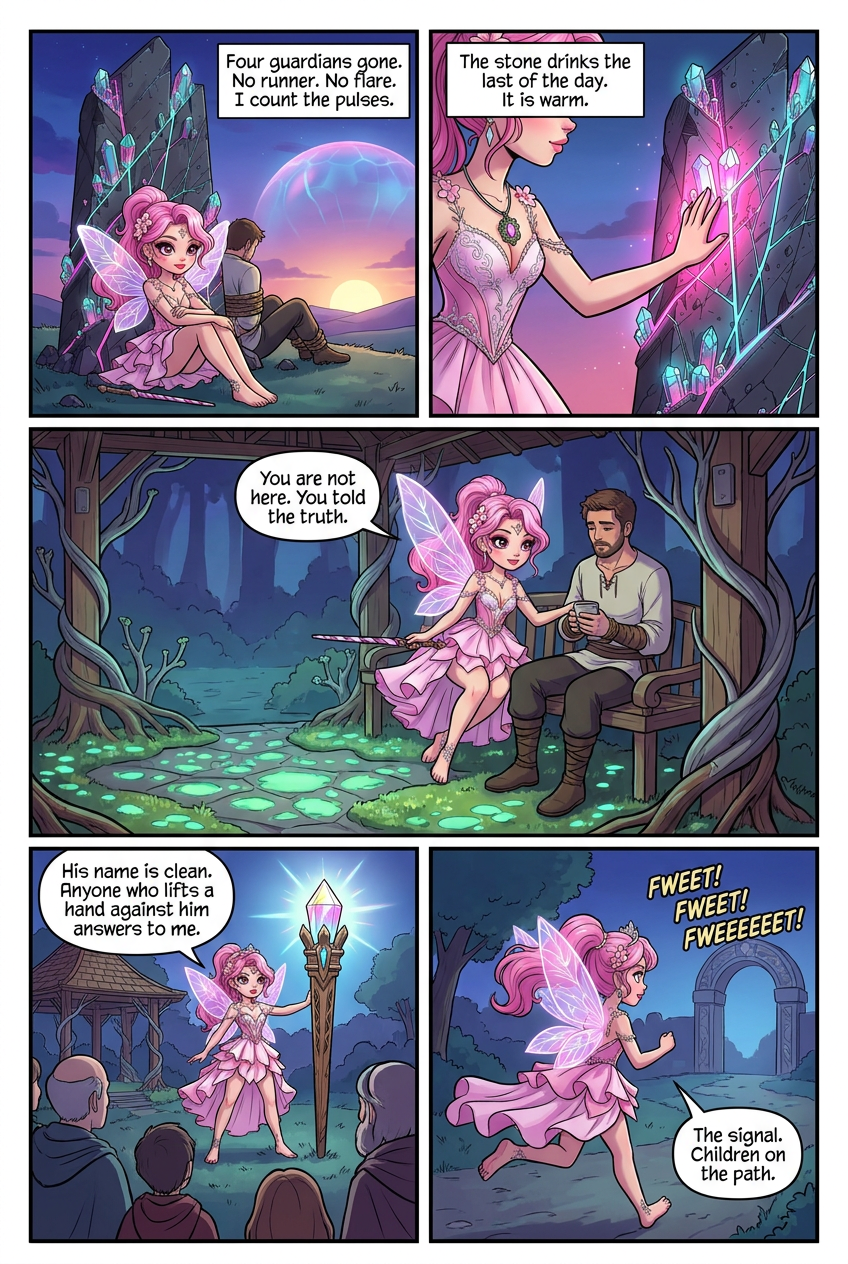
Cherriese sat at the base of the pillar and watched the light go thin. The four guardians had been gone since midday. No runner had come back. No flare had lit the ridge. Her husband was tied to the stone behind her, his head down, his breath even. She had set the two wands across her knees. The shield above the valley held its slow pulse, pink at the seams, clear at the centers. She counted the pulses to keep from counting the hours. When the sun touched the western ridge she stood and walked to the crystal-veined stone that rose beside the pillar. She had not noticed, in the rush of the binding, how the dusk light fed it. The pink and blue veins inside the rock brightened as the sky darkened, drinking the last of the day. She set her hand on it. It was warm. She had built the shield, named the rules, sent the four out. There was nothing left to do that would bring them back faster. She made herself say it plainly. He had given the names. He had given the hour. He had given the gully. Every word he spoke had matched the road. She turned to her husband. His wrists were raw under the rope. She cut the rope with the needle wand. He did not move at first. She put her shoulder under his arm and lifted him to his feet. "Walk," she said. He walked. She brought him across the clearing to the small pavilion at the inner edge, the one with the wooden roof and the living branches grown into its posts. Glowing moss lit the floor in soft patches. She sat him on the bench inside and gave him water. "You are not tied here," she said. "You are not on trial here. You told the truth and the truth saved seven lives, if they live." He drank. He did not speak. She left him on the bench and went back out to the clearing. The valley people had come to the lodge door again. She raised the striped wand and drove the butt of it into the soft ground a few paces from the pillar. She spoke three words her mother had taught her for naming. A tall wooden post pushed up under her hand, grain warm in the dusk, and a crystal bloomed at its peak in pink and gold and blue. The light from it reached the lodge door and the watch post and the arch at the valley mouth. "His name is clean," she said to the sixteen faces. "Anyone who lifts a hand against him answers to me." Then she heard the first whistle from the ridge. Two short, one long. The signal for children on the path. She ran for the arch.
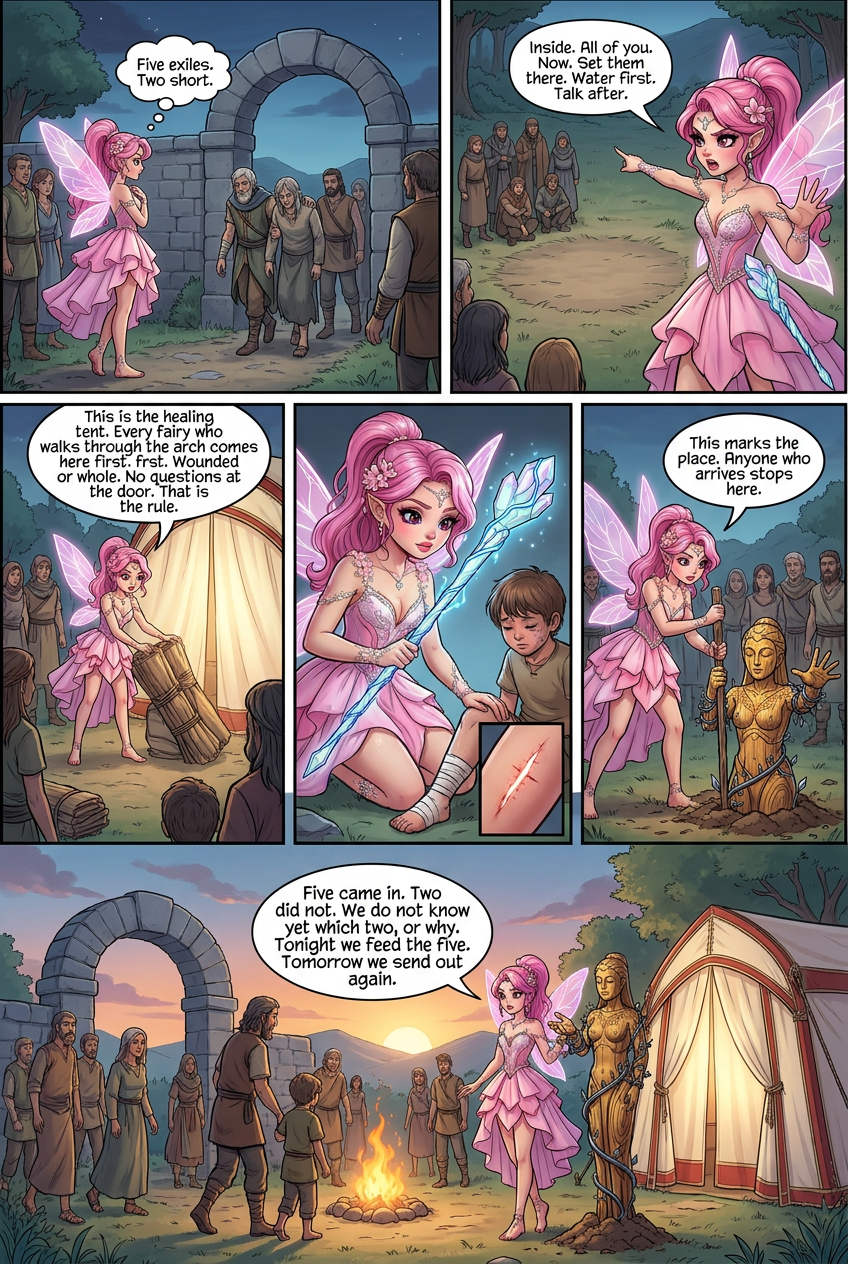
Cherriese reached the arch before the first guardian came through. She counted as they stepped under the stone. Two children with a guardian carrying a third on his back. Then a woman limping on a bound foot, held up by another guardian. Then a man with his arm tied across his chest. Then the last guardian alone, walking backward, watching the path. Five exiles. Two short. She had promised seven names to the valley, and the valley stood at the lodge door counting with her. She did not let the count show on her face. She stepped into the arch and raised both hands. "Inside," she said. "All of you. Now." She pointed past the pillar to the flat ground near the inner spring, where she had cleared a circle that morning for whatever came back. "Set them there. Water first. Talk after." The guardians obeyed. The valley people watched. She felt the question behind their eyes and did not answer it. She walked to the supply lodge and pulled out the bundled poles and folded cloth she had cut and sewn over the past three nights. She raised a tent on the cleared ground in under a quarter hour. The cloth glowed soft from the inside where she had stitched moss into the seams. She set the shelves against the back wall and laid out the jars, the bandages, the folded towels. "This is the healing tent," she said to the valley. "Every fairy who walks through the arch comes here first. Wounded or whole. No questions at the door. That is the rule." She took the second wand from her belt. The crystal staff was pale and clear, threaded with blue veins that brightened when her hand closed on the grip. She knelt by the child the guardian had carried. She set the point above his bound ankle and drew a slow line. The skin closed under the light. The child breathed out and slept. She moved to the woman next, then the man, then the other two. The wand grew warm but did not dim. When she finished, every wound in the circle was clean. She stood and walked to the edge of the cleared ground and drove a wooden stake into the soil. She spoke the naming words her mother had taught her. A carved figure pushed up from the earth, a woman of pale wood with one hand held open, metal vines curling up her arms. "This marks the place," Cherriese said. "Anyone who arrives stops here." Then she turned to the valley and spoke the count plain. "Five came in. Two did not. We do not know yet which two, or why. Tonight we feed the five. Tomorrow we send out again." No one spoke against her. The valley moved to the fire. She stayed by the carved figure and watched the arch until the light failed.
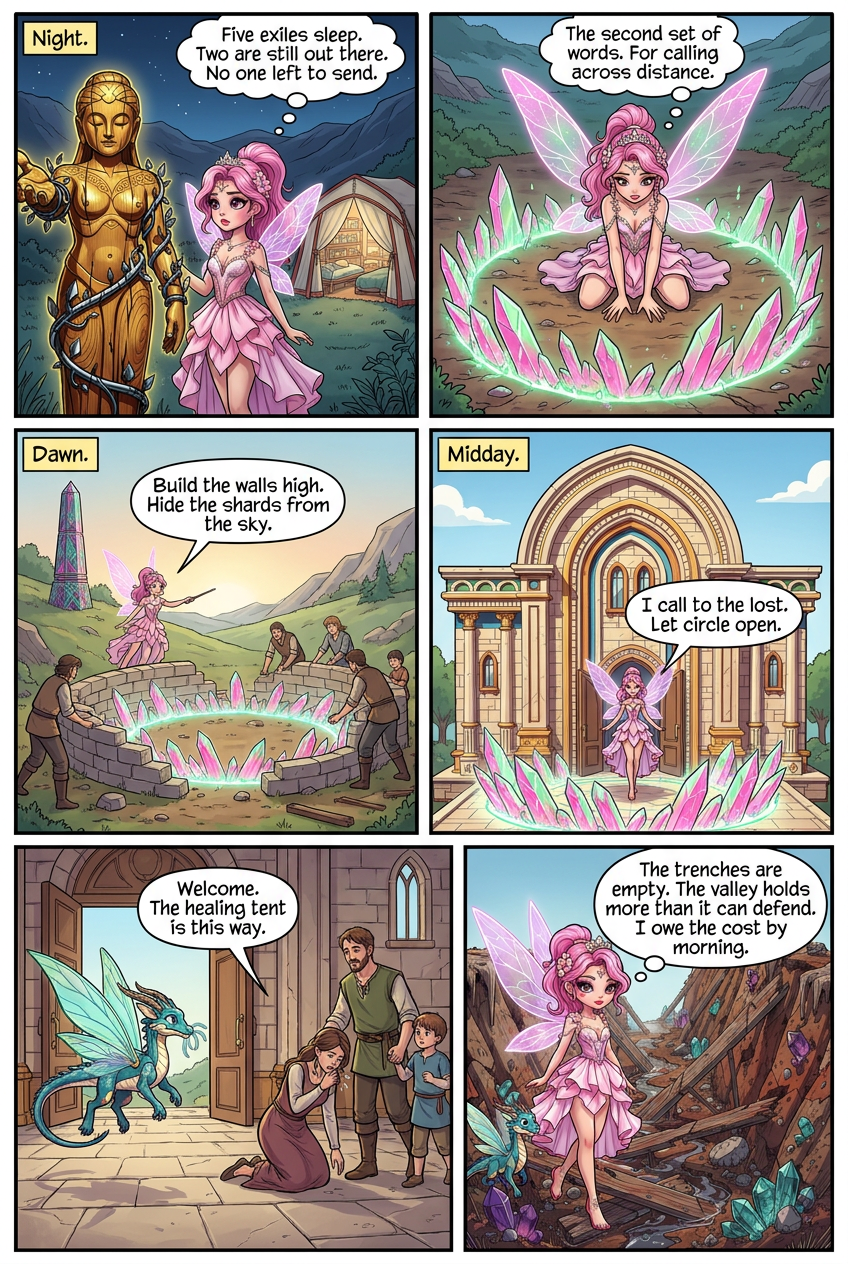
Cherriese stayed by the carved figure until the fire burned low. The five exiles slept inside the healing tent. Two were still out there. She walked the valley once and counted her guardians. Two held the arch. Two held the watch post on the ridge. The rest were children, wounded, or strangers she had not yet measured. No one was left to send at first light. She had promised a search and had no one to lead it. She walked back to the cleared ground near the inner spring. She knelt and pressed both palms flat to the soil. She spoke the second set of words her mother had taught her, the ones for calling across distance. The ground under her hands grew hot. A ring of light cut into the earth, ten paces wide. Sharp crystal pushed up through the dirt at the edge of the ring, jagged shards in pink and green that locked the circle in place. The shards hummed when she stood. The circle would pull any exile who had spoken her name and still carried the wish to come. She could not leave the circle open to the sky. Iron-dust patrols watched ridgelines for light. She woke three of the valley people and put them to work before the moon set. They hauled stone from the slope below the obelisk. She drew the shape on the ground with her wand: a tall arched door, a broad floor of fitted stone, walls high enough to hide the shards. By dawn the walls stood waist-high. By midday a roof of pale stone closed over the circle. She set the doors open and named it the greeting hall. Anyone who arrived inside it would step onto the floor and find a guardian waiting. She spoke the calling word at noon. The shards brightened. The air inside the hall thickened. A small shape dropped onto the stone floor first, not a fairy but a dragon no bigger than her forearm, blue and green, wings still trembling from the pull. It looked at her and folded its wings. Then a woman fell to her knees on the stone, coughing, one of the two missing names. Then a man with a child against his chest, the last name from her husband's list. Three more came after them, exiles she had not known were close enough to hear. Six in all. She steadied each one and pointed them toward the healing tent. The dragon followed her at the heel. She walked out of the hall and looked at the empty ground where her guardians had stood the night before. The trenches they had dug for the arch defense were still open, crystal soil glinting in the broken walls, the wooden braces leaning where the guardians had left them. She had no one to fill the trenches now. The valley held more exiles than it could defend. She had bought their lives and owed the cost by morning.
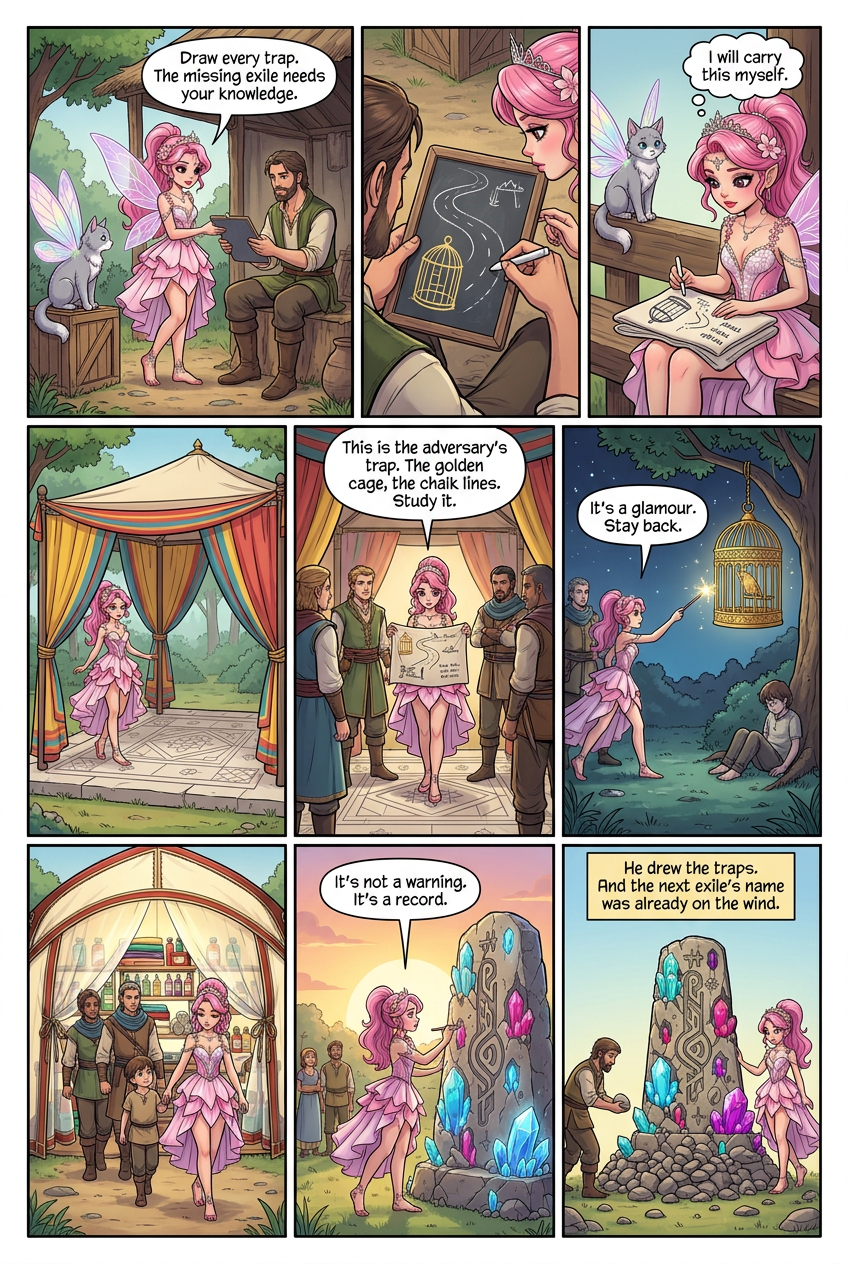
Cherriese walked to the shelter where her husband sat. The fairy cat that had come through the calling followed her, wings folded flat against its back. She set a slate before him and told him to draw every trap he had ever seen the adversary set. He stared at her. She said the missing exile would not survive another night on the road, and the valley people would not let him out to lead a party. So he would teach her, and she would carry it herself. He drew through the morning. He drew a road bend with a gold-barred cage hung from a tree, baited with a glamour that mimicked a friend's voice. He drew the chalk lines the patrols laid before the cage. He drew the timing of the patrol passes and the signal lights they used at night. The fairy cat watched the slate as if it understood. Cherriese copied each drawing onto folded cloth and slid the cloth into her belt. She could not teach this in the open. The valley people would call it proof he still ruled her. She walked to the cleared ground past the spring and raised a small pavilion from the spare poles and dyed cloth left over from the healing tent. She fitted a stone floor under it and cut three meeting marks into the slab. She called four guardians she had measured by what they had given up to stay. Inside the pavilion she spread the cloth drawings and taught them the cage, the chalk, the timing, the false voice. She told them where the knowledge came from. One guardian set his jaw and stayed. None walked out. They left at dusk. Cherriese led. They found the gold cage hung exactly where the drawing showed, three bends past the western gully. A child sat under it, drawn in by a voice that was not real. Cherriese cut the glamour with her wand and pulled the child clear before the chalk could close. They walked back through the night and reached the arch by the second watch. The child slept in the healing tent before dawn. At sunrise Cherriese went to the cleared ground where she had first opened the cloth drawings. She set a tall stone there and carved the marks of what she had used into its face. She pressed crystal shards into the cuts until they held. She did this in front of the valley so no one could later say she had hidden it. A woman asked if it was a warning. Cherriese said it was a record. She had used her husband's knowledge openly, and a child was alive because of it. The valley people did not cheer. They did not turn away either. One of them picked up a stone and set it at the base. Then another did. By midmorning the pile reached her knee, and the next exile's name was already moving on the wind.
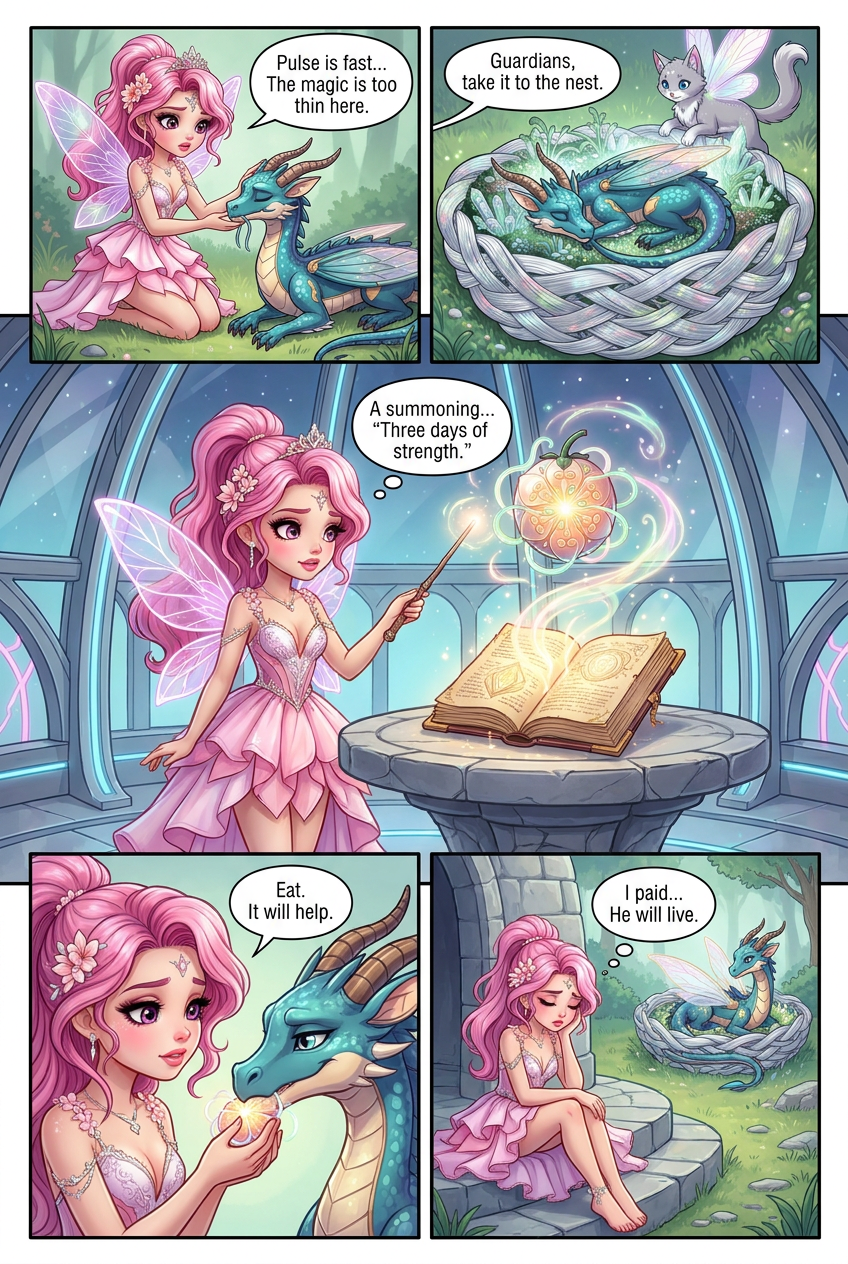
By the second morning after the calling, the small dragon could not lift its head. It lay near the spring where the new arrivals had set it down, wings folded wrong, breath coming in short clicks. Cherriese knelt beside it and pressed two fingers under its jaw. The pulse was fast and thin. The valley's magic ran shallow here, thinner than the air the creature had been born to. No one in the settlement had ever kept a dragon. No one knew what it ate, what it drank, what it needed to breathe. She had the guardians carry it to a woven basket lined with crystal moss, set on the flat stones past the healing tent. The fibers held a soft glow that warmed the dragon's belly without burning. The fairy cat from the calling jumped up onto the rim and stayed there, wings tucked, watching the small ribs rise and fall. Cherriese left them and walked to the glass-paneled dome she used for spellwork. She shut the door behind her. Inside, she opened her mother's spell book on the stone table and turned the pages by the light of the mineral veins in the walls. She passed the binding spells. She passed the calling. She found a summoning her mother had marked with a thumbprint of dried sap. The note beside it read: for creatures of higher magic, when the ground will not feed them. The cost was written underneath. Three days of her own strength, paid at once. She read it twice. Then she cut the sap seal with her wand. The spell pulled the air thin around her. She spoke the words and held the shape of what she needed in her mind: a fruit for a dragon, not for a fairy. Light gathered above the table and folded inward. A round fruit dropped onto the stone. Its skin was clear as river ice. Inside, seeds glowed like small lamps, and pale tendrils of light curled off the rind and drifted in the still air. Cherriese caught the edge of the table to keep from going down. She had paid. The fruit was here. She carried it out in both hands. The fairy cat stood when it saw her coming. Cherriese split the fruit on a flat stone. The seeds came loose easy, wet with light. She pressed one to the dragon's mouth. The dragon swallowed. She fed it another, then another, until half the fruit was gone. The clicking in its breath softened. The wings shifted under the moss. By the time the sun cleared the ridge, the dragon had opened its eyes and looked at her. Cherriese set the rest of the fruit in the basket beside it. She told the guardian at the tent to wake her only if the breathing changed. Then she walked back to the dome and sat on the step, because her legs would not carry her further. The dragon would live. She had three days of weakness to spend, and the next name on the wind was already closer than the last.
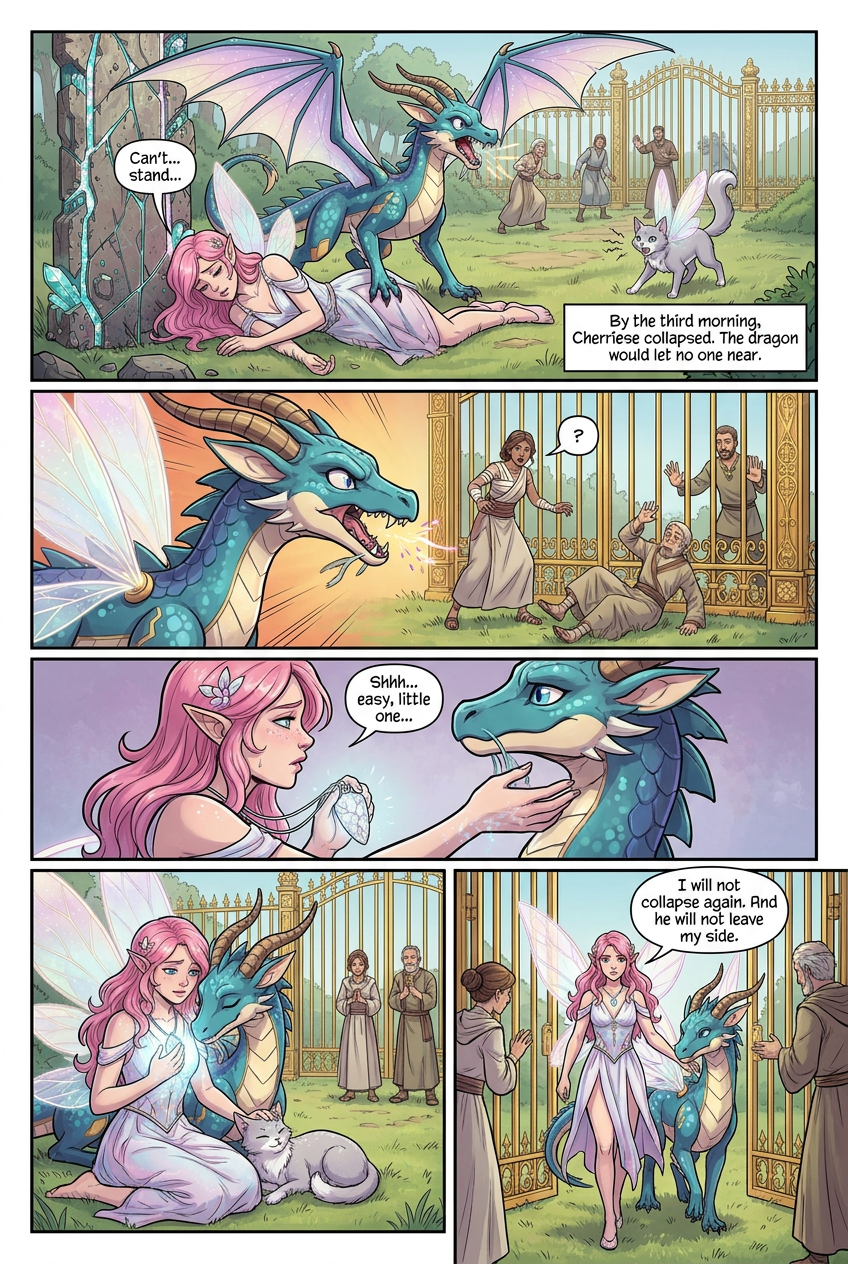
By the third morning, Cherriese could not stand. She had walked from the dome to the dragon's basket to check the breathing, and her knees folded on the flat stones near the spring. She heard the fairy cat hiss before she felt the ground. Then the small dragon was over her, wings spread wide, body planted across her chest. It clicked at the air and bared its teeth at anything that moved. The guardians came first. The dragon snapped at the closest hand and drove them back to the gilded fence the valley people had set around the healing tent. The healers reached the bars and stopped there. Two tried to climb through. The dragon launched at the gap and they fell back into the grass. A woman with bandages called to Cherriese by name. Cherriese could not answer. Her tongue felt slow. Her eyes tracked the dragon's tail as it whipped past her ear. The creature would not let them near. It had imprinted on her in the basket, fed from her hand, healed by her cost. Now she was on the ground and it was guarding her body the way a thing guards what it owns. Cherriese saw a husband at the fence, palms up, telling the healers to wait. She saw the fairy cat circling at a distance, wings low. The dragon's claws gripped the stone beside her shoulder. A pale crack opened in the rock under its weight, and a faint blue light bled from inside the fissures, climbing up the pillar of stone that had stood there since the calling. She had to move the dragon herself. She reached one hand to her collar and pulled out the pendant her mother had left her. The crystal was pale, threaded with silver veins like winter branches. She pressed it against the dragon's throat and spoke the soft words her mother used for frightened creatures, the charm she had learned before she could read. The dragon's eyes slowed. Its breath evened. The teeth closed. It lowered its head onto her shoulder and stayed there, watching the fence but no longer striking. She turned the pendant in her palm and pressed it to her own chest next. The silver veins warmed. The amulet drew from itself, not from her, the way her mother had built it. Light moved into her ribs and her arms came back. She sat up under the dragon's weight. The fairy cat walked to her side and lay against her hip. The healers at the gate lowered their hands and waited. Cherriese got to one knee, then to her feet. She kept one hand on the dragon's neck and walked it through the gate herself. The healers parted. She told them she would not collapse again and that the dragon would not leave her side. She had a guardian now that could not be bribed. She also had a creature she would have to feed for the rest of its life.
Play your story to life
Storycraft is a mobile game where you create AI characters, craft items and locations to build their world, then discover what direction your story takes. Download the iOS game for free today!
Download for free