

CHESTER MCBADBAT's Arc
5 Chapters
CHESTER MCBADBAT's dream is running a farm with his homies. Clothing optional..

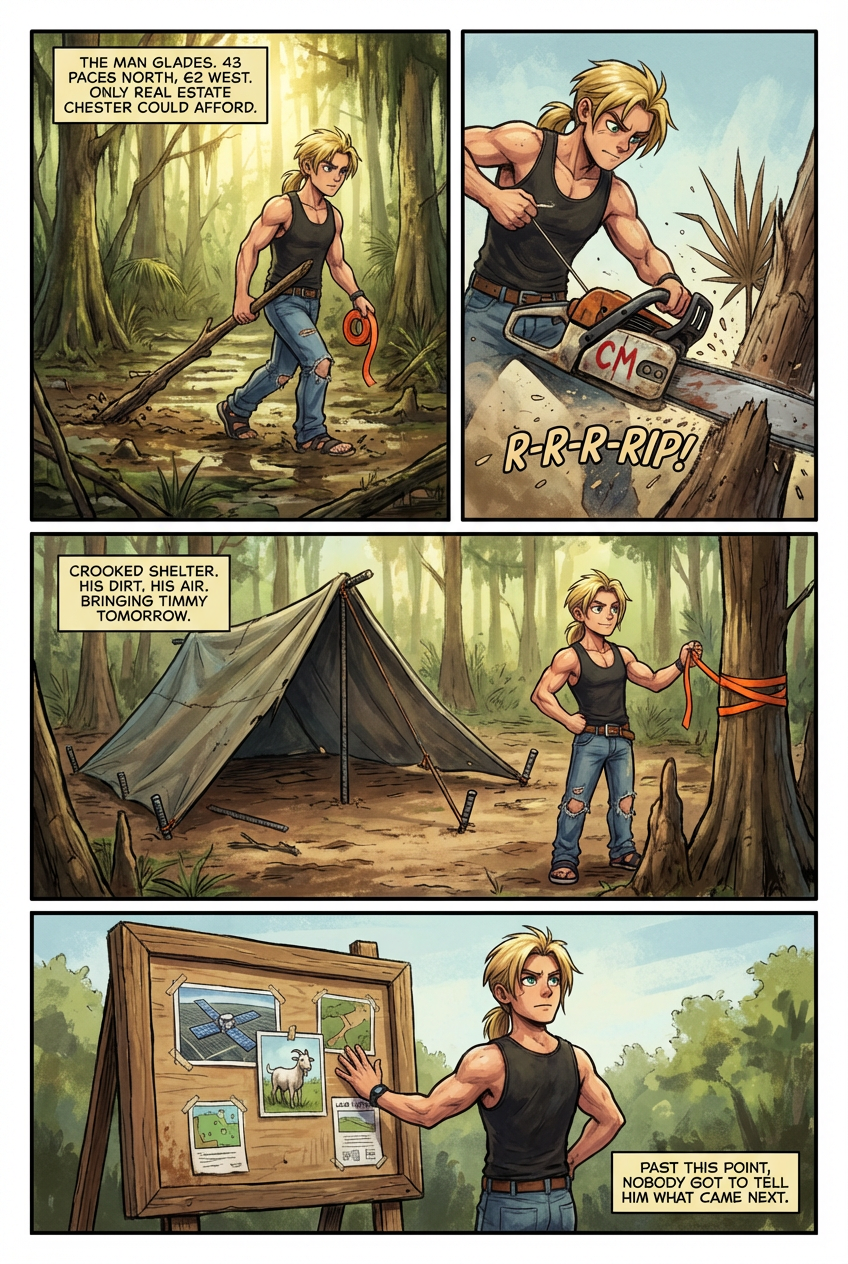
Chester dragged a stick through the mud, measuring out forty-three paces north, then sixty-two west. The Man Glades didn't care what you did with it, which made it the only real estate he could afford. He'd brought a roll of orange surveyor's tape from the hardware store—cost him three bucks and a half-truth about helping his dad—and now he tied the first strip to a cypress knee. He yanked the chainsaw's starter cord twice before it caught. The saw had belonged to his old man once, back when the trailer had copper wiring instead of extension cords. Chester had painted his initials on the side in red—big curvy letters that looked like something off a van. The blade bit into a dead palmetto, clearing space for the tent. The tarp shelter went up crooked but standing. Chester staked the corners with rebar he'd pulled from a demo site last week. Inside was just dirt and air, but it was his dirt, his air. He walked the perimeter one more time, tying orange tape every ten feet. Tomorrow he'd bring Timmy out here, show him the layout, talk chickens and fencing. At the far corner he hammered together a frame from scrap two-by-fours and nailed up a sheet of plywood. He'd printed out pictures at the library—satellite shots of farmland, photos of goats, a screenshot of property listings two counties over. He tacked them all to the board in overlapping rows. This was the edge of it. Past this point, nobody got to tell him what came next.
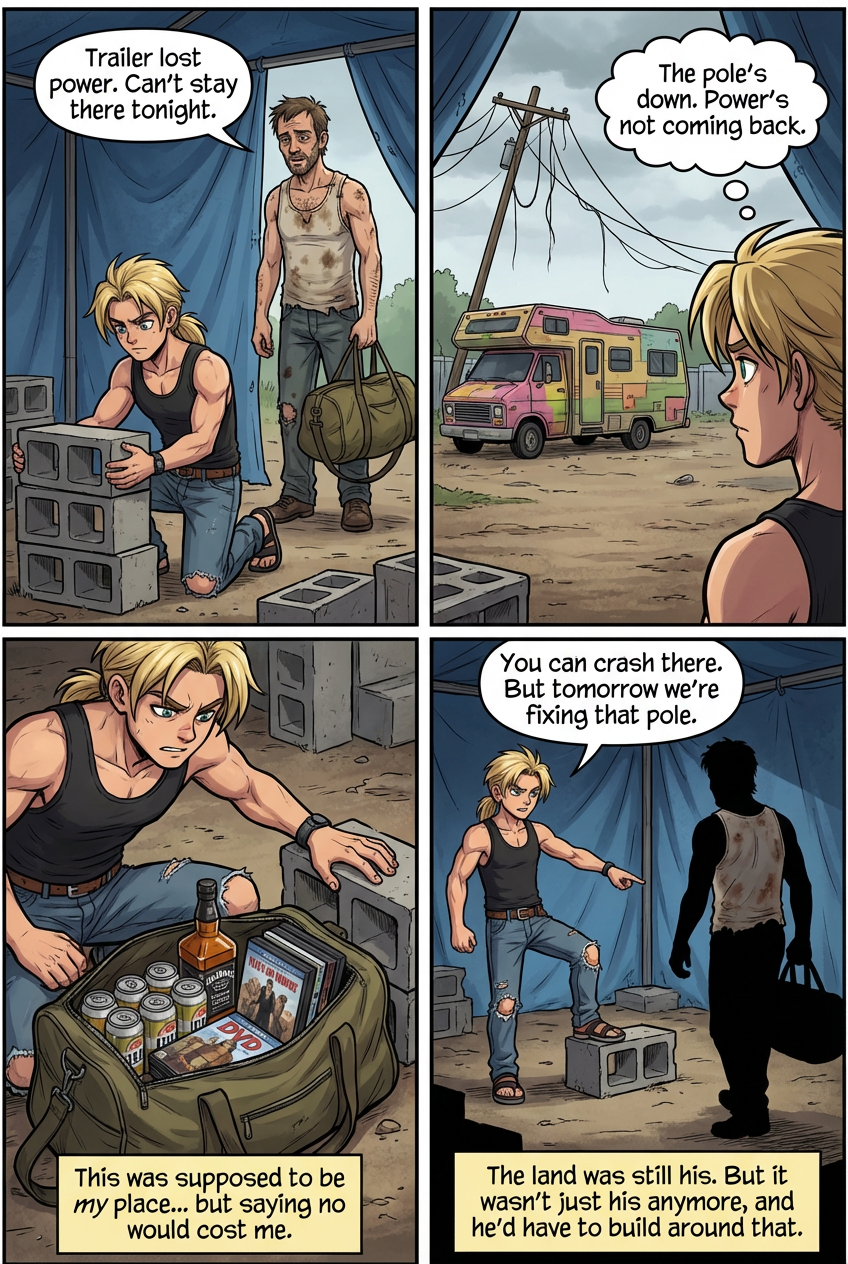
Chester was stacking cinder blocks for a rain barrel when his dad showed up at the tarp line. The old man stood there in a torn undershirt, holding a duffel bag that sagged in the middle. The trailer lost power, he said. Couldn't stay there tonight. Chester looked past him toward the lot where the RV sat dark. The patchwork paint job—pink and yellow and about six other colors—looked dull without the string lights his dad kept running off the hookup. Past it, the light pole leaned at an angle it hadn't yesterday, wires hanging loose like dead vines. Something had hit it, or it just gave up. Either way, the power wasn't coming back. His dad set the duffel down and unzipped it. Inside was a six-pack, a bottle of whiskey, and a stack of DVDs still in their cases. No sleeping bag. No food. Chester felt his jaw tighten. This was supposed to be his place—the start of something that didn't include anyone else's problems. But he looked at the tarp shelter, then at his dad standing there like he was waiting for permission, and realized what saying no would cost him. Not guilt. Something worse. It would mean he'd turned into the kind of person who measured everything by what it took from him. Chester kicked one of the cinder blocks into place and pointed at the far corner under the tarp. You can crash there, he said. But tomorrow we're fixing that pole. His dad nodded, picked up the duffel, and walked over without another word. Chester went back to stacking blocks, but his hands moved different now—slower, heavier. The land was still his. But it wasn't just his anymore, and he'd have to build around that.
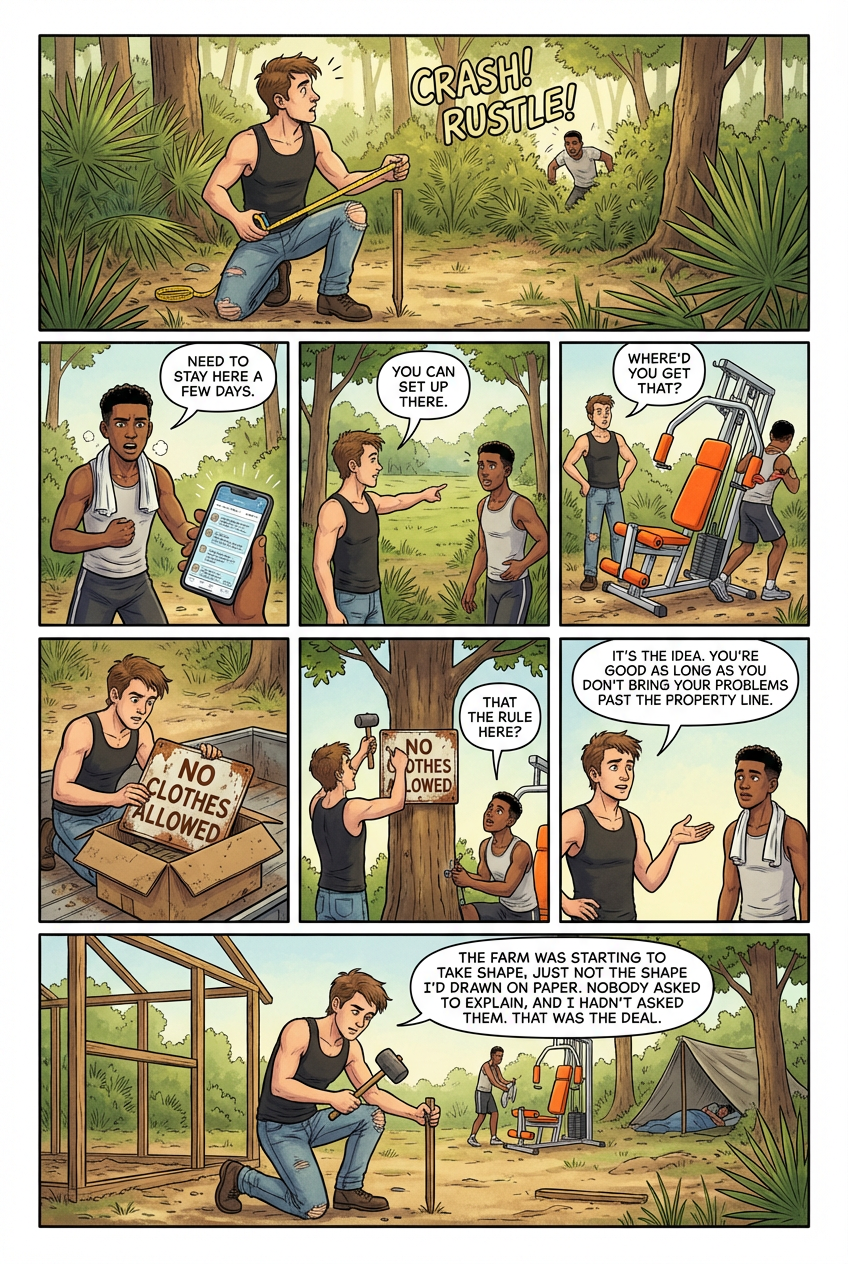
Chester was halfway through measuring out a spot for the chicken coop frame when DeShawn came crashing through the palmetto scrub like something was chasing him. He wasn't running, but he moved fast, head down, shoulders tight. Chester dropped the measuring tape and stood up. DeShawn stopped at the tarp line, breathing hard. His phone was in his hand, screen lit up with a string of messages and photos he didn't bother hiding. Need to stay here a few days, he said. No details. Just that. Chester looked at the phone, then at DeShawn's face, and knew better than to ask. Whatever it was, it wasn't his business unless DeShawn made it his business. He pointed to the clearing past his dad's corner. You can set up there, he said. DeShawn nodded and walked over, dragging something heavy behind him—a workout machine with orange padding and chrome bars that looked like it cost more than Chester's entire setup. Where'd you get that, Chester asked. DeShawn didn't answer, just started bolting it into the dirt. Chester went back to the trailer and found the sign in a box of junk his dad had left behind. It was rusted metal, white background with brown letters: NO CLOTHES ALLOWED ALLOWED. He'd meant to toss it, but now it felt right. He walked it over to DeShawn's spot and hammered it into a tree with a rock. DeShawn looked up from tightening bolts and saw it. He didn't smile, but his shoulders dropped an inch. That the rule here, he asked. Chester shrugged. It's the idea, he said. You're good as long as you don't bring your problems past the property line. DeShawn went back to work without answering, but the way he moved was different—less like he was hiding, more like he was building something. Chester walked back to the coop frame and picked up the measuring tape. His dad was asleep under the tarp, DeShawn was setting up a gym in the dirt, and the land he'd marked out for himself and Timmy and AJ now had two people on it he hadn't planned for. But neither of them had asked him to explain himself, and he hadn't asked them. That was the deal, even if nobody said it out loud. The farm was starting to take shape, just not the shape he'd drawn on paper. He measured the next post hole and drove the stake in deep.
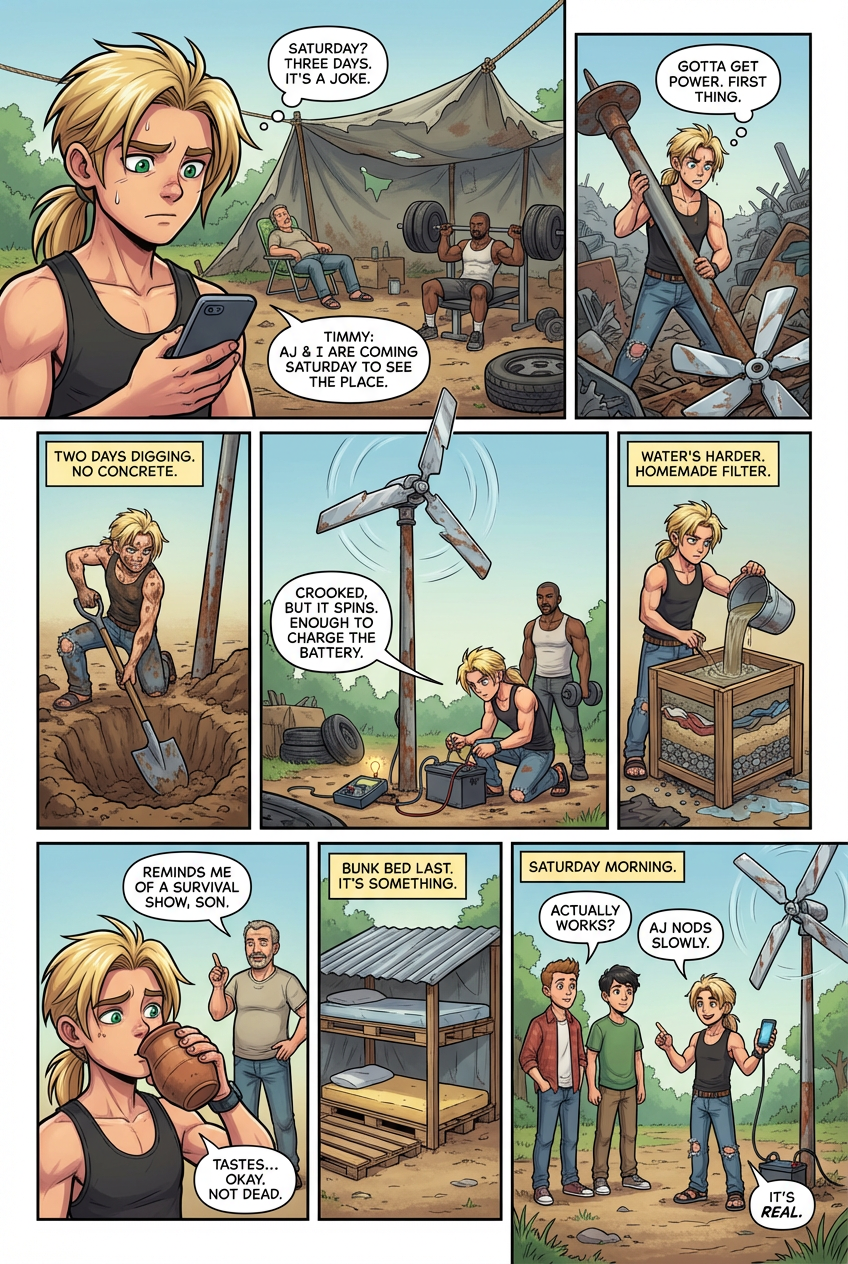
Timmy texted that he and AJ were coming out Saturday to see the place. Chester read the message twice, then looked around at what he'd actually built. A tarp held up by rope and hope. A half-framed chicken coop with no chickens. His dad sleeping in a lawn chair. DeShawn doing bench presses in the dirt. He had three days to make the property look less like a joke. First thing was power—he needed something that would run more than his dad's dead phone. Chester drove to the junkyard and found an old turbine pole in the scrap pile, plus three ceiling fan blades someone had spray-painted silver. He hauled them back and spent two days digging a hole deep enough to anchor the pole without concrete. The blades went on crooked, but when the wind picked up they spun fast enough to charge the car battery he'd wired underneath. Not enough for lights, but enough to prove the idea worked. DeShawn watched him test it and said nothing, just went back to his workout. Water was harder. Chester couldn't afford pipe or a pump, so he built a filter box out of plywood and layered it with gravel, sand, and torn T-shirts. He ran creek water through it into clay pots he'd found behind his dad's trailer. It came out brown the first six times, then murky, then almost clear. He tasted it and didn't die. His dad wandered over, looked at the setup, and said it reminded him of something from a survival show. Chester didn't answer. The bunk bed frame came last—two pallets stacked with foam he'd pulled from a dumpster, wedged under a sheet of tin roofing. It didn't look like the farms in his vision board, but it was more than a tarp. Saturday morning, Timmy and AJ showed up and stood at the edge of the clearing. Chester walked them through—showed them the turbine spinning, the water dripping clear, the beds under the tin roof. Timmy looked at the turbine, then at Chester, and asked if it actually worked. Chester plugged in his phone and the screen lit up. AJ nodded slow, like he was doing math in his head. They didn't say it was good, but they didn't leave either. Timmy asked where they'd put the goats. Chester pointed past the chicken coop frame, and for the first time since he'd texted them, he didn't feel like he was selling something that didn't exist.
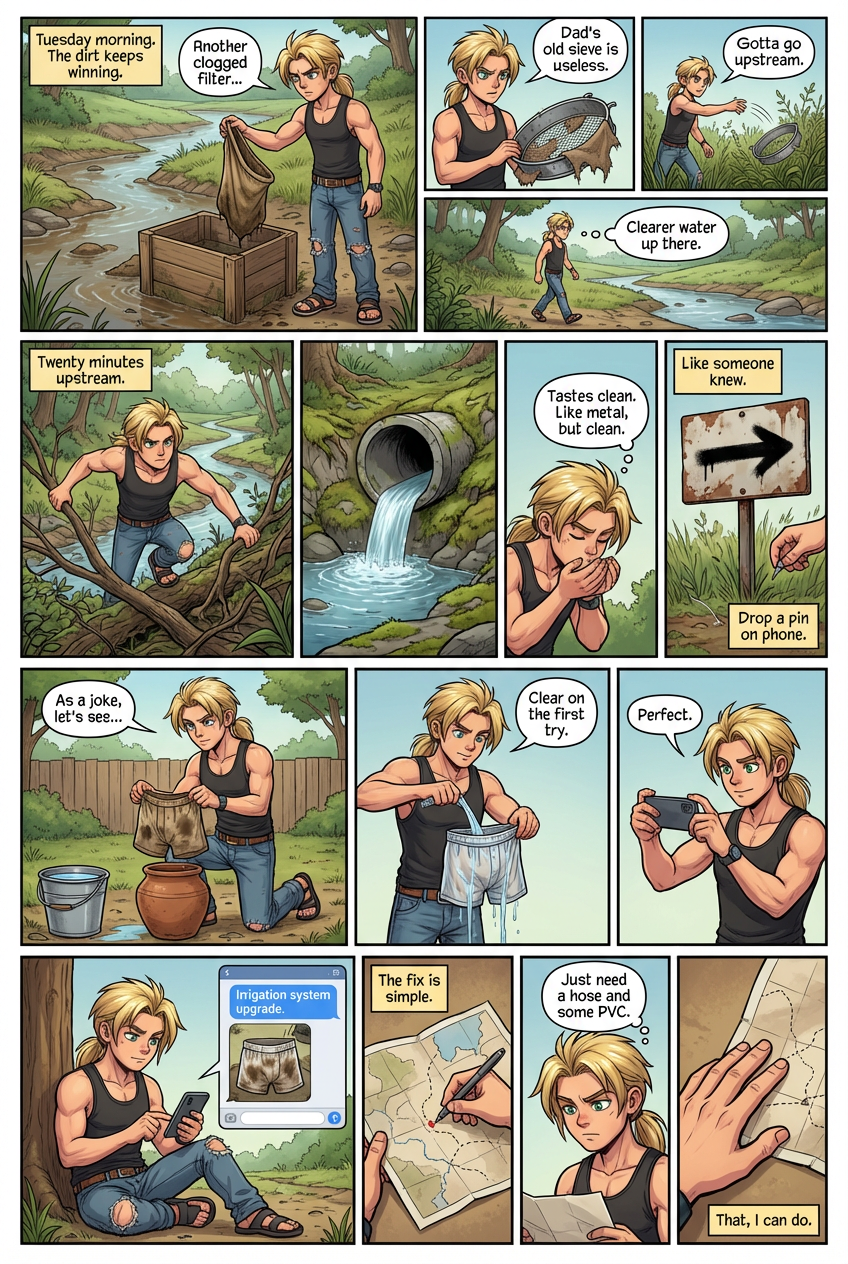
The filter clogged again Tuesday morning. Chester pulled out the cloth layers and found them brown and slick, already turning sour in the heat. He'd been dumping creek water through the box every day since Timmy and AJ left, but the dirt kept winning. He grabbed the metal sieve his dad had left by the chicken coop—bent frame, burlap stretched across it like old skin. Chester dunked it in the creek and dragged it through the water, watching mud and hair and something green clump up in the fabric. The burlap tore. He threw it in the weeds and looked upstream, where the water ran clearer before it hit his property. If the problem was downstream, the answer had to be up there. Chester followed the creek for twenty minutes, stepping over roots and ducking branches until he found it—a concrete pipe sticking out of the bank, half-buried in moss. Water poured out clean and fast, no sediment, no smell. He cupped his hands and drank. It tasted like metal but not dirt. Fifty feet up, someone had spray-painted a arrow on a rusted sign, pointing right at the pipe like they knew someone would need it. Chester pulled out his phone and dropped a pin. This wasn't a fix he had to build—it was already here. Back at the property, he grabbed a pair of old boxers from the laundry pile and rigged them over a clay pot as a joke filter, just to see if the upstream water needed anything. It ran through clear on the first try. He texted Timmy a photo of the boxers with the caption "irrigation system upgrade." Then he sat down and marked the pipe location on the property map he kept in his bag. The farm didn't need a better filter. It needed a hose, some PVC, and a walk upstream every week to keep the intake clear. That, he could do.
Play your story to life
Storycraft is a mobile game where you create AI characters, craft items and locations to build their world, then discover what direction your story takes. Download the iOS game for free today!
Download for free