

Chloe Carter's Arc
12 Chapters
Chloe Carter's dream is escaping the mountain in her luxury sedan to reach the federal safe house that will grant her a new life..

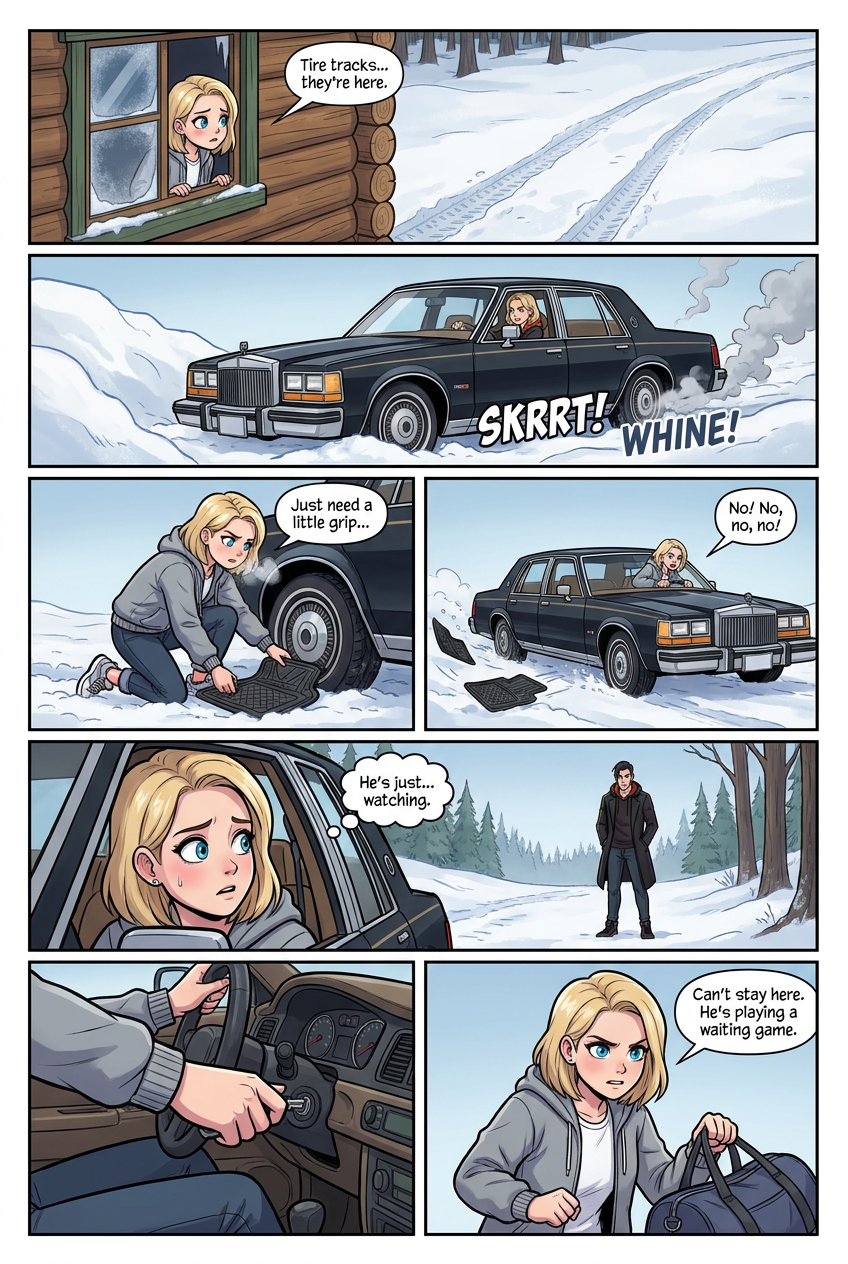
Chloe Carter saw the second set of tire tracks in the snow at dawn, and she knew the cabin was done. She'd been hiding here six weeks, watching the road the way other people watched the news. The marshals had told her to run at the first sign. The sign was two ruts curving up her drive and stopping thirty feet short of the porch. She threw her duffel across the passenger seat of the black sedan and turned the key. The engine caught clean. That was the last easy thing. She backed up. The rear tires spun. The car slid sideways off the packed drive and buried itself to the rocker panels in the drift beside the porch steps. She heard the whine of rubber polishing ice. "No." She hit the wheel. "No, no, no." Chloe knew this car. She had picked it out herself, signed for it herself, felt proud walking past it every morning. She had also known, since the first snow, that rear-wheel drive on a mountain was a joke told at her expense. She had told herself she'd learn the road before she had to use it. She had not learned the road. She got out. The cold burned her throat. She kicked snow away from the back tires with the side of her boot, then dropped to her knees and dug with her hands. She pulled the floor mats from the driver's side and wedged them under the rear wheels for grip. Back behind the wheel. Reverse. Gas. The car rocked an inch, slid, sank deeper. Drive. Reverse. Drive. The mats shot out behind her like black tongues and vanished into the snow. She cried. Ten seconds, maybe. Then she stopped crying and got angry, because angry was useful and crying was not. That was when she saw him. He stood at the tree line where her drive met the logging road. A man in a long dark coat, hood back, hair slicked flat. He wasn't hurrying. He had his hands loose at his sides. He watched her the way a cat watches a moth against a window. He could have crossed the clearing in twenty seconds. He didn't. He tilted his head, almost polite, and waited. Chloe understood. Whoever had sent him hadn't sent him to finish it fast. He was here to watch her panic. To let her burn the tank and the tires and the daylight until she made the mistake that saved him the trouble. She put the sedan in drive. Eased the pedal. Felt the tire catch the frozen gravel underneath, just for a second, then lose it. The car settled another inch. She killed the engine. If she kept rocking, she'd dig her own grave in the snow while he watched. She needed a route down the mountain her car could survive, and she needed it before he decided the game was over. She reached across for the duffel and got out of the car on the far side, keeping the sedan between them.
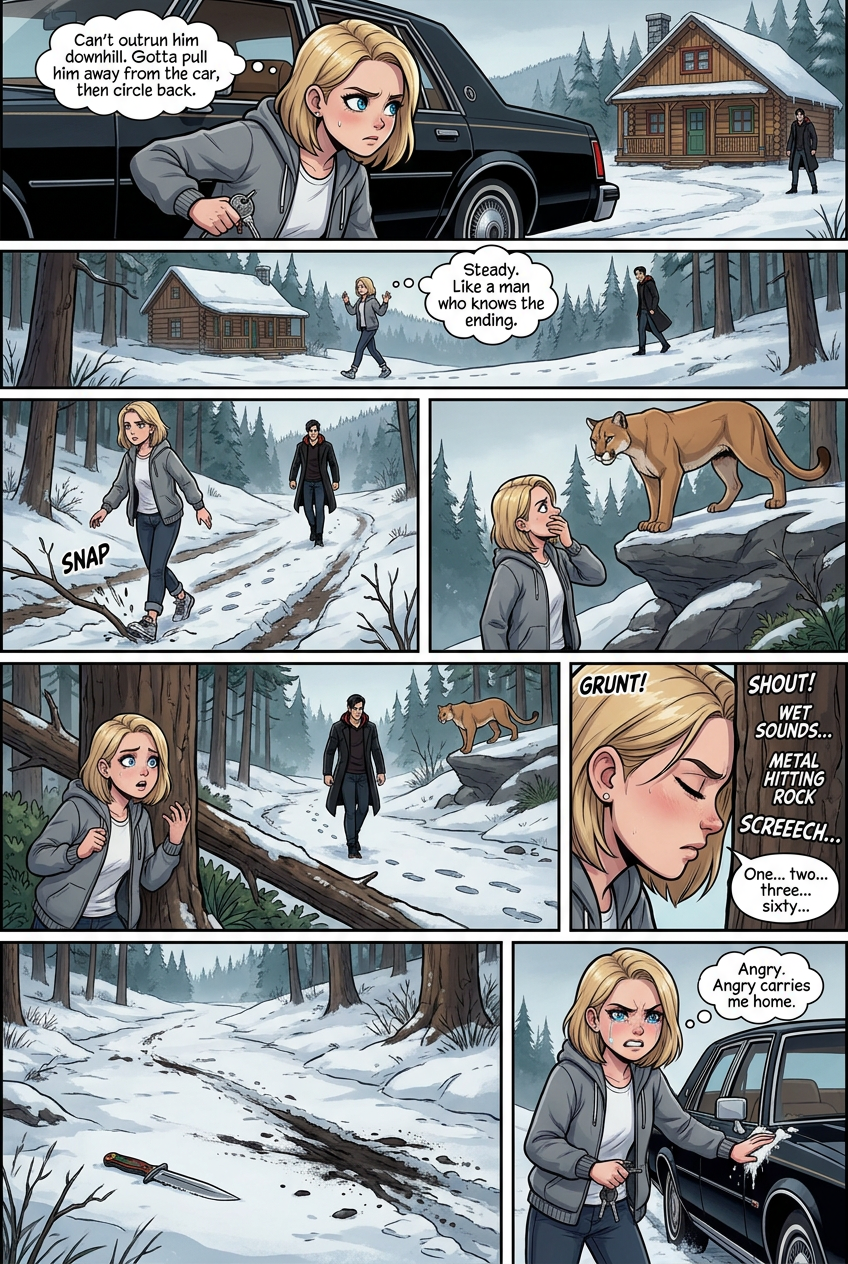
Chloe crouched behind the sedan and worked out the math. She could not outrun him downhill. She did not know the woods well enough to lose him in a straight line. But he was watching her, only her. If she pulled him away from the car, she could circle back, dig it out, and drive. She left the duffel. She took the keys from her pocket, the ones with the old Buick tag her mother had passed her years ago, and shoved them deep into her coat so they wouldn't jingle. Then she stood up where he could see her, showed him her empty hands, and walked straight into the trees above the cabin. He moved. She heard the crunch of his boots start along the tree line and swing after her. Not fast. Steady. The way a man walks when he knows the ending. The old logging road cut across the slope a hundred yards up. She found it under a skin of snow, two ruts full of frozen puddles and broken branches. She followed it away from the cabin, loud on purpose, snapping wood under her heel every few steps. Behind her, his footfalls kept the same patient pace. She went a quarter mile. Then she stopped snapping branches and started listening. That was when she saw the cat. It stood on a rock shelf above the road, tail low, shoulders loose. Tawny. Bigger than she'd pictured a mountain lion in her head. Its eyes were on the road behind her, not on her. It had been tracking the sound of two people. It had picked the slower one. Chloe did not run. Running was how you died. She stepped sideways off the ruts, into the pines, and lowered herself behind a deadfall. She put her hand over her mouth and breathed through her fingers. She heard him come up the road. His boots. His even breath. He passed her hiding spot without turning his head. He was looking for her tracks in the snow ahead. The cat dropped off the shelf without a sound. She heard him grunt, then shout, then the wet sounds people are not supposed to make. Something metal hit a rock, a knife maybe, skidding. Then a longer sound she made herself stop listening to. She pressed her forehead into the bark and counted to sixty. When she looked, the road was empty except for a dark smear and a drag trail leading off into the brush. Chloe stood up. Her legs shook. She wanted to cry. She got angry instead, because angry would carry her back down the road to her car. She walked the ruts to the cabin the way she'd come. The sedan sat where she'd left it, buried to the rocker panels, waiting. She pulled the keys from her coat and started digging.
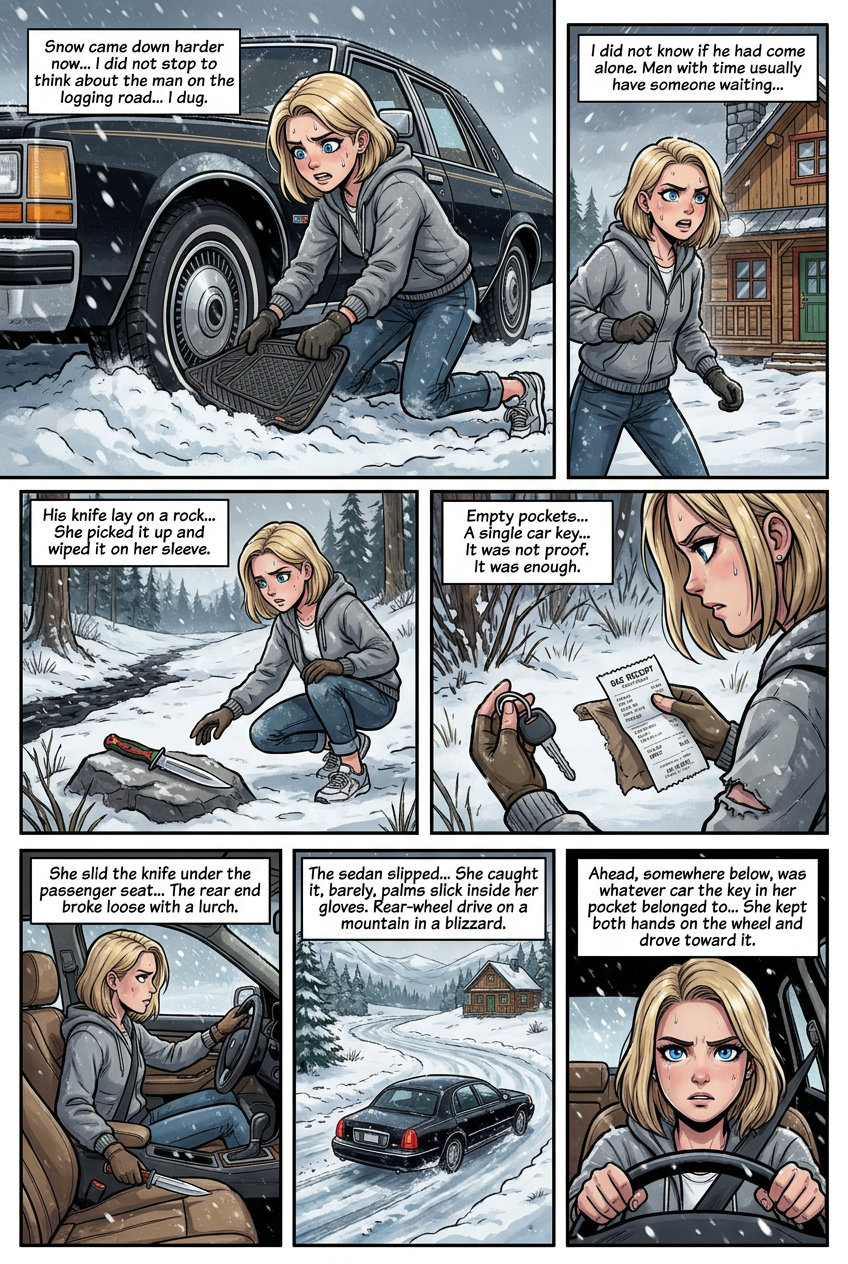
Chloe dug until her arms burned. She used the flat of a broken board, then her gloved hands, then a rubber floor mat from the driver's side, wedged under the rear tire for grip. Snow came down harder now, fat and steady, filling the ruts as fast as she cleared them. She did not stop to think about the man on the logging road, or the cat, or the wet sound she was still hearing in her head. She dug. Then she stopped. She stood up straight beside the cabin and made herself think. She did not know if he had come alone. He had walked toward her like a man with time. Men with time usually have someone waiting at the bottom of the road, or a radio in a coat pocket, or a partner sitting in a truck at the switchback. If she drove off blind, she could drive straight into the next one. She walked back to the tree line where he had fallen. The drag trail was already softening under new snow. His knife lay on a rock, the steel dark with blood, the handle striped red and green like something bought at a gas station. She picked it up and wiped it on her sleeve. No radio on the rock. No phone. She made herself follow the drag ten yards into the brush and crouched by what was left of his coat. Empty pockets except for a folded gas receipt and a single car key on a plain ring. No second phone. No note. No name. One key. One man. One car, somewhere down the mountain. It was not proof. It was enough. She went back to the sedan. She slid the knife under the passenger seat where she could reach it. She rocked the car, reverse to drive, reverse to drive, feeding the mat under the tire each time it spat free. The rear end broke loose of the drift with a lurch, and she was on the driveway, then the road. The sedan slipped the second the tires touched ice. The back end swung wide on the first bend and she caught it, barely, palms slick inside her gloves. Rear-wheel drive on a mountain in a blizzard. She had known. She had known when she signed the papers. She crawled the car down at fifteen miles an hour. On the second switchback the tail slid again and she rode it out, pig on ice, tapping the brake the way her mother had once shown her on a wet parking lot years ago. The cabin disappeared behind the pines. Ahead, somewhere below, was whatever car the key in her pocket belonged to. She kept both hands on the wheel and drove toward it.
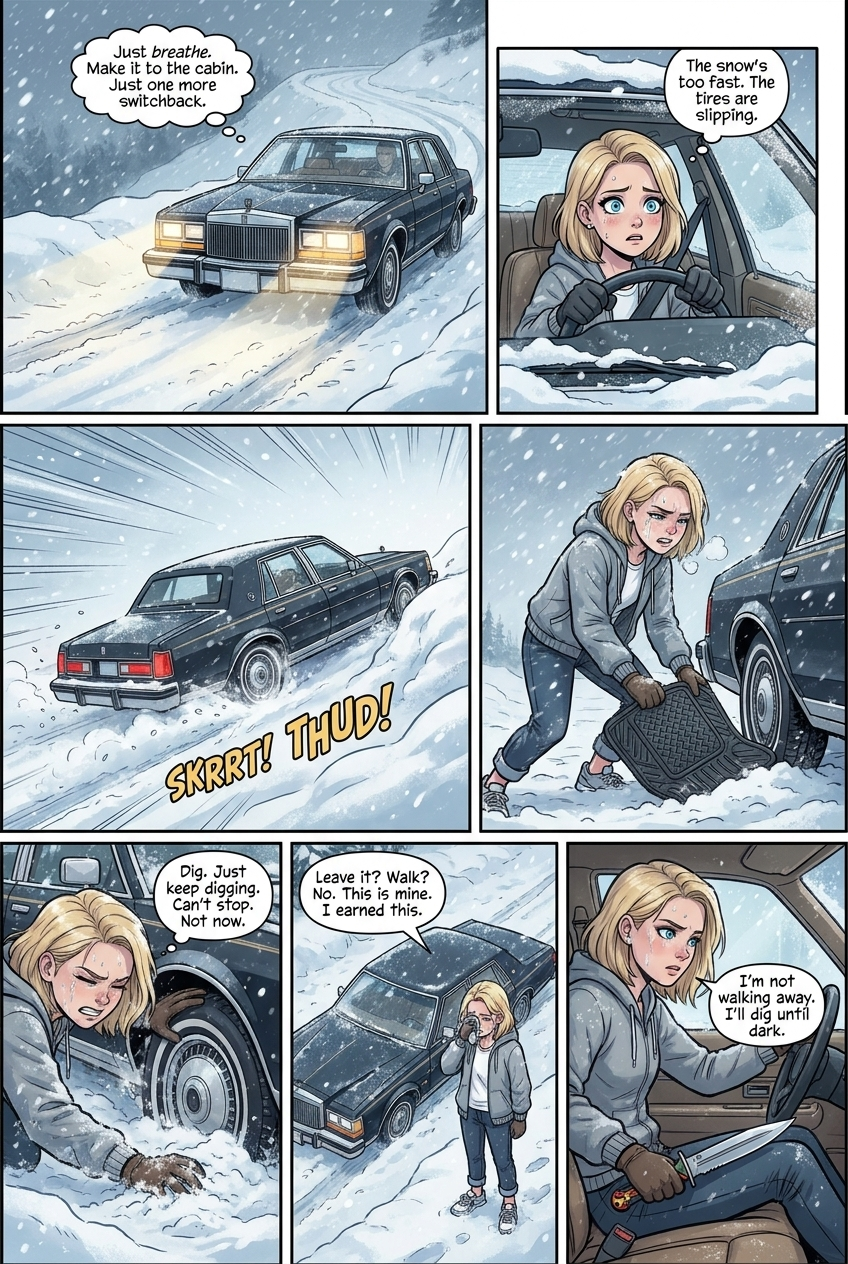
The sedan crawled through the third switchback and Chloe let out a breath she had been holding since the cabin. Then the snow thickened. It came down in sheets now, not flakes, and the wipers dragged instead of swept. The road ahead lost its edges. She could not tell where the shoulder stopped and the drop began. She eased off the gas. The rear tires hissed, caught, hissed again. The powder was building faster than she was moving through it. She knew what came next. She had felt it in the driveway at the cabin, that soft grab when the wheels stopped biting and started swimming. She tried to keep momentum. She fed the pedal in a thin, steady line, the way she had taught herself on wet parking lots. The sedan answered for maybe twenty yards. Then the back end sank. The car tipped left, kissed a wind-shaped drift at the road's edge, and stopped. The engine revved on nothing. The rear wheels spun free in the powder. She closed her eyes. She counted to three. She opened them and got out. The cold cut through her coat. The drift against the rear quarter was already up to the wheel well, its surface smooth and folded like poured cream. She kicked at it. The snow gave and then packed. She went back for the rubber mat she had used at the cabin, jammed it under the right rear tire, and climbed in. Reverse. Drive. Reverse. Drive. The mat shot out behind her the first two tries. On the third the tire caught it and held, and the car heaved forward six inches before the front end plowed into fresh powder and stalled again. She got out. She dug. She dug until her gloves were soaked through and her fingers stopped bending. The snow kept coming. For every scoop she cleared, the sky put back two. She stood up beside the driver's door and looked at the road behind her. Already her tire tracks were softening. In an hour they would be gone. A voice in her head, calm and reasonable, said: leave the car. Walk. Find the man's vehicle on foot before you freeze. She stared down at the sedan. The black paint under the snow. The interior she had picked out. The key she had signed for herself, the first thing in her life no one had given her and no one could take. She had bought this car with the money she earned before any of this started, before the trial, before the new name. Her eyes stung. She wiped her face with a wet glove and felt the heat behind her teeth turn. "No," she said out loud. "No. Not this one too." She got back in. She shut the door. She reached under the passenger seat, closed her hand around the knife handle, and set it on her thigh. She would dig until dark if she had to. She was not walking away from her car.
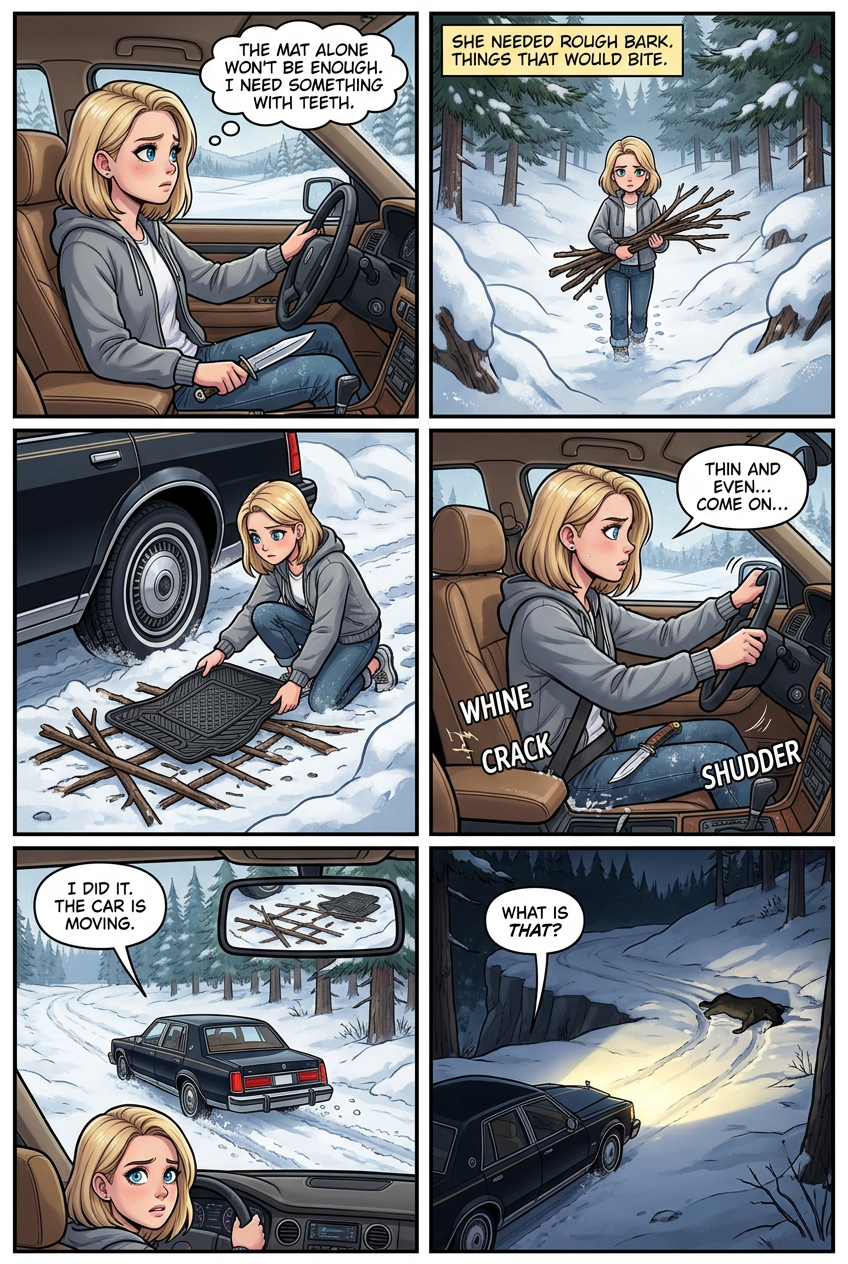
Chloe sat behind the wheel with the knife across her thigh and stared at the trees. The mat was not going to be enough. She had known that after the third try. The rear tires needed something with teeth. Something the rubber could not give her. She thought of the tree line and the dead branches under the snow, and she understood what she had to do. She got out. The wind pushed her sideways. She waded off the shoulder into the timber, sinking to her knees at every step. Under the low pines the snow was thinner. She kicked around the trunks until her boot struck wood. She bent and pulled up a branch as long as her arm, then another. She snapped off the soft ends and kept the hard middles. She wanted rough bark. She wanted things that would bite. It took four trips. Her arms shook by the last one. She piled the wood beside the right rear tire and knelt in the slush she had already dug. She laid the biggest branches flat against the packed snow, running them away from the tire like rails. She wedged the smaller ones crosswise between them, bark up. On top of the whole mess she pressed the rubber floor mat, textured side down, so the tire would grip rubber first and drive the wood into the ice underneath. She did the same on the left side with what was left. Then she stood up and looked at it. It was ugly. It might hold. She got in and shut the door. She did not pray. She put the car in drive and fed the pedal the way she had taught herself, thin and even. The tires whined. The wood cracked. The sedan shuddered, sat, and then climbed. She felt the back end lift onto the branches and catch. She kept her foot steady. The car crawled forward a foot. Two feet. The front tires found the packed track she had cleared and pulled. The sedan rolled out of the hollow and onto the road. She did not stop. She could not stop. If she stopped she would sink again. She steered into the center of the road where the wind had scoured it thinnest and kept her speed at a walk. The branches and the mat stayed behind her in the snow. She watched them shrink in the mirror until the next bend took them. Her hands were shaking on the wheel. She let out a laugh that came out closer to a sob. She had done it. The car was moving. Then the headlights caught something ahead on the road. A shape at the next switchback, low and still, off to the side where the drop began. Not a drift. Not a tree. She eased off the gas and the sedan slowed on the ice, and the shape did not move.
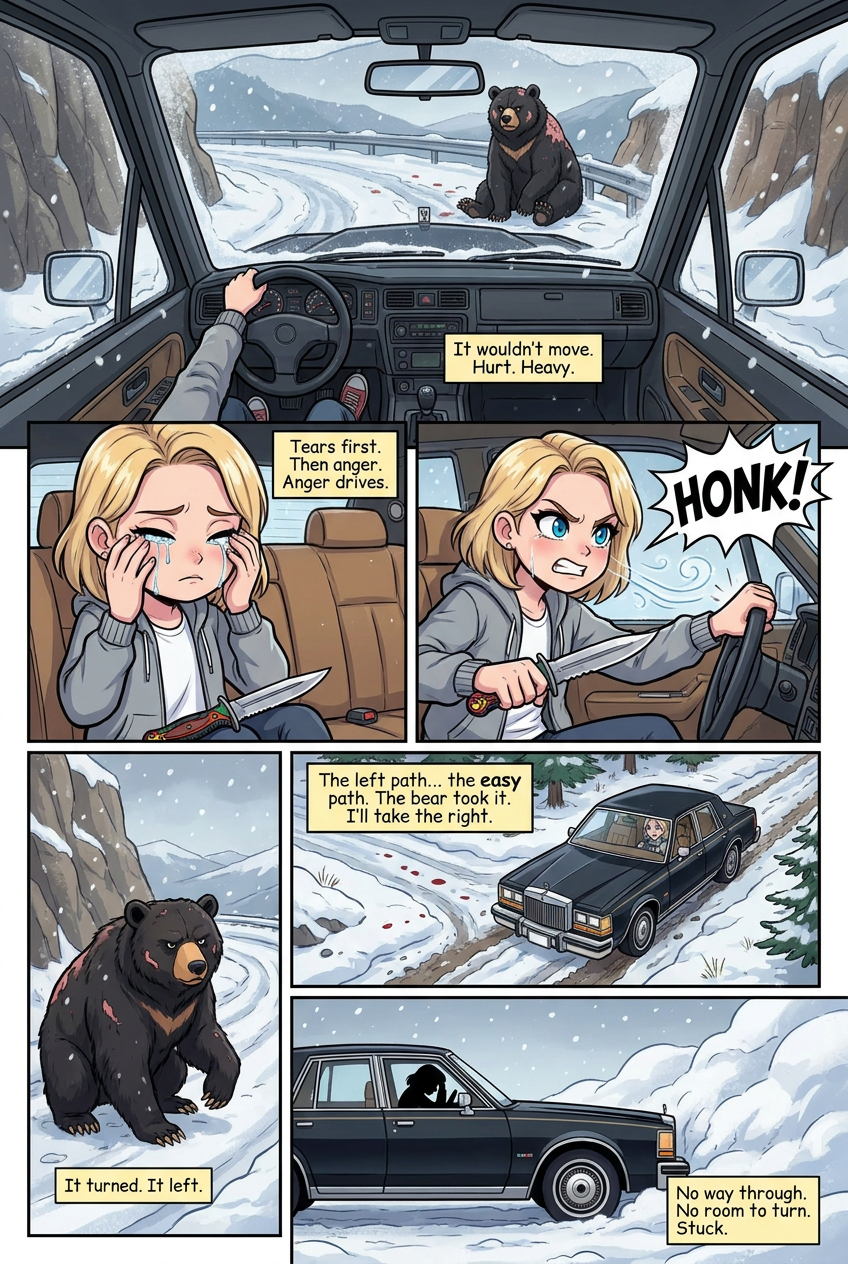
The sedan crept forward until the headlights held the shape in full. A black bear. It sat in the middle of the switchback, hunched on its haunches, one shoulder raw and pink where the fur was gone. Blood had dried in a crust down its side. It looked at the car and did not move. Chloe stopped ten feet short. She kept her foot on the brake. The switchback narrowed here, cliff on the left, cut bank on the right. She could not go around. She could not back up on the ice without sliding. She watched the bear breathe. Every breath came slow and heavy. It was hurt and it was not leaving. Behind it, the road bent down and out of sight. She did not know what waited past the turn. She had never driven this far. The main road switchbacked all the way to the highway. There was also a logging road that branched off somewhere below, if she remembered the map right. One of them ended at pavement. The other ended at nothing. She pressed her palms to her eyes. The tears came first, hot and quick. She let them. Then she found the anger under them and held on to it. Anger was useful. Anger drove. She picked up the knife from her thigh. She rolled the window down two inches. Cold air knifed in. She laid on the horn. The bear flinched. Its head swung up. She hit the horn again and held it. The sound bounced off the rock wall and came back doubled. The bear pushed itself up on three legs, the wounded shoulder held clear. It stared at the car for a long second. Then it turned and limped down the road, into the bend, and was gone. Chloe waited until her hands stopped shaking. She eased off the brake. The sedan crawled around the switchback. Below the turn the road forked. She had forgotten about the fork. The left branch was plowed once, maybe, and dropped away in clean grades toward the valley. The right branch was a rutted cut through the pines, wheel tracks filled with old snow, the shoulders sagging. A logging road. She could not see either one to its end. She did not know which fed the highway. She stopped the car at the split. The bear's blood spotted the snow to the left. It had chosen the plowed grade. Something about that made her stomach turn. She thought of a hurt animal picking the easy path because it could not manage the hard one. She turned the wheel right. The sedan rolled onto the logging road. The tires dropped into a rut and held. Branches scraped the paint. She kept her foot light and her eyes on the tracks ahead. A quarter mile in, the ruts ended at a wall of snow packed shoulder high across the road. A drift. No way through. No room to turn around.
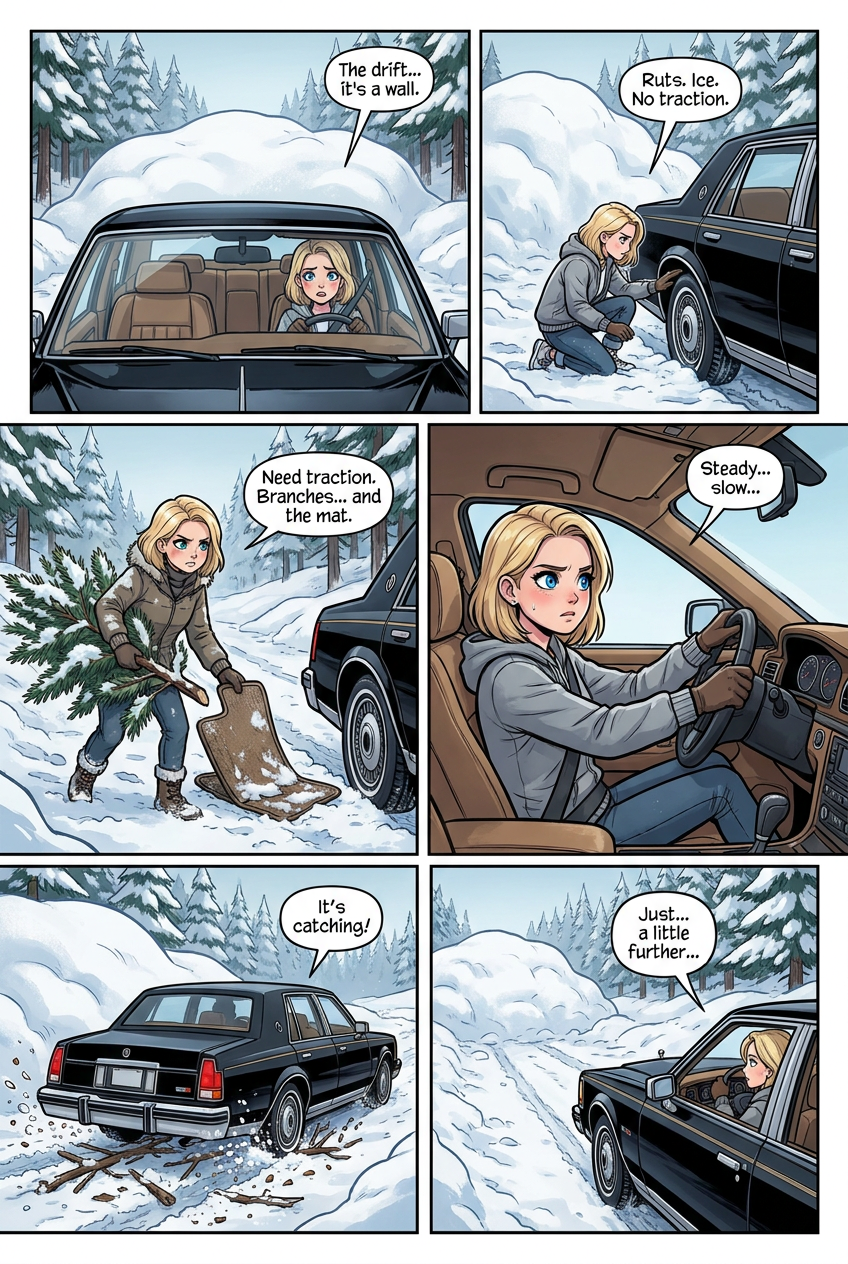
The drift filled the road ahead like a wall. Chloe stared at it through the windshield and felt the anger drain out of her hands. The logging road had ended. There was no turn wide enough for the sedan. The pines pressed in close on both sides, trunks and stumps and heaped snow. She had to go back the way she came. She shifted into reverse and eased off the brake. The tires spun. She let off and tried again, slower. The car crept back a foot. Then the rear dropped into a rut and stopped hard. The engine whined. She lifted her foot. She got out. The cold hit her face. She walked to the back of the car and knelt. The rear tires sat in a deep wheel track carved by something bigger than her sedan long ago. Old ice glazed the bottom of the rut. The tires had nothing to bite. If she gunned it, she would only dig in deeper and pack the ice smoother. She needed something under the tires. Branches again. She had used branches before and it had worked. She looked at the trees. The living limbs were high and green. The dead ones lay half-buried under snow along the shoulder. She dug with her gloves. She pulled out a length of pine, then another. Her fingers went numb inside the wet wool. She dragged four branches to the car and shoved them under the rear tires, thick ends first, pointing back the way she wanted to go. She pried the floor mat out of the driver's side and laid it flat behind the left tire, where the ice was worst. She got in. She set both hands on the wheel. She let the clutch of the brake go and gave the gas a slow, steady press. The tires caught. The branches cracked under the weight. The sedan rolled back two feet, three, then the mat spat out sideways and the left tire dropped again. She held the pedal. The right tire found wood and pushed. The car climbed out of the rut and kept rolling. She steered by the mirrors, one arm over the seat. The ruts ran straight for a hundred feet. She rode them backward, slow, until the road widened at a bend where trees had been cleared for a landing. She cut the wheel and worked the car around in short pulls, forward and back, until the nose pointed downhill again. She stopped. She was breathing hard. Her gloves were black with sap and mud. She looked through the windshield at the way out. The logging road ran down between the pines toward the fork. Beyond the fork, the plowed grade dropped toward the valley and the highway. She put the sedan in drive and started back down.
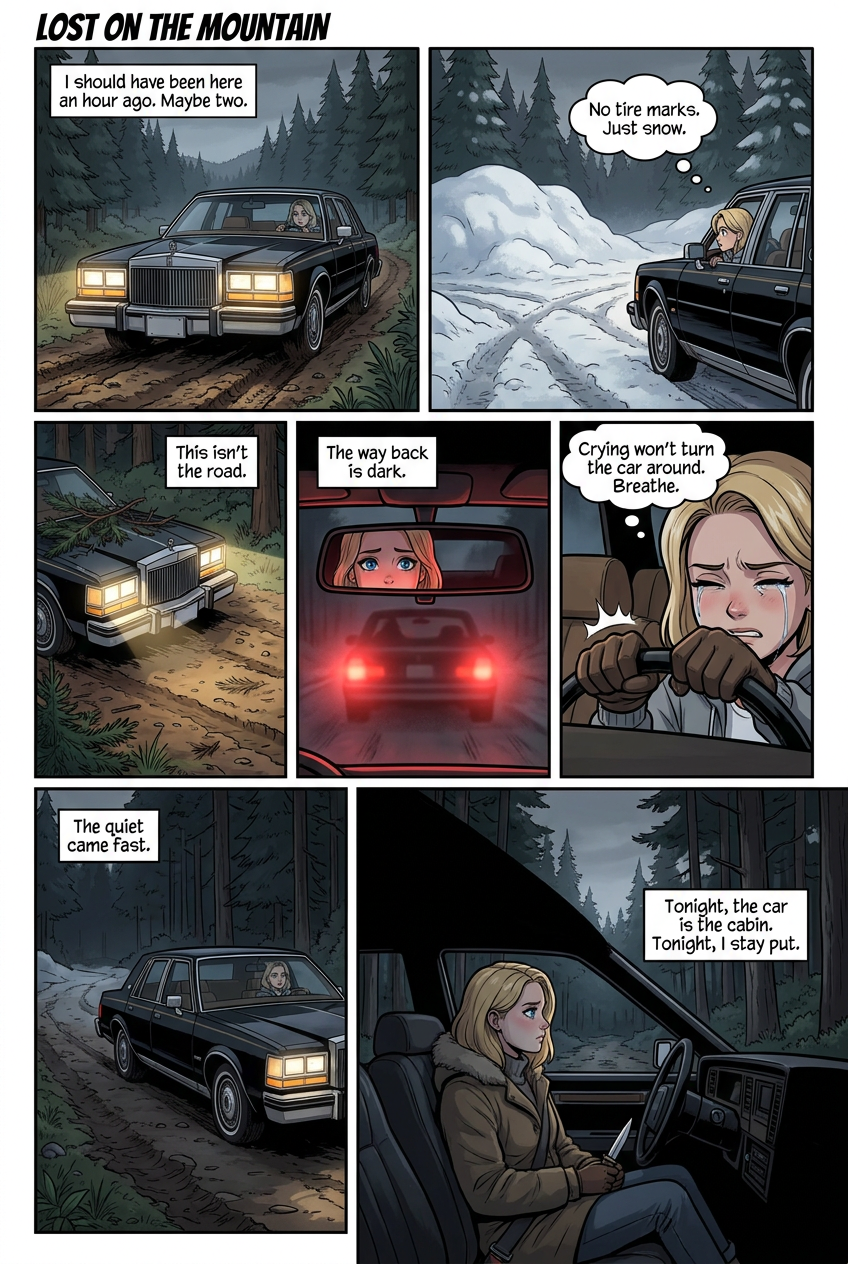
The logging road ran downhill between the pines. Chloe drove slow, both hands on the wheel. The sedan rocked over frozen ruts. She kept looking for the fork where the plowed grade cut left toward the valley. It should have been close. She had come up this way an hour ago. Maybe two. She could not remember now. The light was going. The sky above the pines had turned a flat gray. The trunks on either side of the road blurred into one dark wall. She flicked on the headlights. The beams jumped over the ruts and lost themselves in the trees. She reached a split. She stopped the car. She did not remember a split here. One track bent left and downhill. The other ran flat into deeper timber. Neither showed her tire marks. Snow had drifted over the road since she came up. She stared at both tracks and tried to think. Downhill was the valley. Downhill was the highway. She took the left. The road narrowed. Branches scraped the roof. The ruts under the tires got shallower, then vanished. The sedan bumped over bare dirt and pine needles. This was not the road she had come up. This was something older. She stopped again. The engine idled. She looked in the mirror. The way back was already dark. If she reversed now she would have to feel her way in the mirrors with no light behind her. If she went forward she did not know where forward went. She hit the wheel with the flat of her hand. She hit it again. Her eyes filled and she wiped them hard with the back of her glove. Then she stopped. Crying would not turn the car around. She made herself breathe. She put the sedan in reverse and backed up until the road widened enough to turn. She swung the nose around in three pulls. She drove back to the split and stopped. The other track ran into the timber. She did not trust it either. She killed the engine. The quiet came in fast. She listened. No wind. No engines. Nothing that sounded like a highway. She was somewhere on the mountain, on a spur she did not know, and the dusk had closed the door behind her. She locked the doors. She reached under the passenger seat and found the knife and set it in her lap. The heater was still warm. The gas gauge sat a hair above a quarter tank. She could run the engine in bursts through the night and keep from freezing. She pulled her coat tighter and watched the last gray drain out of the sky between the pines. She would find the highway in the morning. Tonight the car was the cabin. Tonight she stayed put.
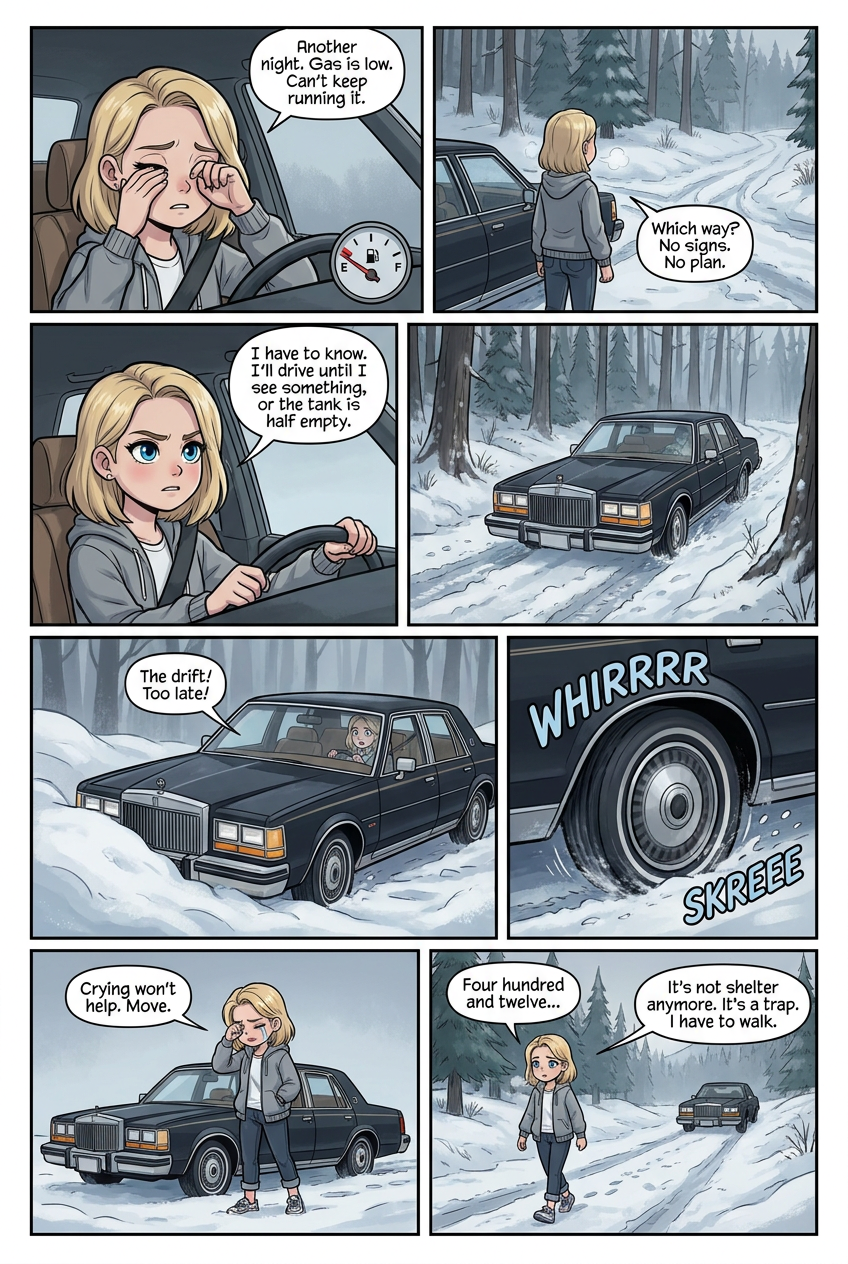
Chloe woke stiff in the driver's seat. Gray light filled the windshield. She had run the engine three times in the night. The gauge sat just under a quarter tank. She rubbed her eyes and looked at the fork in front of her. She still did not know how far the highway was. Without a number she could not plan anything, not fuel, not steps, not how long the cold would take her. She got out. The air burned her nose. She walked to the other track, the one into deeper timber, and looked at the ground. No tire marks. Old ruts under new snow. She walked twenty paces in and stopped. The road bent and kept going. She had no way to see the end of it from here. She went back to the sedan. She had to know. She could not sit here another night guessing. She would drive the flat track until she saw the highway or ran the tank to a half. If she saw nothing by then she would turn around while she still had gas to get back to this fork. She started the engine and rolled forward. The ruts were shallow and hard. The tires bit. She kept the wheels on the raised center where the wind had scoured the snow thin. The trees pressed close. Branches dragged the roof. A quarter mile in the road dipped. She saw the drift too late. It sat across the track in a smooth, rounded pile, wind-shaped, taller than her bumper. She hit the brake. The sedan slid forward on packed snow and pushed into the drift up to the headlights. The front end stopped hard. The rear tires spun and caught nothing. She put it in reverse. The wheels whined. The car did not move. She tried again, easing the pedal. Nothing. She got out and looked. The drift had swallowed the front bumper. The rear wheels sat in a glazed rut. Under them the snow was ice. She stood in the road and felt the tears come. She let them. Then she wiped her face and made her jaw set. Crying would not dig the car out. Anger would at least move her arms. She walked back the way she had come and counted her steps to the fork. Four hundred and twelve. She marked the number in her head. She looked down the flat track once more. No highway sound. No engines. Just trees. The sedan was stuck again, and this time she could not push through and she could not back out. The car was no longer the cabin. The car was the thing pinning her here. She would have to leave it and walk, and she still did not know which way the highway lay.
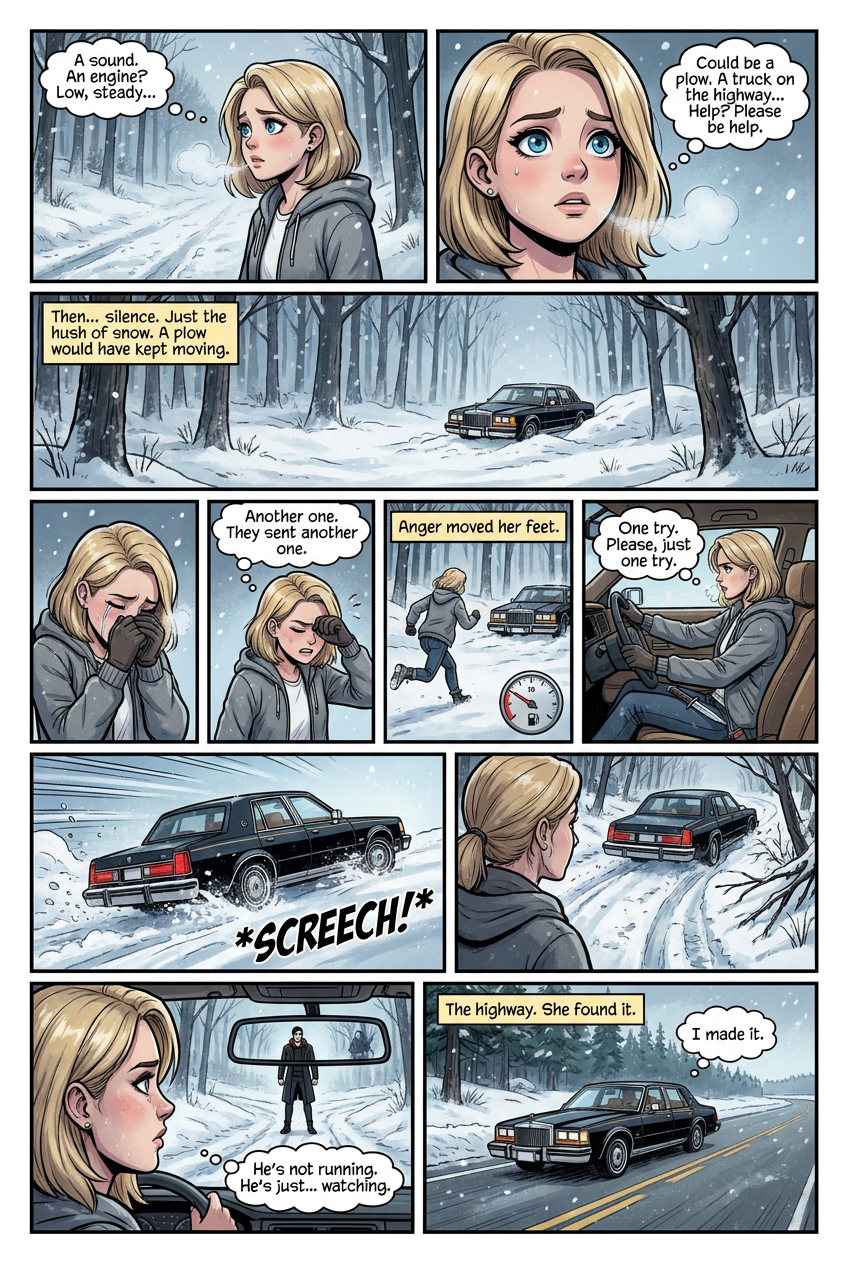
Chloe was ten steps from the sedan when she heard it. An engine, low and steady, somewhere back through the trees. She stopped in the middle of the track. Her breath fogged. She turned her ear toward the sound and held still. It could be a plow. It could be a truck on the highway she had been trying to find. It could be help. She wanted it to be help so badly her chest hurt. Then the engine cut out. No door slammed. No voices. Just the hush of snow settling on branches. A plow would have kept moving. A rescue crew would have called out. She knew then. Whoever had sent the first man had sent another. The one in the trees was not alone after all, or someone had come to finish the job. She cried once, hard, one sob into her glove. Then she wiped her face and let the anger take the place of it. Anger moved her feet. She ran back to the sedan. The drift held the front end like a fist. She did not care. She got in and slammed the door and locked it. She pulled the knife from under the passenger seat and set it on her thigh. She turned the key. The engine caught. The gauge shivered under a quarter tank. Enough for one try. She put it in reverse and floored it. The rear tires screamed on the glaze. The car shifted an inch and stopped. She threw it into drive. The bumper pushed deeper into the snowdrift. She reversed again, harder, rocking it, drive, reverse, drive, the way her father had shown her on a wet lawn a lifetime ago. The sedan lurched back a foot. Then two. Then the rear tires found the ridge of scoured center and bit. She backed down the track fast, one hand on the wheel, neck twisted to see behind her. Branches raked the paint she had once been proud of. She did not slow. She reached the fork and swung the wheel. The rear end slid wide, kissed a bank, came back. She pointed the hood down the flat track, the one she had not tried, and gave it gas. In the rearview she saw him. A man in a dark coat, standing where the two roads met, hood back, hands loose at his sides. He did not run. He watched her go the way the first one had watched her panic. The sedan carried her forward on the packed center. The trees opened. A hundred yards on, she saw a gray line cut through the timber ahead. Guardrail. Asphalt. A road wide enough for two lanes. She had found the highway. The gauge sat at an eighth. The man was behind her on foot. She turned onto the pavement and drove.
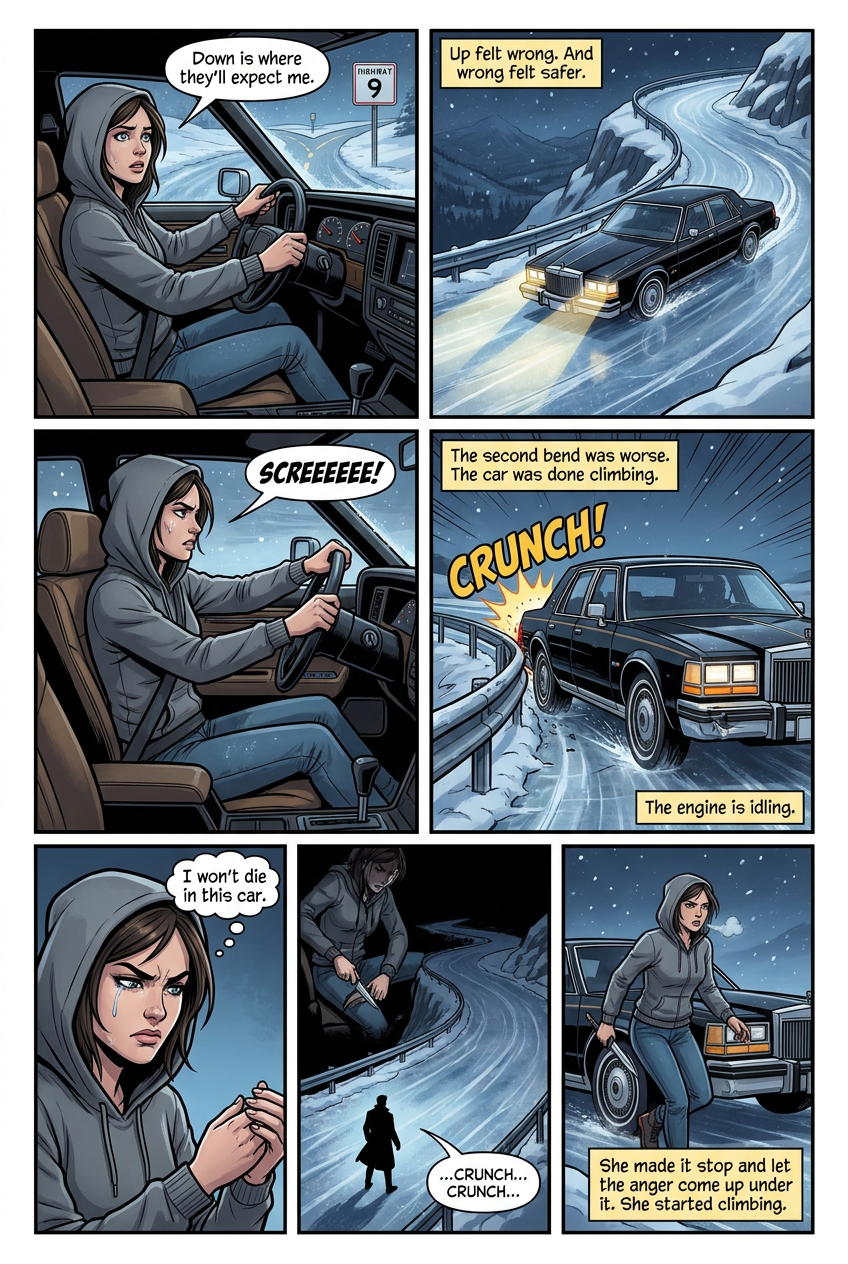
The highway ran flat for maybe thirty yards. Then it bent, and Chloe had to choose. Left dropped away between dark pines. Right climbed a grade that shone under her headlights like glass. She slowed the sedan to a crawl at the seam of the two directions. The gauge sat just under an eighth. The man in the coat was somewhere behind her on foot, but not for long. She had no map. She had no sign. She had a highway she didn't know and a safe house at the end of it that a federal voice on a phone message had promised her weeks ago. Down felt right. Down was towns and gas stations and people. But down was also the way she had come, and the way anyone hunting her would expect. If down was where they had staged the first man and the second, then down led back to whoever had paid them. She picked up. Up felt wrong, and wrong felt safer than obvious. She turned the wheel right and gave the sedan gas. The grade steepened inside a hundred feet. The headlights caught a switchback ahead, a tight curl of pale ice hugging the mountain. The rear tires spun once, caught, spun again. She eased off. The car crept. She could hear the tread hunting for anything to grip and finding a polished sheet instead. She took the first bend at ten miles an hour. The back end drifted left toward the guardrail. She steered into it the way her father had taught her on wet grass. The sedan straightened. She breathed out. The second bend was worse. The ice curved up and away, sculpted smooth by wind. She gave it a touch more gas to keep momentum. The rear wheels broke loose. The tail swung wide. The guardrail flashed white in her window and the bumper kissed it with a sound like a dropped pan. She stopped. The engine idled. The car sat crossways on the switchback, nose uphill, rear pinned against the rail. She tried the gas. The tires screamed and went nowhere. She tried reverse. Nothing. The sedan was done climbing. She cried once into her glove. Then she made it stop and let the anger come up under it. She had picked wrong. Up was a trap and she had driven straight into it, and the man in the coat was walking toward her right now on the flat road below. She killed the headlights. She killed the engine. In the sudden dark she heard her own breath and, under it, far down the grade, the soft crunch of boots on packed snow. She pulled the knife off her thigh. She unlocked the door. She would not die inside the car she had paid for. She stepped out onto the ice and started climbing on foot.
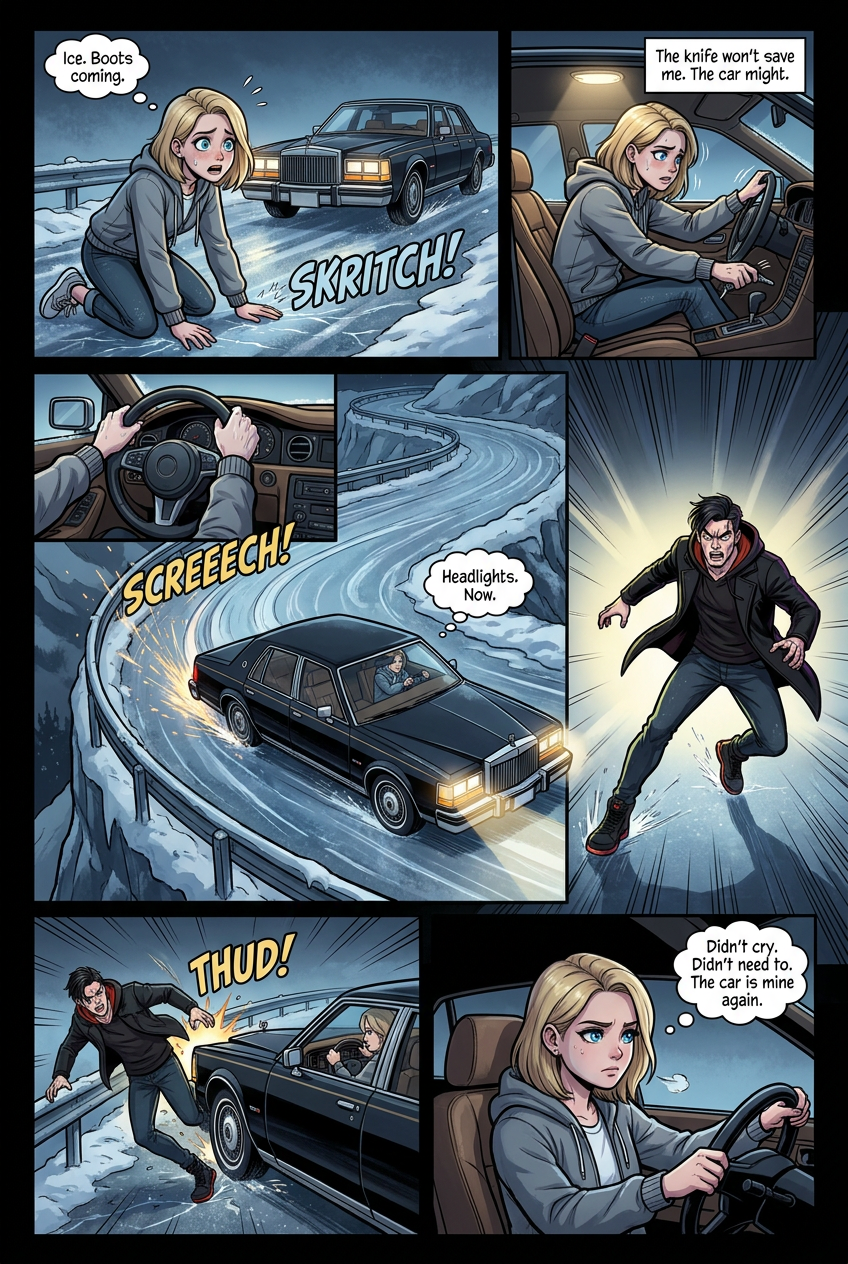
The ice on the switchback took her weight in a way the road never had. Chloe went down on one knee before she'd made it ten feet from the sedan. Below her, the boots kept coming. She could hear them now without straining. Whoever he was, he wasn't running. He didn't have to. She was on foot on a glass road with a paring knife, and he knew it. She turned back to the car. The knife wouldn't save her. The car might. The sedan sat crossways on the bend, rear bumper kissed to the guardrail, nose pointed up the grade. If she could pull it off the rail and let it roll, gravity would do what the engine couldn't. Downhill was toward him. That was the point. A two-ton car on ice was a weapon he couldn't outrun. She scrambled back. Her palm slapped the fender and slid. She hauled herself along the door and dropped into the driver's seat. The dome light showed her hands shaking. She let them shake and worked anyway. Key. Ignition. The engine caught on the second turn. She left the headlights off. She cranked the wheel hard left, toward the downhill drop. She fed the gas in a soft, steady press the way she'd learned climbing out of the snowdrift. The rear tires spun on the rail, screamed once, then bit against the metal itself. The sedan lurched. The bumper scraped free with a sound like a can opening. The car swung. Gravity took it. She pumped the brake once to test it. Nothing. The pedal went soft on the ice. She let go. The sedan gathered speed down the curl of the switchback, tail drifting, nose finding the fall line on its own. She steered into every slide and kept her foot off everything. Headlights, she thought. Now. She punched them on. He was closer than she'd guessed. Twenty yards, maybe less. The beams caught him full — long black coat open at the run, hood shoved back, teeth bared in a face she'd never seen and would never forget. He had time to understand. He tried to go sideways. On the ice there was no sideways. The sedan hit him at the hip. The sound was dull, not sharp. His body folded over the hood and slid off into the guardrail on the outside of the bend. The car kept going. Chloe kept her hands on the wheel. She rode the grade down through two more curves before the tires found grit and the brakes came back. She stopped on the flat where the highway bent. Her breath came in one long shudder, then evened. She didn't cry this time. She didn't need to. The gauge read just under an eighth. The road ahead was dark and unknown. The car was hers again, and she pointed it forward.
Play your story to life
Storycraft is a mobile game where you create AI characters, craft items and locations to build their world, then discover what direction your story takes. Download the iOS game for free today!
Download for free