

Cordelia's Arc
3 Chapters
Cordelia's dream is rebuilding her candy cottage into a witchy bakery that lures every lost child in the forest to her door.

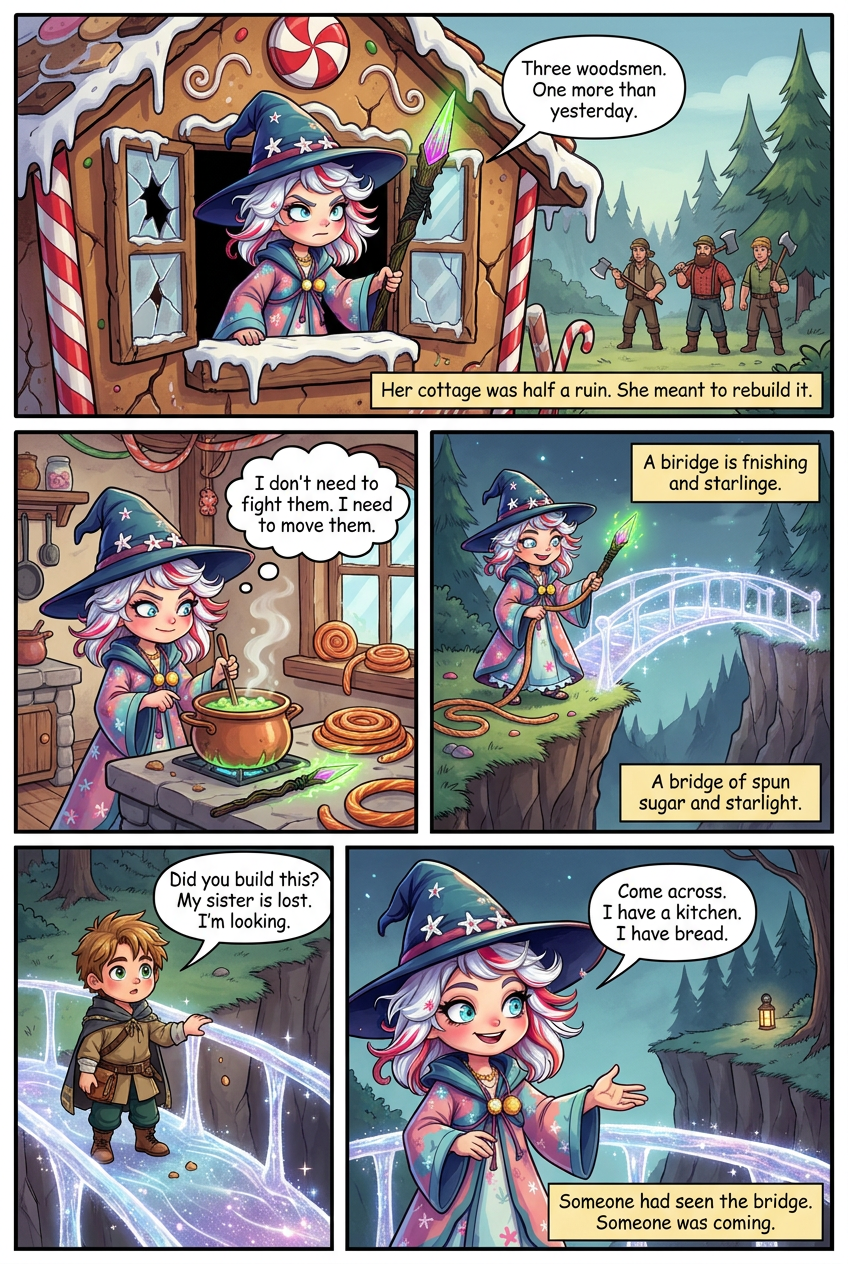
Cordelia counted three woodsmen on the north path before breakfast. That was one more than yesterday. She watched them from her kitchen window, past the sagging icing on the eaves, past the cracked peppermint that used to catch the sun. Her cottage was half a ruin now. The gingerbread walls had gone soft with rain. The candy-cane beams leaned. She meant to rebuild every sugared inch of it, brighter and sweeter than before, until no lost child in this forest could walk past her door without stopping. But no child could reach the door. The woodsmen kept turning them back at the tree line, axes on their shoulders, whistling to each other through the pines. She pulled her wand from the flour jar. The thorned shaft was still warm from last night's work. The green crystal at its tip pulsed once when she gripped it. She did not need to fight the woodsmen. She needed to move them. Cordelia worked all afternoon at the stone counter. She melted sugar in a copper pot until it ran clear as glass. She whispered into the steam. She poured the syrup into long ribbons and cooled them on the sill. By dusk she had a coil of candy rope thick as her wrist, warm and faintly humming. She carried it past the bone-white birches to the ravine that split the forest in two. The woodsmen guarded the paths, but no path crossed here. She tapped the wand against the candy rope. It unrolled itself across the gap, arching from lip to lip, hardening into a bridge of spun sugar and starlight. Anyone small enough to be curious would find it before any grown man did. She was smoothing the last rail when she heard boots. Not a woodsman's boots. Lighter. Quicker. A boy stood at the far end of the bridge, hand on the sugar rail, green eyes taking in the whole shining span. His cloak was too big for him. His satchel hung heavy at his hip. He was already dropping something from his fingers as he walked, one crumb, then another, marking his way back. "Did you build this?" the boy called. "I did," Cordelia said. She kept her wand behind her skirt. She smiled the way she had practiced in the cracked window glass. "Are you lost?" "My sister is," he said. "I'm looking." "Come across," Cordelia said. "I have a kitchen. I have bread." Hansel stepped onto the bridge. It held. He crossed to her side, still trailing crumbs, and she saw the trail stretching back into the dark beyond the ravine, past where the woodsmen watched the wrong paths. Cordelia turned toward her cottage and the boy followed. Behind them, on the far bank, a lantern bobbed into view. Someone had seen the bridge. Someone was already coming.
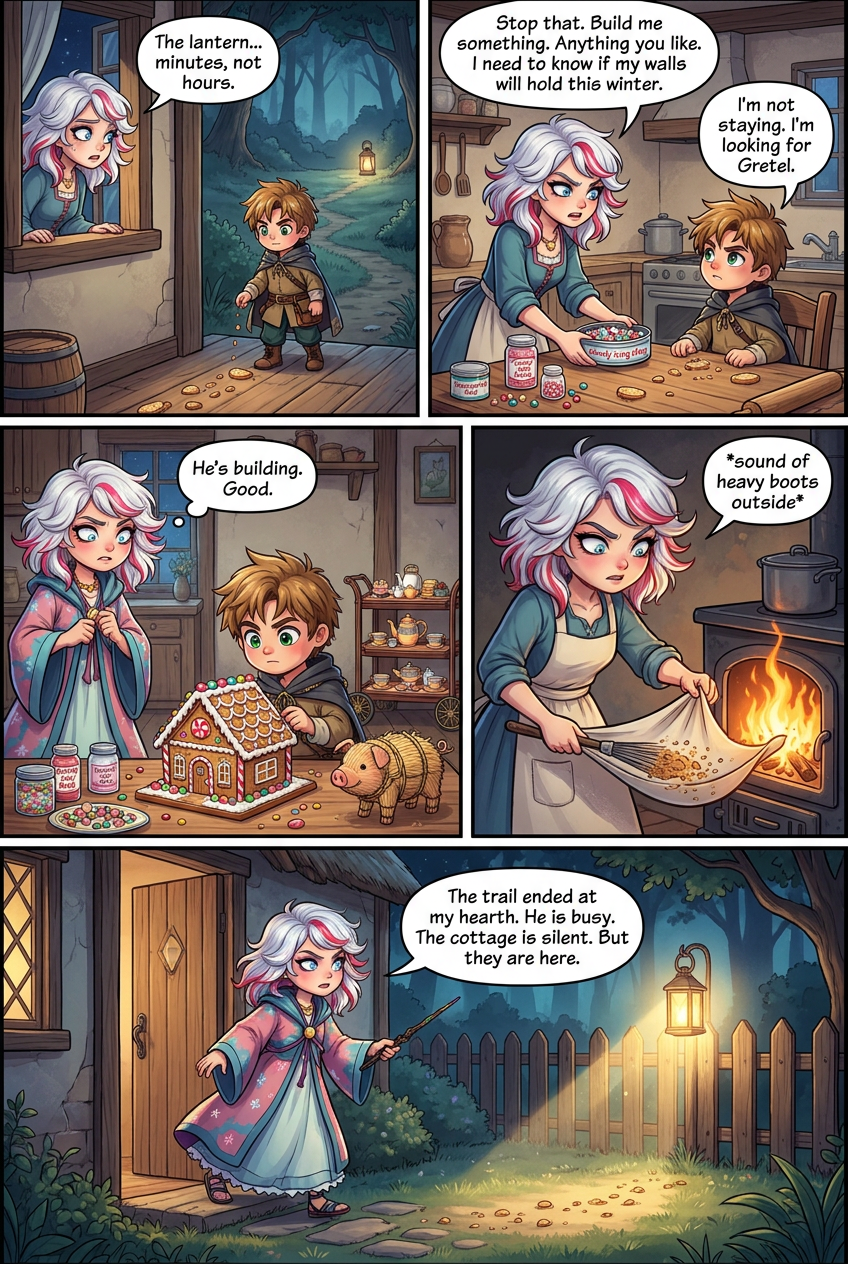
Cordelia shut the cottage door behind the boy. The lantern on the far bank was still small, but it was moving. She had minutes, not hours. She turned and found Hansel already at her kitchen table, satchel open, boots kicking the chair legs. He was pulling bread from his bag and setting the pieces in a curling line across her floor, one crumb, then another, marking the way back to a sister who was not here. "Stop that," Cordelia said, softer than she wanted. The boy did not stop. He looked up at her with the same green eyes from the bridge and kept dropping bread. If he cried, if he ran, if he shouted his sister's name out the window, the lantern would find her door in ten minutes flat. She needed him quiet. She needed him occupied. She crossed to the pantry and pulled down what was left of her old cottage — a tin of icing chips, a jar of peppermint dust, half a bag of hard sugar beads. She set them on the table between his hands. "Build me something," she said. "Anything you like. I need to know if my walls will hold this winter." Hansel looked at the tin. He looked at the crumbs on the floor. "I'm not staying," he said. "I'm looking for Gretel." "I know where trails go," Cordelia said. She sat across from him. She kept her voice level. "Build first. Then we talk about your sister. That is the trade." He watched her a long moment. Then he pushed the bread aside and pulled the tin toward him. He began stacking sugar beads into a small crooked hut, thatched with strips of icing, walls patched with peppermint. He worked fast, the way a boy works when he wants to prove something. Beside it, without asking, he shaped a lump of dough into a little pig and wrapped it in straw from her broom. Cordelia watched the door. The lantern light had reached her garden fence. She could hear boots now, heavy ones, not a woodsman's patrol rhythm. Someone alone. Someone who had followed the crumbs. She stood. She swept every piece of bread off her floor into her apron. She dropped the apron into the stove and shut the iron door. The trail ended at her hearth. "Keep building," she told Hansel. "Do not open the door for anyone but me." He nodded without looking up. His hands were sticky. His mouth was full of icing. He was quiet. Cordelia took her wand from the flour jar and stepped outside. The obstacle was solved. The boy was busy, the trail was ash, and her cottage was silent behind her. But the lantern was ten steps from her gate, and whoever held it had already seen her face on the bridge.
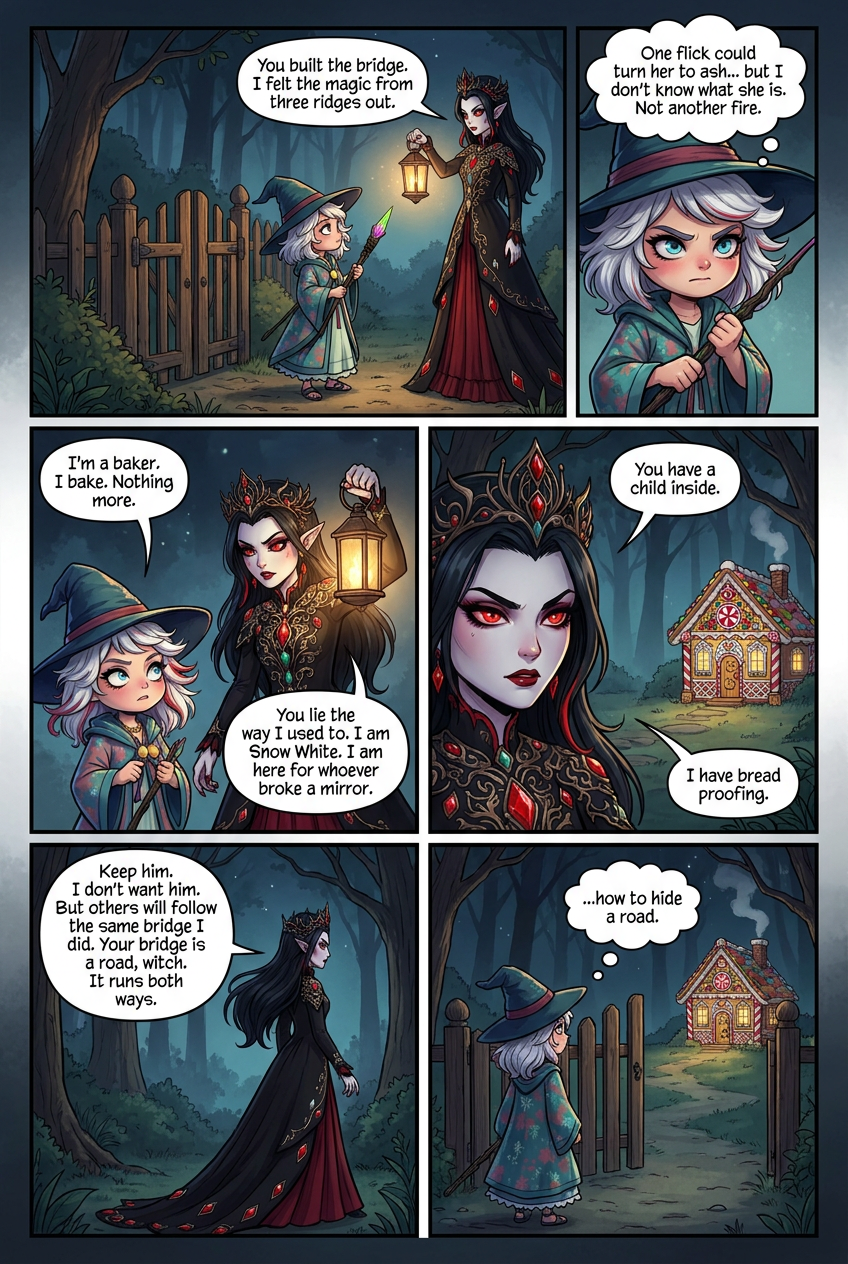
Cordelia stood in her garden with the wand low at her side. The lantern light stopped at the gate. A woman held it. She wore a black gown stitched with red stones, and a crown of dark iron. Her skin was pale as the inside of an apple. Cordelia knew the face from tales, but the tales had never shown those red eyes. "You built the bridge," the woman said. Short words. Flat. "I felt the magic from three ridges out." Cordelia kept her wand hidden in her skirts. One flick could turn the crumbs of this stranger to ash, as she had done inside her stove. But she did not know what the woman was. Attack the wrong thing, and the whole forest would learn a witch lived here again. She had burned once. She would not hand them a second fire. "I'm a baker," Cordelia said. "I bake. Nothing more." The woman lifted the lantern higher. The light crossed Cordelia's face, then slid past her left ear. Cordelia felt it like a cold finger. The woman had looked for the mark. The three black lines. The raven's foot. "You lie the way I used to," the woman said. "I am Snow White. I am not here for you." She stepped closer. The straw pig in Cordelia's memory, the boy's little toy on the table inside, felt suddenly loud through the door. "I am here for whoever broke a mirror. Old glass. Cracked now. If it shatters, things walk out of it that should not exist." Cordelia held still. "I broke no mirror." "No." Snow White studied her. The certainty left her voice. She went quieter. "The glass used to tell me who lied. It stopped. Now I read faces alone, and I am bad at it." She almost smiled. "You are bad at hiding. But you did not do this." Relief moved through Cordelia's chest. She let her grip on the wand loosen. Then Snow White's eyes went to the cottage window, where a small candle burned. "You have a child inside," Snow White said. Cordelia's mouth went dry. "I have bread proofing." "Children are what I trade in," Snow White said. "Apples. Curses. I know the smell of a hidden one." She turned the lantern down. "Keep him. I don't want him. But others in this forest do, and they will follow the same bridge I did." She stepped back toward the dark. "Your bridge is a road, witch. It runs both ways." Then she was gone, lantern swinging, into the trees. Cordelia stood alone at her gate. She had not been burned. She had not been named. But the queen was right. The bridge she built to pull children in had shown a stranger the way to her door. Inside, Hansel was still stacking sugar into a crooked hut. Cordelia turned back to him, and began to think about how to hide a road.
Play your story to life
Storycraft is a mobile game where you create AI characters, craft items and locations to build their world, then discover what direction your story takes. Download the iOS game for free today!
Download for free