

Cordelia “the museum curator”'s Arc
12 Chapters
Cordelia “the museum curator”'s dream is curating the rarest exhibits and solving the mysteries of the art that is dropped off at the museum's doorstep.

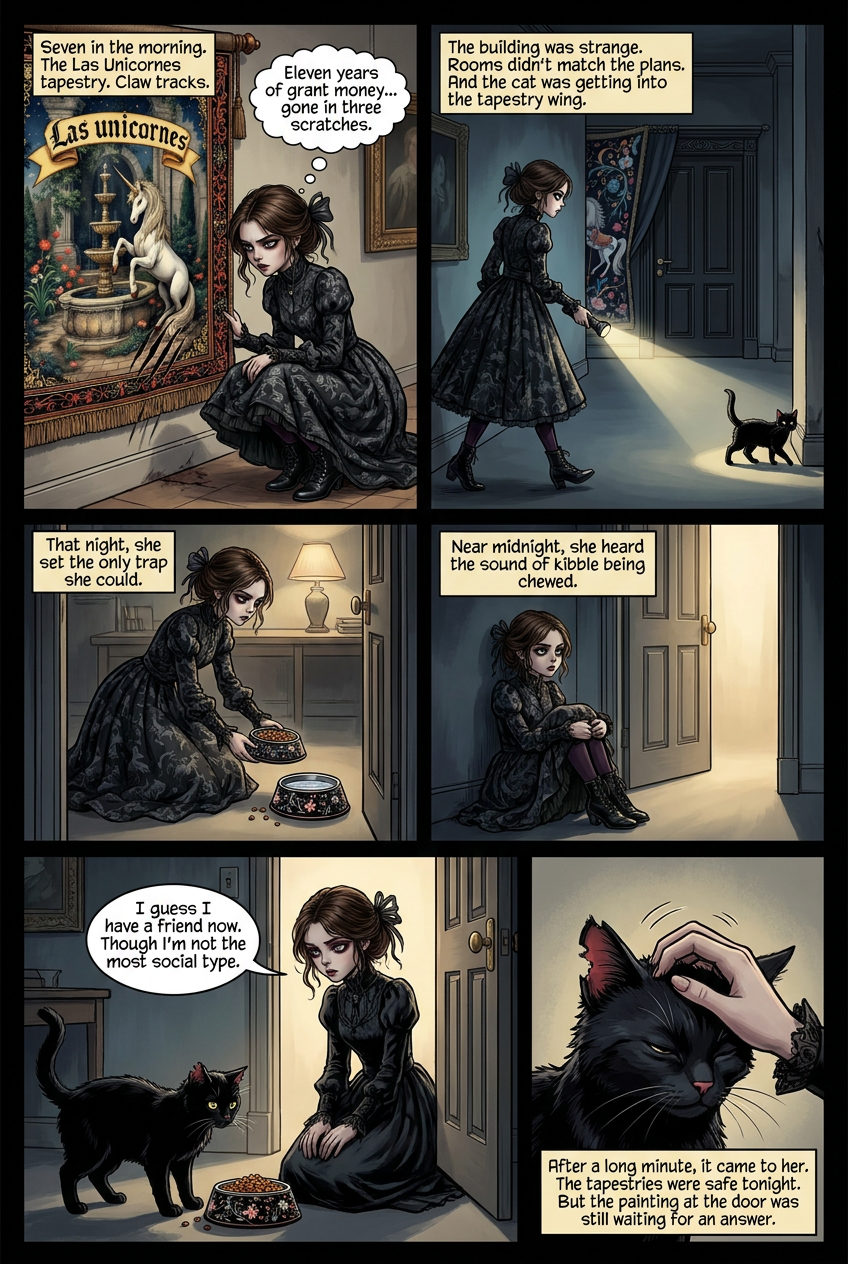
Cordelia found the claw tracks at seven in the morning, three thin scratches running across the bottom corner of a medieval tapestry she had paid eleven years of grant money to acquire. The unicorn beside the fountain was untouched. The border was not. She crouched in front of it and pressed her thumb to the snagged thread. One more pull and the whole lower edge would unravel. She had opened the Curio Museum alone. She found the building herself, a strange old place with rooms that did not match the original floor plans. She bought it cheap because no one else wanted the carousel pieces left behind in the basement. She wrote every grant. She hung every label. Last week someone had left an oil painting at her door overnight, a woman on a carousel horse, older than it looked, and she still meant to find out who knew enough to leave it. But first she had to find the cat. She knew it was a cat now. She had seen it twice, a skinny black stray with yellow eyes, slipping past her ankles in the dim hall and vanishing before she could shut a door. It was getting into the tapestry wing. She had moved the whole collection there after she peeled back a carousel-horse tapestry while dusting and found a hidden door behind it, a black panel with gold handles that did not appear on any blueprint. She had thought the wing was sealed. The cat disagreed. She walked the wing on her hands and knees with a flashlight. She checked the baseboards, the vent grates, the seam where the new wall met the old. She found nothing. The gap was somewhere she could not see, and the Las Unicornes tapestry was four feet from the floor. One jump. One claw. Six hundred years gone. That night she set the trap she could manage. She carried a pair of black ceramic bowls into the office at the far end of the building, filled one with water and one with dry food, and left the office door propped open. Then she sat in the dark hallway with her back against the wall and waited. Near midnight she heard the small dry sound of kibble being chewed. She stood up slowly, crossed the hall, and closed the office door behind her. The cat froze over the bowl. Cordelia knelt. She did not reach for it. After a long minute it came to her on its own and pushed its head against her knuckles, and she scratched behind one torn ear and then the other. "I guess I have a friend now," she said. "Though I'm not the most social type." She would call the vet in the morning and ask about the gap in the wing in the afternoon. The tapestries were safe tonight. The painting at the door was still waiting for an answer.
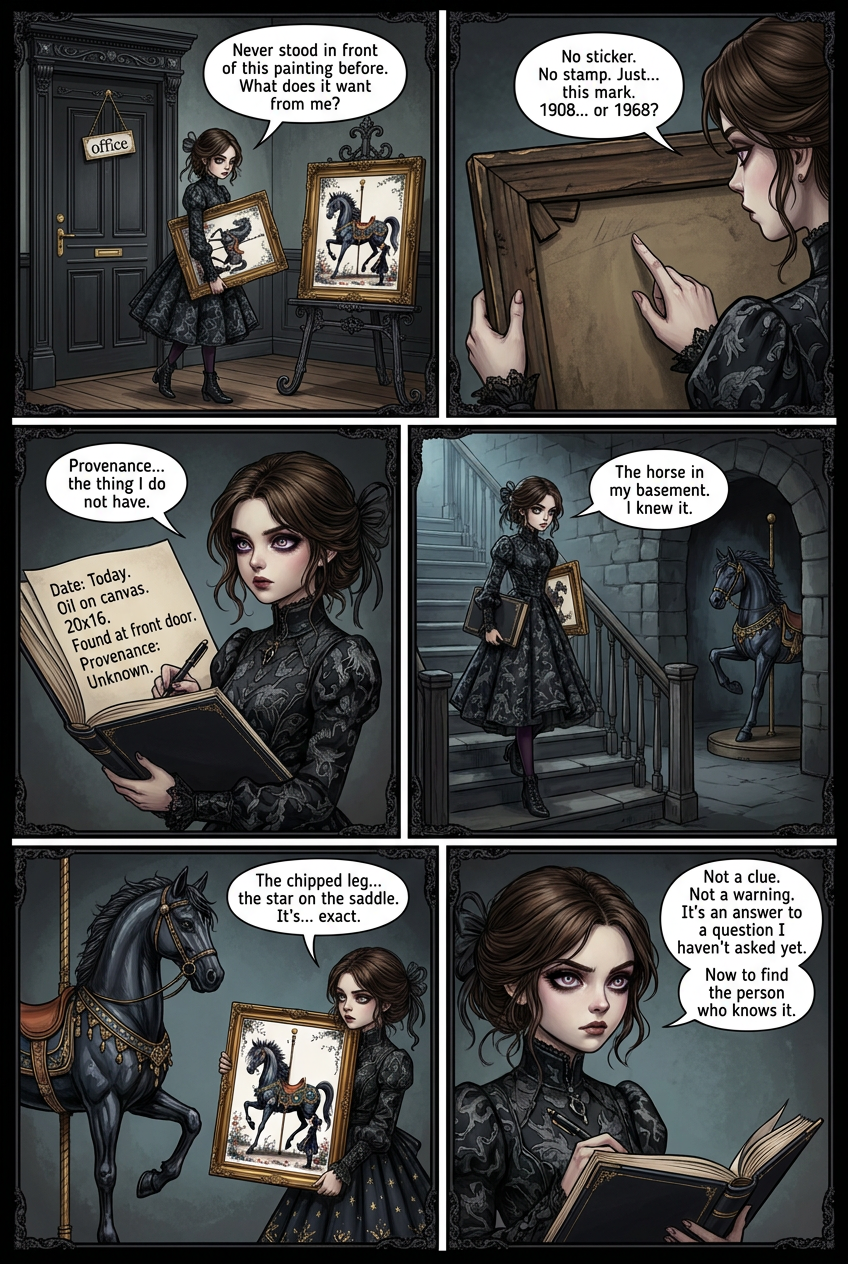
In the morning Cordelia fed the cat and carried the painting from the entry hall to her office. The black door with the crooked sign shut behind her. She set the canvas on the iron easel at the center of the room and stepped back until her desk pressed her hip. The carousel horse was black with gold trim. A little girl in a dark dress reached up to touch its bridle. Cordelia had stood in front of this office a hundred times. She had never stood in front of this painting before, and she needed to know what it wanted from her. She pulled her portfolio from the bottom drawer. It was already too full. She unsnapped the clasp and turned to the back, where she kept the entries for pieces with no paper trail. She wrote the date. She wrote oil on canvas, roughly twenty by sixteen inches. She wrote left at front door, no note, no witness. Then she stopped, because the next line was always provenance, and provenance was the thing she did not have. She worked the way she had taught herself to work alone. She lifted the painting off the easel and turned it over. No gallery sticker. No auction lot. No customs stamp. The stretcher bars were old pine, dark at the corners where someone had handled them often. She found a single mark in pencil on the top bar, three letters she could not read and a number that might have been 1908 or 1968. She wrote both down. She photographed the back. She set the canvas on the easel again and sat down to look at the front. The horse was the one in her basement. She had not let herself say it until now. When she bought the building the previous owner had left a single carousel horse downstairs, black lacquer, gold bridle, copper pole. She had cleaned it herself. She kept it on its stand near the back stair. The painted horse had the same chipped place on the left foreleg. The same star tooled into the saddle. Someone had stood in her basement long enough to paint it, or had known the horse before she did. She carried the portfolio down the stairs. The carousel horse waited on its copper stand where she had left it. She held the painting up beside it. The match was exact, down to the small gold tassel at the throat. She looked at the little girl in the painting again. Dark hair pulled back. A dress her mother had owned. Her own face, or close enough that the difference did not matter. She went back upstairs and wrote one line under the entry. Painter knew this horse before I did. Painter knew me. She closed the portfolio. The painting was not a clue and it was not a warning. It was an answer to a question she had not asked yet, and now she had to find the person who already knew it.
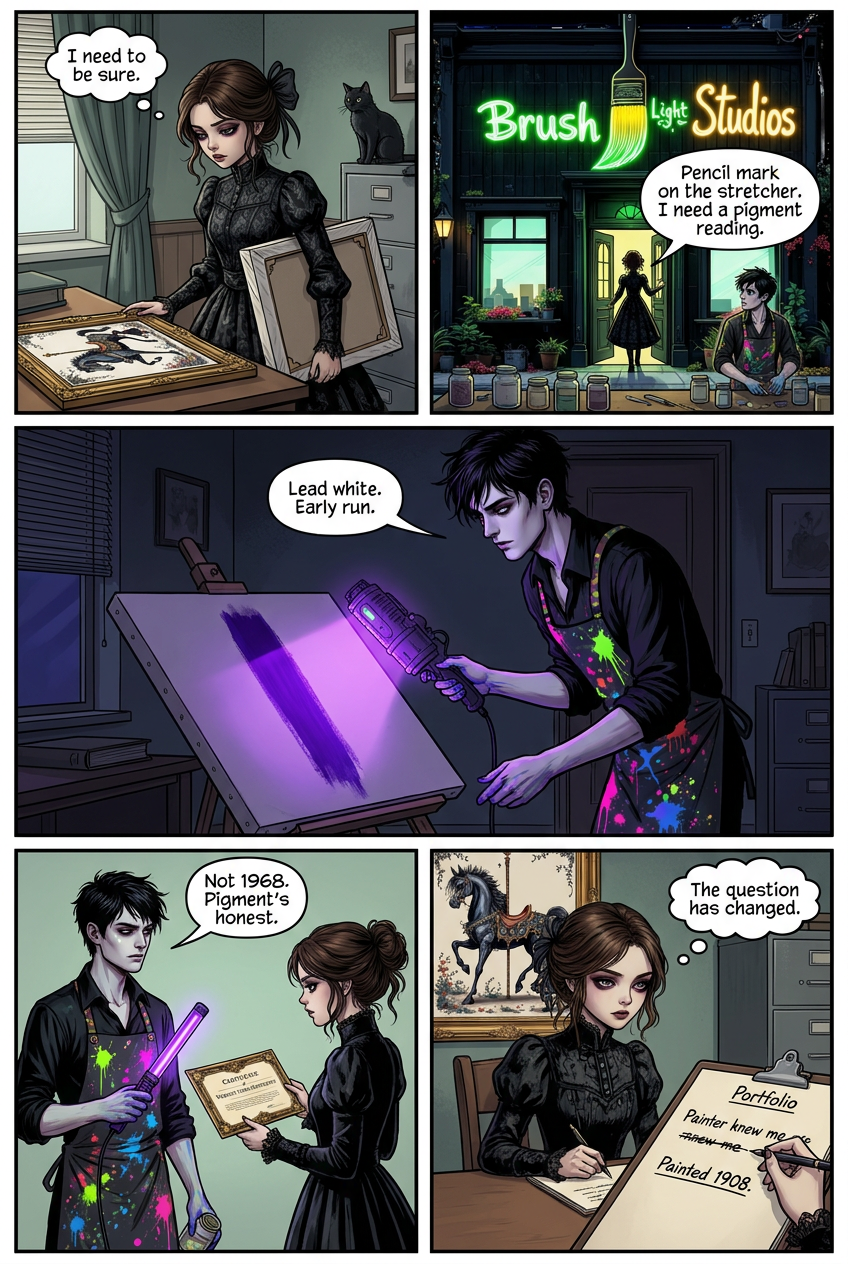
The portfolio entry sat open on her desk for two days before Cordelia admitted she could not date the painting alone. She needed a pigment reading, and she knew one person who did them. She wrapped the canvas in linen, carried it under one arm, and locked the office door behind her. The cat watched her go from the top of the filing cabinet. Brush Light Studios sat behind a black storefront with a neon sign shaped like a dripping brush. Cordelia had read about the owner in a trade bulletin years ago. He had built a clear UV-reactive coating with a chemist after a forger gutted a gallery he loved. She pushed the door open. Silas Luminova stood at a workbench in a paint-spattered apron, sorting jars. He looked up once, then kept sorting. "I have a painting," she said. "Pencil mark on the stretcher. Could be 1908. Could be 1968. I need to know which." "Bring it," he said. He picked up a black iron wand and a small jar of clear fluid. He followed her back through the streets without asking where they were going. In her office he set the wand on her desk and studied the carousel horse on the easel for a long moment. The little girl in the dark dress reached for the bridle. He did not comment on her face. He brushed a thin stripe of the clear coating along the edge of the canvas, where the paint met the tacking margin. He clicked the wand on. The room dropped into a low hum of violet light. The stripe bloomed deep purple, dark as a bruise, and held. Silas watched the color settle. "Lead white. Linseed binder. Early run." He clicked the wand off. "Late 1800s to about 1910. Not 1968." He pulled a folded certificate from his apron pocket, uncapped a pen, and wrote the date range on the signature line. He pressed his stamp beside it and handed it to her. "Pigment's honest. Whoever painted it wasn't hiding the year." Cordelia read the certificate twice. The pencil mark on the stretcher was 1908. She had proof now that the canvas was older than she was, older than her mother, painted before either of them stood near a carousel. Silas gathered his wand and his jar and let himself out. She sat down at the desk with the certificate in one hand and the portfolio in the other. Under the line that said Painter knew me she wrote a new line. Painted 1908. Then she set the pen down, because the question had changed. The painter was not someone who had watched her grow up. The painter was someone who had painted her face sixty years before she was born, and she had no idea whose hand had held the brush.
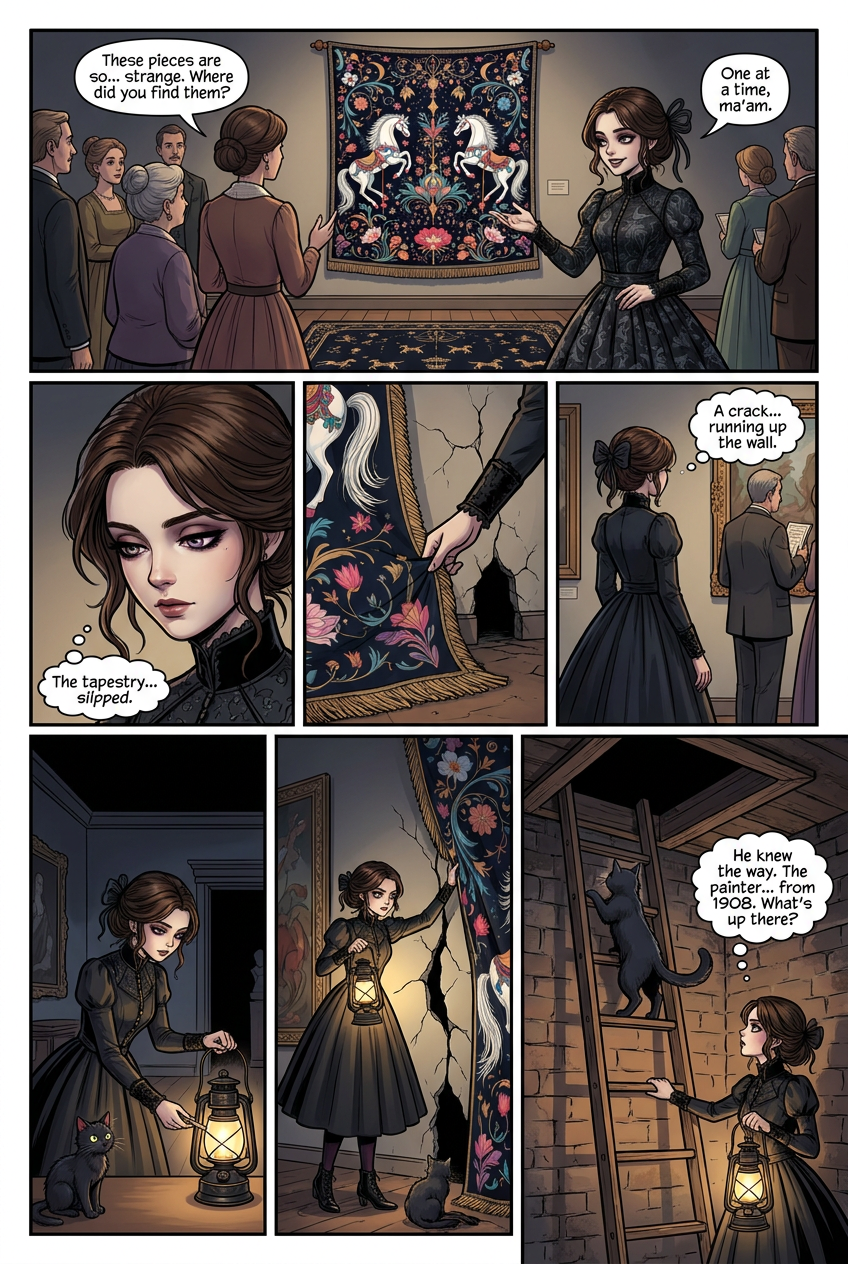
The certificate sat in the portfolio on her desk all week. Cordelia could not work the 1908 question from her chair, so she went back to the floor. The tapestry wing drew a small crowd that afternoon. She moved among the guests with a practiced smile, pointing out the stitching on the carousel-horse tapestry, the gold thread under the saddle, the dark border that swallowed the light. A woman asked where she had found such strange pieces. Cordelia said she had found them one at a time. She was crossing the dark rug under the center tapestry when she saw it. The bottom corner of the tapestry had slipped from its hook and pooled on the floor. Behind the slack fabric, a thin crack ran up the wall. It widened near the baseboard into a small dark opening. She straightened the corner with one hand and kept her face calm. A guest was watching the next panel. Cordelia made a mental note of the spot and moved on. She waited until closing. When the last guest left, she locked the front doors and went to her office for the lantern. It was a small black thing with a carousel horse etched on the glass, left over from an estate lot she had bought years ago. She lit the wick and carried it back to the tapestry wing. The cat followed her at a distance, silent on the rug. Cordelia pulled the tapestry to one side and crouched. The crack was wider than it looked from the floor. She held the lantern through the gap. The light fell on rough brick, then on a square of old wood set into the ceiling above the gap. Iron straps held it at the corners. A hatch. A ladder ran up the inside wall to meet it. The hidden door at the back of the wing did not open into a room. It opened into a shaft, and the shaft climbed to the attic she had never been able to reach from the main stair. Something moved at her elbow. The cat shot past her hand, scrambled up the brick, and used the ladder rungs like a staircase. He stopped under the hatch and looked back at her. His eyes caught the lantern light. He pawed once at the wood above him. The hatch shifted. It was not locked. Cordelia set one hand on the lowest rung. The gap was no longer a question. It was a way up. She did not know what the attic held, or why the cat had known the route before she did, but the painter who had drawn her face in 1908 had used this building, and the building had an attic she had never seen. She lifted the lantern and started to climb.
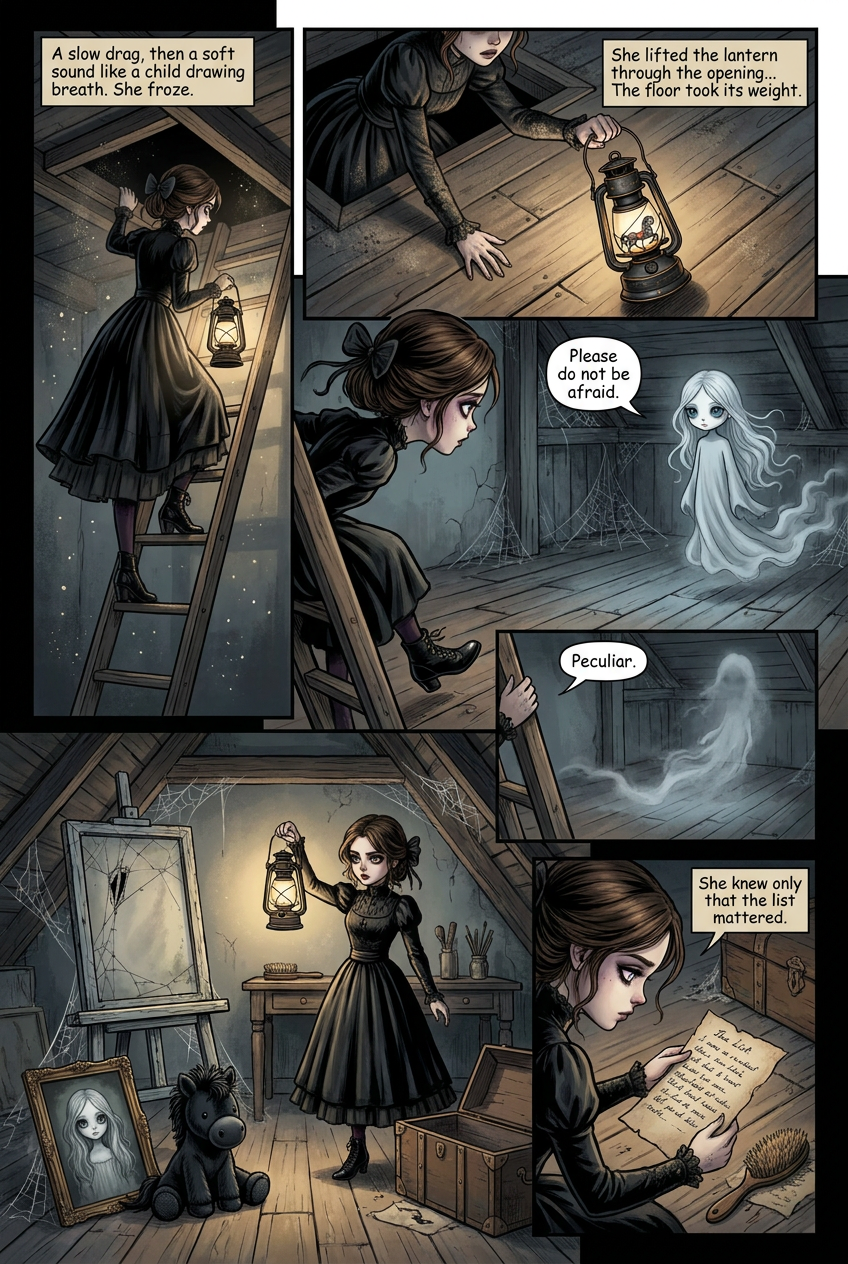
Cordelia climbed until her head met the hatch. She pushed it up with one shoulder and let it fall open against the attic floor. Dust rolled down onto her sleeve. She did not climb through. Something shifted above her in the dark. A slow drag, then a soft sound like a child drawing breath. She froze on the ladder and listened. The sound came again. A thin cry, no louder than a sigh. She lifted the lantern through the opening and set it on the boards just inside the hatch. Then she pressed down on the wood with her free hand, testing. The boards held. She slid the lantern forward by its handle, a foot at a time, watching for sag or splinter. The floor took its weight without a sound. Only then did she put her head through. A shape stood at the far end of the attic. A girl, small, in a pale dress, her edges trailing off into the air like smoke pulled from a candle. Cordelia's foot slipped on the rung. She caught the hatch frame with both hands and stopped herself from falling. The girl turned. Her eyes were very large and very dark. She saw that Cordelia saw her. "Please do not be afraid," the girl said. Then she thinned out and was gone. Cordelia held the frame a moment longer. "Peculiar," she said aloud, to steady her own voice. She pulled herself up through the hatch and stood. She lifted the lantern. The beam swept the room in pieces. First an easel, grey with dust, cobwebs strung corner to corner across the empty frame. Then a low table of dried brushes and cracked tubes, the paint inside gone to stone. Then an old trunk with its lid half open. Then, on the bare floor, a framed portrait laid face up. A pale girl with dark hair and dark eyes looked back at her. It was the same child from the carousel painting left at her door. The same face, Cordelia knew, that resembled her own at that age. Beside the frame lay a black stuffed horse, floppy at the legs, its mane matted flat. She had owned that horse. Her mother had bought it for her at the carousel. Cordelia knelt. She did not touch the portrait or the toy. Past them, near the trunk, a single sheet of paper lay weighted by a dry brush. She slid it free. It was a list, handwritten in faded ink, of paintings by title and date. She did not yet know what the list named, or whose hand had written it, or how a toy from her childhood had come to rest in a room sealed before her birth. She knew only that the list mattered. She folded it once, slid it into her coat, and looked back at the empty corner where the girl had stood.
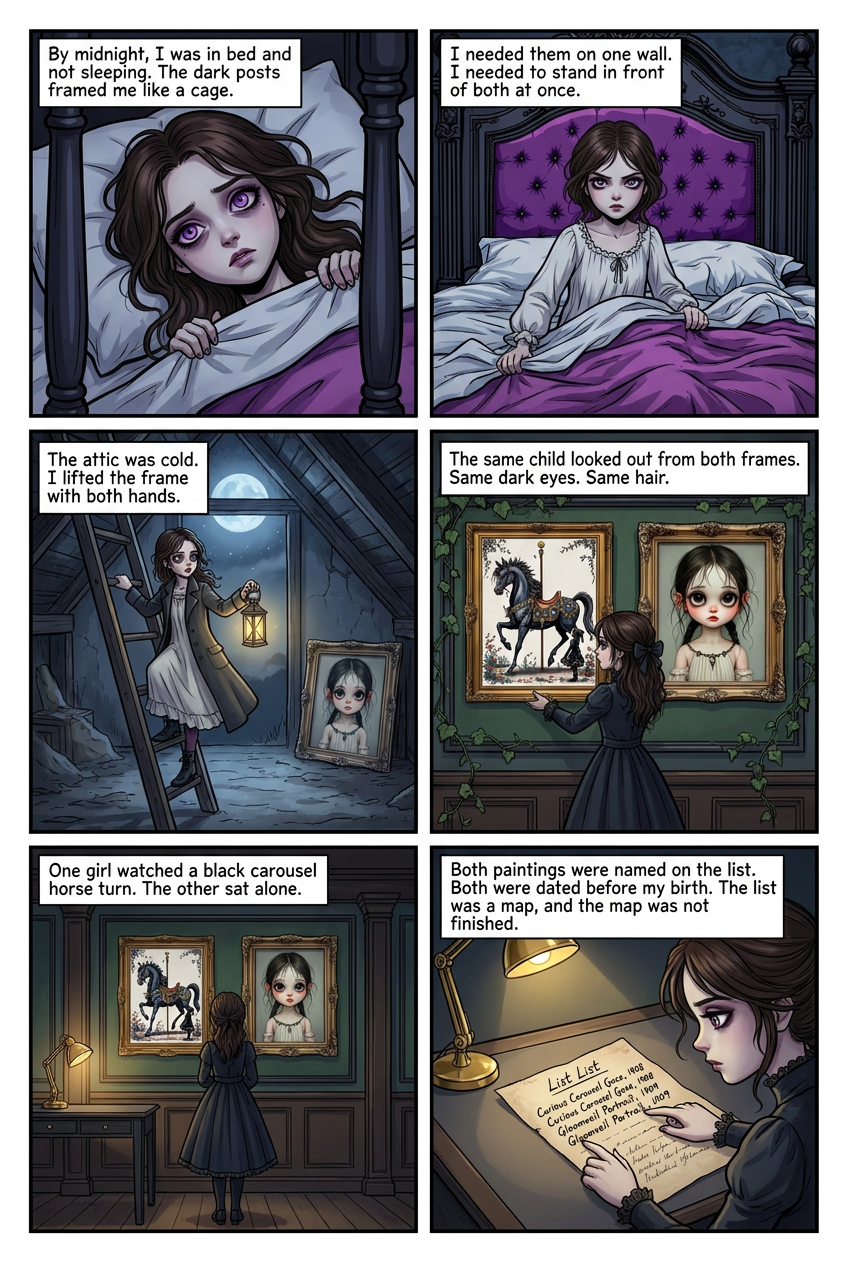
Cordelia came down from the attic with the folded list in her coat and the carousel painting still propped in her office downstairs. She ate nothing. She locked the museum and walked home with the list pressing against her ribs. By midnight she was in bed and not sleeping. The purple covers slid off one side. A pillow ended up on the floor. The dark posts of the bed framed her like a cage. She kept seeing the painted girl's face, and her own face under it, and the carousel horse with the chipped foreleg. At two in the morning she sat up. The painting left at her door was downstairs at the museum, in her office. The portrait from the attic was still on the attic floor where she had left it. She needed them on one wall. She needed to stand in front of both at once. She pulled on her coat over her nightclothes and went out. She walked back to the museum and unlocked the front door. She climbed to the tapestry wing, opened the hidden shaft, and went up the ladder with a lantern. The attic was cold. The portrait of the pale girl lay where she had left it, face up beside the black stuffed horse. She lifted the frame with both hands and carried it down the ladder one rung at a time. She did not look toward the corner where the girl had stood. In her office she cleared the dark panel above her desk. She mounted the rail across it. She hung the carousel painting on the left. She hung the attic portrait on the right. The vines at the panel's edges brushed her wrist as she stepped back. The same child looked out from both frames. Same dark eyes. Same hair. Same mouth. One girl watched a black carousel horse turn on its pole. The other girl sat alone against a plain green wall, wearing a small necklace Cordelia did not recognize. She spread the handwritten list flat on her desk under the brass lamp. The ink was brown with age. She read the titles down the column. Halfway through she found Curious Carousel Gaze, dated 1908. Three lines below it she found Gloomveil Portrait, dated 1909. Both paintings on her wall were named on the list. Both were dated before her birth. The same hand had made them, recorded them, and meant them to be found together. Cordelia sat down. She had wanted the two paintings side by side to think. Now she had them, and the list, and a date, and a painter who had known her face and her toy and her horse sixty years too early. She did not know who he was. She did not yet know what the rest of the list named. But she knew the list was a map, and the map was not finished.
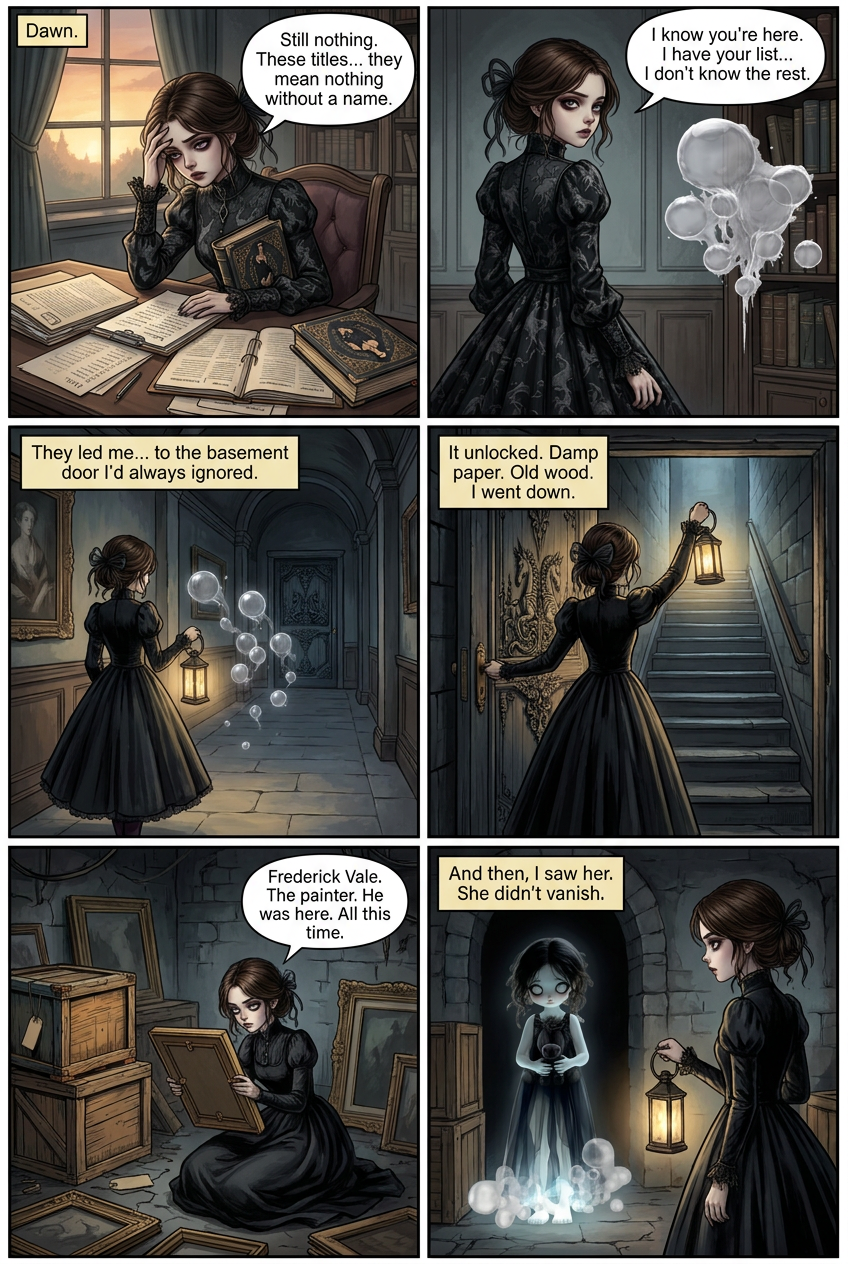
Cordelia did not go home. She stayed in her office with the two paintings on the wall and the list flat on her desk. By dawn she was pulling files from the cabinet behind her, looking for any record that might match a title further down the column. She found nothing. She paced between the desk and the door. She read the list again. She read it a fourth time. The titles meant nothing to her, and she had no painter to attach to them. She stopped pacing. The room felt colder than the hallway. She turned her head slowly. The cold sat behind her left shoulder, steady, like someone standing close. She did not move. She had felt it before in the attic, and she had felt it last night near the wall. Whatever stood there was watching her read. "I know you're here," Cordelia said. She kept her hands on the desk. "I have your list. I have two of the paintings. I don't know the rest." The air thickened near the bookcase. Small pale shapes formed there, one then another, until a loose cluster of gray orbs hung at shoulder height. They drifted toward the office door and stopped. Cordelia took her lantern from the shelf. She followed. The orbs led her down the main stairs, past the tapestry wing, and through the back corridor she rarely used. They stopped at the end of it, in front of a door she had walked past for years without opening. Dark wood. A carousel horse carved into the panel. A brass handle gone green at the edges. The basement door. She had always assumed it led to storage she had inherited and never sorted. The orbs sank into the floor and vanished. Cordelia tried the handle. It turned. The door swung inward on a stairway that smelled of damp paper and old wood. She went down with the lantern raised. At the bottom, the carousel horses she kept stored stood in their usual row against the far wall. But behind them, stacked along the side she had never cleared, sat a dozen wooden shipping crates with curling tags, and beside the crates a leaning stack of empty black frames. She lifted the top frame. A small brass plaque sat at the bottom edge. Frederick Vale. She set the frame down and stood very still. The painter had a name. The crates had his name. The frames had his name. He had used her building. He had stored his work here, decades before she ever found the deed. She turned in a slow circle, lantern held high, and saw the pale figure of a girl standing between two crates, holding a black stuffed horse against her chest, watching her. The girl did not vanish this time. Cordelia did not look away.
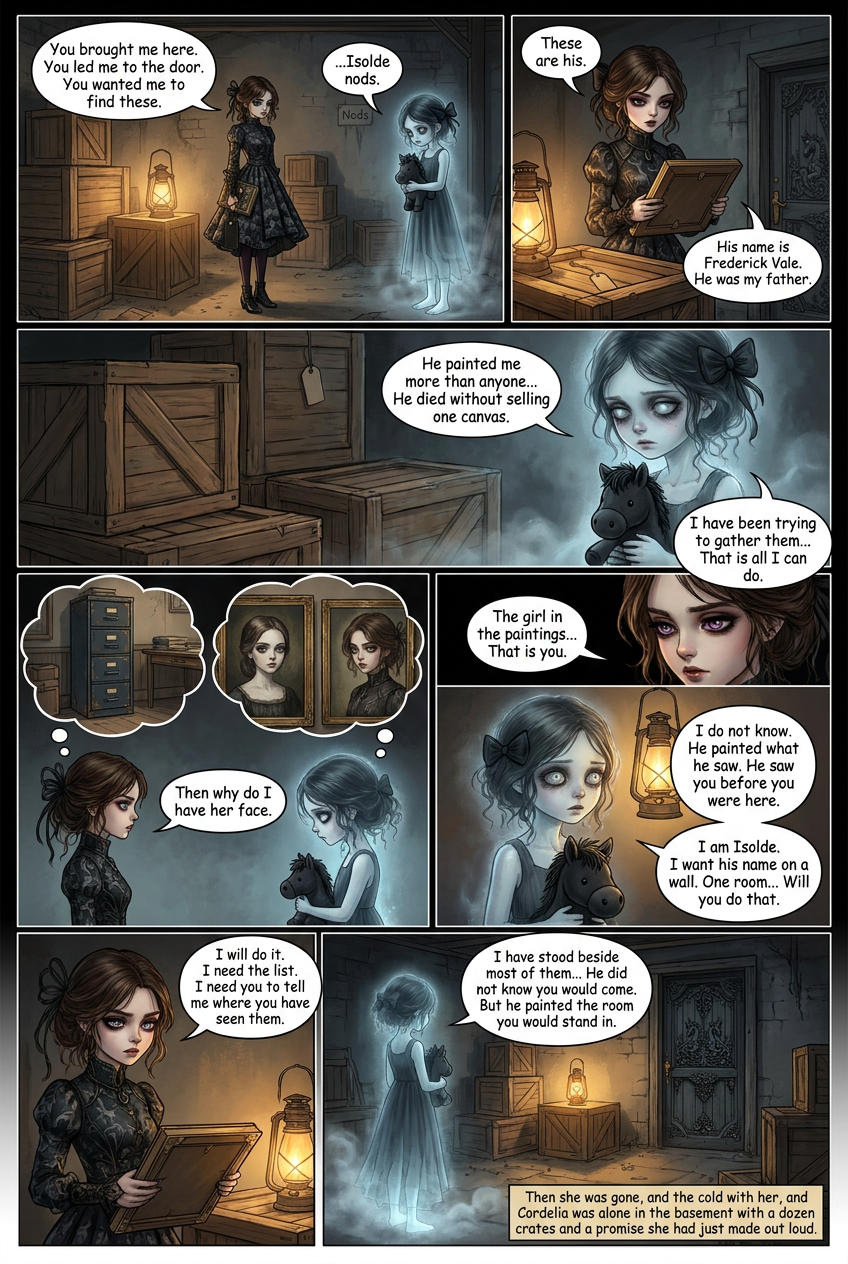
Cordelia set the lantern on a crate and did not step closer. The girl stood between the stacks, thin as a curtain, holding the black stuffed horse against her chest. A wisp of black ribbon trailed from her hair. Cordelia had seen her twice before, and both times she had vanished. This time she stayed. "You brought me here," Cordelia said. "You led me to the door. You wanted me to find these." The girl nodded once. Her voice, when it came, was flat and small. "His name is Frederick Vale. He was my father." Cordelia lifted the top frame from the leaning stack. The brass plaque caught the lantern light. She turned the frame so the girl could see it. "These are his." "He painted me more than anyone. He told me so." The girl paused. "He died without selling one canvas. The paintings went to strangers. I have been trying to gather them." She looked at the crates. "I cannot lift them. I cannot move a page. I led you to the shaft. I led you to this door. That is all I can do." Cordelia thought of the list on her desk, and the two paintings hung side by side upstairs. She thought of the child's face in both, and her own face in the mirror. "The girl in the paintings," she said. "That is you." "Yes." "Then why do I have her face." The girl did not answer at once. She looked down at the stuffed horse. "I do not know. He painted what he saw. He saw you before you were here." She lifted her eyes. "I am Isolde. I want his name on a wall. One room. All of them together. Will you do that." Cordelia set the frame down against the crate. Her file cabinet upstairs held every provenance record she had ever written. None of them held his name. She would have to build the record from nothing, track the paintings on the list to whoever owned them now, and bring each one back. It would take months. It might take years. "I will do it," she said. "I need the list. I need you to tell me where you have seen them." Isolde nodded. The lantern flame bent toward her and steadied. "I have stood beside most of them. I can show you the rooms. I cannot always find the streets." She looked at Cordelia a long moment. "He did not know you would come. But he painted the room you would stand in." Then she was gone, and the cold with her, and Cordelia was alone in the basement with a dozen crates and a promise she had just made out loud.
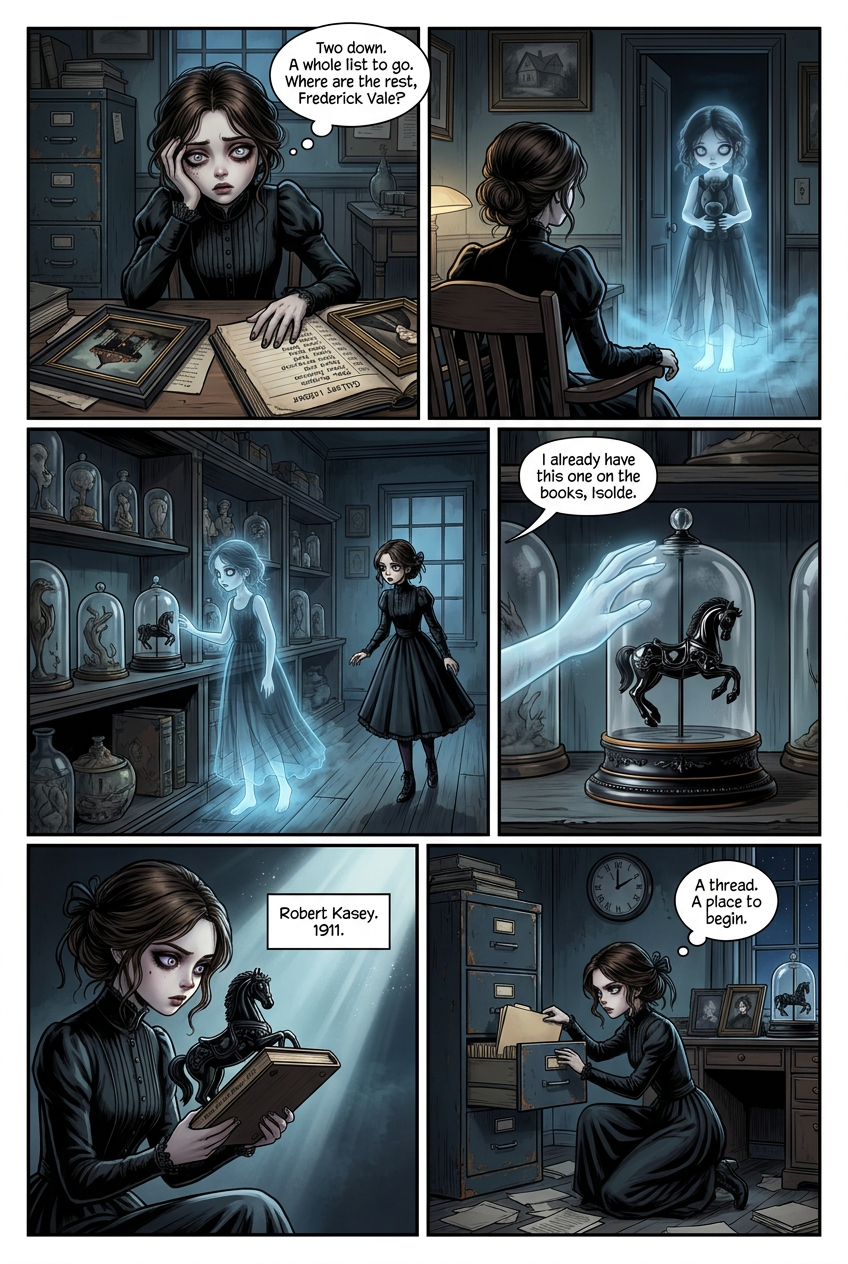
Cordelia sat at her office desk with two black frames in front of her. Each frame carried a small plaque etched with the name Frederick Vale. She had pulled them from the basement crates the night before. Now she fit the carousel painting into the first frame and the attic portrait into the second. Two down. A whole list to go. She had promised Isolde an exhibition, and she had no idea where the rest of the paintings were. She leaned back and looked at the list beside her. The paper was soft at the edges from handling. Titles and dates. No owners. No cities. No leads. Her file cabinet in the corner held every provenance record she had ever written, and none of them named Vale. She had spent the morning pulling drawers and finding nothing. Without a first thread, the exhibition was a promise she could not keep. A cold pressed the back of her neck. Cordelia turned. Isolde stood in the doorway, thin as smoke, the stuffed horse clutched to her chest. Her sunken eyes fixed on Cordelia. She did not speak. She drifted back into the hall. Cordelia followed. Isolde led her past the tapestry wing and into the curio room, where bell jars and small cases lined the shelves. Cordelia had walked this room a hundred times. Isolde crossed to a low shelf near the back and stopped at a glass dome she had priced and catalogued years ago: a black onyx carousel horse under an ornate bell jar. Isolde lifted one transparent hand and let it hover against the glass. The dome fogged where her fingers passed. "I already have this one on the books," Cordelia said. "It came in an estate lot." Isolde did not answer. She only kept her hand near the base. Cordelia knelt. She lifted the jar and set it aside. The onyx horse sat on a small wooden plinth. She tilted the plinth toward the light. Etched into the underside, in thin careful script, were two lines. From Robert Kasey. And a date: 1911. Cordelia sat back on her heels. Robert Kasey. The name meant nothing to her. But it was a name, and it was tied to a carousel horse, and it had come from someone who had once owned this piece and cared enough to sign the wood. She carried the plinth back to her office and set it beside the list. She opened the file cabinet and began pulling every estate lot record she had. By midnight she had it: a shipping receipt from an auction house, Kasey estate, forty years ago. An address. A city. A place to write to in the morning. She had her first thread. The exhibition had somewhere to begin.
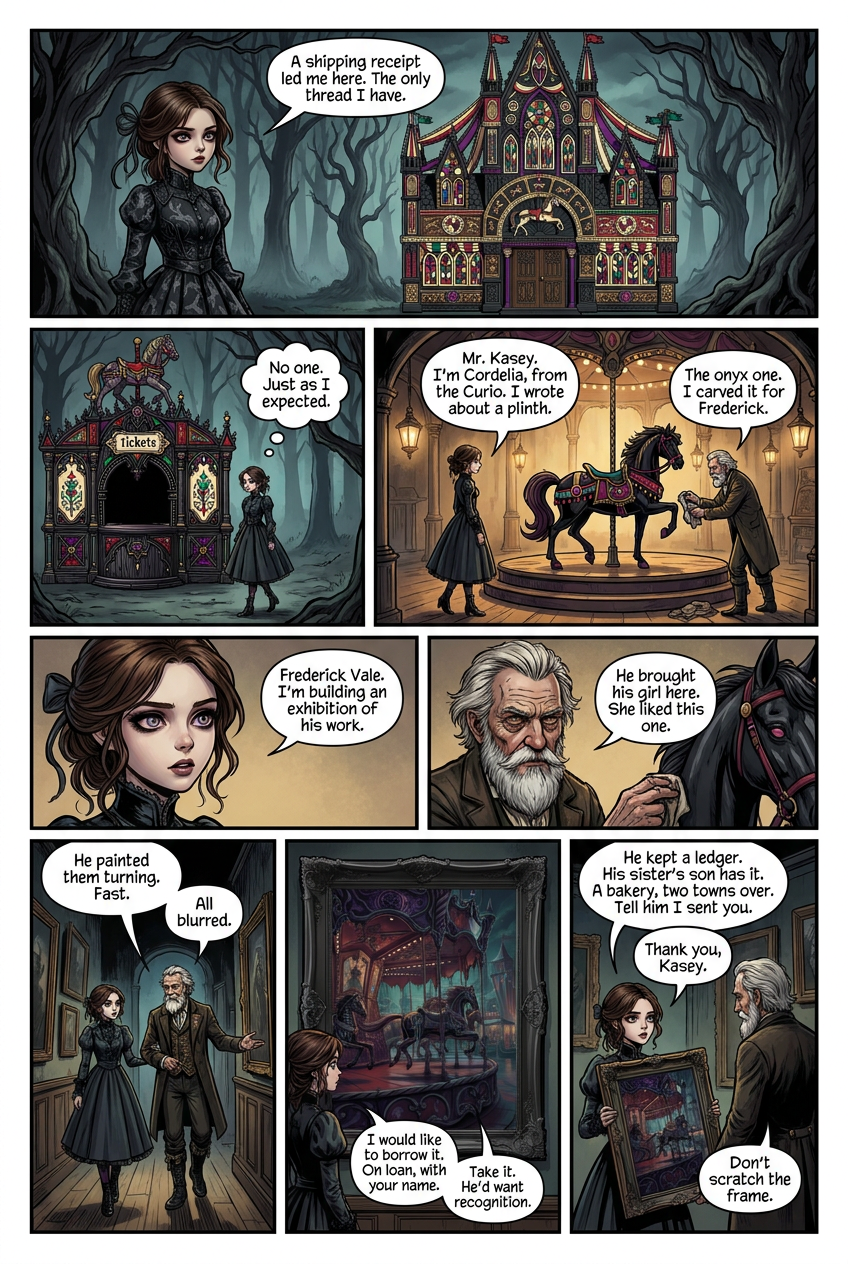
The address from the shipping receipt led Cordelia to the edge of town, where a gothic circus hall rose out of the trees. Pointed arches. Red flags on black spires. A carved horse above the doors, mid-leap. She had written ahead. She had not waited for an answer. The exhibition needed more than two framed canvases, and the man who had signed a plinth in 1911 was the only thread she had. A ticket booth stood at the gate, topped by a silver carousel horse on a brass pole. No one sat inside. Cordelia followed a painted arrow past the booth and into the main hall. Lanterns hung from the rafters. In the center of the floor, a black carousel horse reared on a low stage, its mane painted deep red, gold trim along the saddle. An old man in a long patterned coat was running a rag along its flank. Small wooden horses circled the band of his top hat. "Mr. Kasey," she said. "I'm Cordelia. I run the Curio of Creations. I wrote you about a plinth." He did not look up. He kept polishing. "The onyx one." "Yes. Your name is on the base. 1911." "I carved it for Frederick." He set the rag on the horse's saddle. "He traded me a painting for it." Cordelia's throat tightened. "Frederick Vale." "He brought his girl here. She liked the black one best." Kasey nodded at the horse on the stage. "He painted them turning. Fast. All blurred." "I'm building an exhibition of his work," Cordelia said. "I have two canvases. I need more. I came to ask if you still have the one he traded you." Kasey walked past her without answering. She followed him through a side door into a narrow room hung with framed prints and one large oil. He stopped in front of it. A carousel spun in the painting, horses smeared into a dark ring under a green sky. The frame was heavy and black. "This one," he said. "I would like to borrow it. For the exhibit. On loan, with your name on the placard." Kasey studied her. "You'll hang it beside the others." "Yes." "Then please take it. I know his family would’ve wanted him to have recognition." "Thank you so much Kasey." He lifted the painting off its hook and handed it to her. It was heavier than she expected. "He kept a ledger," Kasey said. "Sold pieces out of a shop in the city before the fire. The buyers' names were in it. His sister took the ledger when he died." "Is she alive?" "No. Her son is. He runs a bakery two towns over. Ask for the ledger. Tell him I sent you." Cordelia held the painting against her chest. Three canvases now. And a name to chase for the rest. "Thank you," she said. Kasey picked up his rag. "Don't scratch the frame."
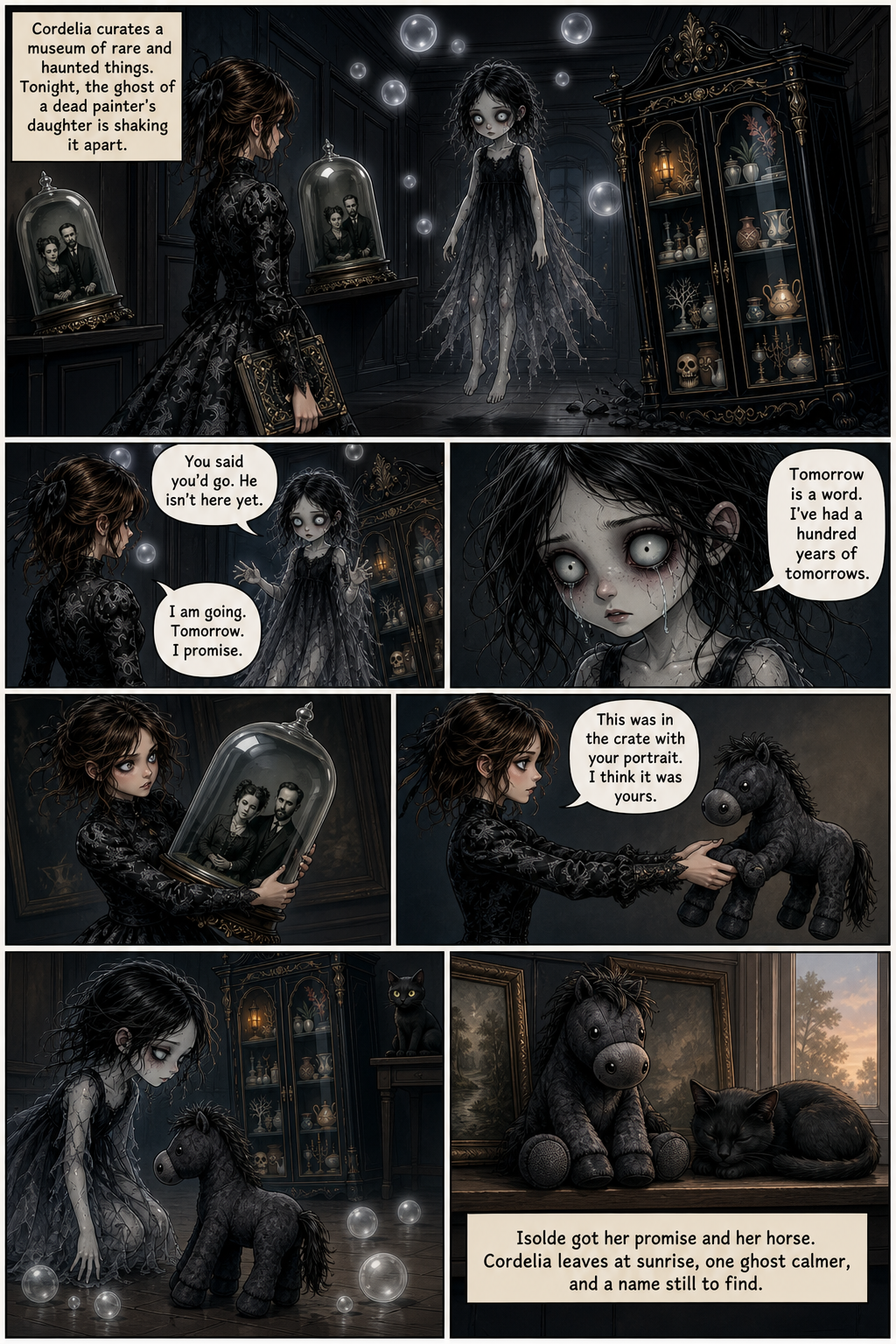
Cordelia set the third Vale canvas against her office wall and locked the museum for the night. The bakery two towns over could wait until morning. She needed sleep. She needed the ledger. She needed a name for every horse Vale had ever painted, and she did not have one yet. The cat woke her at midnight, hissing at the office door. Something down the hall was moving. Cordelia heard glass rattle. Then a soft thud. Then another. She pulled on her coat and went out into the collection wing. Pale orbs drifted along the ceiling. A display case in the curio room shook on its base, the artifacts inside sliding toward the edge of the glass. The black marble cabinet leaned forward an inch, then rocked back. A bell jar with an old family photograph inside slid across a shelf and stopped at the lip. Isolde stood in the middle of the room. Her dress hung around her like wet gauze. Her eyes were wet too. She was not touching anything. The orbs around her were doing the shaking. "You have to stop," Cordelia said. "You'll break the case. You'll break yourself." "He isn't here yet," Isolde said. "You said you'd go." "I am going. Tomorrow. I promise." "Tomorrow is a word." Isolde's voice cracked. "I've had a hundred years of tomorrows." The bell jar tipped. Cordelia lunged and caught it against her chest. The photograph inside slid; the closed eyes of the man and the girl faced her through the glass. She set the jar down on the floor, away from the shelf. "Listen," Cordelia said. She kept her voice low. "Breaking my collection won't get me there faster. It slows me down. I have to file reports. I have to replace glass. That's a week I'm not on the road." Isolde looked at the floor. The orbs dimmed. Cordelia went to her office and came back with the black stuffed horse from the attic. Its limbs sagged. Its mane stuck up in tufts. She held it out. "This was in the crate with your portrait," she said. "I think it was yours." Isolde did not reach for it. She could not. But she stepped close and bent her face to it, and the room went quiet. The cabinet settled. The orbs sank to the floor and faded. "Keep him with the paintings," Isolde said. "Where I can see him." "I will. On a plinth. Beside the carousel." "And you leave at sunrise." "At sunrise." Cordelia carried the stuffed horse to the office and set it on the shelf between the two framed canvases. The cat jumped up beside it and lay down. Nothing else moved in the museum that night. At first light Cordelia packed a bag, wrote the bakery's address on the back of Kasey's receipt, and locked the door behind her.
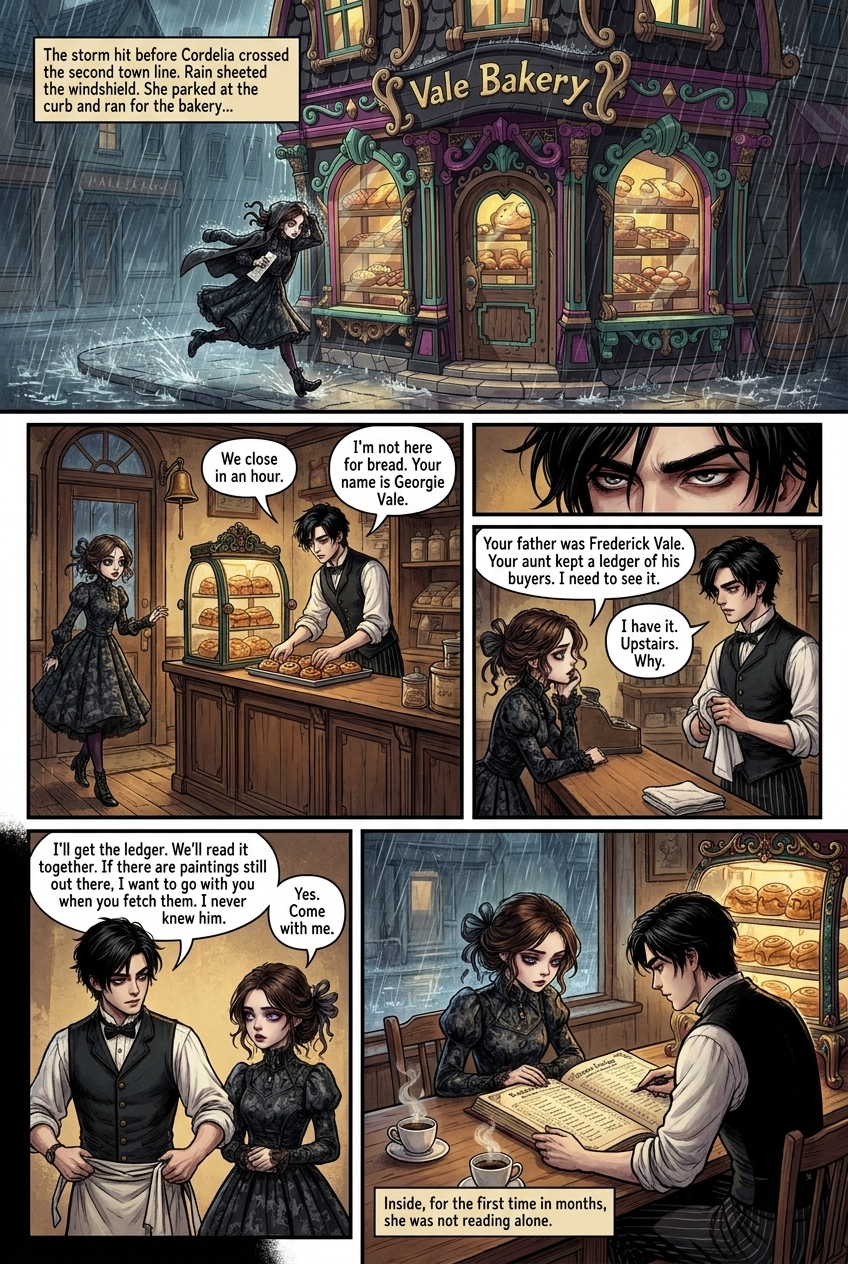
The storm hit before Cordelia crossed the second town line. Rain sheeted the windshield. She parked at the curb and ran for the bakery, coat over her head, Kasey's receipt crushed in her fist. The bakery sat between two darker buildings, its narrow front lit yellow from inside. Steep gables, curled trim, a painted sign above the door. She pushed inside. A bell rang. Warm air hit her, sugar and butter and yeast. A young man stood behind the counter, sleeves rolled, arranging sticky buns on a tray inside a glass warmer. Black hair, dark vest, quiet hands. He looked up once, then went back to the tray. He was the last Vale left, and he did not know it yet. "We close in an hour," he said. "I'm not here for bread." Cordelia shook water from her sleeves. "Your name is Georgie Vale." His hands stopped. "Yes." "Your father was Frederick Vale. Your aunt kept a ledger of his buyers. I need to see it." He closed the warmer. He wiped his palms on a towel. He studied her the way he probably studied dough. "I have it," he said. "Upstairs. Why." "I run the museum where he stored his paintings. I found his crates in my basement. I'm building an exhibition of his work. I need the buyers to trace what's left." Georgie folded the towel. "What are you paying with." She had rehearsed a lie on the drive and could not use it. "Nothing. I came empty. I didn't know until Kasey what the ledger was." He did not answer. Rain drummed the window. "You can come to the museum whenever you want," she said. "Free. Every exhibit. Your father's wing when it opens. I'll walk you through it myself." She stopped. She could not tell him about the girl in the attic. He would think she was unwell. But she thought of Isolde bent to the stuffed horse and tried once more. "There's someone there who would want to meet you. A relative. It matters to her that you come." His eyes moved. "A relative." "Yes." "I have none." "You do." He looked at her a long time. Then he untied his apron. "I'll get the ledger," he said. "We'll read it together. If there are paintings still out there, I want to go with you when you fetch them. I never knew him. I'd like to hear what people say." "Yes," Cordelia said. "Come with me." He went upstairs. He came back with a leather-bound book and set it on the counter between them. Dates. Buyers. Titles. Amounts. Page after page in a woman's tidy hand. Cordelia opened it. Georgie poured two cups of coffee. Outside, the storm kept on. Inside, for the first time in months, she was not reading alone.
Play your story to life
Storycraft is a mobile game where you create AI characters, craft items and locations to build their world, then discover what direction your story takes. Download the iOS game for free today!
Download for free