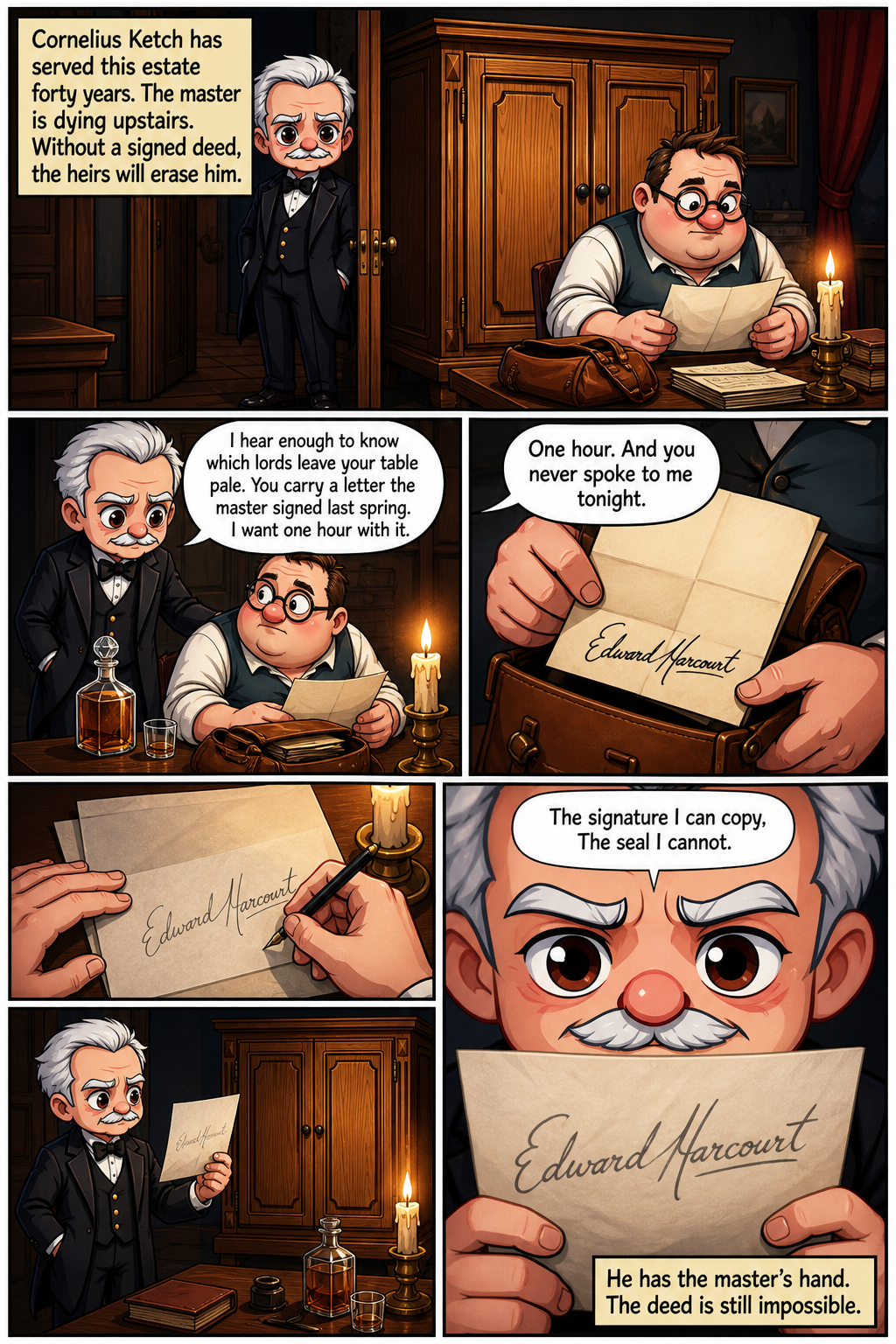
Chapter 1Cornelius Ketch had served the estate forty years, and he had no paper to prove he belonged in it. The master lay dying upstairs. Heirs would come soon, strangers who did not know his name. So Cornelius meant to draft a deed granting himself a room and a wage for life, signed in the master's own hand. He had the paper, the ink, the phrasing. He lacked the one thing that made ink into law: the master's true signature and seal, locked away where no servant could reach.
He had watched the master sign a thousand letters. But watching was not proof. A shaky copy from memory would fool no lawyer. He needed a genuine example to trace, and every genuine example left this house in another man's satchel.
That thought brought him to the parish clerk. Felix Warne visited the estate more than any priest. He came quietly, sat with the master an hour, and left carrying signed papers. Lords crossed the county to whisper in his ear. If any man held a letter bearing the master's true hand, it was the stout clerk with the stuffed leather bag.
Cornelius found him in the study that evening, spectacles low on his nose, sorting documents on the writing table by the wooden cabinet. Warne did not look up. "You move like a cat, Ketch. I heard nothing."
"I hear a great deal myself," Cornelius said. He set a decanter beside the clerk's elbow. "Enough to know which lords leave your table relieved, and which leave pale."
Warne's pen stopped. He studied Cornelius over the wire rims, weighing the sentence. "That is a careful thing to say to a man who keeps records."
"I keep records too. In my head." Cornelius nodded at the satchel. "You carry a letter the master signed last spring. I want an hour with it. Nothing leaves the room. You lose nothing."
The clerk sat still a long moment. He was not a man who frightened; he was a man who calculated. Cornelius watched him add the cost of refusal against the cost of a butler who heard things.
Warne opened the satchel. He drew out a single folded letter and laid it on the table, the master's signature dark and looping at the foot. "One hour," he said softly. "And you never spoke to me tonight."
Cornelius pressed thin paper over the signature and traced it by candle, slow, exact, until the master's hand lived under his own pen. Then he returned the letter. The clerk buckled his bag and left without another word.
Alone, Cornelius held his tracing to the flame's light. It was perfect. He could forge the deed now, letter for letter.
But the seal was ink he could copy. The wax seal was not. And the traced signature, he saw now, would only pass if pressed beneath the master's true seal, still locked in the cabinet at his back.
Read chapter →