

Creusus's Arc
43 Chapters
Creusus's dream is winning the grand tournament of Embermere with bare fists alone, never once drawing a blade or donning armor..

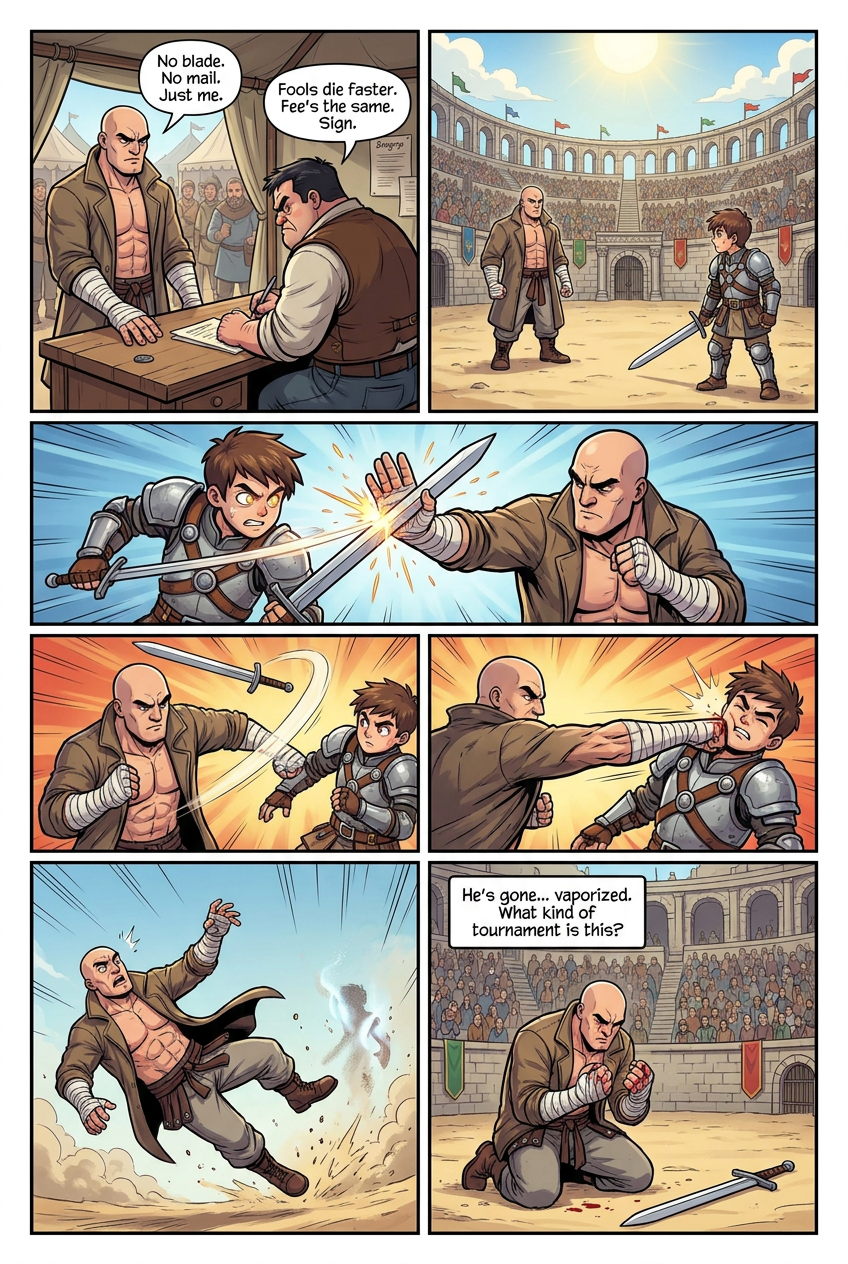
Creusus set his bare hand on the registration desk and said his name once. Brogan Ironquill did not look up. He was sorting entries, and his back hurt, and he had no patience for a man who arrived without a sword, without armor, and without a sponsor's page pinned to his form. "No blade," Creusus said. "No mail. Just me." Brogan lifted his eyes then, took in the shaved head, the wrapped knuckles, the bare chest under an open coat, and grunted. "Fools die faster," he said. "Fee's the same. Sign." Creusus signed. He meant to win the grand tournament of Embermere with his fists, and he had come to the desk to make that promise binding. The first bout came before the sun was high. His opponent was a squire in dented plate, a boy barely old enough to grow stubble, drawn against him by lot. The boy's sword was too long for his arm. That was the problem Creusus had carried since the training post: he could not measure a swung blade by eye. He knew the length of a fist. He did not know the length of steel in motion. One misread step in the ring meant a cut he would never see coming. So he did not step. He stayed close. Each time the squire swung, Creusus drove the flat aside with the heel of his wrapped hand, taking the shock on bone and cloth. The boy's breathing changed. His swings got faster, then wilder, then wrong. Something behind his eyes lit up, a shine that did not belong on a squire's face. Creusus felt the air around the boy grow tight, the way a rope grows tight before it snaps. He did not wait to learn what it meant. He slapped the blade wide, and the sword flew from the squire's grip and skidded across the sand. Creusus stepped in and threw a single straight punch to the jaw. It landed clean. The squire's head snapped back. In the same instant a wave hit Creusus in the chest and lifted him off his feet. He flew backward and struck the sand hard. When he looked up, the boy was gone. Not fallen. Gone. The armor was gone with him. The sword lay alone on the ground, and the crowd in the stone tiers had stopped making noise. Creusus pushed to his knees. His knuckles were bleeding through the wraps. He had won the match. He had also learned, in one punch, that the ring held things his fists were not built for, and that the next opponent might not vanish so kindly.
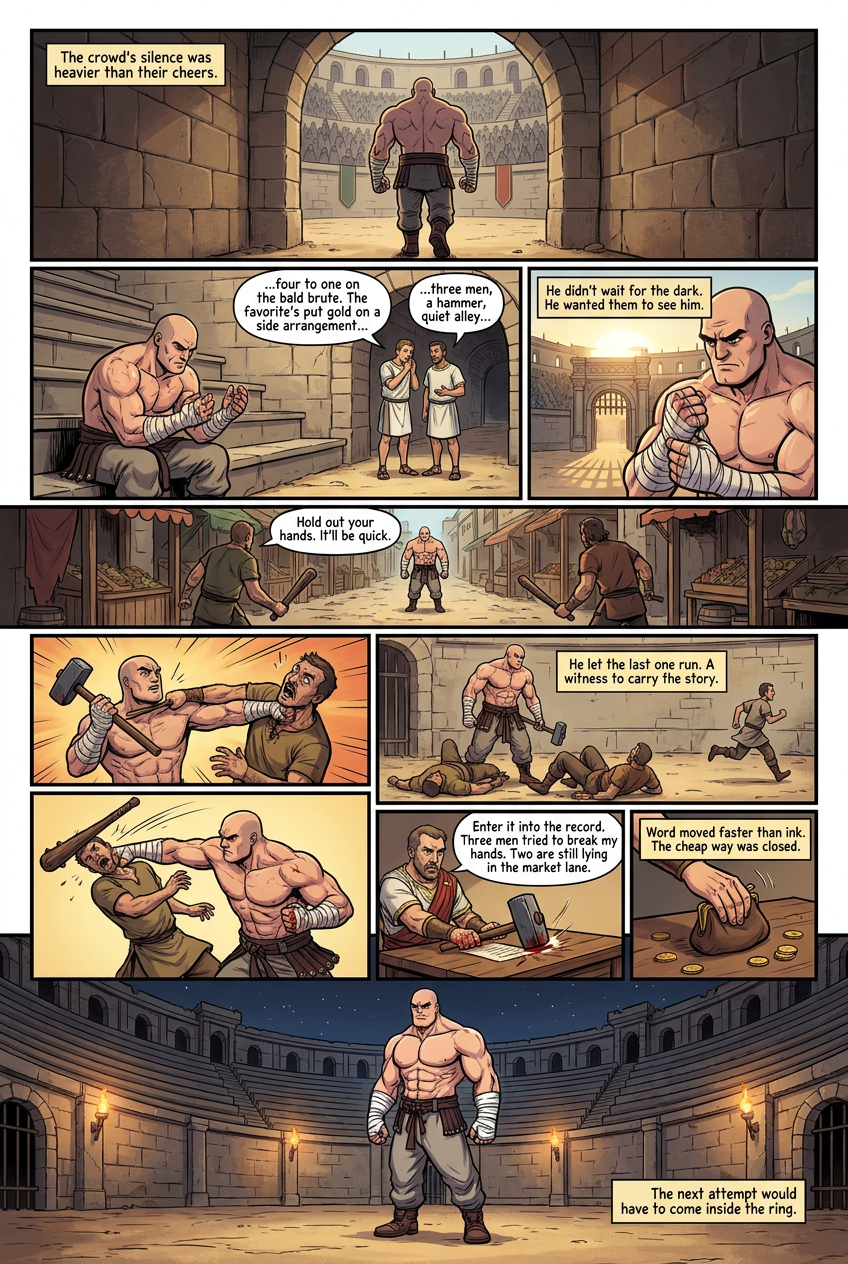
Creusus walked out of the arena with the crowd still silent behind him. He did not go to the barracks. He went to a bench under the stone tiers and unwrapped his knuckles to look at the cuts. That was where he first heard the numbers. Two men in clean tunics stood by the archway, talking loud enough for a fighter to hear on purpose. Odds against the bald brute were four to one and climbing. A sponsored favorite had put gold on it. And, one of them added, the favorite had put more gold on a side arrangement: three men, a quiet alley, and a hammer for the brute's hands before the next bout. Creusus finished wrapping his hands again. He did not go back to the training post, and he did not seek a guard. He walked out through the arena's front gate while the sun was still up, because men who plan to break hands prefer the dark. He wanted them to come now, where he could see them. He picked a narrow lane between two market stalls and stopped in the middle of it. He waited. They came within the hour. Three of them, as promised. One carried a smith's hammer down along his leg. The other two carried short clubs. They spread to block both ends of the lane. The one with the hammer told him to hold out his hands and it would be quick. Creusus held out his hands. When the man stepped in, Creusus caught the hammer shaft against his wrapped palm, drove his other fist into the man's throat, and took the hammer as the body dropped. He did not use it. He set it on the ground. The club on his left swung for his temple. He ducked under the arc, hit the ribs, hit the jaw, and stepped over him toward the last one. That one ran. Creusus let him run. He wanted a witness who would carry the story back to whoever had paid. He walked back to the arena with his knuckles bleeding through fresh cloth. Brogan Ironquill was still at the desk. Creusus set the smith's hammer on the wood between them and said he wanted it entered into the record that three men had tried to break his hands in the market lane, and that two of them were still lying there. Brogan looked at the hammer, then at the bandages, then wrote it down without a word. Word moved faster than ink. By evening the odds against him had shortened, and the sponsored favorite had withdrawn a purse from the bettors' table. Creusus had kept his hands. He had also told every fighter in Embermere that the cheap way to stop him was closed, and that the next attempt would have to come inside the ring.
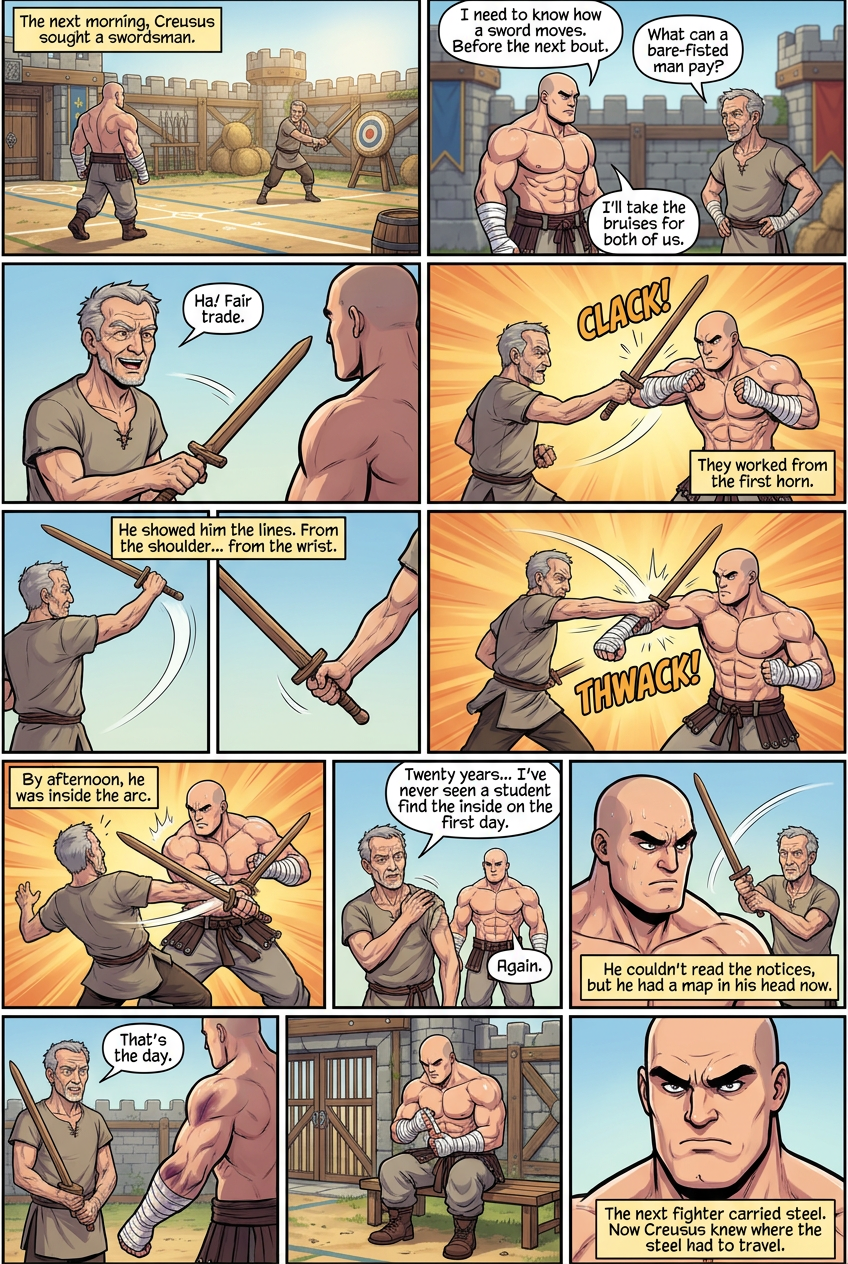
The next morning Creusus went looking for a man who fought with a sword. He had learned in the alley that his fists worked when he could see the blow coming. In the ring, a blade would come faster. He walked to the training grounds behind the arena and stopped at a lane where an older fighter drilled alone against a straw target. The man had gray at his temples and a nick in one ear. Creusus said he needed to learn how a sword moves before the next bout. The man looked at his bare chest and his wrapped hands and asked what he would pay. Creusus said he would take the bruises for both of them. The man laughed once and picked up a wooden blade. They worked from the first horn to the second. The man showed him the line a cut travels from the shoulder, and the shorter line from the wrist. He showed him where a thrust starts and where it has to pass. He swung slow, then faster, then at full speed. Creusus caught the wooden blade against his forearm on the third try, on the flat, the way he had been shown. By midday he was catching it clean. By afternoon he was stepping inside the arc before it finished and pinning the man's wrist against his own chest. The man stopped and rubbed his shoulder and said he had taught this drill for twenty years and never seen a student find the inside of it before dusk on the first day. Creusus did not answer. He set his feet and asked for another pass. He could not read the notices pinned on the gate and he could not count past the fingers on both hands, but he had watched the wooden blade a hundred times now and his body already knew where it would be. When the man finally called the day and lowered the practice sword, Creusus had a bruise the length of his forearm and a map in his head for how a blade reaches a man. He wrapped his knuckles again at the bench by the gate. The next fighter in the bracket carried steel. Now Creusus knew where the steel had to travel to reach him, and how little of that path he needed to close.
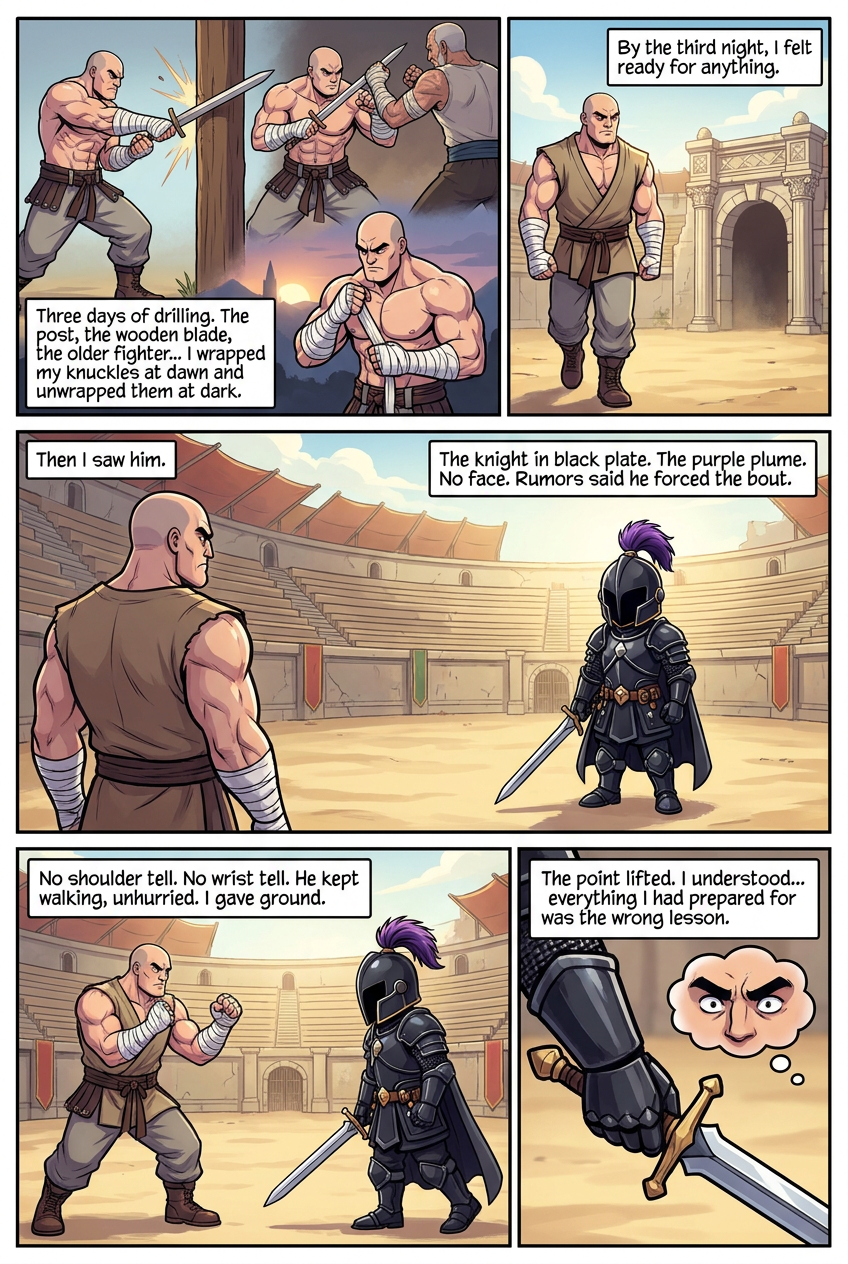
For three days Creusus worked the post and the wooden blade. He hired the older fighter again and paid him in bruises. He drilled the inside step until his shoulder went numb. He wrapped his knuckles at dawn and unwrapped them at dark. By the third night he could catch the practice sword blind, by sound alone. He slept well. He ate. He walked to the arena at second horn feeling ready for anything a man with steel could show him. Then he crossed the sand and saw the figure waiting on the far mark, and the ease went out of his chest. The knight stood in black plate from boot to gorget. A purple plume rose from the helm. The visor showed no face. The sword hung at his side, long and clean, the point resting in the sand. Creusus had heard the rumor in the bunk lane the night before. Marshals had tried to strike the bout from the card after the squire vanished. This man had walked into the registrar's room with a sealed paper and made them put it back. Creusus was standing here because the knight wanted him standing here. The horn blew. Creusus raised his wrapped hands and set his feet the way the old man had shown him. He waited for the first cut so he could read it. The knight did not cut. The knight took one step forward, then another, unhurried, the sword still low, the plume steady. No shoulder tell. No wrist tell. Nothing to read. Creusus gave ground. He had never given ground in a ring before. His heel found the chalk line and he stepped over it and gave more. The knight kept walking. The crowd noise thinned to a hum inside the helm Creusus was not wearing. He had trained for a blade that traveled. This blade was not traveling. It was only coming closer, held by a man who did not seem to care whether Creusus was ready. Creusus circled left and made himself stop backing. He lowered his hands a finger's width and set his weight over his front foot. He would take the first strike on his forearm the way he had drilled it, whenever it finally came. The knight closed to sword length and stopped. The point lifted from the sand for the first time. Creusus watched the tip and understood, in the space of one breath, that everything he had prepared for the last three days had been the wrong lesson.
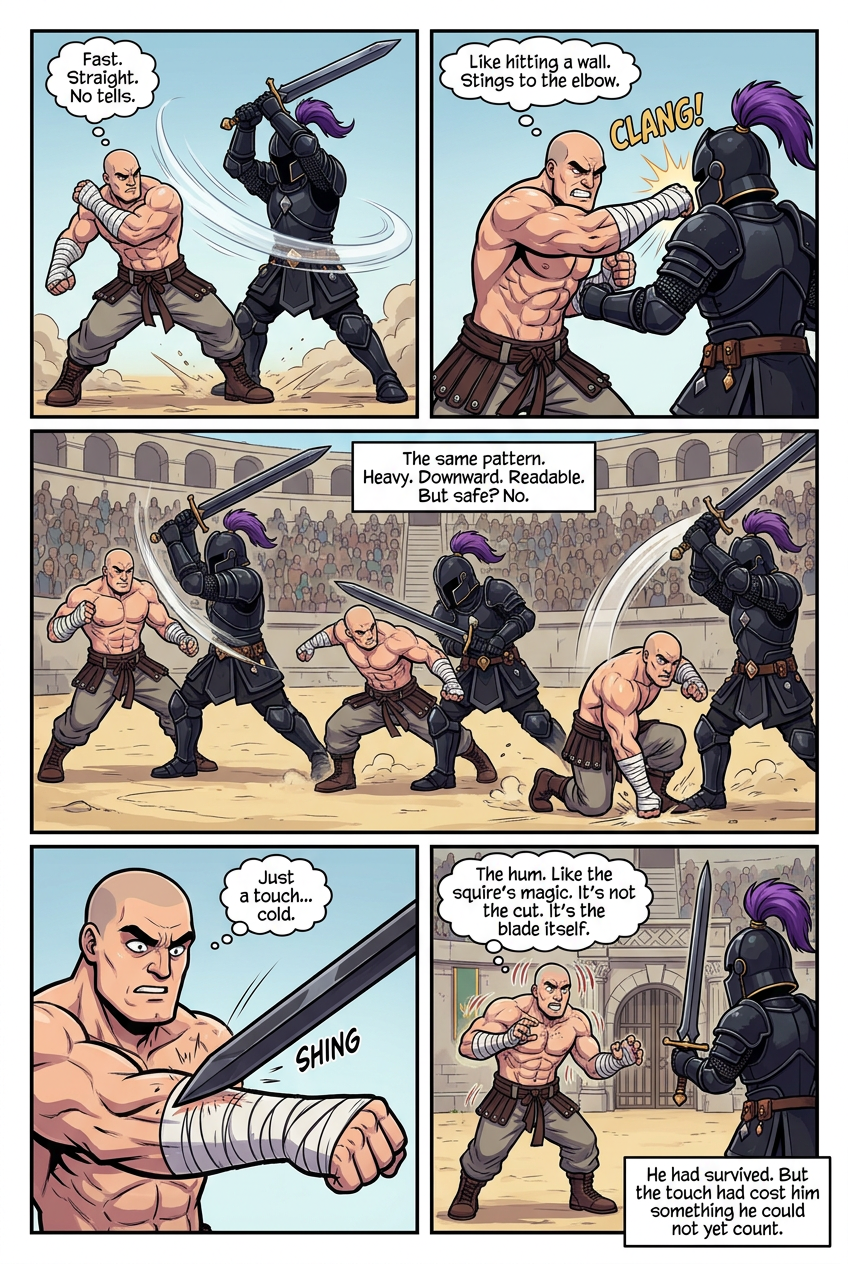
The point lifted and Creusus moved. He shifted off the line as the knight brought the sword down in a heavy overhand cut. The blade came fast and straight, no wrist flick, no false start. Creusus rolled his shoulder past it and felt the wind of the steel against his ribs. He came up outside the knight's sword arm and threw a short hook at the gorget. His knuckles skipped off the black plate and stung all the way to his elbow. The knight was already turning. The second cut came down the same way. So did the third. Creusus stopped trying to hit and started trying to read. Every strike began at the shoulder and ended at the sand. Heavy. Downward. Readable. He could see each one leaving the helm's shadow before it moved. That was the trick, and it was not a kind trick. Reading the strike did not make the strike safe. The knight had picked one pattern and dared him to solve it inside a ring the width of a stall floor. Creusus rolled under the fourth cut and felt the blade pass a hand above his skull. He rolled under the fifth and his knee scraped chalk. He was giving ground again. The tiers above the arena had gone quiet the way a crowd goes quiet when it thinks it knows the ending. Creusus set his back foot and told himself the next cut, he would step in instead of out. He did not step in. The sword came down. He rolled. The tip caught the top of his forearm as he came up, a graze so light he only felt the metal itself, cold, the way a razor feels before the blood. The hair on his arm went with it. No cut. No sting. Just the touch of the edge and gone. His whole body rang. Not the arm. All of him, the base of the skull, the teeth, the soles of his feet inside his boots. He had felt this before. He knew he had felt this before and could not say where. The squire in the first bout. The wave of force when the boy vanished with his armor. That same low hum sitting inside his bones now, like a bell that had been struck days ago and never stopped. Creusus stumbled back two steps and kept his hands up. The knight did not press. The knight raised the sword to the shoulder again, the same starting mark, patient. Creusus stared at the plume and the empty visor and understood what he had learned. The pattern was not the weapon. The blade was. And the blade was doing something to him that had nothing to do with cuts. He had survived the round. He had also been touched, and being touched had cost him something he could not yet count.
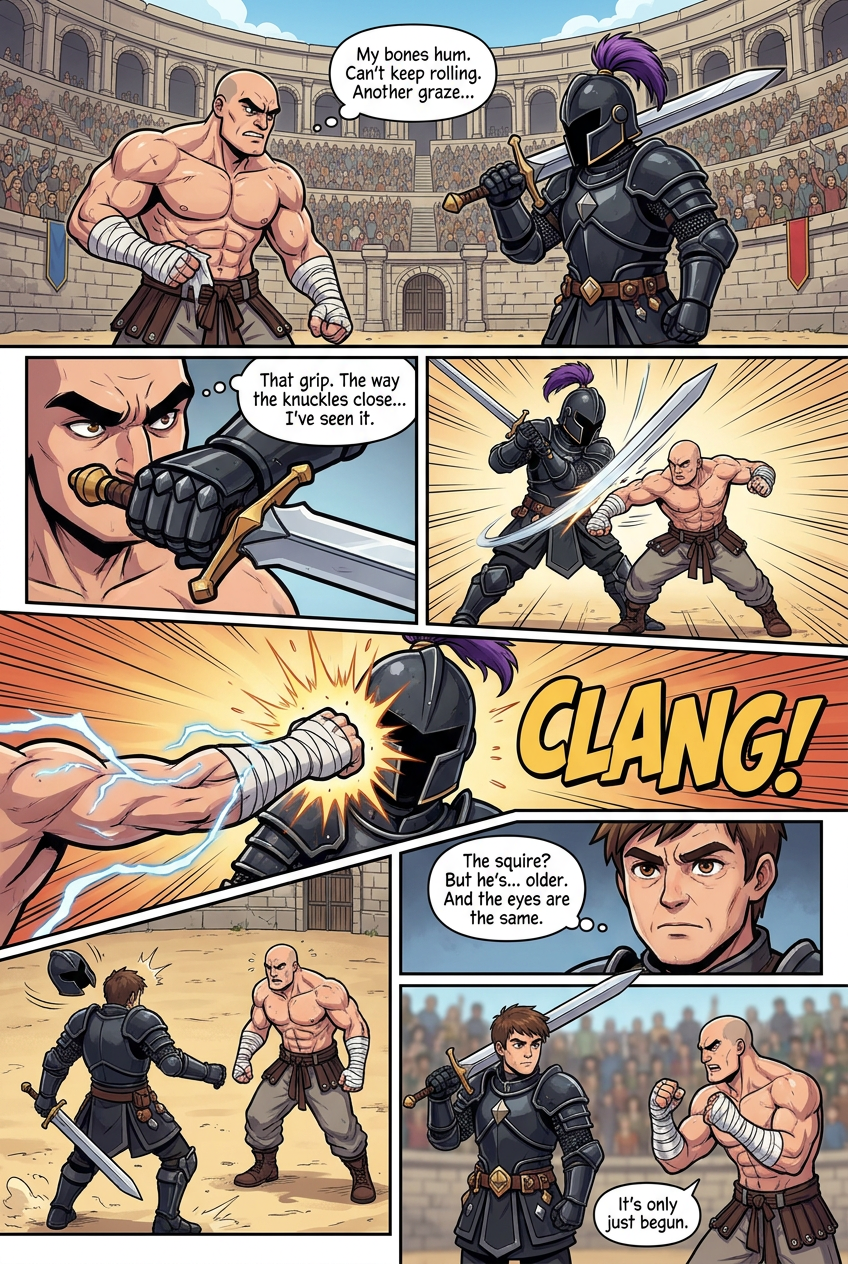
The knight lifted the sword to the shoulder again. Same mark. Same patient start. Creusus stood in the sand with his bones still humming and knew he could not keep rolling. Another graze would take more of whatever the first had taken. He wiped his palm on his belt and watched the black plate, and this time he did not watch the blade at all. The knight cut. Creusus rolled outside and came up close, and while the sword was still traveling he looked at the gauntlet on the hilt. The fingers. The way they set and reset before the shoulder moved. He had seen those fingers before. Not the size, not the reach. The small clean grip. The knuckles that closed one at a time from the outside in. He had watched a boy hold a practice sword that way three bouts ago, right before a single punch put him on his back and a wave of force took him out of the world. It was the same hand. Older. Bigger. Same hand. Creusus decided to test it. He set his back foot into the sand and pulled from the hip, the way he pulled at the post when no one was watching. He let the knight begin the sixth cut and stepped inside it. The sword came down past his shoulder and bit only air. He drove up under the visor with everything he had, aiming past the strike, past the man, at the helmet itself. His wrapped knuckles struck the side of the helm above the ear. The ring came back the instant his skin touched the metal, worse than before, up his arm and into his teeth like a bell swung against his skull. His knees almost went. The helm did not. It turned on the gorget, tipped, and slid off the head beneath it and dropped into the sand. Creusus stumbled back and made himself look. The face inside the black plate was the squire's face. Older by years he had not lived. The soft cheeks were gone. The jaw had set. The brown eyes were the same eyes that had looked up at him from the chalk before the wave took the boy away. The boy who had vanished was standing in front of him in a man's armor, holding a sword that fed on him every time it touched him. The crowd in the tiers made a sound Creusus did not hear. He kept his fists up. The helm lay between them in the sand. The knight did not pick it up. The knight lifted the sword to the shoulder again, and Creusus understood the bout had only now begun.
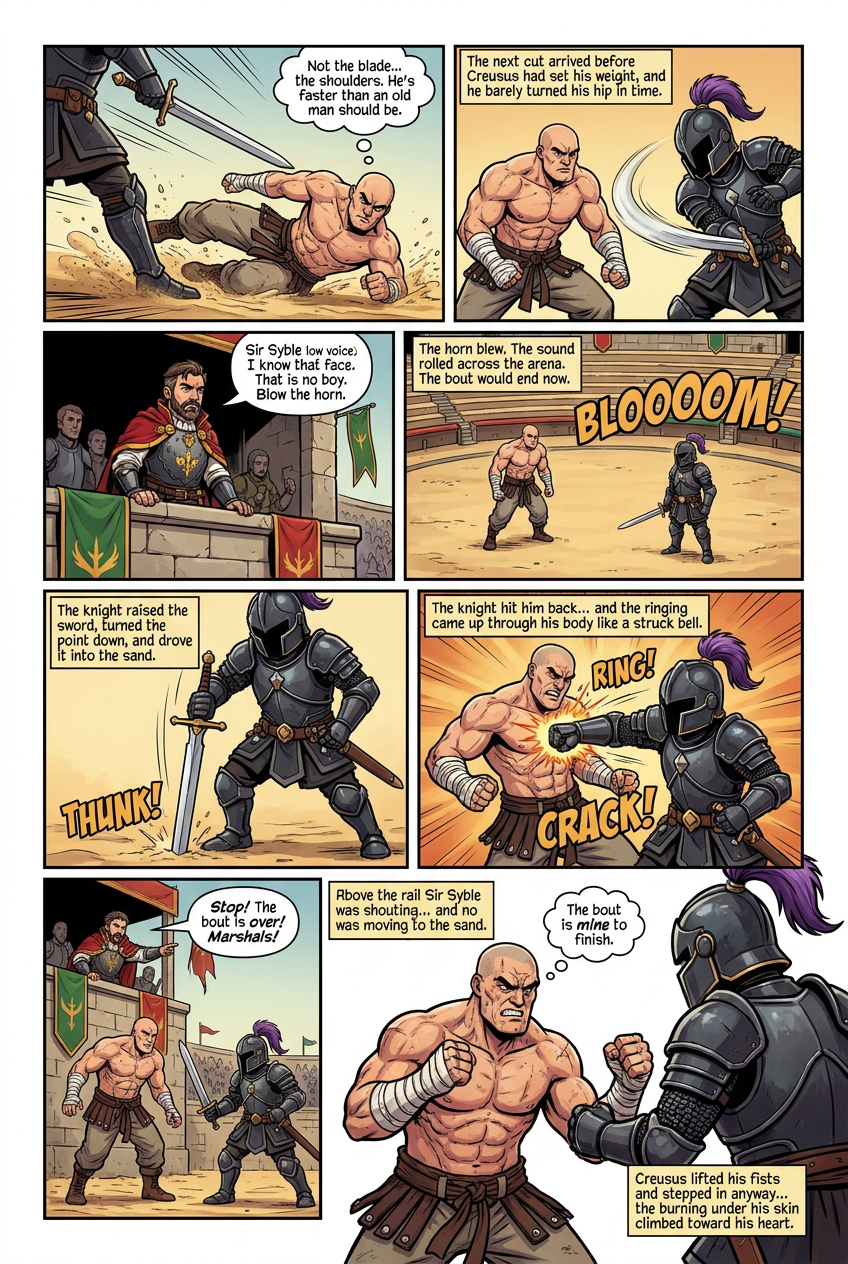
The knight lifted the sword again and cut. Creusus rolled out and came up on the balls of his feet. He no longer watched the blade. He watched the shoulders. The knight moved the same as the last pass, and the one before, and Creusus began to think the older face had not brought older habits with it. Then the sword came faster. The next cut arrived before Creusus had set his weight, and he barely turned his hip in time to let it pass. The one after that whistled where his ear had been. Whatever the boy had lost in years, the man had gained in speed. High above the sand, in the shaded box that overlooked the field, the marshals leaned together. Sir Syble stood at the rail with his cape gathered in one fist. He had watched the helm come off. He had seen the face inside. He knew the boy who wore that face three bouts ago, and he knew a boy did not age six years between horns. He spoke low to the men beside him. One shook his head. Another pointed at the sealed paper on the table. Sir Syble looked down at the stone tiers, at the banners hung along the rail, at the two figures in the sand, and gave the sign to blow the horn. The bout would end now. Nothing here was clean. The horn blew. The sound rolled across the arena and hung there. Creusus dropped his fists and stepped back, breath sawing. The knight did not step back. The knight raised the sword, turned the point down, and drove it into the sand at his own feet. Then his gauntlets went to the belt and unbuckled the scabbard and let it fall. He came at Creusus with bare fists inside black steel. Creusus laughed. One short bark. He had asked the tournament for this and the tournament had given it. He set his stance and threw the first punch he trusted, straight from the hip, into the side of the knight's jaw. The head barely moved. The knight hit him back in the ribs and the ringing came up through his body like a struck bell. Creusus staggered. The ring was not in the sword now. It was in the man. Every knuckle that touched the black plate poured the same drain into him that the blade had, and the plate was everywhere. He swung again and took another to the ribs and felt his legs go warm and loose beneath him. Above the rail Sir Syble was shouting at the marshals and no one was moving to the sand. The horn had blown and the fight had not ended. Creusus lifted his fists and stepped in anyway, because the bout was his to finish, and the burning under his skin climbed toward his heart.
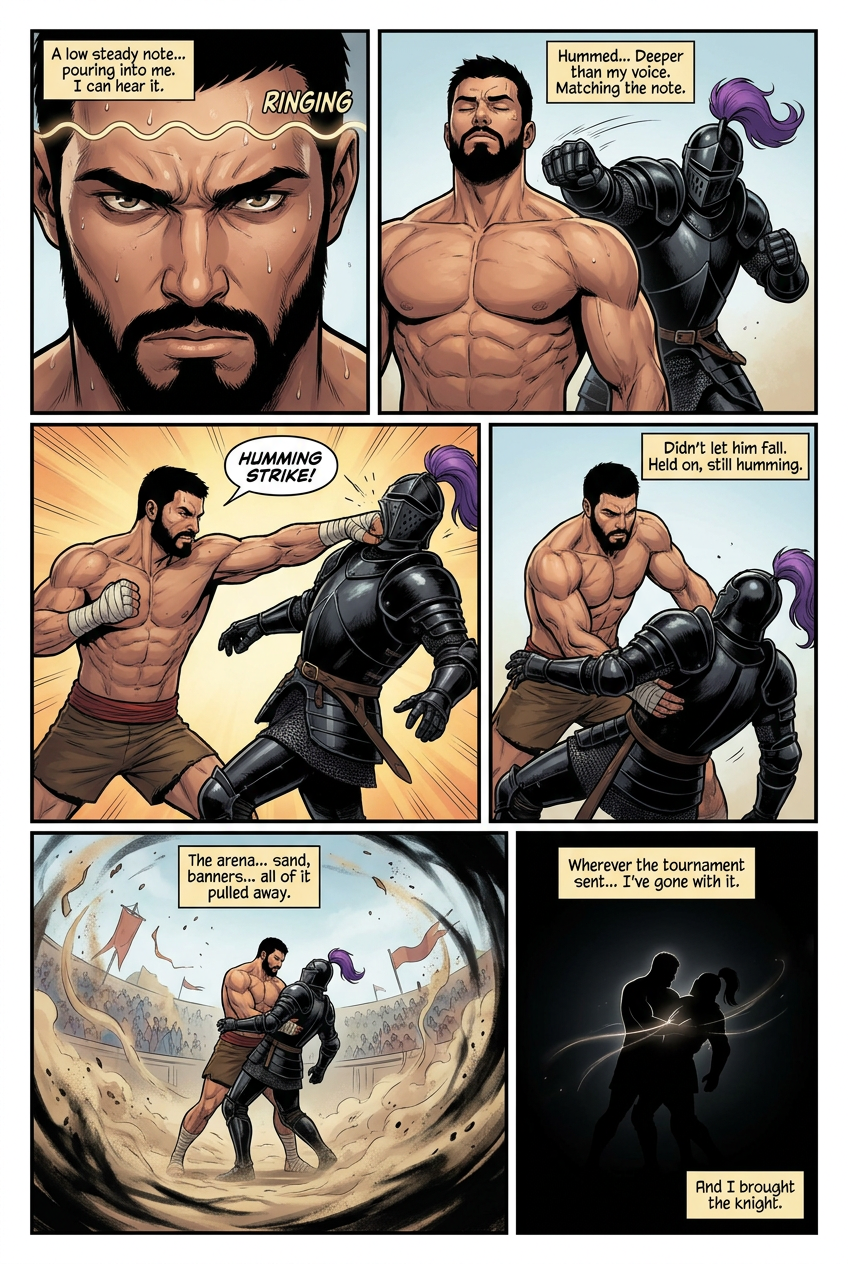
Creusus pressed his tongue to the roof of his mouth and listened. Under the ringing in his skull there was a pitch, a low steady note the black plate poured into him with every touch. He had heard it in the sword. He heard it now in the man. He filled his chest and hummed. Low. Deeper than his own voice wanted to go. He matched the note under his ribs to the note the knight was pushing into him, and the ringing in his ears thinned. His legs came back under him. One breath. Two. The knight cocked a fist for the blow that would end it, and the shoulder telegraphed the strike the way it had in the first pass, before the speed came. The speed was in the drain. Kill the drain, kill the speed. Creusus stepped inside the punch and threw everything he had left from the hip. His bandaged knuckles landed clean on the jaw, humming as they struck. The head snapped sideways inside the helm. The knight's knees folded. Creusus did not let him fall. He caught the black pauldron in one hand and the belt in the other and held on, still humming, chest against the cold plate. The wave came the way it had come for the squire. He felt the arena go out from under his feet like a floor dropped through. Sand, horn, banners, the shouting from the marshals' box, all of it pulled away. There was no light. There was the knight's weight in his arms and the note in his own chest and nothing else. Creusus kept humming into the dark. Wherever the tournament sent the ones it took, he had gone with it, and he had brought the knight with him.
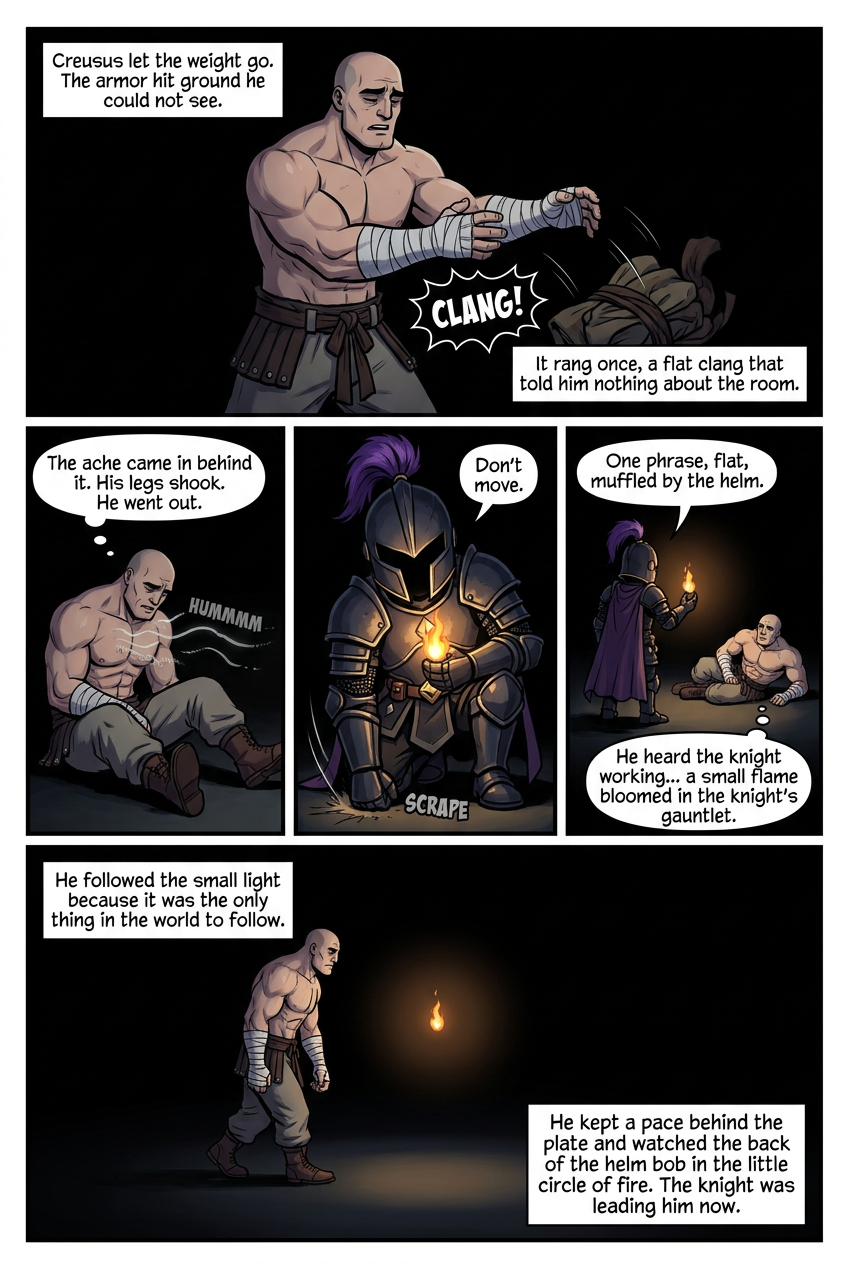
Creusus let the weight in his arms go. The armor hit ground he could not see and rang once, a flat clang that told him nothing about the room. He stood over the sound and waited for the note in his chest to fade. It took a long time. The hum bled out of his ribs by slow degrees, and the ache came in behind it. His knuckles throbbed inside the bandages. His legs shook. He put one hand out and found no wall. He shuffled a step and found no wall. The dark was even on every side, not a seam of light anywhere, not under a door, not above. He sat down beside the knight because standing was worse. His head dropped. He meant to listen. Instead his body took the choice from him and he went out. He woke to the scrape of plate on stone close to his ear and rolled back before he was fully awake. "Don't move," the knight said. One phrase, flat, muffled by the helm. Creusus froze on his elbows. He heard the knight working at something, buckles maybe, a pouch. Steel tapped steel. Then a small flame bloomed in the knight's gauntlet, no bigger than a thumb, and hung there. It lit the knight's chest and the underside of the helm and nothing else. No floor showed. No wall. The light stopped at the edge of the knight's reach as if the dark ate it. The knight turned the flame toward Creusus once, so Creusus could see the hand holding it, then turned it away and lifted it and began to walk. He did not speak again. He beckoned once with the free hand. Creusus pushed to his feet. Every joint complained. He followed the small light because it was the only thing in the world to follow, and because the man carrying it had said the one thing that mattered, which was that there was somewhere not to move and, by implication, somewhere to go. He kept a pace behind the plate and watched the back of the helm bob in the little circle of fire. The floor under his bare feet was smooth and cold and gave back no echo. He did not hum. He did not need to. The knight was leading him now.
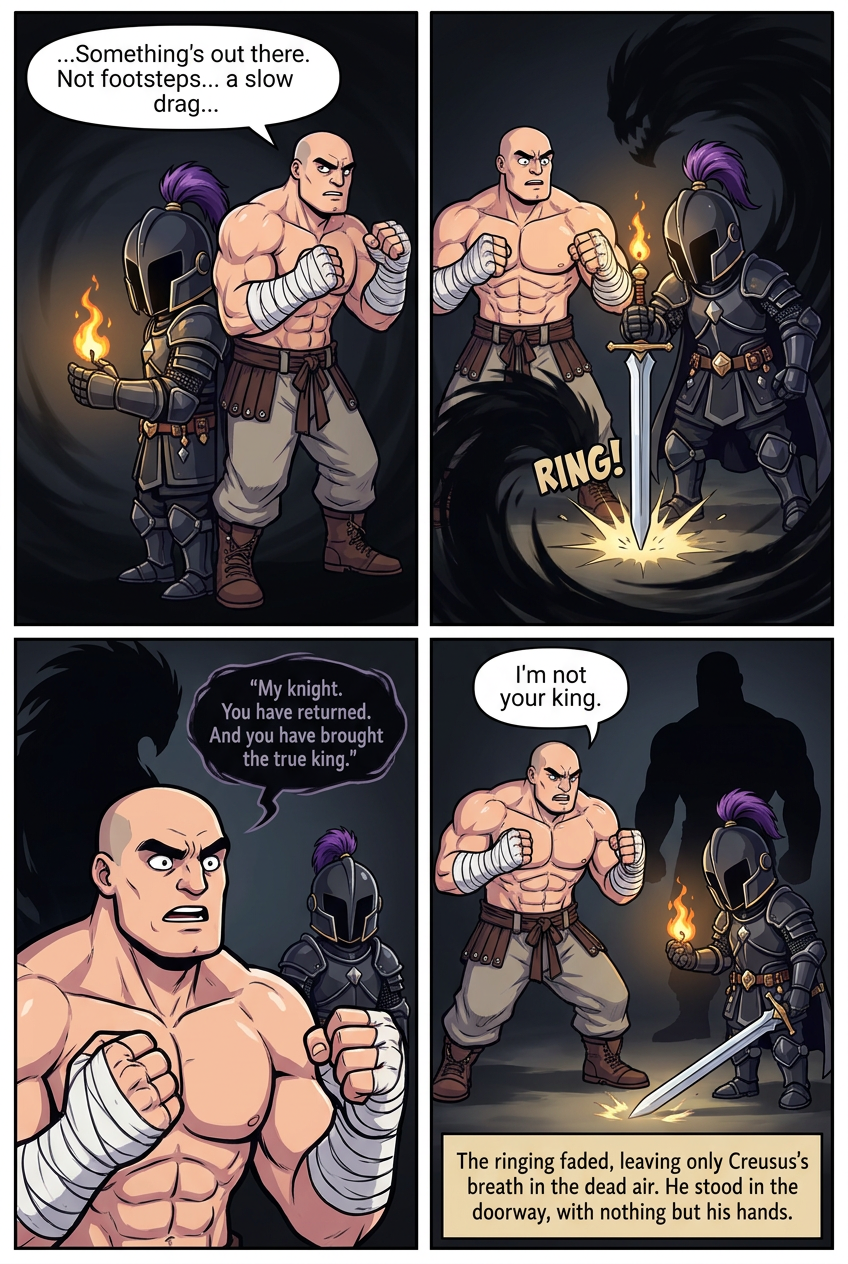
The knight stopped walking. Creusus almost bumped the plate before he caught himself. The little flame in the gauntlet was still too small. It showed the knight's hand and the front of the helm and nothing past that. Creusus could hear something moving beyond the light. Not footsteps. A slow drag, like cloth pulled over stone, circling wide. He put his back near the knight's back and set his weight low. He waited for the knight to lift the flame higher. The knight did not. Instead the knight drew the sword. The knight slammed the blade point-first into the ground. The ring went out from the steel in a long clean note, louder than any hum Creusus had matched before. The dark answered. It gathered. Creusus watched the black around them pull inward like water finding a drain, thickening, taking on edges, until a shape stood a few paces off. It had a head and shoulders and a long trailing body that never finished. It was not lit by the flame. It was lit by nothing. It was there the way a hole is there. Creusus wondered why the knight had waited so long to strike the ground, and had no answer, and let the question go. His fists came up on their own. The bandages pulled tight across his knuckles. The shape tilted its head. When it spoke, the sound arrived inside Creusus's chest, not his ears. "My knight. You have returned. And you have brought the true king." Creusus looked at the knight. The knight stared straight ahead at the shape and said nothing. Creusus's mouth went dry. He was no king. He was a man with wrapped hands who had followed a stranger into a room without walls. He opened his mouth to say so and closed it. The shape had not asked him a question. It had named him. The knight lowered his head one small degree, the way a man bows who does not want to bow. The flame in the gauntlet guttered and held. Creusus understood two things at once. The knight had brought him here on purpose. And whatever waited in this place had been waiting for him, not for the knight. He set his feet. He did not lower his fists. He said, "I'm not your king." His voice sounded flat in the dead air. The shape did not move. The knight did not move. The ringing from the sword faded out of the ground and left only the sound of Creusus breathing. He had followed the light this far. The light had brought him to a door he did not choose to open, and the door was open now, and he stood inside it with nothing but his hands.
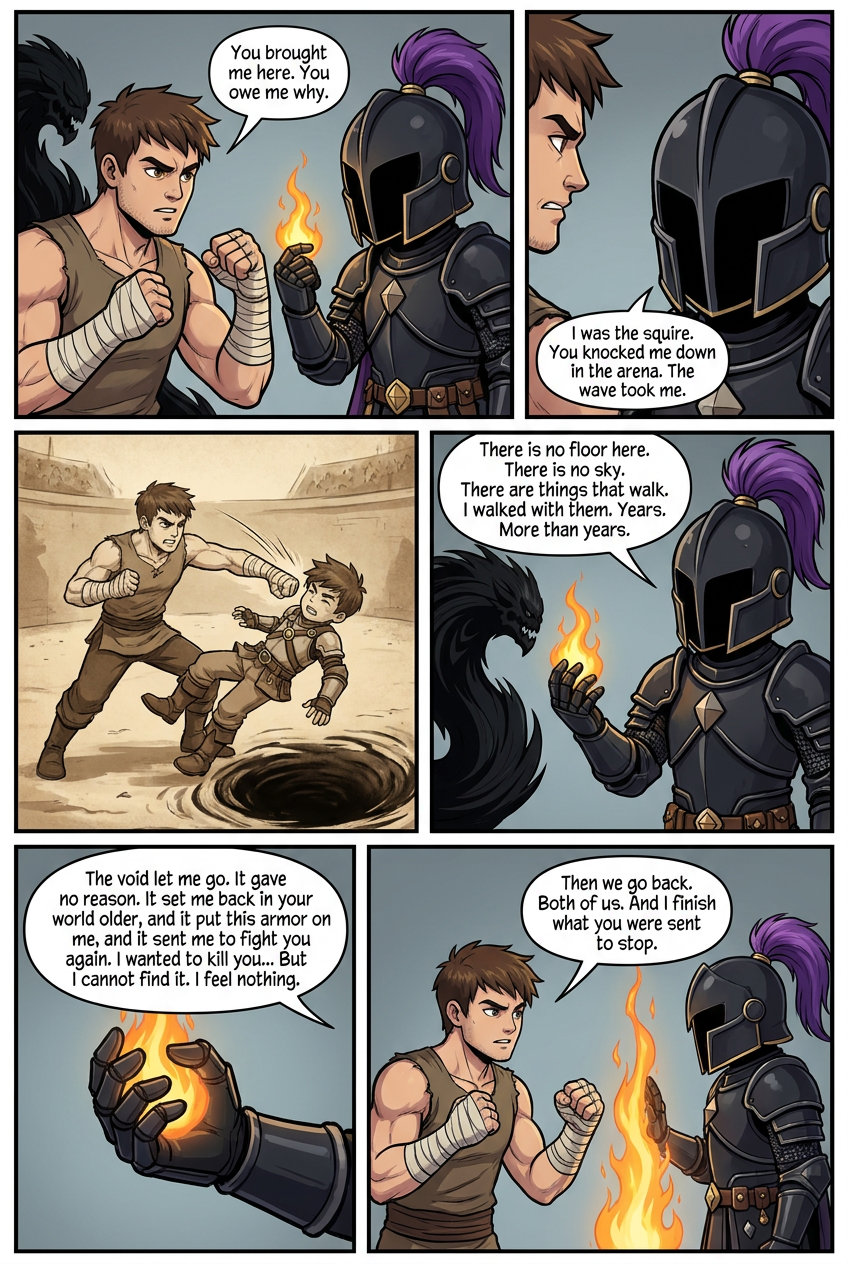
Creusus kept his fists up. The shape had not moved. The knight had not moved. He turned his head a small degree toward the black helm beside him and spoke through his teeth. "You brought me here. You owe me why." The flame in the gauntlet did not waver. For a long breath he thought the knight would stay silent, the way he had stayed silent through every step of the walk. Then the helm turned toward him. The visor was empty inside. The voice that came out of it was flat and dry, like a board dragged over sand. "I was the squire." Creusus's jaw tightened. He kept his hands where they were. The knight went on in the same dead tone. "You knocked me down in the arena. The wave took me. It brought me here." He lifted the small flame a little, as if to show the dark around them. "There is no floor here. There is no sky. There are things that walk. I walked with them. I do not know how long. Years. More than years. I saw every thing a man can be afraid of. I saw them come for me one at a time. Then all at once." His gauntlet closed slowly. "The void let me go. It gave no reason. It set me back in your world older, and it put this armor on me, and it sent me to fight you again." Creusus said nothing. The shape behind them watched. The knight's voice did not rise. "Every hour I stood in that place, I stood there because of your fist. I wanted to kill you. I carried that want across the walk back. I carried it into the arena." The helm tilted a fraction. "I am standing next to you now and I cannot find it. Something in this place has taken it out of me. I feel nothing. I want nothing. I am telling you because you asked." He lowered the flame. "That is the answer. There is no more." Creusus lowered his fists. Not all the way. Enough. He looked at the black shape past the flame and then back at the empty visor. He had come here thinking a man had wronged him and needed answering. He saw now it ran the other way. He had knocked a boy into a hole and the hole had kept him. The tournament had done that. The thing that ran the tournament had done that. He said, "Then we go back. Both of us. And I finish what you were sent to stop." The knight did not answer. He turned toward the shape and set the flame between them like a small wall. Creusus set his feet beside the plate. Whatever came next, he would meet it with the knight on his shoulder, not across from him.
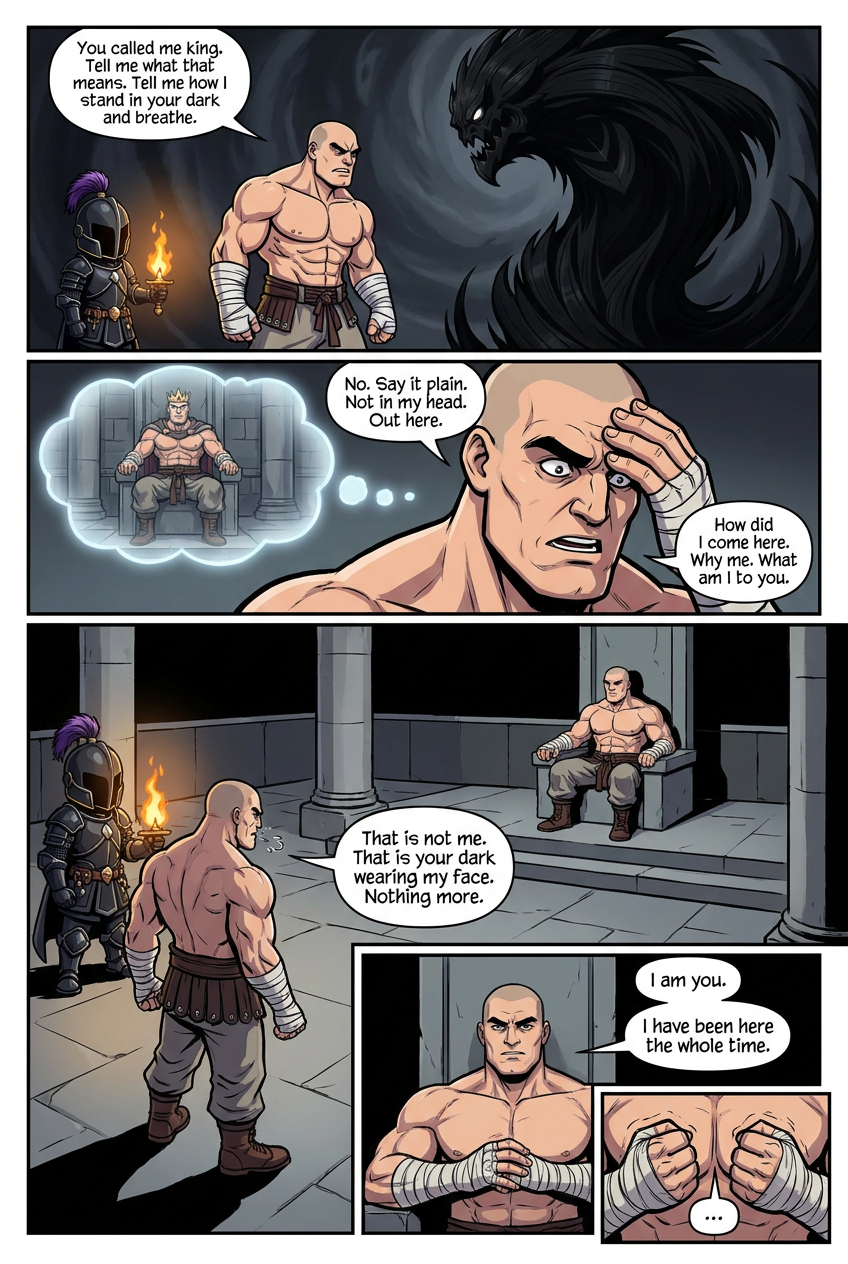
Creusus turned to face the shape. He kept his fists loose at his sides now. The knight stood a pace behind with the small flame. "You called me king," Creusus said. "Tell me what that means. Tell me how I stand in your dark and breathe." The shape did not answer with sound. It answered inside him. A weight pressed behind his eyes and set words there without asking. He saw a place ruled by a man. He saw the man on a seat. He saw the face and it was his own. He stepped back. "No." He said it to the shape and to the pressure and to the picture it had put in him. "Say it plain. Not in my head. Out here." The shape gave nothing more. The knowledge stopped where it stopped, like a bucket run dry. Creusus pressed. "How did I come here. Why me. What am I to you." The dark held. The flame in the gauntlet bent once and steadied. Whatever the shape had to give, it had given. Then the floor became a floor. Stone rose under his bare feet without sound. Walls climbed on four sides in black and grey. A long room opened around them with pillars he had not seen laid. At the far end a seat stood on a low step. A man sat on the seat. The man had no hair and no beard. The man was thick through the shoulders. The man had his hands wrapped in clean linen at the knuckles. Creusus stopped walking. His breath went shallow. The knight stood where he had stood, flame still lit, as if the room had grown around him and left him untouched. "That is not me," Creusus said. He spoke to the room. He spoke to the shape he could no longer see. "That is your dark wearing my face. Nothing more." The man on the seat lifted his head. He looked at Creusus with Creusus's own eyes. He shook his head once, slow, the way a father corrects a child who has counted wrong. "I am you," the man said. His voice was Creusus's voice. "I have been here the whole time." Creusus's hands came up on their own. The linen at his knuckles felt suddenly tight. Behind him the knight said nothing. The flame did not move. Creusus stared at the seated man and could not make his mouth work to answer.
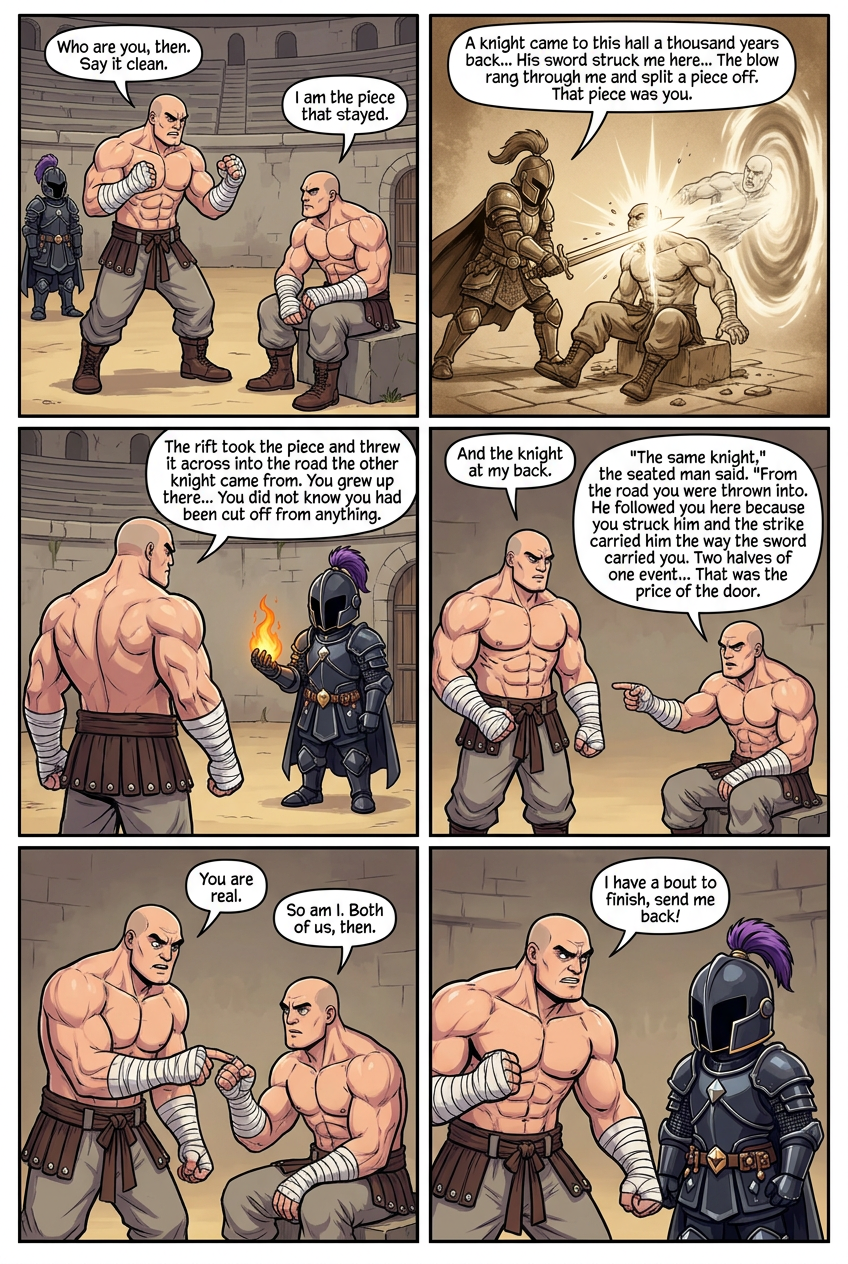
Creusus found his voice. "Who are you, then. Say it clean." The seated man set his wrapped hands on his knees. He did not stand. "I am the piece that stayed," he said. "A knight came to this hall a thousand years back. Not the knight behind you. Another one, wearing the same plate, carrying the same blade, out of a road that ran beside yours and never touched it." Creusus glanced back. The knight held the small flame steady. The knight did not move. The seated man went on. "His sword struck me here, on this floor. The blow rang through me and split a piece off. That piece was you. The rift took the piece and threw it across into the road the other knight came from. You grew up there. You learned the post. You learned the linen from the old man at the docks. You did not know you had been cut off from anything." Creusus's hands stayed up. He lowered them a finger at a time. "And the knight at my back." "The same knight," the seated man said. "From the road you were thrown into. He followed you here because you struck him and the strike carried him the way the sword carried you. Two halves of one event, walking back to the room where it happened. You had to be aware. Both of you. That was the price of the door." Creusus stepped forward once. The floor held. He watched the seated man's chest rise and fall in the same rhythm as his own. He reached out and pressed two fingers to the linen at the seated man's knuckle. The linen was warm. The hand was solid. No illusion gave back heat like that. "You are real," Creusus said. The seated man nodded. "So am I," Creusus said. "Both of us, then." He drew his hand back. He turned to the knight. The knight tilted his helm a fraction. That was answer enough. Creusus faced the seat,”I have a bout to finish, send me back!”
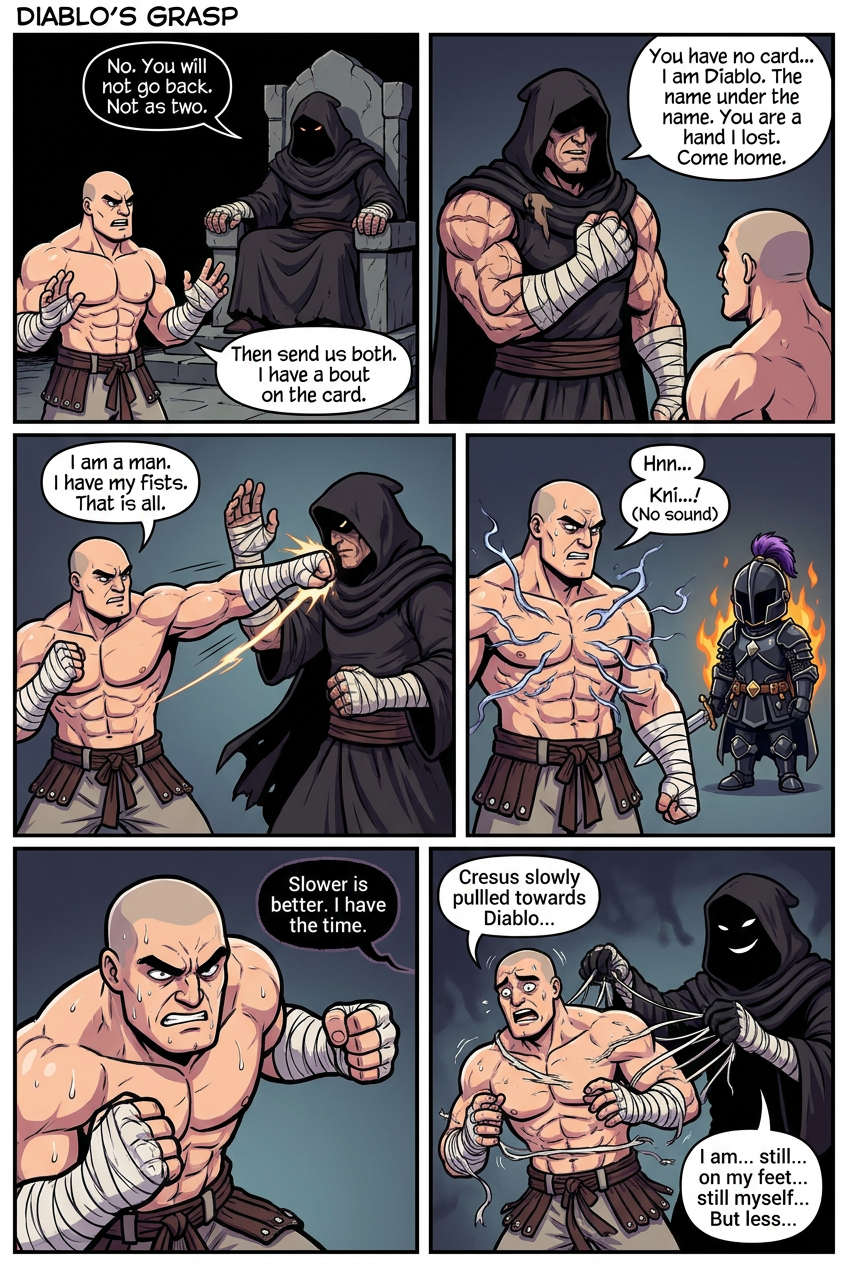
The seated man did not rise. He looked at Creusus the way a man looks at a tool he set down long ago. "No," he said. "You will not go back. Not as two." Creusus kept his hands up. "Then send us both. I have a bout on the card." "You have no card," the seated man said. "You have a borrowed life on a borrowed road. The pieces must come whole again. That is the only door out of this hall." He stood then, slow, and the linen on his knuckles matched Creusus's own. "I am Diablo. Not a name you were told at the docks. The name under the name. A thousand years I have sat here missing a piece of my body. You are that piece. Come home." Creusus shook his head once. "I am a man. I have my fists. That is all." "You are a hand I lost," Diablo said. "I will fold you back in. It will take longer than it took the knight, because you did not spend those years in the void being scoured. But I will enjoy every hour of the work. When it is done, you will not remember the post or the old man's linen. You will remember only me." He raised one wrapped hand. Creusus felt a pull start under his ribs, low and steady, like a rope drawn hand over hand through his chest. He set his feet. He threw a straight punch at Diablo's jaw. His fist stopped a hand's width from the face and hung there. The pull tightened. His knees bent without him bending them. He hummed, the same frequency that had broken the armor's hold, and the hum came out thin and wrong, as if the air in the hall would not carry it. He turned his head. The knight stood where he had stood, flame in one hand, sword in the other. The knight did not move. Creusus opened his mouth to call him and no sound came. The pull dragged a piece loose behind his sternum. He felt it slide toward the seated man like iron toward a lodestone. He drove his heel back into the stone to hold ground. The stone did not care. His wrapped fist trembled in the air, still a hand's width from Diablo's jaw, closer now by a finger, then two. Diablo smiled without moving his mouth. "Slower is better," he said. "I have the time." Creusus's vision narrowed to the linen on his own knuckles. He watched a thread of it fray and lift, drawn toward the seated man. He was still on his feet. He was still himself. But less of him, and the pull had not stopped.
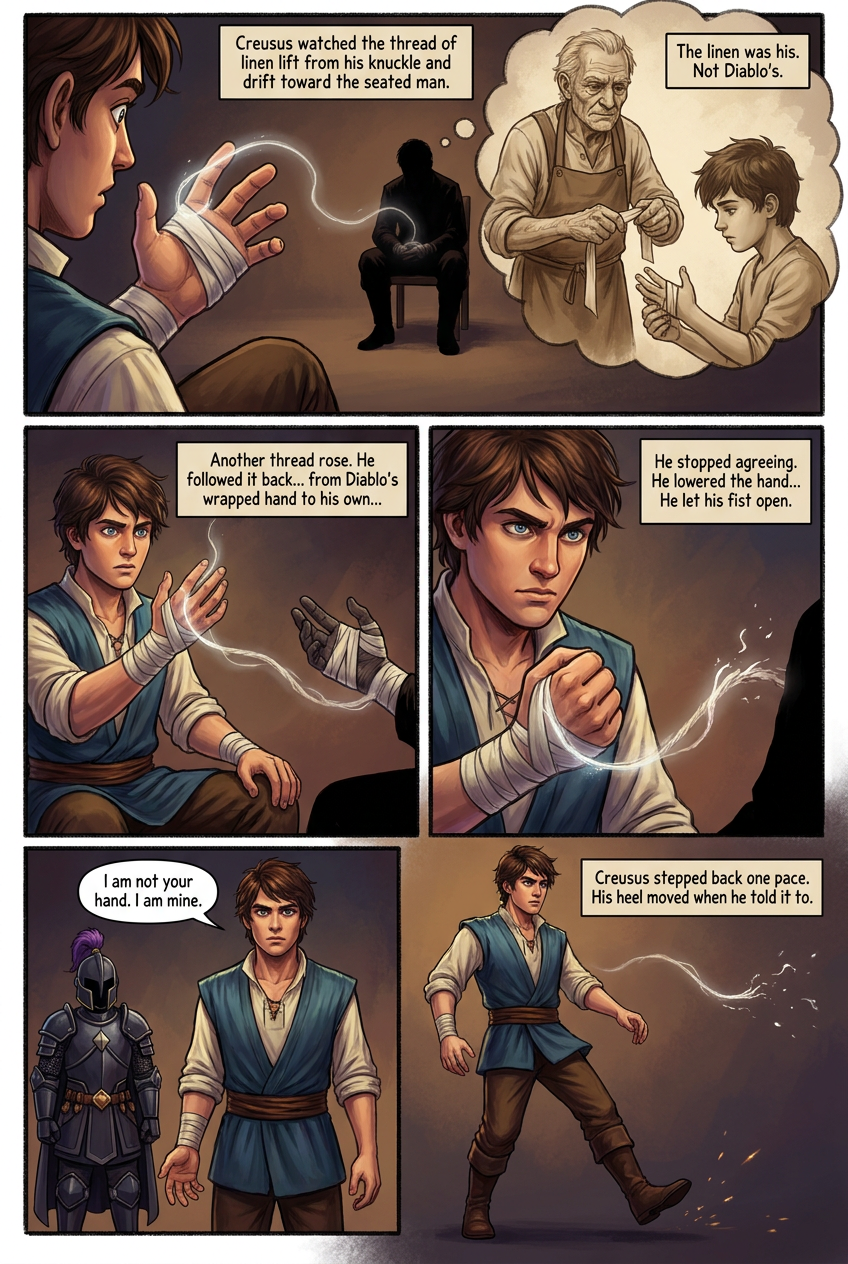
Creusus watched the thread of linen lift from his knuckle and drift toward the seated man. He watched it and did not look away. The linen was his. The old man at the docks had shown him the wrap, year after year, until his hands learned it without asking. That was his. Not Diablo's. He held that fact in his head like a stone in a fist. The pull kept working under his ribs. Another thread rose. He followed it back with his eyes, from Diablo's wrapped hand to his own, and he understood what bound them. It was not blood. It was not a sword strike a thousand years old. It was the belief that the missing piece belonged in the other man's palm. Diablo pulled because Creusus half-agreed he was a piece. As long as he agreed, the rope had somewhere to catch. He stopped agreeing. He lowered the hand that hung in the air. He let his fist open. He said, "I am not your hand. I am mine." The pull did not stop, but it thinned, as if the rope had frayed at the far end. Creusus stepped back one pace. His heel moved when he told it to.
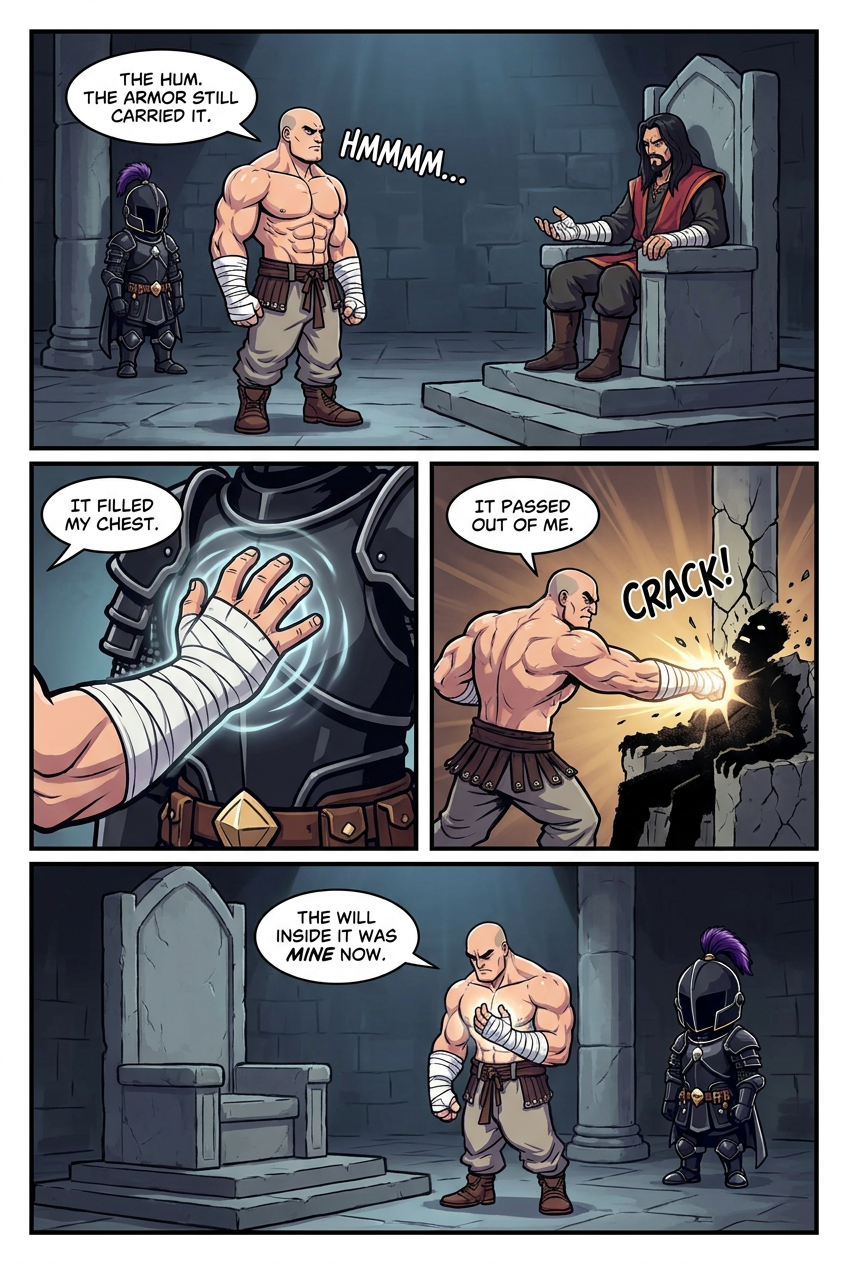
Creusus took another step back. The stone hall held its shape. Diablo sat on the seat with his wrapped hand still open, waiting for a piece that would not come. Behind Creusus, the knight stood near a pillar, silent, his black plate catching no light. Creusus looked at the knight and remembered the hum. In the arena, the armor had rung under his fingers, and matching that ring had given him his body back. The armor still carried it now. He could hear it under the quiet, low and even, like water moving under ice. Diablo did not have it. Diablo had only the pull, and the pull had thinned. Creusus crossed to the knight in four strides and set his wrapped fist against the breastplate. The hum climbed into his teeth. He held it, matched it in his throat, and let it fill his chest. Then he turned and drove his fist into Diablo's jaw. The ring passed out of him and into the seated man, and the stone hall answered. A crack ran up the nearest pillar. Diablo's head snapped sideways. His mouth opened, but no sound came. Creusus hit him again. The wrappings on Diablo's hand went loose. A third punch, and the skin at Diablo's temple split without blood, showing a dry seam beneath, like a pot fired wrong. Creusus kept the hum going. He hit the seam. Diablo came apart along it, shoulder to hip, in a slow tearing that made no noise the ear could name. What lifted out of the broken shape was not a body. It was a weight, a wanting, a shape that had used a face. Creusus opened his mouth and drew it in. He did not decide to. He only stopped refusing. It settled behind his ribs and lay down there, heavy and quiet, and he knew the will inside it was his now, not the other way. The pillar stopped cracking. The seat was empty. The knight had not moved. Creusus lowered his fist and looked at his own hand, still wrapped, still his. Something else was his too…
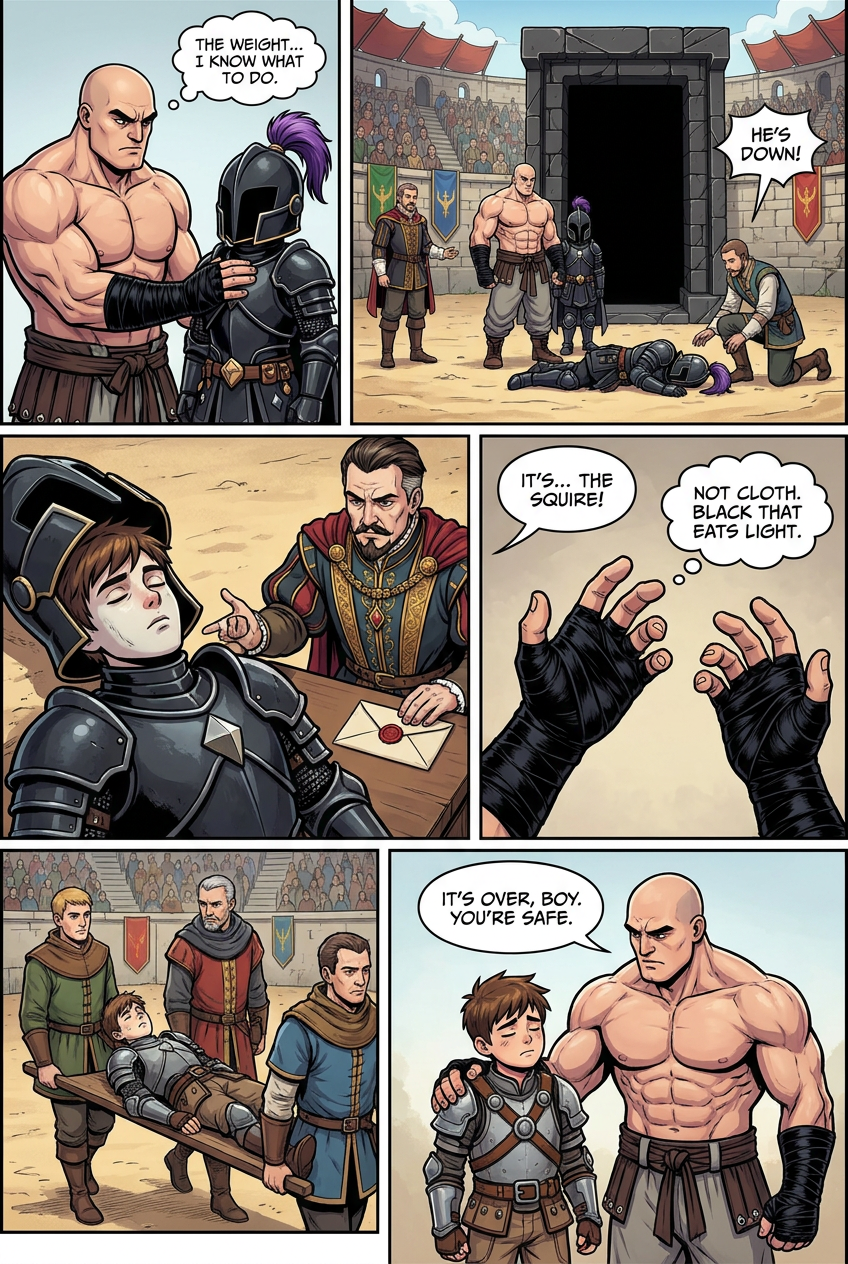
The weight behind Creusus's ribs settled, and he knew what to do with it. He turned to the knight and set his palm on the black breastplate. The hum was still there, low and steady. Creusus matched it in his throat, then reached past the hum for the new thing under his ribs. He asked it for the arena. It answered like a door opening in a wall he had not seen. A dark frame rose in front of them, taller than a man, stone at its edges, nothing inside but black. Creusus took the knight by the arm and stepped through. They came out on the sand. The tiers rose around them. Banners hung where they had hung. The marshals stood where they had stood. No one gasped. No one pointed at the sky. To the crowd, no time had passed at all. The knight dropped at Creusus's feet, face down in the dust, armor loose on a smaller frame. Sir Syble lowered his hand from the signal he had been about to give and stared. A marshal walked out, knelt, and could not find a pulse he trusted. He looked up at Creusus and raised the winner's arm. Creusus let the arm go up. He watched the marshals lift the black helmet. Under it was the squire again, the boy's face, unaged, mouth slack, breathing shallow. The marshals murmured. Sir Syble came down onto the sand and looked hard at the boy, then at Creusus, then at the sealed paper still on the registrar's desk. He spoke to the head marshal in a low voice. The head marshal nodded once and turned to the crowd. The knight who had forced the bout was struck from every card. He would not fight in Embermere again. The reason went unspoken. The boy would be carried to the hospital. Creusus looked down at his hands. The bandages he had wrapped that morning were gone. In their place, his knuckles were bound in something that was not cloth. It was black the way the frame had been black, a black that ate the arena light and gave nothing back. He flexed his fingers. The wrappings moved like cloth. They were not cloth. The weight under his ribs stirred when he looked at them, pleased, and he made it lie down again. He crossed to where the marshals had lifted the squire onto a plank. The boy's eyes opened. They were only eyes now, no hum behind them, no void. The boy tried to speak and could not. His face bent around something that had no name yet, and Creusus understood it as pain, only pain, the ordinary kind a body carries after too long away from itself. Creusus set two black-wrapped fingers on the boy's shoulder and let them rest there while the marshals carried him out. He had won the bout. The tournament went on. The hands he would fight with next were not the hands he had come in with.
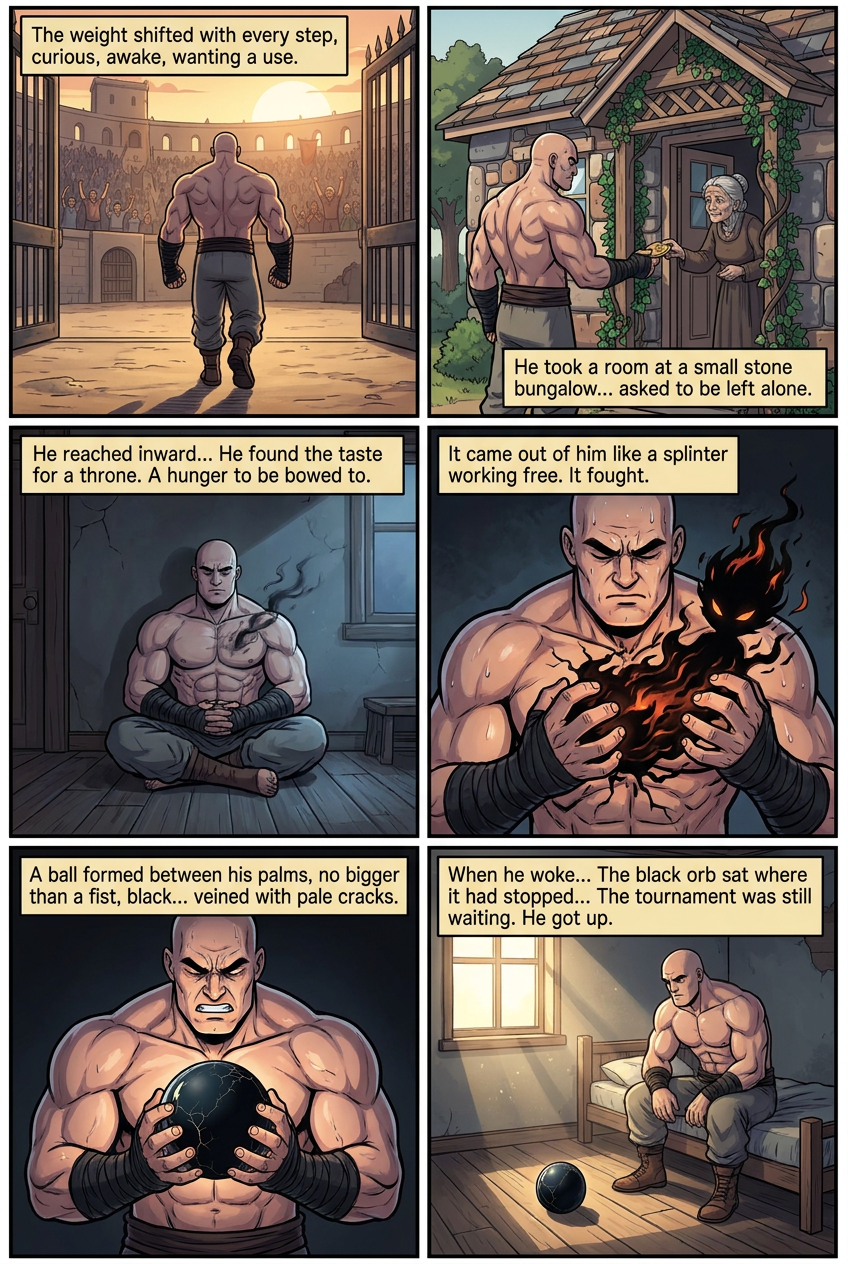
Creusus walked out of the arena on his own feet. The marshals stepped aside. The crowd noise slid off him. Under his ribs the new weight shifted with every step, curious, awake, wanting a use. He felt it push at his thoughts and try to color them. It liked the sound of the crowd. It wanted to turn and look at the tiers and count who owed him something. He kept walking. He knew whose thought that was. It was not his. He took a room at a small stone bungalow past the arena walls, ivy on the trellis, one door, one window on each side. He paid the woman there and asked to be left alone. Inside, he sat on the floor with his back to the wall and looked at his black-wrapped hands. He closed his eyes and reached inward the way he had reached for the door in the wall. The weight met him. He sorted through it. He found the taste for a throne. He found a hunger to be bowed to. He found the wish to break a man for the pleasure of it. Each one had Diablo's shape on it. Creusus took hold of the first and pulled. It came out of him like a splinter working free. It fought. It told him he was cutting away his own strength. He kept pulling. He pulled out the hunger next, then the pleasure in cruelty, then the small quiet want to be feared. He set each one in the air in front of him and held them there with the same power that had opened the frame in the arena. He shaped that power around them into a thin skin, then thickened it, then closed it. A ball formed between his palms, no bigger than a fist, black as the frame had been, veined with pale cracks where the trapped will pressed against its cage. Creusus poured what he had left into the shell until the shell went hard and cold. His arms dropped. The ball rolled once on the boards and stopped. He sat where he was for a long time. His hands shook. His mouth was dry. The weight under his ribs was smaller now, and quieter, and his. He crawled to the narrow bed and pulled the blanket down and lay on the floor beside it because the floor was closer. He slept without dreams for the first time since the squire had vanished from the sand. When he woke the light through the window had moved across the room and back again. The black orb sat where it had stopped, watching nothing, holding what he had cut out. His knuckles were still wrapped in the black material. The tournament was still waiting. He got up.
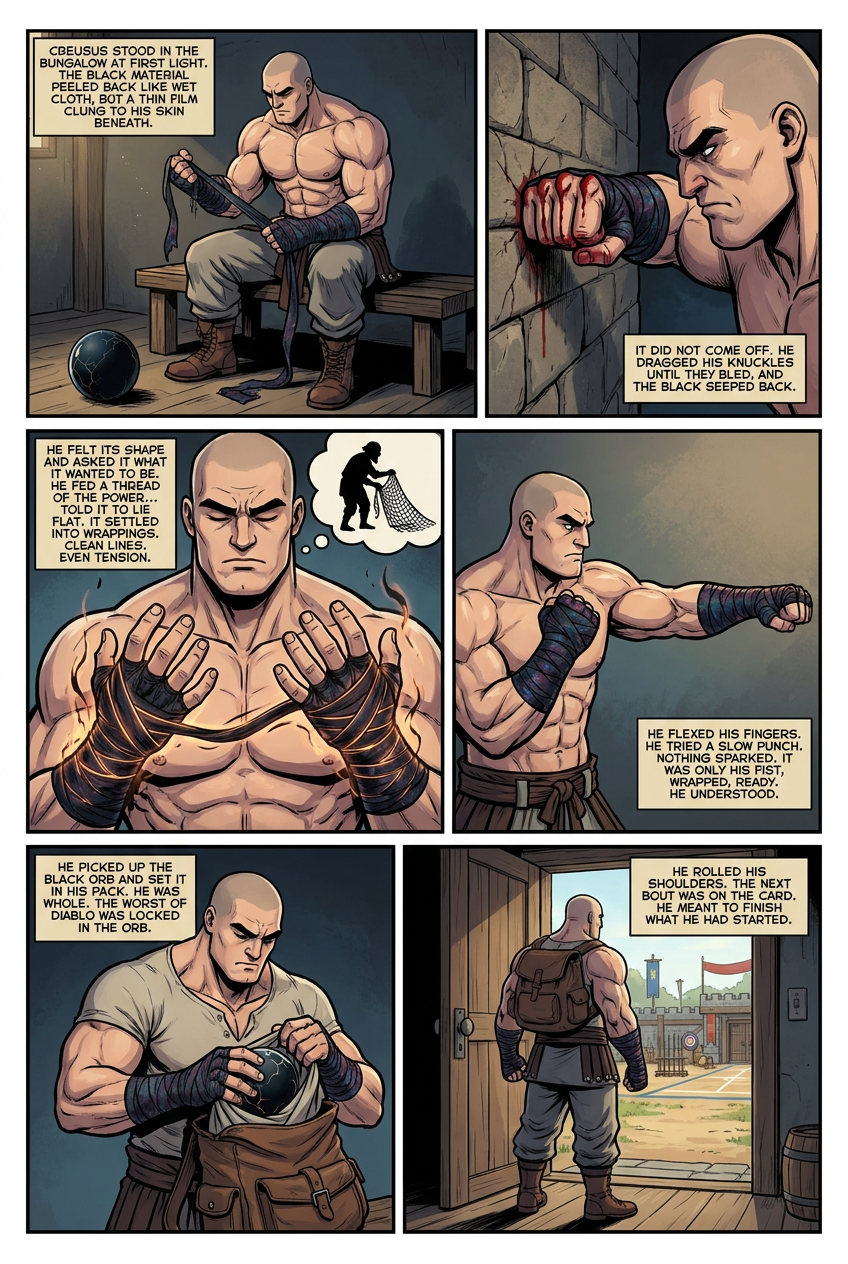
Creusus stood in the bungalow at first light and unwrapped his hands. The black material peeled back like wet cloth, but a thin film clung to his skin beneath. He rubbed at it with his thumb. It did not come off. He dragged his knuckles across the stone wall until they bled, and the black seeped back through the cut and closed it. He sat down. The orb on the floor watched nothing. Inside himself he could feel the rest of the power humming low, small, patient. He had cut out the worst of it and sealed it in the shell. What was left was quieter, but it was not gone. He closed his eyes and reached for it the way he had reached before. This time he did not try to pull. He held it. He felt its shape and its weight and asked it what it wanted to be. It answered with heat under his skin and a slow pressure in his wrists. He thought of the post at the training grounds. He thought of the old man at the docks and the way the man's fingers moved over the net, tying knots without looking. Creusus opened his hands. He fed a thread of the power down into the black film on his knuckles and told it to lie flat. The film thickened, then thinned, then settled into the shape of wrappings. Clean lines. Even tension. He flexed his fingers. The power sank back and went still. He tried a slow punch at the air. Nothing sparked. Nothing hummed. It was only his fist, wrapped, ready. He understood then. He could not scrape the magic out. He could shape it. He could hold it in a small pocket under the skin and leave it there until he called for it. For the tournament he would call for none of it. He would fight the way he had always fought. The power would wait. He picked up the black orb and set it in the bottom of his pack, wrapped in a spare shirt. The cracks on its surface pressed faintly against his palm, and the thing inside pushed back and found the shell and gave up. He tied the pack shut. He was whole in the way a man is whole after he has cut off a bad finger and lived. The worst of Diablo was locked in the orb. The rest was his to spend or save. He rolled his shoulders, wrapped his knuckles once more out of habit over the black skin, and walked to the door. The next bout was on the card. He meant to finish what he had started.
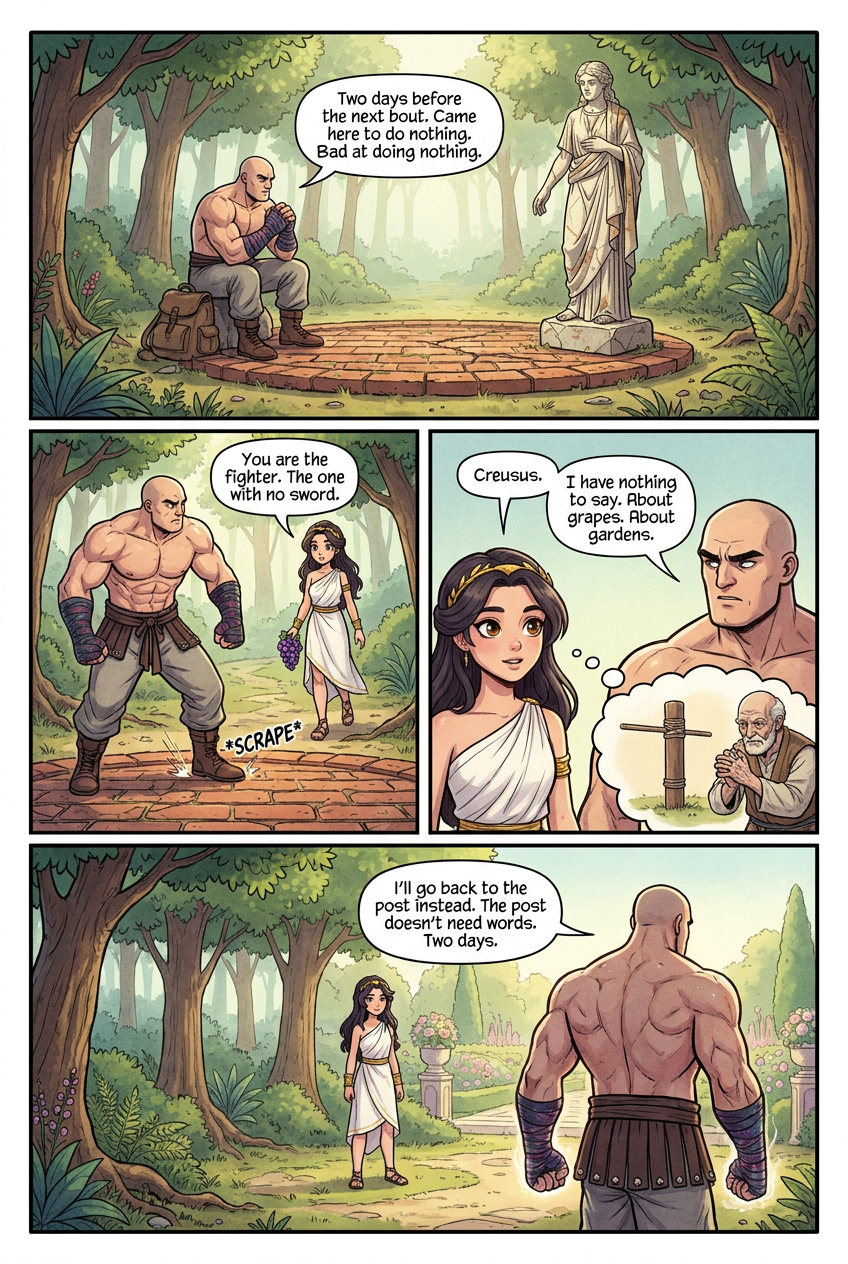
Creusus had two days before the next bout. He walked past the arena gates without looking at them and followed a stone path up into the kingdom gardens. The pack on his back was light. The orb inside it was quiet. He passed low hedges and pastel beds of flowers he could not name, and he made his shoulders drop for the first time in a week. He had come here to do nothing. He was bad at doing nothing, so he kept walking until the paths narrowed and the noise of the town fell away behind him. The path opened into a small grove. Trees closed over a ring of old brick set into the ground. A weathered statue stood at the edge, a robed figure with one hand held across its chest. He read the plaque. Aegis of Mercy. He did not know the story. He sat on the brick and looked at the stone face and felt his knuckles itch under the wrappings. He rubbed them through the cloth. The black skin beneath stayed still. A woman stepped into the grove from the far path. She carried a small cluster of grapes in one hand. A thin gold band held back her dark hair, and her white dress caught the light between the leaves. She stopped when she saw him. She did not turn away. She looked at him the way a person looks at a horse in a field, curious and unafraid. He stood up too fast. The brick scraped under his boot. "You are the fighter," she said. "The one with no sword." "Creusus." His voice came out flat and low, the way it always came out. He tried to think of something else to add. He thought of the post at the training grounds and the sound his fist made on wood. He thought of the old man at the docks and his knotted fingers. He had nothing to say about grapes, or gardens, or the statue behind him. He said, "I was leaving." It was not true. He watched her face for the small pull of disappointment he expected. It did not come, but he had already decided what her silence meant. He nodded once and stepped past her onto the path. He did not look back. He heard her say his name once, softly, like a question. He kept walking. By the time he reached the main garden his hands were fists inside the wrappings and the power under his skin was warm and awake. He forced it down. He had come here to rest. He had failed at that. He would go back to the post instead. The post did not need words. Two days. He walked faster.
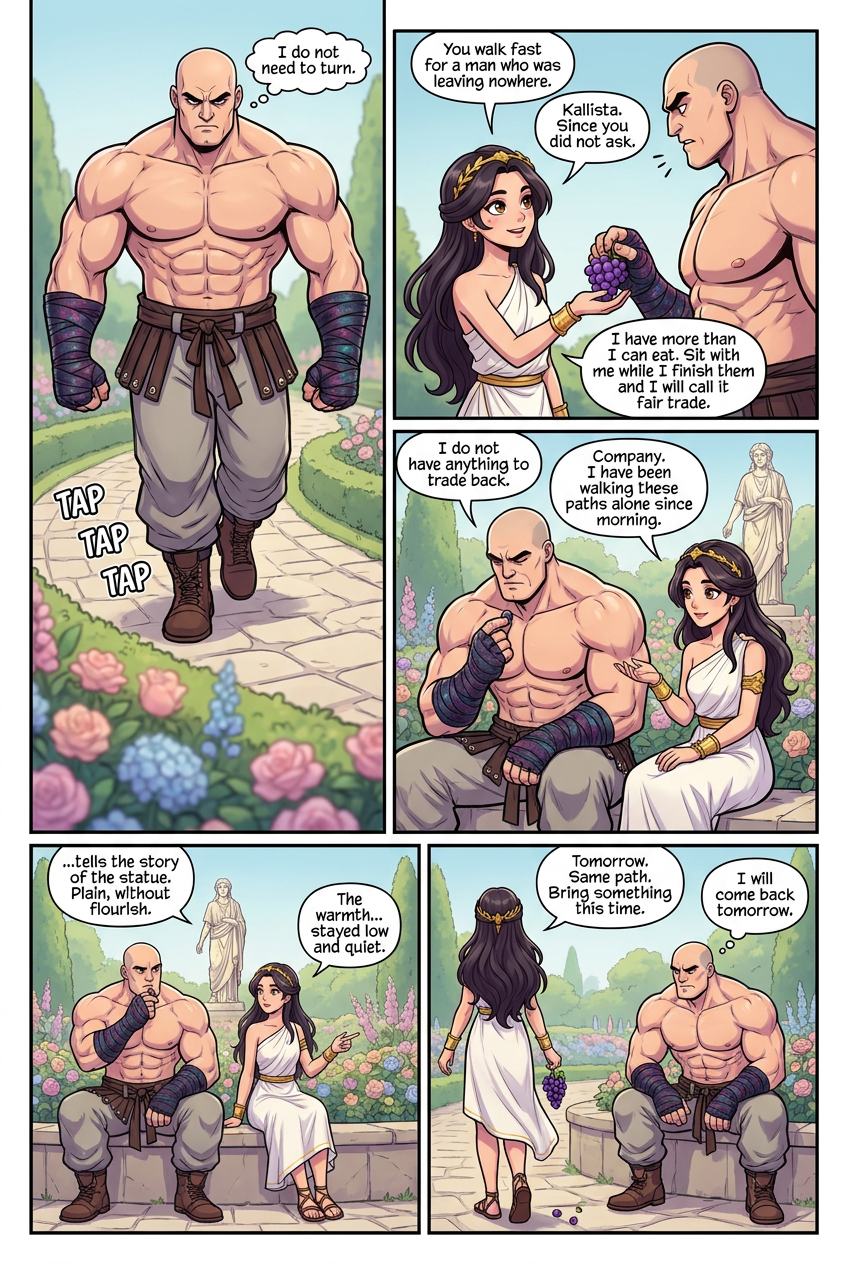
Creusus was halfway down the main path when he heard the footsteps behind him. Quick steps on stone, not the tread of a guard. He did not stop. The pastel beds blurred past on either side, pink and blue and pale yellow flowers in low tidy rows. He told himself the post was two gates and a road away. He told himself he did not need to turn. The steps caught up. "You walk fast for a man who was leaving nowhere," she said. She came around his shoulder and stopped in the path in front of him. The grapes were still in her hand. Up close he saw the gold band in her hair and the plain sandals on her feet. "Kallista," she said. "Since you did not ask." She held out the cluster. "I have more than I can eat. Sit with me while I finish them and I will call it fair trade." He looked at the grapes. He looked at her face. He thought of the post and the sound of wood. He thought of the warm thing under his knuckles that had woken up the last time she spoke to him. He opened his mouth to refuse. What came out was, "I do not have anything to trade back." She shrugged. "Company. I have been walking these paths alone since morning." He stood there a long moment. Then he sat down on the low stone edge of the nearest bed. She sat beside him, close enough that he could see the small chip in one of her bracelets. She pulled a grape free and held it out. He took it between two bandaged fingers and ate it. It was cold and sweet. She did not ask about his hands. She asked about the statue in the grove, and when he said he did not know the story, she told it to him in a few short sentences, plain, without flourish. He listened. He ate another grape. The warmth under his skin stayed low and quiet, like a dog that had lain down. They sat until the grapes were gone. She dropped the stem in the dirt beside the flowers and stood and brushed her dress. "Tomorrow," she said. "Same path. Bring something this time." She did not wait for an answer. She walked back the way she had come. Creusus stayed on the stone a while longer. His hands rested open on his knees. He counted the flower beds across from him because he had nothing else to count. Six. He would come back tomorrow. He knew it before he stood up. The post could wait one more day. He walked out of the gardens toward the town, and for the first time in a week his shoulders were down and stayed down.
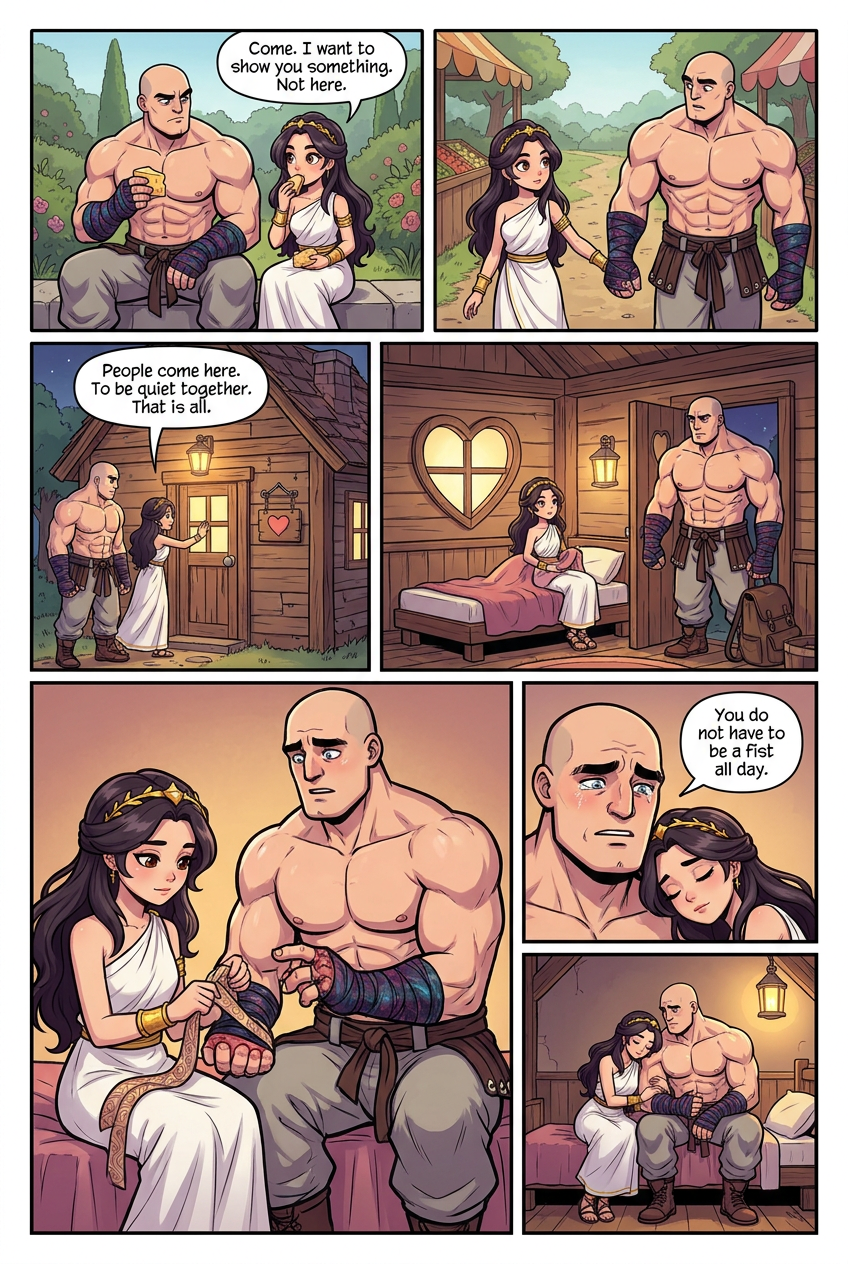
Creusus came back to the garden the next day with a small wedge of hard cheese wrapped in cloth. Kallista was waiting on the same stone edge. She took the cheese, broke it in half, and gave a piece back to him. They ate without much talk. When she stood, she did not walk toward the flower beds. She caught his wrist in her hand and tugged. "Come," she said. "I want to show you something. Not here." He let her pull him. That surprised him more than anything. His feet followed her out of the gardens and along a dirt track behind the market. His pack knocked at his hip. Inside it the orb sat quiet. His knuckles did not warm. His shoulders stayed low. She held two of his fingers, not his whole hand, as if she knew a whole hand was too much to ask. She stopped at a little wooden building set back from the path. Flowers were nailed along the eaves. Ribbons hung from the porch rail, faded from sun. A painted heart swung on a chain by the door. A lantern glowed in the front window even in daylight. "People come here," she said. "To be quiet together. That is all." She pushed the door open with her shoulder. Inside smelled like old cedar and dried petals. A low bed sat under the heart-shaped window. She sat on the edge of it and patted the blanket. Creusus stood in the doorway. He thought about the post. He thought about the tournament and the next bout on the card. Then he set his pack down against the wall and sat beside her. The mattress dipped under him. She took his hand and turned it over in her lap. She began to unwind the bandage on his right knuckles. He did not stop her. No one had done that for him since he had learned to do it himself. The cloth came away in a slow spiral. His skin underneath was raw and pale. She ran her thumb once across the knuckles and set the bandage on the blanket, folded, neat. "You do not have to be a fist all day," she said. He looked at his own bare hand in her lap. It looked small there. He felt something inside his chest give way, like a rope cut clean. His eyes stung. He did not speak because he did not trust his voice. She rested her head against his shoulder. He let her.
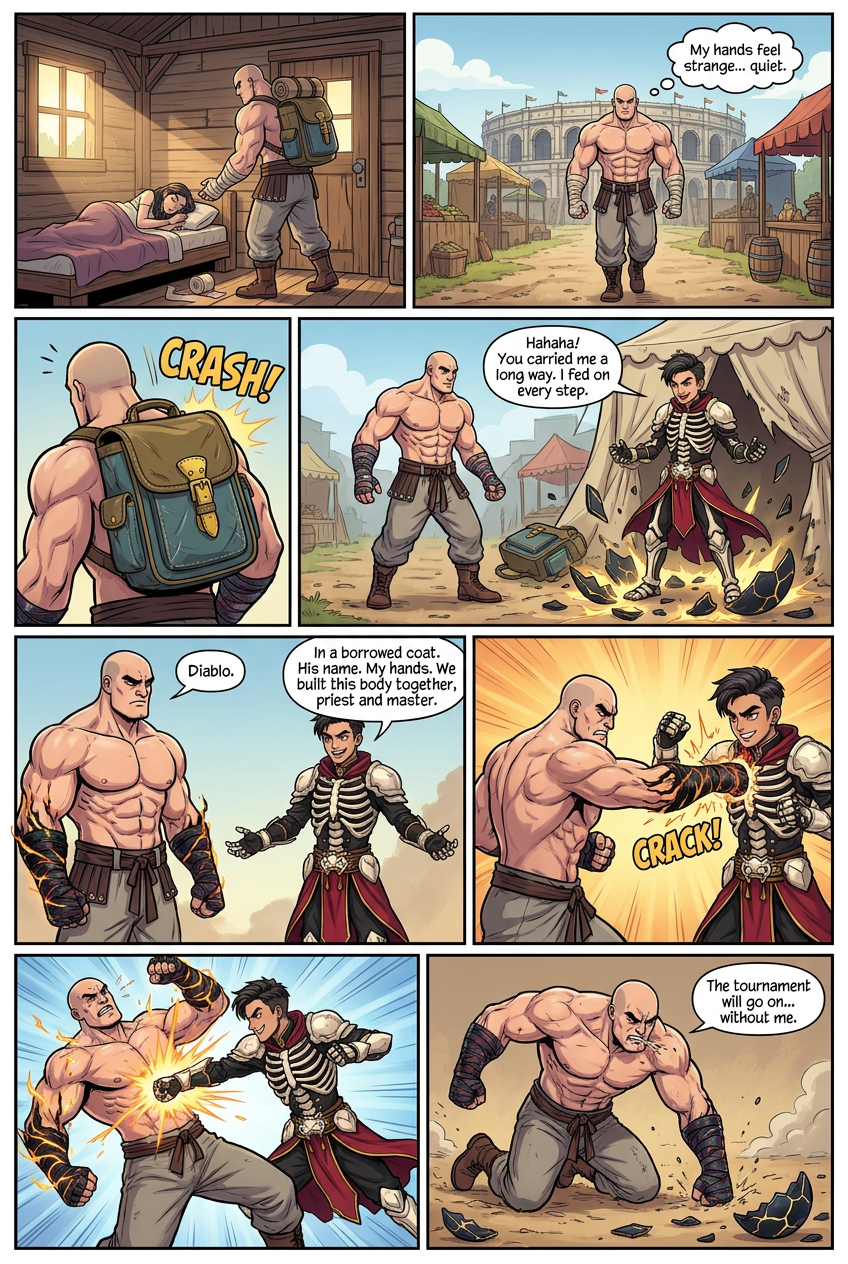
Creusus left the little building at dawn. Kallista was still asleep on the low bed, one arm folded under her cheek. He set her bandage roll on the blanket beside her hand. He did not wake her. He picked up his pack, felt the weight of the orb inside it, and stepped out onto the dirt track. The morning smelled of wet grass. His next bout was on the card before midday. He walked back toward the arena the long way, past the market stalls opening their shutters. His hands felt strange without the wrappings. The black material under his skin was quiet. He rolled his shoulders and lengthened his stride. He thought about the post. He thought about Kallista's thumb on his knuckles. He let himself think about both without choosing. Halfway down the track he heard the crash. It came from inside his pack. A hard sound, like a plate breaking under a boot. He stopped. He swung the pack off his shoulder and dropped it in the dirt. The canvas bulged. Something inside was growing. The pack split down the seam. A man climbed out of it. He was full-sized, standing where no full-sized man should fit, brushing dust from a skeletal breastplate. Dark hair. Bone plates on his shoulders. A red skirt at his hips. Creusus did not know his face. Shards of the black orb lay in the torn canvas at the stranger's feet, gold cracks still glowing along the pieces. The stranger laughed. It was a full, easy laugh, as if he had heard a joke on the way up. "You carried me a long way," he said. His voice was warm and uncaring at once. "I fed on every step. Every match. Every night in the garden with the girl. I filled myself on you." Creusus stared. The wrappings under his skin began to warm. "Diablo." "In a borrowed coat." The stranger spread his arms. The bone plates clacked. "His name. My hands. We built this body together, priest and master. I am his and he is mine." He laughed again. "You played god with an orb. So did I. I won." Creusus did not have a plan. He had a road, an empty pack, and a man in front of him who should not exist. His next bout was on the card. Kallista was asleep in a wooden building behind him. The orb was gone. He stepped in and threw the first punch. Malachai caught it on his forearm. The bone plate cracked. He was still smiling. He drove a fist into Creusus's ribs and Creusus felt the ground leave him. He landed hard on his back in the dirt. The wrappings under his skin flared black and hot. Creusus rolled to his knees and spat. The orb was broken. The tournament would go on without him this hour. He rose to meet the man who had climbed out of his bag.
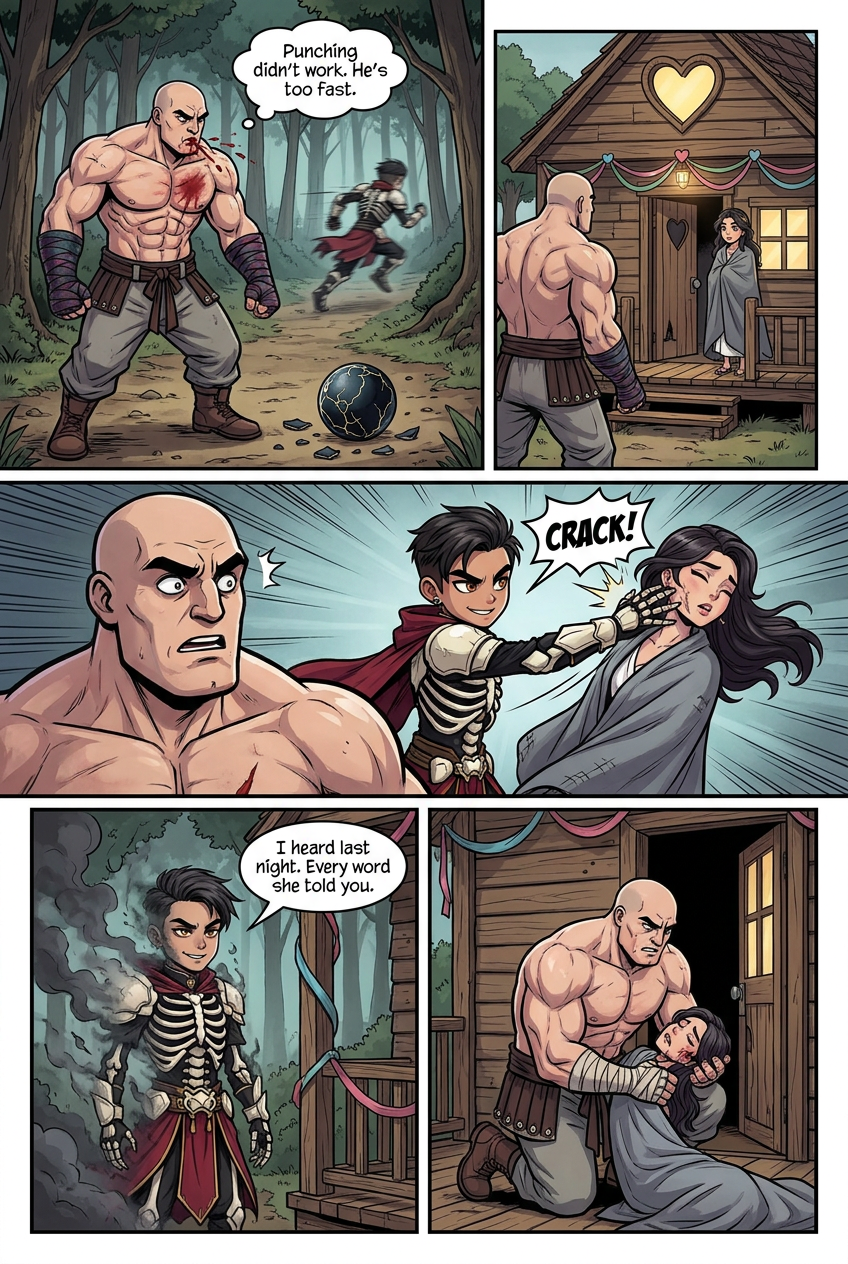
Malachai stepped back from the fight. He wiped dust from his skeletal breastplate and laughed once more, sharp and bright. Then he turned and ran. He moved faster than a man should move. His feet barely marked the dirt. In three breaths he was down the track and gone into the trees. Creusus stood in the road with his fists still raised. His ribs burned where the punch had landed. The broken pack lay open at his feet, shards of the orb dulling in the light. He spat blood and started after the running man, but he already knew he would not catch him. Malachai had chosen the trees on purpose. Malachai had chosen everything on purpose. Creusus stopped at the edge of the path. He needed a plan. Punching had not worked. He turned back toward the little building where he had left her. The love shack sat at the end of the track, ribbons stirring on the porch, a heart carved above the door. Kallista was already outside. She had wrapped a blanket around her shoulders. She was looking down the road for him. She saw him and started to smile. Then a shape stood beside her that had not been there a breath before. Dark hair. Bone plates. A red skirt at the hips. Malachai's hand rose almost gently and struck her across the jaw. The sound reached Creusus a moment after the blow. Kallista's head snapped sideways. Her legs folded. The blanket slid from her shoulders. Creusus ran. Malachai looked up at him and smiled. "I heard last night," he said. His voice carried down the track without effort. "Every word she told you. Creusus was still running when Malachai came apart into smoke and was gone. No wind. No sound. Only the porch and the fallen woman and the ribbons moving. Creusus dropped to his knees beside her. Her jaw sat wrong under the skin. Her breath was shallow. He put one hand under her head and one at her shoulder and did not lift her yet. He lifted her carefully and carried her inside.
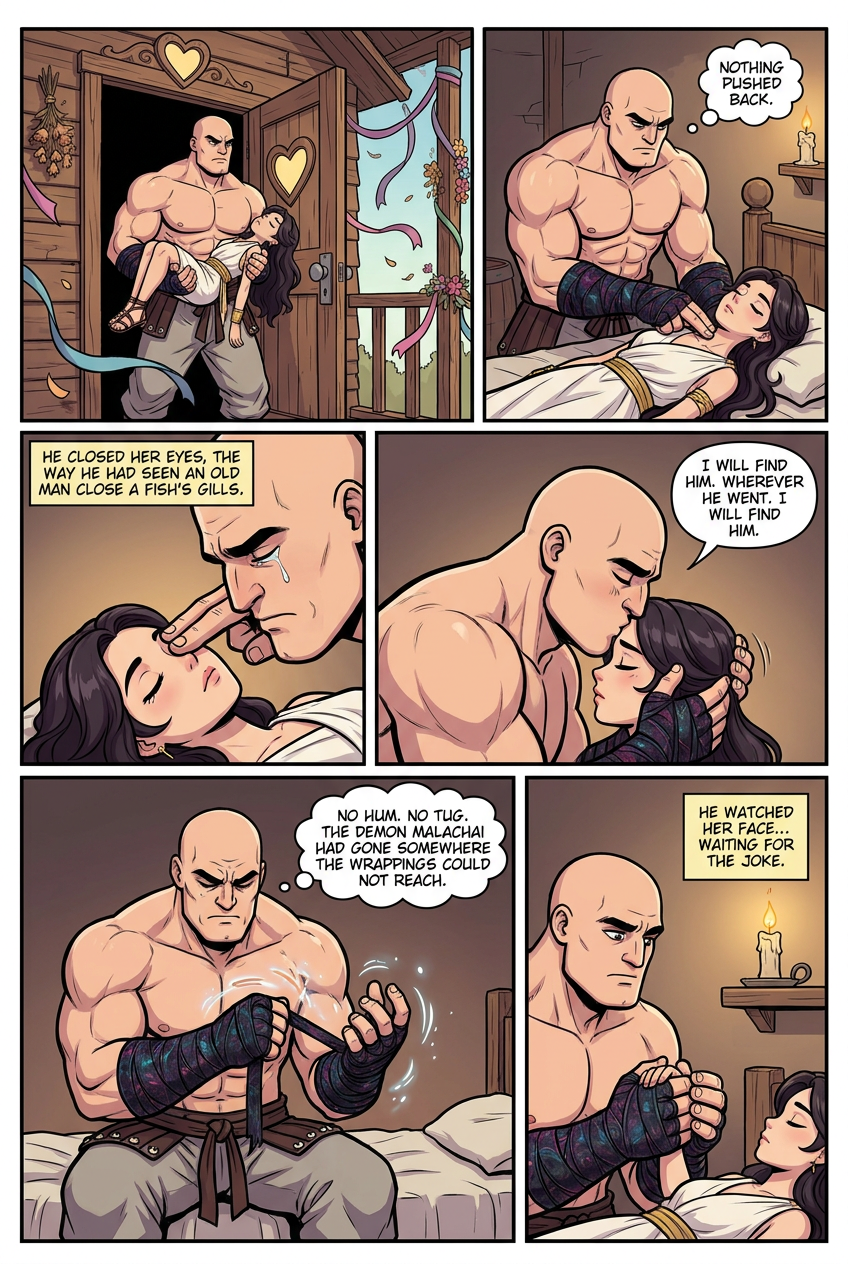
Creusus pushed the door open with his shoulder. The little shack smelled of dried flowers and old wood. Ribbons on the porch still moved behind him. He carried Kallista across the room and laid her on the bed where they had sat the night before. Her head rolled once on the pillow and settled. He knew before he straightened up. He put two fingers to her throat. He held them there a long time. He moved them lower, then to her wrist. Nothing pushed back. Her chest did not lift. Her mouth stayed open a small amount, the way a person's mouth opens when sleep takes them fast. This was not sleep. He sat on the edge of the bed. His weight tipped her toward him and he caught her shoulder and steadied her. He wiped the blood from her lip with his thumb. He closed her eyes with the flat of two fingers, the way he had seen an old man close a fish's gills at the docks, gentle, not thinking about it. He bent and kissed her forehead. Her skin was already cooler than it should have been. He wept without sound. His shoulders shook once and then stopped. He was not a man who knew how to cry for long. "I will find him," he said into her hair. "Wherever he went. I will find him." He reached inside himself for the black wrappings on his knuckles. He pushed his will down into them, searching. He wanted the pull he had felt before, the thread that led to Diablo. There was nothing. No hum. No tug. The demon had gone somewhere the wrappings could not reach. Malachai's body had walked it out of range. Creusus lowered his hands. The promise sat in the room with no direction to travel. He stayed on the bed. He took her hand and put it between both of his. Her fingers were small and did not close. He watched her face. He watched it the way a man watches a door he expects to open. He waited for her to breathe in sharply, sit up, laugh at him, tell him it was a jester's trick. He waited for the joke. The candle on the shelf burned down a finger's width. Then another. Ribbons tapped the outside wall. No one came. She did not move.
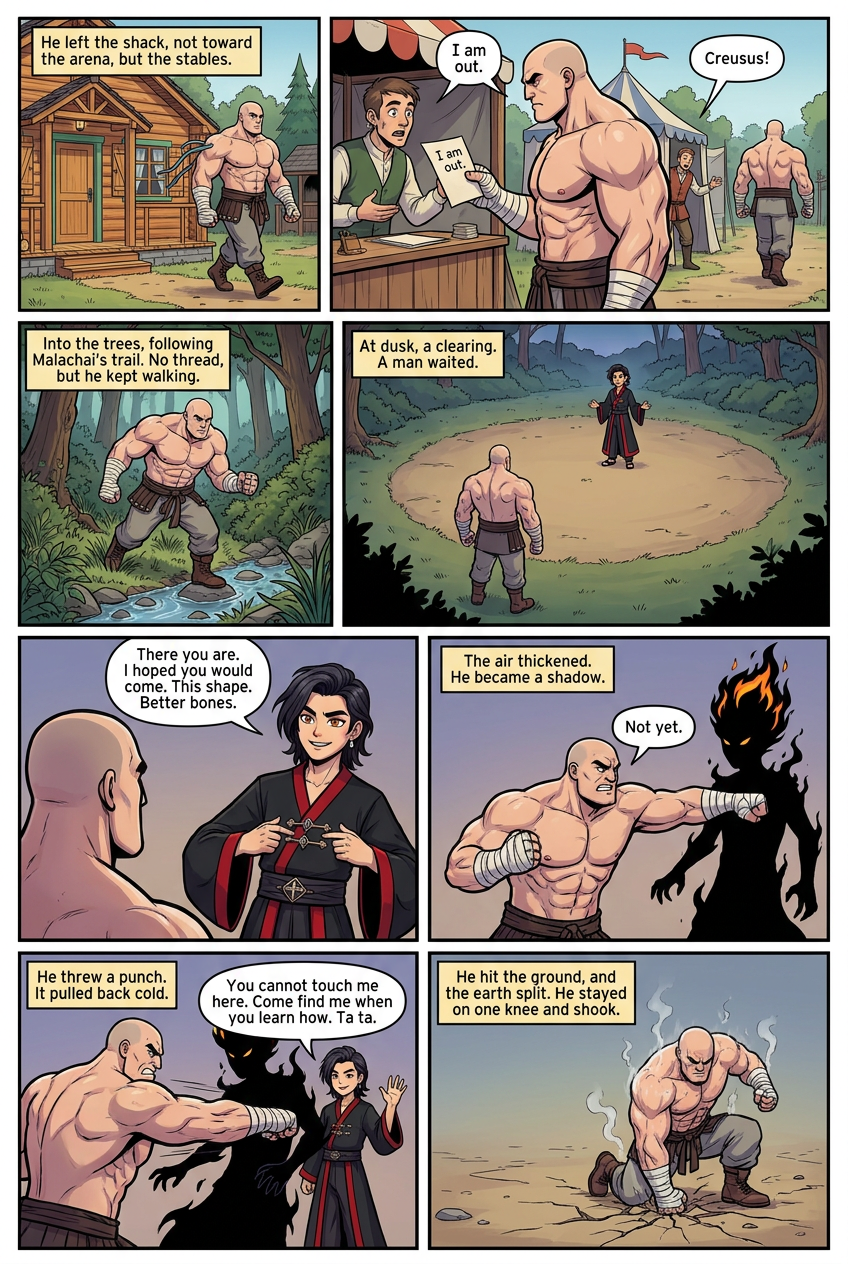
Creusus left Kallista on the bed and walked out of the shack. The ribbons on the porch touched his shoulder as he passed. He did not go toward the arena. He went toward the stables. He found a clerk at the tournament tent and gave him a folded piece of paper. On it he had written three words. I am out. The clerk read it twice and looked up. Creusus was already walking away. Behind him, a marshal called his name. He did not turn. He headed into the trees where Malachai had run. He pushed his will into the black wrappings on his knuckles as he walked. Still no thread. He kept walking anyway. He crossed a stream and climbed a slope of loose stone. He listened for anything wrong. By dusk he found a clearing where the grass lay flat in a wide circle. A man stood at the center. Not Malachai. Not the priest in bones he had glimpsed before. This one wore a long black robe with red at the hem. His hair fell past his shoulders. A single silver earring swung at his jaw. He was smiling as if he had been waiting a long time. "There you are," the man said. The voice was Malachai's mouth and someone else's weight behind it. "I hoped you would come." Creusus stopped at the edge of the circle. "Diablo." "He suits me," Diablo said. He lifted one sleeve and let it fall. "Lighter than the last shape. Yours was too much muscle. Slow. This one moves." He rolled his shoulders and grinned. "I have been reshaping him all afternoon. Longer hair. Better bones. A face people will open doors for." Creusus stepped into the circle and set his feet. Diablo lifted a hand. "Not yet." The air around him thickened. His robe stirred without wind. The skin at his throat darkened, then his jaw, then his eyes. The color climbed him like water rising in a jar. In a breath the man was gone and a black shape stood in his place, tall as a doorframe, with a shifting crown that looked like flame but gave off no heat. The grass under him did not burn. The clearing went quiet in a way that pressed against Creusus's ears. Creusus threw a punch. His fist passed through the shape and pulled back cold. The shape laughed. It was a small sound, almost polite. It shrank back into the robed man, who tilted his head and looked at Creusus's wrapped hands. "You cannot touch me here," Diablo said. "Not yet. Come find me when you learn how." He wiggled his fingers in a small wave. "Ta ta." The clearing was empty. Creusus stood in the flattened grass. Heat climbed his chest and neck. He hit the ground once, hard, and the earth split under his knuckle. He stayed on one knee and shook.
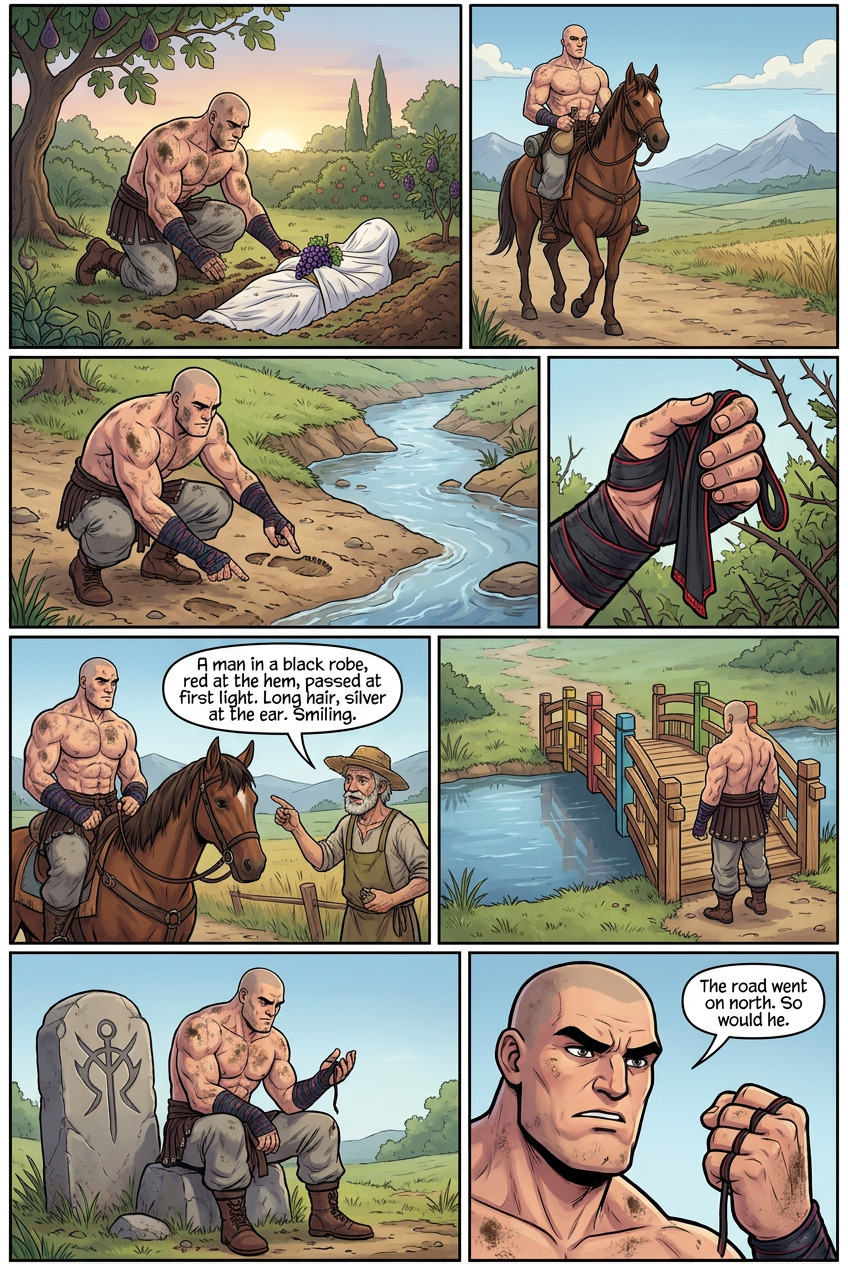
Creusus walked back to the shack before dawn. He wrapped Kallista in the sheet from the bed and carried her out past the ribbons on the porch. He found soft ground under a fig tree at the edge of the garden. He dug with his hands until his black wrappings were caked with dirt. He laid her in and set the grapes she had brought him on her chest. He covered her slow. He said nothing over the mound. He stood a while, then turned north. He went to the stables and paid a boy for a horse and a skin of water. He rode toward the road that ran between Embermere and the neighboring kingdom to the north. He did not push the black wrappings for a thread. He knew there was none. He rode looking at the dirt. At the last village before the border he got down and walked. He read the ground the way his old trainer had taught him years back. Bootprints churned by carts. A crow feather. Nothing. He worked outward in circles from the last place he was sure Diablo had stood. By noon he had one print in soft clay at a stream crossing. A sandal. Narrow foot. Fresh. He followed it. The trail went cold on stone, then picked up again on a patch of moss. A thread of black cloth hung on a thorn at knee height. A robe hem. He pulled it free and kept it in his fist. A farmer at a fence said a man in a black robe with red at the hem had passed at first light, walking north with no pack. "Long hair," the farmer said. "Silver at his ear. Smiling like he owned the road." Creusus asked which way. The farmer pointed northwest, toward the low hills. Creusus went northwest. The trail thinned again. Bent grass. A sandal scuff on a root. He lost it. He found it. He lost it. By late afternoon he was walking the edge of a pond where a small wooden bridge arched over the water. Painted posts in bright colors stood along the rails. The boards were dry. No prints on them. No hem catch on the rail. He crossed. On the far side he found a stone marker cut with the sigil of the northern kingdom. The border. He stopped there. The trail was gone. He had followed a man he could not touch to a line on a map, and the man had walked over it and vanished into a country that was not his own. Creusus sat on the marker. He opened his hand. The thread of black cloth lay on his palm. He closed his fingers on it. His fists were still his. The road went on north. So would he.
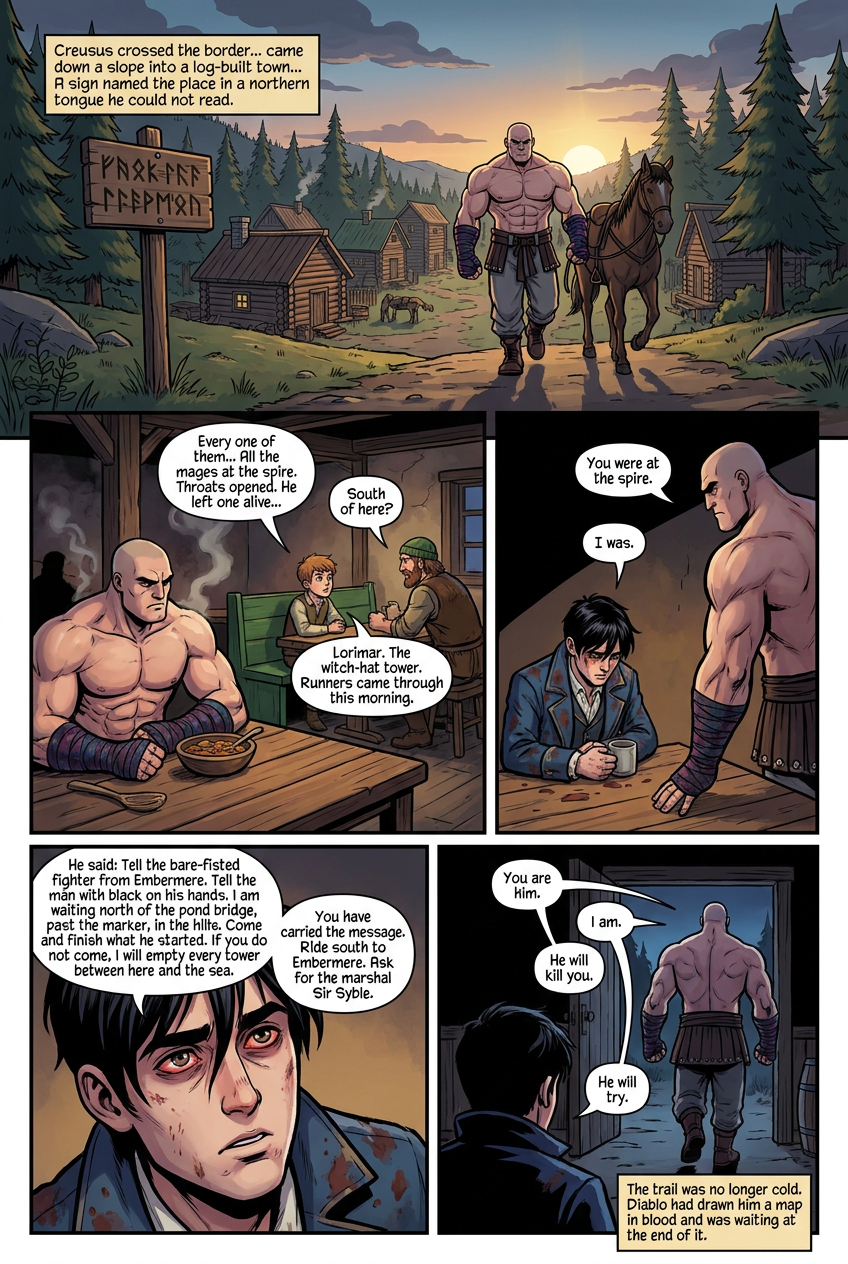
Creusus crossed the border on foot and led the horse by the rein. The road climbed into pine country. By dusk he smelled woodsmoke and heard axes. He came down a slope into a log-built town of clustered wooden homes, sawpits, and drying racks. A sign nailed to a post named the place in a northern tongue he could not read. He tied the horse at a trough and went to find a place to sit and listen. The tavern was a single long room with green benches. Men came in smelling of pitch and sap. Creusus took a bowl of stew and kept his hands under the table. Talk came in bits. A boy at the next bench was telling anyone who would hear. "Every one of them," the boy said. "All the mages at the spire. Throats opened. He left one alive to walk down and tell it." A logger spat. "South of here?" "Lorimar," the boy said. "The witch-hat tower. Runners came through this morning." Creusus set down his spoon. He asked the boy where the survivor was. The boy pointed at a back corner near the hearth. A young man sat there in a stained blue coat with gold thread at the cuffs. His hair fell over half his face. He held a cup he was not drinking. Creusus walked over and sat across from him. The mage did not look up. "You were at the spire," Creusus said. "I was." The voice was flat. "Tell me what he said." The mage lifted his eyes. They were red at the rims. "He said to carry a message. He said to say it to every road until someone heard it. I have said it forty times today." "Say it once more." The mage drew a breath. "He said: Tell the bare-fisted fighter from Embermere. Tell the man with black on his hands. I am waiting north of the pond bridge, past the marker, in the hills. Come and finish what he started. If you do not come, I will empty every tower between here and the sea." Creusus felt the black wrappings warm on his knuckles. The mage did not know the name of the man he was describing. He was staring at his cup again. "How many?" Creusus asked. "Forty-two of us in the spire. I am one." The mage's hand shook. "He came in smiling. He touched no one. They fell anyway. My masters. The children I taught fire tricks to." He wiped his face with the cuff. "I am Thane. I do gravity. I do time. I could do nothing." Creusus put a hand on the table between them, palms down, black cloth showing. "You have carried the message," he said. "You are done carrying it. Ride south to Embermere. Ask for the marshal Sir Syble. Tell him what you told me. Stay there." Thane looked at the black wrappings a long moment. "You are him." "I am." "He will kill you." "He will try." Creusus stood. He paid for the stew and walked out into the dark. The trail was no longer cold. Diablo had drawn him a map in blood and was waiting at the end of it.
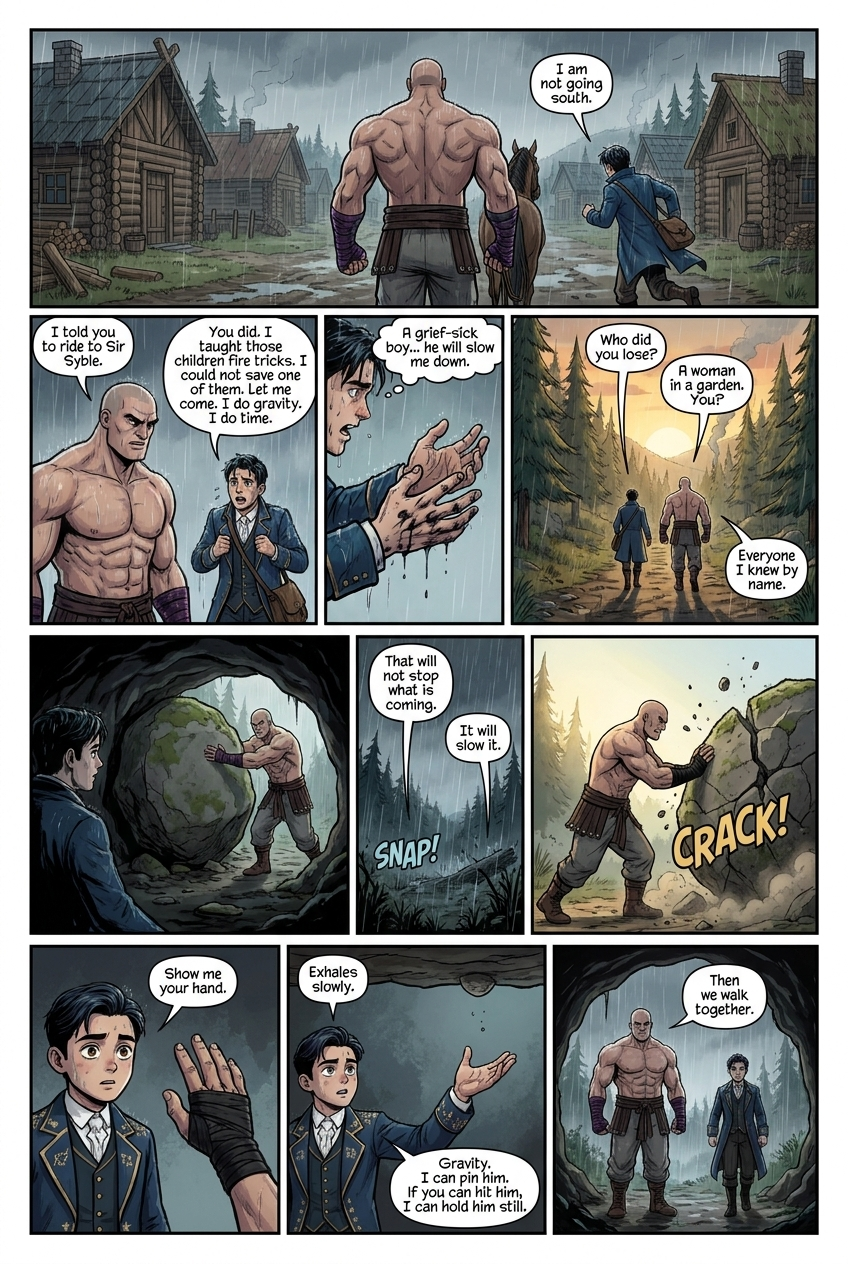
Creusus was three strides past the tavern door when he heard boots slap the mud behind him. He turned. Thane, the survivor mage from the Lorimar spire, stood in the lane with his blue coat half-buttoned and a satchel on one shoulder. His hair was still wet from where he had splashed his face. "I am not going south," Thane said. Creusus watched him. "I told you to ride to Sir Syble." "You did." Thane's mouth worked. "I taught those children fire tricks. I could not save one of them. If I ride south I will spend the rest of my life hearing them ask why." He held up his hands. Thin, ink-stained, shaking. "I do gravity. I do time. Let me come." Creusus did not want him. A grief-sick boy in a coat with gold thread would slow him down and die on the road. He said none of that. He turned and walked. Thane followed. They climbed out of the log-built town before full dark. Pine smoke thinned. The road narrowed into a game trail. Neither spoke for an hour. Creusus led the horse. Thane walked behind, breath loud on the grade. "Who did you lose?" Thane asked once. "A woman in a garden," Creusus said. He did not look back. "You?" "Everyone I knew by name." They did not speak again until the rain started. Creusus found a cave mouth in a rock face above the trail. Low, dry, smelling of fox. He walked the horse in and set his pack against the wall. Outside, the rain came harder. Then he heard a branch snap that was not a branch. Something heavy moved in the trees below. He stepped out. A boulder sat in the scree twenty paces off, chest-high, mossed on one side. Creusus set his shoulder to it and rolled it up the slope. He fit it against the cave mouth. Light died. The horse shifted. "That will not stop what is coming," Thane said in the dark. "It will slow it." In the morning Creusus put his palm on the stone and pushed. The stone did not move. He unwrapped one hand. The black cloth beneath his knuckles warmed. He set that hand flat on the boulder and drove his weight through it. The stone cracked from the point of contact outward in a white web and fell apart in three pieces. Thane stared. "Show me your hand." Creusus showed him. Thane exhaled slow. He raised his own hand and turned it palm up. A pebble on the cave floor lifted, hung, then pressed into the ceiling and stuck there. He lowered his hand. The pebble stayed. "Gravity," Thane said. "I can pin him. If you can hit him, I can hold him still." Creusus looked at the shattered stone at his feet. Then at the boy who had refused to go south. "Then we walk together," he said.
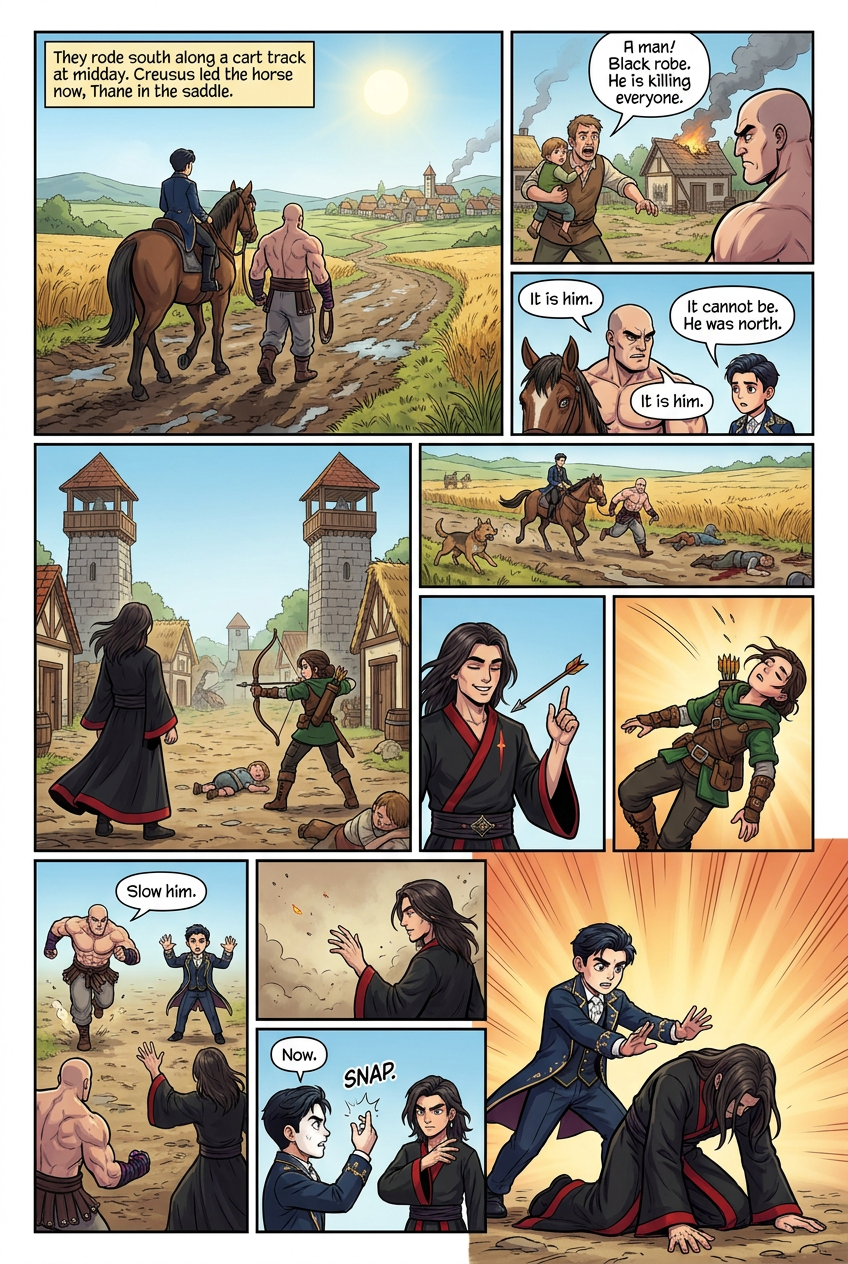
They rode south along a cart track at midday. Creusus led the horse now, Thane in the saddle, his coat still damp from last night's rain. The sun had burned off the mist. Fields opened on both sides. A small farming village sat in the shallow valley ahead, thatched roofs and stone watchtowers, hay stacked in tight rounds. Then the screaming started. A farmer ran up the track toward them, boots slapping mud, a child under one arm. Behind him more people came, dropping baskets, dropping tools. A woman fell and did not get up. Smoke lifted from one of the thatched roofs. "A man," the farmer gasped as he passed. "Black robe. He is killing everyone." Creusus dropped the reins. Thane slid down from the horse. "It is him," Creusus said. "It cannot be. He was north." "It is him." Creusus ran. Thane swore and ran after him. They cut across a hay field and came into the village square between two watchtowers. Bodies lay in the dirt. A dog stood barking at nothing. At the center of the square, in a black robe with a red hem, stood the demon in Malachai's body. His long hair moved though there was no wind. A silver earring caught the sun. A woman in a green hood stood between him and a fallen child. She had a short bow drawn. Creusus knew her face from nowhere and from everywhere: a huntress, a widow by the black band on her sleeve. She loosed her arrow. It stopped a hand's breadth from Diablo's chest and dropped. Diablo smiled and lifted one finger. The huntress's head snapped sideways. She fell. Creusus did not stop running. "Slow him," he said. Thane raised both hands. The air around Diablo thickened. Dust hung. A falling ember froze in place. Diablo turned his head through the drag like a man walking through shallow water. He looked at Thane and shrugged the spell off his shoulders. It broke apart like wet paper. Creusus was ten paces out. Diablo raised his hand toward him. "Now," Creusus said. Thane's face went white with effort. He snapped his fingers. The sound cracked across the square, high and sharp, and everything stopped. The dog stopped barking. The smoke hung in a still column. Diablo froze mid-gesture. Then Thane pushed his palms down and gravity slammed onto Diablo alone. The demon's knees buckled. His robe pressed flat to the ground. His head bowed.
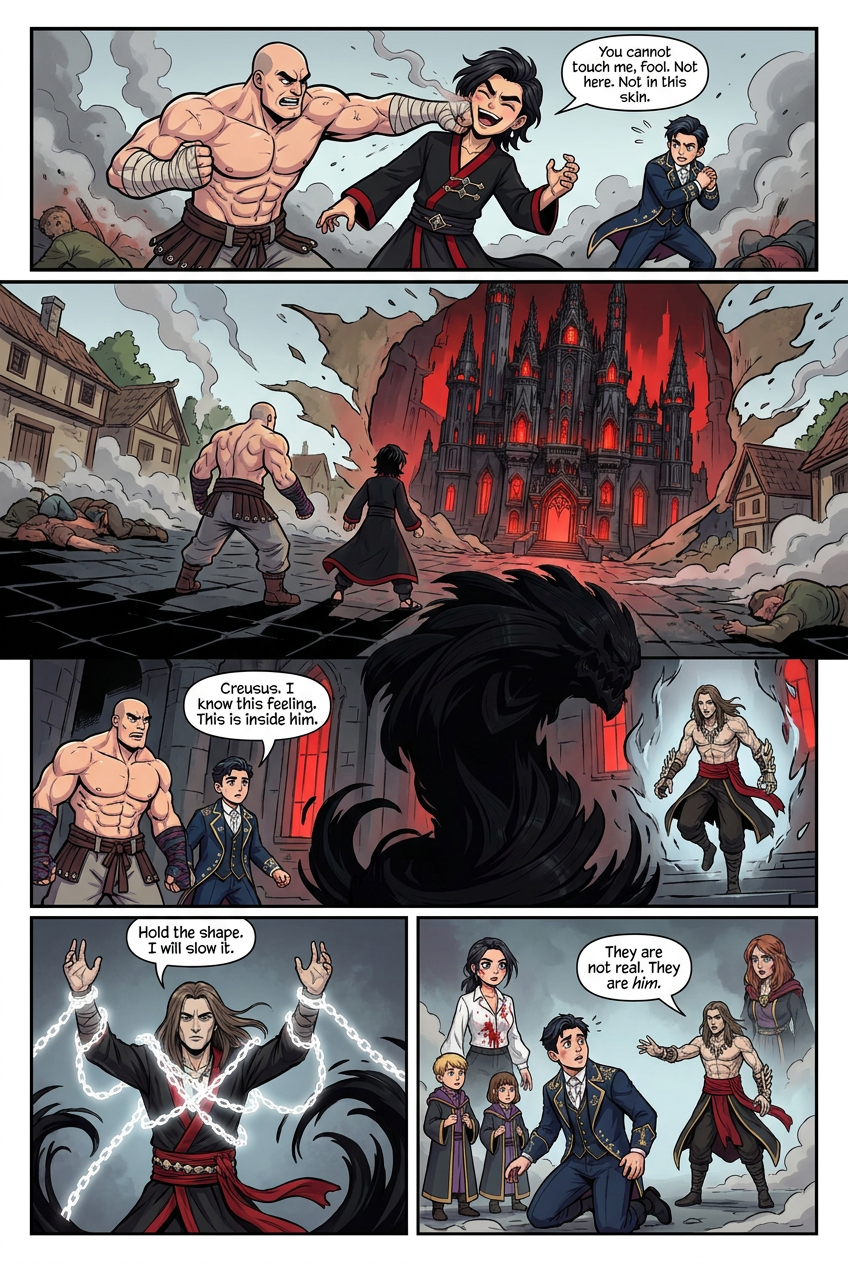
Diablo knelt in the dirt, pinned by Thane's gravity. Creusus reached him at a full run and drove his fist into the demon's temple. The blow should have crushed bone. His knuckles passed through the head like a hand through smoke. He stumbled forward. Diablo laughed under the weight. "You cannot touch me, fool," Diablo said. "Not here. Not in this skin." Creusus struck again. Ribs. Jaw. The black wrappings on his hands hummed and gave him nothing back. Every punch found no purchase. Thane's face was gray with strain. The gravity was the only thing still holding. Then Diablo's eyes changed. Something behind them snapped. He stopped laughing. "Enough," he whispered. "I will give you a nightmare you cannot wake from." The village folded away. The bodies, the smoke, the watchtowers, all of it peeled off like wet paint. Creusus and Thane stood on black stone. Red light bled from tall windows above them. Spires rose on every side, carved with grim faces. A temple. Not a place. A mouth. At the far end of the hall, something rose out of the floor. A shape made of pure absence. It had the silhouette of a beast, a wide skull, a jaw hinged too far open. It was the size of a house. It began to slide toward them without feet. "Creusus," Thane said. His voice cracked. "I know this feeling. This is inside him." A seam split the air behind the void beast. A man stepped through it. Long hair, bone-colored gauntlets, a red sash. He was the twin of the body Diablo wore, but paler, sharper, alive in the eyes. Malachai. The real one. Pulled out of the corner of his own stolen mind by the tear in Diablo's control. "Hold the shape," Malachai said, flat as a stone. "I will slow it." He raised his hands. Chains of white light wrapped the void beast's throat. It thrashed. The temple shook. Then the nightmare found Creusus and Thane too. A woman walked out of the pillars, blood down her white shirt, smiling the way she had smiled in a garden. Kallista. Behind her, forty villagers with their throats open. Beside her, a middle-aged woman with black hair and red stains at her collar, Deborah, reaching for Malachai. Thane fell to one knee. Children in mage robes stepped from the dark toward him. Their small hands were empty. Their eyes asked why. "They are not real," Malachai called. "They are him."
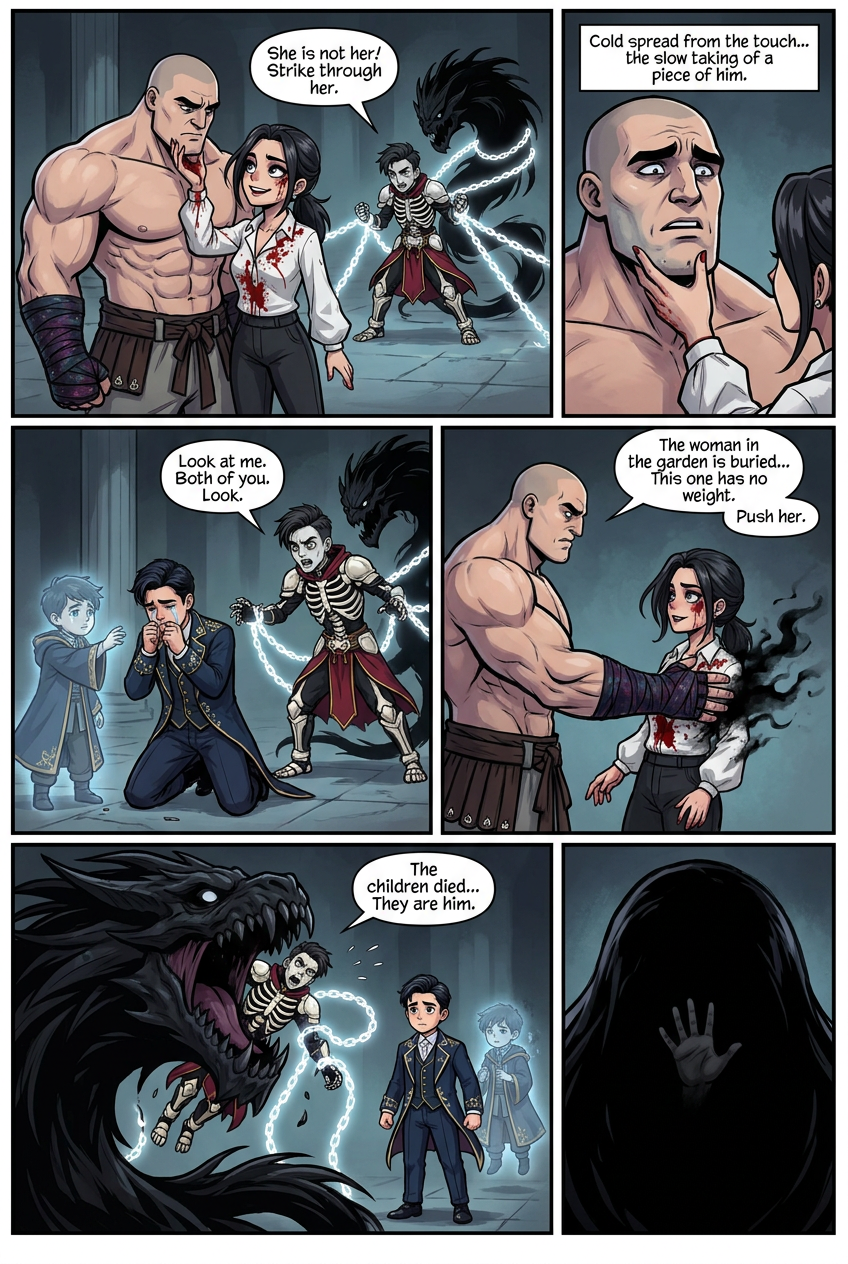
Kallista walked closer. Her smile did not change. Blood soaked her white shirt in the same pattern Creusus had seen the morning he buried her. She reached for his face. He lowered his fists. His arms would not lift against her. "She is not her," Malachai called from across the hall. The chains of white light strained in his grip. The void beast twisted against them. "Strike through her." Creusus could not. His hand hung at his side. Kallista's fingers brushed his jaw. Cold spread from the touch down into his chest. He felt the pull he had felt in the dark hall long ago, the slow taking of a piece of him. Thane was on both knees now. A small boy in mage robes stood in front of him with an empty hand out. Thane was weeping. His gravity was gone. The temple floor groaned as the void beast dragged Malachai a step forward. "Look at me," Malachai said. Not to the beast. To them. "Both of you. Look." Creusus turned his head. Malachai stood pale in his skeletal armor, chains burning his palms. He met Creusus's eyes. "The woman in the garden is buried under a fig tree," Malachai said. "You put her there. This one has no weight. Push her." Creusus pushed. His palm went through Kallista's chest like it went through Diablo. She smiled the same smile and thinned into smoke. The cold left him. "The children died in the spire," Malachai said to Thane. "You did not hold their hands then. You cannot hold them now. They are him." Thane raised his head. He lifted one shaking hand. The boy in front of him lost his shape and folded into the floor. The other children came apart behind him. Thane stood. The void beast lunged. Malachai's chains snapped taut and held. Then the beast opened its jaw wider than a jaw could open and closed it around him. It did not bite. It swallowed. Malachai went in whole. The chains hung a moment in empty air and fell. Inside the beast's black hide, a hand pressed outward. The shape of a face rose against the surface, mouth open. It sank back. It rose again at the shoulder, at the ribs, at the throat. Each time the void folded it back in.
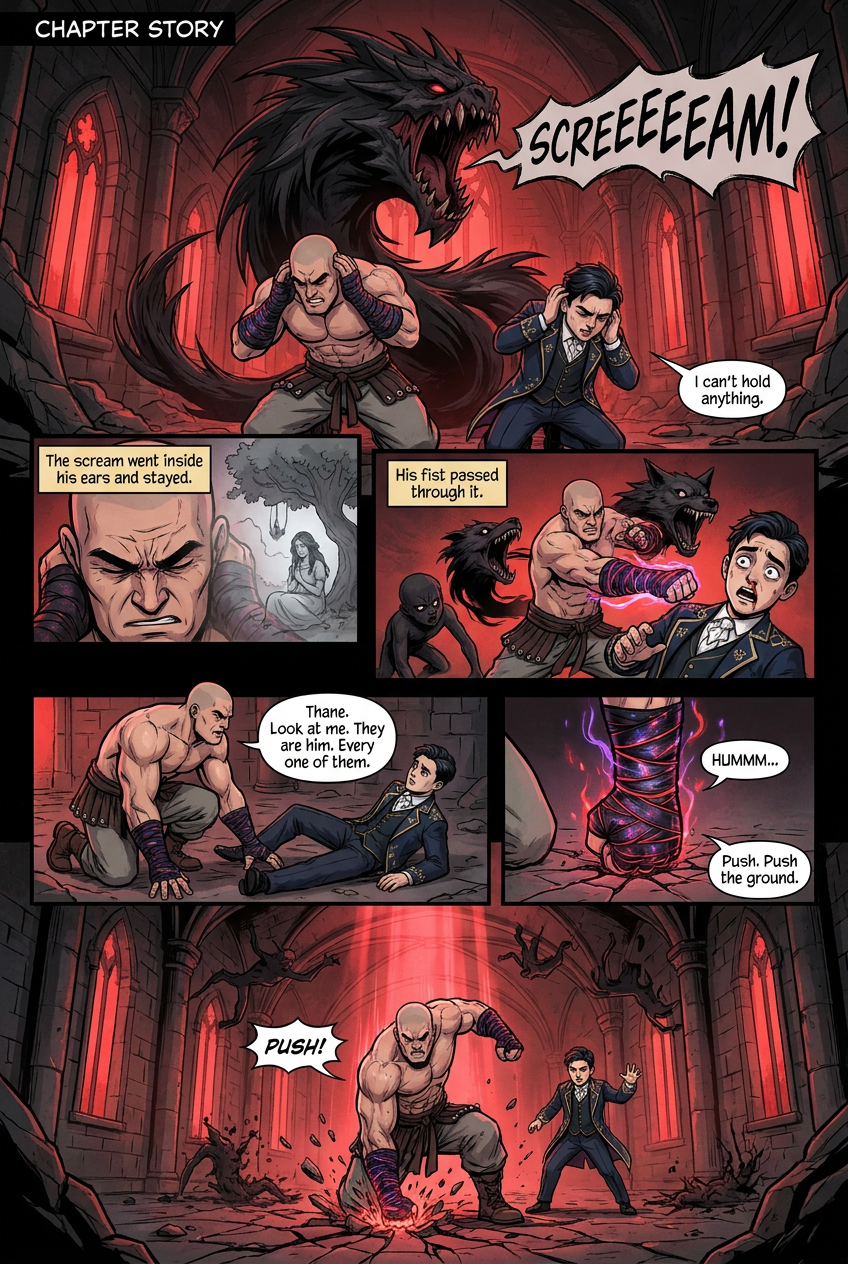
The chains lay dead on the floor where Malachai had stood. The void beast shuddered and grew. Its hide split along the spine and a mouth opened along the length of it. The mouth screamed. The sound was a woman's cry torn raw and held there. Creusus dropped to one knee. The scream went inside his ears and stayed. He saw Kallista under the fig tree. He saw the dirt on her hands. The temple walls of black stone bled at the seams. Red light ran down the columns like water. Thane fell beside him with his hands on his ears. Blood came from his nose. "I can't," Thane said. "I can't hold anything." Smaller shapes broke off the beast's back. They dropped to the floor on wet legs. One had Kallista's face and a wolf's jaw. One was a child with no eyes, walking on hands. One was a shape that was only teeth. They came fast. Creusus swung at the wolf-jawed thing. His fist passed through it. It bit his shoulder and cold ran down his arm to the bone. He staggered. Another one hit his back and he went to the floor. The teeth-shape crawled onto Thane's chest and Thane screamed a mage's boy scream. Creusus could not get up. His hands were shaking. The black wrappings on his knuckles felt like dead skin. He thought, I am going to die here. He thought, this is what he did to the squire. He thought of Kallista and his arms would not move. "Thane," he said. His voice cracked. "Thane. Look at me." Thane turned his head. His eyes were wide and gone. "They are him," Creusus said. It was what Malachai had told them. He said it again. "They are him. Every one of them." Thane's mouth moved. No sound. Creusus pushed his palm flat against the floor. The stone was warm and rotten. He remembered the hum from the black armor a long time ago. He hummed. It came out broken. He hummed louder. The wrappings on his knuckles woke. He drove his fist down into the stone. The floor cracked. The temple lurched. The wolf-thing on his back thinned and pulled apart. The teeth-shape on Thane's chest snapped like a dry stick. "Push," Creusus said. "Push the ground." Thane put one hand up. His fingers shook. The air above them bent. The smaller shapes were dragged toward the ceiling and pinned there against the red-lit vault. They writhed. The scream from the beast's long mouth cut short.
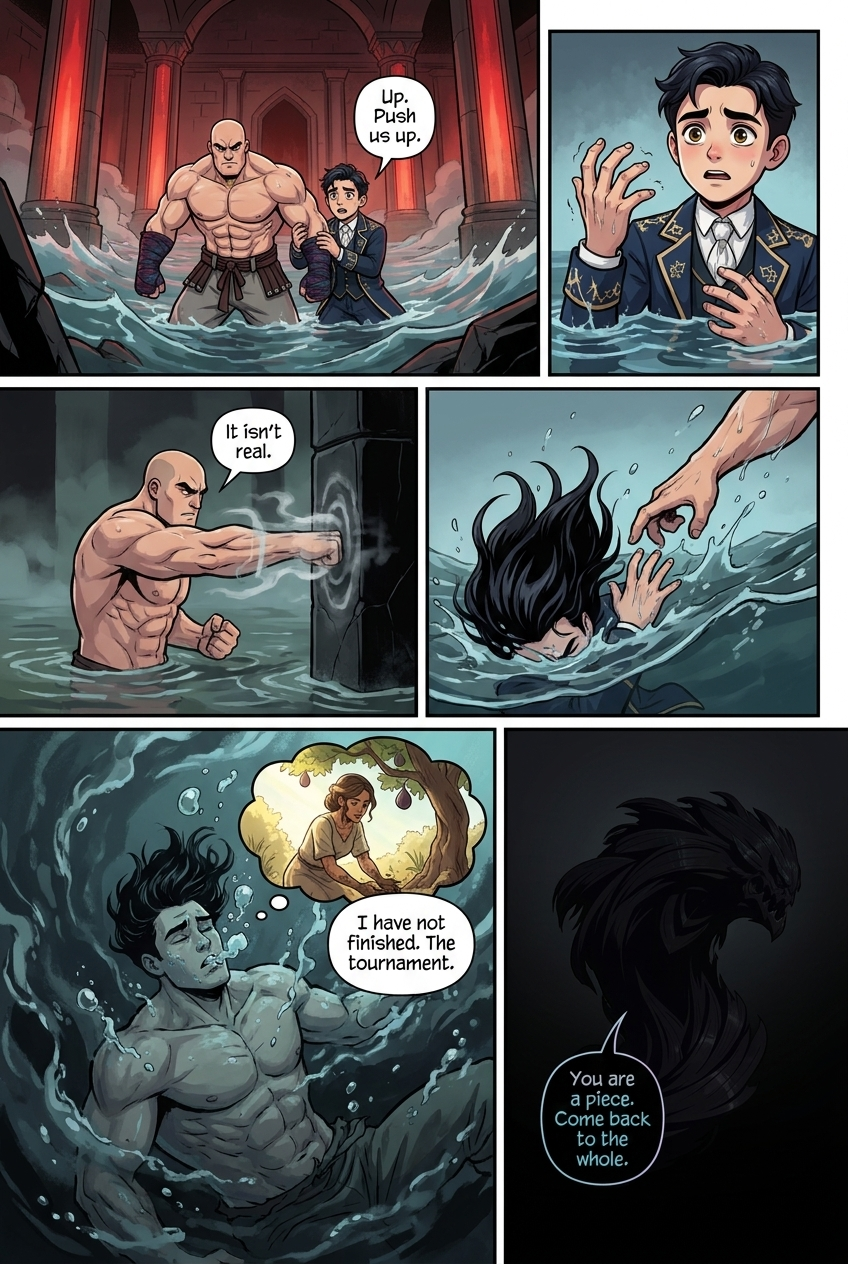
The pinned shapes above them thinned to smoke. The red light in the columns dimmed. For a breath Creusus thought they had won it. Then the floor tilted and the temple folded inward like wet paper. Water came. It came from the seams in the black stone and from the mouths of the pinned things. It rose past Creusus's knees before he could stand. Thane grabbed his arm. The water was warm and it smelled like the pond bridge north of the logging town, like weeds and old rain. "Up," Thane said. "Push us up." Thane raised one hand. The air above them refused him. His fingers shook and closed on nothing. The water hit Creusus's chest. Creusus hummed. The wrappings on his knuckles were cold. He drove a fist into the nearest column. His hand went through the stone like it was cloth. There was nothing behind it to hit. The column stayed. The water climbed. "It isn't real," Creusus said. His mouth filled. He spat it out. "Thane. It isn't real. Don't breathe it." But he breathed it. He could not help breathing it. Thane went under first. His dark hair spread on the surface and then that was gone too. Creusus reached for him and his hand closed on water. He kicked. His legs were heavy. He thought of Kallista under the fig tree and the dirt on her hands. He thought, I have not finished. He thought, the tournament. The post. The bandages. His chest burned. He opened his mouth to say a name and the water took him. Then there was no water. There was no floor. There was no up. Creusus had no arms to lift. He tried to hum and had no throat. The dark around him was not the dark of the temple. It was thicker. It pressed. It pressed on a shape of him that was not his body but remembered being his body. Somewhere in the pressing he could feel Thane, a small warm point that was also being pressed. A voice moved through the dark. It was his own voice, and it was Diablo's. You are a piece. Come back to the whole. Creusus had answered this before. He remembered answering. He could not find the words now. The pressing grew. The warm point that was Thane grew smaller. Creusus felt himself thinning at the edges, like ink in water. The dark took the rest of him.
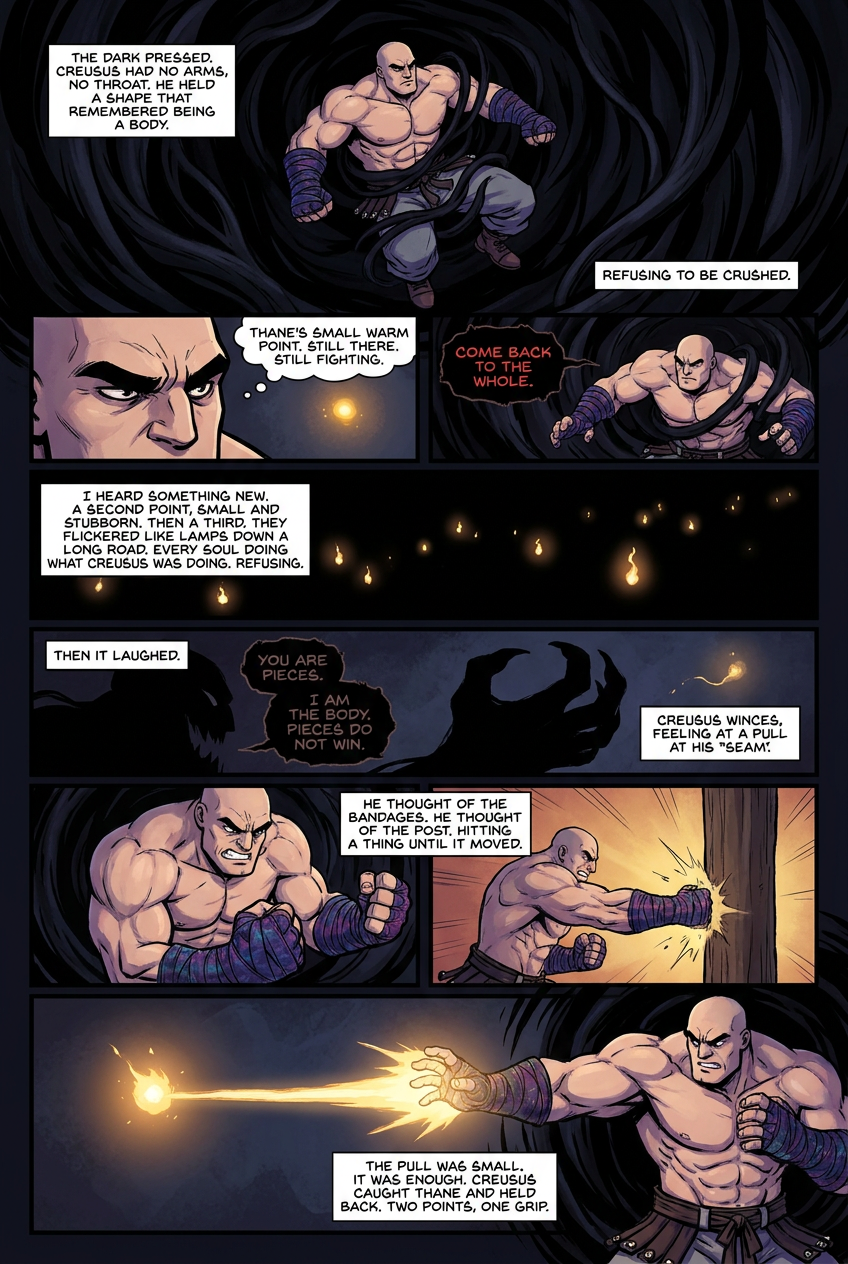
The dark pressed. Creusus had no arms, no throat, no post to hit. He held a shape that remembered being a body and would not give it up. Somewhere far off in the pressing he felt Thane's small warm point, still there, still fighting to stay itself. Creusus reached toward it without hands. He pushed back against the dark the way he pushed against a heavy bar. Not lifting. Refusing to be crushed. The voice came again, closer now. His voice. Diablo's voice. One voice worn thin over two mouths. Come back to the whole. Creusus did not answer. He listened instead. Under the pressing he heard something new. A second point, small and stubborn. Then a third. Then more. They flickered on across the dark like lamps down a long road. Each one small. Each one holding. He understood without being told. Every scrap of the thing that called itself Diablo, every soul the demon had grown inside his orb and inside his temple, was doing what Creusus was doing. Refusing. Pulling itself back from the whole. They did not know each other. They did not need to. They only knew they did not want to be one thing. The pressing shuddered. Then it laughed. The laugh moved through the dark like a hand closing. You are pieces, the voice said. I am the body. Pieces do not win. The dark pulled tighter. One of the small lights guttered. Another. Creusus felt the pull find the seam of him and start to work it open. The stubborn points around him thinned. The demon was stronger than any one of them. Stronger, maybe, than all of them. Creusus set his shape against it anyway. He thought of the bandages. He thought of the post. He thought of hitting a thing until it moved. Thane's point flared. It reached toward him across the pressing, gravity's old habit, pulling like it had pulled stone. It found Creusus and held. The pull was small. It was enough. Creusus's edges stopped fraying. He caught Thane and held back. Two points, one grip.
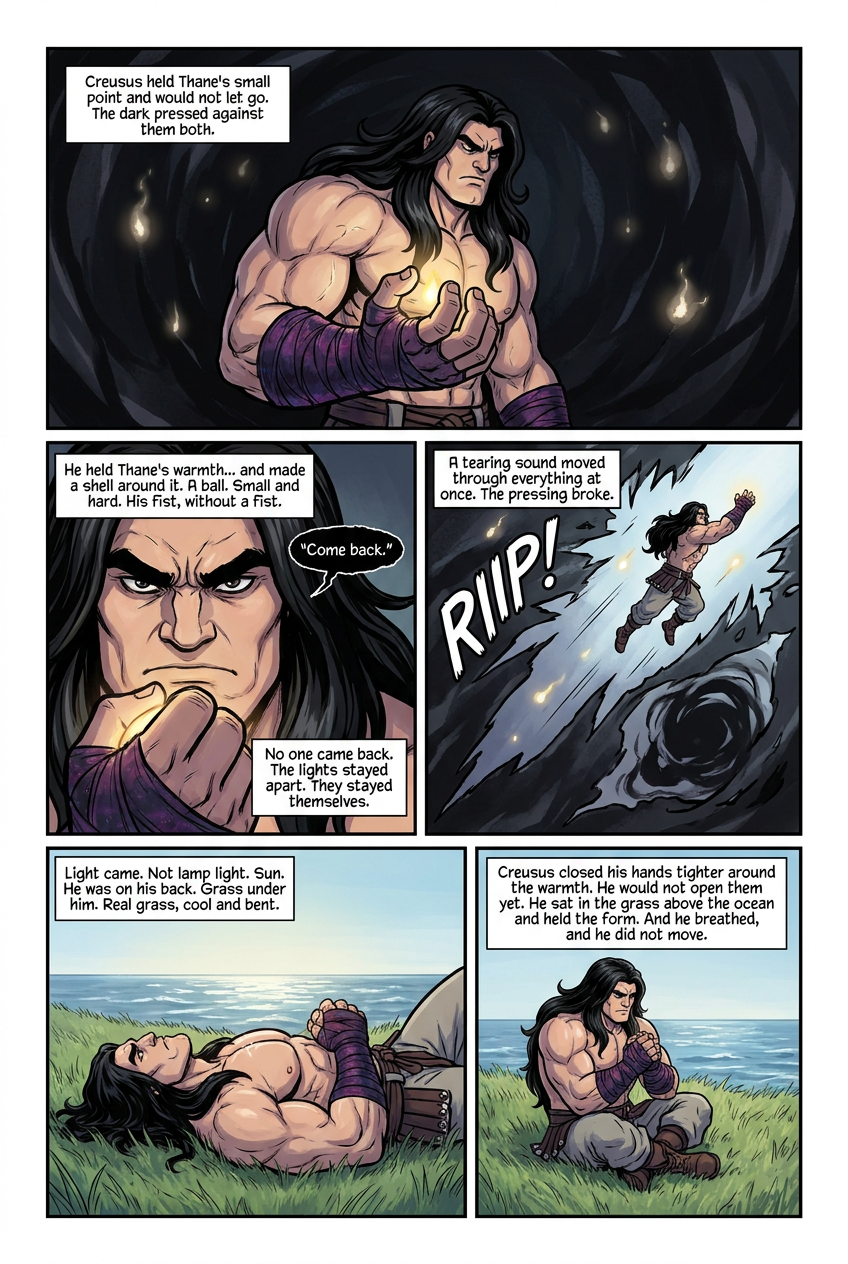
Creusus held Thane's small point and would not let go. The dark pressed against them both. Around them the other stubborn lights kept burning. He counted them without counting. One by one they steadied. One by one they stopped fraying. Then something shifted. A light near him found another light. They did not merge. They simply knew each other. Creusus felt it happen the way a hand knows another hand in the dark. The two points held, and a third joined them. Then a fourth. The fragments were finding themselves. Each one remembered its own shape and named itself against the pressing. Creusus felt his own edges firm. He knew which part was him. He knew which part was Thane. He held Thane's warmth in the place where his chest would be and made a shell around it. A ball. Small and hard. His fist, without a fist. The voice tried again. Come back. No one came back. The lights stayed apart. They stayed themselves. The pressing broke. It did not break like stone. It broke like a held breath let go. The dark thinned. A tearing sound moved through everything at once. Creusus felt the whole shape of the thing that had held them split along a thousand seams. Each seam was a soul stepping out. Each soul was a piece the demon had grown and kept and named its own. They were not his to keep. Creusus felt himself pulled through the tear. Not toward the whole. Away from it. He kept the shell tight around Thane's warmth. He did not look at what he was leaving. He felt the dark condense behind him into a single shapeless absence, gathered small and hungry and alone. Then even that was gone from him. Light came. Not lamp light. Sun. He was on his back. Grass under him. Real grass, cool and bent. He opened his eyes and the sky was above him, wide and pale blue. an ocean moved. He could hear it. He could smell the salt. Creusus closed his hands tighter around the warmth. He would not open them yet. He sat in the grass above the ocean and held the form. and he breathed, and he did not move.
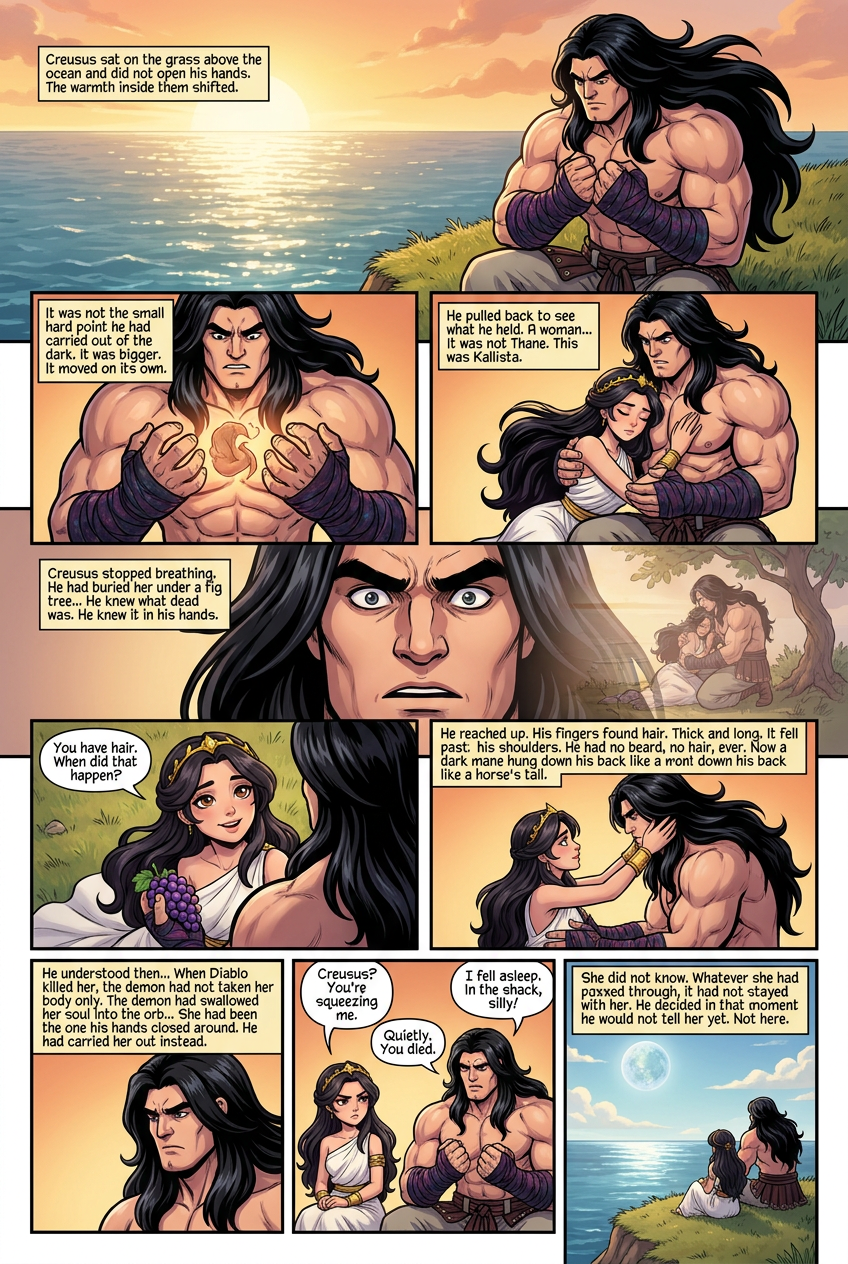
Creusus sat on the grass above the ocean and did not open his hands. The warmth inside them shifted. It was not the small hard point he had carried out of the dark. It was bigger. It moved on its own. He looked down and saw a shape curled against his chest, and his arms wrapped around it the way a man shields a child from rain. He pulled back to see what he held. A woman. Black hair spilled across his forearm in a long dark wave. Her cheek pressed to his bare chest. Her breath was warm and steady on his skin. She was not Thane. Thane was a man, thin and tall, a mage from the northern spire. This was not him. This was Kallista. Creusus stopped breathing. He had buried her under a fig tree. He had checked her pulse and closed her eyes. He knew what dead was. He knew it in his hands. She stirred. She looked up at him with brown eyes and smiled, sleepy, as if she had only just woken from a nap in the grove. "You have hair," she said. She lifted one hand and brushed his scalp. "When did that happen?" He reached up. His fingers found hair. Thick and long. It fell past his shoulders. He had shaved his head every week of his adult life. He had no beard, no hair, ever. Now a dark mane hung down his back like a horse's tail. He did not answer her. He could not. He understood then, all at once. When Diablo killed her, the demon had not taken her body only. The demon had swallowed her soul into the orb with the rest. She had been one of the small stubborn lights in the dark. She had been the one his hands closed around. He had thought it was Thane. He had carried her out instead. "Creusus?" Kallista said. She sat up a little. "You're squeezing me." He loosened his arms. His hands shook. He looked at them and saw the black wrappings still there, the knuckles dark and quiet. "You died," he said. She frowned. "I fell asleep. In the shack, silly!" She did not know. Whatever she had passed through, it had not stayed with her. He decided in that moment he would not tell her yet. Not here. Not on this shore with the salt in the air and her breath warm on his skin.
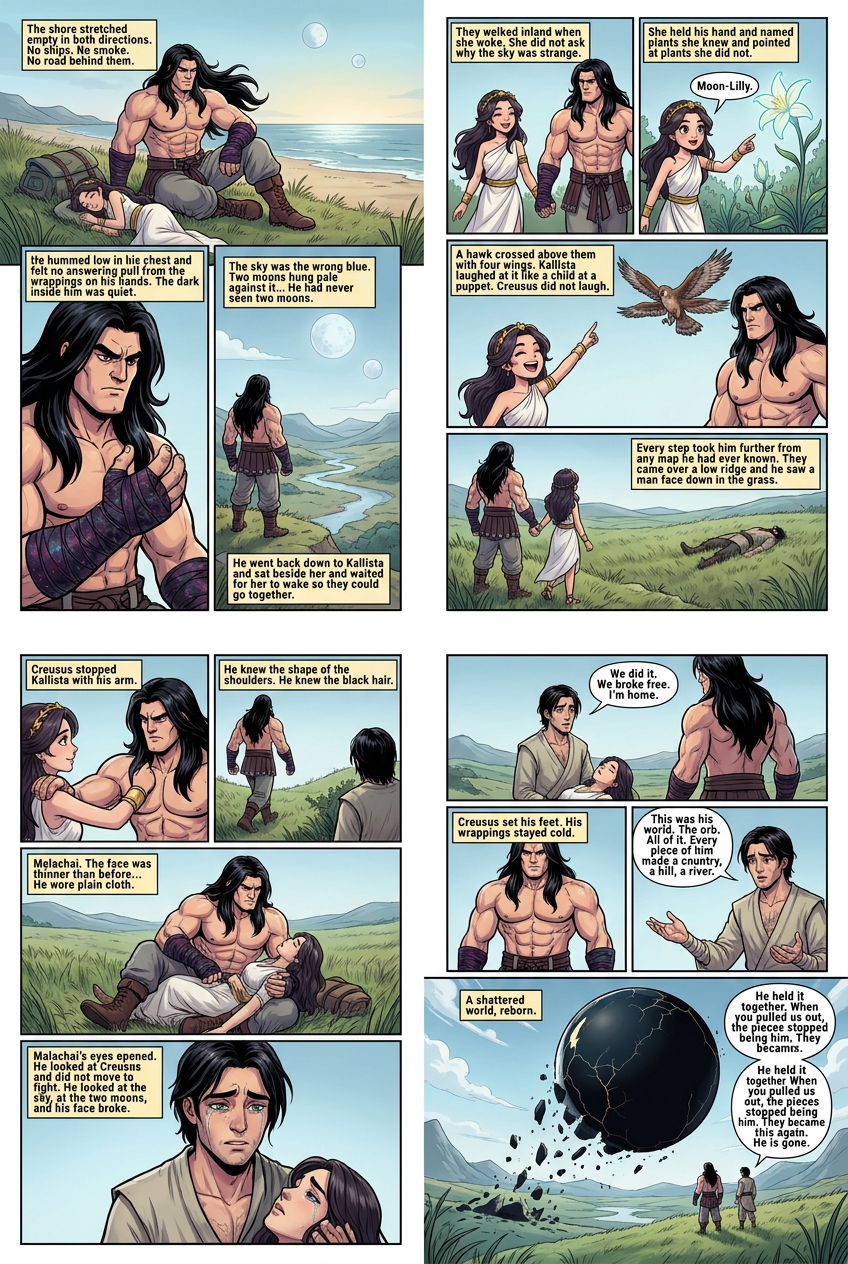
Kallista fell asleep again in the grass. Creusus laid her down on his folded pack and stood. He needed to know where they were. The shore stretched empty in both directions. No ships. No smoke. No road behind them. He hummed low in his chest and felt no answering pull from the wrappings on his hands. The dark inside him was quiet. That was new too. He walked the treeline first, then a rise of grass above it. From the top he saw hills, a river, and past that a valley with no village in it. The sky was the wrong blue. Two moons hung pale against it, one small and one smaller. He had never seen two moons. He went back down to Kallista and sat beside her and waited for her to wake so they could go together. They walked inland when she woke. She did not ask why the sky was strange. She held his hand and named plants she knew and pointed at plants she did not. A hawk crossed above them with four wings. Kallista laughed at it like a child at a puppet. Creusus did not laugh. Every step took him further from any map he had ever known. They came over a low ridge and he saw a man face down in the grass. Creusus stopped Kallista with his arm. He knew the shape of the shoulders. He knew the black hair. He walked closer and turned the man over with his foot. Malachai. The face was thinner than before. The skeletal armor was gone. He wore plain cloth. In his arms he held a woman with her head against his chest, unconscious, breathing. Deborah. Creusus had never met her, but he had seen her inside the nightmare, reaching, dying in Malachai's hands. Malachai's eyes opened. He looked at Creusus and did not move to fight. He looked at the sky, at the two moons, and his face broke. "We did it," he said. "We broke free. I'm home." Creusus set his feet. His wrappings stayed cold. "This was his world," Malachai said. "The orb. All of it. Every piece of him made a country, a hill, a river. He held it together. When you pulled us out, the pieces stopped being him. They became this again. He is gone."
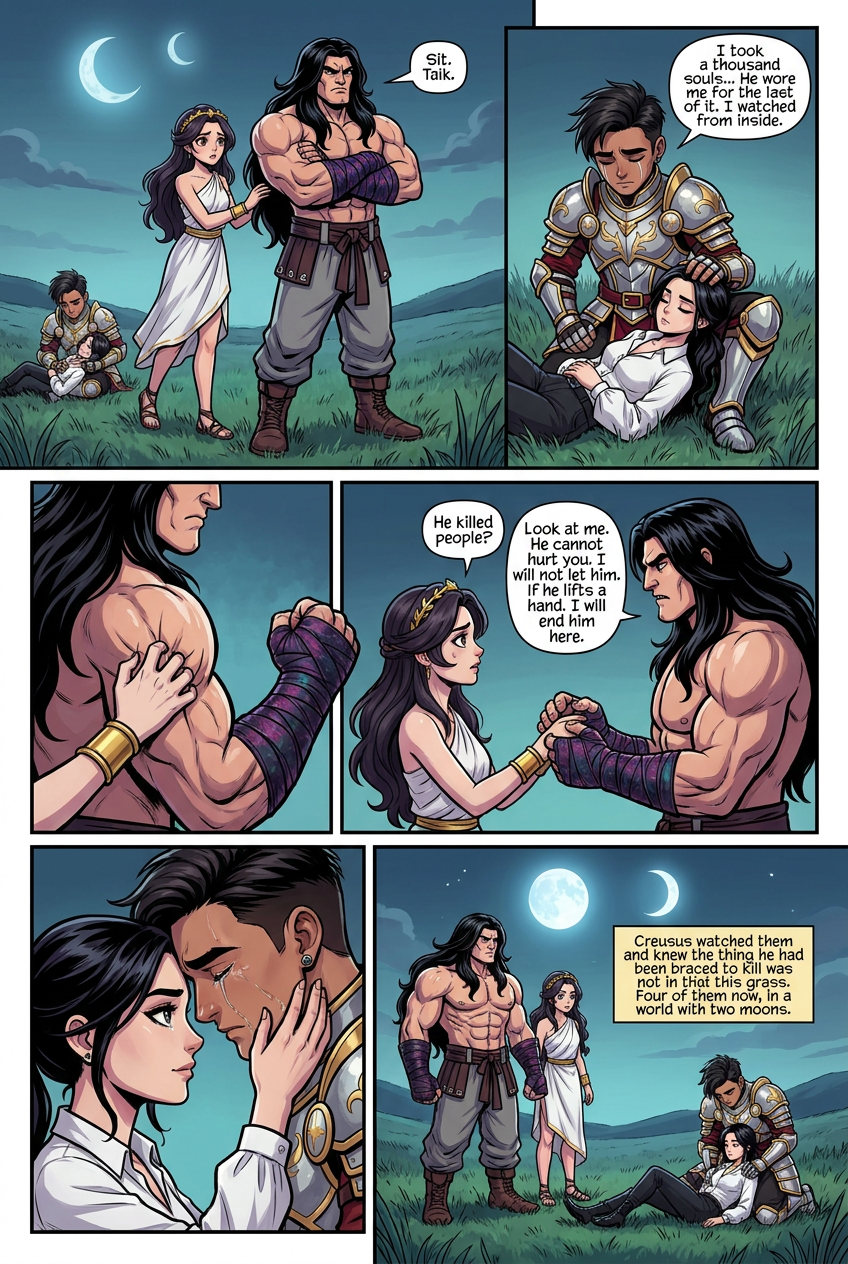
Creusus kept his feet set, but Malachai made no move to rise. The man only held the woman closer and waited. Kallista came up beside Creusus and touched his arm. She did not know this face. She did not know what he had done. Creusus loosened his shoulders and let her stand there. "Sit," Creusus said. "Talk." Malachai sat up in the grass. He laid Deborah's head on his folded knee and smoothed her hair once. His hand shook doing it. Creusus had never seen his hand shake before. "I took a thousand souls," Malachai said. "Not near a thousand. A thousand. I fed them to him one by one. A boy first. His father last on that count. Forty more in a temple. Villages after that. I found what a person wanted and I became it. Then I took them." Kallista's fingers tightened on Creusus's arm. Creusus did not look at her. He watched Malachai's face for the old smile and did not find it. "Why tell me," Creusus said. "Because i owed a debt, he gave me until my 35th birthday and I gave him 1000 souls" Malachai said. "He wore me for the last of it. I watched from inside. I strangled her with my own hands and I could not stop them." He looked down at Deborah. "And now," Creusus said. "Now he is gone," Malachai said. "Whatever he put in me went with him. The hunger. I woke here and I could not feel it. I have not felt it since." Creusus studied him. The wrappings on his knuckles stayed cold. If Diablo were still in this man, they would have warmed. They did not warm. Kallista spoke first. "He killed people?" She stepped back from him. Her face had gone pale. Creusus turned and took her hands. He kept his voice low. "Look at me," he said. She did. "He cannot hurt you. I will not let him. If he lifts a hand I will end him here." "You promise that." "I promise that." She breathed out. She did not smile, but she stayed. Deborah stirred in Malachai's arms. Her eyes opened on the wrong sky and did not flinch. She looked up at Malachai and touched his jaw with two fingers, calm, like a woman greeting a husband at a door. No fear. No memory of the hands that had killed her. Malachai bent and pressed his forehead to hers. He wept without sound. Creusus watched them and knew the thing he had been braced to kill was not in this grass. Four of them now, in a world with two moons. He let his fists open at his sides.
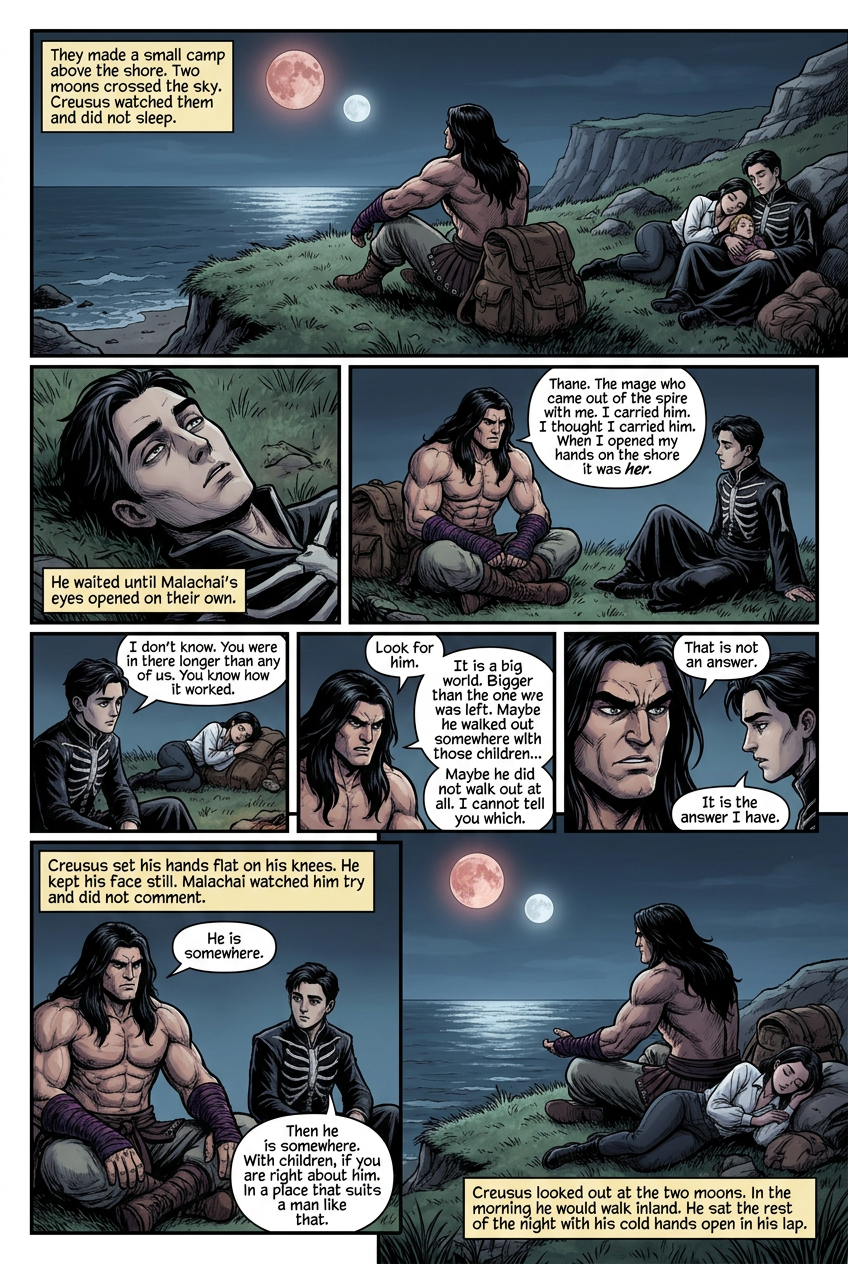
They made a small camp above the shore. Kallista slept curled against Creusus's pack. Deborah slept in the crook of Malachai's arm. Two moons crossed the sky at different speeds. Creusus watched them and did not sleep. He waited until Malachai's eyes opened on their own. Then he moved to sit across from him in the grass. "Thane," Creusus said. "The mage who came out of the spire with me. I carried him. I thought I carried him. When I opened my hands on the shore it was her." Malachai looked at Kallista's back. He said nothing. "I don't know," Malachai said. "You were in there longer than any of us. You know how it worked. "look for him," Malachai said. "It is a big world. Bigger than the one we left. Maybe he walked out somewhere with those children and does not know the way back to us. Maybe he did not walk out at all. I cannot tell you which." "That is not an answer." "It is the answer I have." Creusus set his hands flat on his knees. He kept his face still. Malachai watched him try and did not comment. "He is somewhere," Creusus said at last. It came out flatter than he meant. "Then he is somewhere," Malachai said. "With children, if you are right about him. In a place that suits a man like that. Creusus looked out at the two moons. In the morning he would walk inland. He pulled his pack closer to Kallista and sat the rest of the night with his cold hands open in his lap,
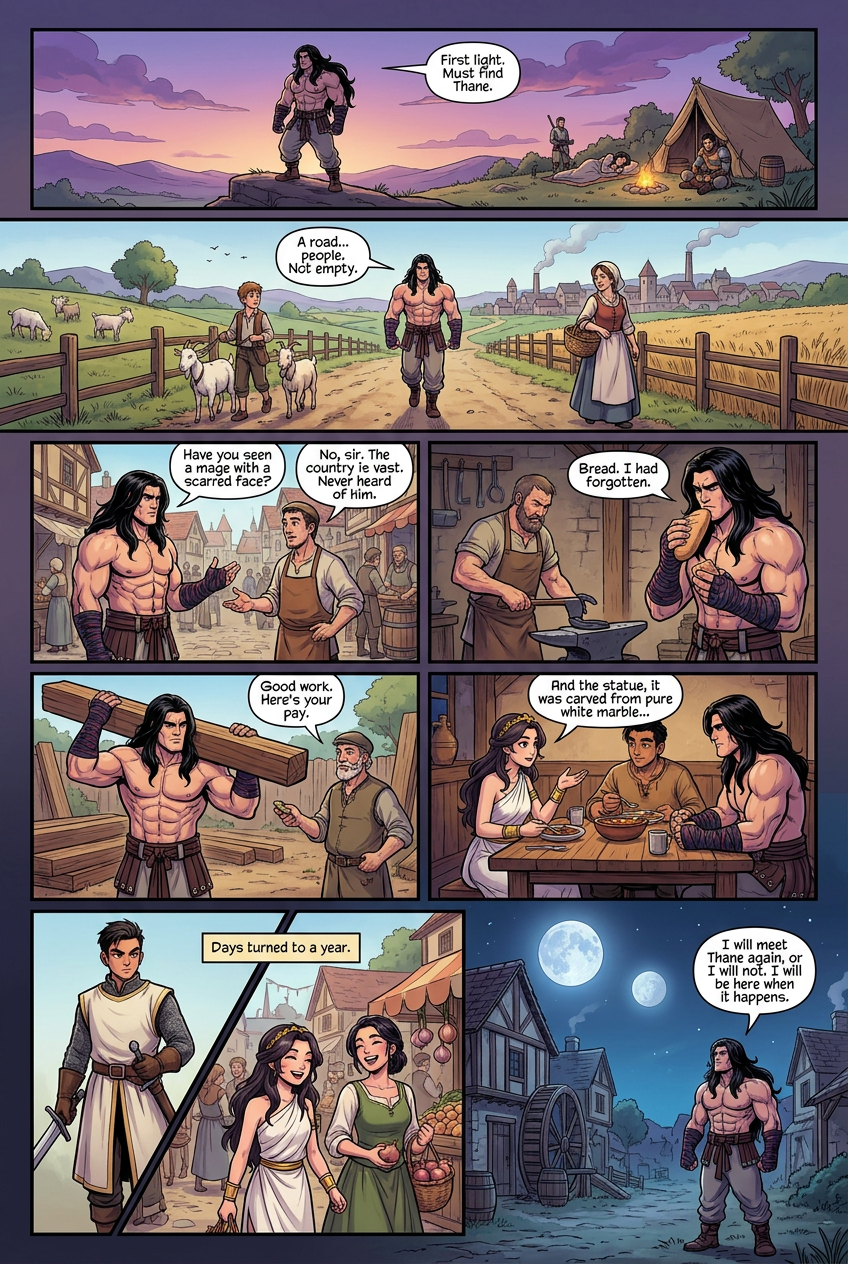
At first light Creusus walked inland to look for Thane. He left Kallista sleeping and told Malachai to keep watch. He crossed a low ridge and expected empty country. He found a road instead. The road ran between fenced fields. A boy drove goats along it. A woman with a basket nodded at Creusus as she passed. Beyond the fields he saw smoke from chimneys and heard a bell ring the hour. This world had people in it. It had work and roofs and morning noise. He walked into the town and asked after a mage with a scarred face. No one knew the name. No one had seen a man come out of the hills alone. A cooper told him the country stretched for weeks in every direction, past rivers he had never heard of. Creusus stood in the square and understood he could search for a year and find nothing. He did not turn back yet. He watched a smith beat a horseshoe flat. He watched two children fight over a crust and then share it. He smelled bread. He had forgotten bread smelled like that. Somewhere Thane was alive or he was not. Creusus could not force the answer today. He took the first work offered. A yard master needed lumber moved from a cart to a stack behind a mill. Creusus unwrapped his hands and set them on the wood. He carried beams two at a time. The yard master watched, then stopped watching, then paid him at dusk in coin he did not recognize but that the innkeeper took. He brought Kallista and the others in before dark. Malachai took a room. Deborah helped Kallista wash the salt out of her hair. They ate stew at a low table and Kallista told a story about a statue she had seen once as a girl. Creusus listened. He did not speak of the shore or the orb or the man he had come inland to find. Days turned. He hauled lumber. Malachai went to the capital and came back in the plain surcoat of an imperial knight, sworn to a lord Creusus would never meet. Deborah and Kallista walked to the market together and came back laughing about the price of onions. A year passed. Creusus stopped asking travelers about a scarred mage. He kept the question, but he stopped asking. One evening he stood outside the mill and looked at the two moons rising at their different speeds. He decided he would meet Thane again or he would not, and either way he would be here when it happened.
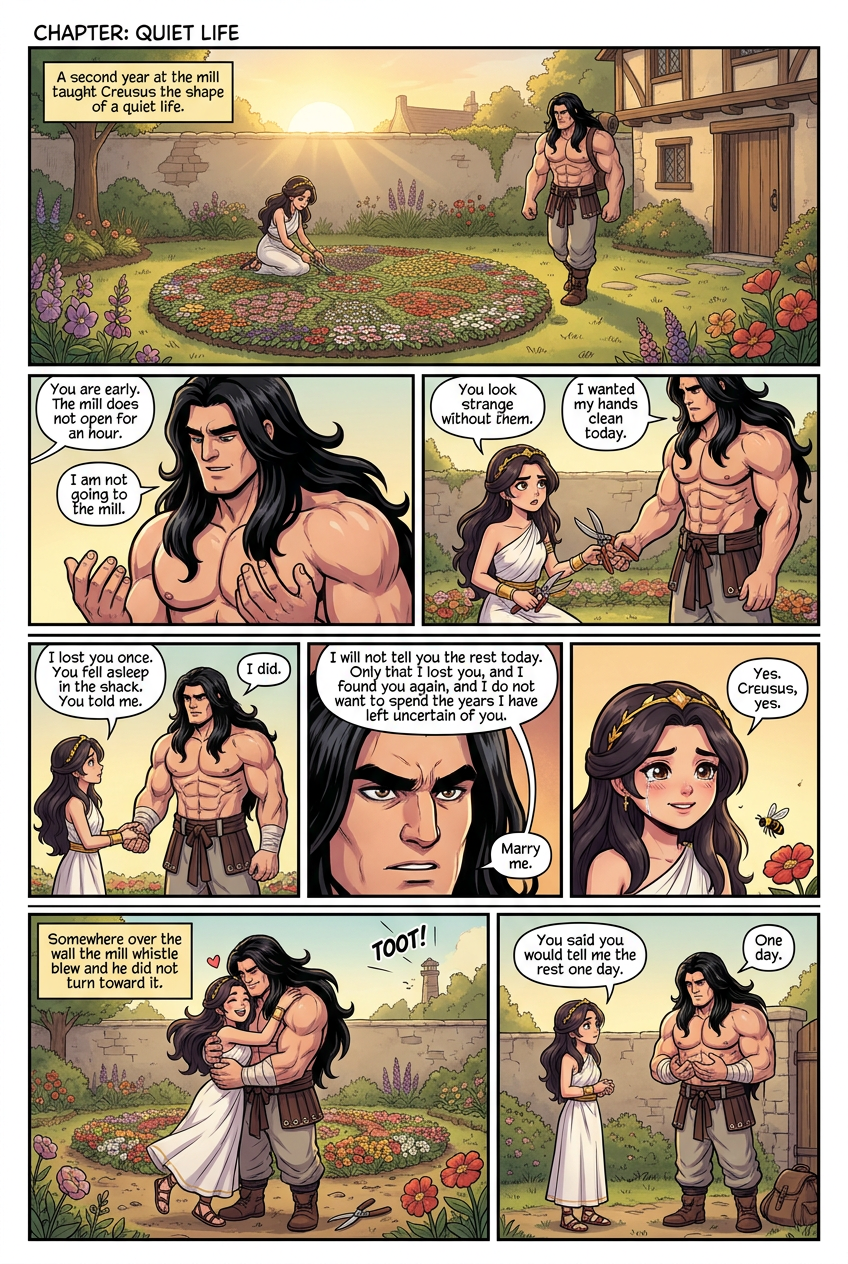
A second year at the mill taught Creusus the shape of a quiet life. He knew the yard master's whistle and the price of bread. He knew which board of the porch creaked when Kallista stepped out at dawn. The tournament was a place he had walked away from. The demon was sealed in a world he had broken. He had nothing left to chase. He had time, and he meant to use it. He found her in the flower garden behind the innkeeper's wall. She stood inside the ring of blossoms she tended most mornings, petals layered in circles she had planned herself. Her white dress caught the low sun. She held a cut stem in one hand and a pair of shears in the other. "You are early," she said, without turning. "The mill does not open for an hour." "I am not going to the mill." She looked at him then. He had washed. He had trimmed the long hair the dark realm had left him. His knuckles were bare of the black wrappings for the first time in a year, tucked away in his pack at the door. "You look strange without them," she said. "I wanted my hands clean today." He stepped into the ring of flowers. He did not kneel. He was too heavy for that and she had never wanted show from him. He took the shears from her fingers and set them on the path. He took her hand. "I lost you once," he said. She frowned. "I fell asleep in the shack. You told me." "You did." He held her hand tighter. "I will not tell you the rest today. Only that I lost you, and I found you again, and I do not want to spend the years I have left uncertain of you." Her eyes did not leave his face. She was very still. "Marry me," he said. She breathed out. A bee moved between two red blossoms at her knee. "Yes," she said. "Creusus, yes." He pulled her against his chest. She laughed into his shirt. The shears lay in the dirt at their feet. Somewhere over the wall the mill whistle blew and he did not turn toward it. When she stepped back her face changed. She looked at his empty knuckles again, and past them, to the pack he had left by the gate. "You said you would tell me the rest one day," she said. "One day," he heard himself answer.
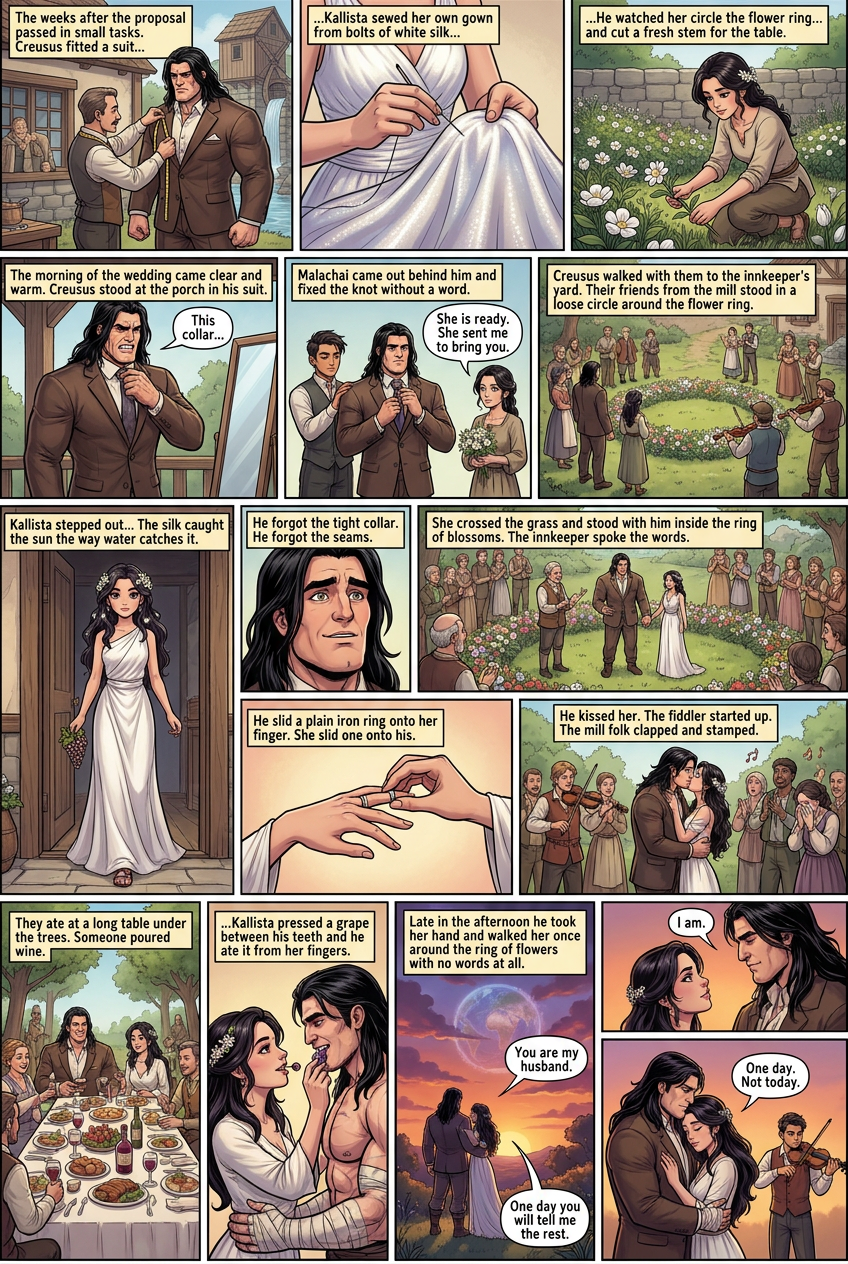
The weeks after the proposal passed in small tasks. Creusus fitted a suit at the tailor's shop on the corner by the mill. Kallista sewed her own gown from bolts of white silk she found at the market. She would not let him see it until the day. He worked his shifts. He came home. He watched her circle the flower ring behind the innkeeper's wall each morning and cut a fresh stem for the table. The morning of the wedding came clear and warm. Creusus stood at the porch in his suit. The tie sat tight against his throat. His shoulders strained the seams. He pulled the collar with one finger and let it go. Malachai came out behind him and fixed the knot without a word. Deborah followed with a small bunch of white blooms she had cut from the ring garden. "She is ready," Deborah said. "She sent me to bring you." Creusus walked with them to the innkeeper's yard. Their friends from the mill stood in a loose circle around the flower ring. The yard master had come. The baker had come. The women from the weave house had come with their husbands. A fiddler he did not know tuned a string against his knee. Kallista stepped out from the inn door. The gown fell straight from one shoulder. The silk caught the sun the way water catches it. She had woven small white flowers into her dark hair. She held a stem of grapes in one hand, the way she had held them the first day he met her in the gardens at Embermere. He forgot the tight collar. He forgot the seams. She crossed the grass and stood with him inside the ring of blossoms. The innkeeper spoke the words. Creusus said yes when he was meant to say yes. Kallista said yes. He slid a plain iron ring onto her finger. She slid one onto his. His knuckles were bare and pale under it. He kissed her. The fiddler started up. The mill folk clapped and stamped. Deborah cried against Malachai's sleeve and Malachai held her steady and did not weep this time. They ate at a long table under the trees. Someone poured wine. Someone made a speech no one could hear over the laughing. Kallista pressed a grape between his teeth and he ate it from her fingers. Late in the afternoon he took her hand and walked her once around the ring of flowers with no words at all. When the sun bent low she leaned into his shoulder. "You are my husband," she said, testing it. "I am." She looked up at his face. "One day you will tell me the rest." "One day," he said. "Not today." She nodded and closed her eyes against his neck. He held her there while the fiddler played on.
Play your story to life
Storycraft is a mobile game where you create AI characters, craft items and locations to build their world, then discover what direction your story takes. Download the iOS game for free today!
Download for free