

Dante Johnson's Arc
7 Chapters
Dante Johnson's dream is winning the heart of the one person who can finally coax him to share the sorrow he has never spoken aloud..

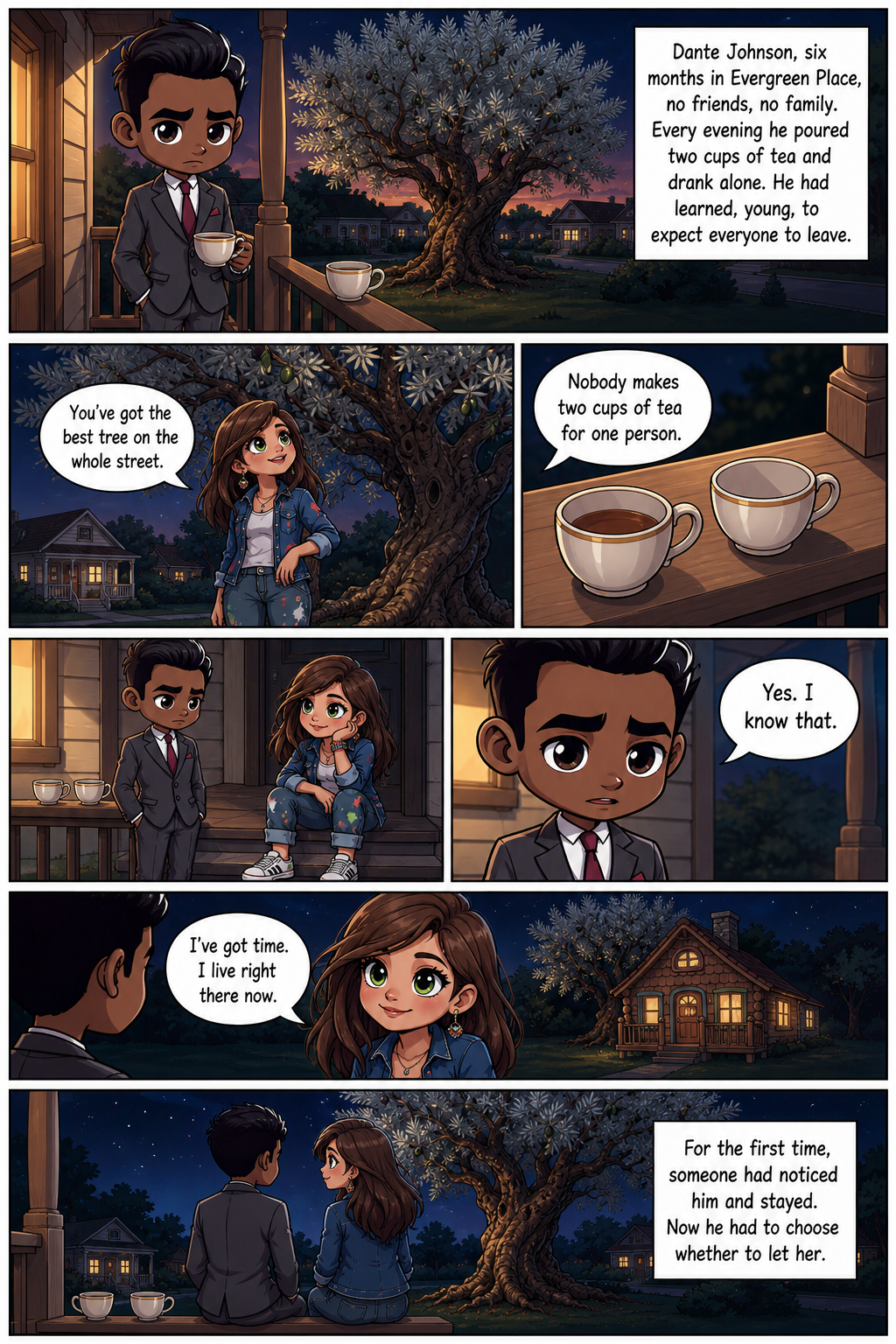
Dante Johnson had lived in Evergreen Place for six months, and he still knew no one's name. He liked it that way. Or he told himself he did. Every evening he sat on his porch with tea he never finished. He watched the light fade behind the old olive tree. His parents died when he was small. After that, one foster family gave him up, then another, then a dozen more. He had learned to expect people to leave. So he kept his door shut and his sorrow locked behind it. He wanted, more than anything, someone he could tell. He also feared no such person existed. A moving truck had rumbled in next door all afternoon. Boxes stacked on the cottage porch. Dante ignored it, as he ignored most things. Then a voice called across the yard. "You've got the best tree on the whole street." He looked up. A young woman stood beneath the olive's twisted branches. Paint stained her jeans in red and green. She tilted her head back and studied the silver leaves like she was already deciding how to paint them. "I'm Charity," she said. "I just moved in." She crossed the grass and stuck out her hand. Her smile came easy, the kind that dared you to frown near it. Dante stood but did not take her hand right away. "Dante," he said. "You always sit out here alone?" She asked it plainly, no cruelty in it. "I prefer it." "Liar." She grinned wider. "Nobody makes two cups of tea for one person." He looked down. A second cup sat on the rail beside his. He had poured it out of habit, the way he had for years, for no one. His throat tightened. He could not remember the last time someone had noticed a small thing about him. Charity picked up the extra cup before he could speak. She sat on his top step like she had done it a hundred times. "I came here to paint," she said. "The city was too loud. I wanted quiet. But quiet gets lonely fast. You must know that." Dante sat back down. Something in his chest loosened, a knot he had tied so long ago he had forgotten it was there. "Yes," he said. "I know that." It was the truest thing he had said aloud in months. She stayed until the sky went dark. She talked about her paintings, her old apartment, the truck driver who got lost twice. Dante mostly listened. But near the end, she asked him where his family lived. He went still. "I don't have any," he said. Then, quieter, "It's a long story." Charity did not flinch or fill the silence. She just looked at him with those steady green eyes. "I've got time," she said. "I live right there now." For the first time, Dante felt the danger of hope. Someone had come close enough to ask. Now he had to decide whether to answer.
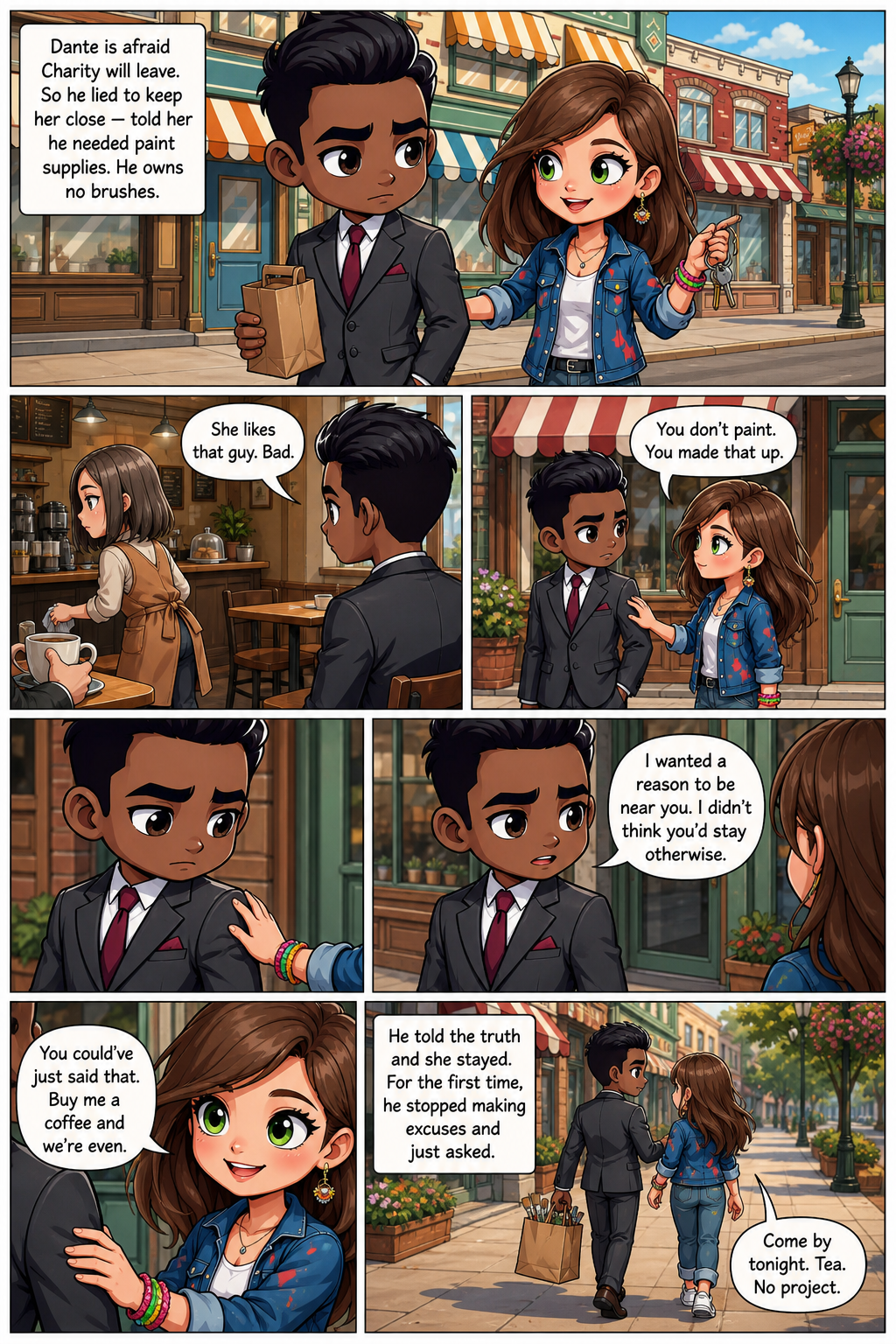
Charity had said she had time. Dante did not believe it would last. People opened a door, then found a reason to shut it. He needed something to keep her near without asking her to stay. So the next morning he knocked on her cottage door. "I'm going downtown," he said. "I need paint supplies, actually. For a project." It was a lie. He owned no brushes. But her face lit, and she grabbed her keys. They walked the row of shops together. Awnings striped the sidewalk in shade. Dante watched her hands as she talked. They moved fast, then went still when she pointed at a window. Steady. He let himself believe it. Inside the corner cafe, a woman in an apron pulled a shot before they reached the counter. Vivian. She handed a cup to a customer, then went blank and turned away without a word. Dante saw his own habit in her. The silence of someone who wanted to speak and could not. Charity saw it too. "She likes that guy," she whispered. "Bad." At the market next door, a red-haired man restocked shelves. Frank. He nodded at them, plain. "Family gave me this place," he said, unprompted. "Still figuring out what's mine." Dante bought tea he didn't need. Charity picked out an orange and bit it like a child. The shop at the end sold brushes and canvas. A blonde woman stood behind the counter. Ashlee. She lined up tubes of paint with care. "Tuesday tomorrow," she said to no one, half under her breath. Dante asked for brushes. She named them in short, flat words. When Charity asked her something private, Ashlee shut it down. "No." Nothing more. Outside, Charity stopped him with a hand on his arm. "You don't paint," she said. Not angry. Just sure. "You made that up." Dante's chest went tight. The old rule said to smooth it over, to charm his way clear. He looked down at her hand on his sleeve. It did not shake. It did not pull back. "Yes," he said. "I made it up. I wanted a reason to be near you. I didn't think you'd stay otherwise." He waited for her to step back. That was what people did. Charity laughed, soft. "You could've just said that." She squeezed his arm. "I'm not going anywhere, Dante. Buy me a coffee and we're even." The knot in him loosened again. He had told a small truth and she had not left. For the first time, he let a plan form he was not ashamed of. He would stop making excuses. He would simply ask. "Come by tonight," he said. "Tea. No project." "Two cups," she said, grinning. "I know." They walked back toward the neighborhood. Dante carried brushes he would never use, and for once he did not mind the weight.
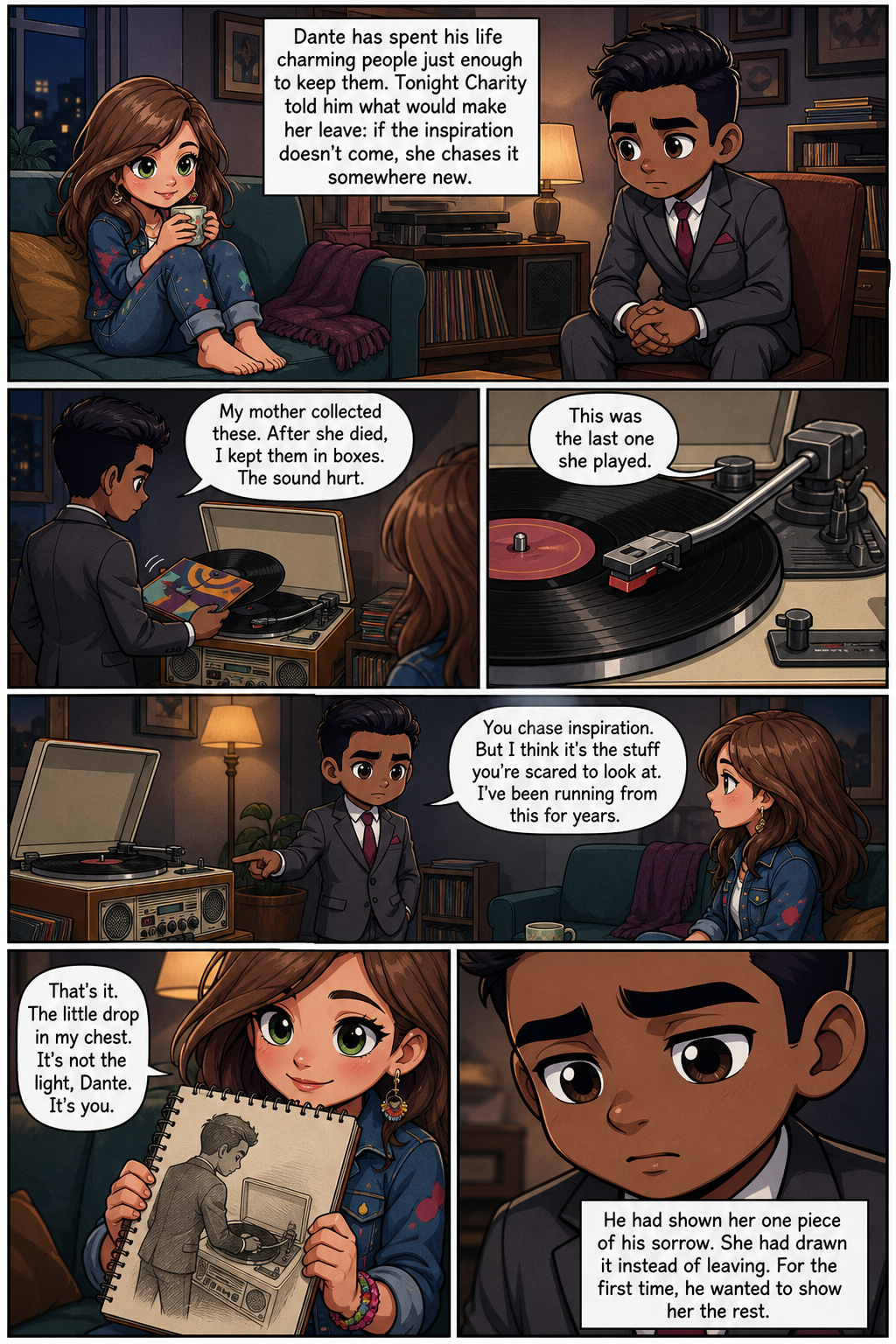
That night Charity came by with two cups already poured in her mind. She kicked off her shoes at Dante's door and curled into his couch like she lived there. He almost believed she might stay for good. Then she said the thing he feared. "I moved here for the light," she said. "The October light. Saw one photo and packed my car." She sipped her tea. "But I haven't painted anything yet. Nothing's clicked." Her sentences shrank. "If it doesn't click, I go. I chase it. That's how I work." Dante set his cup down. The old fear climbed up his throat. People opened a door, then found a reason to shut it. She had told him she wasn't going anywhere. Now she named the thing that would take her. He watched her hands. They were still around the cup, but her eyes moved to the window, to somewhere else. He could charm her. He could change the subject and keep her comfortable. Instead he stood and crossed the room to his record player. Vinyl stacked beside it in neat rows. He had not played them for anyone in six months. "My mother collected these," he said. He slid a record from its sleeve. His hand shook once, then steadied. "After she died, I kept them in boxes. Couldn't listen. The sound hurt." He set the needle down. A soft horn filled the room. "This was the last one she played." Charity put her cup down. She didn't speak. She just watched him, and for once he let her. "You chase inspiration," Dante said. "I get it. But I think it's not out there." He pointed at the spinning record. "It's the stuff you're scared to look at. I've been running from this for years." He met her eyes. "Maybe you don't need a new town. Maybe you need to stop running." The horn played low between them. Charity's face changed. Something cracked open. She reached into her bag and pulled out a small sketchpad. Her pencil moved fast, then stopped. She turned it around. She had drawn him. His hand on the needle. The curve of his shoulder as he leaned over the records. "That's it," she whispered. "That's the drop. The little drop in my chest." She looked up, stunned. "It's not the light, Dante. It's this. It's you." She set the sketchpad on his knee. "I'm not chasing anything anymore," she said. "I found it here." Dante looked at the drawing. She had seen him. Not the clothes, not the polish. The real thing. He had shown her one piece of his sorrow, and she had drawn it instead of leaving. For the first time, he wanted to show her the rest.
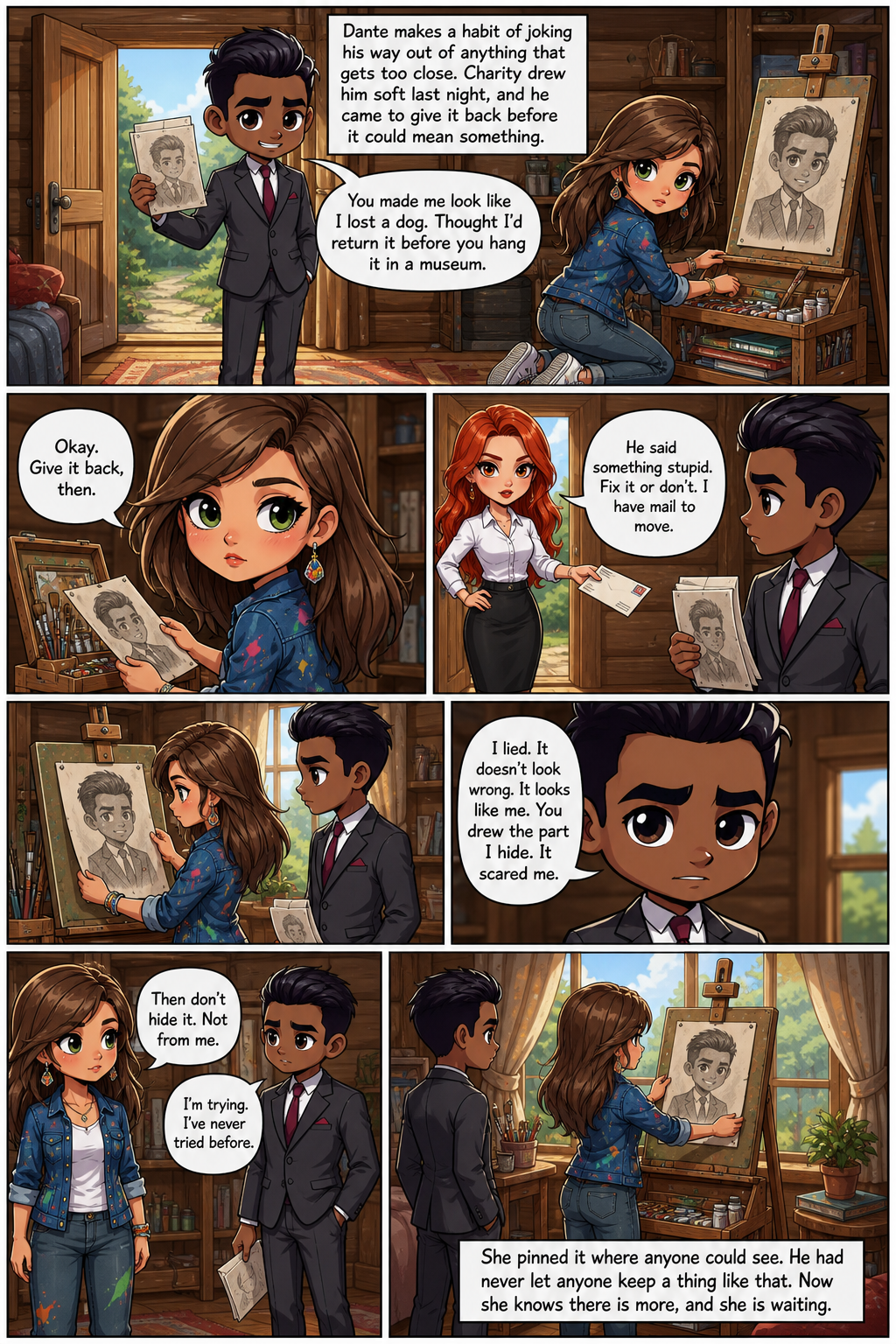
The sketch stayed on Dante's knee after the record stopped. Charity had gone home hours ago, but she left the page with him. She drew him soft. His mouth was open a little. His eyes looked like a man about to cry. He stared at it until the lines blurred. That was not him. That could not be him. By morning the old habit took over, and he decided to give it back and say something light. He crossed to her cottage. The door stood open. Inside, she knelt over a weathered crate packed with brushes, old paintings, and a folded easel. She was pinning the sketch of him to the easel like it mattered more than the rest. "Morning," he said. He held up his version, the copy he'd meant to mock. "You made me look like I lost a dog. Thought I'd return it before you hang it in a museum." He watched his own words land. He watched them hurt her. Her hands went still over the crate. She did not look up right away. When she did, her face had closed, like a window pulled shut. "Okay," she said. Short. Flat. "Give it back, then." A knock stopped them both. A woman stood in the doorway, red hair bright against the dim room. Scarlett, the mayor's secretary. She ran the town office, though another man signed the papers. She held out a notice without stepping in. "Package held at the post office," Scarlett said. "Your name. They need a signature." Her eyes moved from Charity's shut face to Dante's forced smile. "You two good?" "We're good," Dante said. "No," Scarlett said. "You're not. I know that look. He said something stupid." She tapped the notice on the doorframe. "Fix it or don't. I have mail to move." She left. The room was quiet. Charity pulled the pin from the easel. She lifted the sketch down. Dante's chest tightened. She trusted that feeling, the drop, the thing that told her when to stay or go. He had just handed her a reason to doubt it. He thought of the person he'd pushed out before, piece by piece, with jokes exactly like the one he'd made. "Wait," he said. He set the copy down. His voice dropped. "I lied just now. It doesn't look wrong. It looks like me." He made himself hold her eyes. "That's why I joked. You drew the part I hide. It scared me." Charity stopped moving. Her hands settled. "Then don't hide it," she said. "Not from me." "I'm trying," he said. "I've never tried before." She pinned the sketch back up. She turned it to face the window, where anyone could see. "Leave it there," she said. "Prove it." Dante nodded. He had kept the drawing from becoming a wound. But now she knew there was more he hadn't shown her, and she was waiting for it.
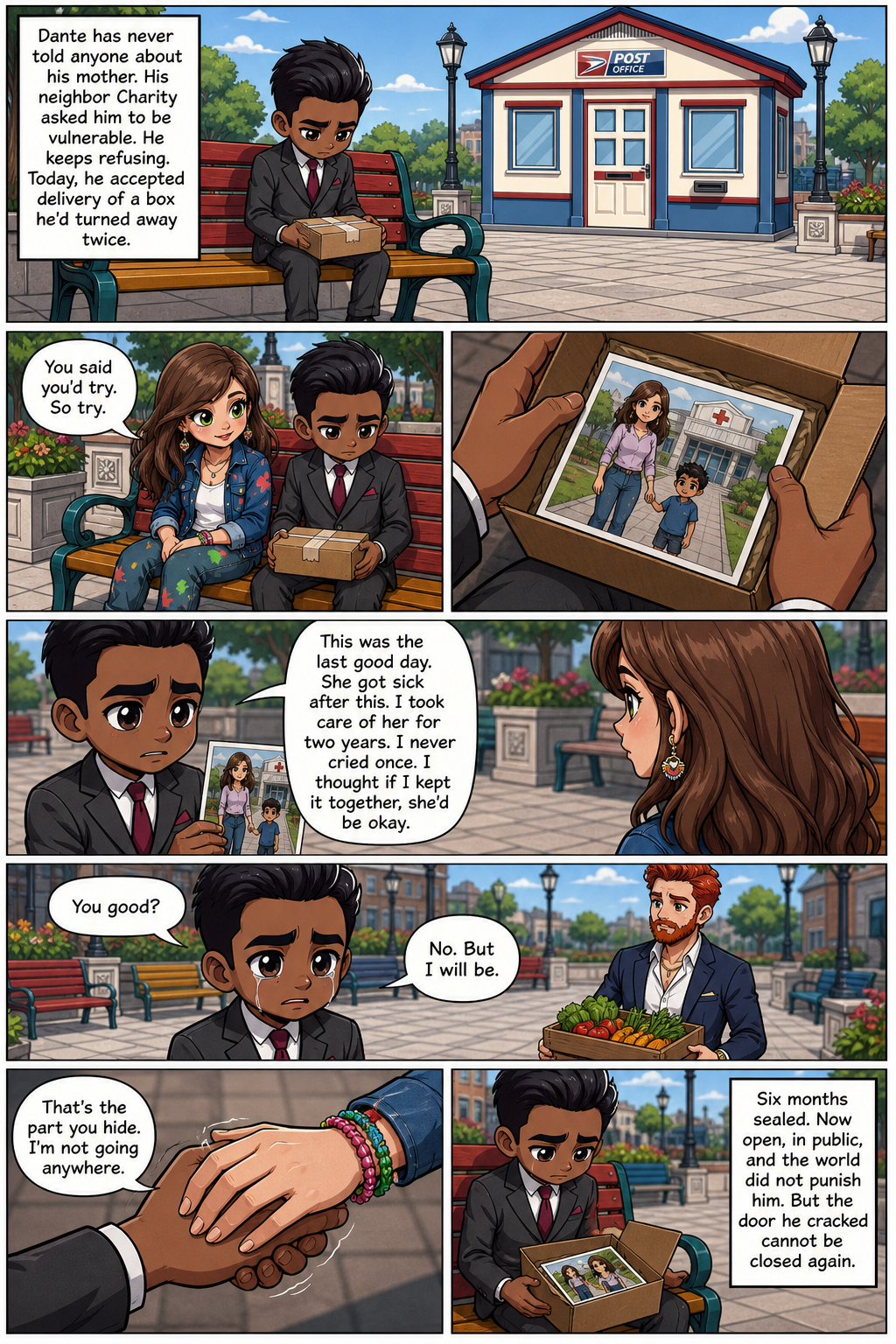
The sketch hung in Charity's window all week. Dante saw it each morning when he passed. She had asked him to prove he could be vulnerable, and he still owed her the words. He had never said them to anyone. He went to the post office first, the notice from Scarlett folded in his pocket. He needed to collect the package before he could face Charity. The clerk slid a small box across the counter. Dante signed. He already knew what was inside. His aunt had mailed it after his mother died, and he had refused delivery twice. He carried it out to a bench in the plaza and sat with it on his knees. Charity found him there. She must have followed. She sat down without asking and looked at the box. "You said you'd try," she said. "So try." Dante opened the lid. Inside was a photograph. His mother, young, holding his hand outside a clinic. He turned it so Charity could see. "This was the last good day," he said. His throat shut. He waited for the old reflex, the joke, the smile that ended questions. It came up fast. He pushed it down. "She got sick after this. I took care of her for two years. I never cried once. I thought if I kept it together, she'd be okay." Charity said nothing. She watched his hands. He watched them too. They were shaking. "When she died I couldn't speak at the service," he said. "I stood up and nothing came out. People thought I was cold." His voice cracked. "I let them think that. It was easier." The tears came then. He did not wipe them. He let Charity see his face fall apart in the open square. A man he half-knew, red-haired, passed with a crate of produce and slowed. Frank, who ran the market. Frank saw Dante crying and did not make a thing of it. "You good?" Frank asked. Plain, no pity. "No," Dante said. The honest word. "But I will be." Frank nodded and walked on. Charity took Dante's hand. His fingers were still shaking. Hers were steady. "That's it," she said softly. "That's the part you hide." "I've never told anyone," Dante said. "Not one person." "I know." She squeezed his hand. "I'm not going anywhere." Dante looked at the photograph again. He had kept it sealed for six months. Now it sat open in his lap, in daylight, and the world had not punished him for it. He let out a breath he felt he'd held for years. But something new moved under the relief. He had shown her the wound. Now she knew its shape, and she would want the whole story. The clinic. The two years. The person he pushed away before her. He had opened the door, and he could not close it again.
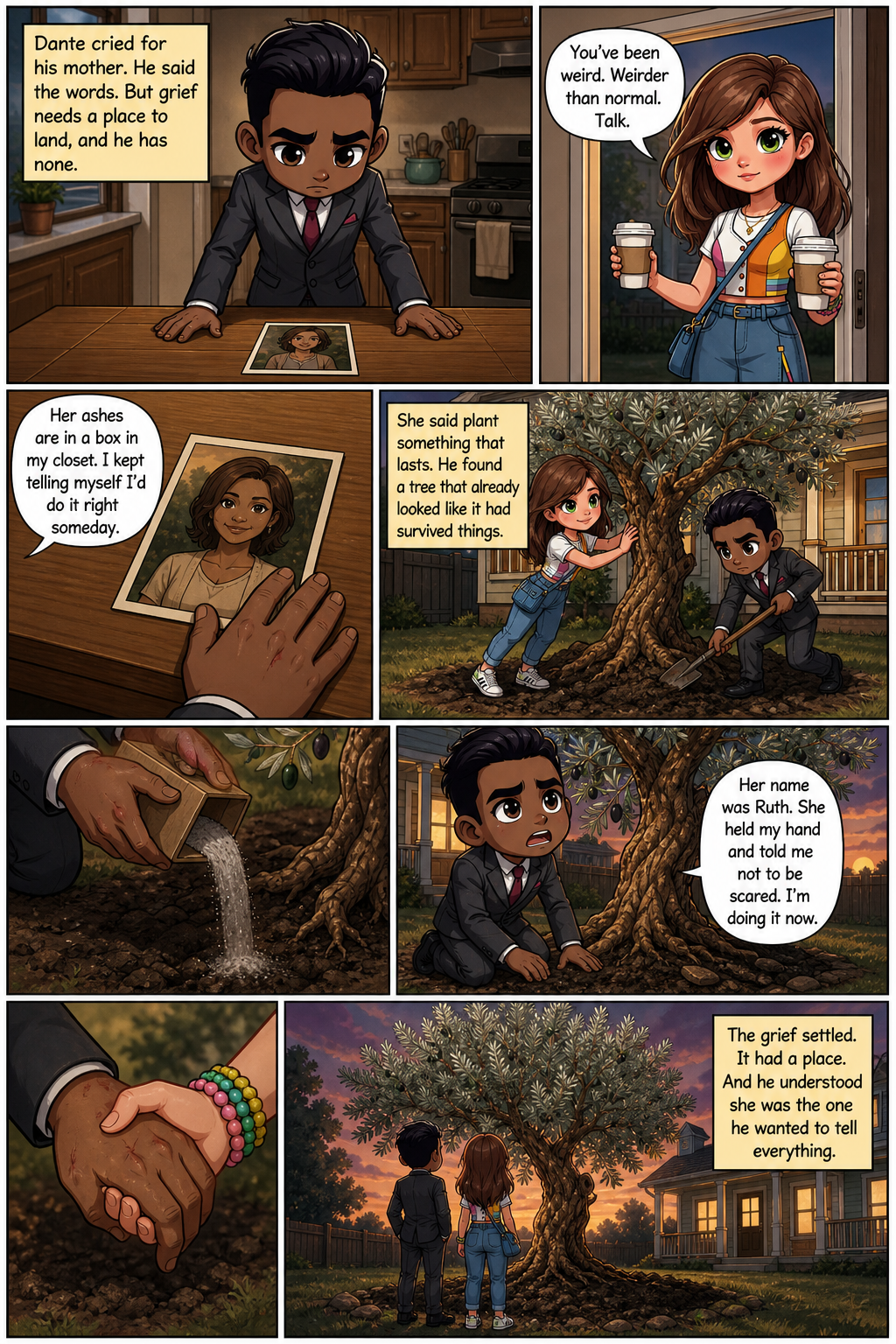
The photograph sat on Dante's kitchen table all week. He had cried for his mother in the plaza. He had spoken the words. But he still had nothing to hold the grief, no place to set it down. Each morning he looked at the photo and felt it float loose inside him. A wound opened was not a wound healed. He needed to mark her death with something real. Charity knocked on Saturday with coffee and a question. "You've been weird," she said. "Weirder than normal. Talk." Dante set the photo in front of her. "I never buried her anywhere I can visit. Her ashes are in a box in my closet. I kept telling myself I'd do it right someday." He stopped. "I don't even know what right means." Charity studied the photo, then him. "So pick a spot. Something that lasts." She drummed her fingers once and went still. "What did she love?" "Her garden. She grew everything." His throat tightened. "She said a tree outlives the person who plants it. That's the point." "Then plant one." Charity said it like it was simple. Maybe it was. They drove to a nursery outside town. Dante walked the rows twice. Then he stopped at an old olive tree, its trunk twisted and gray, its roots thick as rope. The leaves showed silver when the wind turned them. It looked like it had survived things. "This one," he said. They planted it in his yard that afternoon. Dante dug the hole himself. His hands blistered and he did not stop. Charity held the trunk steady while he filled the soil. When the tree stood on its own, he went inside and brought out the box of ashes. His hands shook. He watched them shake and did not hide it. He poured the ashes into the soil at the roots, a slow gray stream. The old reflex rose, the joke, the smile. He let it pass. "Her name was Ruth," he said. "She liked loud music and bad weather. She held my hand in that clinic and told me not to be scared." His voice broke clean through. "I'm sorry I never did this. I'm doing it now." Charity stood beside him. She did not fill the silence. She took his blistered hand in hers. Hers were steady, like always. Dante pressed the last of the soil flat. He breathed, and the grief that had floated loose for six months finally settled somewhere. It had a place now. He could come stand here. He could talk to her. "It'll be here longer than me," he said. "Yeah," Charity said. "That's the whole idea." Dante looked at her. He had shown her the wound, then let her watch him tend it. There was no hiding left between them. And he understood, standing in the dirt, that she was the one he wanted to tell everything. The whole story. Even the person he pushed away before her.
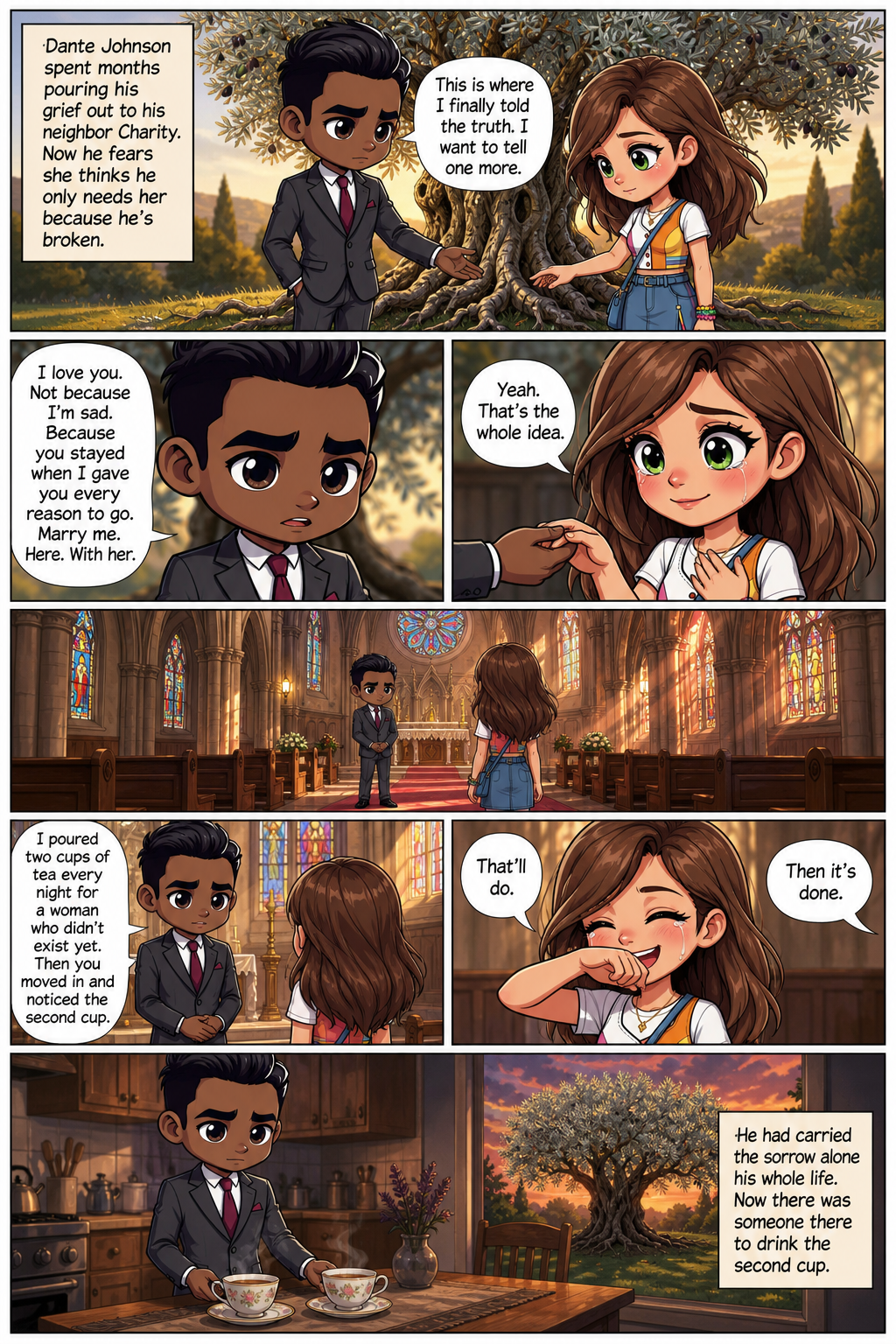
The olive tree took root over the following weeks. Dante visited it each morning. He told Charity about his mother, his childhood, even the person he pushed away years ago. He held nothing back. But one worry stayed. He had told her everything, and yet he had never once given her a true romantic gesture. He feared she doubted him. He feared she thought he only leaned on her because he was grieving. One evening he said it plainly. "You've carried me for months. I've given you words. I've never given you anything that proves this is real." Charity set down her coffee. "Dante. I don't need a—" "I know." He stopped her. "That's the problem. I've never done a single romantic thing in my life. I don't know how to start without it sounding fake." She watched his hands. They were still. "Then don't perform," she said. "Just do the truest thing you can think of." He thought about it all night. The truest thing was not flowers. It was the tree. It was his mother. It was the place he came to speak the things he had never spoken. The next morning he walked Charity out to the olive tree. He took her hand there, at the roots where Ruth's ashes lay. "This is where I finally told the truth," he said. "I want to tell one more. I love you. Not because I'm sad. Because you stayed when I gave you every reason to go." His voice held. "Marry me. Here. With her." Charity's eyes filled. For once she had no quick words. She drummed her fingers once against his, then went still. "Yeah," she said. "That's the whole idea." They planned a small wedding at the town's old church. The building had tall windows and colored glass that threw light across the floor. Dante asked the mayor to officiate, since the town had no other soul who could. Bryan Garrison agreed without much warmth. He was the man who moved to town years ago and ran it like a project. He studied Dante the way he studied everyone, measuring. "You sure about this," he said. Not a question. "Weddings are easy. Staying is the hard part." "I know the hard part," Dante said. "I've done nothing but the hard part." Garrison almost smiled. "Then I'll keep it short. Short weddings. Those are the real ones." A year passed. Charity painted again, finally, canvases full of the fire-colored light she had crossed the whole country chasing. She found it, in the end, at home. On the wedding day the church filled with the few friends the town had given them. Light came through the tall windows and lay across the aisle in bands of red and gold. Dante waited at the front in a dark suit. For the first time the clothes were not a trick. They did not hide anything. There was nothing left to hide. Charity walked toward him. He watched her hands, the old habit, searching for stillness under pressure. Her hands were steady. They had always been steady. Garrison kept it short, as promised. He spoke a few dry lines, then nodded at Dante to say his own. Dante did not pull out a card. He looked at her and said what was true. "I poured two cups of tea every night for a woman who didn't exist yet. Then you moved in and noticed the second cup. You've been noticing me ever since." His throat tightened and he let it. "I spent my whole life keeping the sorrow in. You're the one who got it out. I'm not sad anymore. I'm just yours." Charity wiped her face with the back of her hand. "That'll do," she said, and laughed through the tears. Garrison closed the book. "Then it's done." They married under the colored light, and when it was over Dante drove his wife home to the house next door to where she'd started. The olive tree stood in the yard, taller now, its silver leaves turning in the wind. Dante stopped and looked at it. He had carried his grief alone for six months, then let one person see it, tend it, and finally outlast it. The wound he never spoke of had a place now. So did he. He went inside and poured two cups of tea. This time both of them were for someone there to drink it.
Play your story to life
Storycraft is a mobile game where you create AI characters, craft items and locations to build their world, then discover what direction your story takes. Download the iOS game for free today!
Download for free