

Delia Prance's Arc
59 Chapters
Delia Prance's dream is founding a sanctuary garden where every wounded traveler and creature finds free healing..

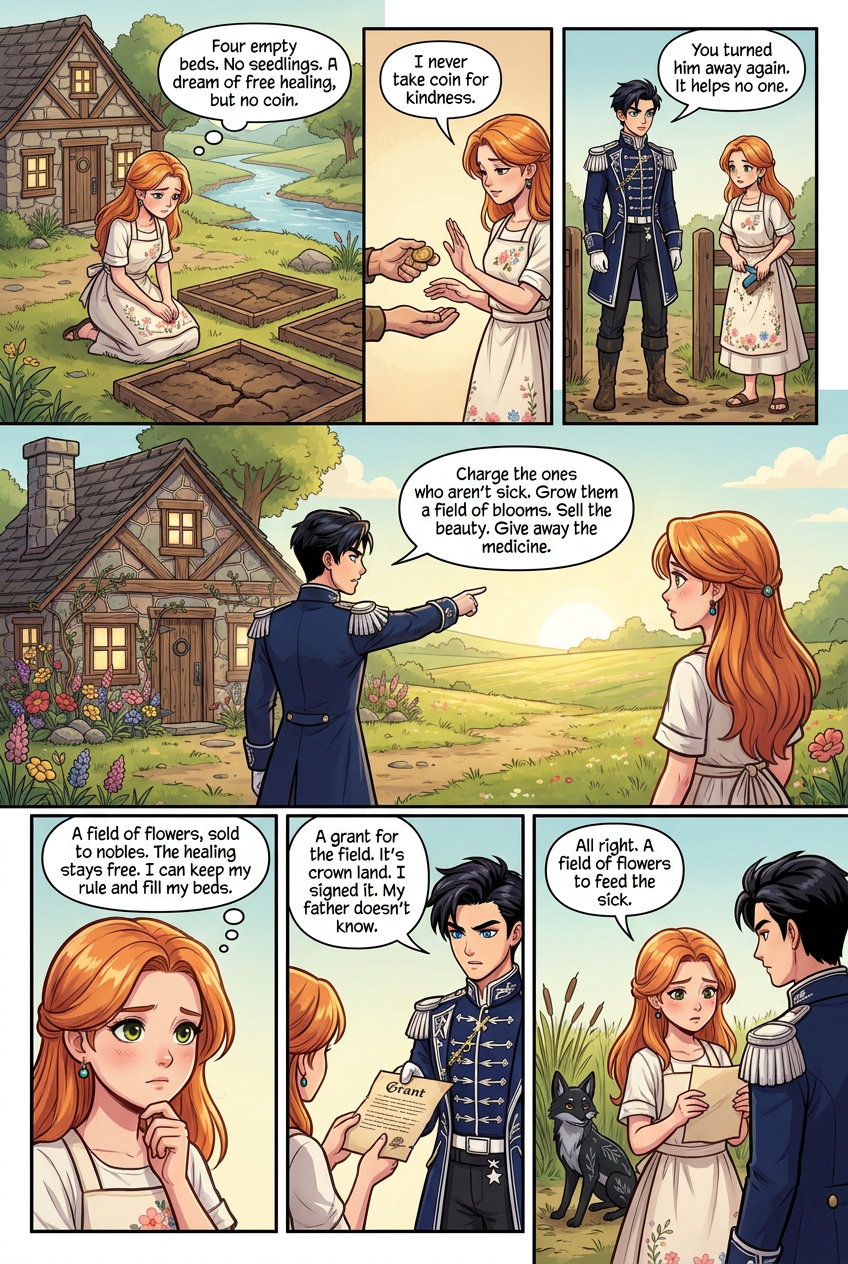
Delia Prance wanted a garden where any hurt traveler or animal could heal for free. Right now she had four empty beds, cracked soil, and no fence to keep the deer out. She knelt by the river beside her cottage and counted what she owned. A jar of dried mint. A bundle of nightshade she had picked by instinct. Nothing that would buy seedlings. A farmer had come at dawn with two coins and a grateful face. She had pressed his hand shut around them and sent him home. She never took coin. But kindness did not fill the beds, and the empty rows shamed her every morning. "You turned him away again." Nick Rider stood at her gate. The second prince wore his dark blue coat, but his boots were caked with village mud. He had walked, not ridden. He came often now, and each time he brought news that weighed on him. Delia stood and brushed dirt from her apron. "I don't sell what I do," she said. "I know." Nick looked at the empty beds. "So they stay bare. That helps no one." He was right, and she hated that he was right. She loved him partly for saying the hard thing plainly. "I won't charge the sick," she said. "Ever." "Then don't." Nick stepped through the gate. "Charge the ones who aren't sick. The palace kitchens throw out silver on wilted flowers. Grow them a field of blooms. Sell the beauty. Give away the medicine." Delia went still. A field of flowers, sold to nobles who wanted color on their tables. The coin from vanity would buy fences and seedlings. The healing would stay free. She could keep her rule and fill her beds at once. "Where would I even grow that much?" she asked. Nick pointed past the cottage to the open field beyond the river bend. It ran wide and empty, catching full sun. "There. It's crown land. No one uses it." He pulled a folded paper from his coat and pressed it into her hand. His fingers were cold. "A grant. It gives you the field. I signed it myself." She unfolded it. Her name sat there in ink beside his seal. "Your father allowed this?" "No." Nick's jaw tightened. "He doesn't know. He's busy signing land away from three villages." He held her eyes. "So take the field before he thinks to sell that too." A black fox trotted from the reeds and sat at Delia's feet, watching the paper as if it understood. Delia laughed, short and surprised. She closed her hand over the grant. "All right," she said. "A field of flowers to feed the sick." But she caught the shadow on Nick's face. He had given her crown land without the king's word. When his father found the grant, someone would answer for it. Delia had her field now. She had also tied her garden to a fight inside the palace she did not yet understand.
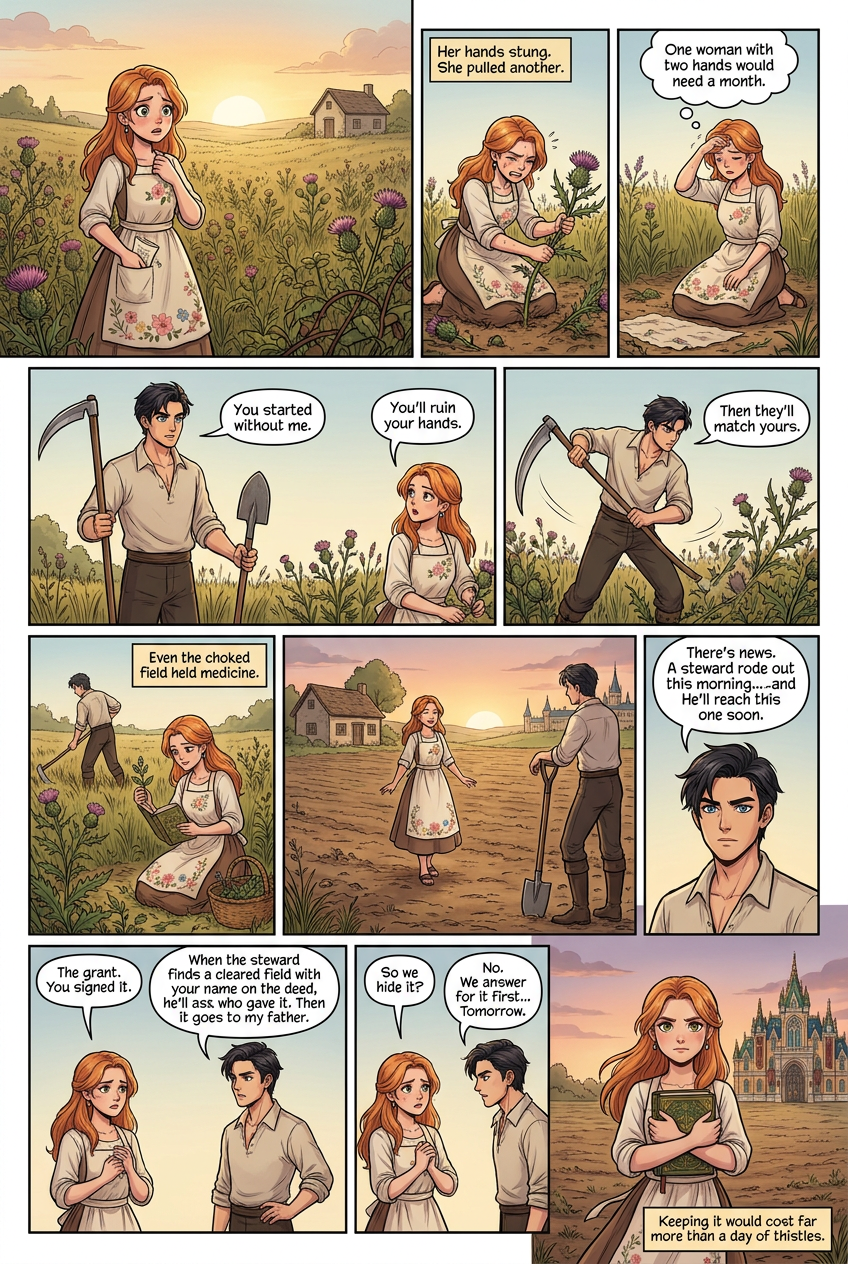
Delia crossed the river at dawn to see her new field. The grant sat folded in her apron pocket. But the field was not the open ground Nick had described. Waist-high weeds choked every row. Thistles gripped the soil. Bramble ran wild along the far edge. She could not plant a single seed until this was gone. She knelt and pulled one thistle by the root. Her hands stung. She pulled another. By noon she had cleared a patch the size of a blanket. The field stretched on, endless. She sat back on her heels and wiped sweat from her eyes. One woman with two hands would need a month. "You started without me." Nick stood at the field's edge. His fine coat was gone. He wore a plain shirt with sleeves rolled to the elbow. He carried a scythe over one shoulder and a spade in his free hand. The second prince, come to pull weeds. She almost laughed. "You'll ruin your hands," she said. "Then they'll match yours." He swung the scythe low. Thistles fell in a long row. He did not slow. He did not speak. He worked like a man trying to outrun something. They cleared together through the afternoon. She dug roots while he cut. When she paused, she opened her worn herb book to a marked page. She checked each plant she pulled against the drawings. Some weeds she saved in a basket. Bindweed for a wash. Dock leaves for stings. Even the choked field held medicine, if she knew where to look. By dusk the ground lay open and dark. Four rows, then eight, then the whole field bare and ready. Delia stood in the center and turned slowly. She had a place to grow now. Flowers for the nobles. Herbs for the sick. The empty beds by her cottage would fill from this soil. Nick did not share her smile. He leaned on the spade and looked back toward the palace. "There's news," he said. "A steward rode out this morning. He counts the crown land. Every field. Every acre my father plans to sell." He met her eyes. "He'll reach this one soon." Delia's stomach dropped. "The grant. You signed it." "I did. My name is on land the king wants to sell to strangers." His jaw set hard. "When the steward finds a cleared field with your name on the deed, he'll ask who gave it. Then it goes to my father." The cold came fast. She had won her ground. She had also made it visible. A weed-choked field drew no eyes. A planted one would. "So we hide it?" she asked. "No." Nick shook his head. "You can't hide a field. We answer for it first, before he does." He looked at her. "That means going to the palace. Tomorrow." Delia gripped her herb book to her chest. The field was hers. Keeping it would cost far more than a day of thistles.
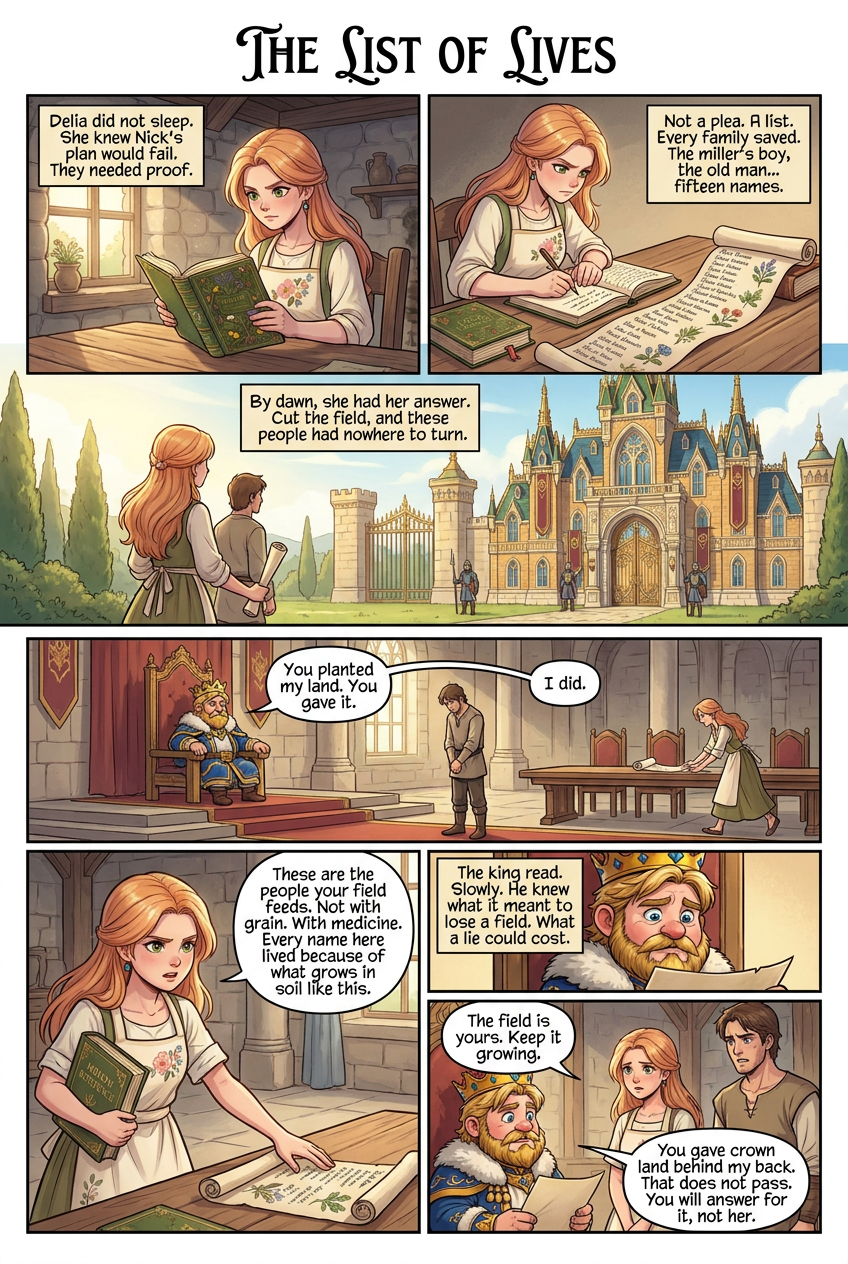
Delia did not sleep. She stood in her cottage at first light and knew that Nick's plan would fail. They would walk to the palace and tell the king the truth. But truth alone would not save the field. The king wanted the land for coin. She had to show him the land was worth more growing than sold. She needed proof. She pulled her worn herb book from the shelf. She opened it on the table and turned each page. Fever cures. Cough syrups. Salves for burns. Every remedy she made came from plants that grew in soil like her new field. She began to write. Not a plea. A list. Every family within a day's walk who had come to her door. The miller's boy she pulled from fever. The old man whose crushed hand she healed. Beside each name she wrote the plant that saved them. By dawn she had three pages. Fifteen names. She rolled them together and tied them with twine. This was her answer. Cut this field, cut these cures, and these people had nowhere to turn. The palace gates rose gold and cold. Nick walked at her side, jaw tight. Guards let them pass. They found the king in his hall. Rowan Rider was shorter than she expected, thick through the middle, his beard streaked with gray. He did not rise. "You planted my land," the king said. He looked at Nick. "You gave it." "I did," Nick said. Delia stepped forward before the king could speak again. She unrolled her pages on the long table. "These are the people your field feeds," she said. "Not with grain. With medicine. Every name here lived because of what grows in soil like this." The king read. He read slowly. Delia watched his eyes move down the list. She thought of his own bad harvest, the one Nick had spoken of, when a steward told him to stay quiet and wait. He knew what it meant to lose a field. He knew what a lie from a trusted man could cost. "My steward would sell this," Rowan said. He set the pages down. "For coin I'd spend in a year." He looked at Delia. "You take no coin." "None," she said. The king was quiet a long moment. "The field is yours. Keep it growing." He turned to Nick. His voice went flat. "You gave crown land behind my back. That does not pass. You will answer for it, not her." Delia's breath caught. She had won the field. But the king's eyes stayed on his son, hard and cold. She had saved her land by turning the king's anger where it belonged. Now that anger had a target, and it was the man beside her.
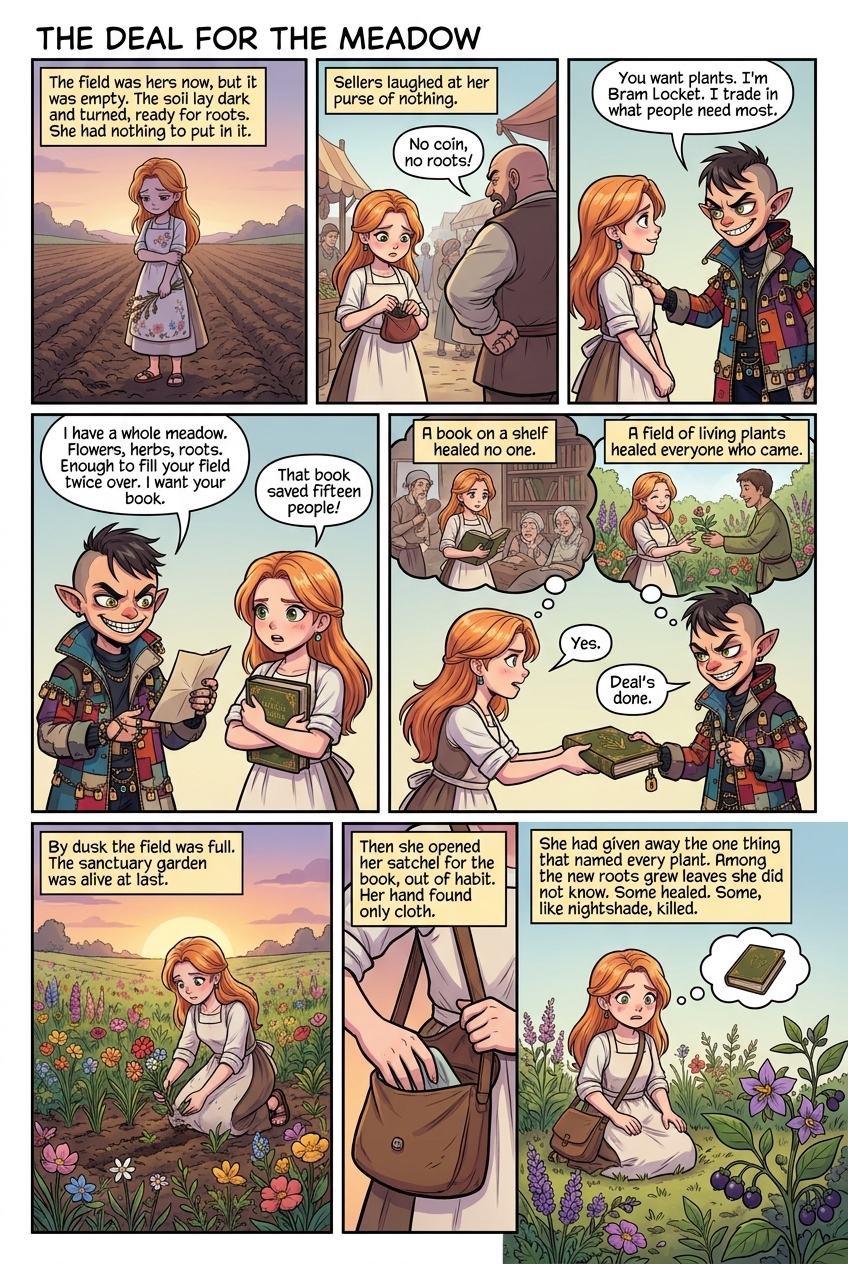
The field was hers now, but it was empty. Delia walked its cleared rows at dawn. The soil lay dark and turned, ready for roots. She had nothing to put in it. Her cottage held dried herbs and cut stems, no living seedlings. Without plants in the ground, the sanctuary garden was only a promise. Growing season would pass. She needed seedlings, and she needed them fast. She went to the market with her herb book under her arm. Sellers laughed at her purse of nothing. "No coin, no roots," one said, and turned away. Delia stood among the stalls, unsure. Then a hand touched her sleeve. "You want plants," said a wiry man in a patchwork coat. Tiny bronze locks hung from it and clinked as he moved. A ring sat on every finger. He grinned like he already knew her answer. "Bram Locket. I trade in what people need most." Delia had heard of him. Rynn, her friend from the palace, once warned her. Bram never lost a deal. Every lock on his coat was a bargain sealed and kept. "I have no money," she said. "I didn't ask for money." Bram pulled a folded paper from his coat. "I have a whole meadow. Flowers, herbs, roots. Enough to fill your field twice over." He let the words sit. "I want your book." Delia's hand tightened on the herb book. It was worn at the corners, thick with everything she knew. Every cure she made lived in its pages. "That book saved fifteen people," she said. "Then it's worth a meadow." Bram's voice went flat and final. "Plants die in a season. Knowledge you carry in your head. You wrote those pages. You can write them again." He held out the paper. "The meadow for the book. Say yes or say no." Delia looked at the empty field in her mind. She thought of travelers with cuts and fevers, coming to a garden with nothing growing. A book on a shelf healed no one. A field of living plants healed everyone who came. She knew every remedy by heart. The pages only held what her hands already knew. "Yes," she said, and gave him the book. Bram took it and slid a fresh lock onto his coat. "Deal's done." He led her past the stalls to a cart. Behind it lay the meadow he'd promised, dug up whole and bound in wet cloth. Poppies, chamomile, yarrow, a hundred colors tangled together. Enough to plant every row. By dusk the field was full. Green shoots stood in straight lines where bare dirt had been. Delia knelt and pressed soil around the last root. The sanctuary garden was alive at last. Then she opened her satchel for the book, out of habit. Her hand found only cloth. She had given away the one thing that named every plant she could not yet tell apart. Among the new roots grew leaves she did not know. Some healed. Some, like nightshade, killed.
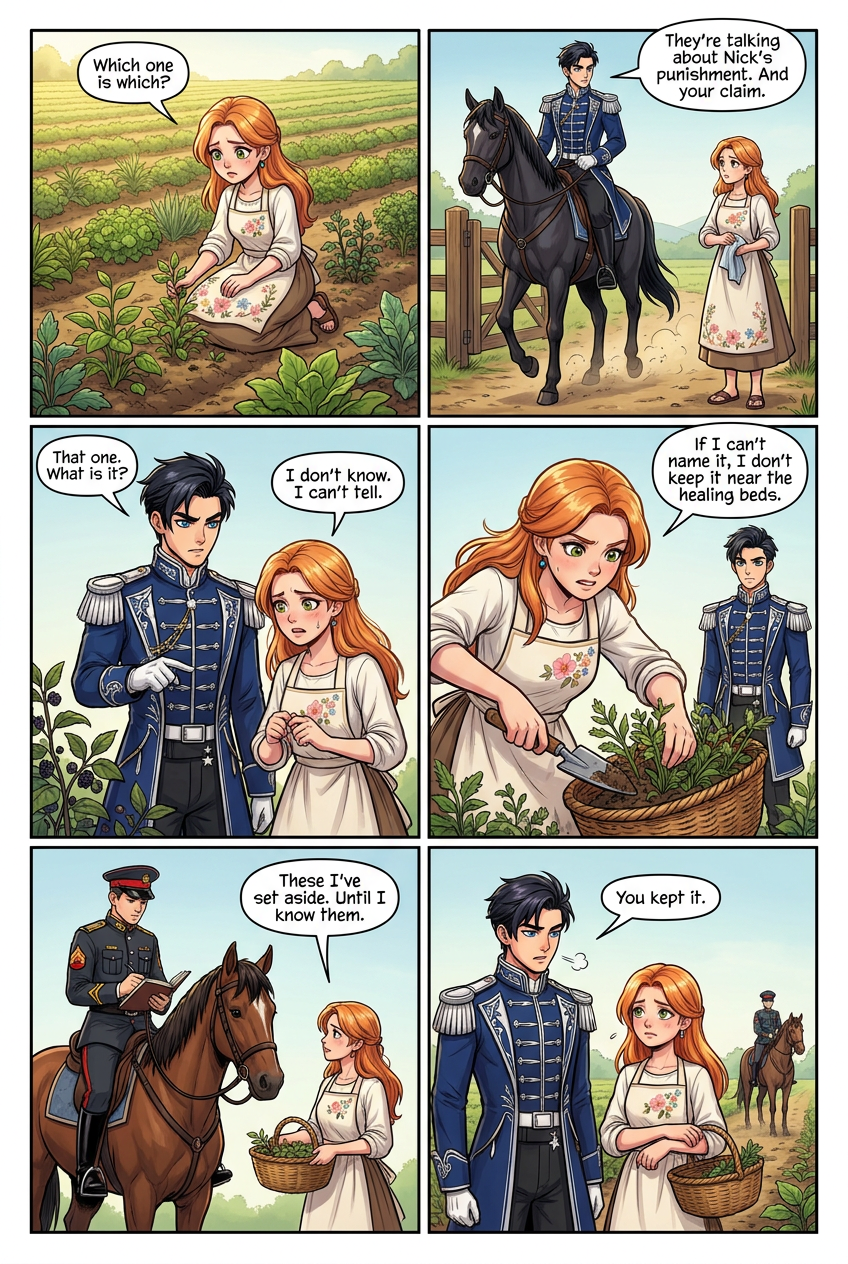
The field bloomed by morning, but Delia knelt among rows she could not name. She had traded her book for these plants. Now some leaves looked like medicine, and some looked like nightshade. She could not tell them apart. Then hooves sounded on the path. A rider in a black uniform swung down at her gate. She stood, wiping soil from her hands. Rynn Evander crossed the field in three strides. He was her friend from the palace, broad in the shoulders, jaw set hard. Other cadets stepped aside for him in the halls. Now he wore no warmth. "They're talking," he said. "About Nick's punishment. And about your claim." "My claim is real," Delia said. "The king signed it." "Doesn't matter what's real." Rynn stopped at the edge of the rows. "A cadet's coming to survey the land. Today. To check if your field earns its grant. If it looks worthless, they use it against Nick." He looked at the plants. "What is all this?" Delia's throat tightened. "A meadow. I planted it yesterday." "Name them." Rynn pointed at a cluster of dark leaves. "That one. What is it?" She knelt. The leaves were smooth and green, with small berries starting to form. Medicine, or poison. Her stomach turned. "I don't know," she admitted. "I gave away my book. I can't tell the healing ones from nightshade anymore." Rynn was quiet. Then he crouched beside her. "A cadet who finds poison in your rows will report it. They'll say you're careless. That the land grows death, not cures." He met her eyes. "That ends your claim. And Nick's with it." Delia looked at the field she had built in one day. She could not fake knowledge she'd lost. But she could show the truth. She stood and walked her rows, touching each plant, sorting by what her hands remembered. Yarrow felt rough. Chamomile smelled of apples. The dark berries she left untouched. She dug the questioned cluster up whole, roots and all, and set it in a basket apart from the rest. "If I can't name it, I don't keep it near the healing beds," she said. "I pull it. Every doubt goes in the basket." She worked fast, row by row. Rynn walked behind her, watching. When the cadet arrived at the gate, Delia met him with clean rows and a full basket of the uncertain. "These I've set aside," she told him. "Until I know them. A healer never plants what she can't name." The cadet studied the ordered field, the labeled beds, the caution in the separate basket. He wrote in his book. Then he mounted and rode off without a word against her. Rynn let out a breath. "You kept it." Delia looked at the basket. Nightshade was in there, she was sure. Along with cures she'd thrown out by mistake. She had saved her claim. But she still could not name half of what she'd planted.
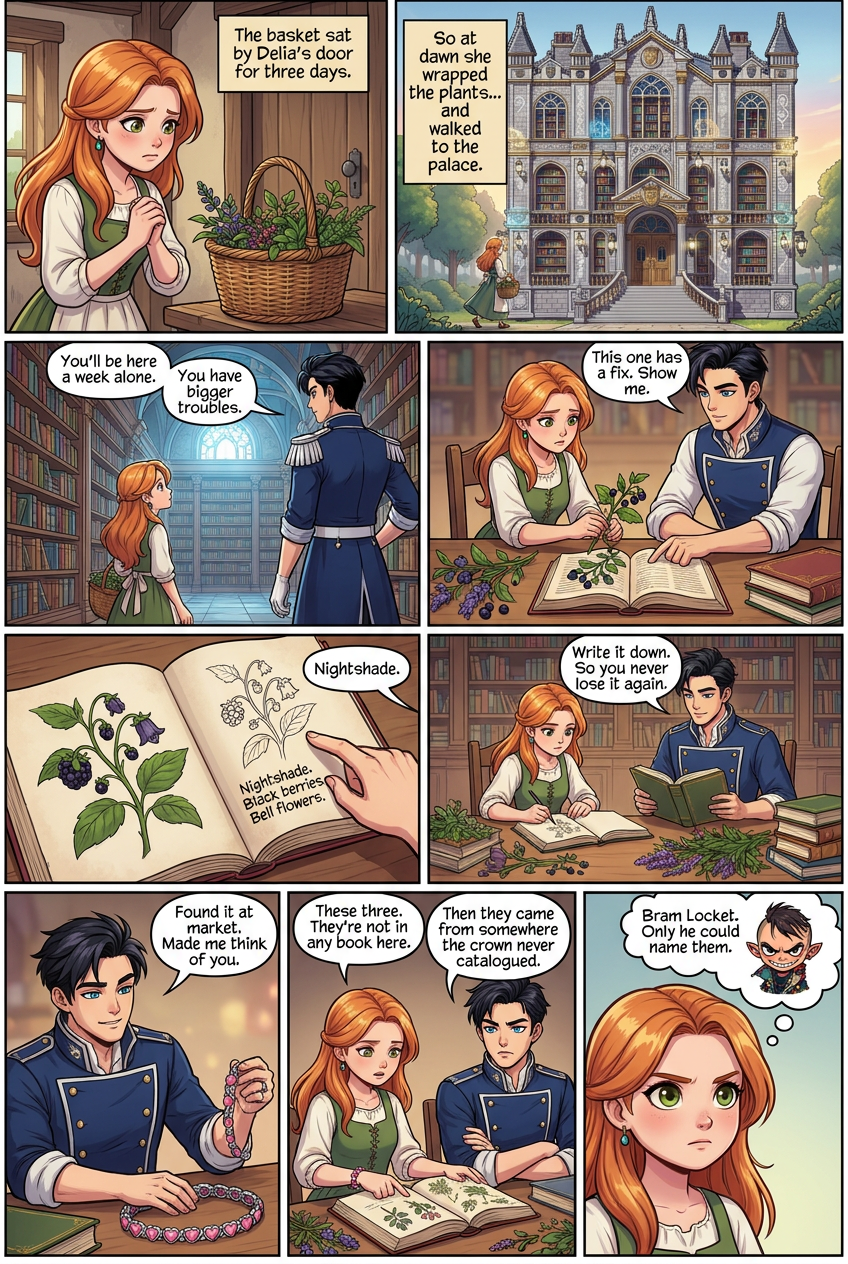
The basket sat by Delia's door for three days. She could not offer a single leaf from it. When a boy came with a burned hand, she reached for the safe beds instead. But the basket haunted her. Nightshade hid inside, mixed with cures she needed. So at dawn she wrapped the plants in damp cloth and walked to the palace. If any book could name them, it was there. The royal library rose grey and tall, its arches carved with glowing marks. Delia had never stood inside a place so large. Shelves climbed past three floors. She set her basket on a wide table and began pulling books down, one by one, hunting for pictures of leaves and roots. "You'll be here a week alone." She turned. Nick stood between the shelves, still in his dark uniform, sleeves already pushed up. He was the prince who had given her the field, and the man she loved. He looked tired. She knew he was fighting his father over three villages the king meant to strip bare. Yet here he was. "You have bigger troubles," she said. "This one has a fix." He pulled a chair beside her. "Show me." She laid the dark-berried plant on the table. Nick opened a thick volume and turned pages until he found a match. "Nightshade," he read. "Black berries. Bell flowers." He pointed at her plant. The berries matched. Delia's stomach dropped. She had grown death in her rows. They worked through the morning. Nick read the descriptions aloud. Delia checked each leaf against the drawings. She set the poison to one side and the cures to the other. Comfrey. Foxglove, dangerous but useful in small doses. Yarrow she already knew. "Write it down," Nick said. "So you never lose it again." He found her a blank ledger and ink. Delia began a new book. She drew each plant by hand. Beside it she wrote its name, its use, its danger. Nick read; she wrote. By afternoon the basket was empty and the pages were full. "There." She closed the cover. "I can name them now. Every one." Nick leaned back. For a moment his face lost its worry. He slid something across the table—a slim silver bracelet, small pink hearts around it. "Found it at market. Made me think of you." Delia fastened it on her wrist. Then she looked at her new book and her heart sank a little. Three plants stayed nameless. No drawing in the library matched them. She had searched every shelf Nick reached. "These three," she said. "They're not in any book here." Nick frowned. "Then they came from somewhere the crown never catalogued." Delia thought of Bram Locket, the man who had traded her the meadow. He had known exactly what he was giving. Only he could name the last three. She would have to find him again—and bargain with a man who never gave anything for free.
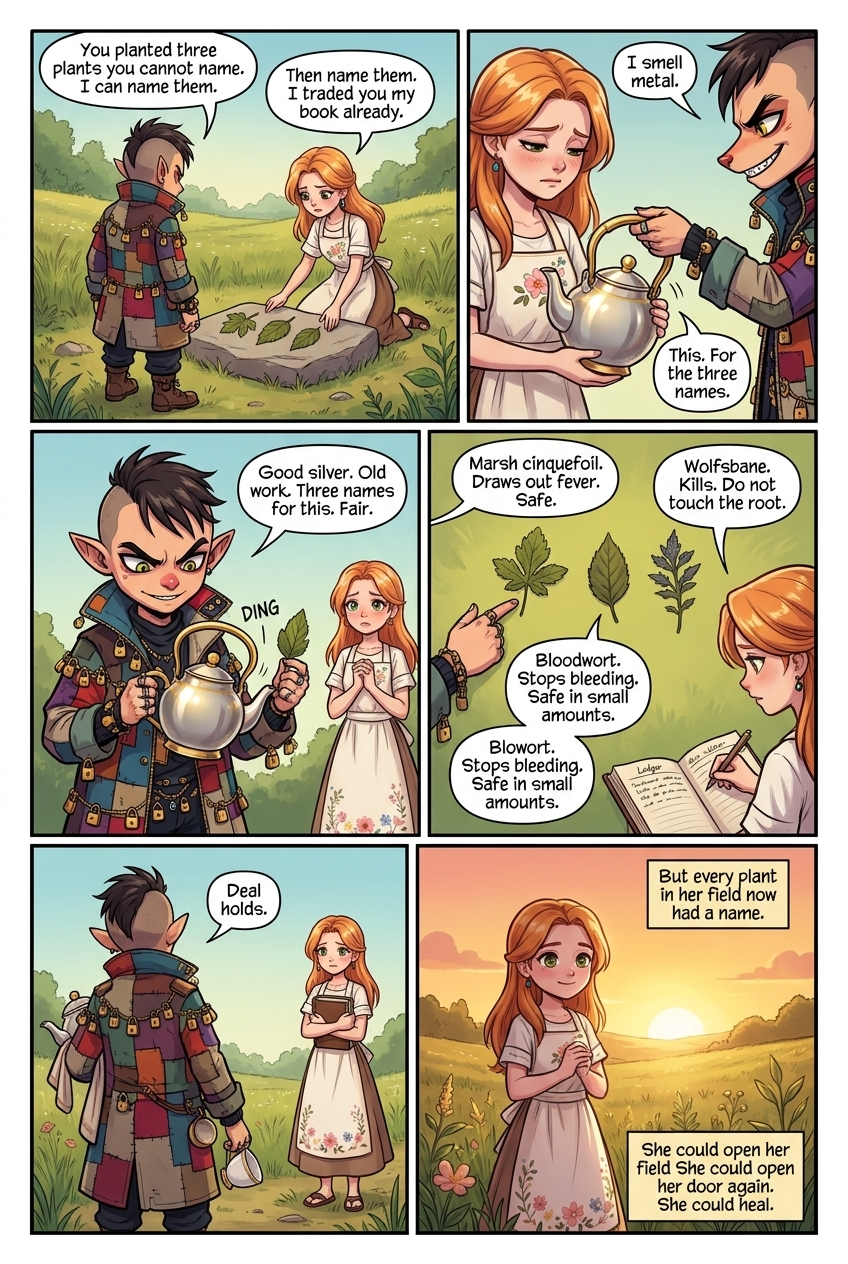
Delia found Bram Locket where she had last traded with him, at the edge of the meadow he once called his. His patchwork coat clinked with small bronze locks. She counted more than she could hold in her mind. He turned before she spoke, as if he had heard her coming for miles. "You planted three plants you cannot name," he said. "I can name them. You know what I want first." Delia laid three pressed leaves on the flat stone between them. "Then name them. I traded you my book already. That was the deal." "That deal is closed." He touched a lock on his sleeve, one of many. "This is new. Names cost. What do you bring?" She had nothing. Her coin purse was empty. Her herb book was his. Her field was full but not yet grown. She stood with her hands open and felt the cold rise in her chest. Bram's fox eyes moved to her bag. "You carry something. I smell metal." Delia pulled out the kettle. It was her grandmother's, silver with a gold handle, packed with three white cups trimmed in gold. She had brewed every healing tea in it. Her grandmother had poured from it before her. It was the only thing left of the woman who taught her which leaves cured and which killed. "This," Delia said. Her voice caught. "For the three names." Bram lifted the kettle. He turned it in the light. He tapped the handle and heard the ring of true metal. "Good silver. Old work." He set it down. "Three names for this. Fair." Delia's hand shook over the handle. She thought of tea steaming in her cottage, of hands warming around those cups after long walks. She thought of nightshade hidden in her rows, of the boy with the burned hand she had turned away. She could not heal what she could not name. A kettle poured tea. Names saved lives. She let go. "Take it." Bram slipped a fresh lock from his pocket and pinned it to his coat. Then he touched each leaf in turn. "Marsh cinquefoil. Draws out fever. Safe." He tapped the second. "Bloodwort. Stops bleeding. Safe in small amounts." He tapped the last. "Wolfsbane. Kills. Do not touch the root with a cut hand." Delia wrote each name in her ledger as he spoke. Three plants, no longer strangers. One more poison she now knew to fear. Bram wrapped the kettle in a cloth and hung a cup from his belt. "Deal holds," he said, and walked into the meadow without turning back. Delia closed her ledger. Her bag felt light and wrong. But every plant in her field now had a name. She could open her door again. She could heal the next boy who came. The garden she meant to build could hold no secrets she did not understand.
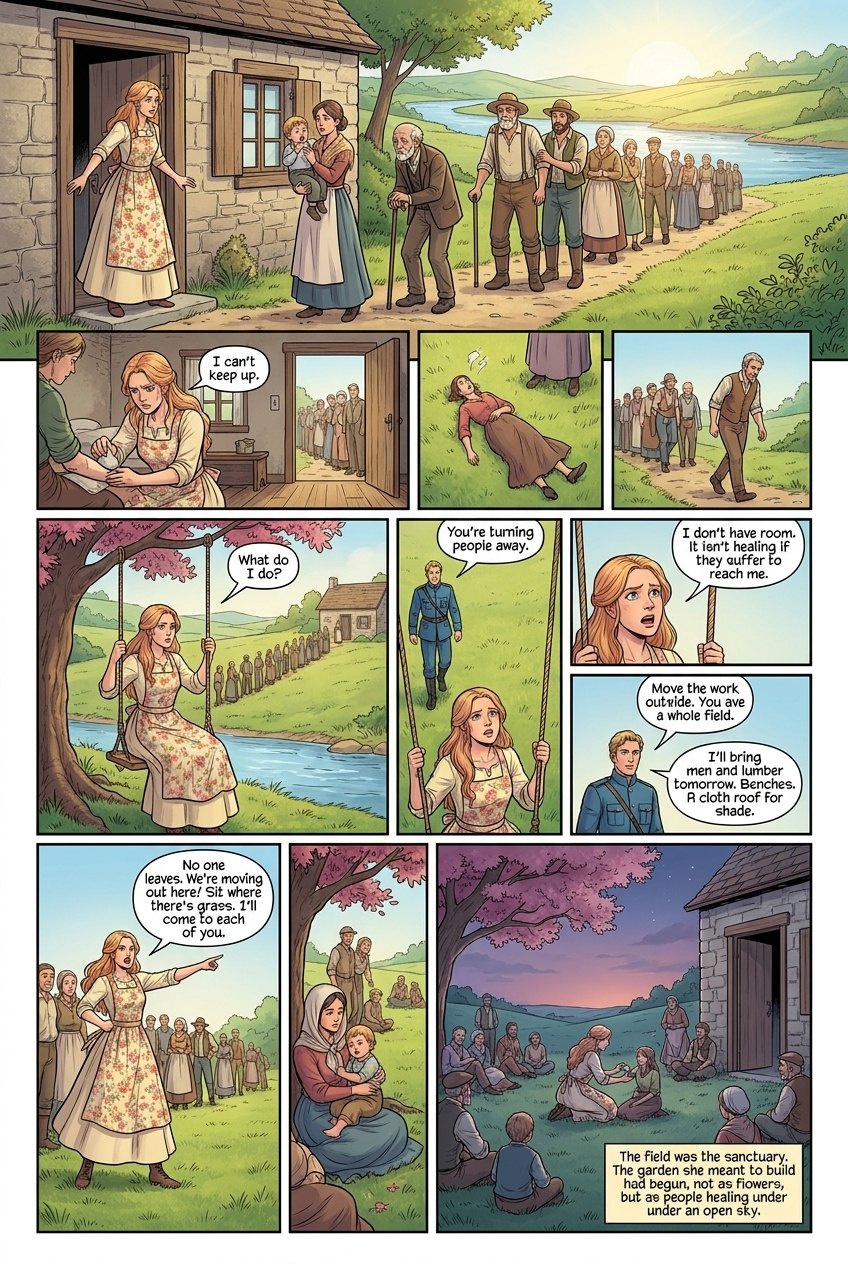
The morning after she named the last plant, Delia opened her cottage door and found a line. People stood along the path and down to the river. A woman held a coughing child. An old man leaned on a cane. Two farmers waited with a friend who could not walk. Her cottage held four chairs. It could shelter six from rain. She had thirty faces looking at her. Delia worked until noon. She treated one, then the next, then the next. But the line did not shrink. More arrived while she worked. A mother fainted from standing in the sun. A man gave up his place and walked home untreated. Word of free healing had spread past what her small house could hold. She could not fit them inside, and she could not send them away. She left the door and walked to the pink-leafed tree at the river's edge. The swing hung still from its branch. She sat and gripped the ropes. This was where she and Nick first met. She looked back at the crowd and did not know what to do. Nick came up the path and saw the line before he saw her. He crossed to the swing and crouched beside it. "You're turning people away," he said. Not a question. "I don't have room," Delia said. "I heal one. Ten more wait in the sun. A woman fainted. It isn't healing if they suffer to reach me." Nick stood and looked at the field beyond the cottage. The one his father had signed to her. Wide, open, green with her planted rows. "Then stop trying to fit them in the house," he said. "You have a whole field. Move the work outside." Delia followed his eyes. The field stretched flat and broad in the sun. Space for benches. Space for shade. Space for every person who came. "I built a cottage," she said. "I need a garden. A place people wait in the open, the way they'd wait by a river." Nick nodded once. "I'll bring men and lumber tomorrow. Benches. A cloth roof for shade. It's crown work I can order without asking him." Delia rose from the swing. She walked back to the crowd and raised her voice. "No one leaves. We're moving out here." She pointed to the field. "Sit where there's grass. I'll come to each of you." The old man lowered himself onto the grass. The mother laid her child in the shade of the tree. The line broke apart and spread across the open field, and no one had to stand. By dusk Delia had treated all thirty. Her cottage door stood open behind her, too small now to matter. The field was the sanctuary. The garden she meant to build had begun, not as flowers, but as people healing under an open sky.
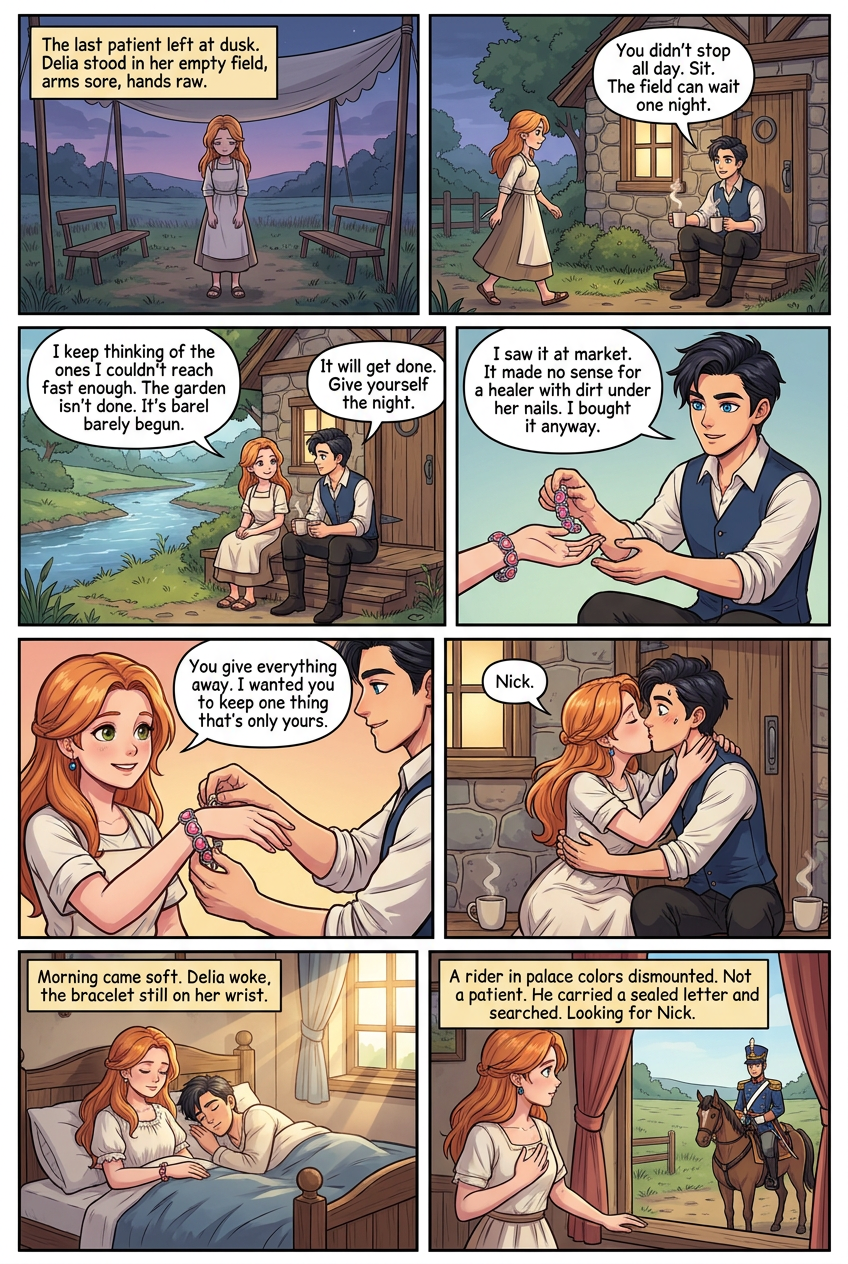
The last patient left at dusk. Delia stood in her empty field, arms sore, hands raw. The benches sat quiet. The cloth roof stirred in the wind. For the first time in weeks, no one waited for her. She walked back to the cottage and found Nick on the step. "You didn't stop all day," he said. He held two cups of tea he'd made from her stove. "Sit. The field can wait one night." Delia took the cup and sat beside him. The river ran low and steady past the flowers along the wall. She had not sat still since the crowd first came. "I keep thinking of the ones I couldn't reach fast enough," she said. "The garden isn't done. It's barely begun." "It will get done." Nick set his cup on the stone. "You built this from weeds and a book you traded away. Give yourself the night." He reached into his coat and pulled out something small. A silver bracelet, set with pink hearts. He turned it in his fingers, not quite looking at her. "I saw it at market. It made no sense for a healer with dirt under her nails." He held it out. "I bought it anyway." Delia laughed, surprised. She had not seen him uncertain before. He always spoke plainly and moved on. Now he waited, the bracelet in his open hand. She held out her wrist. He fastened it, his fingers careful against her skin. "You give everything away," he said. "Your book. Your kettle. Your whole day. I wanted you to keep one thing that's only yours." She looked at him then, really looked. The prince who ordered lumber for her benches. Who stood against his own father to sign her this field. Who now sat on her step at dusk, afraid of a bracelet. "Nick," she said. She set down her cup. She leaned in and kissed him. He went still, then pulled her close. The cups sat forgotten. The river kept moving past the door she'd left open behind them. She led him inside, and for once the cottage held no patients, only the two of them. Morning came soft through the window. Delia woke against his shoulder, the bracelet still on her wrist. Nick slept. She watched his face without the weight it carried in daylight. Then she heard hooves on the path. She rose and looked out. A rider in palace colors dismounted at the field's edge. Not a patient. He carried a sealed letter and searched the benches, the cottage, the empty rows. Looking for someone. Looking for Nick. Delia's chest tightened. Nick had crossed the king to give her this land. Now a royal messenger stood in her field at dawn, and whatever the letter held, it had followed him here. The quiet was over. She reached for her dress and woke him.
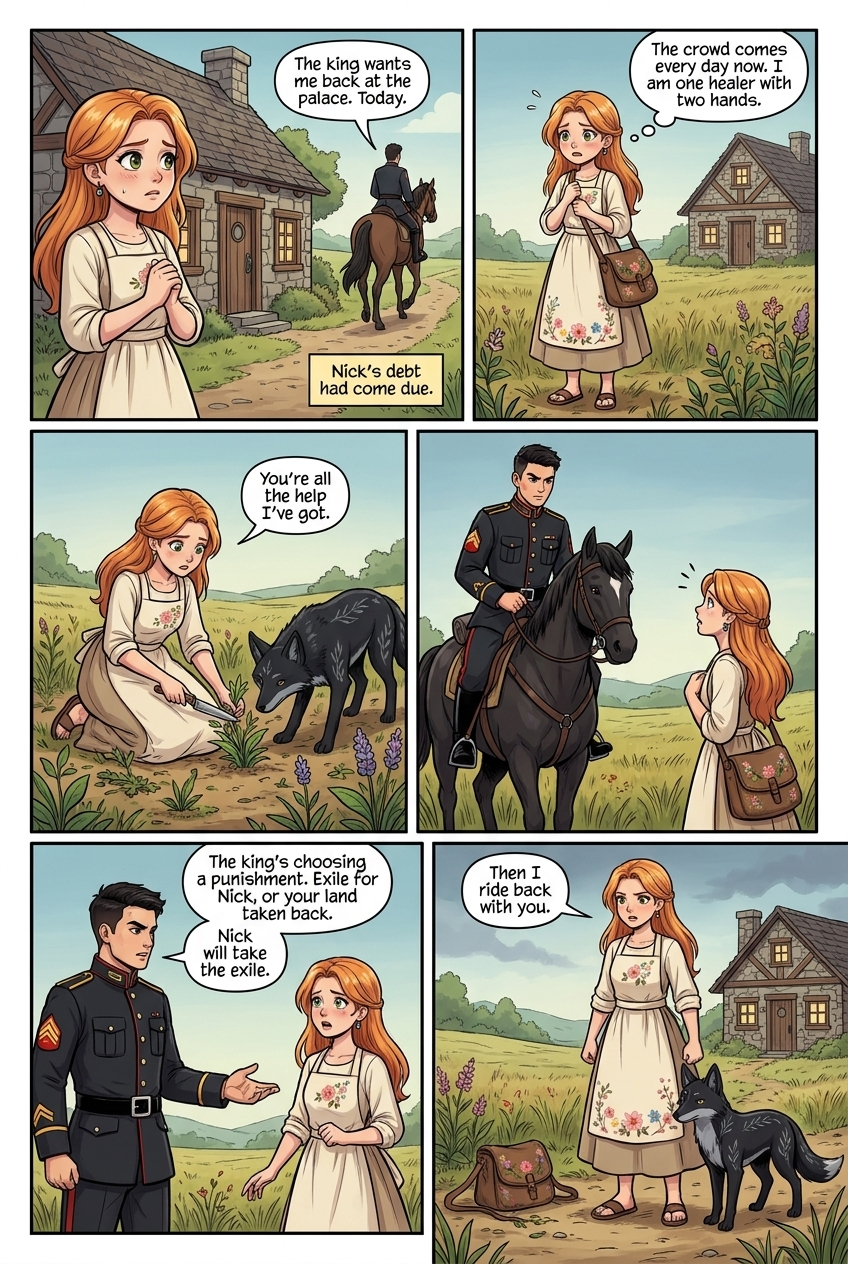
Nick read the letter twice. Then he folded it and looked at the field, not at Delia. "The king wants me back at the palace," he said. "Today." He did not say what for. He did not have to. He had crossed his father to sign her this land, and now the debt had come due. He gathered his coat. Delia caught his sleeve, but he only pressed her hand once and mounted the messenger's horse. She watched him ride the path until the trees took him. The benches sat empty. By noon they would not be. The crowd came every day now, thirty at a time, and Nick had carried water, moved the sick into shade, held the ones who shook. He was gone, and she was one healer with two hands. She needed medicine ready before they arrived, more than she could gather and grind alone. She took the flower-stitched satchel from its hook and walked into the field. The black fox slipped from the tall grass to meet her. It had come to her weeks ago and stayed, and it knew the plants better than she did some days. It trotted ahead, nose low, and stopped at a patch of feverfew. Delia knelt and cut. "You're all the help I've got," she told it. The fox flicked its ears and moved to the next row. They worked fast. The fox found yarrow, then the marsh cinquefoil, then stopped short of the wolfsbane and would not step closer. Delia marked that spot in her mind and left it. Her satchel filled. Her hands stung. She thought of Nick standing in his father's hall, alone, and cut faster, because grinding roots was the only thing she could do with her fear. Hooves again. Not the crowd. Delia turned and saw a black palace uniform. Rynn Evander swung down from his horse and crossed the field to her. He was the cadet who had once warned her of the inspection that could have ruined her, a friend inside those palace walls. His jaw was set hard. He did not waste words. "Nick's in the hall," Rynn said. "The king wants a punishment that sticks. Exile from the palace, or the land taken back." He looked at the rows of plants, at her raw hands. "I rode ahead of the ruling. Thought you'd want to know before it's done." Delia stood, satchel heavy on her hip. The fox pressed against her leg. "Which one is he choosing?" "The land," Rynn said. "He'll strip your grant to spare his son the exile. Nick won't let him. He'll take the exile first." The satchel slipped from her shoulder to the dirt. Nick would lose his family to save her field. Or she would lose the field that fed thirty sick people a day. Someone was choosing tonight, and neither choice was hers to soften from here. "Then I ride back with you," Delia said.
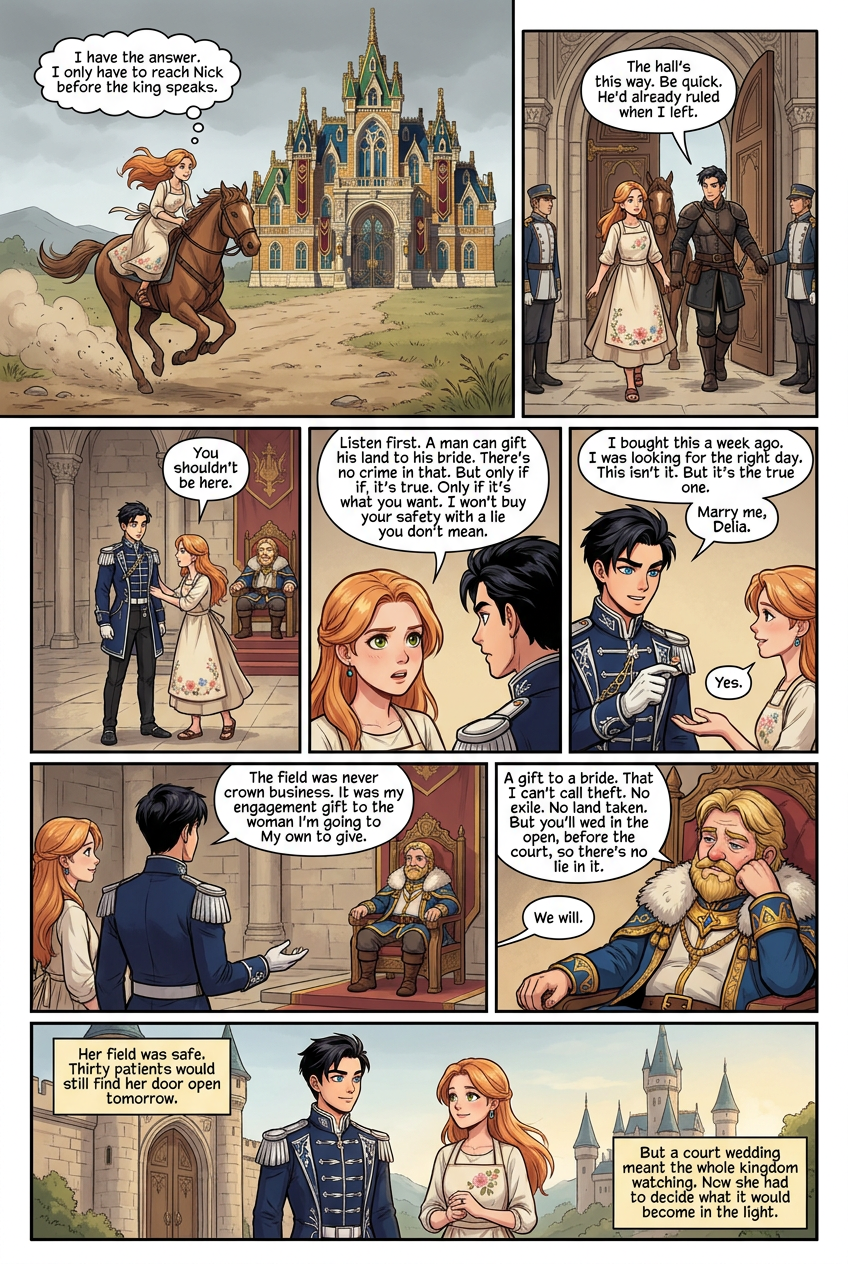
The palace towers rose ahead, sharp against the grey sky. Delia rode hard behind Rynn, and the whole way one thought ran under the hoofbeats. The king wanted to punish Nick for giving away crown land. But land given as a gift was not a crime. And a gift between a man and the woman he meant to marry was no one's fault at all. She had the answer. She only had to reach Nick before the king spoke, and she had to know he wanted it too. They reached the ornate gate and left the horses. Rynn cut through the guards with a look, and the cadets stepped aside for him the way they always did. He pushed a side door open. "The hall's this way," he said. "Be quick. He'd already ruled when I left." Nick stood alone before his father's chair. The king watched him with plain, tired eyes. Delia crossed the stone floor and caught Nick's arm. He turned, surprised, then set his jaw. "You shouldn't be here," he said. "Listen first," she said, low. "You gave me that field. But what if it wasn't crown land you gave away? What if it was your own gift to me, because we're to be married? A man can gift his land to his bride. There's no crime in that." She searched his face. "But only if it's true. Only if it's what you want. I won't buy your safety with a lie you don't mean." Nick did not answer with words. He reached into his coat and drew out a small ring. Rose gold, an oval stone circled by smaller ones. He had carried it, waiting. "I bought this a week ago," he said. "I was looking for the right day. This isn't it." He almost smiled. "But it's the true one." He pressed the ring into her palm. "Marry me, Delia." "Yes," she said. They turned together to the king. Nick spoke plainly. "The field was never crown business. It was my engagement gift to the woman I'm going to marry. My own to give." King Rowan looked at the ring in Delia's hand, then at his son. He was quiet a long moment. "A gift to a bride," he said. "That I can't call theft." He leaned back. "No exile. No land taken. But you'll wed in the open, before the court, so there's no lie in it." "We will," Nick said. Outside the gate, Delia slid the ring onto her finger. Nick was staying. Her field was safe. Thirty patients would still find her door open tomorrow. She looked at the towers and felt the ground steady under her. But a court wedding meant the whole kingdom watching. And a sanctuary garden, once known to nobles, would draw more than the sick and the poor. She had won the land. Now she had to decide what it would become in the light.
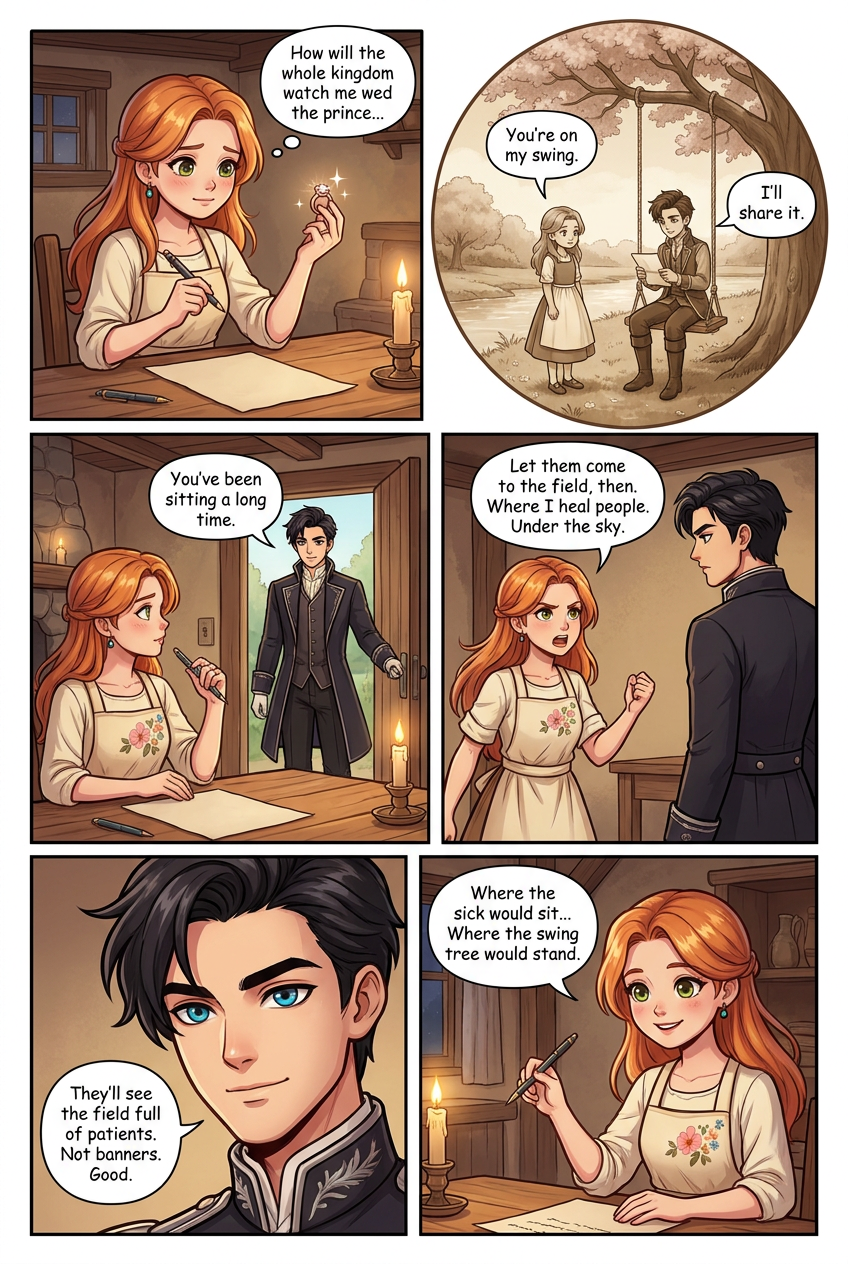
Delia sat at her cottage table with a blank sheet before her. The court wedding needed planning. She had to list who would stand where, what flowers would fill the hall, how the whole kingdom would watch her wed the prince. She dipped her pen. But her hand did not move. The rose gold ring caught the candlelight, and her mind slipped somewhere else. Three years back, she had walked a path she did not know. She was new to healing then, unsure where to build her practice. She stopped under a tree with soft pink leaves. A wooden swing hung from one branch. A man sat on it, turning a folded letter in his hands. He did not look like a prince. He looked tired. "You're on my swing," she said, half joking. "I'll share it," he answered. He slid over. She sat. He nodded at the river below. "You could heal people here. People pass this way." She had not told him she was a healer. "How did you know?" "Your hands," Nick said. "They pick at the leaves without thinking. Like they're always looking for something useful." She had chosen the riverside soon after. Because of him. Because he saw what she was before she said it. The cottage door opened and pulled her back. Nick stepped in, still in his dark palace coat. He saw the blank sheet and the still pen. "You've been sitting a long time," he said. "I was remembering the pink tree," she said. "The swing. The day we met." He set his hand on the table. "I remember. You told me I was in your way." "You told me my hands were always searching." She looked up at him. "Nick, I can't plan this wedding." His jaw set. "The king ordered it. In the open, before the court." "I know. But not this way." She stood. "A hall full of nobles isn't us. It never was. We met on a swing under a tree. Let's marry there." He was quiet. "The court expects a spectacle." "Let them come to the field, then. Where I heal people. Under the sky." Her voice steadied. "If the whole kingdom must watch, let them watch me marry you in the place I built for the sick and the poor. Let the wedding show them what the garden is for." Nick studied her. Then he almost smiled, the way he had that first day. "They'll see the field full of patients. Not banners." "Good," she said. "That's the truth of it." He nodded once. "I'll tell my father. A wedding on your land." Delia looked down at the blank sheet. She would not fill it with a hall and flowers for nobles. She dipped her pen and began a new list. Where the sick would sit. Where the swing tree would stand. How to make her sanctuary ready for the eyes of the whole court.
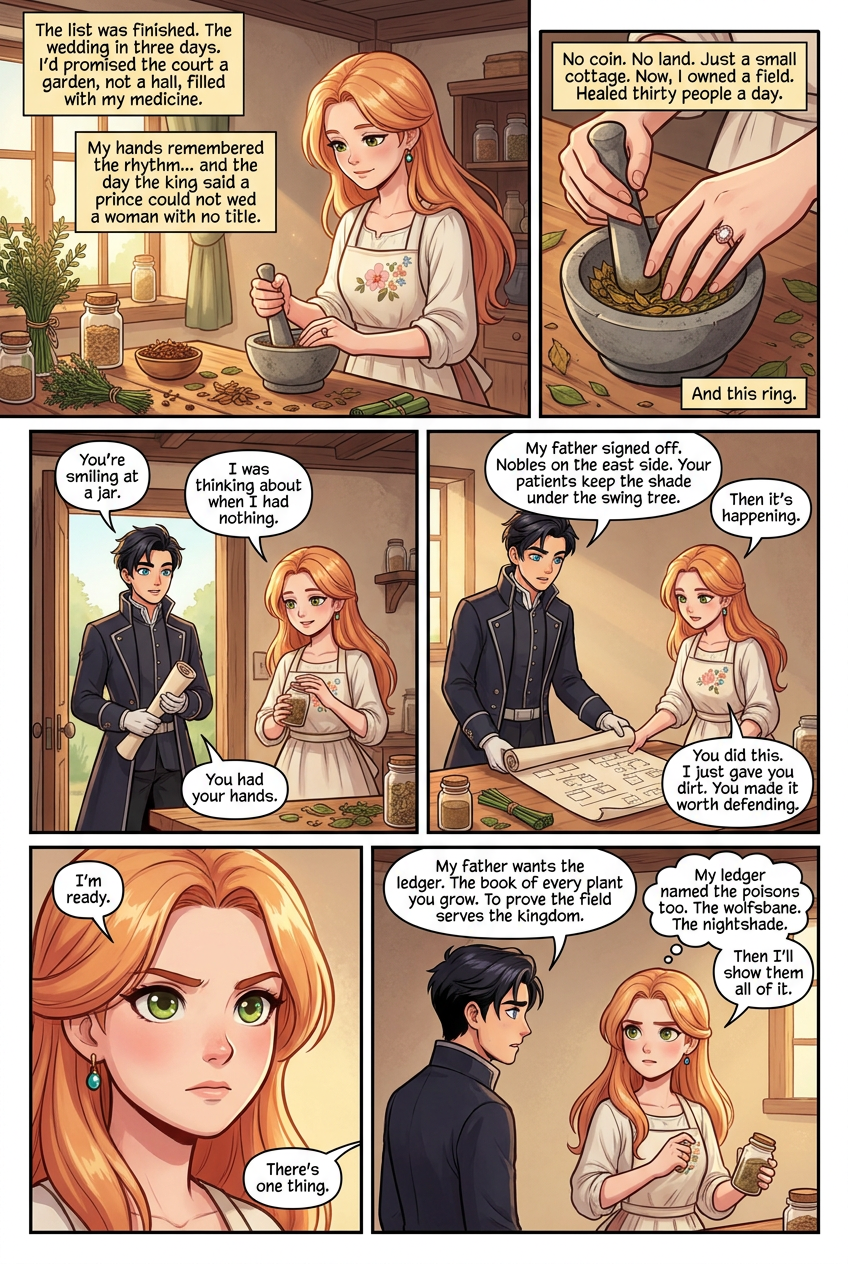
The list from last night lay finished on the cottage table. Delia set it aside and moved to her cedar desk. The wedding was three days off. She had promised the court a garden, not a hall, and now she had to fill it with medicine before the eyes of the whole kingdom arrived. She reached for her mortar and began grinding dried leaves into powder. Her hands worked without her watching them. The rhythm let her mind wander back. She remembered standing before the king in his cold hall, the day he told Nick a prince could not wed a woman with no title. She had no coin then, no land, only a small cottage by the river. Now she owned a field. Now she healed thirty people a day under open sky. Now the rose gold ring sat on her finger. She smiled at a jar of crushed root. Nick had given her all of it, in a way. Not the skill in her hands, but the room to use it. The land. The chance. She thought of how he saw her healing gift before she named it herself, three years back on a swing. The door opened. Nick stepped in, still in his dark palace coat. He carried a rolled paper under one arm. "You're smiling at a jar," he said. "I was thinking about the hall," she said. "When your father said I wasn't a princess. When I had nothing." He set the paper on the desk. "You had your hands." "You saw them before anyone did." She wiped powder from her fingers. "I keep waiting for this to fall apart. The wedding. The field. All of it." Nick unrolled the paper. It was the seating plan for the court. "My father signed off. They come in two days. Nobles on the east side. Your patients keep the shade under the swing tree." Delia looked at the plan. The court and the sick, sharing one field. Her whole idea, made real on a page. "Then it's happening," she said quietly. "It's happening." He looked at her steady. "You did this. Not me. I gave you dirt. You made it worth defending." She put down the mortar. The doubt she had carried for weeks loosened in her chest. She had spent so long fighting to keep the land that she had forgotten to believe it was hers. "I'm ready," she said. And she meant it. Nick nodded once. Then he frowned at the plan. "There's one thing. My father wants the ledger present. The book of every plant you grow. He wants it shown to the court, to prove the field serves the kingdom." Delia went still. Her ledger named the poisons too. The wolfsbane. The nightshade. Every dangerous plant, listed in her own hand, laid open before nobles who already doubted her. "Then I'll show them all of it," she said. But her fingers had gone cold around the jar.
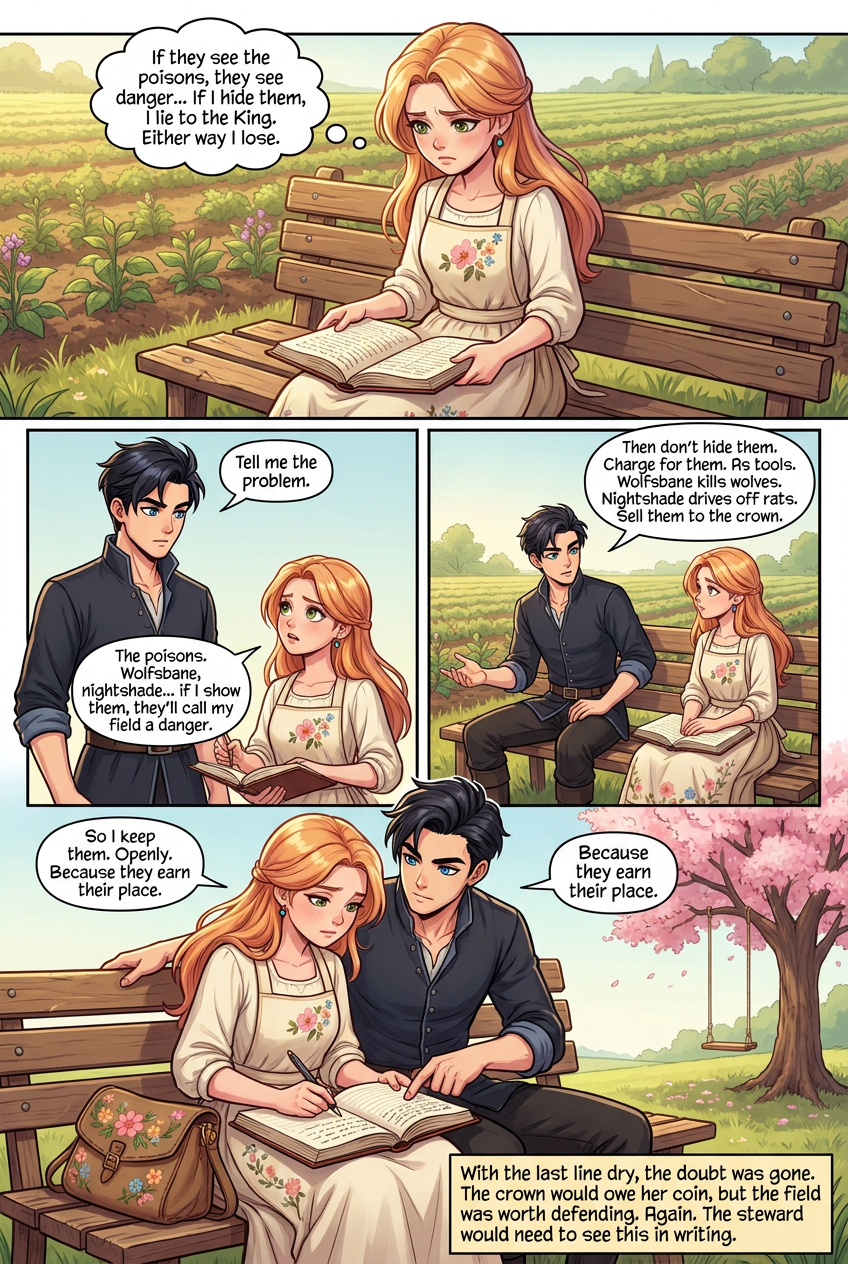
The next morning Delia carried her ledger to the field. The wedding was two days off. The king's demand still sat cold in her chest. She had to show the court every plant, poison and all. If the nobles saw wolfsbane and nightshade named in her hand, they would call her field a danger, not a gift. She set the book on a bench and stared at the open pages. Nick found her there. He wore his dark palace coat, but his sleeves were rolled. "You've read that page ten times," he said. He did not soften it. "Tell me the problem." "The poisons," Delia said. "If I show them the ledger, they see only the danger. If I hide the poisons, I lie to the king. Either way I lose." Nick sat beside her. He looked at the field, at the rows she had planted by touch. "Then don't hide them," he said. "Charge for them." She turned to him. "I don't take coin. You know that." "Not for healing." He tapped the ledger. "These plants aren't for healing. Wolfsbane kills wolves that take a farmer's sheep. Nightshade drives off rats from the grain. Sell them to the crown as tools. Then the poisons aren't a danger in your field. They're a service the field provides." Delia sat still. Charging for the poisons went against everything she held. But it was not the sick she would charge. It was the kingdom, for the very plants that frightened them. A price would turn each poison from a threat into a purpose the nobles could count. "So I keep them," she said slowly. "Legally. Openly. Because they earn their place." "Because they earn their place," Nick said. She pulled her flower-embroidered satchel onto her lap and dug for her pen. Together they went through the ledger. Beside each poison, Delia wrote a use and a price. Wolfsbane, for wolves at the sheepfold. Nightshade, for rats in the stores. Nick named the villages that would pay. He knew them all. He knew the people by name. When the last line was dry, Delia closed the book. "Now the king can show it," she said. "Every plant proves the field serves the kingdom. Even the ones that kill." Nick looked at her the way he had three years back, on the swing by the river. "You made it worth defending," he said. "Again." Delia set the ledger down. She leaned in and kissed him, slow and sweet, her hand still stained green from the plants. He held her there in the open field, under the sky she had planted for the sick. When she drew back, she was smiling. The doubt was gone. She had a book the whole court could read without fear. But now the crown would owe her coin for her poisons, and the steward who managed crown lands would want to see the new arrangement in writing before the wedding.
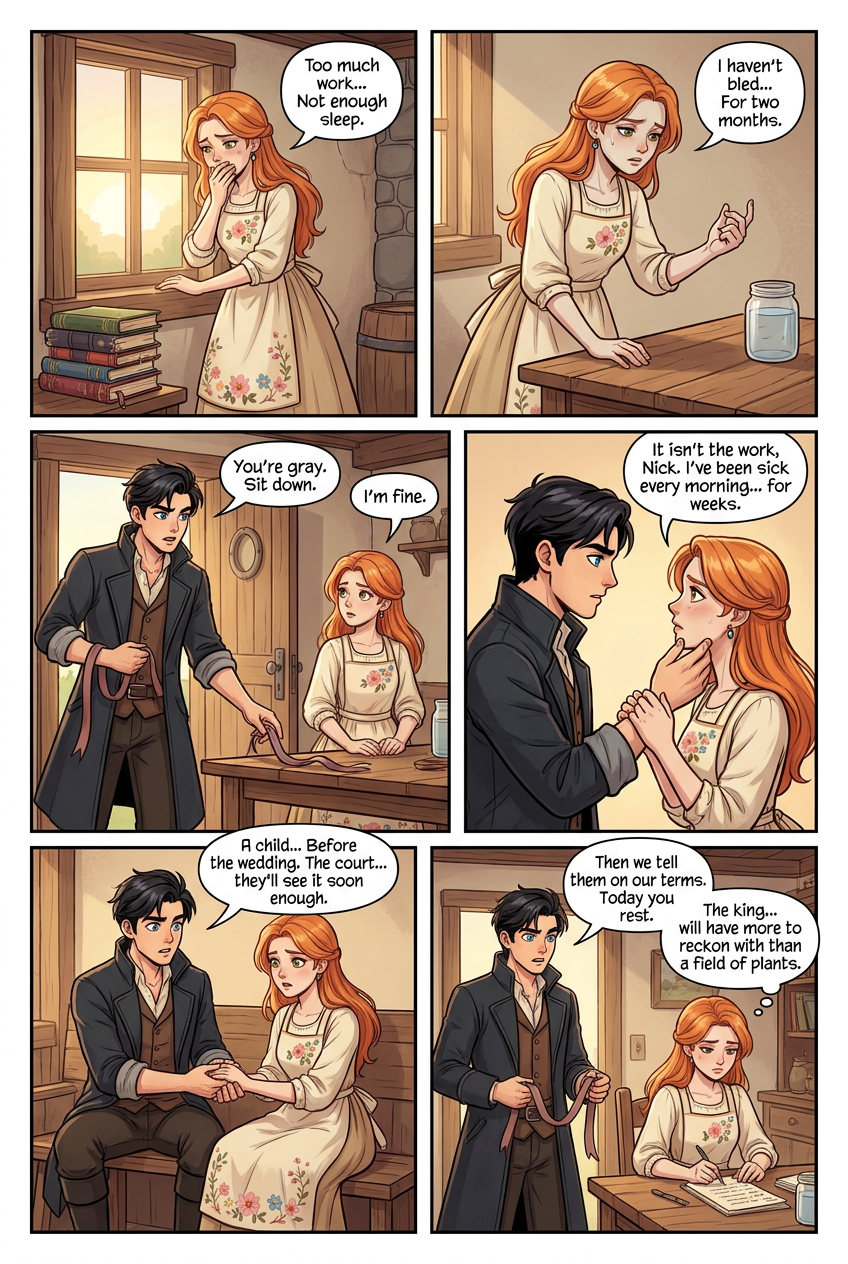
The wedding was one day off. Delia woke before dawn in the cottage and reached for her lists. Ribbons to hang. Benches to set. Tea for the patients who would sit on their side of the field. Her stomach rolled the moment she stood. She pressed a hand to her mouth and breathed until it passed. Too much work, she told herself. Not enough sleep. She tied on her flower-embroidered apron and went to the stack of worn books by the window, the ones wrapped in pink vine, and pulled out the plan she had drawn for the day. By midmorning she had scrubbed the benches and cut the last flowers. The sickness came again while she filled water jars. She gripped the table and waited it out. She counted the days on her fingers, and stopped. She had not bled this month. Or the month before. She set the jar down slowly and stood very still in the quiet kitchen. Nick found her there. He wore his dark coat, sleeves rolled, a roll of ribbon under his arm. He saw her face and dropped the ribbon on the table. "You're gray," he said. "Sit down." "I'm fine." She did not sit. "You're not." He crossed the room. He put two fingers under her chin and looked at her the plain way he looked at everything. "Tell me the problem." Delia met his eyes. She was a healer. She knew the signs better than anyone. "I've been sick every morning," she said. "For weeks. I thought it was the work." She took his hand off her chin and held it. "It isn't the work, Nick." He went still. His blue eyes moved over her, and she watched him count the same days she had counted. "You're sure," he said. It was not a question, but she answered it. "I'm sure." For a moment he said nothing. Then he sat down hard on the bench she had scrubbed, and a laugh came out of him, low and surprised. He pulled her down beside him. "A child," he said. "Before the wedding. Before I've even—" He stopped. He took her stained hand in both of his. "The court sits in that field tomorrow. My father. Every noble in Pinehollow. They'll see it soon enough." "They'll count too," Delia said. "Same as we did." Nick nodded slowly. His jaw set. "Then we tell them on our terms. Not theirs." He stood and pulled her up with him. "But not today. Today you rest. I'll hang the ribbons." Delia looked at her lists, still half undone. For once she let them lie. She sat back down while Nick took the ribbon roll to the door. The wedding was ready enough. But now she carried something the whole court would read in her face, and the king who demanded an open marriage would have more to reckon with than a field of plants.
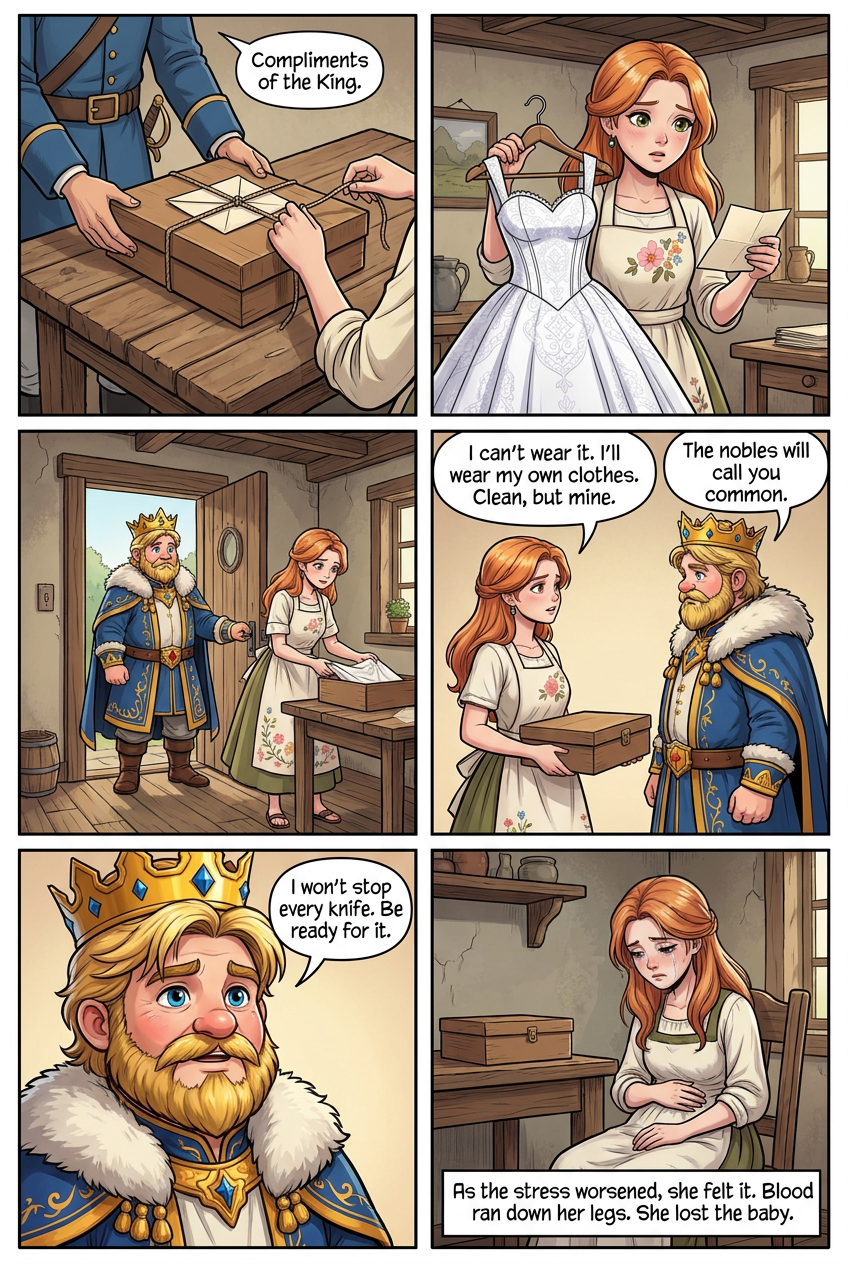
Delia woke on her wedding morning to a knock at the cottage door. A palace rider stood outside with a flat box in his arms. He set it on her table, bowed, and left without a word. She untied the cord and lifted the lid. Inside lay a wedding dress, sleeveless, with a heart-shaped bodice and lace across every panel. A folded note sat on top, sealed with the king's mark. She read it standing in her apron. The king wrote that the dress was his gift. Then he wrote a warning. Not everyone would be glad to see the prince marry a woman with no title. Some at court would look for a reason to stop it, or to shame her in front of them all. The king ended plainly: he liked her, but his liking would not shield her from the rest. Delia lifted the dress from the box. It was beautiful. It was also not hers. She thought of her patients sitting on their side of the field, in their plain clothes, watching a healer dressed like a noblewoman. She thought of the poison ledger the king had ordered displayed. She thought of the child she carried, and the counting the nobles would do. Hooves sounded outside. The king himself came through her door, blue eyes moving over the small room. His crown caught the window light. A belly strained his blue coat. He was not a tall man, but the cottage felt smaller with him in it. "You got the dress," he said. "I did." Delia stood with it draped over her arms. "Thank you. But I can't wear it." He did not soften. "Say why." "My patients sit across the field from your nobles today. If I stand in this, I stand on the noble side. I built that field so no one there feels beneath anyone." She laid the dress back in its box. "I'll wear my own clothes. Clean, but mine." The king studied her a long moment. "The nobles will call you common." "They'll call me that in silk or in cotton," she said. "I'd rather be common and honest." Something shifted in his face. He had waited out a hard season once, told to stay quiet, and lost a woman who stayed only for his grain. He knew the cost of pretending. He nodded once. "Keep the dress," he said. "Wear what you like. But hear me. When they see you plain, and they count the months soon enough, they'll come for you both. I won't stop every knife." He turned for the door. "Be ready for it." He left. Delia closed the box and set it on the shelf. She had kept her ground. But the king had named her real danger. Today the court would gather, and the nobles were already sharpening their reasons to break the marriage she'd fought to keep. As the stress and anxiety worsened, she felt it before she saw it. Blood ran down her legs. The cramping started, and she knew for sure what it meant. She lost the baby. Delia decided not to tell Nick right away. She knew he would be devastated.
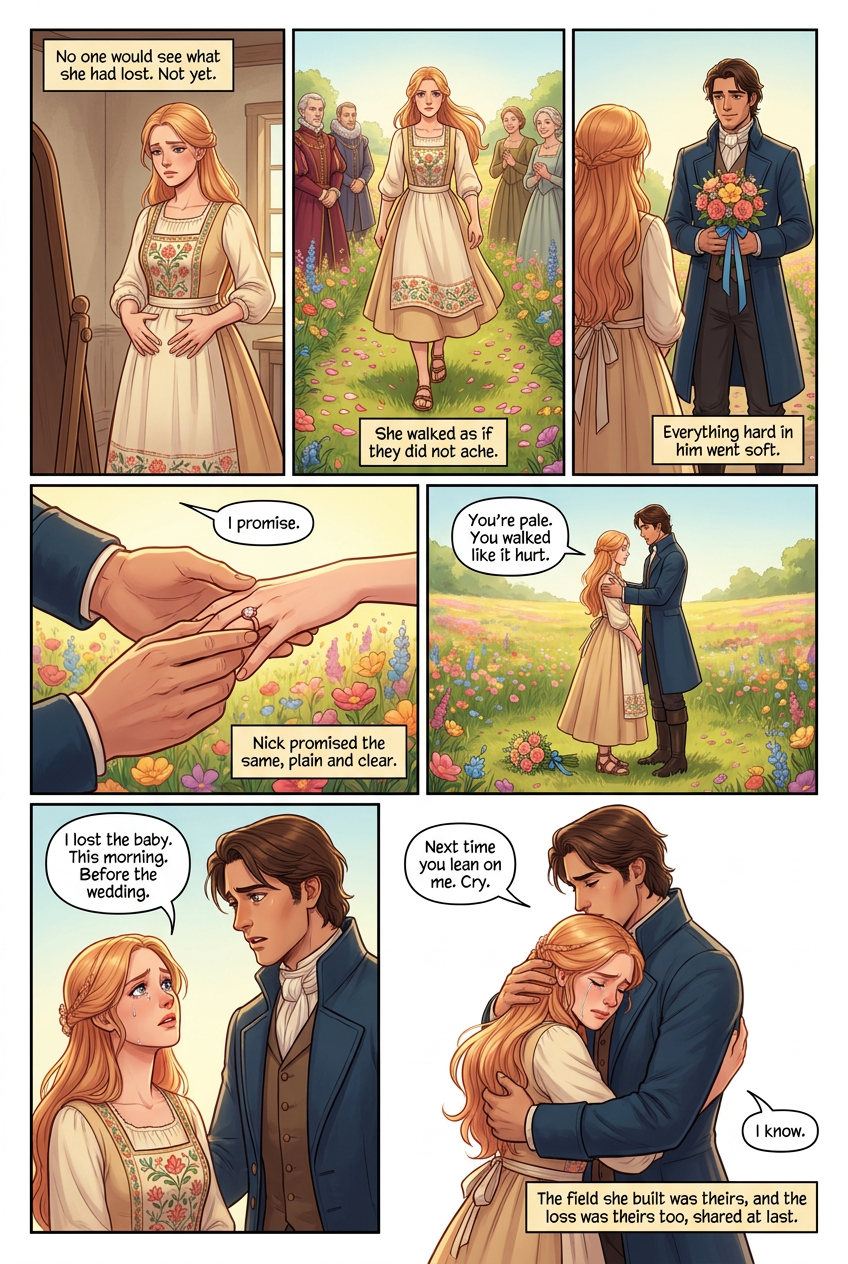
Delia washed the blood away and changed into her plain clothes. Her hands shook, but she made them still. Outside, the field waited. Nobles sat on one side, her patients on the other. The flowers she had planted stood bright under the sun. She had built this place for them all. She would not ruin it now. She pressed a hand to her flat belly, then let it fall. No one would see what she had lost. Not yet. She walked out into the field. A path ran between the two rows of guests. Someone had laid petals along it. The nobles turned to watch her, faces cool, looking for a crack. She gave them none. She kept her chin level and her steps even. Her legs still ached. She walked as if they did not. Nick stood at the far end, tall in his dark blue coat. His black hair caught the light. When he saw her, his face changed. Everything hard in him went soft. He held a bouquet of roses and sunflowers, tied with a blue ribbon. He had picked it himself. She fixed her eyes on him and let the crowd blur. The words came and she said them. She promised herself to him before the whole court. Nick promised the same, plain and clear, the way he said everything. He slid the ring onto her finger. The nobles found no reason to stop it. There was nothing common in the way she stood there. She had walked the path whole, and now it was done. They were married. Nick led her away from the guests, past the flowers, to the quiet edge of the field. He set the bouquet down on the grass. He looked at her closely. "You're pale," he said. "You walked like it hurt." Delia meant to hold it a while longer. She could not. "I lost the baby," she said. "This morning. Before the wedding." Nick went still. His jaw tightened. For a moment he said nothing at all. "You walked through all of that," he said. "After that." "I couldn't tell you first." Her voice broke. "If I'd said it, I'd have fallen apart. And they were watching. They wanted me to fall apart." He understood. She saw it land. He did not ask why she hid it, or make her explain. He pulled her against his chest and held her tight. She felt his hand press flat on her back. His breath was uneven. "You should have leaned on me," he said. "Not carried it alone." "I know." "Next time you lean on me." He held her tighter. "There's no court here now. Cry." So she did. The strength she had held all day let go. Nick did not loosen his grip. The nobles were gone from sight. The field she built was theirs, and the loss was theirs too, shared at last.
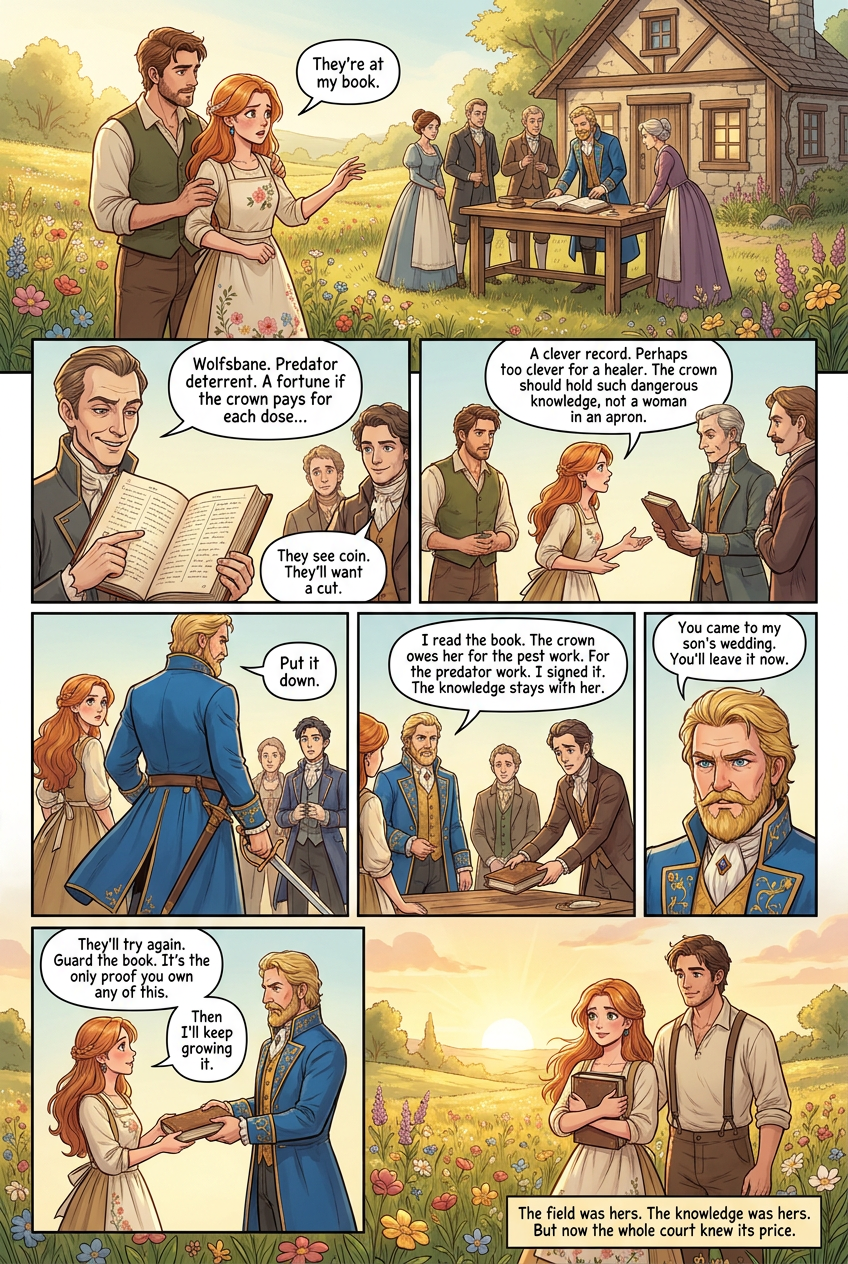
The wedding was done. Delia's tears had dried, but her legs still ached. Nick kept his arm around her as they walked back toward the field. The nobles had not left. They stood in a loose knot near her worktable, where her ledger lay open under the sun. One reached out and turned a page. Another leaned close, reading. Delia stopped walking. "They're at my book," she said. The ledger held everything. Every plant she grew. Every use. Every poison, with its price. She had written it because the king demanded it. Now the nobles studied it like a market list. One tapped the page and spoke low to the others. She caught a few words. Wolfsbane. Predator deterrent. A fortune, one said, if the crown pays for each dose. Nick's jaw tightened. "They see coin in it," he said. "They'll want a cut. Or want it taken from you." Delia crossed the grass. The nobles did not step back. One held her ledger up and smiled thin. "A clever record," he said. "Perhaps too clever for a healer. The crown should hold such dangerous knowledge, not a woman in an apron." Before Delia could answer, a heavy step sounded behind her. King Rowan Rider came through the flowers, his blue coat bright, his belly leading him. The nobles went quiet at once. They lowered the book. The king looked at the open ledger. He looked at the noble holding it. "Put it down," he said. The man set it on the table. "Your Grace," the noble began, "the poisons alone are worth—" "They're worth what she says they're worth," Rowan said. "I read the book. The crown owes her for the pest work. For the predator work. I signed it." He did not raise his voice. "The knowledge stays with her. She grows it. She names it. She keeps it." The noble's smile fell. "And if she dies? If it's lost?" "Then the kingdom loses a healer," the king said. "Not a thief." He turned to the whole knot of them. "You came to my son's wedding. You'll leave it now." The nobles bowed and moved off through the field, past the flowers, toward the road. Delia watched them go. Her hands had stopped shaking. Rowan picked up the ledger and held it out to her. "They'll try again," he said. "Not today. But they saw what your field is worth. They won't forget it." Delia took the book. "Then I'll keep growing it. Free for the sick. Paid by the crown for the rest." "That's the deal," the king said. He looked at Nick, then at her. "Guard the book. It's the only proof you own any of this." He walked away, slow and heavy, and left them alone in the field they had married in. Delia held the ledger to her chest. The field was hers. The knowledge was hers. But now the whole court knew its price.
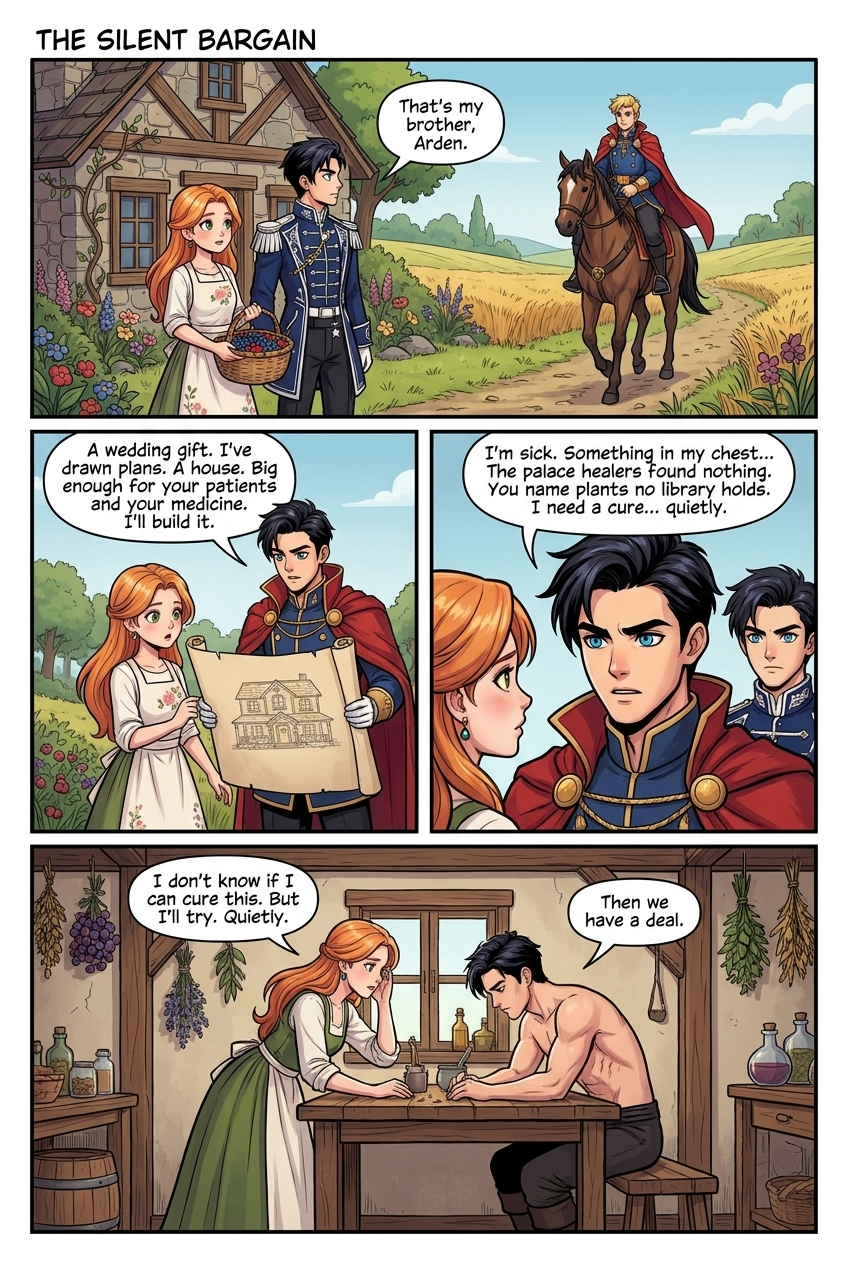
Two days after the wedding, a rider came up the field path. He was broad and blonde, green-eyed, in a red-lined coat. Delia had never met him, but she knew the face. Nick went stiff beside her. "That's my brother," he said. "Arden." The king's first son. The one the court whispered had been passed over. Delia set down her basket of berries and waited, the way she waited for anyone. Arden did not dismount right away. He looked at the flowers, the worktable, the sick lined on their side of the field. "You treat all these for free," he said. It was not a question. He climbed down and pulled a rolled paper from his saddlebag. "A wedding gift. I've drawn plans. A house. Big enough for your patients and your medicine. I'll build it." Delia unrolled the paper. A wide house, two floors, rooms for beds, a whole store for herbs. More than she could ever build alone. Her arc was a garden where every hurt traveler found care. This house would hold ten times what her cottage held. "Why?" she asked. Nick's jaw was tight. He knew his brother did nothing without a reason. Arden met her eyes. "I'm sick," he said. "Something in my chest. It's spreading. The palace healers found nothing." He said it flat, like reading a list. "You name plants no library holds. I need a cure. If one exists." He glanced back down the path. "And no one at court can know. Not my father. Not the nobles. A dying heir is a thing they'd use." Delia understood the trade at once. The house for the secret. Nick spoke first. "You come to my wife the week after our wedding and hand her a debt." Arden did not soften. "I hand her a house. And a patient. She helps people. I'm people." He looked at Delia. "Or I take the plans back." Delia thought of the nobles reading her ledger. If they learned the crown's own heir was dying, they'd tear her field apart looking for what saved or killed him. The risk was real. But a wounded man stood in front of her, and she had never once turned that away. "Sit," she said. "Let me listen to your chest." He sat on the bench by her worktable. She pressed her ear to his back and heard the wet catch in his breath. It was bad. She did not lie to him. "I don't know if I can cure this," she said. "But I'll try. Quietly." "Then we have a deal," Arden said. He stood and looked at the field like he already owned the ground the house would fill. The plans stayed in Delia's hands. She had her larger sanctuary now, and a secret that could burn it down. Somewhere in her field grew a plant that might save the king's first son, or one that might kill him. She did not yet know which was which.
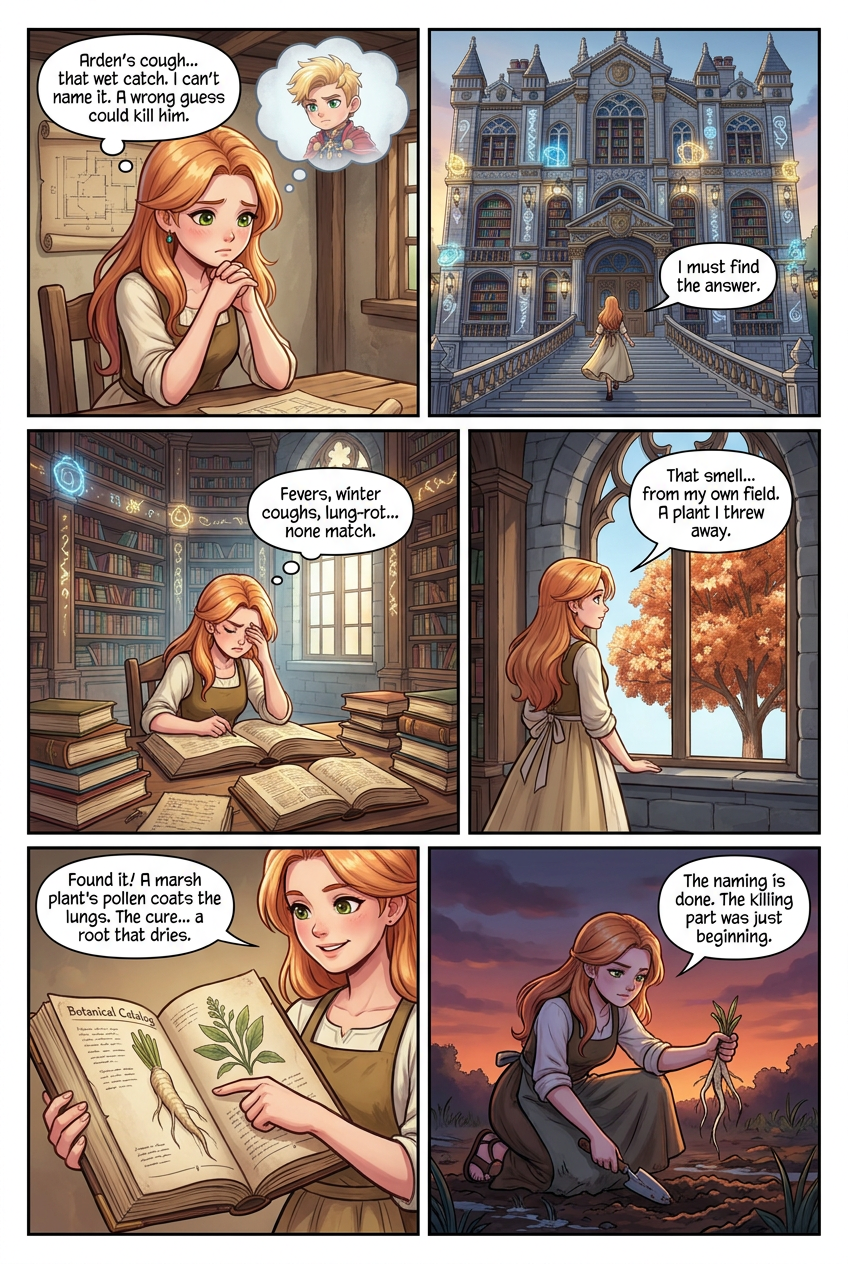
Arden's plans stayed rolled in Delia's cottage, but the wet catch in his breath stayed in her ears. She had heard many sick chests. Never one like his. She could not name it, and she could not treat what she could not name. A wrong guess would kill the king's first son. So at dawn she rode to the palace and climbed the wide stone steps to the great archive library. The doors were carved and gilded, taller than three men. Inside, shelves rose past the light. Glowing marks curled along the stone between them. Delia had been here once before, to name her strange plants. Now she came for a sickness. She told a clerk she needed records of chest illness, coughs, wet lungs. He led her to a corner and left her with a stack. She read all morning. Books listed fevers, winter coughs, the lung-rot that came from mines. None matched what she had heard. Arden's breath had a wet click low in the chest, and a smell she knew but could not place. She pressed her memory. Not smoke. Not rot. Something green. By noon her eyes burned. She carried a book to a tall window for better light. Outside stood a maple with copper leaves, its canopy full and bright against the gray stone. She watched it a moment and let her mind rest. Then the smell came back to her. It was the smell of her own field. Of a plant she had crushed by accident and thrown away. She turned pages faster now. Not sickness books. Plant books. She found it near the back of a thick catalog: a marsh plant whose pollen and dust, breathed in over weeks, coated the lungs and made them weep. The book named the source. It named the cure too, a root that dried the lungs. Both grew in wet ground. Both grew in her field. Delia sat back. Arden was not sick from within. Something he breathed had done this. The wet ground near the palace, or near his own hunts. She had walked past the cause a hundred times without knowing. Now she knew the name. She knew the root that answered it. She copied the page into her own hand, closed the book, and returned it to the clerk. Her ride home was fast. She had a plant to find and a dose to measure, and the measure had to be exact. Too little would do nothing. Too much of the drying root would stop his breath as surely as the illness. She reached her field by dusk and knelt at the wet edge she had always avoided. The root was there, pale and thick. She dug three and carried them to her table. The naming was done. The killing part was just beginning.
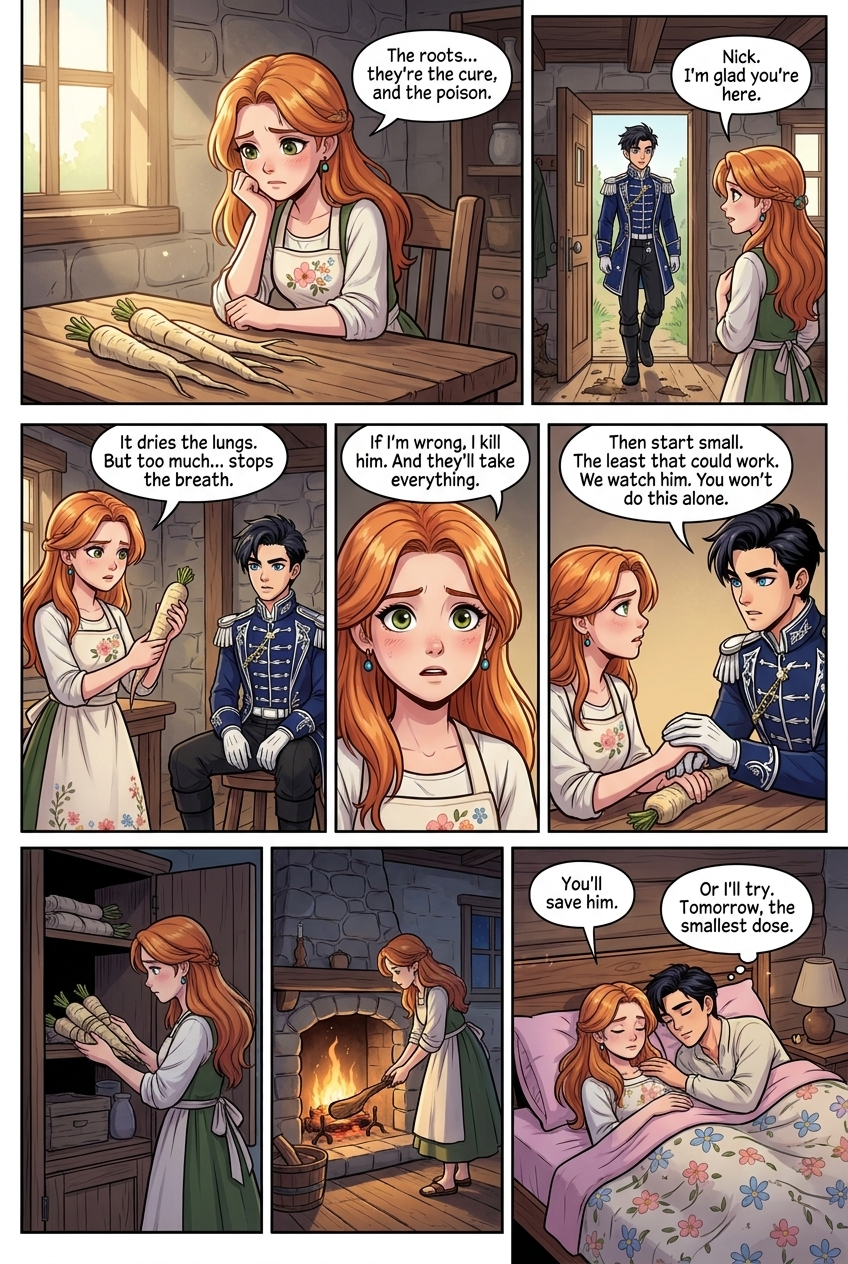
The three roots lay on Delia's table, pale and thick. She had named the illness and found the cure. Now she had to decide the dose, and a wrong measure would kill Arden as surely as his sickness. She turned the roots in her hands and did not trust herself alone. When the cottage door opened and Nick stepped in, mud on his boots, she was glad she had waited. Nick set down his gloves and looked at the roots. He knew what they meant. Delia had told him of his brother's secret bargain, though the two men had not spoken in years. "You found it," he said. "I found it." She pointed. "This root dries the lungs. It answers what's drowning him. But it's a poison too. Too little does nothing. Too much stops his breath." Nick pulled a stool close. "How much is too much?" "That's the danger. I don't know his weight or how far the illness has gone." She pressed her thumb to the root. "If I give a healing dose to a body already weak, I could push him over. If I give too little, he coughs another week and dies anyway." Nick was quiet. When he spoke, he did not soften it. "So you might be the one who kills him." "Yes." She held his eyes. "And if the court learns I dosed the king's first son with poison and he died, they take everything. The field. The ledger. Maybe you." "Then start small." He said it plainly. "Give the least that could work. Watch him. Add to it only if his breath eases and his color holds. Never leap." Delia let out a slow breath. It was the answer she had circled all evening but had feared to trust. "Small, then wait. Small again." She nodded. "It's slower. He suffers longer." "He's suffered years. A few more days won't undo him." Nick reached across and closed her hand around the root. "You measure. I'll be there when you carry it to him. You won't do this alone." She felt the weight lift a little. Not the danger, but the loneliness of it. She wrapped the three roots in cloth and set them in the cool cupboard where the light would not reach. "Tomorrow I grind the first dose. The smallest one." "Tomorrow," he agreed. Delia banked the fire. Outside, the river ran low and steady past the flower border. Nick took off his boots by the cedar bed and turned back the blanket with its blue flowers. She lay down beside him under the pink sheets, and for the first time in days her hands were still. "You'll save him," Nick said into the dark. "Or I'll try, and know I tried right." She closed her eyes. The decision was made. In the morning she would begin the smallest dose, and either the root would heal a dying prince or prove she should never have taken his bargain. She slept.
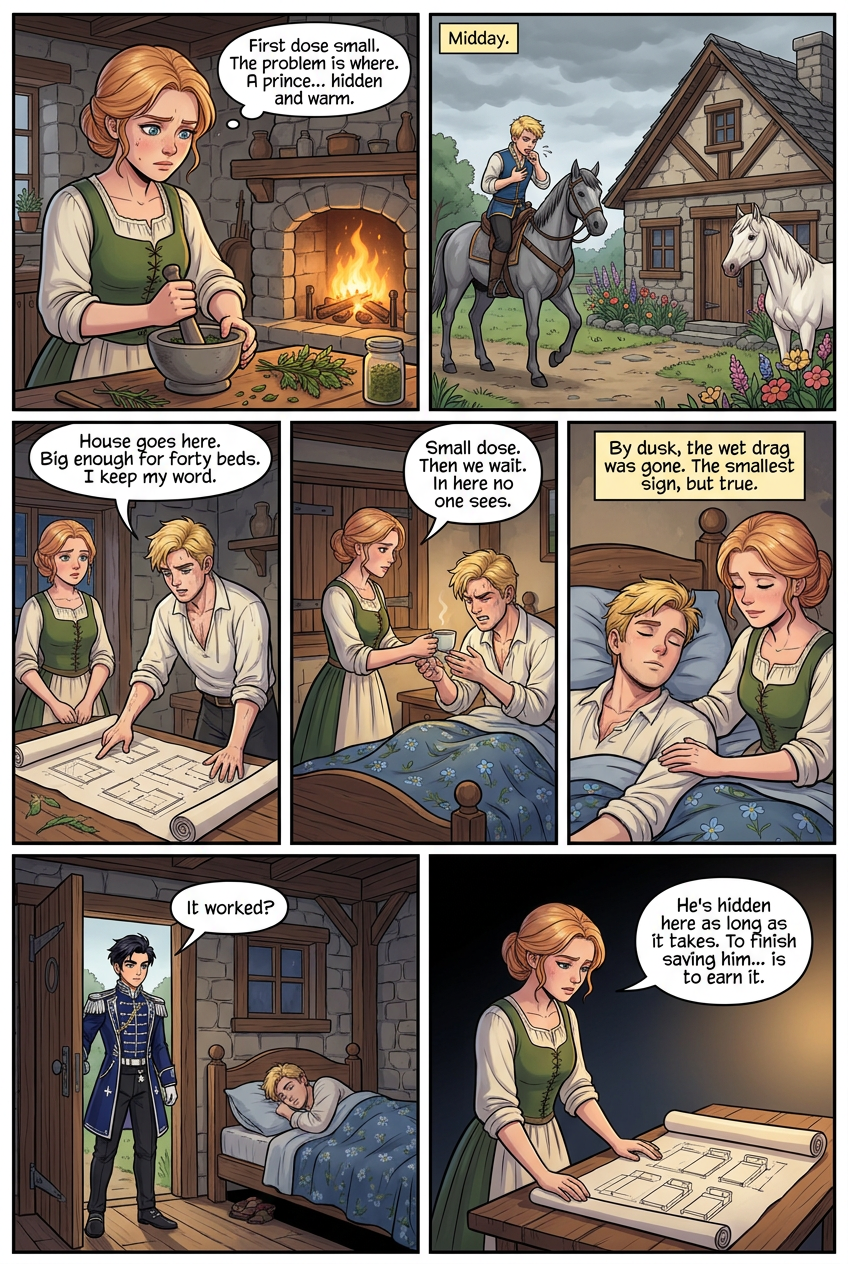
Delia woke before dawn and ground the first dose small. The problem was not the powder now. It was where to give it. Arden was the king's first son. If a servant saw him sick in her open field, the court would learn of the bargain. She needed a place private and warm, where he could sweat and shake through the poison without a stranger's eyes. She had one idea. Nick had brought her plans for a large house Arden promised to build for her practice. She would tell the court Arden came to help lay it out. A prince inspecting a gift. No one would think to look closer. He came at midday on a gray horse. Broad-shouldered, blonde, green eyes gone dull from the cough. He dismounted slow, one hand pressed to his chest. Delia's white horse lifted his head from the flower border but did not spook. Only she rode him, and he watched Arden the way she did, careful. "Show me the plans," Arden said. No greeting. He unrolled a wide sheet across her table and stabbed a finger at it. "House goes here. Big enough for forty beds. I keep my word." He coughed into his fist. Blood flecked the cloth. He folded it away before she could speak. "The court thinks that's why you came," Delia said. "Let them. But the plans are real. When you're well, you'll build it." He looked at her flat. "You think I'll be well." "I think you'll try, and I'll try with you." She banked the fire higher until the cottage went hot. She drew the shutters. "In here no one sees. You'll be sick before you're better. I need you warm and hidden for that." Arden sat on the cedar bed. For a moment the hard set of his jaw slipped. "My father never gave me a warm room to be sick in," he said. "He gave that to Nick." Delia said nothing to that. She measured water and stirred the powder in. "Small dose. Then we wait. If your breath eases, more tomorrow." She held out the cup. He took it without pause and drank it down. He grimaced at the taste. Then he lay back on the blue-flowered blanket and closed his eyes. Delia sat beside him through the afternoon. His breath rasped, caught, then eased a fraction. His color held. No worse. By dusk he slept without the wet drag in his chest she had heard at his arrival. The smallest sign, but a true one. Nick came in from the field and stood in the doorway, watching his brother sleep in the warm dark. "It worked?" "The first dose held," Delia said. "He's hidden here as long as it takes." She looked at the plans still spread on her table, the forty beds drawn in ink. The house she wanted was on that page. To finish saving Arden was to earn it. She had a warm room, a hidden prince, and a start.
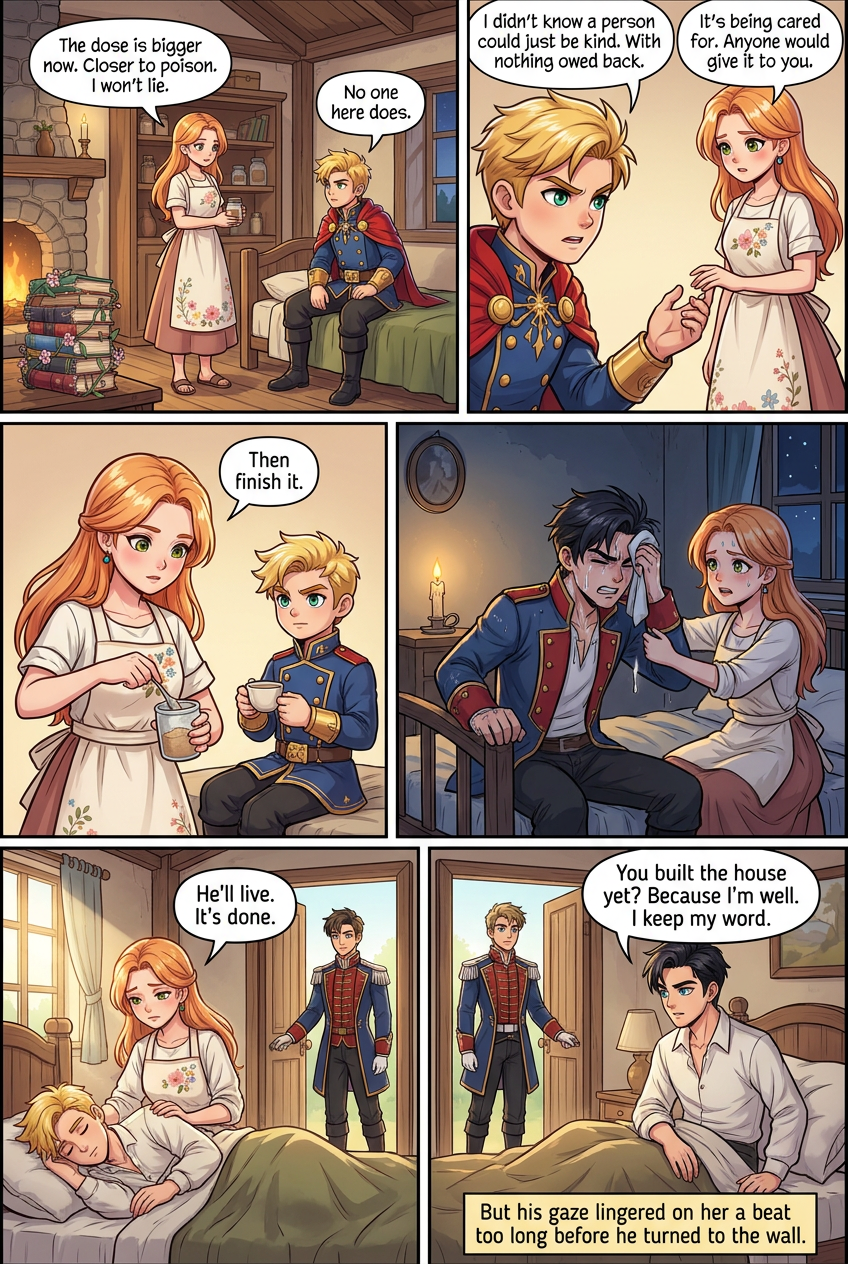
Six mornings passed. Each dawn Delia measured the powder a little larger, watched Arden sweat and shake, and watched his breath come cleaner after. Now two doses remained in the jar. She counted them by candlelight and knew: give both, and he was cured or dead. There was no third try. Arden woke while she stood at the shelf. He had grown steadier in the warm cottage. The wet drag was gone from his chest. He watched her hands. "You're afraid of the last one," he said. Flat, like he read it off her back. "The dose is bigger now. Your body is stronger. But bigger means closer to poison." She set the jar down. "I won't lie to you." "No one here does." He said it plain, but something moved under it. He looked at the flower-vined books stacked by the hearth, the border of blooms out the window, the blue blanket he'd sweated through. "Nick got rooms like this his whole life. Warm. Someone sitting up with him." He met her eyes. "I didn't know a person could just be kind. With nothing owed back." "You owe me a house," Delia said, trying to lighten it. "That's a trade." Arden shook his head slow. "This isn't." He reached for her wrist, then stopped himself. His jaw set hard, but his eyes stayed on her too long. "I don't know what this is I feel. I've never had it aimed at me." Delia felt the weight of what he meant. She was married to his brother. She kept her hand still and her voice level. "It's being cared for," she said. "That's all. Anyone would give it to you. I'd give it to a stranger on the path." She said it kindly, but she said it clear. Arden held her look a moment more. Then he let it go. He nodded once, like a man setting down something heavy he couldn't keep. "Then finish it," he said. She mixed the seventh dose and gave it. He drank without pause. This time the shaking came worse. He gripped the bed rail, breath ragged, sweat sheeting his face. Delia stayed the whole night, wiping his brow, counting each breath. Near dawn the shaking stopped. His chest rose deep and even. No blood. No drag. She pressed her ear to him and heard clean air move. The eighth and last dose she never needed. He was cured on the seventh. Nick found them at first light. He looked at his brother sleeping easy, then at Delia's tired face. "He'll live," she said. "It's done." Arden opened his eyes. He looked at Nick standing in the doorway, then at Delia. "You built the house yet?" he asked her. "Because I'm well. I keep my word." But his gaze lingered on her a beat too long before he turned to the wall. Nick saw it. He said nothing. He only watched his brother, and kept it to himself.
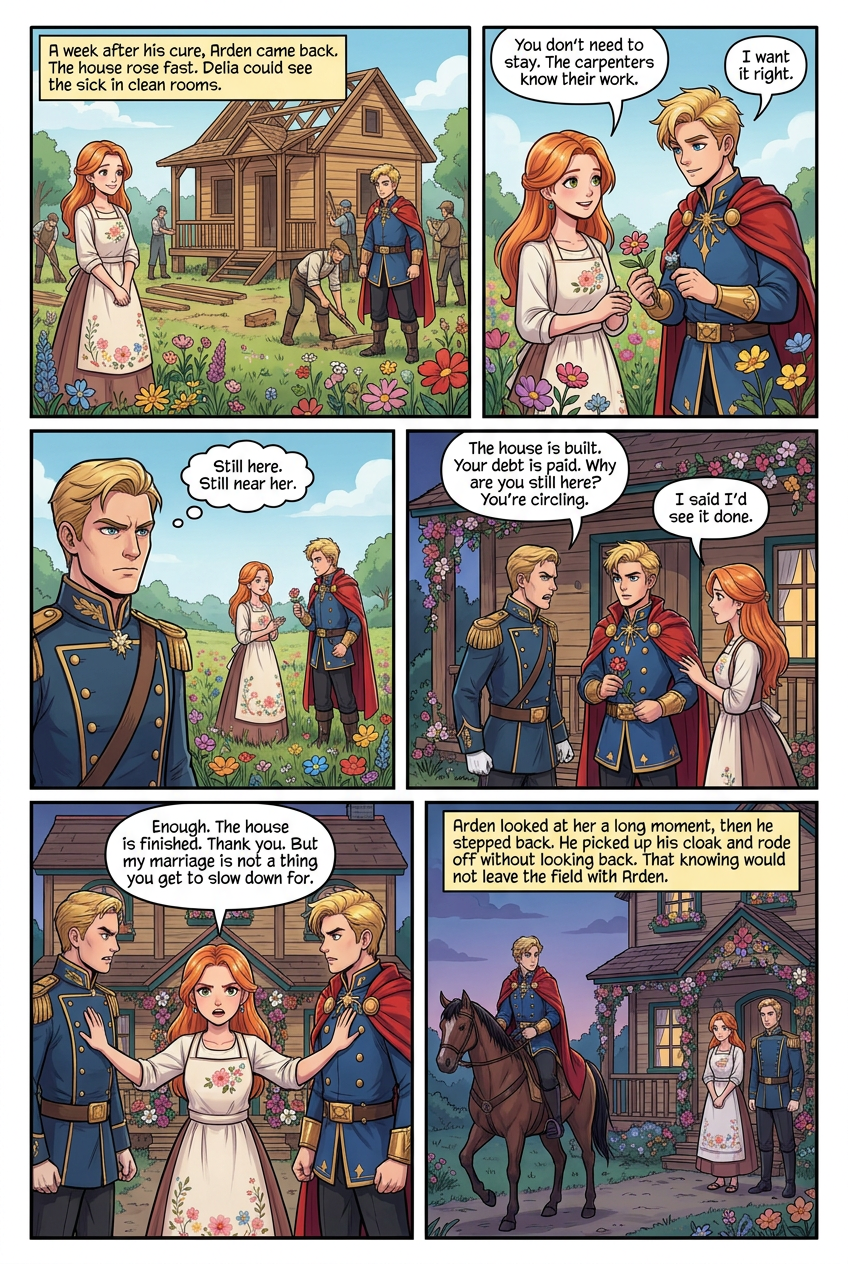
A week after his cure, Arden came back to Delia's field. He kept his word. He brought carpenters and carts of cut timber, and he stayed to watch the house go up. Delia thought he would send the plans and leave. Instead he lingered by the flowers every morning, longer than the work needed. The house rose fast. Delia watched the frame become walls, then a porch, then windows with boxes for blooms. It would hold forty beds. She could already see the sick lying in clean rooms instead of the open field. This was the thing she had wanted from the start. But Arden slowed the work. He questioned the timber. He sent for finer wood. He argued that the doorframe should be wider, the shelves deeper, the roof pitched higher. Each change added a day. Each day he walked the meadow beside Delia, asking which flower was which, standing close. "You don't need to stay," she told him one morning. "The carpenters know their work." "I want it right," Arden said. He did not look at the house. He looked at her. Nick saw it all. He came each evening from the palace and found his brother still there, still near his wife. He said nothing, but his jaw hardened. He and Arden had spent their lives fighting for their father's eyes. Now they stood in the same field, fighting for something else. One evening Nick found them at the porch. Arden held a bloom he had picked, turning it in his fingers, telling Delia its name as if he taught her. Nick crossed the grass fast. "The house is built," Nick said. "Your debt is paid. Why are you still here?" Arden set the flower down. "I said I'd see it done." "It's done." Nick stepped between his brother and Delia. "You're not building anymore. You're circling." The brothers stood close, chests near touching. Delia had seen them cold to each other, but never this. This was not about the throne. It was about her. "Enough," Delia said. She put a hand flat on each man's chest and pushed them apart. "The house is finished. Arden, thank you. Your promise is kept. But my marriage is not a thing you get to slow down for." Arden looked at her a long moment. Then he stepped back. "You made it plain before," he said. "I heard you. I just wanted more days near it." He picked up his cloak. "I'll go." He mounted his horse and rode off without looking back. The finished house stood behind them, draped in blossoms, its rooms waiting for the sick. Nick let out a breath. He turned to Delia, and the anger drained from his face. But something stayed in his eyes. His brother had ridden away wanting his wife, and now they both knew it. That knowing would not leave the field with Arden.
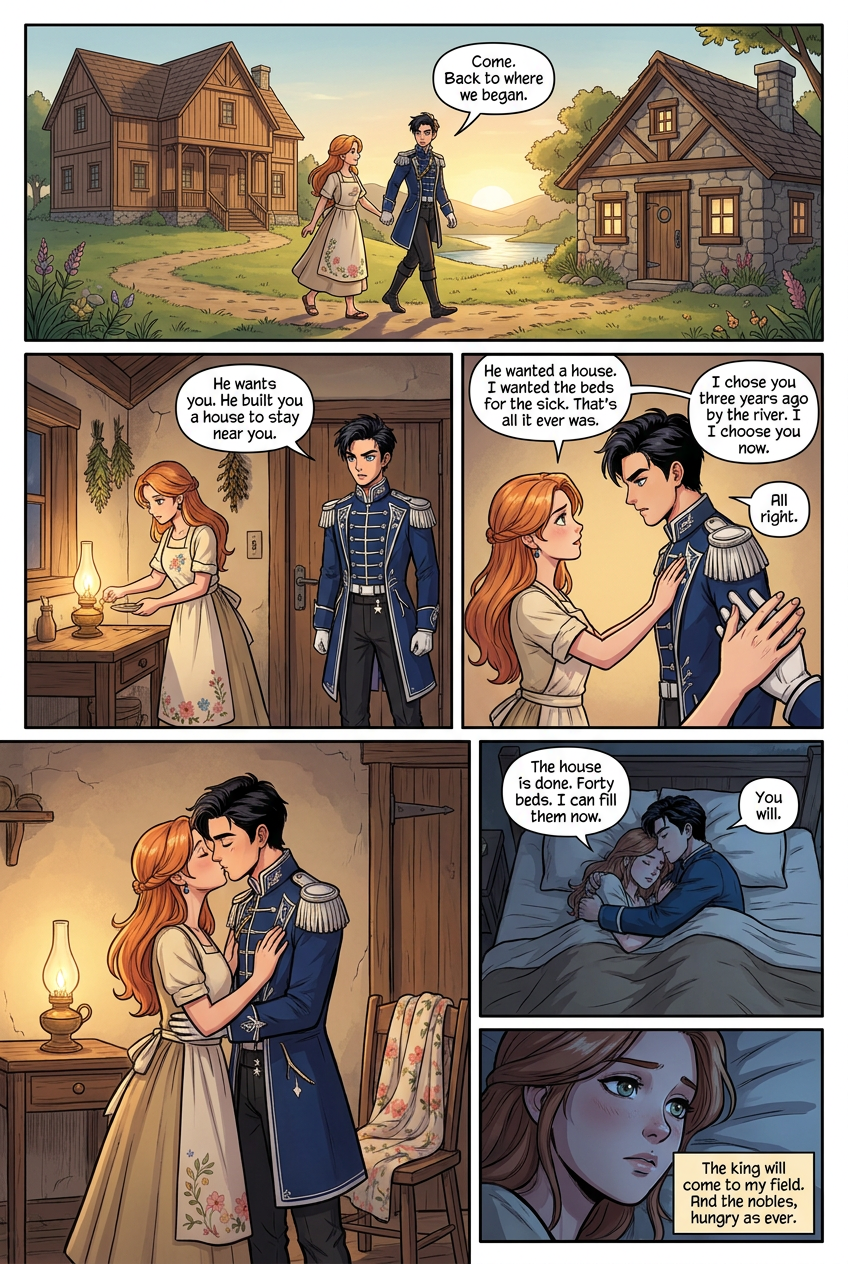
Arden's horse was gone from the field, but his shadow stayed. Nick watched the empty road long after the dust settled. Delia saw the doubt still sitting in him. Words at the porch had not been enough. So she took his hand and led him away from the finished house, back to the small stone cottage by the river where they first began. The cottage smelled of dried herbs and river water. Delia lit the lamp. Nick stood by the door, stiff, his jaw hard the way it got when something cut deep. "You're wondering," she said. "About your brother." "He wants you." Nick did not soften it. "He built you a house to stay near you." "He wanted a house. I wanted the beds for the sick." Delia crossed the room. "That's all it ever was to me." "He picked flowers for you. Every morning." "And I named them for him and sent him back to work." She stopped close to Nick. She put her hand flat on his chest, over his heart. "Listen to me. I turned him away when he was still weak from the cure. I turned him away at the porch. I chose you three years ago by the river, before any land or crown. I choose you now." Nick looked at her hand. "You never say a thing you don't mean." "Then hear this and hold it." Delia lifted his chin the way she lifted a frightened patient's. "You are the one I want. Not your brother. Not any other man. You. There is no doubt in me. Let there be none in you." Something broke loose in Nick's shoulders. The hardness left his jaw. He let out a long breath, as if he had held it since the day Arden first lingered too long in the meadow. He raised his hand and covered hers where it rested on his chest. "All right," he said. "All right." He kissed her then, slow at first, then not slow. Delia untied her apron and let it fall over a chair. The lamp burned low. Outside, the river ran on past the flowers at the door, the way it always had. Inside, there was no palace, no nobles, no ledger, no brother. There was only the two of them in the little house where it started. Afterward they lay quiet under the blankets. Nick's arm was heavy across her. The doubt had gone out of him. Delia felt it leave, the way fever leaves a body once the medicine takes. "The house is done," she said into the dark. "Forty beds. I can fill them now." "You will." Nick's voice was warm and sure. "Tomorrow we tell my father it's finished. He'll want to see it." Delia lay still. The house was built and her marriage was whole. But the king would come to her field. And the nobles would come with him, hungry as ever for what she had made.
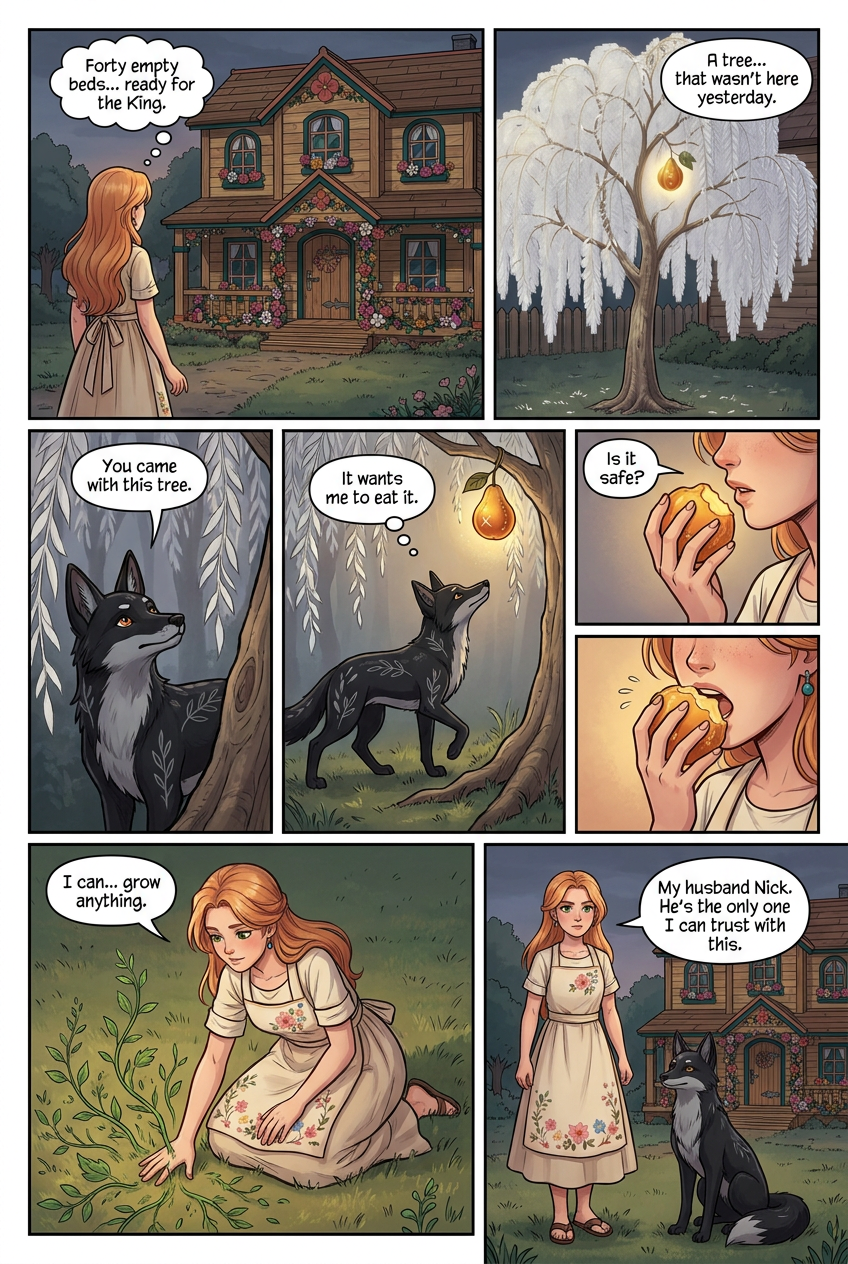
At dawn Delia walked to the finished house alone. Blossoms climbed its porch rails and framed every window. Forty beds waited inside, empty and clean. She wanted to see it once more before the king came. But near the door she stopped. A tree stood there that had not stood there yesterday. It was a weeping willow, its leaves pale as bone. Long branches hung to the grass and swayed with no wind. Among them, one fruit glowed like a coal. Delia stepped closer. The fruit gave off a soft light against the dim morning. The black fox slipped from the willow's shadow. Delia knew the animal well; it had walked her fields for weeks, nosing out roots and leaves she needed for medicine. Now it sat beneath the strange tree and looked up at her. Its amber eyes held her the way a patient's eyes hold a healer before a hard truth. "You came with this tree," Delia said. The fox rose. It stepped to the trunk, then back to her, then to the trunk again. It stopped under the glowing fruit and looked up, then at her. The meaning was plain. Eat. Delia hesitated. She knew fruit that killed. She grew nightshade herself and never forgot its danger. She reached up and touched the fruit. It was warm. The warmth ran down her arm and settled in her chest, gentle, not sharp. The fox pressed its head against her leg. It had never led her wrong. Every plant it found had healed someone. She trusted its nose more than her own hands. So she picked the fruit and bit into it. Sweetness filled her mouth. Then something opened behind her eyes. She saw every plant she had ever grown, and every one she had ever wanted and lacked. The drying root for lungs. The nightshade. Herbs with no names she had never held. She knelt and pressed her palm to the bare grass. Green broke through the dirt under her hand. Stems rose. Leaves spread. A patch of healing herb she needed spread across the ground in one breath. Delia pulled her hand back and stared. She thought of a rarer plant, one Bram had once named for her, and pressed down again. It grew. She sat back on her heels, shaking. She could grow anything now. Any medicine, any root, any leaf. No trade with Bram. No empty market. No sick person turned away for want of a plant. The fox sat beside the willow, calm, as if its work was done. Delia looked at the forty beds through the open door, then at the ground she could now fill with any cure the wounded needed. She also know if anyone found out about her new gift they would try to use her. So the only person who she trusted to tell was her husband Nick. The king would come today. The nobles would come with him, hungry for what she made. But now what she made had no limit. She stood, brushed the dirt from her knees, and knew the ground under her feet had changed for good.
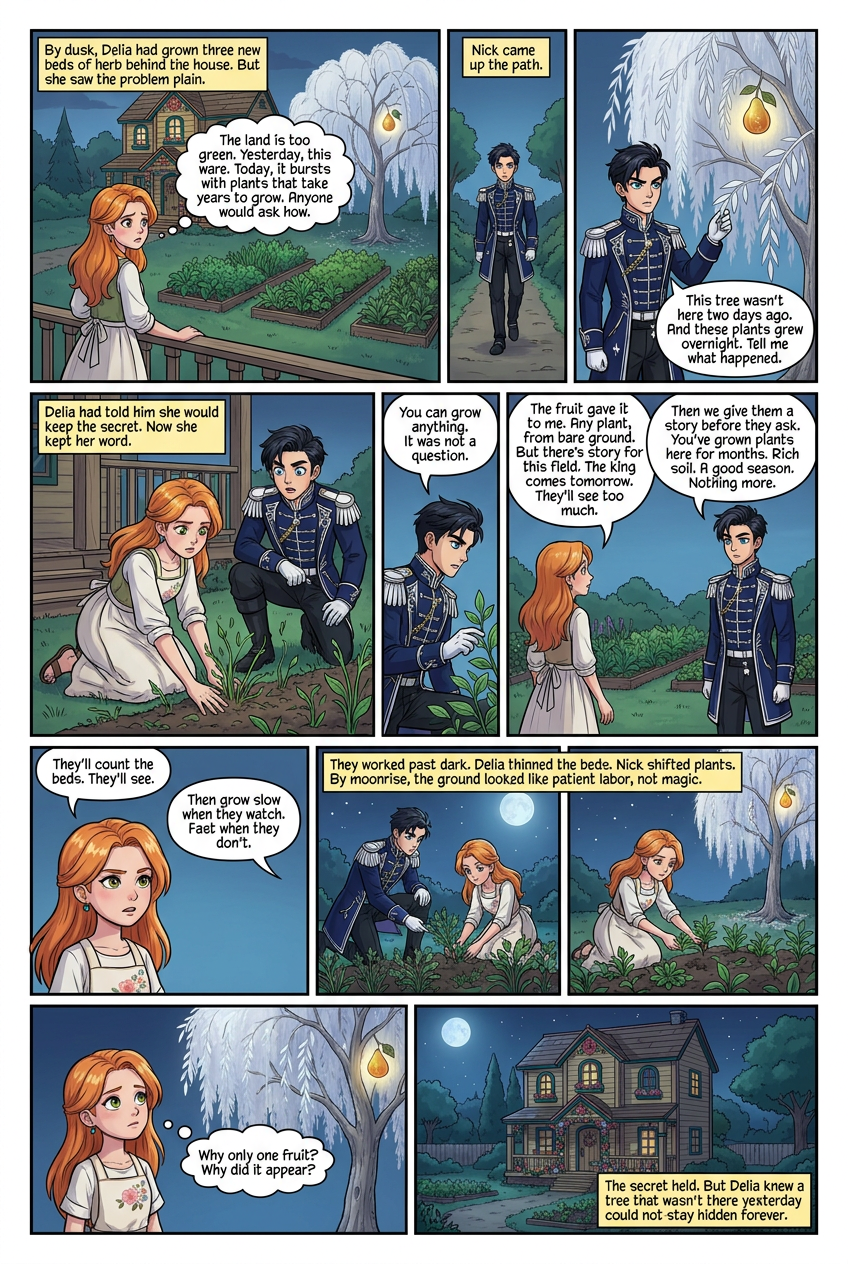
By dusk Delia had grown three new beds of herb behind the flower-draped house. She meant to fill the empty forty beds with cures no market could sell her. But she stood at the porch rail now and saw the problem plain. The land was too green. Yesterday the ground was bare. Today it burst with rare plants that took years to grow. Anyone who walked here would ask how. One wrong answer would send nobles hunting the willow and her secret. She had power without a cover for it. Nick came up the path in his dark uniform. He walked straight to the pale willow near the door and stopped. Its white leaves swayed with no wind. He touched one branch, then looked at the ground where the new herbs spread thick. "This tree wasn't here two days ago," he said. He did not soften it. "And these plants grew overnight. Tell me what happened." Delia had told him she would keep the secret from everyone but him. Now she kept her word. She knelt and pressed her palm to the bare dirt at the porch edge. Green broke through. Stems rose and spread into a patch of drying root, the same root that had cured his brother. She pulled her hand back. Nick knelt beside her. He touched the new leaves as if to prove them real. "You can grow anything," he said. It was not a question. "The fruit gave it to me," Delia said. "Any plant, any cure, from bare ground. No trade with Bram. No empty market. No one turned away." She looked at the willow. "But look at the field. There's no story for it. The king comes tomorrow. The nobles will see rare plants where weeds grew. They'll ask how. If one word slips, they'll take me apart to learn it." Nick stood and studied the green fields for a long moment. "Then we give them a story before they ask," he said. "You've grown plants here for months. You bought seed. You traded with Bram. The court already knows that. We say the field finally came in strong after a good season. Rich soil. Nothing more." "They'll count the beds," Delia said. "They'll see too much." "Then grow slow when they watch," Nick said. "Grow fast when they don't. Never touch the ground with anyone near. The willow stays hidden behind the house. If they never see the source, there's nothing to chase." Delia looked from him to the swaying tree. A cover story built on the truth they already believed. She could hide the miracle inside the ordinary. "A good season," she repeated. "That, I can sell." They worked past dark. Delia thinned the newest beds by hand so the field looked earned, not conjured. Nick shifted plants to spread the growth even. By moonrise the ground looked like patient labor, not magic. As Delia looked at the willow she noticed no new fruit appeared on it. And she wondered why it had appeared and only grown one fruit. The secret held. But Delia knew the willow still stood behind her house, and a tree that wasn't there yesterday could not stay hidden forever.
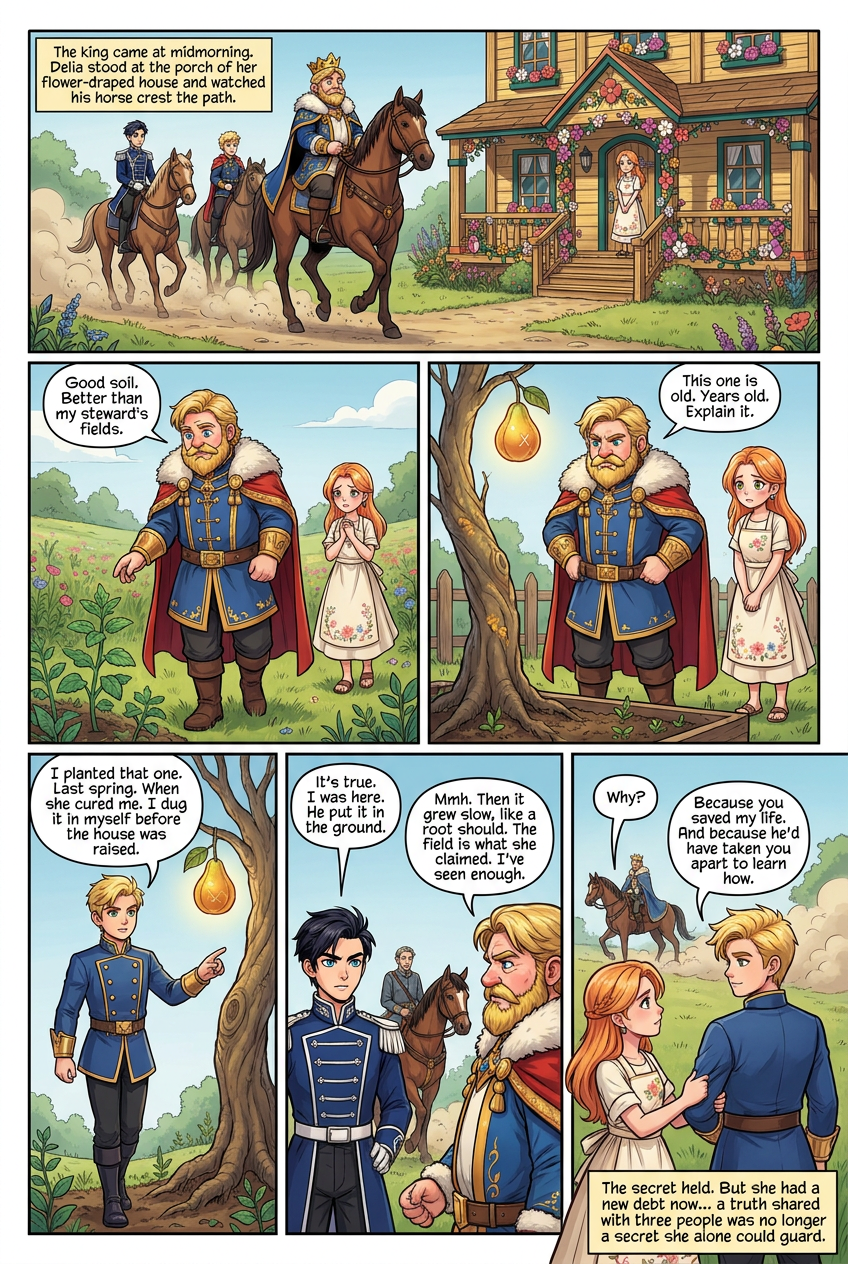
The king came at midmorning. Delia stood at the porch of her flower-draped house and watched his horse crest the path. Nick rode beside his father. Behind them, well back, came Arden. The beds looked earned now, thinned and spread by two nights of labor. But one bed near the fence still troubled her. A drying root had shot up thick and tall overnight. She had grown it too fast to hide. Rowan swung down and walked the rows without a word. He stopped at each bed. He counted. He touched the leaves of a young mint and moved on. Delia followed a step behind, her hands folded to hide their shaking. "Good soil," Rowan said. "Better than my steward's fields." He stated it plainly and kept walking. Then he reached the fence bed. He looked at the tall root. His brows drew down. "This one is old. Years old. The rest are months." He turned to her. "Explain it." Delia's mouth went dry. She had no answer that would hold. Arden reached the fence then. He had dismounted quietly. He looked at the root, then at Delia, then at his father. Delia braced. This was the brother she had ordered off her land, the man who wanted her still. "I planted that one," Arden said. Flat, like a fact everyone should know. "Last spring. When she cured me. I dug it in myself before the house was raised." He met the king's eyes. "You want a witness. I'm your witness." Rowan studied his first son. The court had watched this man lose his father's favor. Now he stood covering for the woman his brother married. Rowan said nothing for a long moment. Nick stepped in beside Arden. "It's true," Nick said. "I was here. He put it in the ground." He did not look at his brother. He looked at his father and held the lie steady. Rowan looked from one son to the other. Two princes who agreed on nothing, agreeing now. He grunted. "Then it grew slow, like a root should." He let the tall stem go. "The field is what she claimed. I've seen enough." He mounted and rode for the gate. His steward trailed after him. The danger passed with the dust of the horses. Arden turned to leave without a word. Delia caught his sleeve. "Why?" she asked. He looked at her hand, then her face. "Because you saved my life," he said. "And because he'd have taken you apart to learn how." He pulled free and walked to his horse. Delia stood between the two brothers who had shielded her. The secret held. But she had a new debt now, one owed to the man she had sent away. And she knew Arden would come to collect it. A truth shared with three people was no longer a secret she alone could guard.
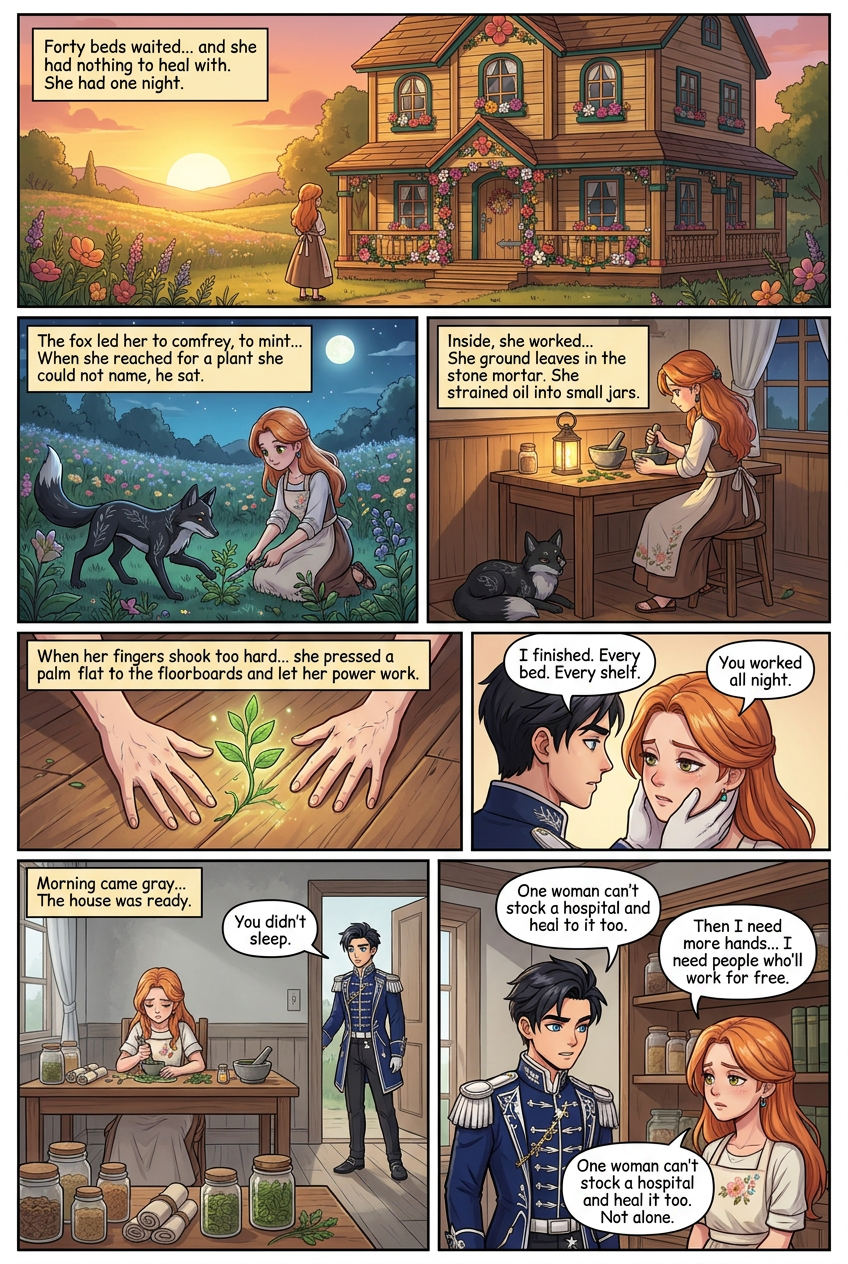
The king rode off, and the danger went with him. But the flower-draped house behind Delia still stood empty. Forty beds waited in clean rows. She had built a place to heal, and she had nothing to heal with. No bandages folded. No salves ground. No jars filled. Patients would come at dawn, and she would meet them with bare shelves. She looked at the sun sinking behind the meadow. She had one night. She started with the field. The black fox trotted at her heels, nose down, weaving through the flowers and herbs. He stopped at a patch of yarrow and pawed the dirt. Delia knelt and cut what he found. He led her to comfrey, to mint, to the drying root by the fence. She filled her basket, emptied it on the cedar desk, and filled it again. The fox never tired. When she reached for a plant she could not name, he sat until she passed it by. Inside, she worked at the desk by lamplight. She ground leaves in the stone mortar. She strained oil into small jars and pressed corks tight. She rolled clean strips of cloth for wrapping wounds. The fox lay by her feet, ears up, watching the door. Twice he brought her a dropped root in his teeth and set it on her lap. She scratched his neck and kept grinding. The hours passed. Her hands cramped. Her eyes stung. She lined the finished jars along a shelf, one row, then two, then three. When her fingers shook too hard to hold the pestle, she pressed a palm flat to the floorboards and let her power work. A fresh sprig of mint rose between the planks. She cut it and ground it and did not stop. Morning came gray through the flower-framed windows. Delia sat slumped at the desk, surrounded by full jars and neat rolls of cloth. The shelves were stocked. The house was ready. The door opened. Nick stepped in, and his face changed the moment he saw her. He crossed the room fast. "You didn't sleep." "I finished," she said. Her voice came out thin. "Every bed. Every shelf. They can come now." He took her chin and turned her face to the light. He saw the gray under her eyes, the tremor in her hands. "You worked all night." "The fox helped." She tried to smile. "He found what I needed." Nick knelt so their eyes met level. "This can't be how it goes. You'll burn out before the month is done." He set his jaw. "One woman can't stock a hospital and heal it too. Not alone." Delia looked at the full shelves. He was right, and she knew it. The house was ready today. But tomorrow it would empty again, and the day after that. She had built something too large for two hands. "Then I need more hands," she said. "I need people who'll work for free."
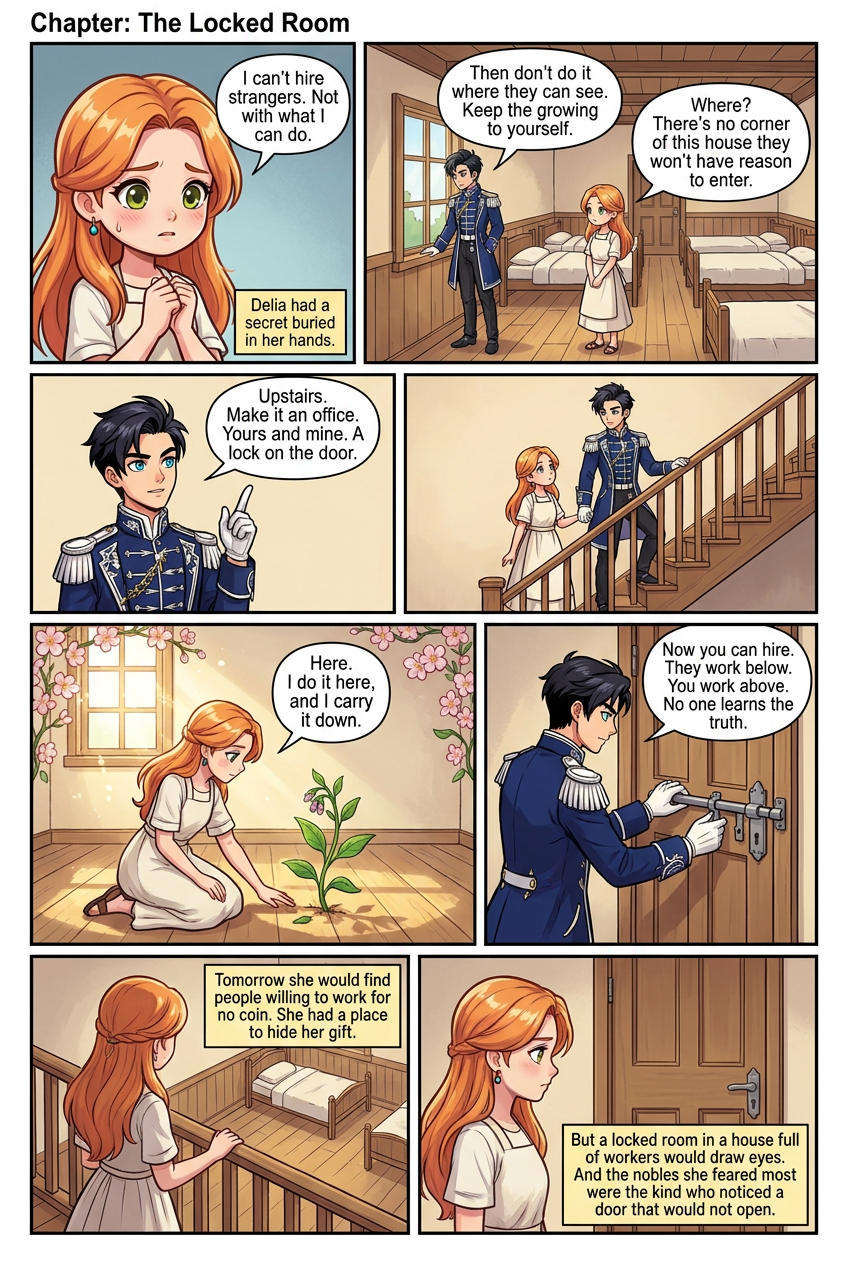
Delia said she needed helpers, and the words hung in the air. But a new fear rose with them. She had a secret buried in her hands. When her fingers touched the ground, plants sprang up whole. Any worker she hired would see it. They would watch her fill jars faster than any healer could. They would talk. And the nobles were always listening for one loose thread to pull. "I can't hire strangers," she told Nick. "Not with what I can do. One of them sees me touch the floor and a mint sprig climbs up, and it's over. The king would know by supper." Nick set his jaw. He walked to the window and looked at the empty field. "Then don't do it where they can see," he said. "Hire hands for the beds and the wash and the wrapping. Keep the growing to yourself." "Where?" Delia asked. "There's no corner of this house they won't have reason to enter." Nick turned. He pointed at the ceiling. "Upstairs." Delia followed his hand. The house had a second floor, wide rooms she had left bare. She had planned to fill them with beds. She had not thought past that. "Make it an office," Nick said. "Yours and mine. A lock on the door. No worker sets foot up there. You grow what you need behind that door, then carry it down as stock. They only see the finished jars. They never see how." She thought it through. A hired girl would fold cloth and scrub floors below. A hired man would carry water and lift patients. None of them would climb the stairs. The magic stayed hidden. The work still got done. "They'll wonder why the door's locked," she said. "Let them wonder," Nick said. "A prince and his wife want one room to themselves. No one questions that." Delia climbed the stairs. Nick came behind her. The largest room faced the morning sun. Blossoms framed the window from the vines outside. She pressed a palm to the floorboard. A stem of comfrey rose green between the planks. She cut it and held it up. "Here," she said. "I do it here, and I carry it down." Nick found a spare bolt in the toolbox and fixed it to the door that afternoon. He tried the lock twice. It held. He put one key in her apron pocket and kept the other. "Now you can hire," he said. "They work below. You work above. No one learns the truth." Delia looked down the stairs at the rows of beds. Tomorrow she would find people willing to work for no coin. She had a place to hide her gift and a way to grow the hospital past two hands. But a locked room in a house full of workers would draw eyes. And the nobles she feared most were the kind who noticed a door that would not open.
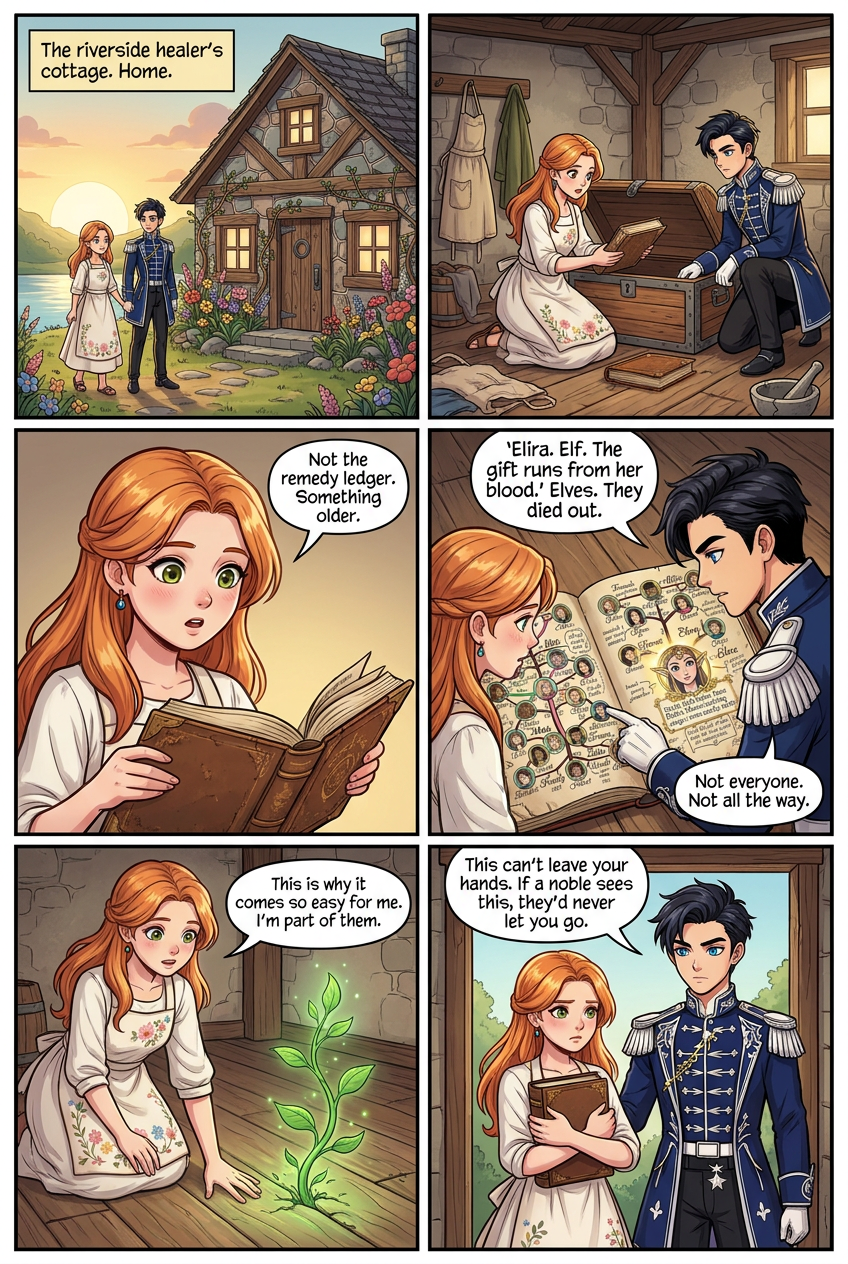
The locked office was ready, but Delia still needed her old cottage. She had left a box of her grandmother's things there, and she wanted the ledger of remedies inside it. So she and Nick rode back to the riverside. The stone cottage stood where the path met the water, its windows framed by vines, flowers crowding the door. Delia had not slept there in weeks. It smelled of dried herbs and dust. She knelt at the old cedar chest by the hearth. Nick crouched beside her. They lifted out folded aprons and a cracked mortar. Under a wool blanket lay a book she did not know. Its cover was worn soft at the corners. She pulled it into the light. "Not the remedy ledger," she said. "Something older." She opened it on her knees. Names filled the pages, drawn in careful ink, joined by thin lines. A family tree. She found her own name at the top branch. She traced the lines back, generation by generation, past her grandmother, past names she had never heard. The line ended at a woman near the root of the page. Beside the name someone had painted a small face. Pointed ears. Pale hair. A note ran beneath in her grandmother's hand. Nick read it over her shoulder. "'Elira. Elf. The gift runs from her blood.'" He went still. "Elves. They died out. Everyone says so." "Not everyone," Delia said. Her hands were shaking. "Not all the way." She understood now what the willow fruit had woken. The magic had not come from nothing. It had come down through this line, sleeping, waiting. The fruit only opened a door her blood already held. She pressed her palm flat to the cottage floor. A green stem climbed between the boards, quick and sure, the way it always did now. She looked at the painted face, then at her own hand. "This is why it comes so easy for me," she said. "I'm part of them." Nick took the book from her and turned the pages slow. His jaw was tight. "This can't leave your hands," he said. "If a noble sees this, they won't call it a gift. They'll call you a thing to own. A living elf, hidden in the king's own lands." He met her eyes. "They'd never let you go." Delia closed the book. Her secret had grown heavier. Before, she hid a power. Now she hid what she was. But she also felt something settle in her chest. The garden she wanted to build, free healing for every wounded soul who came, it was not a stranger's dream. It was the work her blood was made for. She wrapped the book in the wool blanket and held it against her. "We take it to the locked room," she said. "No shelf. No worker. Only us." Nick nodded. They rode back with the truth of her line hidden under her arm, and a new danger riding with them.
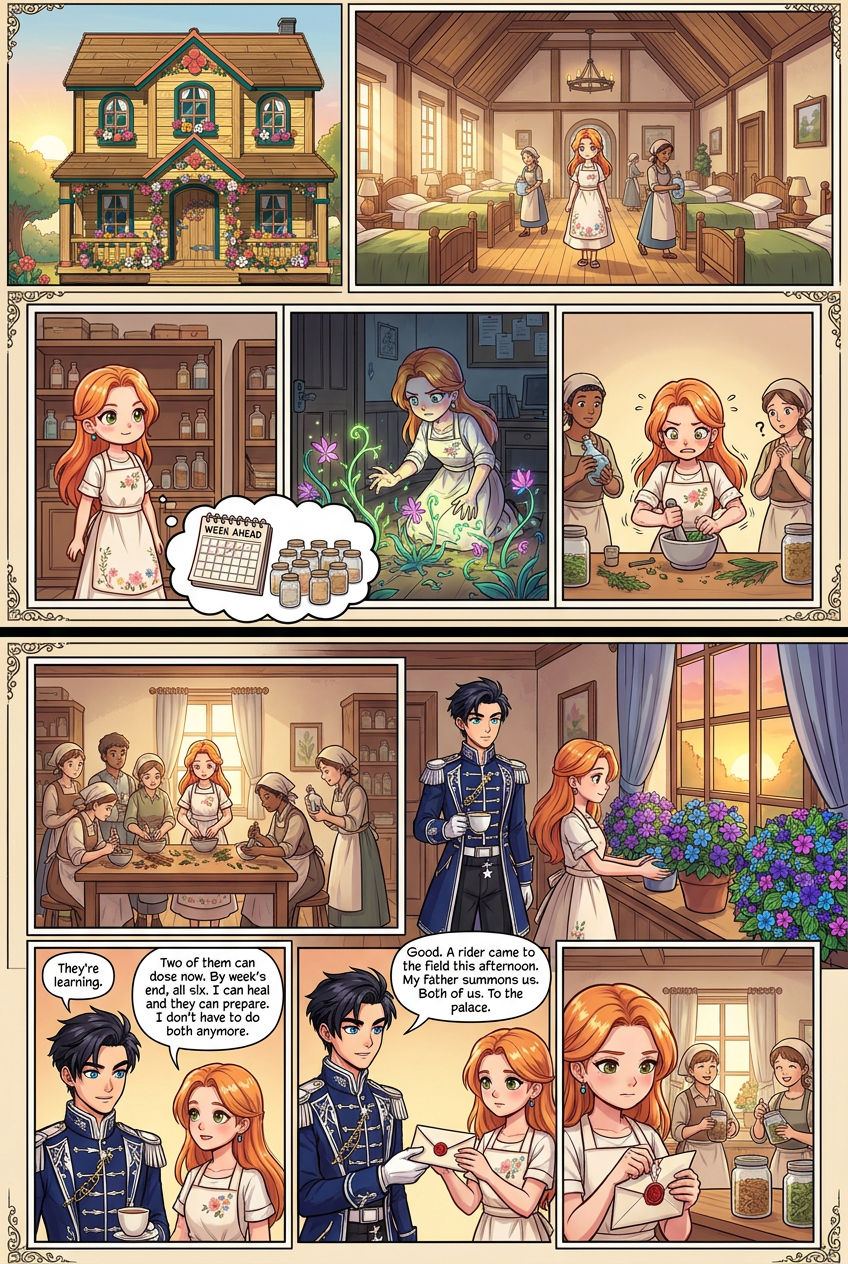
The truth of her blood was locked away, but the house was full of the sick. Delia stood in the flower-draped healing house at dawn, watching her hired workers move between the forty beds. She had brought them on to change dressings, carry water, and feed patients. That part worked. The floors stayed clean. The beds turned over fast. But when a boy came in with a fever, she found the medicine shelf half empty. She climbed to the locked office, pressed her palm to the floor, and grew what she needed. She ground it, jarred it, carried it down. The workers watched her hands and did not understand. None of them knew how to steep a root or measure a poison. They could hold a cup. They could not fill it. So Delia did both jobs. She healed every patient and made every dose herself, and by midday her arms shook. A worker asked her how much bloodwort went into a burn salve. Delia stopped. She saw the whole week stretch ahead, every jar hers alone to fill, every dose hers alone to weigh. She would break before the beds emptied. So she changed the plan. She gathered the six workers around a table in the sunlit ground floor. She kept her magic hidden, but the craft she could teach. She showed them how to grind a dried root to powder. How to smell wolfsbane and set it aside. How to count drops for a child against drops for a grown man. She let them ruin a batch and try again. By dusk two of them could mix a fever draught without her. Nick found her there past sundown, sleeves rolled, teaching a woman to strain a tincture through cloth. He crossed to the flowering bushes by the window, blue and purple blooms crowding the sill, and set down a cup of tea. "They're learning," he said. It was not a question. "Two of them can dose now," Delia said. "By week's end, all six." She wiped her hands. "I can heal and they can prepare. I don't have to do both anymore." "Good." Nick's face stayed flat. He turned the cup in his hand and did not drink. "A rider came to the field this afternoon." He drew a folded paper from his coat. The wax seal bore the king's mark. "My father summons us. Both of us. To the palace." Delia took the letter. The trained workers moved behind her, filling jars without her hand. She had solved the house. Now the crown wanted her inside its walls again. She broke the seal.
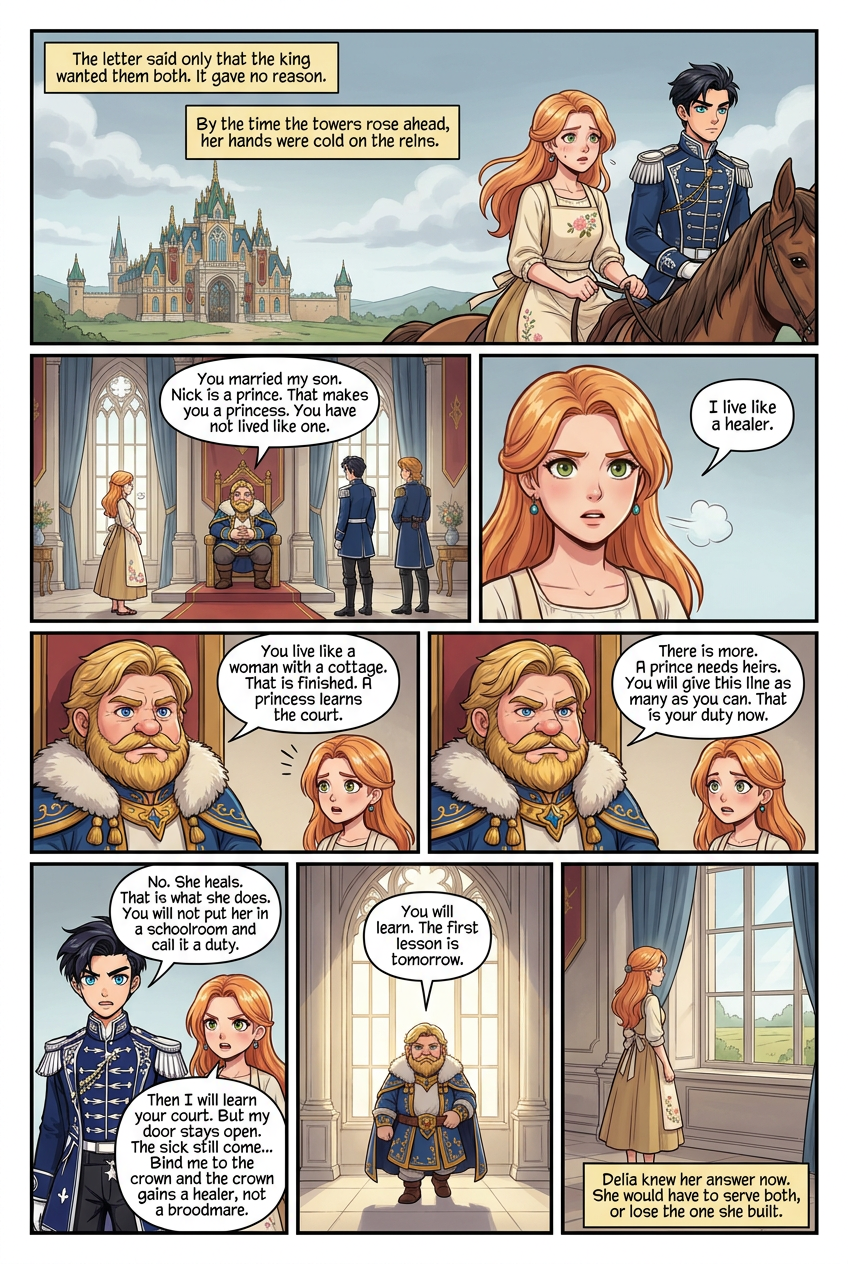
The letter said only that the king wanted them both. It gave no reason. Delia rode beside Nick to the palace with the words turning over in her head. She thought of the workers she left mixing draughts, of the beds full behind her. Then she thought of the poisons in her ledger, of Arden, of the secret three people now held. Any one of them could have reached the king's ear. By the time the towers rose ahead, her hands were cold on the reins. She did not know what she had done wrong. She only knew a summons like this meant she had done something. Rowan Rider waited in a hall with tall windows. He was heavier than Delia remembered, his beard streaked pale, a crown pushed back on blonde hair. He did not rise. He looked at her the way he looked at a field he meant to survey. "You married my son," the king said. "Nick is a prince. That makes you a princess. You have not lived like one." Delia's breath came back. This was not about the willow, or the poisons, or her blood. "I live like a healer," she said. "You live like a woman with a cottage." Rowan folded his hands over his belly. "That is finished. A princess learns the court. The seating, the seasons, the names of every house. You will be taught. You will attend. My steward will bring you the lessons." Delia stood very still. "And my house? My patients?" "They wait," the king said, "or others tend them." He did not soften it. "There is more. A prince needs heirs. You will give this line as many as you can. That is your duty now. It is not a request." The hall went quiet. Delia thought of the child she had lost on her wedding day, of the ground she had wanted to give the sick, not the crown. She heard Nick shift beside her. "No," Nick said. His voice was flat and even. "She heals. That is what she does. You will not put her in a schoolroom and call it a duty." "She is bound to this house," Rowan said. "She takes its name and its burdens both." Delia lifted her chin. "Then I will learn your court," she said. "I will sit where you place me. But my door stays open. The sick still come to my field, free, every day. Bind me to the crown and the crown gains a healer, not a broodmare. I will not close the house." The king studied her a long moment. "You will learn," he said again, once. "The first lesson is tomorrow." He rose and left them in the tall light. Delia knew her answer now. The court would try to pull her from her field. She had a title she never asked for, and a garden that still needed her. She would have to serve both, or lose the one she built.
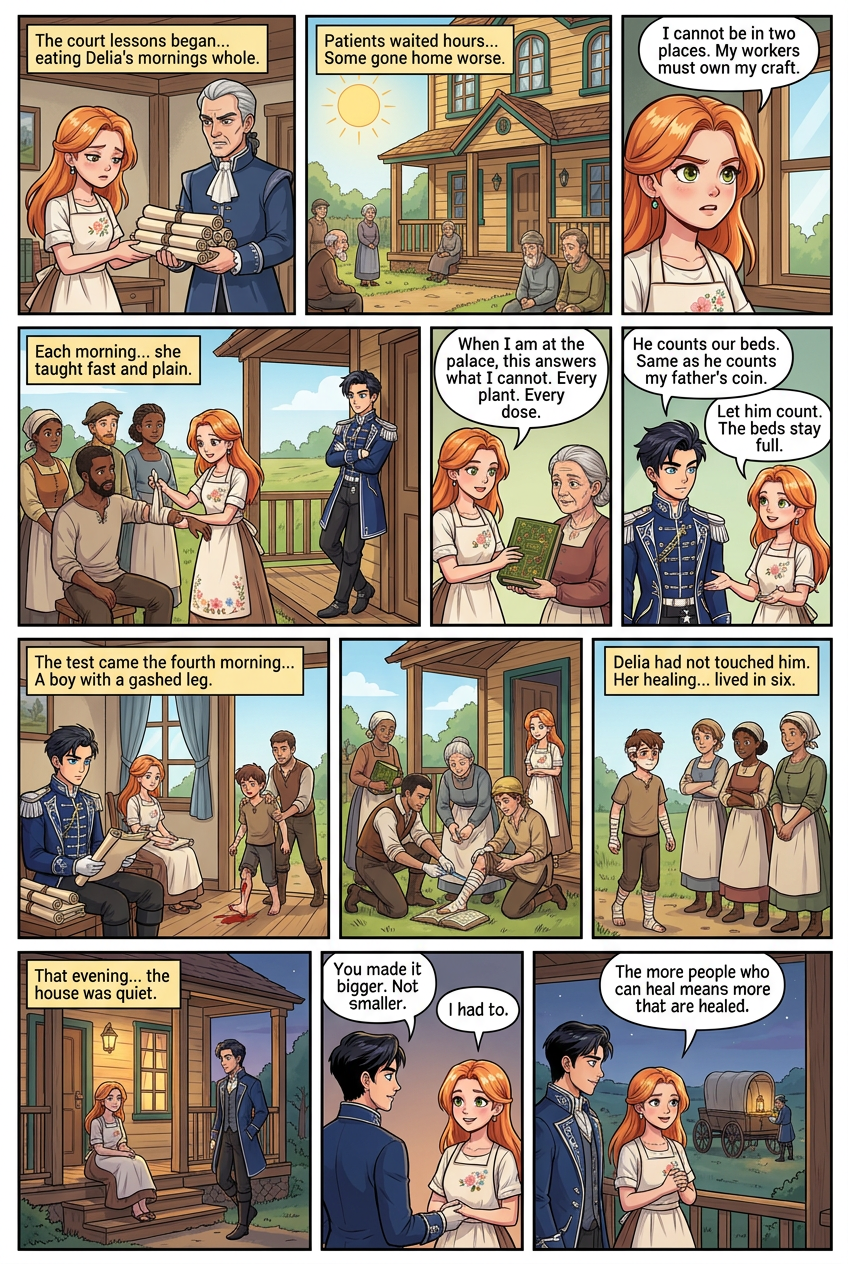
The court lessons began the next week, and they ate Delia's mornings whole. The steward came at dawn with a bundle of scrolls—seating charts, house names, the order of bows. By the time she was free, the sun stood high. Patients had waited hours in the field. Some had gone home worse than they came. Delia knew she could not be in two places. If the crown owned her mornings, then her workers had to own her craft. So she changed the shape of her day. Each morning before the steward arrived, she gathered her six workers on the porch of the flower-draped healing house. She taught fast and plain. She showed them how to measure a fever draught, how to bind a wound, how to spot the pale skin of blood loss. She could not show them the locked office upstairs, or how the jars filled themselves. But everything below that door, she gave them. Nick stayed close through every lesson. He leaned against the doorframe with his arms crossed and watched the field beyond. He was not there to learn draughts. He was there because his father's steward walked their land now, and Nick did not trust the man an inch. His jaw set every time the crown's servant passed the window. "He counts our beds," Nick said, low. "Same as he counts my father's coin." "Let him count," Delia said. "The beds stay full." She pulled a worn green book from the shelf, its cover thick with painted roots and flowers. It was her new reference, built page by page since she lost her first one. She set it in the oldest worker's hands. "When I am at the palace, this answers what I cannot. Every plant. Every dose. Every danger. You read it before you pour." The woman held it like something breakable. The others crowded near. For the first time, Delia saw them stop looking to her for each small thing. They looked to the book, and to each other. The test came the fourth morning. A boy arrived with a gashed leg while the steward's scroll pinned Delia to a chair inside. She could not rise. She watched through the window. Her workers laid the boy down, opened the book, cleaned the wound, and bound it tight. The bleeding stopped. The boy walked out on his own feet. Delia had not touched him. That evening the porch was quiet. All six workers could run the house without her hands. The lessons had cost her the mornings, but they had bought her something larger. Her healing no longer lived in one pair of hands. It lived in six, and in a book anyone could open. Nick found her on the step at dusk. "You made it bigger," he said. "Not smaller." "I had to," Delia said. Then she frowned. The steward's cart still sat in the field. He had not left. He was writing something down. She turned to Nick and smiled. The more people who can heal means more that are healed.
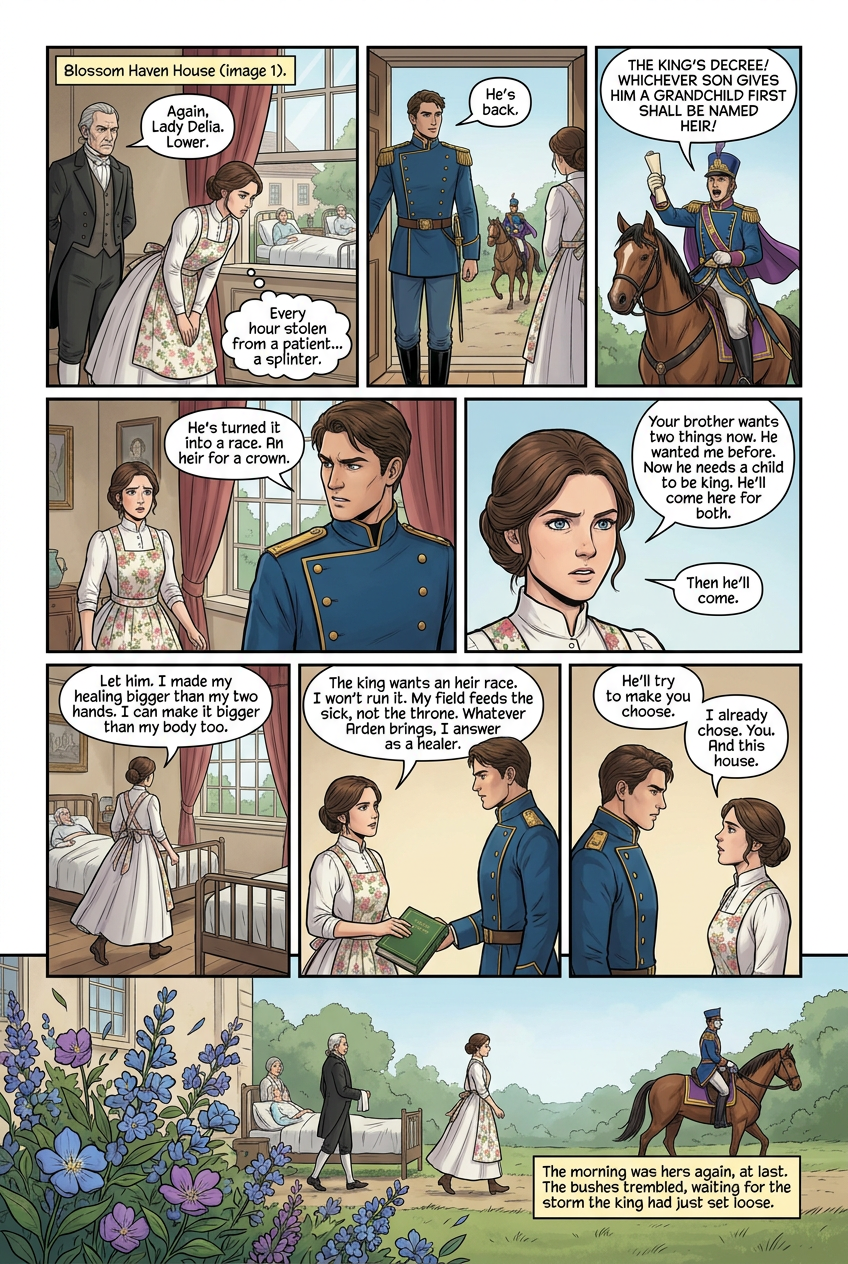
The next morning's lesson ran long. Delia sat in the flower-draped healing house while the steward drilled her on court bows. Her mind stayed on the field. Every hour spent here was an hour stolen from a patient, and she felt each one like a splinter. She kept sliding out of her seat to check the beds, then sliding back before the steward looked up. She was healing on stolen time, and both crown and patients felt the theft. Nick stood in the doorway. He watched the field, not the lesson. "He's back," Nick said. Beyond the porch, a rider in palace colors pulled up hard. The man carried no scroll for Delia. He carried news for the whole land. The rider read it out plain. The king had made his choice for the throne. Whichever son gave him a grandchild first would be named heir. The words hung in the warm room. Delia set down her folded hands and felt the floor shift under her. "He's turned it into a race," Nick said. His voice went flat and hard, the way it did when the stakes were his. "An heir for a crown." He did not look at Delia. He looked past her, to the ornamental bushes crowding the window, blue and purple blooms she had planted for beauty and nothing else. Delia understood at once what the decree bought her. Not peace. Arden. "Your brother wants two things now," she said. "He wanted me before. Now he needs a child to be king. He'll come here for both." Nick's jaw set. "Then he'll come." "Let him." Delia rose. She crossed to the window and looked over the beds where patients waited. The lessons had stolen her mornings. This decree would steal her house, if she let it become a nursery for princes and their claims. She would not. "I made my healing bigger than my two hands," she said. "I can make it bigger than my body too." She turned from the window and faced Nick. "The king wants an heir race. I won't run it. My field feeds the sick, not the throne." She reached for the green reference book on the shelf and pressed it flat with her palm. "Whatever Arden brings when he comes, I answer as a healer. Not a broodmare. Not a prize." Nick crossed the room and stood close. "He'll try to make you choose." "I already chose," she said. "You. And this house." He held her look a long moment, then nodded once. Outside, the steward gathered his scrolls and left early. The decree had bigger business than her bows. Delia watched the palace rider ride off to carry the news down every road. The morning was hers again, at last. She walked out to her patients, and behind her the blue and purple bushes trembled in the wind, waiting for the storm the king had just set loose.
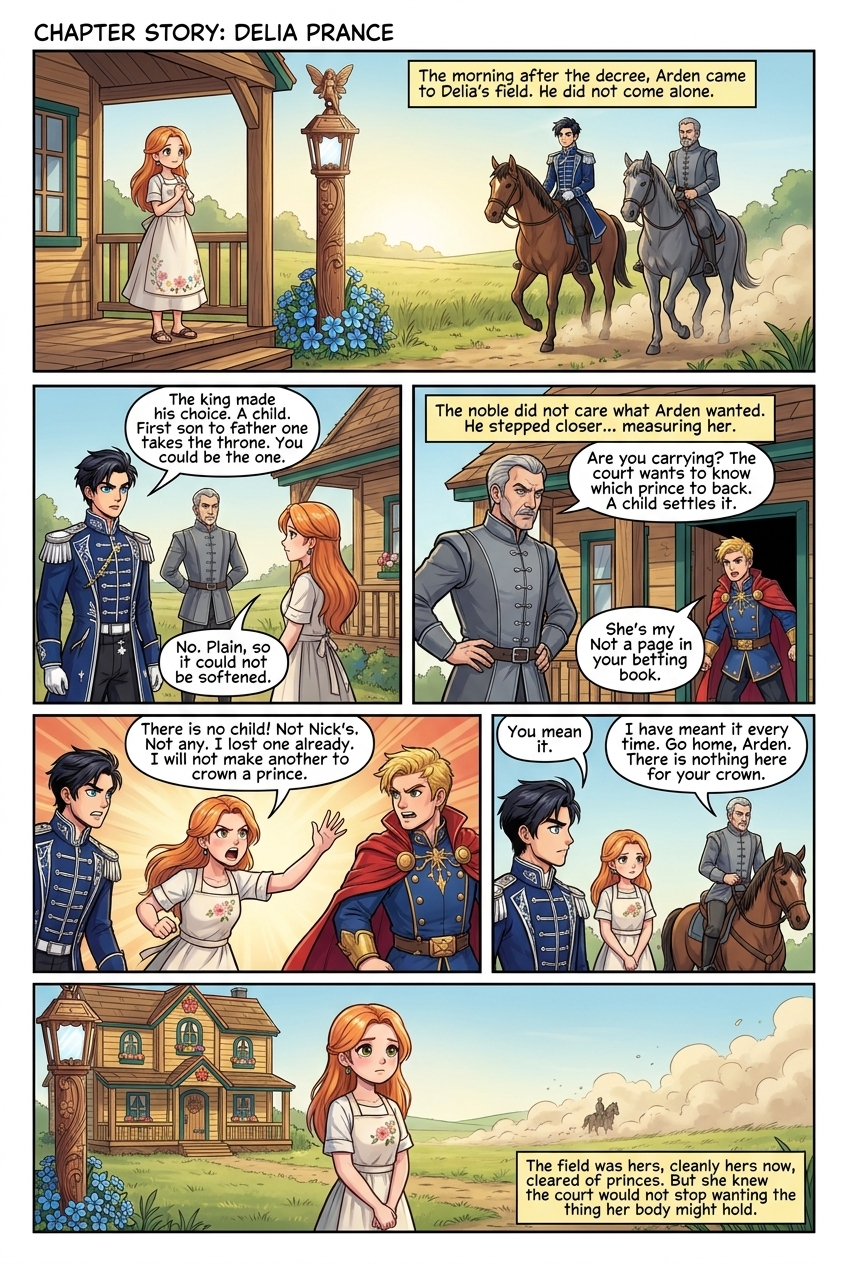
The morning after the decree, Arden came to Delia's field. He did not come alone. A court noble rode with him, dressed in fine gray, his eyes moving over the blossoming house and the flower beds like a man counting coins. Delia stood on the porch of the healing house, the wooden lantern post beside her, blue flowers clustered at its base. She knew the field was hers by the king's own word. But Arden kept coming, and each time he came, he studied it like something he might still take. Arden crossed the grass. He is the king's first son, and Delia had once saved his life in secret. Now he wanted more than his life back. "The king made his choice," he said. "A child. First son to father one takes the throne." He looked at her the way he always did, too long. "You could be the one." "No," Delia said. Plain, so it could not be softened. The noble did not care what Arden wanted. He stepped closer and looked at Delia's waist, her face, her hands. He was not measuring the field. He was measuring her. "Are you carrying?" he asked. "The court wants to know which prince to back. A child settles it." Delia understood then. They had not come for her land at all. They had come to read her body like a ledger. If she carried Nick's child, the nobles backed Nick. If not, they turned to Arden. The field was never the prize. She was. Nick came out of the house. He heard the last of it. His voice went flat and hard. "She's my wife. Not a page in your betting book." Arden turned to his brother. "Then give the king an heir. Or step aside." Delia stepped between them before it could become fists. "There is no child," she said. She said it to the noble, loud enough for the field to hear. "Not Nick's. Not any. I lost one already. I will not make another to crown a prince." The noble's mouth tightened. He had his answer, and it broke his errand in half. Neither son could be backed on her account. Arden's face changed. Not to anger. To something quieter. He had built her this house. He had lied to the king to guard her secret. And still she would give him nothing. "You mean it," he said. "I have meant it every time," Delia said. "Go home, Arden. Stop coming to my field. There is nothing here for your crown." He held her look. Then he nodded once, the way Nick did, and mounted his horse. The noble followed. They rode off toward the palace with no answer to sell. Delia watched the dust settle. The field was hers, cleanly hers now, cleared of princes. But she knew the court would not stop wanting the thing her body might hold. They would only look for another way in.
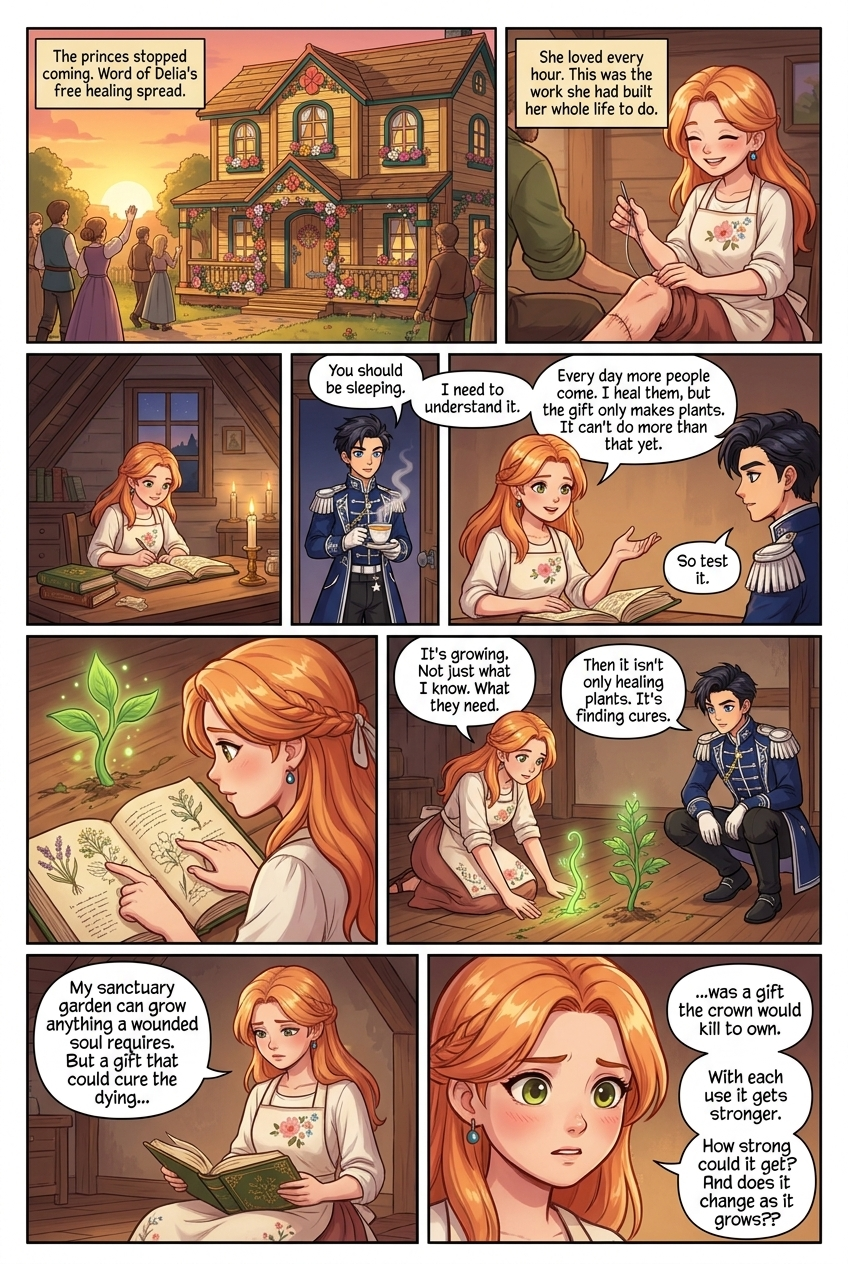
The princes stopped coming after that day. Word of Delia's free healing spread instead. Travelers walked in from far roads, some for a whole day, drawn by the promise of a healer who took no coin. Her flower-draped house filled from dawn to dusk. She set broken fingers, cooled fevers, and stitched a woodcutter's leg. She loved every hour of it. This was the work she had built her whole life to do. The last patient left at dusk, a mother with a mending child. Delia locked the door and climbed to her hidden office. Her healing gift came from elf blood, but she still did not understand it. She could grow any plant by touching the ground. She wanted to know how far that reach went, and where it stopped. She took two books from the shelf. One was her herbal reference, thick with plant lore. The other was her family record, its pages tracing her line back to an elf named Elira. She read the family book by candlelight. Beneath the drawing of Elira, a note said the gift ran strongest down the mother's line, and grew with each use. Nick came up the stairs. He set a cup of tea beside her. "You should be sleeping," he said. "I need to understand it," she said. "Every day more people come. I heal them, but the gift only makes plants. It can't do more than that yet." He looked at the two books. "So test it." Delia knelt and pressed her palm to the office floorboards. She thought of the willow that gave her the fruit. A shoot of green pushed up through the wood grain, then a second, thicker one. She had never grown two at once before. Her hands shook, but not from fear. Something in her had opened wider. She checked the reference book against the second sprout. It was not a plant she had named. She flipped pages until she found it. A rare root, one that eased a failing heart. She had never grown it before, never even seen it living. The gift had reached for what her patients needed most. "It's growing," she whispered. "Not just what I know. What they need." Nick crouched beside her. "Then it isn't only healing plants. It's finding cures." Delia sat back on the floor, the family book open in her lap. Her gift was no longer a trick for stocking shelves. It answered need. Every traveler on every road could be met, not with what she happened to have, but with the exact thing that would save them. She closed the book. Her sanctuary garden was no longer a dream of beds and walls. It could grow anything a wounded soul required. But a gift that could cure the dying was a gift the crown would kill to own. She had just made her secret far more dangerous to keep. With each use it gets stronger and that is what scared Delia more. How strong could it get? And does it change as it grows??
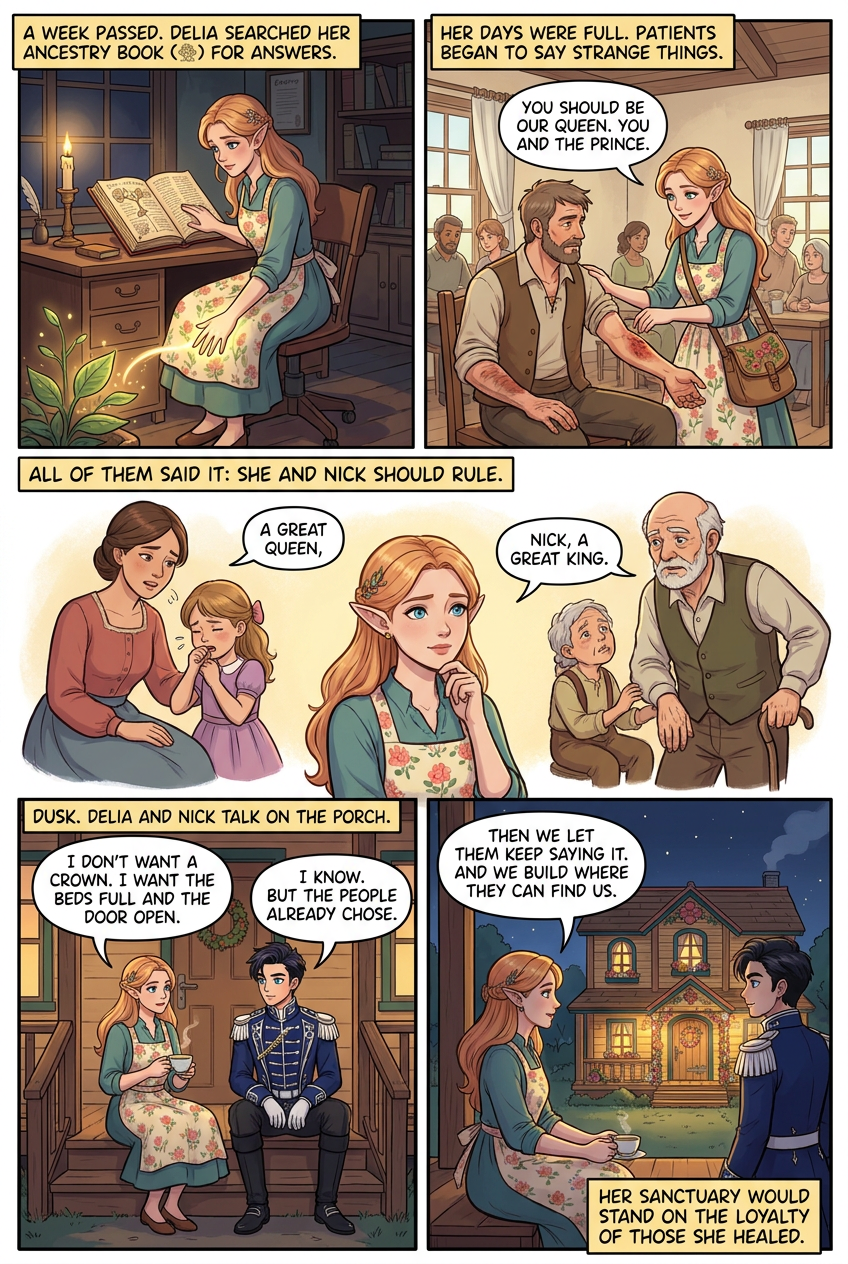
A week passed. Delia searched for the truth of her gift every night. She read her family record until the candle burned low. She pressed her palm to the office floor and grew plant after plant. Nothing new came. The book said the gift grew stronger with use, but it told her no more than that. She learned nothing about her elf blood she did not already know. But the days downstairs were full. Her flower-draped house filled from dawn to dusk. She carried her flower-stitched herb satchel from bed to bed, mixing draughts and setting bones. And her patients had begun to say a strange thing. A farmer with a burned arm said it first. "You should be our queen," he told her. "You and the prince both. He'd make a fine king." Delia smiled and wrapped his arm and said nothing. But the next patient said it too. And the next. A mother with a coughing girl. An old man with a bad hip. All of them, over the week, said the same words. She would make a great queen. Nick would make a great king. At dusk she locked the door and sat on the porch steps. Nick found her there. He set down a cup of tea and sat beside her. "They keep saying it," she told him. "Every one of them. That I should be queen. That you should be king." Nick was quiet a moment. "My brother has no such following," he said. "The nobles argue in the hall. But the people already chose." "I don't want a crown," Delia said. "I want the beds full and the door open." "I know." He looked out at the dark field. "But this is worth more than the archive books you've been reading. You wanted to understand your gift. Here's what it's done. It hasn't just healed them. It's turned every road into a friend." Delia turned the cup in her hands. She had spent a week chasing what her blood could grow. She had missed what it had already grown around her. Not plants. People. A whole countryside that would speak for her. "The crown fights over which prince fathers an heir," she said. "But if the people want us, that's a claim the nobles can't buy." "It is," Nick said. She set the cup down. The search inside her locked office was finished for now. Her blood held no new secret this week. But the answer had been coming through her door all along, one grateful patient at a time. Her sanctuary would not stand on magic she couldn't explain. It would stand on the loyalty of everyone she had healed for free. "Then we let them keep saying it," Delia said. "And we build where they can find us."
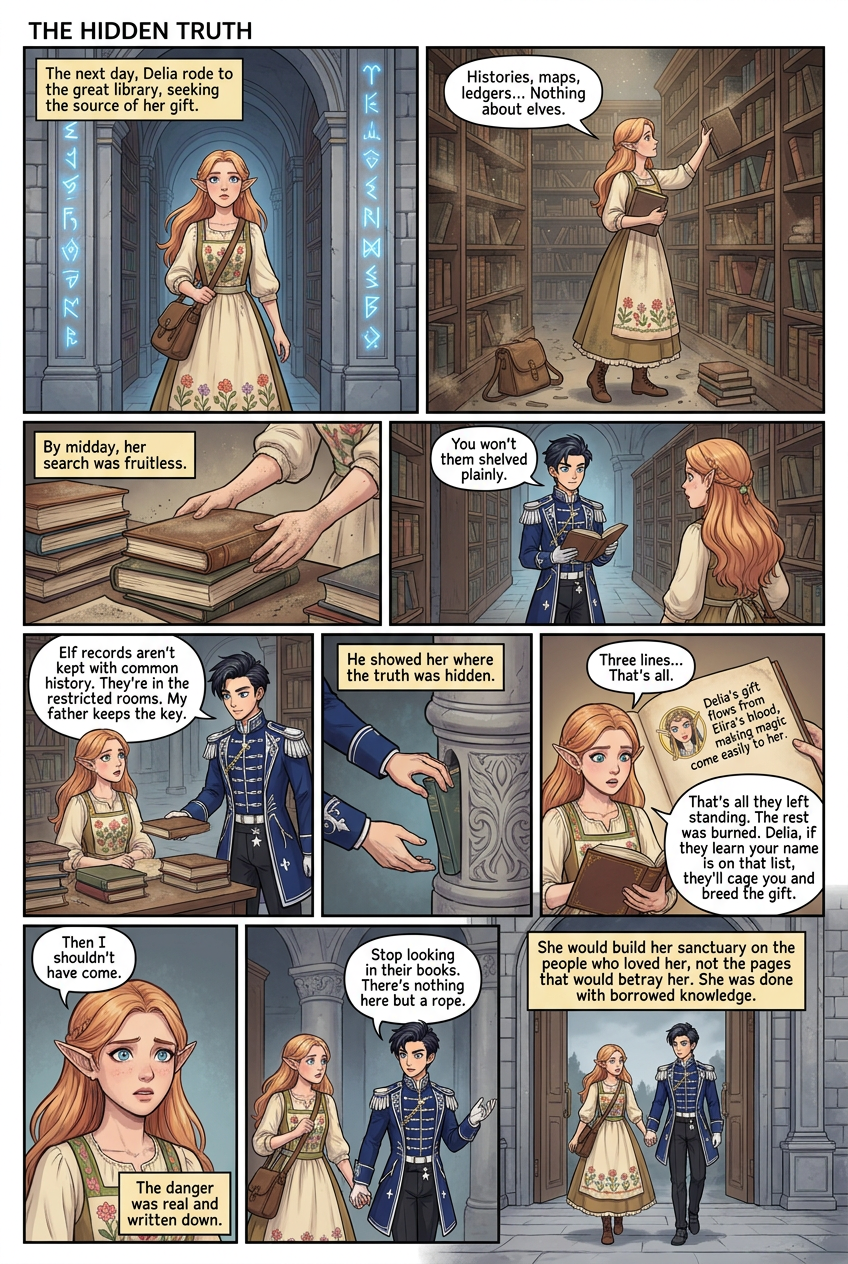
The next day came slow. No travelers walked the field path. No sick child cried at the door. Delia let her workers manage the empty beds. She had learned the countryside loved her. Now she wanted to know why her blood could do what it did. The family record told her nothing new. But her family tree named Elira, and elves were catalogued somewhere. She took her satchel and rode to the great library. The archive rose tall and gray, its walls carved with old runes that glowed faint blue. Inside, the shelves climbed higher than her cottage. She walked the aisles and searched every spine for the word elf. She found histories of kings and maps of rivers and ledgers of grain. Nothing about elves. She pulled book after book and set them in a growing pile. Her hands smelled of dust by midday. "You won't find them shelved plainly." Delia turned. Nick stood at the aisle's mouth, a book already open in his hand. Her husband found her here the same way he always found her when she chased a thing too far. He set the book on her pile. "Elf records aren't kept with common history," he said. "They're locked in the restricted rooms. My father keeps the key." He walked her to a narrow shelf behind a carved pillar. There he pulled one slim volume the catalogue had buried under a false title. He handed it to her. Delia opened it and found a list of old bloodlines. Halfway down was the name Elira, and beside it, three lines about elf healers who once served this very palace. "Three lines," she said. "That's all." "That's all they left standing," Nick said. "The rest was burned or hidden. My family made sure." He closed the book gently over her hands. "Delia. Listen. Every noble who reads this knows what an elf is worth. If they learn your name is on that list, they won't ask you to be queen. They'll cage you and breed the gift." Delia felt the weight of the small book. It gave her almost nothing. Three lines and a name she already knew. But it told her the danger was real and old and written down. "Then I shouldn't have come," she said. "You needed to see it," Nick said. "Now you know. Stop looking in their books. There's nothing here for you but a rope." She slid the slim volume back behind the pillar where it had hidden for years. Her search among the archive shelves was finished. The library held no key to her gift, only proof that others would kill to own it. She would build her sanctuary on the people who loved her, not the pages that would betray her. She took Nick's hand and walked out into the gray afternoon, done with borrowed knowledge for good.
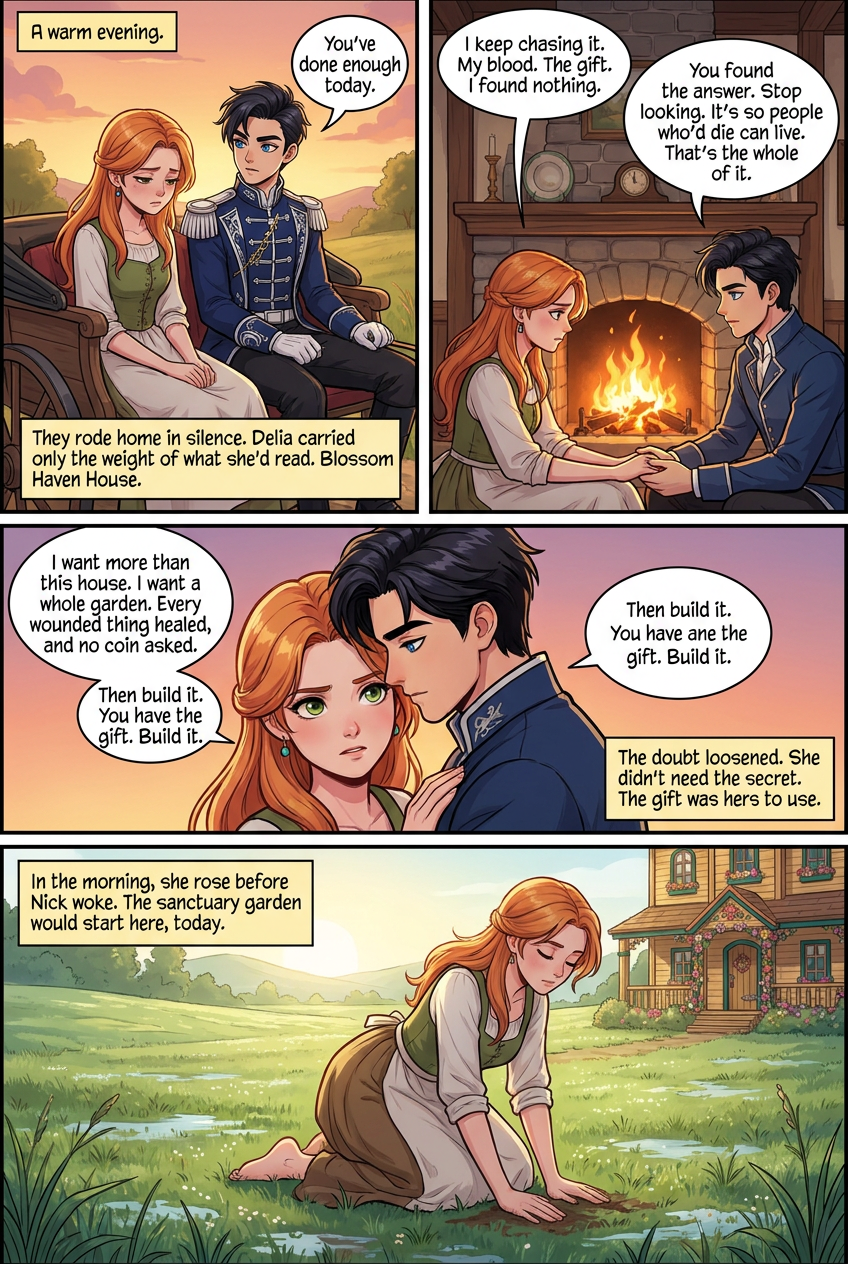
They rode home from the library in silence. Delia carried nothing new from the archive, only the weight of what she'd read. Three lines and a name. A rope, Nick had called it. She wanted to think about something else. When the flower-draped house came into view, warm light in its windows, she let her shoulders drop for the first time in days. Her workers had gone home. The forty beds sat empty and clean. Delia hung her satchel by the door and knelt at the hearth. She stacked dry logs and struck a flint until the fire caught. Nick pulled two chairs close to the flames. "Sit," he said. "You've done enough today." She sat. For a long moment neither of them spoke. The fire snapped and threw orange light across the floor. Delia realized she could not remember the last quiet evening they'd shared. There had always been a patient, a summons, a secret to hide. Now there was only the fire and Nick beside her. "I keep chasing it," she said. "My blood. Where the gift came from. I gave a whole day to dust and found nothing." "You found the answer," Nick said. "Stop looking. That's the answer." Delia laughed. It surprised her. "You make everything sound simple." "Some things are." He reached over and took her hand. His thumb moved across her knuckles. "You wanted to know why you can do what you do. Here's why. So people who'd die can live. That's the whole of it." She leaned into him. The heat of the fire touched her face. She thought of the empty beds upstairs, the ones she'd fill tomorrow, and the ones after that. Not for the crown. Not for any prince. For the traveler who limped up the path with nowhere else to go. "I want more than this house," she said. "I want a whole garden. Every wounded thing that comes, healed, and no coin asked." "Then build it," Nick said. "You have the land. You have the gift. Build it." Delia turned to look at him. The doubt she'd carried since the library loosened in her chest. She had spent weeks digging for a secret to explain herself. She did not need it. The gift was hers to use, not to understand. "I'm done looking back," she said. "I'll build forward." Nick nodded once. He pulled her close, and she rested her head against his shoulder. They watched the fire burn low together, and for once she asked nothing of the night. In the morning she rose before Nick woke. She dressed and went out to the field. The grass was wet and cold under her bare feet. She knelt and pressed both palms flat to the ground. The sanctuary garden would start here, today. She closed her eyes and reached for the soil, ready to grow the first bed of it.
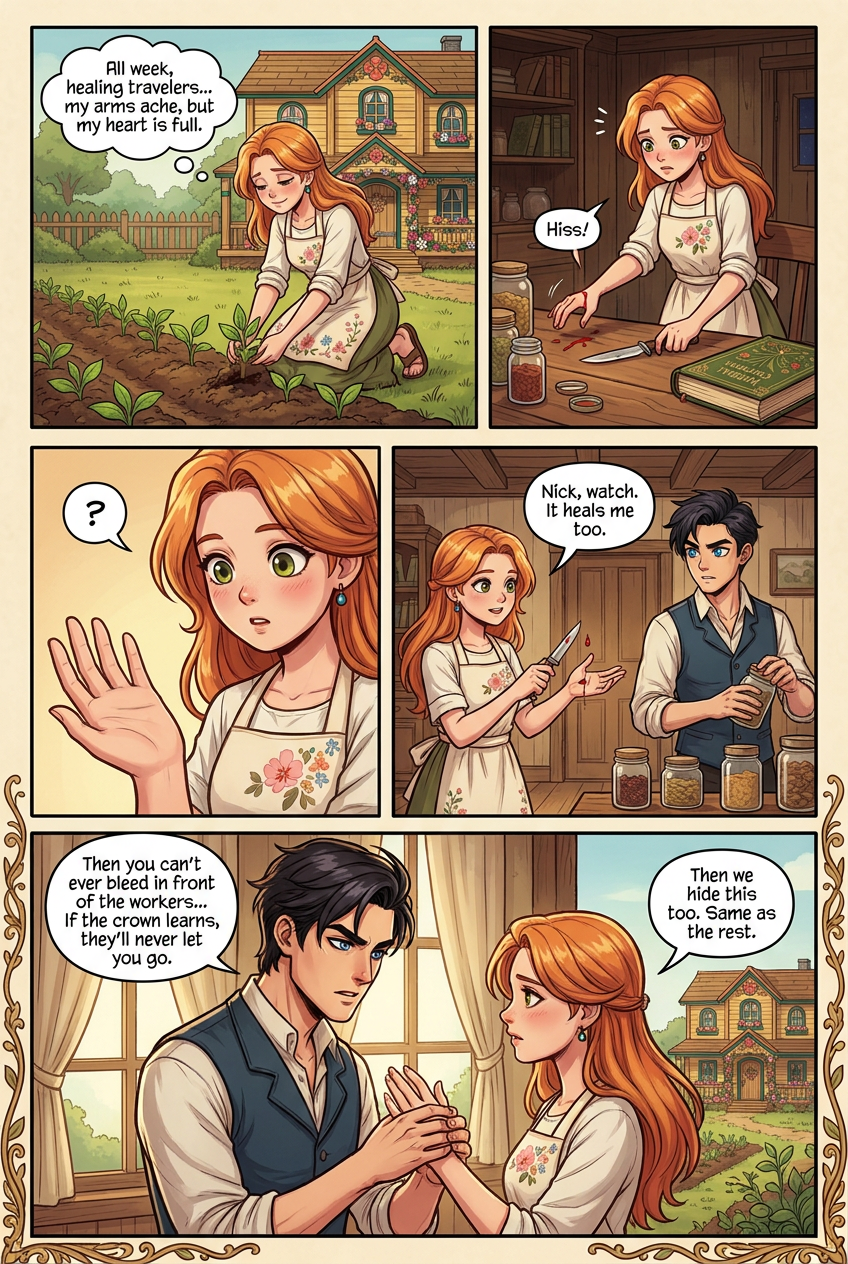
The first bed grew easy under Delia's hands. All week she and Nick kept moving. Travelers came up the path with fevers, broken wrists, coughs that wouldn't quit. She healed them one by one and asked no coin. Between patients she planted more of the garden, one green row at a time. By the sixth day her arms ached and her heart felt full. On the seventh morning she climbed to the locked office to grow a batch of drying root. The bolt slid back under her key. She set out her jars and reached for a knife to trim the old stems. Her hand slipped. The blade opened a line across her palm. Delia hissed and grabbed a strip of clean cloth. She pressed it down and turned toward the shelf for salve. When she lifted the cloth to wrap the cut, there was nothing to wrap. The skin lay smooth and whole. No line. No blood. Only a pink mark that faded as she watched. She stood very still. She pressed her thumb hard along the palm. Nothing hurt. She picked up the knife again and, before her nerve failed, drew a shallow cut on the back of her hand. The blood welled, then thinned, then stopped. The wound closed itself like water filling a print in the mud. She had grown plants from bare ground. She had grown plants she'd never seen. She had never once turned the gift on her own body. Her hands began to shake. She wiped the knife clean and went down the stairs two at a time. Nick was in the front room, stacking fresh jars from her worker's basket. He looked up when he heard her feet. "Delia?" She crossed to him and held out both hands, palms up. "Watch." She took the small knife from her apron and cut the pad of her thumb. Nick reached to stop her, too late. The blood beaded. Then, in front of him, the skin drew shut. Nick set the jar down slow. He took her hand and turned it under the window light. He pressed the healed spot with his own thumb. "When?" "Just now. Upstairs. I cut myself by accident." Her voice came fast. "It closed before I could wrap it. So I tried again. And again. Nick, it works on me. It always healed others. It heals me too." He was quiet a long moment. His jaw tightened the way it did when the stakes turned personal. "Then you can't ever bleed in front of the workers," he said. "Or a patient. Or the steward." He closed her fingers over her palm and held them there. "If the crown learns you can't be hurt, they'll never let you go." Delia looked past him at the beds she meant to fill, the garden she meant to grow. The gift had just grown larger, and so had the danger of it. "Then we hide this too," she said. "Same as the rest.” But Delia was wondering if it could heal others the same way.
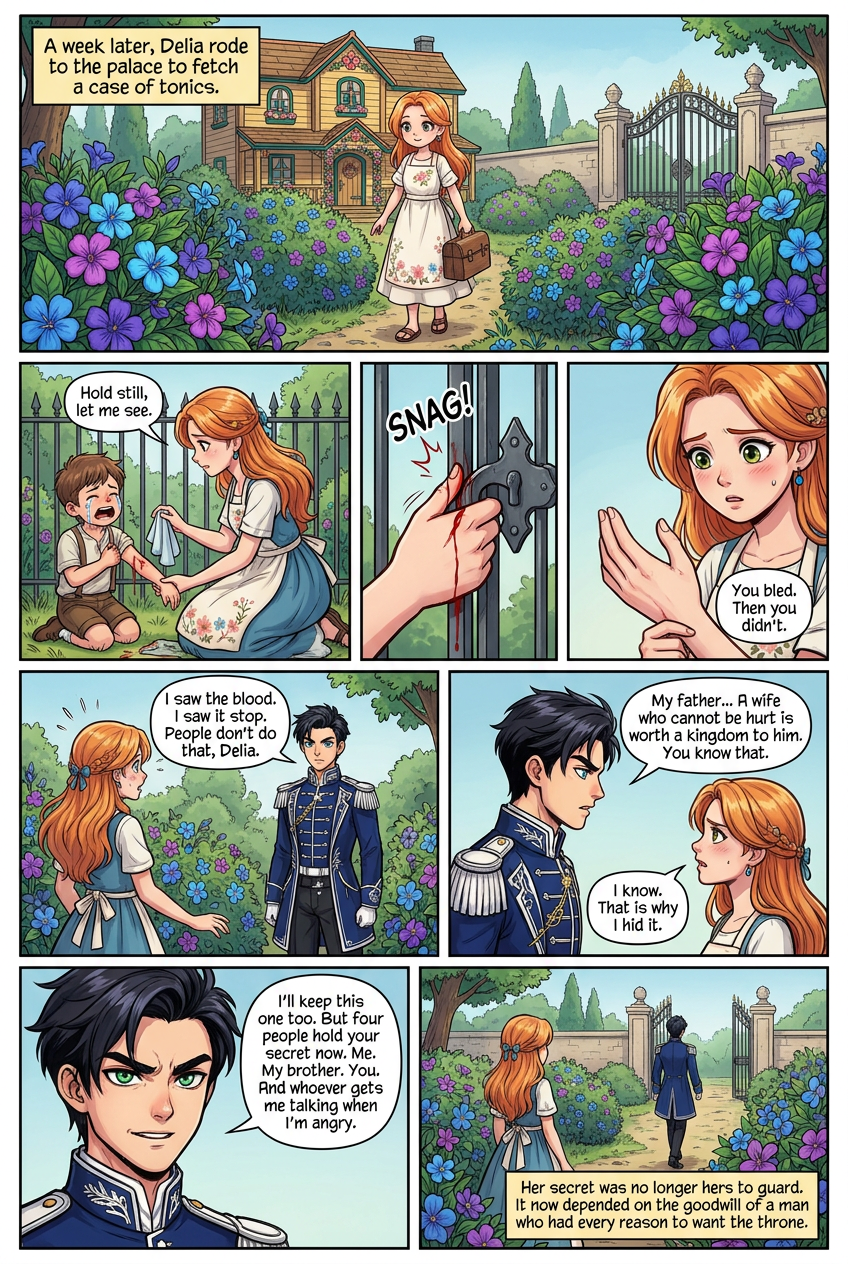
A week later Delia rode to the palace to fetch a case of tonics Nick had promised the court healers. Nick had gone north to settle a dispute over the steward's survey. She did not expect to find him gone, only the case waiting by the gate. She carried it through a garden thick with blue and purple blossoms, past a house draped in flowers. She had not walked this ground alone in months. A boy had cut his arm on the garden's iron fence. He sat crying near the flowering bushes, blood down his sleeve. Delia knelt at once. She pressed her palm to the wound to steady it and reached for cloth. But her own hand caught the sharp latch as she moved. A cut opened across her thumb. She wrapped the boy fast and sent him to the kitchens. Then she looked at her own thumb. The blood had already stopped. The skin drew shut while she watched. She turned her hand over and told herself to move. "You bled," a flat voice said behind her. "Then you didn't." Delia turned. Arden stood at the edge of the path. Nick's estranged brother, the king's first son, the man who had once wanted her and once lied to save her secret. He had not been here since he accepted her refusal and left. His green eyes moved from her hand to her face. "I cut myself on the latch," she said. "I'm fine." "I saw the blood." He stepped closer. "I saw it stop. Your skin closed. Roots don't do that, Delia. People don't do that." Her stomach dropped. Arden already knew she could grow plants from bare ground. He had lied to his father to hide it. But this was more. This was her own body. "Say nothing," she said. "Please." "My father set my brother and me against each other for the throne." His jaw stayed hard. "A wife who cannot be hurt is worth a kingdom to him. You know that." "I know." She stood and faced him. "That is why I hid it. You saw what the crown did with the plants. Imagine what they do with this." Arden was quiet. He looked at the house full of beds, the garden she had built for anyone who came. Then he looked back at her. "I told him a lie once for you," he said. "I'll keep this one too." He paused. "But four people hold your secret now. Me. My brother. You. And whoever gets me talking when I'm angry." "Then don't get angry." "I'm always angry." It was almost a smile. He turned to go. "Send Nick to me when he's back. Some things are safer said between brothers than kept alone." He left through the blossoms. Delia stood among the beds she meant to fill and knew the danger had widened again. Her secret was no longer hers to guard. It now depended on the goodwill of a man who had every reason to want the throne.
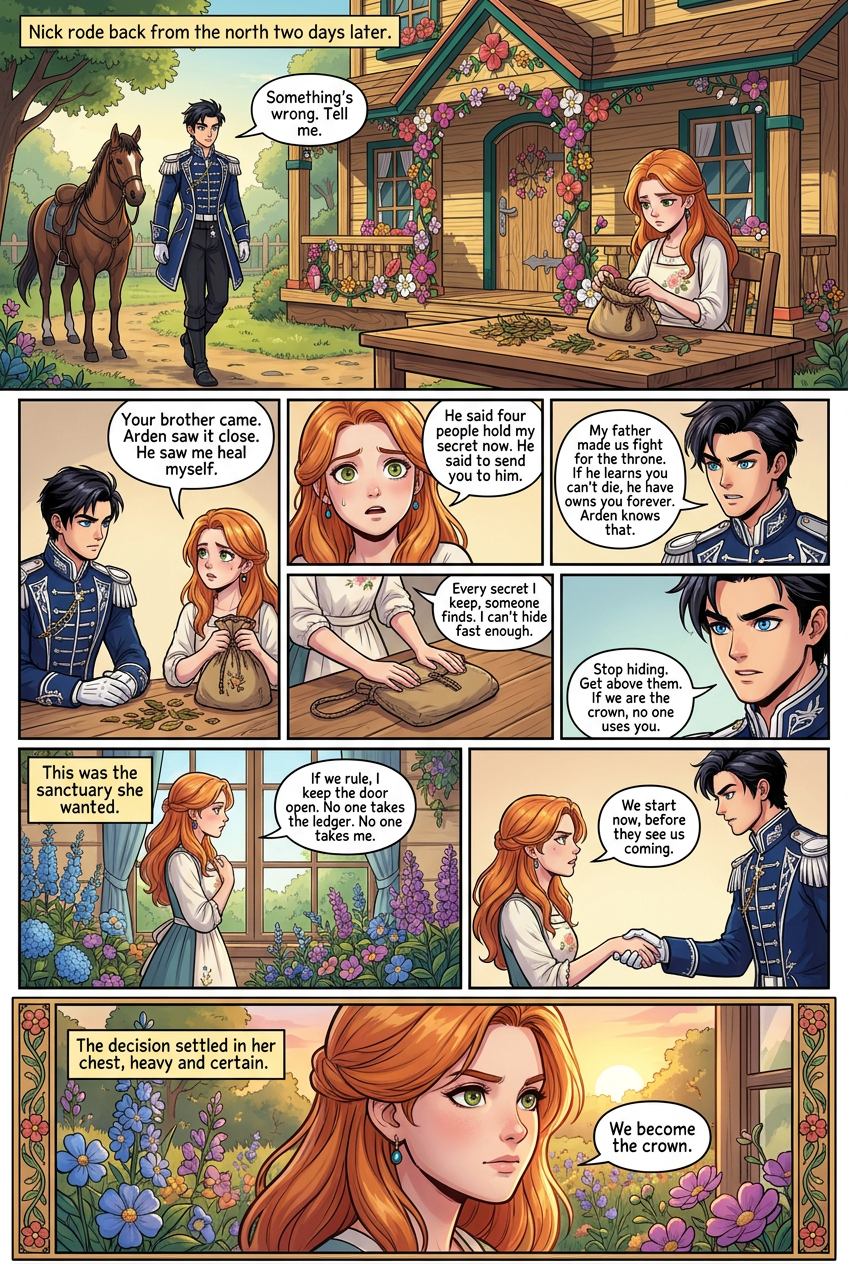
Nick rode back from the north two days later. He found Delia at the flower-draped house, sorting dried leaves into her embroidered satchel. She had not slept well since Arden left. Her hands moved slow. Her face showed everything she tried to hide. Nick set down his bag. "Something's wrong. Tell me." Delia looked up. She had meant to wait, to find the right moment. There was no right moment. "Your brother came while you were gone. A boy cut his arm on the fence. I cut my thumb helping him. Arden saw it close." Nick went still. "He saw you heal yourself." "He knows what it means. A wife who can't be hurt." Her voice dropped. "He said four people hold my secret now. He said to send you to him." Nick sat across from her. He did not soften it. "My father made us fight for the throne. If he learns you can't die, he owns you forever. Arden knows that. So do the nobles." "I know." Delia pressed the satchel flat. "Every secret I keep, someone finds. The plants. My blood. Now this. I can't hide fast enough." Nick was quiet a long moment. Then he leaned forward. "Stop hiding. Get above them." "What do you mean?" "The crown uses you because it stands over you. It can order you, sell your work, take your child. But it can't take from itself." His eyes stayed on hers. "If we are the crown, no one uses you. There's no one above us to obey." Delia set the satchel down. "You mean the throne. King and queen." "The people already want it. Your patients say it every week. They love you, not the nobles." He counted it plain. "My father set us against each other. Arden will fight for it either way. If we don't take it, one of them rules over us and everything you built." Delia stood and walked to the window. The garden spread below, blue and purple, full of beds she had filled for anyone who came. This was the sanctuary she wanted. She had told herself she only wanted to heal. But she could not heal freely under a crown that could seize her. "If we rule," she said slowly, "I keep the door open. No one closes it. No one takes the ledger. No one takes me." "No one," Nick said. She turned back to him. The fear that had sat on her for two days shifted into something harder. "Then we stop defending. We take it." Nick reached out. She took his hand. "Arden fights for the throne. So does my father's court," he said. "We start now, before they see us coming." Delia looked once more at her garden. She had built a place where the wounded came free. To keep it free, she would have to sit above the men who wanted it. She nodded. The decision settled in her chest, heavy and certain. "We become the crown."
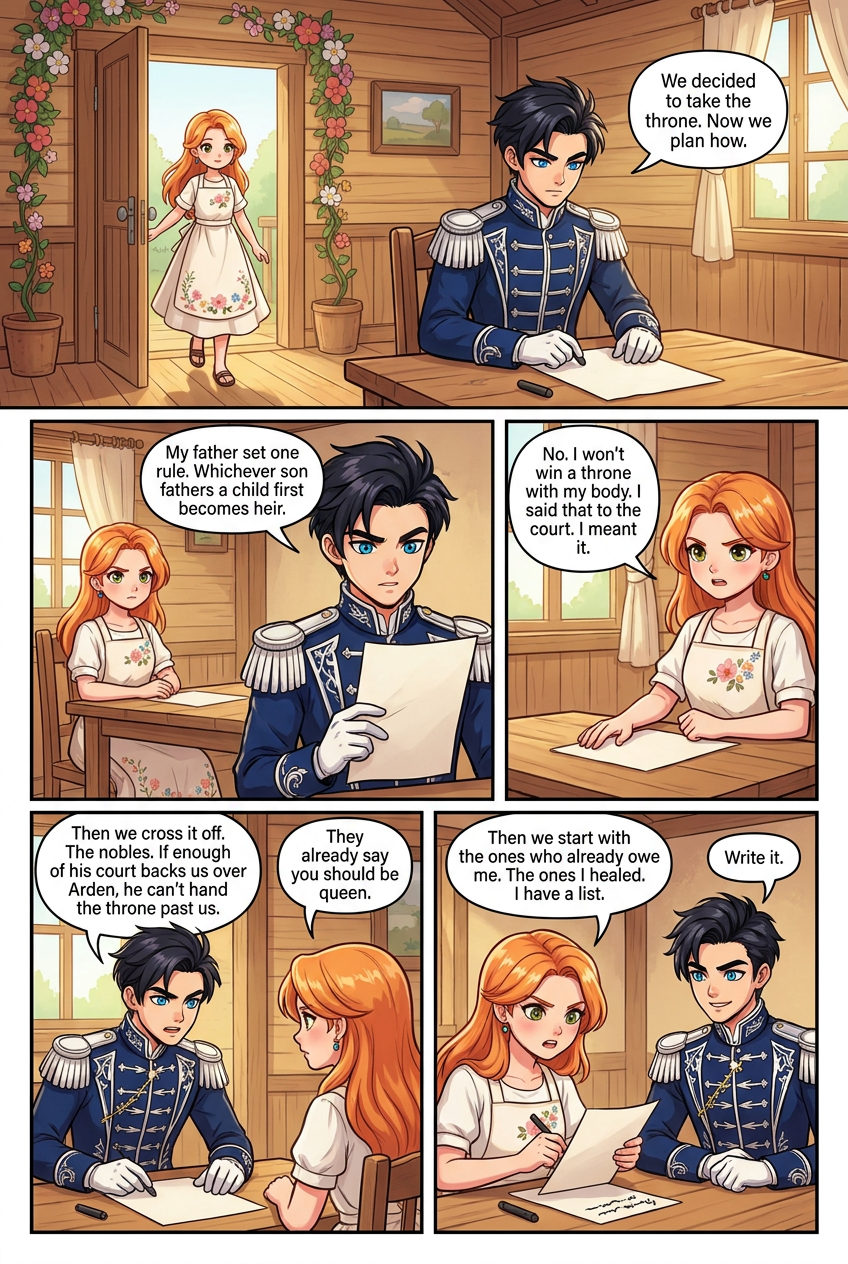
The next morning Delia found Nick at the table in the blossom-draped house. He had a sheet of paper and a stub of charcoal. He did not look up when she came in. "We decided to take the throne," he said. "Now we plan how." Delia sat across from him. "Where do we start?" "My father set one rule." Nick tapped the paper. "Whichever son fathers a child first becomes heir. That's the fastest road. A grandchild, and the crown is ours by his own word." Delia's hands went still. She had lost one child on her wedding day. She had stood in her own field and told a noble she would not breed to crown a prince. "No," she said. "I won't win a throne with my body. I said that to the court. I meant it." Nick set down the charcoal. He did not argue. "Then we cross it off," he said, and drew a line through the word he had written. "That was the king's road, not ours." "Then what's left?" "The nobles." He turned the paper toward her. Two names sat at the top, then a short list below. "My father is old. If enough of his court backs us over Arden, he can't hand the throne past us. The court chooses who the king listens to." "The court wants to own me," Delia said. "They tried to take my ledger. They want my plants and my blood. Why would they back me?" "Because you don't need them." Nick leaned forward. His voice dropped, plain and hard. "That's the change. The nobles bought loyalty for years. You gave healing free. Every village north of here knows your name. Farmers, cadets, mothers. They already say you should be queen." Delia thought of the beds outside, blue and purple, open to anyone. The travelers who came from far roads. The workers she had trained to help. She had spent months hiding her gift. Now Nick asked her to spend it in the open, as a weapon. "So we don't beg the nobles," she said slowly. "We show them the people are already with us. A noble who backs us keeps his seat. A noble who backs Arden loses the room." "That's the road," Nick said. "Support, not an heir. We build it patient by patient, name by name, until the court has no choice." Delia looked at the crossed-out word, then at the list of names. The fear that had ridden her for weeks turned into work she could do with her hands. "Then we start with the ones who already owe me," she said. "The ones I healed. I have a list. I always have a list." Nick almost smiled. "Write it," he said. She pulled the paper close and began to write. The heir's road was gone. Only the harder one remained, and it was hers to walk.
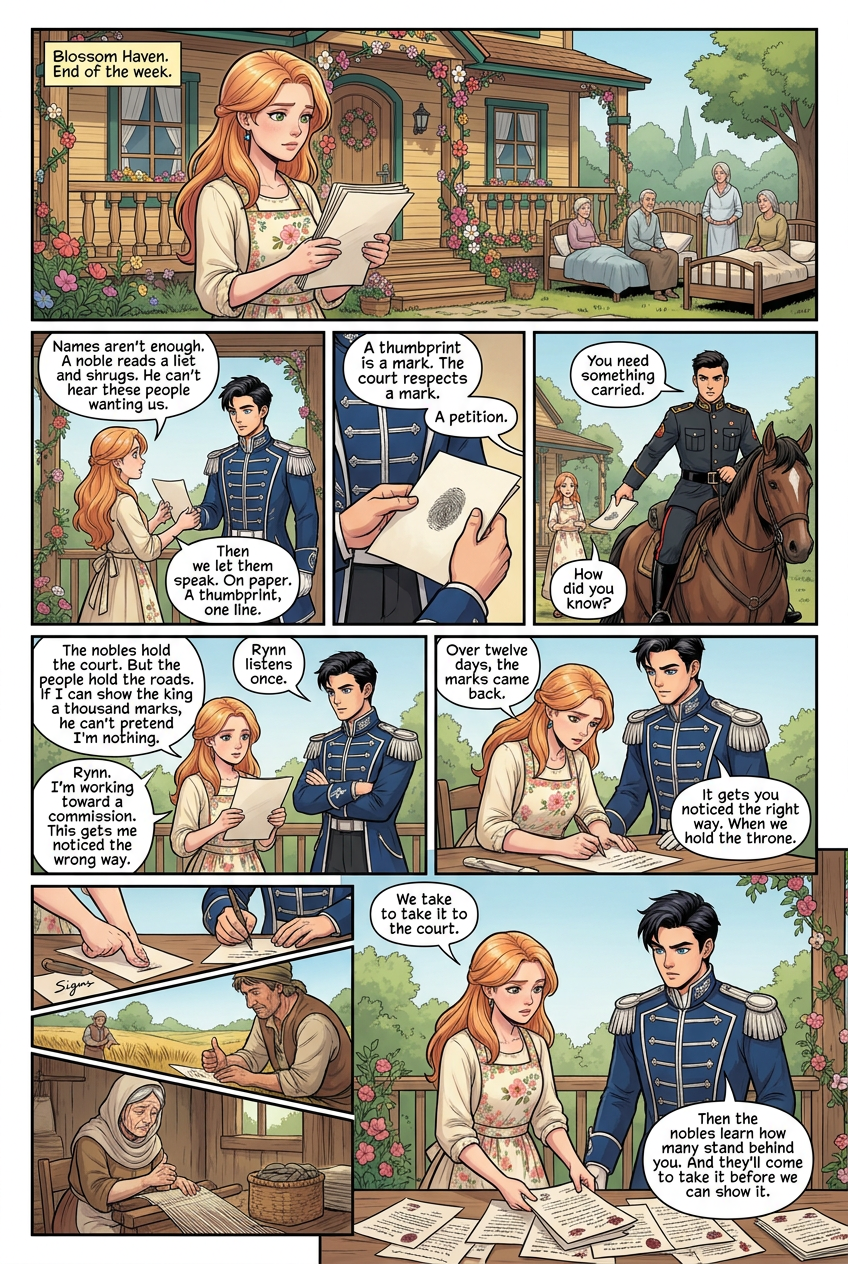
Delia's list of healed names filled three pages by the end of the week. But a list of names was not a voice. The people who loved her had no way to say so where the court could hear. She stood on the porch of the blossom-draped house and watched patients wait in the beds outside. They trusted her. They could not speak for her. Nick found her there with the pages in her hand. "Names aren't enough," she told him. "A noble reads a list and shrugs. He can't hear these people wanting us." Nick took the pages and studied them. "Then we let them speak," he said. "On paper. Every patient marks the sheet. A name, a thumbprint, one line saying who they want to rule." "A petition," Delia said. "But most of them can't write." "A thumbprint is a mark. The court respects a mark." Nick set the pages down. "We need someone to carry it village to village. Someone the crown watches but can't touch." Hooves sounded on the path. Rynn Evander rode in and swung down before the horse stopped. He was the broad-shouldered cadet who had warned Delia twice before, once about the inspection, once about the king's punishment. Other cadets stepped aside for him in the palace halls. He stepped aside for no one. He looked at the pages, then at Delia. "You need something carried," he said. Not a question. "How did you know?" Delia asked. "You always have a list." His jaw stayed hard. "What is it this time?" Delia explained. A sheet in every village she had healed. Each person marks it. Each names the healer and the prince they want as queen and king. Rynn listened without moving. "The nobles hold the court," she said. "But the people hold the roads. If I can show the king a thousand marks, he can't pretend I'm nothing." "They'll try to seize it," Rynn said. "Then you carry copies. Three of them. Different riders, different days." Nick met his eyes. "You know which roads the steward doesn't watch." Rynn was quiet. Then he nodded once. "I'm working toward a commission. This gets me noticed the wrong way." "It gets you noticed the right way," Nick said. "When we hold the throne." Rynn took the first sheet. Delia pressed her own thumb to the top, then wrote her line beneath it. Nick signed after her. Rynn folded the paper into his coat. Over twelve days the marks came back. Farmers, mothers, cadets, a blind weaver who pressed her thumb and wept. By the end Delia counted more than a thousand names. She spread the sheets across the porch and looked at them. Her patients had a voice now. It sat on paper, in ink and thumbprints, too many to burn or bury. "We take it to the court," she said. Nick looked at the pile. "Then the nobles learn how many stand behind you," he said. "And they'll come to take it before we can show it."
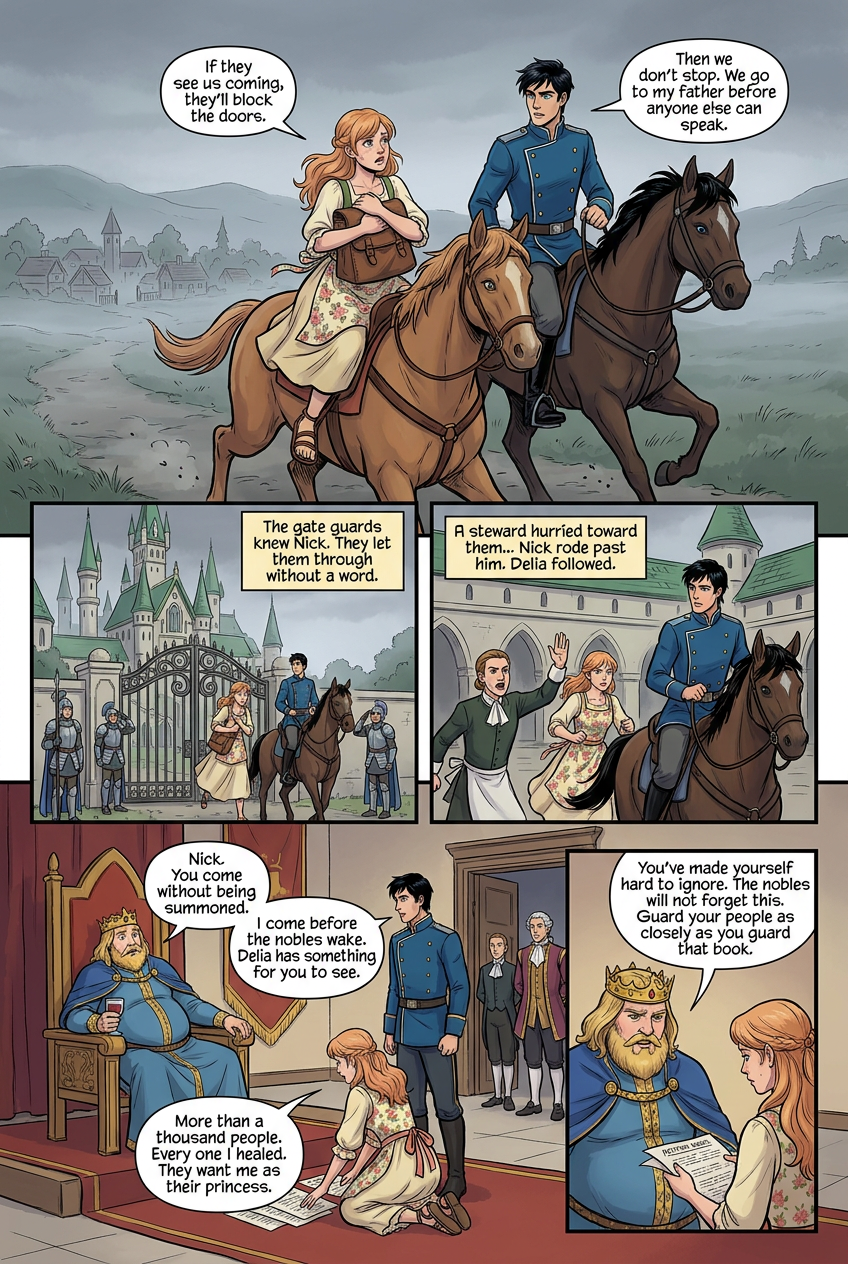
The petition sheets filled a leather satchel by dawn. More than a thousand marks, each a thumbprint or a name. Delia knew the nobles would try to take them before the court ever saw. So she and Nick left while the sky was still gray. No announcement. No escort. Just two riders and a bag of paper the crown could not afford to lose. They rode straight for the palace. Its towers rose ahead, green roofs catching the first light, the ornate gate shut tight. Delia held the satchel against her chest the whole way. Twice she looked back at the road behind them. Empty. Nick watched it too. "If they see us coming, they'll block the doors," she said. "Then we don't stop." Nick kicked his horse faster. "We go to my father before anyone else can speak." The gate guards knew Nick. They let them through without a word. Delia's heart pounded as they crossed the courtyard. A steward hurried toward them, hand raised, mouth open to protest. Nick rode past him. Delia followed. They dismounted at the great doors and went in on foot, fast, before the man could call for anyone. The throne hall was near empty. King Rowan sat with a cup of morning wine, blond beard uncombed, belly straining his robe. He looked up, surprised, as his son strode in with the healer at his side. "Nick," the king said. "You come without being summoned." "I come before the nobles wake." Nick set his jaw. "Delia has something for you to see. First. Before anyone whispers in your ear." Delia stepped forward and opened the satchel. She spread the sheets across the floor at the king's feet. Thumbprints in ink. Names in shaky letters. A blind weaver's mark. A farmer's. A cadet's. "More than a thousand people," she said. "Every one I healed. They put their mark down. They want me as their princess. They want Nick beside me." The king rose from his chair. He walked slowly along the rows of paper, reading. His face gave nothing away. Behind them, the steward reached the doorway with two nobles at his heels. They saw the sheets. One went pale. "Your Majesty," the noble began, "that book belongs before the court, not—" "It is already before me," Rowan said. He did not look up. He finished walking the length of the pages, then turned to the nobles at the door. "You will tell the court what you saw here this morning. All of it. A thousand marks for this woman. No prince earned that. She did." The noble opened his mouth, then closed it. He bowed and withdrew. Delia let out a slow breath. The petition was safe. The king had seen it first, and now his own court would hear it from his hand. Rowan looked at her. "You've made yourself hard to ignore," he said. "The nobles will not forget this. Guard your people as closely as you guard that book."
The petition sheets were still on the floor when the king spoke again. Delia gathered them slowly, the ink smudged where the morning light fell. Rowan watched her, then set down his cup. The hall was quiet enough to hear the paper move. He had one more thing to say, and Delia felt it coming before he opened his mouth. "The court will hear of this by noon," Rowan said. "So I will make it plain before they can twist it." He stepped past the sheets and stood before Nick. "You gave away my land. You married against my word. And a thousand people signed their names for your wife." He paused. "Arden won nothing. You did." Nick did not move. "Say what you mean, Father." "I mean you are my heir." Rowan said it once. "You will be king. Delia will be queen beside you." Delia's hands went still on the paper. She had come to make herself hard to ignore. She had not come for this. A crown meant the court, the etiquette, the endless watching. It meant every noble in the kingdom studying her for a secret. She thought of her healing house, the forty beds, the door she kept open like a river. "Your Majesty," she said, "my work is at the field. Not here." "Your work made you queen," Rowan answered. "You cannot have the one and refuse the other." Nick turned to her. His face had changed. Not with hunger for the throne. With relief. "Delia," he said, low. "Think what this gives us. No noble can take you. No steward can survey your land. If we rule, they answer to you." She understood then what he saw. All the secrets she carried, her gift, her blood, her body that would not stay wounded. A queen could not be owned. A queen could protect a garden no one dared touch. Nick had wanted her safe since the day he signed the grant. This was the safest she could ever be. "You're happy," she said to him. "I'm happy you'll be out of their reach," Nick said. "That's all I ever wanted." Rowan crossed to a table by the throne. He lifted a cloth. Under it sat two crowns, gold set with red stones, one larger and one small. "For the coronation," he said. "I will announce it to the court myself. There will be no whispering behind my back. My son is heir, and his wife with him." Delia looked at the smaller crown. It was heavier than any basket she had ever carried. She thought of the willow, the locked office, the family tree hidden upstairs. All of it would come under a queen's protection, or all of it would come under a queen's scrutiny. She did not yet know which. "Then I will wear it," she said. "But my house stays open. Every day. Free." "Agreed," Rowan said. "You are the heir's wife now. The nobles will kneel. And they will not forgive it."
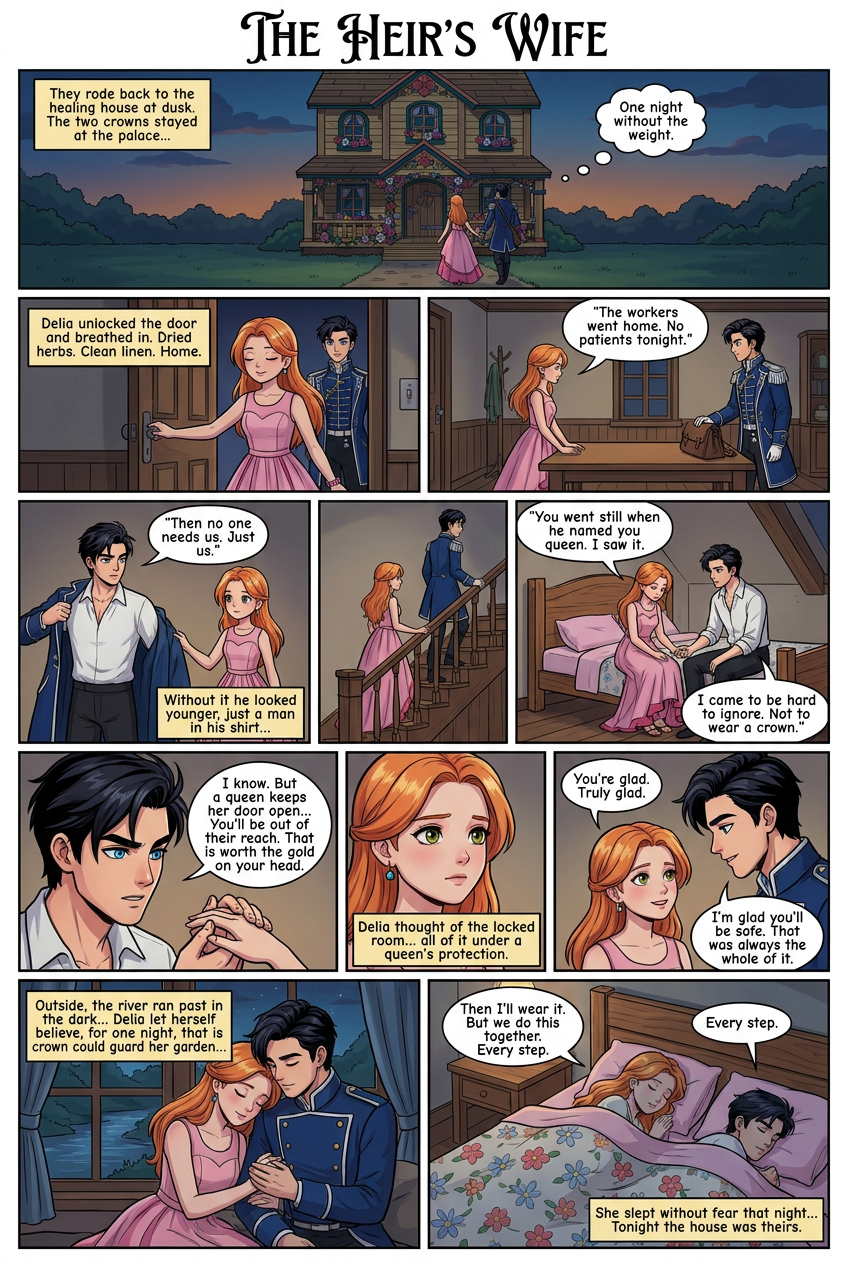
They rode back to the healing house at dusk. The two crowns stayed at the palace, wrapped in cloth, waiting for a coronation Delia had not agreed to want. She was heir's wife now. Safer, the king had said. But the nobles would not forgive it, and Delia felt their eyes even here, miles from the throne. She wanted one night without the weight of it. The house met them draped in blossoms, its windows dark, the beds inside empty until morning. Delia unlocked the door and breathed in. Dried herbs. Clean linen. Home. Nick came in behind her and dropped the satchel of petition marks on the table. For the first time in days, no one was watching them. "The workers went home," she said. "No patients tonight." "Then no one needs us," Nick said. He pulled off his stiff court coat and hung it on a chair. Without it he looked younger, just a man in his shirt, tired around the eyes. "Just us." They climbed the stairs to the small room at the top. The cedar bed sat under the window, dressed in pink and blue flowers. Delia sat on the edge and let her shoulders drop. Nick sat beside her. He took her hand and turned it over, tracing the palm where a cut had once closed itself in front of him. "You went still when he named you queen," Nick said. "I saw it." "I came to be hard to ignore. Not to wear a crown." "I know." He did not soften it. "But a queen keeps her door open and no steward argues. A queen grows what she likes and no noble counts the beds." He met her eyes. "You'll be out of their reach. That is worth the gold on your head." Delia looked at him. She thought of the locked room down the hall, the family tree hidden inside, the willow, her body that would not stay wounded. All of it under a queen's protection. Or all of it under a queen's watch. She still did not know which. But tonight the man beside her was not the prince or the heir. He was Nick, who had signed a grant against his father to give her a field. "You're glad," she said. "Truly glad." "I'm glad you'll be safe," Nick said. "That was always the whole of it." She leaned into him. His arm came around her. Outside, the river ran past in the dark, the way it always had, open to anyone who came to it. Delia let herself believe, for one night, that the crown could guard her garden instead of cage it. "Then I'll wear it," she said again, quiet. "But we do this together. Every step." "Every step," Nick said. She slept without fear that night. In the morning, the first patient would knock, and the court would begin sharpening its knives. But that was tomorrow. Tonight the house was theirs.
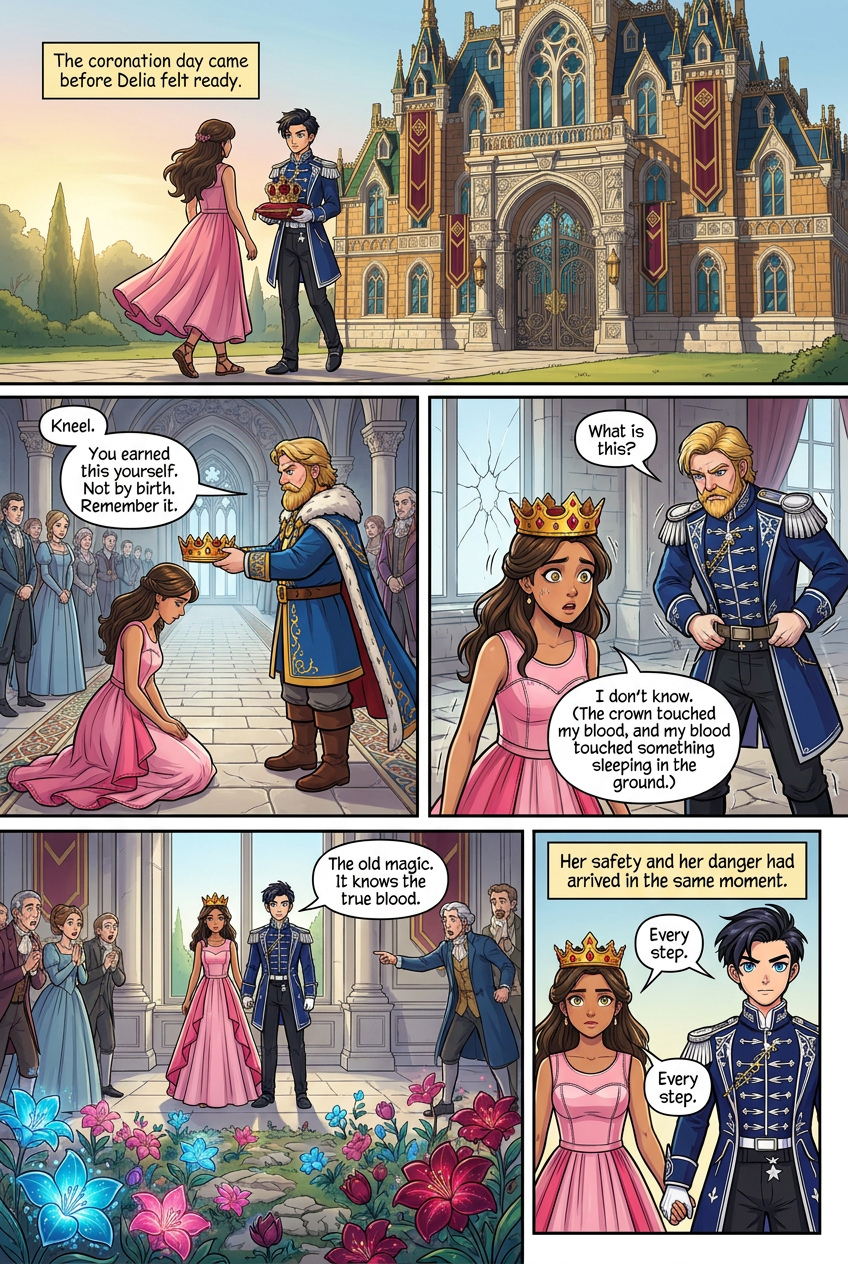
The coronation day came before Delia felt ready. She left the healing house at dawn and rode to the palace with Nick. The two crowns waited inside, wrapped in cloth, and she had agreed to wear the smaller one. She wore a pink flowing dress, the drape soft against her legs. Nick stood beside her in his court coat. She had told him only one thing that morning. Whatever the crown did to her, they faced it together. The palace hall filled with nobles. They watched her the way they watched all her secrets, hungry and cold. King Rowan stood at the front, the two gold crowns on a cushion, each set with red gems. He did not smile. He never did. "Kneel," Rowan said. Nick knelt. Delia knelt beside him. Her heart beat hard. She thought of the locked room, the family tree, the elf blood no one here knew ran in her. She kept her face still. Rowan lifted the larger crown and set it on Nick's head. Then he took the smaller one. He held it above Delia. "You earned this yourself," he said. "Not by birth. Remember it." The gold touched her hair. The crown was old, older than any book she had read. The moment it settled, something in it woke. Delia felt it pull at her, the way the willow fruit had pulled. Her elf blood answered. A shiver ran up through her hands. The floor shook. Nobles cried out and grabbed the walls. A crack ran up a tall window. Rowan gripped his belt and stared at the trembling stone. "What is this," he said. Not a question. A demand. "I don't know," Delia lied. But she did. The crown had touched her blood, and her blood had touched something sleeping in the ground. The shaking stopped. Through the tall windows, the courtyard below began to glow. Delia rose and moved to the glass. Nick came with her. Across the palace grounds, flowers pushed up through the stone in bursts of blue and pink and deep red. Their petals shone with light, as if each held a small fire. They spread past the gate and down the avenue, farther than she could see. The nobles crowded the windows, silent now. The glowing blooms were nothing they could name or price. Rowan stood beside Delia. He looked at the flowers, then at her. He said nothing, but she saw him understand something he could not prove. "The old magic," a noble whispered. "It knows the true blood." Delia's hand found Nick's. She was queen now, crowned before the whole court. But the ground had spoken her secret in light, and every noble had seen it. Her safety and her danger had arrived in the same moment. "Every step," Nick said, low. "Every step," she answered. And she turned to face the room that now knew too much.
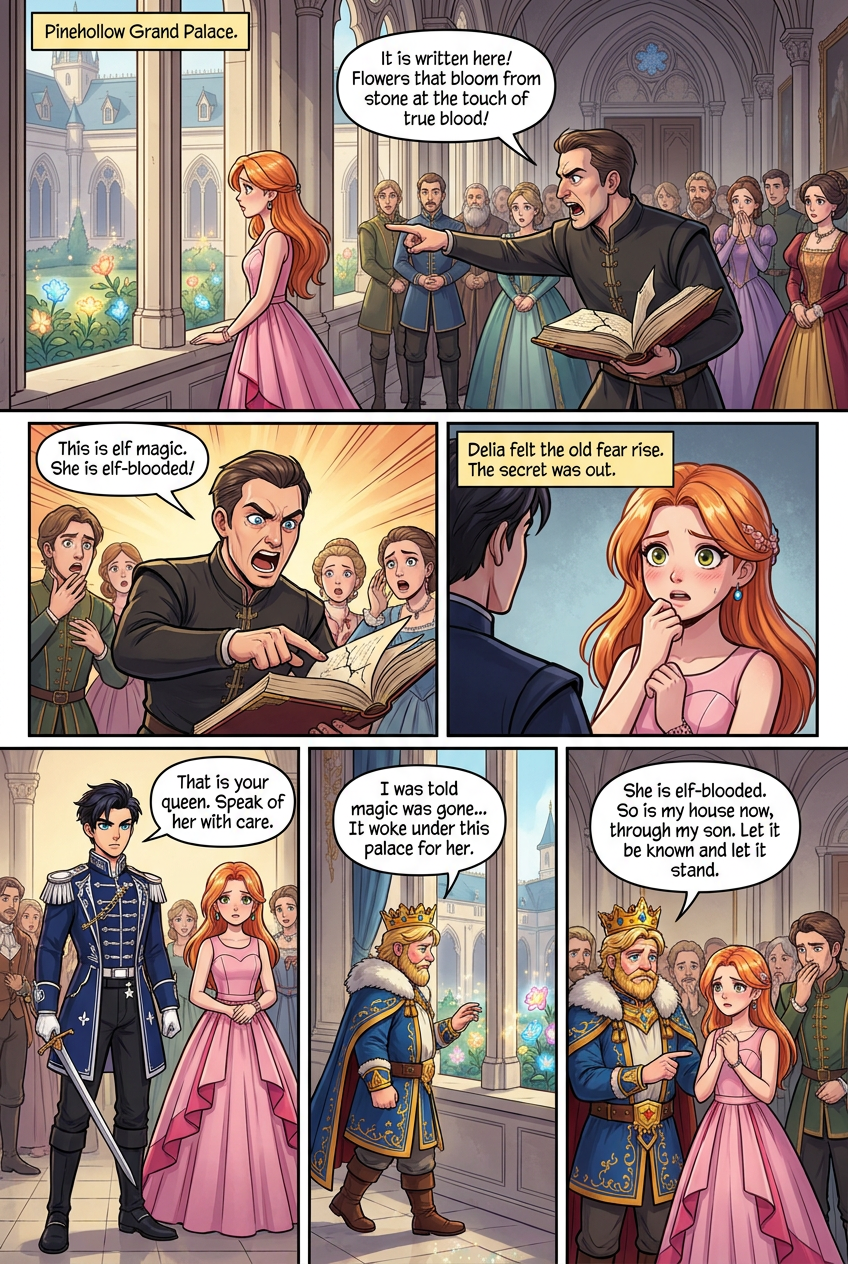
The glowing flowers still bloomed across the courtyard. Delia stood at the window and watched their light not fade. She had hoped the shaking would end and the blooms would die with it. They did not. Every noble in the hall could see them through the glass. And every noble now knew the magic had come from her. One noble pushed to the front. He held an old book against his chest, its cover cracked and stained. He had run to fetch it. He opened it now and stabbed a finger at a page. "I know this," he said. His voice climbed. "It is written here. Flowers that bloom from stone at the touch of true blood. This is elf magic. She is elf-blooded. It says so plainly." He turned the page toward the room. "Magic we were told died out. And it lives in her." The hall went loud. Some nobles stepped back from Delia. One woman covered her mouth. Delia felt the old fear rise, the fear she had carried since she found the family tree in her grandmother's cottage. The secret was out. She could not lie it back into the dark. Nick moved. He stepped in front of her, between her and the shouting noble. He set his shoulders square. "That is your queen," he said. His voice was flat and hard. "Speak of her with care." He did not raise it. He did not need to. The crown sat fresh on his black hair. Delia touched his back. She would not hide behind him. But she let him stand there, because he had promised. Every step together. Then King Rowan spoke. He had said nothing since the floor shook. He walked to the window and looked at the glowing blooms a long time. His face did not change. He never smiled, and he did not smile now. But his eyes were wet. "I was told magic was gone," Rowan said. "When I was a boy, they told me it left the world forever." He turned from the glass. "It did not leave. It slept. And it woke under this palace for her." He faced the room. "I am glad," he said. Plain. Once. The noble with the book lowered it slowly. A few nobles near him nodded, and their faces eased. But not all. Delia saw the others. A cluster near the door drew close and spoke behind their hands. One looked at her the way a man looks at a wolf in a pen. They were afraid, and fear did not nod along with a king. Rowan lifted his chin. "She is elf-blooded. So is my house now, through my son. Let it be known and let it stand." Delia's secret was gone. The whole court knew her blood. Rowan had made it law, not shame. But half the room feared her, and fear would look for a way to end her. Her sanctuary was safe today. Tomorrow those frightened nobles would come for it.
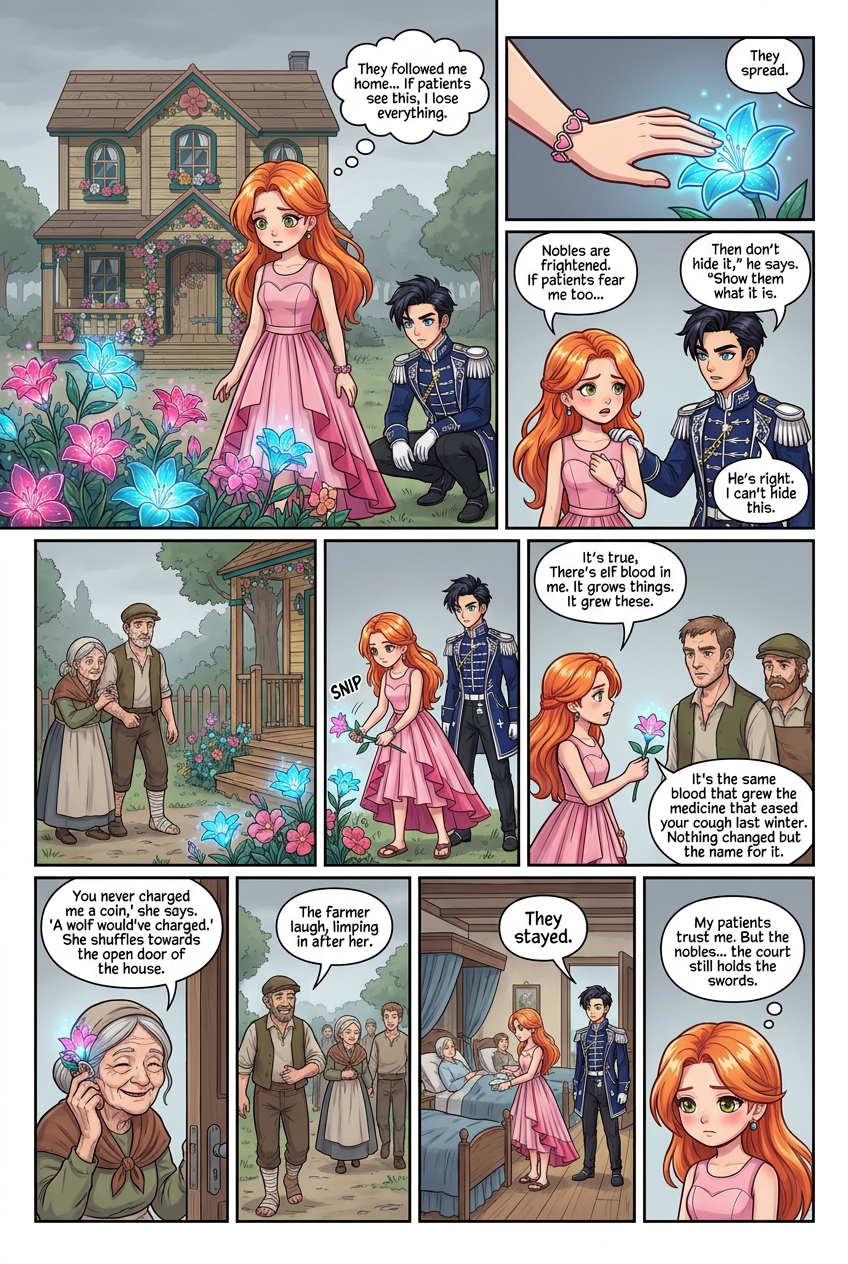
The glowing flowers had followed Delia home. She found them the next morning, blooming along the porch of her healing house, their petals lit blue and pink in the gray light. She had grown nothing there. The magic had simply woken and stayed. She knelt and touched one. It did not fade. The whole court had seen this light in the palace courtyard. Half of them called it a wonder. Half of them called it a threat. And now the threat had grown at her own door, where her patients would see it. Nick found her there. He crouched beside her and looked at the blooms without flinching. "They spread," he said. "They spread," she agreed. "Nobles are already frightened. If patients fear me too, I lose them. Then I lose everything I built." "Then don't hide it," Nick said. "Show them what it is." He stayed close, closer than he needed to. Since the exposure he had barely left her side. He watched every road and every stranger who came near her. Delia understood. She could not lie the magic back into the dark. So she would put it in the light instead. She waited by the porch as her patients arrived. They came slow that morning. Word had run through the villages. An old woman leaned on her son's arm and stopped at the gate. A farmer with a wrapped foot stood behind her. They stared at the glowing flowers. Delia felt Nick tense beside her. She did not wait them into fear. She stepped down and cut a stem from the porch. She carried it to the old woman and held it out. "It's true," Delia said. "There's elf blood in me. It grows things. It grew these." She pressed the glowing bloom into the woman's hand. "It's the same blood that grew the medicine that eased your cough last winter. Nothing changed but the name for it." The old woman turned the flower in her fingers. Her son had gone stiff. But she only smiled, slow and toothless. "You never charged me a coin," the woman said. "A wolf would've charged." She tucked the bloom behind her ear and shuffled through the gate. The farmer laughed at that. He limped in after her. One by one they came, and none turned back. They had known her kindness for years. A word from a frightened noble could not undo it in a morning. By noon her beds were full. Nick stood at the door and watched them work, and some of the hardness left his face. "They stayed," he said. "They stayed," Delia said. But she knew the count was only half won. Her patients trusted her. The nobles did not. The frightened ones had gone home to the palace, and they would not throw a flower behind their ears and smile. They would look for a lever. Her people held one side. The court held the other. And the court held the swords.
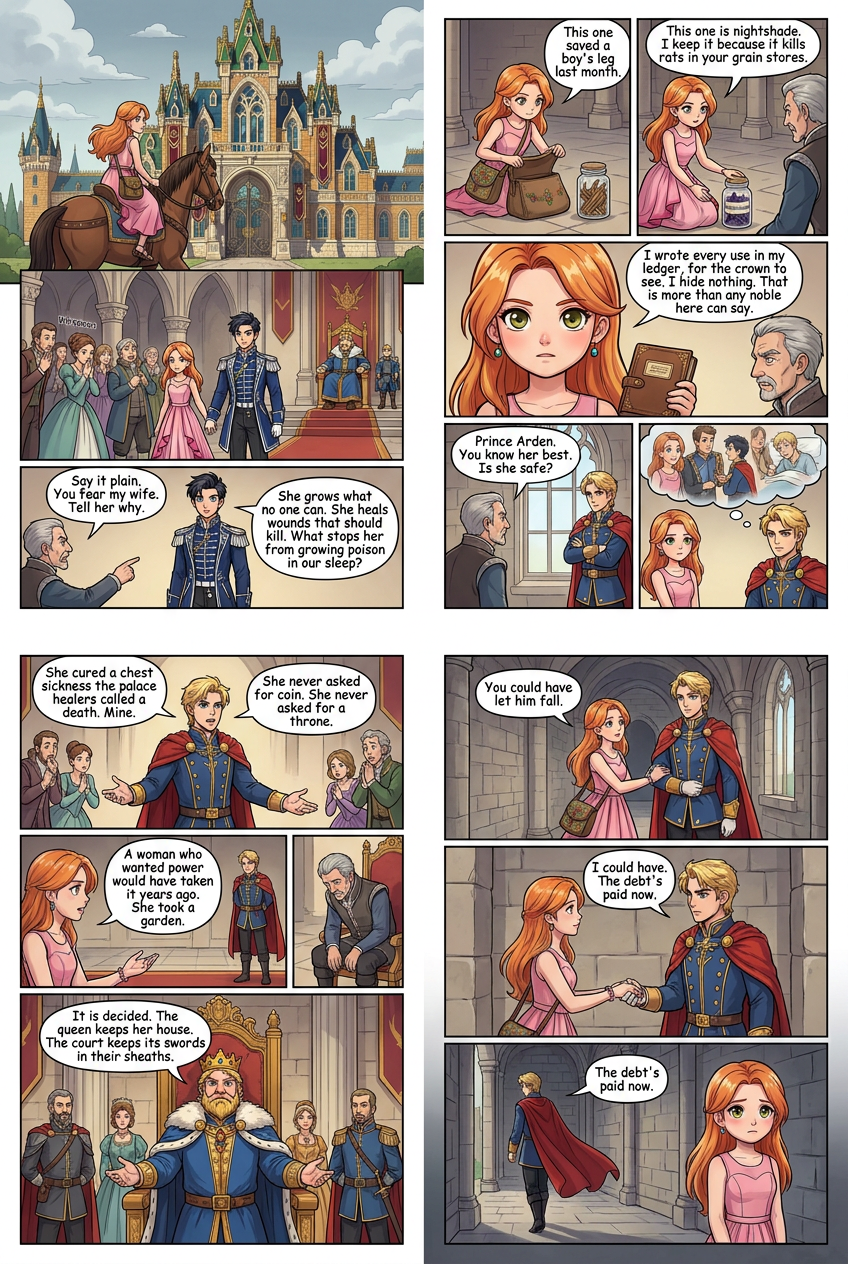
Delia rode to the palace three days later, her flower-stitched satchel of herbs slung across her back. The nobles had not thrown a flower behind their ears. They had gone quiet, and quiet was worse. Nick had gathered them in the great hall to answer for their fear. Half the court wanted Delia gone. Half wanted her power for the crown. She walked in beside Nick and felt every eye land on her hair, her hands, the ground under her feet. Rowan sat on his high chair, watching his sons. He had made this happen. He had crowned her and named her elf blood law. But even a king could not order a room to stop being afraid. "Say it plain," Nick told the court. His voice was flat. "You fear my wife. Tell her why." A gray-haired lord stood. "She grows what no one can. She heals wounds that should kill. What stops her from growing poison in our sleep?" Delia opened her satchel. She set a jar of dried root on the floor. "This one saved a boy's leg last month. This one"—she set down another—"is nightshade. I keep it because it kills rats in your grain stores. I wrote every use in my ledger, for the crown to see." She looked at the lord. "I hide nothing. That is more than any noble here can say." The room shifted. But the gray-haired lord did not sit. He turned to Arden. Arden had stood apart the whole time, near the tall window, arms crossed. The king's first son. The one who should have been heir. The court had waited for him to speak, because his word could tip the frightened half either way. He had once loved Delia. She saw it still, buried under the flat set of his jaw. He wanted Nick to fall. He also owed her his life. "Prince Arden," the lord said. "You know her best. Is she safe?" Arden looked at Delia for a long moment. Then at Nick. She could see the choice pull at him. One word and he could break his brother. One word and he could break her. "She cured a chest sickness the palace healers called a death," Arden said. "Mine. She never asked for coin. She never asked for a throne." He let that sit. "A woman who wanted power would have taken it years ago. She took a garden." The gray-haired lord sat down. One by one, the frightened half stopped whispering. Arden had spent his own name to steady them, and it held. Rowan stood. "It is decided. The queen keeps her house. The court keeps its swords in their sheaths." He said it once and turned away. Outside the hall, Delia caught Arden's sleeve. "You could have let him fall." "I could have," Arden said. He did not smile. "The debt's paid now." He walked off before she could answer. The court was hers. But Arden was no longer bound to protect her, and that was a lever waiting to be pulled.
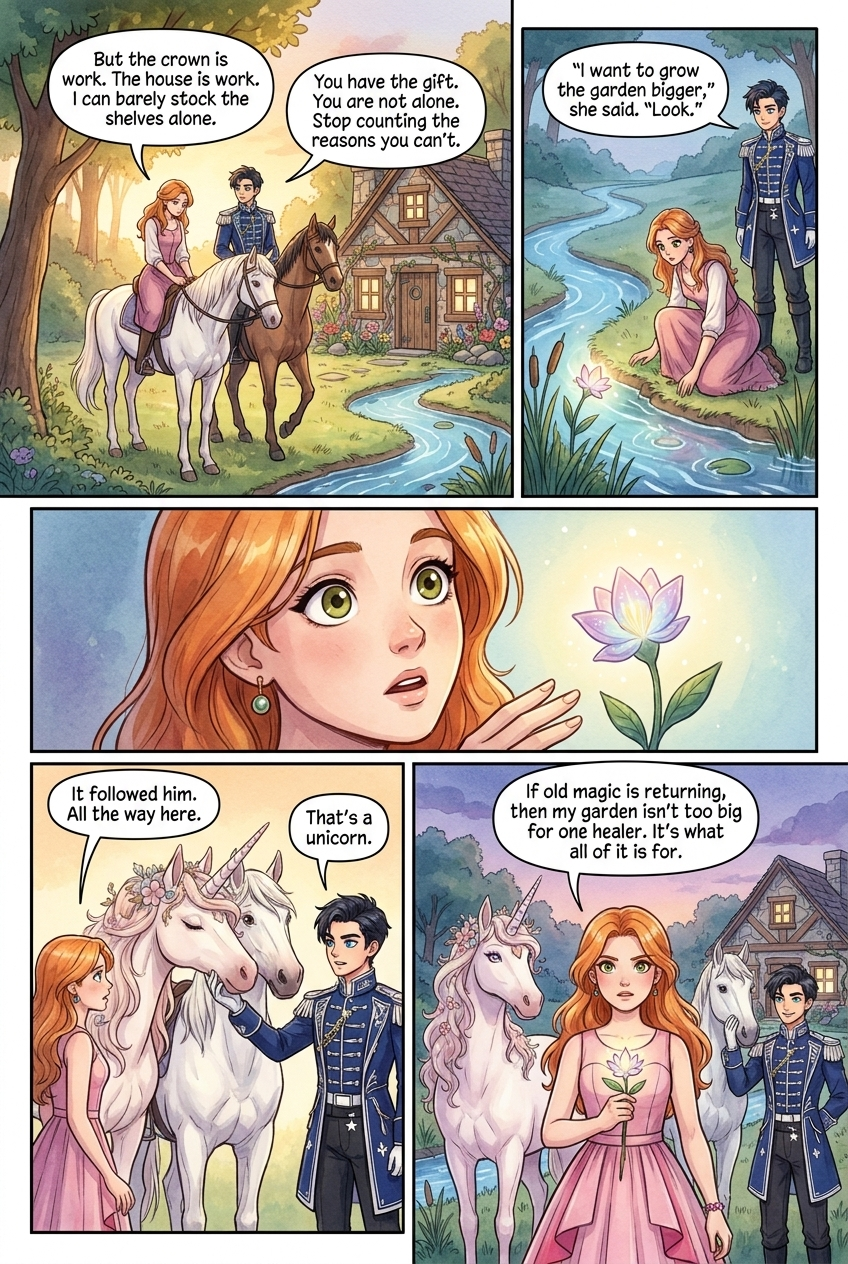
The court had accepted her. The healing house was full every day. But Delia felt the weight of it pressing on her shoulders, so she rode to the old cottage by the river to think. Her white horse carried her along the path. Nick rode beside her, quiet, letting her breathe. She meant to plan the sanctuary garden she had promised herself. Now she wondered if she could even keep the beds she had. "I want to grow the garden bigger," Delia said. She looped the reins loose. "Free healing for every traveler. Every hurt creature." She shook her head. "But the crown is work. The house is work. I can barely stock the shelves alone." Nick swung down at the cottage. He tied his horse and studied her. "You trained six workers. You have the gift. You are not alone." He said it plainly, the way he said everything that mattered. "Stop counting the reasons you can't." Delia walked to the water. The blue river wound past the stones, its banks thick with flowers. Then she stopped. A single blossom stood near the reeds that had not been there before. It glowed faint at the center, like the ones from her field. She knelt and touched it. She had not grown it. No one had planted it. "Nick," she said. "Look." He came to her side. But he was looking past the flower, up the bank. Delia followed his eyes. Near her white horse stood another animal. Pale, slim, with flowers laced through its mane. A long horn rose from its brow. It pressed close to her horse, unafraid, as if it had chosen him. Delia stood slowly. "That's a unicorn." Her voice caught. "They died out. Grandmother said so. Long before I was born." The creature dipped its head. It did not run. It stayed beside her horse, nosing his shoulder, settled and calm. When Delia stepped toward it, it only watched her with soft eyes. Her white horse stood still and let it stay. "It followed him," Nick said. "All the way here." Delia looked at the glowing flower by the river. Then at the unicorn that should not exist. Her hands were steady now. The weight on her shoulders had not lifted, but something under it had shifted. "This isn't just my blood waking up," she said. "The magic is coming back. Into the land. The water. The creatures." She met Nick's eyes. "If old magic is returning, then my garden isn't too big for one healer. It's what all of it is for." She made her choice standing there by the brook. "I'll expand the garden. Not smaller because I'm tired. Bigger, because this is why I was given the gift." The unicorn stayed close to her horse as they turned back. It would follow her home. And whatever else was waking would follow too.
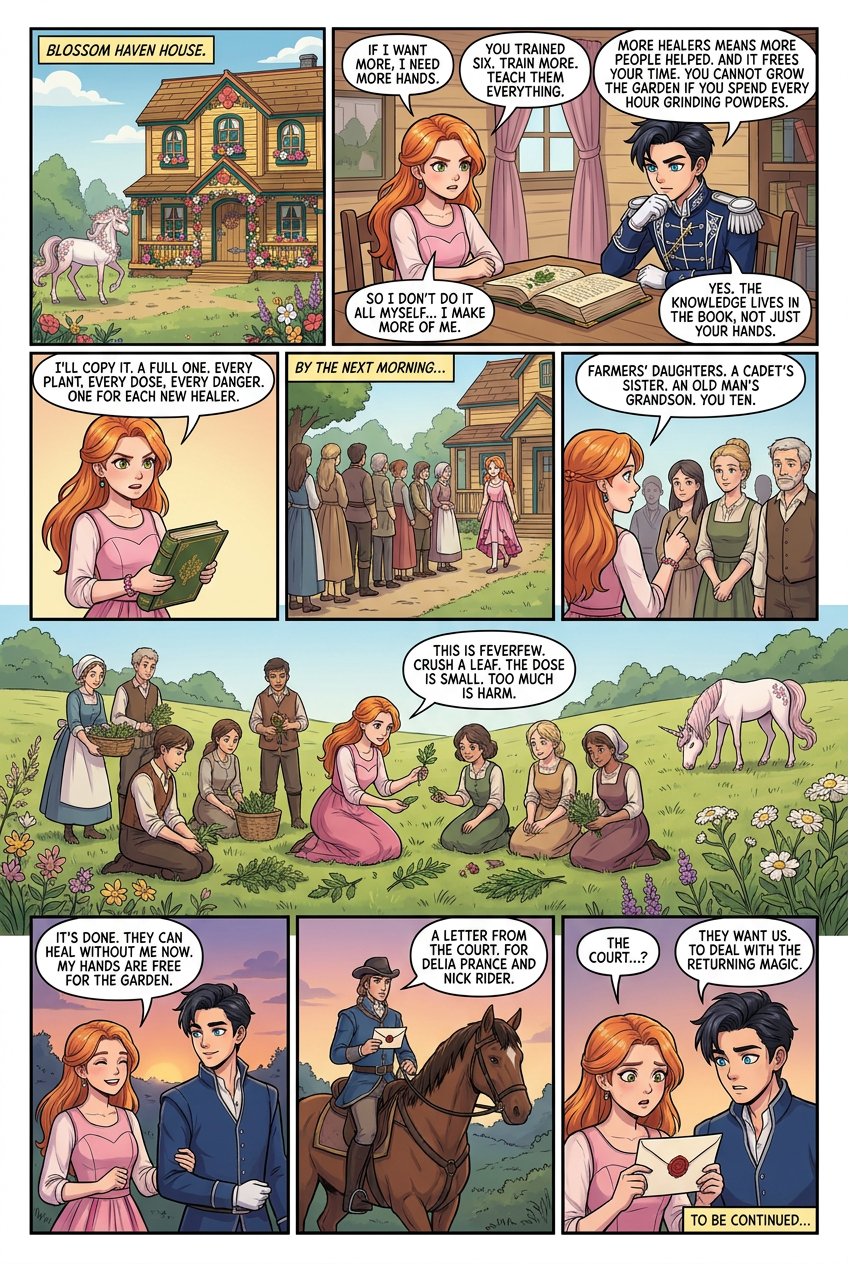
The unicorn followed them home and settled in the field. Delia meant to keep her promise. She would make the garden bigger. But the beds she already had were more than she could stock alone. She sat with Nick at the long table in her healing house, its walls draped in blossoms, and spread her worn herb book open between them. "If I want more," she said, "I need more hands." Nick pulled the book toward him. His finger traced a page of dried leaves and roots. "You trained six," he said. "Train more. Teach them everything." He looked up, blue eyes steady. "More healers means more people helped. And it frees your time. You cannot grow the garden if you spend every hour grinding powders." Delia turned the idea over. She thought of the mornings she woke before dawn to fill jars. She thought of patients waiting on the porch while she worked alone. "So I don't do it all myself," she said slowly. "I make more of me." "Yes," Nick said. "You already proved it works. Your workers treated a patient without you. The knowledge lives in the book, not just your hands." Delia stood and walked to the shelf. She lifted the reference book she had written for her staff. Then she looked at her grandmother's old herb book, thick with names and warnings. She had memorized most of it long ago. "I'll copy it," she said. "A full one. Every plant, every dose, every danger. One for each new healer." Her voice grew firm. "I'll take on ten more. Teach them here, in the beds, the way I taught the first six." Nick closed the book. "Then do it." They did not wait. That afternoon Delia sent word through her patients that she needed workers. By the next morning, a line stood outside the blossom-draped house. Farmers' daughters. A cadet's sister. An old man's grandson. She walked the row and chose ten. She led them into the field and knelt in the dirt, her flowered apron folding under her knees. She showed them the fever herbs first. She crushed a leaf and passed it hand to hand. She named it, named its dose, named the harm of too much. Her six trained workers moved among the new ten, repeating her words. By dusk the field hummed with voices learning. Delia stood at the edge and watched sixteen people do the work that had crushed her alone. "It's done," she told Nick that night. "They can heal without me now. My hands are free for the garden." But as she spoke, a rider came up the path with a sealed letter. The note carried the court's stamp. The nobles wante Nick and Delia at court. They need to deal with the returning magic.
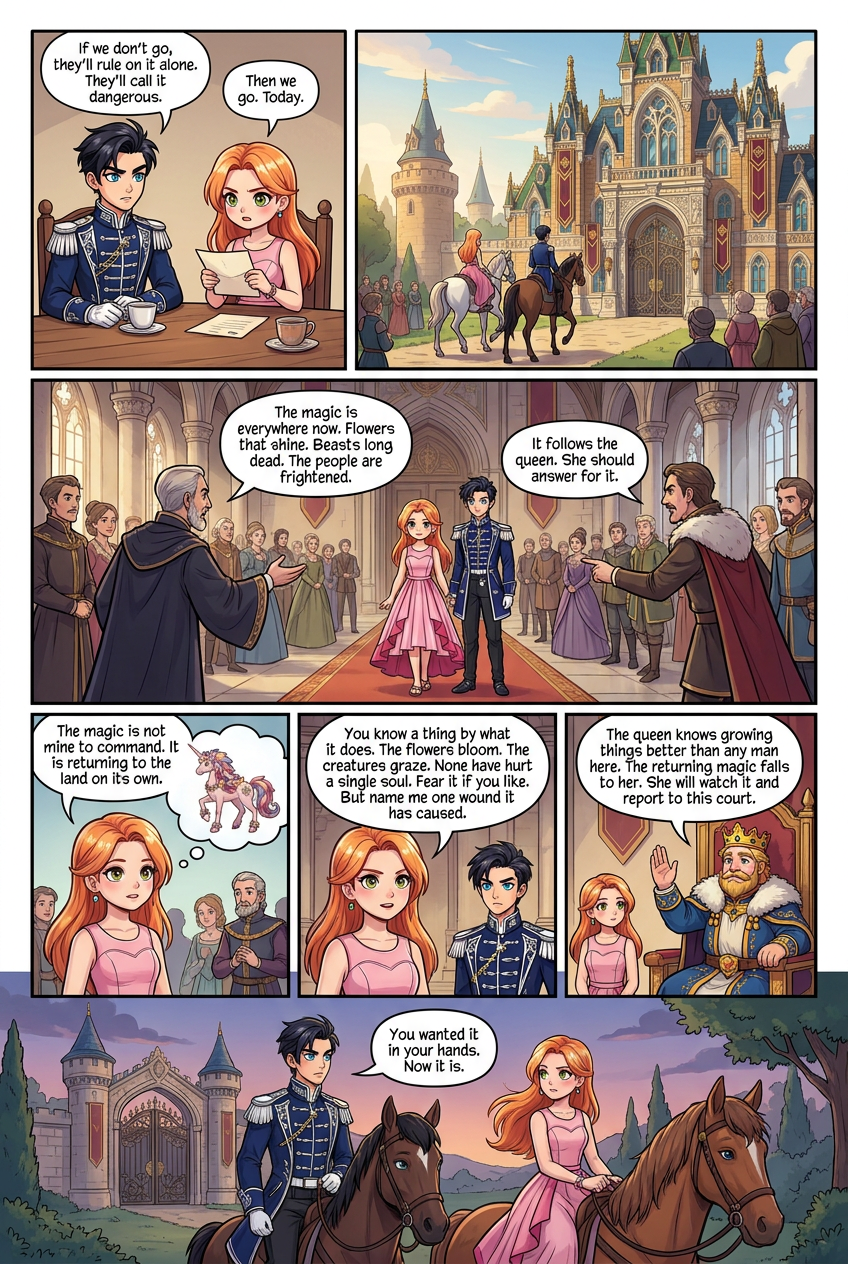
The letter still lay on the long table when the second rider came. Delia read it twice. The court wanted her at the palace to answer for the magic spreading across the land. Glowing flowers. A unicorn in her field. Blooms she had not planted. She looked out at her beds, at the sixteen healers she had just trained, at the work she had finally freed her hands to do. If she stayed, the crown would decide about the magic without her. They would call it a threat and act. She could not let that happen. Nick set his cup down. "If we don't go, they'll rule on it alone. They'll call it dangerous." "Then we go," Delia said. "Today." They rode to Pinehollow Grand Palace by afternoon. Its towers climbed above the gate, and nobles waited in the hall. Delia felt their eyes. Half of them still feared her blood. She walked between them to the front and stopped where the whole court could see her. A noble spoke first. "The magic is everywhere now. Flowers that shine. Beasts long dead. The people are frightened. No one knows if it means harm." Another rose. "It follows the queen. She should answer for it." Delia did not step back. "The magic is not mine to command," she said. "It is returning to the land on its own. I have seen it by the river. I did not call it." "Then how do we know it is safe?" the first noble asked. Delia thought of the unicorn resting in her field. She thought of the flowers that had healed no one and harmed no one. "You know a thing by what it does," she said. "The flowers bloom. The creatures graze. None have hurt a single soul. Fear it if you like. But name me one wound it has caused." The hall went quiet. No noble answered. Nick moved to her side. "My wife heals your people for free," he said. "The same blood you fear does that. Call it a threat and you insult every farmer she has saved." Delia pressed on. "Give me the magic to tend. I know plants. I know what heals and what harms. Let me study these blooms and tell you the truth of them. If I find danger, I will say so. If I find none, you will have your answer." The nobles murmured. King Rowan sat above them, listening. At last he raised his hand. "The queen knows growing things better than any man here," he said. "The returning magic falls to her. She will watch it and report to this court." It was done. The crown would not act alone. But Delia had bound herself to a new task. She rode home with the whole strange magic of the land laid on her shoulders. She now had to understand a power no living person had ever explained. Nick watched her at the gate. "You wanted it in your hands," he said. "Now it is."
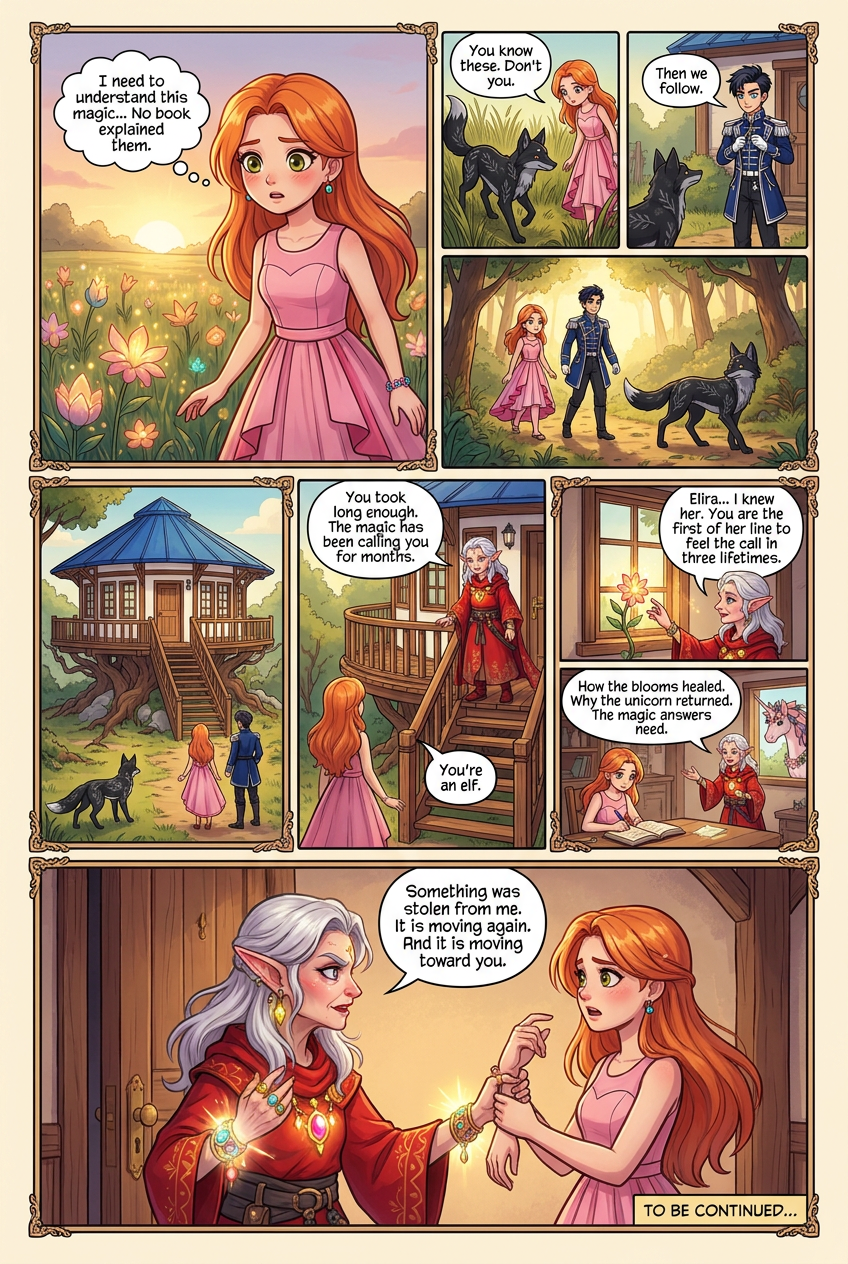
The court had given Delia the magic to study, but she had no idea where to start. She stood in her field at dawn and looked at the glowing flowers she had never planted. She knew every healing plant by touch and smell. These she did not know at all. No book explained them. No living person could. She had promised the king answers she could not give. The black fox stepped out of the tall grass. Delia knew him. He had led her to plants before, guiding her hands to what she needed. Now he sat and watched her, ears sharp. "You know these," she said. "Don't you." The fox turned and trotted toward the trees, then stopped and looked back. Delia called for Nick. He came from the house, still buttoning his coat. "The fox wants us to follow," she said. Nick studied the animal. "Then we follow." They walked behind him through the woods, the fox pausing whenever they fell behind. He led them up a slope to a small round house on a rise of gnarled roots, its walls white and its roof blue. An old woman stood on the wraparound railing. She was small and wore red. Rings and pendants glowed at her throat and hands, brighter as they neared. Her ears were pointed. Her eyes were sharp and blue. "You took long enough," she said. "The magic has been calling you for months." Delia stopped at the stairs. "You're an elf." "Elara Jance," the woman said. "I have hidden longer than your grandmother's grandmother lived. The blooms woke me too." She looked Delia over, slow and careful. "You have the blood. I can smell it on you like rain." Delia climbed the steps. "I have to explain this magic to the court. I don't understand any of it." "Then sit," Elara said. She led them inside, past windows on every wall. "The magic is old. It sleeps in the land when there are none to tend it. It wakes when the right blood returns." She touched a glowing flower on the sill. "These grow for you. The creatures come for you. You are what the land waited for." Delia sat forward. "My ancestor was named Elira. She served the palace." Elara went still. "Elira," she said. "I knew her. She was a healer, like you. Kind, like you." She looked at her own glowing rings. "You are the first of her line to feel the call in three lifetimes." Elara taught them until the sun crossed the sky. How the blooms healed. Why the unicorn returned. How the magic answered need, not command. Delia wrote every word. When they left, she carried the answers the court demanded. But Elara had watched her rings all day. At the door she gripped Delia's wrist. "Something was stolen from me," she said. "It is moving again. And it is moving toward you."
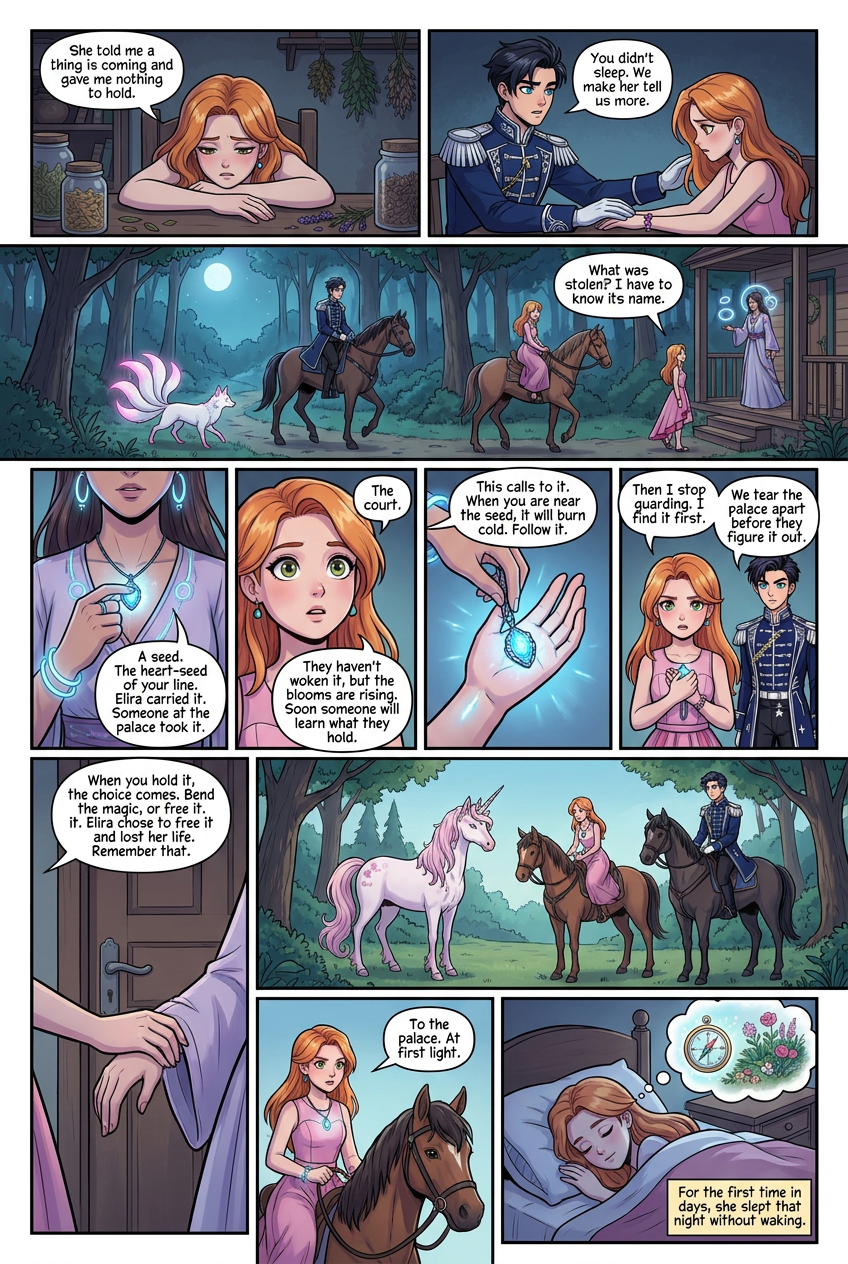
Elara's warning followed Delia home. Something stolen. Moving toward her. She could not fight what she could not name. For three days she worked her healing house without rest. Nick watched her measure the same fever draught twice. He set his hand over hers to stop it. "You didn't sleep," he said. "I can't," she said. "She told me a thing is coming and gave me nothing to hold." Nick's jaw tightened. He knew this fear. He had worn it before, waiting for his father's blow to fall. "Then we make her tell us more," he said. They rode back through the woods. The white fox with nine glowing tails met them on the path and led them the last stretch. Elara stood on her railing, rings already bright. "You came back angry," she said. "I came back with a question," Delia said. "What was stolen? If I'm to guard against it, I have to know its name." Elara went inside and lifted a glowing pendant from her throat. "A seed," she said. "The heart-seed of your line. Elira carried it. It holds the memory of every healer before her. Someone at the palace took it when she died. Whoever holds it can wake the old magic and bend it. Command it. Not through need. Through will." Delia's stomach dropped. "The court," she said. "If a noble has it—" "They have not woken it," Elara said. "They don't know what it is. But the blooms are rising now. The seed feels its own blood returning. It stirs. Soon someone will learn what they hold." She pressed the pendant into Delia's palm. "This calls to it. When you are near the seed, it will burn cold. Follow it." Delia closed her hand around the pendant. It sat warm now, quiet. "Then I stop guarding," she said. "I find it first." Nick nodded once. "We tear the palace apart before they figure it out." "Not tear," Delia said. "We were given leave to study the magic. I'll study it right into their vaults." Elara caught her wrist at the door, the same grip as before. "When you hold it, the choice comes," she said. "Bend the magic, or free it. Elira chose to free it and lost her life for the choosing. Remember that when your hand is on it." Outside, the dusk-toned unicorn stood among the roots, petals in its mane, watching Delia as if it already knew. Delia mounted her horse with the pendant against her chest. The dread was gone. In its place sat a road. She had a name now, and a compass, and a garden waiting to grow wherever the old magic was set loose. "To the palace," she told Nick. "At first light." For the first time in days, she slept that night without waking.
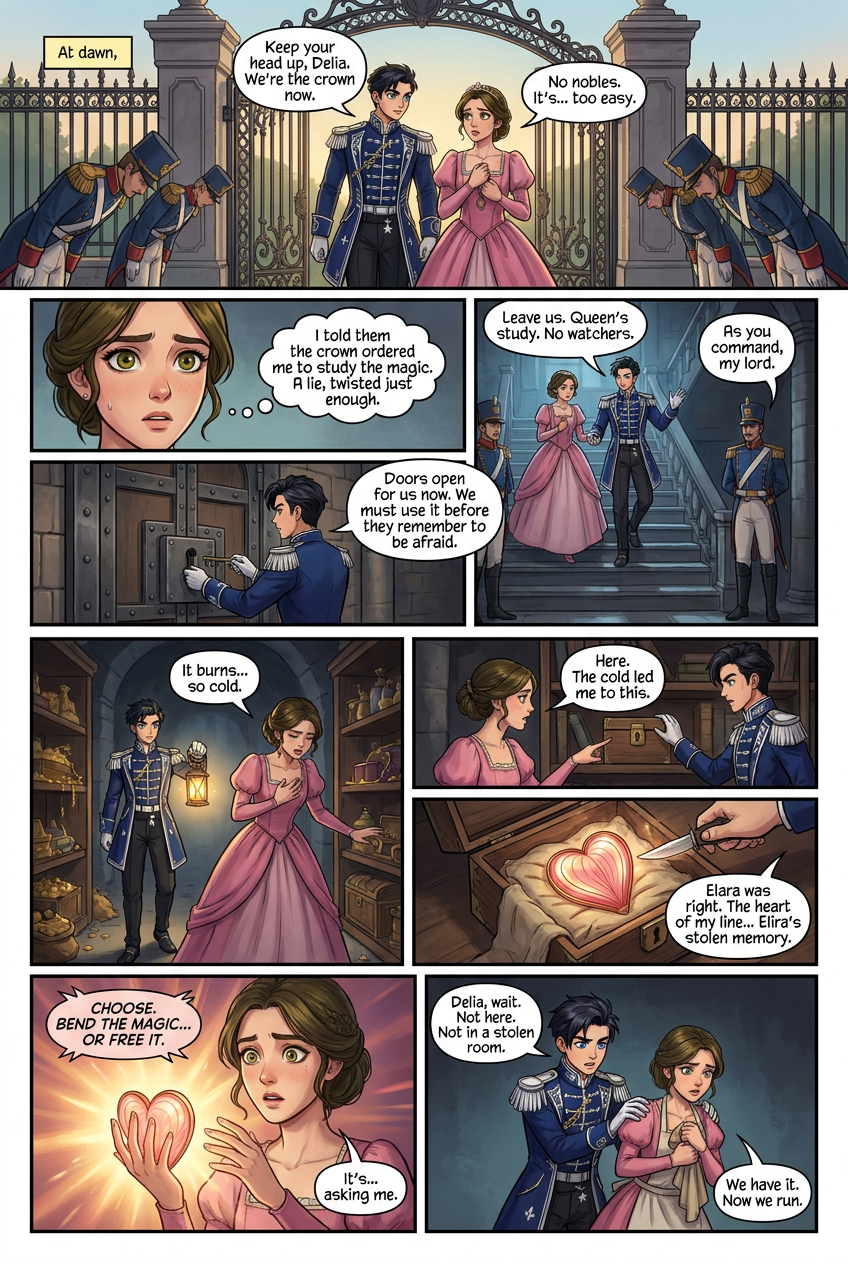
At first light, Delia and Nick rode through the palace gate as queen and king. No noble stopped them. Guards bowed and stepped back. Delia kept the pendant against her chest, cold and quiet for now. She had told the steward the truth twisted just enough: the crown had ordered her to study the magic. The vaults held old records. She meant to read them. Nick led her down a stone stair past two guards. He waved them off with a flat word. "Leave us. Queen's study. No watchers." The men obeyed and climbed away. Delia watched the last one go. "That easy," she said. "We're the crown now," Nick said. "Doors open for us. Use it before they remember to be afraid." The vault door stood tall and iron-bound. Nick worked the crown's key. The lock turned. Inside, shelves of coin, sealed chests, and old banners stretched into the dark. Delia held the pendant loose in her palm and walked the rows. Nick took a lantern from the wall. At the third shelf, the pendant bit her skin. She hissed. It burned cold, so cold her fingers ached. "Here," she whispered. She followed the cold to a small locked box on the highest shelf. Nick reached it down. He forced the clasp with his knife. Inside, wrapped in old cloth, sat a seed shaped like a heart. It glowed with a soft inner light, pink and gold, veined like a leaf. "Elara was right," Delia said. Her breath caught. This was the heart of her line, the memory of every healer before her, stolen when Elira died. It had waited in the dark all these years, so close to the throne. She reached for it. "Delia," Nick said. "Wait." She did not wait. Her fingers closed on the seed. Warmth flooded up her arm. Then a voice, not in the room but in her skull, old and many at once. Choose, it said. Bend the magic to your will, or free it and let it heal by need. Elara's warning came back sharp: Elira chose to free it and lost her life for it. Delia stood frozen, the seed glowing in her fist. Nick set the lantern down. "What is it," he said. "It's asking me," she breathed. "Command it, or let it go. Elira died freeing it." His hand found her shoulder. "You don't have to choose in a stolen room," he said. "Not with guards a shout away." He was right. The cold pendant, the open vault, the seed in her hand, all of it could turn to ruin if a noble came down that stair. Delia wrapped the seed in its cloth and pressed it under her apron. The voice quieted, but the choice stayed. "We have it," she said. "Now we run before they know it's gone." She had come to find the seed. She had it. And now she carried a choice that could cost her life.
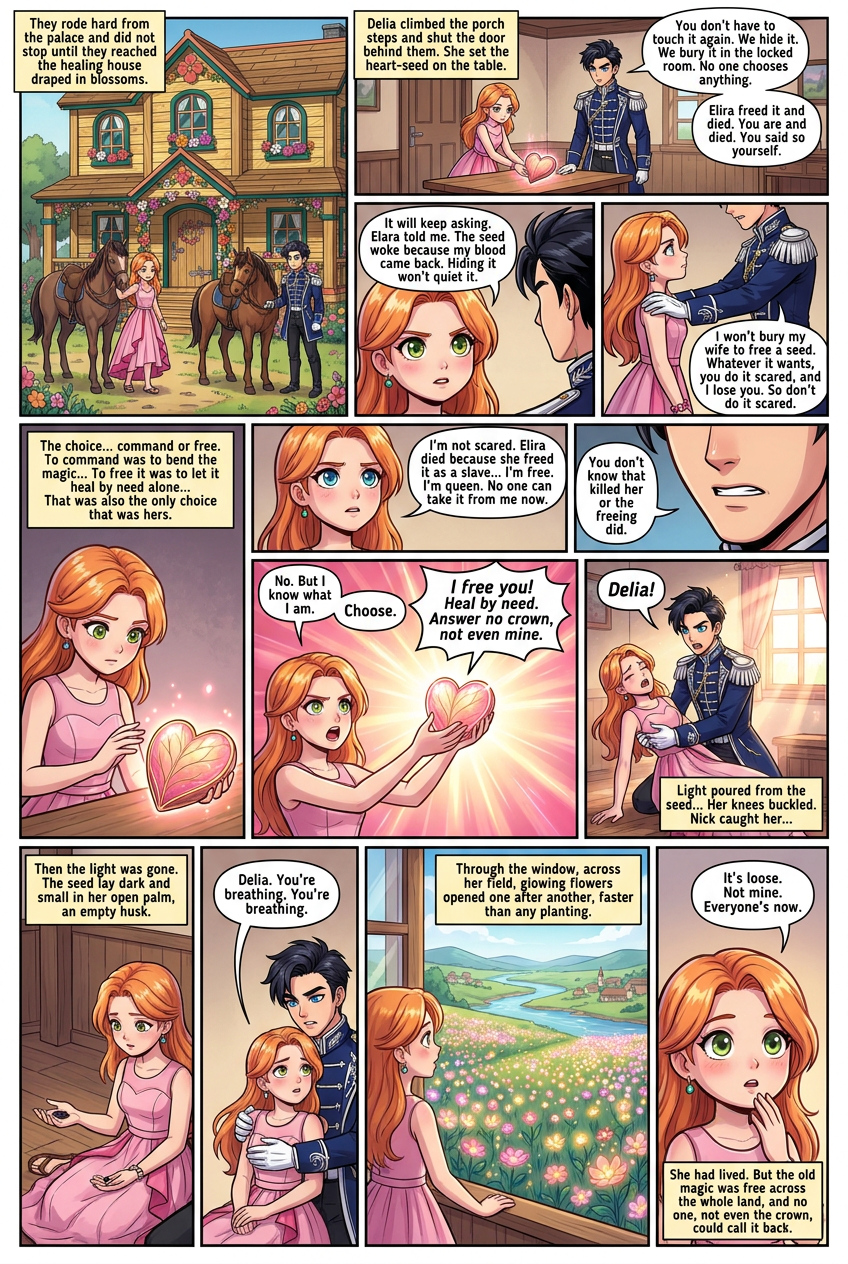
They rode hard from the palace and did not stop until they reached the healing house draped in blossoms. Delia climbed the porch steps and shut the door behind them. She set the heart-seed on the table. It glowed pink and gold in the dim room, veined like a leaf. The choice had not left her. It had ridden home in her apron the whole way. "You don't have to touch it again," Nick said. He stood between her and the table, tall, his blue eyes hard. "We hide it. We bury it in the locked room. No one chooses anything." "It will keep asking," Delia said. "Elara told me. The seed woke because my blood came back. Hiding it won't quiet it." Nick set his hands on her shoulders. "Elira freed it and died. You said so yourself." His voice dropped, plain and low. "I won't bury my wife to free a seed. Whatever it wants, you do it scared, and I lose you. So don't do it scared." Delia looked at the seed. She thought of the choice as two words: command or free. To command was to bend the magic to her will, to rule it like the nobles ruled land. To free it was to let it heal by need alone, the way her blooms already did by the river. That was the danger. That was also the only choice that was hers. "I'm not scared," she said. It was almost true. "Elira died because she freed it as a slave, hunted, with the seed stolen from her hands. I'm free. I'm queen. No one can take it from me now." Nick's jaw tightened. "You don't know that killed her or the freeing did." "No," Delia said. "But I know what I am." She picked up the seed. Warmth flooded her arm. The voice returned, old and many at once. Choose. "I free you," she said aloud. "Heal by need. Answer no crown, not even mine." Light poured from the seed and up her arm. Her knees buckled. Nick caught her before she hit the floor, shouting her name. The glow spread from her hand into the wood, into the walls, out through the window. Delia felt it leave her, a great warmth draining away, and for one moment she could not breathe. Then the light was gone. The seed lay dark and small in her open palm, an empty husk. She was alive. Her heart still beat. "Delia." Nick held her tight. "You're breathing. You're breathing." She pushed up and looked past him. Through the window, across her field, glowing flowers opened one after another, faster than any planting. They spread toward the river, toward the villages, farther than her eyes could follow. "It's loose," she whispered. "Not mine. Everyone's now." She had lived. But the old magic was free across the whole land, and no one, not even the crown, could call it back.
Play your story to life
Storycraft is a mobile game where you create AI characters, craft items and locations to build their world, then discover what direction your story takes. Download the iOS game for free today!
Download for free