

Dollie the Doctor's Arc
5 Chapters
Dollie the Doctor's dream is curing the mysterious illness that has quietly spread through her hometown's oldest neighborhoods..

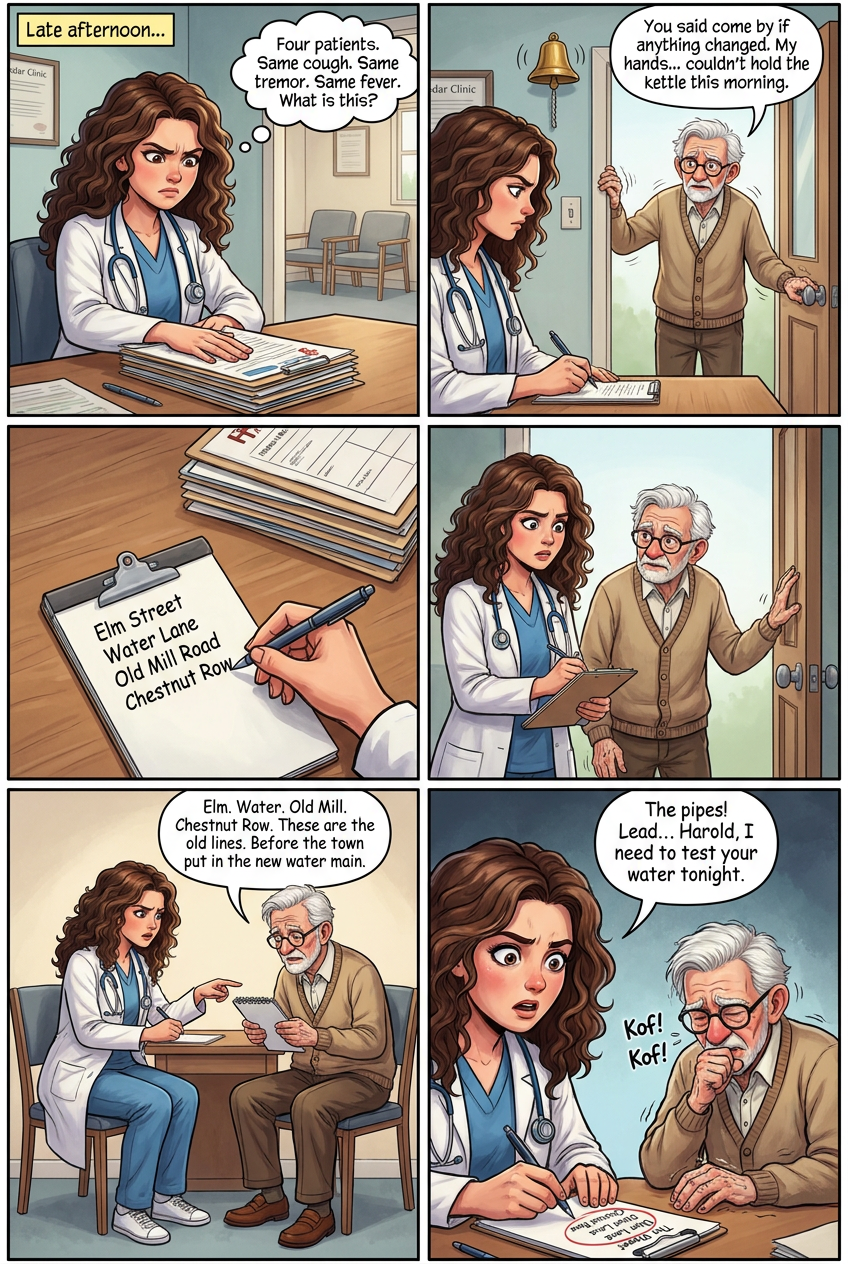
Dollie set the fourth chart on top of the other three and pressed her palm flat against the stack. Four patients this month. Same cough that would not clear. Same slow tremor in the hands. Same low fever that spiked at night and vanished by morning. She had trained for eight years and could not name what she was looking at. Her clinic sat quiet in the late afternoon. Blue clapboard walls. A small waiting room with two empty chairs. She had opened the doors here two years ago because this was her hometown, and because the old doctor had retired without a replacement. Now people were getting sick, and she was the only one who might stop it. She spread the four files across her desk and wrote the addresses on a notepad. Elm Street. Water Lane. Old Mill Road. Chestnut Row. She stared at the list. Four streets she had walked her whole life. Nothing linked them that she could see. Different families. Different ages. Different jobs. She needed a map, and she needed someone who had watched this town longer than she had. The bell above the door rang. Harold Winters shuffled in, cardigan buttoned crooked, one hand braced on the frame. He had run the pharmacy for forty years before he closed it. He was also her first patient with the cough. He was the reason she had started keeping the list. "You said come by if anything changed," he said. His voice was thin. "My hands were shaking this morning. Couldn't hold the kettle." She pulled out a chair for him. "Sit. I want to show you something first." He lowered himself down and squinted at the addresses. "These your sick ones?" "Four so far. I can't find what they share. You've lived here longer than anyone I trust." Harold took the notepad. He read the streets slowly, mouthing each one. Then he set the pad down and looked at her over his glasses. "These are the old lines," he said. "Before the town put in the new water main in seventy-two. Every one of these houses is still on the original pipes. My street too." Dollie sat down hard in the other chair. "The water." "The pipes," Harold said. "Lead, most of them. Some worse. I used to fill prescriptions for half these families. Kidney complaints. Nerve troubles. I thought it was just old people getting old." She grabbed the notepad back and drew a rough circle around the four streets. Her hand was steady, but her chest was not. If Harold was right, the illness was not spreading. It had always been there. And every house on the old lines was already drinking it. "Harold," she said, "I need to test your tap water tonight. And theirs. All of them." He nodded once, then coughed into his sleeve. When he pulled his hand away, his fingers were trembling.
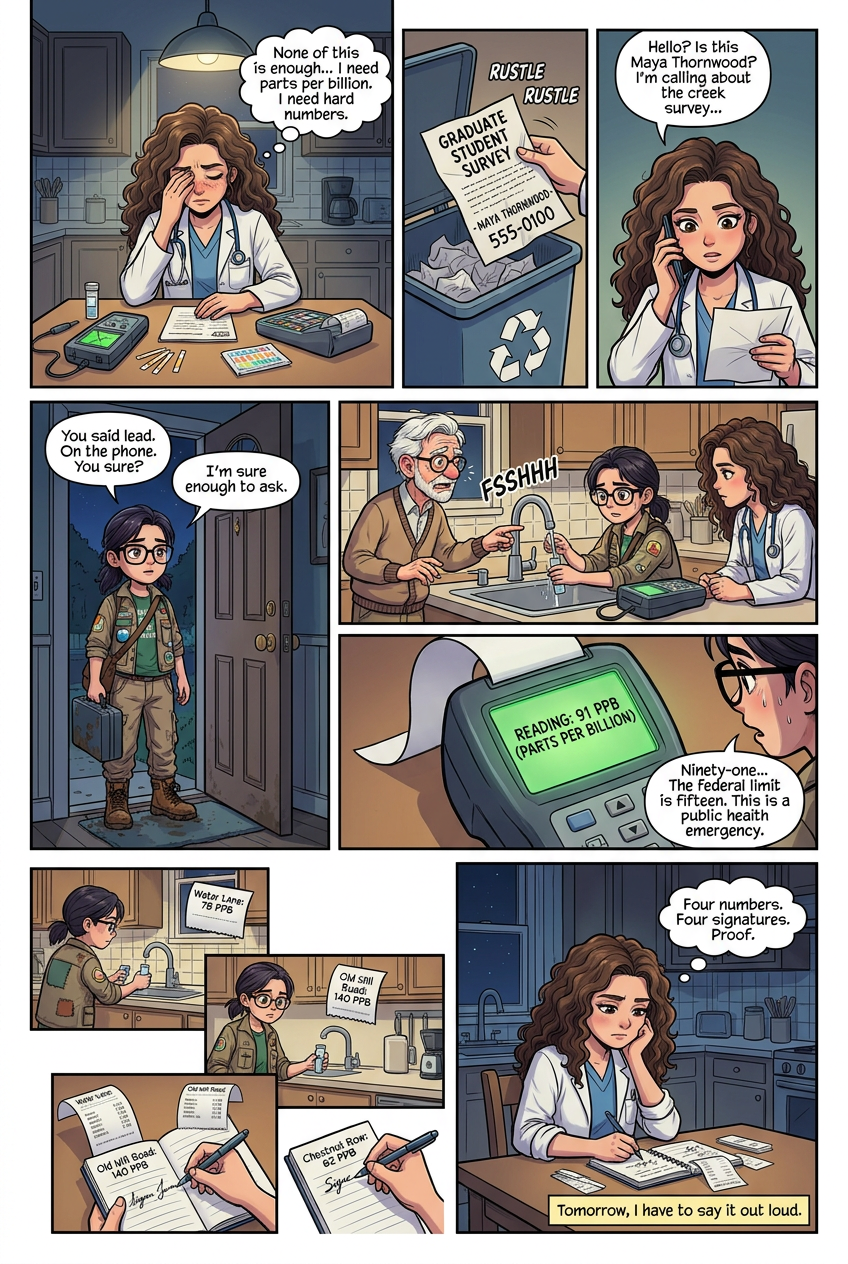
Harold left with a promise to unlock his back door for her that night. Dollie locked the clinic and drove home to gather what she had. She spread her supplies on the kitchen table. A field kit from med school. Test strips meant for pool water. A pH meter with a cracked screen. None of it could measure lead at the levels that would poison a body slowly over years. She needed parts per billion. Her strips read parts per million, if they read anything at all. She sat down and rubbed her eyes. Without hard numbers, the town council would call it a hunch. The water utility would call it slander. Harold's tremor and four charts would not be enough. She remembered a flyer taped to the clinic's community board. A graduate student had been surveying the creek behind the elementary school for her thesis. Dollie had barely glanced at it. Now she dug it out of the recycling bin and called the number. Maya Thornwood arrived within the hour. She was small, in muddy boots and a patched field vest, a sample bottle already in her hand like she never set it down. She looked twenty-five and tired in the way graduate students get tired. "You said lead," Maya said at the door. "On the phone. You sure?" "I'm sure enough to ask." Maya set her pack on the table and pulled out a hard case. Inside, a portable spectrometer nested in foam. "University loaned it to me for the creek work. It reads down to one part per billion. If it's in the pipes, this will see it." Dollie felt her shoulders drop for the first time in a week. "Why help me? You don't know these families." Maya shrugged. "I know lead. And you called a stranger at eight at night. That means you're scared." They drove to Harold's house first. He met them at the back step and pointed to the kitchen tap. Maya ran the water thirty seconds, filled two vials, and fed one into the machine. The screen counted. Dollie watched Harold's hand shake against the counter. The reading came up. Ninety-one parts per billion. The federal limit was fifteen. Maya whistled low. "That's not borderline. That's a public health emergency." They drove to the other three addresses. Water Lane hit seventy-eight. Old Mill Road hit one-forty. Chestnut Row hit sixty-two. Maya printed each result on a small thermal strip and taped them into Dollie's notebook, signed and timed. By midnight Dollie had four numbers, four signatures, and a witness with credentials. She had proof. She also had four houses full of people who had been drinking poison for decades, and a town council meeting in nine hours where she would have to say so out loud. Harold coughed into his sleeve on the porch behind her. Somewhere on Old Mill Road, a child was asleep in a house reading one-forty.
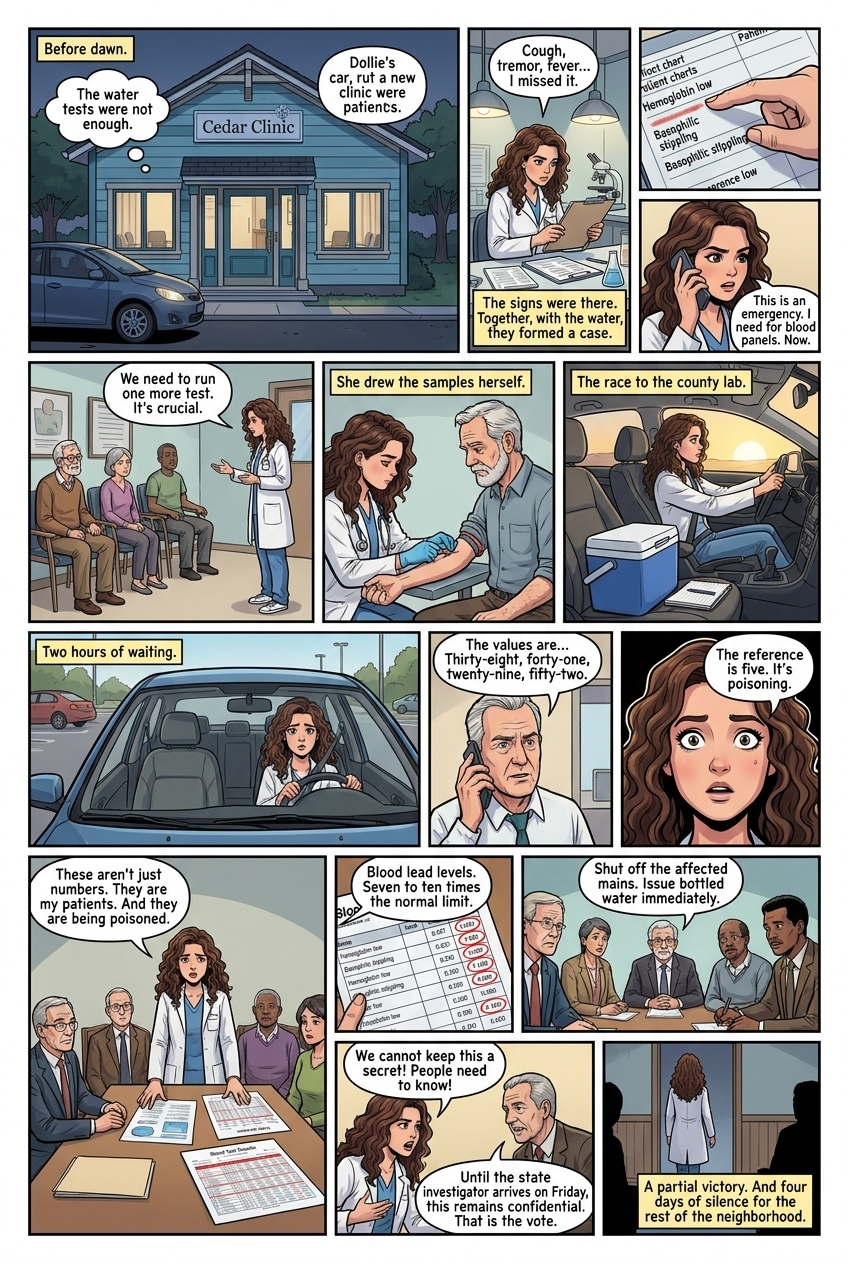
Dollie drove to the clinic before dawn with the notebook on the passenger seat. Four numbers, four signatures, one exhausted graduate student's credentials. Enough to prove the water was poison. Not enough to prove the water was making her patients sick. She parked under the pale blue siding of her clinic and read the notebook again. A council member would ask the obvious question. Where is the doctor's evidence? Numbers on pipes were not diagnoses in bodies. She had eight hours. She unlocked the front door and turned on the lab lights. Four charts sat on her desk from the week before. Cough. Tremor. Fever that spiked and fell. She had ordered basic panels on all four and filed the results without knowing what to look for. Now she pulled the sheets and spread them across the exam table. She ran her finger down the columns. Hemoglobin low in three of four. Basophilic stippling flagged on the smear notes for Harold and one other. Kidney markers creeping past normal. She had seen these numbers and called them nothing. Read together, with lead in the water, they were a case. She still needed the one test that named it. Blood lead level. Her clinic did not run it in-house. The county lab did, and the county lab opened at seven. She called at seven exactly. She told the tech she needed four rushed blood lead panels back by ten. The tech said twenty-four hours minimum. Dollie said the word emergency and named the federal reporting threshold. The tech went quiet, then said she would talk to the director. Dollie called Harold next. He agreed to come in at seven-thirty and to phone the other three. By eight all four patients sat in her waiting room. She drew the tubes herself, labeled each one, and drove them to the county lab in a cooler on the passenger seat. She waited in the lab parking lot with the notebook on her knees. At nine-forty her phone rang. The director read the four values aloud. Thirty-eight micrograms per deciliter. Forty-one. Twenty-nine. Fifty-two. The reference range topped out at five in adults. He said he was required to report the results to the state within the hour. She drove to the council chamber with the printed sheet still warm from the fax machine. She laid the water numbers and the blood numbers side by side on the table before the five members. She named each patient's symptoms and matched each one to a known effect of lead. She said the word poisoning out loud. The council voted before lunch to shut off the affected mains and issue bottled water to the listed addresses. They also voted, over her objection, to keep the finding confidential until the state investigator arrived Friday. Four days of silence. Four days for the rest of the old neighborhood to keep drinking from taps she now knew were killing them.
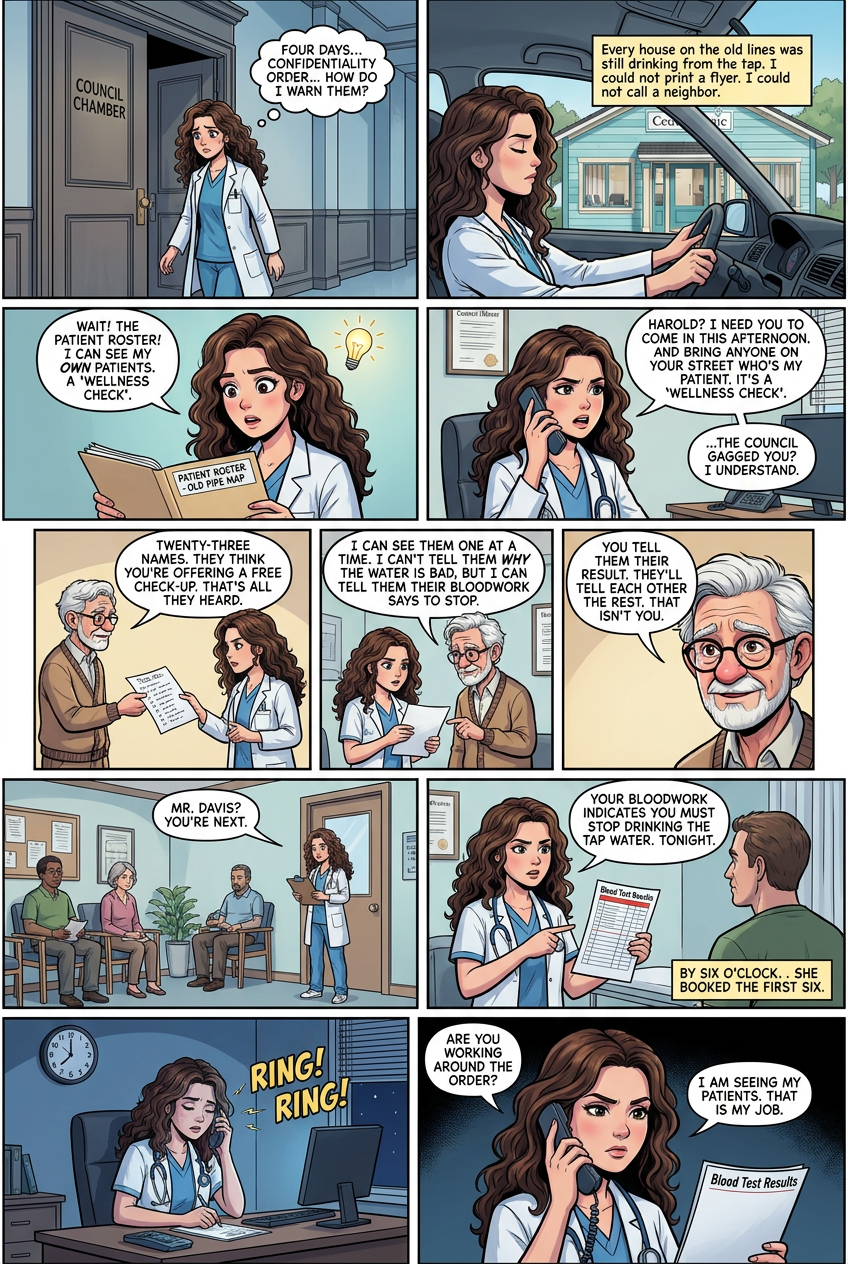
Dollie left the council chamber with the confidentiality order ringing in her ears. Four days. She drove back to the clinic and sat in the parking lot with the engine off. Every house on the old lines was still drinking from the tap. She could not print a flyer. She could not call a neighbor. The council had made that a crime she could lose her license over. But she had to warn them somehow. She unlocked the clinic and pulled the patient roster. Every address on the old pipe map had a chart in her files. That was the crack in the order. She could not announce a public danger, but she could see her own patients. She could offer a free wellness check. She called Harold Winters first. He picked up on the second ring. She asked him to come in that afternoon and to bring anyone on his street who was his patient too. He was quiet for a moment. Then he asked if the council had gagged her. She said she could not answer that. He said he understood exactly what she was asking. He arrived at two with a list in his cardigan pocket. Names, phone numbers, house numbers, all on the old lines. He set it on her desk in the exam room. "Retired pharmacist," he said. "I still know who fills what prescription on that block. I made calls on the drive over. They think you're offering a free check-up. That's all any of them heard from me." Dollie looked at the list. Twenty-three names. She could book them as patients. She could draw blood. She could tell each one, inside the exam room, what their own numbers meant. That was medicine, not a public announcement. The order did not reach across her own door. "I can see them one at a time," she said. "I can tell them to stop drinking the tap water because their bloodwork says so. I cannot tell them why the whole neighborhood is at risk." "You tell them their result," Harold said. "They'll tell each other the rest. That isn't you." She booked the first six for that evening and the rest across Wednesday and Thursday. She pulled a stack of blood test result sheets from the printer and clipped them to fresh charts. She wrote STOP TAP WATER at the top of each intake note in red pen. By six o'clock the waiting room held four people from Harold's list. She drew tubes. She asked about coughs and tremors. She said, inside the room, the sentence she could say: your water is not safe, stop drinking it tonight. At eight-thirty her phone rang. A council member. He had heard she was booking wellness checks on the affected streets. He asked her, flat, if she was working around the order. Dollie held the phone against her ear and looked at the twenty-third name on Harold's list. "I am seeing my patients," she said. "That is my job."
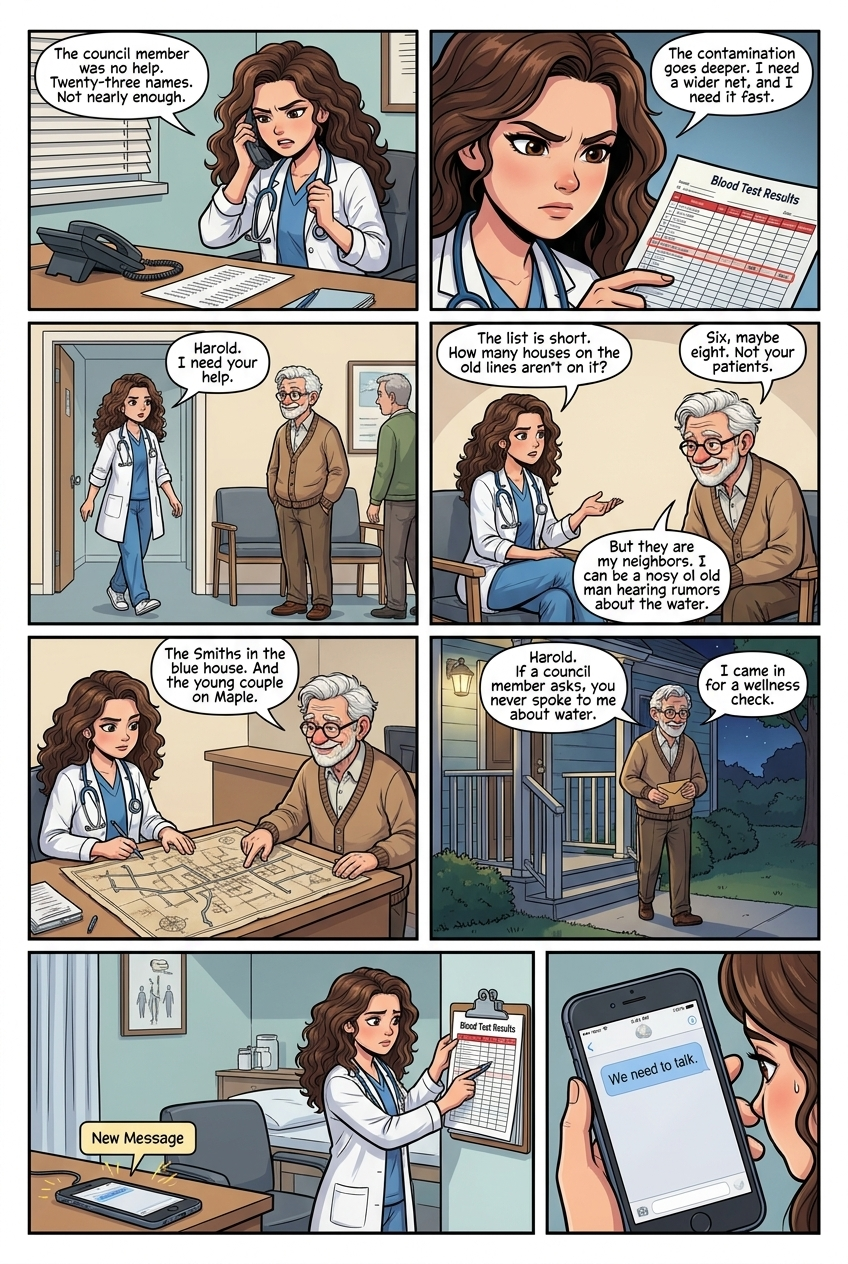
Dollie ended the call with the council member and set the phone face down on the desk. She looked at the twenty-third name on the list. Twenty-three was not the whole neighborhood. The old lines ran under houses Harold's memory could not reach. She needed a wider net before Friday, and she needed it without breaking the order. She walked out to the waiting room. Harold was still there, hands in his cardigan pockets, watching the last patient sign out. She asked him to stay. "The list is short," she said. "How many houses on those lines aren't on it?" He took his hands out of his pockets and thought. "Six, maybe eight. Renters. New owners. People who fill their prescriptions in the next town. I don't know their charts." "Then they aren't my patients," Dollie said. "I can't call them." "No," Harold said. "But I can." She stopped. He met her eyes. "I'm retired," he said. "I don't have a license to lose. I can knock on a door and tell a neighbor I heard from a friend that the tap tastes off and they should switch to bottled until Friday. That isn't your voice. That's a nosy old man on a walk." Dollie sat down on the arm of the waiting room chair. The order pinned her mouth shut inside these walls. It said nothing about what a retired pharmacist chose to say on a sidewalk. "If they ask why," she said, "you don't know why." "I don't," Harold said. "I heard it from a friend." She pulled the old pipe map from the file cabinet and spread it on the reception counter. Harold leaned in. He tapped houses one by one and named who lived there, or admitted when he didn't. They marked eight addresses that were not on his original twenty-three. He wrote them on the back of an envelope and folded it into his cardigan. "Tonight," he said. "Before bed. Bottled water by morning." "Harold." She caught his sleeve at the door. "If a council member asks, you never spoke to me about water." "I came in for a wellness check," he said. "You told me my numbers. I went home." He left. She watched him cross the parking lot under the clinic's porch light, envelope in his pocket, walking like a man with errands. Dollie went back to the exam room and clipped a fresh blood result sheet to the next chart. The twenty-three were still hers to see across Wednesday and Thursday. The extra eight now belonged to Harold. The net was as wide as she could make it without losing her license. Her phone buzzed on the desk. A text from a number she did not recognize. Three words. We need to talk.
Play your story to life
Storycraft is a mobile game where you create AI characters, craft items and locations to build their world, then discover what direction your story takes. Download the iOS game for free today!
Download for free