

Dr. Grey's Arc
11 Chapters
Dr. Grey's dream is opening a hospital to cure the sick and fix the broken.

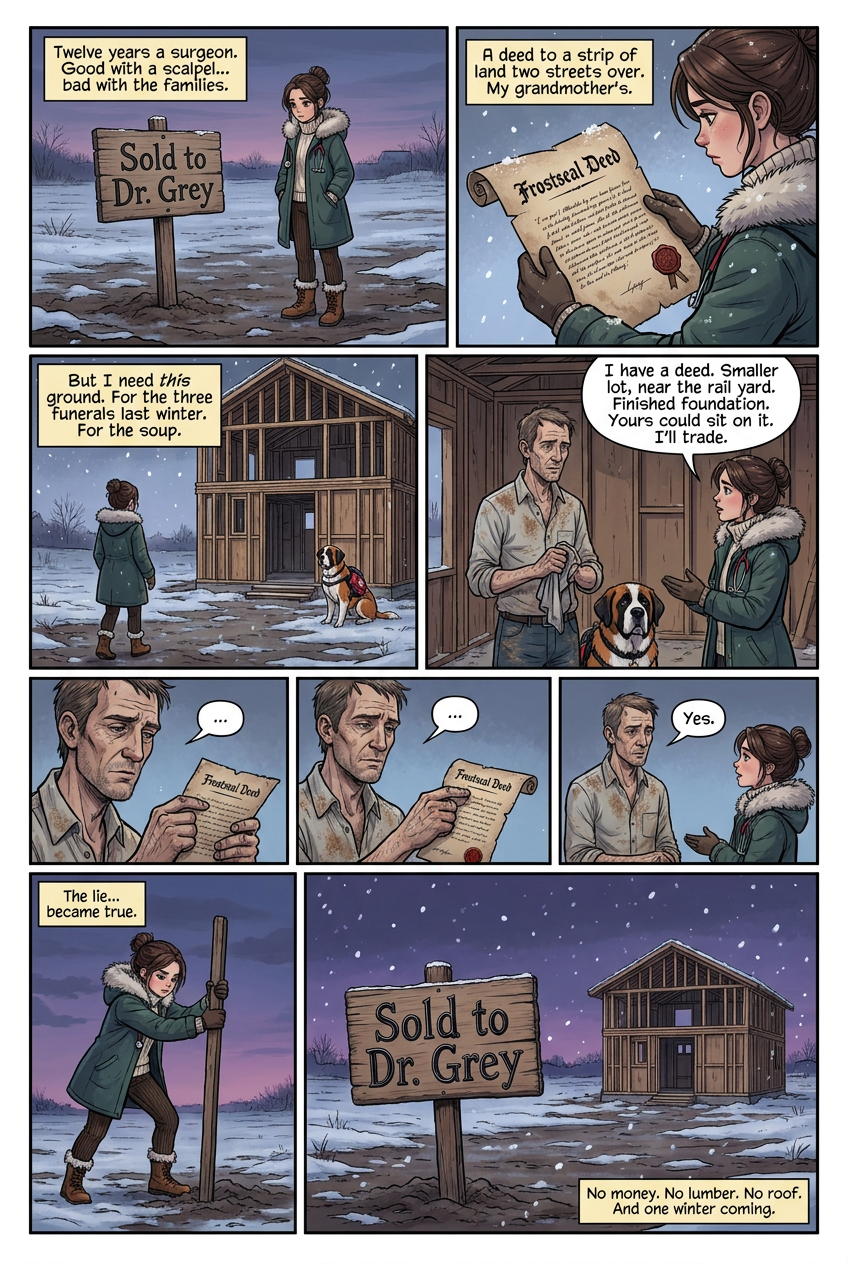
Dr. Grey stood on the empty lot with a deed in her coat pocket and no right to be there. The paper was old, the wax seal cracked from the cold. It named her grandmother as the owner of a strip of land two streets over, not this one. She had hoped, the way tired people hope, that the clerk would not look closely. The clerk had looked closely. So she had come here instead, to the lot where three funerals had started last winter, to see the ground she could not yet buy. She had been a surgeon for twelve years. She was good with a scalpel and bad with the families in the hallway after. Every patient on her table had already been hurt past saving the part that mattered. She wanted a hospital here, on this block, so the sick could walk in before the cutting started. She wanted it for the neighbor who had left soup at her door all last winter, a debt she could not pay back in soup. She had hammered a plain wooden sign into the dirt last week. It read, in clear black letters, Sold to Dr. Grey. It was a lie, and she knew it, and she had left it standing anyway. The lot was not empty. At the back of it stood a half-built shell of a house, framing bare, roof unfinished, doorway open to the wind. The owner worked from inside it. He had bought the parcel two years ago and run out of money halfway through his own walls. Dr. Grey crossed the frozen mud and called through the doorway. A thin man came out wiping sawdust from his hands. Behind him, a Saint Bernard with a small red medical pack strapped to its back watched her without standing. She told him plainly. She had no money left after the permits. She had a deed to a different lot, smaller, closer to the rail yard, with a finished foundation his unfinished house could sit on. She would trade the deed for this ground. She told him about the three households. She told him about the soup. She was not good at this part. She kept her hands at her sides and made herself finish. The dog leaned against his leg. He looked at the deed a long time, at the cracked seal, at the faded ink. Then he said yes. She walked back to her sign in the dusk and pulled it out of the dirt, then drove it in again, deeper. The lie had become true between one breath and the next. She had the ground. She had no money, no lumber, no roof, and one winter coming. The shell at the back of the lot was hers now too, framing bare, open to the wind, waiting.
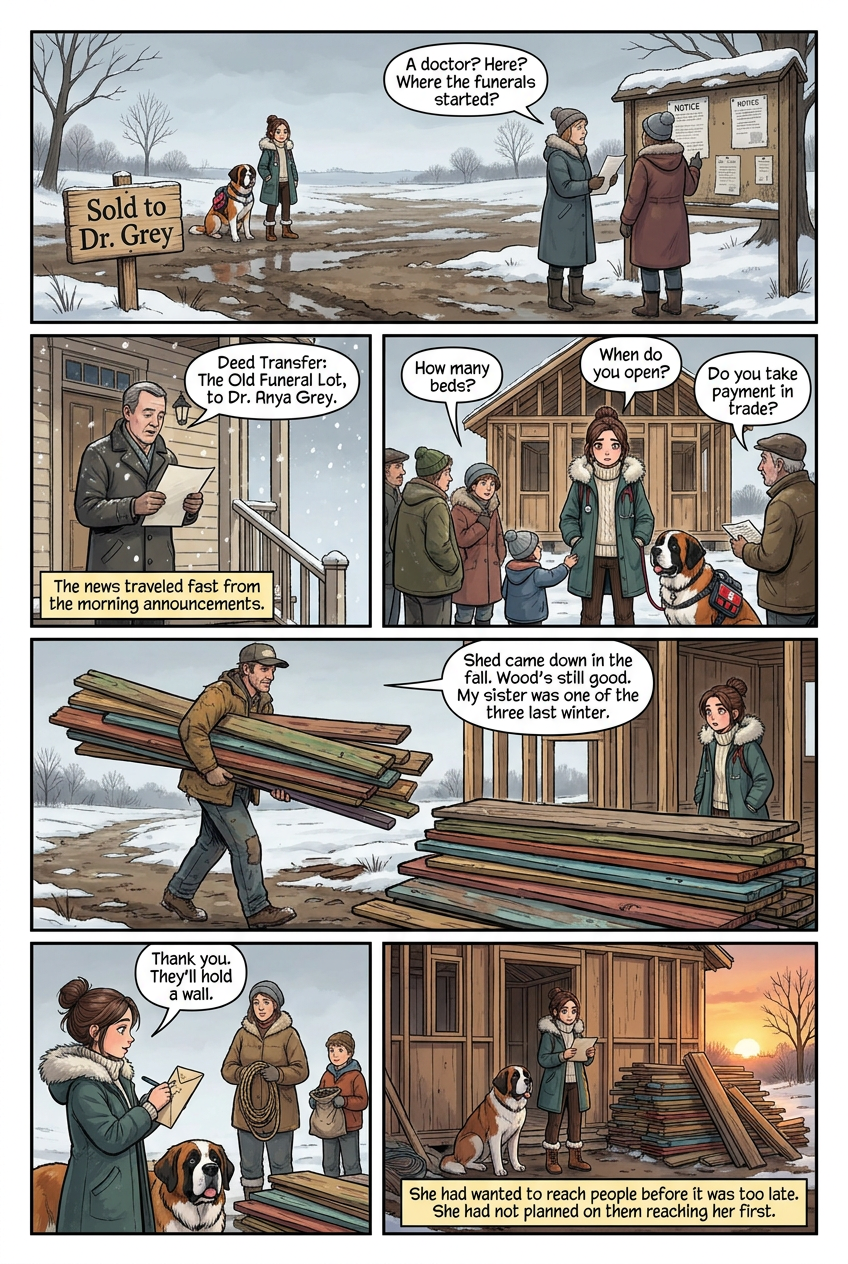
Word traveled before Dr. Grey did. By the time she walked back to the lot the next morning, two women stood at the message board near the corner, reading a fresh notice someone had pinned overnight. The notice named her. It named the lot. It said a doctor had bought the ground where the funerals started. Dr. Grey stopped at the edge of the path and watched the women read it twice. One of them turned and saw her and did not look away. The news had started at the meeting house with the bell tower. A clerk there had read the deed transfer aloud at the morning announcements, the way every transfer was read. By noon people were crossing the lot to look at the half-built shell. They came in ones and twos, in coats and work boots, carrying nothing, asking questions she did not know how to answer. How many beds. When would she open. Did she take payment in trade. She kept her hands in her pockets and gave short answers. The Saint Bernard sat in the doorway of the shell and let children touch its pack. A man came across the mud in the afternoon with a bundle of boards on his shoulder. He set them down beside the frame without speaking. The boards were old, painted, pulled from somewhere else. Red, blue, yellow, the paint cracked and soft. He said his shed had come down in the fall and the wood was still good. He said his sister was one of the three last winter. Then he stepped back and waited, as if she might refuse. Dr. Grey was bad at this part. She knew it standing there. She made herself meet his eyes. She said thank you. She said the boards would hold a wall. She asked his name and wrote it on the back of an envelope from her coat. Behind him, two more people were already coming up the path with their arms full. A woman with a coil of rope. A boy dragging a sack of nails. They stopped near the boards and waited their turn. By dusk a small pile had grown beside the shell, and a short line of names ran down the back of the envelope. She stood in the doorway after they left. She had ground. She had the start of a wall. She had a list of neighbors who expected her to finish what the sign in the dirt promised. The shell behind her was still open to the wind, and winter was still coming, and every board on the pile had a face attached to it now. She had wanted to reach people before it was too late. She had not planned on them reaching her first.
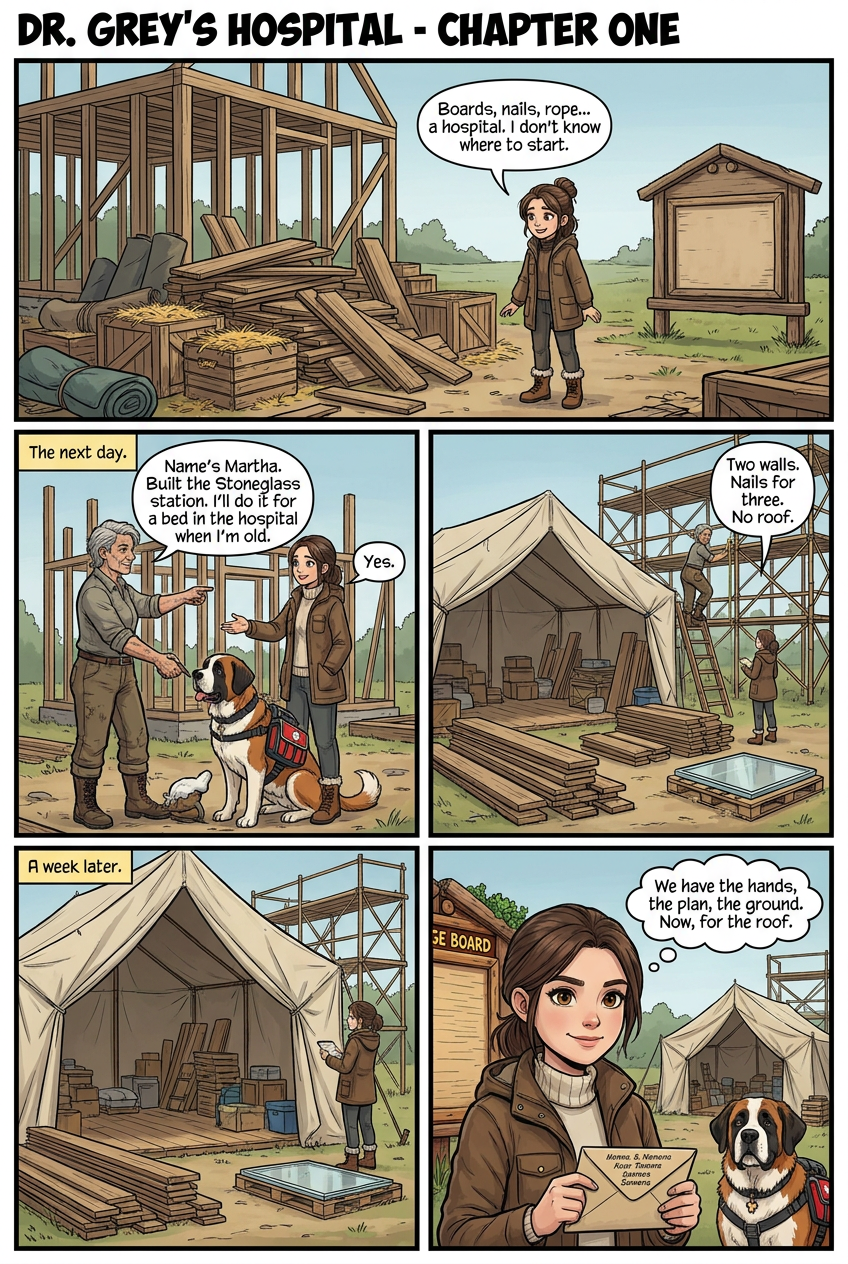
The pile by the frame grew for three days. Boards, nails, rope, two crates of glass wrapped in straw. Dr. Grey stood beside it on the fourth morning and understood she did not know where to start. She could set a broken arm and close a belly. She could not raise a wall before the snow came. She walked to the message board at the corner and pinned a short notice. She needed a builder. She had no money. She had materials and a roof to put over them. A woman came the next afternoon. She was older than Dr. Grey, with gray hair cut short and hands that had been broken and healed more than once. She said her name and said she had built the research station on the rise above the river, and the meeting house with the bell. She walked the lot once. She kicked the base of the frame. She told Dr. Grey the shell was square and the footings were honest. She said she would do the work for a bed in the hospital when she was old. Dr. Grey said yes before she finished the sentence. They shook hands beside the pile. The Saint Bernard came out of the doorway and sniffed the builder's coat and sat down at her boot. By the end of the week the lot had changed. The builder raised a canvas tent on poles beside the shell and sorted the donations inside it. Boards by length. Nails by size. Glass on a pallet off the ground. She set a scaffold against the south wall, three platforms high, braced and pinned, and climbed it on the second morning to measure the top plate. She came down and told Dr. Grey the frame would hold a second floor if they wanted one. Dr. Grey said one floor was enough. Then the builder walked the sorted piles and counted. She counted twice. She came back to Dr. Grey with a short list on a scrap of board. They had enough wood for two walls. They had nails for three. They had no roofing at all. She said the donated boards would not close the building. She said winter was six weeks out, maybe five. She said the work could start tomorrow, but it would stop at the rafters unless more came. Dr. Grey looked at the tent, the scaffold, the woman who had agreed to build her hospital for a bed she might never use. She had found her builder. She had the hands and the plan and the ground. She did not have the roof. She walked back to the message board at the corner and stood in front of it with the envelope of names in her coat pocket, and began to think about which door to knock on first.
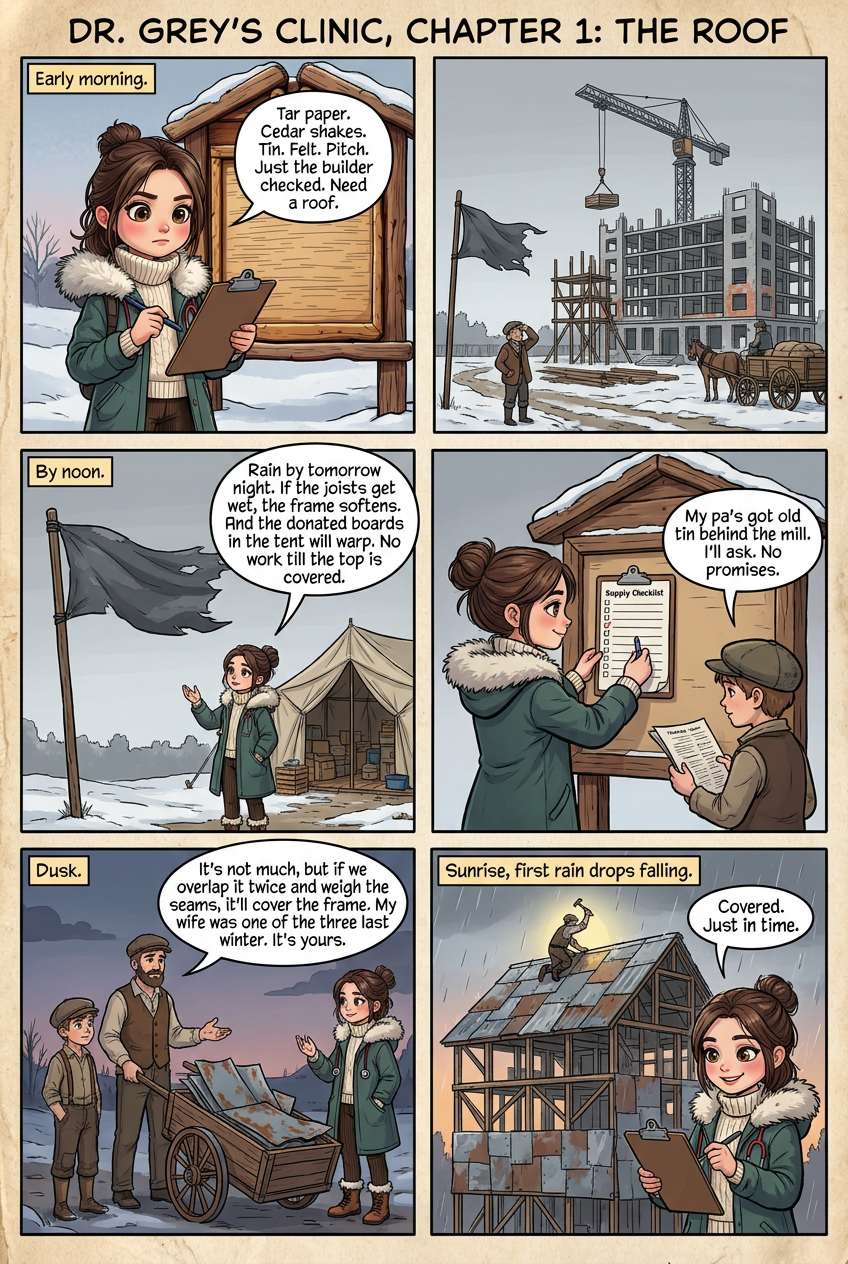
Dr. Grey stood at the corner board with the envelope of names in her hand and pulled out a clean board of her own. She wrote a list down the left side. Tar paper. Cedar shakes. Tin sheets. Felt. Pitch. She marked a single check beside the one line she could promise: the builder, already hired. The rest stayed empty. She pinned the list to a scrap of plank and carried it back to the lot, because she did not trust herself to remember the count when a door opened in front of her. The lot looked worse in the morning light than she expected. The frame stood tall against a flat gray sky, ribs open, the top plate bare. The scaffold the builder had braced against the south wall climbed three platforms high and ended at nothing. From the road, anyone could see straight through the building. A passing wagon driver slowed, looked up at the open top, and shook his head before he flicked the reins. By noon the wind shifted. A neighbor had tied a square of dark cloth to a pole at the edge of the lot to mark the wood pile from the road. The cloth snapped sideways and held there. The builder came down the scaffold and stood beside Dr. Grey and watched it. She said rain by tomorrow night. She said if water hit the joists, the frame would soften at the joints, and the donated boards inside the tent would warp before they were ever nailed. She said the work could not start until something covered the top. Dr. Grey took the list back to the corner board and pinned a second notice beside her old one. She wrote what she needed in plain words. Tar paper. Tin. Anything that shed water. She wrote that she had no money and could trade only future care. She stood there an hour. Two people read it and walked on. A boy stopped and said his father had a stack of old tin behind the mill, bent and rust-spotted, kept for patching. He said his father owed nobody and gave nothing. He said he would ask anyway. He ran off before she could thank him. He came back at dusk with his father and a handcart. The tin was bent. Some sheets had holes the size of a coin. The father said it would cover the frame if they overlapped it twice and weighed the seams. He said he wanted nothing for it. He said his wife had been one of the three the winter before. Dr. Grey took the checklist out of her coat and put a mark beside the line for tin. The builder met them at the gate and began sorting sheets by size under the lantern. The first drops came at sunrise. The frame was covered.
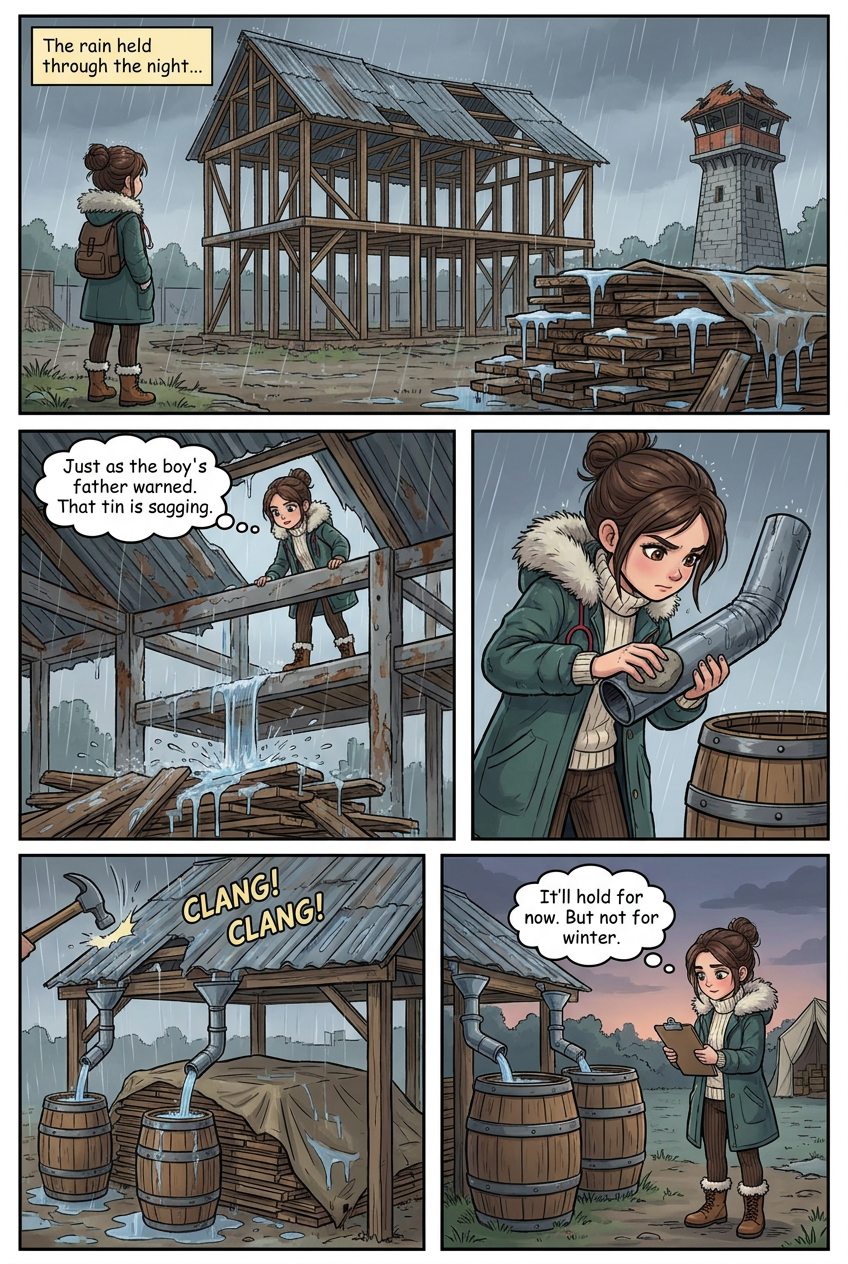
The rain held through the night and into the next day. Dr. Grey came to the lot at first light and saw the trouble before she reached the gate. Water ran down the outside of the frame in dark streaks. The tin overhead sagged at the seams where the boy's father had warned them it would. A thin sheet of water fell from one corner of the roof onto the boards stacked inside, and the stack had begun to darken at the edges. She climbed the scaffold to look. From the top platform, the tin roof showed its full damage. Two sheets had peeled back at the overlap and folded inward under the weight of standing water. Rust ran in orange streaks down the stone-gray frame below. Through the open gap, she could see straight down to the donated boards inside. The builder came up behind her and said the joists were already soft at three points. He said another day of this and the frame would not hold a wall when they nailed it. He said they needed the water off the wood before they fixed anything above. Dr. Grey climbed down and pulled the tarp off the supply tent. She dragged an empty barrel from the corner of the lot to the worst drip and set it under the fall. She cut a length of stovepipe from the scrap pile and bent it into a funnel with her hands and a stone. She wedged the funnel into the barrel's lid. Within an hour she had three barrels in place under the three worst leaks, each fed by a bent pipe or a folded sheet of tin. The water no longer hit the boards. It hit the barrels and held there. She moved the board stack two feet to the dry side and threw the spare tarp over it. The builder watched her work and then climbed back up with a hammer and began bending the peeled sheets flat against the frame. He nailed each seam twice. He weighed the patches with stones from the yard. By dusk the rain thinned. Dr. Grey stood inside the frame and listened. No water fell on wood. The barrels were half full. The boards on the dry side were still sound at the core, though three on the outside of the stack had swelled past use. She wrote three losses on her checklist and a mark beside the line for roofing repair. The roof would hold for now. It would not hold through winter. She stood there until the last drip stopped and then went to find the builder to ask what it would take to replace the tin before the first freeze.
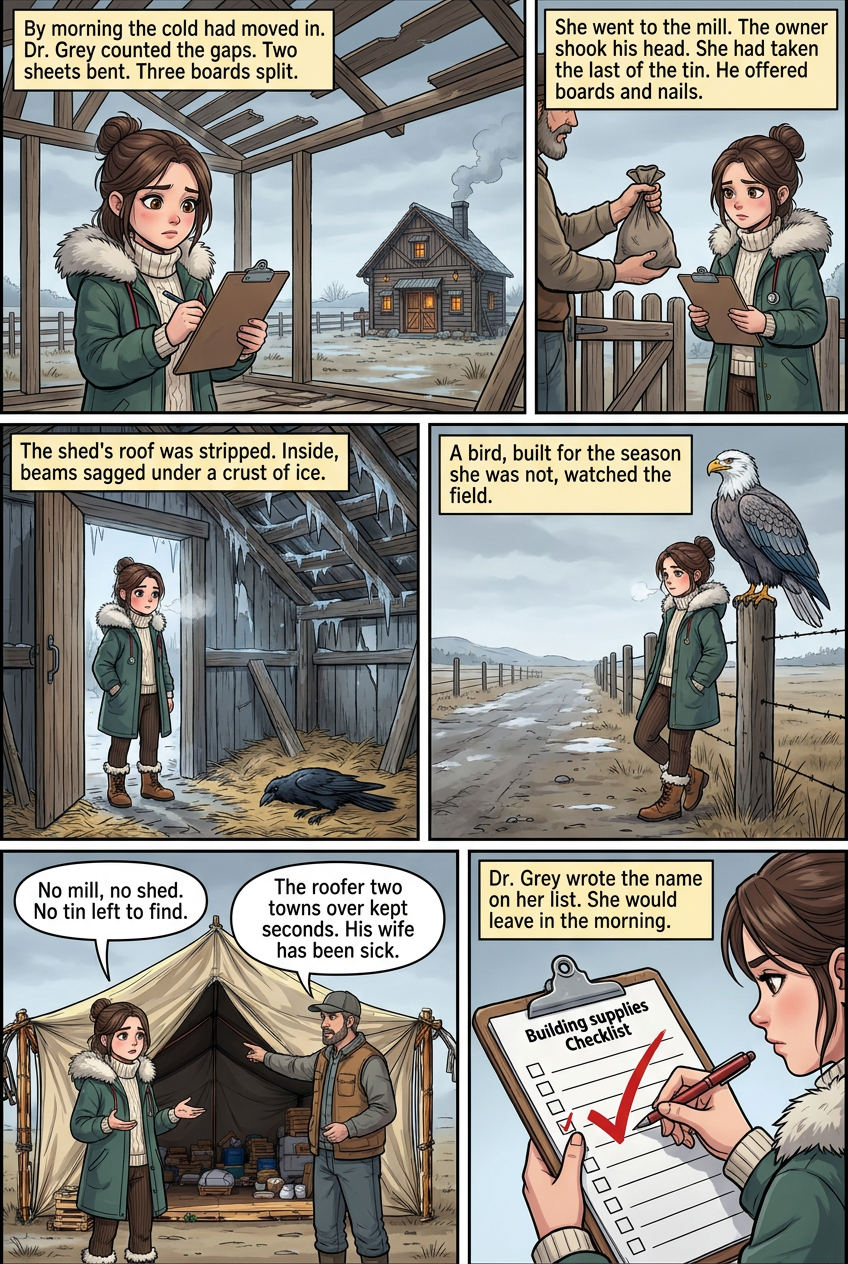
By morning the rain had stopped and the cold had moved in behind it. Dr. Grey stood inside the frame and counted the gaps in the roof again. Two sheets bent past use. Three boards swelled and split. She wrote the count on her supply list and underlined the line for tin. The builder said they had four weeks, maybe five. Past the lot, smoke poured from the smokehouse chimney in a thick straight line. The air carried the smell of cured meat and the bite of frost. Winter was already in the wind. She spent the morning walking to every place tin might still be found. She went to the mill first. The owner met her at the gate and shook his head before she spoke. The pile behind the mill was gone. She had taken the last of it. He offered her boards instead, and a sack of nails, and told her he was sorry. She thanked him and wrote his name on the list anyway. She walked the edge of town to a shed she had been told about, a low building with a tin face that had stood empty for years. When she reached it the door hung open on a broken hinge. The roof was already stripped. Someone had pulled the sheets months ago. Inside, the beams sagged under a crust of ice, and the floor held nothing but old straw and a dead crow. She stood in the doorway a long minute. Then she closed the door as best she could and turned back. On the road she stopped to rest against a fence post. A large bird sat on the post above her shoulder, white-headed, gray across the back, claws sunk into the wood. It did not move when she came near. Its feathers were thick and layered against the cold. She watched it watch the field. It was built for the season she was not. She thought of the open seams above the boards inside her frame, and the way the wind would pass straight through them in a month. She had walked the whole town. There was no tin left to find. She went back to the lot and found the builder waiting by the supply tent. She told him the truth plainly. No mill, no shed, no donation left to ask for. He listened and did not argue. Then he said there was one thing she had not tried. The roofer two towns over kept seconds and offcuts in a yard behind his shop. He would not give them away. But he had a wife, and the wife had been sick a long time, and no doctor in that town would ride out to see her. Dr. Grey wrote the name on her list and put a check beside it. She would leave in the morning.
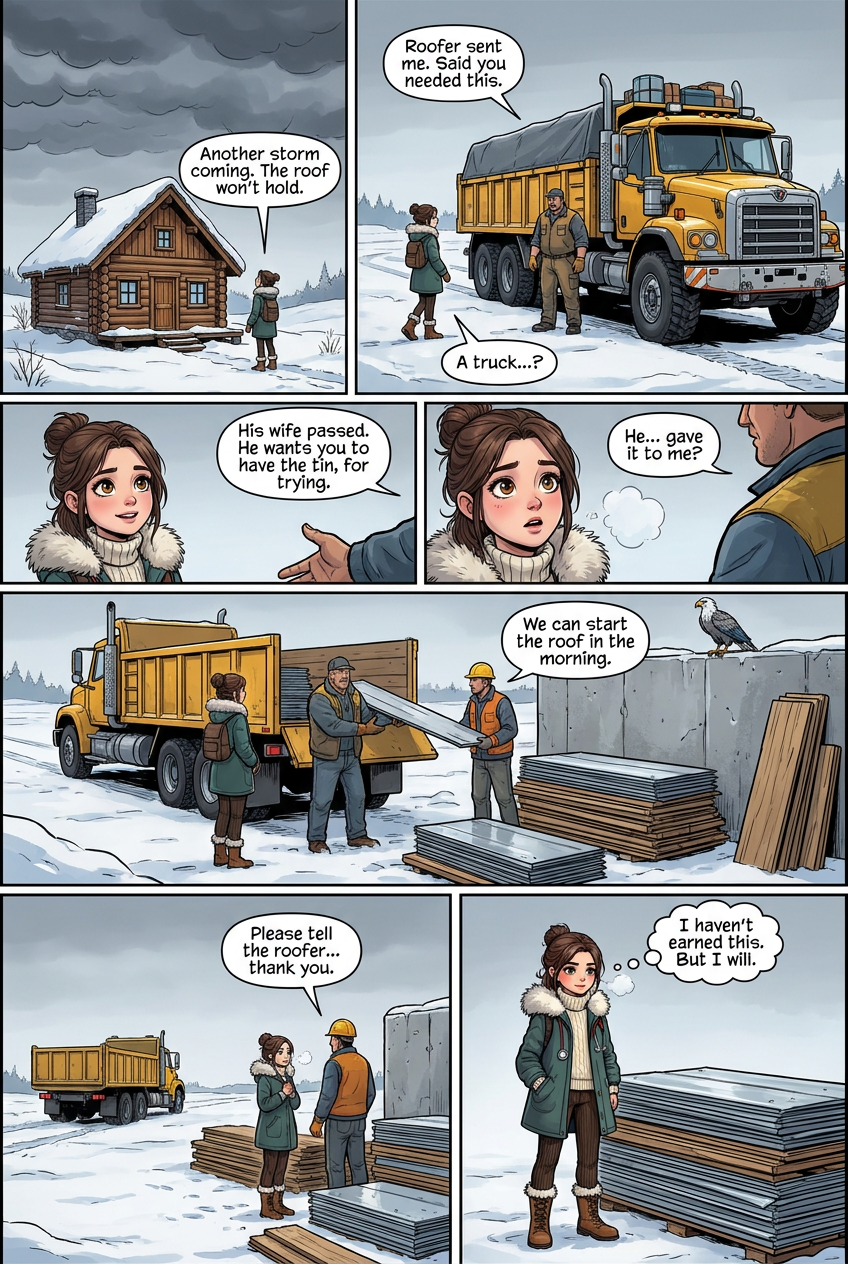
Dr. Grey woke before light and packed for the road. She had no horse and no cart that would hold against snow. The road two towns over climbed through a pass that closed by the first hard storm. She stood at the door of her small cabin and looked at the sky. The clouds sat low and gray. She tied her bag, pulled on her coat, and stepped out to start walking. She did not know how she would carry tin back if she got it. She reached the lot and stopped. A truck sat in front of the frame, idling, larger than any wagon in town. Its bed rose high with stacked tin sheets strapped down under a thick insulated cover. Boards leaned against the cab. A sack of nails sat on the running board. The driver climbed down and pulled off his gloves. He said the roofer had sent him. He said the roofer's wife had died two weeks ago, quietly, in her sleep, and the man wanted Dr. Grey to have the tin anyway, for trying. Dr. Grey did not speak for a long moment. She walked to the bed of the truck and put her hand on the cover. The tin underneath was cold and solid. She counted the edges of the sheets. Enough for the whole roof. Enough for the gaps over the boards and the seams she had measured a hundred times. The driver said he could not stay long. The pass was already closing behind him. He had driven through the night to beat it. He pulled the cover back and showed her the load. Tin, boards, two boxes of nails, a roll of tar paper. He said the roofer had asked him to unload at the site and turn back the same hour. The builder came out from the supply tent and stared. Together they walked the driver to a flat patch of ground beside the frame, where a concrete pad had been poured the week before for a small insulated supply shed. The driver backed the truck against the pad. The three of them worked fast. They stacked the tin under the shed's eave and covered it. They piled the boards along the wall. They set the nails inside the door. A large white-headed bird watched from the ridge of the frame and did not move. The driver climbed back into the cab and lifted a hand. Dr. Grey asked him to carry her thanks to the roofer. He nodded and pulled away. She stood beside the stacked tin and felt the cold come down through her coat. The builder said they could start the roof in the morning. She wrote the roofer's name on her list and put a check beside it. She had not earned this. She would have to.
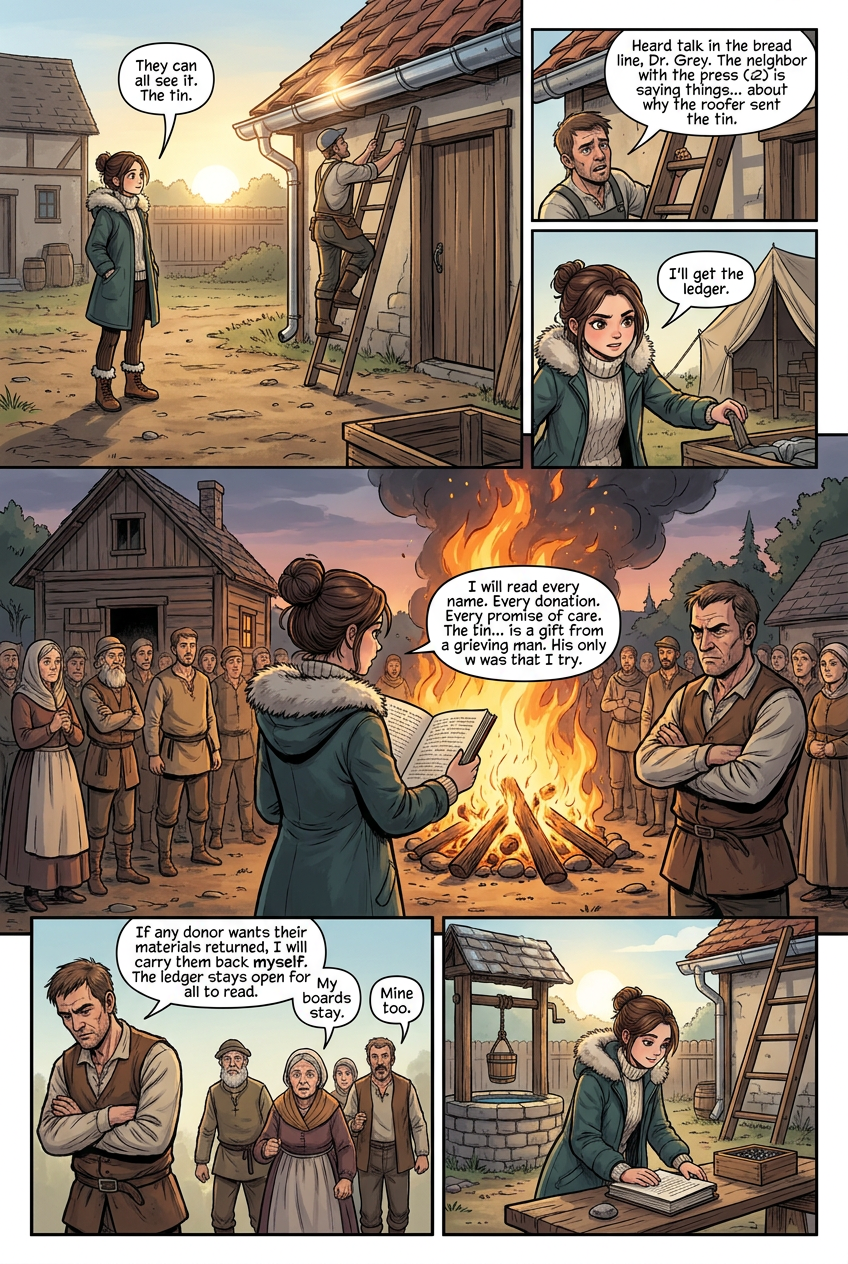
By the second morning the tin was on the roof. Dr. Grey stood in the yard and watched the builder bend a length of half-round gutter along the eave. The metal caught the low sun and threw light across the lot. Anyone passing on the road could see it. Anyone could count the sheets and ask where they came from. The builder climbed down and told her what he had heard in the bread line. A neighbor two doors past the printing shed was saying things. The neighbor ran a small press from a building stacked with pamphlets, and lately the pamphlets carried a question. Why had a roofer two towns over sent a truck of tin to a woman he had never met. What had she promised him. What had she already given. Two donors had pulled their names from the list that week. A third had sent a boy to ask for his boards back. Dr. Grey walked to the supply tent and took down the donor record. It was a plain ledger she kept under the lid of a stone-walled well at the edge of the lot, wrapped in oilcloth, weighted with a tin lid. She had written every name there since the first board arrived. She carried the ledger to the smokehouse at the center of the lane, where the butcher let people gather on cold evenings. She asked him to build the fire up. By dusk the bonfire stood waist high. Neighbors came because they always came when the logs were stacked that high. The press neighbor came too, hands in his coat, mouth tight. Dr. Grey waited until the ring was full. Then she opened the ledger and read. She read every name, every donation, every promise of care she had written beside it. She read the roofer's name last. She said his wife had died before she could reach her. She said the tin was a gift from a grieving man, and the only payment he had asked for was that she try. She closed the ledger and looked at the press neighbor across the flames. She said if any donor wanted his materials returned, she would carry them back herself in the morning. She said the ledger would sit open at the lot through the week. Anyone could read it. Anyone could strike a name. The neighbor did not speak. An older woman beside him said her boards would stay. A man behind her said the same. One by one they said it around the ring. The press neighbor left before the fire burned low. In the morning no boy came for boards. The third donor sent nails instead. Dr. Grey set the ledger on a plank by the gate and weighted it with a stone. The whispers did not stop everywhere, but the list held. She went back to the roof and climbed the ladder.
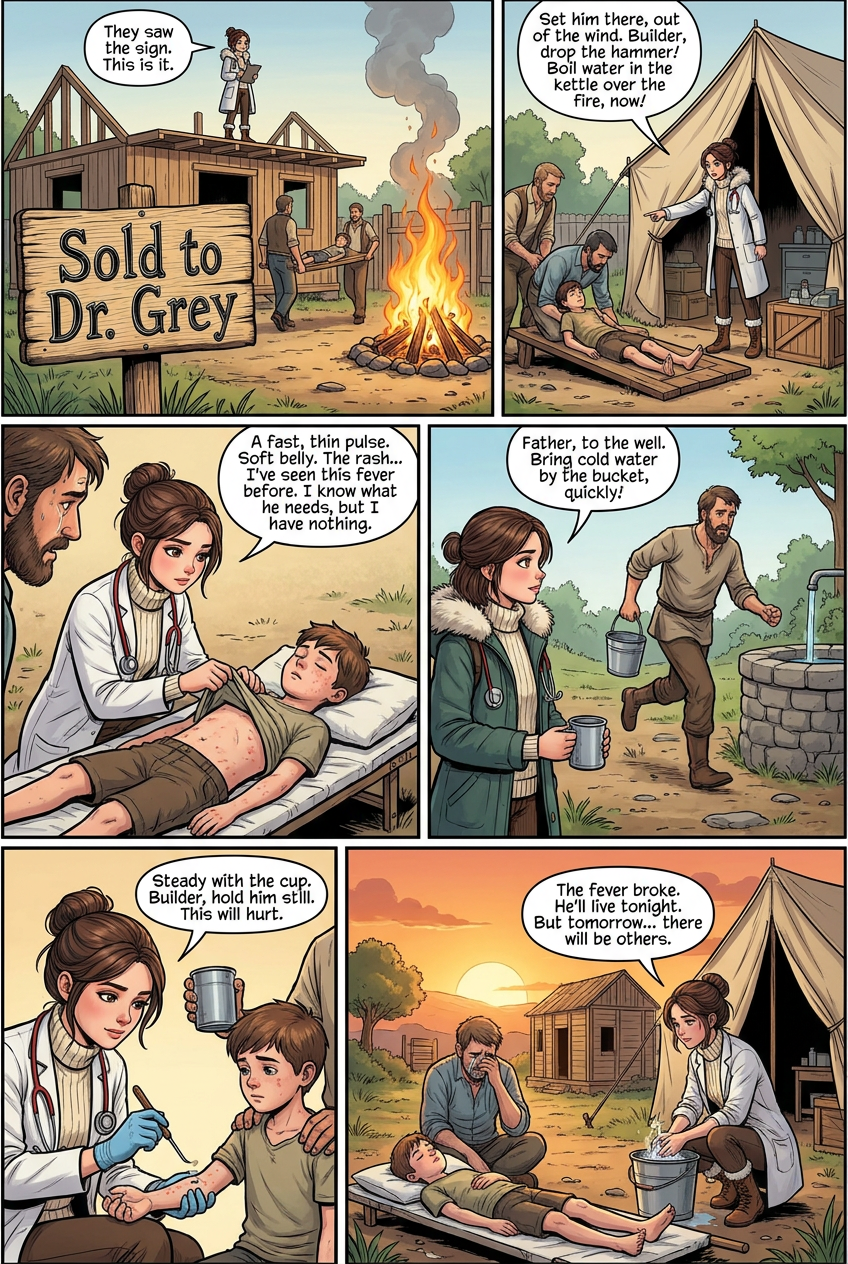
She was back on the roof when the shouting started at the gate. A man came up the lane carrying a boy on a door pulled from its hinges. Two others held the corners. The boy was maybe seven. His face was red and slack, his lips cracked. The father said the fever had come in the night and would not break. He said the next doctor was a day's ride and the boy would not last it. He had seen the sign at the gate. He had come here. Dr. Grey climbed down. She had no clinic yet. She had no cabinet, no thermometer, no quinine, no clean blade. The frame above her was half walls and new tin. She told the men to set the door down in the yard where the wind was cut by the south wall. She pulled the supply tent flaps wide and dragged a crate inside it for a table. She told the builder to drop the hammer and boil water in the kettle over the bonfire he kept going for the nails. She had a tent, a fire, and her hands. She knelt by the boy on the door. His pulse was fast and thin. His belly was soft. She lifted his shirt and found the rash along his ribs. She had seen it before, in the houses two streets over last winter. She knew what it was and she knew what it needed, and she had none of it here. What she could do was bring the fever down and get fluid into him before his heart gave out. She sent the father to the well at the edge of the lot for cold water by the bucket. She tore a clean sheet from her own bedroll and soaked strips and laid them on the boy's neck and groin. She boiled water and let it cool and salted it from her cooking tin and spooned it past his teeth one slow mouthful at a time. The vein at his elbow had collapsed. She needed a way in. She had no cannula, no fine steel. She went to her sewing kit and took out the bone needle she used on canvas. She held the tip in the kettle flame until it glowed and let it cool on a clean rag. She tied off the boy's arm with a strip of the same sheet. She found a small vein on the back of his hand, slid the bone in, and threaded a length of boiled gut tubing she cut from the builder's snare line. She raised the salted water in a tin cup above his head and let it drip. The father held the cup steady. The builder held the boy's shoulders. By dusk the boy's skin was cooler. He swallowed on his own. He opened his eyes once and closed them. The father sat on the dirt and cried without sound. Dr. Grey washed her hands in the bucket and looked at the half-built walls around her. She had treated a patient on a door in the open air. The boy would live tonight. Tomorrow there would be others, and still no room to put them in.
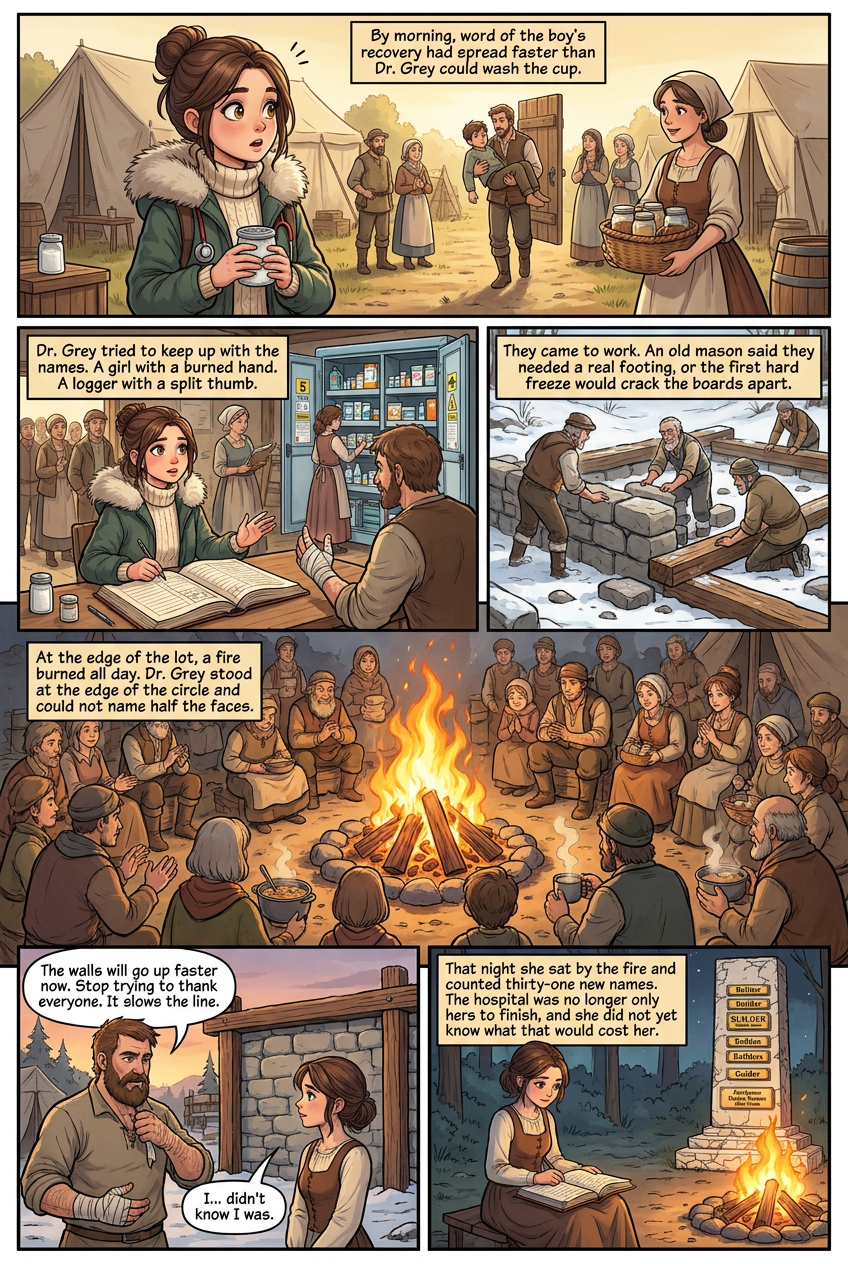
By morning the boy was awake and asking for water. His father carried him home on the same door, and word of it went down the lane faster than Dr. Grey could wash the salt cup. By noon a woman she had never met stood at the gate with a basket of jars. By dusk there were six more people in the yard, and none of them had come to be treated. They came to work. A man with a wagon brought field stone he said had been sitting behind his barn for years. Two brothers unloaded sand and a barrel of lime. An old mason walked the frame with the builder and pointed at the soft ground under the south wall. They needed a real footing, he said, or the first hard freeze would crack the boards apart. By the second morning the men were digging a trench along that wall, and by the third they were laying stone and beam into a low base that locked the frame to the ground. Dr. Grey tried to keep up with the names. She wrote them in the ledger between patients. A girl with a burned hand. A logger with a split thumb. An old woman who only wanted her chest listened to. The supply tent was no longer a tent of crates. Someone had brought a tall cabinet on wheels with shelves and a door that latched. The women who came in the afternoons sorted the jars onto the shelves and labeled them in pencil: salt, lye soap, boiled rags, the bone needles in a tin. When Dr. Grey reached for a thing now, the thing was there. At the edge of the lot a fire burned all day. People kept it fed without being asked. They boiled water on it for the cabinet and warmed their hands between shifts. Around the fire they ate from a common pot a baker's wife brought each noon. Dr. Grey came down off the frame once and stood at the edge of the circle and could not name half the faces. The builder found her there at dusk on the fourth day. He wiped his hands on his shirt and said the south footing was set. He said the walls would go up faster now than she could pay for, and she was not paying for any of it. He said she should stop trying to thank each person at the gate. It slowed the line. She nodded. She had not known she was doing it. That night she sat by the fire with the open ledger and counted thirty-one new names since the boy left on the door. The building had a stone base under it now. It had walls rising on three sides. It had a cabinet and a fire and a pot and hands she did not have to ask. She closed the ledger. The hospital was no longer only hers to finish, and she did not yet know what that would cost her.
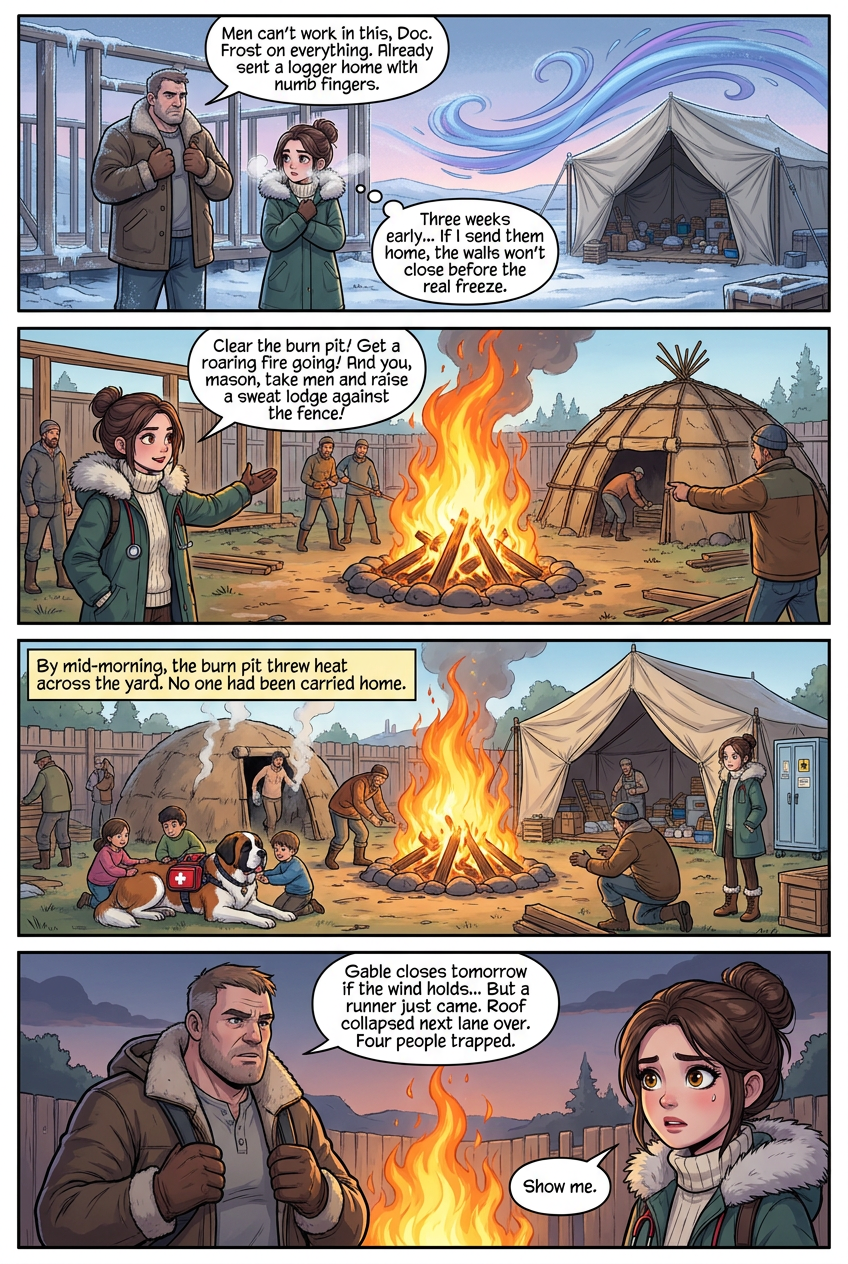
Dr. Grey woke before dawn on the fifth day and knew the season had turned. The water in the wash bucket had a skin of ice. Outside, a hard wind cut across the lot and stung her face the moment she stepped through the door. It was not the slow chill she had counted on. It was three weeks early. She walked the frame and found frost on every nail head, and on the boards the volunteers had stacked the night before. Two walls stood. The third was half up. The roof was patched but open at the gable end, and the wind drove straight through it. The builder met her at the south footing with his hands inside his coat. He said the men could not work in this. He said a logger had already gone numb in the fingers and been sent home, and the old mason was shaking by the fire pot they kept near the cabinet. The fire pot was too small. It warmed three people if they stood close. There were twenty in the yard now, and more would come at sunrise. She looked at the open gable. She looked at the wind moving the canvas on the supply tent. If she sent them home, the walls would not close before the real freeze. If she kept them, someone would lose fingers by noon. She gave two orders. She told the builder to clear the burn pit at the edge of the lot and build the fire as high as he could feed it, dry wood first, green wood after, and to keep it roaring all day. She told the old mason to take four men and raise a sweat lodge against the north fence, bent saplings, canvas, and clay from the trench, the kind he had built as a boy. Men would rotate through it in shifts, ten minutes inside for every hour on the frame. She walked to the gate and stopped the women coming up the lane with their jars and sent them back for every blanket and wool coat in their houses. By mid-morning the burn pit threw heat she could feel across the yard. The lodge stood low and round against the fence, steam leaking from its seam. Men came off the wall blue at the lips and came out of the lodge pink and swearing. A neighbor arrived with a large rescue dog harnessed with a small medical pack, and the dog lay by the fire while children warmed their hands against its flank. By dusk the third wall was up. No one had been carried home. The builder found her at the burn pit. He said the gable would close tomorrow if the wind held. Then he said a runner had come from the next lane. A roof had collapsed under the early snow. Four people were under it.
Play your story to life
Storycraft is a mobile game where you create AI characters, craft items and locations to build their world, then discover what direction your story takes. Download the iOS game for free today!
Download for free