

Dr. Matthias Corvus's Arc
8 Chapters
Dr. Matthias Corvus's dream is curing the plague that killed his family so no one else suffers the loss he carries..

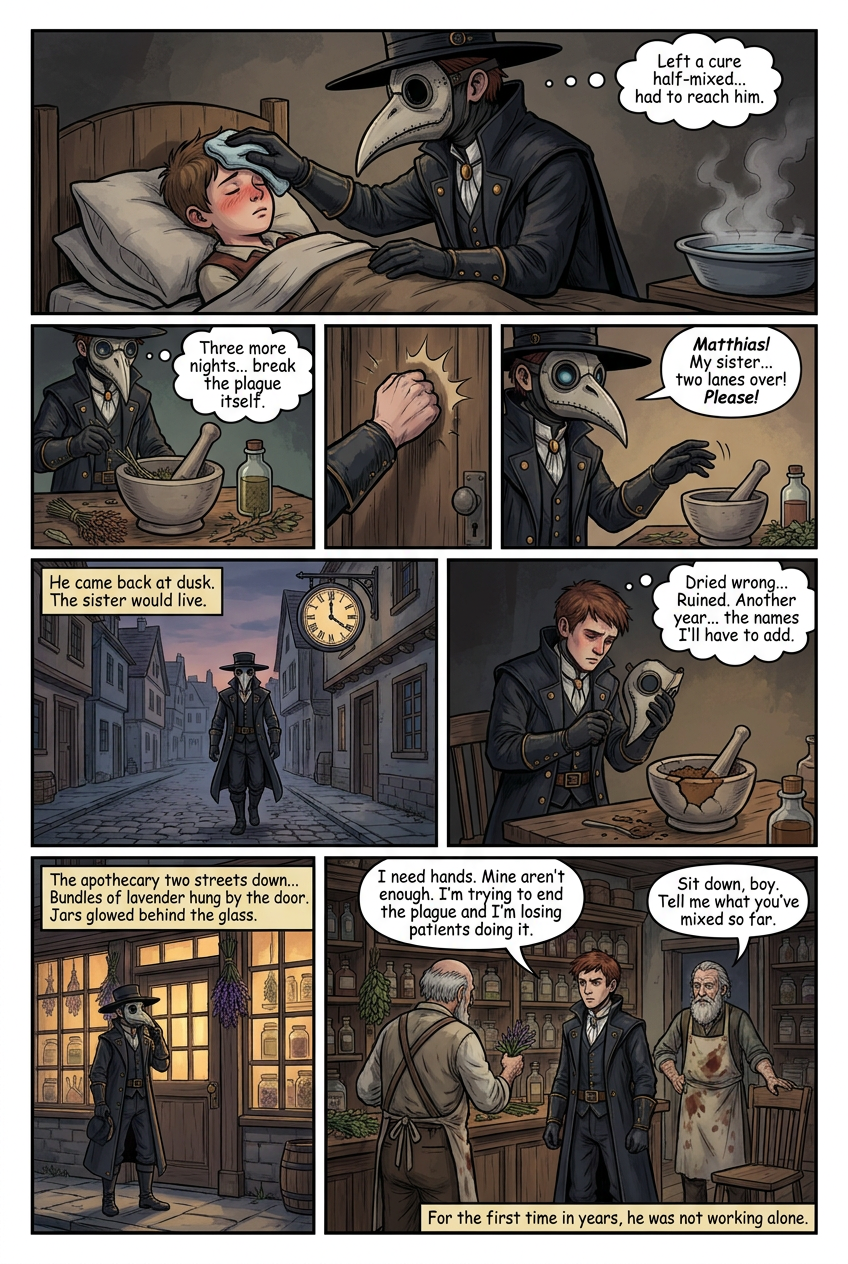
The boy on the cot was seven and burning, and Dr. Matthias Corvus had left a cure half-mixed on the workbench to reach him. He pressed a cool cloth to the child's neck. In the next room, a woman coughed the wet cough he knew too well. Down the lane, three more families waited for him to come knock. He had promised each of them he would. He was the only plague doctor who would take these streets. Other doctors had walked past the boy's door twice already this week. Matthias had learned young not to trust them. He had buried his parents behind one man's mistake and his girl behind another's shrug. Now he worked alone, and alone meant every hour was a choice about who lived. He carried the boy's fever down with willow bark and left him sleeping. In the front room, his shelf waited: labeled bottles, wrapped packages, dried bundles hanging from the top rail. A mortar sat half full of the thing he actually needed to finish, the compound he believed could break the plague itself. He had been building it for two years. Three more nights of work, maybe four. He picked up the pestle. A fist hit the door. A man he half-knew begged him to come to a sister two lanes over. Matthias set the pestle down. He went. He came back at dusk. The sister would live. The boy's fever had climbed again. The compound on the workbench had dried wrong and was ruined. He stood over it and did the arithmetic he had been avoiding. If he kept splitting himself, the cure would take another year. In another year, he knew the names he would have to add to the list he kept in his head. He wiped the mortar clean. He put on his coat and mask and walked out into the last light. The apothecary two streets down still had a lamp burning. He had passed the shop a hundred times without going in. Bundles of lavender hung by the door. Jars glowed behind the glass. Inside, an old man in a stained apron was sorting dried stems by feel, not sight, his fingers quick and certain. Matthias had heard the name in the market. A retired physician. The best of his generation, before his eyes went. People said he was gentle if you were kind and cruel if you were not. Matthias took off his mask so the man could hear him plain. "I need hands," he said. "Mine aren't enough. I'm trying to end the plague and I'm losing patients doing it." The old man's fingers stopped on a stem. He turned his face toward the sound of Matthias's voice. "Sit down, boy," he said. "Tell me what you've mixed so far." Matthias sat. For the first time in years, he was not working alone.
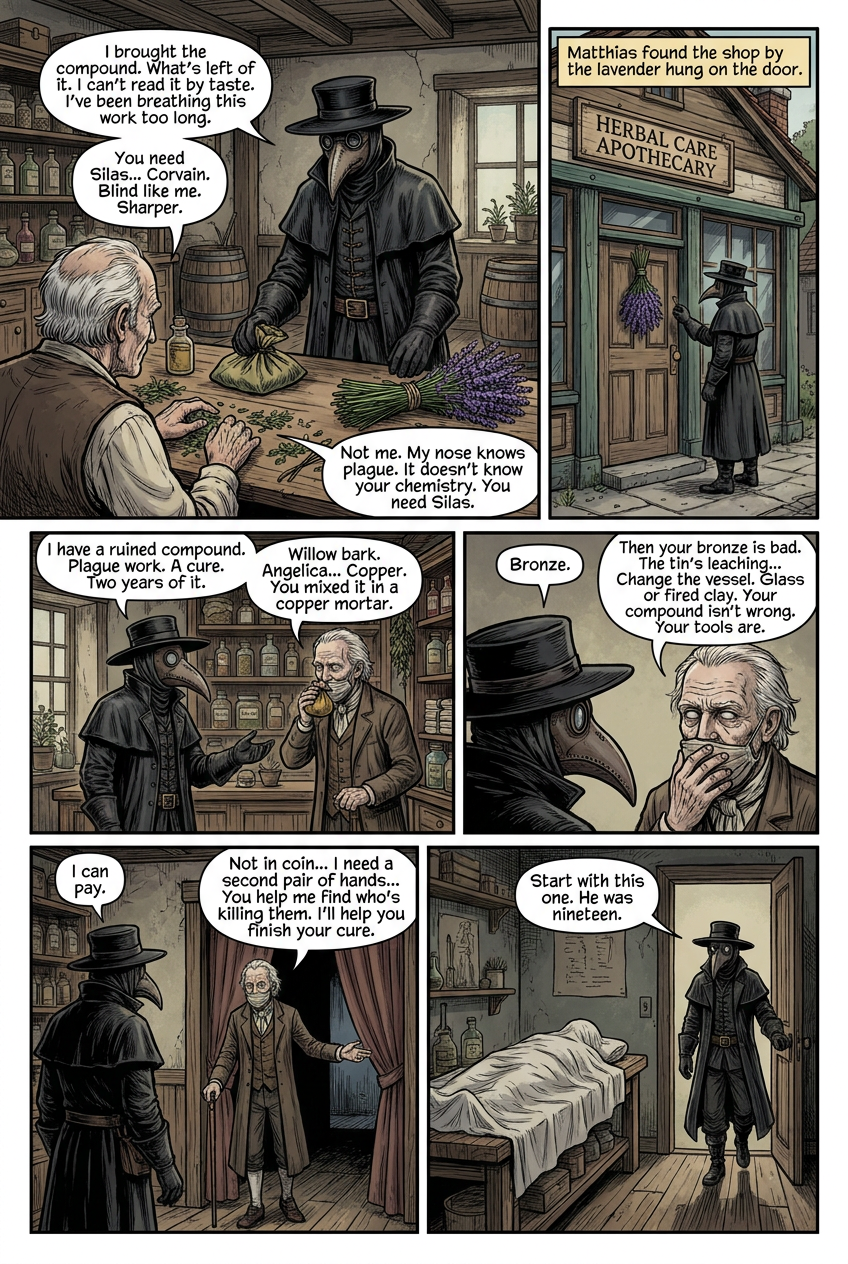
Matthias came back at dawn with the ruined batch wrapped in oilcloth. He set it on the counter between a mortar and a bundle of lavender. The old man he had sat with the night before was already awake, sorting stems by touch. Matthias watched the blind fingers move and felt the size of what he had asked for. "I brought the compound," Matthias said. "What's left of it. I need to know what went wrong before I mix the next batch. I can't read it by taste. I don't trust my nose anymore. I've been breathing this work too long." The old man lifted the cloth and passed a hand over the dried crust. He frowned. "Not me," he said. "My nose knows plague. It doesn't know your chemistry." He set the cloth down. "You need Silas." "Silas." "Corvain. Blind like me. Sharper. He diagnoses by smell. He'll tell you what soured your batch in three breaths." The old man tapped the counter. "He's also busy. He's been examining nobles the Council wants buried fast. Come at him wrong and he won't hear you." Matthias found the shop by the lavender hung on the door. He knocked and gave his name plain. The door opened on a small man in a long black coat, a beaked mask pushed back on his head. Milk-pale eyes fixed somewhere past Matthias's shoulder. A cane rested against his hip. "I was sent," Matthias said. "I have a ruined compound. I need someone who can tell me what spoiled in it." "Plague work?" Silas said. "A cure. Two years of it." Silas held out a gloved hand. Matthias placed the oilcloth in it. Silas lifted it to the mask's beak and drew one slow breath. Then another. "Willow bark. Angelica. Something sulfurous." A pause. "Copper. You mixed it in a copper mortar." "Bronze," Matthias said. "Then your bronze is bad. The tin's leaching. That's what killed the binding." Silas handed the cloth back. "Change the vessel. Glass or fired clay. Your compound isn't wrong. Your tools are." Matthias stood with the oilcloth in his hands. Two years of failed batches rearranged themselves in his head. Not the formula. The mortar. "I can pay," he said. "Not in coin." Silas stepped back into the shop and tilted his head toward the inside. "I have three noble corpses the Council wants gone by week's end. One's already been embalmed against me. I need a second pair of hands that knows a poisoned liver from a plagued one. You help me find who's killing them. I'll help you finish your cure." Matthias followed him in. The door closed behind them. On the workbench in the back room lay a sheet, and under the sheet, the shape of a body. "Start with this one," Silas said. "He was nineteen."
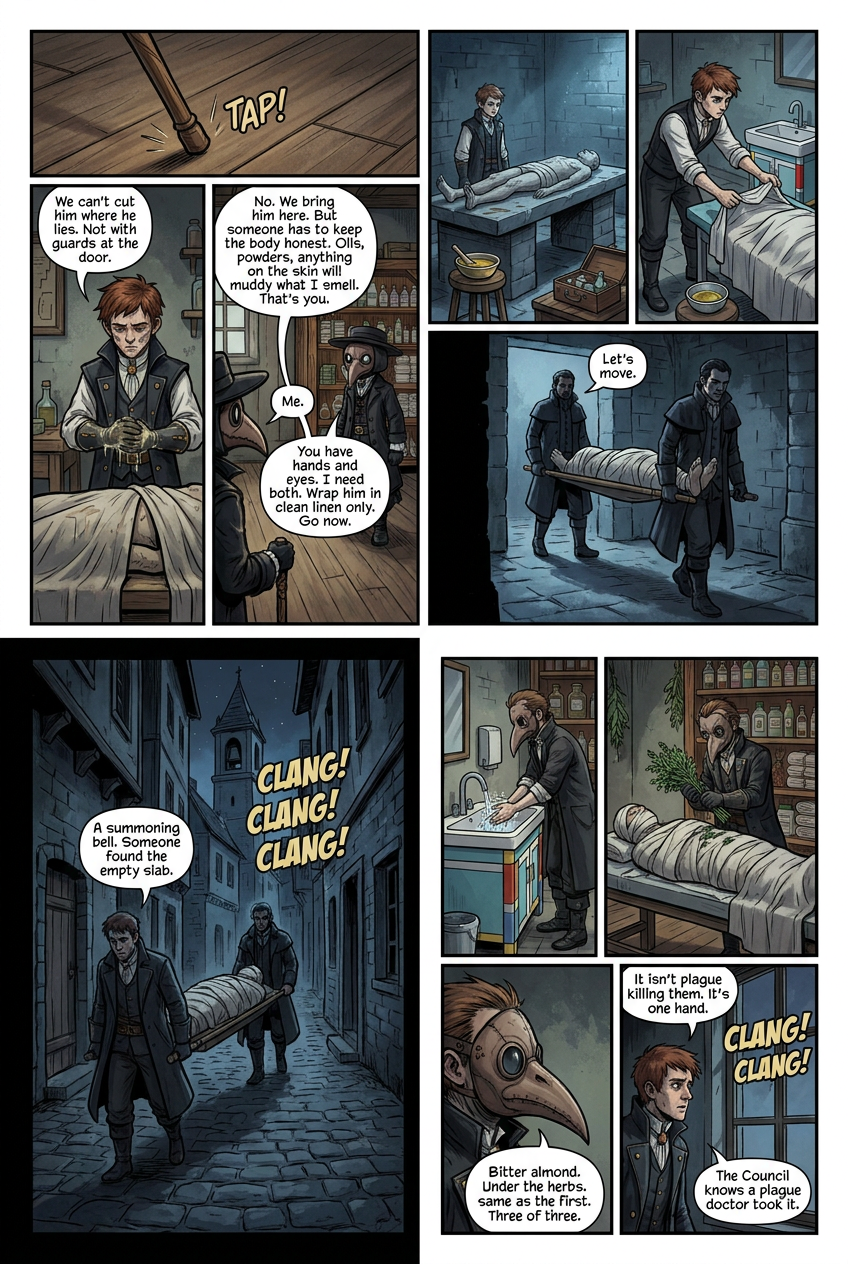
Silas set the second body's report aside and tapped his cane once on the floor. "The third one's still in the Council hall. Guarded. If we wait, the embalmers reach him first. A man with a preparer's kit was seen there an hour ago." Matthias stood at the workbench. The nineteen-year-old was covered again. His own hands still smelled of the vinegar wash. "We can't cut him where he lies. Not with guards at the door." "No. We bring him here." Silas turned his masked face toward the front room. "I've paid for that before. The Asterwing works fast. But someone has to keep the body honest between the hall and this table. Oils, powders, anything on the skin will muddy what I smell. That's you." "Me." "You have hands and eyes. I need both. Wrap him in clean linen only. No perfumes. No lye. If a servant tries to wash him, stop them." Matthias thought of the merchant lord already ruined by oils. He thought of Silas's bargain, and the cure waiting behind it. "How long do I have?" "Until the preparer finishes his tea. Go now." Matthias went. He waited in an alley across from the Council hall until a cart rattled up to the side door. Two figures in dark coats stepped down. He did not ask their names. He gave the word Silas had given him and followed them in past a guard who looked the other way for coin. The body lay on a slab in a cold room. A bowl of oil sat beside it, uncapped. The preparer's kit rested on a stool. The man himself was not in the room. Matthias moved the bowl aside without spilling it. He pulled the linen from the kit, checked it for scent, and wrapped the corpse himself. The dark coats lifted the body between them. Matthias carried the feet. They were three streets from the shop when a bell began to ring behind them. Not a plague bell. A summoning bell. Someone had found the empty slab. Back in the shop, they laid the body on the padded treatment table. Silas was already washing his hands at the basin. He took up a bundle of green stems from the shelf and crushed a leaf under the beak of his mask. Mint. Rosemary. Thyme. He passed the bruised herbs slowly over the corpse's mouth, then the belly. He stopped at the belly. Breathed again. "Bitter almond. Under the herbs. Cyanide, same as the first." He straightened. "Three of three. It isn't plague killing them. It's one hand." Matthias set down the linen. Outside, the bell was still ringing. Somewhere in the town, guards were being counted and sent. The body was here. The proof was here. And now the Council knew a plague doctor had taken it.
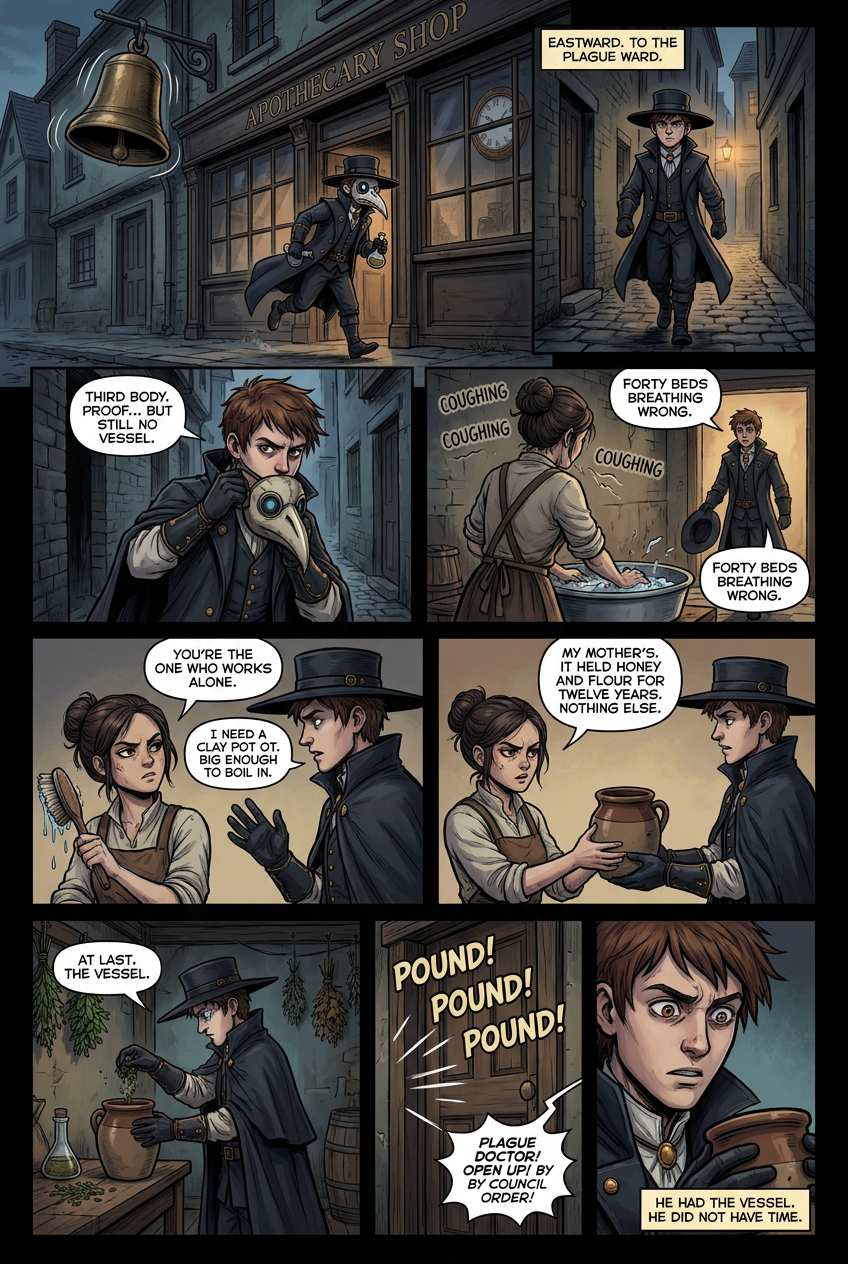
The summoning bell still rang when Matthias slipped out the back of Silas's shop. The third body was proof, but proof did not brew a cure. His formula waited in a corked flask, useless without a vessel that would not poison it. Bronze had already ruined one batch. Glass or clay. Nothing else. He kept to the alleys. Every apothecary he knew sat under the Council's eye, and by now the Council had a description: a plague doctor, beaked mask, moving fast. He pulled the mask off and tucked it under his cloak. His face felt bare in the daylight. He went east, toward the plague ward. The nurses there bought their own supplies. They did not answer to the Council. He found her outside the ward's back door, sleeves rolled, scrubbing a tray in a bucket. Mercy Sweetwell. He had seen her twice before, carrying baskets of honey cakes into the rows of the dying. She sat with them when no one else would. She had never asked his name and he had never offered it. She looked up. Her eyes went to the mask under his cloak, then his hands. "You're the one who works alone." "I need a clay pot. Sealed. Unused. Big enough to boil in." "For what." "A cure. I'm close. My bronze mortar ruined the last batch." She wiped her hands on her apron. She did not ask if he was lying. "I have one. My mother's. I bake in it." She said it flat, the way she said everything hard. "I can pay." "No." She stood and went inside. He waited by the bucket. Through the open door he heard forty beds breathing wrong. He counted three coughs before she came back. She carried a squat brown crock, glazed inside, the lip chipped once. She held it against her hip like a child. "It held honey and flour for twelve years," she said. "Nothing else. Bring it back clean." "I will." "If your cure works, you come here first. Forty beds. You start in this ward." "I promise." She pushed the crock into his arms. It was heavier than it looked. She did not smile. She went back to her bucket and her tray and did not watch him leave. He returned through the alleys with the pot wrapped in his cloak. The bell had stopped. That was worse than the ringing. It meant the guards had been given somewhere to go. In the shop's back room he set the crock on the bench beside his flask and his dried herbs. His hands were steady for the first time in three days. He measured the first pinch. Someone pounded on the front door. Three hard strikes. A voice through the wood called for the plague doctor by profession, not by name. Matthias looked at the crock. He had the vessel. He did not have time.
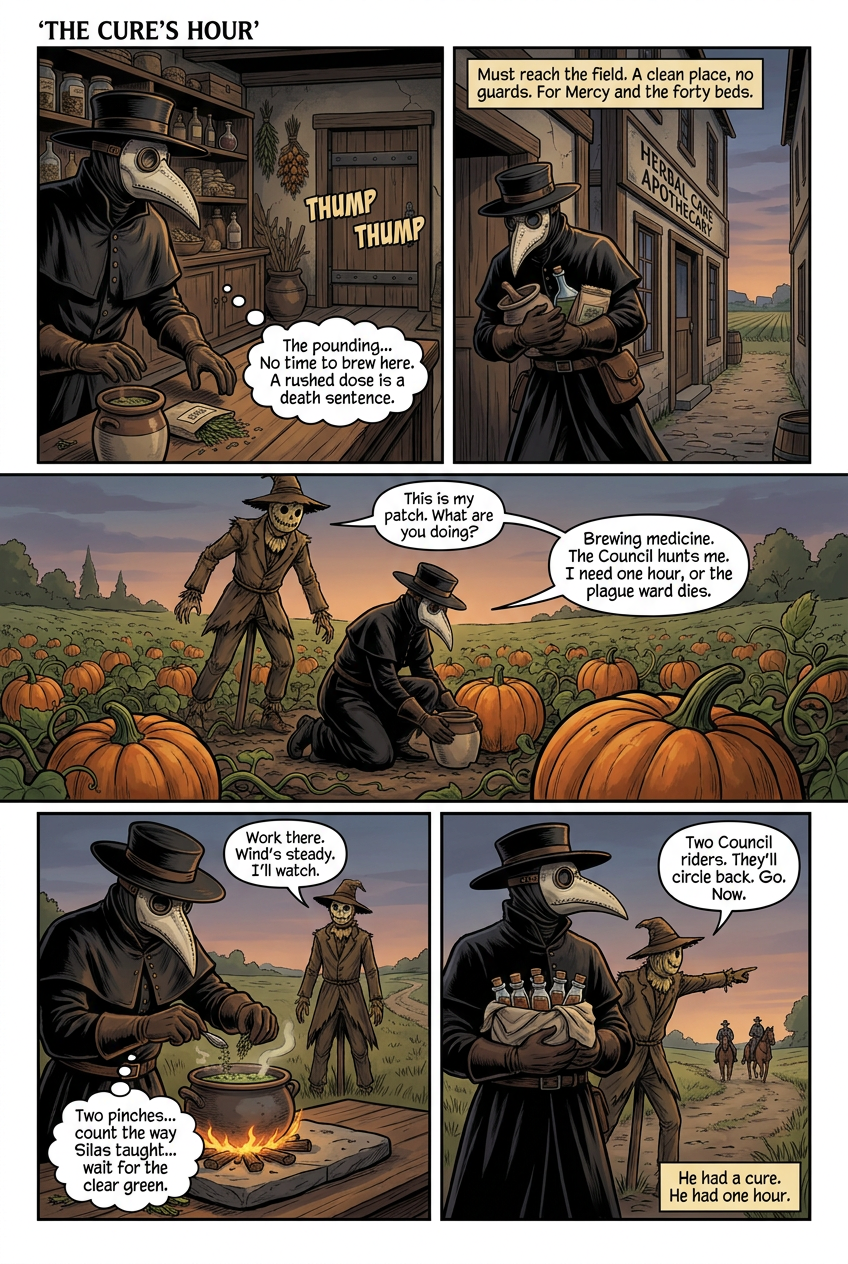
The pounding came again. Matthias set the pinch of herbs back in its packet. He looked at the crock on the bench, at the flask beside it, at the door shaking on its hinges. If he brewed here now, with guards at the front and his hands shaking from the run, he would rush the measures. A rushed dose would reach forty beds in the plague ward. He had promised Mercy Sweetwell those beds first. A bad dose would kill them faster than the plague. He wrapped the crock in his cloak. He took the flask, the herbs, and the packet of dried root from the shelf above the bench. The shelf held Silas's neat rows of jars and bundles, none of it his to take. He left it alone. He went out the back. The alley was empty. He kept the crock against his chest and moved toward the edge of town, where the houses thinned and the fields began. He needed a clean bench, still air, and no one at his back. He needed a place no guard would think to look. He found the field by the low stone wall. Rows of orange pumpkins sat fat among tangled vines. At the far end stood a scarecrow on a pole, hat tipped low. Matthias climbed the wall and set the crock down between two pumpkins. The scarecrow stepped off the pole. "This is my patch," the scarecrow said. Short. Flat. He walked closer through the vines. Straw showed at his sleeves. His stitched mouth did not move when he spoke. "What are you doing." "Brewing medicine," Matthias said. "The Council is looking for me. I need one hour. Nobody comes near the plague ward if I get this wrong." Scyther looked at the crock. He looked at Matthias's hands. "Who dies if you rush." "Forty in the ward. A nurse named Mercy. Every bed I promised." Scyther was quiet. Then he pointed to a flat stone by the wall. "Work there. Wind's steady. I'll watch the road." Matthias set the crock on the stone. He built a small fire from vine and dry wood. He measured each pinch twice. He counted under his breath the way Silas had taught him. The clay held the heat even. No metal touched the brew. When the color turned from brown to a pale, clear green, he pulled it off the flame. He filled six vials. He corked them. He waited for the shake in his hands to stop, then he drank a swallow himself. Bitter. Clean. No burn. Scyther came back through the vines. "Two riders on the road. Council colors. Going the other way." "They'll circle back." "Then go. The ward. Now." Matthias wrapped the vials in cloth. He had a cure. He had one hour to reach forty beds before the guards found the field.
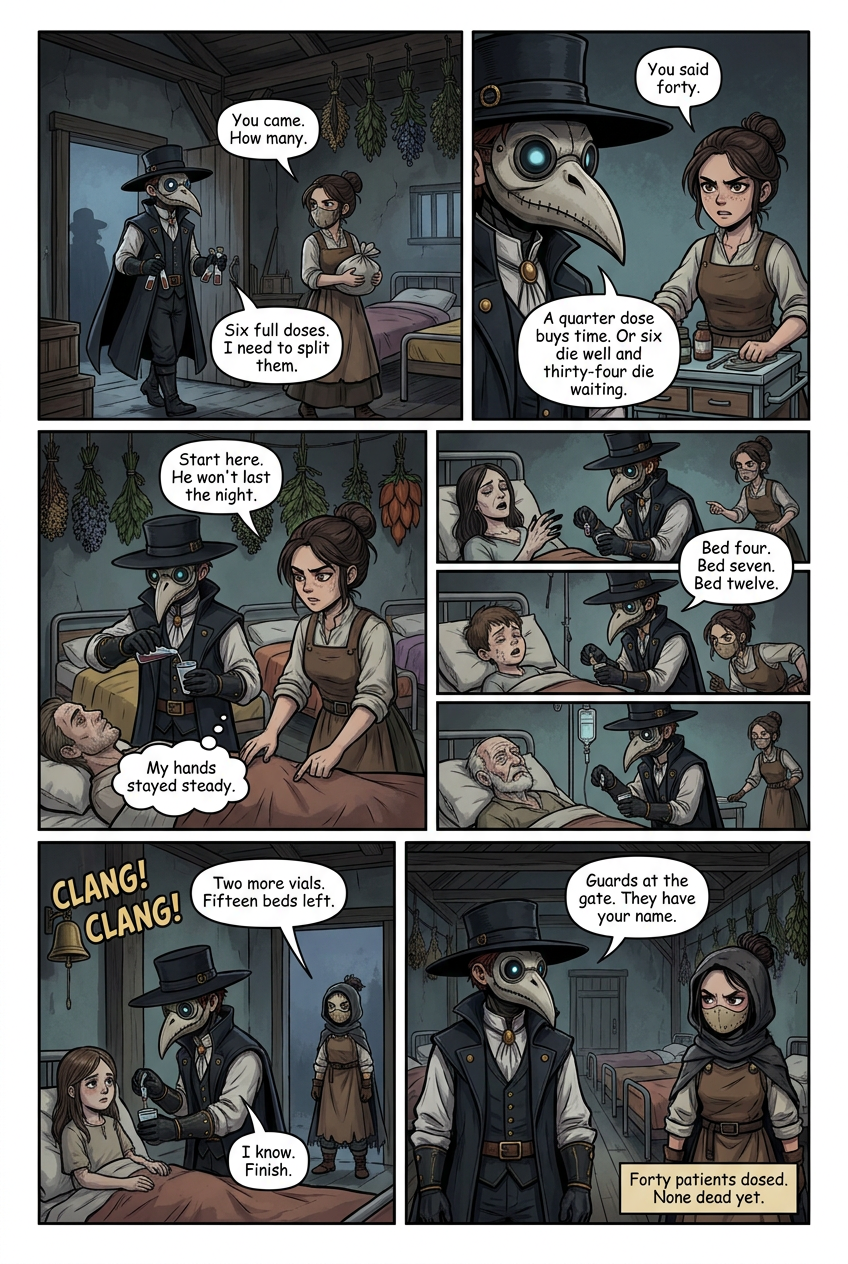
Matthias reached the plague ward with the six vials wrapped against his chest. The east ward held forty beds in two long rows. Dried herb bundles hung from the rafters. A supply cart stood at the far wall. The air smelled of sweat and vinegar. He counted the beds again. Six vials. Forty patients. He had planned the math on the walk in and it had not changed. Mercy Sweetwell met him at the door. She wore her hood up and her mask down. She was small and quick, and she carried a cloth bundle that smelled of honey and warm bread. "You came," she said. "How many." "Six full doses. I need to split them." "You said forty." "I know what I said. Guards are circling back. I have one pass through this room." She set the bread bundle on the cart. "Split them how." "Quarter doses. Sickest first. A quarter will slow the fever enough to buy a day. A full dose kills it. A quarter buys time until I brew again." "You tested a quarter?" "No." She looked at him. She did not blink. "Then you guess." "I guess with the formula I know. Or six die well and thirty-four die waiting." She picked up the cart and pushed it to the first bed. "Start here. He won't last the night at full strength." Matthias uncorked the first vial. He measured a quarter into a clean cup with water. He lifted the man's head and poured it slow. The man swallowed. Matthias moved to the next bed. Mercy walked ahead of him, checking pulses, pointing. She did not say the patients' names. She said bed four. Bed seven. Bed twelve. He worked down the row. A quarter for the woman with black fingers. A quarter for the boy whose breath rattled. A quarter for the old man who could not open his eyes. His hands stayed steady. The clay had held the brew clean. The measures held. Halfway down the second row, a bell rang outside. Not the ward bell. The council's summoning bell. Close. Mercy did not look up. "Two more vials. Fifteen beds left." "I know." "Finish. I'll meet the door." She walked past him toward the front. She picked up the bread bundle on her way and set it on an empty stool, as if she meant to come back for it. Matthias dosed the last fifteen in quarters. He emptied the sixth vial into the mouth of a girl who could not have been older than the one who once walked out of his care. He corked the empty glass. He looked back down the ward. Forty patients dosed. None dead yet. Mercy returned. Her hood was pushed back. Her mouth was tight. "Guards at the gate," she said. "They have your name."
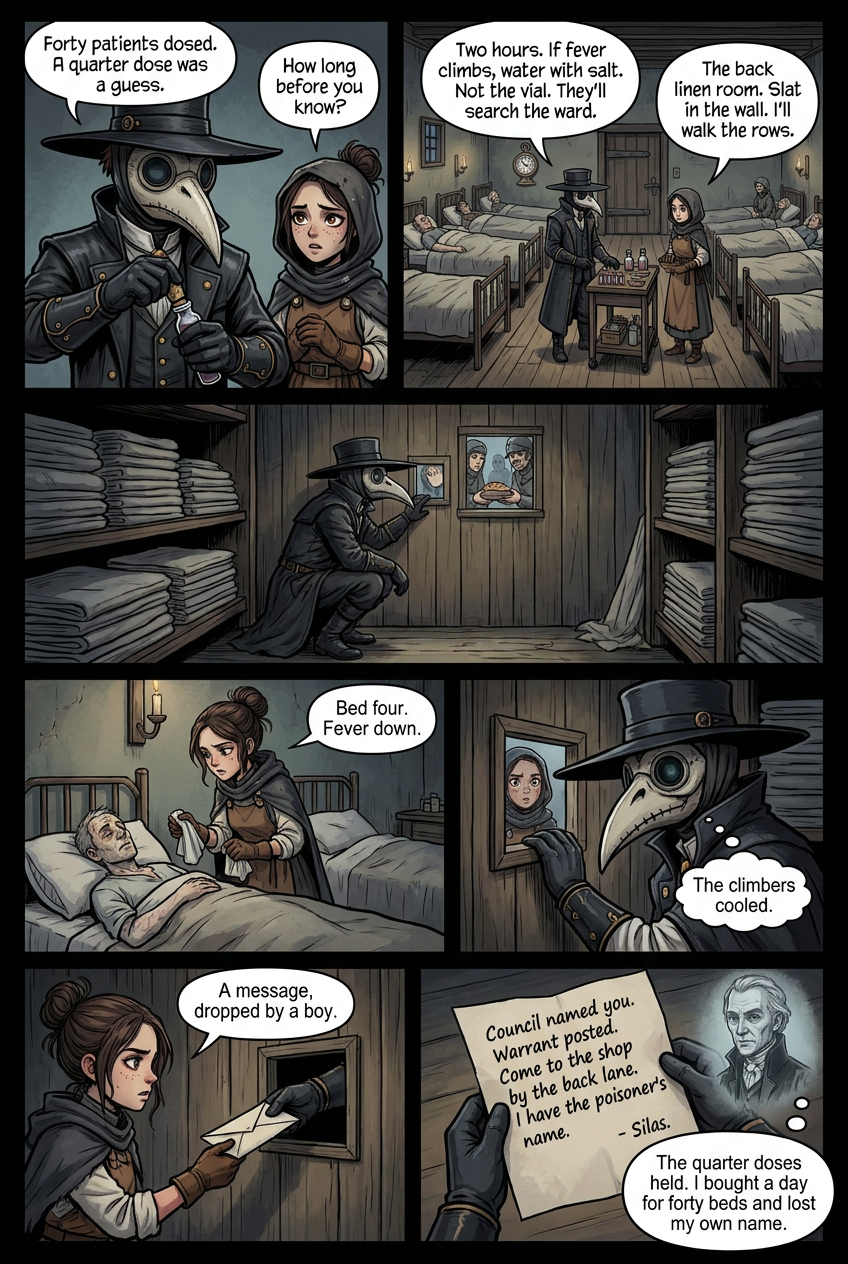
Matthias corked the last empty vial. Forty patients dosed. Guards at the gate with his name in their mouths. He could not stay, and he could not leave. A quarter dose was a guess. If it failed, patients would seize inside the hour. Mercy could not adjust what she had never mixed. "How long before you know?" Mercy asked. "Two hours. Fever should drop by then. If it climbs instead, they need water with salt and a cool cloth. Not the vial. Never a second dose." "I can do that." "You can do that for one bed. Not forty." She looked down the ward. She did not argue. The front door rattled. A fist, not a knock. A voice called for the plague doctor by name. Matthias looked at the supply cart. He looked at the rafters. He looked at the small door at the back of the ward, the one the linen men used. He had two hours to watch forty people and no room to stand in. "The back linen room," Mercy said. "Slat in the wall. You can see bed one through bed twenty from the crack. I'll walk the second row past the slat every quarter hour and say the number and the fever. You listen. You tell me what to do through the wood." "They'll search the ward." "They'll search the beds. Not a shelf of sheets." He hesitated. The fist hit the door again. "Go," she said. "I brought bread. If they smell honey they think nurse, not doctor." He went. The linen room was narrow and smelled of lye. He crouched behind stacked sheets and found the slat. He could see the first row. He set his watch by the ward's small clock on the far wall, its painted face still catching lamplight. The front door opened. Boots. Three sets. Mercy's voice, flat and small, offering bread. A guard cursed the smell of the ward and moved down the row fast. Matthias held his breath at bed nine, where the boy's chest rose shallow. The guard did not stop. They passed through and out the back yard door. Mercy came to the slat. "Bed four. Fever down. Bed seven. Down. Bed twelve. Still climbing." "Cool cloth. Salt water. Not the vial." "Yes." She walked. She came back. She walked again. Two hours. The climbers cooled. No seizures. No deaths. At the third round she pressed a folded paper through the slat. A message, dropped at the ward door by a boy who ran. Matthias unfolded it. Silas's hand, short and clipped as his voice. Council named you. Warrant posted. Come to the shop by the back lane. I have the poisoner's name. Matthias folded the paper. The quarter doses held. Mercy could carry the ward now. He had bought a day for forty beds and lost his own name in the trade.
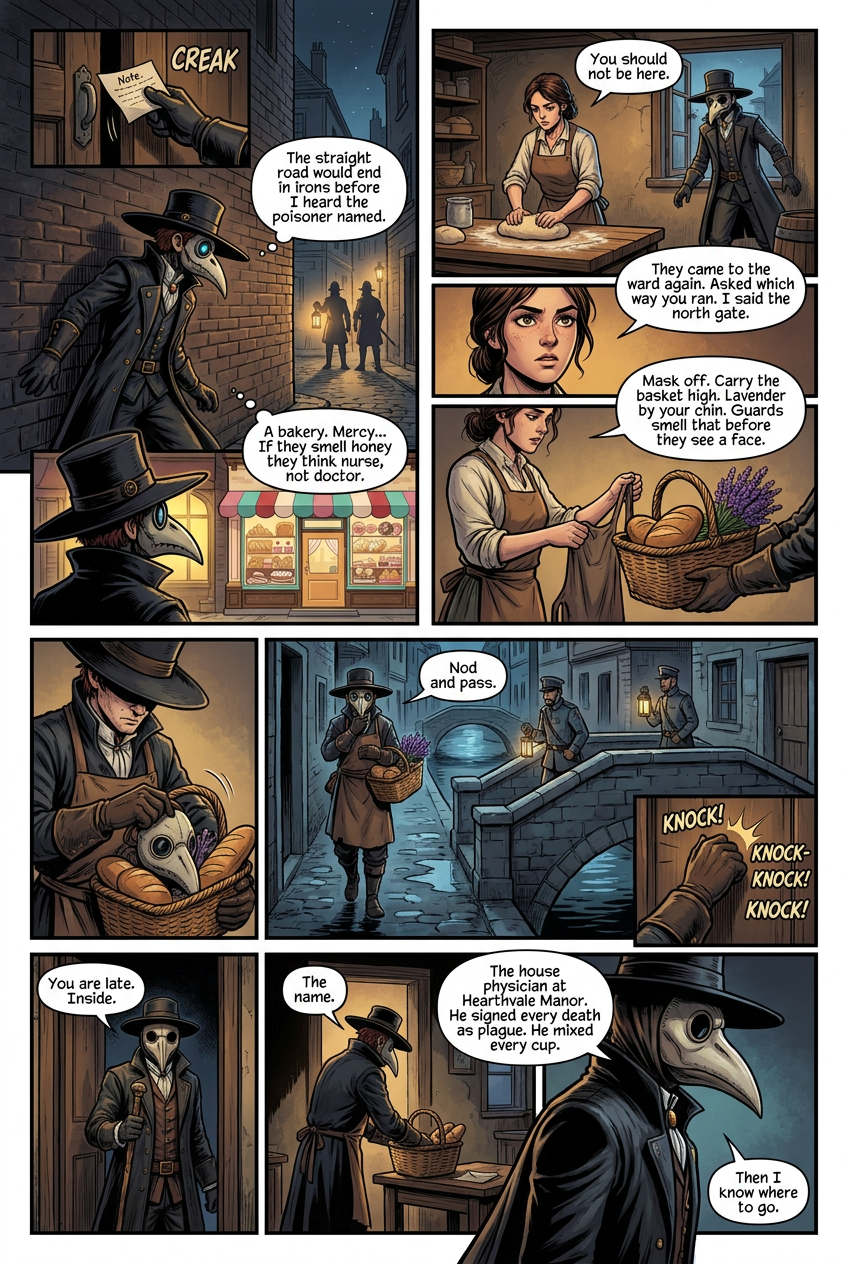
Matthias slipped out the ward's back door with Silas's note folded in his glove. The shop sat across town. His name was on every guard's tongue. The straight road would end in irons before he heard the poisoner named. He cut through an alley and stopped. Two guards stood at the mouth of the next street, checking faces. He backed against the wall. His mask alone would mark him. Every plague doctor in Willowmaw was being stopped now, and only one was wanted. He looked up. A striped awning hung two doors down. Warm bread smell rolled from a propped side window. A bakery. Mercy had said once she traded honey loaves there before her shifts. He remembered her line about the smell. If they smell honey they think nurse, not doctor. He slid along the wall and ducked through the side window into a back room. A woman looked up from a wooden table dusted with flour. Mercy. Sleeves rolled, hands deep in dough. She did not startle. She had never startled at him yet. "You should not be here," she said. "I know." "They came to the ward again. Asked which way you ran." She wiped her hands. "I said the north gate." "Thank you." She looked at his mask, his coat, the black gloves. "You will not cross three streets in that." She pulled an apron from a hook and pushed it at him. Then a flat basket. She dropped two loaves in, a wax paper of buns, and a bundle of lavender from the sill. She tucked the lavender on top where anyone could see it. "Mask off. Carry the basket high. Lavender by your chin. Guards smell that before they see a face." "If they stop me." "They stop the boy in the plague coat. Not the boy with bread." He unhooked the mask and put it in the basket under the loaves. The apron hid his coat to the knees. His hands still shook from the ward. He steadied them on the basket handle. "Silas said back lane," he said. "Then go by the canal. Two guards at the bridge. They know my basket. Nod and pass." He went. The canal path was narrow and wet. At the bridge one guard glanced at the lavender and turned back to his talk. The other did not lift his eyes. Matthias walked past close enough to hear the buckle on the man's belt creak. He reached Silas's back lane and knocked once, twice, once. The door opened on its chain. Silas's voice came through, dry and short. "You are late. Inside." Matthias stepped in. Silas shut the door and slid the bolt. "The name," Matthias said. "The house physician at Hearthvale Manor," Silas said. "He signed every death as plague. He mixed every cup." Matthias set the basket down. The lavender tipped against the loaves. "Then I know where to go."
Play your story to life
Storycraft is a mobile game where you create AI characters, craft items and locations to build their world, then discover what direction your story takes. Download the iOS game for free today!
Download for free