

Dr. Veer Quel's Arc
5 Chapters
Dr. Veer Quel's dream is curing the plague that took his beloved so no one else loses their love to it..

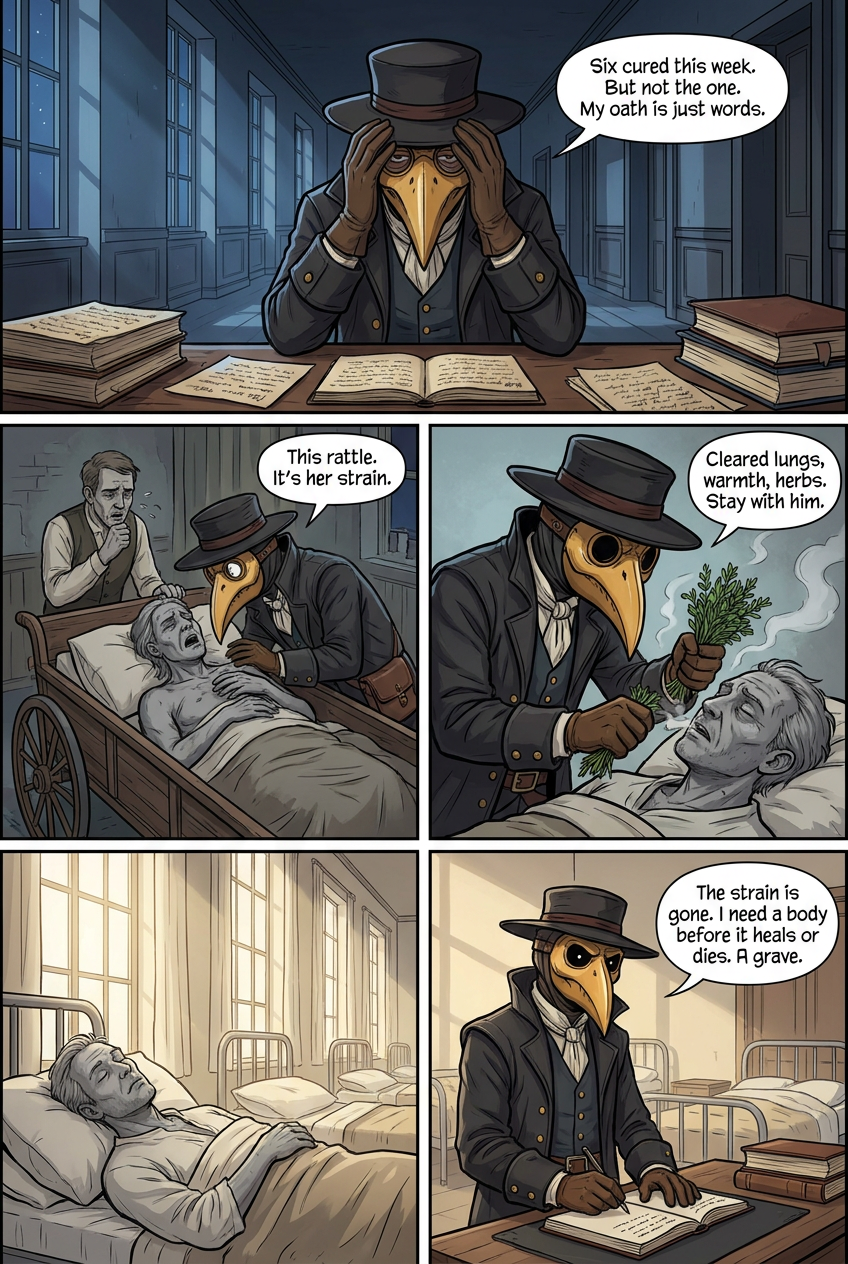
Dr. Veer Quel had cured six patients this week, and none of them had the disease he needed. Two years ago pneumonia took the woman he had loved since he was eleven. He swore then to cure the strain that killed her. But a plague doctor cannot fight a sickness he has never touched. He had never studied that strain. He had no sample of it. Without one, his oath was just words spoken over a grave. He worked in the great stone hospital that welcomed everyone. Tall windows lit the long halls. Veer moved between the beds, staying with the frightened ones, holding hands until fear loosened. Half of medicine was that. But holding hands cured no one. At his weathered writing desk each night, he read his old notes and found nothing. His last words to her still burned. He had told her she made him want to be a better doctor. It was true. It had not been enough. On the sixth day a coughing man arrived on a cart. His skin was gray. His breath rattled wet and shallow. Veer bent close and listened. The sound matched her final nights exactly. This was the strain. This was the sickness that had killed her. He worked all night. He cleared the man's lungs, warmed him, dosed him carefully. He crushed a bundle of scent herbs and held them near the man's face to ease each breath. He stayed through every scared hour, the way he believed a doctor must. By dawn the man's fever broke. The rattle in his chest went quiet. He would live. And he took the sickness with him. Veer understood too late. A living, cured man carried no fresh sample. The healthy body burned the strain away. To study the disease that killed her, Veer needed it raw, active, taken from someone the sickness still held. He had saved the one man who could have shown him the enemy. He had chosen the patient over the cure. He would choose that way again. He sat at his desk as light filled the tall windows. His hands shook. He wrote one line in his notebook: I must reach a body before it heals or dies. That meant the dead. The freshly dead, taken before the ground claimed them, before the sickness faded from cold flesh. He had never robbed a grave. He did not know who could bring him such a body, or what they would ask in return. But he knew now what his oath required. Veer closed the notebook. He stood, put on his coat, and went to find someone who dealt in the dead.
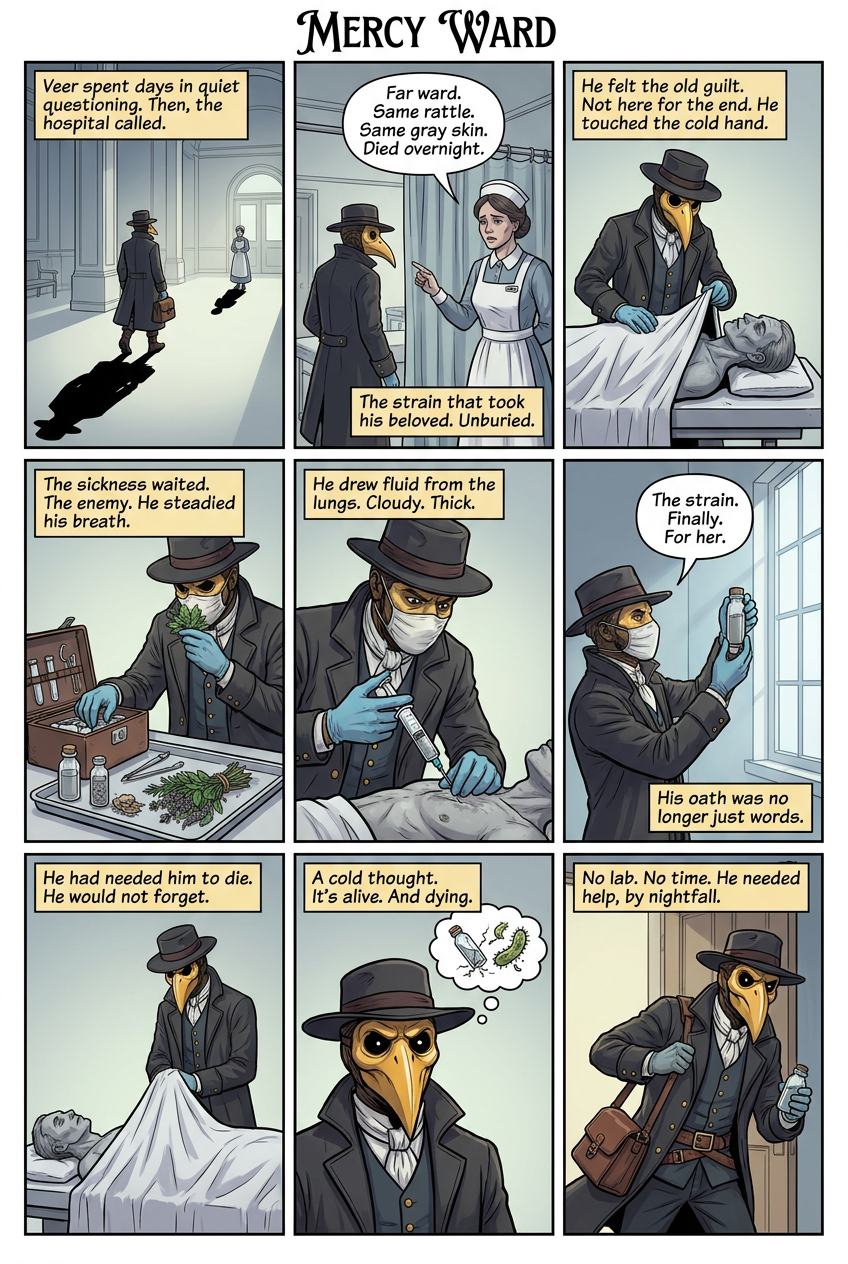
Veer had spent two days asking quiet questions about men who moved the dead. He learned nothing useful. Then, back inside the great stone hospital, a nurse found him between the beds. A patient in the far ward had died overnight, she said. The same wet rattle. The same gray skin. The strain that killed his beloved had taken this man too. And the body still lay in the ward, unburied. He walked fast down the long hall. Tall windows threw pale light across the floor. His heart pounded, and he hated that it did. A man had died. Veer had failed him. Yet the failure gave him what no living patient could. He pushed the thought down and kept walking. They let him examine the body. It lay on a padded treatment table, the frame clean and plain. The man's face was slack. His chest no longer moved. Veer stood over him and felt the old guilt press in. Half of medicine was staying with the frightened. He had not been here for this one's last scared hour. He touched the cold hand once, the way he would have if the man were still afraid. Then he worked. He opened his kit and set out clean glass vials. He knew what the dead offered. The sickness had not yet left this flesh. It waited in the lungs, raw and active, the enemy he had never been allowed to touch. He crushed a bundle of scent herbs and held it near his own face to steady his breath. His hands did not shake now. They moved with care. He drew fluid from the lungs. He watched it fill the glass, cloudy and thick. This was the strain. This was the thing that took her two years ago, when he could only hold her and speak words that were true and not enough. He capped the vial and held it to the window. The light passed through it, dim and gray. He had the sample. After two years of empty notes, he finally held the disease itself. His oath was no longer only words spoken over a grave. He could study it now. He could learn how it killed, and how to stop it. Veer sealed the vial in wax and wrapped it in cloth. He looked back at the dead man on the table. He had needed him to die to get this. He would not forget that. He drew the sheet up over the still face and stood a moment in silence. Then a cold thought struck him. Glass could break. Cold flesh healed nothing, but warmth would rot the strain within hours. The sample was alive, and dying. He had no lab, no proper vessel, no way to keep it. If he did not find a place to work by nightfall, the enemy would fade again, and this death would mean nothing. He put the vial in his coat and went to find help.
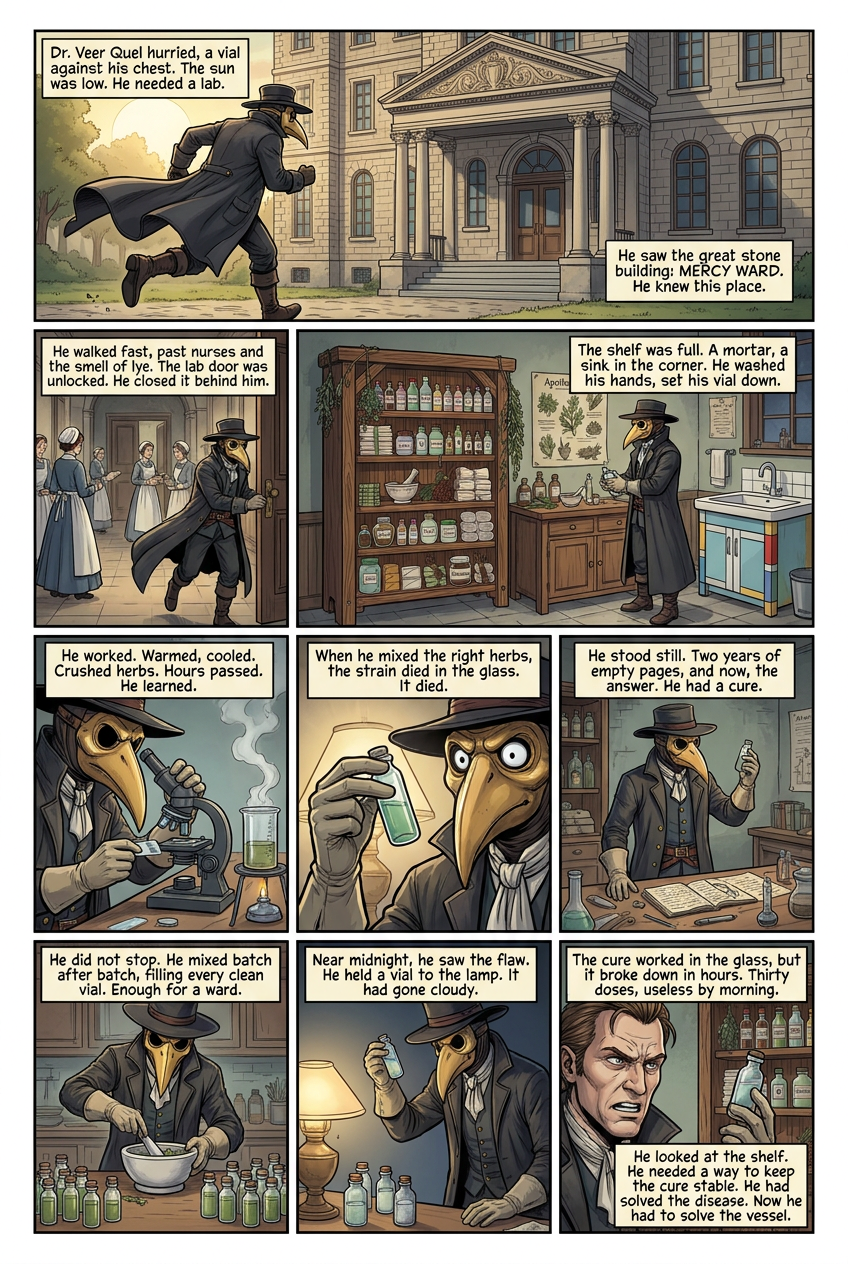
Veer ran with the wrapped vial against his chest. The sun was low. He needed a lab before the strain rotted in his coat. Then he saw the great stone building ahead. Tall windows lined its front. Carved letters over the door spelled MERCY WARD. He knew this place. He had worked its halls years ago. He knew where the pathology lab was. He climbed the wide steps and pushed inside. Nurses moved between beds in the long hall. No one stopped him. He walked fast to the lower rooms, past the smell of lye and old wood. The lab door was unlocked. He went in and closed it behind him. A tall shelf stood against one wall. Jars, herbs, and wrapped bandages filled every row. A mortar sat on a middle shelf. In the corner stood a plain white sink. Veer turned the fixture. Cold water ran. He washed his hands, then set his vial on the bench. He worked. He warmed and cooled the fluid, drop by drop, and watched it under glass. He crushed herbs to test which killed the strain and which fed it. Hours passed. His notes grew. He learned how the sickness gripped the lungs. He learned what weakened it. When he mixed the right herbs in clean water, the strain died in the glass. It died. He stood still and stared at the dead sample. Two years of empty pages, and now he held the answer. He had a cure. He did not stop. He measured the herbs from the shelf and mixed batch after batch. He filled every clean vial he could find. He lined them along the bench, twenty, then thirty, enough for a ward full of the dying. He thought of her cold hand two years ago. He had held it and said words that were true and not enough. This was not words. This would save the next one. He capped the last vial near midnight. Then he saw the flaw. He picked up one vial and held it to the lamp. The mixture had already gone cloudy at the bottom. He watched a second vial. The same. The cure worked in the glass, but it broke down within hours, just as the raw sample had. Warm and open to air, it died. He had made thirty doses that would be useless by morning. Veer set the vial down. His hands did not shake, but his jaw tightened. The cure was real. He had proven it. But he could not carry it, store it, or send it to the sick. It rotted faster than any patient could reach it. He looked at the shelf of jars and herbs. He needed a way to hold the cure stable, something to keep it alive between the bench and the bed. He had solved the disease. Now he had to solve the vessel, and he had until the next dying patient to do it.
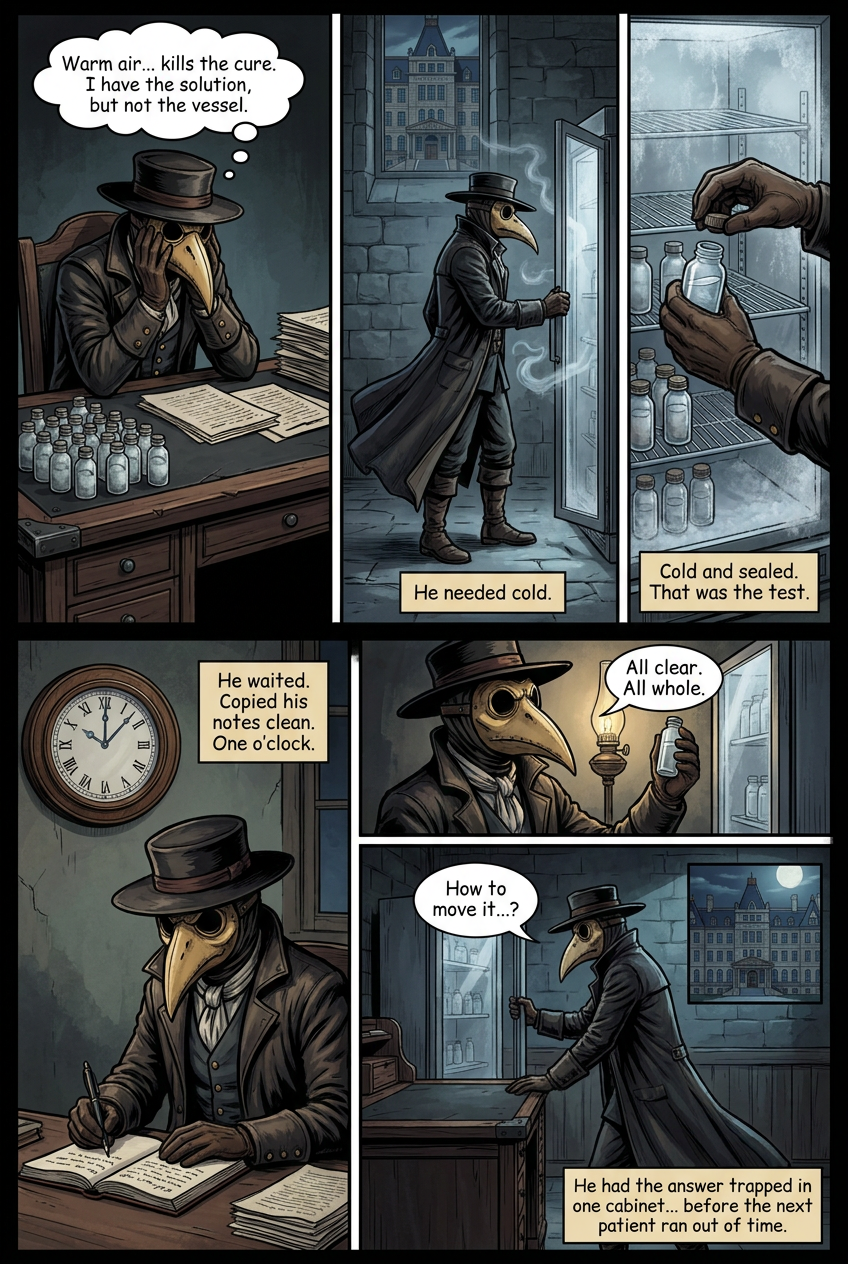
Veer stared at the thirty cloudy vials. Warm air and daylight killed the cure within hours. He had solved the disease but not the vessel. His notes lay stacked on the plague doctor's desk, page after page of tests. None of them held the answer. He rubbed his eyes and looked up. The wooden clock on the wall read half past midnight. He had until the next dying patient, and no way to keep the cure alive. He needed cold. The raw sample had lasted longer over ice on the bench. Warmth broke the mixture. Cold slowed it. He knew this from the lung fluid days ago. He scanned the room. Jars. Herbs. A sink. Then, across the lab, he saw a tall metal cabinet against the far wall. A cooling box. The ward used it to store fresh tissue samples for study. Veer crossed the floor and pulled the door open. Cold air rolled out over his hands. He worked fast. He gathered the vials two at a time and set them on the wire shelves inside. He capped each one tight to keep the air out. Cold and sealed. That was the test. He shut the door and turned back to the desk. He waited. He copied his notes clean while the clock ticked. He wrote the herb amounts, the water, the order of each step. If the cure held, others would need to make more. Every few minutes he glanced at the metal door and made himself sit still. At one o'clock he could not wait longer. He opened the cabinet and lifted a vial to the lamp. He held his breath and turned it slowly. The mixture was clear. No cloud at the bottom. He checked a second. Then a third. All clear. All whole. He set the vial down and gripped the edge of the desk. Thirty doses, alive and stable. The cold had done it. He had a cure he could carry to a bed, a ward, a city. He thought of a cold hand two years gone. He had said words then. Now he had this. But the cabinet was bolted to the wall. He could not carry it. The cure held only while it stayed cold, and the cold lived here, in this locked ward. He looked at the wall of jars and the sealed vials on the wire shelves. He could save the dying now, but only the ones brought to this room. Veer picked up his pen. He needed a way to keep the cold with the cure on the road. Ice would melt. A box would warm. He had the answer trapped in one cabinet in one building. Now he had to move it into the world, before the next patient ran out of time.
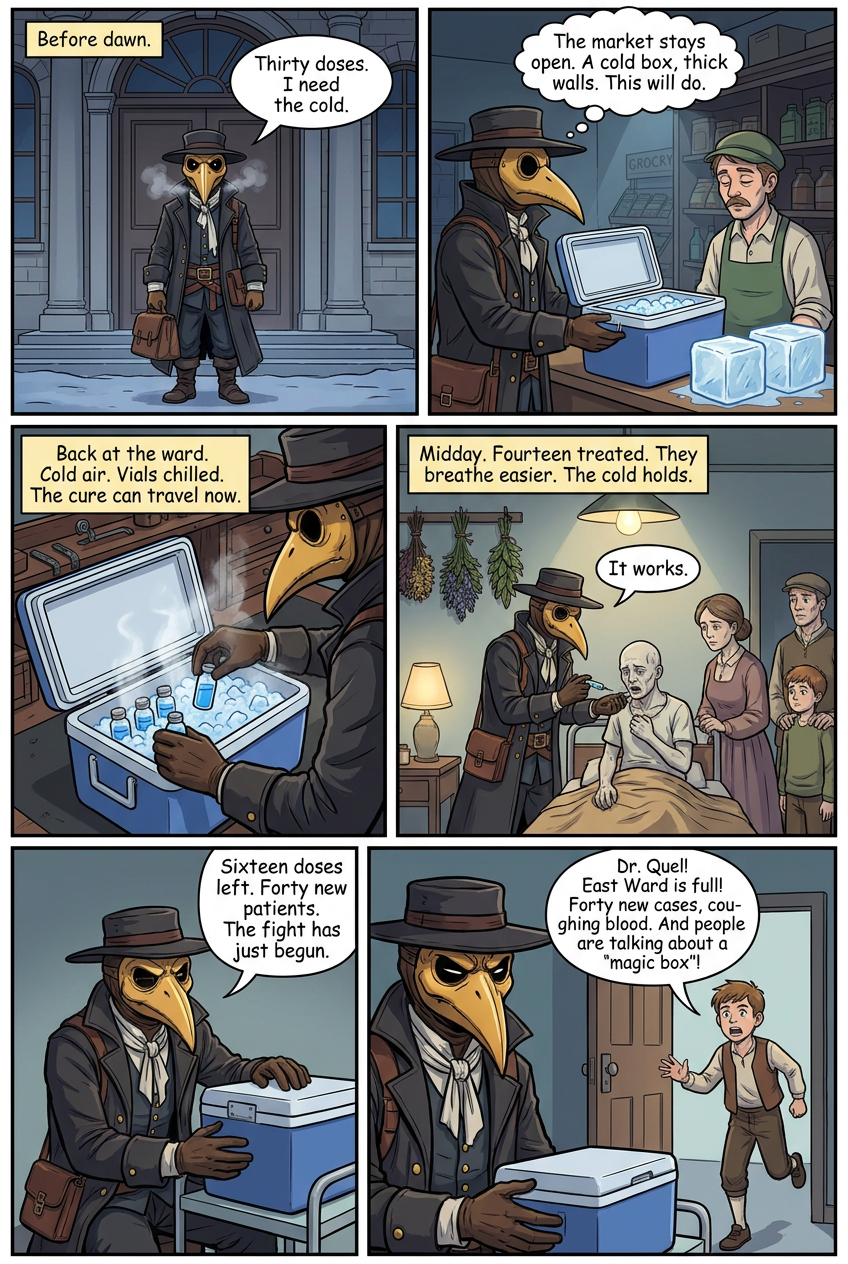
Veer left the locked ward before dawn. The bolted cabinet held thirty doses, alive only in the cold. He could not carry the cabinet. But he could carry the cold. He walked out of Mercy Ward's tall doors with an empty satchel and one plan. The market building stayed open through the night. Veer moved down the aisles until he found what he needed. A plastic box, thick-walled, meant to keep meat cold on a long trip. He bought it, along with two blocks of ice. He paid and walked back fast, before the sun climbed. In the ward, he opened the metal cabinet. Cold air rolled over his hands. He packed the ice into the box, then set the vials on top, spaced so each one touched the chill. He capped them tight. He shut the lid and pressed his palm to the plastic. It held the cold in. The cure would live outside these walls now. Veer carried the box to a quiet room off the main hall. Four beds stood in a row. Dried herbs hung above them. A cart of supplies waited near the wall. He had sent word to the sick who could still walk. Now they came, one after another, coughing, pale, leaning on doors and strangers. He worked without stopping. He drew a dose from the box and closed the lid at once. He tilted each patient's head and gave the cure slow. Between patients, he checked a vial against the lamp. Still clear. Still whole. The ice held. The cold held. He treated one man, then a woman, then a boy who could barely stand. By midday he had emptied fourteen vials. Fourteen people breathed easier on the four beds and on the floor. No cloud in the mixture. No seizures. He wiped his hands and let himself sit for one breath. He had done it. The cure had left the cabinet and reached the dying. Then a runner came from the front hall. A boy, out of breath. He said the East ward had filled overnight. Forty more, coughing blood, the same strain. And another word followed, quieter. People were talking. A doctor with a magic box was curing the plague. Word had reached the wrong ears. Veer looked at the box on the cart. Sixteen doses left. Forty new patients across the building, and more each hour. The ice was already softening at the edges. He had proven the cure could travel. Now everyone would want it, and he did not have enough. He stood and lifted the box. The cold weighed on his arm. He had won the small fight and started a larger one. He needed more doses, more cold, and more hands, before the whole city came knocking and the ice ran out.
Play your story to life
Storycraft is a mobile game where you create AI characters, craft items and locations to build their world, then discover what direction your story takes. Download the iOS game for free today!
Download for free