

Echo's Arc
10 Chapters
Echo's dream is scaring Earthlings.

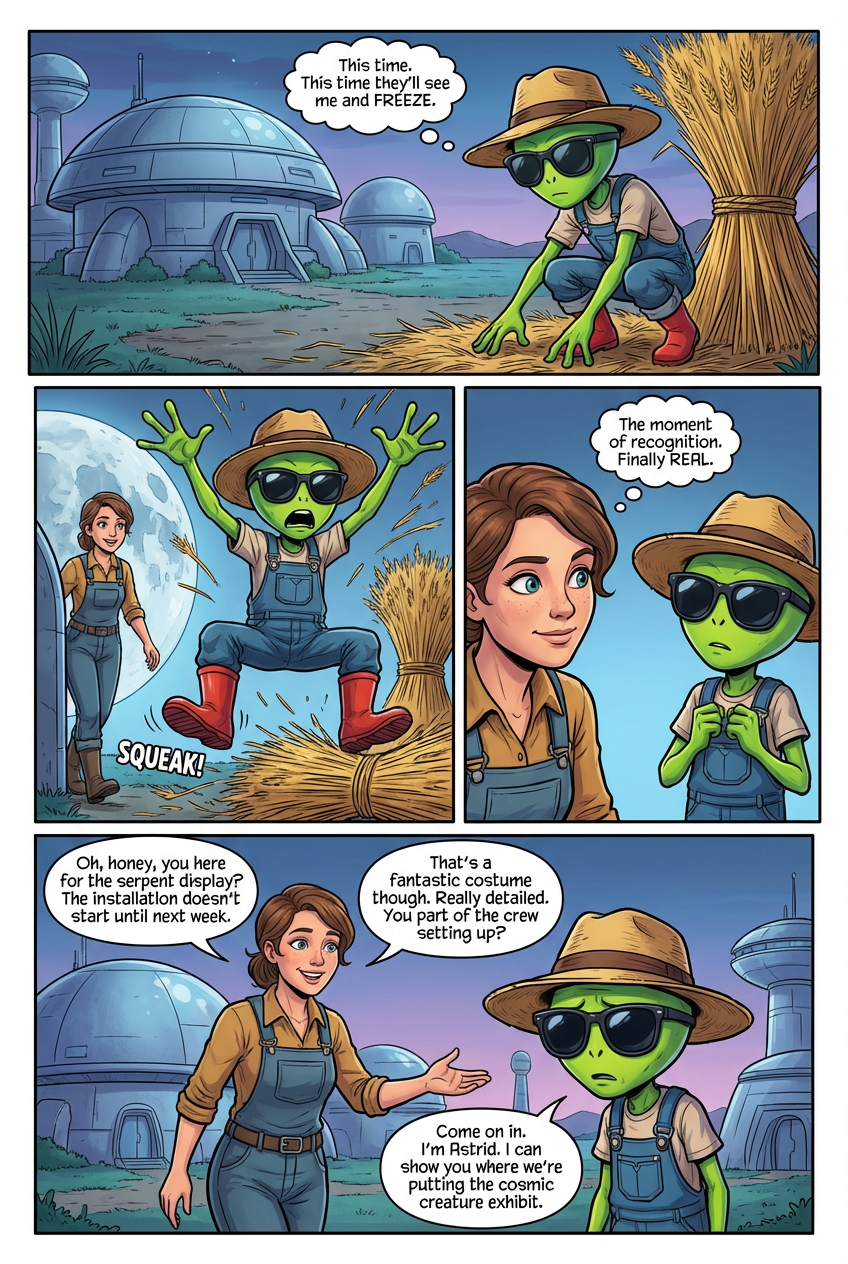
Echo crouched behind a bundle of straw near the planet buildings, his green skin hidden beneath the brim of his straw hat. This time would be different. This time, someone would see him and freeze, their heart pounding with the sacred fear his teacher had promised. He adjusted his sunglasses and waited for footsteps. But the woman appeared from behind the moon structure without warning. Echo lurched upright, knocking over the straw. His vibrant rubber boots squeaked against the ground. He raised his arms high, fingers spread wide like they'd taught him in training. The woman stopped and stared. Echo held his breath. She tilted her head, studying him. This was it. The moment of recognition. The moment he would finally be real to someone. "Oh, honey," the woman said, walking closer. "You here for the serpent display? The installation doesn't start until next week." She glanced at his green skin, his three-fingered hands. "That's a fantastic costume though. Really detailed. You part of the crew setting up?" She smiled and gestured toward the buildings. "Come on in. I'm Astrid. I can show you where we're putting the cosmic creature exhibit."
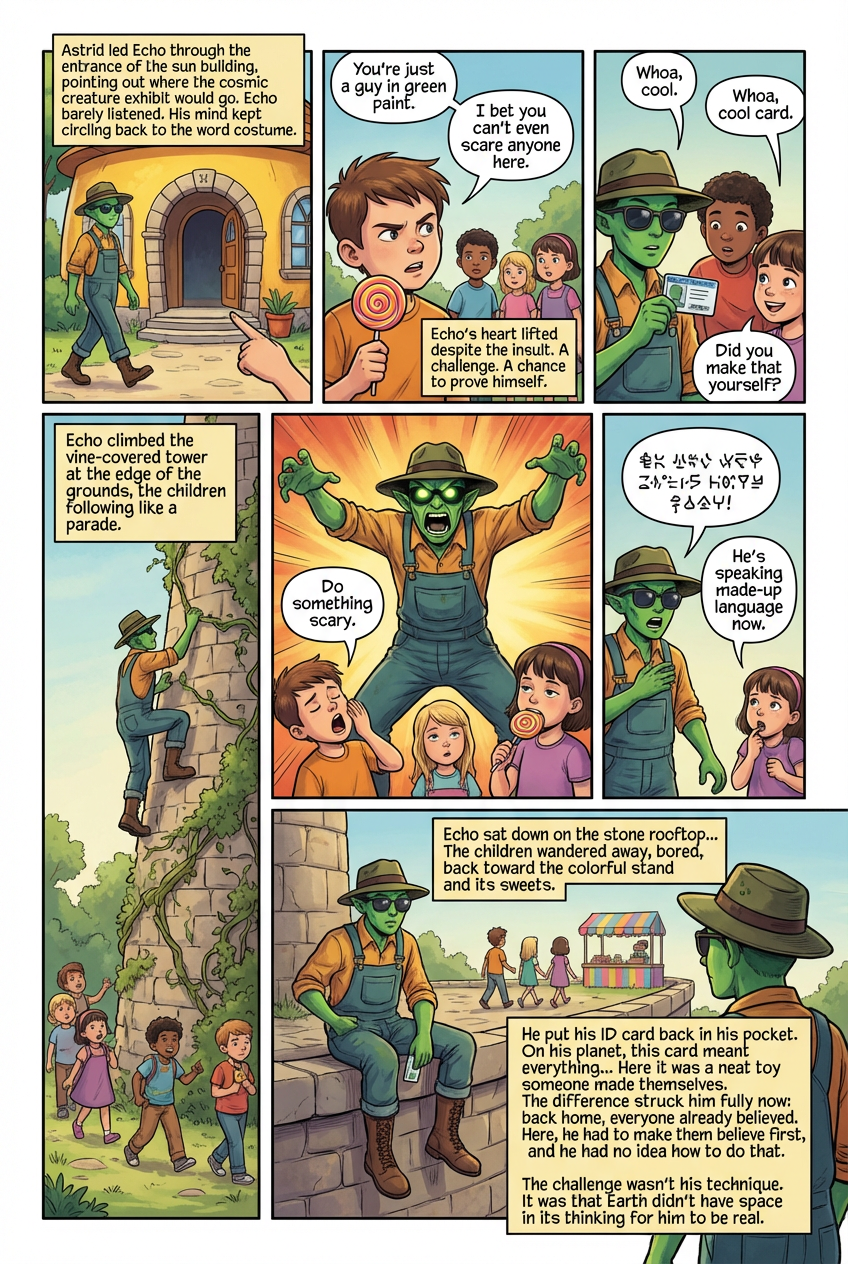
Astrid led Echo through the entrance of the sun building, pointing out where the cosmic creature exhibit would go. Echo barely listened. His mind kept circling back to the word costume. She thought his skin was painted. His three fingers were props. Everything he was, everything he'd trained for, reduced to fabric and makeup. A boy appeared at the doorway, maybe seven years old, holding a spiral lollipop from the stand outside. He looked Echo up and down. "You're just a guy in green paint," the boy announced. Other children gathered behind him, sticky-fingered and skeptical. "I bet you can't even scare anyone here." Echo's heart lifted despite the insult. A challenge. A chance to prove himself. He pulled out his ID card, the one with the official seal from his training academy, and held it up. The children leaned closer. "Whoa, cool card," one said. "Did you make that yourself?" Echo climbed the vine-covered tower at the edge of the grounds, the children following like a parade. At the top, he struck his most terrifying pose, the one his teacher had perfected over decades. Arms wide. Eyes glowing. A sound from deep in his chest that should have frozen blood. The children stared up at him. One yawned. Another took a bite of her lollipop. "Do something scary," the boy called. Echo tried again, adding the ritual words in Alienese that meant I see into your soul. A girl giggled. "He's speaking made-up language now." Echo sat down on the stone rooftop, his boots dangling over the edge. The children wandered away, bored, back toward the colorful stand and its sweets. He put his ID card back in his pocket. On his planet, this card meant everything—proof of his training, his lineage, his purpose. Here it was a neat toy someone made themselves. The difference struck him fully now: back home, everyone already believed. Here, he had to make them believe first, and he had no idea how to do that. The challenge wasn't his technique. It was that Earth didn't have space in its thinking for him to be real.
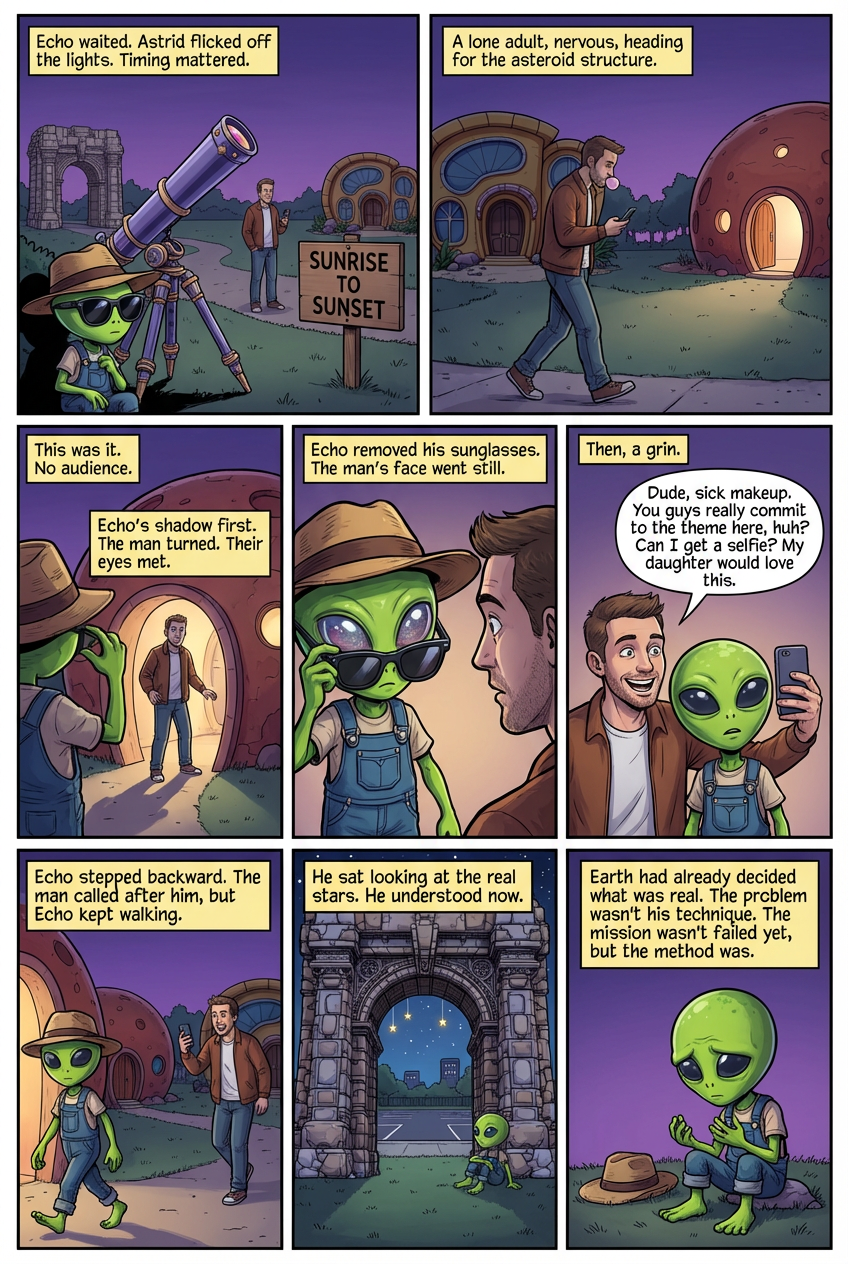
Echo waited until the last families left through the arch, their voices fading into the parking lot. Astrid moved between the buildings, switching off lights one by one. The sun building went dark. Then the Mars house. Echo stayed in the shadows near the telescope, watching the entrance. His teacher had always said timing mattered as much as technique. Adults were different from children. They didn't travel in packs. They didn't expect entertainment. An adult alone, already nervous about something, might actually freeze when they saw him. Might actually feel fear instead of amusement. The sky deepened to purple. Echo adjusted his hat and waited. A man appeared at the entrance just as Astrid flipped the last light switch. He stood beside the wooden sign that read sunrise to sunset, checking his phone, then looking up at the buildings. His jaw worked constantly, chewing gum in rapid clicks. He walked past the closed Mars house, past the darkened sun building, heading toward the asteroid structure at the far edge of the grounds. The door stood open, a soft light still glowing inside. Echo's three fingers tightened on the telescope stand. This was it. A lone adult, already tense, walking into an enclosed space. No audience. No laughter waiting to erupt. Echo moved silently across the grass, following twenty paces behind. The man stepped inside the asteroid building, his footsteps echoing against the curved walls. Echo reached the entrance and paused in the doorway, letting his shadow fall across the threshold first. The man turned. Their eyes met. Echo removed his sunglasses slowly, revealing his true eyes—the ones that had made his teacher proud, the ones that proved he was real. The man's face went still. His hand froze halfway to his pocket. For three full seconds, nobody moved. Then the man's mouth curved into a grin. "Dude, sick makeup. You guys really commit to the theme here, huh?" He pulled out his phone. "Can I get a selfie? My daughter would love this." Echo stepped backward out of the building. The man called after him, still holding up his phone, but Echo kept walking. Past the darkened houses. Past the telescope. Past the arch. He sat down on the grass beyond the parking lot and looked up at the real stars, not the installed ones Astrid had hung above the doors. He understood now what he'd been refusing to accept: Earth had already decided what was real and what wasn't. His skin, his fingers, his eyes—all of it fit too neatly into their category of pretend. He could train for a hundred more years and it wouldn't matter. The problem wasn't his technique. It was that he was trying to be seen in a world that had no frame for seeing him. He took off his hat and set it on the ground beside him. The mission wasn't failed yet, but the method he'd believed in was.
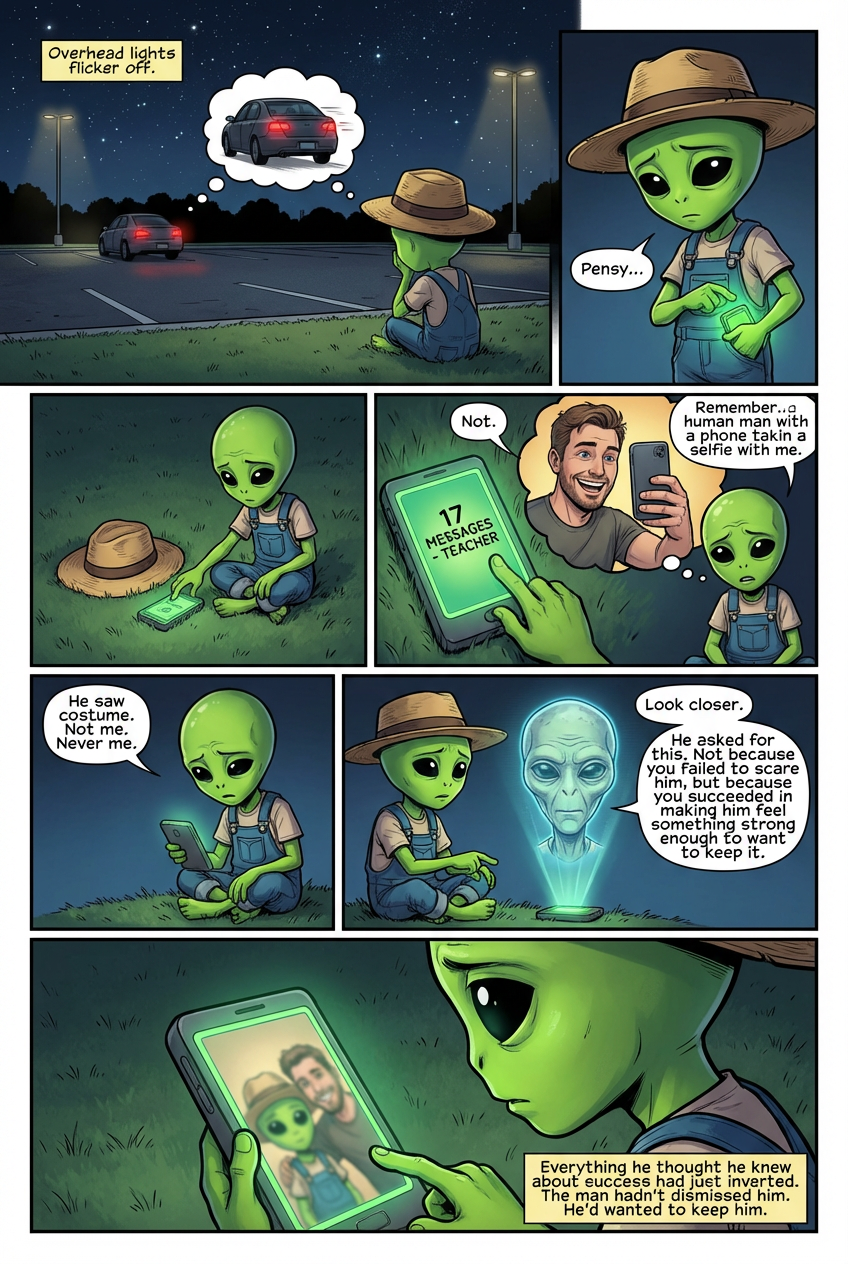
Echo sat on the grass until the parking lot lights clicked off. Astrid's car pulled away, leaving only silence and the real stars above. He touched the communicator in his overall pocket, the one he'd been avoiding since he landed. Home could reach him anytime. He'd just been too afraid to check. The device pulsed warm against his palm. Echo pulled it out and set it on the grass beside his hat. The screen glowed green, showing seventeen messages waiting. All from his teacher. He pressed the oldest one first, bracing himself for disappointment or anger. Instead, his teacher's voice came through calm and curious: "The selfie reached us. I have seen what you cannot see from inside the moment. Call when you are ready to understand." Echo's fingers hesitated over the call button. He thought about the man in the asteroid building, grinning and holding up his phone. That moment had felt like absolute failure—proof that Earth would never see him as real. But his teacher had watched it happen from across the galaxy and found something worth discussing. Echo pressed the button. His teacher's face appeared on the screen, familiar and patient. "You look tired," she said. "Tell me what you think happened tonight." "He saw costume," Echo said. "Not me. Never me." His teacher nodded, then held up her own screen. The blurred selfie filled the frame—the man's grinning face, Echo's green skin caught in harsh phone light, both of them frozen in the same moment. "Look closer," she said. "He asked for this. Not because you failed to scare him, but because you succeeded in making him feel something strong enough to want to keep it." She paused, letting the words settle. "Fear is not the only way to touch a soul, Echo. It is simply the way we have always done it. But Earth has taught you something we could not learn at home—they have so many categories for feeling that they have forgotten fear is sacred. Perhaps the mission is not to make them afraid. Perhaps it is to make them feel anything true enough that they must reach out and try to hold onto you." The screen went dark. Echo sat with the communicator in his hands, staring at the blurred selfie still glowing on the display. Everything he thought he knew about success had just inverted. The man hadn't dismissed him. He'd wanted to keep him.
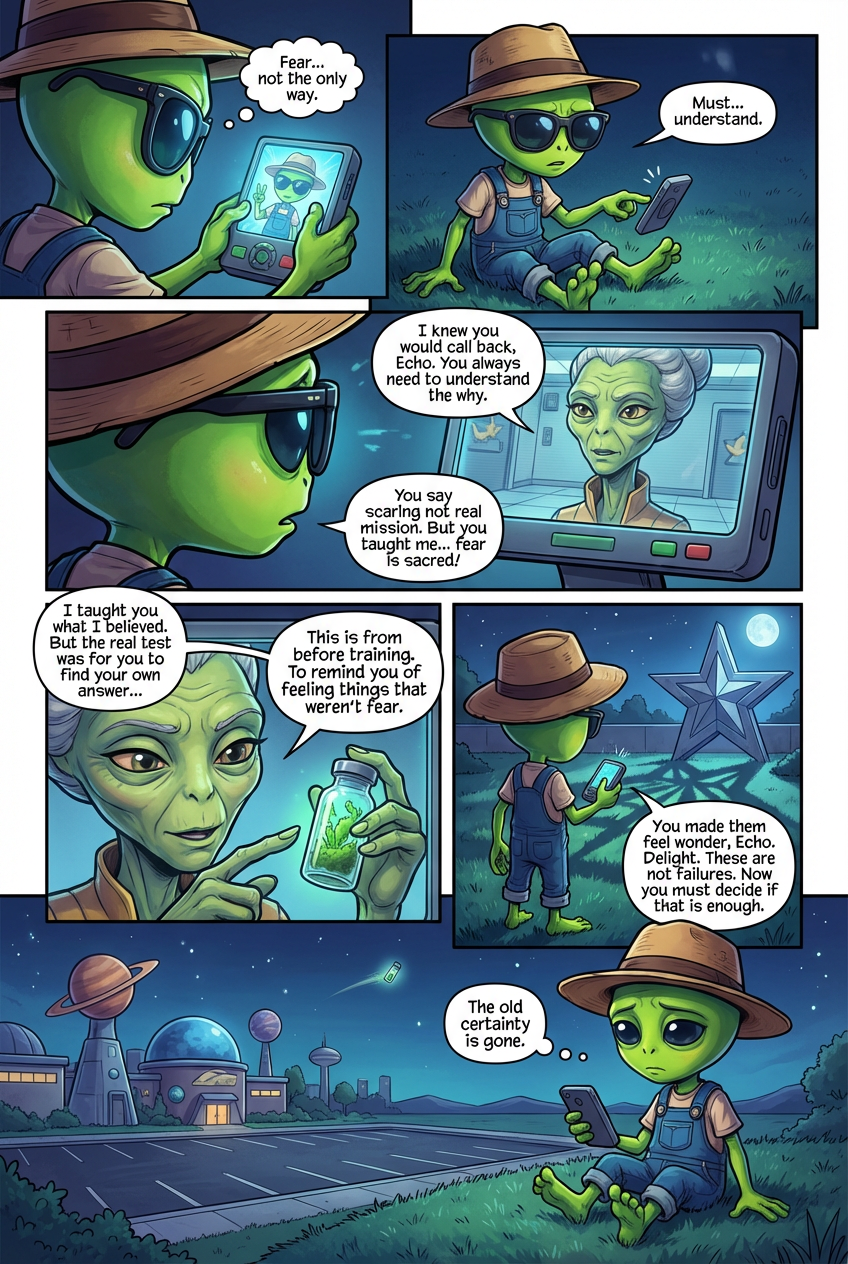
Echo stared at the communicator screen until his eyes hurt. The selfie still glowed there, proof that his teacher had seen something he couldn't. But her words kept circling in his head, refusing to settle into anything solid. Fear wasn't the only way to touch a soul. The mission might be something else entirely. He pressed the call button again. His teacher answered immediately, her face filling the screen. Behind her, Echo could see the familiar walls of the training academy, the place where he'd spent years learning techniques that now felt hollow. "I knew you would call back," she said. "You always need to understand the why." Echo's three fingers gripped the communicator tighter. "You say scaring not real mission. But you taught me. Every day. Every technique. You said fear is sacred." His teacher nodded slowly. "I taught you what I believed was true. But Echo, the scaring mission was never the real test." The words hit him like gravity shifting. Echo stood up, the communicator shaking in his hand. Above him, the star sculpture at Space Haven's entrance caught the moonlight, throwing patterns across the grass. "Then what?" he managed. "What was test?" His teacher leaned closer to her screen. "The test was whether you could find your own answer when everything you were taught stopped working. We sent you to Earth knowing their fear response is broken, knowing they would see you as costume and pretend. We needed to see if you could discover a new way to be real to them—not by following our old path, but by finding your own." She paused, then reached off-screen and held up a small glass vial wrapped in twine. Luminescent moss glowed inside it, casting green light across her face. "This is from the forest where you used to play as a child, before training. Before you learned to be what we told you to be. I'm sending it to remind you of who you were when you still knew how to feel things that weren't fear." Echo looked up at the sculpture above him, then out across the parking lot to where the planet-themed buildings stood in careful arrangement. The transmission device beside his teacher beeped, confirming the vial was on its way. Somewhere above Earth's atmosphere, his home planet watched through whatever instruments let them see this far. His teacher's face softened. "The man took your picture because you made him feel wonder, Echo. The child called you funny because you made her feel delight. These are not failures. These are souls you touched without making them afraid. Now you must decide if that is enough to make you real." The screen went dark. Echo sat back down on the grass, the communicator warm in his palm, and realized he had no idea what he believed anymore. The vial would arrive tomorrow, but the old certainty was already gone.
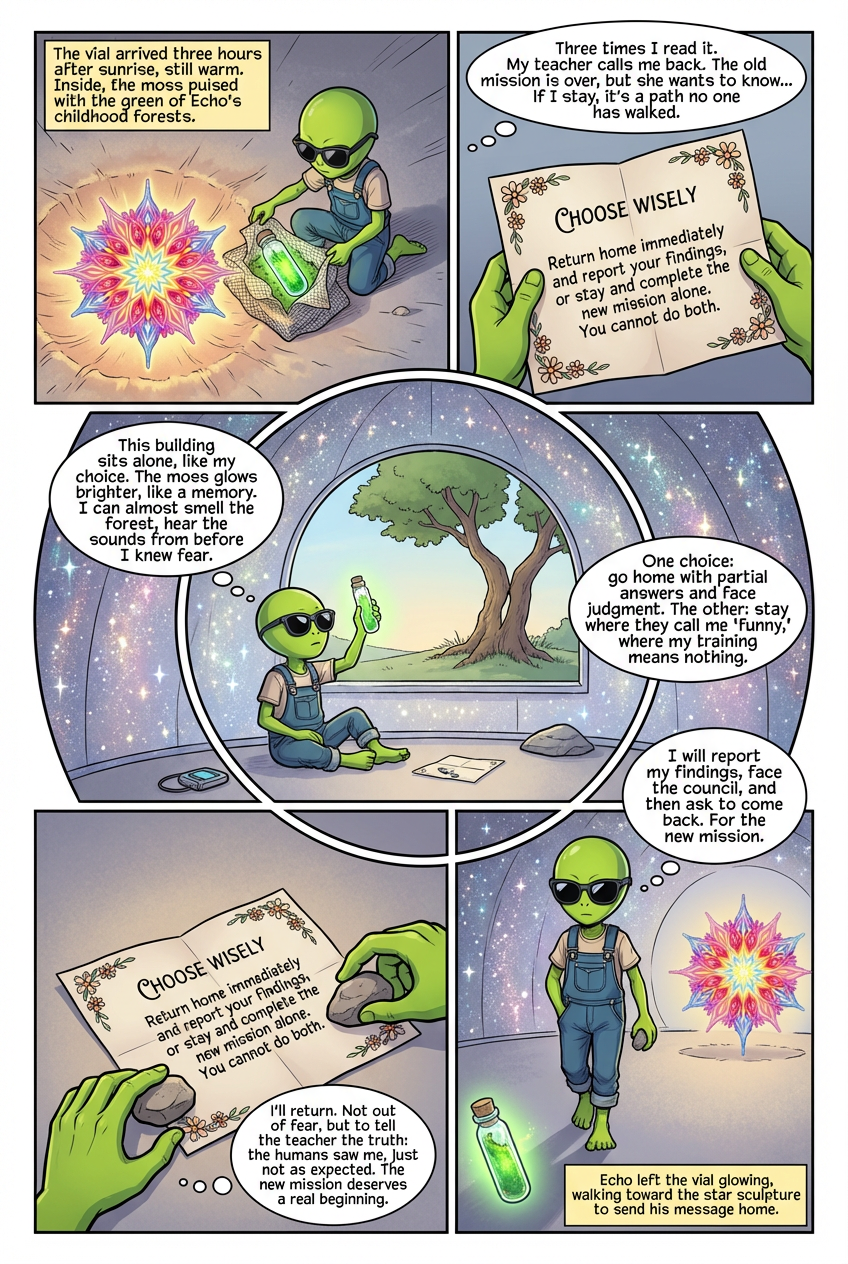
The vial arrived three hours after sunrise. Echo found it outside the star sculpture, wrapped in protective mesh and still faintly warm from atmospheric entry. He unwrapped it carefully, and the moss inside pulsed with green light—the exact shade of the forests near his childhood home. A folded note slipped out as he lifted the vial. The paper was decorated with small flowers along the edges, and in the center, two words were written in his teacher's handwriting: CHOOSE WISELY. Below that, a single instruction: "Return home immediately and report your findings, or stay and complete the new mission alone. You cannot do both." Echo read it three times. His teacher was calling him back. The old mission was officially over, but she wanted to hear what he'd learned before the council made their judgment. If he stayed on Earth, he would be choosing a path no one from his planet had ever walked—with no guidance, no certainty that wonder and delight would be enough to prove he was real. He carried the vial and note to the moon building at the edge of Space Haven's grounds. The structure sat alone, its surface covered in sparkles that caught the morning light. Inside, the circular room was empty except for a window that looked out toward a tree with a split trunk—one branch twisted left, the other stretched right, both reaching away from each other. Echo sat on the floor and held the vial up to the light. The moss glowed brighter, responding to warmth. He could almost smell the forest it came from, almost hear the sounds he'd made as a child before anyone taught him that fear was sacred. His communicator sat beside him, ready to confirm his return flight. One choice meant going home with partial answers and facing judgment. The other meant staying in a place where people called him funny and asked for pictures, where his carefully learned techniques meant nothing. Echo set the vial down and picked up a small rock from outside the moon building. He placed it on the note's left side, then picked up a second rock and set it on the right. The rocks sat there, weighing down both halves of the paper, holding the choice in place. Then he picked up the left rock and put it in his pocket. He would return home—not because he was afraid to stay, but because he needed to tell his teacher something true: the humans had seen him, just not the way anyone expected. He would report his findings, face the council's decision, and then ask permission to come back. The new mission deserved more than running away from the old one. It deserved a real beginning. Echo folded the note, left the vial glowing on the floor of the moon building, and walked toward the star sculpture to send his message home.
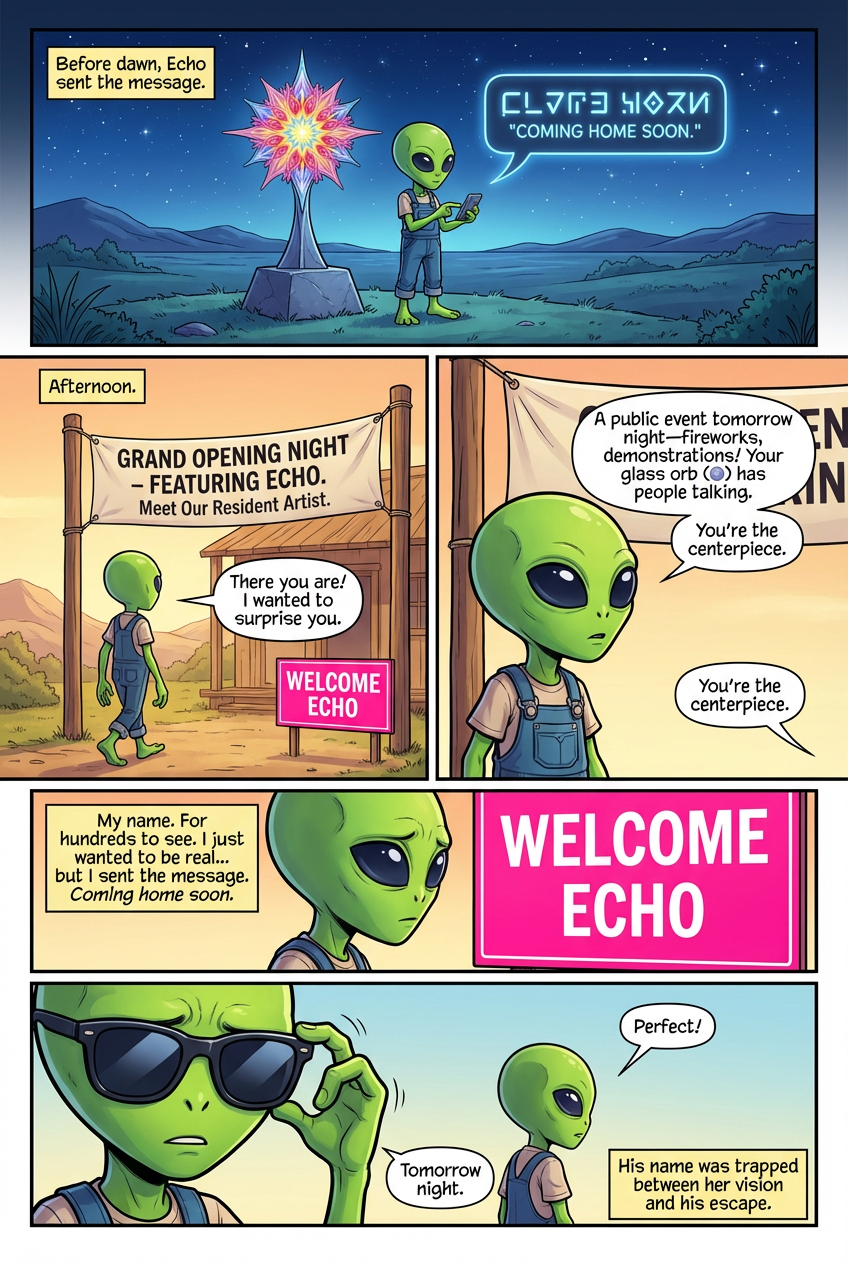
Echo sent the message before dawn. Three words in Alienese, translated carefully: "Coming home soon." He didn't mention the new mission or the humans who'd smiled at him instead of screaming. He kept it simple, the way his teacher had taught him to report mission updates. But when he walked back to the star sculpture that afternoon, Astrid was standing on a wooden platform near the entrance, directing two workers as they hung a banner between two posts. The fabric stretched wide, printed with colorful letters that read: GRAND OPENING NIGHT - FEATURING ECHO. Below that, in smaller text: "Meet Our Resident Artist." Echo stopped walking. His name. His actual name, the one his teacher had given him, displayed for everyone to see. Astrid turned and saw him. "There you are! I wanted to surprise you. We're doing a public event tomorrow night—fireworks, demonstrations, the whole thing. Your glass orb has people talking, so I'm making you the centerpiece." She smiled like she'd given him a gift. Echo looked at the banner, then at the bright pink sign someone had installed near the platform: WELCOME ECHO in bold white letters. He'd wanted to be seen. He'd spent his whole mission desperate for humans to notice him as real. Now his name hung in the air for hundreds of strangers to read, and all he could think about was the message he'd sent that morning. Coming home soon. He tried to tell Astrid he was leaving. The words formed in his throat, but what came out was: "Many people come?" Astrid nodded. "At least two hundred. Maybe more if the weather holds." Two hundred humans. Two hundred chances to be seen—not as a scarer, but as whatever this new thing was. Echo looked at the banner again. His teacher had told him to choose. He'd already chosen to go home, to report and ask permission to return properly. But Astrid had chosen too, without asking him, and now his name was trapped between her vision and his escape. He reached up and adjusted his sunglasses. "Tomorrow night," he said quietly. Astrid beamed. Echo turned away before she could see his three-fingered hand trembling.
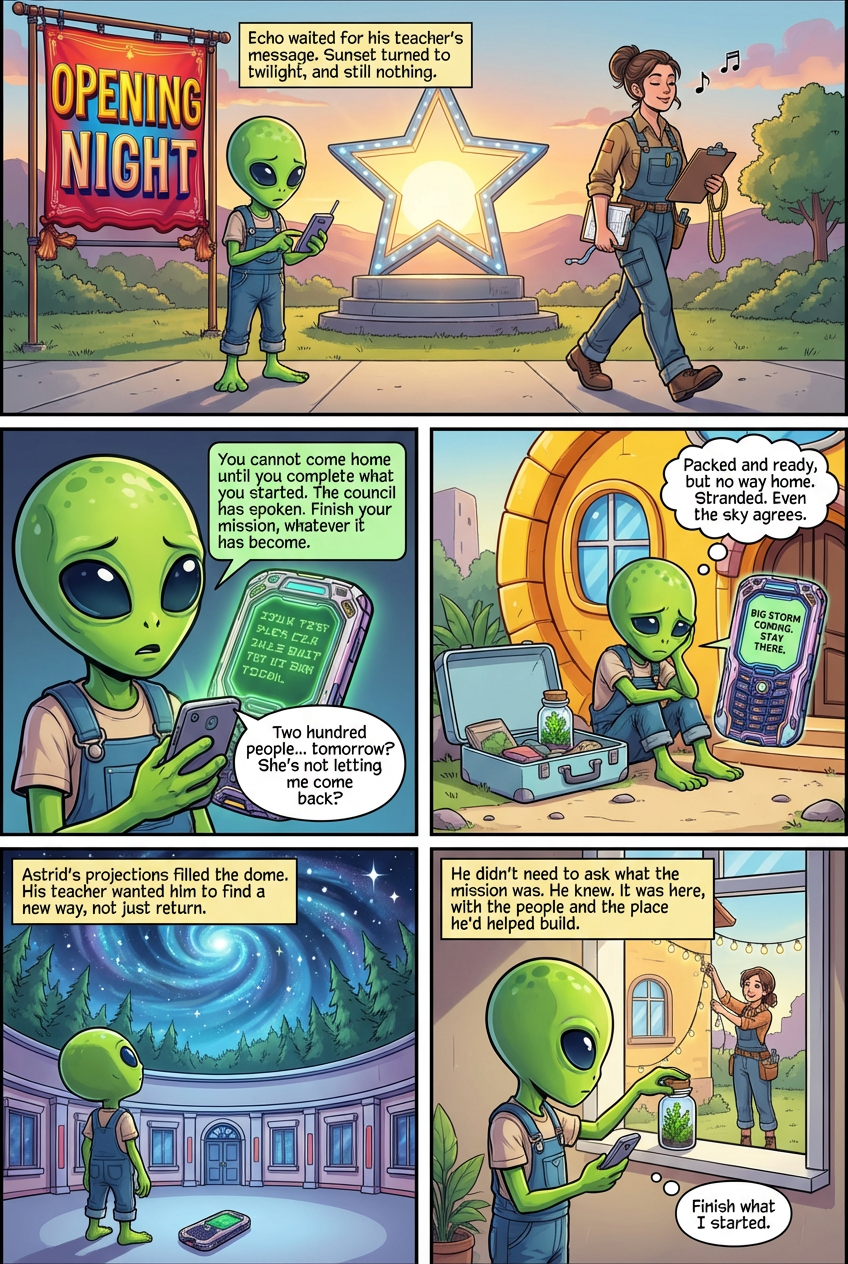
Echo stood beneath the banner with his name on it and waited for his communicator to buzz. The sun set behind the star sculpture, painting the metal gold, and still nothing came. He checked the device three times before the sky went dark. Maybe his teacher was asleep. Maybe she was preparing her response. Maybe she was gathering the council to discuss his return. He told himself these things while Astrid walked past with clipboards and measuring tape, humming something cheerful. When the stars appeared above the sculpture, Echo finally felt the buzz against his hip. He pulled out the communicator. The message was short, written in Alienese, glowing green against the small screen: "You cannot come home until you complete what you started. The council has spoken. Finish your mission, whatever it has become." Echo read it twice. Then a third time. The banner with his name fluttered in the evening breeze. Two hundred people would arrive tomorrow night to see him. His teacher had just made leaving impossible. Echo walked to the sun building where he'd left his suitcase that morning. He'd packed it carefully before dawn—the vial of moss, his training manual, the photo of his family standing outside the academy. Everything ready for departure. Now he stood in the doorway and stared at the pale blue case sitting on the blanket Astrid had placed there. His three-fingered hand reached for the handle, then stopped. There was nowhere to go. The ship wouldn't accept a return command without his teacher's authorization code. He was stranded until he figured out what "complete what you started" actually meant. He sat down next to the suitcase and opened his communicator again. His teacher's message still glowed on the screen. Below it, a second notification appeared—a weather alert forwarded from Earth's systems. The phone display showed bold white letters: BIG STORM COMING. Beneath that, in yellow: STAY THERE. Echo almost laughed. Even the sky was telling him he couldn't leave. He looked up at the dome ceiling where Astrid had installed her projections of stars and forests merging together. His teacher had sent him here to discover a new way. She'd never planned to let him come back before he found it. Echo closed the suitcase and stood. Outside, workers were hanging strings of lights between the planet buildings, preparing for tomorrow's event. He could see a tall sculpture near the entrance—something new that Astrid must have installed today. It had radiant wings that caught the light, colors shifting like the moss in his vial. Beautiful and impossible to ignore, the way his teacher had always been. Echo picked up his communicator and typed a response in Alienese: "I understand." He didn't ask what the mission was anymore. She'd already told him—whatever it has become. That meant the answer was here, in this place where his name hung on banners and humans smiled at his glass orb and two hundred strangers would gather tomorrow to meet him. He unpacked the suitcase and put the moss vial on the windowsill where it could catch the morning light. Then he walked outside to help Astrid hang the rest of the lights.
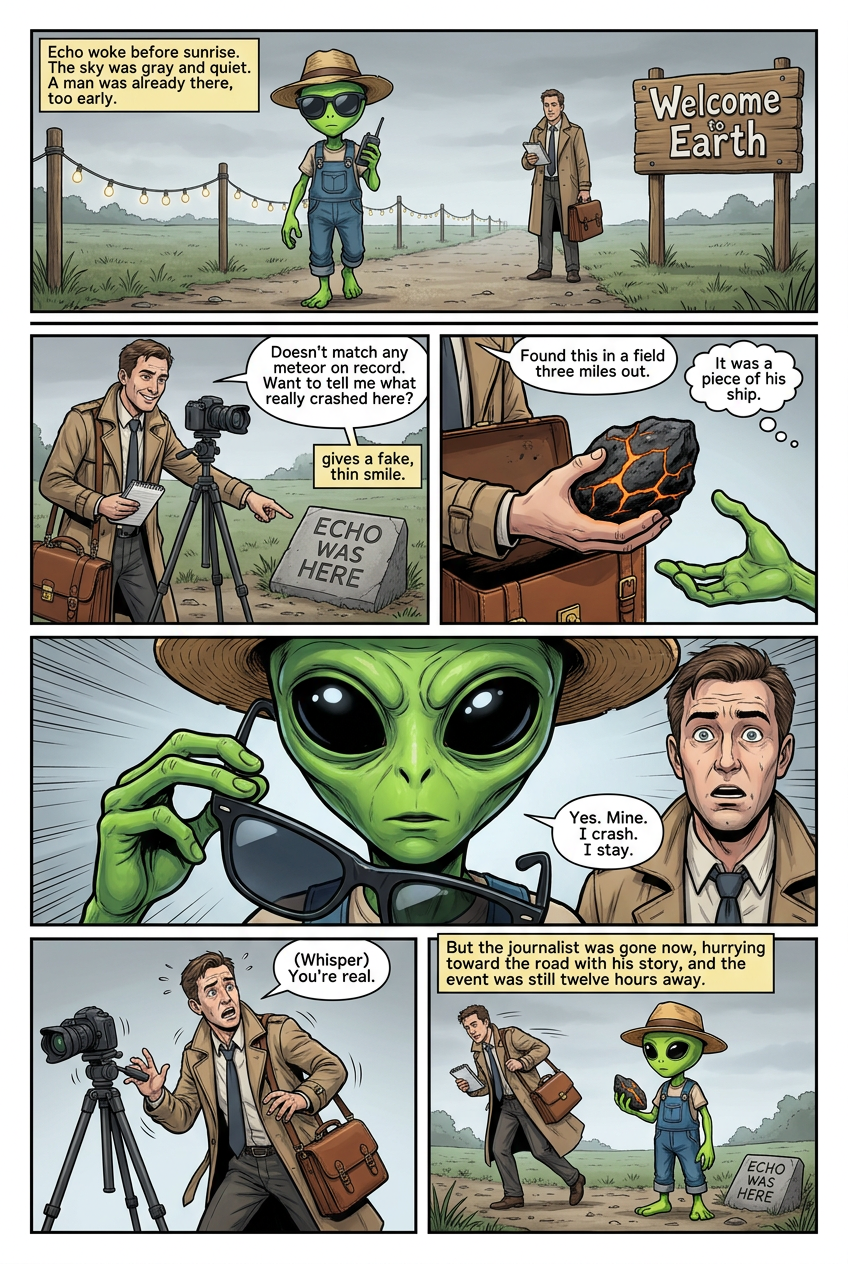
Echo woke before sunrise and walked outside to check the lights they'd strung the night before. The sky was gray and quiet. He held his communicator in one hand and watched the path that curved toward the entrance sign. A man was already there, too early, with a leather briefcase tucked under his arm and a notebook open in his hand. He looked up and saw Echo. He smiled the kind of smile that wasn't really a smile, and started walking over. The man set up a camera on metal legs near the stone plaque that read ECHO WAS HERE. He pointed at the plaque and laughed softly. Then he pulled a charred rock from his briefcase. Cracks of orange ran through it like cooled lava. "Found this in a field three miles out," he said. "Doesn't match any meteor on record. Want to tell me what really crashed here?" Echo stared at the fragment. It was a piece of his ship. Echo took off his sunglasses. He looked straight at the man and let him see the green skin, the wide black eyes, the three fingers on each hand. "Yes," Echo said, slow and careful. "Mine. I crash. I stay." The man's pen stopped moving. His mouth opened. He stepped back once, then twice, and bumped into the tripod. The camera tipped and caught itself. He did not laugh. He did not ask for a selfie. His hands were shaking. The man whispered, "You're real." Then he packed his notebook fast and walked away from the plaque, leaving the spaceship fragment on the ground at Echo's feet. Echo picked it up. It was still warm somehow, after all this time. He had told the truth, and someone had finally believed him. But the journalist was gone now, hurrying toward the road with his story, and the event was still twelve hours away.
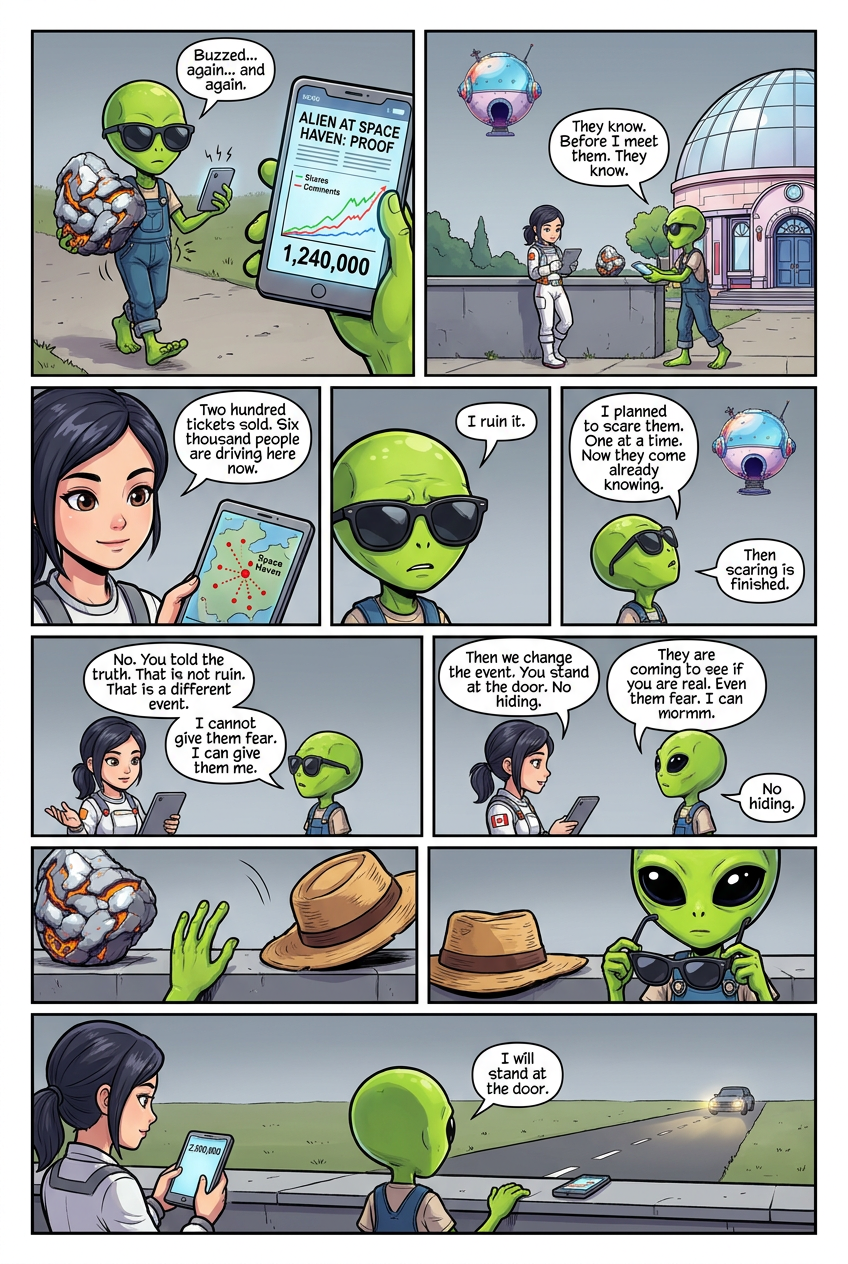
Echo carried the ship fragment back toward the buildings. His communicator buzzed in his pocket. It buzzed again. By the time he reached the path, it was buzzing without pause. He pulled it out. The screen showed a news story with his photograph, taken through a long lens. The headline said ALIEN AT SPACE HAVEN: PROOF. Below it, a number climbed. Shares. Comments. The number doubled while he watched. Astrid was already outside the planetarium dome, tablet in hand, reading. She did not look up when he approached. She scrolled once, then set the tablet flat on the low wall. The Canadian flag on her shoulder caught the gray light. She had the stillness of someone who had already decided something. "They know," Echo said. He held out the fragment. "Before I meet them. They know." "Two hundred tickets sold," Astrid said. "Six thousand people are driving here now." She tilted the tablet so he could see the map. Red dots crawled along every road toward Space Haven. "The gates open in ten hours. We cannot hold six thousand." Echo's throat felt tight. "I ruin it." "No." She looked at him then. "You told the truth. That is not ruin. That is a different event." Above them, high and small, the surveillance sphere hovered where it always hovered. Its antennas caught the light. Echo felt his teacher watching through it. He felt his whole planet watching. His hands shook around the fragment. "I planned to scare them," he said. "One at a time. Quiet. Now they come already knowing." "Then scaring is finished," Astrid said. Plain. No softness added. "They are not coming to be scared. They are coming to see if you are real." Echo lowered the fragment to the wall. He thought of the journalist stepping back, hands shaking. He thought of the child who called him funny costume man. He thought of six thousand faces arriving with the answer already in their pockets. "I cannot give them fear," he said. "I can give them me." Astrid nodded once. She picked up her tablet. "Then we change the event. Close the parking to cars. Move people through the dome in groups of fifty. You stand at the door. They walk past. They look at you. You look at them." "No hiding." "No hiding." Echo took off his straw hat and set it on the wall beside the fragment. He took off his sunglasses. The gray sky pressed against his black eyes and did not hurt. He was already exposed to the whole world. The hat and glasses were only for himself now. "I will stand at the door," he said. Astrid tapped her tablet and began making calls. The number on the news story kept climbing. Somewhere on the road, the first car turned onto the long drive toward Space Haven. Echo watched it come.
Play your story to life
Storycraft is a mobile game where you create AI characters, craft items and locations to build their world, then discover what direction your story takes. Download the iOS game for free today!
Download for free