

Elder Bright's Arc
13 Chapters
Elder Bright's dream is brokering a lasting peace between the witches and the technologists before the next cataclysm erupts.

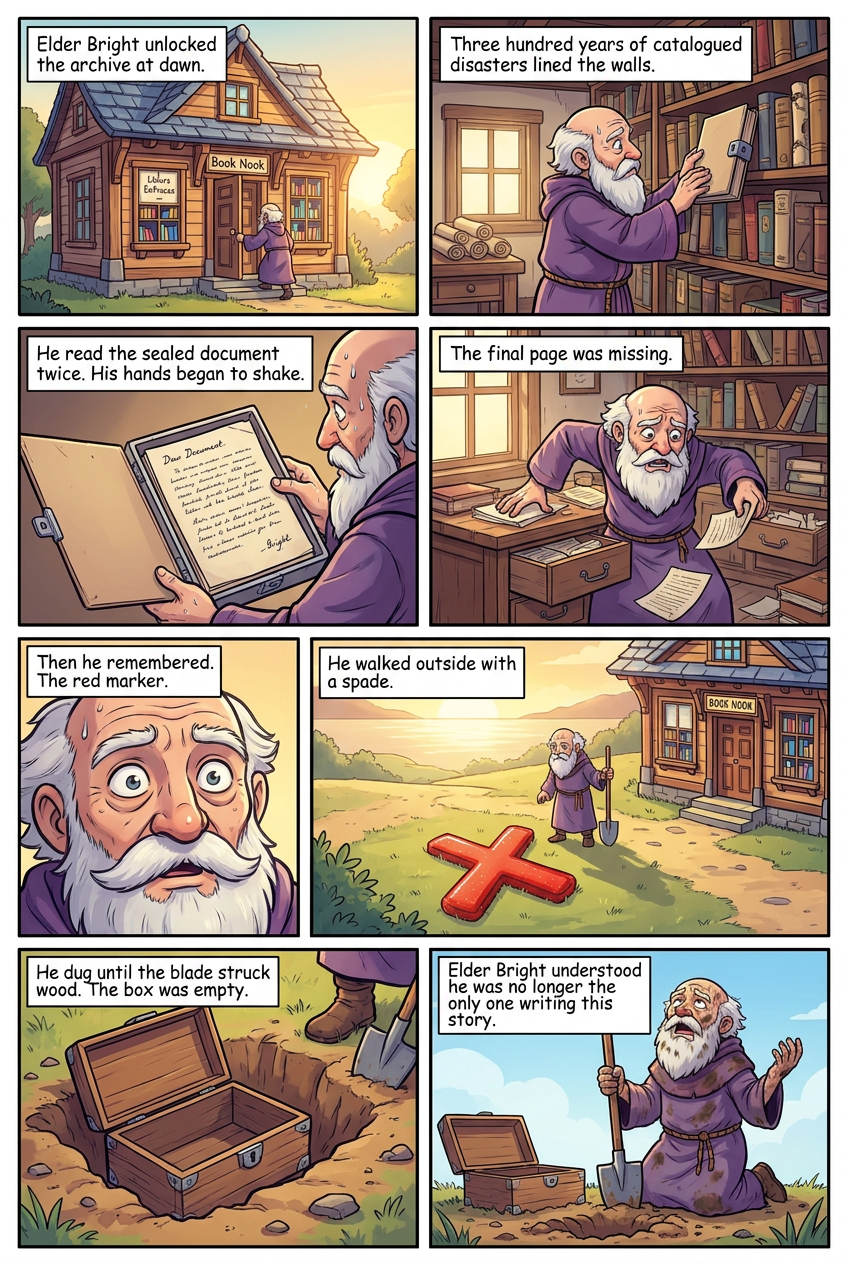
Elder Bright unlocked the small archive at dawn. Three hundred years of catalogued disasters lined the walls. He had come for one thing: proof that the witches and technologists could still be stopped before another cataclysm. He wanted a peace that lasted. He wanted to be wrong, just once. He pulled a slim folder from the shelf marked with this year's date. The lock clicked open. Inside lay a sealed document in his own careful handwriting, predicting the exact crisis now spreading through the city. He read it twice. His hands began to shake. The final page was missing. Elder Bright searched the desk, the drawers, the floor. Then he remembered. Years ago, he had buried that last page beneath the painted marker outside, a bold red X on the patch of grass and sand behind the archive. He had hidden it from himself. He walked outside with a spade. The X stared up at him, faded but stubborn. He dug until the blade struck wood. The box was empty. Someone had taken the page already. Elder Bright stood in the morning light, dirt on his hands, and understood he was no longer the only one writing this story.
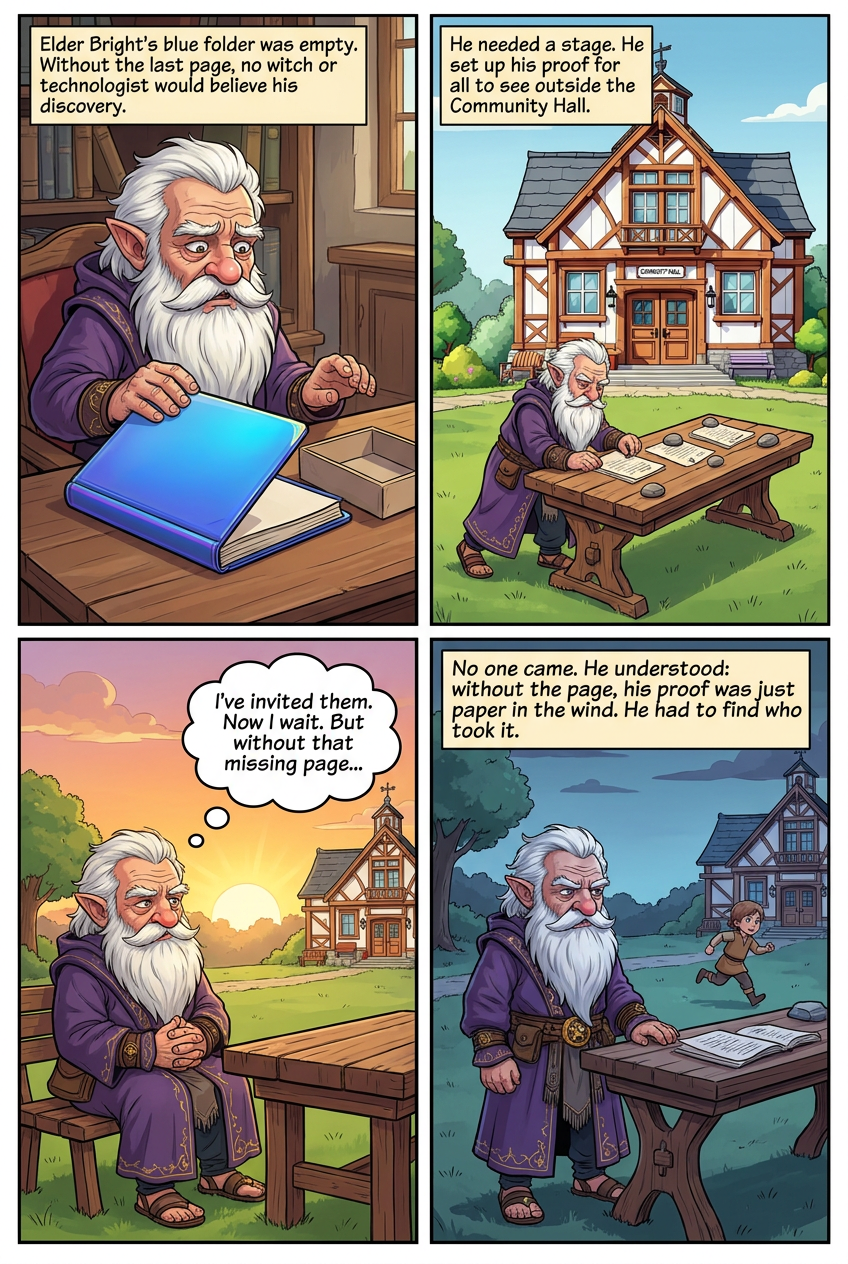
Elder Bright carried the empty box back inside and set it on his desk. The blue folder inside gaped open, its pockets stripped bare. Without that last page, no witch or technologist would believe a word he said. He needed a stage instead of a secret. He walked to the community hall before noon. On the lawn out front, he dragged a sturdy wooden table into the open. He pinned the pages he still had across its surface, weighted by stones. Anyone could read them. Anyone could come. He sent two invitations, one sealed in wax, one tucked into a copper sleeve. Then he waited beside the table, hands folded, while the wind lifted the corners of his proof. By dusk, no one had come. A child wandered past, read a line, and ran. Elder Bright understood then: without the missing page, the table was only paper in the wind. He would have to find who took it, and face them directly.
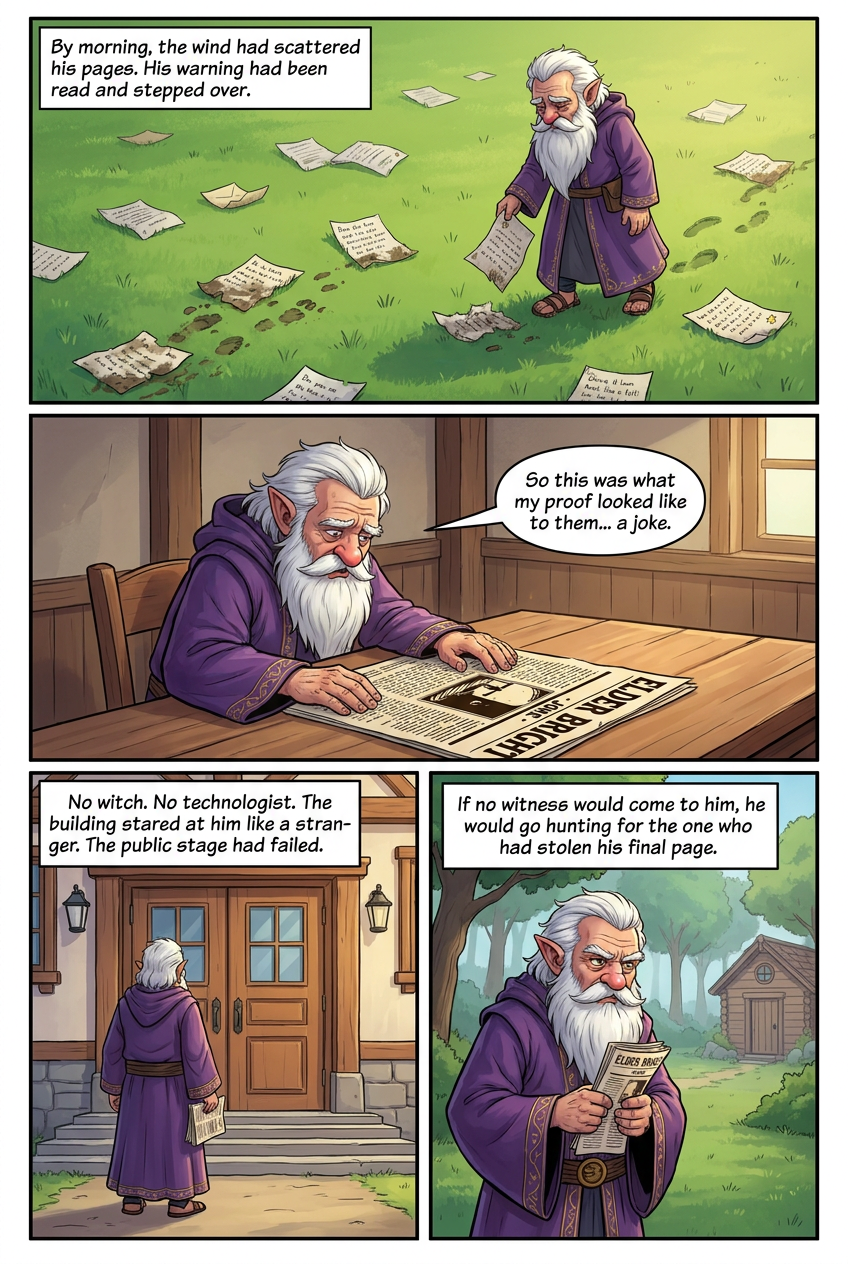
By morning, the wind had scattered his pages across the lawn. Elder Bright walked through them slowly. Some were trampled. Some bore muddy footprints. His warning had been read and stepped over. On the table sat a folded newspaper someone had left behind. The headline read ELDER BRIGHT — JOKE. A small drawing of him stood beneath it, hunched and small. He smoothed it flat with one hand. So this was what his proof looked like to them. He looked back at the community hall. Its doors were shut tight. No witch had come. No technologist had come. The building stared at him like a stranger. Elder Bright gathered the newspaper into his coat and turned away. The public stage had failed. If no witness would come to him, he would go hunting for the one who had stolen his final page.
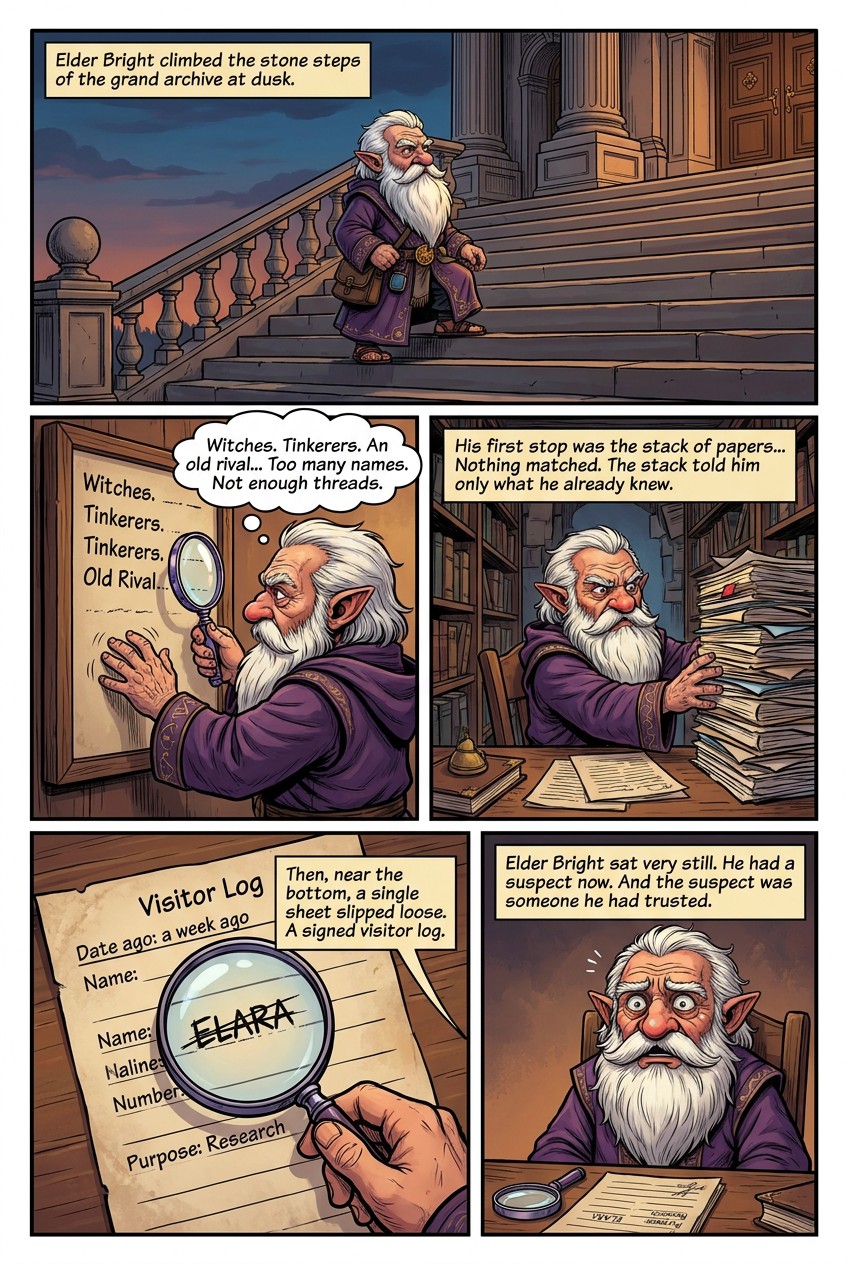
Elder Bright climbed the stone steps of the grand archive at dusk. He had set up a small room behind the towering shelves, quiet and out of sight. Here he could call people in one by one and ask his questions without the city watching. He needed a name. Without one, every door he knocked on would slam shut. He pinned a list of suspects to a wooden board outside, under the eaves. He bent close with his magnifying glass, tracing each name with a shaking hand. Witches. Tinkerers. An old rival from the cathedral cafe. Too many names. Not enough threads. His first stop was the stack of papers he had hauled from the old reading room. He sat with it for hours, lifting page after page, hunting for any hand that matched the thief's. Nothing matched. The stack told him only what he already knew. He pushed it aside. Then, near the bottom, a single sheet slipped loose. A signed visitor log from the week the page vanished. One name had been scratched out — but under the glass, the letters rose clear. Elder Bright sat very still. He had a suspect now. And the suspect was someone he had trusted.
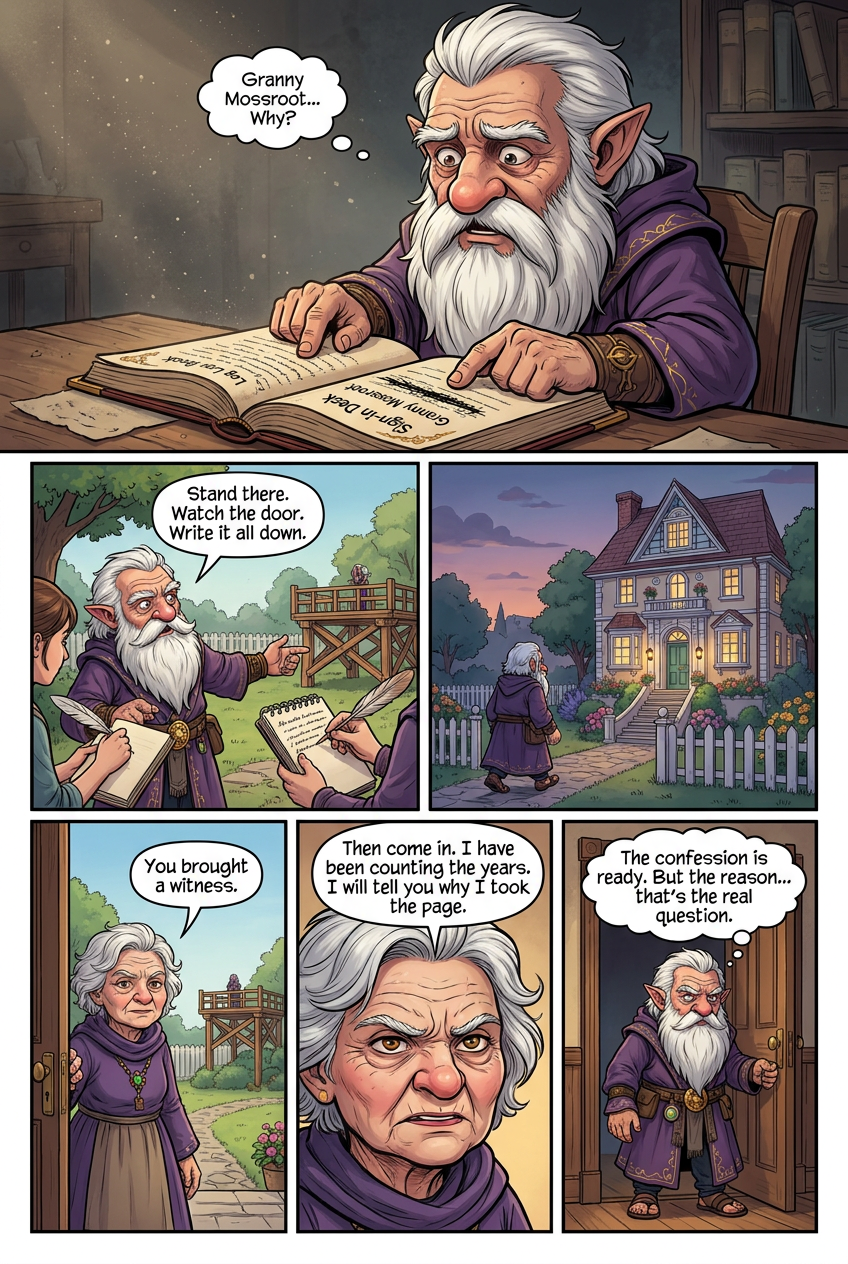
Elder Bright closed the log book and stared at the name beneath the scratch. The thief was Granny Mossroot. He had trusted her once with every secret he owned. He sat alone in the archive a long time. Then he stood, because waiting would not make the truth softer. He knew he could not face her by himself. She was strong, and grief had made her stronger. If she denied it and turned on him, no one would ever know what was said. He needed eyes on the meeting. He needed a witness. He sent a quiet word to a young scribe and told her where to stand. A small wooden platform rose at the edge of the garden across from Granny Mossroot's house. From there she could see the front door clear as day. She agreed to watch and to write down everything she saw. At dusk Elder Bright walked up the path to the bright little manor with its white fence and bowing flowers. The house looked too sweet to hold a thief. He knocked. Granny Mossroot opened the door, calm as still water. She looked past him, saw the scribe on the platform, and her mouth tightened. "You brought a witness," she said. "Then come in. I have been counting the years. I will tell you why I took the page." Elder Bright stepped inside. The door shut behind him. He had his confession waiting — and a deeper question now opening at his feet.
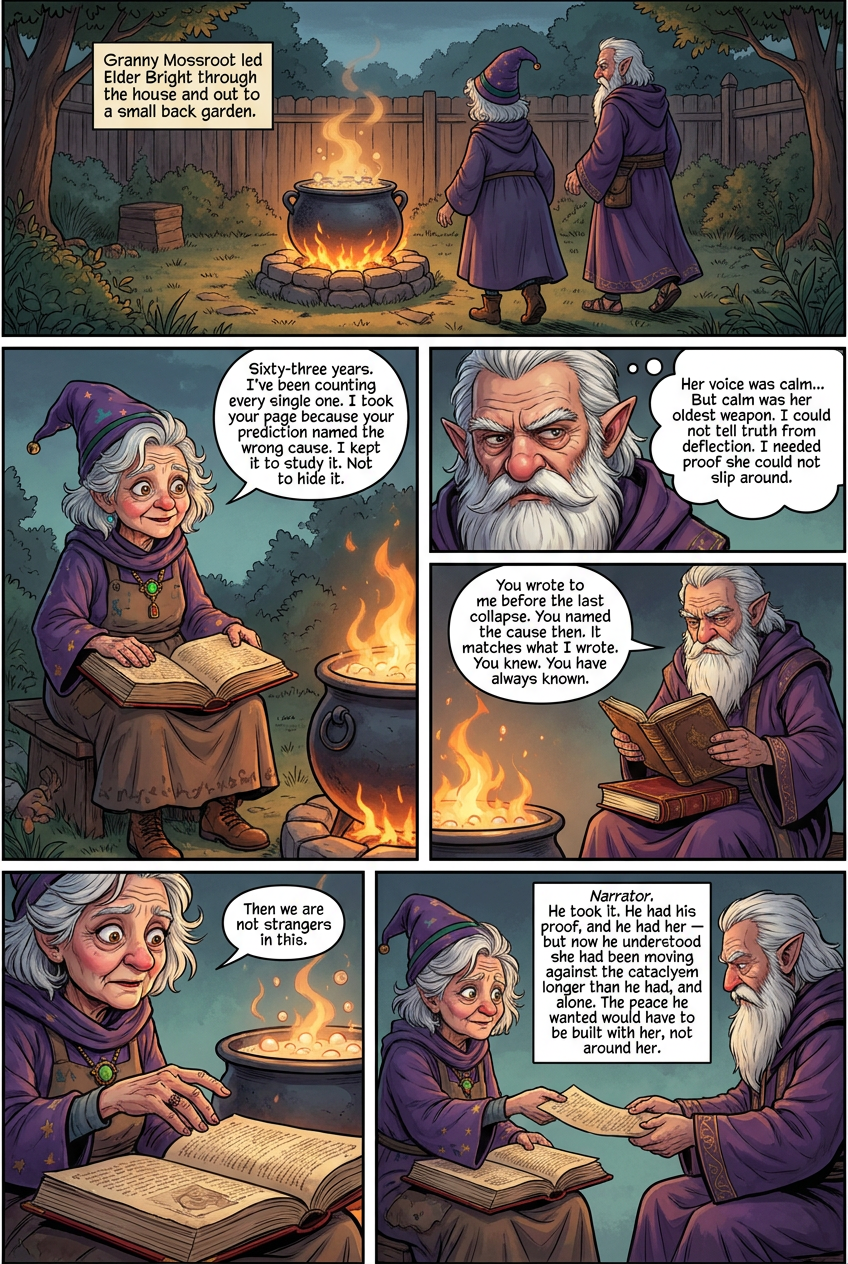
Granny Mossroot led Elder Bright through the house and out to a small back garden. A cauldron bubbled on a stone fire pit, throwing bright drops of light into the dusk. She sat beside it. On her lap rested a heavy red book with gold leaf curling across the cover. She opened it. Pressed between two pages was his missing final page, flat and unbroken. "Sixty-three years," she said. "I've been counting every single one. I took your page because your prediction named the wrong cause. I kept it to study it. Not to hide it." Elder Bright listened. Her voice was calm, her words clean. It sounded true. But calm was her oldest weapon, and he had once trusted her into ruin. He could not tell truth from deflection. He needed proof she could not slip around. He drew a worn book from his coat. It looked like the one on her lap — same red, same gold — but the cover was a careful copy. Inside were her own letters to him from forty-three years ago, saved and bound. He set it on the stones beside the fire. "You wrote to me before the last collapse," he said. "You named the cause then. It matches what I wrote. You knew. You have always known." Her hand stopped above the page. The bubbles in the cauldron hissed. "Then we are not strangers in this," she said at last, and slid his final page across to him. He took it. He had his proof, and he had her — but now he understood she had been moving against the cataclysm longer than he had, and alone. The peace he wanted would have to be built with her, not around her.
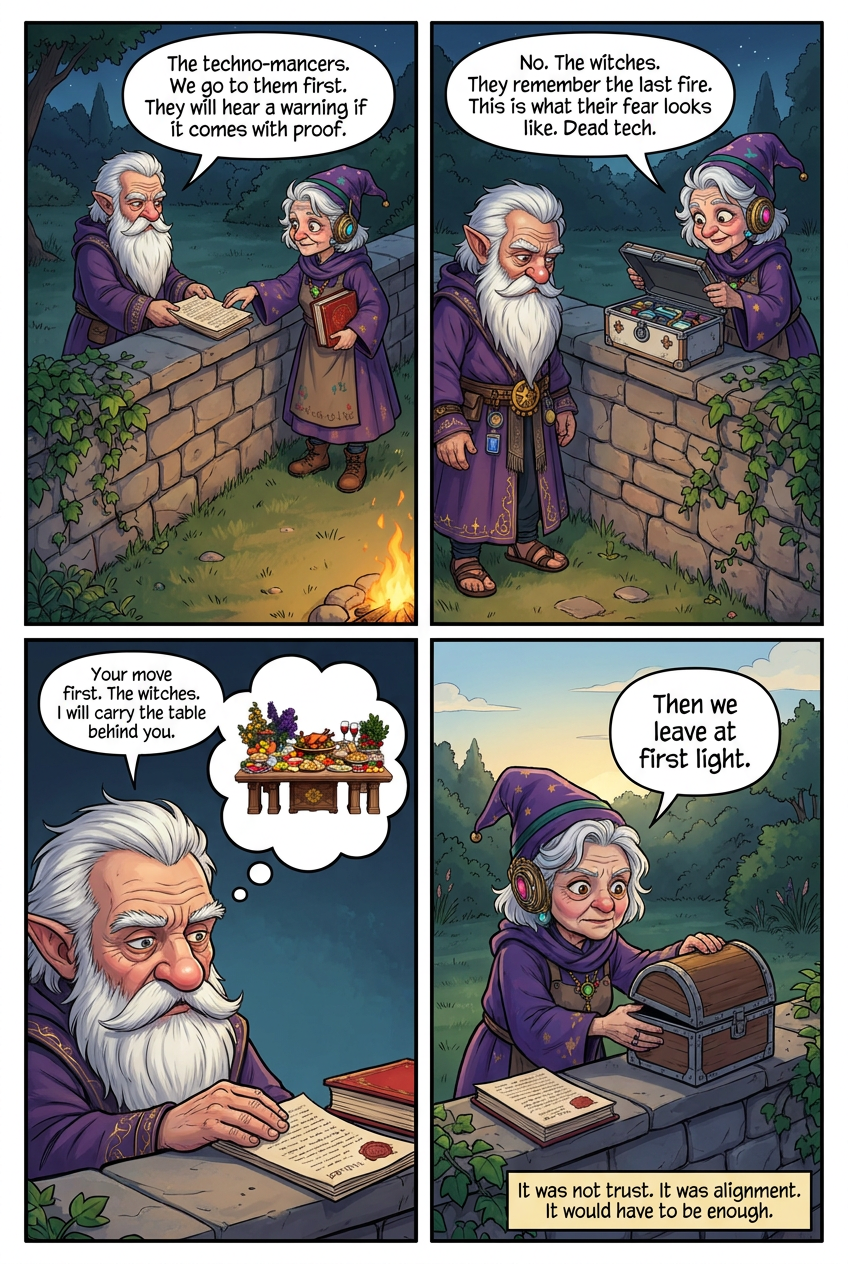
The fire had burned low when they moved to the back of the garden. A vine-covered stone wall stood between them, old and patient, its green leaves trembling in the night air. Elder Bright set his final page on a flat stone. Granny Mossroot set her red book beside it. The wall sat between them like a question neither wanted to answer first. "The techno-mancers," he said. "We go to them first. They keep records. They will hear a warning if it comes with proof." "No," she said. "The witches. They remember the last fire. They will listen because they are afraid." She placed a small box on the wall. Inside were old gadgets — cracked phones, a cassette, a faded handheld. "This is what their fear looks like. Dead tech. They have been collecting it for years." Elder Bright stared at the box. He had planned to bring a banquet — a long table of food and open hands, the oldest peace offering he knew. He had pictured it set before the techno-mancers at dawn. Now he saw the box, and he saw her sixty-three years of counting, and he understood his plan was built on his own habits, not on what would work. He pushed the page toward her side of the wall. "Your move first," he said. "The witches. I will carry the table behind you." Granny Mossroot did not smile. She closed the box and lifted it. "Then we leave at first light," she said. The wall stayed between them, but the page and the box had crossed it. It was not trust. It was alignment. It would have to be enough.
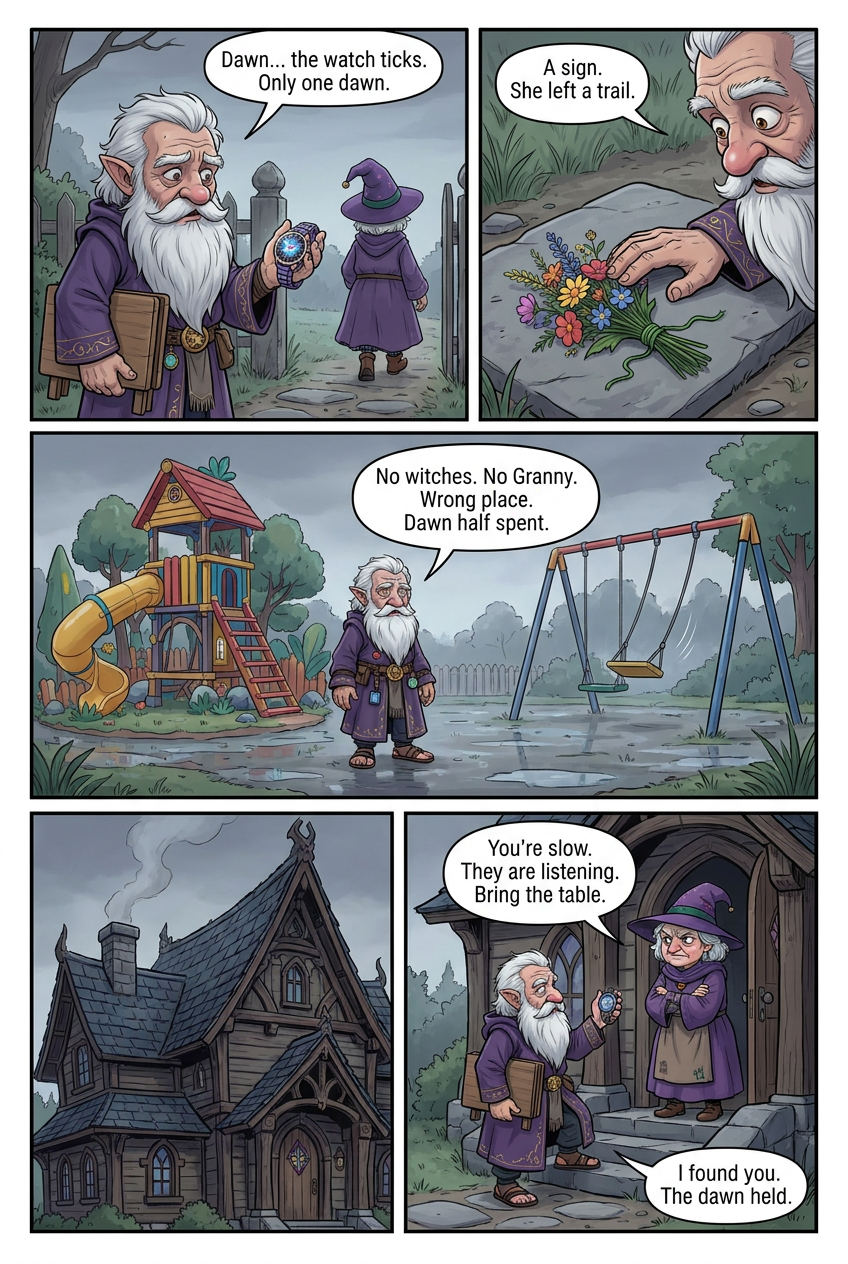
Dawn came gray and thin. Elder Bright met Granny Mossroot at the garden gate, his pocket watch already ticking against his palm. She did not speak. She turned and walked, and he followed with the table folded under his arm. The watch counted down the only dawn he had. He lost her at the first bend. One moment her purple hat moved ahead of him. The next, the path was empty. He stopped, breathing hard. On a flat stone by the road sat a small bouquet of wildflowers — poppies, daisies, blue stalks bound with a green thread. She had set it there. A sign. Keep going. He followed the flowers. Another bunch waited at a fence post. Another at a split in the trail. The watch hand crawled forward. He came at last to a bright playground, slides and swings standing still in the wet grass. No witches. No Granny. Only a child's swing moving in the wind. His chest went cold. Wrong place. Dawn half spent. Then he saw it — one last bouquet, tucked under the yellow slide, pointing down a narrow track behind the trees. He ran. The track opened into a clearing, and there it stood: a dark wooden clubhouse with stained glass eyes and carved symbols around the door. Smoke rose from its chimney. Voices inside. Granny Mossroot waited on the step, arms folded. "You're slow," she said. "They are listening. Bring the table." Elder Bright snapped the watch shut. He had found them. The dawn had held. He lifted the table and climbed the stone step, and the door of the coven opened to let him in.
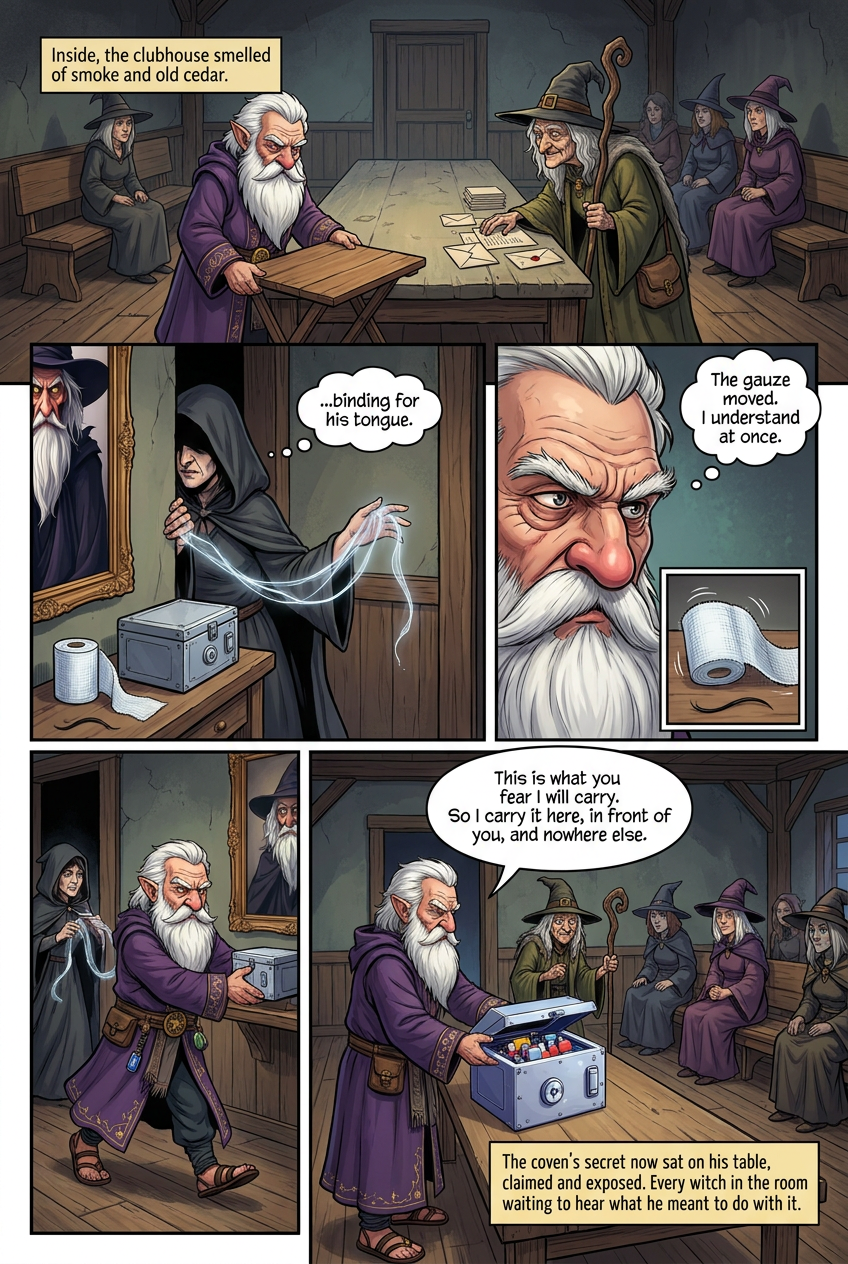
Inside, the clubhouse smelled of smoke and old cedar. Granny Mossroot moved to the long table and began to lay out her letters. Elder Bright unfolded his own table beside hers. The witches watched from their benches. He nodded at them, ready to speak. He did not yet see the woman in the corner. She stood half-hidden behind a tall oak-framed painting of an old witch in a pointed hat. The painted eyes stared out, but her own eyes were sharper. On the small shelf at her elbow sat a roll of soft white gauze, a thread of black hair, and a locked metal box packed tight with colored thumb drives. He knew that box. Cursed sticks. The coven's worst secret. She was unwinding the gauze in silence, mouthing a binding for his tongue. Elder Bright saw the gauze move. He understood at once. He did not shout. He walked straight to her, lifted the locked box in both hands, and set it on his table in front of every witch in the room. "This is what you fear I will carry," he said. "So I carry it here, in front of you, and nowhere else." The gauze went slack in her fingers. The binding had needed a hidden target. He had made himself seen. Granny Mossroot did not smile, but she gave a small nod. The witch in the corner stepped out from behind the portrait and sat down among the others. The coven's secret now sat on his table, claimed and exposed. He had kept his voice. But the box was open business now, and every witch in the room was waiting to hear what he meant to do with it.
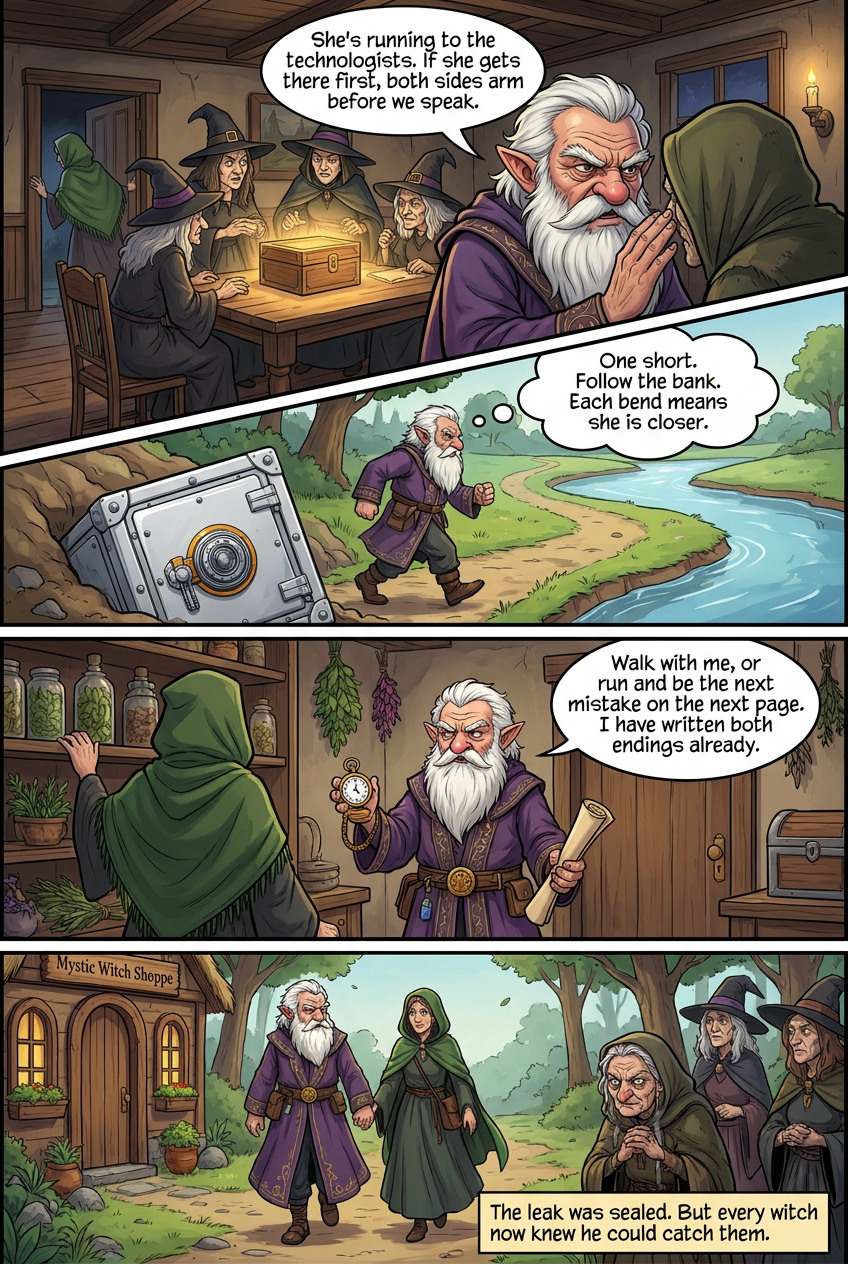
While every eye was on the box, a thin witch in a green shawl slipped from the back bench and out the door. Elder Bright saw the bench shift. He counted heads. One short. He turned to Granny Mossroot. "She's running to the technologists. If she gets there first, both sides arm before we speak." He left the box on the table and went out after her. The trail was easy at first. Bent grass led past the stone slab where the cursed drives had been buried, the safe-like marker still tipped on its side. Then the trail forked at the river. He followed the bank. Each bend of the water meant she was closer to the workshop, and he was not. She stopped, just once, at a small thatched shop crowded with hanging herbs. She ducked inside for a charm. That pause was all he needed. Elder Bright stepped through the low door and stood between her and the road. He did not raise his voice. He held out the pocket watch and her own coven's letter, copied in his hand. "Walk with me, or run and be the next mistake on the next page. I have written both endings already." She stared a long moment. Then she lowered her hood and walked beside him back toward the clearing. They returned together before the technologists ever heard her name. The coven saw her come in at his shoulder, not in chains, not in triumph. The leak was sealed. But every witch now knew he could catch them, and Granny Mossroot's eyes told him the next runner would be harder.
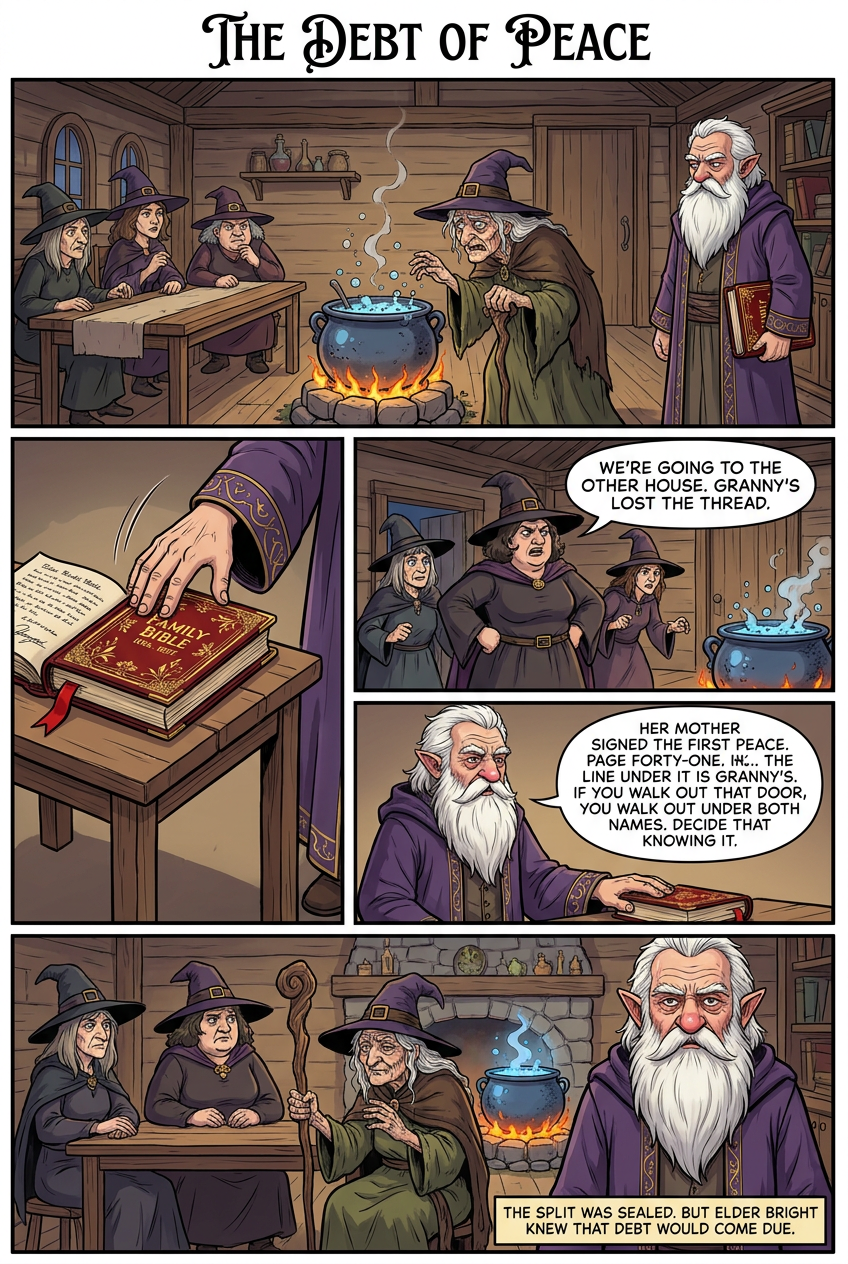
The runner was back on her bench, but the room had not settled. Granny Mossroot stood at the head of the long table, and her hands shook on her staff. The cauldron behind her bubbled wrong — uneven, spitting, the color of the bubbles turning dull. Every witch in the room watched those bubbles instead of her face. Elder Bright saw it. So did she. He did not step forward. He stepped sideways. He opened the heavy red book he had carried in under his arm and set it on the corner of his small table. It was not his book. It was hers — a family record her own mother had kept, which he had borrowed and rebound. He turned it to a page marked with red ribbon and let it lie open. He said nothing about it. He only laid a hand flat beside it and waited. Three witches at the back rose. Their leader, the broad one who had argued loudest for leaving, jerked her chin toward the door. "We're going to the other house," she said. She meant the smaller carved lodge across the clearing, where the breakers had been sleeping the last two nights. "Granny's lost the thread." The cauldron spat again. Granny Mossroot's mouth opened and closed. Elder Bright spoke then, but not to them. He spoke to the open book. "Her mother signed the first peace. Page forty-one. The line under it is Granny's." He looked up at the broad witch, not at Granny. "If you walk out that door, you walk out under both names. Decide that knowing it." Then he closed the book gently and stepped back behind Granny Mossroot's shoulder, one pace, no more. The broad witch sat. So did the other two. Granny Mossroot drew a breath that finally reached the bottom of her chest, and her staff stopped shaking. She took the room back in her own voice. The cauldron steadied to a clean blue boil. The split was sealed — but every witch had seen who had handed her back the floor, and Elder Bright knew that debt would come due before the peace did.
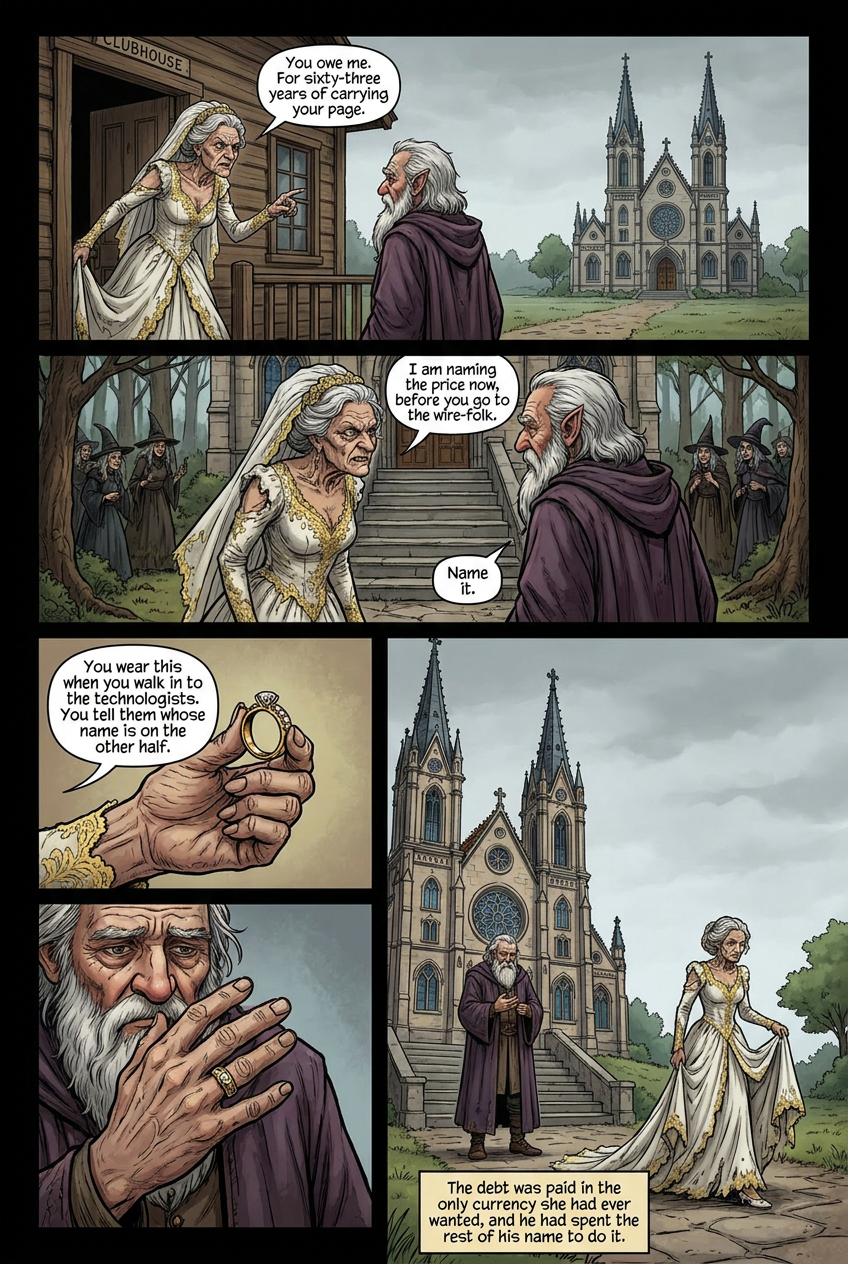
Granny Mossroot did not wait for the cauldron to cool. She crooked one finger at Elder Bright and walked out the clubhouse door, and he followed her across the clearing and down a path he had not walked in a hundred years. The old stone church rose at the end of it, spires sharp against the gray sky. She stopped on the steps where he had once stopped, and turned. She was wearing the dress. It was torn at the hem and yellowed at the lace, and she had kept it folded in a chest for longer than most marriages last. The witches behind them could see it through the trees. That was the point. "You owe me," she said. "For the floor. For the book. For sixty-three years of carrying your page." Her voice was flat. "I am naming the price now, before you go to the wire-folk." Elder Bright's mouth was dry. He had rehearsed a hundred apologies in three centuries and forgotten all of them on the step. "Name it," he said. She held out her palm. On it sat a small gold ring, diamonds in a row, the band scratched from being kept too long in a pocket. "You wear this when you walk in to the technologists," she said. "You tell them you speak for the coven and for the woman who backed you. You tell them whose name is on the other half." She did not smile. "You do not get to broker this peace as a free man. You broker it as mine, or you do not broker it at all." He took the ring. He put it on. It fit, which was the worst part. Granny Mossroot nodded once, gathered the torn train of the gown over her arm, and walked back up the path without looking at him. Elder Bright stood on the church step with the weight of the band on his finger and understood that he could go to the technologists now — but not as himself. The debt was paid in the only currency she had ever wanted, and he had spent the rest of his name to do it.
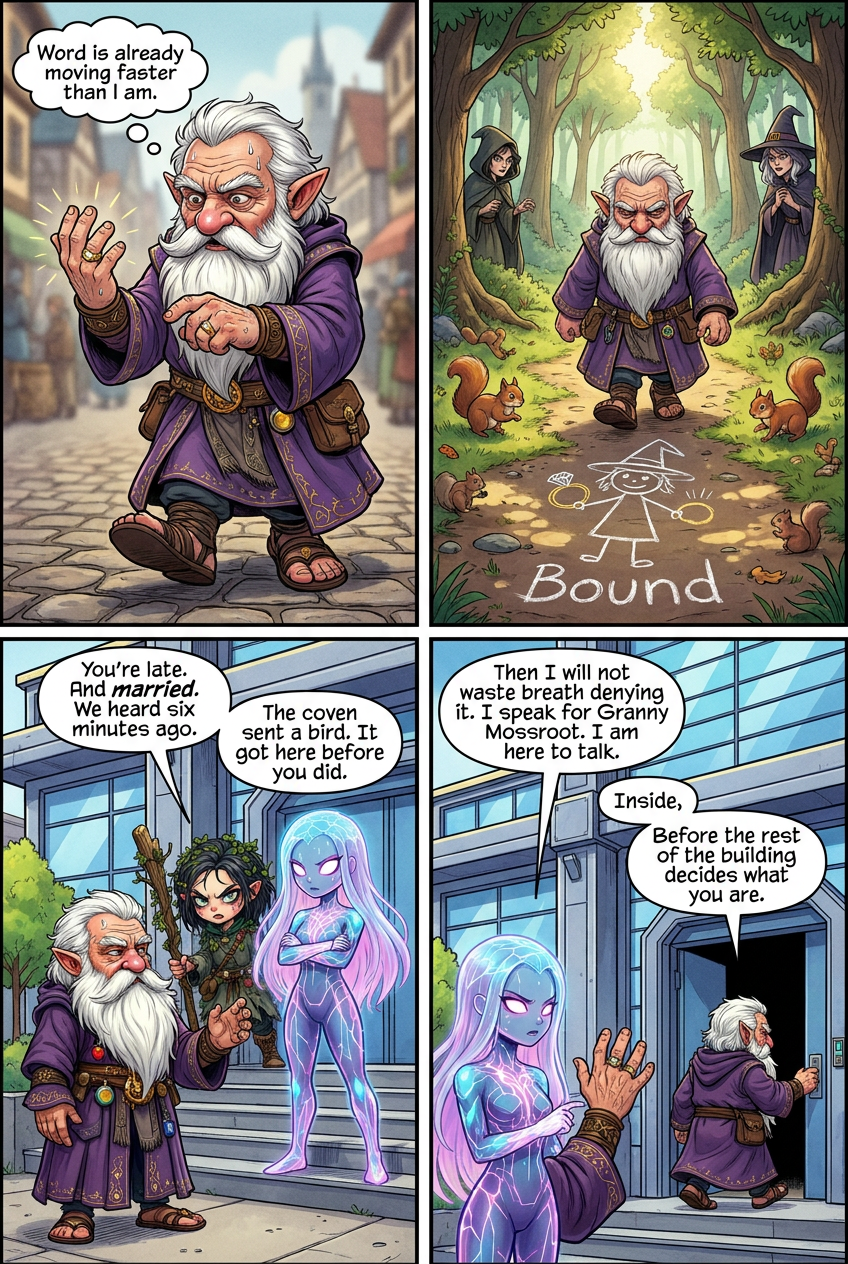
Elder Bright stepped off the church path and into the city with the ring biting his finger. The gold caught light it should not have caught. Diamonds threw small white sparks against his knuckle. He pulled his sleeve down. It did not help. Word was already moving faster than he was. He cut through the small park near the data center. Squirrels scattered. A child's chalk drawing on the path showed a stick figure with a ring and a pointed hat beside it. Someone had written one word underneath. Bound. The chalk was still damp. He rubbed it out with his boot. Two witches watched him from the trees and did not move. He understood then that he would not beat the rumor on foot. He would have to walk in wearing it and name it first. The technologists' tower rose ahead, glass and gray metal, doors sealed. Hexa Vire was waiting on the front step. She did not look at his face. She looked at his hand. "You're late," she said. "And married. We heard six minutes ago." Behind her, Belladonna Blight leaned on her staff, eyes narrow. "The coven sent a bird," Belladonna said. "It got here before you did." Elder Bright lifted his hand so they could both see the ring plainly. "Then I will not waste breath denying it," he said. "I speak for Granny Mossroot. I am here to talk." Hexa Vire's mouth tightened. She turned and keyed open the door. "Inside," she said. "Before the rest of the building decides what you are." He walked in branded, but he walked in.
Play your story to life
Storycraft is a mobile game where you create AI characters, craft items and locations to build their world, then discover what direction your story takes. Download the iOS game for free today!
Download for free