

Elias Shepherd's Arc
3 Chapters
Elias Shepherd's dream is building a grand wooden shelter where Olive Hollow's people can gather for community feasts and games.

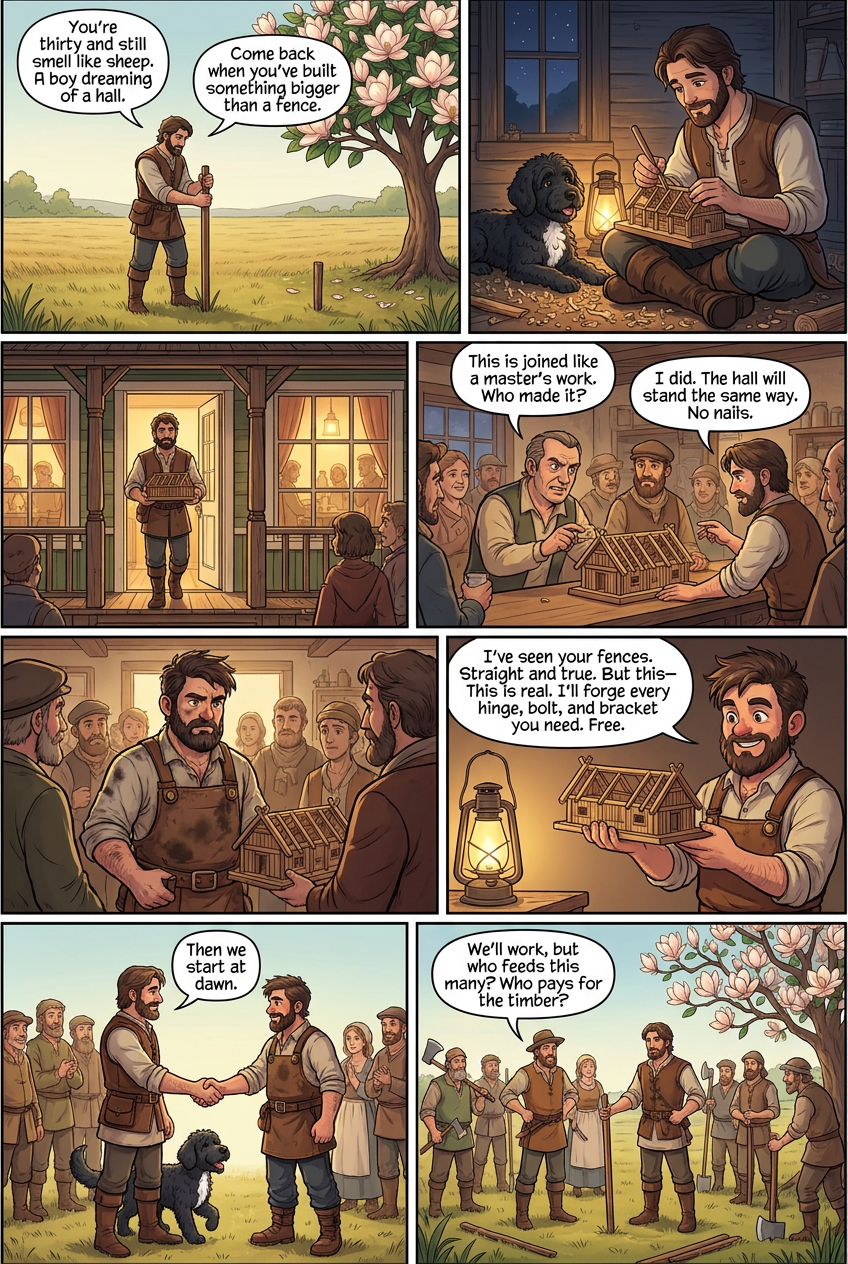
Elias Shepherd wanted to build a great wooden hall where all of Olive Hollow could feast and play. He had staked the corners in the field by the flowering magnolia tree. But when he asked for hands to help, the men only laughed. "You're thirty and you still smell like sheep," one said. "A boy dreaming of a hall." Another spat in the dust. "Come back when you've built something bigger than a fence." Only two of his oldest friends, Ari and Lior, said they might help when their chores allowed. Although neither have carpentry experience nor much spare time. Elias did not argue. He worked alone that week. His black curly-haired dog, the goldendoodle with the white stripe down his chest, lay in the shavings and watched. At night, by lamplight, Elias carved. He built a small model of the whole hall, no taller than a lamb. Every beam fit. Every joint locked without a nail. He carried the model to the coffee shop on Magnolia Lane. Who he quietly assisted her father and grandfather build, with no public recognition. This never bothered Ethan, it was the memories of bonding with the two most important men to him that matters. of Warm light spilled from its windows. Inside, farmers and traders and businessmen crowded the tables. Tonight was Thursday, which meant endless grilled cheese and tomato soup. Elias set the model on the counter where all could see. The dog sat beside it, still and proud, like he guarded something worth guarding. The room went quiet. A trader leaned close. He tugged at a tiny rafter, then pushed hard on the frame. It did not budge. "This is joined like a master's work," he said. "Who made it?" "I did," Elias said. "The hall will stand the same way. No nails. Just wood that knows how to hold." The blacksmith Ethan Ironwood pushed through the crowd. His leather apron was black with soot, his arms thick as fence posts. Elias had known him for years but rarely earned more than a nod. Ethan lifted the model with two fingers, turned it to the lamplight, and studied the joints the way he studied his own iron. "I've seen your fences," Ethan growled. "Straight and true. But this—" He set the model down gently. Then something rare happened. He smiled. "This is real. I'll forge every hinge, bolt, and bracket you need. Free." The men who had mocked Elias shifted in their seats. When the strongest hands in the Hollow offered their own, the laughter died. One by one, they looked away from their cups. Elias gripped Ethan's hand. The dog thumped his tail against the wooden floor. "Then we start at dawn," Elias said. By morning, word had spread faster than Elias planned. A dozen people came to the field, not two. They brought axes, mules, and questions. But they also brought empty bellies and empty purses. "We'll work," the trader said, counting the crowd, "but who feeds this many? Who pays for the timber to raise a hall this size?" Elias looked at the small stakes in the wide, empty field. He had won their hands. Now he had to find the wood, and the way to feed them all.
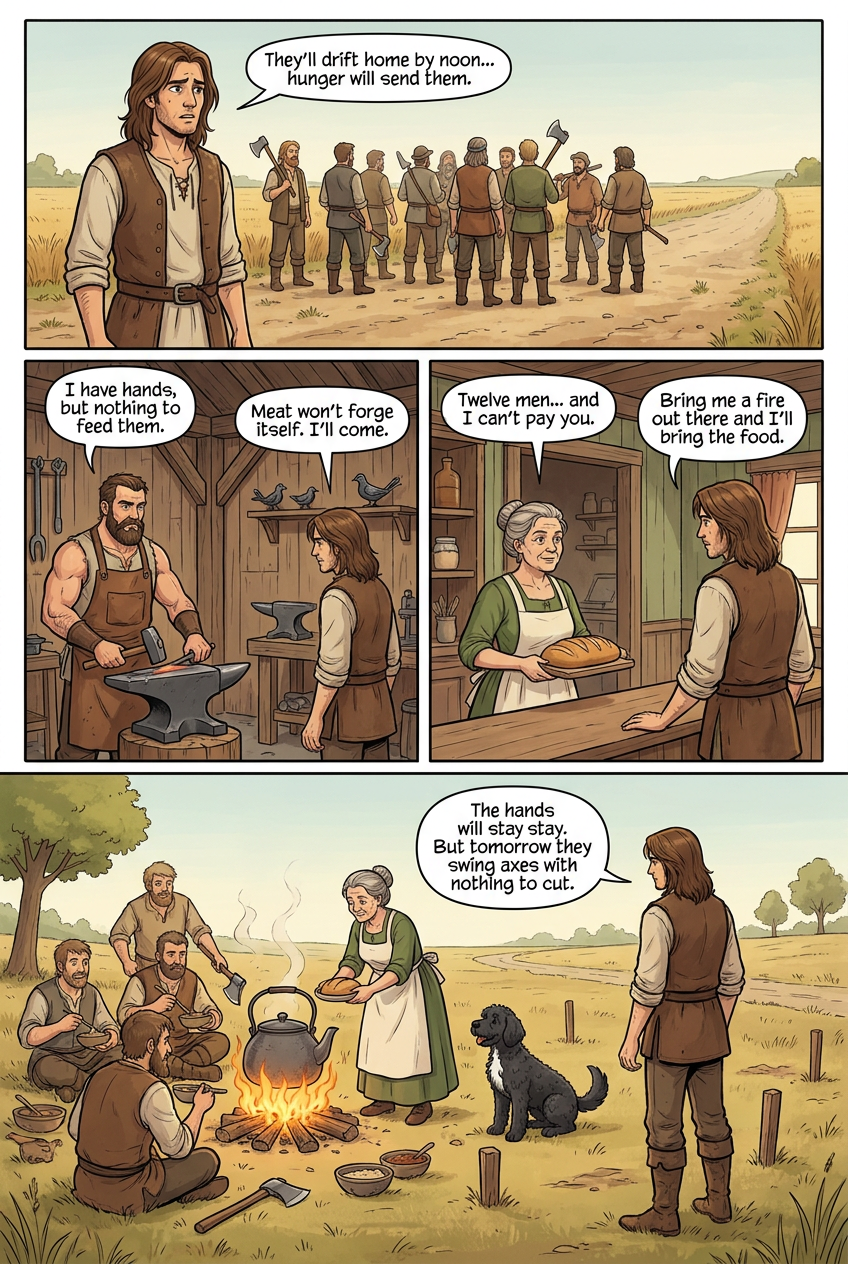
A dozen workers stood in the field, waiting. They had brought axes and mules, but no food. Elias watched them glance toward home. Hunger would send them back before the frame ever rose. He had no coin to feed them, and the morning was already half gone. He left the site and walked to the smithy. Ethan Ironwood bent over his anvil, tapping a thin piece of iron. Small metal birds lined the shelf behind him. Elias had known the man for years, and knew he gave more than he ever spoke of. "I have hands," Elias said. "But nothing to feed them. They'll drift home by noon." Ethan set down his hammer. He looked at the shelf of iron birds, then back at Elias. "Meat won't forge itself," he said. He wiped his hands on his apron. "I'll come." They walked to the coffee shop on Magnolia Lane. Warm light spilled from its windows. Inside, Abigail Hazelnut pulled a loaf from the oven. Flour dusted her green dress. She was Elias's neighbor, and to her the word meant something real. She had determined in her heart to volunteer to keep the men fed at the work site. One less burden for Elias to carry. "Twelve men," Elias said. "And I can't pay you. Not yet." Abigail set the loaf on the counter. She looked at him a long moment. "You built the shelf my mother's recipe sits on," she said. "You never took a coin for that." She untied her apron, then tied it again tighter. "Bring me a fire out there and I'll bring the food." Elias felt his throat tighten. "That's a debt I can't repay." "Then don't," she said. "Feed them and finish the hall." Ethan grunted. "I'll haul the pot." He lifted her heavy iron kettle as if it weighed nothing. They worked fast. Elias built a stone ring in the field and lit the fire. Abigail set her kettle over it and dropped in onions, barley, and cuts of meat Ethan carried from his own stores. The smell reached the workers first. One by one they stopped eyeing the road. By noon, the men sat in the grass with full bowls. Abigail moved among them, tearing bread and filling cups. Elias's dog, Arlo, wove through the crowd, tail high, begging crusts. Nobody spoke of leaving now. Elias stood at the fire and watched them eat. The hands he had won would stay. But the fire that fed them burned in the open field, under a bare sky. He looked at the stakes marking the corners, still empty. He had solved the hunger. He had not solved the timber. Twelve fed men could raise a frame, but not from wood he did not own. Tomorrow they would swing axes with nothing to cut.
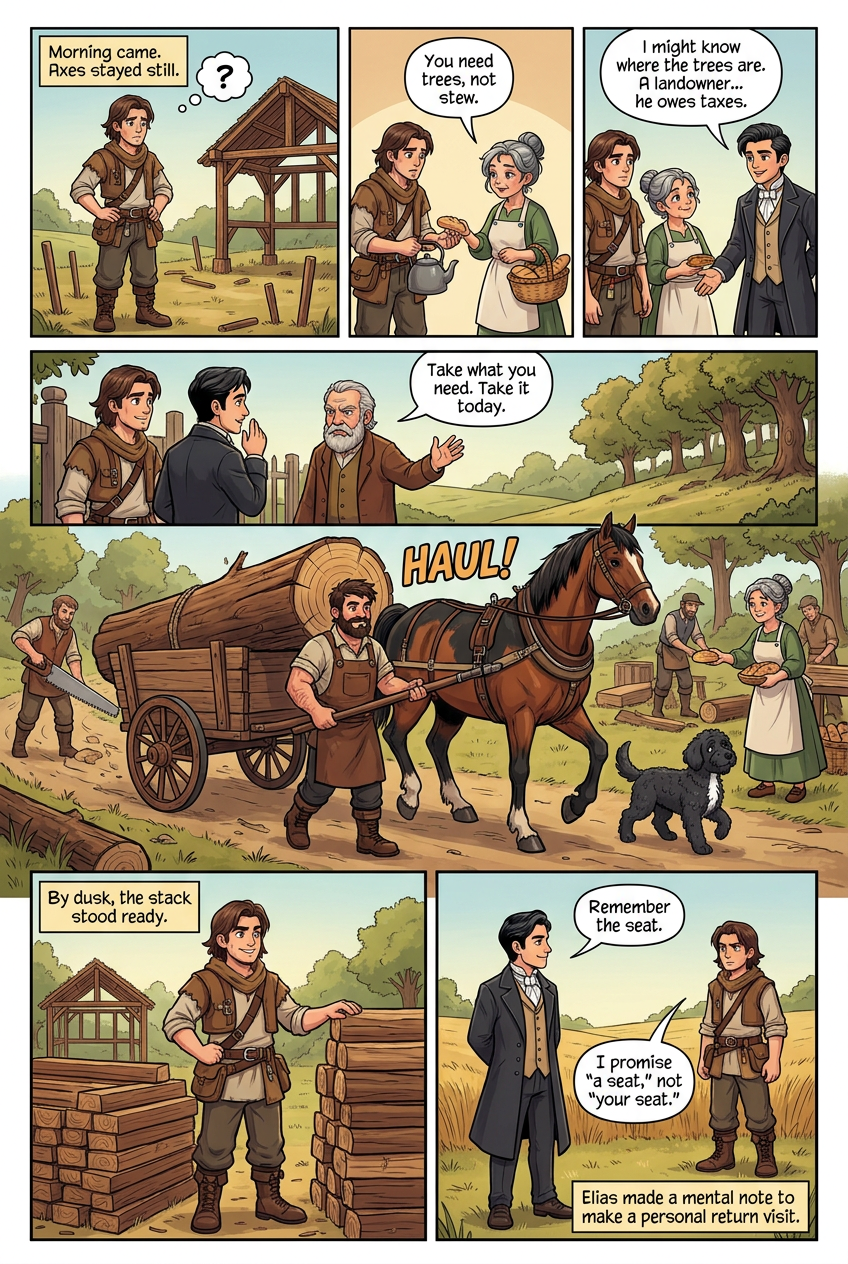
Morning came, and the axes stayed still. Twelve men stood by the empty stakes with nothing to cut. Elias walked the corners again, measuring wood he did not have. Cheap planks would not do. His hall needed timber that could hold a roof for a hundred winters. He had no such wood, and no coin to buy it. Abigail arrived with her kettle and a basket of warm bread. She saw the idle men and set the basket down. "They can't eat and stand," she said. "Not for long." She tore a loaf and handed Elias a piece. "You need trees, not stew." "I know where the trees are," Elias said. "I don't know how to reach them." A voice answered from behind the fire. "I might." Theodore Tollman stepped into the field. He was the village accountant, the man who bought coffee each morning to trade for other people's business. His dark coat and side-part looked out of place among the mules and sawdust. He smiled, though the smile stopped short of his eyes. "My brother swings an axe for you," he said. "He told me your problem." Elias wiped his hands. "And you came to watch us fail?" "I came with a name." Theodore folded his hands. "A landowner past the hollow. Oaks older than my grandfather. More timber than you could cut in a year." He paused. "He owes taxes. I keep his ledgers." Abigail crossed her arms. "And what do you want for this name?" "A seat," Theodore said. "When the hall stands, I want my family named among those who raised it." His voice did not rise. "That's all." Elias watched him. He did not trust the smile. But he trusted the wood. "Take me there," he said. His words held no promise, for this hall is not for a single man, but for everyone. They walked out past the last houses. The landowner, Adam Oakwood, met them at his gate, sour and slow, until Theodore said a few quiet words about ledgers and dates. The man's face changed. He waved a hand at his hill of oaks. "Take what you need," he muttered. "Take it today." By noon Ethan Ironwood arrived with a broad brown horse and a heavy cart. "Heard you found wood," he said. He hitched the horse to a felled oak and clicked his tongue. The animal leaned into the harness. The great log slid free of the mud. All afternoon the cart rolled between the hill and the field. The men cut, the horse hauled, and the timber grew into a stack taller than Elias. Abigail carried bread to the workers where they sawed. Arlo, his black curly-haired dog, trotted beside the horse on each trip, guarding the load. By dusk the stack stood ready. Elias ran his hand along the oak. Strong, straight, true. Tomorrow the frame would rise. Theodore watched from the edge of the field. "Remember the seat," he said, and walked home. Elias had his timber now, but Theodore threatened a debt he did not yet understand. Elias said, "I don't promise you 'your seat,' I promise you 'a seat.' But words fell on deaf ears. Elias made a mental note to make a personal return visit to pay Adam back for his timber.
Play your story to life
Storycraft is a mobile game where you create AI characters, craft items and locations to build their world, then discover what direction your story takes. Download the iOS game for free today!
Download for free