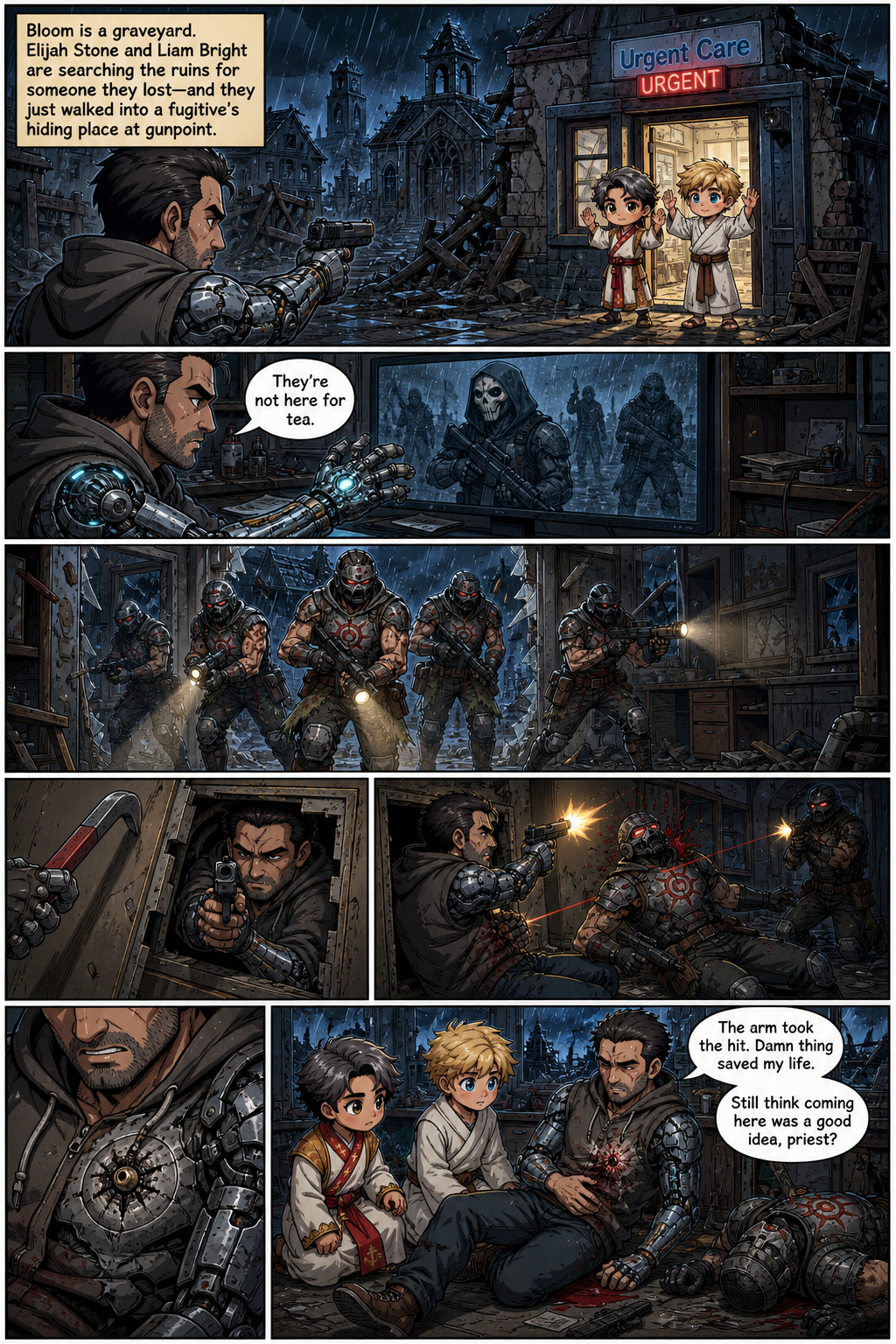
Chapter 1The wind had teeth in Bloom.
It howled through the charred ribs of shattered buildings, kicking up soot and ash like ghosts too bitter to rest. The old medical clinic where Dr. Santos made his den sat half-buried beneath collapsed concrete and scorched steel beams, invisible unless you knew what to look for—a cracked neon sign that once read “Walk-In Urgent Care” now just blinked URGENT every few hours when the backup generator flickered to life.
Inside, it was silent. Warm, even.
A single camping stove hissed as water boiled for tea. A solar lantern hung from a rusted IV stand, casting soft light across a haphazard living space: medical books, ration packs, surgical tools, a half-dismantled drone, and a cot draped in thermal blankets. Everything in its place. Everything controlled.
Santos sat at the workbench, running diagnostics on his left arm. The cybernetic limb hissed softly as it flexed open, exposed layers of fine wiring and reinforced carbon plating gleaming under the overhead light. He didn’t flinch. He hadn’t in years. The arm worked fine—better than fine—but he checked it anyway. Habit. Routine. Safety.
A thin scar traced beneath his jawline, barely visible unless the light caught it just right. His skin was taut in places, stretched unevenly across the side of his neck where old burns refused to fade. One hand, the right one, was mottled with the same faded scarring. Burned, healed, but not forgotten.
He pulled the blanket tighter around his chest, hiding the deep web of tissue where metal met muscle. The prosthetic joined at the ribs, the entire left pectoral replaced after the “incident.” That was the word he used now. Incident. It sounded clean. Clinical. Not like betrayal.
From the corner of the clinic, a repurposed TSF scout drone chirped and clicked. Motion detection. Something outside.
Santos rose, silent. He turned off the stove, capped the kettle, and slid it beneath the table. Then he reached for the small pistol he kept duct-taped beneath the workbench. Standard slugthrower. Loud and dirty. Not much good if someone found him—but still better than nothing.
He killed the lantern, bathing the room in darkness save for the green glow of his diagnostics screen.
He listened.
Nothing.
Then—whispers. Faint. Human.
Not TSF chatter. Not that clipped, practiced rhythm. These were hesitant. Searching. Lost.
Santos didn’t move.
“Not my problem.”
He whispered it to himself. His mantra. The thing that had kept him alive long after his name became a liability.
He sat back down. Opened the diagnostic again. The fingers of his metal hand trembled slightly before steadying.
Outside, the whispers grew louder.
Whoever they were, they were getting close.
And Santos hated how much he cared.
The door creaked.
It wasn’t loud, but it was the kind of sound that didn’t belong in a dead place like Bloom. Santos had the pistol drawn before he was fully standing. He moved to the wall beside the door, silent, practiced. He’d survived this long by assuming every sound was a threat.
The footsteps were careful. Uncertain. One set heavier than the other. Someone older. The second—lighter, hesitant, younger.
Not soldiers, he thought, but could still be bait.
The old waiting room lit up as a flashlight beam swept lazily across dust-covered chairs and a shattered vending machine. Then the beam turned toward the hallway, toward him.
He moved fast.
By the time the two strangers reached the doorway, Santos was behind them, pistol raised, voice sharp.
“Turn around. Slow.”
The taller one did so first—middle-aged, dark-skinned, wiry beard peppered with gray, long priest robes stained from travel. His hands raised in practiced calm.
“Please,” the man said in a heavy Eldridge accent. “We mean no harm.”
The younger one—blond, maybe early twenties, dressed in an oversized coat and pants—looked rattled but obedient. His blue eyes locked onto the barrel of the pistol.
“You picked the wrong hole to crawl into,” Santos growled. “You military?”
“No,” the older man said. “We are… pilgrims.”
Santos stepped closer. “Pilgrims don’t usually walk around bombed-out towns. Try again.”
“We’re searching for someone,” the younger one offered, his voice tight. “A woman. She was with us during the evacuation. We think she may still be alive.”
Santos didn’t lower the gun.
“You think you can just find someone in this hellhole?” he snapped. “This entire town’s crawling with Rean nests and TSF kill-teams. You’re lucky it was me that found you.”
He paused, eyes narrowing.
“Unless… you’re not lucky at all. How’d you even get here?”
“We walked,” said the elder. “We’ve been scavenging. Hiding.”
“And no one followed you?”
“No one,” the younger one said quickly. “We’ve been quiet. Careful.”
Santos hesitated. His finger was still on the trigger, but something in their eyes didn’t add up. They weren’t lying. At least, not about that.
“You didn’t answer my question,” he muttered. “Who are you?”
The older man offered a shallow bow. “My name is Elijah Stone. This is Liam Bright. We are not enemies.”
Santos’s eye twitched at the word enemy.
“Anyone can say that.”
“And anyone can shoot,” Elijah said gently, “but you haven’t. So perhaps… you’re not one either.”
For a long, tense second, silence hung thick in the room.
Then—Santos lowered the gun.
“A priest,” he muttered. “Perfect. All I need now is a choir and a confession.”
Elijah smiled, just slightly. “You’d be surprised what I’ve heard confessed lately.”
Santos holstered the pistol, stepped back. “You got five minutes. You say you’re looking for someone? Then get to the point.”
Liam exchanged a glance with Elijah. The older man nodded, but chose his words carefully.
“She was important. Our evac ship crashed. A lot of death. We lost track of her.”
“That’s all you’re giving me?” Santos raised a brow. “You wander into my hideout in the middle of hell, and you can’t even tell me who you’re looking for?”
“It’s not a matter of trust,” Elijah said, “it’s a matter of safety. For her.”
Santos leaned back, studying them. “You think I’m gonna rat you out?”
“I think everyone has a price,” Elijah said softly. “We’ve met many who were willing to sell others to save themselves.”
Santos was quiet for a long moment.
Then he turned, muttering, “You’re not wrong,” and walked back toward his workbench. “Close the door behind you. If someone followed you, we’ll all be dead soon anyway.”
Santos tapped a few things on the small terminal mounted to the side of his cluttered workbench, muttering to himself as the two strangers hovered awkwardly near the door. The hum of old machinery filled the silence, mixed with the faint buzzing of broken lights overhead.
Then came the first crack of thunder.
It rolled through the ruins like a warning, deep and low. A few seconds later, rain came down in sheets, slamming against the broken windows and rusted roof like a thousand hammers. The power flickered. Santos flinched and looked toward the door, his expression sour.
“Perfect,” he muttered again. “Absolutely perfect.”
Liam turned to Elijah. “That came out of nowhere…”
“They always do,” Santos said, wiping his hands on a grease-stained rag. “Weather’s been all screwed up since the bombs fell. Storms come and go like drunks at a barfight.”
He paused, staring toward the leaking window. “They say the rain can carry it, you know. Airborne, absorbed into the clouds. You get caught in it near the desolation—might as well swallow glass.” His voice was low, almost distracted, like the thought had taken him somewhere far away. “Heard of a man who turned just from washing his face in it. Skin peeled off in sheets. Started growing tumors in his lungs before he even screamed.”
Then he blinked, snapping out of it, and shook his head. “Not that it matters. We’re too far west for that kind of nightmare. Probably.”
A beat passed.
Elijah cleared his throat. “Well, we can find shelter somewhere else if we are intruding.”
“You’re not going anywhere in that,” Santos cut in. “Getting infected by the rain is the least of your worries out here but if you want to drown or get crushed by falling steel be my guest.”
He pointed to the ceiling with a lazy wave. “Half this place collapses when the wind blows hard. City’s a graveyard on a good day. During a storm?” He looked at Elijah, then Liam. “That’s suicide.”
Liam glanced at the door, at the howling wind beyond the cracked frame. “So we can stay?”
Santos snorted. “You can not die here. That’s the best I’m offering.”
He reached beneath the workbench, pulled out a couple of folded tarps and tossed them toward the back of the room. “You can sit over there. Don’t touch anything. And don’t start preaching.”
Elijah smiled and gave a slow nod. “You have my word.”
Santos returned to his chair and resumed tinkering with a half-disassembled cybernetic joint, mumbling something in a language neither of them recognized.
For a moment, it almost felt quiet. Peaceful, even. The storm raged outside, but the interior of the clinic felt oddly warm.
Until Elijah noticed something on the wall.
A scratched-out logo. Faint, but unmistakable.
Talenstar.
Elijah leaned forward slightly, peering at the faint logo half-buried beneath dust and soot. He tapped it with the back of his knuckle. “That… that’s Talenstar, isn’t it?”
Santos didn’t look up. “Used to be.”
“You worked for them?”
“I worked near them,” Santos said, tightening a bolt on the half-exposed shoulder joint of his cybernetic arm. “That’s about as close as I’d like to put it these days.”
Liam raised an eyebrow. “They make weapons, right.”
“They made a lot of things,” Santos replied. “Weapons were just the ones that kept the lights on. People love a good bomb more than they love their neighbors.”
Elijah stepped around the bench, just enough to get a better view of the cluttered workspace. Diagrams, loose parts, half-built prosthetics—each one covered in the grime of long-forgotten tech. “You’re an engineer?”
Santos tapped the metal of his left arm with a metallic clink. “Cybernetics. Used to work for a company called CyberTech after Talenstar fell apart. Built arms. Legs. Sometimes spines, if the budget was right.”
He paused, eyes drifting toward the storm outside.
“Until the jerks at TSF decided I knew too much and put a price on my head. Now I build silence. And hide in it.”
Elijah nodded slowly. “CyberTech… they’re from Tōzenka, right?”
“Yeah,” Santos muttered. “Headquarters in Neo-Seto. Towering glass nightmare of a city. They built a few clinics out here on the west coast, thinking they could capitalize on war victims. But folks in Alister never trusted steel in their bones.”
The room fell into silence again, the storm outside now steady and unrelenting. A deep hum filled the space, part generator, part tension.
Then Santos spoke, softer this time. “People think Talenstar died when the bombs fell. Truth is… they died long before that.”
He turned the camp stove back on and retrieved the kettle. “You want tea, preacher? It’s the fake kind, but it’s hot.”
Elijah took the chipped mug from Santos after the tea was brewed and gave it a cautious sniff. It didn’t smell like much—faintly metallic, maybe a hint of roots or leaves that had long since given up their flavor. But it was warm, and that was enough. He gave a quiet nod of thanks and sat on an overturned crate.
Across the room, Liam stood near a boarded-up window, arms crossed, eyes locked on the darkness beyond. Rain streaked the cracked glass, and the occasional boom of thunder rattled the walls.
Then—flash.
A streak of lightning carved through the sky, painting the ruins of Bloom in stark white for a half-second.
Liam blinked. His hand tightened on the edge of the window frame.
Another flash. This time longer. And there it was—just for a moment.
A silhouette. Thin. Twisted. Wrong.
Standing in the rain at the edge of the collapsed street.
Then—darkness.
A third flash. It was gone.
“Elijah,” Liam said, his voice low but urgent.
Santos glanced up from the workbench, a screwdriver still in his hand. “Something funny out there, choir boy?”
“I saw something,” Liam said. “A Rean. I think.”
Santos didn’t even flinch. “They’re always out there. Place is crawling with half-dead rats and worse. But they don’t like the rain much. You’re fine.”
Liam stayed by the window, staring. “It was watching us.”
“Then I hope it liked what it saw.” Santos returned to the bench, waving his hand as if brushing away the thought. “You hear hoofbeats in Bloom, don’t assume it’s horses. Half the time, it’s just your mind playing tricks.”
Elijah took a slow sip from his mug, eyes flicking between Liam and the window.
Liam didn’t move. “I don’t think this storm’s going to keep them away for long.”
“Then let’s just hope it passes before they get curious,” Santos muttered, tapping his cybernetic arm lightly against the bench. “And pray they don’t remember how to knock.”
Liam bowed his head, lips moving in silent rhythm as the rain intensified outside. Thunder rumbled again—closer now—and the wind howled like a beast clawing at the broken edges of Bloom.
Santos sighed, dragging a hand down his face.
“Really?” he muttered, not bothering to hide the irritation in his voice. “We’re doing this now? I didn’t mean literally.”
Elijah looked up from his tea. “Let the boy pray. It brings him peace.”
“It brings me a headache,” Santos grumbled. He stood up and began pacing. “Look, I’ve had enough holy men in my life telling me what God wants and what He’ll forgive. But here’s the truth: prayers don’t keep bullets from flying or monsters from breaking down your door.”
“He’s not praying for protection,” Elijah said calmly. “He’s praying for clarity. For strength. There’s a difference.”
“Well, unless he’s got divine insight into when those things outside decide to pay us a visit, I suggest we spend less time on sermons and more time prepping the fallback exits.”
Liam’s voice finally broke the silence—quiet, but firm. “Even if you don’t believe, someone has to ask for mercy.”
Santos stopped pacing, turned, and stared at Liam for a long second. Then he scoffed and dropped into his chair.
“Mercy doesn’t live here anymore, kid,” he said. “It packed up and left with the last shuttle out of Bloom.”
Elijah leaned back slightly, watching Santos. “Maybe. Or maybe it just got lost… same as the rest of us.”
Outside, the rain kept falling.
The room fell quiet again, save for the rhythmic ticking of water dripping through the cracked ceiling and the occasional rattle of wind against the boarded windows.
Then—beep.
A sharp, mechanical chirp broke through the silence.
Santos froze. His head turned slowly toward the drone on the table. The red light blinked. Once. Twice.
Motion detected.
Liam rose halfway from his seat and turned to the window again, wiping away a foggy patch of glass with the sleeve of his robe.
“I don’t see anything,” he said. “Just the rain.”
Santos stood up, grabbing the pistol that had never strayed far from his reach. “Could be nothing. Rain sometimes throws off the sensors—too much static, wind interference… But I’m not betting my life on it.”
He moved to the console and tapped the screen, switching to the external camera feed. Static. Blurred rain streaked across the lens, washing out any details.
“No visuals. Shoot.”
Elijah calmly set his teacup down. “How often does that sensor get tripped?”
Santos didn’t look at him. “Never.”
The three men stood in a tense triangle of silence. Outside, the rain seemed to fall harder now—sheets of water hammering the old tin roof like distant gunfire.
The static on the monitor flickered—then cleared.
A figure stood just within the camera’s range, hunched, glistening with rain. At first glance, the pale skin and jerky movements made it easy to mistake for a Rean.
But then it turned slightly, and something glinted in its hand.
A rifle.
Liam leaned forward, eyes wide. “Do… do Rean use guns?”
Santos didn’t answer right away. He leaned in closer, squinting at the screen. His mouth pulled into a thin line.
“No,” he said finally, voice low. “Because that’s not a Rean.”
He tapped a command on the console, switching to infrared. The figure burned red-hot in the cool night. Human.
“Rezstahl.”
Elijah stood, calm but grim. “Are you certain?”
“I know their posture. The disguise. The way they move.” Santos muttered something under his breath. “They’ve been scouting the ruins for weeks now, looking for something. Maybe someone.”
“Us?” Liam asked.
Santos gave him a sidelong glance. “Maybe. Maybe not. But you brought the storm with you, boys.”
Another flash of lightning lit up the window—and now there were more shapes outside. Two. Three. Maybe more. Moving toward the building.
Santos chambered a round in his pistol. “They’re not here for tea.”
He pulled open a trap panel in the floor, revealing a narrow crawl space lined with insulation and rusted piping.
“Inside,” he ordered. “Now.”
Elijah hesitated. “We can help—”
“You want to help? Don’t die. That includes not getting me killed.”
Liam climbed in without argument. Elijah followed, casting a final glance at Santos before the panel closed behind them.
The room fell quiet.
Santos took a slow breath, locking the bolt on the door and muting the lights. His boots creaked against the floorboards as he moved to the far end of the room, where a hidden panel in the wall offered another hiding place.
Voices drifted in—casual, careless.
“…like ghosts, the way they move around. That one nutjob called us phantoms.” A dry chuckle. “Guy practically freaked out when we walked through that town.”
“Let him believe what he wants,” another voice said. “Fear works better than firepower out here.”
Santos narrowed his eyes, steadying his breathing. Phantoms. The name fit. Rezstahl’s field units had a reputation—silent, precise, always watching before they struck.
They were hunting.
He switched the safety off his pistol. If they came through that door, he’d give them something to fear.
Santos crouched near a support beam from inside the wall as he slid the panel close. Breath shallow, ears straining to catch every sound.
The Rezstahl operatives moved with careful steps now—no more banter. Just the hum of rain and the occasional clink of gear.
“…you sure he’s here?”
“Intel said he was seen scavenging in the north two days ago. Our drone caught his profile.”
A pause.
“Then why the heck are we checking every building like blind rats?”
“Because if he’s here and we miss him, we answer for it.”
Santos gritted his teeth. So they were looking for him, just not specifically here—yet.
Boots splashed closer.
One of operatives stepped near the broken generator behind the building—the same one Santos had rigged weeks ago with a proximity bomb.
A faint blinking light pulsed beneath the casing, barely visible unless you knew where to look.
“Hey,” a voice said sharply. “You see this?”
Another voice. “What is that? Trip sensor?”
“No—this is rigged. That’s a trigger node.”
A pause.
“…He’s here.”
The decision was made in a breath. One of them stepped up to the front door. Santos heard the quiet metal-on-metal as a breaching charge was primed.
He muttered under his breath. “Well. So much for hiding.”
The blast hit like thunder—sharp, close, and shattering. The entire clinic jolted as the proximity bomb detonated, blowing debris across the back wall and knocking the power out completely. Sparks danced along the wiring overhead. The lights died with a gasp.
Then the front door gave way.
With a crack and a hiss, the breaching charge blew the hinges apart, and the steel door swung inward on a bent frame.
Boots stormed inside. Four shadows moved fast and clean—clearing corners with rifles raised, tactical lights slicing through the dark.
They wore torn cloaks and mismatched gear, splashed with dried gore and dirt. Bone-like masks obscured their faces, and jagged metal was welded to their armor in grotesque shapes. At first glance, they looked like Rean—but their movement was too sharp. Too precise.
“He’s in here somewhere,” one muttered.
Another scanned the floor, then swept his light across the walls, the cot, the cold stove. “No bodies. No blood. Just a whole lotta nothing.”
They fanned out.
“Check for hidden rooms,” someone barked. “He’s a slippery jerk.”
The room appeared empty—but Santos wasn’t stupid. He’d built the crawlspaces himself.
Hidden behind a sliding panel, Santos crouched in the narrow crawlspace. His arm glowed faintly, the cybernetics in his shoulder humming in the dark. Under the floor Elijah clutched a rusted wrench like a bat, and Liam whispered prayers so soft they sounded like static.
Above them, heavy boots creaked.
One of the operatives grabbed a pry tool from his belt and wedged it into the corner seam, between the wall panels. With a grunt and a metallic clink, the old panel gave way, revealing nothing but dusty insulation and a tangle of cracked piping.
“Too shallow,” the man muttered. “No room to hide back here.”
Another operative stepped closer to the far end of the room. He ran his gloved hand across the paneling. Knocked once. A hollow sound.
“There.”
Santos held his breath. Sweat rolled down his temple, stinging his eye. His pistol stayed steady, trained on the sliver of light in the crack between panels. One wrong move, one sharp breath—
The panel shifted.
A crowbar slid behind the wood and wrenched forward.
“Got it!”
The false wall cracked, and a chunk of it came free, revealing a dark crawlspace—and Santos, crouched low, gun raised, eyes blazing.
“Hands!” the first man shouted, swinging his rifle toward the gap.
Santos fired.
The bullet struck center mass—one of the operatives collapsed without a sound.
“Shoot—he’s got a gun!”
“Drop him!”
Gunfire erupted in the tight space. The crawlspace lit up with muzzle flashes, the walls erupting in splinters and dust. Santos ducked back, but he wasn’t fast enough.
A searing pain ripped through his side—his left chest.
He collapsed.
The lead operative approached cautiously, rifle trained on Santos’ slumped body. He kicked the pistol away, then tapped his Circl
“This is Phantom One. Target is down. Confirmed.”
“A beat?”
“Negative. Not breathing.”
He cut the feed and turned to the others. “Pack it up. Leave the wreck. If TSF wants cleanup, they can send their own.”
Without another word, the group filtered out—silent shadows retreating into the storm, leaving behind a shattered wall and the faint creak of a loose floorboard behind them.
Elijah and Liam emerged from the floorboards slowly, cautiously. Dust still hung in the air like a fog. The storm outside howled, but inside, everything was deathly still.
The body of the fallen Rezstahl operative lay slumped across the floor, blood pooling beneath him.
Liam knelt beside him, frowning as he turned the man’s wrist slightly. “They were speaking into Circl devices,” he murmured. “How could it be working? I thought the whole network was down.”
Elijah shook his head. “Only thing I know is, someone’s still talking. And they’ve got access we don’t.”
They turned toward the crawlspace—and gasped.
Santos jerked upright with a ragged cough, one hand pressed to his side.
Elijah rushed forward. “You’re alive?!”
“More or less,” Santos growled, wincing. His cybernetic arm hung limply at his side, its lights dead, fingers twitching uselessly. He glanced down at the scorched plating over his chest where the bullet had embedded deep.
“Damn thing took the hit.” He tapped the metal with his knuckles. “The arm’s fried. That’s gonna take forever to fix.”
He looked between the two men, breath shaky, face pale. “Still think coming here was a good idea, priest?”
Elijah didn’t answer. He just looked down at Santos, then at the dead man across the floor.
Outside, the storm raged on—lightning flickering through broken windows, casting long shadows across the ruined room.
Read chapter →