

Frost's Arc
3 Chapters
Frost's dream is mastering a signature dish so perfect it brings a famously bitter critic to tears..

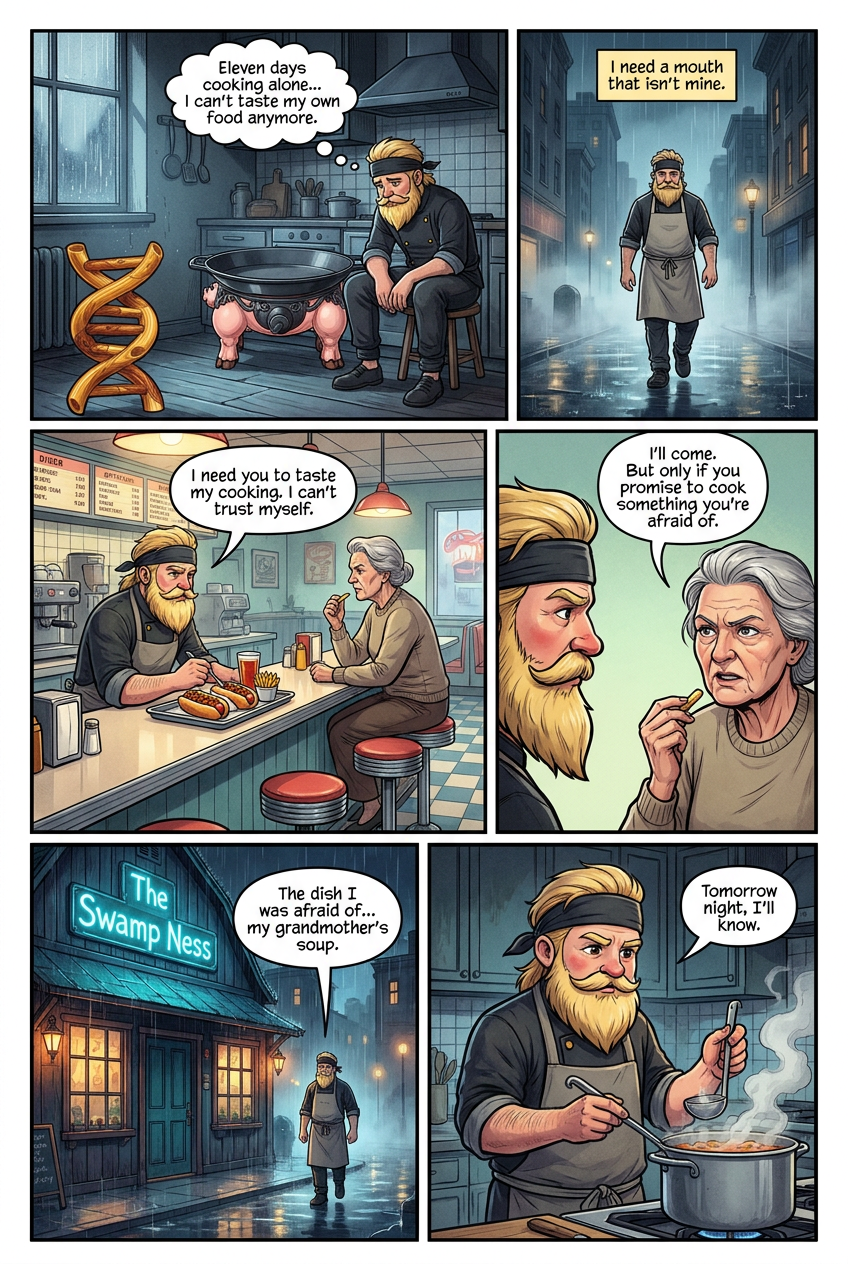
Frost had cooked alone for eleven days, and on the twelfth he admitted he could no longer taste his own food. The paella pan sat on its cast-iron stand in the corner of his kitchen, empty, waiting for a dish he had not yet made. He had built the stand himself, welded the pig-leg supports, and set it aside for the night he would serve the critic. The critic had written reviews for twenty years and had never cried at a meal. Frost intended to change that. He had cycled through a consommé, a tart, and four other drafts, and each one had died on his own tongue without telling him why. The problem was simple and it was ruining him. Alone, he could not tell brilliance from delusion. He needed a mouth that was not his. He had already set the small table by the window for the night the critic would come, a twisting wooden piece carved like a helix that he had bought years ago on the promise he would earn the right to use it. It stayed empty. He needed someone honest before that chair was ever filled. He took off his apron and walked out. Fogged City was wet that evening. He went to the diner three blocks from his kitchen, the one he had eaten at since he was a line cook with holes in his shoes. The tray came the way it always did: two chili dogs, fries, a root beer. He ate without tasting. He was there for the woman two stools down, a retired cook who had told him, years ago, that his consommé was thin. She had also, once, made him cry over a bowl of pork stew she cooked from a pig she had raised herself, a big pink husker she named and killed and served without ceremony. She did not flatter. That was why he wanted her. He asked her to come to his kitchen the next night and taste whatever he put in front of her. He told her he was chasing the critic. He told her he could not trust himself anymore. She chewed a fry and looked at him for a long moment. Then she said she would come, but only if he promised to cook something he was afraid of. Not clever. Afraid. He agreed before he understood what he had agreed to. Walking home past the blue neon of the jazz club on the corner, he understood. The dish he was afraid of was the one shaped like his grandmother's soup, the one he had sworn he would never touch. He had told himself for years that soup belonged to her and her dying husband and the silence between them. Now he had promised a stranger he would cook toward it without stealing it. He did not know yet how. But tomorrow night, for the first time, someone else's mouth would tell him whether he was close.
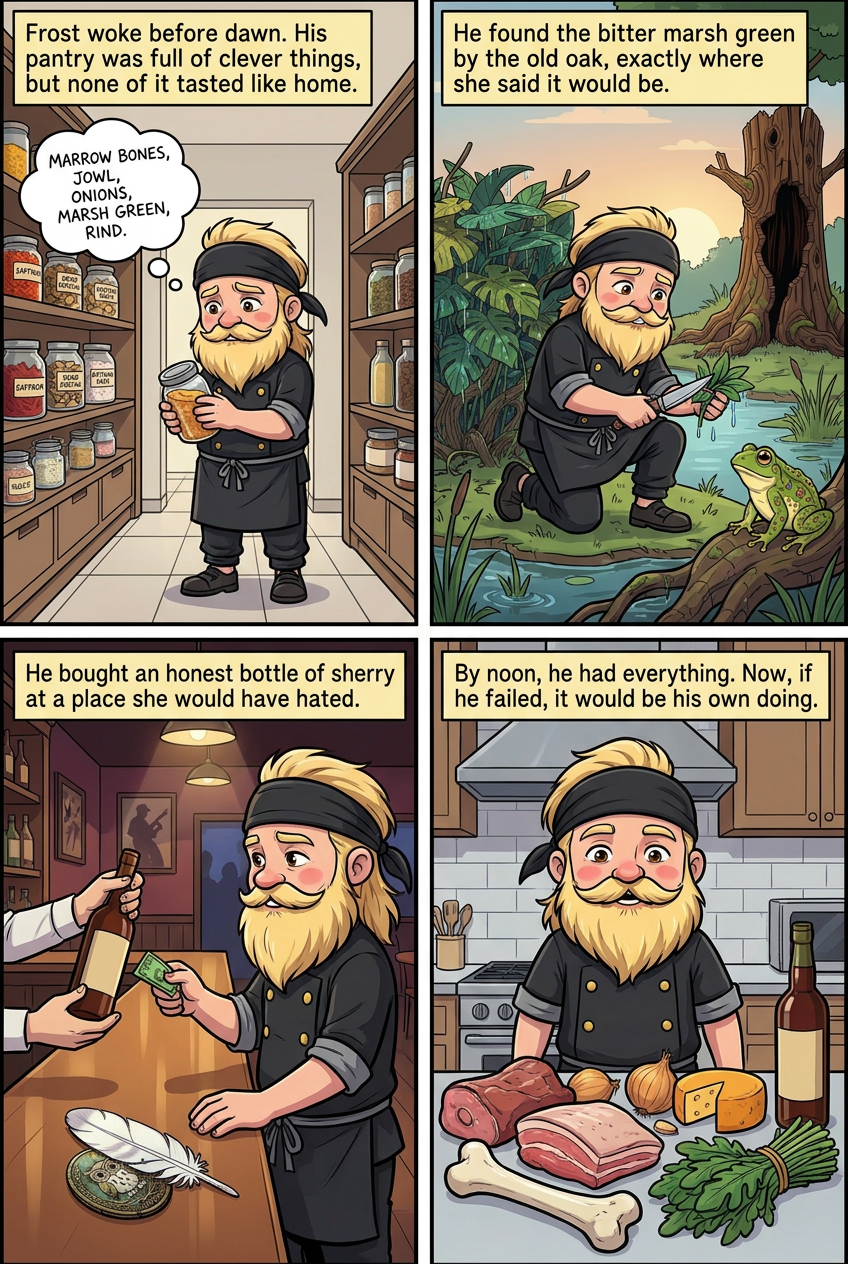
Frost woke before dawn and opened his pantry. He was cooking that night for the retired cook, and he had promised her something he feared. That meant moving toward his grandmother's soup without stealing it. He needed her bones, her roots, her sour green weed from the ditch behind her house. He needed the fat pork she cured in a shed. He had none of it. His shelves held saffron, aged vinegar, dried porcini, three kinds of salt. Nothing on them tasted like the countryside she cooked from. Every pot he built here would come out clever. He had one day to fix that. He wrote a list from memory. Marrow bones. Yellow onions with the skins on. A bitter marsh green his grandmother pulled from standing water. Smoked pork jowl, not belly. A hard, dry cheese rind. He drove out of Fogged City before the light broke. The farms east of the city were half-shut for the season. At the first stall he found bones and onions and a wedge of rind from a woman who remembered his face from years ago. She wrapped the bones in butcher paper without asking why he wanted them. The jowl took longer. He drove another hour to a smokehouse and paid too much for a piece cured the old way, with black pepper and no sugar. He put it in the cooler beside the bones and kept going. The marsh green was the problem. His grandmother pulled it from a wet ditch, and no grocer sold it. He stopped at the edge of a swampy park where the ground stayed soft all year. He walked in past a hollow oak with a wide split down its trunk. Something pale sat inside the cavity, a feather laid on a small painted disc. He did not touch it. He kept his eyes on the ground. He found the plant at the base of a tangled bush, broad glossy leaves dripping from last night's rain. He knew the shape. He knew the smell when he crushed a leaf between his fingers. Bitter, iron, faintly sweet. A frog with a mottled green back watched him from a root and did not move. He cut a full bundle at the stems and wrapped it in a wet cloth. On the way back he stopped at a lounge with dark wood and brass rails, the kind of place his grandmother would have laughed at. He bought a bottle of dry sherry from the bar. She had used cheap cooking wine, but he wanted one honest ingredient of his own in the pot. He drove home with the windows down. By noon his counter held everything the list demanded. Bones, jowl, onions, rind, the wet green bundle, the sherry. The pantry was no longer the reason he would fail. Whatever happened tonight when the retired cook tasted his food, it would happen because of him, not because of what he lacked.
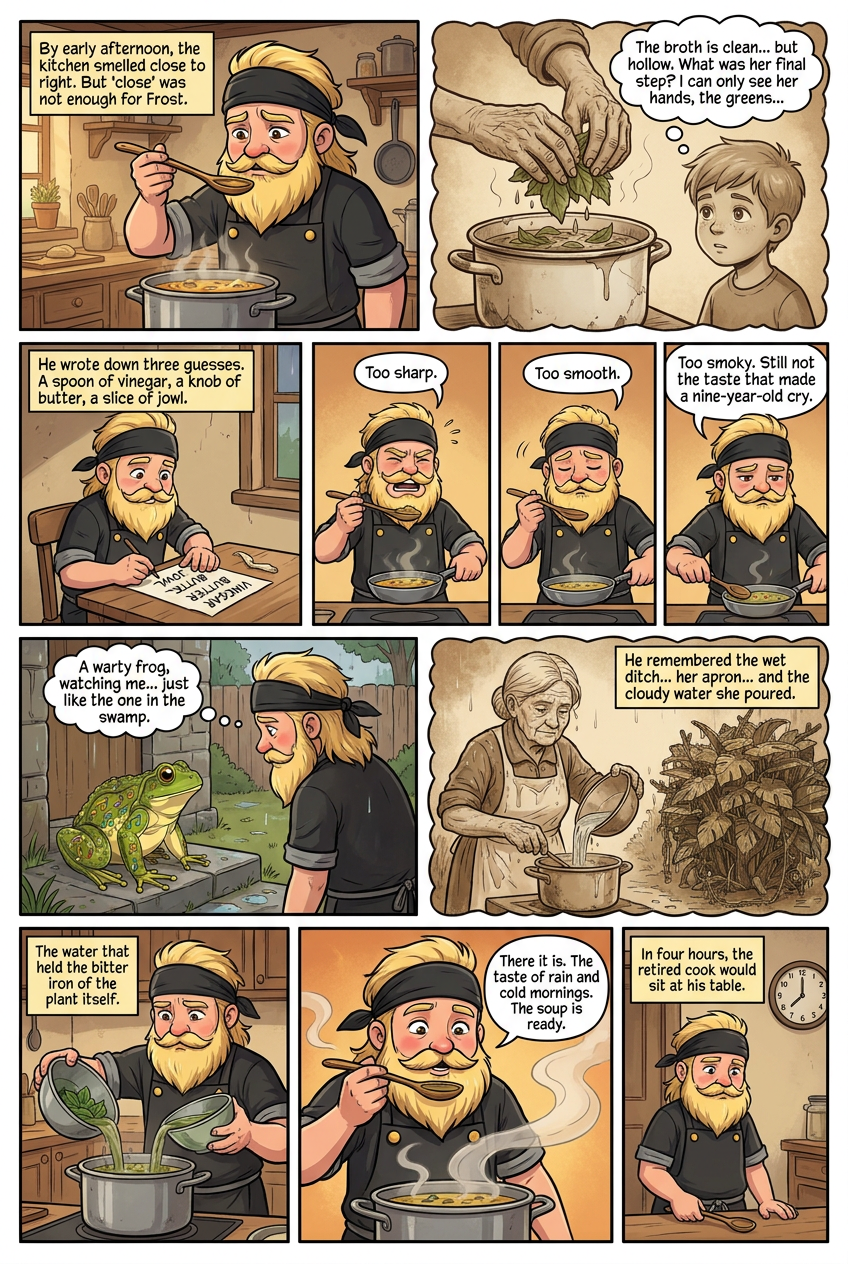
By early afternoon Frost had the stock going. Bones roasted first, then a slow simmer with the onion skins and cheese rind. The kitchen smelled close to right. But right was not enough. His grandmother had finished her soup with one last step, and he could not remember what it was. He stood over the pot with a wooden spoon and tasted. The broth was clean. It was also hollow. The retired cook would sit down in five hours and know the difference in one sip. He tried to picture his grandmother at her stove. He saw her hands, the chipped enamel pot, the marsh green going in last. He did not see the finish. He wrote three guesses on a napkin. A spoon of vinegar. A knob of butter whisked in cold. A slice of the smoked jowl grated over the top like a hard cheese. Each one was plausible. Each one would lock the dish into a shape he could not undo. He pulled a small pan down and ladled three tastes. He added vinegar to the first. Butter to the second. Grated jowl over the third. He tasted them in order. The vinegar sharpened the broth but pushed the grief out of it. The butter rounded the edges into something a restaurant would serve. The jowl was closer, smokier, but still not the taste that had made a nine-year-old cry. He set the spoon down. He was guessing. Guessing would give the retired cook a hollow bowl, and she had asked him for the opposite. He walked out to the small yard behind the kitchen to breathe. A warty green frog sat on the step, mottled and still, watching him the way the one in the swamp had. He remembered the wet ditch behind his grandmother's house. He remembered her walking back from it with the green bundle wet in her apron, and he remembered what she did next. She had poured the ditch water. A half-cup of the cloudy water the greens had soaked in. Not stock. Not wine. The water that held the bitter iron of the plant itself. She stirred it in at the end and covered the pot. Frost went back inside. He lifted the bowl where his marsh greens had been rinsing and looked at the murky liquid at the bottom. He measured half a cup and stirred it into the pot. He covered it and waited two minutes. Then he tasted. The broth held. It tasted of the ground the plant grew from, of rain and cold mornings, of something a person could not fake. He set the spoon on the counter. The soup was ready. In four hours the retired cook would sit at his table, and he would find out whether the truth of a memory was enough to move someone who was not in it.
Play your story to life
Storycraft is a mobile game where you create AI characters, craft items and locations to build their world, then discover what direction your story takes. Download the iOS game for free today!
Download for free