

Furrow Inkwhisker's Arc
2 Chapters
Furrow Inkwhisker's dream is amassing the largest ink collection ever gathered by any Beln on Planet PAD..

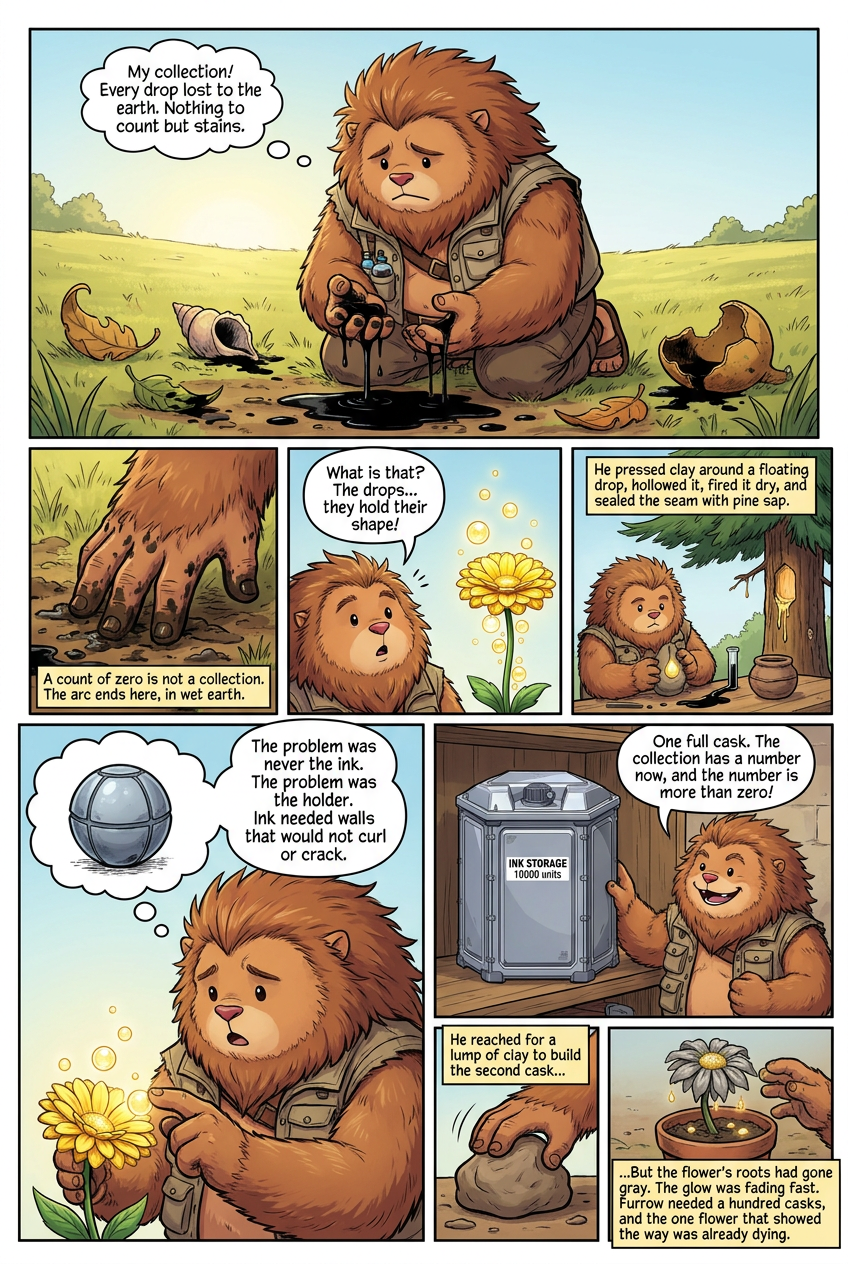
Furrow Inkwhisker wanted the biggest ink collection any Beln had ever gathered, and today the collection was leaking into the dirt. Furrow knelt in the meadow, three thick fingers cupped around a puddle of black ink. It seeped between the joints and dripped away. Furrow was large, hairy, and slow, and could not scoop fast enough. Every batch dried in the sun or spilled before it could be counted. Furrow had gathered ink for weeks. Leaves, shells, folded bark, a cracked gourd. Each holder failed. The leaves curled. The shells tipped. The gourd split down one side and drank the ink into its own wood. By afternoon Furrow had nothing to count but stains. Furrow sat back and pressed sticky fingers to the ground. A count of zero was not a collection. Without a proper vessel, the arc toward the largest hoard on the planet ended here, in wet earth. Then Furrow noticed the flower. It stood a step away, a bright yellow bloom on a slim green stem. Round drops of light floated up from its petals and hung in the air. More drops gathered at its roots, glowing and whole. The drops did not spill. They did not dry. Each one held its shape like a sealed bead. Furrow leaned close and touched one floating drop. It did not burst. It rolled across a broad finger, firm as fruit skin. The flower spilled its glow, yet the drops kept their walls. They held. Furrow understood. The problem was never the ink. The problem was the holder. Ink needed walls that would not curl or crack. Furrow dug up the flower, roots and all, and carried it home cradled against a wide chest. The glowing drops bobbed the whole way. At the workbench, Furrow poured the day's last thread of ink beside them and watched. The ink slid loose and flat, useless. The flower's drops sat firm. So Furrow copied the flower. Furrow pressed clay around a floating drop, wrapping it until the drop's skin lay trapped inside a hard round shell. Then Furrow hollowed the clay, fired it dry, and sealed the seam with pine sap. The result was a small round cask, walls thick, mouth narrow. Furrow poured ink inside. Furrow waited. The ink did not curl. It did not crack. It did not drink into the walls or climb out the top. It sat, black and whole, held. Furrow filled the cask to the brim and set it on the shelf. One full cask. One batch, finally counted. The collection had a number now, and the number was more than zero. Furrow reached for a lump of clay to build the second cask. But the flower's roots had gone gray, and its last drops were sinking into the dirt of the pot. The glow was fading fast. Furrow needed a hundred casks, and the one flower that showed the way was already dying.
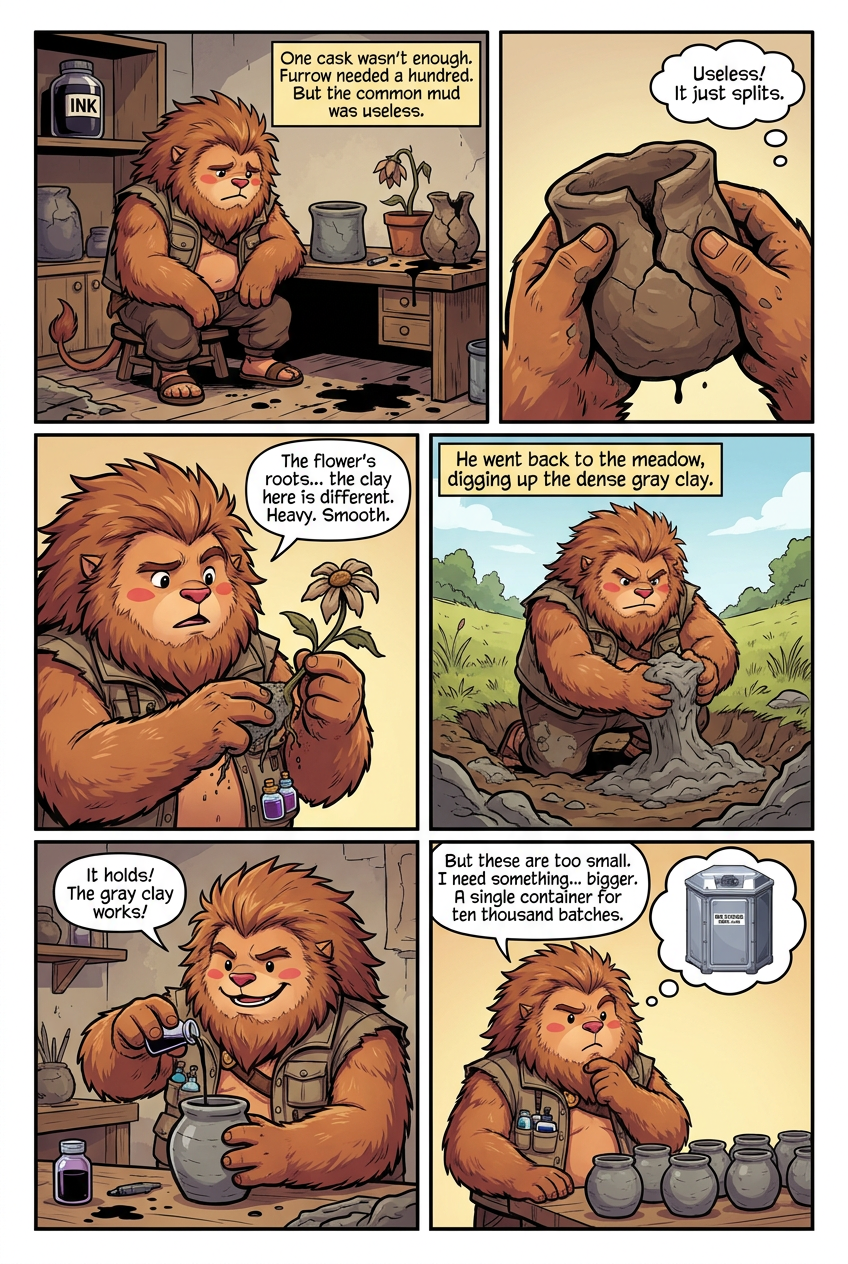
The one full cask sat on the shelf, black and whole. Furrow needed a hundred more like it. The flower that showed the way had died in its pot. To build another cask, Furrow needed the same clay: thick-walled, dense, able to hold ink without cracking. But no such clay lay near the workbench. The soft mud outside curled and split when fired. Furrow knew this now. One cask was not a collection. Ninety-nine were still missing. Furrow scooped a lump of the soft mud and tried anyway. Thick fingers pressed it into a shell. Furrow hollowed it, fired it dry, sealed the seam with pine sap. Then Furrow poured in a thread of ink. The wall drank it. A crack opened along the side. Ink ran out and stained the floor. The mud was wrong. Furrow needed better clay, and the meadow held none. Furrow remembered the flower's roots. When Furrow had dug the plant up, the dirt around the roots had felt different. Heavy. Gray. Smooth as wet stone. Furrow tipped the dead flower from its pot and rubbed the root soil between three fingers. It packed tight and held its shape. This was the clay. The flower had grown in it. So Furrow followed the trail back to the meadow, to the hollow where the flower once stood. Furrow dug. Below the loose topsoil lay a thick gray seam of the same dense clay. Furrow pulled up armload after armload and carried it home against a wide chest. The clay was cold and firm. It did not crumble. Furrow shaped a new cask from the gray clay, fired it, and sealed it. Furrow poured in ink and waited. The wall held. No crack. No leak. The ink sat black and whole. Furrow made a second cask, then a third. Each one held. The gray clay worked. The problem was solved. But as Furrow lined the finished casks along the shelf, a harder truth came clear. Each round cask sat small and narrow. Each held only one batch. To hold the largest collection ever gathered, Furrow would need a hundred of them, then a hundred more. They would crowd every shelf, every corner, the whole floor. There was not enough room, and not enough clay in one seam to build so many. Furrow set down the newest cask and stared. One vessel could not fix this. Furrow needed a single container built to hold thousands of batches at once. A large one. Flat sides packed tight against flat sides, so many casks could fit in the space of one. A shape with straight walls. Six of them, maybe. Furrow pictured it: tall, hard-walled, one narrow mouth at the top, a body that swallowed ten thousand units of ink and never spilled a drop. The gray clay could build it. Furrow had the clay now. The next thing to build was bigger.
Play your story to life
Storycraft is a mobile game where you create AI characters, craft items and locations to build their world, then discover what direction your story takes. Download the iOS game for free today!
Download for free