

Grampy Fernside's Arc
22 Chapters
Grampy Fernside's dream is growing a legendary heirloom bloom thought lost to time and returning it to his beloved wife as an anniversary gift..

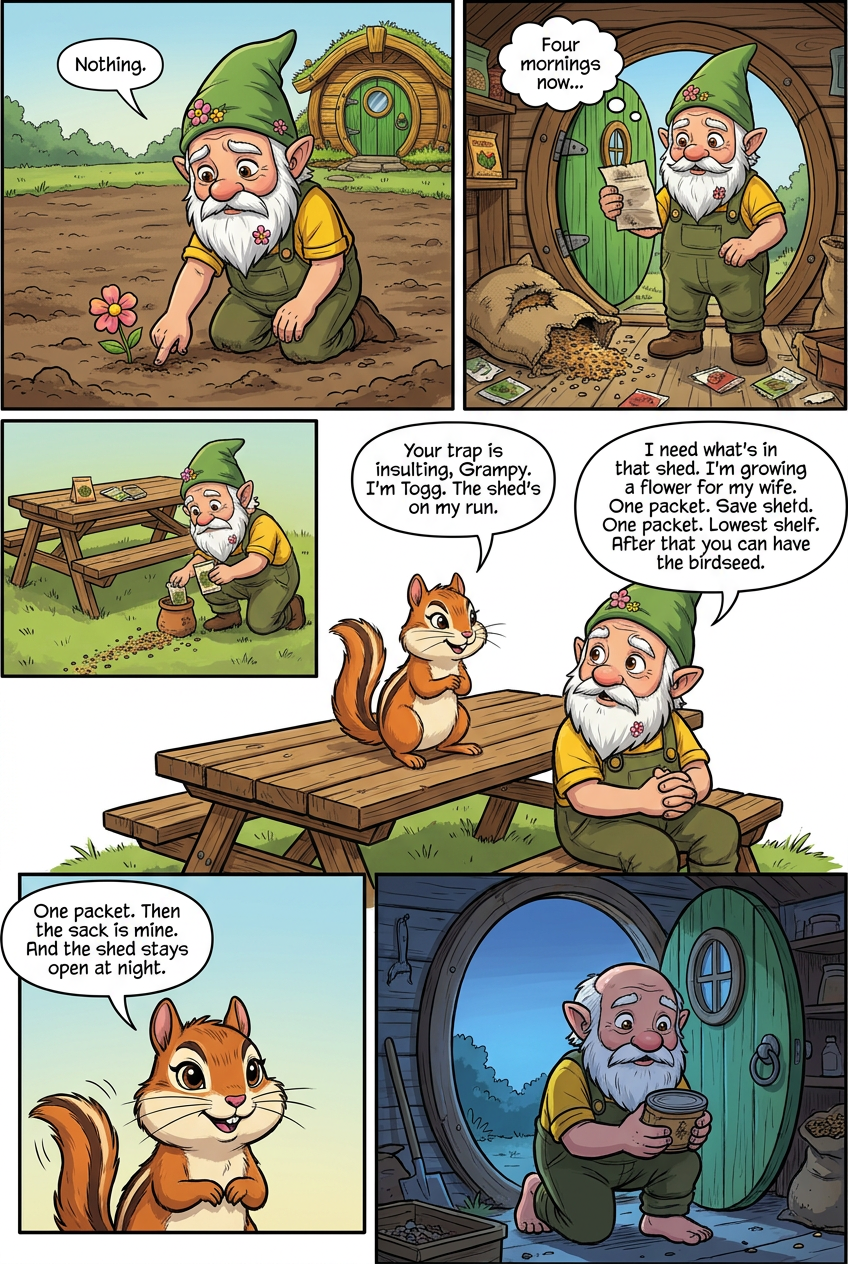
Grampy Fernside knelt in the dirt and pressed a finger into the bare row where his beans should have been. Nothing. Forty years he had grown food from this patch, and this season the soil gave him three sprouts and a lot of brown. His wife had tucked a pink flower and a yellow flower into his beard at sunrise, the way she had every morning of their marriage. Tonight was the night he meant to start over. Somewhere in the back of his shed, behind the trowels and the twine, was a tin he hadn't opened in years. Inside the tin was a single packet of seeds for a bloom most gnomes thought was gone for good. Their anniversary was coming. He wanted that flower in her hands. He stood and brushed his knees. The shed sat at the edge of the garden, a round green door set into a grassy mound. He had built it himself the year they married. He walked over and pulled the door open. The floor was a disaster. Seed packets lay torn across the boards. A burlap sack leaned on its side, gnawed through at the seam, birdseed spilling in a wide fan. Paper labels he had written in his own hand forty years ago were chewed at the corners. He crouched and picked one up. The ink was smudged but readable. He set it on the step and picked up another. He had been finding this mess for four mornings now. Whatever was coming in at night was working its way deeper into his shelves, and the tin he needed was on the lowest one. He dragged a picnic table out of the shade and set it in the sun. Moss clung to its legs. He carried the packets out in armfuls and began sorting: beans here, herbs there, anything unlabeled in a pile of its own. He worked until his back hurt. Then he set a trap. He tipped an old clay pot onto its side, propped the rim with a twig, and trailed a line of seeds underneath. He sat down on the bench to wait. The chipmunk came at dusk. He was small and orange and walked straight past the seed trail without stopping. He climbed onto the picnic table, sat on his haunches, and looked at Grampy. "Your trap is insulting," the chipmunk said. "I'm Togg. The shed's on my run. Has been since before you sorted anything." Grampy folded his hands on the table. "I need what's in that shed. I'm growing a flower for my wife. One packet. Lowest shelf. After that you can have the birdseed." Togg's tail twitched once. "One packet. Then the sack is mine. And the shed stays open at night." "Done," Grampy said. Togg dropped off the table and was gone. Grampy walked back to the shed in the blue light and knelt at the lowest shelf. The tin was there. He lifted it out and held it in both hands.
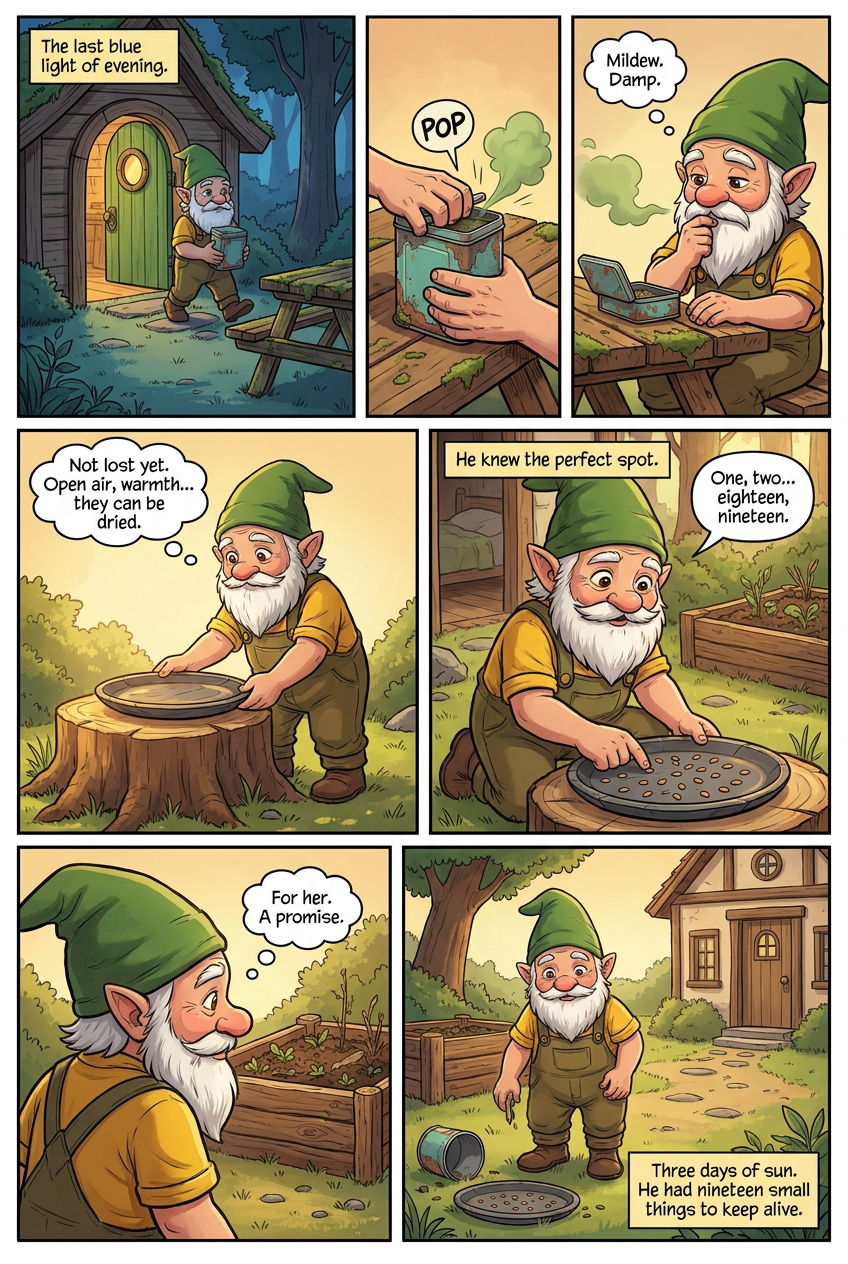
Grampy Fernside carried the tin out of the shed and set it on the picnic table in the last blue light. The lid stuck. He worked it with his thumbs until it popped. A breath of damp air came up at him, sour and green. The tin was rusted along the corners, paint flaking off in soft chips, a fringe of moss along one seam. He bent close and sniffed. Mildew. Faint, but there. If he tipped these seeds into the ground tonight, they would rot before sunrise. He sat down on the bench and thought it through. The seeds were not lost yet. Damp seeds could be dried. He had done it with beans in a wet year, with herbs after a leaking jar. The trick was open air and steady warmth, and a surface that would not hold water against the shells. He went around the side of the shed to the flat stone he used for resting tools. It was a smooth slate dish, dark, worn round at the edges from forty years of use. He carried it to the sunniest spot near his garden and set it on a low stump where the morning light would hit first and the evening light would hold longest. He wiped it clean with the hem of his shirt. Then he tipped the tin. The seeds slid out in a small heap. There were not many. Long striped ones, pale ovals, a few round ones the color of old honey. He spread them with one finger until each seed sat alone on the stone, none touching, none stacked. He counted as he went. Nineteen. Nineteen chances at the bloom he had promised his wife. He looked past the stone to the bed he had been readying for weeks. He had built it from sturdy logs notched at the corners and filled it himself, layer by layer: peat moss, aged manure, sifted dirt from the old bean row. The soil sat dark and loose, waiting. He had not told her about the bed. He had not told her about the tin. Their anniversary was still weeks off, and he meant to keep it that way. He set the empty tin upside down beside the stone so no dew would settle inside it overnight. The seeds would need three days on the slate, maybe four, turned twice a day. He would know they were ready when they rattled instead of clicked. He stood up, brushed his knees, and started back toward the house where his wife would be pouring tea. The seeds were out of the tin. The bed was waiting. Now he only had to keep nineteen small things alive long enough to plant.
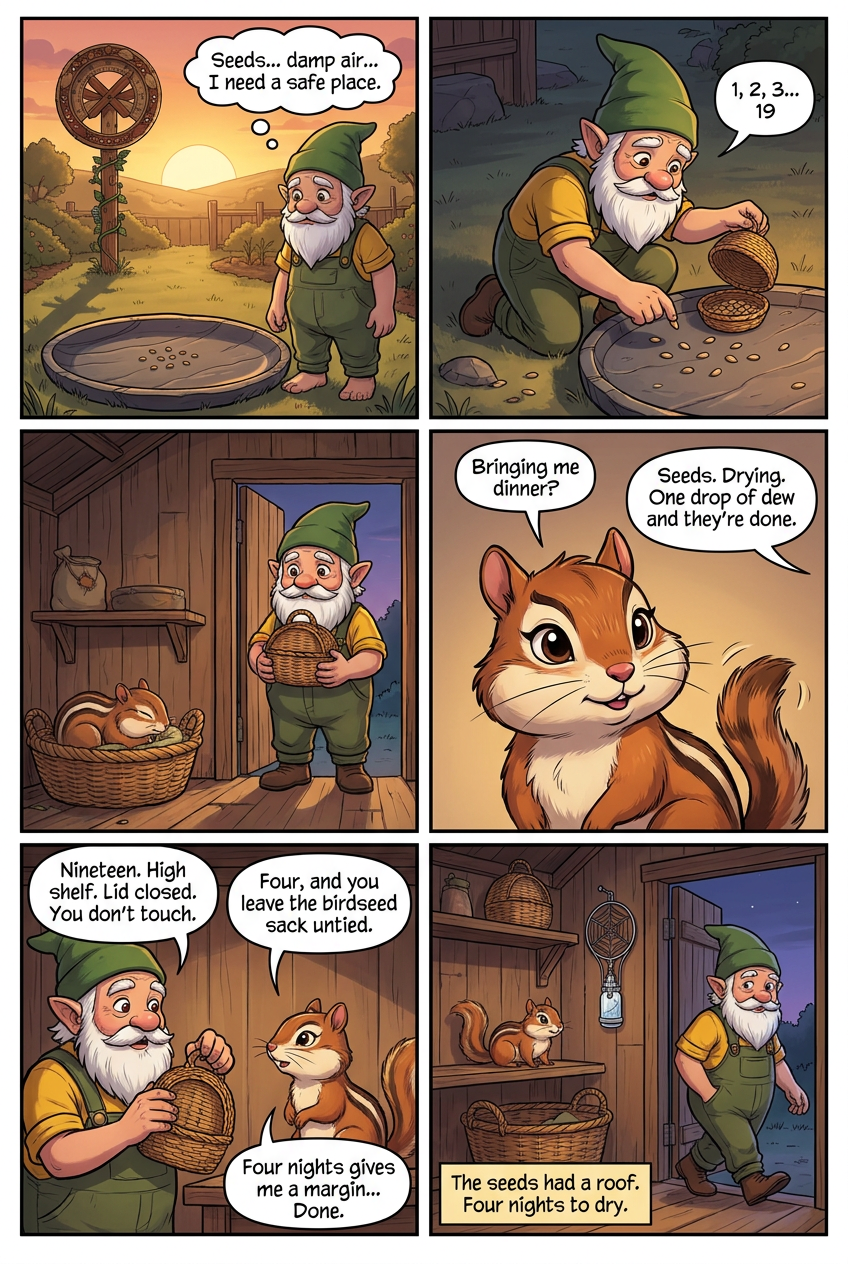
Grampy walked back to the slate at dusk and saw the problem he had not let himself name yet. The seeds sat clean in the last light, but the air was already cooling. By dawn the stone would be wet. One night of dew would soak the shells and undo the day's drying. He had three more days of this ahead. He needed somewhere to put the seeds at night, and somewhere safe enough that he would not lie awake worrying. He checked the wooden sky clock at the edge of the garden. Its X-shaped shadow had slipped past the lower marks. He had maybe an hour before the grass turned cold. He went into the shed and took down a small wicker cover with a linen mesh lid, the one he used for moving cuttings. It would hold the seeds without crushing them and let air pass through. He carried it out, knelt by the stone, and slid the seeds in one by one. Nineteen. He counted twice. The trouble was where to set it down. The shed stayed open at night by agreement, and any open door meant damp air and small feet. He stood in the doorway with the basket against his chest and looked in. Togg was already there, curled in the patched wicker nest he kept in the back corner. He opened one eye. "Bringing me dinner?" Togg said. "Seeds," Grampy said. "Drying. One drop of dew and they're done." "Then don't leave them out." "I need them dry and safe. Both." Grampy held up the basket. "High shelf. Lid closed. You don't touch." Togg looked at the basket, then at Grampy. "Nineteen?" "Nineteen." "Top shelf is mine on cold nights. I sit there to watch the door." "Sit on the middle shelf for three nights." Togg's tail flicked once. "Four." "Three." "Four, and you leave the birdseed sack untied." Grampy thought it through. Four nights gave him a margin if the sun was weak. "Done." He set the basket on the top shelf, well back from the edge, and closed the linen lid. He hung a small wire frame beside it on a nail. He used the frame in the mornings to gather web water from the fence line, and the dry wire would tell him at a glance if the air inside the shed had turned wet overnight. If the wire beaded, he would move the seeds again. He stepped out and pulled the door to its usual gap. The sky clock showed full dusk. Behind him, Togg shifted to the middle shelf without a word. Grampy walked back to the house with his hands empty for the first time all evening. The seeds had a roof. He had four nights to dry nineteen small things into a bloom worth giving.
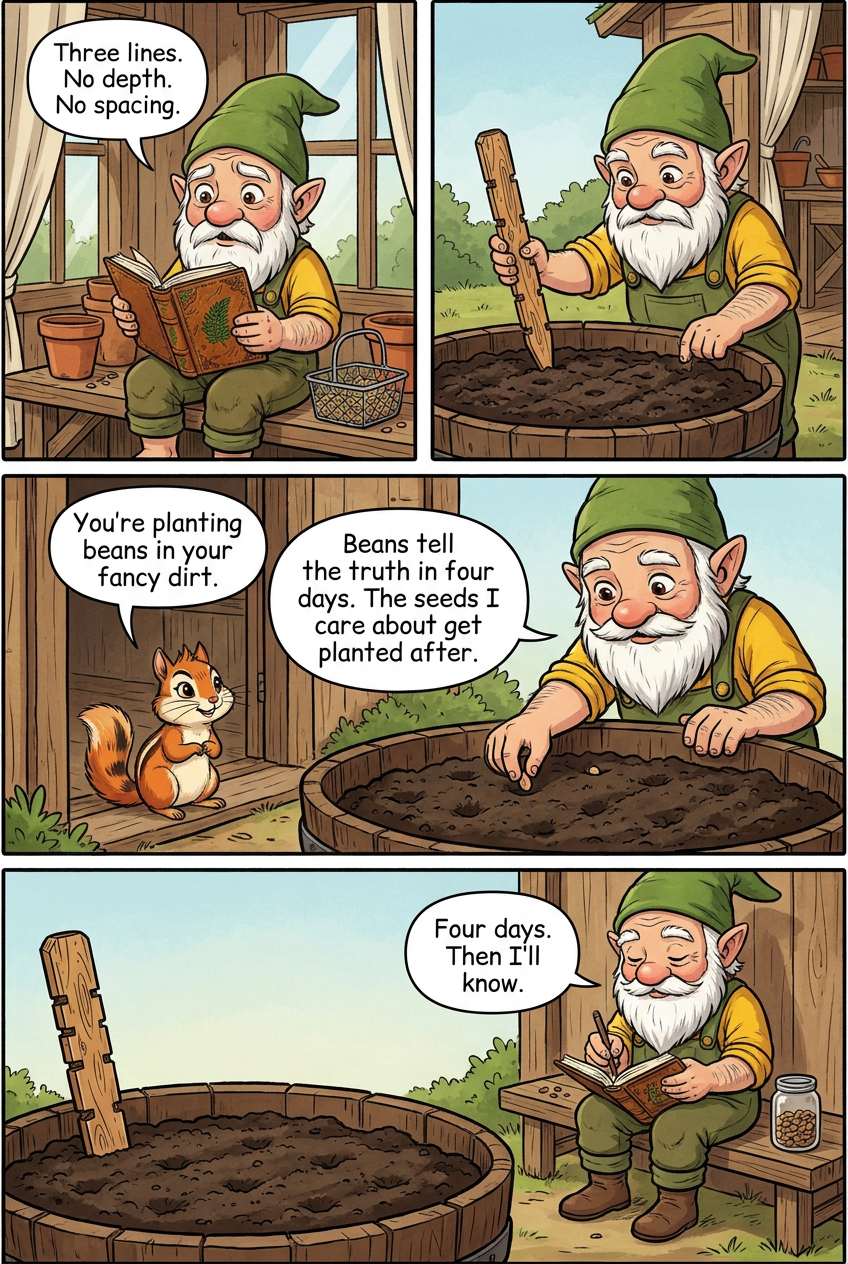
Morning came clear. Grampy checked the wire frame in the shed and found it dry. The seeds rattled softly when he lifted the basket. Three more nights and they would be ready for soil. But ready for soil meant nothing if he did not know how to plant them. He had never grown this bloom. No one alive had. The tin held no slip of paper, no scratch of ink telling him how deep or how far apart nineteen seeds should sit. He carried the basket to the lean-to he had built against the south wall of the shed. Clay pots sat in rows on the bench. Cloth curtains hung at the open front to break the wind. He set the basket down and pulled his garden diary from the shelf. The fern-stamped cover was soft from years of handling. He turned to the back, where he kept notes on seeds he had only read about. The page for this bloom held three lines copied from an old trader's almanac. None of them mentioned depth. He went out to the half-barrel he had turned over last week. The soil inside was dark and loose, the same mix he planned to use in the secret bed. A test patch. He had set it up for exactly this reason, though he had hoped the tin would tell him what to test for. It had not. He would have to guess, and then watch. From the corner of the lean-to he took the notched stake he used for spacing rows. The cuts marched up the wood at one-inch steps. He laid it flat across the barrel and pressed nine shallow dimples into the soil along its length, at three different depths and three different spacings. A grid. He had a small jar of common bean seeds on the bench. Beans were not the bloom, but beans pushed up fast and would show him which depth and spacing let a sprout open without choking. "You're planting beans in your fancy dirt," Togg said from the shed doorway. He had come out to sit in the sun. "Beans tell the truth in four days," Grampy said. "The seeds I care about get planted after." "Four days is what you've got." "I know." He pressed one bean into each dimple, covered them, and wrote the grid into the diary with the depth and spacing marked beside each spot. He set the stake upright at the edge of the barrel as a marker. The seeds in the basket would dry for three more nights. The beans would sprout in four days, maybe five. The timing would be close, but the test would answer the question before he committed nineteen irreplaceable seeds to blind dirt. He closed the diary and set it on the bench. For the first time since the tin came out of the shed, he knew what tomorrow looked like.
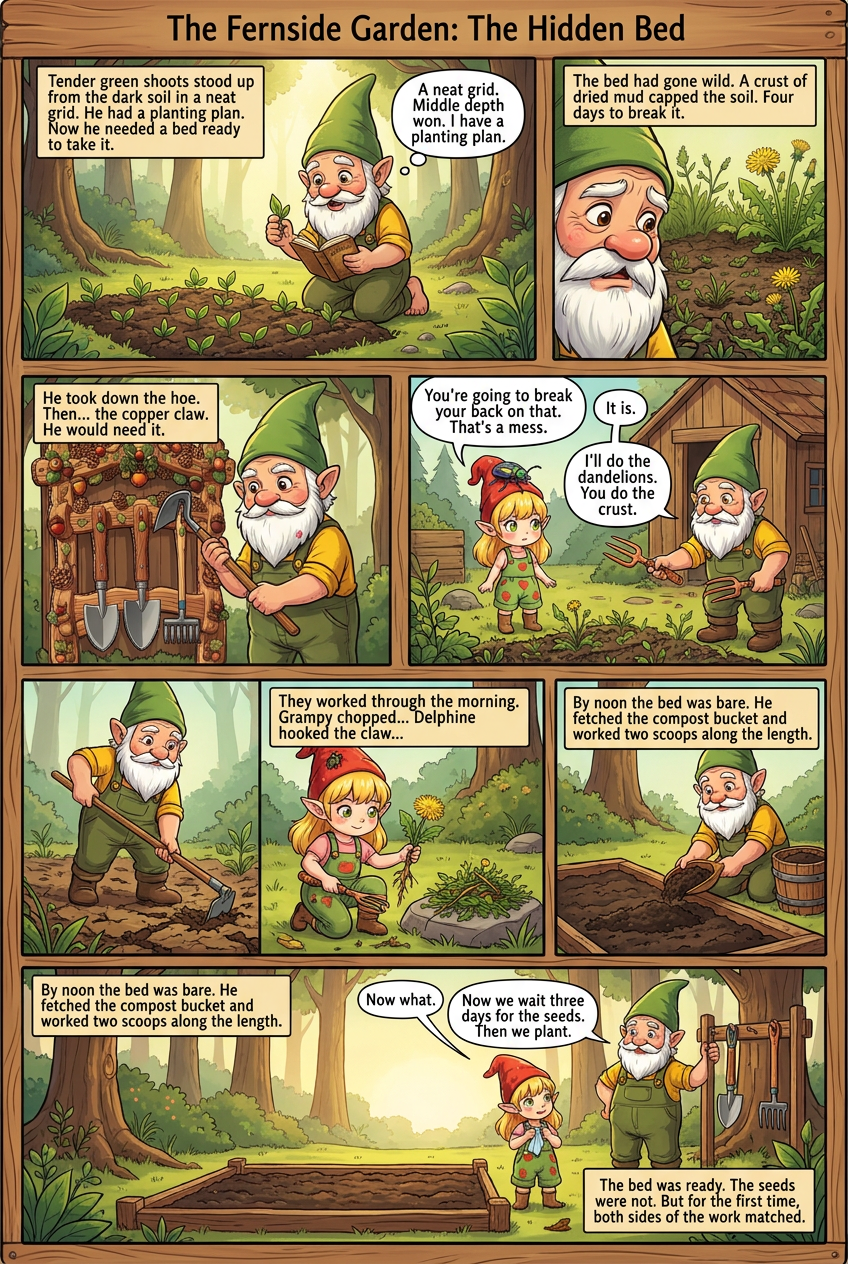
On the fourth morning, Grampy walked to the half-barrel and found his answer waiting. Tender green shoots stood up from the dark soil in a neat grid. Some had pushed through clean. Two stayed buried. He bent close and counted leaves. The middle depth and the wider spacing had won. He wrote the numbers in his diary and closed the cover. He had a planting plan. Now he needed a bed ready to take it. He walked around the shed to the hidden corner where his secret bed waited. He stopped. The bed had gone wild while he chased seeds and sprouts. A crust of dried mud capped the soil. Chickweed spilled over the log sides in pale green ropes. Yellow dandelions stood tall in the middle, roots already deep. Twigs and fallen leaves littered the surface. He pressed a thumb against the crust. It did not give. Four days. Four days to break it, clear it, and feed it before nineteen seeds went in. He went to the tool rack on the south wall. The pine-cone frame held his spade, his hoe, and his rake in their three notches. Forty years of use had worn the handles smooth and dark where his hands sat. He took down the hoe. Then he reached to the small hook below and lifted off the copper claw, three curved tines on a beaded handle. The claw was for weeds with stubborn roots. He would need it. "You're going to break your back on that." Delphine stood at the corner of the shed, barefoot, a beetle riding the point of her red hat. She looked at the weedy bed. "That's a mess." "It is," Grampy said. "I'll do the dandelions. You do the crust." He almost said no. Then he looked at the sun and the bed and the four days. "Claw goes deep," he said. "Get the whole root or it grows back stronger." He handed her the copper claw. She took it without ceremony and knelt at the far end. They worked through the morning. Grampy chopped the crust with the hoe in short strokes, then turned the clods and broke them with the rake. Delphine hooked the claw under each dandelion crown and pulled slow and steady until the white root came up whole. She piled the weeds on a flat stone. The chickweed came out in mats. By noon the bed was bare dark soil again, loose to the depth of his finger. He fetched the compost bucket and worked two scoops along the length. He raked it smooth. He stood back and looked at it. A clean bed. Four days early. Delphine wiped her hands on her overalls and handed back the claw. "Now what," she said. "Now we wait three days for the seeds," Grampy said. "Then we plant." He hung the claw back on its hook. The bed was ready. The seeds were not. But for the first time, both sides of the work matched.
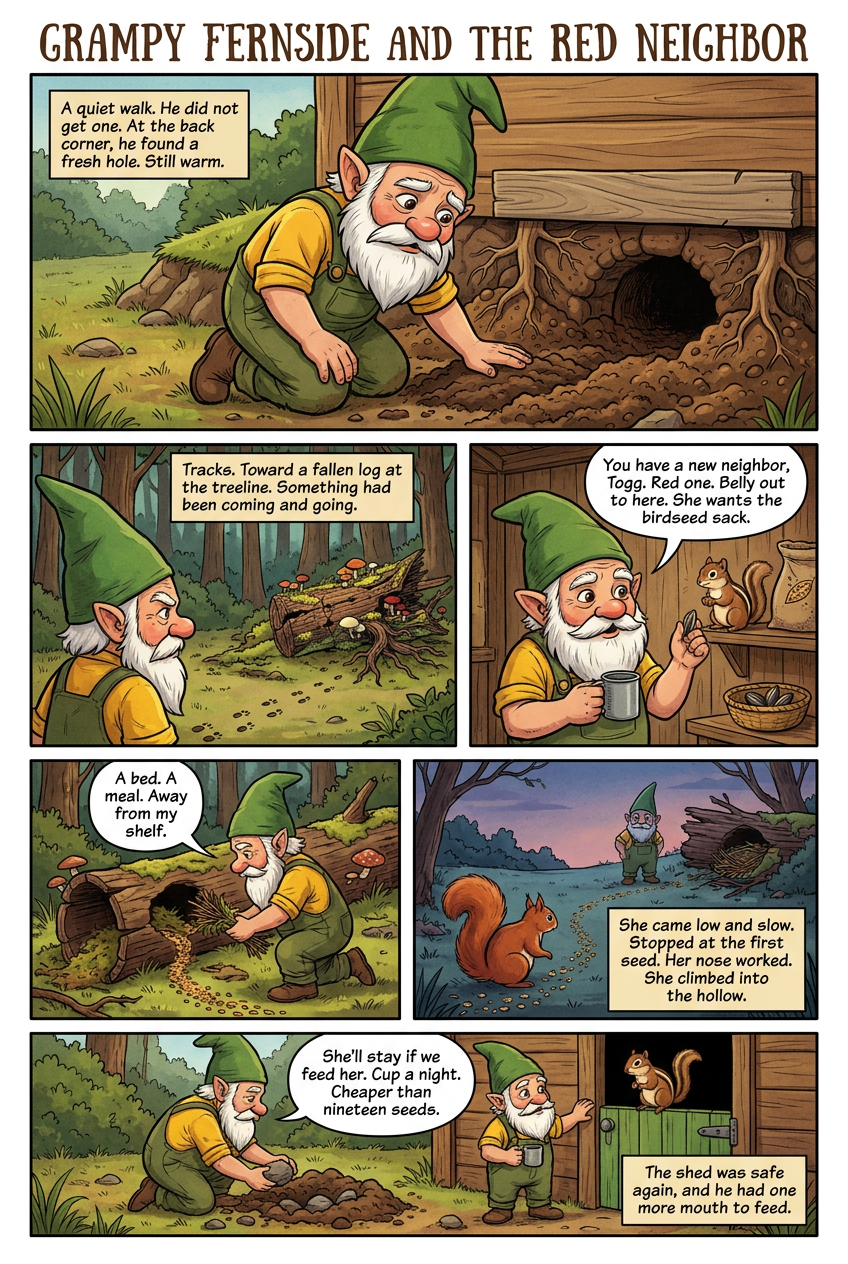
That evening Grampy walked the shed line before supper. The bed was ready. The seeds still sat on the top shelf in their basket, three nights from planting. He wanted a quiet check and a quiet walk. He did not get one. At the back corner of the shed, where the boards met the ground, he found a fresh hole. Loose soil fanned out from it. Pale roots stuck out of the walls where something had clawed them free. He knelt and put his hand flat on the dirt. Still warm from digging. He followed the tracks with his eyes. Small prints led from the hole across the bare ground toward the treeline. There a fallen log lay half-buried in moss, mushrooms crowding its bark, roots twisted out at one end. Behind the log the brush was pressed down in a narrow run. Something had been coming and going. Toward his shed. Toward his seeds. He found Togg on the doorsill, tail twitching. "You have a new neighbor," Grampy said. Togg flicked his ears. "Red one. Belly out to here. Been under the boards two nights. She wants the birdseed sack. She'll take the top shelf if she climbs." Grampy looked up at the shelf through the open door. Nineteen seeds. Three nights left. He could move the basket into the house. He could also lose Togg's deal, and the shed stayed open per their agreement. He chose a third way. He went inside and filled a tin cup from the birdseed sack. Then he walked to the fallen log at the treeline and poured a curved trail of seed along the moss, ending at a hollow between the roots. He carried a bundle of dry grass and moss from the shed's rag pile and tucked it deep in the hollow. A bed. A meal. Away from his shelf. He waited at the corner of the shed as the sun dropped. She came out of the brush low and slow, red coat dark in the dusk, sides round with young. She stopped at the first seed. Her nose worked. She followed the curve to the log and climbed into the hollow. She did not look back at the shed. Grampy watched until her tail disappeared into the nest bundle. Then he walked back and packed loose stones into the hole under the boards until it was full. He closed the shed door partway, the way Togg liked it. "She'll stay if we feed her," he told the chipmunk. "Cup a night until her kits come. Cheaper than nineteen seeds." Togg accepted this with a chirr and went inside. Grampy climbed to the top shelf and checked the basket. Dry. Rattling. Three nights to planting. The shed was safe again, and he had one more mouth to feed until the anniversary bloom went in the ground.
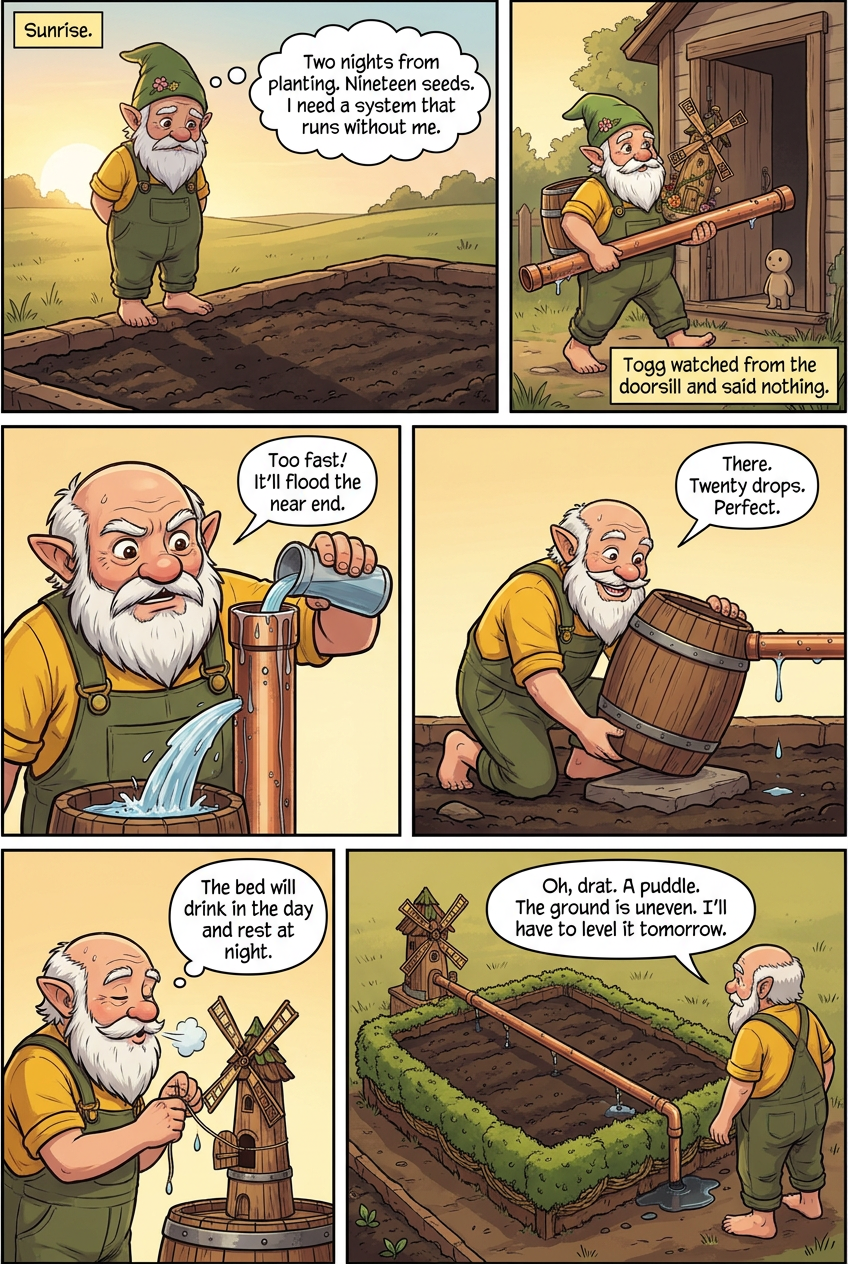
Morning came hot. Grampy walked out barefoot and felt the difference in the ground already. The path was warm at sunrise. By noon the bed would bake. He stood at the edge of his secret plot and looked at the dark, level soil he had turned and fed. Two nights from planting. Nineteen seeds. If he watered by can, he would either miss a morning or drown the sprouts. He needed a system that ran without him. He went to the shed and pulled down what he had saved: a length of copper pipe, a shorter copper column, a wooden barrel he had lined last summer, and a small windmill his granddaughter had helped him build from bark and leaf shingles. He carried the parts to the bed one by one. Togg watched from the doorsill and said nothing. He set the barrel at the high corner of the bed, where the roof runoff would find it. He fit the tall copper column into the barrel's lid so water could rise and feed out the side. Then he laid the long copper pipe across the length of the bed on two low forks. He had punched a line of pinholes along its underside the winter before. He tipped the pipe until each hole showed a bead of water when he poured a test cup through the column. The first run failed. Water rushed out the near holes and never reached the far end. Grampy sat back on his heels. He walked to the barrel and lifted the near side onto a flat stone. He poured again. This time the beads formed all down the pipe, slow and even, one drop every few seconds. He counted twenty holes. Twenty drops. He grinned into his beard, where his wife's pink and yellow flowers had wilted a little in the heat. He still had the windmill. He mounted it on a post beside the barrel and tied a light cord from its shaft to a small wooden gate he cut for the column's mouth. When the breeze turned the blades, the gate lifted a hair and let water pass. When the wind stopped in the cool of evening, the gate closed. The bed would drink in the day and rest at night. He tested it with a puff of breath. The gate lifted. A drop fell. He covered the wet soil with a knitted moss blanket his granddaughter had brought him last week, tucking the edges in around the frame. The moss would hold the damp and shade the seedlings from the worst sun. He stepped back. The bed was ready. The water was ready. Two nights from planting. Then he saw the puddle. Under the far end of the pipe, water pooled where the ground dipped. The soil there was already soft and dark and swelling. If he planted tomorrow night, half his row would sit in a bog. He would have to level the bed again before the seeds went in.
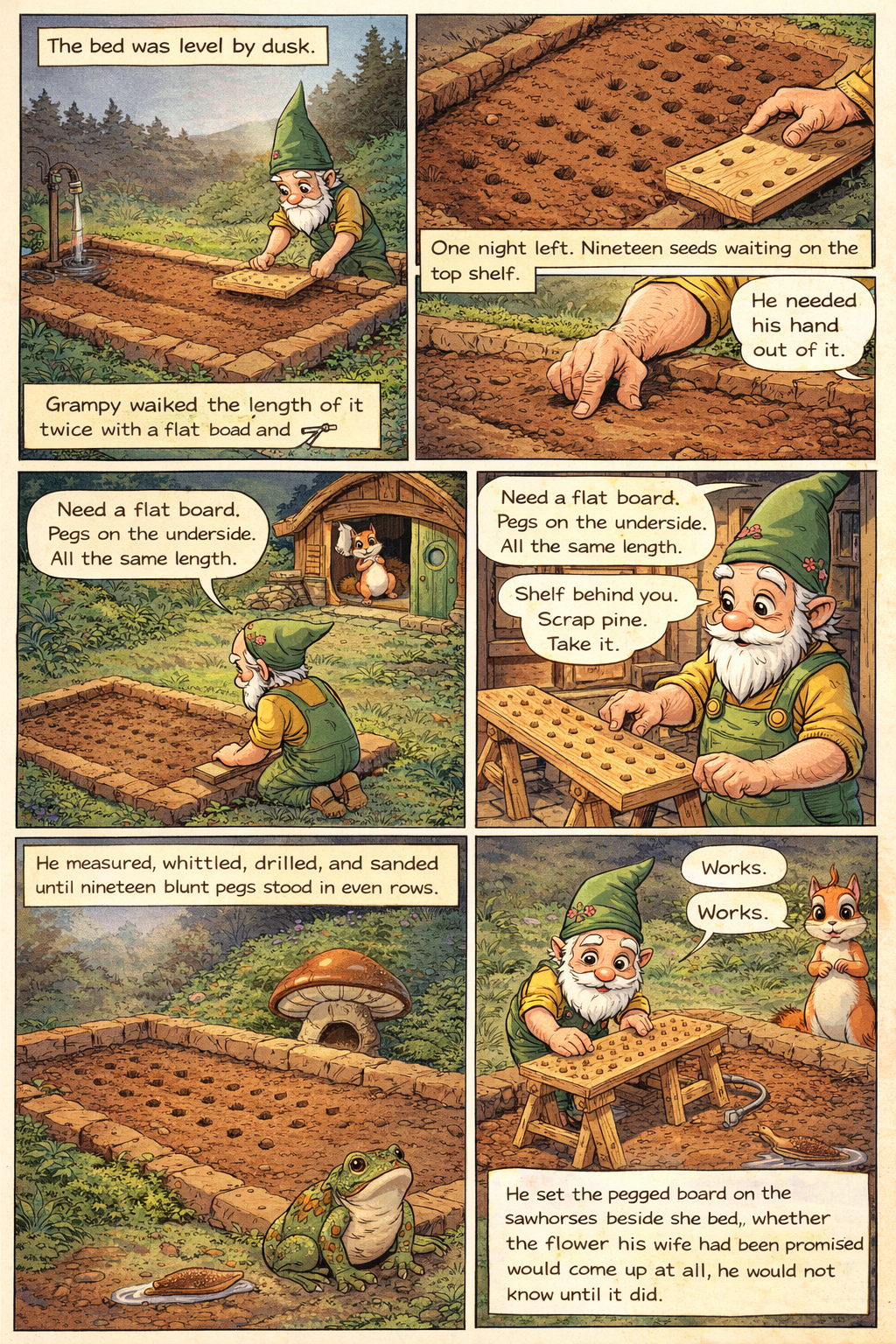
The bed was level by dusk. Grampy walked the length of it twice with a flat board and shaved the far end down until the puddle drained. He tucked the moss blanket back and stood in the cooling air. One night left. Nineteen seeds waiting on the top shelf. He had proved in his test barrel that middle depth grew the strongest sprouts. But middle depth meant the same depth every time, in every hole, and his thumb was not a ruler. He tried it on a corner of the bed to see. He pressed a hole with his thumb, then another, then another. The first felt right. The fourth went deep. The seventh barely dented the soil. He scraped them out and sat back on his heels. Nineteen seeds. Half would sit too shallow and dry. Half would sit too deep and never break the crust. He needed his hand out of it. He went to the shed. Togg sat on the doorsill washing his paws. "Need a flat board," Grampy said. "Pegs on the underside. All the same length." "Shelf behind you," Togg said. "Scrap pine. Take it." Grampy carried the pine board out and set it across the two small sawhorses his granddaughter had helped him build. He measured the bed against the board and marked nineteen points in the pattern his test had proved: wider spacing, staggered rows. He whittled nineteen short pegs from a handy stick, each one the length of his smallest fingernail. He drilled the board and tapped the pegs in from above, sanding the tips smooth so they would not tear a seed. When he flipped the board, nineteen blunt teeth stood in even rows. He carried it to the bed and pressed it down. The board sank until the flat wood met the soil. He lifted it. Nineteen clean holes, all the same depth, all the same distance apart. He pressed his thumb into one to check. Middle depth. Exactly. He grinned into his beard. A fat toad watched from under the ceramic mushroom his wife kept by the path, and a slug inched along the frame of the bed. Grampy flicked the slug into the grass and let the toad be. "Works," Togg said from the shed door. "Works," Grampy said. He set the pegged board on the sawhorses beside the bed, ready for tomorrow night. The watering pipe dripped its slow beads. The moss held. The holes would be waiting when he brought the seeds down. He turned toward the house and the tea his wife would have poured by now. One thing was left. Nineteen seeds, nineteen holes, and the planting itself — whether the bloom his wife had been promised would come up at all, he would not know until it did.
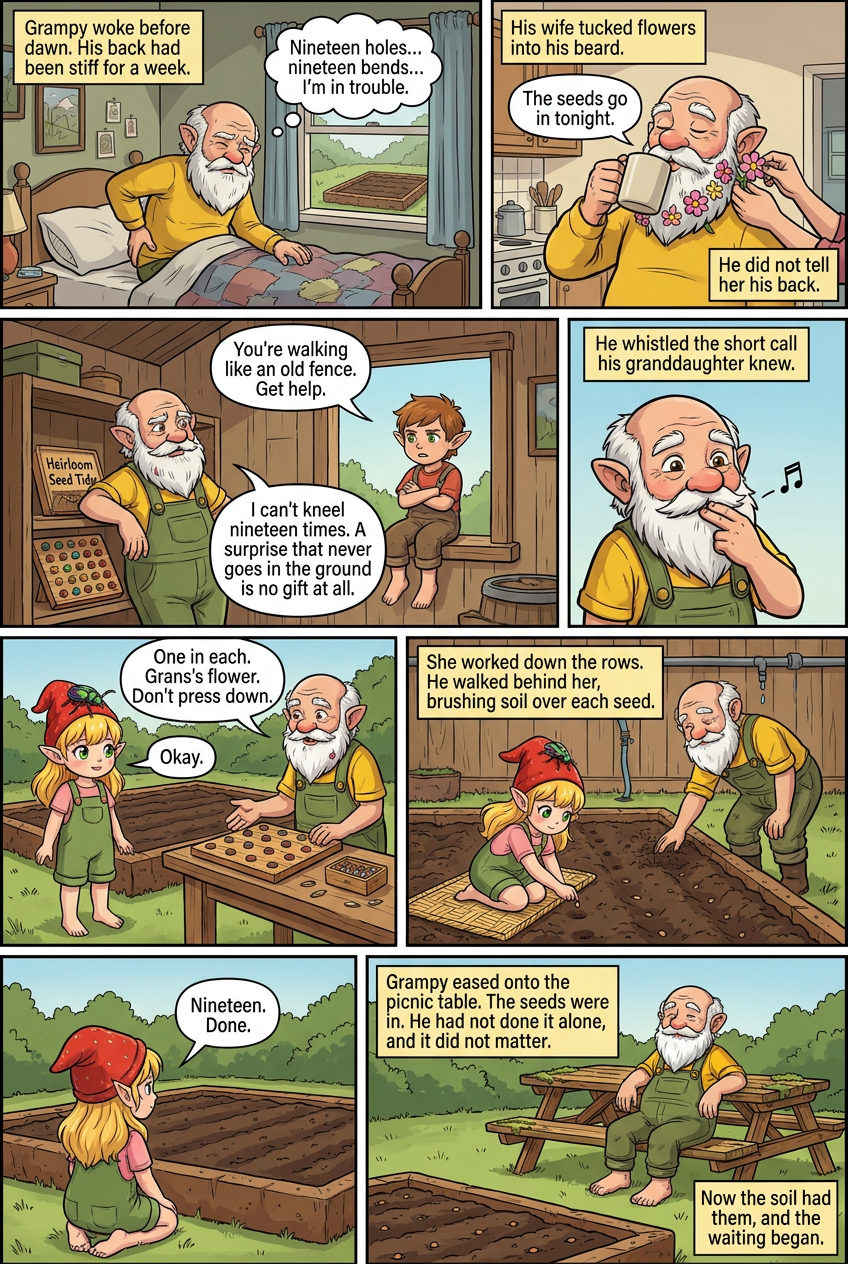
Grampy woke before dawn on planting day and knew he was in trouble. His back had been stiff for a week, and last night's leveling had wrung the last strength out of it. He sat up in slow pieces. He walked to the window and looked out at the covered bed with its nineteen waiting holes. Nineteen holes meant nineteen kneels, nineteen bends, nineteen careful drops. He put his hand on the small of his back and pressed. The muscle jumped like a rope pulled tight. He drank his tea standing. His wife tucked a pink flower and a yellow one into his beard and asked if the seeds went in tonight. He said they did. He did not tell her his back. She watched him a moment, then let him go. He made it to the shed by mid-morning. Togg sat on the doorsill. "You're walking like an old fence," Togg said. "I can't kneel nineteen times," Grampy said. "Not tonight. Maybe not five times." "Then don't," Togg said. "Get help." Grampy stared at the shelf where the wicker basket sat with the seeds spread on their flat stone. Nineteen seeds. One chance. He had planned every step alone because the gift was meant to be a surprise. But a surprise that never went into the ground was no gift at all. He walked out to the path and put two fingers in his mouth and whistled the short call his granddaughter knew. Delphine came through the gate within the hour, barefoot, red cap crooked, a beetle riding the point of it. She looked at his hand on his back and did not ask. "Show me," she said. He led her to the covered bed and lifted the moss. He set the pegged board across the soil and pressed. Nineteen clean holes. He handed her the little tray of seeds from the shed. "One in each," he said. "Middle of the hole. Don't press down. I'll cover." She knelt at the head of the bed and set a woven straw tile under her knees so the soil stayed smooth. "Which flower?" she asked. He shook his head. "Grans's flower. That's all I know." She nodded once, like that settled it. She worked down the rows. He walked behind her on his feet, bending only from the hips, brushing soil over each seed with the side of his hand. The watering pipe dripped its slow beads at the far end. When the last seed was covered, Delphine sat back on her heels and looked at the smooth dark bed. "Nineteen," she said. "Done." Grampy eased himself onto the mossy picnic table and let his back unclench. The seeds were in. He had not done it alone, and it did not matter. Now the soil had them, and the waiting began.
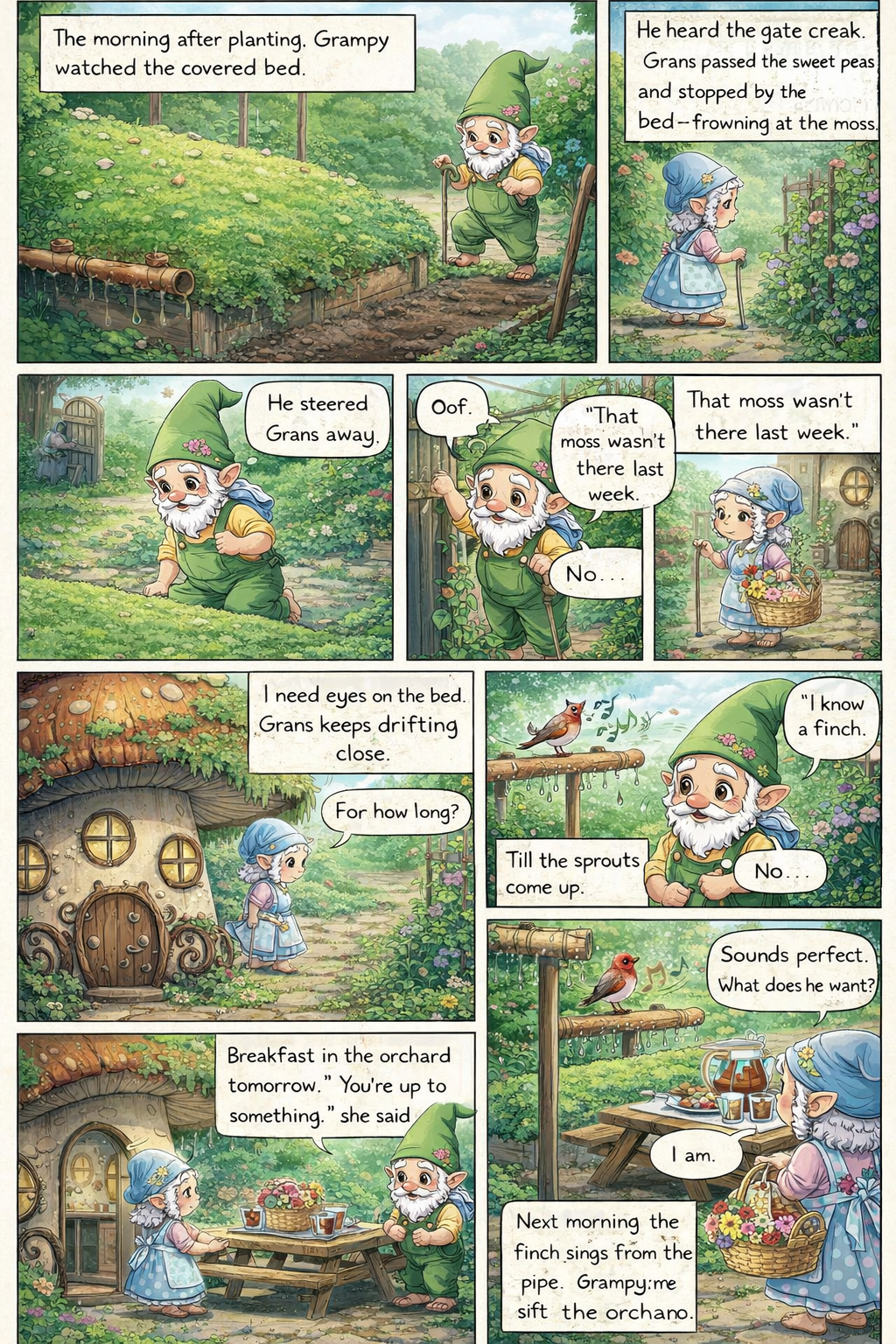
The morning after planting, Grampy sat on the picnic table with a cold cloth on his back and watched the covered bed. The moss was smoothed flat. The pipe dripped its slow beads. Nothing looked disturbed. Then he heard the gate creak and saw his wife coming up the path with her walking stick, checking the sweet peas as she passed. She stopped three steps from the secret bed and frowned at the moss. She had frowned at it yesterday too. And the day before. One more look, he knew, and she would lift a corner. He stood too fast and his back caught. He hobbled over and steered her elbow toward the sweet peas. "They need tying," he said. She let him turn her, but her eyes stayed on the covered patch a moment longer. "That moss wasn't there last week," she said. "No," he said. She waited. He said nothing. She gave him a small smile and went to the trellis. When she was inside, Grampy limped to the little mushroom-shaped house at the garden's edge where Hazel sometimes rested between errands. He tapped the door. The mouse fairy opened it with a crumb on her whisker. "I need eyes on the bed," Grampy said. "Grans keeps drifting close. One more look and the surprise is over." "For how long?" Hazel asked. "Till the sprouts come up. Then it won't matter." Hazel thought for a breath. "I know a finch. Sings when anyone comes near a spot. I'll ask him to sit the bed each morning. When Grans comes down the path, he sings. You steer her off." "What does he want for it?" "Millet. A handful a day." "Done." Hazel flew off and came back within the hour with the small red bird on her shoulder. The finch hopped onto the copper pipe above the bed and looked around like a foreman. Grampy set a pinch of millet on the slate dish nearby. The bird ate two seeds and tucked the rest away. Grampy went inside and packed a flower-trimmed basket with bread, apples, and a rolled note that said For Grans. He carried it to the kitchen where his wife had set out the chilled tea and a plate of blueberry biscuits. He put the basket on the table between them. "Breakfast in the orchard tomorrow," he said. "Away from the beds. Give your knees a rest." She looked at him a long moment. "You're up to something," she said. "I am," he said. "Good," she said, and poured the tea. The next morning, when she started down the garden path, the finch sang from the pipe. Grampy called her toward the orchard basket. She turned. The moss stayed flat. The bed kept its secret, and the seeds kept their dark, and now he only had to wait for green.
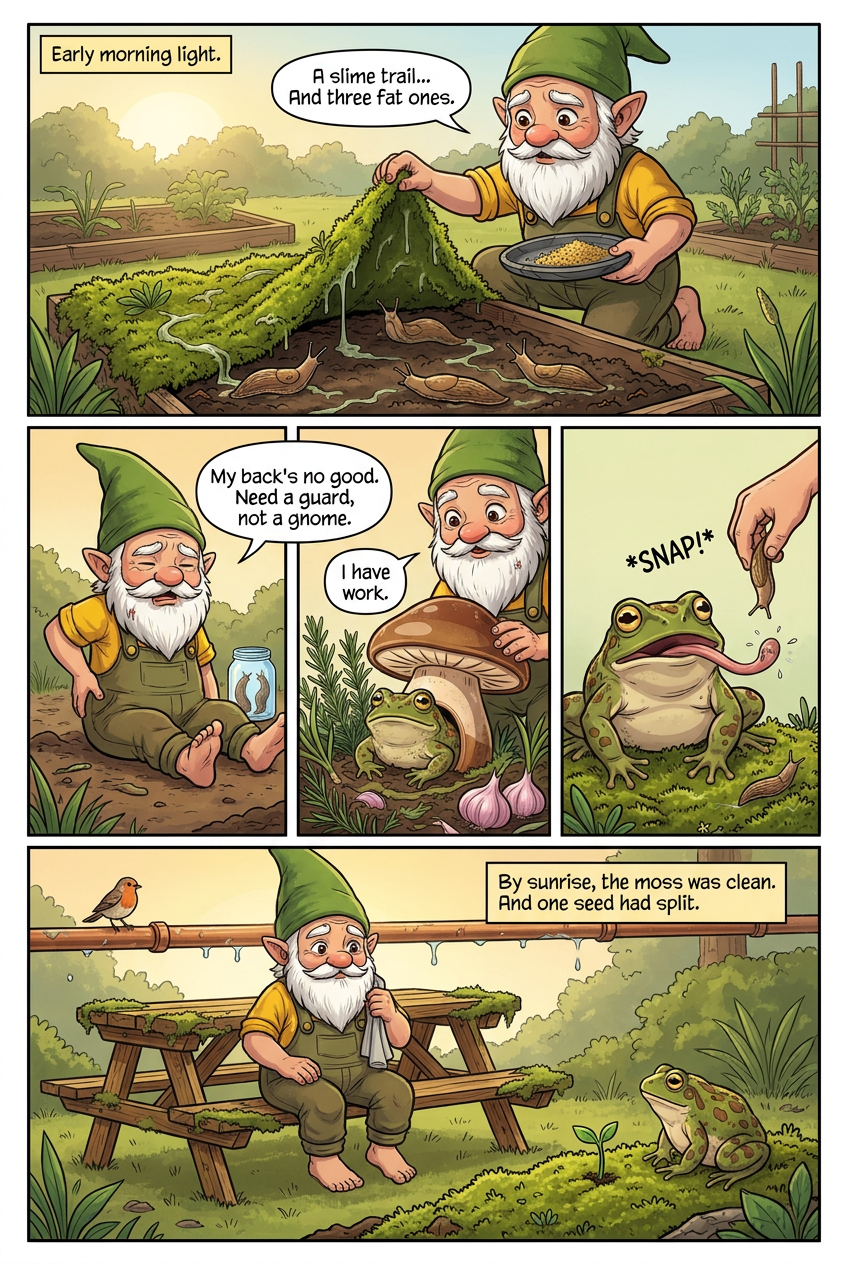
Two mornings after the finch took his post, Grampy carried a fresh handful of millet down the path before sunrise. The bird sang his ordinary greeting from the copper pipe. Grampy set the millet on the slate dish and bent to check the moss. Something silver caught the low light. A slime trail crossed the cover and slipped under the edge. He lifted the corner. Three slugs sat on the compost, fat and patient, working toward the buried seeds. He counted four more trails leading in from the sweet peas. His back locked when he crouched, so he sat flat in the dirt. The seeds were half a finger down. A sprout pushing up would meet a mouth. He had one morning at most before the first green tips broke the surface. If the slugs found them then, nineteen seeds became nothing, and forty years of a promise ended in a wet chew. He hobbled to the shed and took down an empty glass jar. He picked the three slugs off the bed with a bent twig and dropped them in. They slid down the glass and curled together at the bottom. Three caught did not fix seven trails. He needed a guard who worked all night, not a gnome with a jar and a sore back. He limped to the ceramic mushroom ornament at the edge of the herb ring. A garden toad lived under it most summers, fed on whatever crawled through the rosemary and the pink-bloom garlic. Grampy tipped the cap back. The toad sat inside, round and blinking. "I have work," Grampy said. He carried the ornament to the secret bed and set it down at the head of the row. He tipped the toad out onto the moss. It squatted, took stock, and did not move. Grampy emptied the jar beside it. The toad's tongue snapped once. One slug was gone. It snapped twice more. Grampy watched the round belly settle lower on the moss. He walked the bed and picked off the rest of the slugs by hand, dropping each one within reach of the toad. By the time the sun cleared the fence, the moss was clean and the toad had not moved from its post. He rinsed the jar at the barrel and set it upside down on the slate. He tucked the mushroom ornament beside the bed so the toad had shade for the day. Then he weighted the moss corner with a stone against the sweet-pea side, where the trails had come in. He sat on the picnic table and pressed the cold cloth to his back. The finch sang from the pipe. The toad blinked at the moss. Under the cover, at the head of the row, one seed had split its coat overnight and pushed a pale hook toward the light.
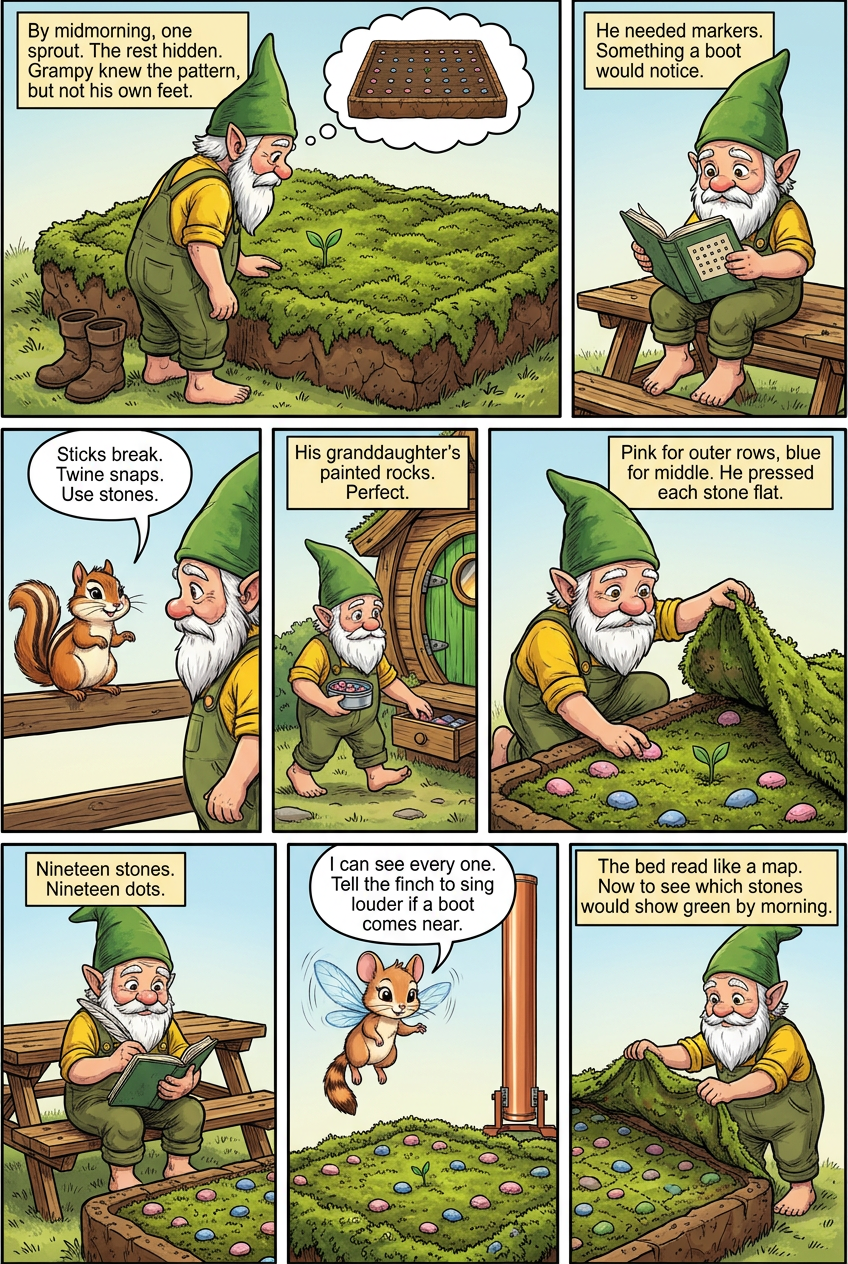
By midmorning the toad had not moved and the finch had not sung. Grampy stood at the edge of the bed and looked at the flat brown surface. One sprout had broken through near the head of the row. The other eighteen seeds lay hidden under the moss cover, half a finger down, spaced by the pegs he had used at planting. He knew the pattern in his head. He did not trust his feet. His boots were off, as always, and his toes were wide and clumsy. One wrong step would crush a stem before it saw daylight. He sat on the picnic table with his green journal open on his knee. The tomato stamp on the cover had faded from forty summers of pocket wear. Inside, he had drawn the bed at planting, nineteen dots in three staggered rows. He counted them again. He needed a marker for each dot that a toad would not swallow, a slug would not climb, and his own foot would notice before it came down. Togg watched from the fence rail, cheek pouches empty for once. "Sticks," he said. "Break in the wind. Twine snaps. Use stones." "Stones look like stones," Grampy said. "I'll forget which ones I placed." "Then don't use plain ones." Grampy closed the journal. He limped to the shed and opened the low drawer where his granddaughter kept her painting things. She had left a tin of small rocks from last summer, pink and blue, each one striped or dotted in white. He carried the tin to the bed and set it on the slate. He counted nineteen out and lined them on the table. He worked on his knees where he could, and on his backside where he could not. He lifted the moss cover a hand's width at a time. Under each peg-hole he set one painted stone, pink for the outer rows, blue for the middle. He pressed each stone flat so it sat level with the soil. The sprouted seed got a pink one tucked behind the pale hook so the stem had room. When he reached the last hole, he sat back and counted. Nineteen stones. Nineteen dots in his journal. He inked a small mark beside each dot to show it was placed. Hazel came down from the pipe and hovered above the bed. Her black eyes moved along the row. "I can see every one," she said. "From the air. From the ground too." She landed on the toad's back for a moment, then lifted off. "Tell the finch to sing louder if a boot comes near." Grampy weighted the moss cover again. The bed now read like a map. He could walk it in the dark. What he could not yet see was which of the other eighteen stones would show a green hook by morning, and which would show nothing at all.
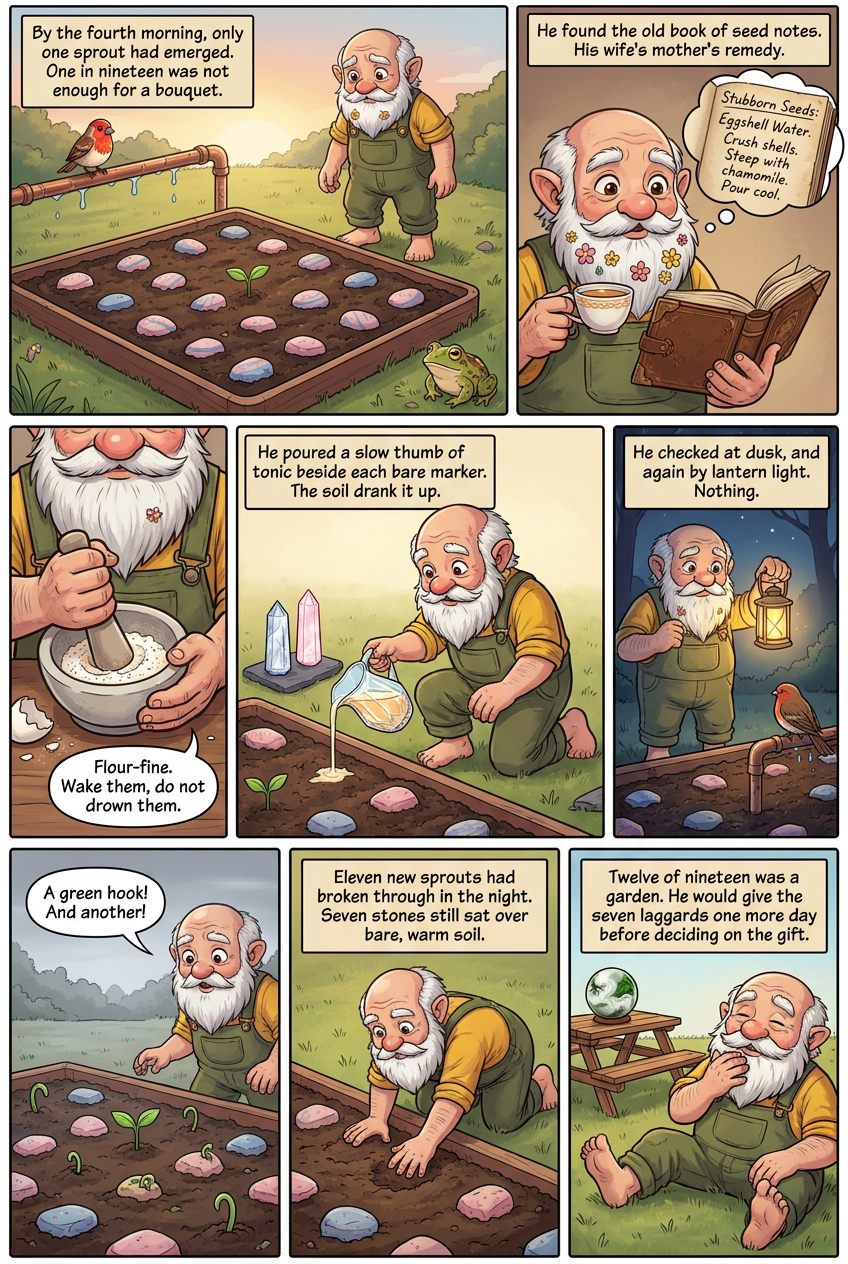
By the fourth morning after the first sprout, the bed still showed one green hook and eighteen flat stones. Grampy stood barefoot at the edge and counted again. The toad blinked from its corner. The finch stayed quiet on the pipe. One in nineteen was not enough. If the rest were duds, the anniversary would come and go with a single leaf where a bouquet should be. He went inside. His wife was already at the kettle, pink and yellow flowers fresh in his beard from breakfast. He did not tell her why he wanted the old book. He said only that he needed the one with the seed notes from her mother. She set it on the table and poured him a cup without asking more. He read at the picnic table until his tea went cold. Near the back, in faded ink, her mother had written a line about stubborn seeds and eggshell water. Crush the shells fine. Steep with weak chamomile. Pour cool along the row. Wake them, the note said, do not drown them. Grampy limped to the shed. He ground shells in a mortar until the powder was flour-fine. He steeped a thin tea, let it cool, and mixed the two in a clear jug. The liquid caught the sun and threw pale color across the slate. He carried it to the bed with both hands. He knelt beside the painted stones. Pink for the outer rows, blue for the middle. He poured a slow thumb of tonic beside each marker, careful not to wet the one sprout's stem. The soil drank each pour without pooling. When the jug was empty he set it on the slate beside two small crystal towers his wife kept there, one clear, one pink, a wedding gift she liked near growing things. He did not know if they helped. He left them where she had put them. He checked at dusk. Nothing. He checked by lantern before bed. Nothing. He slept badly and came out before the finch woke. In the gray light he saw them. Beside the blue stone in the middle row, a green hook. Beside a pink stone at the near corner, another. He crawled the row on his knees and counted. Eleven new sprouts had broken through in the night. Seven stones still sat over bare soil. He pressed a thumb against one of those seven. The soil was warm and soft. He did not know if the seven were slow or gone. He sat back on the grass and rubbed his beard. Twelve of nineteen was a garden. Twelve was not the bouquet he had promised. He had one round of tonic left in the jug and a shrinking calendar. He would give the seven laggards until the next dawn. After that, he would have to decide whether to wait, or plan a gift built from twelve.
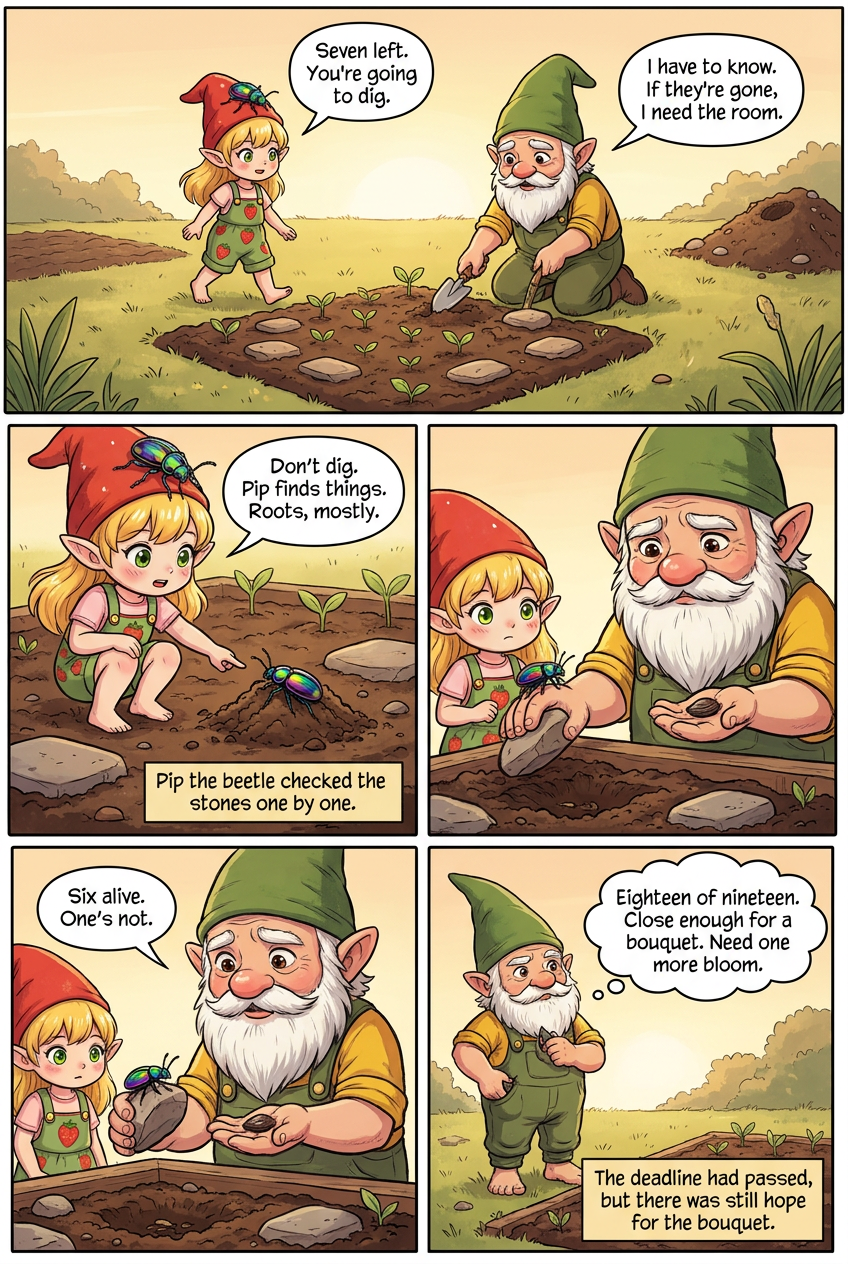
Grampy came out at first light with the empty jug in one hand and a small trowel in the other. The bed showed twelve green hooks and seven flat stones. The dawn deadline he had set himself was here. He knelt by the nearest pink stone and set the trowel on the soil. If the seed under it was dead, he needed to know so he could replant the spot with a common bloom to fill the bouquet. If the seed was alive, one wrong dig would end it. He could not tell by looking. He pressed a thumb near the stone. The soil felt the same as every other patch. He sat back and rubbed his beard, and the flowers his wife had tucked in that morning brushed his wrist. A small crunch came from the grass. Delphine walked up in her red hat and strawberry overalls, a beetle riding on the brim. She stopped at the edge of the bed and counted the stones without being asked. "Seven left," she said. "You're going to dig." "I have to know," Grampy said. "If they're gone, I need the room." "Don't dig." She crouched and lifted the beetle off her hat. Its shell threw green and pink in the light. "Pip finds things. Roots, mostly. He can smell if there's anything under." She set the beetle on the soil beside the first pink stone. It sat still, then walked a slow half-circle and pushed its head into the dirt. A small mound turned up beside the stone. The beetle climbed out and went to the next stone on its own. Grampy watched it work its way down the row. At six of the stones the beetle dug a shallow scoop, sniffed, and moved on without lingering. At the seventh, the beetle stayed. It circled the stone twice and would not leave. Delphine picked it up and set it on her palm. "Six alive," she said. "One's not." Grampy lifted only the stone the beetle had refused to leave. He scraped a careful thumb of soil aside. A dark husk lay just under the surface, soft and split, no root, no shoot. He pinched it out and held it in his palm. Then he moved to the six mounds the beetle had made and pressed the soil back flat. Under each, he knew now, a pale seed sat with a thread of root and a stem still climbing. He replaced six stones and pocketed the seventh husk. Eighteen of nineteen. Not the full count he had promised, but close enough for a bouquet. He would need one more bloom to round it out, and he had a day less than he wanted to find it.
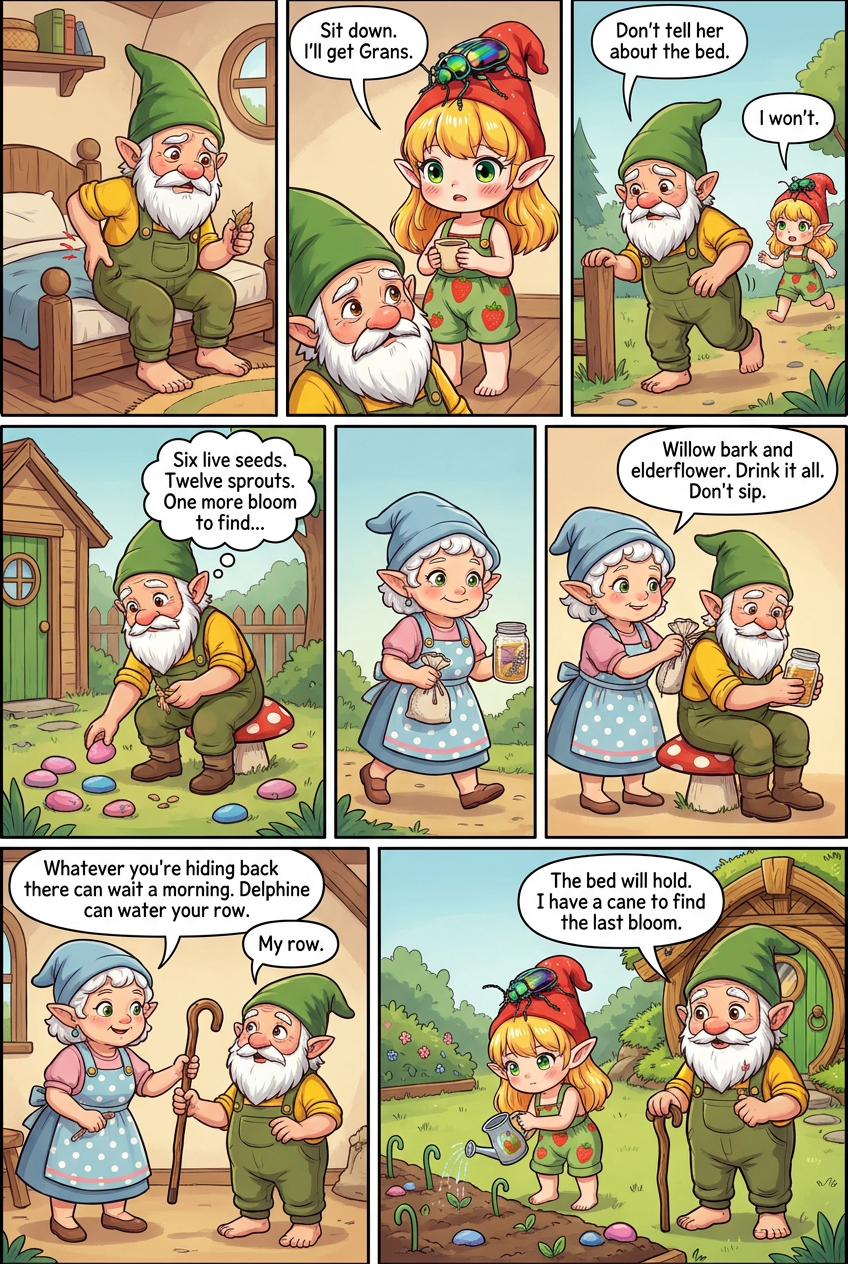
Grampy pocketed the dead husk and tried to stand. His back locked halfway. He caught himself on the edge of the bed with one hand and breathed through his teeth. The six live seeds needed shallow water twice a day and a careful thumb pressing the crumbs back around each shoot. He could not stoop. He could barely straighten. Delphine stood over him with the beetle cupped in her hands and watched him fail to rise. "Sit down," she said. "I'll get Grans." "Don't tell her about the bed." "I won't." She was already running. He shuffled to the red-capped toadstool near the shed and lowered himself onto it in stages. The pain settled into a hot band above his hips. He counted the pink and blue stones from where he sat. Six live seeds. Twelve sprouts. One husk in his pocket. One more bloom still to find, and now he could not even kneel to tend what he had. Grans came around the corner in her polka-dot apron with a linen sachet in one hand and a glass jar in the other. She did not ask what he had been doing. She set the sachet against the small of his back and tied it there with the apron string. The smell of lavender and warm oats rose off it. Then she pressed the jar into his palm. The tea inside was still warm from the sun. "Willow bark and elderflower," she said. "Drink it all. Don't sip." He drank. She went into the shed and came back with a hickory cane he had not seen since her father's time. She set it against his knee. "You've been up before dawn for a week," Grans said. "Whatever you're hiding back there can wait a morning. I'll water the sweet peas. Delphine can water your row." He looked up. "My row." "The one with the painted stones." She brushed a yellow flower straight in his beard. "I've known about it since Tuesday. I haven't looked under the cloth. I won't." He opened his mouth and closed it. Delphine crouched by the bed with the small jug and began working her way down the row, tipping a thin stream at each green hook and each blue and pink stone. Pip rode her hat. Grampy leaned on the cane and stood. The band of heat loosened. He could walk. He could not kneel, not today, maybe not tomorrow. But the six seeds would be watered, and the twelve sprouts would be tended, and the bed would hold. He had one day less to find the nineteenth bloom, and now he had a cane instead of two good knees to find it with.
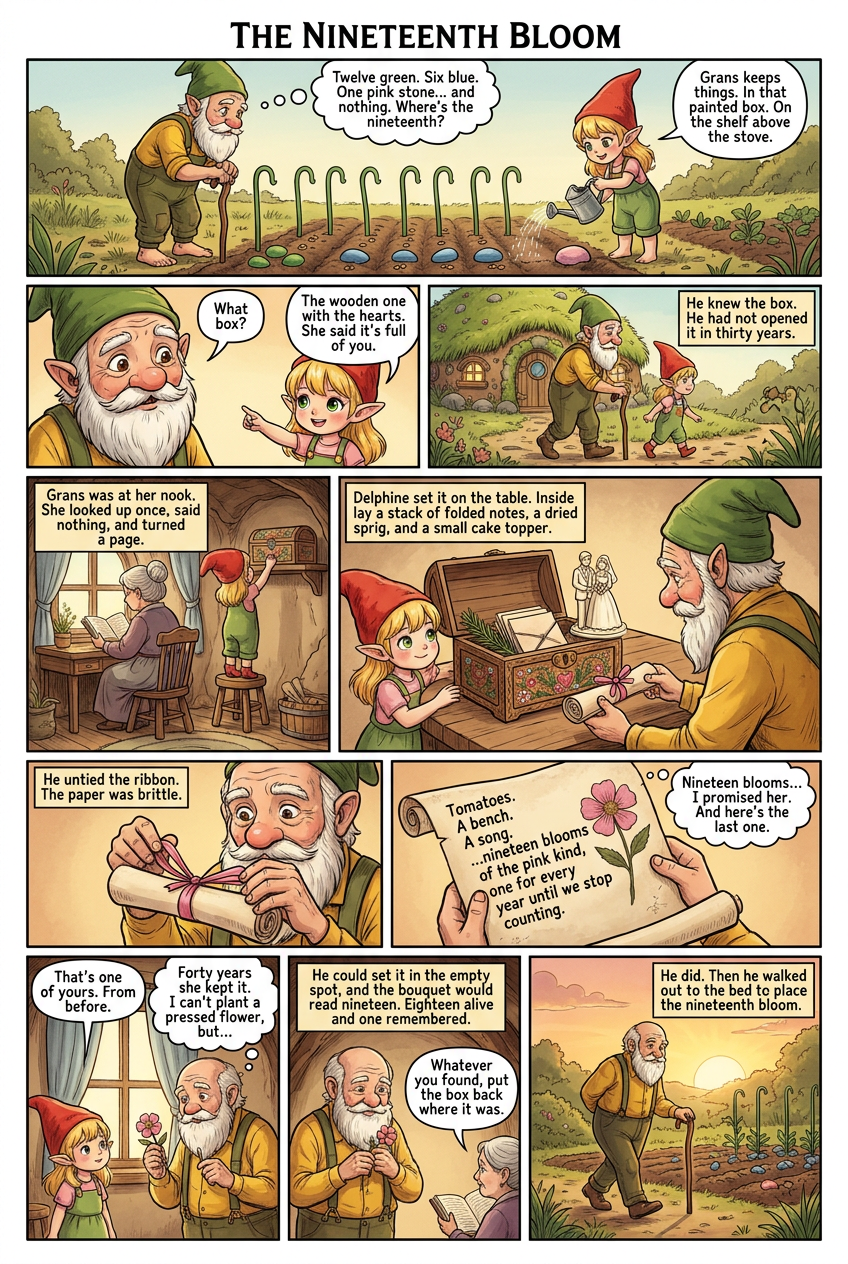
Grampy leaned on the cane and watched Delphine finish watering the row. Twelve green hooks. Six blue stones over sleeping seeds. One pink stone with nothing under it. He had walked every hedge and fencerow this week and found no cutting, no volunteer, no seedling that matched the flowers already up. The bouquet needed nineteen. He had eighteen coming, and a hole where the last should stand. "Grans keeps things," Delphine said. She had not looked up from the jug. "In that painted box. On the shelf above the stove." "What box." "The wooden one with the hearts. She showed me once. She said it was full of you." He knew the box. He had carved the hinges himself. He had not opened it in thirty years, and he could not think what a keepsake chest had to do with a missing bloom. But Delphine was already walking to the burrow, and he followed with the cane biting the path. Grans was at her writing nook by the window, her tea steaming beside an open book. She looked up once, said nothing, and turned a page. Delphine climbed the stool and lifted the painted chest down with both hands. She set it on the table in front of him. Inside lay a stack of folded notes, a dried sprig of rosemary, and a small cake topper of two gnomes in ivory, holding each other by the wrist. Under the topper was a scroll tied with a pink ribbon. He untied the ribbon. The paper was brittle at the edges. It was his own handwriting, forty years younger, listing what he had promised her on the morning of their wedding. He read down the list. Tomatoes. A bench by the door. A song on her birthday. And near the bottom, in a line he had forgotten writing: nineteen blooms of the pink kind, one for every year until we stop counting. Folded inside the scroll, flat and dry as paper, was a single pressed flower. Pink. Five petals. The exact match of the seeds he had spent the season coaxing from dirt. "That's one of yours," Delphine said. "From before." He held it to the window. The petals were thin as moth wing but whole. Grans had kept it forty years in a box he had built her. He could not plant a pressed flower. But he could set it in the empty spot beneath the cloth, stem in the soil, and the bouquet would read nineteen when she lifted the cover. Eighteen alive and one remembered. He tucked the flower into his shirt pocket, closed the chest, and reached for the cane. Grans turned another page and did not look up. "Whatever you found," she said, "put the box back where it was." He did. Then he walked out to the bed to place the nineteenth bloom.
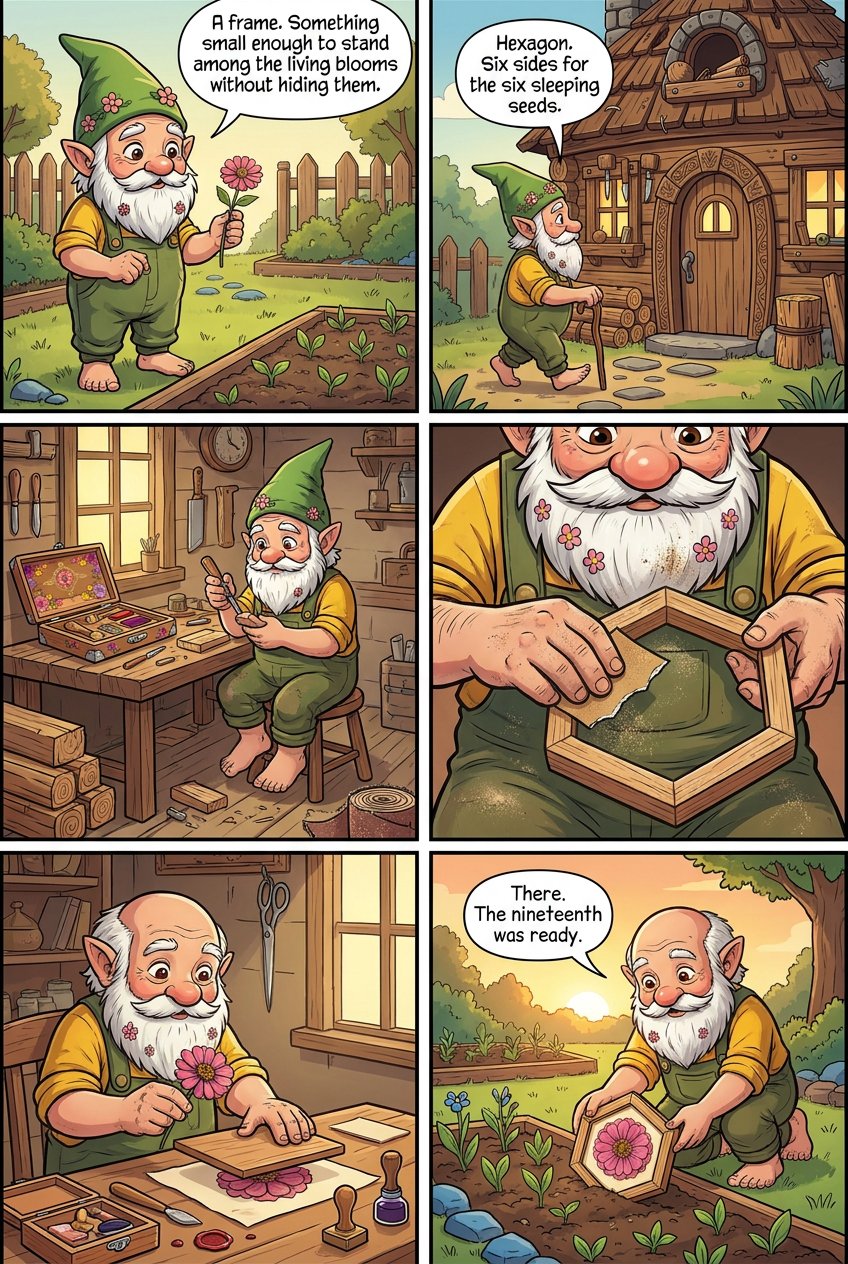
Grampy set the pressed flower on the bed beneath the cloth and stopped. The stem sat in soil, but the petals looked wrong against the living sprouts. One dry touch of wind would break it. When Grans lifted the cover, she would see eighteen green shoots and a crumbling flake beside them. He picked it up again, cradled in his palm, and turned toward the workshop. He crossed the yard with the cane and pushed open the tinkershop door. The stove was cold. Sawdust lay in the corners. He needed to make the flower safe to hold and safe to show. A frame, then. Something small enough to stand among the living blooms without hiding them. He laid the pressed flower on a scrap of cloth and studied his stacked lumber. Thin offcuts sat on the top row. He chose six pale pieces, each no longer than his thumb. Hexagon, he decided. Six sides for the six sleeping seeds still underground. He drew angles on the wood with a pencil and clamped the first piece in the vise. His back would not let him stand long. He sat on the stool and worked slow. He opened the chisel box and lifted a small blade with a polished handle. The saw took the corners at a slant. The chisel cleaned the joints. He fit the six pieces together dry, and the seams closed without gaps. He pulled the sanding roll from the shelf and tore a strip. He rubbed the frame smooth, edge and face, until the wood felt like skin. Dust settled on his beard flowers. He blew it off and set the frame down. The petals were the harder part. He opened the sealing kit Grans kept for her letters. Inside sat a small block of beeswax and a square of thin paper. He warmed the paper over a candle stub until the wax softened into it. He laid the pressed flower on the warmed sheet, set a second sheet on top, and pressed them together between two flat boards. When he lifted the top board, the flower lay sealed inside, flat and safe. He trimmed the sealed paper to fit the hexagon and glued it into the back of the frame with pine sap. He held it to the window. The petals stayed put. The paper let the light through and turned honey-gold behind the pink. He carried the frame back to the garden bed on the cane. He lifted the cloth. Twelve sprouts. Six blue stones. One pink stone with nothing under it. He pressed the frame's bottom edge into the soil at the empty spot, so it stood upright like a bloom on a stem. He covered the bed again. The nineteenth was ready. Now he needed the other six seeds to break ground before the anniversary morning, and only three days remained.
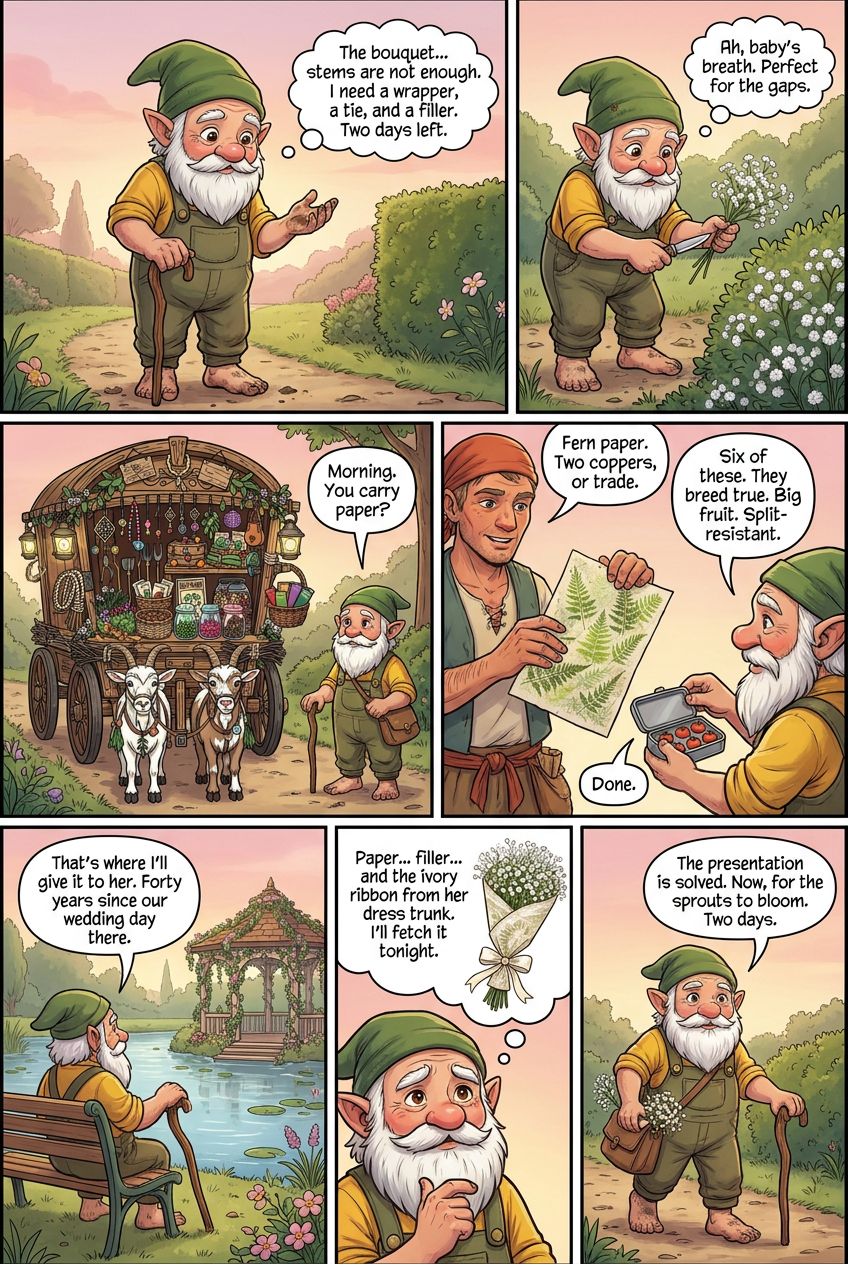
Grampy left the covered bed at first light and started down the path with his cane. The bouquet had a frame, stones, and eighteen living sprouts under cloth. What it did not have was a way to be presented. A handful of stems pulled from soil would look like weeds in his fist. He needed a wrapper, a tie, and a filler. Two days remained. He stopped where the path dipped past a low hedge. White baby's breath grew there in a soft cloud. He cut a full spray with his pocket knife and laid it across his forearm. The tiny blossoms would fill the gaps between the pink blooms and make the bouquet look full even if a sprout or two stayed short. Further on, a peddler's wagon stood at the bend. Two goats chewed at the harness. Jars of seeds and bundles of dried herbs hung from hooks along the side. The merchant was a stranger, sunburned and quick-eyed, sorting packets on the drop-shelf. "Morning," Grampy said. He leaned on the cane. "You carry paper?" The merchant lifted a folded sheet from a basket. Pressed ferns ran through it in green veins. "Fern paper. Two coppers, or trade." Grampy did not have two coppers on him. He did have the small tin in his pocket, the one he carried out of habit. He opened it. Six heirloom tomato seeds sat inside, saved from the year he and his wife filled bags for strangers. "Six of these," Grampy said. "They breed true. Big fruit. Split-resistant." The merchant took one, bit it lightly, nodded. "Done." Grampy folded the fern paper carefully into his satchel with the baby's breath and moved on. The path opened at the pond. A carved bench sat beside the water, lily pads painted across its back. He lowered himself onto the seat and rested the cane against his knee. Across the pond stood the pavilion where he had married her forty years ago. Vines still climbed the posts. Flowers still hung from the eaves. That was where he would give her the bouquet on the anniversary morning. He took stock. Paper for the wrap. Filler for the gaps. He still needed the tie. He thought of the trunk under their bed and the length of ivory ribbon inside it, cut from the hem of her wedding dress the night before their first tomato harvest. She had saved it for him to use once. He had waited forty years for the once. He would fetch the ribbon tonight while she baked. Fern paper around the stems. Baby's breath tucked between the pink blooms and the framed flower. Ribbon knotted at the base. Grampy stood on the cane and started back. The presentation was solved. Now the last six sprouts had to break ground in two days, or the wrapping would hold nothing but promises.
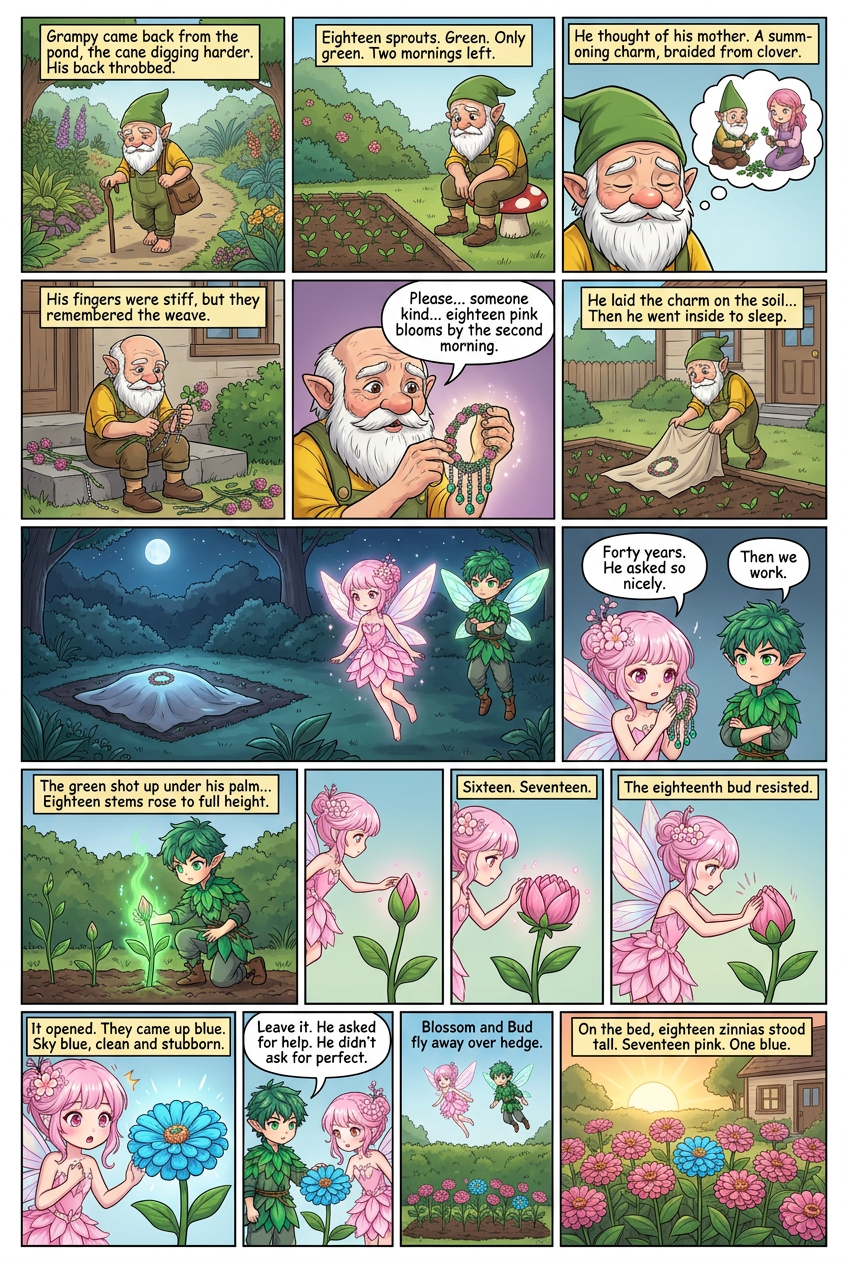
Grampy came back from the pond with the fern paper tucked in his satchel and the cane digging harder into the path than it had that morning. His back throbbed. His hands shook when he lifted the cloth off the secret bed. Eighteen sprouts stood in their rows. Green. Only green. Two mornings left, and no way to tell if a single one would open pink before his wife walked to the pavilion. He sat on the toadstool seat by the bed and pressed his palms to his knees. He had built a watering pipe, moved a fox, traded seeds, framed a keepsake. He could not force a bud open with a cane and a sore back. If they bloomed white, or yellow, or stayed shut, the promise broke. He thought of his mother then. She had taught him a summoning charm when he was small, braided from clover and whispered over. She had used it once to call help for a sick apple tree. He had never tried it himself. He did not know if it still worked. He did not have another idea. He gathered pink clover from the edge of the lawn and sat on the step. His fingers were stiff, but they remembered the weave. He braided the stems, threaded in a few silver seed beads from his workshop drawer, tied off the ends with jade chips his granddaughter had left on the sill. He spoke his mother's words over the loop. He asked, plainly, for someone kind to help eighteen sprouts bloom pink by the second morning. He laid the charm on the soil between the marker stones and covered the bed. Then he went inside to sleep. Before moonrise, two small figures found the charm. She landed first, a pink-haired sprite in a petal dress, her wings catching the last light. Her brother followed, leaf-cloaked, green-eyed, arms folded as he read the bed like a page. She lifted the clover loop and held it to her cheek. "Forty years," she whispered. "He asked so nicely." "Then we work," her brother said. He knelt at the first sprout and set his hand on the stem. The green shot up under his palm, unfurling leaves, opening a tight bud at the crown. He moved down the row. Eighteen stems rose to full height before the owl called twice. Then his sister stepped in. She touched each bud in turn. Petals loosened, curled back, flushed pink from center to edge. Sixteen. Seventeen. The eighteenth bud resisted. She pressed her fingertip to it, then her palm. The petals opened. They came up blue. Sky blue, clean and stubborn, refusing her color. She tried once more. The bloom stayed blue. Her brother touched her shoulder. "Leave it. He asked for help. He didn't ask for perfect." They rose together and slipped over the hedge. On the bed, eighteen zinnias stood tall in the dark. Seventeen pink. One blue.
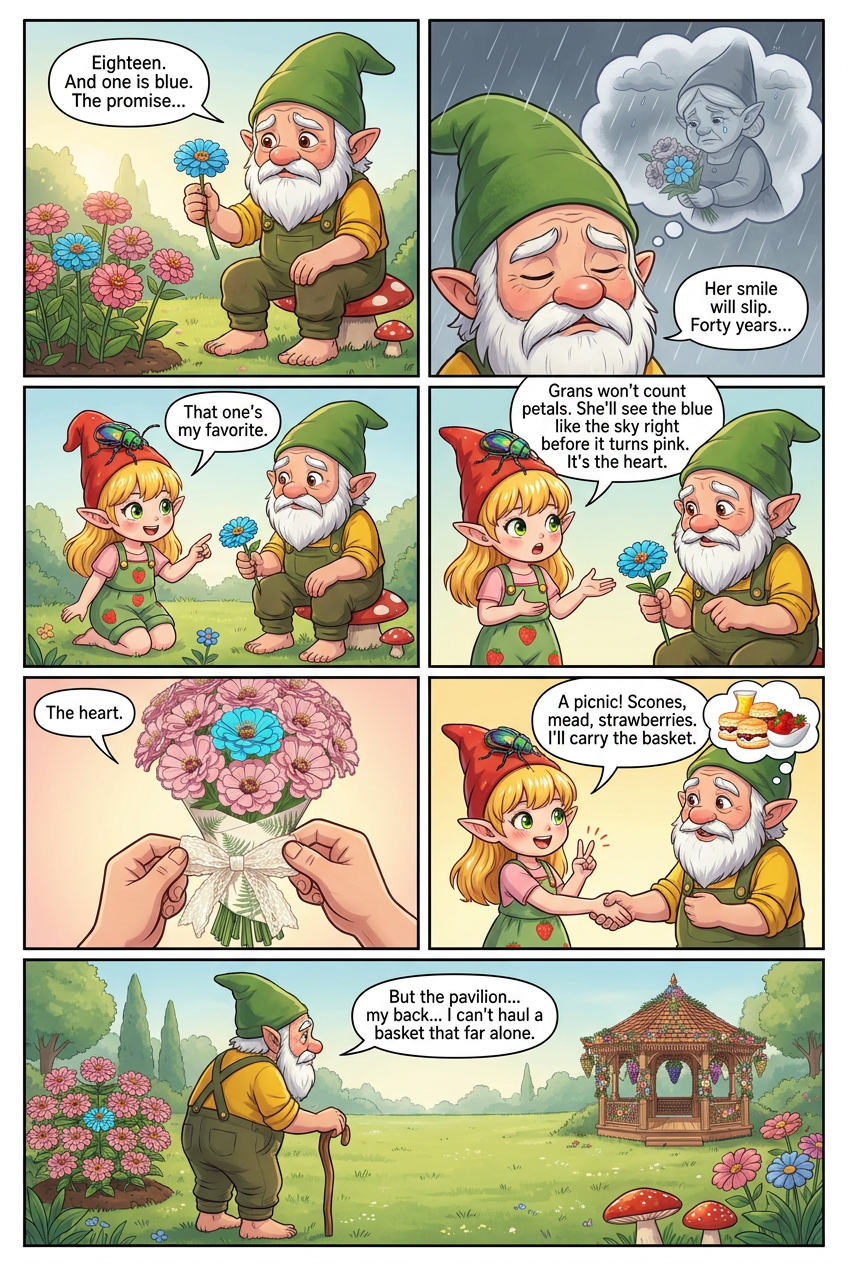
Morning light fell on the secret bed. Grampy lifted the cloth and counted again, hoping the night had changed something. Seventeen zinnias glowed pink. One stood blue at the center, stubborn and bright. He had promised nineteen pink blooms, one for each year. Now there were eighteen flowers, and one wore the wrong color. He sank onto the toadstool seat and stared at the blue bloom. He saw it play out in his mind, clear as a picture. He would carry the bouquet to the pavilion where they married. Grans would smile, then count, then find the blue one. Her smile would slip. Forty years of promise, broken by a single petal. The daydream hung over him like a soft gray cloud, and he could not push it away. "Why are you sad? They bloomed." Delphine climbed the step, bare feet quick, a beetle riding her cap. His granddaughter had knelt in this dirt beside him, placed every seed with her own hands. She looked at the blue flower and tilted her head. "That one's my favorite." "It was supposed to be pink," Grampy said. "All nineteen. That's the promise." Delphine folded her arms. "You moved a fox. You built a water pipe. You planted every seed on your knees till your back gave out." She pointed at the bouquet. "Grans won't count petals. She'll count all of that." Grampy shook his head. "She loves flowers. She'll see the blue." "Then let her." Delphine crouched beside him. "Blue like the sky right before it turns pink. Like someone dropped a piece of morning in the middle." She grinned. "You can't fake that. It grew that way." He looked at the blue bloom again. Slowly, it stopped looking like a mistake. "Wrap it in the middle," Delphine said. "On purpose. Then it's not the one that went wrong. It's the heart." Grampy's throat tightened. He gathered the seventeen pink zinnias in a ring. He set the blue one at the center, tall and clear. He folded the fern paper around the stems and tied the ivory ribbon in a slow knot. The bouquet held together, eighteen blooms, one blue heart. It looked whole. "Better," Delphine said. "She still visits the pavilion tomorrow," Grampy said. "I want more than flowers." Delphine's eyes went wide with a plan. "A picnic. Scones with jam and cream. Honey mead. Strawberries in a white dish." She was already counting on her fingers. "I'll carry the basket. I'll set it all out before she comes." She held out her small hand. "And I won't breathe a word to Grans. Promise." Grampy shook her hand. His fear had turned into a plan. The blue bloom would stay. The picnic would carry the rest. But the pavilion sat across the meadow, and his back still bent him over the cane. He could not haul a basket that far alone.
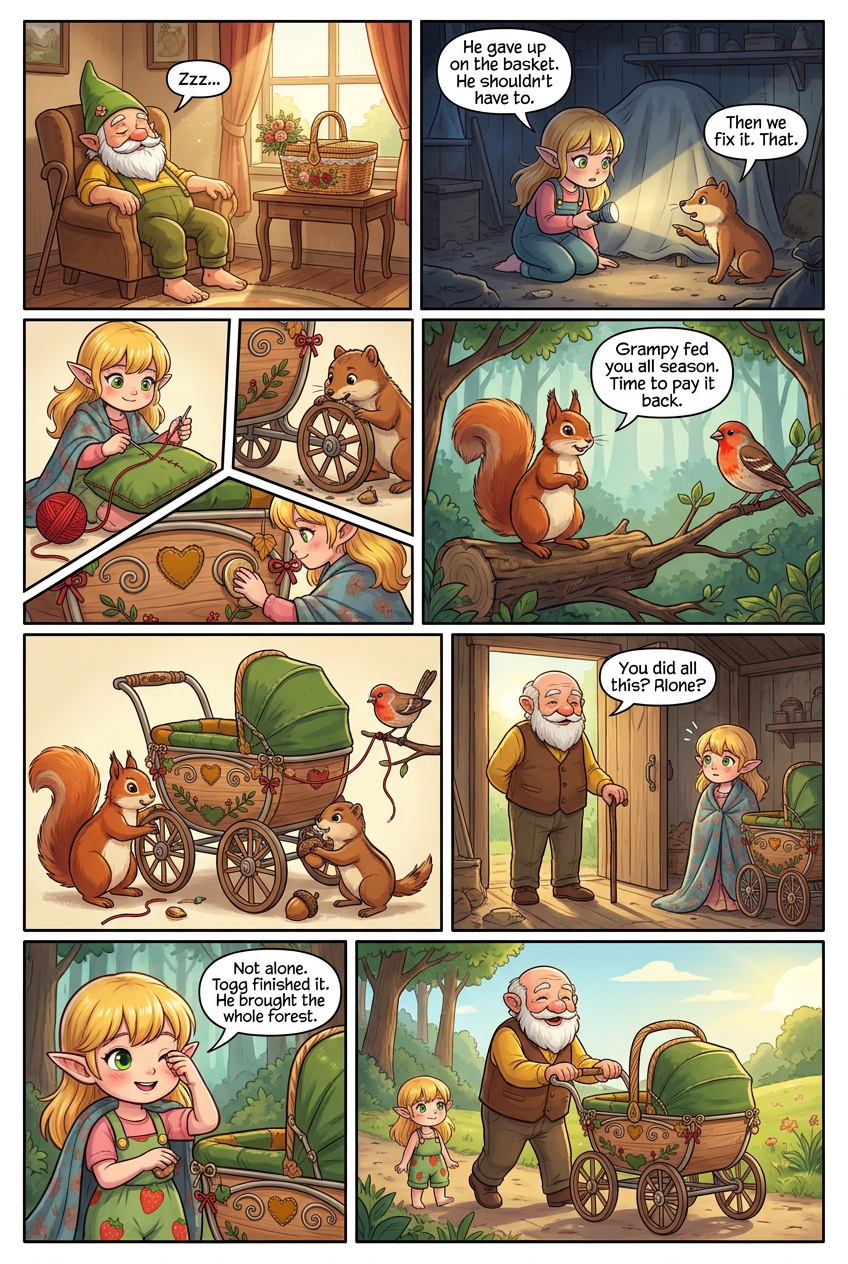
Grampy slept in his chair by the window, his cane leaning against the wall. The bouquet waited on the table, eighteen blooms tied in ivory ribbon. The picnic was planned. But the pavilion sat across the meadow, and his back would not let him carry the basket that far. He did not know his granddaughter had a plan of her own. Delphine crept into the shed after dark. Togg dropped from the top shelf and landed beside her. "He gave up on the basket," she whispered. "He shouldn't have to." "Then we fix it," Togg said. He was Grampy's oldest deal-maker, the chipmunk who ran the shed at night and never backed down from anything. He pointed his nose at a shape under a cloth in the corner. "That." They pulled the cloth away. Under it sat an old baby carriage, one wheel cracked, the cushion split and gray with dust. Delphine ran her hand over the wooden body. "We can roll the basket in this. No lifting." They worked through the night. Delphine tightened the cracked wheel while Togg gnawed loose threads from the torn cushion. She stitched the seam with strawberry-red yarn. She rubbed the wood until the old heart carved on its side showed clean again. Her hands slowed. Her head dipped. Long past midnight she curled under a blanket on the shed floor and slept. Togg looked at the half-fixed carriage and the sleeping girl. One wheel still wobbled. Dawn was coming. He scrambled out the door and up the treeline. He found the pregnant red squirrel first, listening from her log. "Grampy fed you all season," Togg said. "Time to pay it back." He woke the finch that guarded the garden. He rapped on the toad's rock. One by one the critters came. They packed the cushion tight with dry moss. The squirrel held the wobbly wheel steady while Togg wedged an acorn cap under the axle to lock it true. The finch tugged the last thread snug. By the time the sky turned pale, the carriage stood whole. Its wheels ran smooth. The green cushion sat plump and clean. Togg tucked leaves along the rim and slipped away. Grampy woke at first light and reached for his cane. He shuffled to the shed and stopped in the doorway. Delphine sat blinking in the straw beside a mended carriage, the blanket still around her shoulders. "You did all this?" he said. "Alone? Through the night?" Delphine rubbed her eyes. "Not alone. I fell asleep." She patted the wooden side. "Togg finished it. He brought the whole forest." She stood and pushed the carriage to him. It rolled without a squeak. "You can use this to carry the basket and bouquet. No lifting. No hurting your back." Grampy set the picnic basket inside. It fit as if the carriage were built for it. He gripped the handle and pushed. The wheels turned easy across the floor. The meadow was no longer too far.
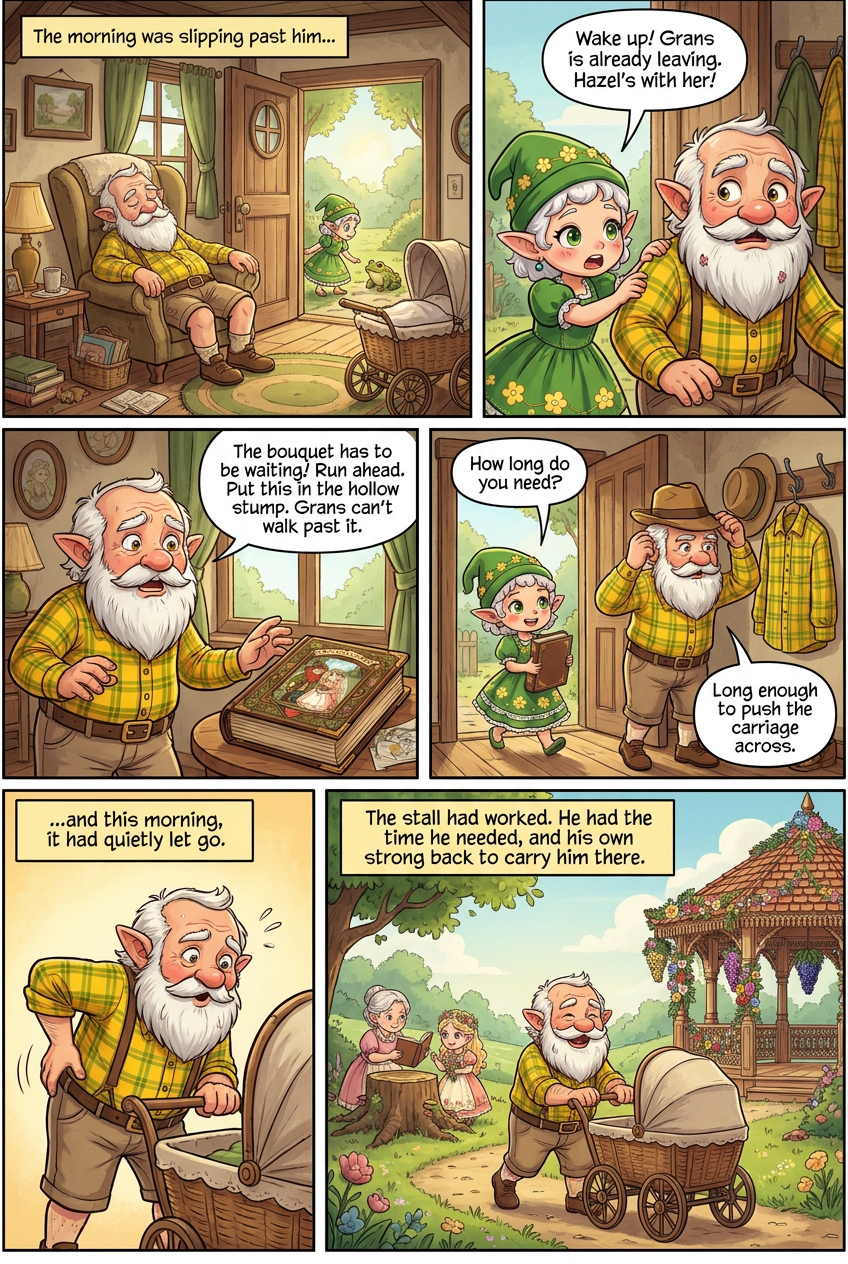
The mended carriage stood ready by the door, the basket and bouquet tucked safe inside. But Grampy had drifted back to sleep in his chair, the morning slipping past him. Delphine crouched outside near a fern, coaxing a toad onto her palm. She looked up when a shape crossed the meadow. Grans was already awake, tying her apron, stepping onto the path toward the pavilion. Beside her fluttered a brown mouse fairy with blue wings—Hazel, the sharp-eyed friend who noticed everything in the forest. The two were walking together, early. Grampy would never beat them there. Delphine set the toad down and slipped through the back door. She shook Grampy's shoulder. "Wake up. Grans is already leaving. Hazel's with her." Grampy jerked upright. He looked at the window, then the carriage, then his bare feet. "They can't reach the pavilion first," he said. "The bouquet has to be waiting when she arrives. That's the whole surprise." He gripped his cane and stood, but his mind moved faster than his legs. His eyes landed on the photo album on the tea table—the one with their young wedding faces on the cover, forty years of gardens and friends pressed inside. He held it out to Delphine. "Run ahead. Put this in the hollow stump along their path. The mossy one, with the sitting nook. Grans can't walk past a thing like this. She'll stop. She'll show Hazel every page." Delphine took the album in both arms. "How long do you need?" "Long enough to dress and push the carriage across." "Then she'll be reading a while," Delphine said. She was already at the door. "Don't fall asleep again." She ran. Grampy pulled his best outfit from the hook—the buttercup-yellow shirt with green plaid, the dove-brown shorts. He dressed faster than he had in weeks. He bent to button the cuffs and waited for the familiar catch in his spine. It did not come. He straightened. He bent again, lower this time, testing. His back held. No stab, no ache. He set the cane against the wall and stood on his own two feet, steady. Forty years of gardening and one hard week of pain, and this morning it had quietly let go. He pushed the carriage into the sunlight and started across the meadow. Far ahead, near the mossy stump, he saw two small figures stop. Grans had found the album. Hazel perched on the rim beside her. Grans was turning pages, her hand pressed to her chest. Grampy smiled and kept walking. The pavilion waited beyond them. The stall had worked. He had the time he needed, and for the first time in days, he had his own strong back to carry him there.
Play your story to life
Storycraft is a mobile game where you create AI characters, craft items and locations to build their world, then discover what direction your story takes. Download the iOS game for free today!
Download for free