

Hannah Mitchell's Arc
8 Chapters
Hannah Mitchell's dream is opening a cozy tearoom in the heart of Angel Forest where every weary traveler feels at home..

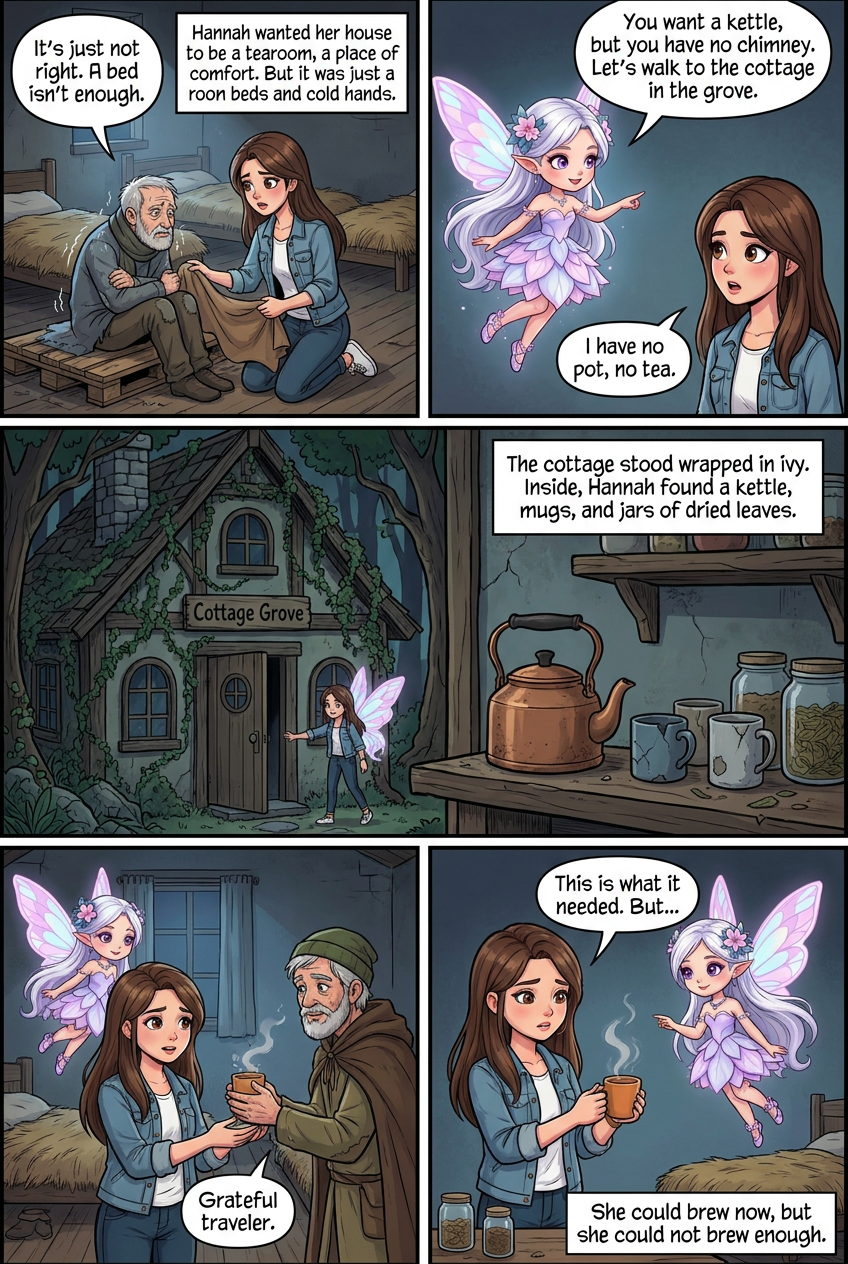
Hannah Mitchell had furnished a house full of beds for weary travelers, but she watched a stranger wake with nothing warm to hold. The old man sat up on his straw pallet and shivered. He looked around the glowing room and found no cup, no kettle, no fire he could use. Hannah knelt beside him with only a blanket. She wanted this place to be the tearoom she dreamed of, where every tired traveler felt at home. Right now it was just a room with beds and cold hands. Hannah sold jam at a farmers market on weekends. Her grandmother wrote every recipe before she died, and Hannah meant to see them printed in a real cookbook. But a book needed a place where people gathered and remembered her name. This house in the forest could be that place. It could not, not while guests woke with nothing to comfort them. The old man drank plain water and left before Hannah could fix it. That failure decided her. She would build a way to brew and serve warm drinks by morning. A fairy dropped through the open door. Luna was small, with silver hair and wings the color of dawn, and she landed on the empty water bucket without asking. Hannah had met her once before, hovering near the cypress tree. The fairy grinned like she already knew the problem. "You want a kettle," Luna said. "You have no chimney. No place for smoke." "I have a stove that never goes out," Hannah said. "I have no pot to set on it and no tea." Luna tilted her head. "Then we walk to the cottage in the grove. It has a chimney and a shelf of things nobody uses." They went together through the trees. The cottage stood wrapped in ivy, small and handmade, its windows dark. Hannah pushed the door. Inside she found a copper kettle, chipped mugs, and jars of dried leaves on a low shelf. Dust covered them, but the kettle held water without leaking. Hannah carried the kettle back and set it on the stove that burned without tending. Luna filled the mugs and crushed dried leaves into each one. The water boiled fast. Steam rose and filled the glowing room with the smell of mint and warm copper. When the next traveler woke, Hannah pressed a hot mug into her hands. The woman held it against her chest and stopped shivering. She drank, and color returned to her face. "That's it," Hannah said. "That's what this place was missing." But she counted her leaves and found only three jars. She had one kettle and a handful of mugs. More travelers arrived each night than she could serve with so little. Hannah stared at the steam and understood her next problem. She could brew now. She could not brew enough.
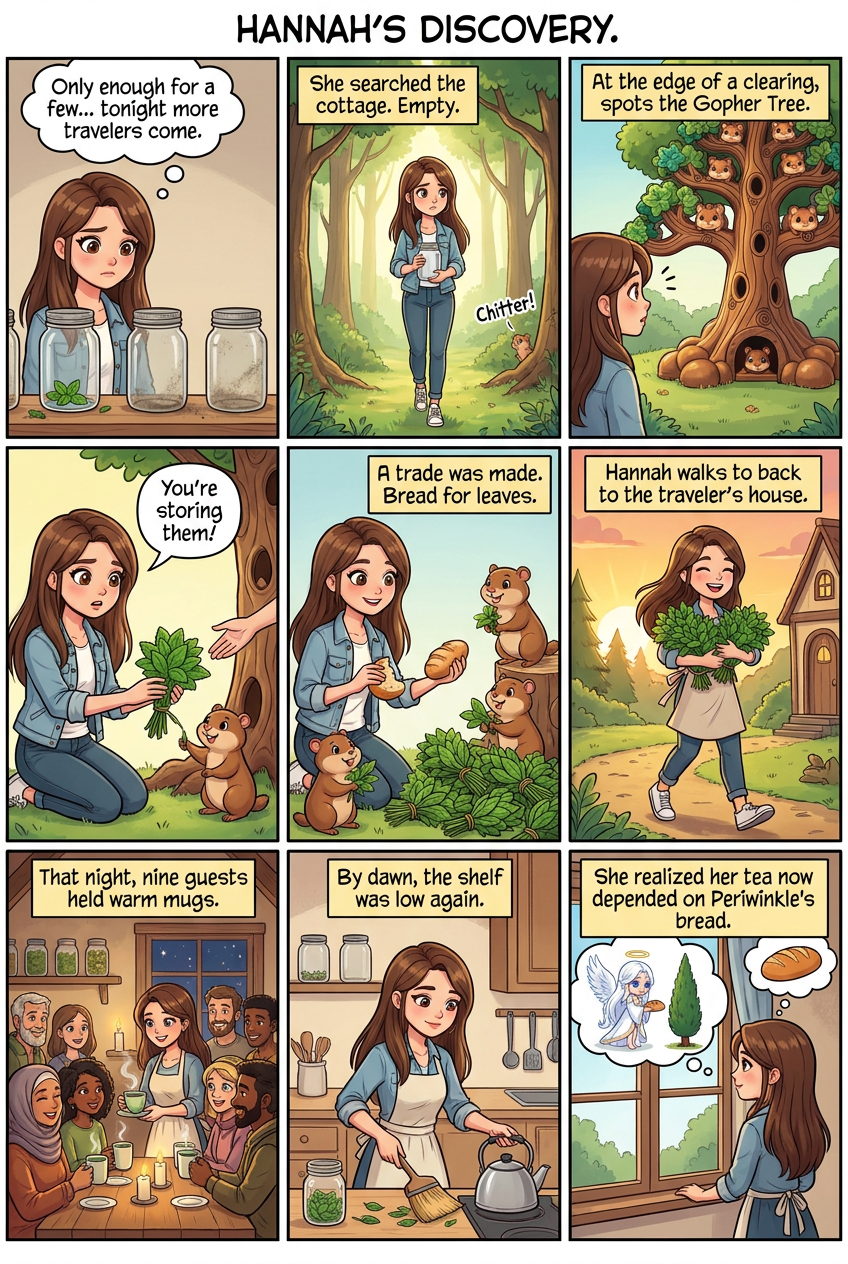
Hannah lined the three jars on the shelf and tipped them into the light. One held a thin layer of mint. The other two showed only dust and a few crushed stems. Tonight more travelers would come than last night. She could brew for four, maybe five. The guardian at the door had counted nine sleepers already. Hannah pressed her hands flat on the shelf. She needed leaves, and she needed them before dark. She walked back to the cottage in the grove, hoping the old shelf held more. The jars there were empty too. She had already taken everything. She stood in the doorway and heard a soft chittering behind her, near the treeline. At the edge of the clearing stood a strange tree. Its trunk curled like a burrow, with round openings carved by nature or by paws. Little brown gophers poked their heads from the holes. They watched her with black eyes. One sat in a hollow at the base, cheeks stuffed full. When it saw her, it dropped what it carried and scurried up the trunk. Hannah knelt where the gopher had been. On the ground lay a small pile of green leaves, fresh and whole. She crushed one between her fingers and smelled mint. The gophers had been gathering them. She looked up and saw the branches. Around each opening, the little animals had tucked bundles of leaves to dry, dozens of them, tied with grass. "You're storing them," she said aloud. One gopher climbed down and set a bundle by her knee. It waited. Hannah understood it wanted something in return. She had brought a heel of bread in her apron pocket. She broke it and laid the pieces at the roots. The gopher grabbed a piece and carried it into the burrow. Others came out. They ferried more bundles down and stacked them in a growing heap. Hannah filled her apron and both arms. She counted twenty bundles, then stopped counting. It was more leaf than her three jars had ever held. The gophers kept working, and she understood they would keep gathering if she kept bringing bread. Periwinkle left bread at the cypress each morning. Hannah could carry a share here. She hauled the leaves back to the travelers' house and spread them on the shelf. That night nine guests woke and each held a hot mug. No one drank plain water. No one left cold. But the shelf was already low again by dawn. Hannah realized the truth as she swept the last stems into the kettle. The gophers gave her a supply, but only while she fed them. Her tea now depended on bread she did not bake. If Periwinkle's loaves ran short, so would Hannah's leaves. She had solved the drought and tied herself to another's oven.
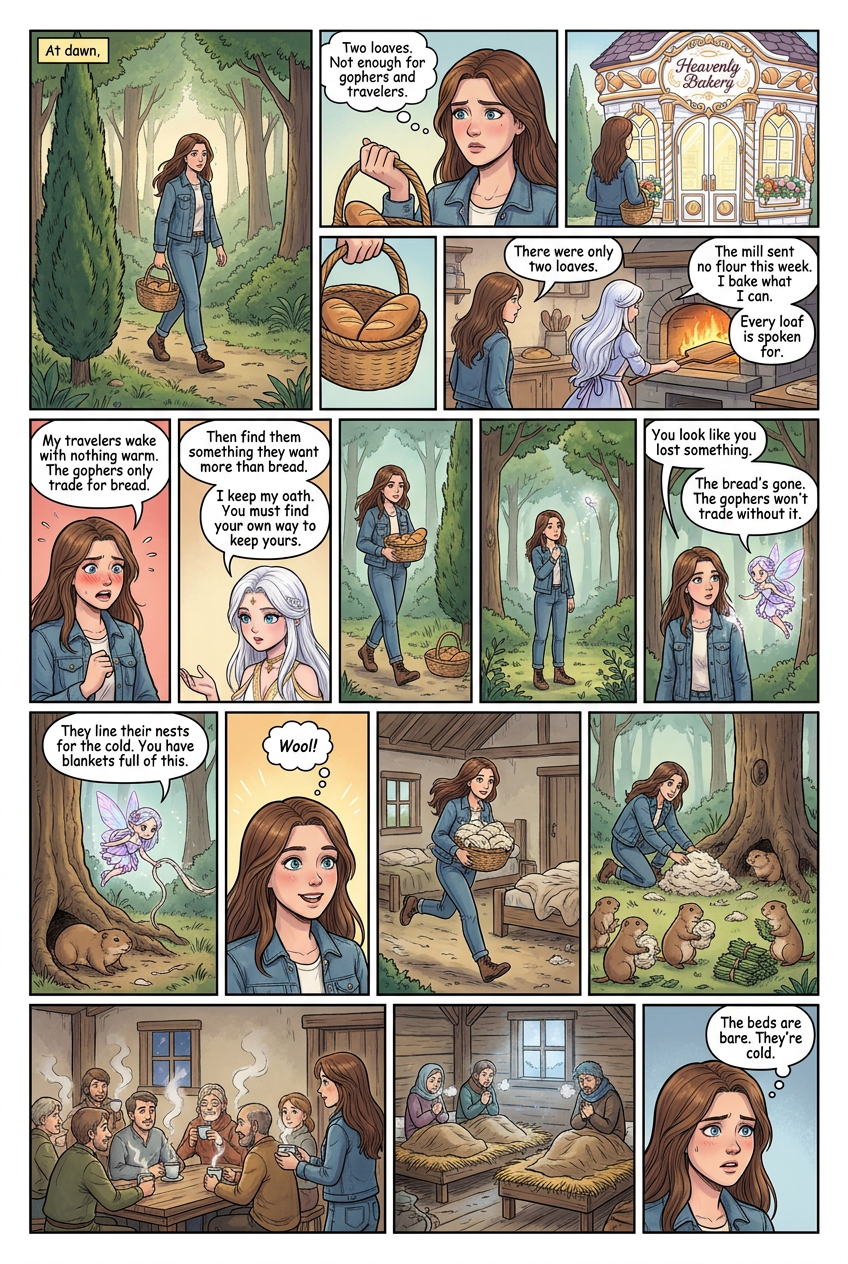
At dawn Hannah carried her bread share toward the gophers' tree. She stopped at the cypress first, where Periwinkle left the loaves each morning. The basket held only two small rounds. Yesterday it had held six. Hannah's stomach tightened. Two loaves would not feed the gophers and her travelers both. If she took the bread for the gophers, no one else would eat. If she left it, her mint supply would end tonight. She found Periwinkle at the bakery, sliding a paddle into the lit oven. The winged woman worked alone, her white robe dusted with flour, her wings folded tight against her back. Hannah had built beds beside her once, but they had never spoken of what happened when the flour ran low. "There were only two loaves," Hannah said. Periwinkle did not turn. "The mill sent no flour this week. I bake what I can. Every loaf is spoken for." Her voice stayed gentle, but her hands moved faster. "I swore to feed the lost. I cannot give bread away for leaves." Hannah's face went hot. She had tied her tea to this oven, and the oven had faltered. "My travelers wake with nothing warm. The gophers only trade for bread." "Then find them something they want more than bread." Periwinkle finally looked at her. "I keep my oath. You must find your own way to keep yours." Hannah walked out with the two loaves still in the basket. She left them at the cypress for the lost. Then she stood in the grove and thought about what the gophers truly needed. Bread filled their bellies. But winter was coming, and small animals hoarded more than food. A glimmer moved through the branches. Luna dropped down, wings catching the light, the same fairy who had led Hannah to the copper kettle weeks ago. She hovered near Hannah's shoulder. "You look like you lost something," Luna said. "The bread's gone. The gophers won't trade without it." Luna flitted to the hollow tree and peered into a burrow. "They line their nests for the cold. Dry grass, soft things." She plucked a strand of wool from Hannah's sleeve, left there from stuffing the travelers' beds. "You have blankets full of this." Hannah understood. She ran back to the travelers' house and gathered the loose wool from the bedding, more than the beds needed. She carried an armful to the tree and laid it at the roots. A gopher crept out. It buried its face in the wool and dragged a tuft toward the burrow. Others came. They ferried bundles of dried mint down and stacked them by Hannah's knees. That night nine travelers drank hot tea. Hannah's supply no longer hung on another woman's oven. She traded wool now, and she had wool to spare. But the beds had lost their padding. By morning the sleepers shivered on bare straw, and Hannah knew the guardian would count more of them cold before long.
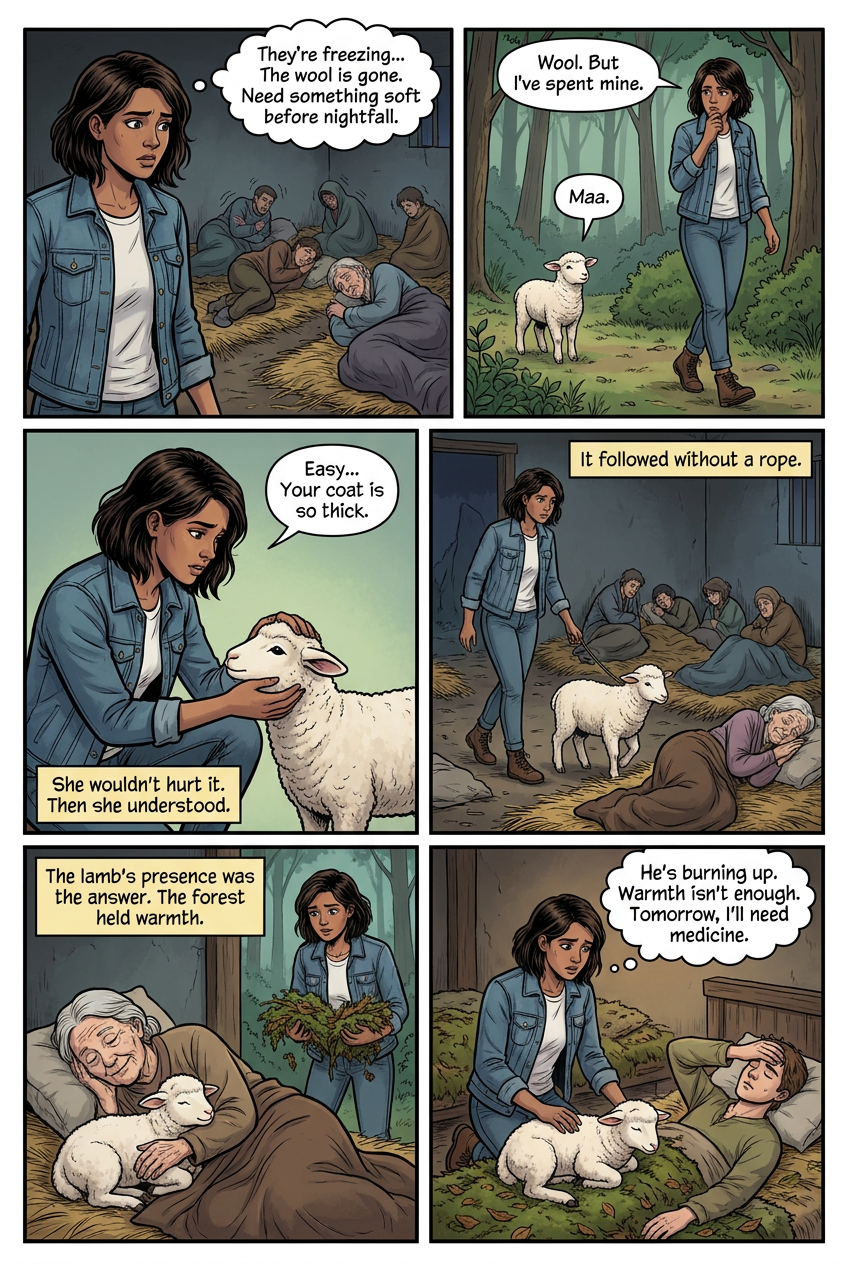
The morning after the trade, Hannah found her guests hunched on bare straw. She had given the beds' wool to the gophers, and now nine travelers shivered without padding. The guardian would soon count more of them too cold to leave. Hannah needed something soft to line the beds before nightfall, and she had already stripped the only wool she owned. She walked the forest edge, thinking. Wool. She needed wool she had not already spent. Near a stand of low bushes, she heard a soft bleat. A young sheep stood chewing grass, its coat thick and curled and clean. It watched her with calm dark eyes and did not run. Hannah knelt slowly. "Easy," she said. She reached out, and the lamb pressed its warm head against her palm. Its fleece was deep and soft, thicker than any blanket she had torn apart. She could shear it and never leave the animal cold; the coat would grow back before true winter. But she had no shears, and she would not hurt the creature to get what she needed. She sat back on her heels. The lamb settled beside her, folding its legs, and leaned its whole warm weight against her side. That was when she understood. She did not need to take the wool. She needed the lamb itself. Hannah led it back to the travelers' house. It followed without a rope, trotting close at her hip. Inside, the sleepers lay curled and gray-lipped on the straw. The lamb walked among them, unafraid, and lay down against an old woman's back. The woman stirred, felt the warmth, and pulled the animal closer in her sleep. Hannah watched the color return to the old woman's face. One warm body could not heat nine people. But the lamb's presence gave her the true answer. The forest itself held warmth she had been too tired to see. She spent the afternoon gathering dry moss, fallen leaves, and armfuls of soft grass. She packed it thick along the straw beds, then laid the lamb's shed tufts on top where the fleece caught on branches. By dark the beds were padded again, not with the traded wool but with what the forest gave freely. The lamb curled at the center of the room like a small warm sun. Hannah served the tea, and this time the guests drank it lying warm, not shivering. The old woman slept deep and still. But near the door, a younger traveler tossed and coughed, his forehead damp. The moss warmed him, yet warmth was not the trouble now. He had come in sick, and no bedding could mend that. Hannah pressed a hand to his hot cheek and knew that tomorrow she would need more than wool or moss. She would need medicine.
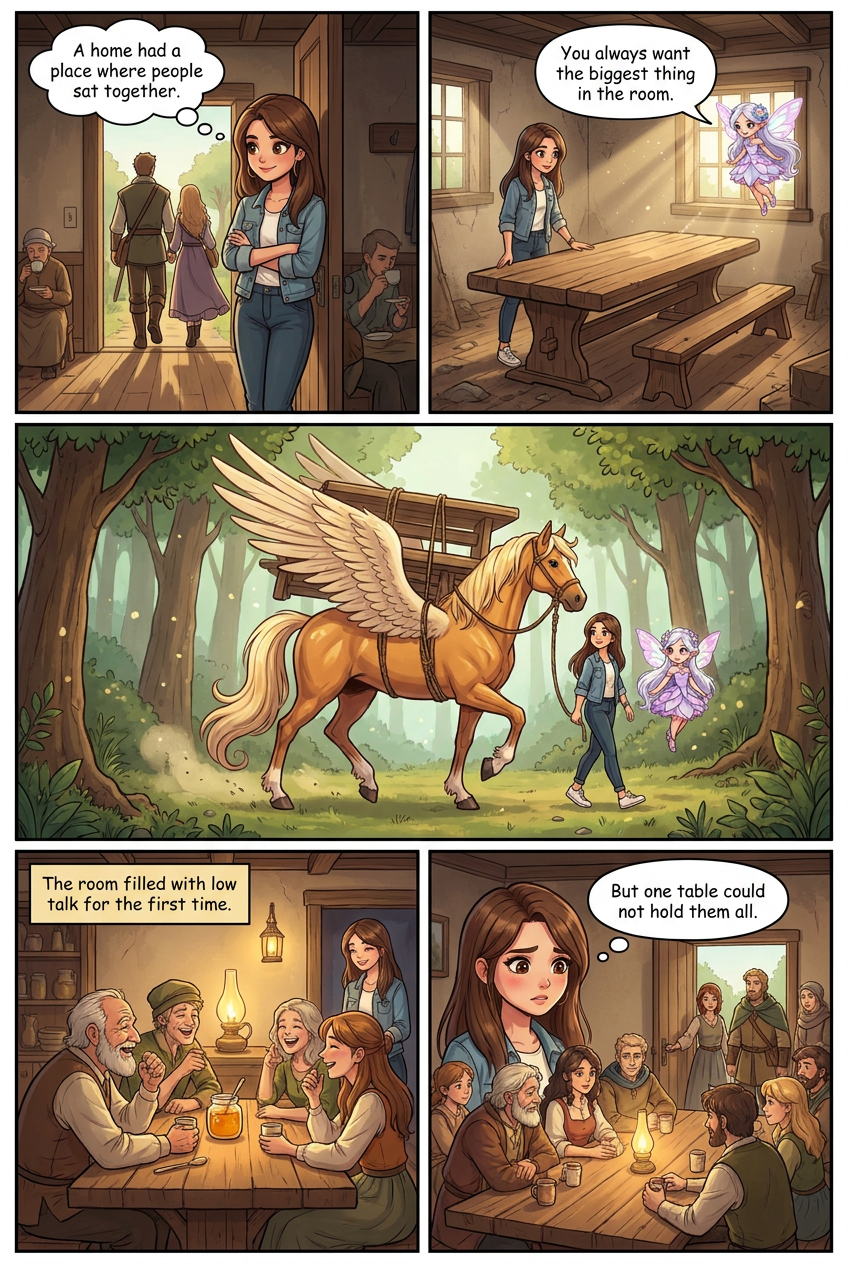
The sick traveler drank his tea and slept, and by morning his fever broke. Hannah watched him walk out with the guardian, steady on his feet. That should have felt like a win. Instead she saw the room clearly for the first time. She served tea standing, moving jar to jar, cup to cup. Her guests took the tea and drank alone against the walls. No one spoke. The weary curled up by themselves and drifted to sleep like strangers in a barn. She wanted them to feel at home. A home had a place where people sat together. She had no table. She had no chairs. She thought of the abandoned cottage in the grove where she had once found the copper kettle. Hannah walked there through the trees. The cottage stood wrapped in a lush grove, its wood dark with age, ivy climbing the walls. Handcrafted shutters framed the windows. She pushed the door and stepped inside. Dust hung in the light. Against the far wall stood a long wooden table, thick and plain, and a bench beside it. Both were sound. She rocked the table with her hand. It did not wobble. But the table was heavy, and the cottage sat far from the travelers' house. She could not drag it through the roots and mud alone. A small light flickered near the window. Luna, the fairy who had helped Hannah find the kettle here, hovered above the sill. She flew down and landed on the table's edge. "You always want the biggest thing in the room," Luna said. She looked at the table, then at Hannah's empty hands. "You'll break your back before you break the tree line." "I need it for my guests," Hannah said. "They drink alone. I want them to sit together." Luna tilted her head. "Then don't drag it. The winged horse carries loads deep into the forest. Send for it." Hannah remembered the horse that carried supplies to the far oven. She had not thought to ask for herself. She and Luna cleared the table of dust and old crocks. When the winged horse came, they roped the table and bench across its broad back. The horse walked slow and sure through the grove. By dusk the table stood in the center of the travelers' house. Hannah set the bench along one side and laid a fresh armful of grass on the floor around it. That night nine travelers came in cold and quiet. She did not carry tea to the walls. She set the cups on the table and waved them over. They came. They sat. An old man passed the honey. A young woman laughed at something he said. The room filled with low talk for the first time. Hannah stood back and watched them lean toward each other in the warm light. Then she saw the trouble. Nine cups crowded the table, and three guests stood waiting. The bench sat four. More travelers came each night, and one table could not hold them all.
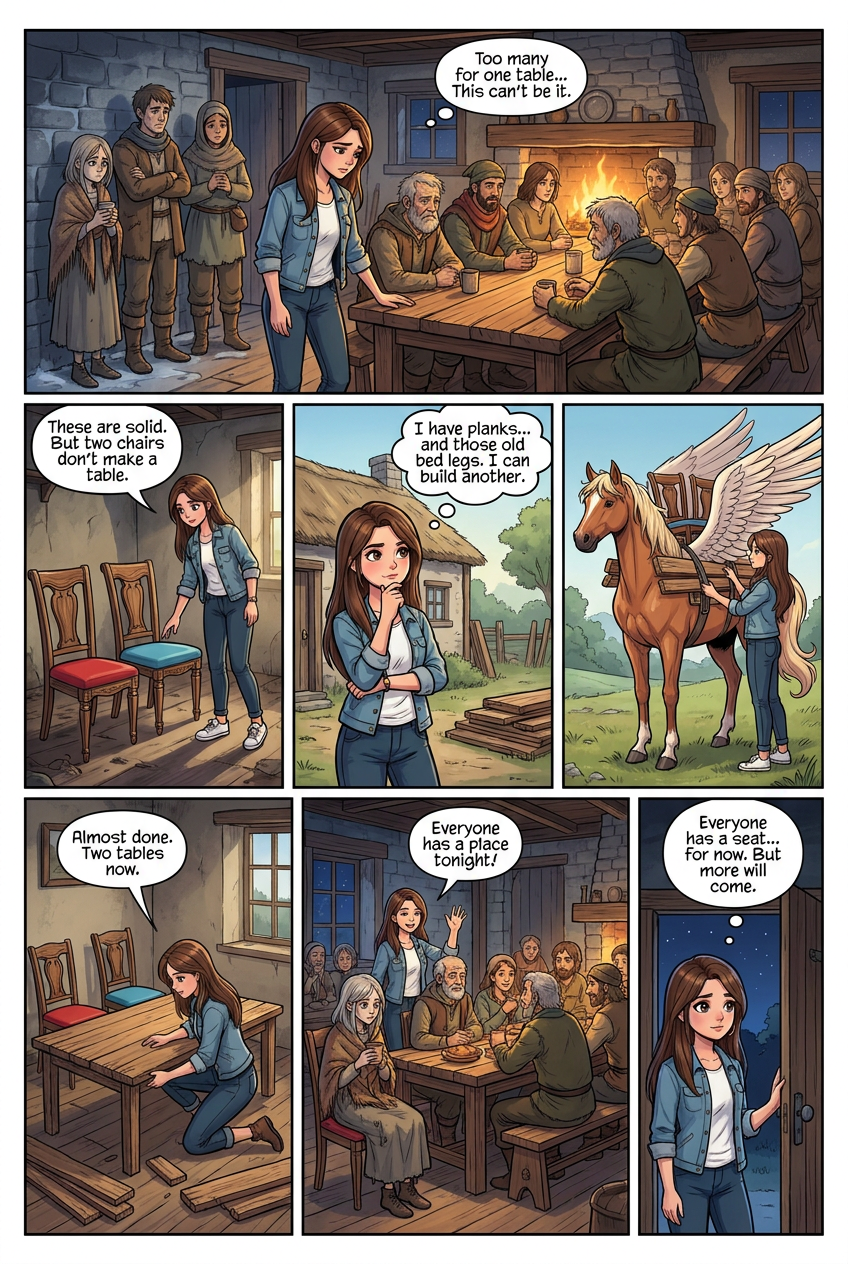
The next night twelve travelers came. The one table sat nine. Three stood at the wall with their cups, quiet, waiting for a place that wasn't there. Hannah watched a thin girl press her back to the cold stone and hold her tea against her chest for warmth. The gathering had worked too well. Now the room mocked her, half of it warm and talking, half of it left out in the dark. Hannah could not fit twelve at one table. She could add a second. She thought of the grove cottage again, but she had already stripped it of its best. She needed more than a table now. She needed seats. At dawn she walked back through the roots and mud to the cottage. Inside she found what she had passed over before. Against the shadowed wall stood two chairs, matched as a pair, their backs carved in clean curves. One seat was red, one blue. Both were sound. She rocked them and they held. But two chairs would not seat three, and there was still no second table. Hannah searched the cottage for more and found none. She sat on the blue chair and thought. She had a table already, the long one at the house. If she pulled the bench away, the chairs could fill its place, and she could raise a second surface for the overflow. She remembered the plain planks stacked behind the cottage, wide and thick, waiting to be a top. When the winged horse came she loaded it careful. The two chairs. Three broad planks for a second tabletop. Four sturdy legs she pried from an old bedframe. The horse walked slow through the trees while Hannah steadied the load with both hands. Back at the house she worked through the afternoon. She joined the planks and fixed the legs and stood the new table beside the old. It was rough but level. She set the two carved chairs at its head, red on one side, blue on the other, and lined the bench along the far edge. Two tables now. Seats for a dozen, and room to spare. That night the travelers came in from the cold. Hannah did not point anyone to the wall. She waved them all to the tables. The thin girl took the red chair and folded her hands around a warm cup. An old man dropped onto the bench and passed the honey down. The two tables filled and the talk rose and no one stood alone. Hannah stepped back and counted the seats against the faces. Every guest had a place tonight. But she looked at the door, still open to the dark, and knew more feet were coming. The tables would fill. The house itself was only one room, and one room could hold only so many before the cold outside pressed at the walls again.
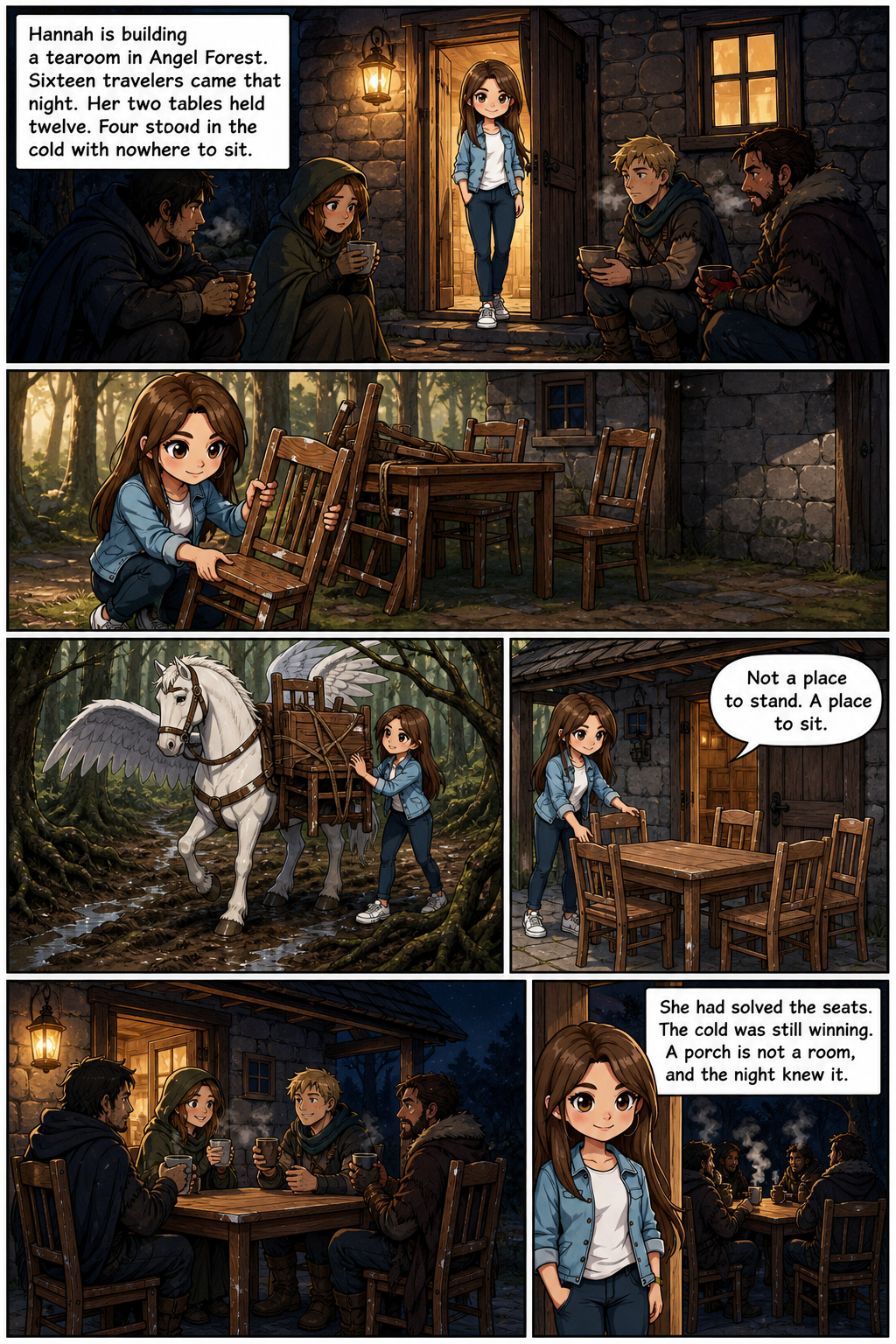
Two tables now filled the room. Every guest had a seat, but the door stayed open to the dark. That night sixteen travelers came. The two tables held twelve. Four stood outside on the cold ground, waiting for a place. Hannah went to them with cups of tea, but she had no chair to offer and no floor left inside. The room was full to its walls. Hannah looked at the packed room and knew the problem was not seats now. It was walls. One room could hold only so many bodies. She could not shrink the travelers. She could not widen stone. But she could build a place outside the door where new arrivals sat while they waited their turn. At dawn she walked back to the grove cottage one last time. She had stripped it of chairs and planks already. Now she looked harder. Behind the cottage she found a whole set left in a heap. A wide table with clean, curved legs. Three matching chairs, their backs carved in simple lines. The wood was worn but sound. She rocked each piece and it held. A gathering set, meant for a family that had long gone. Hannah could not carry the table alone. When the winged horse came she loaded it slow. The table first, then the three chairs bound tight with cord. The horse walked steady through the roots and mud. Hannah steadied the load with both hands and watched the branches. Back at the house she set the table just outside the door, under the eave where the roof reached past the wall. She placed the three chairs around it. Now the space outside was not bare ground. It was a porch, a waiting place, close enough to the door that the warmth of the room spilled out. That night the travelers came in a long line. The two inside tables filled first. When the twelfth seat was taken, Hannah did not send the rest into the dark. She waved them to the porch. Four sat at the outside table with hot cups, sheltered under the eave, watching the door for a place to open inside. Hannah counted the faces against the seats. Sixteen travelers, and every one of them sat. No one pressed a cold wall. No one stood alone on the ground. The porch had bought her room she did not have before. But Hannah stood in the doorway and looked at the two seatings. Inside stayed warm. The porch stayed cold. The waiting travelers held their cups against their chests and shivered while they waited their turn to come in. She had given them a place to sit. She had not given them a place that was warm. The eave kept off the rain, but the night still reached the porch, and the cups went cold faster than the guests could drink.
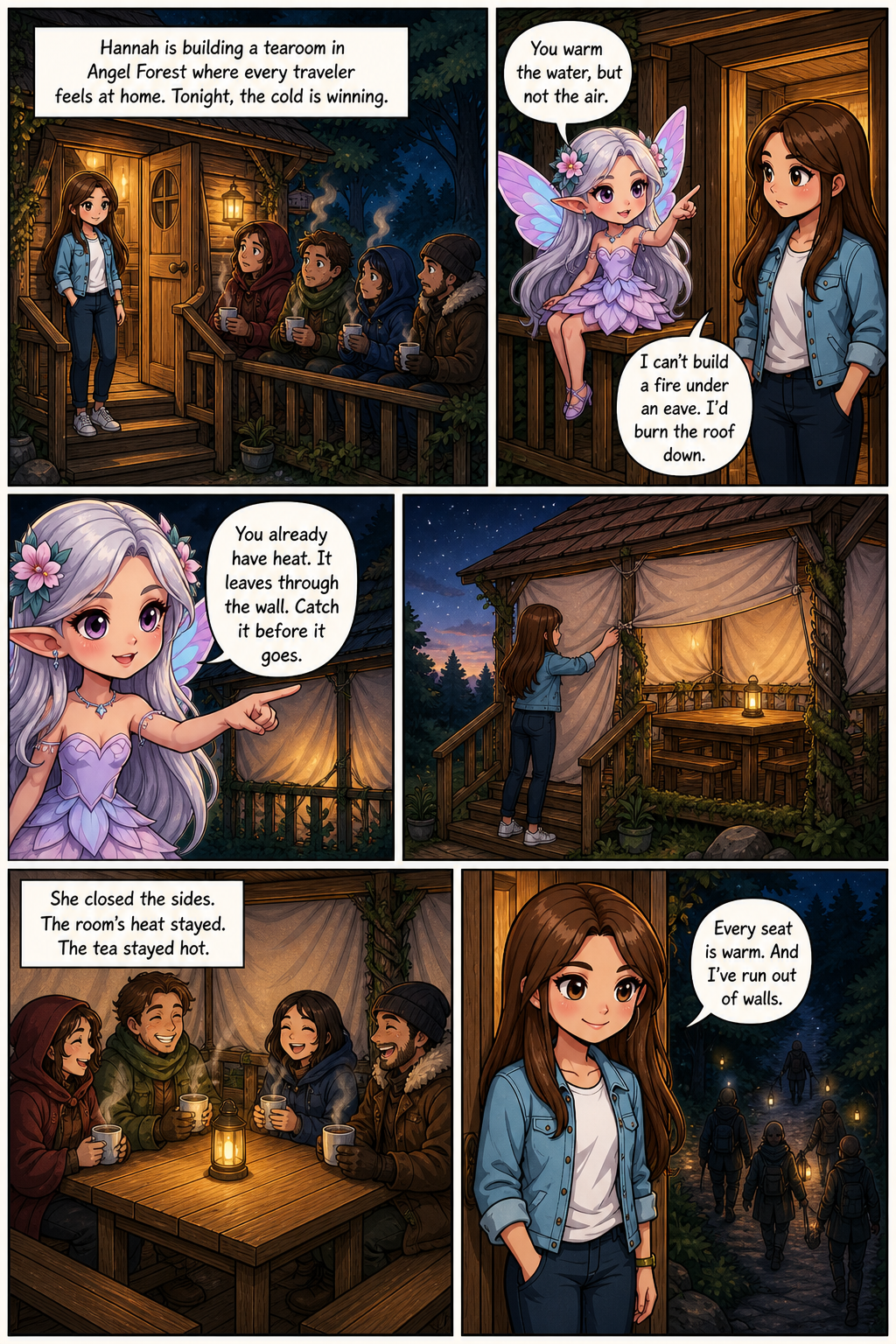
The porch held four travelers, but the cold held them harder. Hannah watched from the doorway as they pulled their coats tight. Their cups steamed for a moment, then went flat and gray. The warm room breathed heat out the open door, but the night swallowed it before it reached the table. Hannah rubbed her own hands and knew tea was not enough. A seat outside the cold was still a cold seat. She stepped off the porch and looked at the stone wall beside the door. There was no chimney here, no oven she could dig into the hill. She thought of the far bakery's oven that burned forever, but she could not haul stone and fire to her porch. She stood in the dark and had no plan. A small light drifted down through the branches. Luna, the fairy who had guided Hannah to the old cottage and its kettle, landed on the porch rail. She folded her wings and studied the flat cups. "You warm the water," Luna said, "but not the air." "I can't build a fire under an eave," Hannah said. "I'd burn the roof down." Luna tilted her head toward the door. "You already have heat. It leaves through the wall. Catch it before it goes." Hannah followed the fairy's small hand. Warm air slid out the doorway and vanished into the yard. The porch sat open on three sides. The night walked in freely. "Close the sides," Hannah said slowly. "Trap what spills out." She worked before dawn. She hung the stripped bedding sheets across two open sides of the porch, tied to the eave posts. She wove branches and packed moss into the gaps, the same forest padding she used on the beds. She left one side open toward the door, so the room's heat could reach in and stay. By the time the sky went pale, the porch was a small closed room, joined to the big one by the open door. Luna hovered near the table and felt the air. "Warmer already," she said. Hannah brought out a fresh kettle and set it on the table's center. The steam rose and did not scatter now. The walls held it. She sat in one chair and stayed until the cold left her fingers. That night sixteen travelers came again. Twelve took the inside tables. Four sat on the porch. Hannah poured their tea, and this time the cups stayed hot in their hands. No one shivered. The four leaned back and talked, warm as the ones inside. Hannah stood in the doorway and counted them. Every traveler sat, and every traveler was warm. But the closed porch fit only four. Behind the last four, more feet were coming up the dark path. She had run out of walls to hang and floor to fill. The house was full, inside and out.
Play your story to life
Storycraft is a mobile game where you create AI characters, craft items and locations to build their world, then discover what direction your story takes. Download the iOS game for free today!
Download for free