

Irbis Chuluun's Arc
3 Chapters
Irbis Chuluun's dream is climbing the unmapped peak that monks whisper houses a sleeping god, to wake it and ask one question..

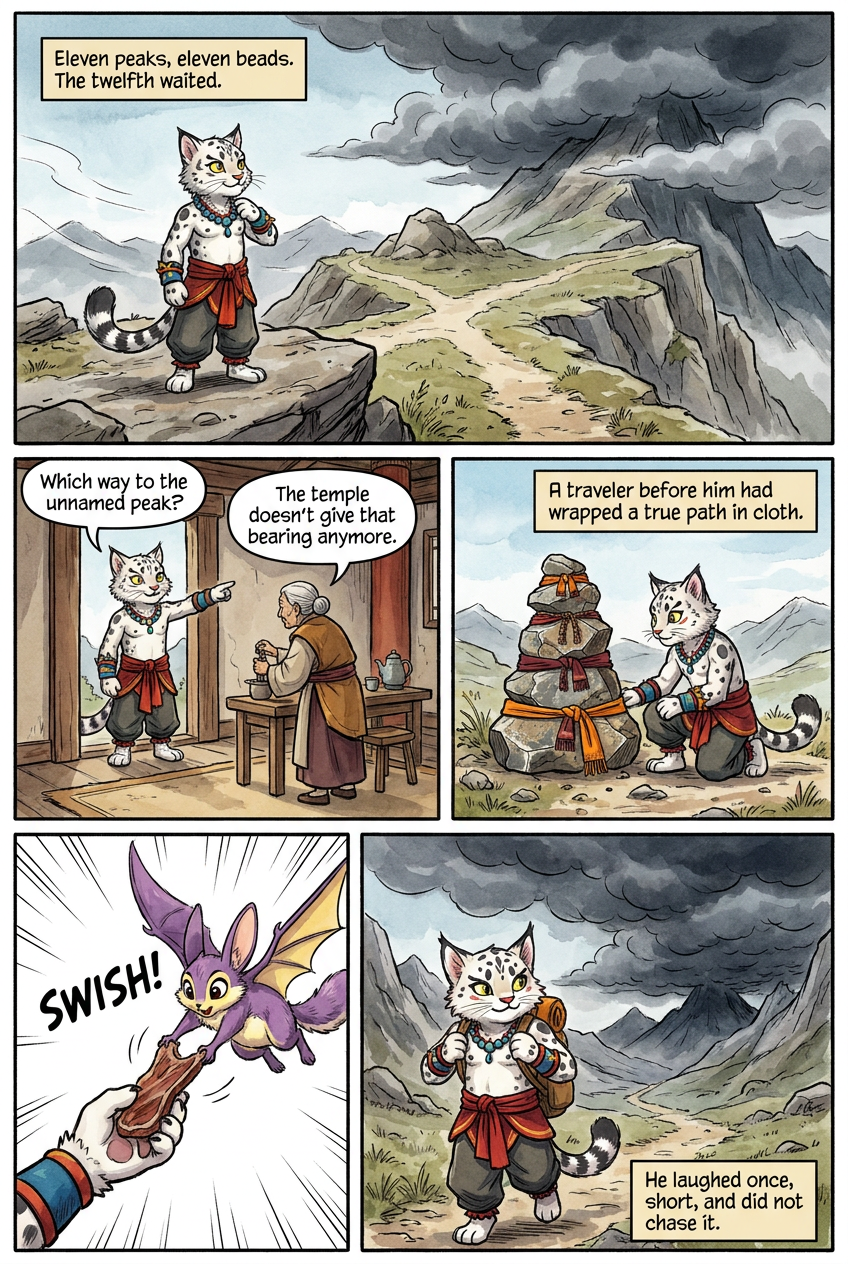
Irbis Chuluun stood at the threshold of two valleys and could not tell which one would kill him. The wind off the snowfield pushed at his trousers and dragged at the beads around his neck. He counted them without looking: eleven peaks climbed, eleven beads, and one more he meant to add before he died. The twelfth peak waited somewhere past this fork. A dying monk had told him about it in a whisper, asking nothing in return. A sleeping god lived inside it. Irbis meant to wake the god and ask one question. The trouble was the sky. Cloud was building behind the eastern ridge, gray and low, the kind that swallows a valley in an hour. He had no map. The monks at the last monastery had only pointed and prayed. From their gate the peak sat at the far edge of sight, and most of them had looked away before they finished looking. Irbis had stared until his eyes watered. He had a direction. He did not have a path. He turned back along the ledge and found the temple he had passed at dawn. Its sashes hung in long bright strips from the eaves, snapping in the wind like flags planted on a summit. He climbed the worn steps and pushed the red door open. Inside, an old woman in robes was grinding tea. She did not look up. He asked which valley led toward the peak the monks would not name. She said the temple did not give that bearing. She said the temple had stopped giving it three winters ago, after the last two who asked for it never came back. Irbis left a coin on the floor and went out into the wind. He worked along the cliffs above the fork, slow on the loose rock, tail counterweighting each step. Where the trail split he found what he had hoped for. A cairn stood waist-high on the lip of the southern valley. Stones stacked careful and square, bound at three heights with monk sashes, the orange one weighted by a braided knot. A traveler before him had wrapped a true path in cloth and left it for the next climber. The northern valley had no marker at all. Its mouth was wide and inviting and wrong. He was kneeling to touch the lowest sash when something dropped past his shoulder and tore the strip of dried meat from his open pack. A flying squirrel, purple and yellow, banked off the cairn and landed on a rock three paces out, chewing fast. It watched him with one bright eye. Irbis laughed once, short, and did not chase it. The cairn pointed south. The clouds were closing. He shouldered his pack, set his hand on the chipped stone blade at his hip, and started down the southern valley before the storm could choose for him.
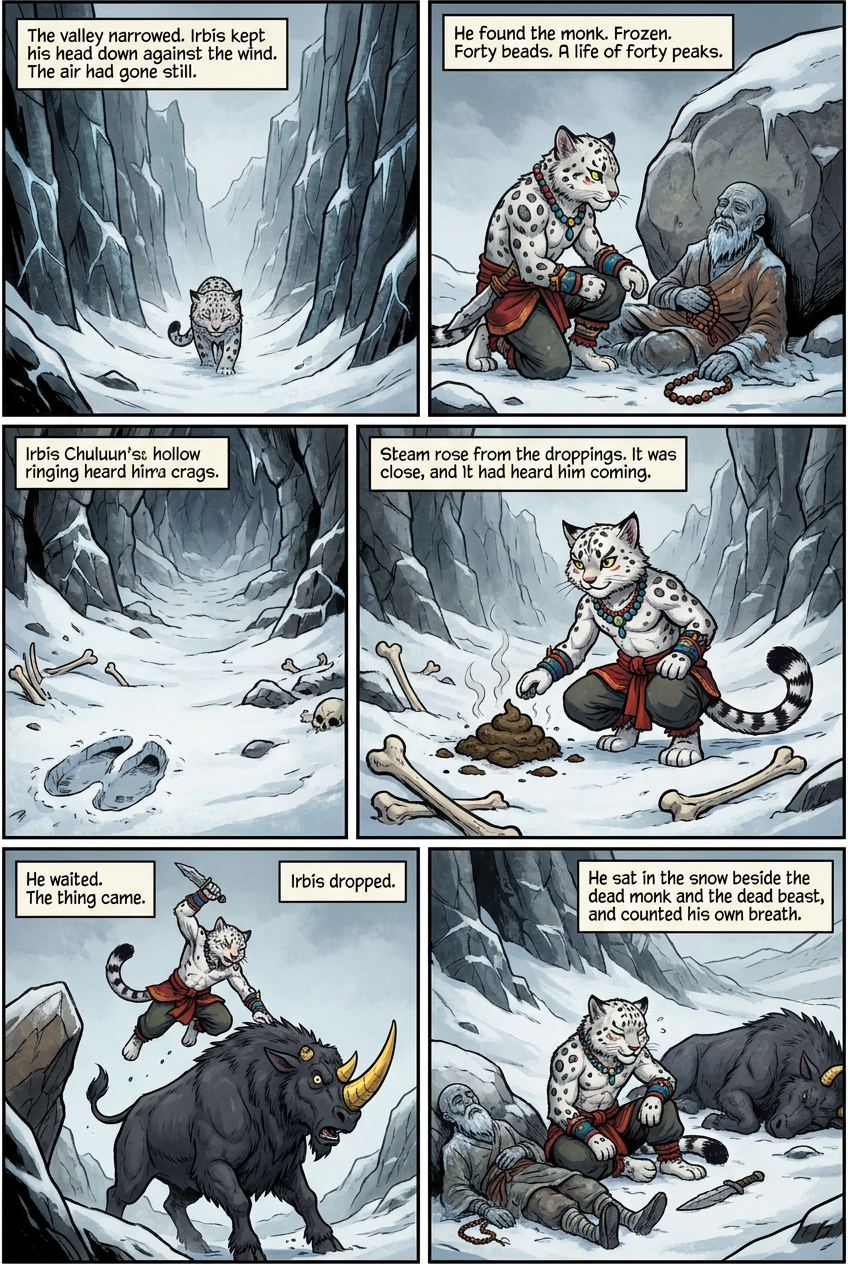
The southern valley narrowed within an hour. The walls rose into jagged crags on both sides, dark stone shot through with veins of ice. Snow lay thin on the path. Irbis kept his head down against the wind and watched the ground. The storm had not yet caught him, but the air had gone still in the wrong way. Somewhere above, a rock clicked against another rock. He stopped and listened. Nothing moved. He set his hand on the chipped stone blade at his hip and walked on. He found the monk a quarter mile in. The body sat slumped against a boulder where the trail bent left. Frost had sealed the robes to the rock. The face was gray and calm, eyes half open, beard stiff with ice. One hand lay in the lap, wrapped tight around a strand of dark beads. Irbis knelt and counted them out of habit. Forty. Forty peaks climbed by a man who had died sitting down on the forty-first. The orange sash at the monk's waist was cut short. The braided knot was missing. This was the climber who had built the cairn at the fork. Irbis looked at the wound next. The monk's chest was punched through above the heart, a clean round hole the width of a fist. No blood on the snow. The cold had taken him before the bleed could finish. Irbis turned the body gently and found the exit wound in the back of the boulder, a chip of stone driven deep where something heavy had struck through and through. Not a blade. Not a claw. A horn. He stood and scanned the path ahead. Twenty paces on, the trail opened into a hollow ringed with tall crags that leaned in like teeth. Bones lay scattered across the stones. Ribs, a cracked skull, the long curve of a leg. Old kills and newer ones. In the fresh snow at the hollow's mouth, a single track pressed deep. A cloven hoof, wider than his palm. Steam still rose from a pile of droppings beside it. Irbis crouched, set two fingers on the dung, and felt warmth. Whatever had killed the monk was close, and it had heard him coming. He took the beads from the monk's hand and tied them to his own belt. Then he stepped off the path, climbed two body-lengths up the left crag, and waited. The thing came around the bend at a slow walk. Goat-shaped, taller than him at the shoulder, wool black and matted, one yellow horn lowered like a spear. It stopped at the body and snuffed the air. Irbis dropped. He landed astride its neck and drove the chipped stone blade behind the horn, into the hollow at the base of the skull. The animal buckled once and fell. He stayed on top until it stopped kicking. Then he sat in the snow beside the dead monk and the dead beast, and counted his own breath until his hands were steady enough to climb again.
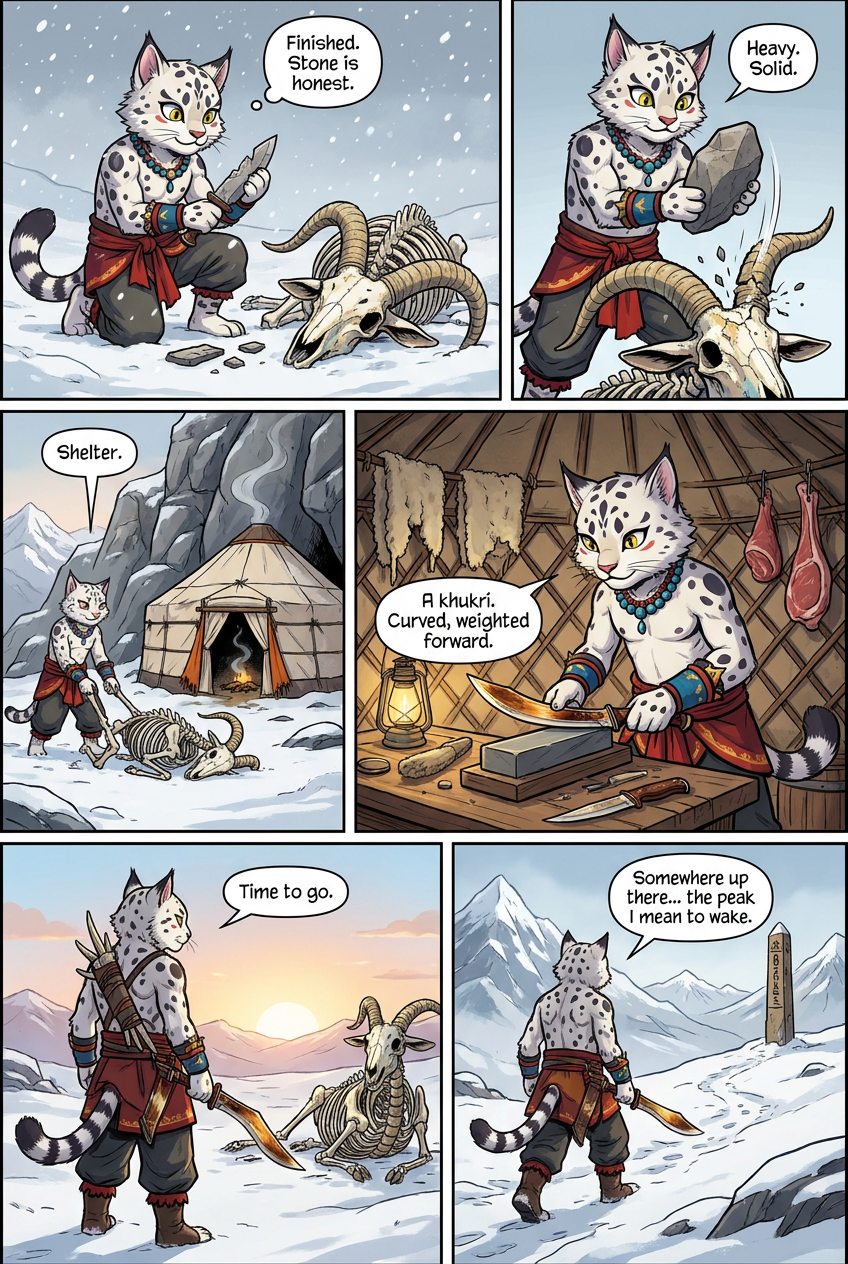
Irbis sat by the dead beast until his breath slowed. The carcass lay on its side in the snow, one yellow horn jammed into the ground, the other pointing at the sky. His chipped stone blade was still wedged in the skull. He pulled it free and the tip broke off in the bone. The blade had carried him over eleven peaks. He set the pieces in his palm, then tucked them into his coat. Stone was honest. It had told him it was finished. He needed a new tool before he climbed another step. He picked up a flat river stone from the edge of the path and knelt by the beast's head. He set the stone against the base of the standing horn and struck. He struck again. On the fourth blow the horn cracked clean at the root and rolled into the snow. It was longer than his forearm and curved like a hook. He weighed it in his hand. Heavy. Solid. No splits. He dragged the carcass off the trail and looked for shelter to work. A quarter mile up the valley, tucked against the lee of a crag, he found an old hunting yurt. The hide walls were stiff and patched. The wooden door hung crooked on leather hinges. Inside, a cold fire pit, a low bench, and a rack of bone scrapers left by hunters who had not come back this season. He hauled what he could of the beast inside, piece by piece, until the snow outside was dark and trampled. He worked through the night. He skinned the wool coat off the beast in long strips and laid it over the bench to dry. He cut the meat into slabs and hung them from the rafters above the cold pit. He split the leg bones with the river stone and shaped four spikes, each as long as his hand, each ground to a point against the yurt's whetstone. He saved the horn for last. He sawed the broken end flat, hollowed a socket, and fitted a length of bench wood into it for a grip. He pinned the grip with two bone pegs. He honed the inside curve against the stone until it caught the lamplight and held an edge that bit his thumb when he tested it. A khukri. Curved, weighted forward, made to chop and to skin and to drive into a skull if it came to that again. At dawn he stepped out of the yurt with the new blade at his hip and the bone spikes wrapped in the wool at his back. The carcass behind the yurt was already half bone, picked at by something small in the dark. He left it. He walked back to the trail and found the path climbing again toward the high crags. Somewhere up there was the peak he meant to wake. He set his hand on the horn grip and started up.
Play your story to life
Storycraft is a mobile game where you create AI characters, craft items and locations to build their world, then discover what direction your story takes. Download the iOS game for free today!
Download for free