

Jack McCready's Arc
5 Chapters
Jack McCready's dream is getting unlimited horses.

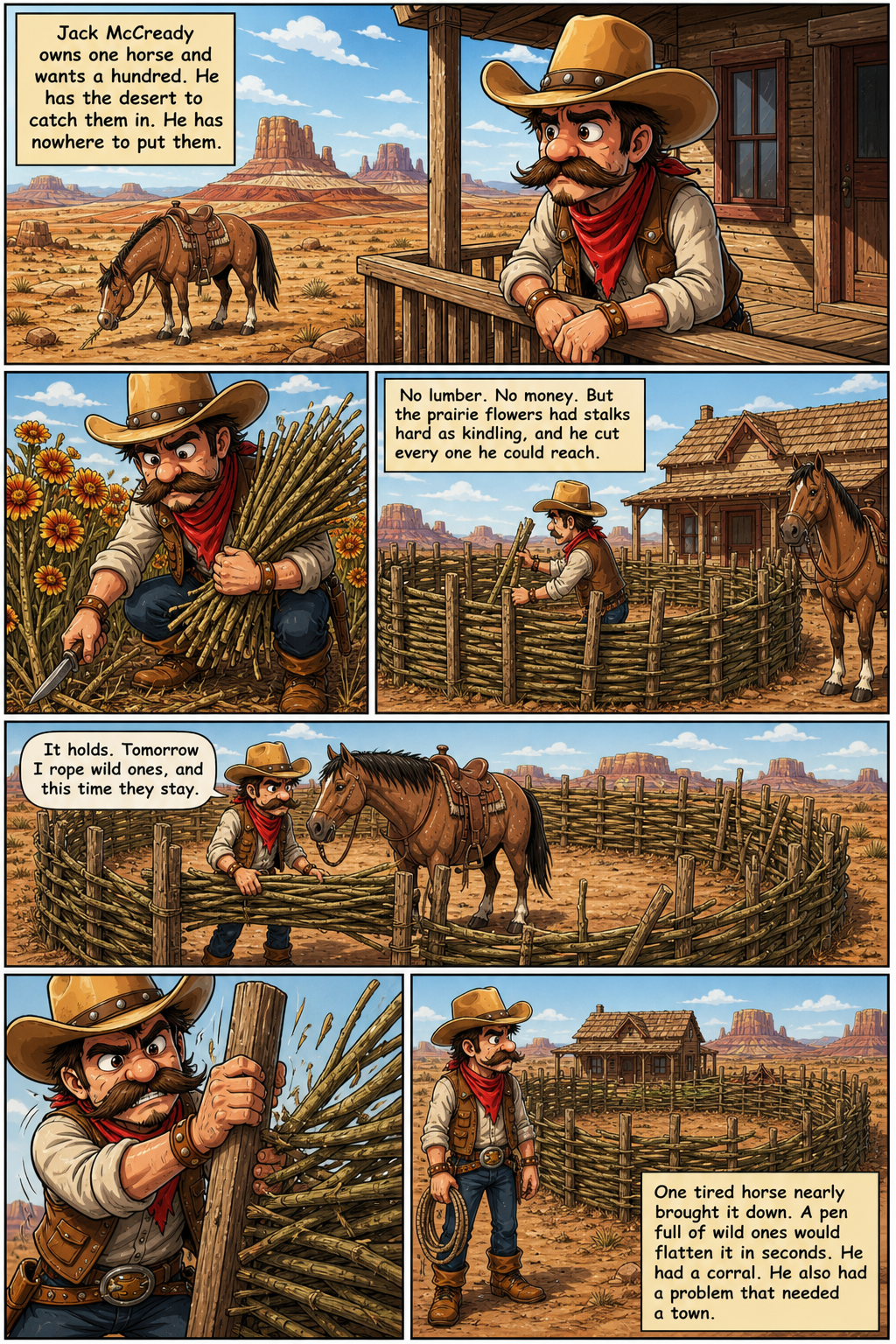
Jack McCready wanted a hundred horses, and he owned one. That one stood swaybacked outside his house, chewing a dry stalk, too tired to wander far. Jack leaned on the porch rail of the weathered homestead and studied the open desert past it. Rust-colored mesas. Cracked, baking earth. Scrub that bit your boots. A man could gather wild horses out there by the dozen. But Jack had nowhere to keep them. He'd learned that hard the day before. He had roped three range horses, led them home proud, and gone inside for water. When he came out, the plains had swallowed them. No fence. No corral. No pasture. Just hoofprints heading nowhere. Every horse he caught would do the same. He couldn't build a herd he couldn't hold. So Jack set to work. He had no lumber and no money for any. But the desert gave him something else. All around the homestead grew tough prairie flowers, their faded orange petals riding thick, woody stalks. Those stalks were hard as kindling and grew in dense clumps. Jack pulled his knife and cut. He worked all morning. He hauled armloads of the woody growth and wove them between stakes he drove into the cracked ground. The old horse watched him, tail swishing flies. By noon Jack had a crooked ring of fencing behind the house. Low, rough, but standing. He shook a post. It held. He grinned and wiped his face. Then he tested it the only way that mattered. Jack led the swaybacked horse inside the ring and shut the gap with a bundle of stalks. The horse sniffed the fence, pushed its nose through, and stopped. It couldn't walk out. Jack stepped back and watched it circle. The corral held one horse. It would hold the next ten. For the first time, Jack had a place to put what he caught. His arc had its first floor under it. Tomorrow he'd ride out and rope wild ones, and this time they'd still be here when he returned. But as Jack coiled his rope, the horse inside leaned against the weave to scratch its flank. The woody stalks bent. A post tipped. Jack lunged and shoved it upright, heart pounding. The fence held one tired animal. It would never hold a pen of panicked wild horses slamming the walls at once. He had a corral now. He also had a corral that would not survive the very horses he meant to fill it with. Jack looked at his handiwork and knew his next problem had just arrived: he needed real posts, real rails, real strength. And for that, he needed a town.
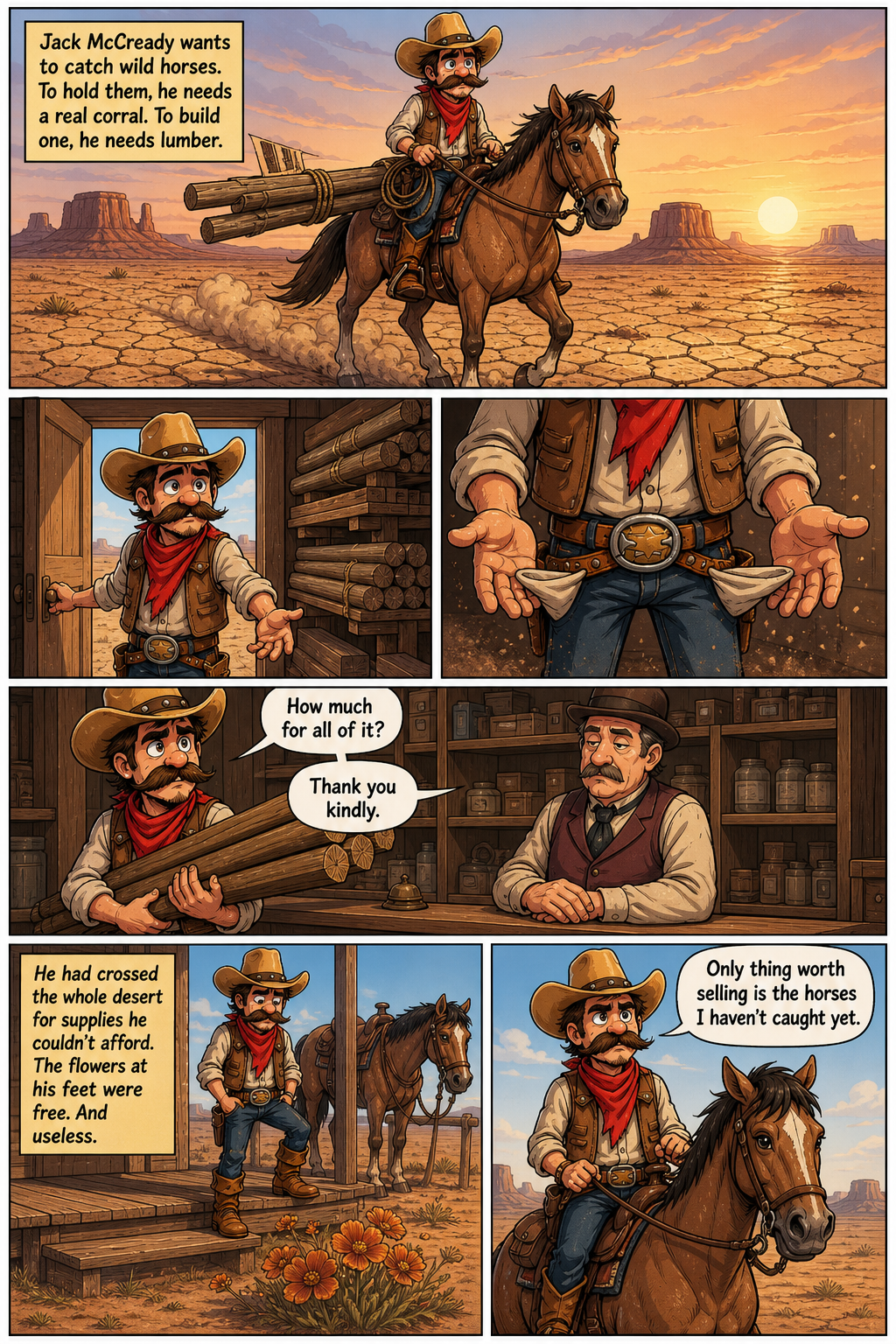
Jack saddled his tired horse at dawn and rode toward town. The animal's faded coat showed every hard mile, but it kept a steady walk across the cracked flats. Jack needed posts and rails strong enough to hold wild horses. A town meant a store, and a store meant lumber. He patted the horse's neck and pushed on through the Texas heat. By midmorning the shop rose out of the dust. Sun-faded timber siding. A front porch with worn boards. A painted sign hung crooked above the door. Jack tied his horse to the rail and climbed the steps. Through the windows he saw stacked lumber, coils of wire, and kegs of nails. Everything he needed sat inside that weathered building. He pushed the door open and breathed in sawdust and oil. Posts leaned against the far wall. Thick rails lay stacked in neat rows. Jack ran a hand along one and felt the solid weight of it. This wood would hold a hundred panicked horses. He gathered an armload and carried it to the counter. Then he reached for his pocket. Empty. He checked the other. Empty too. He stood still and understood. He had ridden out with rope and grit and nothing else. Back home he had no coins buried in a jar, no bills folded in a drawer. He had built his corral from desert plants because he could not pay for wood. Nothing had changed. He had simply forgotten the plain truth until he stood here with his hands full. The shopkeeper watched him from behind the counter. Jack met the man's eyes and found no softness there, only waiting. "How much for all of it?" Jack asked. The shopkeeper named a price. It was more money than Jack had ever held. Jack lowered the rails back onto the stack, one at a time. His face burned. He had crossed the whole desert to reach exactly what he needed, and he could not take a single board of it. He thought of asking for credit. One look at his dusty clothes and swaybacked horse told him the answer. "Thank you kindly," Jack said. He turned and walked out. The porch boards creaked under his boots. His horse lifted its head and waited. Jack untied the reins and stood a moment in the glare. Near the steps grew a clump of prairie flowers, faded orange petals on woody stalks. The same plants he had cut to build his first flimsy fence. Free for the taking. Worthless against wild horses. Jack swung up into the saddle. He had no wood and no money to buy it. But the ride had shown him something sharp and clear. If he wanted real supplies, he needed real money first. And a man with one tired horse had only one thing worth selling: the horses he had not yet caught. He turned his mount toward the open range and rode.
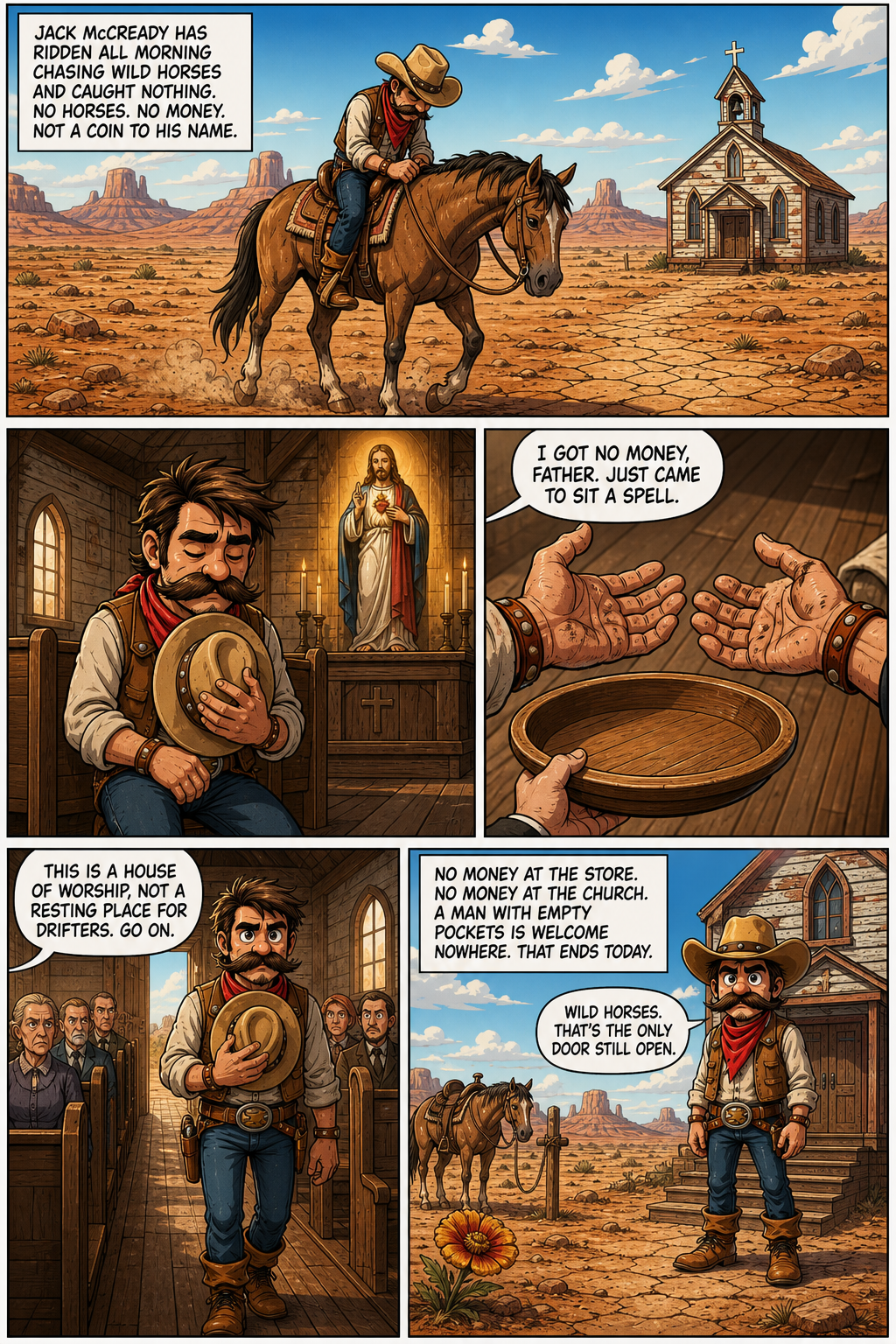
Jack rode across the desert with no horses caught and no money earned. The heat pressed down on his tired mount. By afternoon he saw a small church rise from the flats, its steeple leaning and its siding bleached by the sun. A bell hung in the tower. Jack reined up. He had chased horses all morning and caught nothing. Maybe a church held something a tired man could use. He tied his horse to a post and climbed the steps. Inside, the air was cool and still. Faded light fell through narrow windows. At the front stood a statue of Christ, robes painted blue and red, one hand raised, a bright heart on his chest. Rows of plain benches held a handful of bowed townsfolk. Jack took off his hat and sat in the back. He bowed his head like the others. For a while his worries loosened. He did not think about horses or lumber. He just breathed. Then a man in a long black robe moved down the aisle, holding a wooden plate. The priest. He was lean, with sharp eyes that missed nothing. He stopped at each bench. Coins clinked onto the plate. Some gave bills. The priest nodded and moved on, slow and certain. He reached Jack's bench and held out the plate. Jack looked at the coins piled there. He patted his pockets. Empty, same as at the store. His face went hot. He had nothing to drop. "I got no money, Father," Jack said. "Just came to sit a spell." The priest's eyes moved over Jack's dusty clothes and cracked boots. His mouth tightened. "This is a house of worship, not a resting place for drifters," he said. "Those who give, give what they can. Those who give nothing take up a seat better used." "I only wanted a minute of quiet," Jack said. "Then find it elsewhere." The priest nodded toward the door. "Go on." The townsfolk turned to look. Jack stood. His chair scraped the floorboards. He gripped his hat and walked up the aisle past the staring faces. Shame burned worse than the sun outside. He pushed through the double doors and stood on the steps. His horse waited at the post. Jack stared out at the empty flats. Twice now a door had closed in his face for the same reason. No money at the store. No money at the church. The lesson hit him hard and clean. In this country, a man with empty pockets was welcome nowhere. He swung into the saddle and sat a moment. His pride was raw, but his mind was clear. He would not come back to beg a seat or ask for credit. He would earn his coins the only way left to him. Out there, wild horses ran free across the range. He turned his mount away from the church and rode toward them.
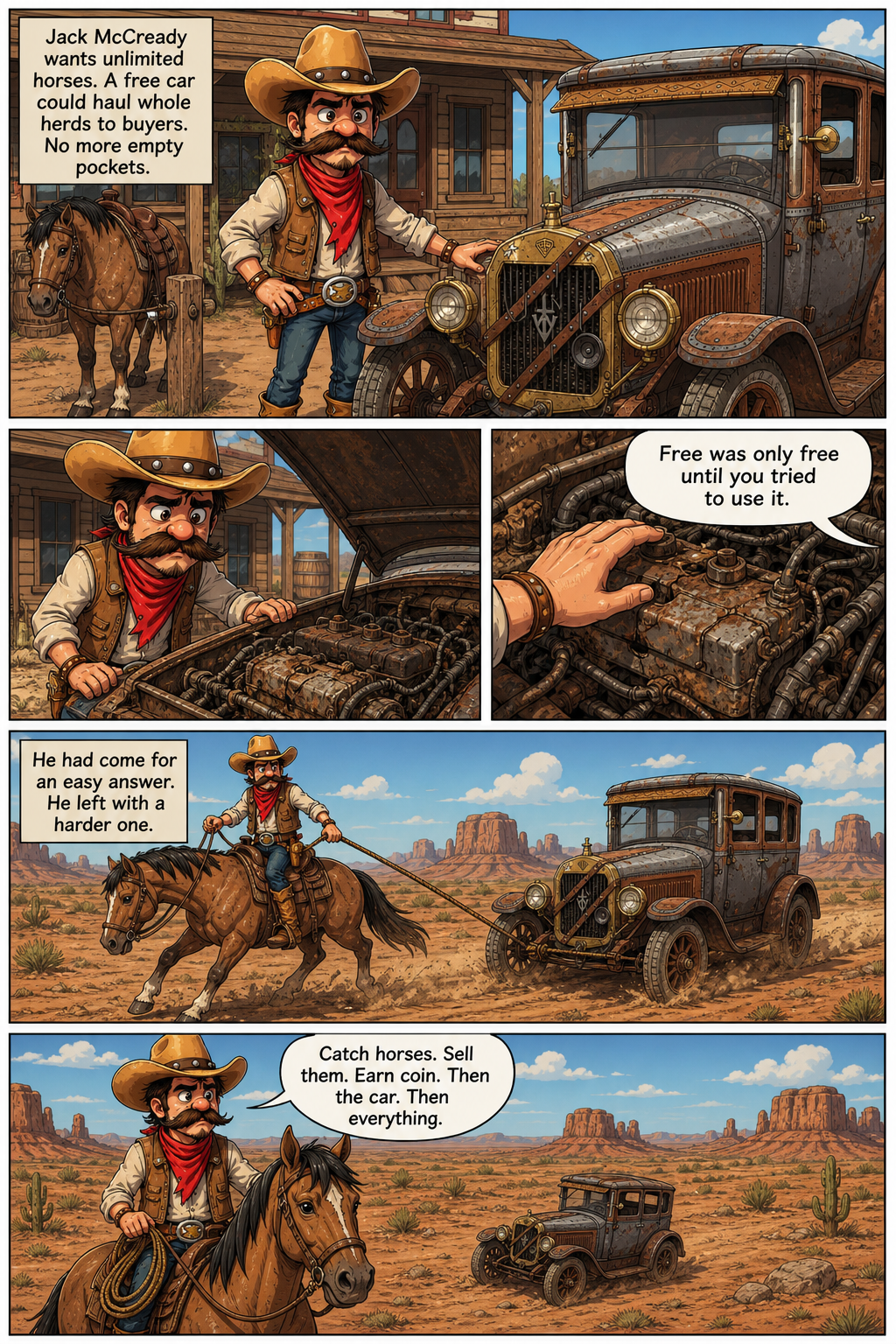
Jack ran his hand along the hood of the free car. A machine could haul more than any wagon. He pictured wild horses loaded in the back and driven to buyers in town. No more lost animals. No more empty pockets. He pried the door open and climbed inside. The wheel felt solid. He pressed a pedal. Nothing. He tried again. A dry click, then silence. He climbed out and lifted the hood. The engine sat packed with sand. Belts hung loose and cracked. Two cables ended in rust. Jack knew engines a little, enough to see the truth. The car ran on nothing now. It needed parts, oil, and fuel he could not name, let alone buy. Free was only free until you tried to use it. The store clerk leaned out the back door. "You want that heap, it's yours," he said. "Been dead two years. Takes money to wake it." He went back inside. Jack stood with his hand on the cold metal. He had come for an easy answer and found another locked door. But he did not ride off. He looked at the car, then at his worn horse at the post. The machine could not move itself. His horse could. And out on the range, more horses ran free, worth real coins to the right buyer. He hitched a rope from the car's frame to his saddle horn. Slow and steady, his horse dragged the dead machine out of the junk pile and onto the open ground. Jack would keep it. One day he would fix it and haul whole herds. But that day needed money, and money needed horses. Jack left the car parked in the dirt and swung back into the saddle. He had no cash, no working machine, and no buyer yet. What he had was a plan with a shape to it. Catch horses. Sell them. Earn coin. Then the car, the lumber, the corral, all of it would follow. He pointed his tired horse toward the range and rode to find the first one.
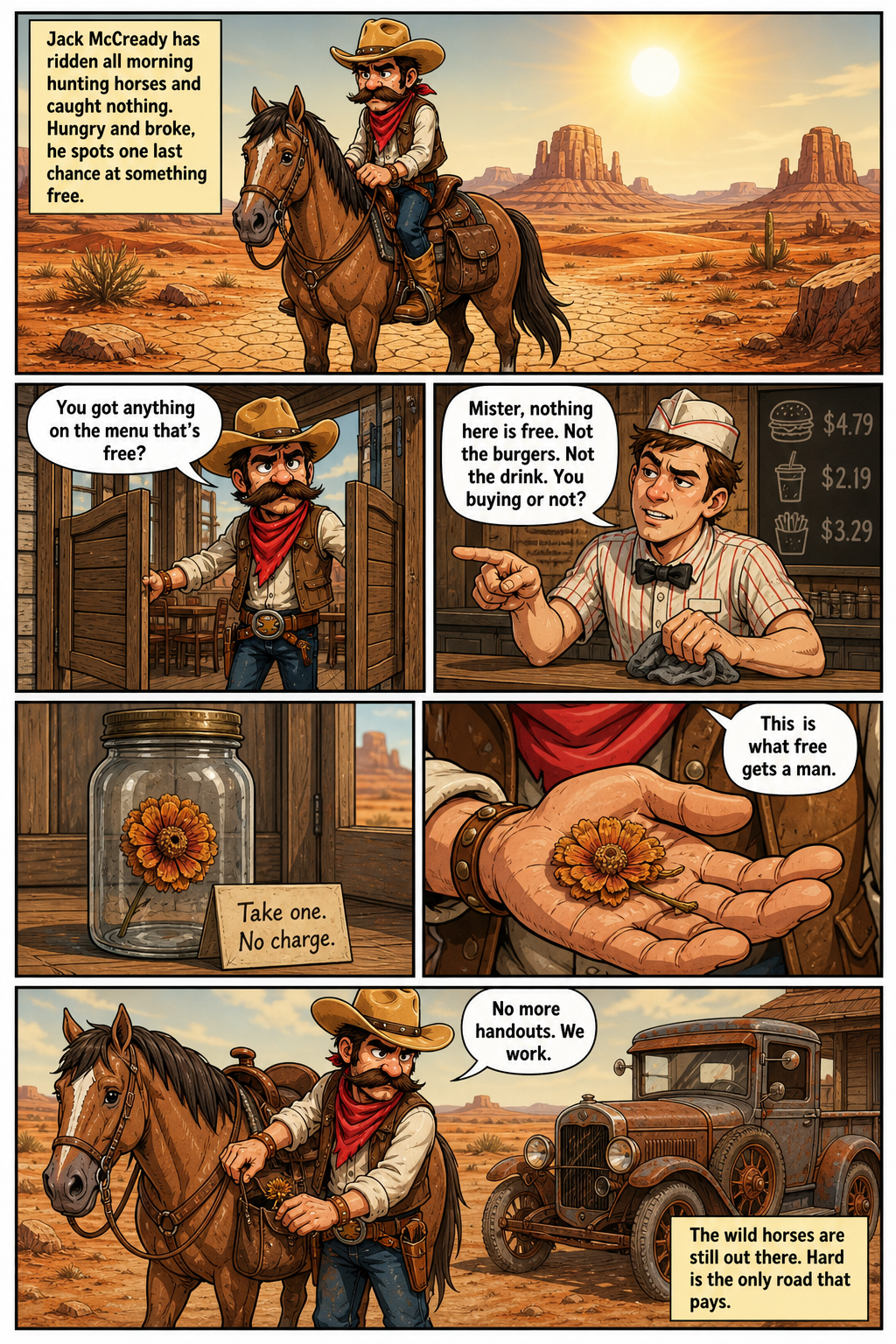
Jack rode the range all morning and caught nothing. By noon his belly ached and his pockets stayed empty. He turned his weary horse toward town. A wooden saloon stood near the trail, golden arches bright above the weathered boards. The sign promised burgers and sarsaparilla. Jack had no coin, but he had an idea. Somewhere in every place, he figured, a man could find something free. He tied his horse to the rail and stepped onto the porch. The swinging doors creaked. Inside, a young worker wiped the counter with a gray rag. He wore a paper hat and a bored look. "Howdy," Jack said. He kept his voice steady, though his pride stung. "You got anything on the menu that's free?" The worker stopped wiping. He stared at Jack's dusty hat and cracked boots. "Free?" he said. He almost laughed. "Mister, nothing here is free. Not the burgers. Not the drink." He pointed to a board on the wall, each price marked in chalk. Jack's face went hot. He read the board anyway, hoping for a zero. There was none. "Water, then," he said. "A cup of water costs nothing." The worker shook his head. "Costs the cup. Costs the trouble. Boss says no cup without a sale." He leaned forward. "You buying or not?" Jack had his answer. Free was a story men told, not a thing he could hold. He turned to go. Then his eyes caught a jar near the door. Inside sat a single dried flower, sun-faded orange, its petals rough as old paper. A handwritten card leaned against the glass. Take one. No charge. Jack lifted the flower out. It weighed nothing. It fed no one. But it was free, and he had asked for free, and here it was. The worker snorted. "That's for decoration. Folks take 'em for their sweethearts." Jack held the dry bloom in his palm. A flower would not fill his belly or buy his lumber. He had wasted a whole morning chasing an easy thing. The lesson landed hard. Out here, a man earned every scrap. Nothing came to the idle hand. He walked out and untied his horse. The animal looked as tired as he felt, ribs showing under a faded coat. Jack tucked the flower into his saddlebag and swung up. "No more handouts," he said to the horse. "We work." He looked back toward the open range. The wild horses were out there. Catching them was hard, and he had failed before. But hard was the only road that paid. He pointed his horse away from the saloon and rode toward the range with the hunger still in him, sharper now, and a plan that had no shortcuts left in it.
Play your story to life
Storycraft is a mobile game where you create AI characters, craft items and locations to build their world, then discover what direction your story takes. Download the iOS game for free today!
Download for free