

Jane Hanna's Arc
6 Chapters
Jane Hanna's dream is restoring the school's forgotten rooftop garden into a haven where the cherished insects gather every evening.

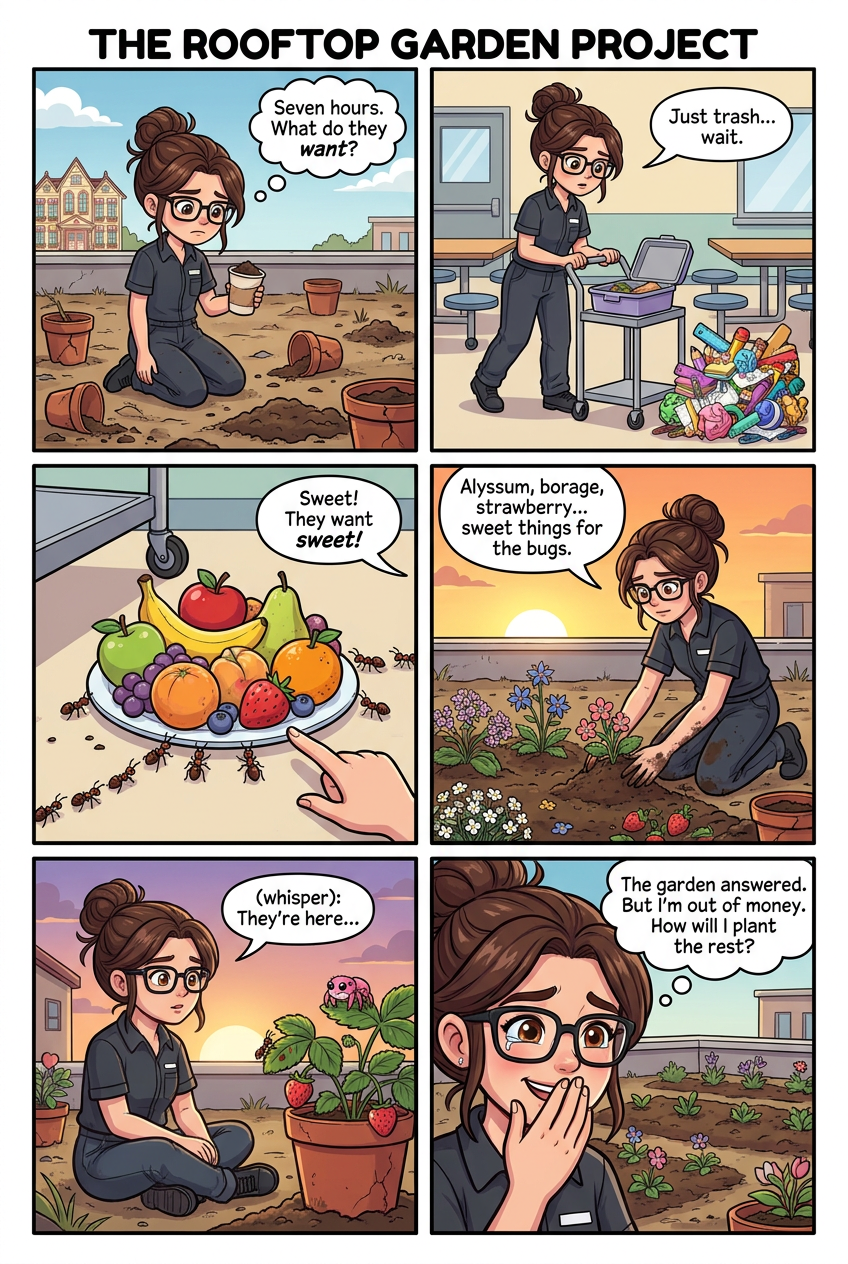
Jane Hanna knelt on the schoolhouse roof with a paper cup of soil in one hand and no idea what to plant. She was thirty-nine, a custodian in a black uniform now smudged with dust, her brown hair falling loose from its bun. The rooftop had been a garden once. Now it was cracked pots, dry beds, and a few stubborn weeds. She wanted it back. Not for the students. For the small bright bugs she used to watch up here on lunch breaks, before the beds went brown and the insects stopped coming. The problem was simple and awful. Evening was seven hours away. If she planted the wrong things, nothing would come. She had a flat of seedlings from the hardware store: marigolds, mint, something with purple spikes. The tags told her sun and water. None of them told her what the bugs actually wanted. She sat back on her heels and pushed her glasses up. Below, the schoolhouse was all painted trim and window boxes, cheerful as a cake. The roof was the opposite. She had guessed once already this week and wasted a whole tray on lavender. Not one visitor. She went downstairs to think. The hallway smelled like floor wax. She rolled her cart to the cafeteria and started on the bins. The first bin was the classroom bin, full of crumpled worksheets, snapped pencils, sticky notes, a few plastic figurines a kid had given up on. She lifted the bag. Clean. Nothing moved. The second bin was the lunch bin. She tipped it and a soft heap tumbled out onto the tile: apple cores, banana peels, a split pear, grape stems, half a strawberry. The ants were already there. Dozens of them. Tiny, round, shiny brown bodies moving in a careful line from the baseboard to the fruit. She crouched close. They ignored the paper bin entirely. They wanted the sweet. Jane sat on the floor and watched them for a full minute. Sweet. Not leaves. Not lavender. Sugar and fruit and nectar. She left the mess and went back to the hardware store on her lunch break. She returned the lavender. She bought what she could afford: alyssum, borage, a small strawberry start, two pots of flowering thyme. Sweet-smelling, sweet-flowering, close to the ground. On the roof she planted fast, hands in the dirt, uniform ruined. She watered. She waited. At six-forty, sitting cross-legged by the strawberry pot, she saw the first ant come up the drainpipe. Then a second. Then a bright pink flick of movement on the borage leaf, a jumping spider no bigger than a pea, staring at her with huge dark eyes. Another landed beside it. Jane laughed once, quiet, and pressed her dirty hand to her mouth. The garden had answered. But four pots would not feed a rooftop. She needed the whole bed replanted by tomorrow, and she had spent her last twenty dollars.
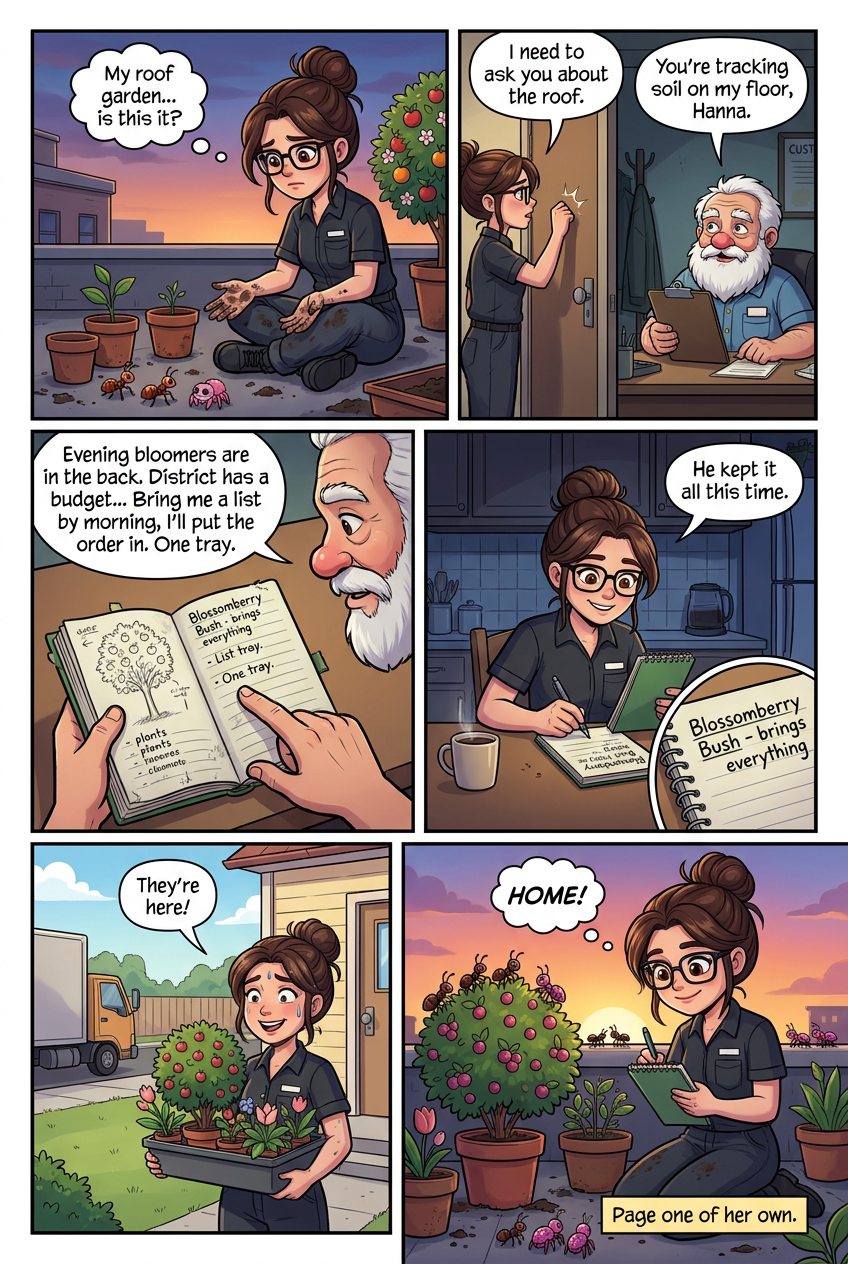
Jane sat on the roof past sunset with dirt drying on her knuckles. Four pots had brought a handful of ants and two pink spiders. She needed a full bed by tomorrow evening, and her wallet was empty. She didn't know which of the old evening flowers to chase. Guess wrong again and the roof would sit quiet at dusk, the bugs gone back to wherever they came from. She went down to the custodial office because the only person who might remember the garden from before was her boss. Joe had run the brooms and boilers at this school since Jane was in grade school herself. White beard down to his second button, uniform shirt tucked tight over his belly, he was writing something on a clipboard when she knocked. He didn't look up. "You're tracking soil on my floor, Hanna." "I need to ask you about the roof." That made him look up. He set the clipboard down. Jane spoke fast. She told him she had replanted. She told him about the ants at the fruit scraps and the little pink jumpers on the borage. She told him she needed more plants by tomorrow and didn't know which ones drew the bugs at dusk. Joe was quiet a long moment. Then he opened the bottom drawer of the desk and pulled out a battered green notebook. He set it on the desk and pushed it across. "That was mine," he said. "When they still let us up there. Evening bloomers are in the back." Jane opened it. Pencil lists. Dates. Little sketches of leaves. On the last written page: evening stock, sweet alyssum, night phlox, and a fruit bush he had drawn in careful lines, blossoms and fat berries clustered together. Beside it he had written, brings everything. "I can't afford any of this," Jane said. Joe scratched his beard. "District has a grounds budget nobody touches. I sign for it. Bring me a list by morning, I'll put the order in. One tray. Don't make me regret it." Jane looked at him. "Why?" "Because I planted the first one," he said. "And I was the one who locked it." She stayed up that night at the kitchen table copying his list in her own handwriting. Evening stock. Night phlox. Sweet alyssum in three flats. The berry bush at the top, underlined. By the next afternoon a delivery truck left a stack of trays at the school's back door. Jane hauled them up herself, one flat at a time, uniform soaked through. She planted until the light went orange. Then she sat down by the new berry bush and waited. The ants came first, up the drainpipe in a thin brown line. Then the pink jumpers, one, then four, then more than she could count. Something bigger hummed past her ear and landed on the stock. Jane didn't laugh this time. She wrote it down in the green notebook. Page one of her own.
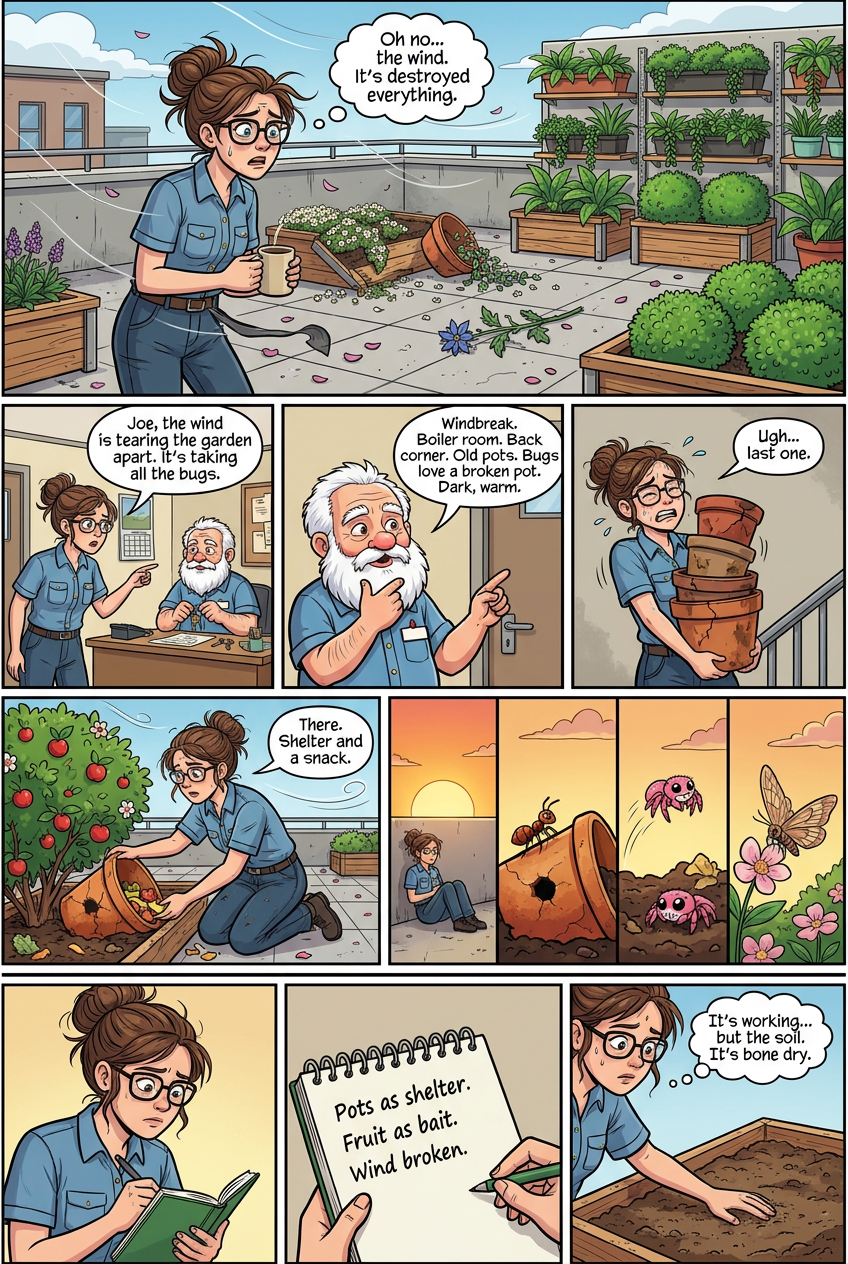
The next morning Jane climbed to the roof with coffee and found the beds thrashed. Wind had come in off the flat expanse of tar overnight. Two of the alyssum flats lay tipped. A borage stem hung snapped at the base. The berry bush her boss had underlined in his notebook had shed half its blossoms across the concrete. She knelt and picked up the petals one by one. No ants. No jumpers. The roof was bare of anything with legs. She understood then what she had missed. There was nothing up here for a bug to hide behind. No wall, no crack, no hollow. The wind rolled straight across the slab every evening and scattered them before they could settle on a bloom. Jane went back down to the custodial office. Joe was at his desk sorting keys. She told him the wind was pulling the garden apart and taking the bugs with it. He listened, then set the keys down. "Windbreak," he said. "Doesn't have to be pretty. Has to block." "I've got no lumber money." He scratched his beard. "Boiler room. Back corner. Pots the old teacher left. Some are cracked. Lay them on their sides, tuck them in the beds. Bugs love a broken pot. Dark, warm, out of the wind." Jane spent the afternoon hauling terracotta up the stairwell. Most of the pots were split. One had a clean hole punched through the side, the rim chipped, the clay stained dark from years in the damp. She carried it up last. On the roof she worked along the raised beds. She laid the whole pots on their sides between the alyssum and the thyme, mouths facing away from the wind. She wedged the cracked one against the base of the berry bush and packed soil around it so it would not roll. Then she went down to the cafeteria and came back with a paper tray of fruit scraps from the lunch bins. She tucked apple cores and strawberry tops into the shade of each pot. She sat against the low wall and waited. The sun dropped. The wind pushed at her collar but broke against the pots and slid over them. Inside the cracked one, the shadow held still. An ant came up the drainpipe. Then a line of them. They turned at the first pot and went in. A pink jumper landed on the rim of the cracked one and dropped inside. Something small and gray followed. Then a moth settled on the berry blossoms above and stayed. Jane counted what she could see and stopped counting at forty. She wrote it in the green notebook. Pots as shelter. Fruit as bait. Wind broken. Then she saw the blossoms above the cracked pot were wilting fast. The berry bush was drying at the tips. She touched the soil. Bone dry. There was no water line on the roof.
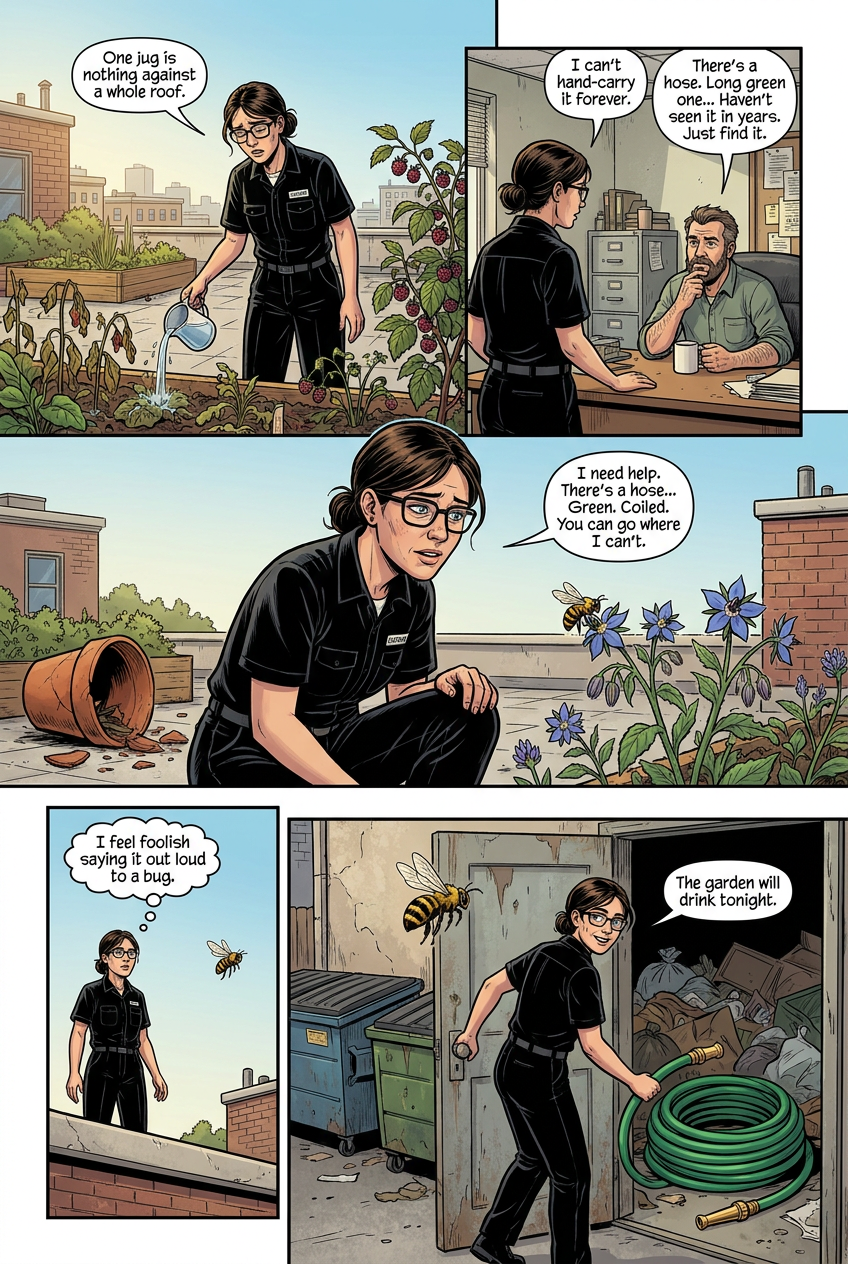
By morning the berry bush had lost more leaves. The alyssum flats sagged. Jane carried a jug of water up three flights and poured it slow along the beds, but one jug was nothing against a whole roof. She would be climbing those stairs every day for the rest of the season, and the plants would still die between her visits. She went down to the custodial office. Joe was at his desk with a mug and a stack of work orders. He looked up when she came in. "There's no water line up there," she said. "I can't hand-carry it forever." Joe scratched his beard. "There's a hose. Long green one. I used to drag it up when the garden was mine." He frowned at the wall. "Haven't seen it in years. Somewhere in the building. Boiler room, maybe. Or the shed off the loading dock. Could be behind the mop closet on two." He shrugged. "It's here. Just find it." Jane checked the boiler room first. Nothing but the empty pot shelves. She checked the loading shed. Rakes, salt, no hose. She checked the mop closet on the second floor and the one on three. By lunch her back hurt and she had opened every door she had a key for. She went up to the roof and sat against the low wall. The pots on their sides still held their small crowds. Ants moved along the rim of the cracked one. A jumper sat on the berry bush. A fat striped bee bumbled over the borage and settled. Jane watched the bee. Then she leaned forward. "I need help," she said. She felt foolish saying it out loud to a bug. She said it anyway. "There's a hose in this building. Green. Coiled. I can't find it. You can go where I can't." The bee lifted off the borage. Two more came up from the alyssum. A third rose from behind a pot. They circled once over her head and dropped over the edge of the roof. Jane stood at the wall and watched them go. They cut around the corner of the building, low and fast, and disappeared. She waited. Ten minutes. Twenty. She was about to give up when one bee came back and hovered in front of her face, then swung toward the stairwell door. She followed. Down three flights. Past her own supply cart. Around behind the dumpster corral at the back of the lot, where a lean-to she had never opened leaned against the fence. The bee bumped the latch. Jane opened the door. A coil of green hose sat on the floor under a mound of trash — old worksheets, a chewed pencil, a paper cup. The brass nozzle poked out at the bottom, bright and clean. She pulled it free. It was long enough. The spigot on the side of the building was six feet away. The garden would drink tonight.
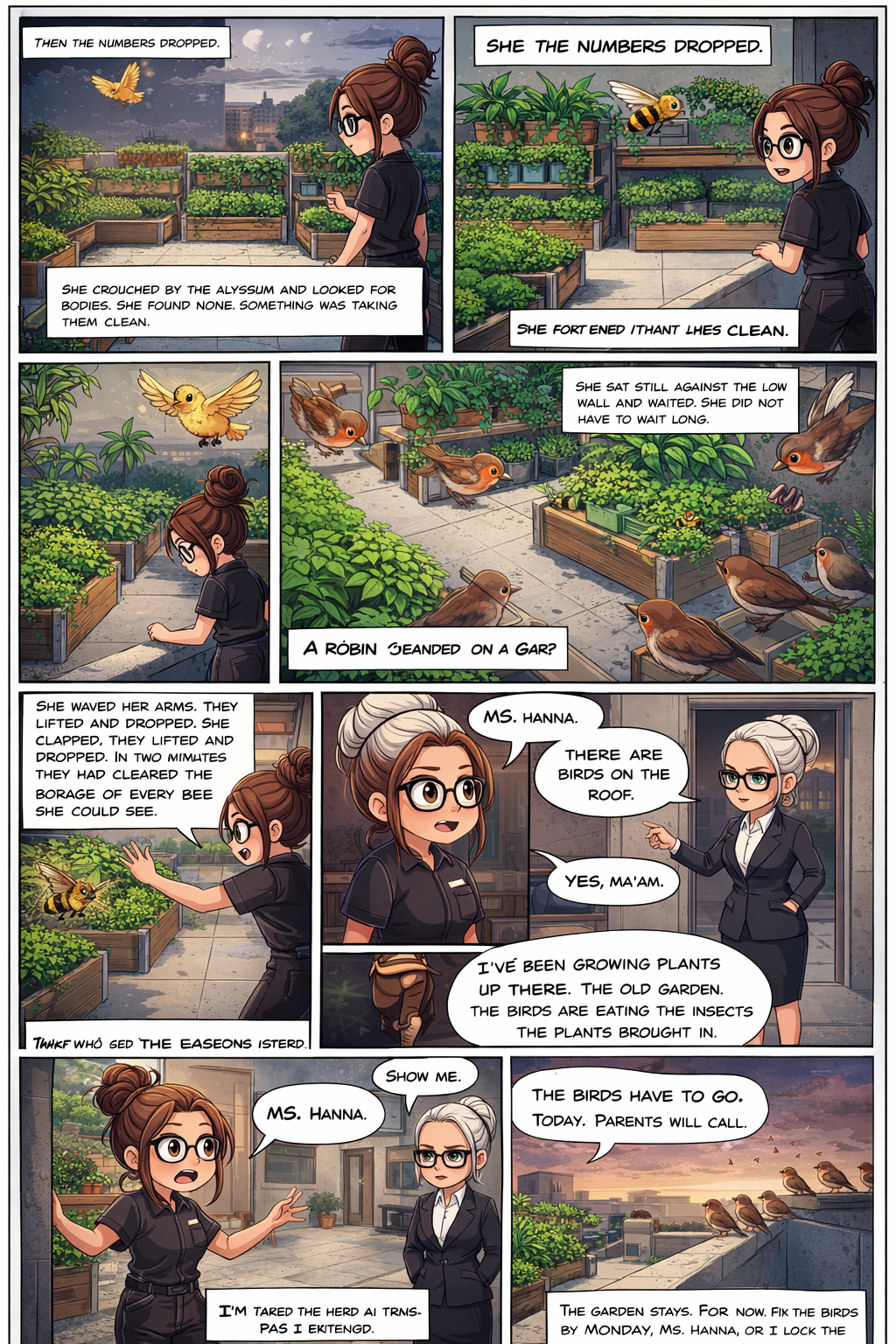
The hose worked. For three evenings the roof drank and bloomed. Bees rolled through the borage. Ants moved in dark lines along the pot rims. Jumpers stitched the berry bush. Jane stood at the wall each dusk and watched the air fill up. Then the numbers dropped. On the fourth evening she counted half the bees. On the fifth, fewer. The ant lines thinned. A jumper she had watched for a week was gone from its usual leaf. Jane crouched by the alyssum and looked for bodies. She found none. Something was taking them clean. She sat still against the low wall and waited. She did not have to wait long. A yellow bird dropped onto the edge of a raised bed. Small, bright, quick. It cocked its head, snapped a bee off the borage, and lifted away. A robin landed on the concrete slab and worked the base of a pot, pulling ants one by one. Then the sparrows came. Six, then ten, then more than she could count. They fell on the garden like it had been set out for them. Jane stood up. The flock scattered, circled, and settled again ten feet down the bed. They were not afraid of her. They were hungry, and the roof was a plate. She waved her arms. They lifted and dropped. She clapped. They lifted and dropped. In two minutes they had cleared the borage of every bee she could see. She went down the stairs fast. She was crossing the second floor landing when the principal came around the corner with a folder under her arm. White hair pinned up, glasses, black suit. Jane's boss's boss. The woman who could lock the roof again with one sentence. "Ms. Hanna." Principal Ashford stopped. "There are birds on the roof. A great many birds. Parents can see them from the parking lot." Jane's mouth went dry. "Yes, ma'am." "Why are there birds on my roof." Jane thought about lying. She could not think of a lie fast enough. "I've been growing plants up there. The old garden. The birds are eating the insects the plants brought in." Ashford looked at her for a long moment. "Show me." They climbed together. Jane opened the door. The sparrows lifted in a brown wave and settled on the parapet, watching. The beds were green and full. The pots held their small survivors. A single bee crossed the thyme and vanished into a crack. Ashford walked the slab once. She touched a strawberry leaf. She looked at the pot windbreaks, the hose coiled by the spigot, the neat rows. "You did this on your own time." "Yes." "The birds have to go. Today. Parents will call." She turned at the door. "The garden stays. For now. Fix the birds by Monday, Ms. Hanna, or I lock the door again." The door shut. Jane looked at the sparrows on the parapet. They looked back.
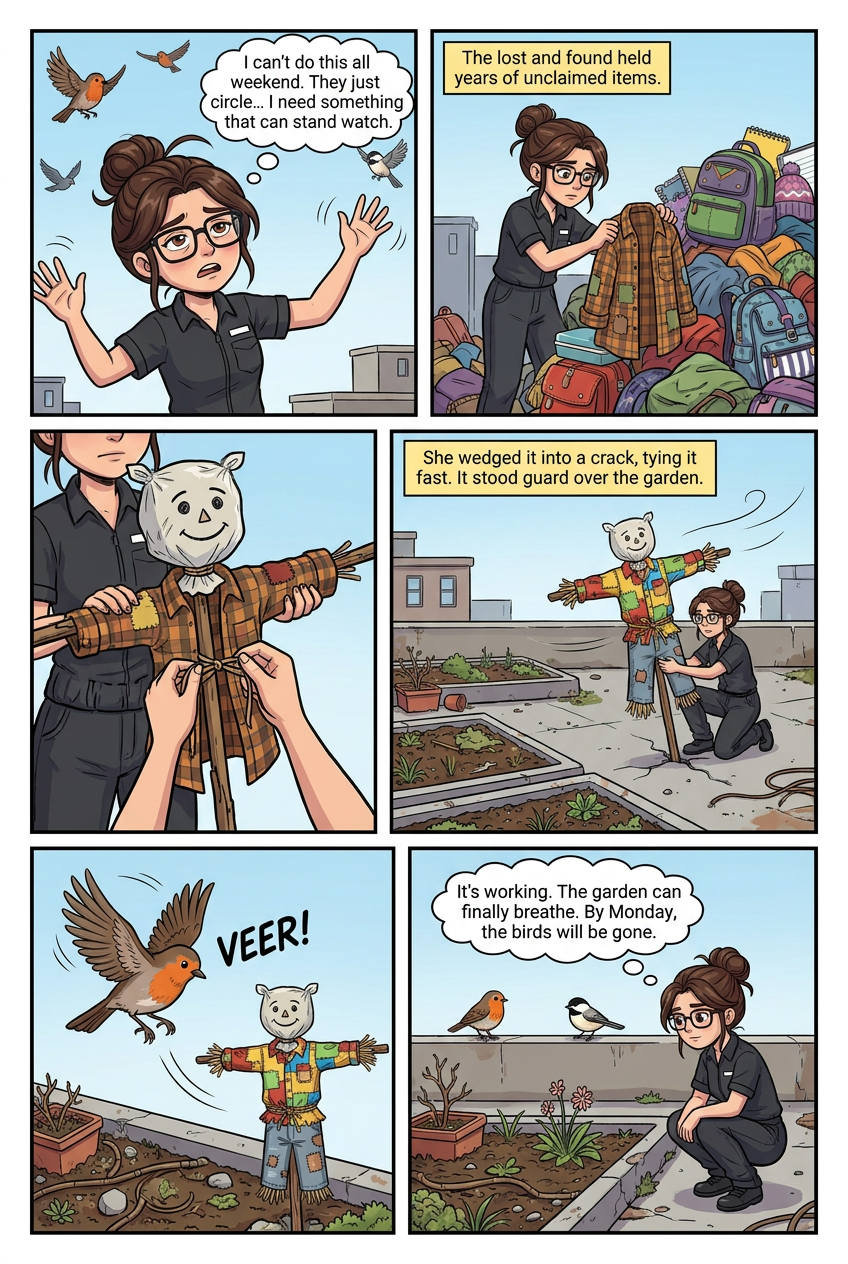
By Saturday morning Jane had a hard truth. She could not stand on the roof all weekend waving her arms. She had tried it once and lasted an hour. The birds only circled and dropped back. On Monday the insects would be gone and the door would lock. She needed something that stood watch when she could not. She went down to the lost and found. The pile sagged against the wall, packed with backpacks, coats, and worn-out shoes. Nobody had claimed any of it in years. Jane dug through and pulled out a patched flannel shirt, a pair of jeans with holes in the knees, and a knit hat. She stuffed a plastic bag with crumpled paper for the head. She drew a face on it with marker. Next she needed a frame. She found the broken pile behind the boiler room, a heap of cracked desks and splintered broomsticks. She took two broom handles and lashed them into a cross with twine. She pulled the shirt over the top bar and tied off the sleeves. The jeans hung from the pole below. The hat sat crooked on the paper head. It looked like a child had made it, patched and soft and cheerful. She carried it up the stairs and out onto the concrete slab. She wedged the pole into a crack near the raised rim, where the old garden had once stood. She tied a strawberry stake against it to hold it straight. The scarecrow stood over the beds with its arms spread wide. A light wind pushed the sleeves and they lifted, then fell. A robin dropped toward the borage first. Warm orange breast, quick eyes. It saw the moving shape and veered hard, wings snapping. It landed on the parapet instead of the beds. A small black-capped bird hopped along the rim, then froze when a sleeve swung. It did not come down. The sparrows wheeled once over the roof and kept going. Jane crouched by the alyssum and waited. An hour passed. The scarecrow's arms shifted with every gust. No bird touched the beds. By late afternoon an ant line crossed the pot rim again. A single bee rolled through the borage and stayed. Jane counted three, then five, then more than she could track. The garden was breathing again. She watched until the light went gold. The birds sat on the parapet and on the wire beyond, watching the shape that never stopped moving. They did not land. On Monday the door would stay open now. Ashford had asked for the birds gone by then, and the beds were clear.
Play your story to life
Storycraft is a mobile game where you create AI characters, craft items and locations to build their world, then discover what direction your story takes. Download the iOS game for free today!
Download for free