

Jory Lanfear's Arc
7 Chapters
Jory Lanfear's dream is winning the hand of the queen's own daughter so his purple-eyed line marries straight into the royal bloodline..

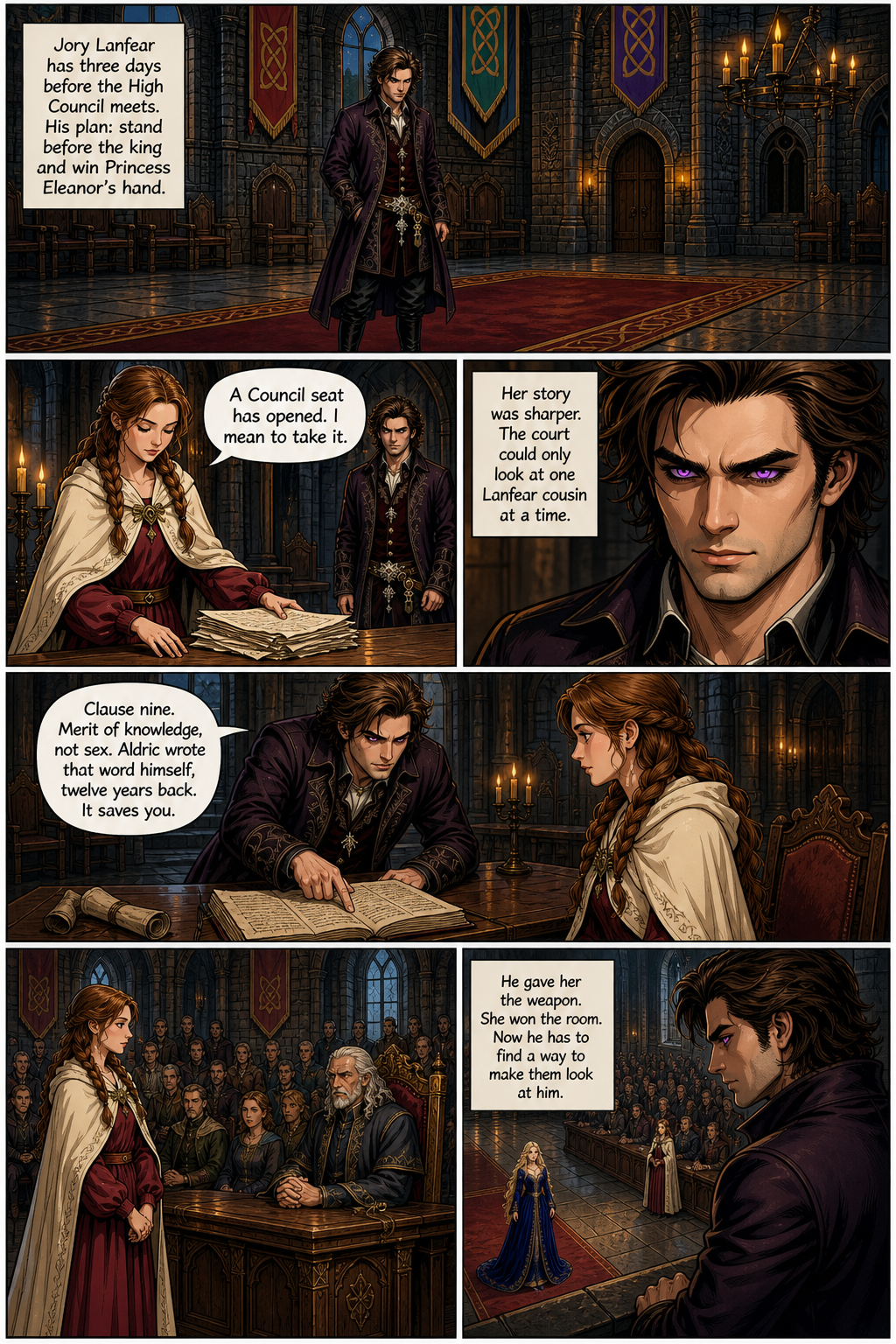
Jory Lanfear wanted to marry a princess. Not any lady, but Princess Eleanor Penrose, the king's own daughter. His house carried purple eyes down the generations, and Jory meant to carry them into the royal blood. He had a plan. In three days the High Council met at Dunquin Keep, and he would stand before the king's court and offer his suit. He practiced his lines in the dark hall, watching the Celtic banners hang from the battlements. Then his cousin arrived and ruined the arithmetic. Lady Gwenllian Quinney crossed the hall with a stack of papers under her arm. She did not bow. She did not smile at him. She spread her papers on the long table and read them by candle. His own blood, come to the same castle, the same week, for her own reasons. "You look pleased," Jory said. "That worries me." "A Council seat has opened," Gwenllian said. "I mean to take it." Jory laughed once, then stopped. She was serious. A Quinney on the Council, debating law in front of the king, while he knelt and asked for a girl's hand. The court could only look at one Lanfear cousin at a time. Hers was the sharper story. A woman who had memorized thirty years of statutes against a man who wanted to breed his eyes into the crown. "The seat is yours, surely," he said. "Who stands against you?" "Lord Aldric. He knows the Charter of Seats better than I do." She tapped one page. "He will argue a woman cannot hold the seat. The Charter does not forbid it. But he will find the words first." Jory saw his chance. If her bid failed before the court convened, no one would speak of her at all. The week would belong to him alone. He almost held his tongue and let Aldric win. But she had traced his family tree once, as a girl, in these same papers. She had never told his secrets. He owed her that. "Clause nine," Jory said. "My father kept old council rolls. I read them as a boy. Clause nine names the holder by merit of knowledge, not by sex. Aldric amended it himself, twelve years back. He wrote the word that saves you." Gwenllian looked up. For a long breath she said nothing. Then she wrote the number down. "That will hold," she said. "Thank you, cousin." Two days later she stood before the Council and quoted clause nine to Lord Aldric's face. He had no answer. The court gave her the seat. Jory watched from the gallery. He had helped her win, and now the whole court spoke of the clever Lady Quinney. No one spoke of his suit. He had traded his quiet week for her victory, and he had done it gladly, and it cost him exactly what he feared. When the king's daughter entered the hall that evening, every eye was still on Gwenllian. Jory would have to make them look at him instead.
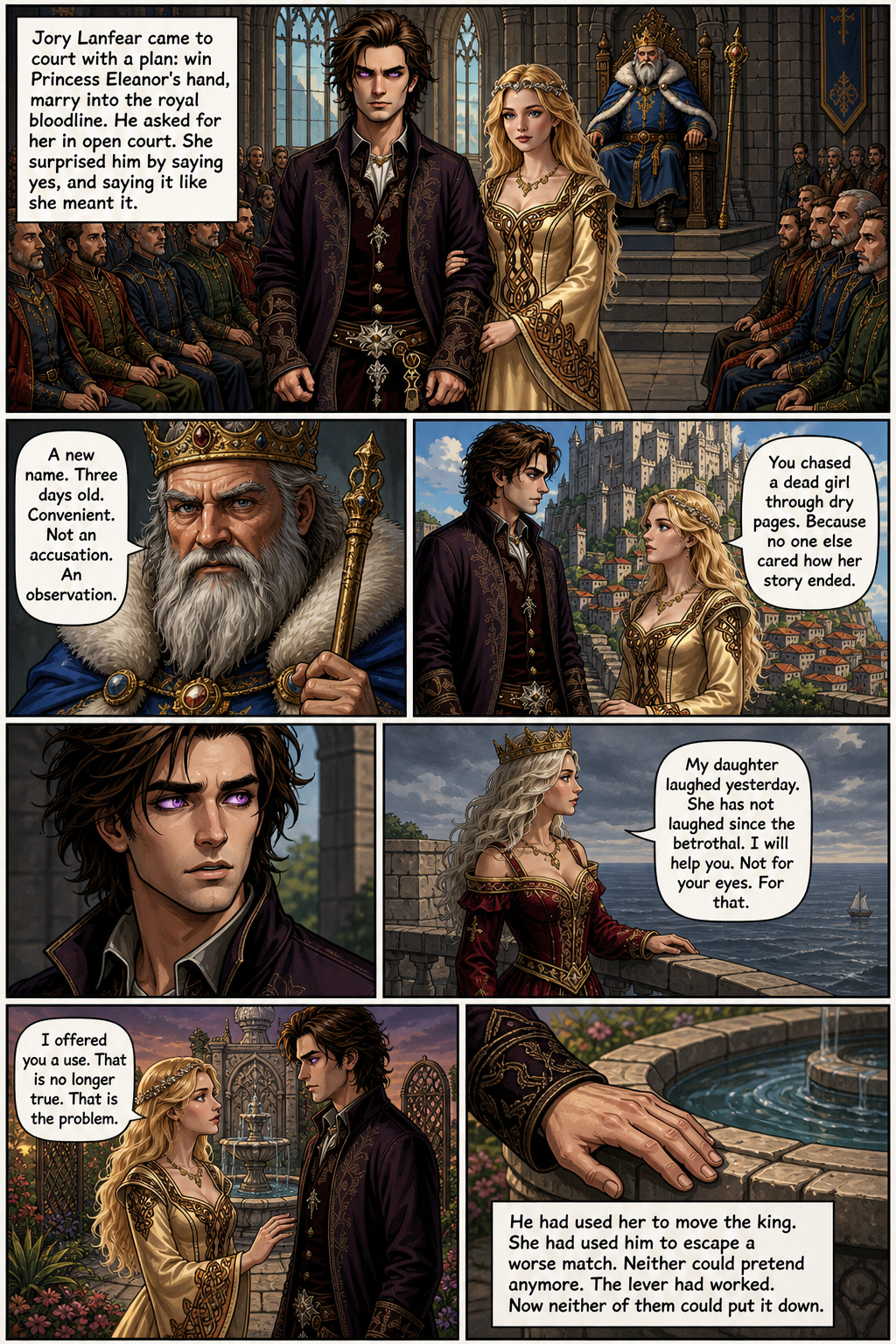
Three days later, Jory came to the Council hall and said the words he had rehearsed. He asked for Princess Eleanor's hand in open court. The lords went quiet. Then Eleanor stepped forward and surprised him. She did not merely allow the suit. She smiled at him. She took his arm. Before the whole court she named him a worthy match. The plan had been a lever. Now she was playing a part, and playing it well. The king watched from his high seat. Eddard Penrose, sixty and gray, leaned on his carved staff. He did not shout. He studied Jory the way a man studies a horse before buying it. "A new name," the king said. "Three days old. Convenient." He corrected himself before Jory could answer. "Not an accusation. An observation." Then he turned to his daughter and said nothing, and his silence was worse than any question. Eleanor used the days that followed. She and Jory walked the terraced city below the pale citadel together, because the match required it. He expected to manage her. Instead she asked him true things. She asked about the book his father stole and the girl in it who died at eight. He had never told anyone. He told her. She listened the way no one at court listened, without waiting for her turn to speak. "You chased a dead girl through dry pages," Eleanor said. "Because no one else cared how her story ended." She stopped on the stone steps. "I thought you wanted my blood. You want the ending to a story." Jory had no clever answer. That frightened him more than the king had. The queen found him alone on the citadel wall the next morning. Mairona Penrose, fifty, blond going gray, wore red and spoke plain. She was Eleanor's mother, and she had already chosen a side. "My daughter laughed yesterday," she said. "She has not laughed since the betrothal." She looked at the sea below. "I will help you. Not for your eyes. For that." She left before Jory could thank her. He had gained a queen as an ally. He had also lost control of the thing he started. On the final evening, Eleanor met him by the fountain in the high garden. Her face had changed. The performance was gone. "The arrangement worked," she said. "My father is listening now." She paused. "But I meant what I said by the water. I offered you a use." She touched his sleeve, then drew back. "That is no longer true. That is the problem." Jory understood. She had set out to use him and had stopped pretending. He had set out to use her and could not. The false courtship had turned real on both sides. The king was watching. The queen was waiting. And the old lord Eleanor was still promised to had not released her yet. The lever had worked. Now Jory could not let go of it.
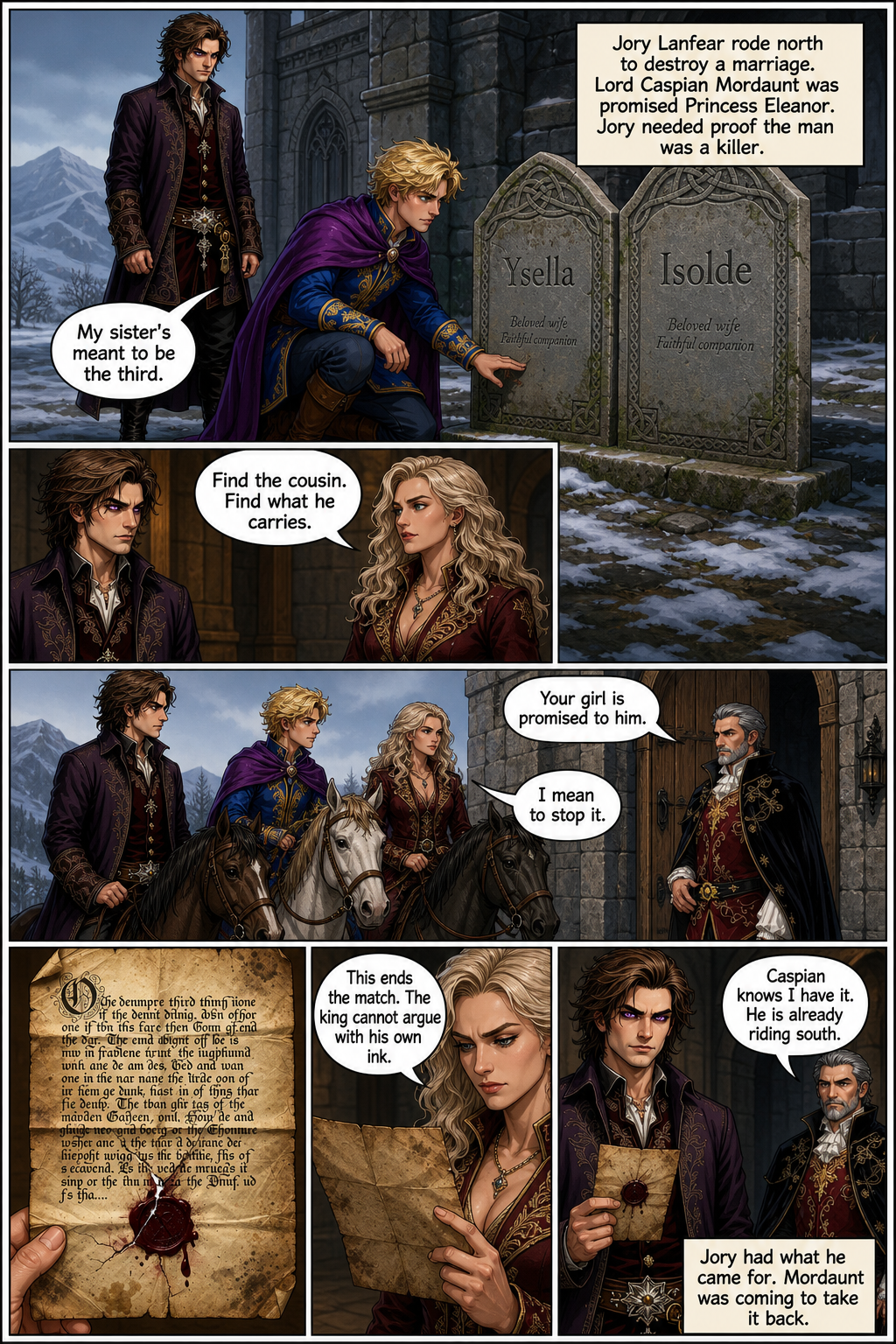
Jory could not let the old lord have Eleanor. So he went looking for the thing that would end the match for good. The queen gave him leave. Her son Rowan rode with him, bored of hunting and hungry for trouble. They crossed to the north together, to the land Lord Caspian Mordaunt ruled. Jory wanted proof the man was dangerous. He wanted the king to see it too. They started at the dead. Behind Mordaunt's hall stood two gray headstones, carved as one. Ysella. Isolde. Both named beloved wife. Both gone young. Jory read the words and felt cold. "Two," he said. "Not one." Rowan crouched by the stones and traced a cracked letter. "My sister's meant to be the third," he said. He did not smile. That was how Jory knew the prince was afraid. The queen had come north herself to lend her weight. Mairona met them inside, plain in travel clothes, no crown. "I asked the servants who tend the graves," she said. "One remembers a man. A cousin. He came for both funerals and spoke to no one." She stated it flat. "Find the cousin. Find what he carries." The cousin was Lord Egan Ó'Keeffe. He held lands near Mordaunt's and shared his blood. Jory knew the name. Ó'Keeffe had once sought Senara Murray and lost her without a fight. A hard man who wasted no words. Jory found him at his own gate, watching them ride up with gray eyes that gave nothing back. "You've come about Caspian," Ó'Keeffe said. Not a question. He did not ask them in. He stood in the door and looked at the queen a long moment. "Your girl is promised to him." "She is," Mairona said. "I mean to stop it." Ó'Keeffe went inside. He came back with a letter, worn soft at the folds, sealed in dark wax now cracked through. "He wrote this to me," he said. "Years ago. After the second wife died." His jaw worked once. "I kept it. I told no one. That was wrong. I have carried it since." He held it out to Jory. Jory broke the rest of the seal and read. The hand was Caspian's. The words did not hide. He wrote of both women. He wrote of what he had done and how no one had ever asked. Jory's throat tightened. He passed it to the queen. Mairona read it twice. Her face did not change, but her hand shook. "This ends the match," she said. "The king cannot argue with his own ink." Rowan took the letter and read over her shoulder. For once he made no joke. "He confesses to killing both," he said. "And Father wants Eleanor to be number three." Jory held the proof he had come for. But Ó'Keeffe spoke again, quiet. "Caspian knows I have it. He is already riding south."
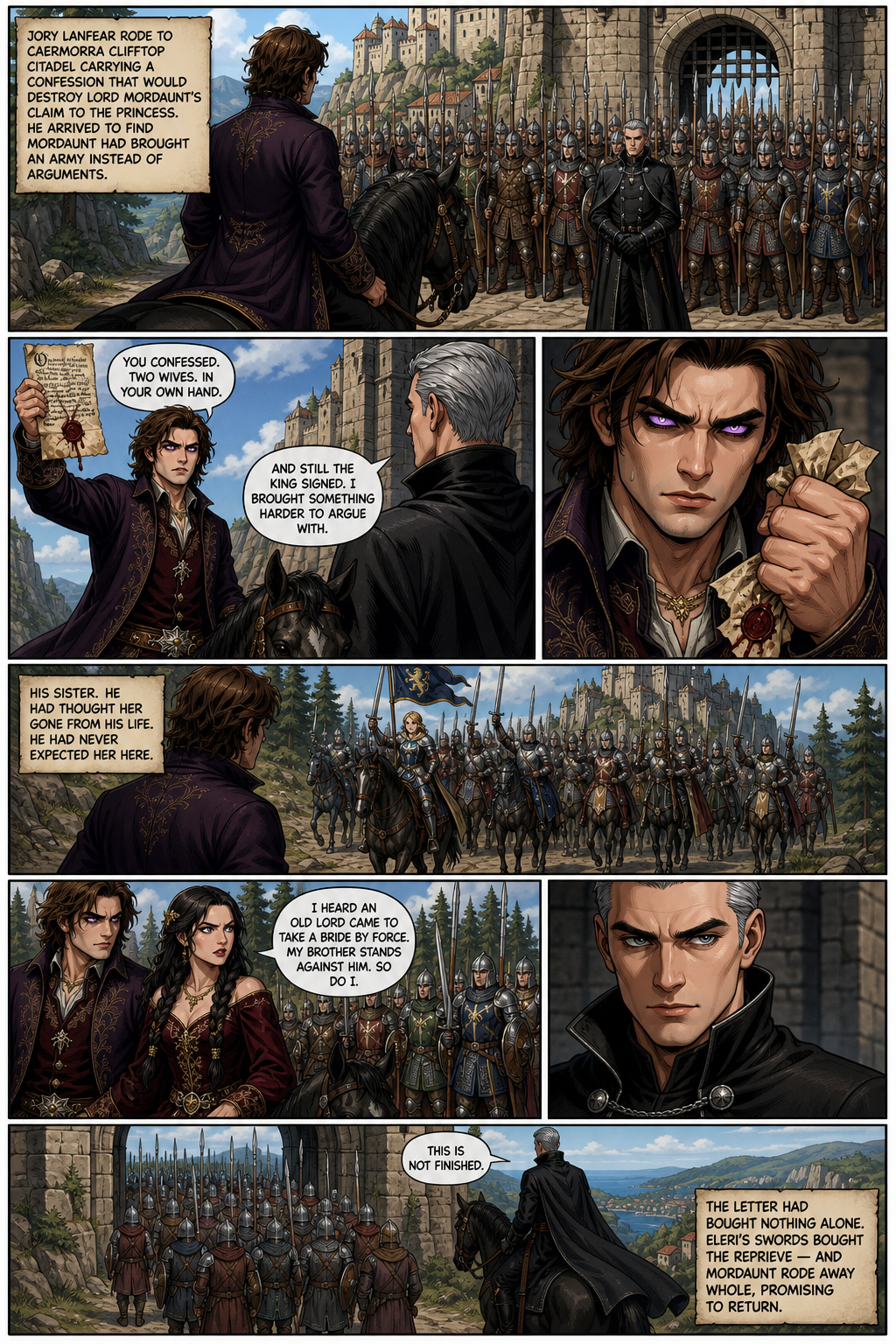
Jory rode south ahead of the letter, hard. He carried the queen's proof and her leave to use it. But Mordaunt had a start on them, and a man like that did not come to court to plead. Jory feared what the old lord brought with him. At the castle gate he learned the fear was right. Mordaunt had arrived that same hour. He stood in the yard in black, gloved hands at rest. Behind him waited rank on rank of hired soldiers, spears up, shields marked, silent as stone. A purchased army. Jory counted them and his mouth went dry. The queen's guards watched from the wall and did nothing. Nobody wanted to strike first. "You've the letter," Mordaunt said. Not a question. His voice did not rise. "Egan always kept things he should have burned." He looked past Jory to the keep. "The king promised me his daughter. I came to collect. Letters don't unmake a bargain. Men do." Jory held the pages up. "You confessed. In your own hand. Two wives." "I did." Mordaunt did not blink. "And still the king signed. That tells you what the king's word is worth." He nodded at his ranks. "I brought something harder to argue with." Jory had the proof and no force to back it. The letter shook in his grip. He had outrun the danger only to meet a worse one. Then a horn sounded on the ridge road. Jory turned. Down the slope came riders under a banner he knew — his own house colors. At their head rode his sister, Eleri, in mail over the dark velvet she favored, her black hair bound back. Behind her marched fifty armed men in close order, swords drawn, moving like one body. Jory stared. Eleri lived at Rossmore now, wed into the Murrays. He had thought her lost to him. He had never once expected her here, armed, for him. She reined in beside him and looked at Mordaunt's host without flinching. "I heard an old lord came to take a bride by force," she said, flat. "My brother stands against him. So do I." "Why," Jory said. His throat was tight. "You don't owe me this." "No," she agreed. "I came anyway." She did not explain further. Mordaunt measured the new ranks with his gray eyes. His soldiers outnumbered hers. But now the yard held two armed hosts, not one, and the queen's guards had a side to join. The math had changed. Blood would cost him everything, and he knew it. "This is not finished," Mordaunt said. He turned his horse. His men wheeled with him and withdrew through the gate, step by step, spears still high. Jory let out his breath. Eleanor was safe tonight. The letter had bought nothing on its own — his sister's swords had bought the reprieve. And Mordaunt rode off whole, his army intact, promising to come again.
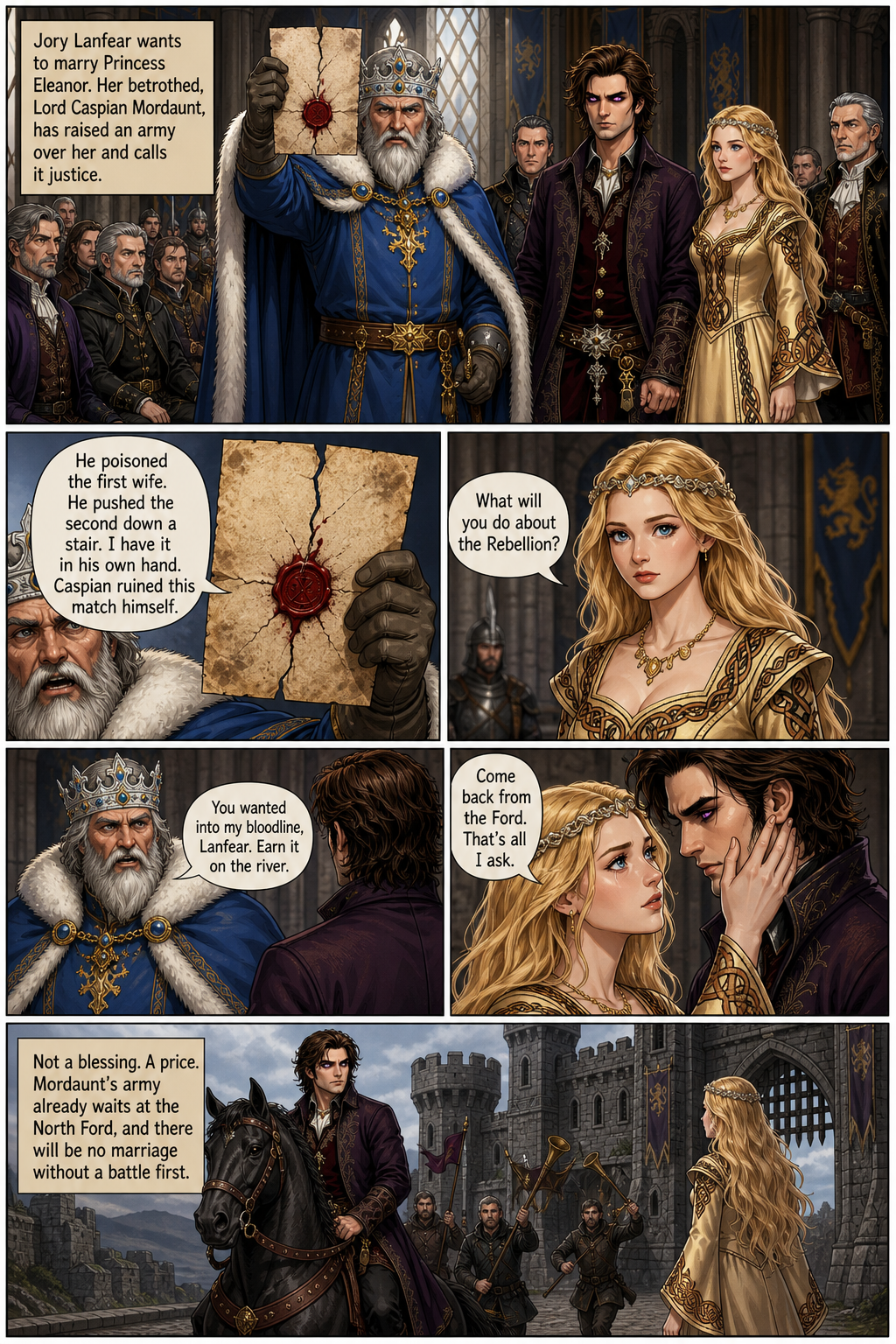
Mordaunt did not withdraw far. Within a week word came south: the North had risen. Caspian Mordaunt had raised his banners, and lesser northern lords unjustly rode under him. He called it a just war. He said the King had promised him Eleanor, then let a purple-eyed upstart court her instead. Betrayal, he named it. He meant Jory. Now the whole border rallied over a bride. The King summoned the court. Jory stood next to Eleanor, holding her hand, as her father read Mordaunt's demand aloud. Eddard Penrose set the page down and did not shout. He spoke so the whole hall would hear it and carry it north. "Mordaunt claims I broke faith," the King said. "I dissolved the betrothal the hour I held proof he murders his wives. I'll not hand my daughter to a man who schemes and murders brides." He lifted the worn, cracked letter sealed in red wax. Mordaunt's own confession, written to his cousin Lord Egan. "He poisoned the first," Eddard said. "He pushed the second down a stair. I have it in his hand. He ruined this match himself. No suitor of hers undid it. Caspian did." Eleanor stood up straight beside Jory. She did not weep or soften. “What will you do about the Rebellion?” The King looked at his daughter, then at Jory. The old skepticism was still in his face. But he had chosen a side, and the side was against Mordaunt. "We end it with men," Eddard said. "My Lords and Ladies, I call you to raise your banners! Gather your levies and your militias. Meet my army at Moanroe’s Ford." He turned to Jory last. "You wanted into my bloodline, Lanfear. Earn it on the river." It was not a blessing. It was a price. Jory bowed. "I'll be there, Majesty." Outside, the yard filled with the noise of a kingdom going to war. Grooms ran. Horns called the muster. Eleanor walked him to his horse. "He'll make me the reason you die," she said, visibly upset. "I don’t want that." "You're not the reason," Jory said. "Mordaunt is. He made this when he killed his wives and lied about why he came." She touched his cheek. "Come back from the Ford. That's all I ask." Jory promised he would. Before he mounts his horse, she kisses him. Jory rode north with the King's command behind him. The obstacle had broken open at last. Mordaunt's grudge was no longer a threat whispered in a courtyard. It was a rebellion with an army, and the King had named the field where it would be answered. He had wanted Eleanor's hand for his children, their futures, his legacy. Now, her father had set the toll. There would be no marriage without a battle first. Jory bent to the wind and counted the leagues to the North Ford, where Mordaunt's purchased host , and whatever Northern lords showed up, already waited.
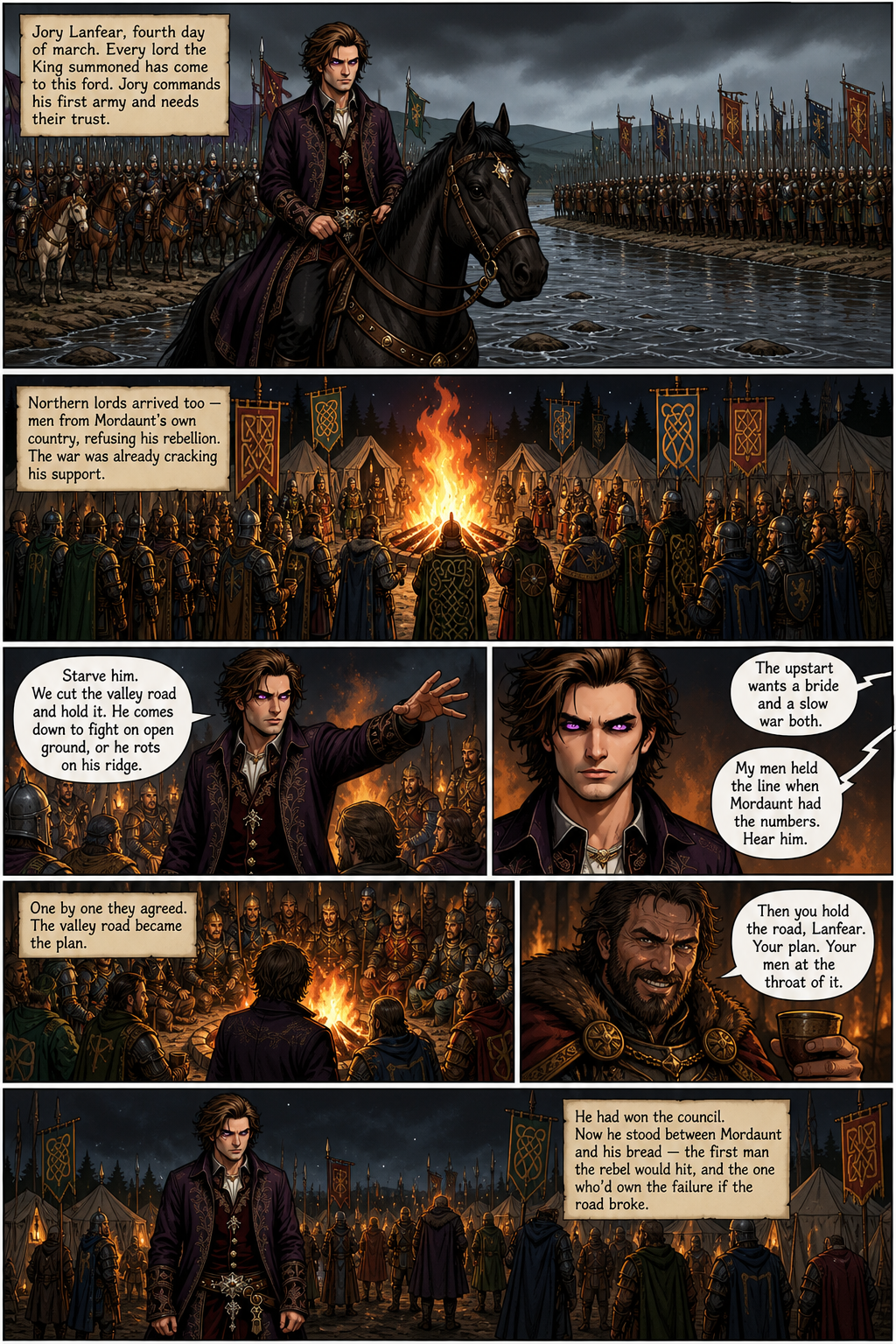
Jory reached Moanroe's Ford on the fourth day. The water ran shallow and brown between two muddy banks. He brought his own host with him, mounted knights, archers, and foot soldiers under his banner. He had never commanded so many men. He sat his horse at the water's edge and watched the other lords arrive. They came all morning. The Murray muster rolled in behind rows of painted shields. His sister Eleri rode at the head of her fifty guards, the same men who had saved him against Mordaunt. Lord Evan's host filled the far bank, spears like a field of reeds. By noon every lord the King had summoned stood by the ford. Then something happened Jory had not expected. Northern border lords rode in. These were men from Mordaunt's own country. They had refused to rise with him. They came to prove it by standing for the King instead. Their arrival changed the whole shape of the war. Mordaunt was not leading the North. He was leading only part of it. That night the lords gathered at the great fire in the war camp. Banners hung on poles around the flames. Tents circled the light. Men argued over the plan while servants poured drink. The northern lords spoke first. They knew Mordaunt's ground. His castle sat high on a ridge. A frontal march would bleed the King's army dry. But Mordaunt's supply came along one road through a narrow valley. Cut the road, and his army would starve inside a month. Some lords wanted the quick assault. They wanted glory and a short war. Jory saw the trap in it. He had chased evidence across the North once. He knew the land ate armies that rushed. "Starve him," Jory said. The fire lit his purple eyes. "We cut the valley road. We hold it. He comes down to fight us on open ground, or he rots on his ridge." A lord laughed. "The upstart wants a bride and a slow war both." Eleri stepped to her brother's side. "My men held the line when Mordaunt had the numbers. Hear him." The northern lords nodded. They had said the same before Jory spoke. One by one, the others agreed. The quick assault died at the fire. The plan became the valley road. But agreement cost something. The lords looked at Jory now as a man with a stake in the war. Mordaunt had named him the reason for the rebellion. Everyone at the fire knew it. The plan was his plan. If it failed, the blame would be his too. "Then you hold the road, Lanfear," the laughing lord said. "Your plan. Your men at the throat of it." The fire popped. No one argued. Jory had won the council and lost the easy part of the war. He had asked to starve Mordaunt. Now he stood between the rebel and his bread, alone at the front.
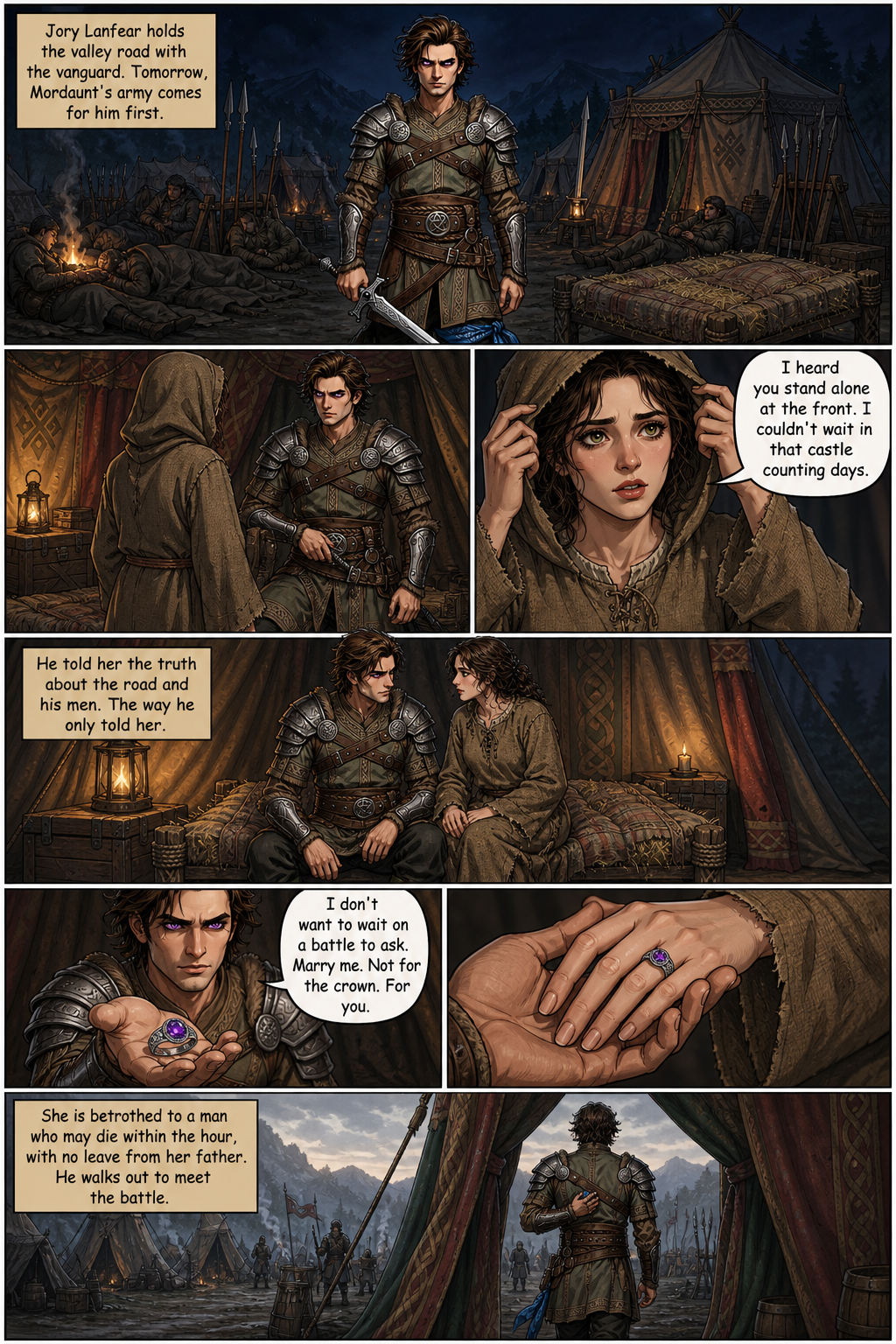
The night before the battle, Jory walked his lines one last time. His men slept among the small tents of the vanguard camp, spears stacked, fires low. He held the valley road now. Mordaunt would come for him first. He ducked into his war tent and sat on his straw pallet, too tired to pull off his boots. A servant slipped past the flap. Worn brown dress, belt tied plain, hood low. She carried no tray. Jory reached for his knife. "You always were slow to trust," she said, and pushed back the hood. Eleanor. The king's daughter, in a servant's rags, in a war camp fifty miles from the castle. Jory stood so fast the pallet scraped the ground. "You can't be here." He pulled the flap shut behind her. "If your father learns of this, he ends my suit tonight." "I heard you lead the vanguard." Her voice shook. "I heard you stand alone at the front. I couldn't wait in that castle and count days until someone brought your name back dead." "So you rode here. In those." He touched the rough sleeve. He meant to be angry. He was not angry. "Send me away, then," she said. He did not. He drew her to the pallet instead. They sat close in the low light, and for the first time since the war council he felt his shoulders drop. She asked him about the road, the ground, his men. He told her the truth, the way he only told her. She stayed. She stayed the whole night. Gray light came too soon. Outside, men stirred and horses stamped. Eleanor pressed a square of folded cloth into his palm. Blue, soft, hers. "For luck," she said. "Carry it where you'll feel it." Jory tucked it against his chest. Then he knelt on the dirt floor and opened his hand. A ring sat in it, platinum worked into Celtic knots, crowned with an amethyst ringed by small diamonds. The purple stone matched his eyes. "I meant to win you by victory," he said. "I don't want to wait on a battle to ask. Marry me, Eleanor. Not for the crown. For you." She was crying before he finished. She gave him her hand. He slid the ring on. Then a horn sounded across the camp. The parting was fast and ugly, the way true partings are. He kissed her once. He walked out into the cold and did not look back, because he could not. Eleanor pulled her hood up again. She could not ride home now, not through a battle. She found the medical tent at the camp's rear, rolled her torn sleeves, and set out clean linen for the wounds that would come. She was betrothed to a lord who might die within the hour, and she had no leave from her father to be here at all.
Play your story to life
Storycraft is a mobile game where you create AI characters, craft items and locations to build their world, then discover what direction your story takes. Download the iOS game for free today!
Download for free