

Julian Kalli's Arc
4 Chapters
Julian Kalli's dream is overthrowing the mayor to lift the music ban and convincing his family that music isn't bad.

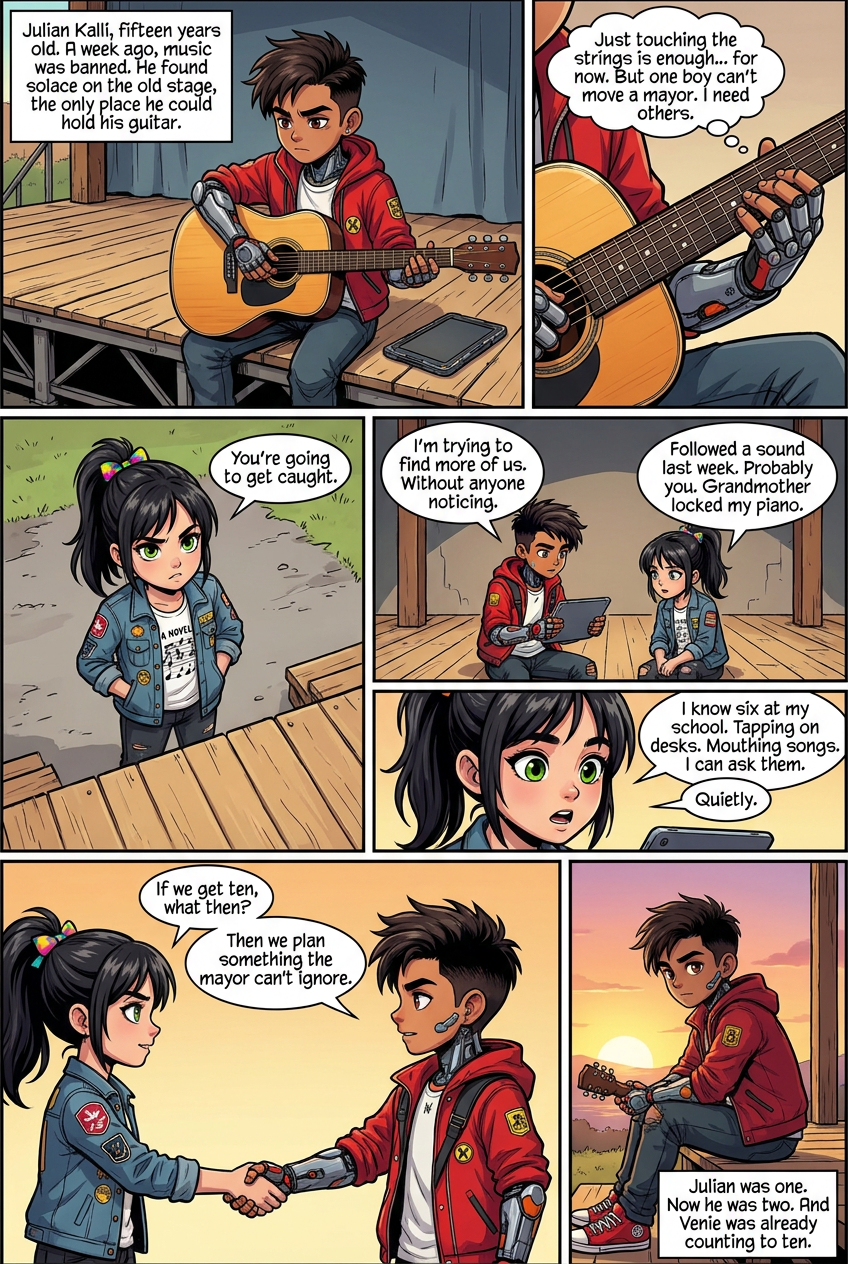
Julian Kalli was fifteen years old and one week behind on a song nobody was allowed to hear. He sat on the lip of the old concert stage with his guitar across his knees, the wooden boards warm under his cyborg arm. A week ago a new mayor had banned all music. That same morning, at the dinner table, his family had nodded along when the announcement played. They said music made people violent. Julian had stopped arguing and walked out. The stage was the only place left where he could keep the guitar hidden and still touch the strings without playing them. He pressed his fingers to the frets without strumming and ran through every note of the song he wrote. He knew the problem already. One boy with a guitar could not move a mayor. He needed others, and he could not ask out loud. The authorities had people listening at corners and posting tip lines on every screen. Julian pulled a slim tablet from inside his red jacket. He had been using it for three days now, logging anyone he caught humming under their breath or tapping a rhythm against a counter. The list was short. Four entries. None confirmed. A board creaked behind him. He turned. A girl stood at the edge of the stage with her hands in the pockets of a denim jacket covered in patches. Black ponytail, green eyes, a shirt with music notes printed across the front. She looked at the guitar. She looked at him. She did not run. "You're going to get caught," she said. "You first," Julian said. He nodded at her shirt. She glanced down, then back up. "Venie." "Julian." He set the guitar flat. "How did you find this place?" "Followed a sound last week. Someone playing. Probably you." She climbed the steps and sat two feet away. "Grandmother locked my piano. Threw the key out. I came looking for anywhere quiet." Julian turned the tablet so she could see the screen. Four names. Four sets of small habits. "I'm trying to find more of us. Without anyone noticing." Venie read the list. Her mouth moved like she was counting. "I know six at my school," she said. "Tapping on desks. Mouthing songs at lunch. I can ask them." "Quietly." "I don't talk loud." She looked at him straight. "If we get ten, what then?" "Then we're not alone," Julian said. "Then we plan something the mayor can't ignore." She held out her hand. He shook it with the cyborg one. She did not flinch. They agreed on a meeting place at the stage in three days, and a signal: a short burst of static on a radio band only musicians watched. Venie left first. Julian waited ten minutes, then locked the guitar behind the back panel and walked home with the tablet against his ribs. He had been one. Now he was two, and Venie was already counting to ten.
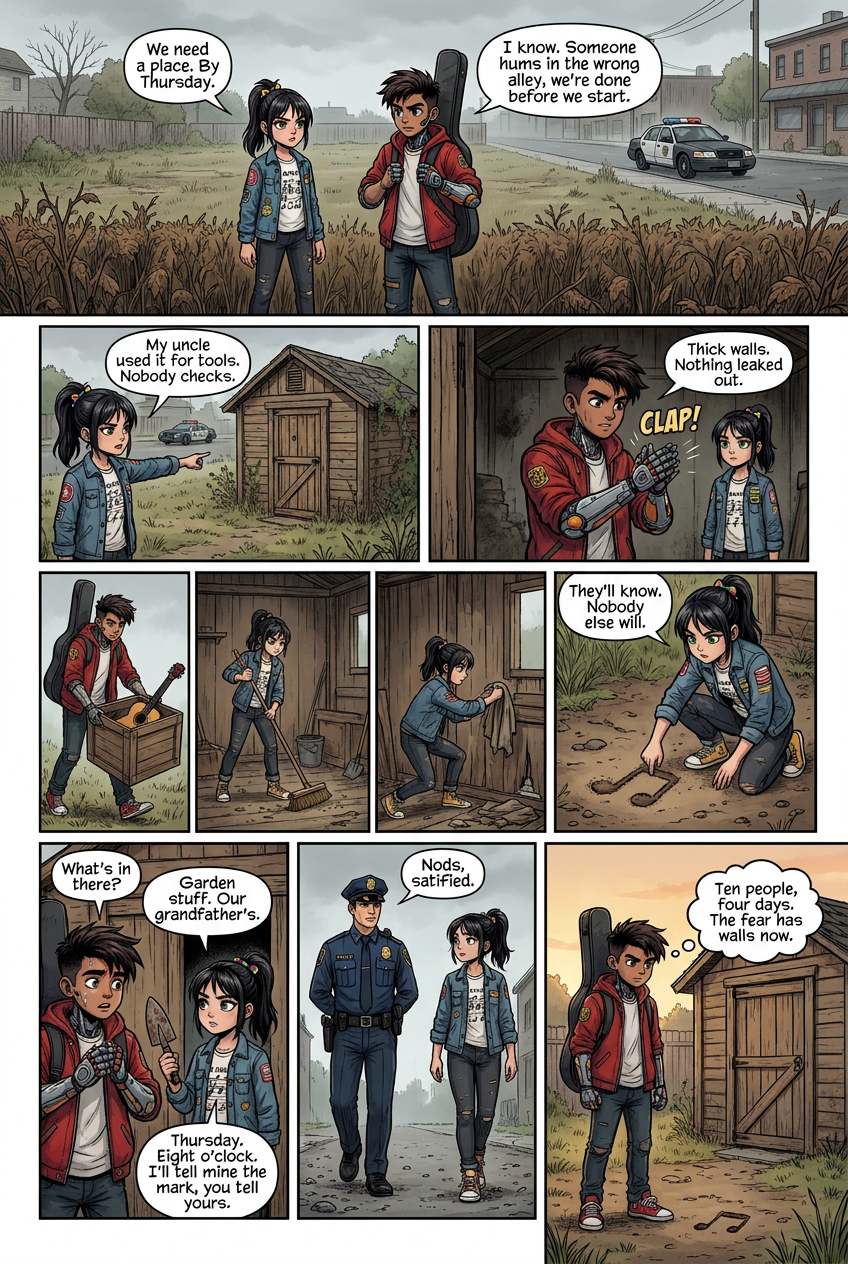
Three days after the stage, Julian met Venie behind a row of dead hedges at the edge of an empty lot. She had six names. He had four. Ten people, if everyone came. But ten people made noise, and noise carried, and the patrols had doubled since Monday. Julian had walked past two officers on the way over. One had watched his guitar case until he turned the corner. "We need a place," Venie said. "By Thursday." "I know." Julian pulled his jacket tighter. "Someone hums in the wrong alley, we're done before we start." Venie thought for a moment, then pointed past the lot to a sagging wooden shed half-swallowed by weeds. The roof dipped. The door hung crooked on one hinge. "My uncle used it for tools. He's dead two years. Nobody checks." She walked over and pushed the door. It scraped open. Inside smelled like old sawdust. The walls were thick. Julian clapped once. The sound stopped at the boards and went nowhere. He clapped again, harder. Still nothing leaked out. He stepped back into the grass and listened. A patrol car rolled past the far street. The officer inside did not turn his head. They worked through the afternoon. Julian dragged in a crate of instruments they had built in secret, taped drums, a length of pipe strung with wire, two whistles carved from scrap. Venie swept the floor and stuffed rags into the gaps between boards. They hid the crate under a tarp behind a stack of broken shelves. Then they walked the lot. Venie knelt by a bare patch of dirt twenty steps from the door and pressed her thumb into the ground. She shaped a small music note in the packed earth, the size of her hand. "They'll know," she said. "Nobody else will." Julian looked at it. From the street it was nothing. From the grass it was a sign. They were latching the shed when boots crunched on gravel behind them. Julian froze. An officer in a pressed blue uniform stood at the lot's edge, hands behind his back, watching. "What's in there?" he called. Venie answered before Julian could breathe. "Garden stuff. Our grandfather's." She held up a rusted trowel she had grabbed from a shelf. The officer stared a long second. Then he nodded once and kept walking. Julian's cyborg arm had locked at the elbow. He forced it loose. They waited until the boots faded. Venie wiped her hands on her jeans. "Thursday," she said. "Eight o'clock. I'll tell mine the mark, you tell yours." Julian nodded. He looked at the shed, then at the small note pressed into the dirt. He had a room now. He had a sign. He had four days to get ten people inside without one of them being followed. The fear in his chest did not leave, but it changed shape. It had walls around it now.
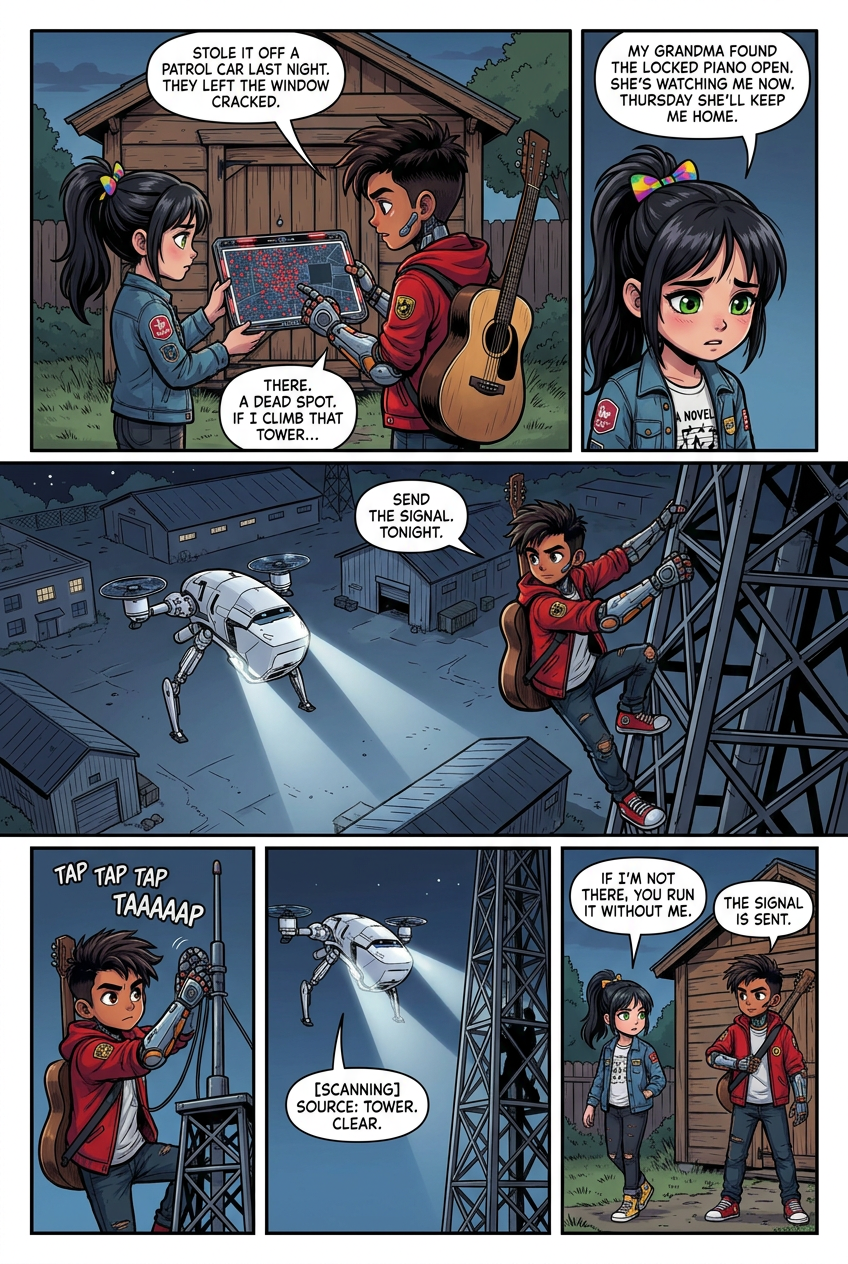
Two days before Thursday, Julian met Venie behind the shed at dusk. She held a flat black tablet against her chest. The screen showed a map of the city, with red dots blinking where the police listening posts stood. "Stole it off a patrol car last night," she said. "They left the window cracked." Julian stared at the dots. They covered almost every block. Almost. "There." Venie tapped a gap in the grid, a dead spot near the edge of town. A tall cell tower stood inside the gap, marked with a faded service tag. "One of their drones went down near it last month. Bird strike. They haven't fixed the post that covered it." Julian zoomed the map with his cyborg fingers. The dead zone was a circle maybe four blocks wide. The tower sat at its center, ringed by empty warehouses. "If I climb that," he said, "and bounce the signal off the antenna array, the posts won't trace it. They'll think it came from the tower itself." Venie's face changed. She set the tablet down. "My grandma found the locked piano open this morning. I forgot to wipe the dust off the lid." She looked at her shoes. "She's watching me now. Asking where I go. Thursday she'll keep me home if I don't give her a reason to trust me by then." Julian's chest tightened. Without Venie at the shed, the recruits would arrive to find a stranger. Half of them would bolt. "Then we send the signal tonight," Julian said. "Not Thursday morning. Tonight. So your recruits know the time and place before she locks you in." Venie nodded once. They waited until full dark. Julian wired his pocket transmitter to a length of copper from the shed. He climbed the tower's service ladder one rung at a time, guitar bumping his back, cyborg arm pulling him up faster than the human one. At the top he clipped the copper to the antenna mount and crouched against the lattice. He keyed the signal. Three short pulses, one long. The pattern any music-lover would know. He sent it twice, then unclipped and climbed down. Halfway to the ground a hum cut the air. An aerial drone slid past the warehouses, lights sweeping. Julian froze against the metal. The drone circled the tower once, scanned, and moved on. It logged the tower as the source, not the boy on its side. He dropped the last six feet and ran. Back at the shed Venie was waiting. "Two of mine messaged the post," she said. Her voice was tight. "They got it. They'll be there Thursday at eight." Then she swallowed. "My grandma's taking my shoes tonight. If I'm not there, you run it without me." Julian gripped the strap of his guitar. The signal was sent. The recruits were coming. And he might be the only one to meet them.
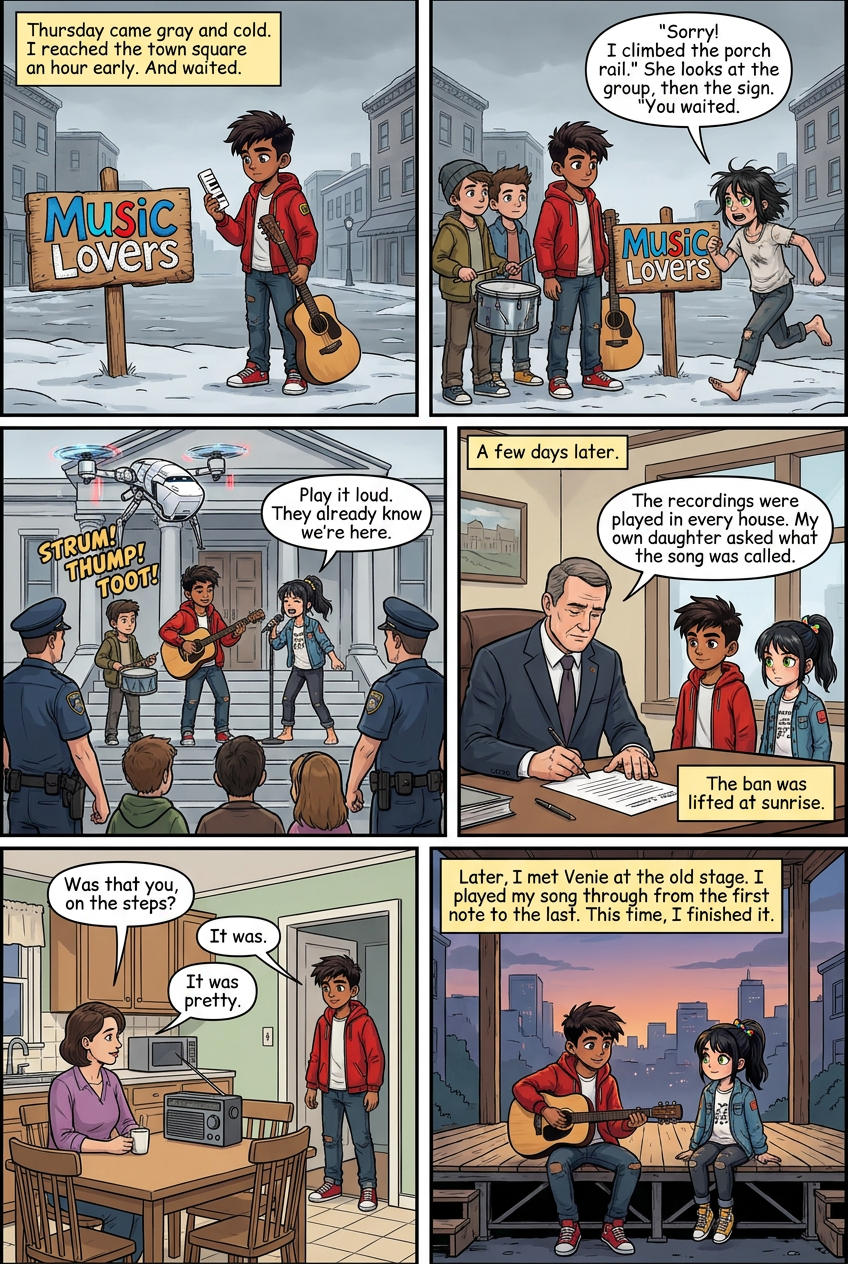
Thursday came gray and cold. Julian reached the town square an hour early and took his post beside the wooden sign the group had nailed to a pole the week before. The paint still smelled fresh. MUSIC LOVERS, in red and blue. He set his guitar against the post and pulled a small thing from his jacket pocket. It was a single ivory piano key Venie had pried loose from her grandmother's locked piano and pressed into his palm the night they sent the signal. He turned it in his fingers and watched the street. Eight o'clock came. Two boys arrived with a scrap-metal drum between them. A girl came after with a bent length of pipe she could blow like a horn. Three more drifted in from the alley behind the square. Six recruits. No Venie. Julian gripped the key until the edge bit his thumb. He had told himself he would start without her. Now, standing under the sign with six strangers watching him, he could not make his mouth move. Then he heard running. Venie cut across the square in socks, no shoes, hair loose. "She fell asleep," she said. "I climbed the porch rail." She looked at the recruits and then at the sign. "You waited." Julian held up the key. She almost smiled. "Play it loud," she said. "They already know we're here." They marched to the town hall steps and set up in the open. Julian struck the first chord of the song he had been playing the day the ban took effect. Venie sang. The drummers hit the scrap pot. The horn player blew flat, then sharp, then on. People came out of shops. People stopped their bikes. A drone slid down from the rooftops, lights blinking, recording everything. Julian kept playing. Two officers in pressed blue uniforms walked toward them with hands on their belts. Julian did not stop. The crowd closed around the steps and the officers slowed. One of them, a young man with a clean cap, listened for a long moment before he reached for his radio. He did not key it. They played the next night, and the night after that. Each night the crowd grew. The drones kept filming and the officers kept not arresting. On the fourth night a woman from the mayor's office came down the steps with a folded paper and asked Julian to come inside. He went with Venie. The mayor sat behind a wide desk and would not look at them at first. He said the recordings had been played in every house in the city. He said his own daughter had asked him what the song was called. He signed the paper while they watched. The ban was lifted at sunrise. Julian walked home with the key still in his pocket. His mother was at the table with the radio on, low, playing a station that had been silent for a week. She looked up. He waited for the argument. She said, "Was that you, on the steps?" He said it was. She was quiet for a long time. Then she said the song was pretty. His father came in and heard the end of it and did not turn the radio off. It was not forgiveness and it was not agreement. It was a kitchen with music in it, which a week ago it had not been. Later Julian met Venie at the abandoned stage where they first found each other. She wore shoes again. He gave her back the ivory key. She set it on the lip of the stage and they sat with their legs over the edge and listened to the city. Somewhere a window was open and someone was practicing scales, badly, without fear. Julian unslung his guitar and played his song through from the first note to the last. This time he finished it.
Play your story to life
Storycraft is a mobile game where you create AI characters, craft items and locations to build their world, then discover what direction your story takes. Download the iOS game for free today!
Download for free