

Juniper's Arc
7 Chapters
Juniper's dream is opening a sanctuary where every hunted magical creature in the realm can find lasting refuge..

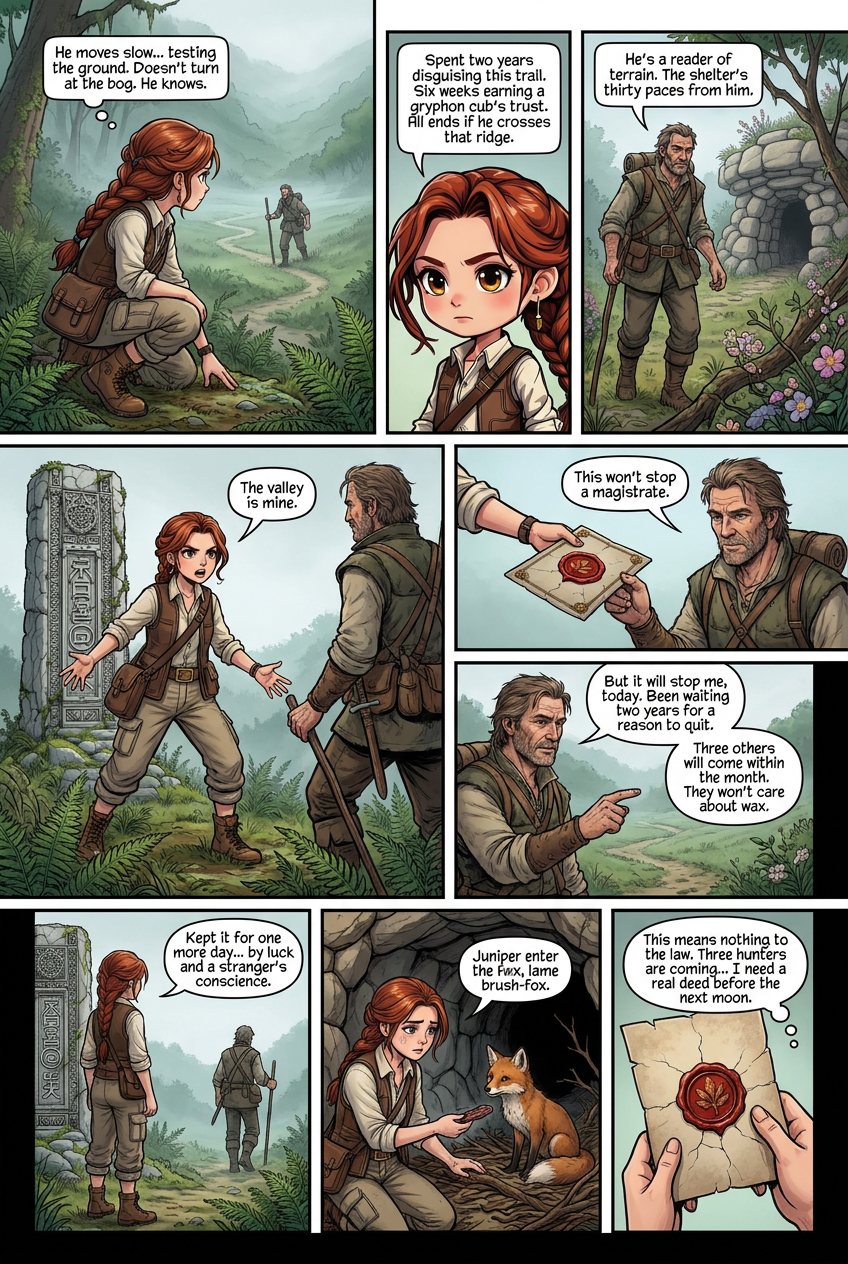
Juniper crouched in the wet ferns and watched a stranger walk the only safe trail into her valley. He moved slow, testing the ground with a stick, and he did not turn back at the false bog the way travelers were supposed to. She had spent two years disguising that trail. She had spent six weeks coaxing a lone gryphon cub close enough to take dried fish from a rock. If the stranger crossed the next ridge, both things ended. She knew him by his walk. He was the patient hunter, the one who read terrain instead of tracks, the one who could spot a place creatures had learned to avoid and follow that absence in. Juniper had a lame brush-fox waiting in a stone shelter she had stacked herself, a low hump of rocks softened by branches and flowers near the valley mouth. She had meant the shelter as a first hiding place for whatever creature reached her before the sanctuary was ready. It sat thirty paces from where the hunter now stood. She had no legal claim to any of this ground. If he asked her by what right she chased him off, she had no answer that would hold. So she walked out of the ferns with her hands open and met him at the carved stone pillar she had dragged here one winter, a weathered post sunk in moss and cut with deep symbols only she understood. She told him the valley was hers. She showed him the stone tablet she carried in her pack, scored with boundary lines and sealed with wax pressed from a juniper leaf, the only proof of intent she owned. He looked at the seal a long time. He said it would not stop a magistrate. He said it would stop him, today, because he had been waiting two years for a reason to quit, and a woman standing alone at a marker was reason enough. He told her the names of three other hunters who would come within the month, and they would not read a wax seal. Then he turned and walked back down the false trail. Juniper went to the stone shelter and fed the brush-fox a strip of dried meat. Her hands shook. She had kept the valley for one more day, and she had kept it by luck and by a stranger's tired conscience. The wax seal on her tablet meant nothing to the law. Three hunters were coming. She needed a deed the courts would honor, and she needed it before the next moon, or the brush-fox in the shelter and the gryphon cub on the ridge would have nowhere left to be hidden.
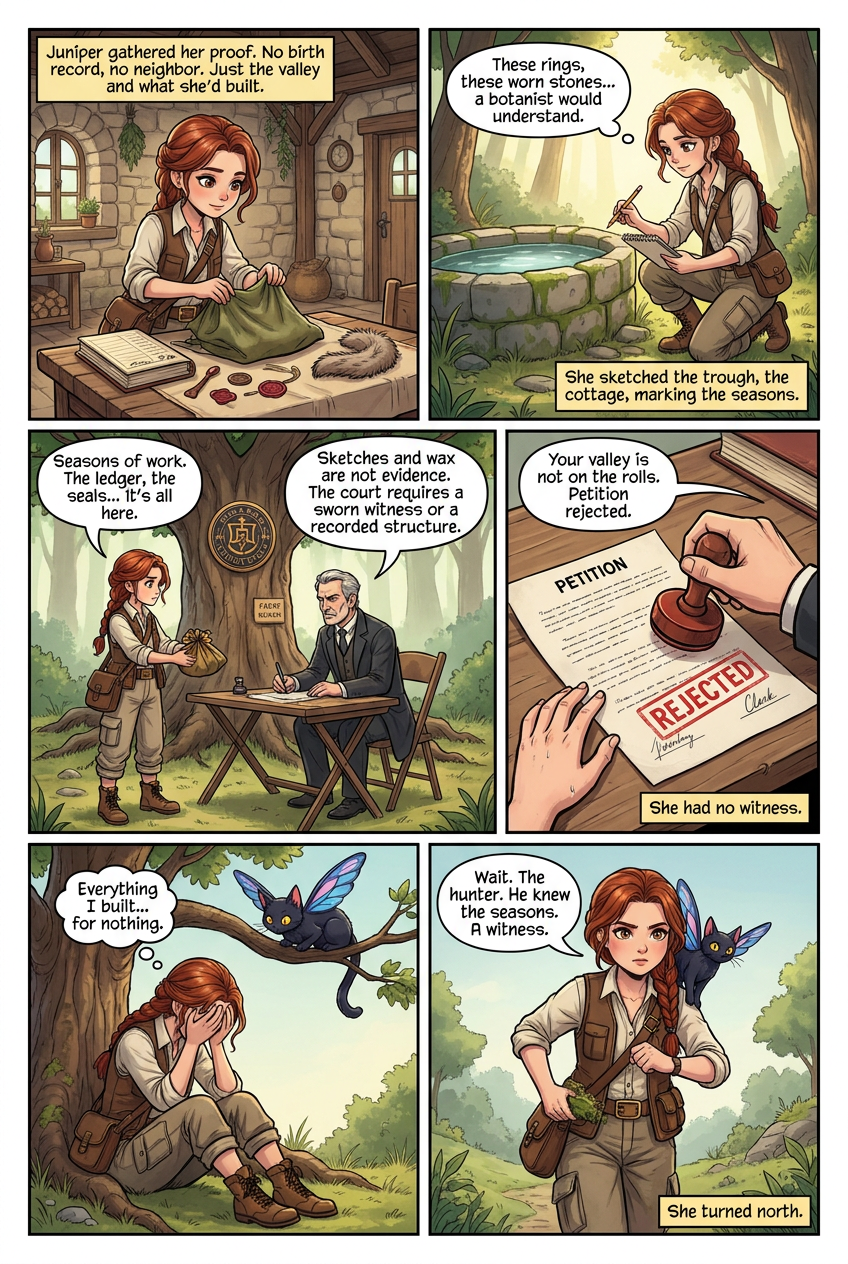
By morning Juniper had a list. The courts wanted proof a person had lived on the land and worked it across seasons. She had no birth record here, no tax stamp, no neighbor to swear for her. What she had was the valley itself, and the things she had built in it. She fed the brush-fox, checked the ridge for the gryphon cub, and started walking the ground like a clerk would. She began at the cottage she had raised her second summer here. The cobblestones came from the creek. The vines on the south wall had thickened four seasons running, and she could mark each year by the woody rings at their base. Inside, she pulled down a tin box and laid its contents on the table. Wax stubs from boundary seals, dated in her own hand. A ledger of every creature she had treated, with dates and weights. A clipping of fur from the brush-fox's first bandage. She wrapped it all in oilcloth. She walked to the stone trough next. She had cut it from a single block her first autumn and dragged it on rollers to the spring. Algae rimmed the lip in soft green bands, one band thicker than the next. A traveling magistrate would not know what the bands meant, but a court botanist would. The smooth drinking stones she had set around it were worn in the places small paws and hooves had stepped a thousand times. She sketched the trough on a clean page. She sketched the cottage. She wrote dates beside each line. Three days south she reached the court tree. It stood alone on a flat stone, its bark burned with the magistrate's seal, its roots gripping the base like fingers. A clerk sat at a folding desk in its shade. Juniper laid out the oilcloth bundle and spoke plainly. She named the seasons. She showed the ledger. The clerk turned each page, then closed the book. He told her sketches and wax were not evidence. The court required a sworn witness who had seen her on the land across years, or a structure recorded on the survey rolls. The valley appeared on no roll. She had no witness. He stamped her petition REJECTED and slid it back across the desk. Juniper walked into the trees before her face changed. She sat against a trunk and pressed the heel of her hand to her mouth. A small dark shape dropped from a branch and landed on the moss beside her, a moth-cat with split ears and wings folded like wet paper. It had followed her from the valley. It watched her without fear. She thought of the hunter who had turned around at her marker, the one who read terrain. He had stood on her land for two years and could name every season she had worked it. A sworn witness. She stood up, brushed the moss from her trousers, and turned north.
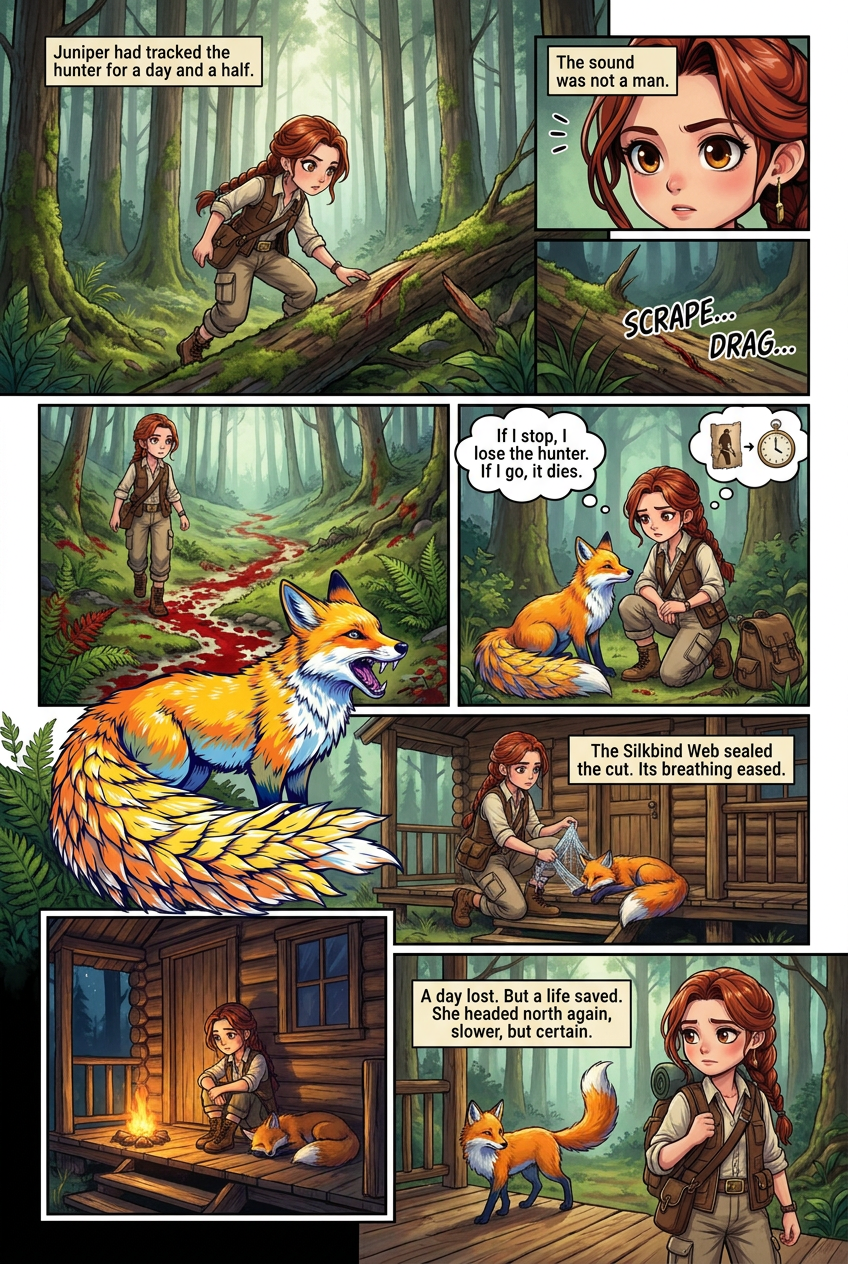
Juniper walked north for a day and a half before the forest changed. The trees thinned, the moss deepened, and she picked up the hunter's old sign on a fallen log. She was reading the cut on the bark when she heard a sound below her on the slope, a wet dragging through ferns. She froze. The sound was not a man. She followed it down to a smear of red across the moss. The trail ran broken between crushed fronds, dark drops thick on the leaves, then thinner, then thick again where the animal had stopped to rest. At the end of the trail lay a fox the size of a small dog. Its coat was orange and pale blue, its tail shaped like a fan of yellow ferns. Its mouth hung open and the two long fangs there were a clear violet. A wire snare was buried in the meat above its back leg. The wire had cut deep. The fox saw her and did not move. Juniper measured the choice in one breath. The hunter's sign was fresh. If she stopped here, she would lose him by nightfall, and with him the witness the court needed. If she walked past, the fox would bleed out before dusk. She knelt and set down her pack. She carried the fox half a mile to a cabin she had built three summers back for work like this. The walls were bark over log, the porch wide enough to lay an animal flat. She put the fox on the boards and worked the wire loose with pliers. The leg bled hard once the pressure was gone. She pressed a folded cloth on it, then opened a tin from her pack and lifted out a pad of silver web. The strands were stiff and dry. She laid the pad over the wound. The web softened against the blood and pulled tight around the cut, sealing the edges. The bleeding slowed, then stopped. The fox's breathing eased. She gave it water from a bowl, banked a small fire, and sat against the wall to watch its chest rise. By morning the fox could stand. It limped to the door, looked at her once, and slipped into the trees. Juniper washed the porch and packed her tin. She had lost a full day, maybe more. The hunter would be deeper into the range now, and the moon was already past its first quarter. She shouldered her pack and stepped off the porch, headed north again, slower than before and certain she could not afford another stop.
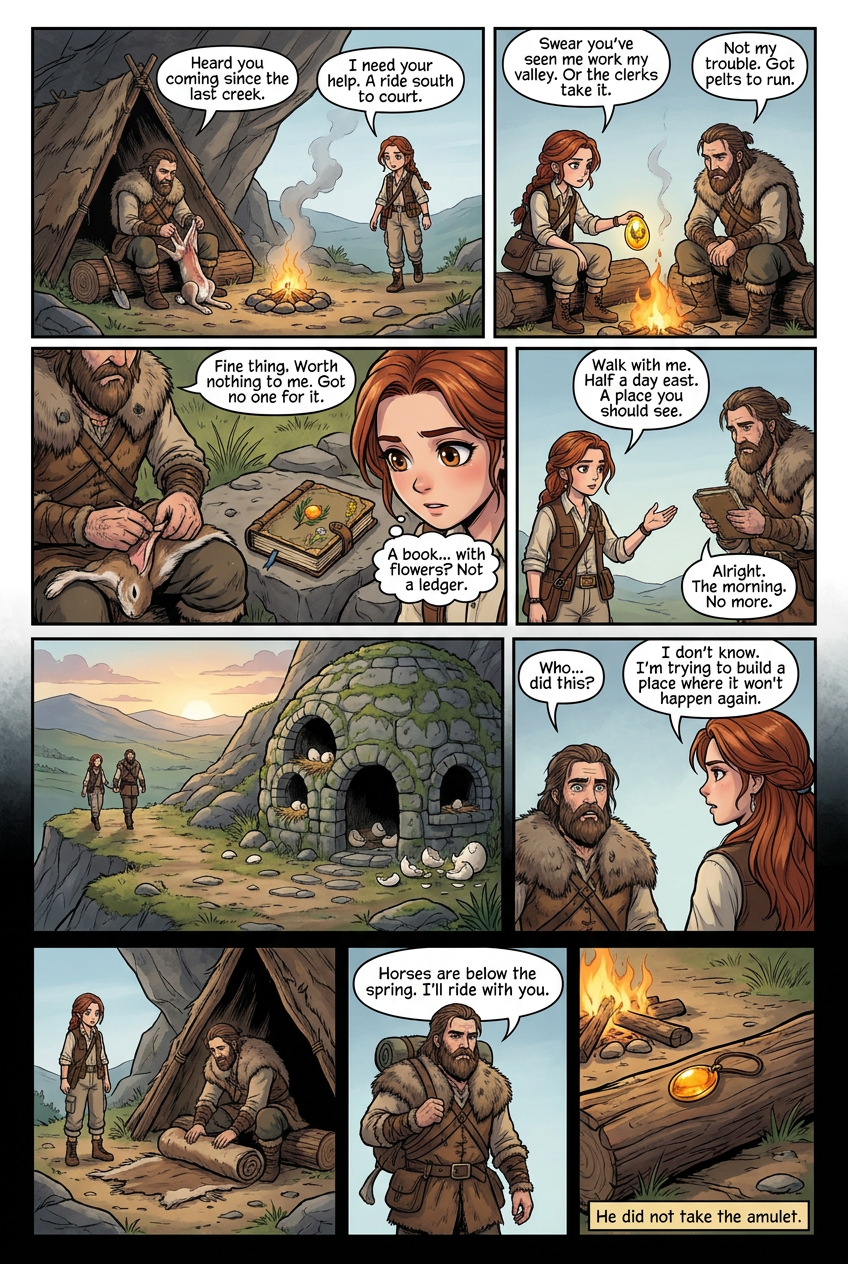
Juniper found the hunter's camp on the third evening, tucked under a leaning rock face where the wind broke clean. The shelter was lashed branches and patched hide, the seams stitched with sinew, the roof weighted with stones against weather. A small fire smoked in front of it. The hunter sat on a log skinning a hare, and he looked up at her without surprise. He said he had heard her coming since the last creek. She told him plainly what she needed. A ride south to the court. A week of his time, maybe more, to swear that he had walked her valley and seen her work it across seasons. Without his word, the clerks would take the land and the creatures in it. He listened, set down the hare, and shook his head. He said he was tired. He said he had a season's pelts to run before the snow, and her trouble was not his trouble. He went back to the hare. She sat across the fire and opened her pack. She took out the amber amulet she had carried for years, a juniper berry set in resin on a leather cord. She laid it on the log between them. He looked at it, then at her, and said it was a fine thing and worth nothing to him. He had no one to give it to. She did not pick it back up. She watched him eat, and she watched his hands, and she watched the small worn book set on a stone by his bedroll. The cover was hide. Pressed flowers stuck out from the pages. It was not a hunter's ledger. She had seen ledgers. This was something a man kept for himself. She asked if he would walk somewhere with her before he said no a second time. Half a day east, no more. He chewed and asked what was there. She said a place she thought he should see. He looked at the journal on the stone, then at her, and said he would give her the morning. They left at first light. She led him along a ridge and down into a hollow she had found her first summer in the range. A round stone building stood there, half sunk in moss, its arched chambers open to the air. Old nests lay inside the cradles. Eggshell fragments still rested in the straw, pale and dry. He stopped at the threshold and did not go in. He stood a long time. Then he asked who had done it. She said she did not know. She said she was trying to build a place where the next ones would not end this way. He walked back to the camp without speaking. He broke down the shelter, rolled the hide, and tied his pack. He told her the horses were picketed below the spring. He said he would ride with her in the morning. He did not take the amulet.
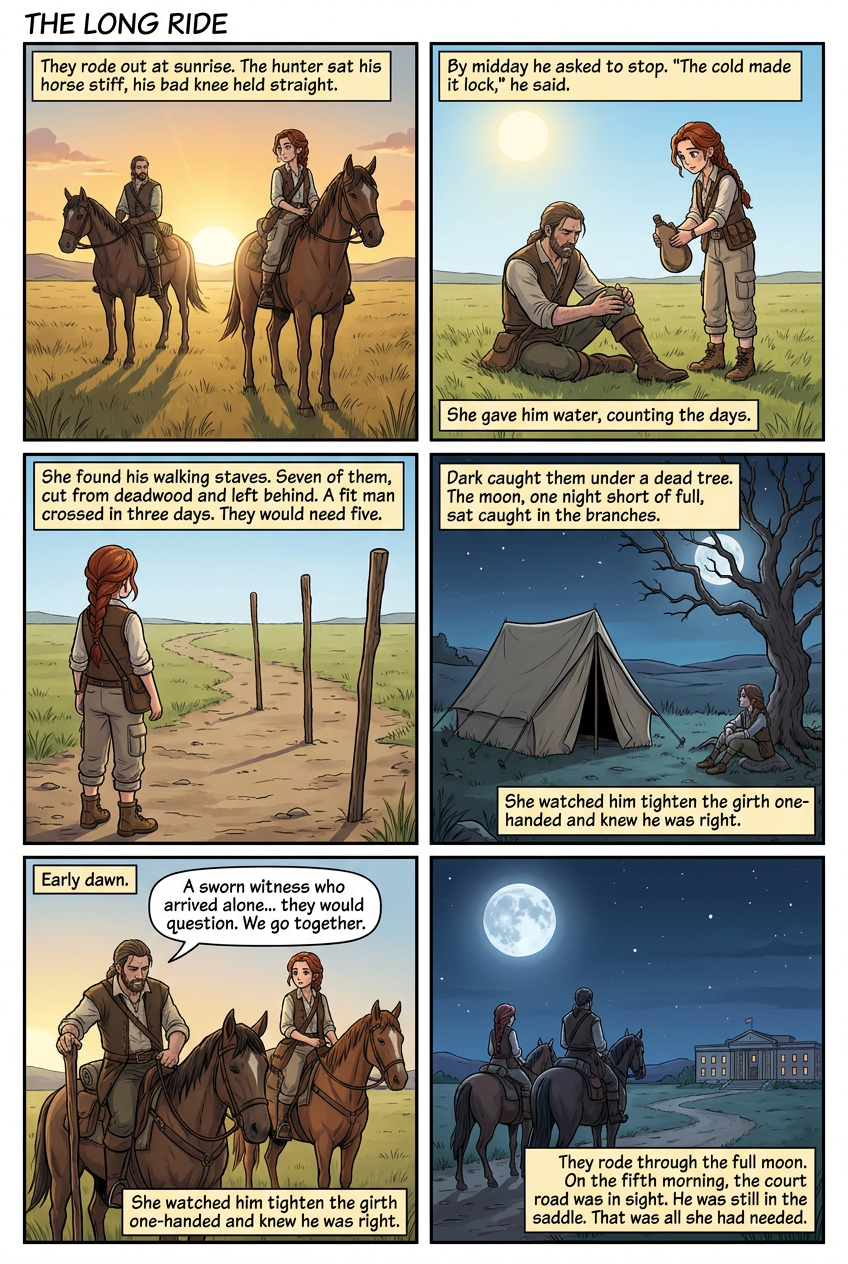
They rode out at sunrise. The hunter sat his horse stiff on the left side, his bad knee held straight against the stirrup. Juniper watched him without watching him. By the second hour he was shifting his weight every few minutes. By midday he asked her to stop. He climbed down at a flat place where short grass ran to the horizon and rubbed the knee with both hands. He said the cold made it lock. She gave him water and did not say what she was counting. Four days to the court. Three nights under the moon. The moon would be full on the second night. They lost ground all afternoon. She saw the proof of it later, when she walked back along their own trail to check the picket line. A dark walking staff stood planted in the dirt where the hunter had stopped to lean. Then another, twenty paces on. Then a third. He had cut them from deadwood that morning and set them down whenever the knee gave. She counted seven before she turned back. A fit man crossed this range in three days. They would need five. Dark caught them on open ground. They made camp under a dead tree that stood alone on a low rise, its bare branches spread wide against the sky. Juniper did not like the tree. It threw no shade and gave no cover, and the moon, when it rose, sat caught in the branches like something snared. She pitched the canvas tent close against the trunk where the shadow was thickest. The hunter crawled in without eating. She sat outside with her back to a root and watched the range. The moon was one night short of full. Tomorrow it would be full, and they would still be two days from the court, and any hunter within a mile of open country would be moving by its light. She woke him before dawn. She told him she would ride ahead at first light and bring back a cart from the nearest waystation, and he would wait at the next creek with the horses. He shook his head. He said a sworn witness who arrived alone in a cart was a witness the clerks would question. He said they went in together or his word was worth nothing. He pulled himself up on one of his cut staves and limped to the picket line. She watched him tighten the girth one-handed and knew he was right. She mounted and turned south. They rode through the full moon that night and the next, and the hunter did not ask to stop, and on the fifth morning they came down out of the range with the court road in sight and his knee swollen to twice its size. He was still in the saddle. He could still speak. That was all she had needed to bring him.
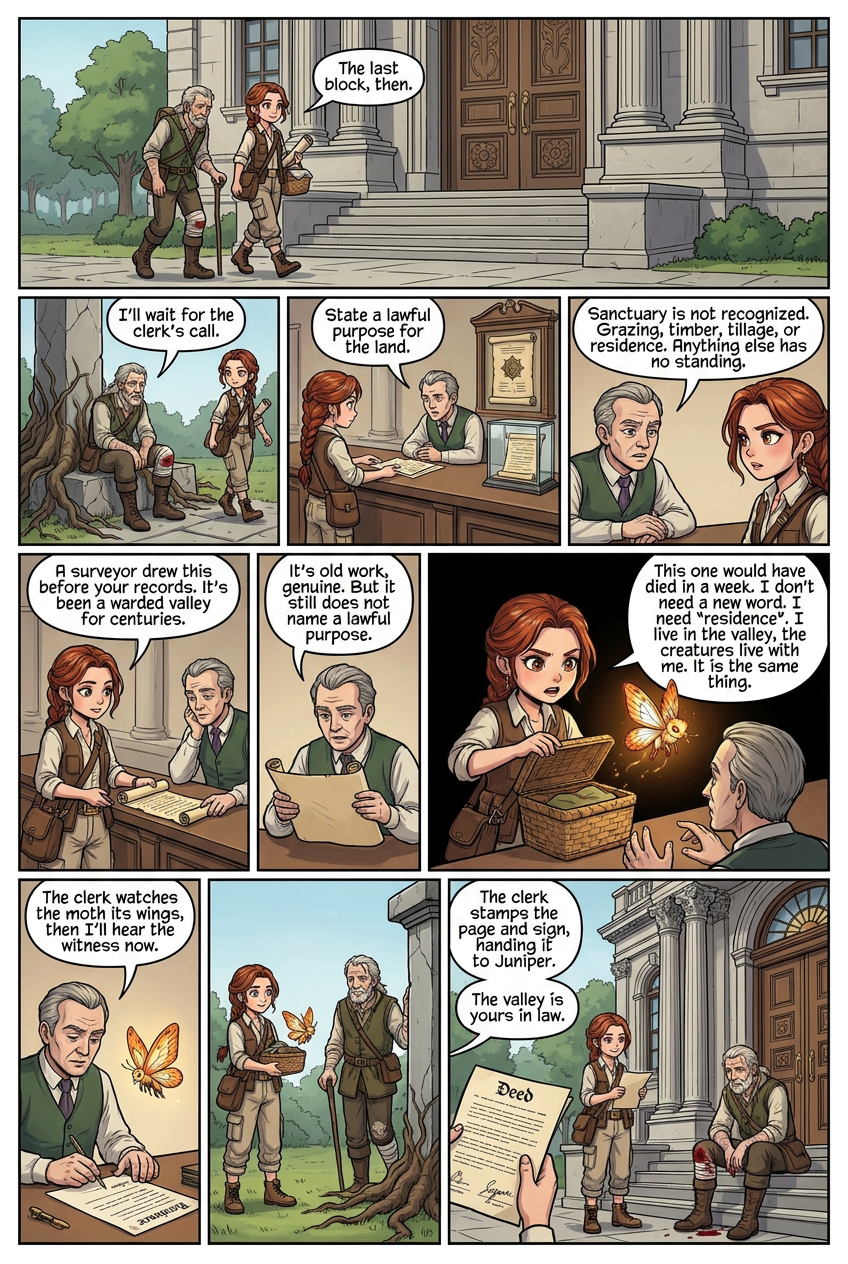
They left the horses at a public rail and walked the last block together. The hunter leaned hard on one of his cut staves. Juniper carried a covered basket against her hip and a rolled scroll under her arm. The courthouse rose at the end of the street, heavy stone and tall doors carved with scales and chains. A granite pillar stood in the yard before it, roots twisting at its base. The hunter stopped there and sat on the stone step beside it. He said he would wait for the clerk's call. Juniper went up the steps alone. The clerk was the same one who had refused her the first time. He sat behind a long counter. Behind him, on a marble pedestal, a locked glass case held an old parchment under brass. He did not look up when she set down her papers. He asked her to state a lawful purpose for the land. She said sanctuary for hunted creatures. He shook his head. He said sanctuary was not a recognized purpose in the registry. He said she could claim it for grazing, for timber, for tillage, or for residence. He said anything else had no standing. Juniper laid the rolled scroll on the counter and untied it. The seal was old, the symbols druidic, the borders marked in faded ink. She said a surveyor had drawn this boundary before the courts kept their own records. She said the valley had been recognized as a warded place long before the registry existed. The clerk picked it up by the edges. He read it twice. He said it was old work, and likely genuine, but it did not name a lawful purpose either. He set it down. She lifted the cloth off the basket. The fire-moth climbed out onto her wrist. It opened its wings slowly, ember light moving across the counter and the clerk's hands. The clerk went still. Juniper said this one had been kept in a jar by three hunters when she found it. She said it would have died in a week. She said she did not need a new word in the registry. She needed residence. She lived in the valley. She had lived there for years. The creatures lived with her. That was the same thing. The clerk watched the moth fold its wings. He drew a fresh form from a drawer. He wrote residence in the purpose line and turned the page toward her. He said he would hear the witness now. Juniper carried the moth back outside in her cupped hands. The hunter pushed himself up off the step and limped to the pillar in the yard. He laid his hand on the stone top and gave his name to the clerk who had followed her out. The clerk wrote down every word. When the hunter finished, the clerk stamped the page and signed the deed. He handed it to Juniper. The valley was hers in law. She folded the paper and put it inside her coat. The hunter sat back down on the step. His knee had begun to bleed through the cloth.
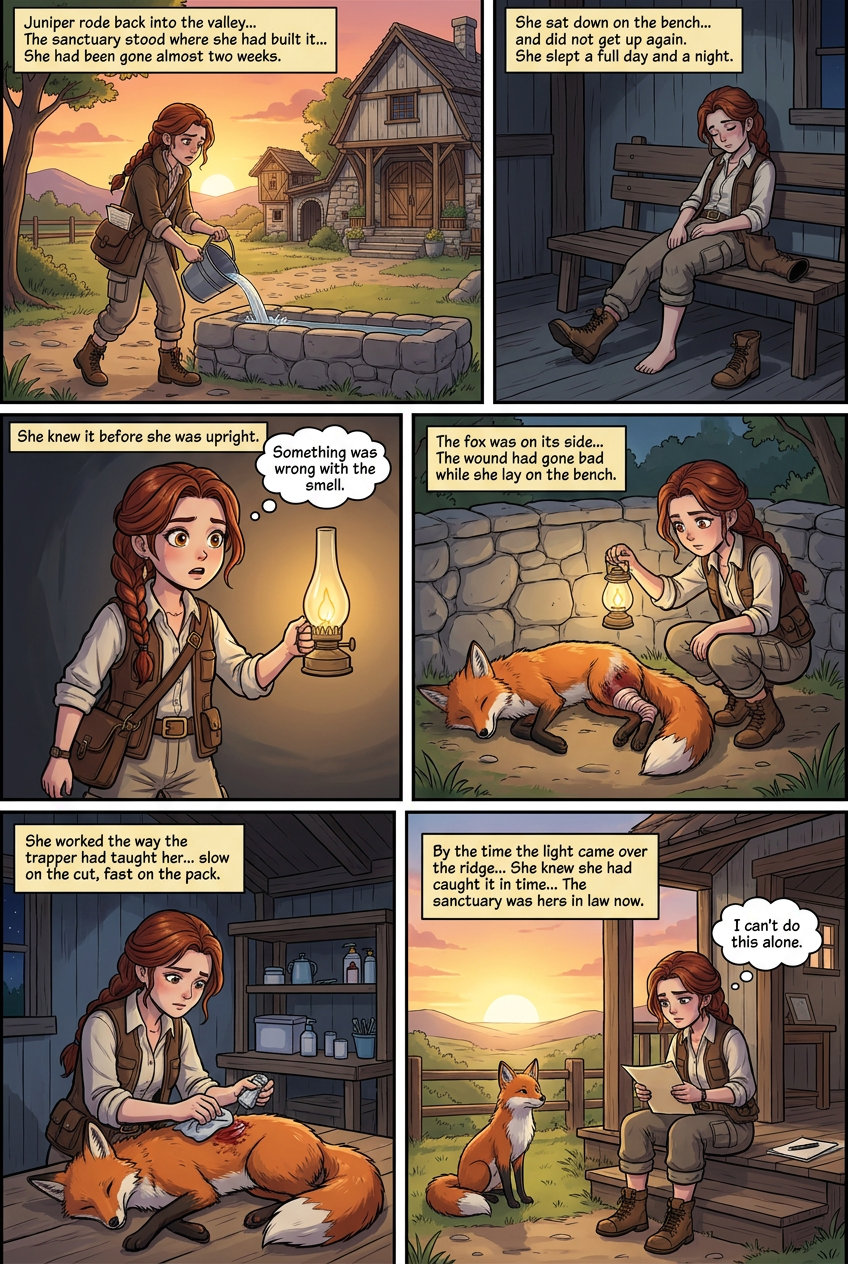
Juniper rode back into the valley on the third day with the deed sewn into the lining of her coat. She left the horse at the gate and walked. The timber sanctuary stood where she had built it, beams dark with rain, stone pens running along its south wall. She had been gone almost two weeks. The water trough was low. The gryphon cub's feed dish sat empty by the door. She filled both before she went inside. Then she sat down on the bench to pull off her boots and did not get up again. She woke in the dark with her face against the wood. Something was wrong with the smell of the room. She knew it before she was upright. She lit the lamp and carried it out to the stone pen with the leafy roof where the lame fox slept. The fox was on its side. The bandage on its hind leg was wet through and yellow. The skin around the wound was hot and swollen and the fur had begun to slip. She had slept a full day and a night. The wound had gone bad while she lay on the bench. She carried the fox to the treatment table under the eaves. Her hands shook from hunger and from sleep still in her arms. She cut the old bandage off. The smell got worse. She pulled the silver web from the lower shelf and the small knife and the bottle of clean water and set them in a row. She worked the way the trapper had taught her, slow on the cut, fast on the pack. She opened the wound, drained it, washed it twice, and laid the silver web across the raw flesh. The fox did not fight. That frightened her more than anything. She stayed at the table until sunrise. She changed the pack twice. She got water into the fox with a cloth. By the time the light came over the ridge the swelling had eased and the fox had lifted its head once to look at her. She knew she had caught it in time. She also knew she would not catch the next one. There were too many pens and one of her, and she had slept through a festering wound because her body had given out. The sanctuary was hers in law now. It was still only one person's work. She carried the fox back to the leafy pen and latched the gate. Then she sat on the step of the timber building with the deed in her lap and made herself say it out loud. She could not do this alone. She thought of the hunter on the courthouse step, his knee bleeding through the cloth, and of the trapper who had taught her and gone quiet for years. By noon she had a sheet of paper on the treatment table and was writing the first letter.
Play your story to life
Storycraft is a mobile game where you create AI characters, craft items and locations to build their world, then discover what direction your story takes. Download the iOS game for free today!
Download for free