

Kendrick "Shade" Sullivan's Arc
6 Chapters
Kendrick "Shade" Sullivan's dream is transforming his autoshop into the go-to garage every racer in the desert trusts for their prized machines..

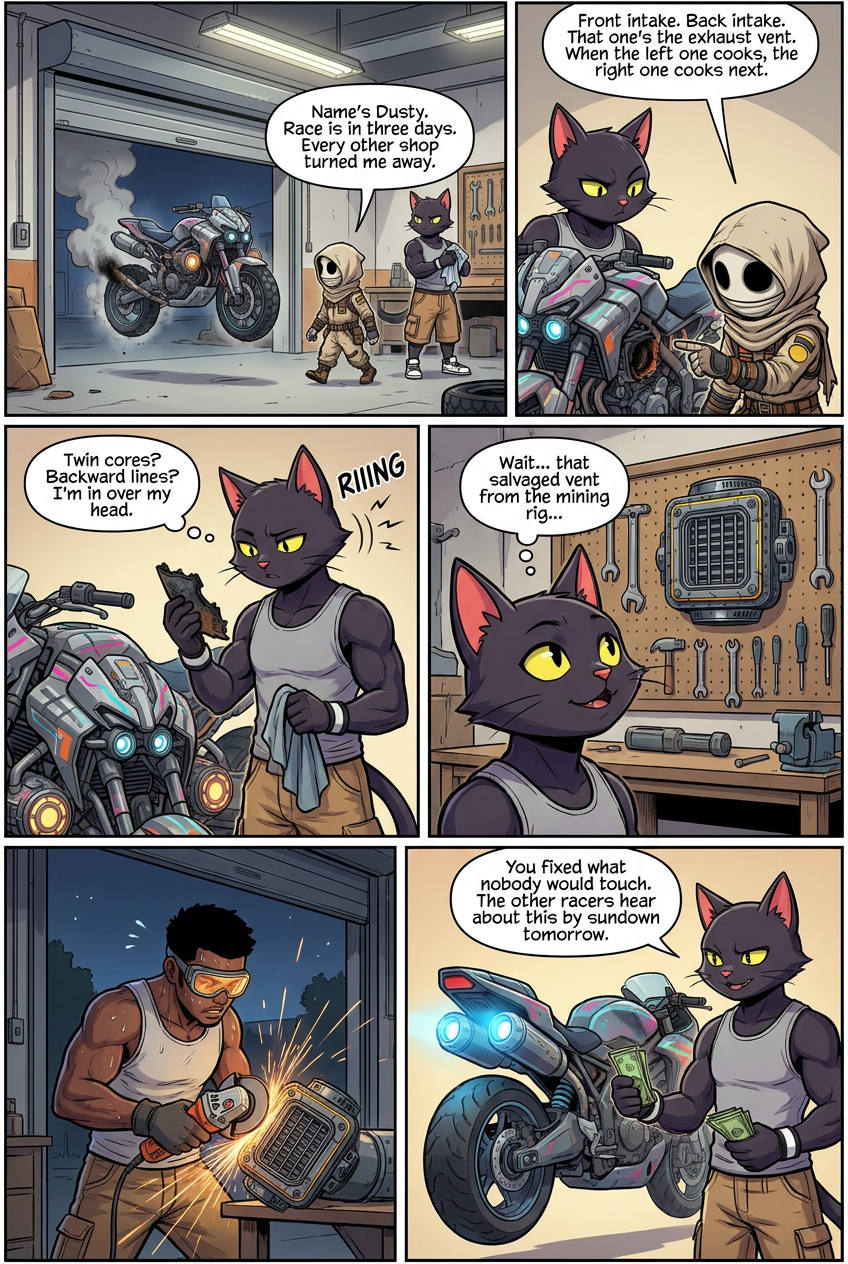
The scorched bike coasted through the bay door on a dying whisper of thrust, and Shade knew before the rider dismounted that his shop's future had just rolled onto the lift. Six years out of the ring, and his left ear still rang like a bell he could not silence. He wiped his hands on a rag and stepped out from under the fluorescents of Sunspin Autoshop. The rider was short, wrapped head to boots in dust-colored cloth, patches sewn crooked across the chest. Two black eyeholes stared out from a wrapped hood. "Name's Dusty," the rider said. "Race is in three days. Every other shop turned me away." Shade looked at the bike. It hovered a hand's width off the concrete, chassis ticking as it cooled, one thruster ring blackened down to bare metal. He had rebuilt truck engines, tuned dune buggies, welded frames back together for kids who could not pay. He had never touched a hover rig. He said yes anyway, because a racer's trust was the door he had been trying to pry open since he signed the cheapest lease on this side of town. He spent the first hour just finding the panels. The bike was stitched together in ways that made no sense to him—twin cores where he expected one, coolant lines that fed backward, a fuel map written in symbols he could not read. Dusty crouched beside him and pointed with a gloved finger. "Front intake. Back intake. That one's the exhaust vent. When the left one cooks, the right one cooks next." Shade pulled the scorched vent free. It came out in flakes. He turned it over in his palm and felt the weight of a race day he was about to lose. He walked the length of his shop twice before he saw it: a reinforced exhaust vent bolted to the wall above his welding bench, salvaged off a mining rig two winters back. Thick frame. Industrial grate. Bolt pattern close enough to matter. He pulled it down, took it to the grinder, and shaved the mounting flanges until they lined up with the bike's housing. He worked past dark. His ear rang. His hands did not shake. When he seated the vent and torqued the last bolt, Dusty thumbed the ignition and both thruster rings lit clean and even, humming at the same pitch. Dusty peeled a strip of cloth from a belt pouch and pressed a folded stack of bills into Shade's palm. "You fixed what nobody would touch. The other racers hear about this by sundown tomorrow." The bike slid off the lift and out the bay door, and Shade stood in the open mouth of his shop watching the dust settle. He had won the job. He had also promised, without saying it, that he could do it again—for whoever came next, on whatever machine they rolled in, before whatever deadline they carried.
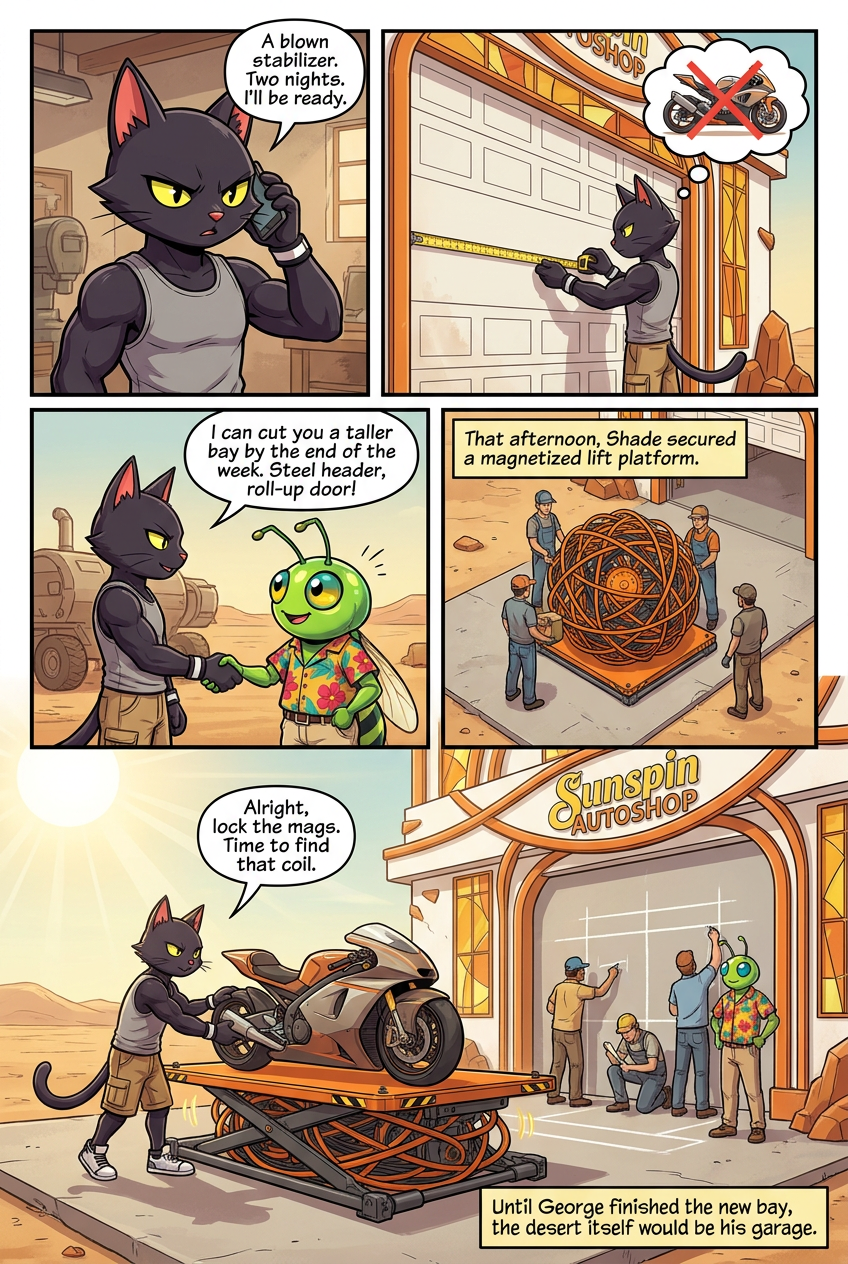
The call came before Shade had finished his coffee. A woman on the other end said her brother's racing rig had blown a stabilizer two nights before the desert circuit. She would drop it off by noon. Shade said yes, hung up, and walked the length of his bay to measure the door. He already knew the answer. Dusty's bike had been slim, stripped for speed. A full racing rig with side fairings would clip the frame by half a foot. Word had traveled fast after the mining-vent repair, and the shop that had earned that word could not fit the next machine through its own front door. He drove out to the site where George Beetlesby was patching a fuel pump for a delivery hauler. George set down his wrench and listened, antennae twitching. "Well shoot, that's a fun one," George said. "You want the wall gone or you want a whole new mouth on the building? I can cut you a taller bay by the end of the week if the landlord signs off. Steel header, roll-up door, wide enough for anything on two thrusters or four wheels." Shade named a number. George named a smaller one and stuck out a green hand. They shook on it in the dust. That afternoon Shade drove to the industrial lot on the west edge of town and paid cash for a magnetized lift platform, bright orange, shaped like a knot of tumbleweed wire around a central plate. The seller warned him it drew more current than a standard jack and needed open sky above it to vent heat. Shade had the delivery crew set it on the concrete pad outside his shop, beside the bay door, bolted flat to the slab. He powered it up. The plate hummed and rose a hand's width, steady, holding his full weight when he stepped on. A racing rig too tall for his door could sit on that platform in the open air while he worked. Until George finished the new bay, the desert itself would be his garage. The racing rig arrived at noon, low and long, fairings flared like a fish. Shade guided it onto the orange platform and locked the mags. He cracked the side panel and found the blown stabilizer coil in under a minute. Behind him, George's crew was already chalking lines on the shop wall for the cut. Shade wiped his hands and looked at what he had made in a single morning: a bay in progress, a lift under open sky, a rig waiting for him. The ringing in his left ear kept its steady pitch. He picked up his tools and went to work on the coil while the sun climbed over Sunspin Autoshop.
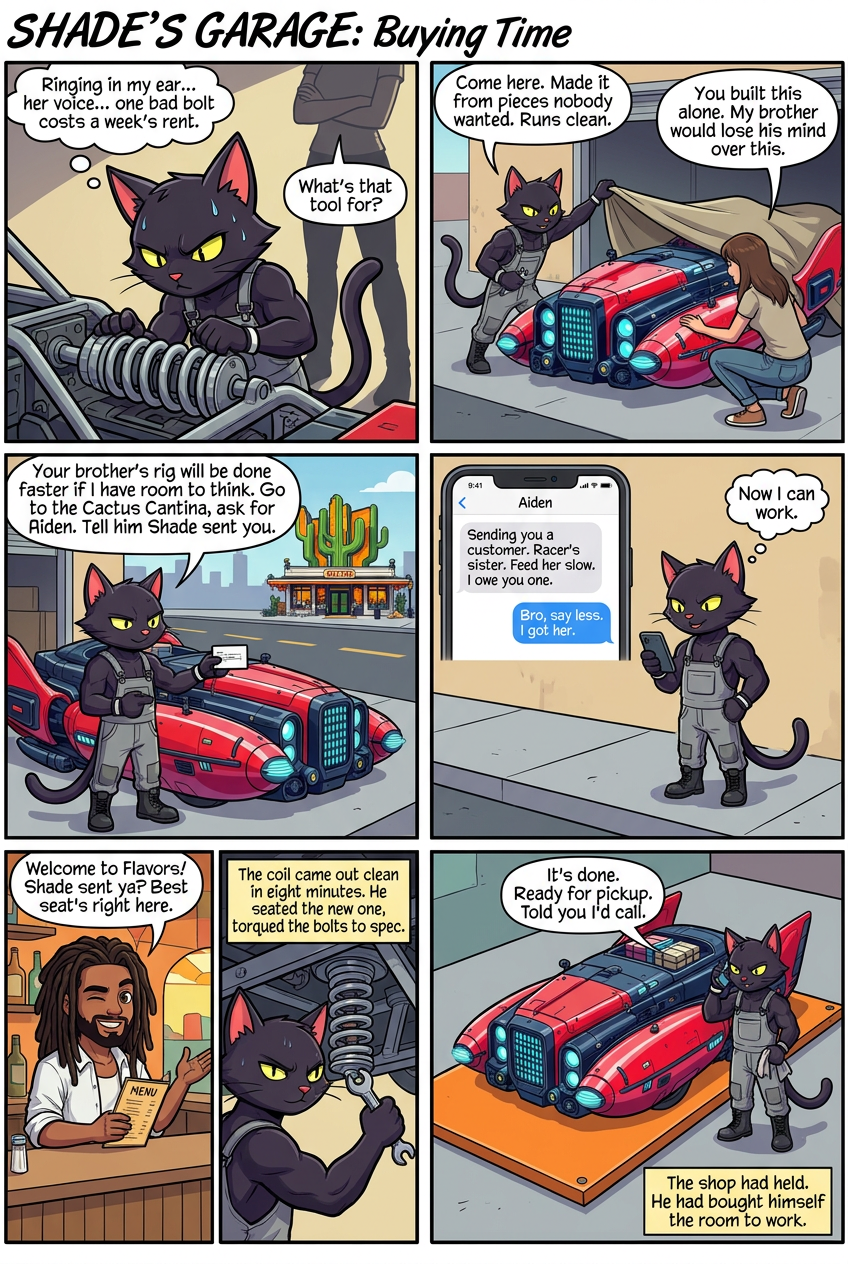
By mid-afternoon Shade had the stabilizer coil half free of its housing, and the sister had not moved from six feet behind his shoulder. She stood on the concrete pad with her arms folded, watching every turn of the wrench. Every time he loosened a bolt she leaned closer. Every time he set a tool down she asked what it was for. The ringing in his left ear pushed against the sound of her voice, and his hands slowed. He put the coil down before he cross-threaded it. One bad bolt on a racing rig cost more than a week's rent. He wiped his hands and turned to her. "Come here," he said. "I want to show you something." He walked her around the side of the shop to a canvas tarp weighted down with cinder blocks. He pulled the tarp back. Under it sat a low hover cart he had built over two winters from scrap: a delivery van's nose, a pair of bike thrusters, a bench seat from a wrecked sedan, all welded to a frame he had cut himself. The paint was three different reds. "Made it from pieces nobody wanted," he said. "Runs clean. I take it out on quiet mornings." She crouched and looked at the seams, and for the first time her hands were still. "You built this alone," she said. It was not a question. He nodded. She ran a finger along the weld at the nose. "My brother would lose his mind over this." "Your brother's rig will be done faster if I have room to think," Shade said. He kept his voice level. "There's a place two blocks down called the Cactus Cantina. Orange glass, big cactus out front, you can't miss it. Ask for Aiden. Tell him Shade sent you. Get yourself lunch. I'll call your phone the minute the coil is seated and the panel is back on." He held out a shop card with his number. She looked at the card, then at the rig on the orange lift plate, then at him. She took the card. She walked off down the block. Shade watched until she turned the corner, then pulled his phone and thumbed a message to Aiden: "Sending you a customer. Racer's sister. Feed her slow. I owe you one." A reply came back inside a minute: "Bro, say less. I got her." Shade pocketed the phone and climbed back onto the pad. The coil came out clean in eight minutes. He seated the new one, torqued the bolts to spec, and closed the side panel. When he called her, he could tell her the rig was ready before her drink was empty. The shop had held. He had bought himself the room to work, and the racer would get his machine back on time.
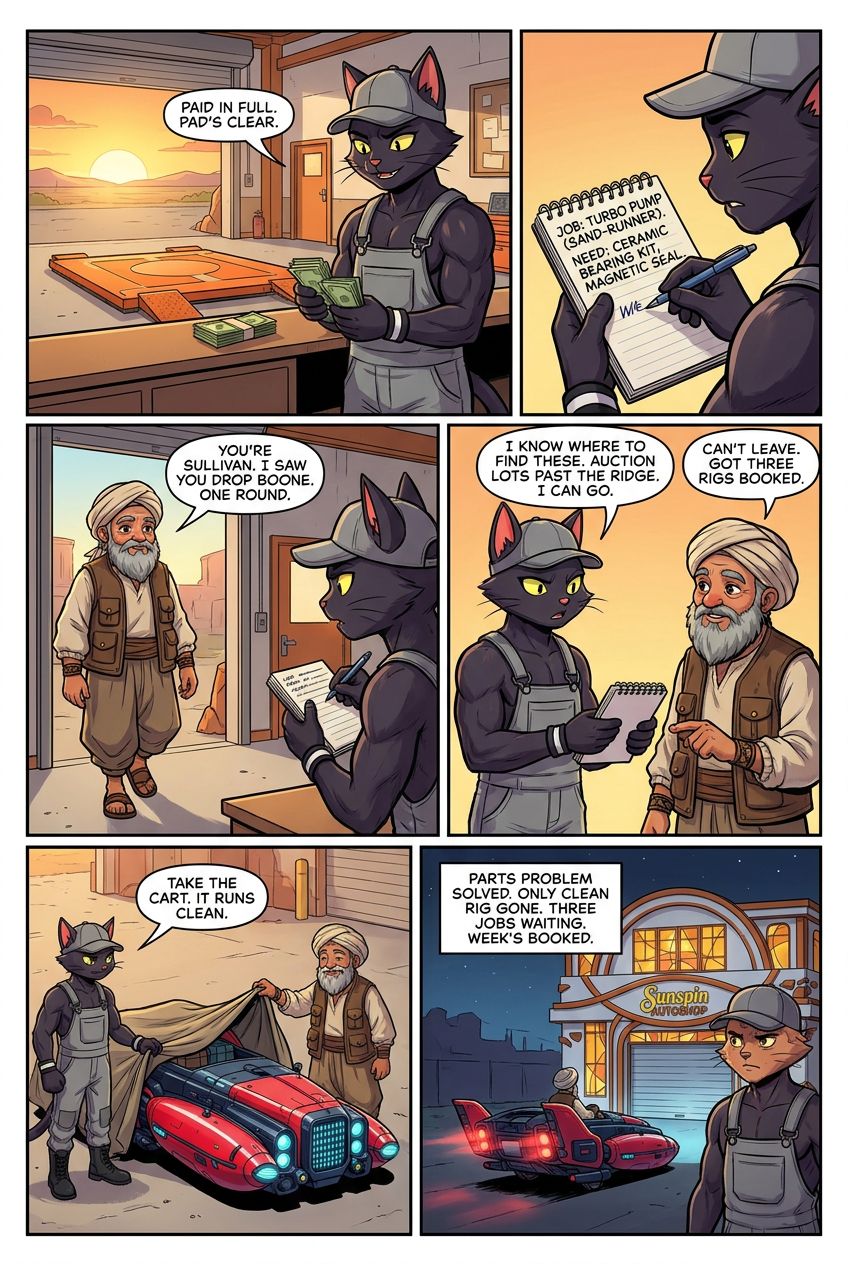
Shade called the sister as promised. She came back, paid in cash, and drove the rig off the orange lift plate before the sun dropped. The pad sat empty. Shade stood in the doorway and counted the bills twice. Then he pulled out his notebook and wrote the next job at the top of a clean page: a sand-runner's turbo pump due in nine days. He knew the pump. He did not know where to buy the parts. His vendors sold brake pads for sedans and belts for delivery vans. A racing pump needed a ceramic bearing kit and a magnetic seal, and the wrong seal would blow the housing on the first start. He was still staring at the page when a small man in a turban stepped through the open bay. The man's beard was gray and his vest had four pockets, each one stuffed. He looked at Shade a long moment. "You're Sullivan," he said. "You dropped Boone in the tenth. I was three rows back." Shade set the notebook down. The man held out a hand. "Omar Hassan. I scout for the auction houses out past the ridge. I heard a mechanic on the east side fixed a bike with a mining vent. I wanted to see if it was the same Sullivan." He grinned. "One round, most nights, I still tell people. One round, and he walked out." Shade let him talk. Then he showed Omar the notebook page and the list of parts he could not source. Omar read it once. He named three auction lots coming up that week, one with a sealed ceramic bearing kit from a decommissioned racing team, another with magnetic seals still in factory wrap. He named the prices. He named the sellers. Shade listened and felt the shop tilt back under his feet. "I can't leave the bay," Shade said. "George cuts the new door tomorrow. I've got three rigs booked behind that." Omar shrugged. "Give me a buy list and a budget. I bring back what fits. I take ten percent." Shade thought about it for the length of a breath. He walked Omar around the side of the shop and pulled the tarp off the low hover cart, three shades of red, welded from scrap. "Take this," he said. "It runs clean. It'll hold whatever you can fit in the back." Omar ran a hand along the nose and laughed once, quiet. He climbed in like he'd owned it a year. Shade wrote the buy list on a fresh page, tore it out, and handed it through the window with an envelope of cash. "Ceramic first," he said. "Seal second. Walk away from anything cracked." Omar nodded and eased the cart out of the lot. Shade watched the taillights turn the corner. The pad was empty. His parts problem had a man on it. His only clean-running vehicle was gone, and three rigs were booked before the week was out.
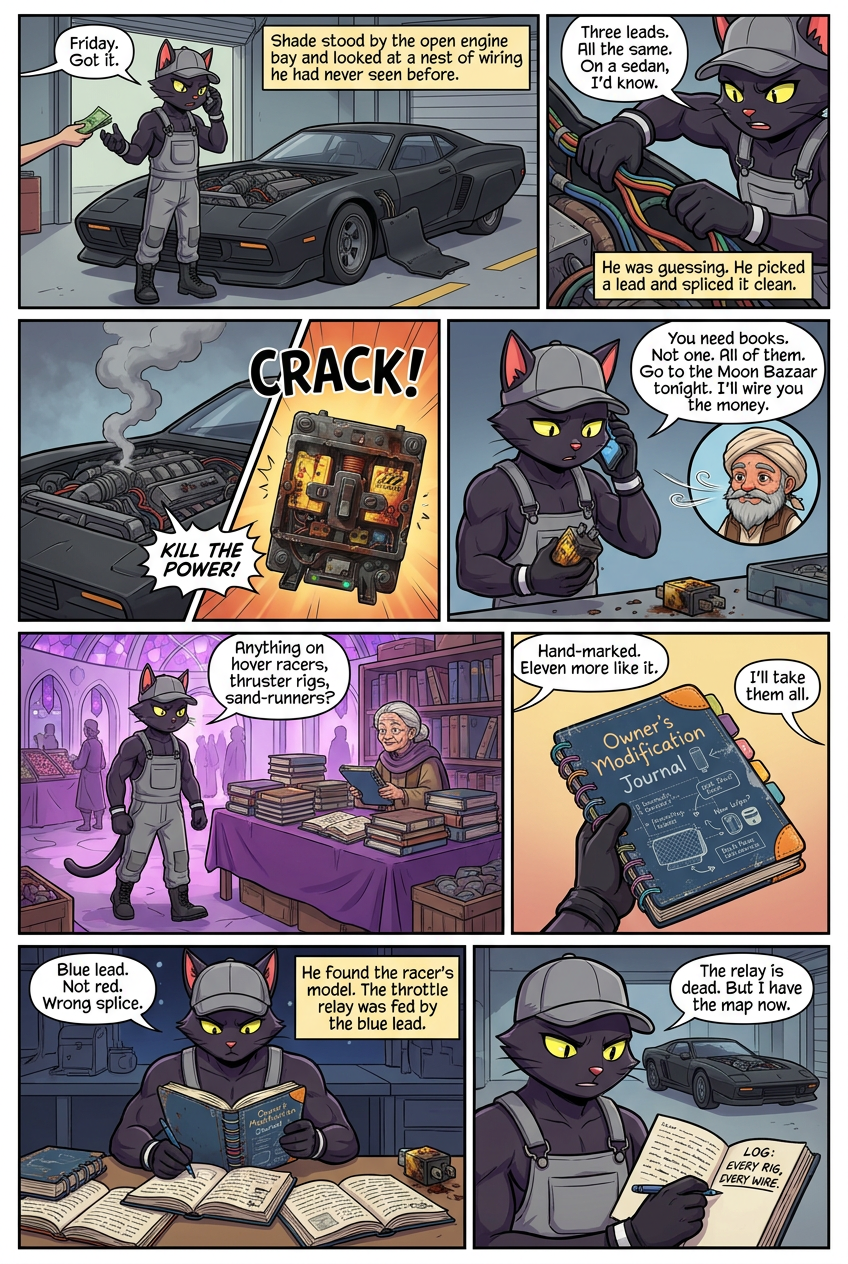
Omar had been gone two days when the next rig rolled onto the lot. It was a hover racer, low and wide, painted matte black with a bent side panel. The owner was a lean woman with grease on her knuckles. She said her thruster kept cutting out at full throttle. She wanted it back by Friday. Shade nodded and quoted her a price. She paid half up front and walked to the corner to call a ride. Shade stood by the open engine bay and looked at a nest of wiring he had never seen before. He traced one harness and lost it behind a plate. He traced another and found three leads that all looked the same. On a sedan he would know. On this machine he was guessing. He picked a lead that ran to what he thought was the throttle relay and spliced it clean. He powered the rig up. The relay popped with a flat crack and smoke curled from the housing. He killed the power and pulled the switch out. The metal was black at the edges and the contacts were fused. He set it on the bench and stared at it. He had just cost himself a part he could not source and a customer he could not afford to lose. He called Omar. Omar picked up on the third ring, wind loud behind him. Shade told him what happened. Omar was quiet a moment. "You need books," he said. "Not one. All of them. Every rig you take in, you need the owner's manual and the mod notes. Racers keep journals. Some sell them when they part out. There's a stall at the Moon Bazaar that deals nothing else." He named the seller. He named the aisle. "Go tonight. I'll wire you what's left of the parts money if you're short." Shade closed the shop early. He caught a ride to the bazaar and walked under the purple glass until he found the stall. The seller was an old woman behind a table stacked with binders and spiral-bound books. Shade asked for anything on hover racers, thruster rigs, sand-runners. She pulled a hand-marked journal from a low shelf, tabbed and worn, filled with a previous owner's notes on wiring colors, relay codes, and torque values. She had eleven more like it. He bought all twelve. He carried them out in two canvas sacks and paid a driver to haul him back. He spread the journals on the bench next to the burnt switch. He found the racer's model in the third book he opened. The throttle relay was fed by the blue lead, not the red. He had spliced the wrong one. He wrote the correction into the margin in his own hand and started a fresh page at the front: every rig, every wire, logged as he learned it. The relay was dead. The customer was still owed a running machine by Friday. But he had the map now.
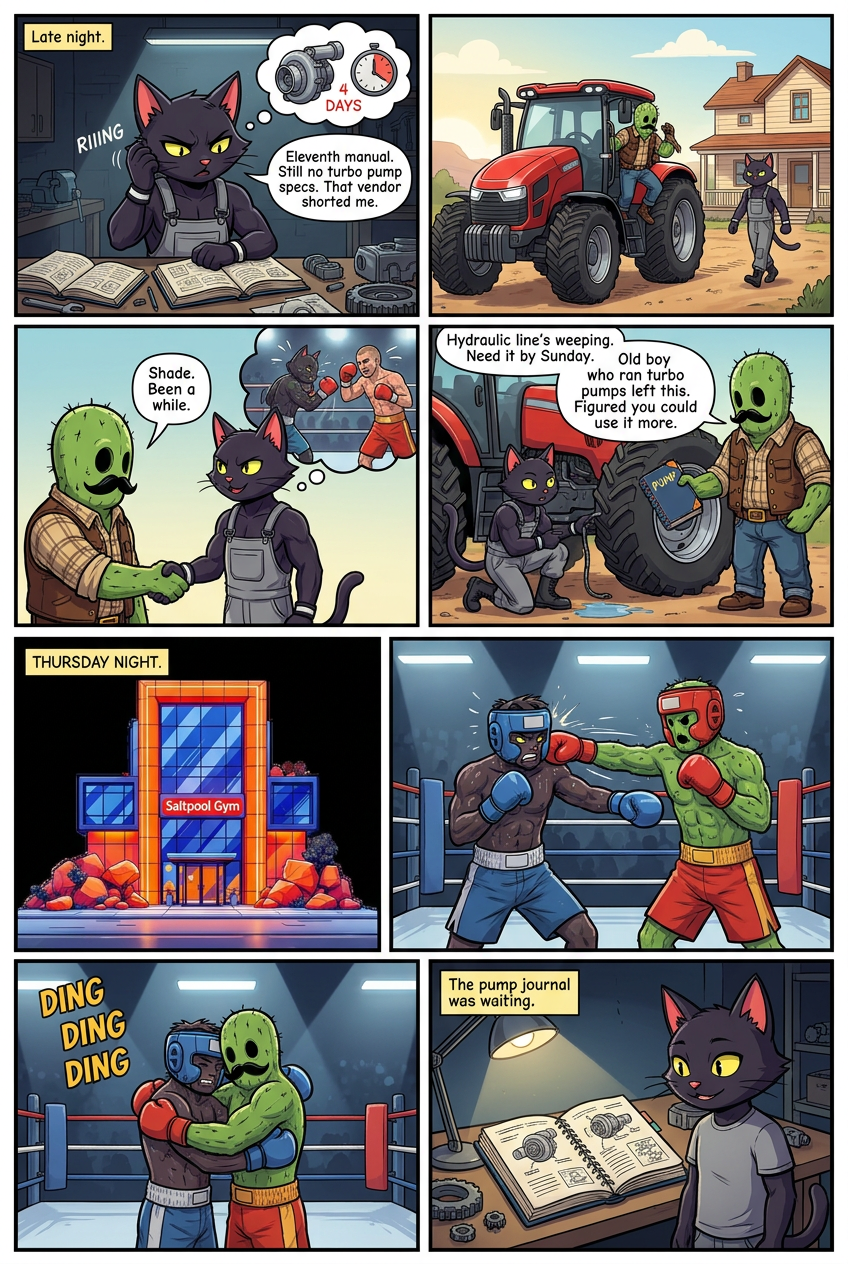
Shade worked past midnight with the journals spread across the bench. He found eleven models covered in careful hand. He found no sand-runner turbo pump. He flipped every book twice. The vendor had told him one volume was missing from the stack she sold him, and this was the gap. Omar's parts were due in four days. Without the pump journal, Shade could not confirm the ceramic bearing kit would seat in the housing, or the magnetic seal would clear the impeller. He shut the last book and rubbed his left ear out of habit. The ring was louder at night. The next morning a tractor rolled onto the lot on wide black tires. Red bodywork, smooth panels, a cab like a helmet. The driver climbed down slow. He was tall and thick through the shoulders, cactus-green, mustache thick under a flat nose. He pulled off a work glove and put out a hand. "Shade," he said. "Been a while." Shade knew the voice before he placed the face. Cisco Thornwood. Ten years and forty pounds ago they had traded punches over four rounds at a card in the flats. Cisco had won on points. Shade had bled from a cut above the eye for a week. "Hydraulic line's weeping," Cisco said. "Lift arm drops on its own. I run prickle pear and corn out past the red flats. I need it back by Sunday." Shade walked around the machine and found the wet seam under the left arm. Straight job. He quoted the price. Cisco nodded once. Then he reached into the cab and came back with a spiral-bound book. Tabs down the side. Cover soft from use. "Heard at the bazaar you bought a stack short one book," he said. "Old boy who ran turbo pumps out of my county left this with me when he sold his rig. Figured you could use it more than I can." Shade took the journal. The tab read PUMP. Inside, the seal tolerances and bearing seats were logged in pencil, page after page. "What do you want for it," Shade said. Cisco shook his head. "Not money." He looked at Shade's hands, then at his own. "Four rounds. Friendly. Saltpool has a ring on Thursday nights. Headgear, sixteen ounce. I want to know what the tenth round did to you. I want to know what it did to me." Shade held the book. He thought about the customer's sand-runner and the four days on the clock. He thought about the ear that would not quiet. He said yes. Thursday he taped his hands in the locker room and climbed through the ropes. Cisco was already there, breathing slow. They touched gloves. Shade caught a hook in the second round that dropped him to a knee. He got up. In the fourth he put Cisco against the ropes and made him cover. When the bell rang they hugged at the center. Shade walked out under his own power. The pump journal was on his bench when he got back to the shop, waiting under the lamp.
Play your story to life
Storycraft is a mobile game where you create AI characters, craft items and locations to build their world, then discover what direction your story takes. Download the iOS game for free today!
Download for free