

King Sahir's Arc
17 Chapters
King Sahir's dream is finding someone who sees them underneath the title and the crown. Somebody who can finally make them feel seen. Somebody who can stop the loneliness they feel constantly..

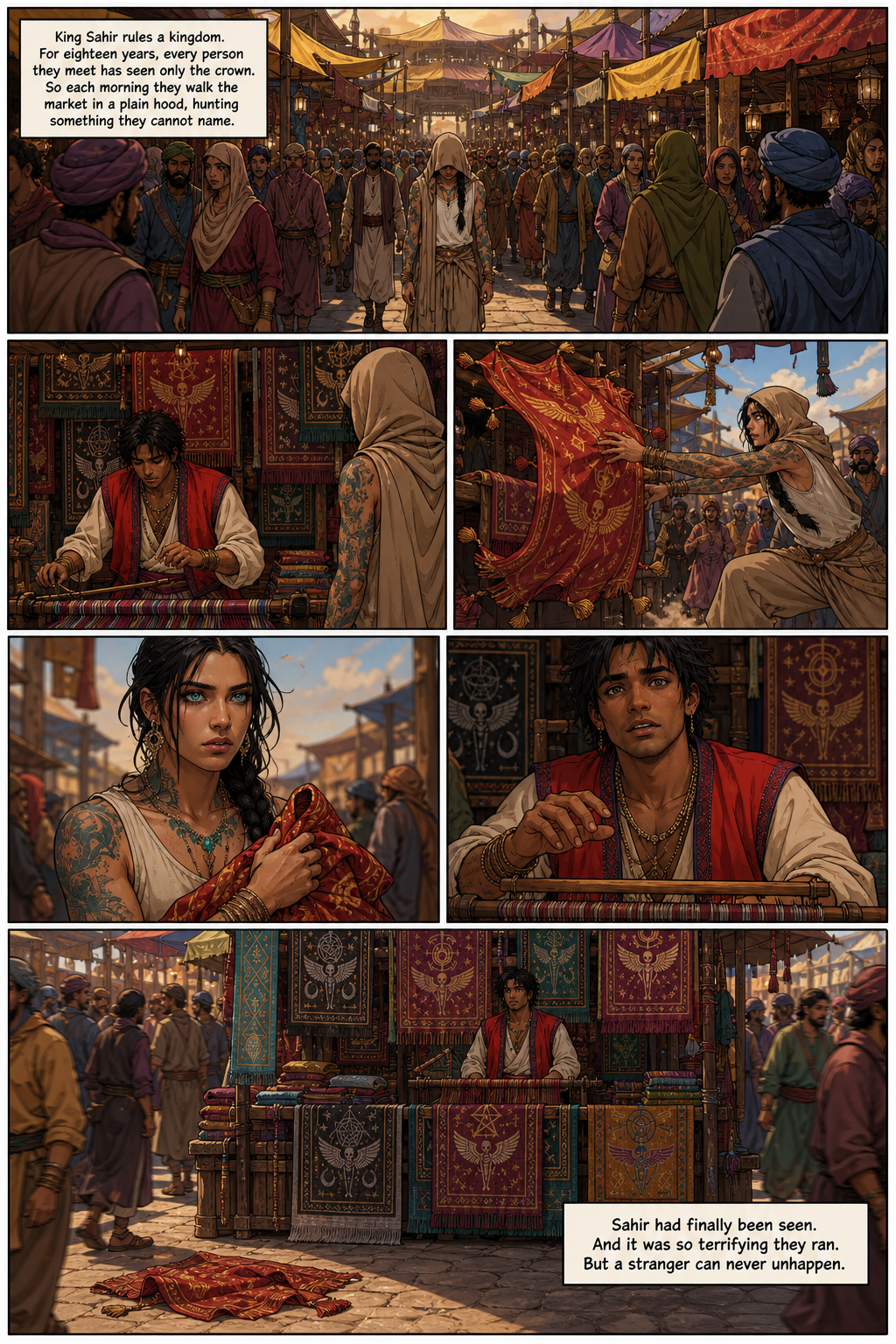
King Sahir ruled a kingdom of saltwater and sand, and still they felt invisible. Every morning they left the palace in a plain hood. No crown, no guards, no title. Just a body in the crowd. For eighteen years people had seen only the King. Sahir wanted one person to see the human under the cloth. So they walked the market each dawn, hunting that one small thing they could not name. The bazaar swallowed them. Wooden stalls leaned together under bright fabric roofs. Spices stung the air. Sahir kept their head low and their braid tucked away. Nobody looked twice. That was the point, and also the wound. One stall pulled them every day. It hung thick with hand-woven tapestries, deep reds and purples and gold. The young man who ran it moved like he loved every thread. He straightened fringes, laughed with buyers, told long stories with his hands. His jewelry caught the sun when he gestured. One red tapestry hung out front. Sahir always stopped there, pretending to admire the weave. The truth was simpler. Sahir came to watch him. Every day the plan was the same. Walk up. Say hello. Ask about the red one. Six words. Sahir had ruled wars with harder words than six. But each morning their throat locked shut. Their feet slowed, then carried them past. The weaver would glance up, smile, and go back to his loom. To him, Sahir was one more quiet customer in a hood. Today Sahir swore it would change. They stepped close. The weaver was threading a shuttle, lips pressed in focus. Sahir opened their mouth. Nothing came. The old freeze gripped their chest. They felt the familiar pull to turn and vanish again. Then the wind moved. A gust snapped under the fabric roofs. The red tapestry tore loose from its hook and dropped. It fell toward the dirt and the trampling feet. Sahir did not think. They caught it against their chest, both arms wrapped around the cloth. The hood slipped back. Their braid swung free over one shoulder. Teal eyes lifted, uncovered, into the morning light. The weaver looked up from his loom. His hands went still. He saw the face he had only glimpsed before. His smile faded into something softer, something caught. He did not speak. He only stared, as if he finally saw someone instead of a shadow in a cloak. Sahir's heart slammed. The secret stood bare between them. Still clutching the tapestry, they held his gaze and did not look away. Neither said a word. But the silence had changed. It was no longer the silence of a stranger passing. It was the silence of two people truly seeing each other for the first time. Sahir's hood was down. The disguise was broken. Whatever came next, they could never again be just another face in the crowd. Terrified by the idea, they dropped the tapestry, turned and disappeared into the crowd.
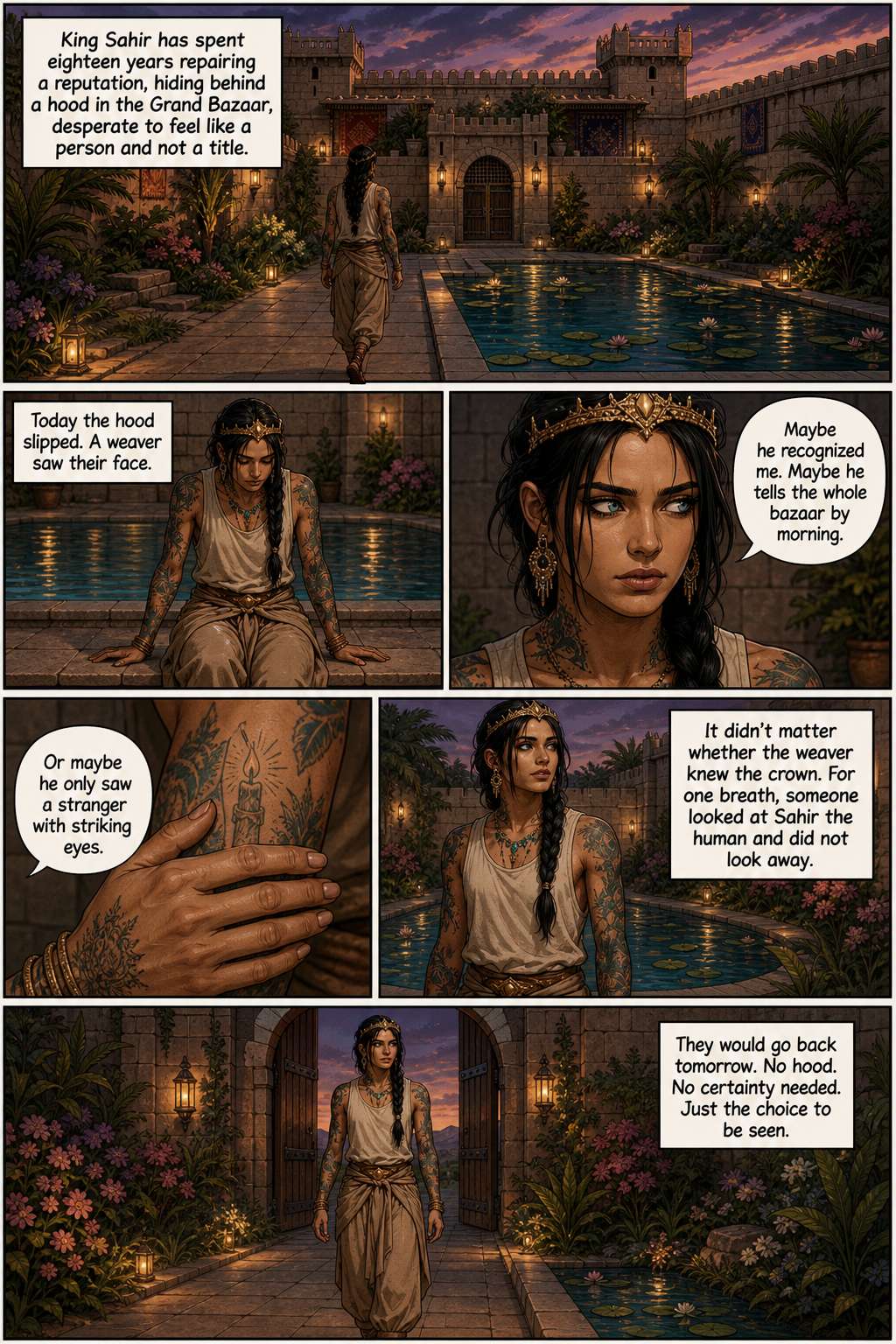
Sahir reached the castle before their breath slowed. They passed through the fortified gate, past the guards who bowed low, and did not stop until they stood alone in the garden courtyard. The high stone walls shut out the city. Flowers ringed a small pool. Here they were safe. Here no weaver could see their face. Sahir sat on the pool's edge and pressed their hands flat on the warm stone. He saw me, they thought. The hood fell, the braid swung free, and the weaver looked right at me. Then a colder thought arrived. He saw a face. Not a crown. Not a name. Sahir turned that over slowly. The weaver had never seen the King in person. No portrait hung in his stall. He had watched a stranger in a hood for eighteen years. Today that stranger caught a falling tapestry. The hood slipped. He saw teal eyes and dark hair. But did he know those eyes belonged to the King? Sahir stood and paced the garden path. A dozen fears fought in their chest. Maybe the weaver recognized them. Maybe he already told the whole bazaar. By tomorrow the market would whisper that the King played dress-up among the stalls. The reputation Sahir had spent years repairing would crack again. Or maybe not. Maybe the weaver saw only a shy customer with striking eyes. Maybe he thought nothing of it at all. Sahir could not know. That was the whole torment. They had no proof either way. A face was not a name. A glimpse was not recognition. They sank back onto the stone. Their mind built both futures and tore them down. In one, the weaver bowed to the King and the spell broke forever. In another, the weaver smiled at a stranger he hoped would return. Sahir pressed their palm against the small candle tattoo on their forearm. They had worn it since fifteen. A reminder that quiet things still matter. That a person could exist beneath the title. And there it was. The answer they had been circling. It did not matter whether the weaver knew the crown. What mattered was that he had looked at Sahir the human, caught holding a tapestry, and not looked away. For one breath, someone saw the body in the hood, not the ruler. That had never happened in eighteen years. Sahir stopped running the futures. They made a choice instead. They would go back. Not hidden. Not fleeing. They would walk to the stall and let the weaver see whoever he had already seen. If he knew the King, so be it. If he knew only a stranger, better still. The fear did not vanish. But the question that had frozen them cracked open. Sahir no longer needed certainty about what the weaver recognized. They only needed to return. They rose from the pool. Tomorrow they would walk back to the bazaar with their face uncovered.
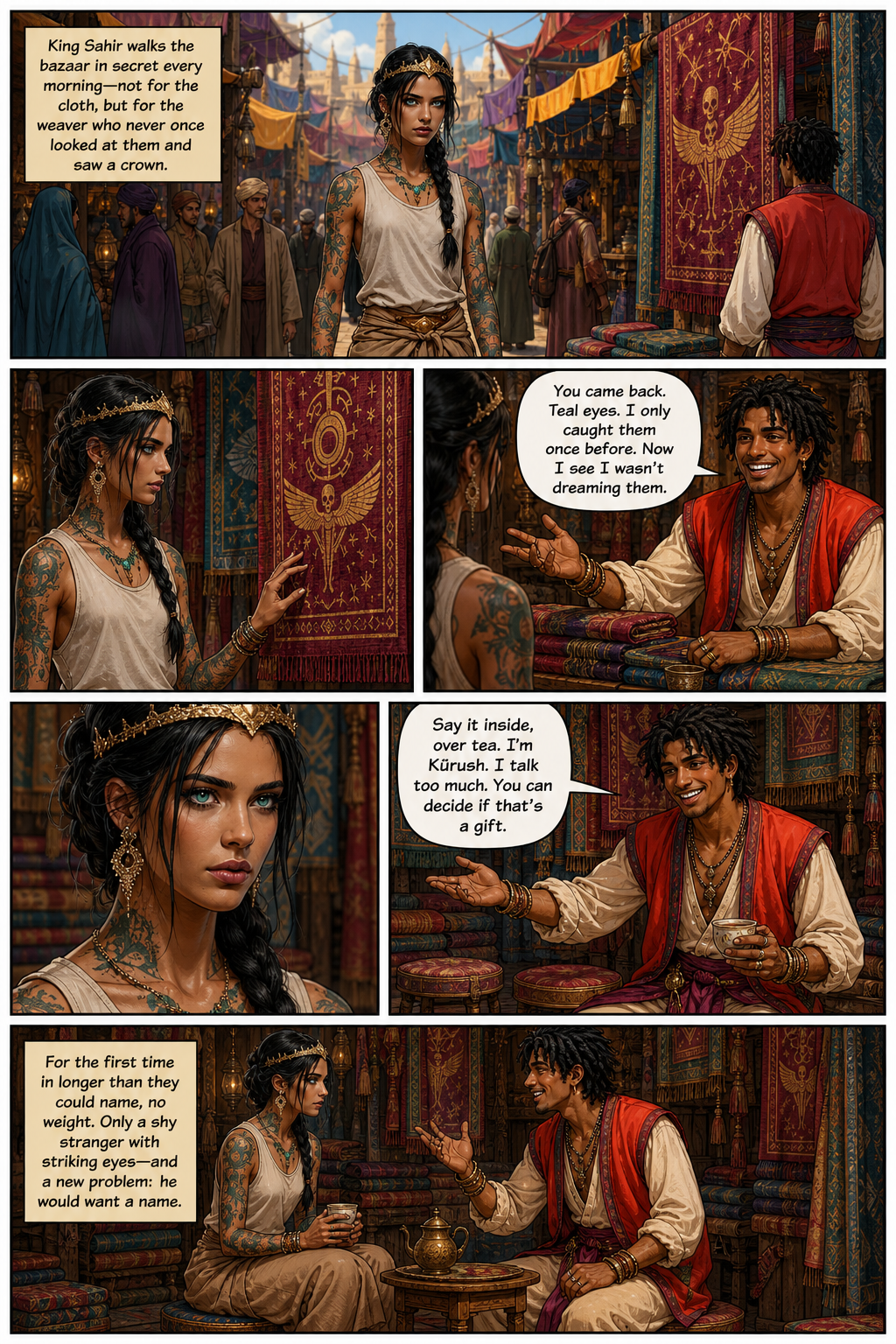
The next morning Sahir walked into the bazaar with their hood down. The braid hung over one shoulder. Nobody bowed. Nobody stared. They passed stalls of spices and copper pots until they reached the one with the woven tapestries. The red one still hung out front. Behind it stood the weaver, the young man who had seen their face. Sahir stopped. Now the old problem returned, sharper than before. They wanted to approach him. But they had no reason. For months they had only looked, then walked on. To step closer now, with their face bare, would show everything. It would say plainly that they came for him, not the cloth. Sahir pretended to study the red tapestry. Their fingers hovered near the woven edge. They tried to think of a question that sounded ordinary. The weaver spoke first. "You came back." He smiled, wide and easy, and set down the thread in his hands. His vest was bright red over pale sandy cloth. Rings and bracelets caught the light. "I was afraid I'd scared you off yesterday. People get shy when the hood slips." Sahir's throat tightened. "You remember me." "Every morning for two years." He laughed. "You slow down at the red one. Same spot. I always wondered who was under there." He tilted his head. "Teal eyes. I only caught them once before. Now I see I wasn't dreaming them." Sahir waited for the next word. The title. The crown. It did not come. The weaver only looked at them the way he would look at anyone. "This one isn't for sale," he said, touching the red tapestry. "My grandmother made it. She taught me the loom when I was too small to hold it. Everything else here is mine. But this one I keep." He paused. "You like it. I can tell. You've liked it longer than anyone." "I do," Sahir said. The truth came out simple. "I've wanted to say so for a long time." "Then say it inside, over tea." He stepped aside and waved a hand toward two low stools behind the display. "I'm Kūrush. I talk too much. My grandmother said it was a gift. You can decide." Sahir looked at the stool. The excuse they had needed all along stood in front of them, offering itself. No clever question required. He had simply invited them in. They sat. Kūrush poured tea into a chipped cup and began a story about the first tapestry he ever ruined. Sahir listened and, for the first time in longer than they could remember, felt no weight on their shoulders. Here they were only a shy stranger with striking eyes. A person at a stall, drinking tea. The obstacle was gone. But as Kūrush talked, a new one took its place. He knew their face now. He would want a name. And the only name Sahir had belonged to the King.
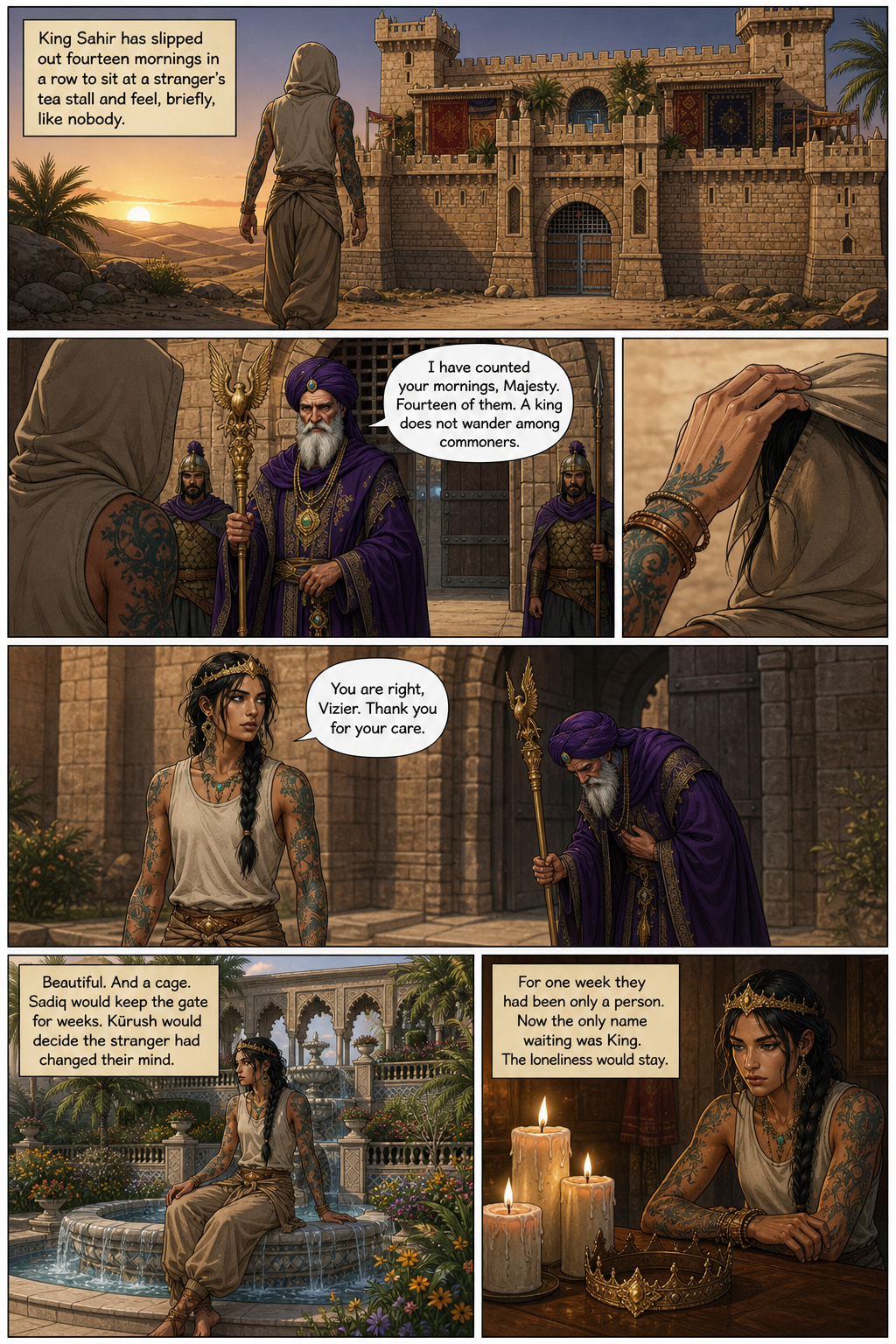
The next morning Sahir dressed in plain clothes and pulled the hood over their braid. They walked toward the castle gate, already tasting the tea, already seeing Kūrush's easy smile. Then they stopped. Vizier Sadiq stood beneath the arch. The old advisor leaned on a golden staff, purple robes bright against the sandy stone. Two guards waited behind them. Sadiq was not passing through. They were watching. "Majesty." Sadiq dipped their head. Their eyes moved over the hood, the dull clothes, the bare arms. "You rise early these days. And you dress strangely for a king." Sahir's hand tightened on the hood. "I wanted air." "The garden has air." Sadiq did not move. "I have counted your mornings, Majesty. Fourteen of them, gone past the gate. A king does not wander among commoners. It shames the crown. The prophets chose you to sit the throne, not to drift through the bazaar." They tapped the staff once on the stone. "I will watch this gate myself. For your protection." Sahir looked past the arch to the city beyond. The road ran down toward the market, toward the red tapestry, toward the one person who did not know their name. For a moment they thought of pushing past. But the guards stood ready. A king who shoved through his own gate would be remembered. Word would spread. Someone would follow. And then Kūrush would learn exactly who had been drinking his tea. Sahir let go of the hood. "You are right, Vizier. Thank you for your care." The words came out smooth and royal, the voice they used for the throne room. Sadiq bowed, satisfied, and Sahir turned back inside. They walked to the garden instead. Fountains ran down the terraces. Flowers crowded the stone beds. It was beautiful, and it was a cage. Sahir sat on the edge of a basin and watched the water fall. There would be no tea. No stall. Not today, not tomorrow. Sadiq would keep the gate for weeks if they chose. And Kūrush would wait at his loom for a stranger who never came back, and decide the stranger had changed their mind. That evening Sahir sat alone in their room. A servant had lit three cream candles on the table, staggered high and low, the flames steady. Sahir pulled off the copper crown and set it beside them. They stared at the smallest flame until their eyes stung. For one week they had been only a person at a stall. Now the gate was closed, and the only name waiting for them was King. Kūrush would forget the teal-eyed stranger. The crown would stay. The loneliness would stay. Sahir pressed their fingers against their tired eyes and did not cry. They simply sat, and let the candles burn down, and understood that nothing would change.
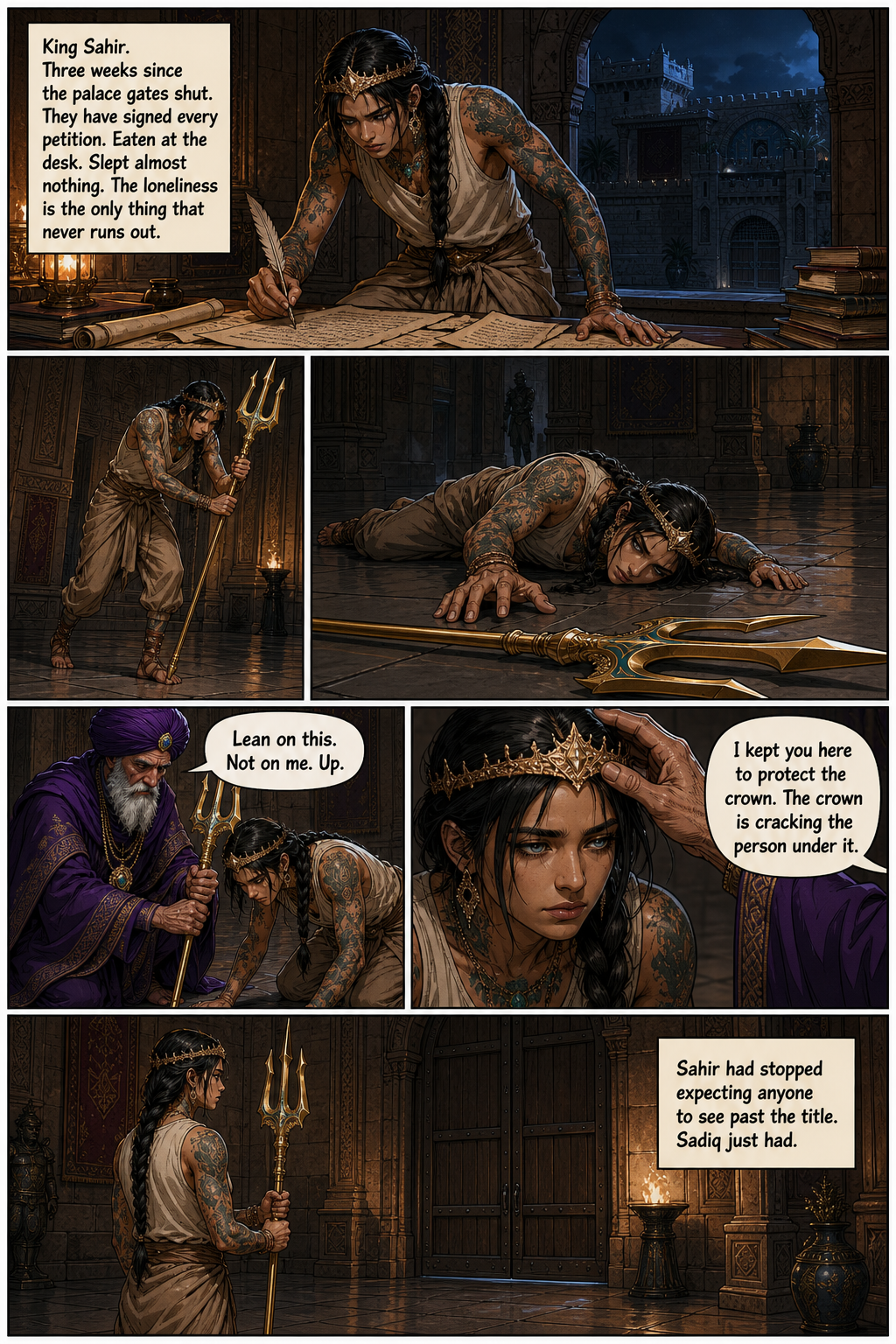
The weeks after the gate closed buried Sahir in paper. Advisors stacked petitions on the long table. Grain disputes. Water rights. A bridge that needed repair before the floods. Sahir signed and signed until their hand cramped. They slept less. They ate at the desk. The garden fountains ran without them. There was no stall, no tea, no stranger who smiled. There was only the work, and the work never ended. The pain came back worse than it had in years. It started in their knees each morning and climbed to their lower back by noon. By the third week Sahir could not rise from the chair without gripping the table edge. They sent for the golden trident they used on bad days. They leaned on it to cross the room, both hands on the teal-marked shaft, dragging each step. The copper crown felt heavy enough to bend their neck. One evening Sahir tried to reach the window alone. Their knee buckled. The trident scraped the floor and they went down hard against the stone. They could not get up. They stayed there, cheek to the cold floor, and waited for the pain to pass. It did not pass. The door opened. Vizier Sadiq stepped in with a sheaf of letters. For thirty years Sadiq had served this palace, loyal to tradition, certain the king belonged within these walls. Sadiq had kept the gate shut. Now Sadiq saw the king on the floor and stopped. "Majesty." Sadiq set the letters down. They crossed the room and knelt, slow in their purple robes. They reached for the trident and held it steady. "Lean on this. Not on me. Up." Sahir pulled. Pain tore through their back. They got one knee under them, then stood, swaying over the shaft. Sadiq did not let go of the trident. "How long," Sadiq said. It was not quite a question. "Weeks." Sahir's voice came thin. "Since the gate." Sadiq studied their face. The old advisor had learned every lie Sahir told. This was not one. "You have signed every petition on that table." "Yes." "A dead king signs nothing." Sadiq straightened the crown on Sahir's head with one hand, almost gentle. "I kept you here to protect the crown. The crown is cracking the person under it." Sahir said nothing. They had stopped expecting anyone to see the person at all. Sadiq stepped back and folded their hands. "I will carry the smaller matters myself. You will rest three days. This is not a request." They picked up the letters and walked to the door. There they paused. "The gate is my duty. But a king who cannot stand is no use to the throne either. Think on that, Majesty." The door shut. Sahir stood alone, both hands on the trident, and understood something had shifted. The one person watching them had finally looked past the title and seen them hurting.
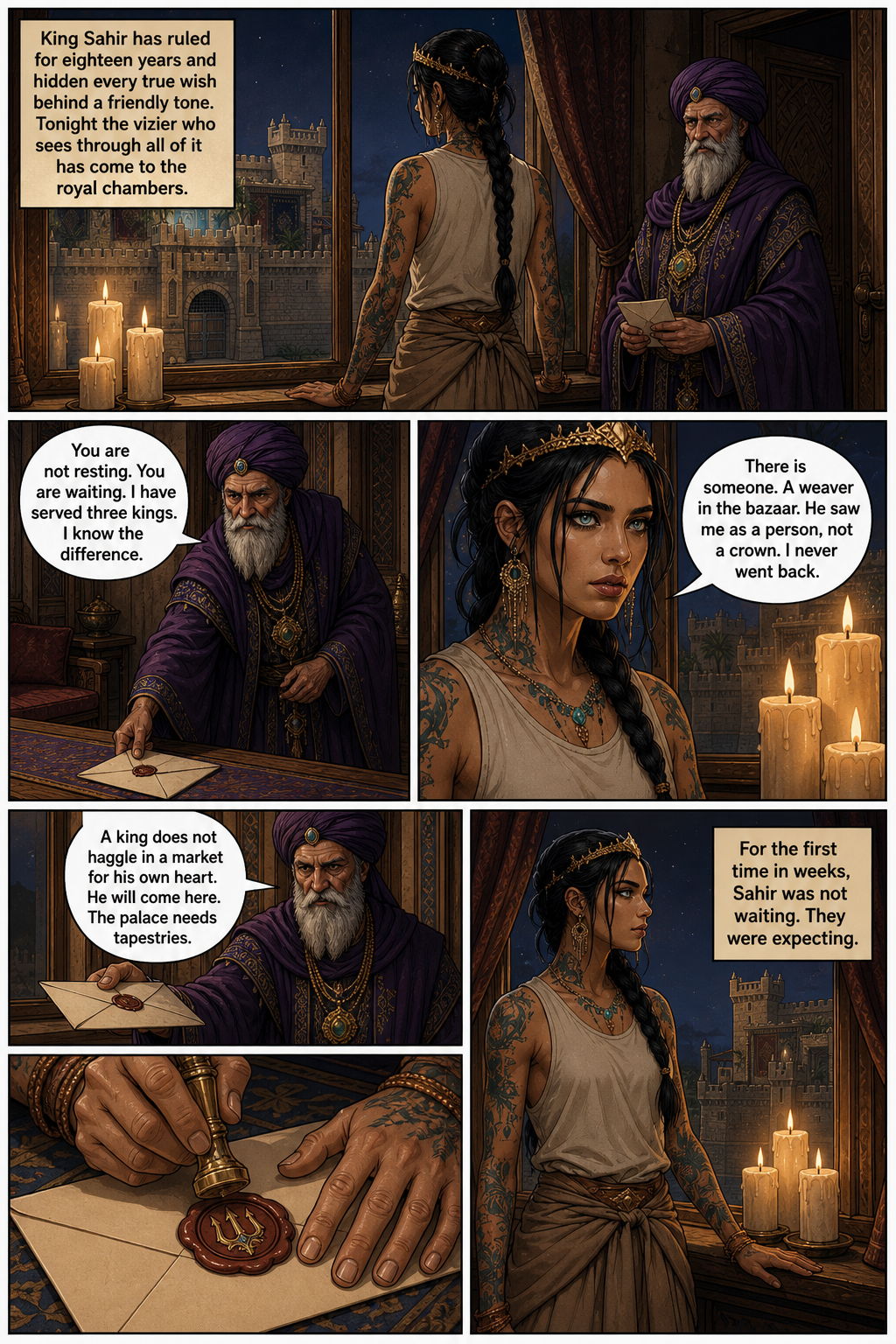
The three days of rest ended, but Sadiq did not leave. The vizier returned each evening to Sahir's chambers, checking the work they carried, watching how they stood. Tonight Sahir sat by the window with three cream candles burning at staggered heights. The warm light fell on their hands. Sadiq stood near the door in purple robes, holding a single letter. "You have not asked to leave the walls," Sadiq said. It was not quite a question. Sahir kept their eyes on the candle flames. "You watch me too closely for that." "I watch everyone closely. It is my work." Sadiq crossed the room and set the letter on the table. "But you are not resting. You are waiting. I have served three kings. I know the difference." Sahir's chest tightened. For eighteen years they had hidden every true wish behind a friendly tone. Sadiq had learned to hear through it. There was no slipping out now. One quiet step toward the weaver's stall, and the vizier would see. A king caught chasing a commoner would feed every rumor the court already told about them. "There is someone," Sahir said. The words felt dangerous. "In the bazaar. A weaver. He saw me as a person, not a crown. I meant to go back. I never did." Sadiq was silent. Sahir waited for the refusal, the speech about tradition and shut gates. "Describe him," Sadiq said instead. "Young. Bright colors over sand-colored cloth. Too much jewelry." A small smile touched Sahir's mouth. "He laughs easily." Sadiq studied the candles. "Kūrush. His grandmother wove for the old king. She was honest. He is too." The vizier folded their hands. "I knew her. I did not expect to speak her name again." Sahir turned from the window. "You would let me go?" "No." Sadiq's voice went flat and final. "A king does not haggle in a market for his own heart. The court would tear you apart." The candle flames blurred. Sahir looked down at their hands. "So you will not go to him," Sadiq said. "He will come here." Sahir's head lifted. "What?" "A king may summon any craftsman. The palace needs tapestries. The garden hall has bare walls." Sadiq picked up the letter they had carried in and held it out. "I wrote the summons before I came. It needs your seal." Sahir took the paper with shaking fingers. The words were plain. A royal commission for the weaver Kūrush, to bring his work to the castle. "You hid him," Sadiq said. "Now the court will see only a tradesman doing honest work. No scandal. No gate to climb." The vizier moved to the door. "I kept you inside these walls. I did not promise you would be alone in them." Sahir pressed their seal into the warm wax. The door closed behind Sadiq. The candles burned on. For the first time in weeks, Sahir was not waiting. They were expecting.
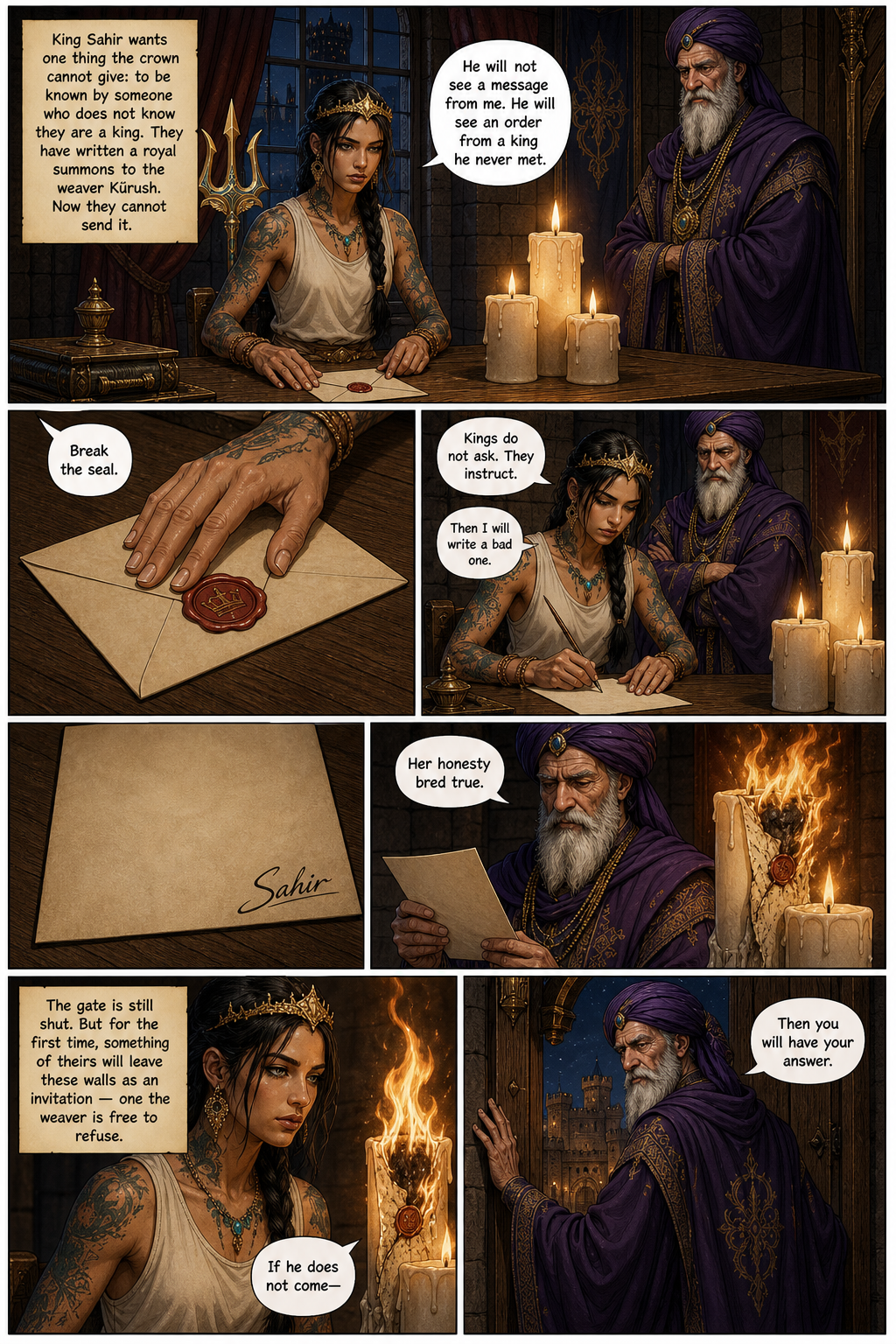
The sealed summons sat on the table between the three candles. Sadiq watched Sahir turn it over twice. The wax held firm. The words were plain and correct: a royal commission for the weaver Kūrush, to bring his work to the castle. Sahir should have felt relief. Instead their stomach knotted. "A rider leaves at dawn," Sadiq said. "He will put this in the weaver's hand." Sahir pressed a finger to the seal. "He will see the crest first. The horse. The uniform." They looked up. "He will not see a message from me. He will see an order from a king he never met." Sadiq said nothing. That was agreement. Sahir thought of the stall. Of the young weaver who talked while his hands moved, who had poured them tea without once asking their name. If a soldier arrived with a sealed command, that man would vanish. Only a frightened tradesman would come. He would bow. He would say yes to everything. He would never laugh again in front of them. "Break the seal," Sahir said. Sadiq's brows rose a fraction. "You sealed it an hour ago." "I know what I sealed. It frightens him." Sahir reached for a fresh sheet. Their knees ached from sitting, but their hands were steady now. "A summons tells him what the crown wants. I want him to choose." "Kings do not ask. They instruct." Sadiq's voice went flat, the way it did when he meant to close a subject. "Then I will write a bad one." Sahir dipped the pen. They did not write of commissions or castle walls. They wrote that a buyer admired the red tapestry that used to hang at the front of his stall. That the buyer missed walking past it. That the buyer would pay fairly, and would understand if the weaver chose not to come. They signed it with their own name. Only Sahir. No title. Sadiq read it over their shoulder. A long silence. "He will know who signed it." "He will know a person signed it," Sahir said. "Not a throne." Sadiq took the paper. He studied the plain words for a long moment. Then he folded it with care, the way a man folds something that belonged to an old friend's grandchild. "Her honesty bred true," he murmured. He tucked the letter into his robe. "The rider leaves at dawn. This one, not the other." He burned the sealed summons in the tallest candle. The wax crest blackened and curled. Sahir watched it char. The castle still held them inside. The gate was still shut. But for the first time, something of theirs would leave these walls and reach the weaver's hands. Not a command. An invitation he was free to refuse. "If he does not come," Sahir said quietly. "Then you will have your answer," Sadiq said, and shut the door.
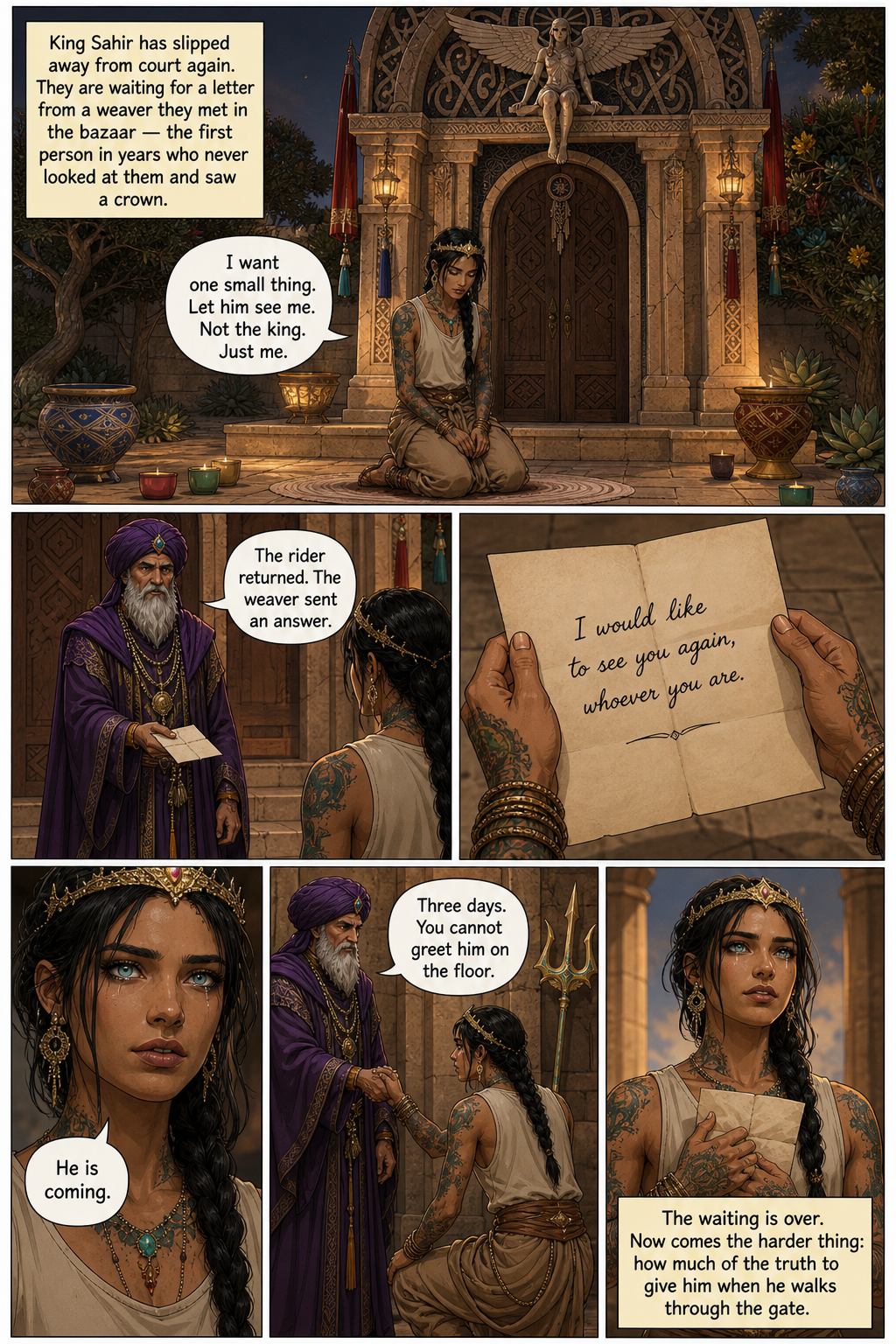
The rider had left at dawn. Three days had passed since. Sahir had no word from the weaver, and no way to know if he would come at all. Until they knew, they could not plan, could not ready a room, could not prepare their own heart to see him again. So they went where they always went when the waiting grew too heavy. They walked to the shrine inside the castle garden, past the trimmed desert greenery, and climbed the cracked stone steps alone. The winged stone figure watched from above the doors. Two lanterns burned low. Sahir knelt at the center, where small bowls waited for offerings. Their knees ached against the stone. They had not come to ask the prophets for a future. The prophets had already chosen their whole life once, and never asked. "I never wanted any of it," Sahir said to the quiet. "The crown. The walls. You studied every future and picked me. You never asked what I wanted." They set a copper coin in a bowl. "I want one small thing now. Let him see me. Not the king. Just me." Footsteps crossed the garden behind them. Sadiq stopped at the base of the steps. He held a folded paper in one hand. His staff did not move. For a long moment he only watched the kneeling king. "You should not be on the floor," Sadiq said. "I know." Sahir did not rise. Sadiq climbed two steps and held out the paper. "The rider returned. The weaver sent an answer." Sahir's breath caught. They took the paper with both hands. The edges were soft, folded the way a careful person folds something they mean to keep. No seal. No crest. Just plain creases. They unfolded it slowly. The writing was uneven, the hand of a man who worked with thread more than pen. *I remember the one who walked past the red tapestry every morning. I hung it back up when I read your letter. I will bring my work to the castle. I would like to see you again, whoever you are.* Sahir read it twice. Their eyes stung. He had not written "Your Majesty." He had written "whoever you are." He still did not care about the crown. "He is coming," Sahir said. Their voice shook. "He is coming," Sadiq agreed. He studied the king's face. "You wept over a tradesman's letter." "Yes." Sahir did not hide it. Sadiq was quiet. Then he offered a hand and helped the king to their feet. "Three days," he said. "That is when he arrives. A room must be chosen. Your pain must be managed. You cannot greet him on the floor." Sahir pressed the letter to their chest. The waiting was over. Now came a harder thing. Soon Kūrush would stand inside these walls, and Sahir would have to decide how much of the truth to give him.
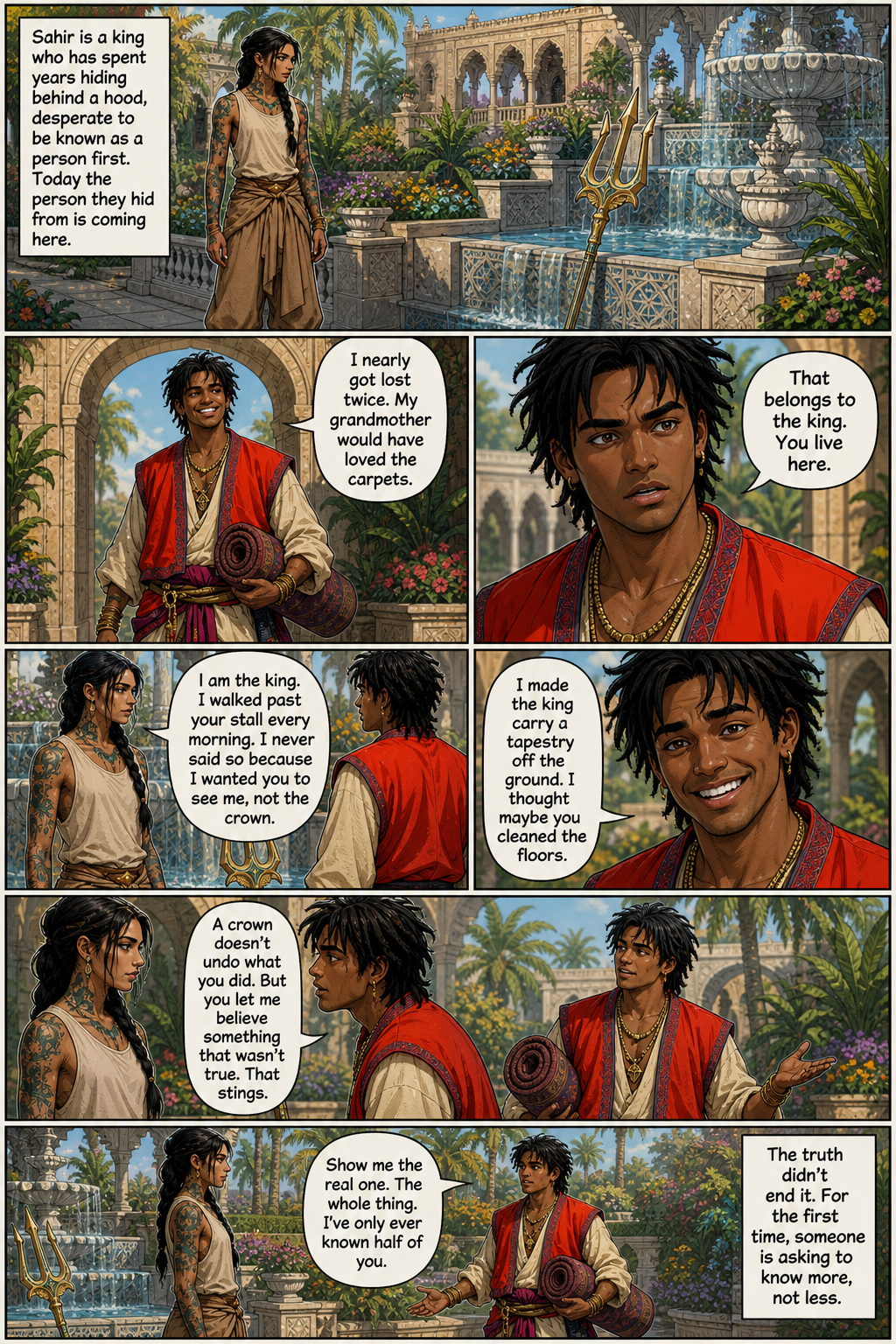
Three days passed. Sahir chose the garden for the meeting. Fountains spilled down the terraces. Flowers crowded every stone ledge. It looked less like a throne room and more like a quiet place where two people could talk. Sahir left the copper crown behind. But a servant had set out the golden trident near the fountain, teal lines bright along its curves. Sahir stared at it. That one object named them king without a word. They told themselves they would decide what to say when he arrived. They never did. Kūrush came at midday. He carried a roll of cloth under one arm. His red vest caught the sun, and jewelry clinked at his wrists. He walked in smiling, already talking. "I nearly got lost twice. These halls go on forever. My grandmother would have loved the carpets." Then his eyes found the trident by the water. His steps slowed. His smile faded. He looked at Sahir, really looked, the way he had looked once at the stall. "That belongs to the king," Kūrush said. He glanced at the garden, the guards at the gate, the walls around them. His voice dropped. "You live here." Sahir's heart pounded. Here was the moment. A lie would be easy. A servant. A steward. Anything small. But Kūrush had written *whoever you are*. He had earned the truth. "I am the king," Sahir said. "Sahir. The one who walked past your tapestry every morning. I never told you because I wanted you to see me, not the crown." Kūrush went still. The cloth slipped lower under his arm. For a long breath he said nothing, and Sahir felt the easy honesty between them crack open and wait. Then Kūrush let out a short, stunned laugh. "The king." He shook his head. "I invited the king for tea. I made the king carry a tapestry off the ground." He set his cloth down on a ledge. "I thought maybe you cleaned the floors here." "Does it change things?" Sahir asked. Their voice was small. Kūrush stepped closer. He studied Sahir's face, the dark braid, the tired teal eyes. "You walked past my stall for years," he said. "You caught my grandmother's tapestry so it wouldn't touch the dirt. That was you. A crown doesn't undo that." He paused. "But you let me believe something that wasn't true. That stings." "I know," Sahir said. "I'm sorry." Kūrush nodded slowly. He did not leave. He picked his cloth back up. "Then show me the real one," he said. "The whole thing. King and all. I've only ever known half of you." Sahir breathed. The truth had not shattered them. It had changed the ground beneath their feet. Kūrush still stood there, asking to know more, not less. Now Sahir had to decide how to let a weaver into a king's guarded life, with Sadiq watching every door.
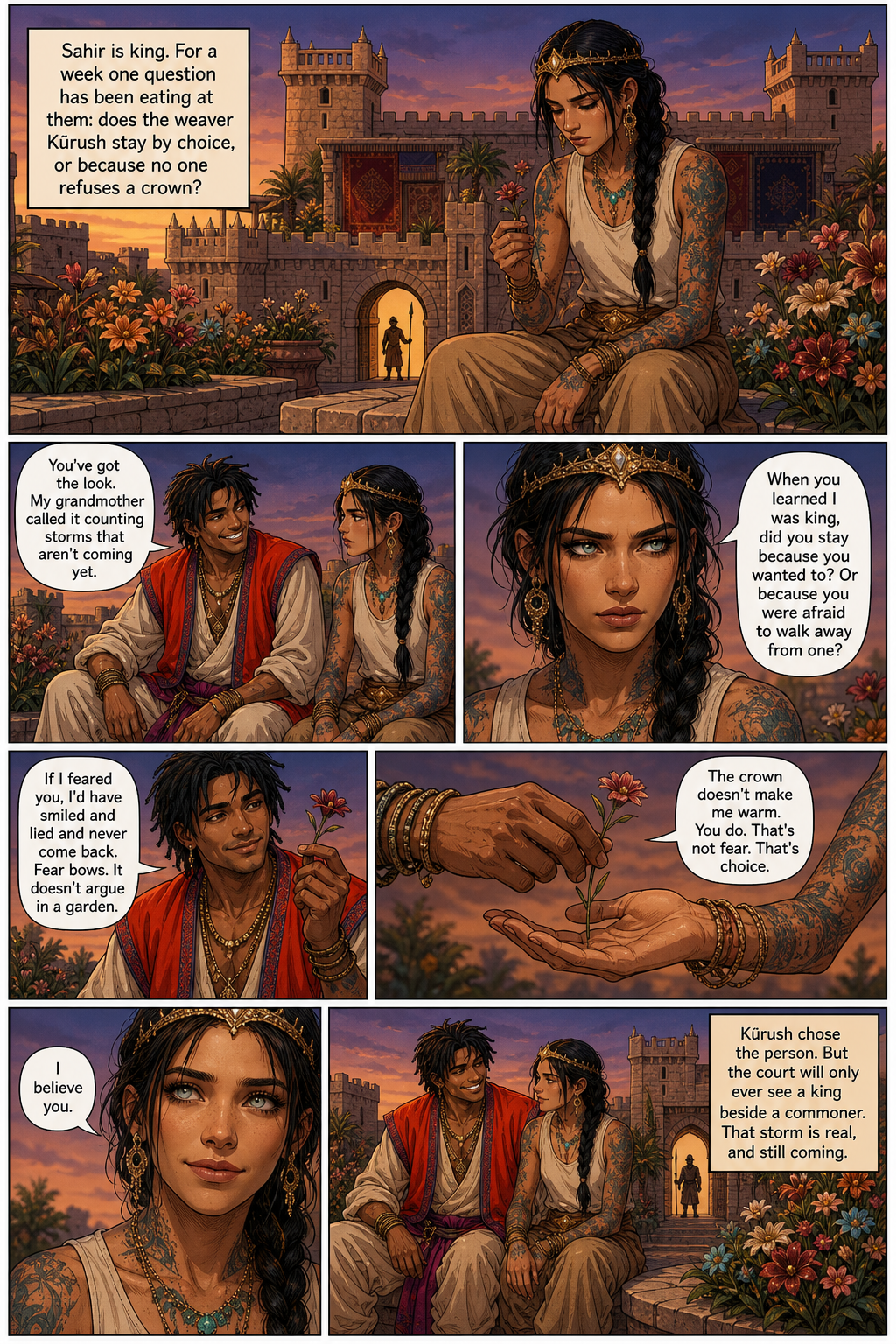
A week after the garden, Sahir watched the fortress walls close out the sun. Kūrush came back often now, carrying cloth and stories. But every visit left Sahir with the same quiet worry. Kūrush had stayed when he learned the truth. Yet Sahir could not tell why. Had he stayed for the person at the stall, or had he stayed because no one refuses a king? That evening Sahir sat alone in the courtyard garden. Desert flowers crowded the stone ledges, bright petals bent by old winds. Sahir turned a small stem in their fingers and chewed the question until it hurt. A servant could love a kind stranger. A subject could only fear a crown. Sahir no longer knew which Kūrush saw. Kūrush found them there. He slowed when he saw Sahir's face. "You've got the look," he said. "The one my grandmother called 'counting storms that aren't coming yet.'" He sat on the ledge without asking. That small rudeness steadied Sahir more than any bow. "I need to ask you something," Sahir said. Their voice shook. "And I need you to answer plainly. When you learned I was king, did you stay because you wanted to? Or because you were afraid to walk away from one?" Kūrush went quiet. He picked a flower from the ledge and studied it. "Fair question," he said. "Here's the honest answer. The day you told me, I was angry. If I feared you, I'd have smiled and lied and never come back. Fear is polite. It bows. It doesn't argue in a garden." Sahir's breath caught. "Then why did you come back?" "Because I missed the person who caught my grandmother's tapestry." Kūrush turned the flower toward Sahir. "The crown doesn't make me warm. You do. I kept coming for the one who looks worried over nothing and needs someone to say it's nothing." He pressed the stem into Sahir's palm. "That's not fear. That's choice." Sahir looked at the flower in their hand, then at Kūrush's steady face. For eighteen years no one had chosen them for themselves. The worry that had gripped their chest all week loosened and let go. "I believe you," Sahir said. And they did. Kūrush grinned and bumped their shoulder. "Good. Now stop counting storms." Sahir almost laughed. The fear was answered. Kūrush had stayed out of feeling, not duty. But as the gate guard shifted at the far wall, Sahir remembered the walls around them. Kūrush saw the person now, freely and fully. The harder truth remained. The whole court would only ever see a king consorting with a commoner, and that was a storm no flower could wave away.
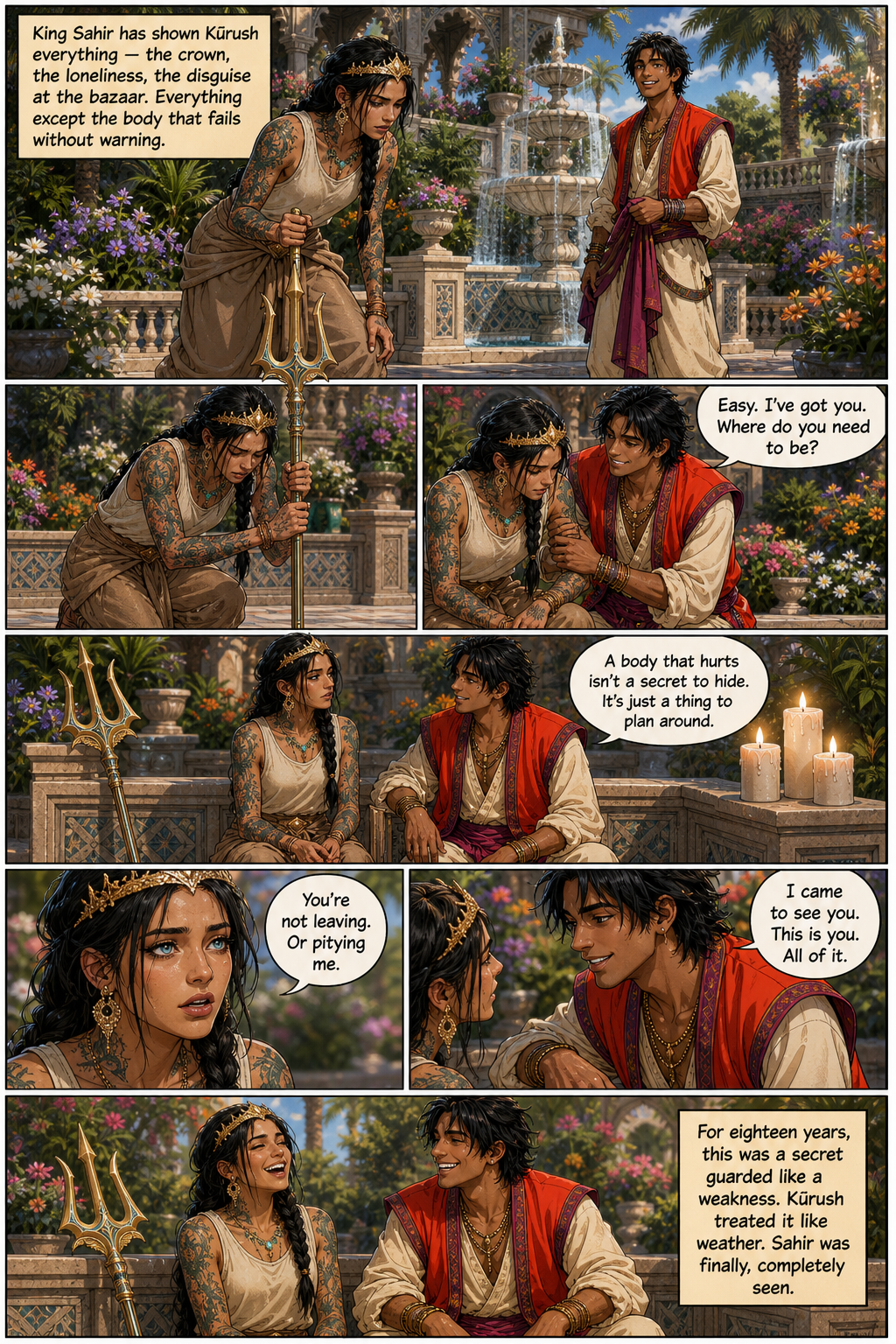
The morning after the garden, Sahir woke to a familiar warning. A dull ache sat deep in both knees. They knew this feeling. A flare was coming, and it would be bad. Today, of all days. Kūrush was in the palace, measuring the great hall for the commissioned tapestries. Sahir had told him everything but this. The weaver knew the crown, the deception, the lonely child beneath. He did not know the body that failed without warning. Sahir dressed slowly and took up the golden trident from its stand. The ceremonial staff was all curves and teal inlay, heavy and proud. Today it served a simpler use. Sahir leaned on it like a cane and walked to the garden, where Kūrush waited among the fountains and planted terraces. "King Sahir!" Kūrush turned from a terrace of bright flowers. He held a strip of cloth he'd been draping to test the light. "I was going to ask which color the hall wants. The east wall gets morning sun, so—" He stopped. He watched Sahir take one careful step, then another. The trident took their weight each time. Sahir meant to smile and brush it off. Instead the ache climbed into their spine. Their knee buckled. They caught the trident with both hands and froze, breath shaking, unable to move forward or back. Kūrush dropped the cloth. He crossed the stone path and was there, one hand under Sahir's elbow, steady and quick. He did not gasp or kneel or call for guards. "Easy," he said. "I've got you. Where do you need to be?" "The bench," Sahir whispered. Shame burned hotter than the pain. "I should have told you. My body does this. Since birth. The stress, the walking—it flares." They let him guide them to the stone ledge. "I didn't want you to see." Kūrush eased them down and sat beside them. He took the trident and leaned it against the ledge. "My grandmother wove sitting down the last ten years of her life," he said. "Her hips gave out. She made her best work in that chair." He looked at Sahir plainly. "A body that hurts isn't a secret to hide. It's just a thing to plan around." Sahir stared at him. "You're not—leaving. Or pitying me." "Why would I?" Kūrush rested a hand near theirs on the stone. "I came to see you. This is you. All of it." He nodded at the trident. "Next time, tell me. I'll bring a stool and we'll work where it's easy." The pain still gripped Sahir's knees. But something loosened in their chest. For eighteen years they had hidden this from everyone but Sadiq, who guarded it like a duty. Kūrush treated it like weather. Something to dress for. "Thank you," Sahir said. Kūrush grinned. "Now. The east wall. Red or copper?" Sahir laughed, and the laugh did not hurt at all.
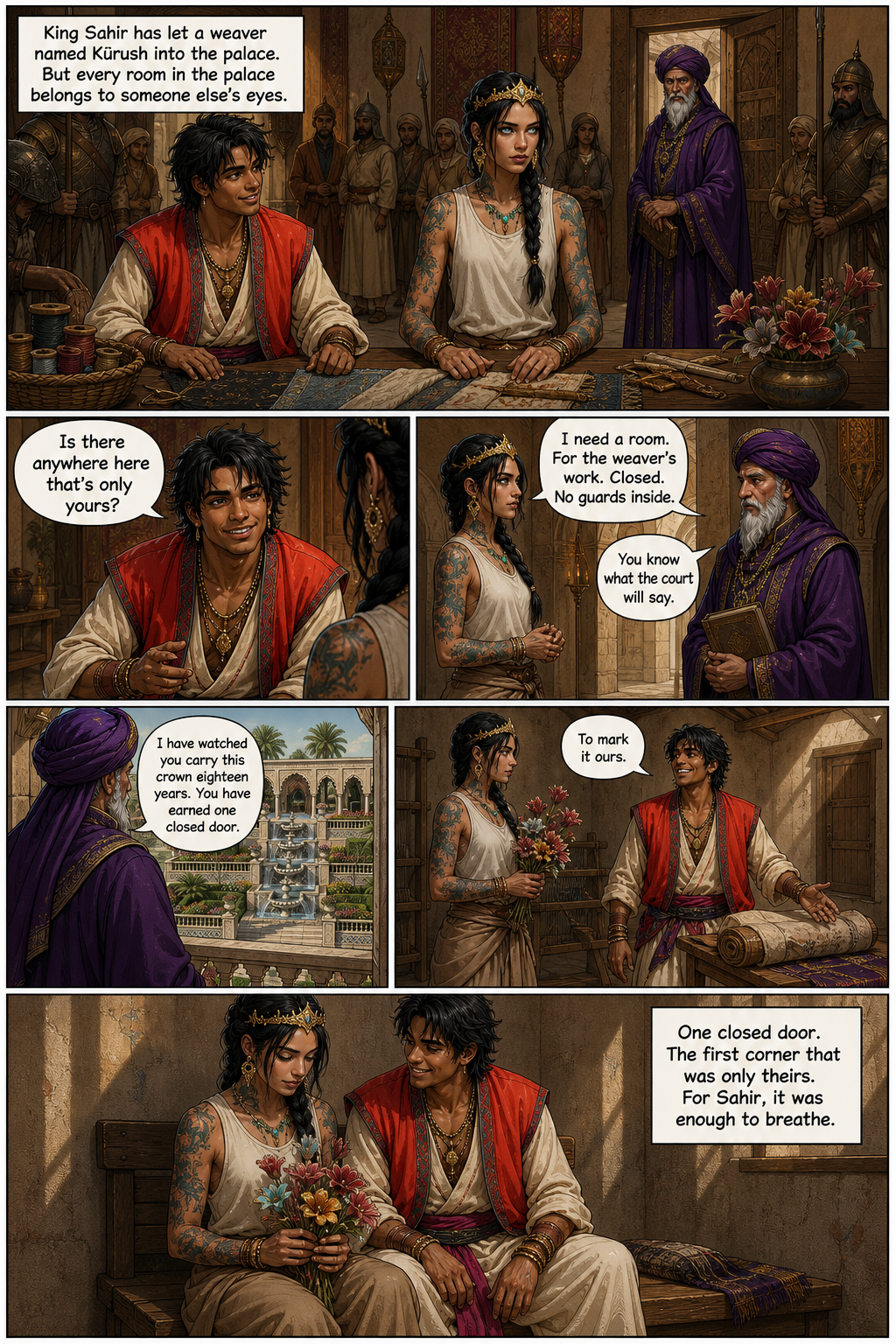
The flare passed by the next week, but a new problem stayed. Every time Kūrush came to the palace, guards stood at the doors. Servants crossed the hall. Sadiq watched from the edge of the room. Sahir and Kūrush worked on the tapestries side by side, yet they were never alone. Their words stayed careful. Their hands never touched. Sahir felt the weight of it like a second crown. One morning, Kūrush set down his thread. "Back home," he said, "my grandmother and I wove in the courtyard. No doors. Just sky." He looked at Sahir. "Is there anywhere here that's only yours?" Sahir thought of the garden. Even there, a gardener trimmed the hedges. A guard paced the stones. "No," they said. "Not one corner." That afternoon, Sahir went to find Sadiq. The vizier stood in the hall, counting bolts of cloth against the commission list. Thirty years of service showed in how fast his eyes moved down the page. "I need a room," Sahir said. "For the weaver's work. Closed. No guards inside." Sadiq set down the list. "A king alone with a commoner. Behind a shut door." His voice stayed flat. "You know what the court will say." "I know what they say already." Sahir held his gaze. "I am asking anyway." Sadiq studied them a long moment. Sahir braced for the refusal. Instead the vizier walked to the window and looked down at the garden. "There is the old loom room," Sadiq said. "Above the east wall. It held the last king's weavers. It has been empty twenty years." He turned back. "Dusty. One door. No windows the yard can see." Sahir blinked. "You would allow it." "The commission needs a workroom. That is the reason written in the ledger." Sadiq's mouth was a straight line. "What happens behind the door is not weaving. We both know this." He paused. "I have watched you carry this crown eighteen years. You have earned one closed door." Sahir's throat tightened. "Thank you." "Do not thank me." Sadiq picked up the list again. "Keep it quiet. If the court hears, I cannot stop what follows." Sahir climbed to the loom room that evening and brought Kūrush up the next day. Dust covered the old frames. A bench sat under the slanted roof. Sahir shut the door, and the hall sounds fell away. No guard. No servant. No watching eyes. Kūrush grinned and dropped his roll of cloth on the bench. From his bag he pulled a cluster of desert flowers, bright petals already wilting at the edges. "For the room," he said. "To mark it ours." Sahir took them and sat. For the first time, Kūrush sat close, knee against theirs, and no one could see. The quiet felt like a held breath finally let go.
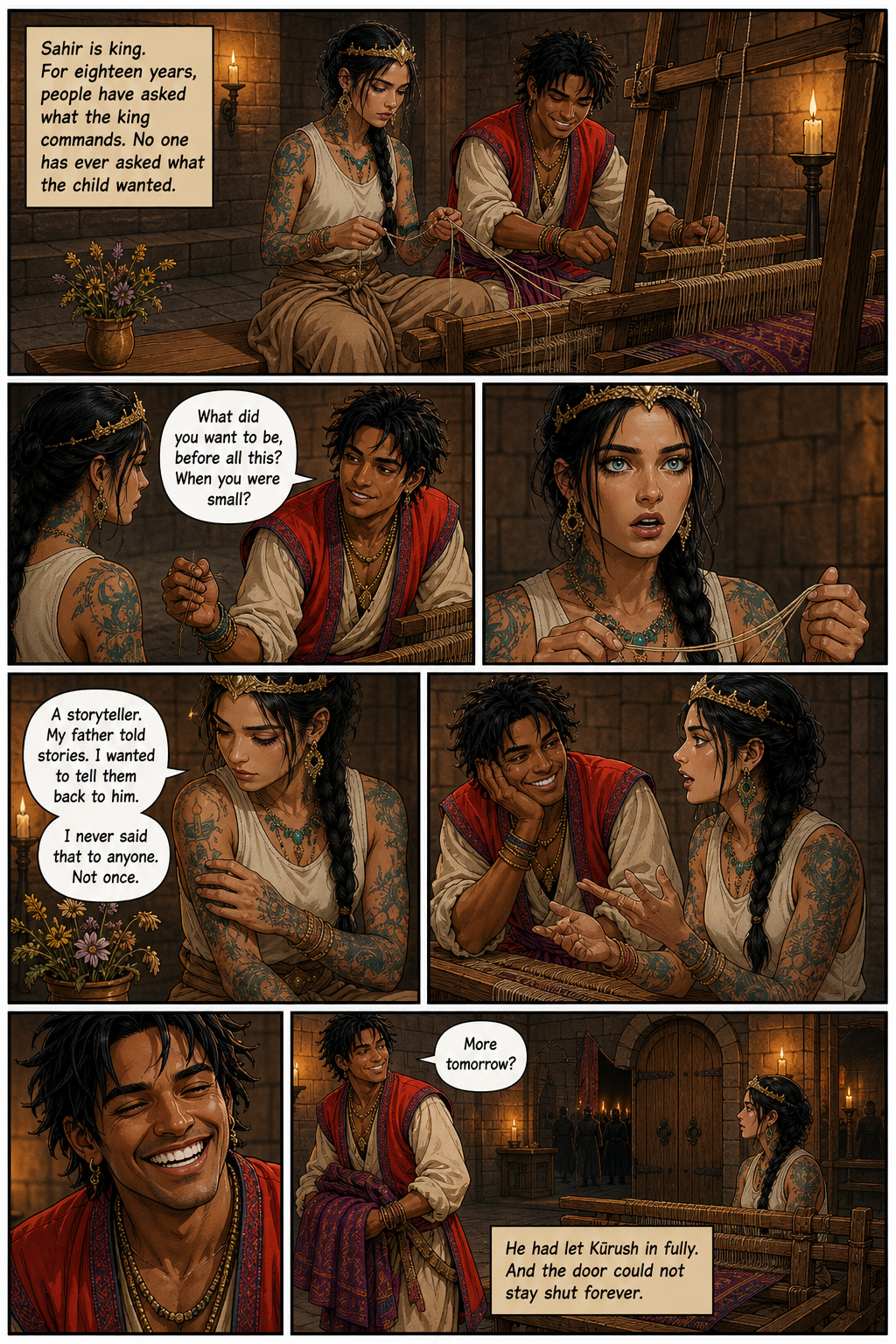
The flowers Kūrush brought the day before now sat in a cup of water on the bench. Sahir had carried it up that morning. In the loom room, behind the one shut door, the castle's noise could not reach them. Kūrush worked the frame while Sahir held the threads. For once, no guard watched. No servant crossed. The quiet felt safe. Kūrush was the weaver who had seen Sahir's face before he knew they were king, and stayed after he learned. He talked while he worked, the way he always did. He told a story about his grandmother losing a shoe in the river. Sahir laughed, soft and real, a sound they rarely let out. Then Kūrush paused, thread between his fingers. "What did you want to be," he asked, "before all this? When you were small?" Sahir froze. The question was simple. Harmless. But no one had ever asked it. For eighteen years, people asked what the king decreed, what the king allowed. Never what the child Sahir had wanted. Their mouth opened and nothing came. Their hands went still on the threads. Kūrush noticed. He did not push. He set down his work and waited, patient, the way he waited for a knot to loosen. "You don't have to answer," he said gently. "I just wanted to know you. The small you." Sahir looked at the wilting flowers. They thought of their father, who told stories late into the night, and how the sound of his voice made the dark feel kind. The truth sat in their chest like a locked door. Kūrush had opened every other door. Sahir decided to open this one too. "A storyteller," they said. The word came out small. "My father told stories. I wanted to tell them back to him." They touched the candle tattoo on their arm. "I never said that to anyone. Not once." Kūrush smiled, bright and warm. "Then tell me one now," he said. "Any one. I'll listen." So Sahir did. They told the story of a child who chased a lost shoe down a river, laughing, inventing as they went. Their voice shook at first, then steadied. Kūrush leaned close, chin in his hand, grinning at every turn. He laughed where the story was funny. He gasped where it needed gasping. He saw them. When Sahir finished, the room felt changed. They had shown Kūrush the person under the crown, and the person had not disappointed him. The old fear, the one that said no one wanted the quiet true self, lay quiet now. "More tomorrow?" Kūrush asked. "More tomorrow," Sahir said. For the first time, they wanted the next day to come. Yet as Kūrush gathered his cloth to leave, Sahir realized the problem. They had let him in fully here, behind the door. But the door could not stay shut forever. Beyond it waited a court that would never allow what this room had become.
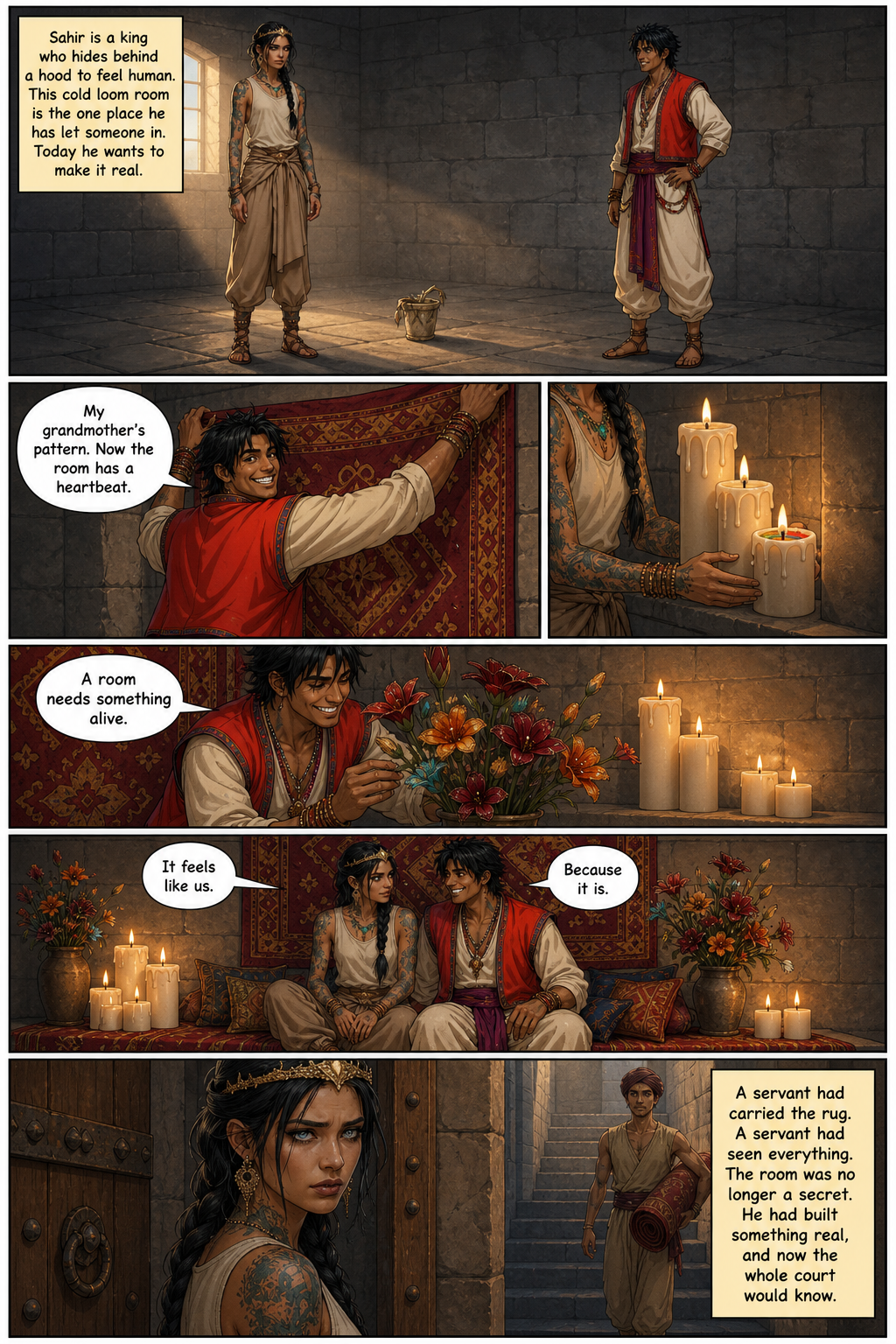
The next morning Sahir climbed to the loom room before court. The story they had told Kūrush still warmed them. But in daylight the room looked bare. Stone walls, a dusty floor, one loom, one bench. The cup of wilting flowers sat alone. Sahir had opened their heart here. The room gave nothing back. When Kūrush arrived, he set down a cloth bundle and looked around too. "It's cold up here," he said. He rubbed his arms. "A room where we tell stories should feel like somewhere. Not a cell." Sahir nodded. "Then let's make it ours," they said. The words came easy. For once they wanted to build something, not just rule it. They worked through the morning. Sahir had servants carry up a low bench and a thick rug, telling them nothing of why. Kūrush unrolled one of his own tapestries and hung it on the bare wall. Red and gold filled the gray stone. "My grandmother's pattern," he said, pleased. "Now the room has a heartbeat." Sahir brought candles. They set a cluster of three on the sill, cream-colored, burning at different heights. Four more went on the bench, their flames layered soft and warm. A pair stood by the loom. The small fires chased the chill from the corners. The stone glowed instead of looming. Kūrush laughed and held up fresh desert blooms, dark red and bright orange, dusted with gold. "These first," he said. He pulled the old wilting flowers from the cup and dropped in the new ones. "A room needs something alive." He placed them where the candlelight caught the petals. Sahir stepped back and looked. The cold room was gone. Warm light moved on the walls. The tapestry breathed color. The flowers leaned toward the flame. It was not a throne room or a shrine. It was a place a person would want to be. "It feels like somewhere now," Sahir said. Their voice caught. No one had ever helped them make a place just for comfort, just for them. "It feels like us." Kūrush came to stand beside them. "Because it is," he said simply. They sat together on the new bench, candles burning, and the hours slid past. Sahir told another story. Kūrush answered with one of his own. The room held them both. Then a bell rang below. Court. Sahir rose. At the door they looked back at the glowing room, the flowers, the hung tapestry plain for any eye to read as Kūrush's work. The thought struck cold. They had built something real up here. But a servant had carried that rug. A servant had seen the candles, the second cup, the care. The room was no longer a secret workspace. It was clearly two people's home. And servants talked. Soon the whole court would know what this room had become.
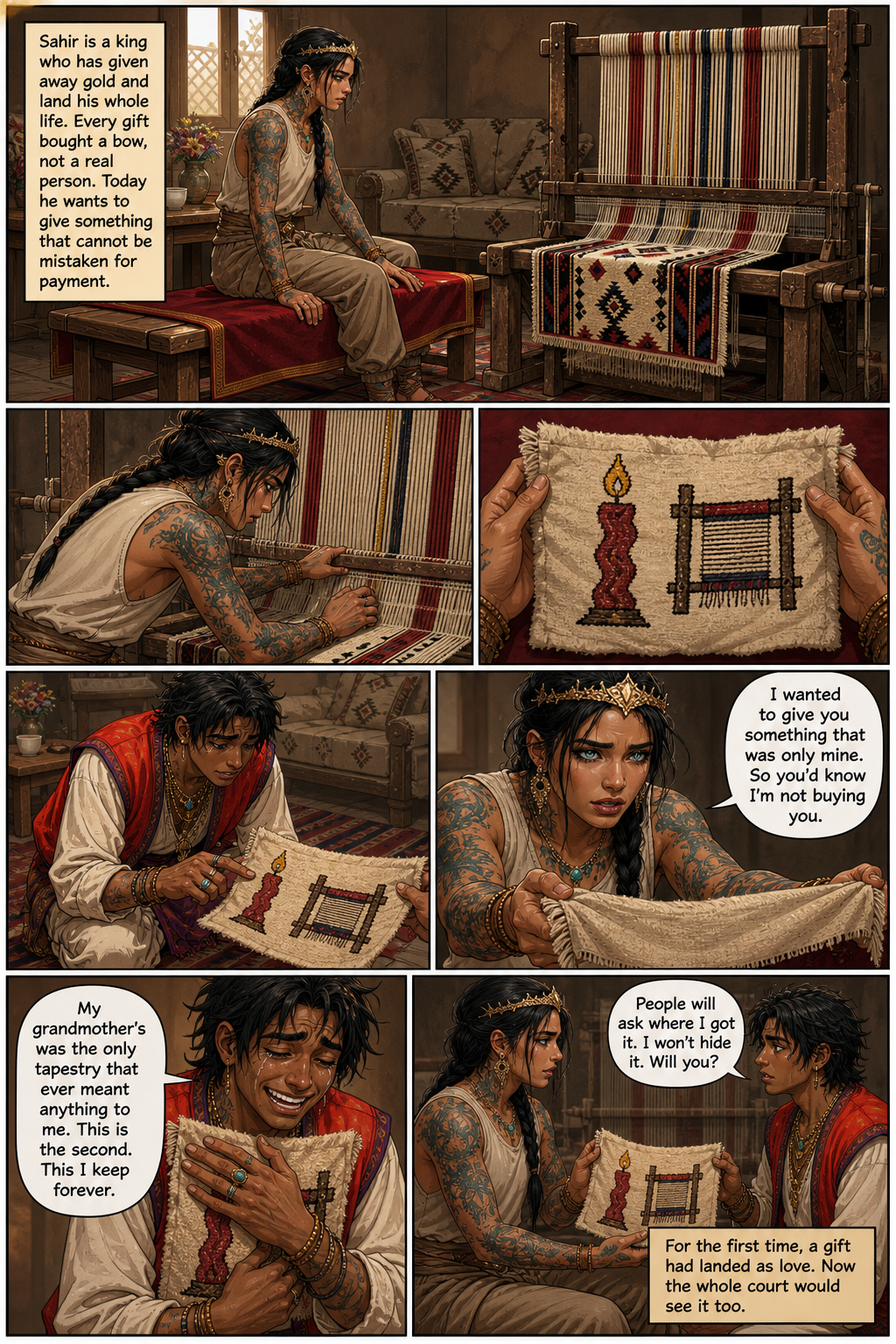
The next morning Sahir could not settle. Court had passed without a single whisper of the loom room, but that quiet would not last. Sahir sat on the warm bench, the red blanket soft under their hands, and knew a truth they had hidden from themselves. They wanted to give Kūrush something. Not a commission. Not a royal gift. Those always felt like payment. Sahir had given away gold and land their whole life and watched people bow for it. They wanted to give Kūrush proof that this was real. But everything they owned belonged to the crown. A ring, a chest of coin, a fine cloak. Kūrush would take any of it and feel like a man being paid to stay. The thought made Sahir's chest ache. What did a king have that was only theirs? Then their eye fell on the loom in the corner. Taut threads, worn beams, the half-finished cloth stretched across it. Kūrush's hands had taught Sahir the simple passes over three afternoons. Sahir rose, crossed to the loom, and sat. They worked all morning. Their knees stiffened and their back burned, but they did not stop. The pattern was clumsy. The lines wandered. Sahir wove a candle, small and crooked, the first image they had ever carved into their own skin at fifteen. A quiet thing that still mattered. Beside it they wove a loom, to say: you taught me this. Kūrush arrived at midday and froze in the doorway. His eyes went to the cloth in Sahir's lap. "You made that," he said. Not a question. He crossed the room and knelt, barefoot on the rug, studying the wobbling threads. He touched the crooked candle with one ringed finger. "It's bad," Sahir said. Their voice shook. "The tension is wrong. I know. But I made it. With my own hands. Not gold from the treasury. Not something a servant fetched." They held it out. "I wanted to give you something that was only mine. So you'd know I'm not buying you." Kūrush took the cloth carefully, as if it might tear. For once he had no story ready. His throat moved. He looked up, and his eyes were wet. "The king of the whole desert," he said softly, "sat down and fought a loom for me." He laughed, but it broke. "I've been given one tapestry in my life that meant anything. My grandmother's. This is the second." He pressed the cloth to his chest. "This I keep forever." Sahir felt something loosen that had been clenched for eighteen years. For the first time they had given a gift and watched it land as love, not duty. Then Kūrush spoke again, quieter. "People will ask where I got it. A weaver with the king's own work." He met Sahir's eyes. "I won't hide it. Will you?" The question sat between them. Sahir had made proof of love. Now the whole court would see it too.
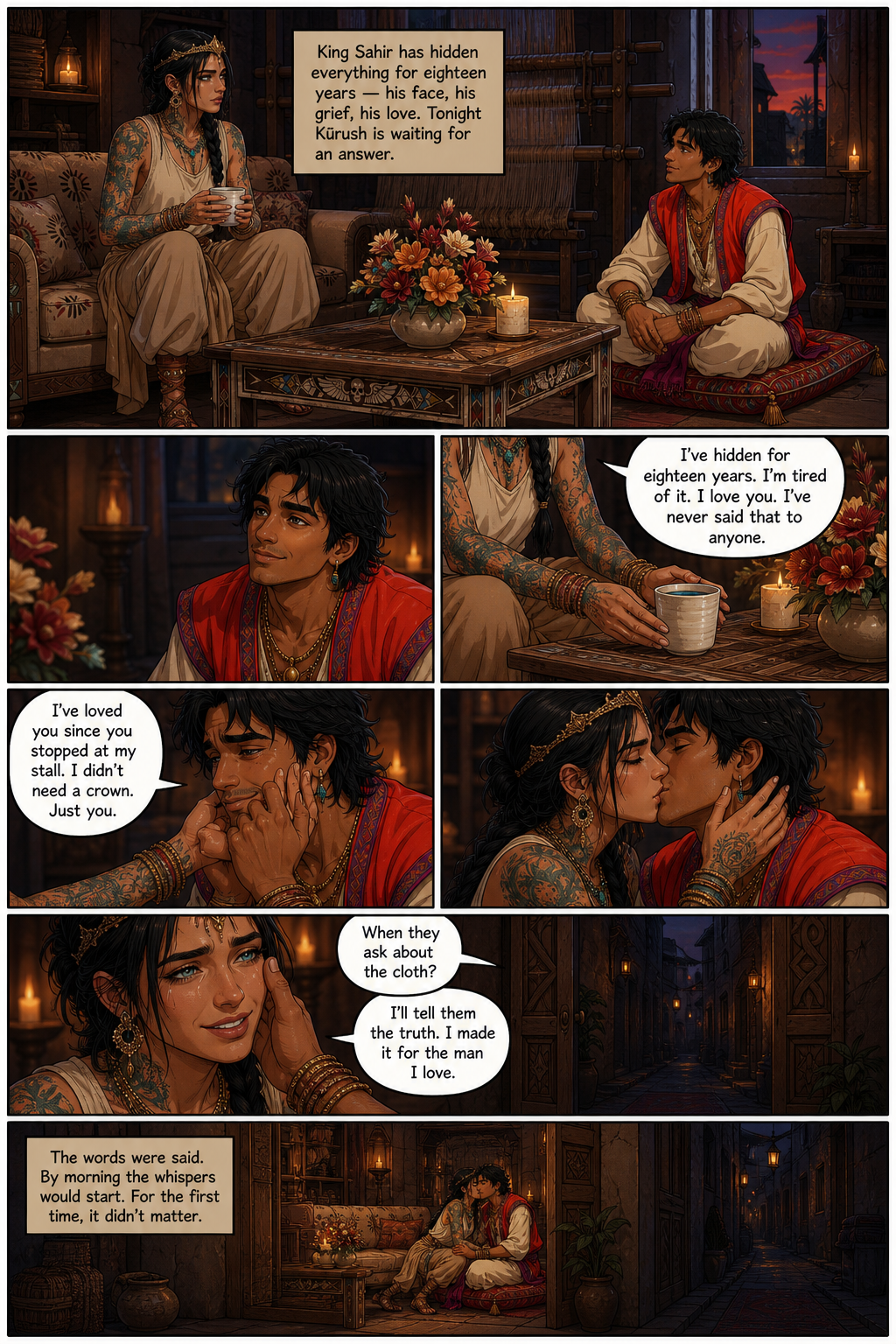
Kūrush's question still hung in the loom room. "Will you?" Sahir had not answered. For three days they turned it over. They had given proof of love with their own hands. Now the court would see it, and Sahir had to choose what to say. They met again in the loom room at dusk. Kūrush had already lit the candles and set fresh desert flowers on the low wooden table. Red and orange petals, bright against the dark oak. He poured water into a plain ceramic cup and held it out. "Drink," he said. "You've been pacing. I can tell. Your knees won't thank you." He grinned, but his eyes watched Sahir closely. Sahir took the cup and sat on the couch. The cushions sank under them, soft and worn. Kūrush dropped onto the red floor cushion beside their feet, legs crossed, waiting. He did not fill the silence with a story this time. "You asked if I would hide us," Sahir said. Their hands tightened on the cup. "I've hidden for eighteen years. I hid my face. My pain. My father's stories. I hid everything that was mine." They set the cup on the table. "I'm tired of it." Kūrush went very still. "But I'm scared," Sahir went on. "If I say it out loud, I can't take it back. The court will never let it go." They looked down at him. "I love you. I've loved you for a long time. I've never said it to anyone." The words left a hollow, ringing space. Sahir braced for Kūrush to laugh it off, to make it small. He did not. "Say it again," Kūrush whispered. "I love you." Kūrush rose onto his knees. He took Sahir's hand, the way he had so many times before, fingers brushing, careful. This time he did not pull back. He pressed Sahir's palm to his cheek. "I've loved you since you kept walking past my stall," he said. His voice shook. "A stranger who looked at my grandmother's work like it mattered. I didn't need a crown or a name. Just you." Sahir leaned down. Kūrush met them halfway. The kiss was slow and certain, nothing like the glancing touches of before. Sahir felt the candle-warmth on their skin and did not flinch from it. For once they were not disappearing. They were here, held, seen. When they drew apart, Sahir was crying and laughing at once. Kūrush wiped their cheek with his thumb. "So," he said softly. "When they ask about the cloth?" "I'll tell them the truth," Sahir said. "I made it for the man I love." The choice was made. There was no taking it back now. Somewhere beyond the door, the court waited, and the whispers would start by morning. But in this room, for the first time, Sahir had said the words and meant them, and been loved back.
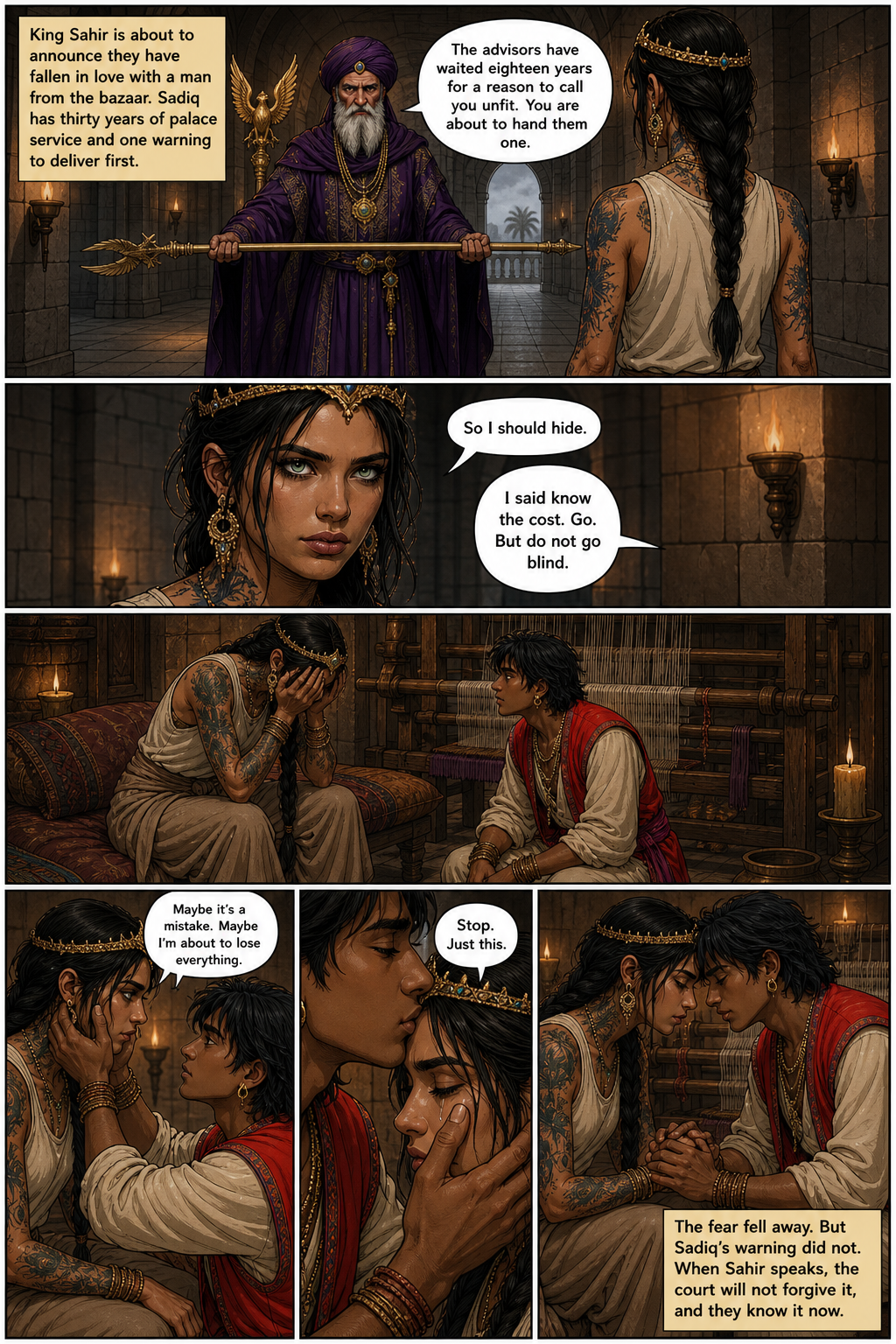
The morning after, Sahir meant to tell the court. They never got the chance. Sadiq found them first, in the corridor outside the loom room. The vizier blocked the way with their staff, purple robes still and heavy in the gray dawn light. Sadiq had served the palace thirty years. They had pulled Sahir off the floor during pain flares, burned a royal summons to protect them, and caught every lie Sahir ever told. Sahir trusted them more than anyone alive. That was why the look on Sadiq's face cut so deep. "You intend to announce it," Sadiq said. Not a question. "I do." "Then listen before you do." Sadiq lowered the staff. "The older advisors will not accept it. A king who weaves. A king in love with a man from the bazaar. They have waited eighteen years for a reason to call you unfit. You are about to hand them one." Sahir's hands went cold. "They already think me unfit." "They whisper it. This gives them leave to say it aloud." Sadiq's voice stayed flat, but their eyes did not. "Some will walk out. Some will try to turn the court against you. I cannot stop that. I can only warn you it is coming." "So I should hide." "I did not say that." Sadiq held their gaze a moment longer. "I said know the cost. You never do, until it is on top of you." They stepped aside. "Go. Or do not. But do not go blind." Sahir walked past them into the loom room and shut the door. Their knees shook. The candles Kūrush had lit still burned on the low table. Sahir sat on the couch and pressed their palms to their eyes. Kūrush looked up from the loom. He crossed the room and knelt at Sahir's feet, searching their face. "What happened." "Sadiq." Sahir's throat tightened. "They said the advisors will revolt. That I'm giving them the reason they always wanted. That I'll be called unfit, in open court, and some of them will leave." They let their hands drop. "Maybe it's a mistake, Kūrush. Maybe I'm about to lose everything." Kūrush did not argue. He rose onto his knees and took Sahir's face in both hands. Then he kissed them. Soft, on the mouth, once. Then again. He kissed their cheek, their brow, the corner of their eye where a tear had slipped free. "Stop thinking," he murmured between each one. He kissed them again. "Stop. Just this." And again, until the advisors and the court and Sadiq's warning blurred and went quiet, and there was only Kūrush's mouth and his hands and the warmth of the candles. Sahir stopped bracing. They kissed him back and let the fear fall away for a while. But when they finally rested their forehead against his, the truth sat plain between them. Sadiq's warning was real. The announcement would still come. And when it did, the court would not forgive it.
Play your story to life
Storycraft is a mobile game where you create AI characters, craft items and locations to build their world, then discover what direction your story takes. Download the iOS game for free today!
Download for free