

Krayzor's Arc
16 Chapters
Krayzor's dream is uniting the scattered tribes of the wildlands under a single banner he raises himself..

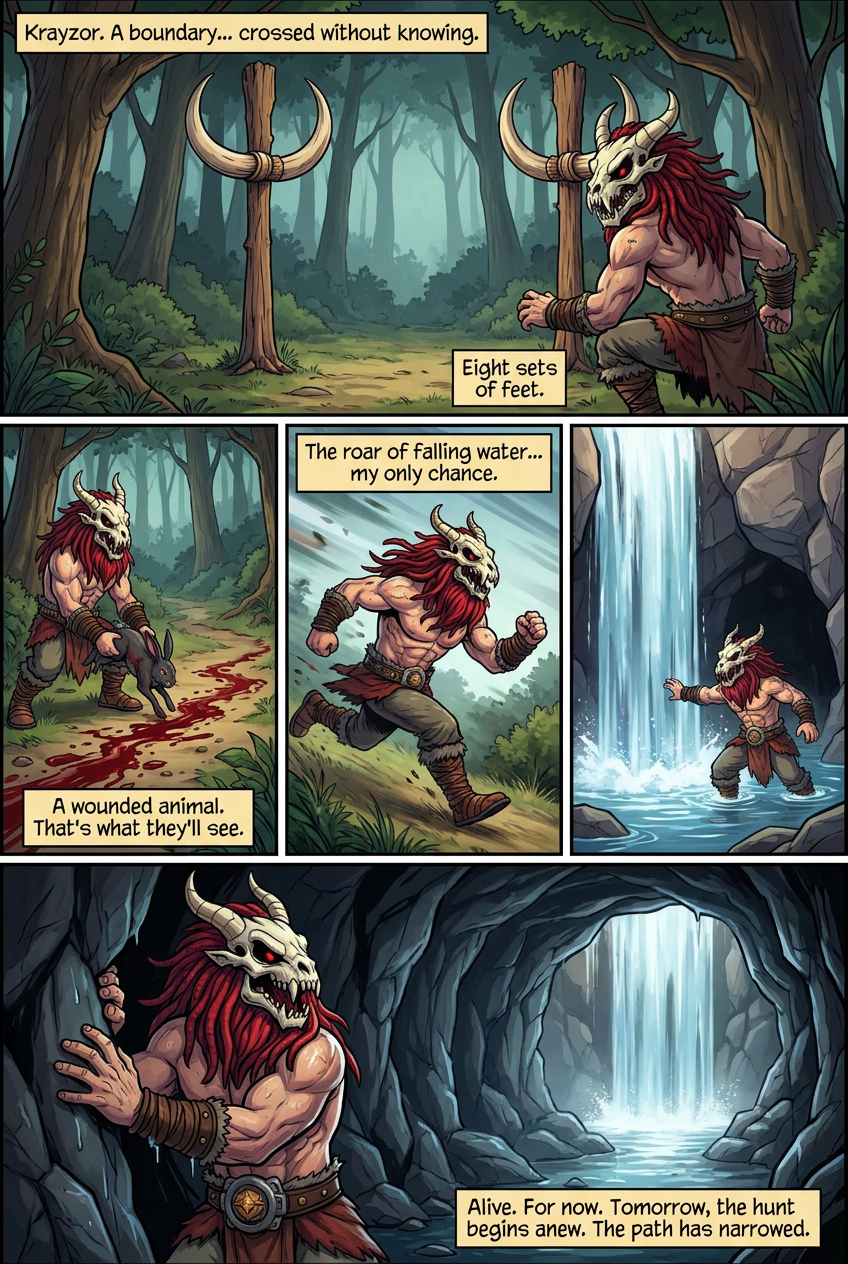
Krayzor crouched low at the edge of the clearing, dragon skull heavy on his shoulders, red dreadlocks pulled tight against his neck. Two wooden poles rose before him, each crowned with a curved boar tusk. A boundary. He had crossed it without knowing. Behind him, eight sets of feet moved through the brush. He breathed once, set the grief down like he did each morning, and reminded himself why he still walked: scattered tribes, one banner, no more dead villages like his own. He needed to vanish. A clean fight here meant a war later, and war meant tribes he could not unite. So he ran low and quiet, angling east toward the river sound he had marked at dawn. At a split in the trail, Krayzor pulled the gutted hare from his pack. He had killed it that morning. He smeared its blood thick across the southern fork, dragged the carcass twenty paces, then flung it deep into the brambles. A hunter would read the splatter as a wounded animal fleeing. It would buy him minutes. The shouts behind him split — half the war party took the false trail. Half kept coming. Krayzor pushed harder, lungs burning, until he heard what he wanted: the roar of falling water. He shoved through ferns and dropped down a wet rock face into a pool, then waded behind the curtain of the falls. A cave opened in the stone, cold and dark and dry. He pressed his back to the wall and listened. Voices passed above. Then faded. Then gone. Krayzor slid down the stone and let his hands shake. He was alive, and the hostile tribe still did not know his name — but they knew now that something had walked their land, and tomorrow they would be looking. The map of safe paths to the next tribe had just gotten smaller.
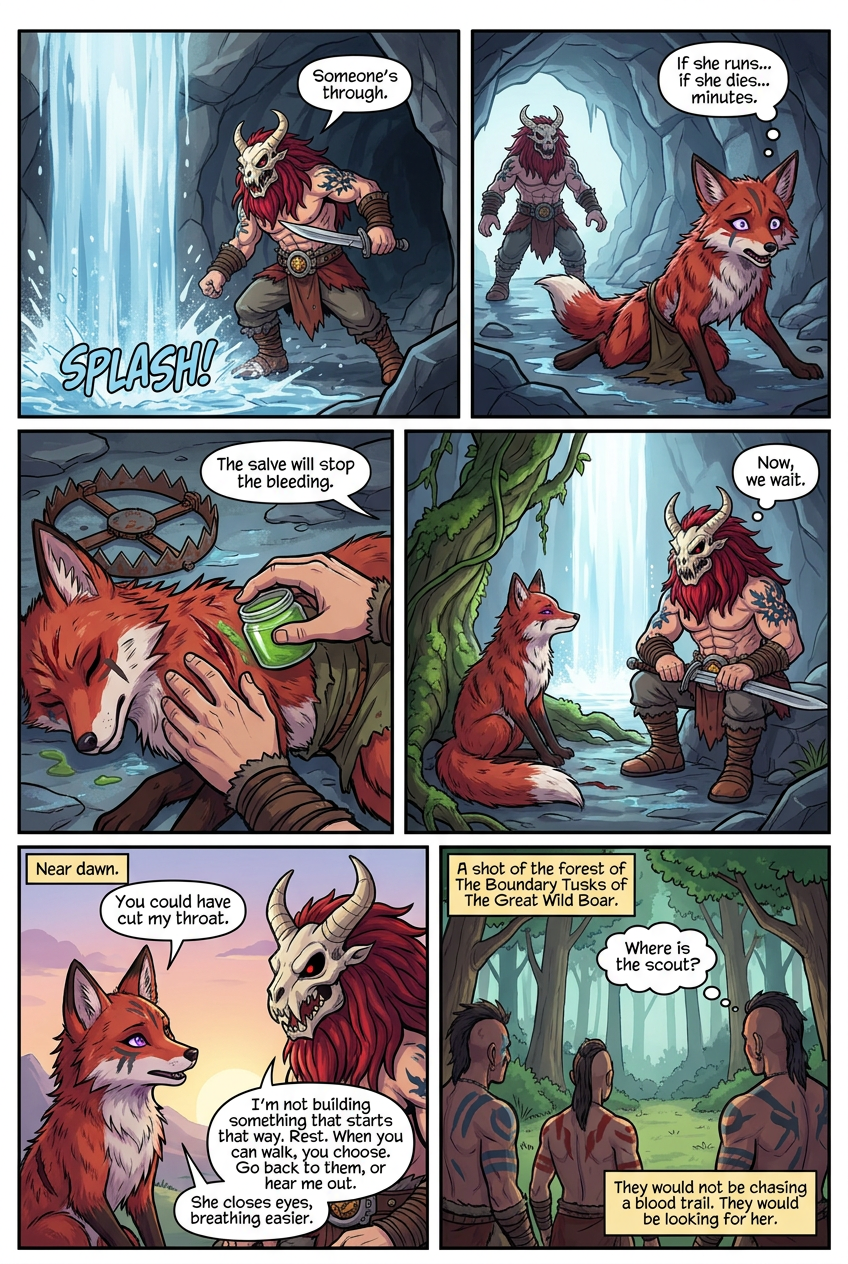
Krayzor's hands had just stopped shaking when he heard the splash. Someone had come through the curtain of water. He drew his blade and crouched low against the wet stone. A small shape staggered into the cave and fell — a kitsune scout, fox ears flat, one tail matted red. She wore the paint of the war party that had hunted him. Her eyes found his, wide and afraid, and then rolled back as she dropped. Krayzor froze. If she ran, she would lead them here. If she died, they would track her last steps to his door. He had minutes, maybe less. He sheathed the blade. He dragged her to the back wall and laid her beside a rusted iron trap left by some long-dead hunter, its jaws sprung open in the dirt. It made a grim marker, but it kept her off the cold stone. He cut her tunic away from a deep gash along her ribs. From his pack he pulled a small jar sealed with cloth — green moss salve, the last of what he had. He pressed it into the wound and bound it tight. Then he sat across from her, beneath a thick curtain of vines crawling down the inner wall. From there he could see her face and the bright slit of the waterfall both. He set his blade across his knees. He did not sleep. Near dawn she stirred. Her violet eyes opened and locked on his. She tried to speak, coughed, tried again. "You could have cut my throat," she whispered. Krayzor met her gaze. "I'm not building something that starts that way," he said. "Rest. When you can walk, you choose. Go back to them, or hear me out." She watched him a long moment, then closed her eyes and breathed easier. She lived. The cave held. But somewhere in the trees, her war party was already counting heads and finding one missing — and the next time they came through the ferns, they would not be chasing a blood trail. They would be looking for her.
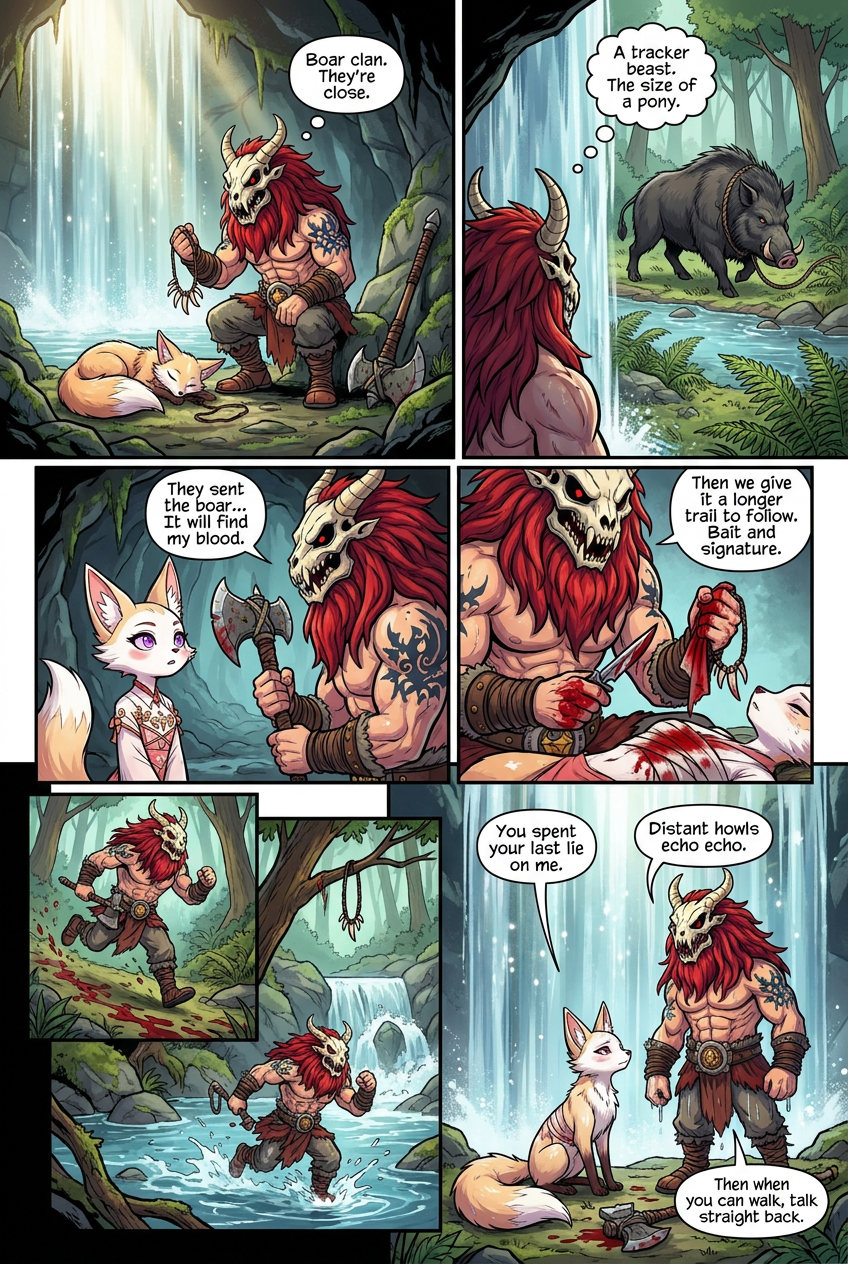
Morning light cut through the waterfall in pale ribbons. The kitsune slept, breathing slow. Krayzor crouched beside her and lifted the necklace at her throat — polished boar tusks strung on braided cord. He knew the mark. Boar clan. They would not stop looking. He set the necklace down and reached for the heavy maul he kept wedged behind the vines, its bovine spine head dark with old use. One exit. One narrow throat of stone. If they came, he would meet them in it. He slipped through the curtain of water and climbed the rocks above. The forest was wrong. Ferns flattened in wide sweeps. A black hunting boar the size of a pony snuffled along the bank, a rope at its neck leading back into the trees. A tracker beast. Closing. Krayzor dropped back into the cave. The scout's violet eyes were open. She had seen the maul in his hand. She did not flinch. "They sent the boar," she whispered. "It will find my blood." He knelt. He could leave her and run. He could end her quiet and run faster. He did neither. Instead he cut the bandage loose, soaked it red against her ribs, and pressed the cloth into his palm. "Then we give it a longer trail to follow," he said. He took her tusk necklace too. Bait and signature, both. He ran the bloody rag a half mile downstream, snagging it on thorns, smearing it across stone, and hung the boar tusk necklace on a low branch above a deep, churning pool. Let them read it as a fall. Let them read it as a death. He doubled back through the water so the beast could not follow his scent home. When he slipped through the falls again, the kitsune was sitting up, pale but steady. Distant howls rose, then turned away downstream. The cave held. She watched him set the maul down. "You spent your last lie on me," she said. Krayzor met her eyes. "Then when you can walk, talk straight back." She nodded once. The hunt had passed — but now she owed him a choice, and he had nothing left to trade if she chose wrong.
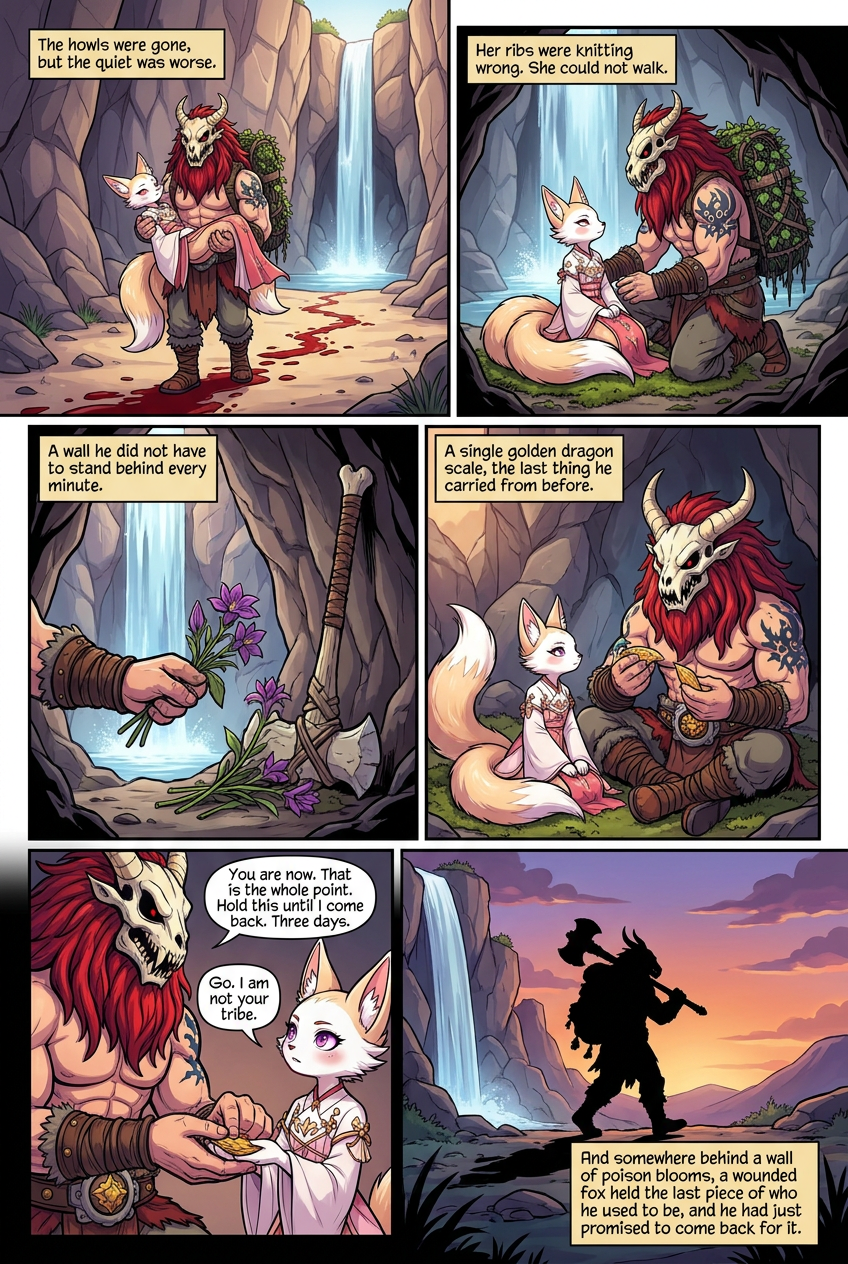
The howls were gone, but the quiet was worse. Krayzor knelt by the kitsune and watched her breathing hitch. Her ribs were knitting wrong. She could not walk. He had scouts to meet two ridges over, leaders waiting on word, and a banner that would not raise itself. If he left, she died in the dark. If he stayed, the alliance bled days he could not spare. He laid her on a bed of moss pulled from his pack, the ivy soft under her cheek, her many tails curled around her like a faded sunset. She watched him with calm violet eyes. She did not beg. That was somehow worse. Near the cave's narrow mouth he wedged the maul upright and ringed the stone with cut stalks of purple death bloom, petals open like small mouths. Any beast that nosed past would breathe wrong and turn back. It was a wall he did not have to stand behind every minute. He sat between her and the falling water and rolled something between his fingers — a single golden dragon scale, the last thing he carried from before. Stay, and the tribes drifted apart another week. Go, and one more life he could have saved would stop. He had built his whole work on not making that second choice again. "Go," she rasped. "I am not your tribe." Krayzor closed his fist on the scale. "You are now," he said. "That is the whole point." He pressed the scale into her palm and folded her fingers shut. "Hold this until I come back. Three days. The flowers guard the door. The moss keeps you warm. Drink when you wake." He stepped through the curtain of water at dusk, maul on his shoulder, pack lighter without the scale. The scouts would get their word. The leaders would get their meeting. And somewhere behind a wall of poison blooms, a wounded fox held the last piece of who he used to be, and he had just promised to come back for it.
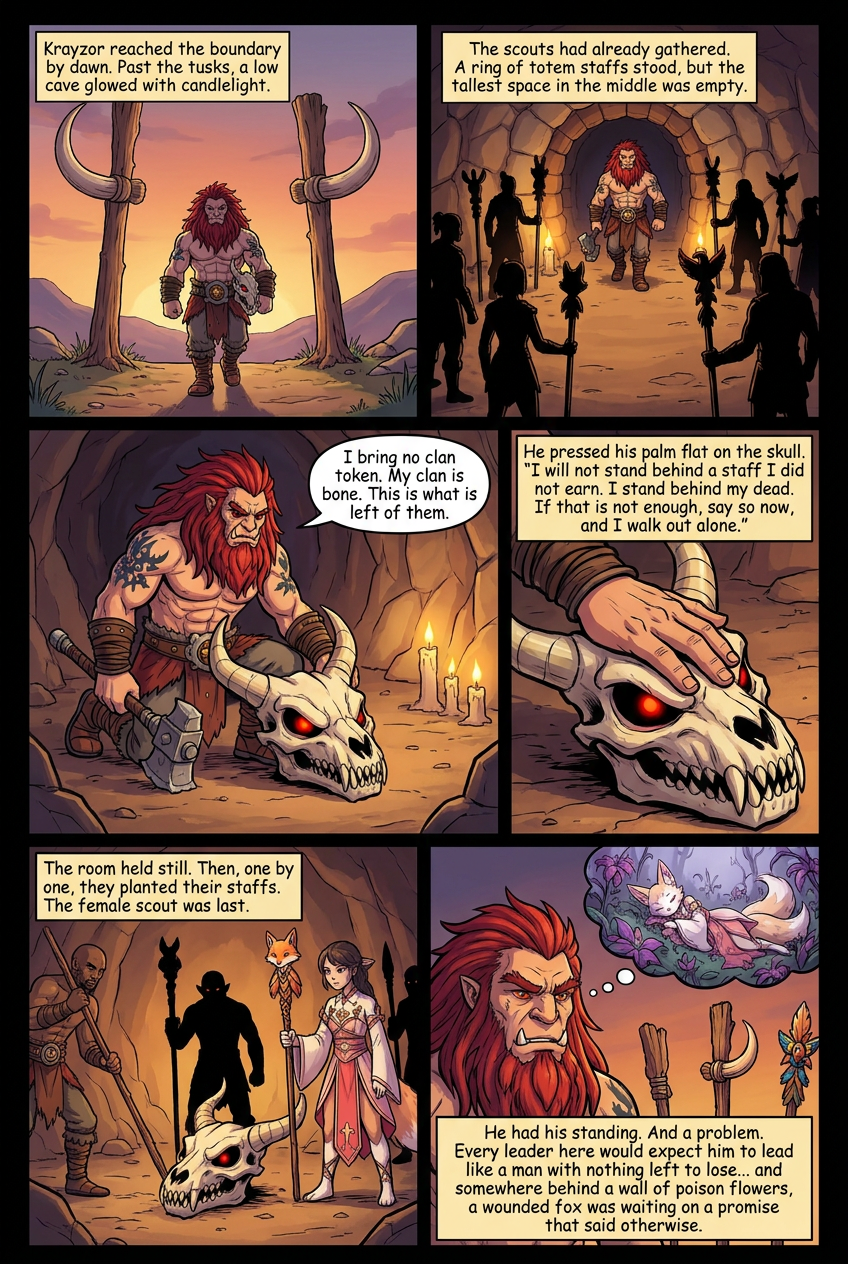
Krayzor walked through the night and reached the meeting place by dawn. Two great tusks rose from the earth on wooden poles, marking the old boundary the scouts used as neutral ground. Past them, a low cave glowed with candlelight, weapons hung along its walls like teeth. He stopped between the tusks and felt the weight of what he did not carry. No staff. No seal. No proof. Inside, the scouts had already gathered. A ring of painted totem staffs stood planted in the dirt at the back of the chamber, one for each clan that had answered. The tallest space in the middle was empty. That post belonged to whoever spoke for the whole. He had no right to stand there, and every scout in the room knew it. A woman near the fire watched him from under her hood. He felt her eyes find the truth before he opened his mouth. He set his maul down. Then he lifted the dragon skull from his shoulders and placed it on the dirt in the empty center, red eye-hollows facing the room. "I bring no clan token," he said. "My clan is bone. This is what is left of them." He pressed his palm flat on the skull. "I will not stand behind a staff I did not earn. I stand behind my dead. If that is not enough, say so now, and I walk out between those tusks alone." The room held still. One scout stepped forward and drove his totem staff into the ground beside the skull. Another followed. Then three more. The female scout was last. She planted her staff so close to the skull that the carved fox at its top almost touched the horns. She did not look away from him. He had his standing. He also had a problem. He had named his dead as his seal, and every leader here would now expect him to lead like a man with nothing left to lose — and somewhere behind a wall of poison flowers, a wounded fox was waiting on a promise that said otherwise.
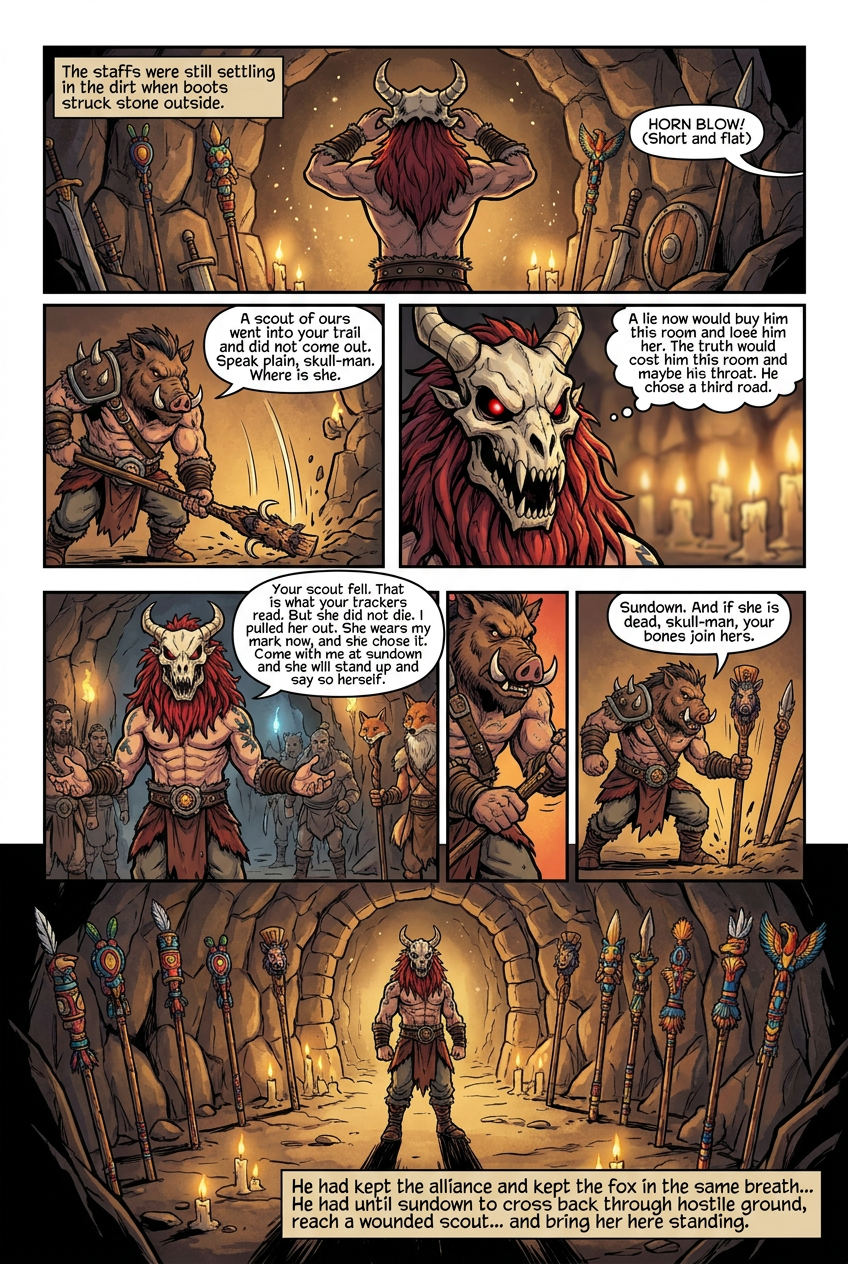
The staffs were still settling in the dirt when boots struck stone outside. A horn blew once, short and flat. Krayzor lifted the dragon skull back onto his shoulders and felt the weight of the horns settle over his eyes. The candles along the cave walls bent in a draft. Someone was coming under boar colors, and his lie about the missing scout had just run out of road. The envoy ducked into the chamber and planted a carved boar staff hard into the dirt, tusks pointed at Krayzor's chest. "A scout of ours went into your trail and did not come out," he said. "Speak plain, skull-man. Where is she." Krayzor did not move from behind the dragon skull. He thought of the fox waiting behind poison flowers, three days promised, one already spent. A lie now would buy him this room and lose him her. The truth would cost him this room and maybe his throat. He chose a third road. "Your scout fell," he said. "That is what your trackers read in the rocks. That is what they will keep reading." He stepped around the skull so the envoy could see his open hands. "But she did not die. I pulled her out. She wears my mark now, and she chose it. Come with me at sundown and she will stand up and say so herself. If she does not, you take my head between those tusks outside and no clan here will lift a staff against you." The envoy's jaw worked. The other scouts watched him, not Krayzor. The fox-carved staff at the center of the ring did not move, but its owner shifted half a step closer to the dragon skull, and that was a vote spoken without a word. The envoy pulled his boar staff out of the dirt and drove it back in beside the others. "Sundown," he said. "And if she is dead, skull-man, your bones join hers." Krayzor nodded once. The room emptied around him and left him alone with the candles and the ring of painted staffs. He had kept the alliance and kept the fox in the same breath, but he had spent the last of his cushion to do it. He had until sundown to cross back through hostile ground, reach a wounded scout behind a wall of poison flowers, and bring her here standing. The promise he had made privately was now a promise made in front of every clan.
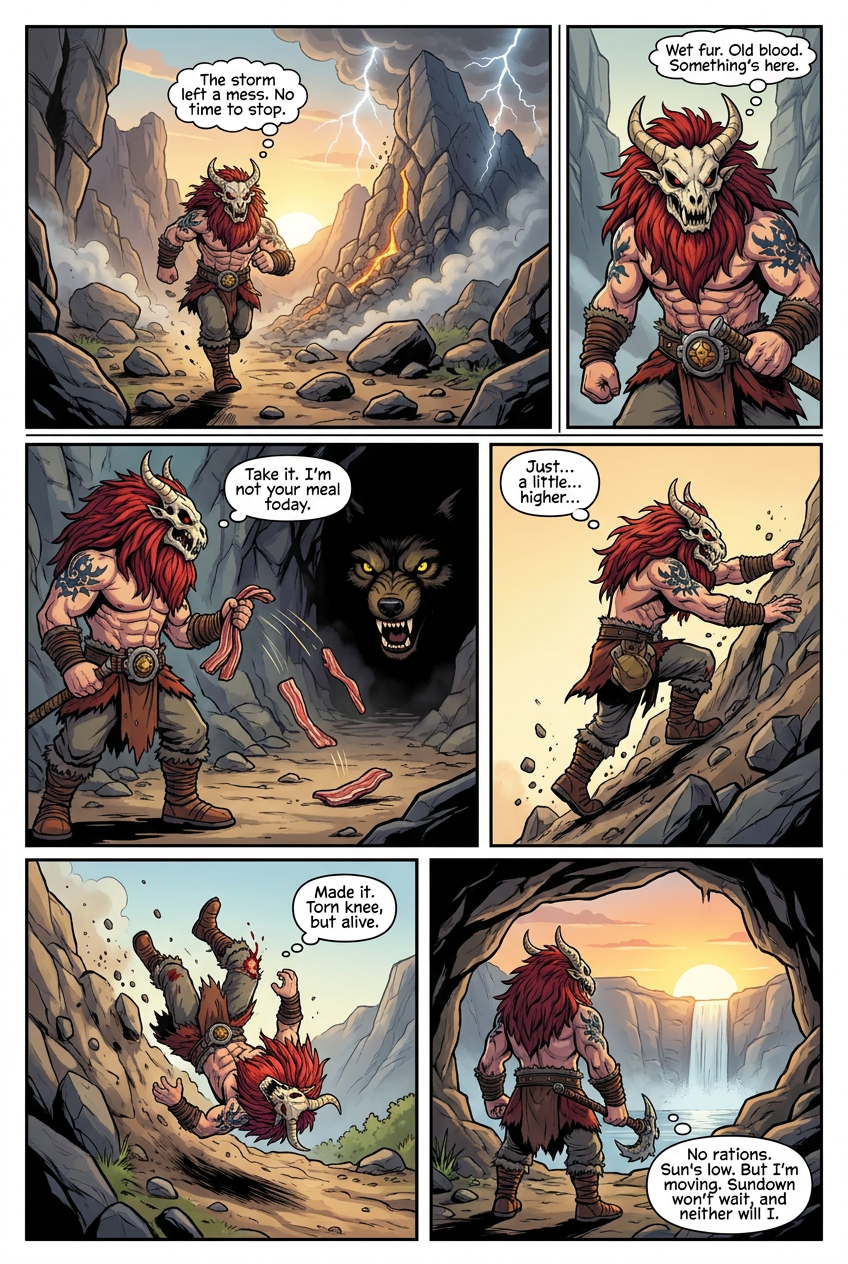
Krayzor left the meeting ground at a hard run and hit the storm's leftovers before the sun was halfway up. The cliff above the gorge had been split by lightning in the night. A long black scar ran down the stone, and burnt rock still smoked at its base. Boulders the size of huts lay scattered across the only fast path back to the cave. He climbed over the first one and kept moving. Halfway through the gorge he smelled it. Wet fur. Old blood. A starving thing breathing hard behind a fresh wall of slid stone. The rockslide had penned a predator into the narrow cut with him, and the beast lifted its head and saw him before he could step back. Yellow eyes. Ribs showing. No way around in time. Krayzor pulled the strips of salted meat from his pack and threw them, one by one, in a line away from the path. The beast lunged at the first strip and tore it down. He dropped a second farther off, then a third, walking the hungry thing away from the cave road one bite at a time. His hand stayed on the haft of the spine maul at his hip. He did not draw it. He was not building something that started with killing a starving animal either. When the last strip was gone the beast lifted its head toward him again. Krayzor was already moving, climbing the loose slope of the fresh slide, hands bleeding on sharp edges. A rock turned under his boot and he went down hard on one knee. He heard the beast coming. He shoved off the stone and rolled over the ridge of the slide and down the other side, out of the gorge, onto the path that led to the waterfall. He stood up shaking and counted what he had left. No rations. A torn knee. The sun already past its peak. But the gorge was behind him and the cave was ahead, and the fox was still waiting behind her wall of poison flowers. He started running again. Sundown would not wait, and neither would he.
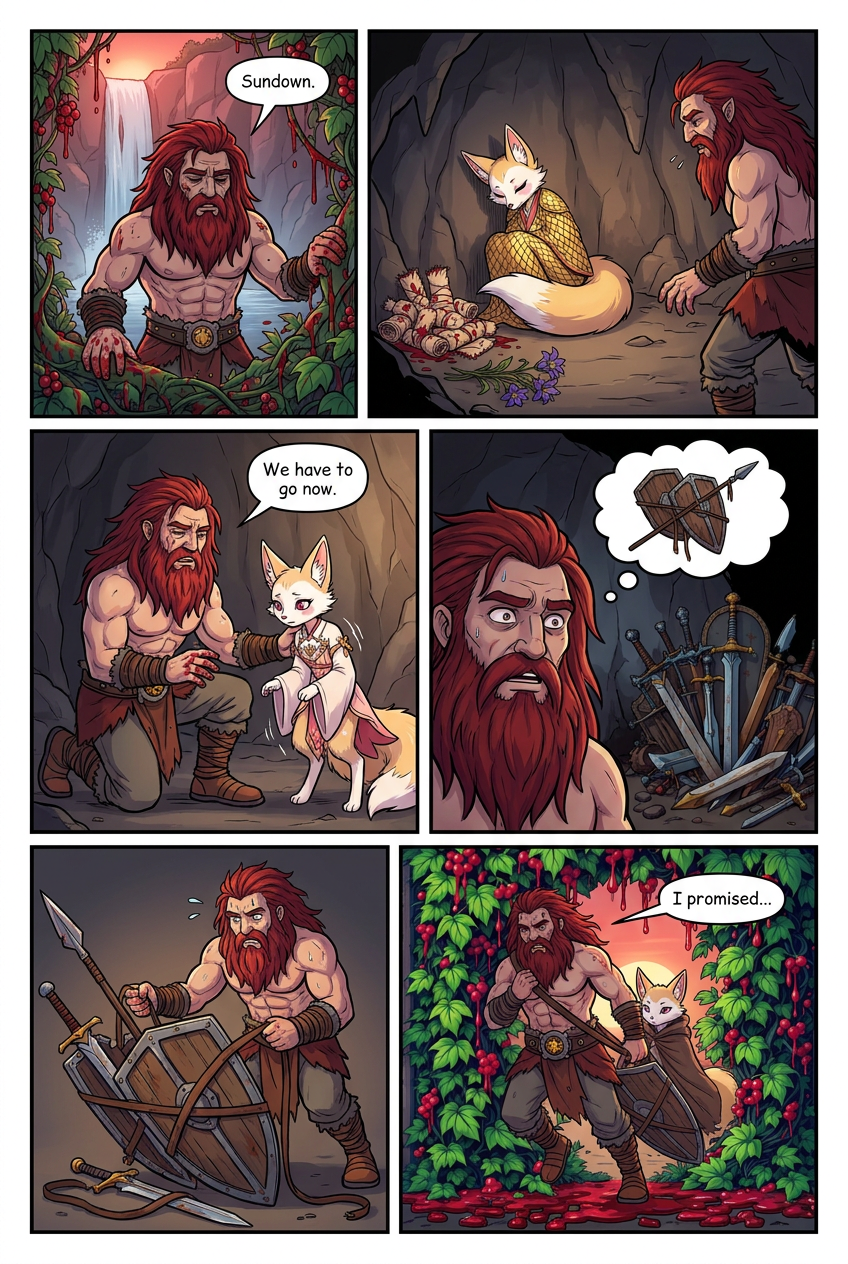
Krayzor hit the waterfall path with blood on his hands and the sun sliding low. The vines at the cave mouth had been splashed with his own red where he'd grabbed them coming through the gorge, every leaf marked by his torn palms. He pushed past them and stopped. She was where he'd left her, curled against the back wall behind the wilting poison flowers, the golden scale still tied at her throat. The kitsune lifted her head. Her tails moved once and went still. A pile of old bandages lay beside her, brown and crusted, peeled off and stacked like a small marker of every hour she had survived alone. She tried to stand. Her legs folded under her before she got halfway up. "Sundown," Krayzor said. "We have to go now." He knelt and his knee screamed. He could not lift her. He could barely lift himself. He looked at her, and she looked back, and neither of them had anything left. His eyes caught the shadowed corner of the cave — the pile of old weapons left behind by whoever had used this place before him. Bent swords. Cracked shields. A long spear with a sound haft. He dragged two shields out and a length of leather strap from a broken scabbard. He lashed the shields together end to end with the spear between them. A flat sled. A drag. He laid his cloak over the metal and lifted her onto it. She weighed almost nothing. He looped the strap across his chest and leaned forward. The shields scraped, caught, then slid. One step. Another. His knee buckled and held. Behind him she gripped the edges with both small hands and did not make a sound. They came out through the bloodied vines together, one dragging, one carried, the sun a finger above the trees. Krayzor set his jaw and started the long pull toward the meeting ground. He had promised to bring her back by sundown. He had not promised how.
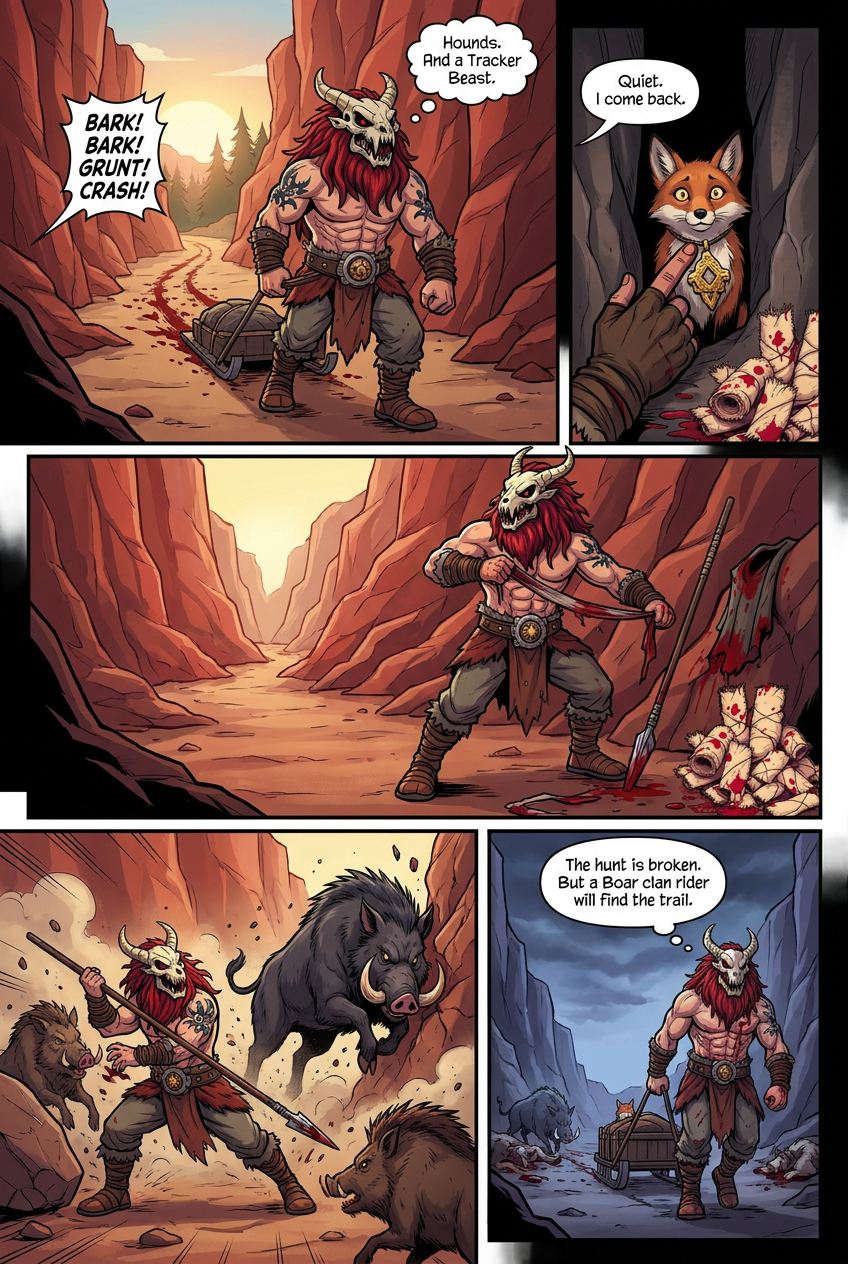
The shields cut a long scar through the dirt behind him. Krayzor leaned into the strap and pulled. The sun touched the trees. Then he heard it — far back, a single bark, then four more, then the deep grunt of something heavier crashing through brush. Hounds. And behind the hounds, the snorting weight of a Boar clan tracker beast. He stopped at the mouth of a narrow canyon. Steep walls rose on both sides, red and rough. The dragged trail behind him was a bright, broken line any pup could follow. Her blood had soaked through the cloak. He could not outrun them pulling her. He could not leave her. He had one move left. Krayzor unhooked the strap and pushed the sled deep into a side cleft in the canyon wall. He stacked loose stone in front of it until only a dark slit remained. The kitsune watched him with wide eyes. He pressed the golden scale at her throat with one finger. "Quiet. I come back." He pulled the spear from the sled rig and tore a strip from his bloody palm-wrap. He smeared it along his own arms, his chest, his thighs. He walked back out into the open canyon floor, dragging the empty cloak behind him. The barking grew louder. He ran, slow and loud, leaving a fresh wet trail straight up the gorge and away from her cleft. The hounds came around the bend in a brown wave. Behind them the tracker beast lowered its head and charged, tusks scraping stone. Krayzor turned at the narrow throat of the canyon and braced the spear against a boulder. The first hound hit the point and died on it. The second he kicked. The third he caught across the skull with the haft. The tracker came last and he stepped aside at the final breath and let it drive itself snout-first into the wall. It dropped, stunned, bleeding from the nose. He stood in the quiet, shaking, and listened. No more barks. No second pack behind. He limped back to the cleft and pulled the stones away. She was still there. He hooked the strap across his raw chest and started dragging again, slower now, the sun gone, the trees black against a bruised sky. The hunt was broken. But somewhere behind him, a Boar clan rider would find dead hounds and a living tracker, and they would know exactly who had done it, and where the trail led next.
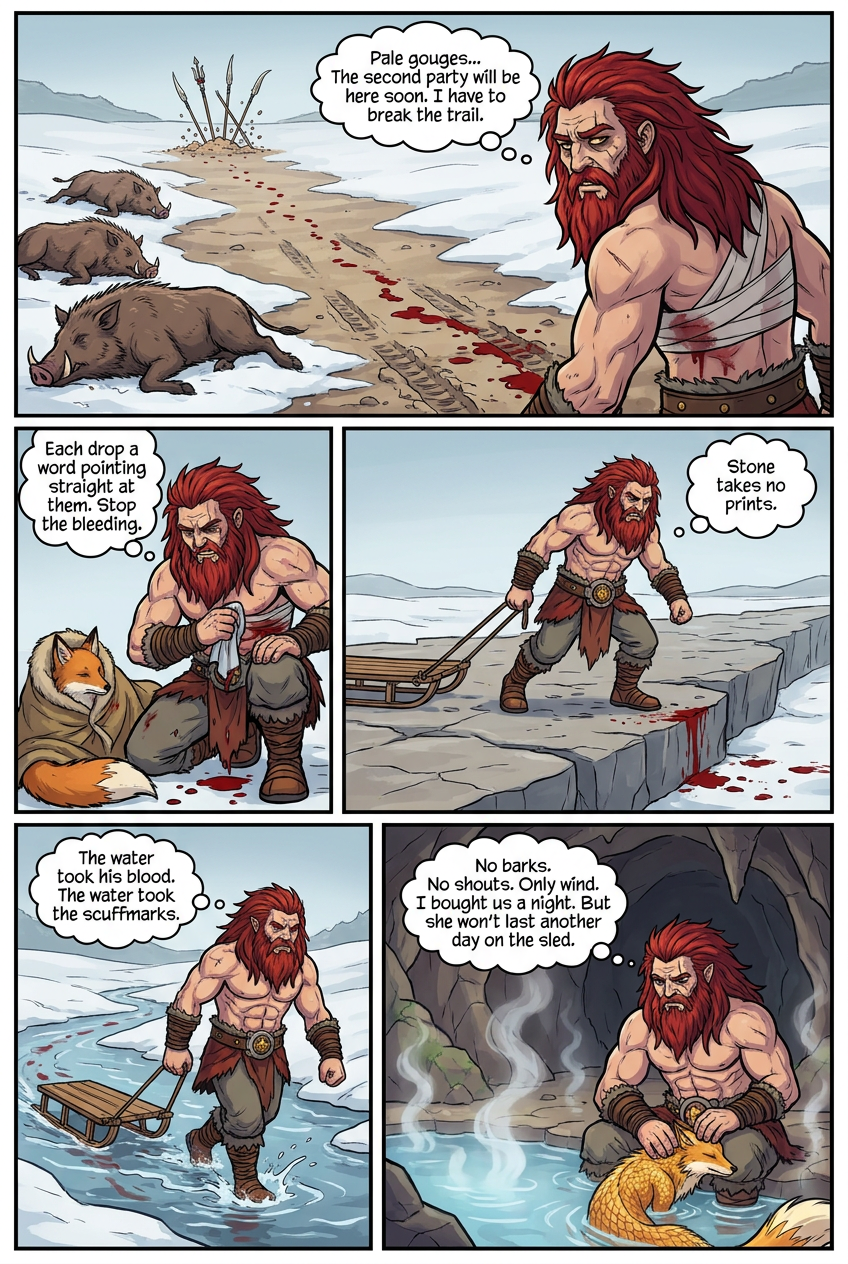
The sled scraped fresh lines through the dirt behind him, pale gouges any child could read. Krayzor stopped and looked back at the marks. The second party would find the dead hounds soon. Then they would find this. He had to break the trail before they reached it. He unhooked the strap and crouched by the kitsune. Her eyes were half open. The wound at his side had soaked his wrap through, and each drop he left was a word pointing straight at them. He cut a fresh strip of cloth and pressed it hard against the cut until the bleeding slowed to nothing. Then he wrapped it tight and tied it off with his teeth. Far back through the trees, he heard the sound he had been waiting for and dreading. Spears struck earth in a rough line — the second party calling its scouts in. They were close to the kill site. Once they saw the bodies steaming in the cold pools beyond, they would fan out and read every print. He needed the ground to forget him. He dragged the sled sideways off the soft dirt and onto a long shelf of bare stone. Stone took no prints. He hauled her along it for as far as it ran, then lifted the back of the sled and walked it instead of dragging, so only two narrow tracks pressed down instead of one wide scar. His shoulder tore with every step. He kept going. Where the stone ended, he turned the sled into a shallow stream and walked it down the bed. The water took his blood. The water took the scuffmarks. He went a long way before climbing out on the far bank, into thick brush that closed behind them like a door. He listened. No barks. No shouts. Only wind. He sat down hard beside her and put a hand on the golden scale at her throat. The trail was broken. The second party would reach their dead and find nothing pointing onward — only stone and water and a hunt gone cold. He had bought them a night. Maybe two. The kitsune's breath was shallow against his wrist, and he knew the next problem already: she would not last another day on the sled, and the meeting ground was still far away.
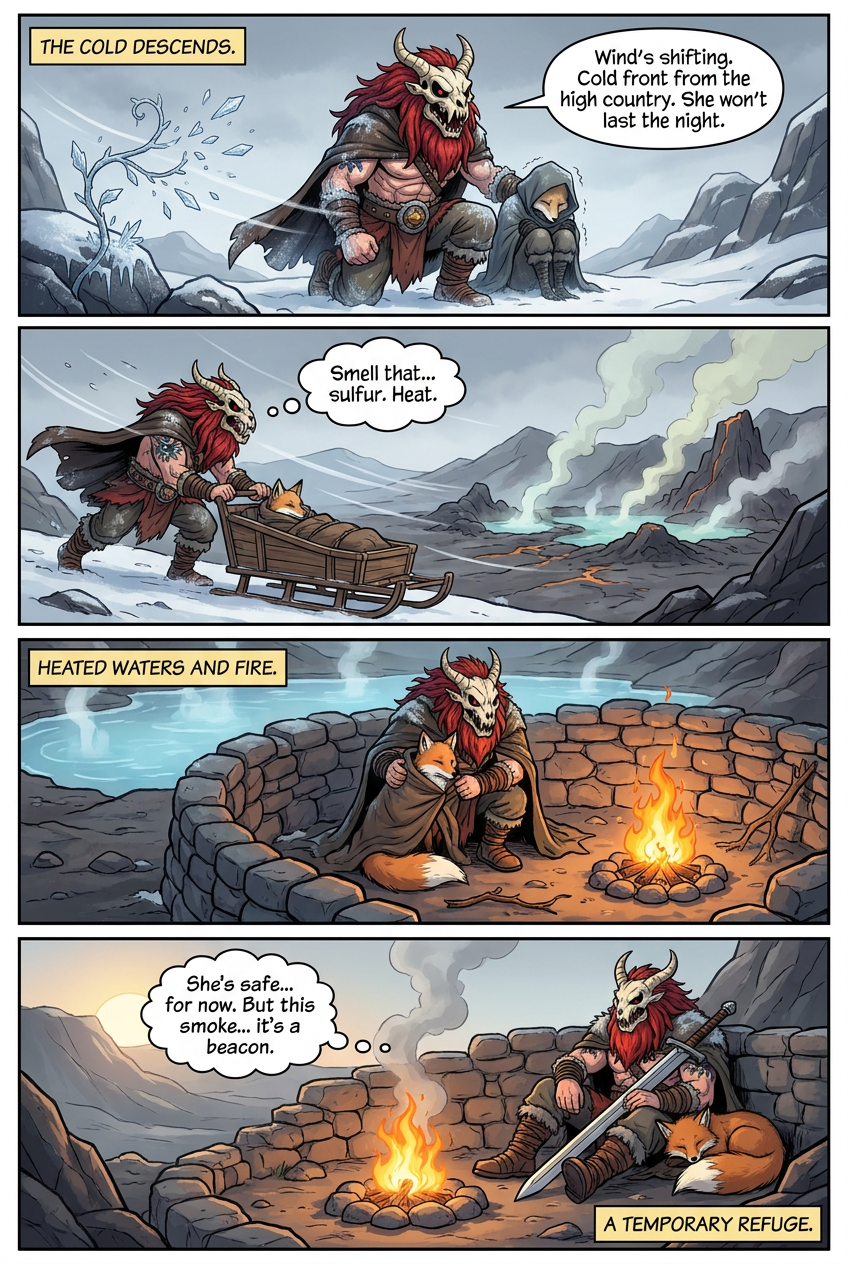
The wind shifted while he sat in the brush, and the warmth went out of the air in one long breath. Krayzor felt it on his wet sleeves first. A cold front, sliding down off the high stone country. He looked at the kitsune. Her lips were going gray. On the open rock ahead, a thin vine glittered with sudden frost and shattered when the wind touched it, branches breaking like glass. He had hours, not a night. He lifted the sled and pushed on, following a faint warm thread he could smell in the air. The ground rose, then dropped into a bowl of dark rock where pale steam curled up from small pools. Heated water. Mineral stink. He dragged her to the largest pool and stacked loose stones on the windward side into a low curved wall, just tall enough to break the worst of the gusts off her body. Wood was thin out here, but he found dry roots and dead brush along the bowl's edge and broke them down with his good arm. He struck a fire close to the stone wall so the heat reflected back onto her. Then he took off his own cloak — the heavy one he had worn since the first cave — and tucked it under and around her until only her face showed. He fed the flames slow. He kept feeding them. Her breathing steadied near dawn. The shaking eased. Krayzor sat against the stones with his blade across his knees and watched gray light climb the rim of the bowl. She had lived through the cold. But the fire was a beacon any tracker could read for miles, and the smoke was already rising straight up into a clear, windless sky.
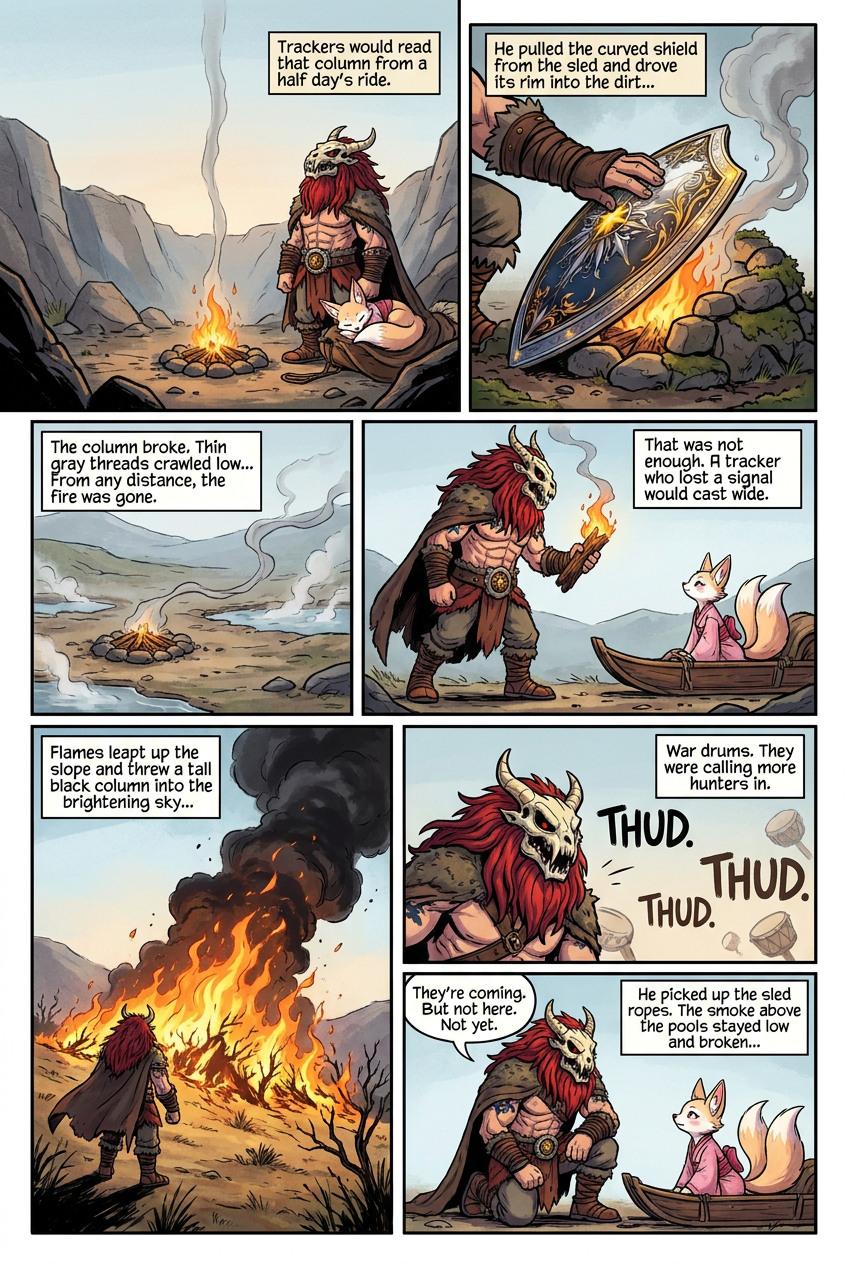
The smoke climbed straight as a spear shaft. Krayzor stood and watched it rise above the rim of the bowl, gray against pale dawn. The kitsune slept inside his cloak, breath steady at last. He had bought her the night and sold himself the day. Trackers would read that column from a half day's ride. He had until the sun cleared the ridge to make it lie. He pulled the curved shield from the sled and drove its rim into the dirt beside the fire, angling the polished face over the flames like a tilted lid. Loose stones braced the foot. He stacked more rocks on the lee side and packed wet moss between them, building a crude hood that forced the smoke sideways along the rock wall. The column broke. Thin gray threads crawled low along the bowl and vanished into the steam off the pools. From any distance, the fire was gone. That was not enough. A tracker who lost a signal would cast wide and find them anyway. He needed them looking somewhere else. Krayzor checked the kitsune once, tucked the cloak tighter, and climbed out of the bowl with an ember wrapped in bark. Half a mile downwind he found what he wanted: a long slope of dead brush and frost-killed scrub, dry as old bone. He dragged a fallen branch through it, scattered the ember, and blew. The brush caught with a soft roar. Flames leapt up the slope and threw a tall black column into the brightening sky, taller and louder than anything he had made by the pools. He backed away as the heat pushed at his face. Any tracker within miles would turn toward that smoke now, not his. He was halfway back when he heard it. A low, rolling thud rolled across the stone, then another, spaced like a slow heartbeat. War drums. Not close yet, but closer than yesterday. They were calling more hunters in, fanning a wider net. He counted the beats between strikes and judged the distance. By full dawn they would be at the burning slope. By midday they would know it was a trick. He had bought hours, not a day. Krayzor slid back down into the bowl. The hooded fire breathed sideways. The kitsune's eyes were open, watching him. He knelt by the sled and met her gaze without smiling. "They're coming," he said. "But not here. Not yet." He picked up the sled ropes. The smoke above the pools stayed low and broken, and somewhere beyond the ridge a false fire roared in his place.
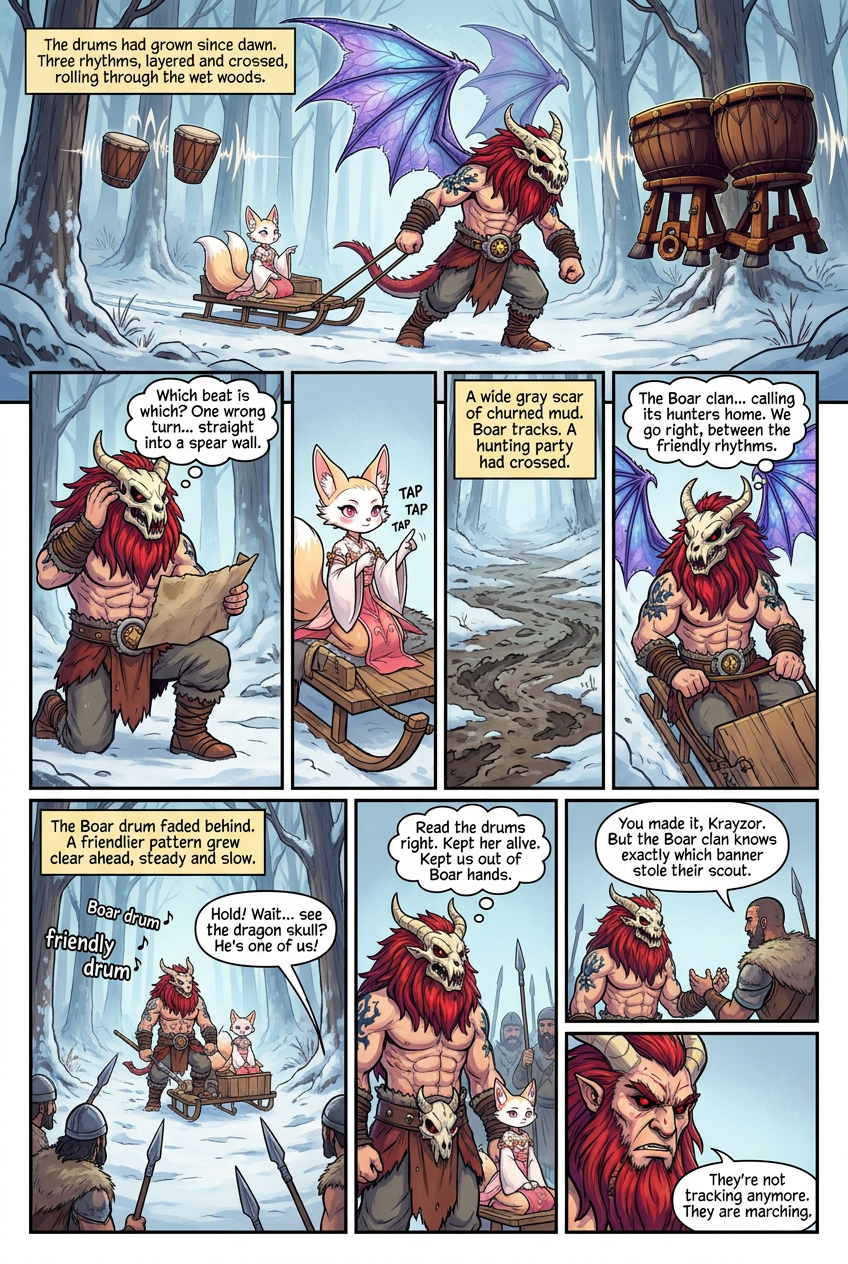
Krayzor pulled the sled into the tree line where frost slid off the branches in slow drops. The drums had grown since dawn. Three rhythms now, layered and crossed, rolling through the wet woods from different ridges. He could not tell which beat belonged to which clan, and one wrong turn would carry him straight into a spear wall. He knelt in the snow and unrolled a strip of pale hide marked with charcoal lines. Each line was a beat pattern he had logged from past councils, faint as veins on a wing. He pressed his ear to the frozen ground and matched what he heard against the marks. Two beats lined up. The third did not. The kitsune watched from the sled. Her ears twitched, sharper than his. She lifted one finger and tapped the air in time with the strange rhythm, then pointed left, toward a clearing where the frost had melted into a wide gray scar of churned mud. Boar tracks. Wide hooves and bare feet. A hunting party had crossed there within the hour. Krayzor's chest went cold. He had been about to angle that way. The third drum was the Boar clan calling its hunters home, and home was the ground he had nearly stepped onto. He shifted the sled rope to his other shoulder and turned them hard right, hugging the line where the two friendly rhythms overlapped. They moved between the wet trunks while the drums kept talking above them. Twice he stopped and checked the hide. Twice the kitsune tapped the beat and nodded him onward. The Boar drum faded behind. A friendlier pattern grew clear ahead, steady and slow, the signal of a clan that had already planted its staff beside his skull. By dusk he reached the edge of an allied picket. Scouts rose from the brush and lowered their spears when they saw the dragon skull at his hip. He had read the drums right. He had kept her alive, and he had kept himself out of Boar hands. But the picket captain told him the Boar clan now knew exactly which banner had stolen their scout, and they were marching, not tracking.
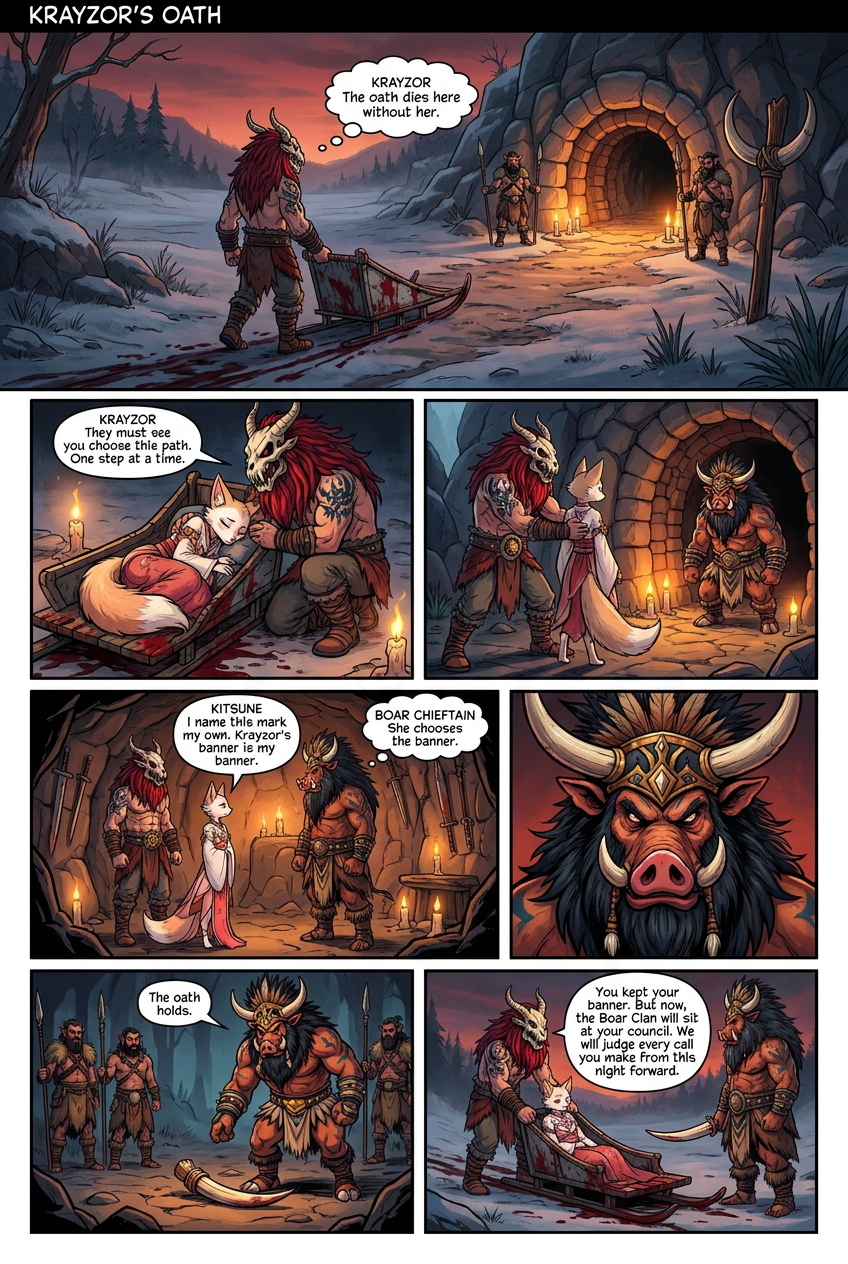
The allied picket led Krayzor down a worn path to the meeting ground. He dragged the bloodied shield sled behind him, its red-stained face cutting two dark lines through the frost. Ahead stood a low cave mouth ringed with candles, its arch glowing warm against the dusk. Boar clan watchers waited at the threshold, spears planted, a heavy tusked totem driven into the dirt beside them to mark their claim on the hour. Krayzor stopped at the edge of the candlelight. The kitsune lay curled on the sled, too weak to stand. Without her on her feet beside him, the oath died here. He knelt and spoke close to her ear. He told her he could not lift her through that door. He told her the watchers needed to see her choose it. She lifted one trembling hand. He took it. He braced his shoulder under hers and rose slowly, letting her weight settle across him without taking it from her legs. Her bare feet found the cold stone. One step. Then another. He kept his arm only as a rail, not a crutch. The chieftain of the Boar clan stepped into the candlelight, tusked headdress low, fists open at his sides. His eyes went to her feet. To the gold scale at her throat. To the marks she had chosen to keep. She spoke. Her voice was thin, but it carried in the small stone room. She named the mark her own. She named Krayzor's banner her banner. The chieftain stared a long moment, then drew one tusk from his headdress and laid it on the ground between them. The oath held. The watchers lowered their spears. Krayzor eased her back onto the sled before her knees gave. He had kept his life and his banner. But the chieftain did not leave. He stood over the laid tusk and said the Boar clan would now sit at his council, and they would judge every call he made from this night forward.
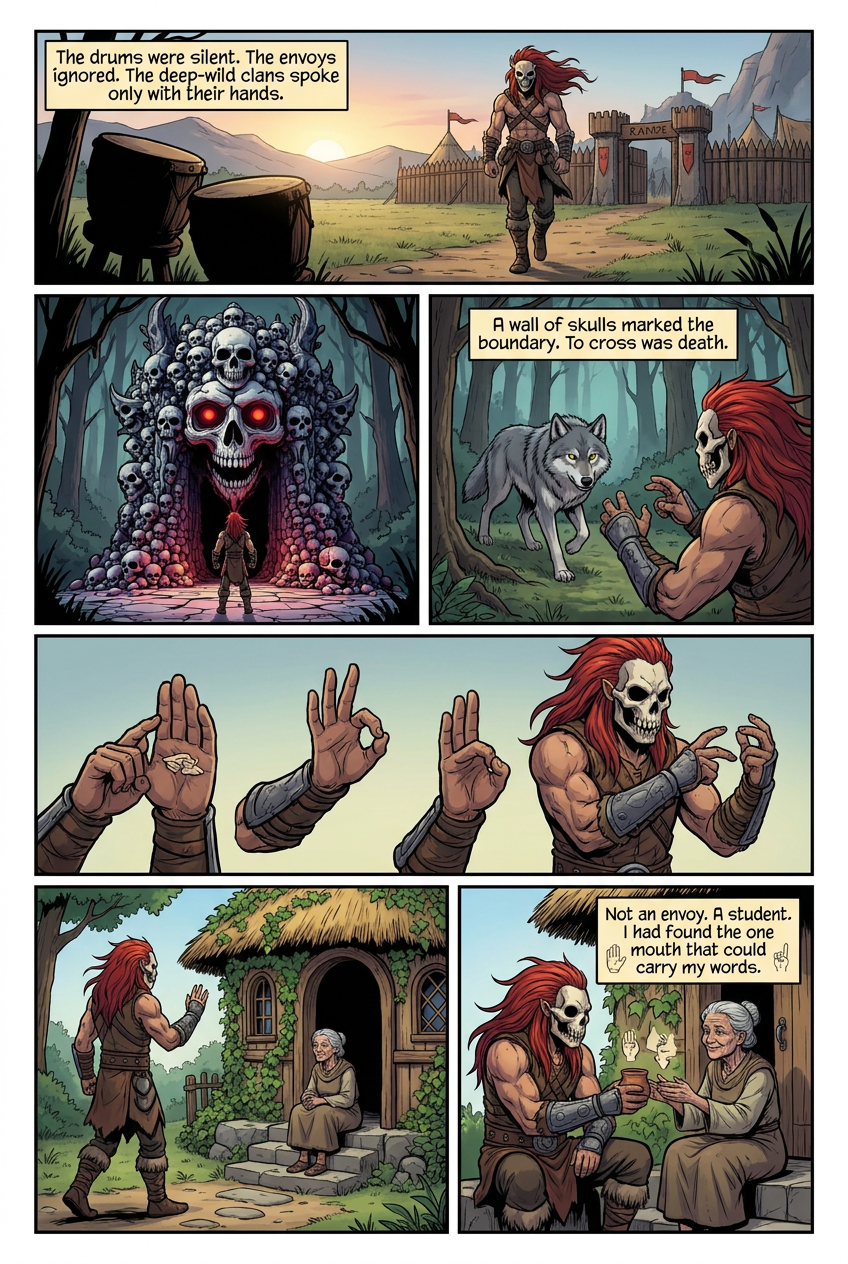
The candles had barely guttered out before Krayzor turned his mind to the next closed door. The deep-wild clans did not answer drums. They did not answer envoys. They spoke with their hands, and no one under his banner knew the shapes. He set the chieftain's tusk in his belt and walked out into the cold dawn alone. He followed an old hunter's trail to the edge of the deep-wild. A wall of stacked skulls rose where the pines thinned. Bone teeth grinned down at him from the arch. He stopped at the line of cracked stone and did not cross. Past that gate, an unknown hand would cut him down before he spoke a word. A gray wolf stepped from the trees beside the gate. Its yellow eyes held him. It lifted one paw, turned it, set it down. It tilted its head. It bared its teeth, then closed them soft. Krayzor watched. He copied the paw. He copied the head. The wolf huffed and trotted a slow circle, showing him three more signs before it slipped back into the brush. Krayzor practiced the four shapes until his hands moved without thought. Then he walked the boundary east until he found a small round hut sunk in ivy. An old woman sat on its step, hands folded. He raised his palm and made the sign for listen. He made the sign for safe word. He made the sign for trade. She studied him a long moment, then patted the stone beside her. He sat. She poured water into a clay cup and pushed it toward him. She signed back, slow, so he could follow. He could not send an envoy yet. But he had found the one mouth that could carry his words into the deep-wild, and she had not turned him away.
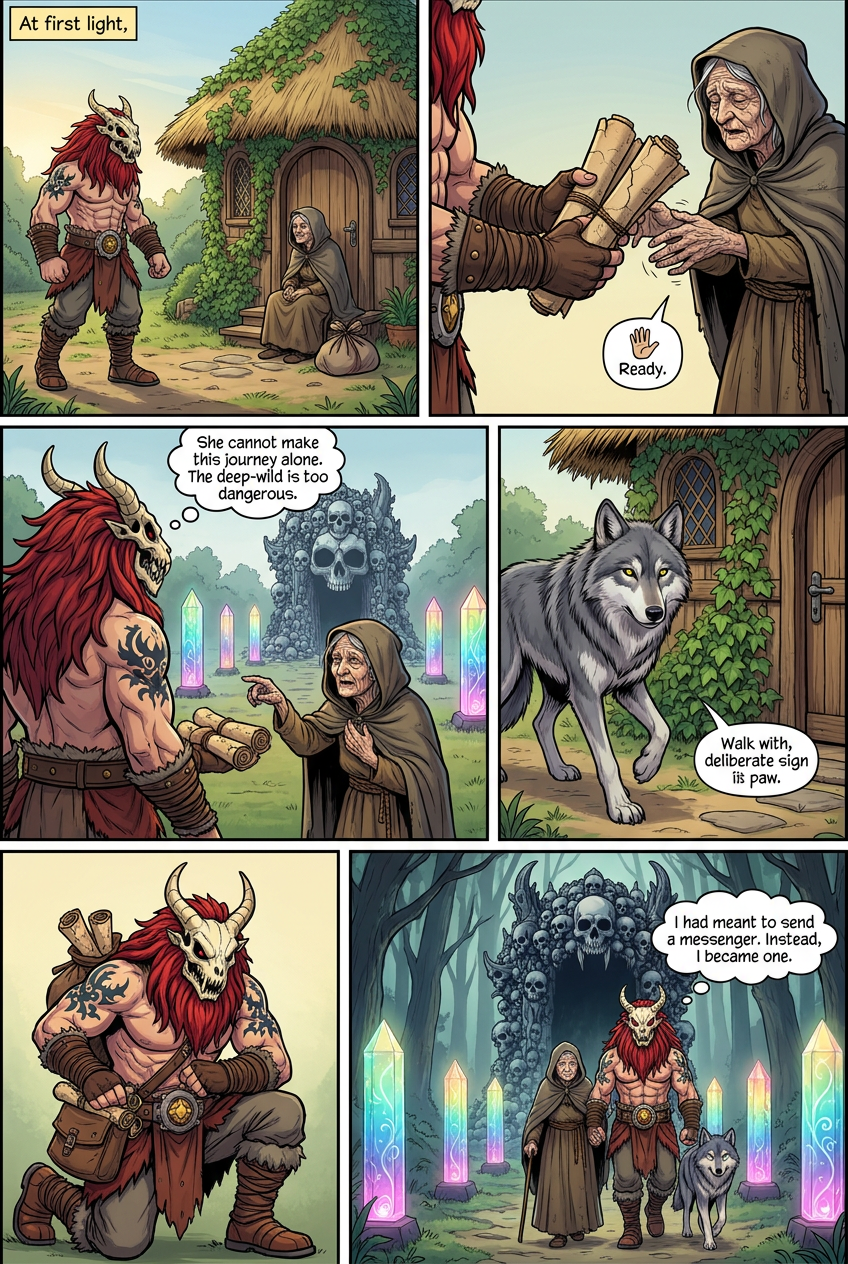
Krayzor came back to the ivy-draped hut at first light. The old woman sat on the step with a bundle at her feet. She signed one word, slow: ready. Then she stood, and her knees shook, and he saw the truth. She could carry his message, but she could not carry herself across the deep-wild alone. She pressed a roll of cracked scrolls into his hands. Old ink. Faded marks in three tongues. She tapped her chest, then the scrolls, then the trees beyond the bone arch. She had walked this road once, long ago. She would not walk it again without a shoulder to lean on. Krayzor stared past the grinning skulls of the gate. A line of tall crystal posts shimmered faintly beyond, marking the old protected path. He could send a scout. He could send the chieftain's son. But every name he picked was a name he could lose, and the woman needed someone the deep-wild would not strike on sight. The gray wolf stepped out from the ivy. Yellow eyes. Same tilt of the head. It huffed at him and signed, paw turning slow: walk with. Then it signed safe. Then it waited. Krayzor knelt and tied the scrolls into his pack. He lifted the old woman's bundle onto his own back. He offered her his arm. She took it. Together they crossed under the skull arch, past the first glowing post, the wolf pacing at their flank. He had meant to send a messenger. Instead he became one. The council would wait. The banner would wait. He set down the man who led and picked up the man who walked beside a frail woman into a country that did not know his name.
Play your story to life
Storycraft is a mobile game where you create AI characters, craft items and locations to build their world, then discover what direction your story takes. Download the iOS game for free today!
Download for free