

Lena Birch's Arc
4 Chapters
Lena Birch's dream is reclaiming the legendary blade she buried in the forest before anyone in Birchrot learns who she truly was..

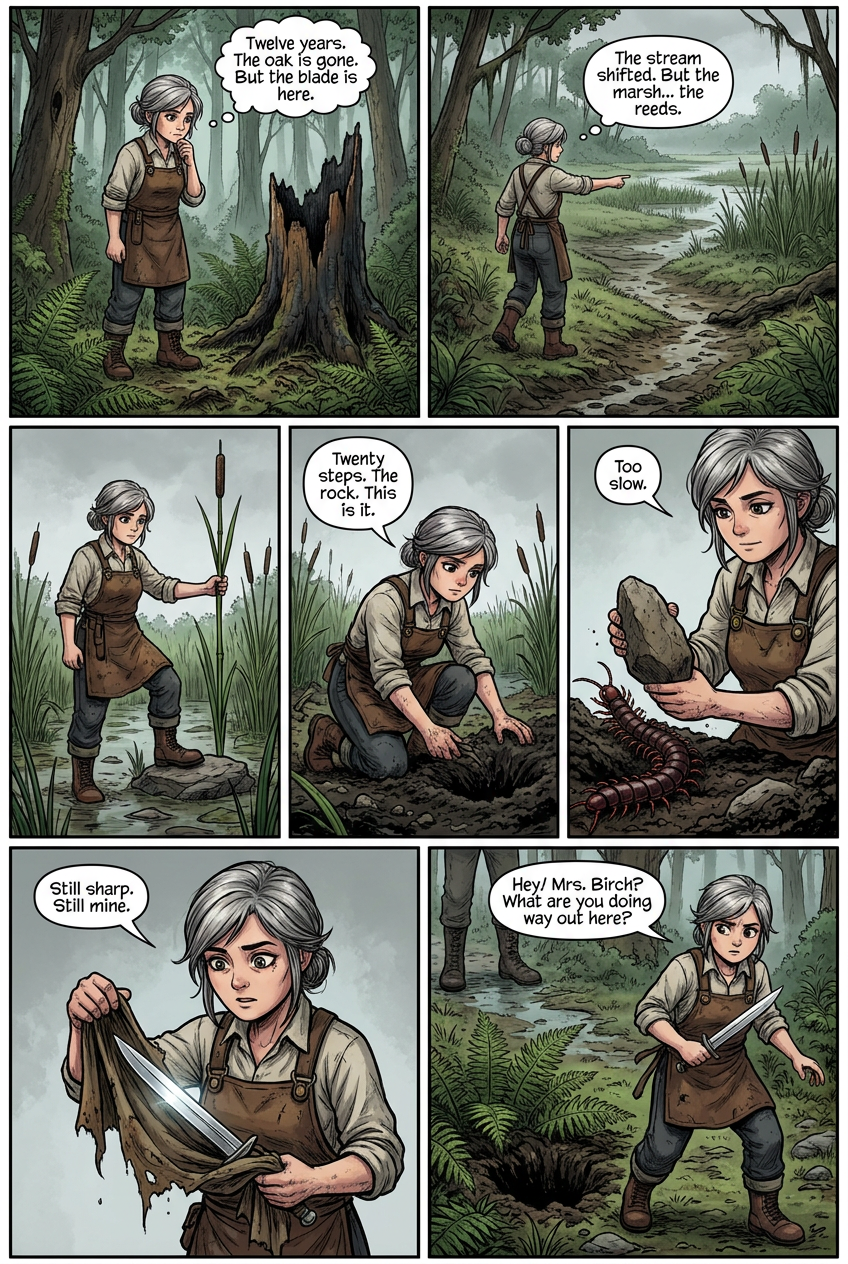
Lena Birch buried a blade in this forest twelve years ago, and now she could not find the tree that marked it. She stood where the tall oak should have been. Instead a burned stump crumbled under her boot. The whole village of Birchrot knew her as the woman who sharpened their knives and split their logs. None of them knew she once carried a weapon worth killing for. She meant to keep it that way. First she had to dig it up before someone else did. She had chosen this spot for a reason. A stream once curled past the oak's roots. She followed the old channel now, but the water had shifted. The land had grown wilder. Ferns swallowed the paths. She could dig a hundred holes and still miss the blade by three feet. Worse, loose earth would draw questions. A woodcutter had no reason to turn soil this deep in the trees. Then she remembered the marsh. The stream fed a wet hollow downhill, and she had lined up the burial with the tallest reed she could see from the oak. She pushed through the brush until the ground turned soft. Reeds stood in the shallow water, slender and green, their hollow stems swaying. One rose higher than the rest, exactly as she remembered. She turned her back to it and paced out her old count. Twenty steps. Her boot struck a flat rock she had set herself. Lena knelt and dug with her hands. The soil came away black and cold. Her fingers found cloth, then the hard line of a hilt beneath it. Her heart steadied. She had it. As she pulled, something moved in the pit. A centipede as long as her forearm poured out of the loosened dirt. Its shell shone dark red. Rows of legs rippled along its body, each tipped for venom. It reared toward her wrist. Lena did not flinch. She had faced worse than this in her old life. She grabbed a stone and crushed the head in one strike. The body coiled and went still. She wiped her hand and lifted the bundle free. The wrapping had rotted, but the steel inside had not. She peeled back the cloth. The blade caught the gray light without a spot of rust. Even now it looked wrong in a woodcutter's hands. Lena wrapped it fast and pressed the soil back down. She smoothed ferns over the hole. When she stood, she heard boots on the wet ground behind her. A voice called out, young and curious, asking what she was doing so far from the village. She had the blade. Now someone had seen her carry it.
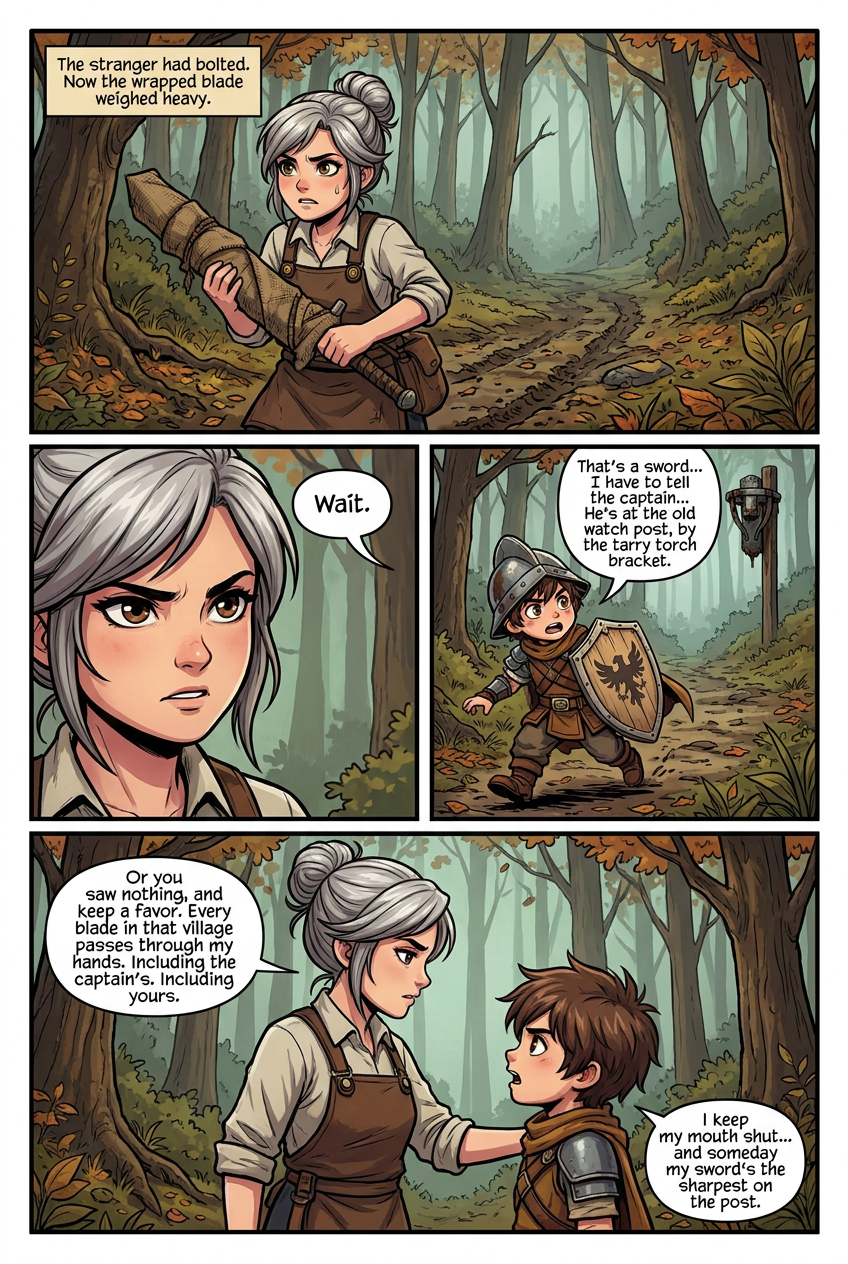
The stranger had bolted before Lena got a good look. She heard the wet slap of running boots, then nothing. Now the wrapped blade weighed heavy under her arm. Whoever saw her would reach Birchrot first. If they told what they'd seen, the whole village would learn the woodcutter carried a killer's steel. She left the burial site and followed the tracks pressed into the mud. The prints were small and quick. A child's stride, or a boy's. They cut through the ferns toward the village road. Lena moved fast but quiet, the way she once had. Broken stems told her where the runner had slipped. She gained ground. Ahead, through the trees, she saw a battered wooden shield bouncing on a thin back. A dented helmet, two sizes too big, wobbled with every step. A squire's boy. She had seen him loitering near the smithy, always one pace behind the older men. He talked too fast for anyone to answer. Now he ran for the village with her secret in his mouth. "Wait," Lena called. Not loud. Calm. The boy stumbled and spun. His helmet slid over his eyes. He shoved it up and stared at the bundle under her arm. "That's a sword. Woodcutters don't carry swords. I saw you dig it up, I saw the whole thing, and I have to tell the captain because that's the rule, that's my job—" "Finn." She had heard the men use his name. It stopped him cold. "How far is the captain?" "At the old watch post. By the road." He pointed with the shield. "There's a torch bracket on the wall, the tarry one, I light it every night. He's there right now." Lena weighed it. She could not outrun a report to a captain. She could not silence a boy who craved importance. So she gave him something better. "You saw a woodcutter carry a rusted old tool," she said. "Anyone digs up scrap in these woods. But a squire who cries wolf gets laughed off the post." She stepped closer. "Or you saw nothing, and you keep a favor from me. Every blade in that village passes through my hands. Including the captain's. Including yours, when they finally trust you with one." Finn's mouth opened. For once no words came. He looked at the shield with its borrowed crest, then at her hands. "I keep my mouth shut," he said slowly, "and someday my sword's the sharpest on the post." "Sharper than the captain's." He swallowed. Then he nodded, fast, and pulled the big helmet down to hide his face. Lena watched him run for the watch post, the tarry bracket waiting on its wall. The boy would hold, for now. But he knew what she was. And a boy who wanted to matter would not stay quiet forever. She had bought silence with a promise. Now she had to hide the blade before he changed his mind.
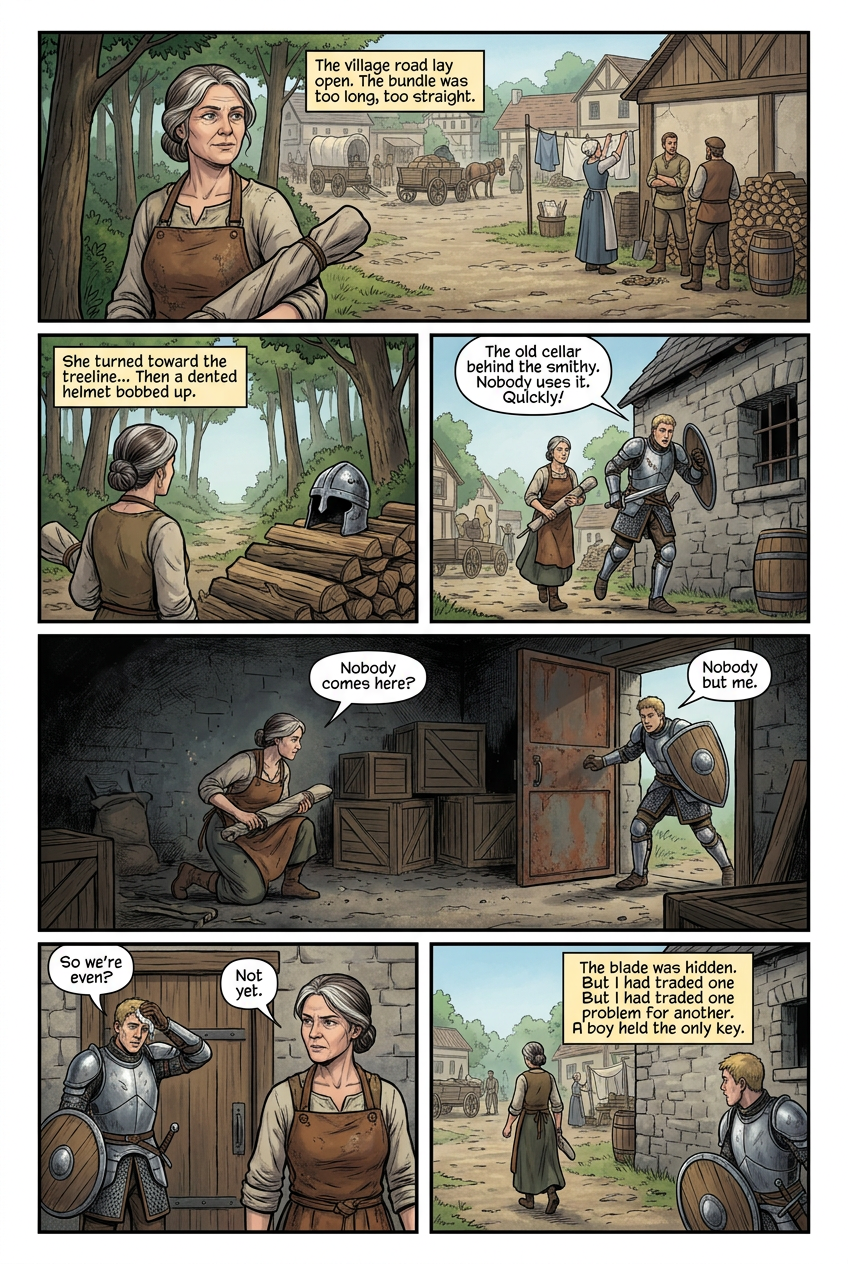
Lena reached the edge of the forest with the wrapped blade still under her arm. The village road lay open ahead. Carts rolled past. A woman hung wash on a line. Two men rested axes near a woodpile and looked her way. The bundle was too long, too straight. Anyone who split logs knew a real tool from a hidden sword. She needed to stow the blade before another set of eyes marked it. Her own shed stood at the village edge, but the path there crossed the open square. She turned toward the treeline instead, looking for a gap, a hollow log, a cellar door. Then a dented helmet bobbed up from behind the woodpile. Finn scrambled toward her, shield banging his knee. He talked before he reached her. "You can't walk it through here, everyone's watching, the captain sent me to fetch kindling and if he sees that thing you're finished and so am I—" He stopped, breathing hard, eyes fixed on the bundle. Lena kept her voice level. "Then help me, or lose your favor." That word held him. He glanced back at the woodpile, then at her hands. "The old cellar," he said. "Behind the smithy. Nobody uses it. I hide there when they yell." He was already moving, waving her along the fence line, keeping his shield up as if it hid them both. He led her behind the smithy wall. A low wooden door sat in the ground, half sunk, its hinges brown with rust. Finn hauled it open. Cold air rose from the dark. "Down there. Under the crates." Lena climbed in. The cellar smelled of damp stone and old coal. She found a stack of empty crates against the far wall and slid the blade behind them, still wrapped, flat against the floor. Dust settled over the cloth. She stepped back. From the doorway you saw only crates. She climbed out. Finn stood guard, shield forward, watching the gap between the buildings. His hands shook on the wood. "Nobody comes here?" she asked. "Nobody but me." He pushed the door shut with his boot. It thumped into the frame. "But I light the captain's bracket every night. He asks where I've been. If he ever follows me here—" "He won't." Lena set her hand on the closed door. The blade was out of sight. No stranger on the road would spot it now. Finn wiped his face. "So we're even?" "Not yet." She looked at him, the boy who now knew where her secret lay. "You know two things now. What I carry, and where it hides. That makes you worth more than a favor to me. And a danger." He swallowed and said nothing. Lena walked back toward the road, her arms empty at last. The blade was hidden. But she had traded one problem for another. It sat under crates in a boy's hiding place, and the boy held the only key.
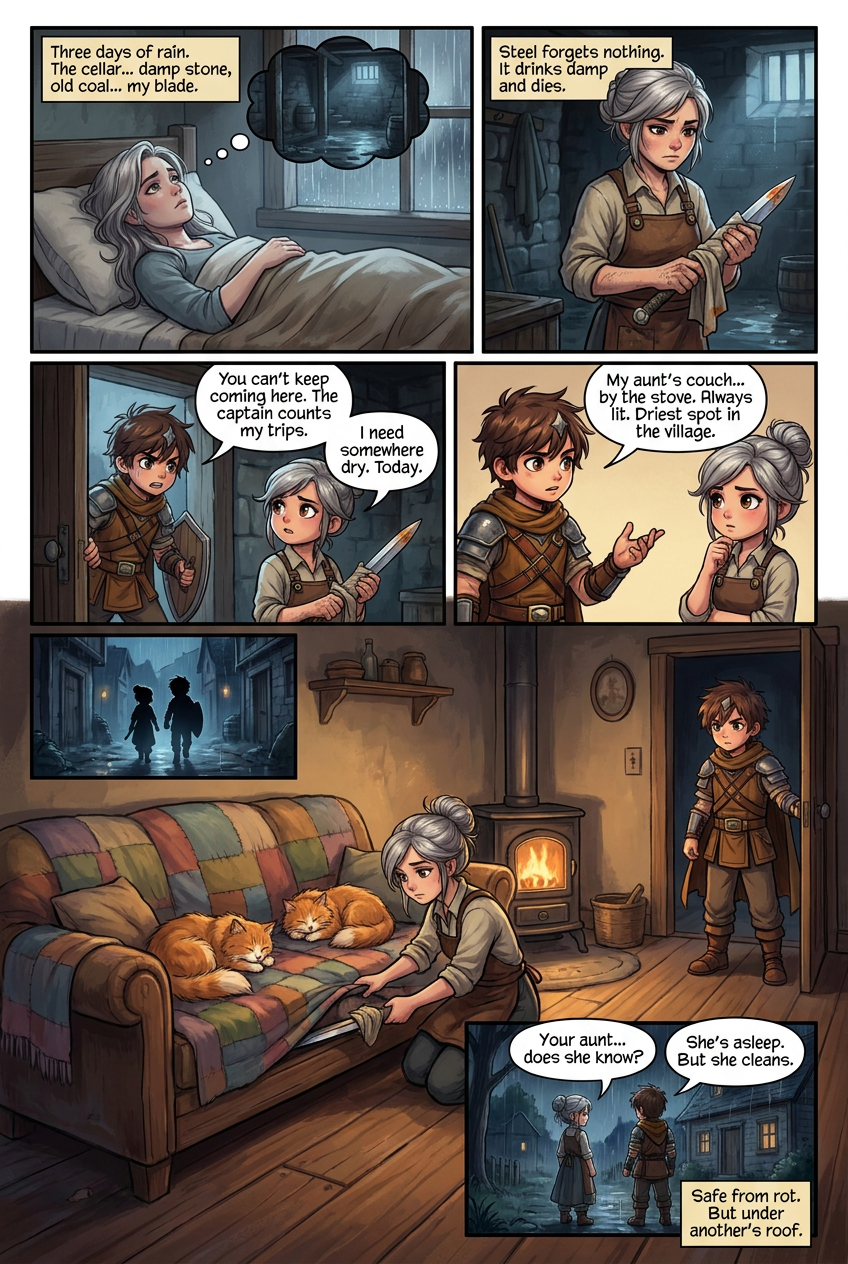
Three days later, Lena woke to rain. She lay still and listened to it drum the roof. Then she thought of the cellar. Damp stone. Old coal. Water running down the walls. She sat up. Her blade lay wrapped on that wet floor. Twelve years buried, and it never rusted. But that forest soil was dry. The cellar was not. Steel forgets nothing. It drinks damp and dies of it. She pulled on her apron and went. The village was gray and empty in the rain. Behind the smithy she found the low door and hauled it open. Cold, wet air rose to meet her. She climbed down and dragged the crates aside. The cloth bundle was dark with moisture. She unwrapped it fast. The blade glinted, still clean, but beads of water sat along the flat. A thin orange bloom crept near the guard. Another week here would eat it through. She wiped the steel with her sleeve. That was not enough. Wet air would return the moment she left. The blade needed a dry place, off the ground, hidden. She could not carry it home in daylight. She could not leave it here to rot. A scrape sounded above her. Finn's helmet leaned into the doorway. "You can't keep coming here," he hissed. "The captain counts my trips." Then he saw the rust and went quiet. "Is it ruined?" "Not yet." She held the blade up so he saw the orange stain. "But this floor will finish it. I need somewhere dry. Today." Finn chewed his lip. He glanced back at the rain, then down at her. "My aunt's got a couch by her stove," he said. "Old striped thing. Two cats sleep in it all day. Nobody moves them. Nobody looks under them." He talked faster now. "The stove's always lit. It's the driest spot in the village." Lena weighed it. A stranger's house. A boy's word. But dry heat would save the steel, and no one searches a napping cat. "Show me," she said. They waited for dark. Finn led her through back lanes to a small warm room. An overstuffed daybed sat by the stove, draped in a faded striped cover. Two orange cats lay curled in its folds. One lifted its head, blinked, and settled again. Lena knelt. She slid the wrapped blade deep beneath the cushions, flat against the wooden frame, where the stove's heat reached. The cats never stirred. She stood. The steel was safe from rot now. But she had moved it into another house, under another roof she did not own. Finn watched her from the door, holding his shield. "Your aunt," Lena said. "Does she know you come here?" Finn's grin faded. "She's asleep. She always sleeps." He looked at the couch, then at Lena. "But she wakes sometimes. And she cleans under the cushions."
Play your story to life
Storycraft is a mobile game where you create AI characters, craft items and locations to build their world, then discover what direction your story takes. Download the iOS game for free today!
Download for free