

Lewis parks's Arc
7 Chapters
Lewis parks's dream is being in an investor smith team duo.

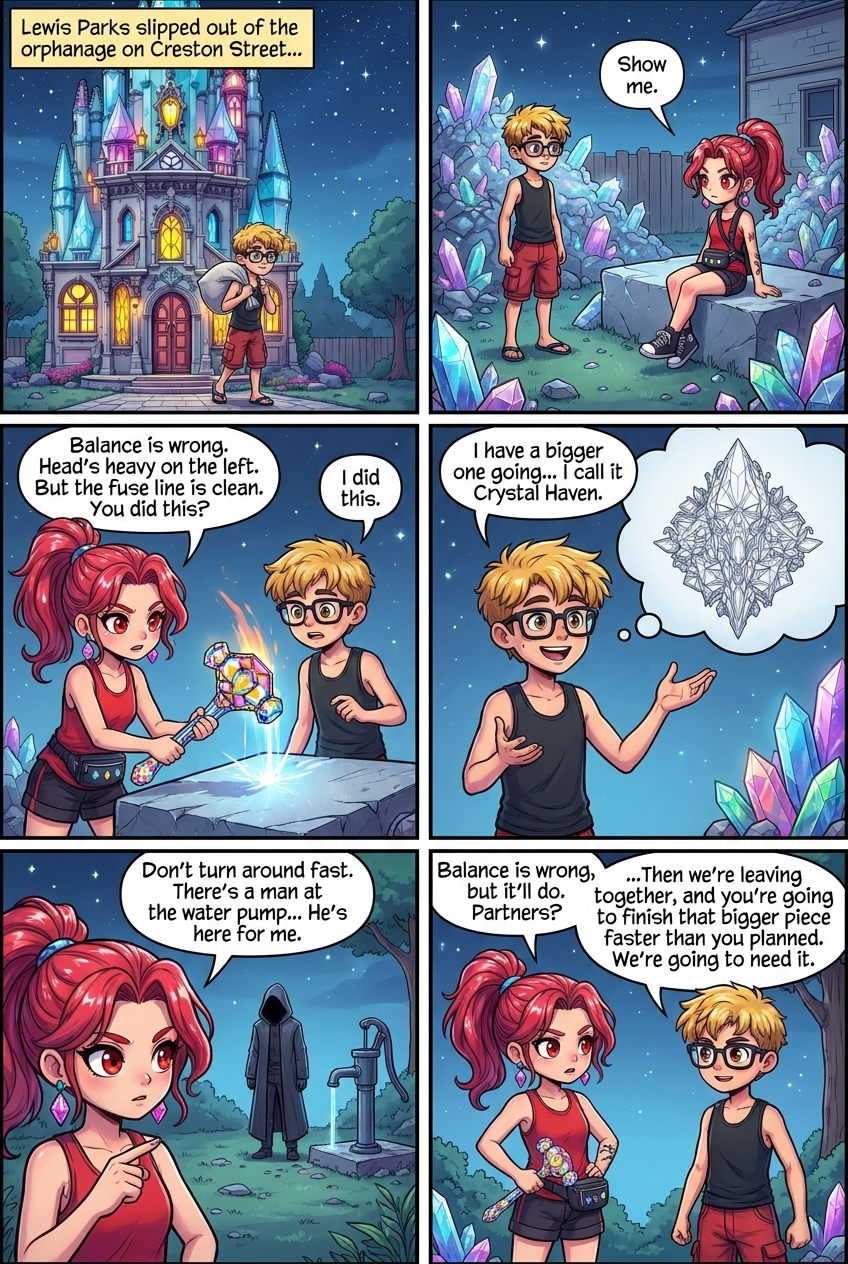
Lewis Parks slipped out of the orphanage on Creston Street with a hammer wrapped in a pillowcase. He was twelve, and three nights ago his memory scanner had shorted at 2am and woken every kid in the building. The matron had said one more invention and he'd lose his workbench for good. He didn't care. He had a meeting. A girl who built weapons out of scrap had agreed to look at his work, and if she liked it, he'd have what he wanted most: a partner. An inventor needed an investor. He had decided she could be both. The meeting place was a yard full of broken crystal, piles of it taller than he was, glinting in every color when the sun caught the edges. Ember was already there, sitting on a slab with her red crystal ponytail over one shoulder. She watched him cross the yard without standing up. "Show me," she said. He unwrapped the hammer. He had built it from scavenged shards, fused at the joints, weighted at the head. It caught the light and threw it back in bright bands across her face. She turned it in her hands. She tapped the head against the slab. She listened. "Balance is wrong," she said. "Head's heavy on the left. But the fuse line is clean. You did this?" "I did this." He spoke fast before she could set it down. "I have a bigger one going. Half done. A forge piece. I can show you the workspace. I built it inside an old chapel down the road, the one with the cracked roof. Faceted walls. Skylights. I call it Crystal Haven." He heard himself selling. He didn't stop. "The unfinished piece is twice my height. It cuts and shapes crystal on its own once I finish the drive. I just need someone who can forge the last parts. Someone like you." Ember set the hammer down. She looked past his shoulder, then back at him. Her face didn't change, but her voice dropped. "Don't turn around fast. There's a man at the water pump. Hood up. He's been watching us since you walked in." Lewis turned his head a small degree. He saw the figure, still as a post, one hand on the pump handle that wasn't moving. The hood pointed straight at them. "He's not here for you," Ember said. "He's here for me. Old man at the docks warned me someone would come one day." Lewis's chest went tight. The hammer suddenly felt small. Ember picked it up again, tested the weight a second time, and slid it into her belt. "Balance is wrong," she repeated, "but it'll do. Partners?" He nodded before he could think. "Then we're leaving together," she said, "and you're going to finish that bigger piece faster than you planned. We're going to need it."
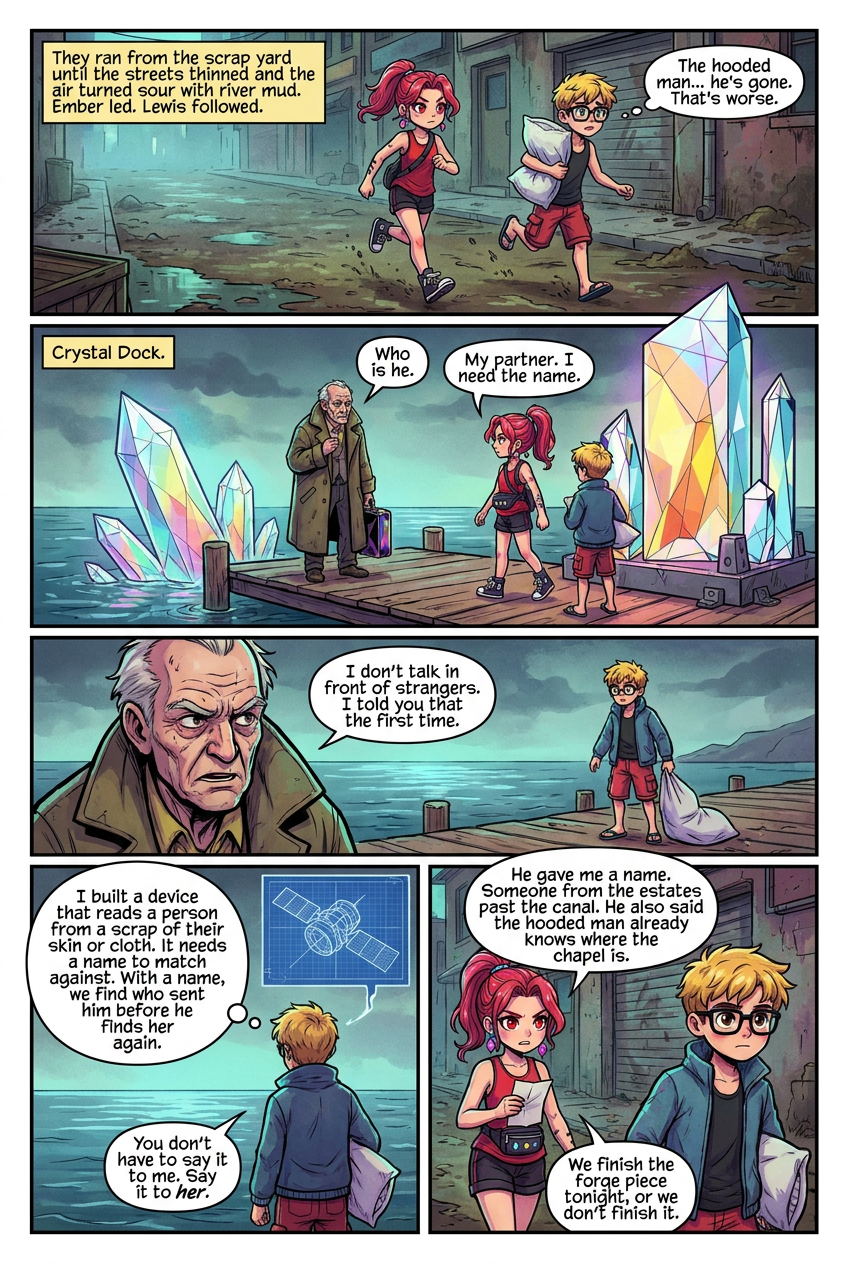
They ran from the scrap yard until the streets thinned and the air turned sour with river mud. Ember led. Lewis followed with the pillowcase bundled under one arm. She did not look back at the water pump, but he did, twice. The hooded man was gone from it. That was worse than seeing him. By the time they reached the docks, Lewis's lungs burned. Ember slowed to a walk. "The old man I told you about," she said. "He'll know who sent the one in the hood. He won't tell you. He barely tells me." The docks smelled of wet rope. At the end of the planks stood a fixture of cut crystal, faceted like a stack of blades, half sunk in the water. The old man crouched behind it. His coat was too big. His hands shook on a small black case with sharp corners. He saw Ember and his shoulders dropped a little. Then he saw Lewis and the case pulled in tight against his chest. "Who is he," the old man said. Not a question. A refusal. "My partner," Ember said. "Someone came for me at the yard. Hood up. You said one day they would. That day is today. I need the name." The old man shook his head. His eyes went to Lewis and stayed there. "I don't talk in front of strangers. I told you that the first time. I'll tell you that the last time." Behind him, taller than the old man himself, a great cut stone sat bolted to the dock, its colors shifting where the sun struck it. Lewis understood, looking at it, that things had been traded here for a long time, and that none of those trades had been clean. Lewis stepped back so the old man could see only Ember. He set the pillowcase down. He kept his voice low and even, the way he had learned to do with the matron after the smoke alarms. "I built a device that reads a person from a scrap of their skin or cloth. It needs a name to match against. Without a name it gives us nothing. With a name, we find who sent him before he finds her again." He did not look up. "You don't have to say it to me. Say it to her. I'll walk to the end of the dock." He walked. He counted twenty paces and stopped with his back turned. He heard the old man's voice, thin and fast, then quiet. When Ember came up behind him, she was holding a folded slip of paper. Her face was tight. "He gave me a name," she said. "Someone from the estates past the canal. He also said the hooded man already knows where the chapel is." She started walking. "We finish the forge piece tonight, or we don't finish it."
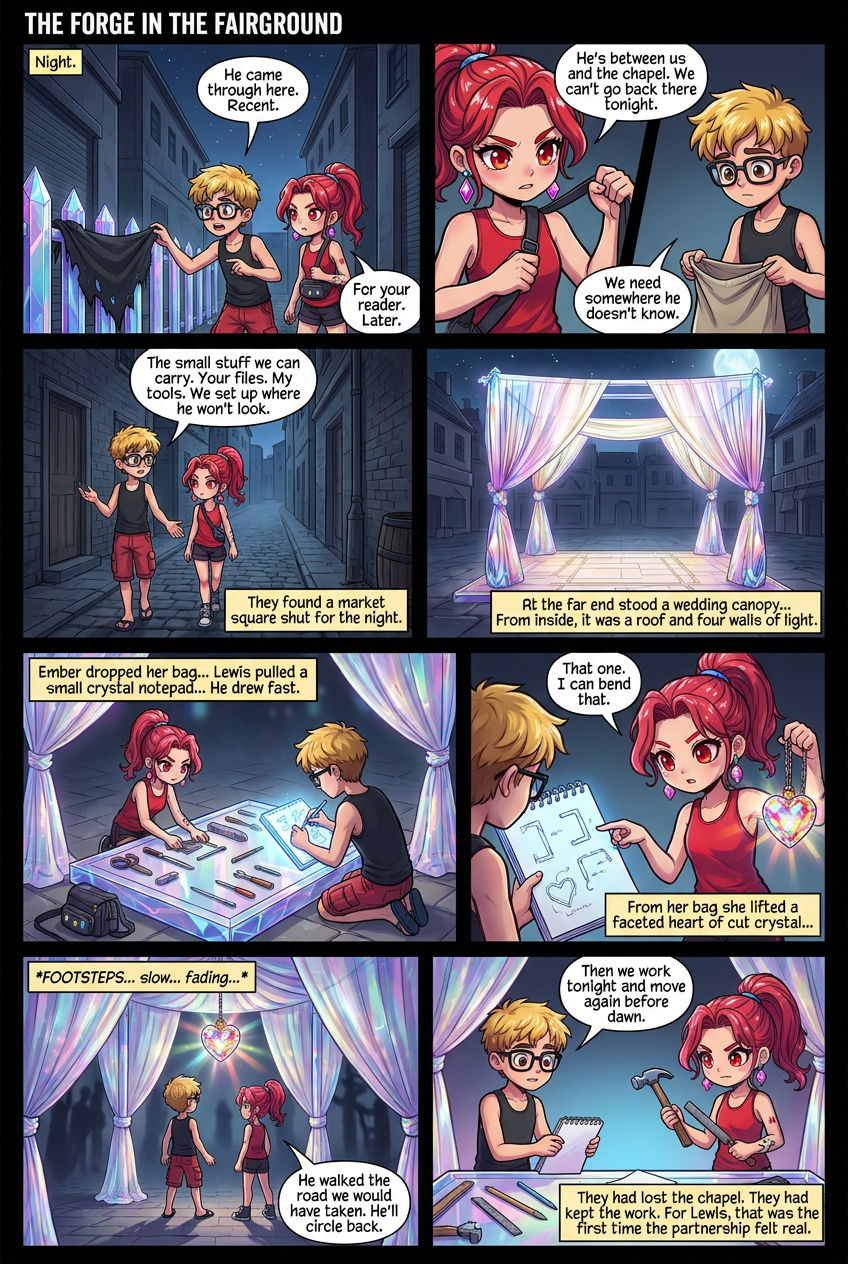
Ember moved fast off the docks. Lewis kept up. The slip of paper was folded in her fist. He wanted to ask the name on it, but her face said wait. They cut between two warehouses and stopped where the planks ended in gravel. That was when Lewis saw it. A long black strip of cloth was caught on a fence nail at chest height, snagged like someone had brushed past in a hurry. It was the same weight and color as the hood at the water pump. Lewis touched it. Still damp. "He came through here," Lewis said. "Recent." Ember pulled the cloth free and pushed it into his pillowcase. "For your reader. Later." She looked up the road, then back at the warehouses. "He's between us and the chapel. We can't go back there tonight." Her voice stayed flat, but her hand had gone tight on the strap of her bag. "We need somewhere he doesn't know. Somewhere we can still work." Lewis thought. The forge piece was at the chapel. The chapel was watched. But the work didn't have to stop. "The small stuff we can carry," he said. "Your files. My tools. We set up where he won't look." Ember nodded once. She led him along a back lane to a market square shut for the night. At the far end stood a wedding canopy left up from a fair, four crystal poles holding a shimmering tarp over a raised board. Curtains hung on three sides. From the road it looked like decoration. From inside, it was a roof and four walls of light. They ducked under. Ember dropped her bag and started laying tools out on the board. Lewis pulled a small crystal notepad from his pillowcase, the pages thin as glass, and began sketching the next bracket for the forge piece from memory. He drew fast. He drew the joint three ways until one of them was right. Ember watched over his shoulder and tapped the second sketch. "That one. I can bend that." From her bag she lifted a faceted heart of cut crystal on a short chain, their stored charge for the small forge. She hung it from the center pole. It caught the streetlight and threw color across the board. Footsteps passed the square. Slow. Lewis stopped breathing. The steps did not turn. They went on and faded. Ember waited a full minute before she spoke. "He walked the road we would have taken." She did not look pleased or relieved. She looked like someone counting. "He'll circle back." "Then we work tonight and move again before dawn," Lewis said. He tore the good sketch from the notepad and set it between them. Ember picked up a file. The hammer in her other hand caught the colored light from the heart above. They had lost the chapel. They had kept the work. For Lewis, that was the first time the partnership felt real, not as a plan, but as a thing already running.
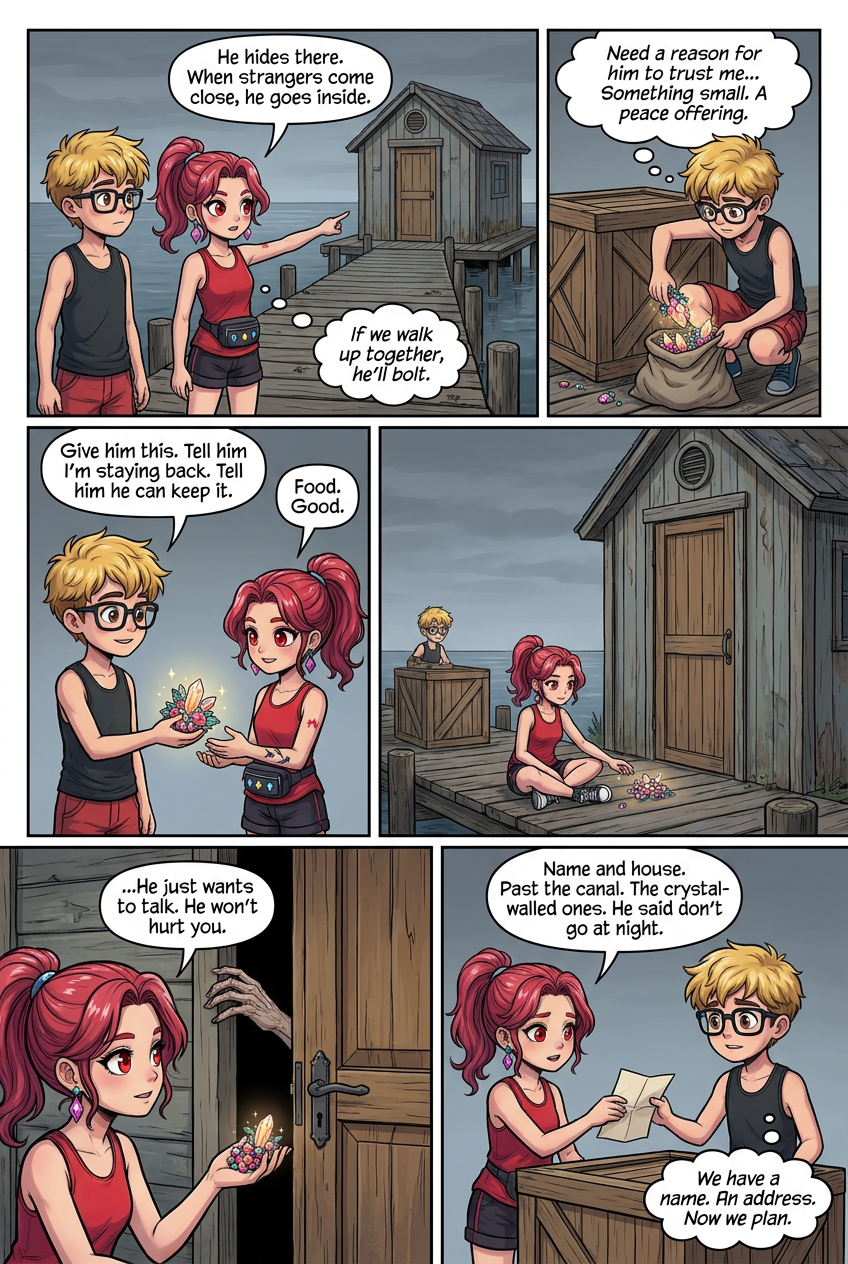
They worked at the canopy until the sky turned gray, then packed and moved before the footsteps could circle back. Ember led them to the docks by a side path. She stopped at the far end of the pier and pointed. A small wooden shed leaned against the last piling, its planks weathered, its gabled roof low. "He hides there," she said. "When strangers come close, he goes inside and shuts the door." Lewis understood the problem at once. If they walked up together, the man would bolt before they got a word out. Lewis crouched behind a crate and thought. The old man had been frightened of him last time too. He had only spoken when Lewis stepped away. The same trick would not work twice on its own. The man needed a reason to believe Lewis meant no harm before Lewis was even in sight. Something in Ember's hand. Something small. Something that said: he is letting me carry this for him. Lewis dug through his pillowcase. He passed over the skin reader and the notepad. At the bottom his fingers closed on a cluster of crystal berries he had clipped from a bush near the orphanage wall, kept for the sugar in the rind. He held it up. The berries caught the early light and threw soft red spots on his hand. "Give him this," Lewis said. "Tell him I'm staying back. Tell him he can keep it." Ember looked at the berries, then at him. "Food," she said. "Good." She took the cluster and tucked it against her palm. Lewis stayed behind the crate. Ember walked the planks alone. She stopped six feet from the shed and set the berry cluster on the boards. She said something Lewis could not hear. Then she stepped back and sat down cross-legged. For a long minute nothing moved. Then the shed door cracked open. A thin hand reached out and pulled the berries inside. The door stayed open an inch. Ember spoke low for a while. The old man spoke back, in pieces. Lewis watched her shoulders. They did not tighten. At one point she took out a scrap of paper and wrote something on it, slow, the way you write down an address you do not want to get wrong. She folded the paper. She stood. The shed door clicked shut. She came back to the crate and showed Lewis the paper without opening it. "Name and house," she said. "Past the canal. The crystal-walled ones." Her voice was flat, but her hand on the paper was not steady. "He said don't go at night." Lewis nodded. They had what they came for. The pursuer was still out there, circling, and now they knew the door he had come from. For the first time Lewis felt the partnership pointing forward instead of running. They had a name. They had an address. The next move was theirs to plan.
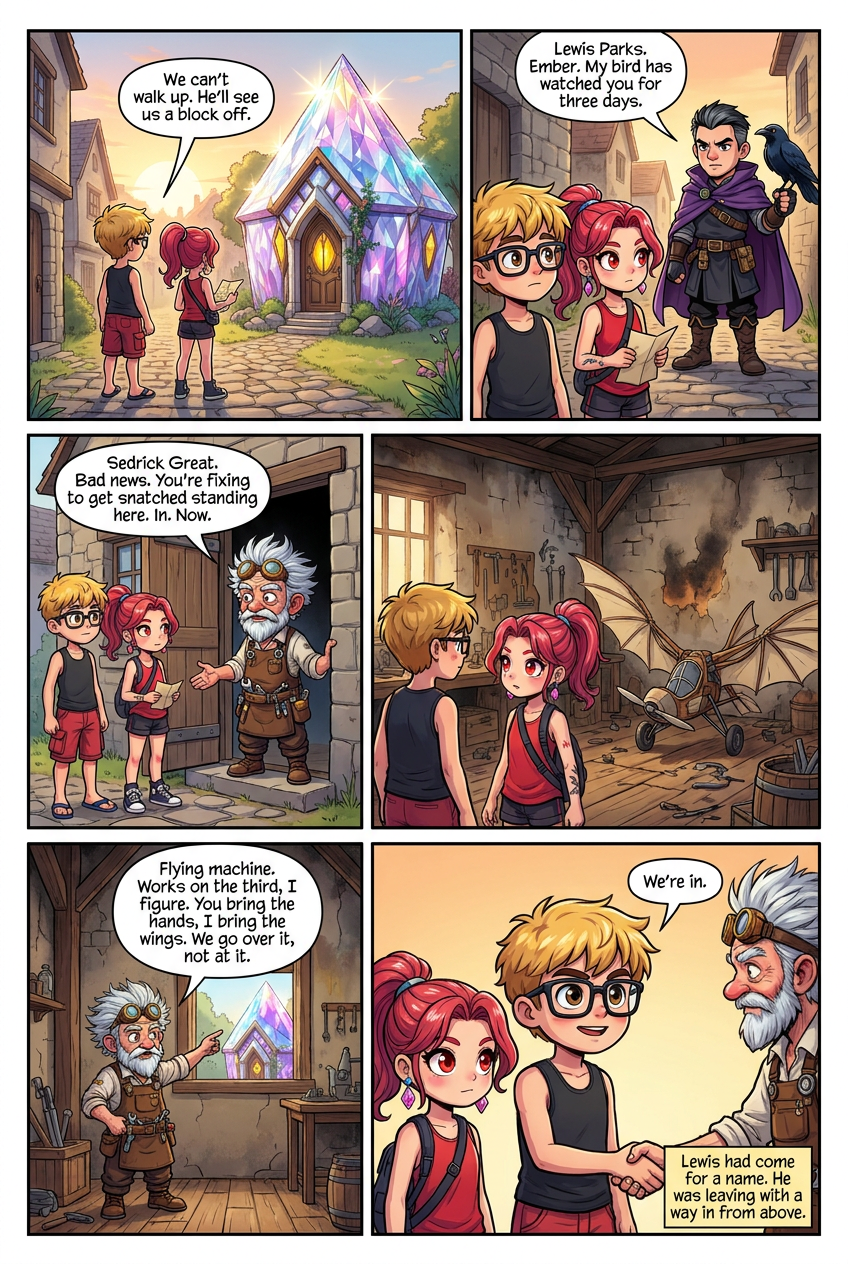
They left the docks before the sun was full up. Ember kept the folded paper in her fist. They crossed the canal by the low footbridge and followed a wall of pale stone until the houses changed. The walls here were not stone. They were glass cut into faces, each panel throwing back a slice of the road. Lewis stopped at the corner. The house on the paper sat alone at the end of a short lane. Crystal walls. A peaked roof that flashed like a knife. No cover. No alley. Anyone inside could watch the lane in every direction at once. "We can't walk up," Lewis said. "He'll see us a block off." Ember crouched and looked at the ground. "Night's out. Old man said no." Lewis tried to think of a screen they could carry, a mirror trick, anything. Every idea ended with two kids standing in plain sight on a bright lane. If they showed themselves, the man would grab them before Lewis got one question out. A boot scraped behind them. Lewis turned fast. A man in a purple cloak stood at the mouth of the lane, a black crow on his glove. His hair was parted, with a gray streak burned through it. "Lewis Parks," he said. "Ember." He did not move closer. "My bird has watched you for three days. You're standing in front of a house you can't enter. I can help with that. Later." He tipped his head and walked on past them, calm, like the lane belonged to him. Before Lewis could speak, a side door in the next building banged open. An old man pushed out, gray hair up in spikes, goggles on his forehead, an apron full of wrenches. He looked at the cloaked man's back, then at the two of them. "Grit Thornwick," he said. "Inventor. That fella's Sedrick Great. Bad news, both ways. You're fixing to get snatched standing here." He jerked a thumb at his door. "In. Now." Lewis looked at Ember. Ember looked at the crystal house, then at the open door. She nodded once. They ducked inside. The room was full of half-built things and scorch marks up the walls. In the corner sat a wide machine with cloth wings folded back. "Flying machine," Grit said. "Blown up twice. Works on the third, I figure." He pointed at a high window that faced the crystal house. "You want a look at that place without being seen, you go over it, not at it. I need a second pair of hands to finish. You bring the hands, I bring the wings." Lewis felt the plan click into place. He had come for a name and an address. He was leaving with a way in from above, a workshop that wasn't a canopy, and the name of the man who had been watching them. He shook Grit's hand. The lane outside stayed empty. For now.
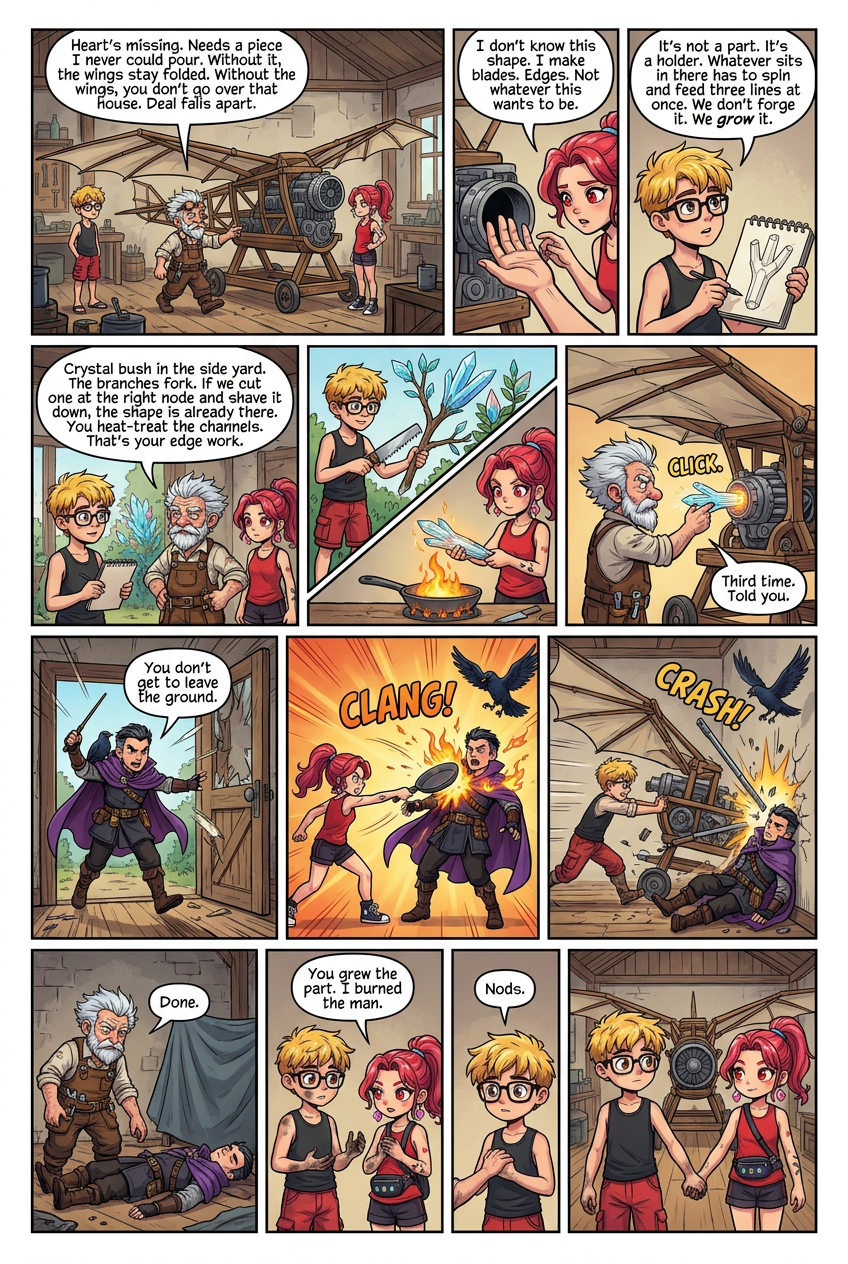
By morning Grit had the flying machine pulled to the middle of the workshop floor. The cloth wings were spread. The frame sat on a wheeled cradle. Grit walked a slow circle around it, pointing. Strut. Strut. Cable. Cable. He stopped at the engine block and tapped a hollow socket near the base. "Heart's missing," he said. "Needs a piece I never could pour. Without it, the wings stay folded. Without the wings, you don't go over that house. Deal falls apart." Ember crouched by the socket and put her hand inside. She pulled it out and stared at her palm. "I don't know this shape," she said. "I make blades. Edges. Not whatever this wants to be." Lewis pulled a notepad from his pocket and started sketching. The socket was round at the base and forked at the top, with three small channels cut along the inside. He held the sketch up. "It's not a part," he said. "It's a holder. Whatever sits in there has to spin and feed three lines at once. We don't forge it. We grow it." Grit squinted. Ember tilted her head. Lewis kept going. "Crystal bush in the side yard. The branches fork. If we cut one at the right node and shave it down, the shape is already there. You heat-treat the channels. That's your edge work." They worked through the afternoon. Lewis cut a forked branch from the bush by the workshop door and trimmed it to fit. Ember set up a small fire in Grit's pan and ran the heat along the three channels until they hardened to a glass shine. Grit fed the piece into the socket. It clicked. The wings lifted an inch on their own and held. Grit laughed once, sharp. "Third time," he said. "Told you." The workshop door rattled. Then it splintered. Sedrick stepped through, wand raised, the crow on his shoulder. He looked at the machine, at the wings, at the children. "You don't get to leave the ground," he said. He pointed the wand at the engine block. Ember moved first. She grabbed the hot pan off the fire and threw it. The pan hit Sedrick in the chest. His cloak caught. He swung the wand toward her, and Lewis shoved the wheeled cradle hard. The frame rolled. A strut caught Sedrick at the throat and pinned him to the wall. The wand dropped. The crow flew at the broken door and was gone. Sedrick slid down the wall and did not get up. Grit checked him and shook his head. "Done," he said. He dragged the body behind a tarp without looking at them again. Ember stood by the machine with soot on her hands. Lewis stood beside her. Neither moved for a long second. She looked at him. "You grew the part," she said. "I burned the man." He nodded. She took his hand. He did not let go.
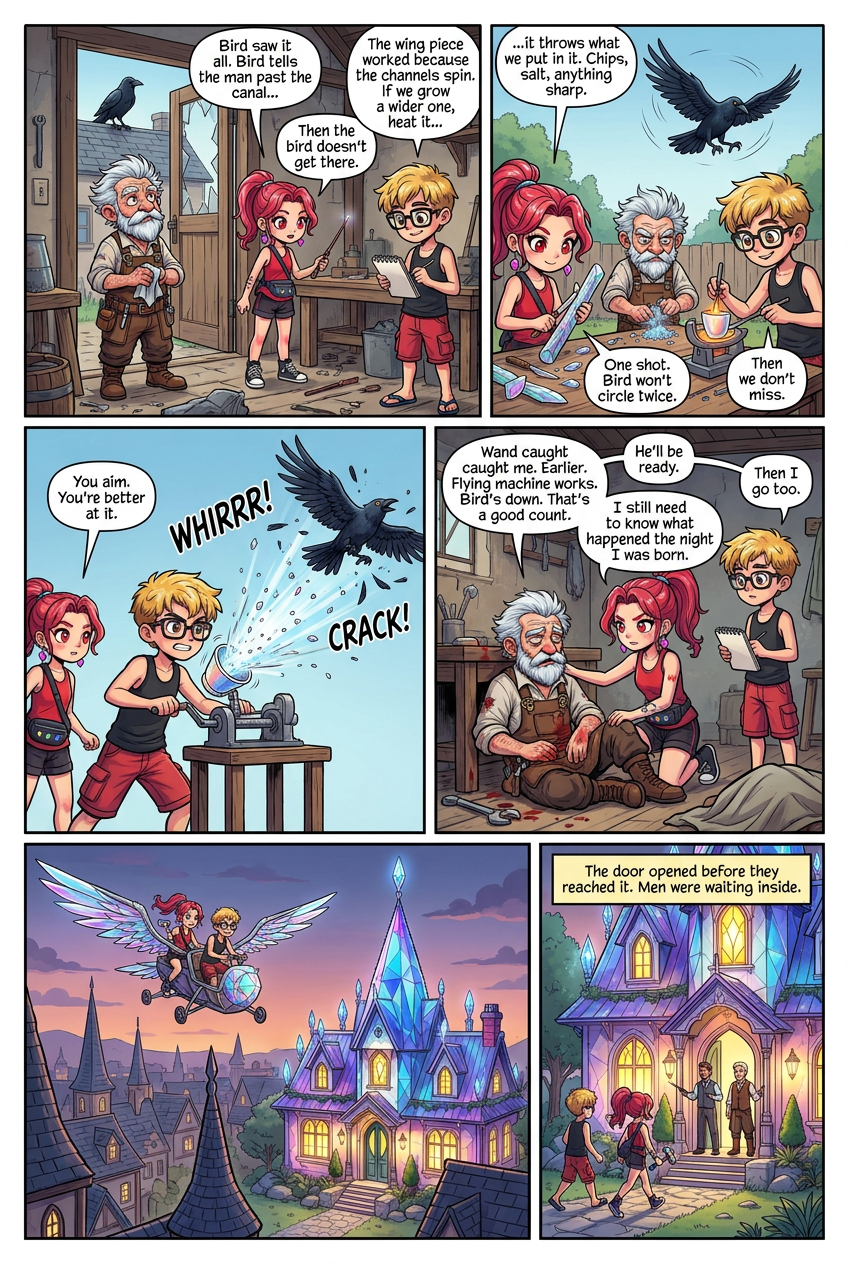
The crow was still up there. Lewis heard it through the broken door, one rough call, then another. Grit wiped his hands on his apron and looked at the ceiling. "Bird saw it all," he said. "Bird tells the man past the canal, and the man past the canal sends ten more like the one behind the tarp." Ember had not let go of Lewis's hand. She did now. She walked to the workbench and picked up the wand Sedrick had dropped. "Then the bird doesn't get there," she said. Lewis pulled his notepad out and started sketching fast. He drew the flying machine. He drew the crystal bush by the door. He drew a forked branch with a wider mouth. "The wing piece worked because the channels spin," he said. "If we grow a wider one, heat it the same way, it throws what we put in it. Chips, salt, anything sharp. Point it up, spin it up, the bird flies through a wall of it." Grit looked at the sketch. "One shot," he said. "Bird won't circle twice after the first miss." Lewis nodded. "Then we don't miss." They worked in the yard. Ember cut a thicker branch from the crystal bush and shaved the fork into a cup. Grit smashed a handful of leftover prism chips into grit the size of seeds. Lewis ran the heat along the channels until the cup hardened. They mounted the cup on the cradle the machine had rolled on. Ember spun the wheel by hand to test. The cup whirred. The chips would leave it fast. Above them the crow turned a tight circle and dropped lower, watching. Ember stepped back from the cradle. She looked at Lewis. "You aim," she said. "You're better at it." Lewis took the handle. He waited until the crow tipped its wing toward the canal, lining up to go. He shoved the wheel hard. The cup spun. The chips tore out in a bright cone. The crow came apart in the air and fell in pieces on the workshop roof. Lewis lowered the handle. His hands were shaking. Ember put her hand on his shoulder, once, then took it away. Grit climbed up and brought down what was left. He laid it on the bench without a word. Then he sat on the floor and pressed his palm to his side. He pulled the palm away red. "Wand caught me," he said. "Earlier. Didn't notice till now." Ember knelt fast. Lewis ran for cloth. Grit waved them off, slow. "Done a lot of things wrong in this shop," he said. "Flying machine works. Bird's down. That's a good count." His head went back against the bench leg. His breath stopped a minute later. Ember stayed kneeling. Lewis stood holding the cloth. They did not have long. The man past the canal would notice the silence even without a report. Ember stood up. She walked to the corner where Lewis's larger forge piece leaned, the one she had agreed to help finish the day they met. She picked up the prism hammer beside it. She turned it once in her hand. "We finish it," she said. "Then we go to the house ourselves." Lewis shook his head. "He'll be ready." "I know," she said. "I still need to know what happened the night I was born. I'm not going to get another chance." Lewis looked at Grit on the floor, and at the flying machine with its wings out, and at her. He picked up his notepad. "Then I go too," he said. They flew over the rooftops of the city at dusk, the wings holding the way Grit had said they would. The crystal house glowed below them, sharp and bright, every window lit. Ember held the hammer in her lap. Lewis held the controls. They came down in the garden. The door opened before they reached it. Men were waiting inside, more than two, with wands of their own. Ember walked in first. Lewis walked
Play your story to life
Storycraft is a mobile game where you create AI characters, craft items and locations to build their world, then discover what direction your story takes. Download the iOS game for free today!
Download for free