

Linny Marsh's Arc
22 Chapters
Linny Marsh's dream is discovering a hidden wonder beyond Palmshade's edge that no other artist has ever laid eyes on..

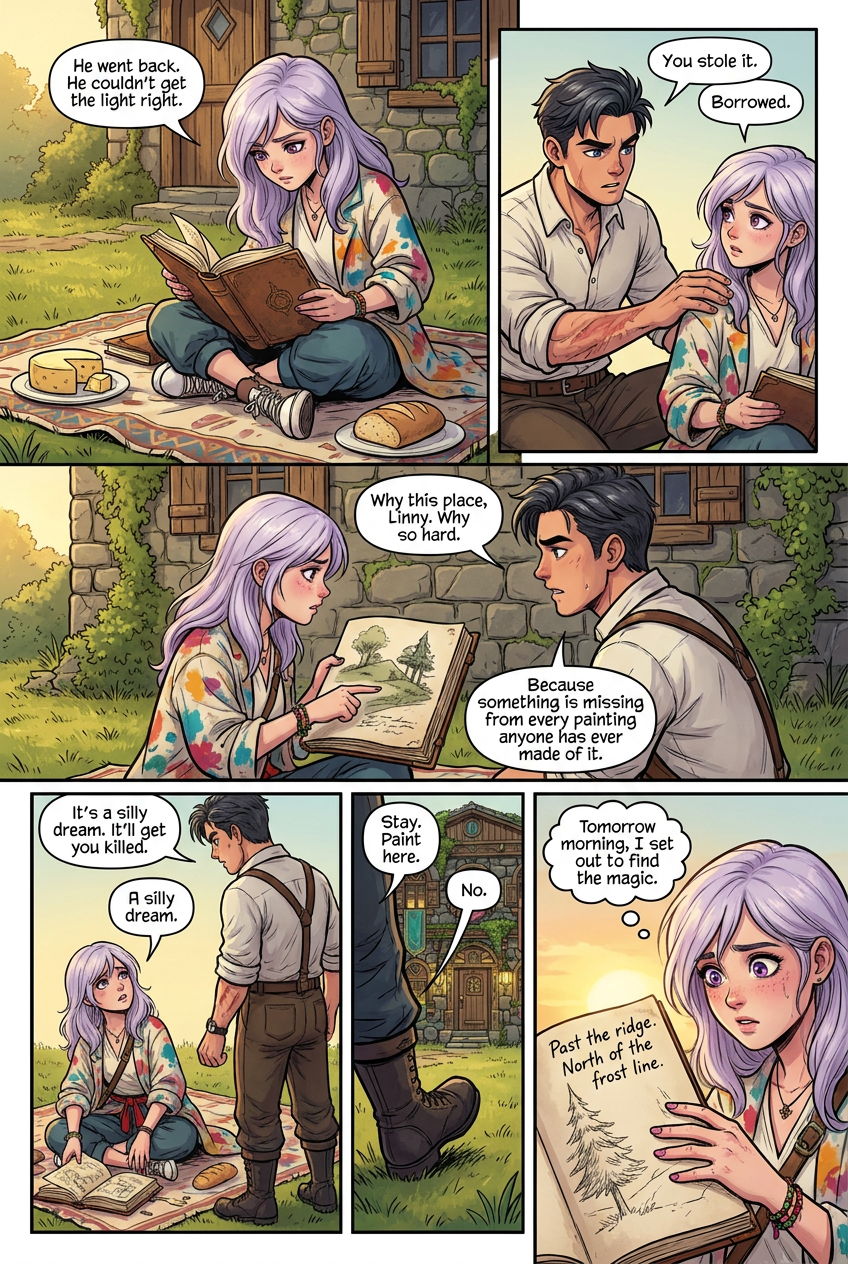
Linny Marsh spread the stolen journal across the picnic blanket and weighed its pages down with a heel of bread. Her painted coat rode up her wrists as she worked. Pale purple hair fell across her cheek. Behind her, the cobblestone wall of her sister's shop threw back the afternoon light, and the moss along its stones smelled damp and green. She had taken the journal from the library three nights ago. It belonged to one of the three painters who had all rendered the same real place with a flat, dead light. Somewhere in these pages was the road there. Forge sat beside her with a plate of cheese he hadn't touched. His sleeves were rolled. A burn scar ran down one forearm. He brushed her hair back and kissed her shoulder. He watched her turn a page and said, "You stole it." "Borrowed." "Fern will know." "Fern already knows." Linny tapped a sketch in the margin. A hill. A stand of trees drawn twice, from two angles. "Look. He went back. He couldn't get the light right, so he went back." Forge set the plate down and scooted back an inch. "Why this place, Linny. Why so hard." "Because something is missing from every painting anyone has ever made of it. All three of them painted the light wrong. Flat. Still. Like they were afraid of it." She looked up. "I want to see what they couldn't." "Don't go." It was almost a plea. "What?" She breathed with disbelief. "It's past the ridge. People don't come back from past the ridge." His voice stayed level, which was worse. "It's a silly dream. It'll get you killed." She closed the journal on her thumb. Betrayal stung her chest. She’d never expected it from him. "A silly dream." "Yes." "You spent two weeks drawing swords instead of finishing Mrs. Hale's bracelet." His jaw set. "You want a forge full of blades no one in this village will ever buy. Don't tell me about silly dreams, Sterling." "That's different." "Because it's yours." He stood. The blanket lifted at one corner and the bread rolled off the journal. "Stay," he said. "Paint here. Paint anything else." It was the same sentence, in a new mouth. She had heard it once already, and she had left that house too. "No." He waited. She did not look up. After a moment his boots crossed the grass and were gone. Linny opened the journal again. Her hands shook once and then stopped. She read every margin. She read the ink smudges. On the fourth page from the back she found what she wanted: a line of small numbers under a sketch of a leaning pine, and beside it, three words in a hurried hand. Past the ridge. North of the frost line. She held her thumb on the words until they printed into her skin. She rolled the journal into her coat pocket, stood. Tomorrow morning, she set out to find the magic. To finish what the other artists couldn’t.
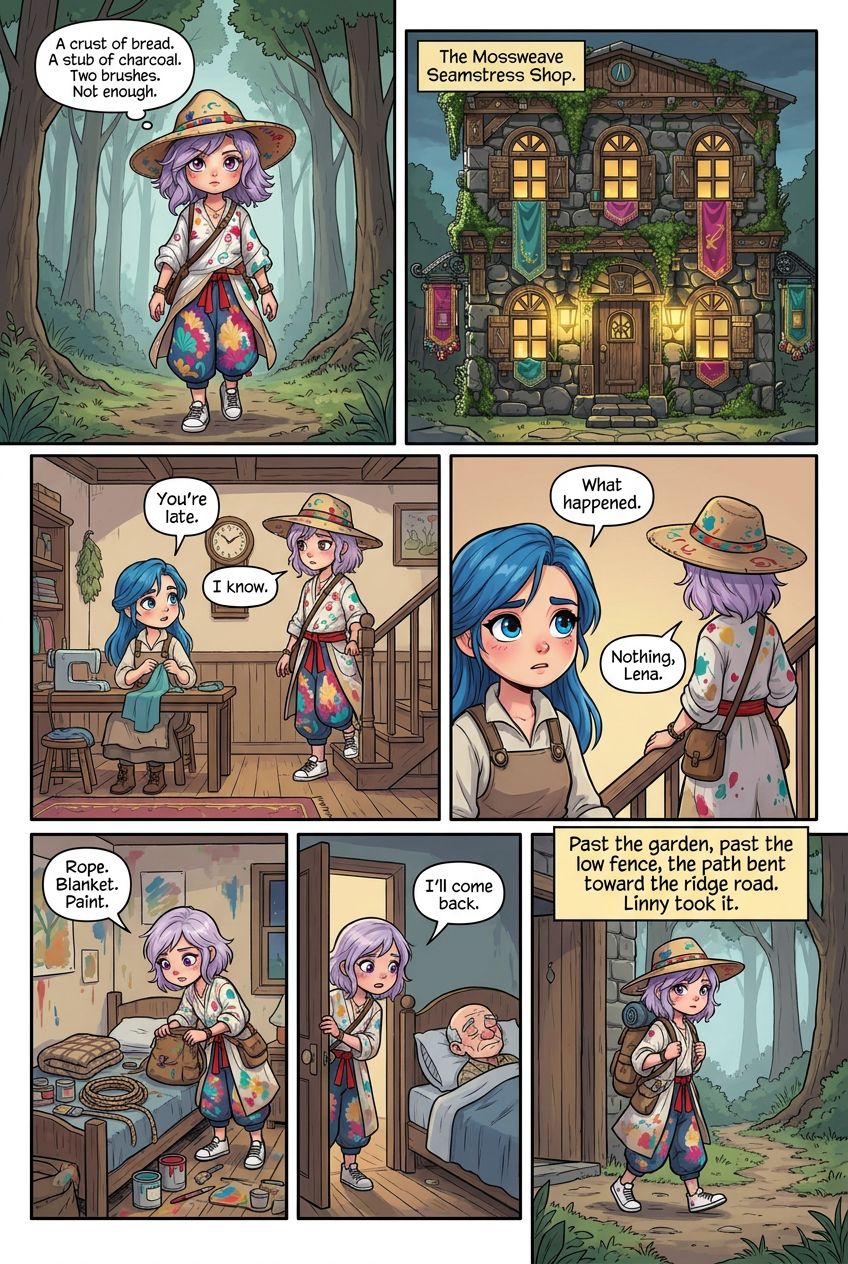
Linny walked home from the picnic with the journal pressed against her ribs. The coat pockets bumped her hips as she went. A crust of bread. A stub of charcoal. Two brushes. That was all they held. Past the ridge was three days out, maybe four. She counted what she had and the number stayed too small. She would freeze before the frost line. She would starve before the leaning pine. She needed rope. She needed a blanket. She needed more than this coat could carry. The cobblestone shop sat under its climbing vines, windows warm. Linny pushed the door open. Her sister Lena looked up from the counter, needle held between her teeth, blue hair pulled back. A bolt of gray wool lay across her lap. She took the needle out. "You're late." "I know." Lena watched her cross the room. The seamstress read faces the way she read cloth. She saw the red at Linny's eyes and the set of her jaw. "What happened." Linny stopped at the stairs. She thought of Forge sitting back on the blanket. Silly dream. She thought of the other house, the other voice, the same sentence. She did not want to hand any of it to her sister. "Nothing." "Linny." "Nothing, Lena." She climbed the stairs before her sister could stand. Her room was small and smelled of linseed oil. She dragged the wooden chest from under the bed. She worked fast so she would not think. A wool blanket, folded tight. A coil of rope from the peg by the window. Two tins of paint. Three brushes wrapped in rag. A tin cup. Hard cheese and a heel of bread stolen from the kitchen shelf. She rolled the blanket around the rest and tied it with twine. Last, she tucked the painter's journal inside her coat, against her chest, where the pages could feel her breathe. She set the bundle by the door and lay down in her clothes. Downstairs, Lena's needle moved in the quiet, tick tick tick, long after the lamps went out. Morning came gray. Linny listened at the top of the stairs. Lena was already at the counter, bent over the gray wool, a shirt laid across her knees. Her hands moved without stopping. She did not look up when the floorboard above her creaked. Linny went into her father’s room. He was pale. He’d made her promise never to give up on her dreams, so we wouldn’t. She gave his head a lasting kiss before she climbed down in her stocking feet with the bundle over her shoulder. She reached the back door. Her hand was on the latch when she stopped and looked once at her sister's blue head bowed over the cloth. "I'll come back," she said, too soft to carry. She stepped into the yard. She pulled her boots on at the wall. The bundle rode her back now, heavy and honest. Past the garden, past the low fence, the path bent toward the ridge road. Linny took it.
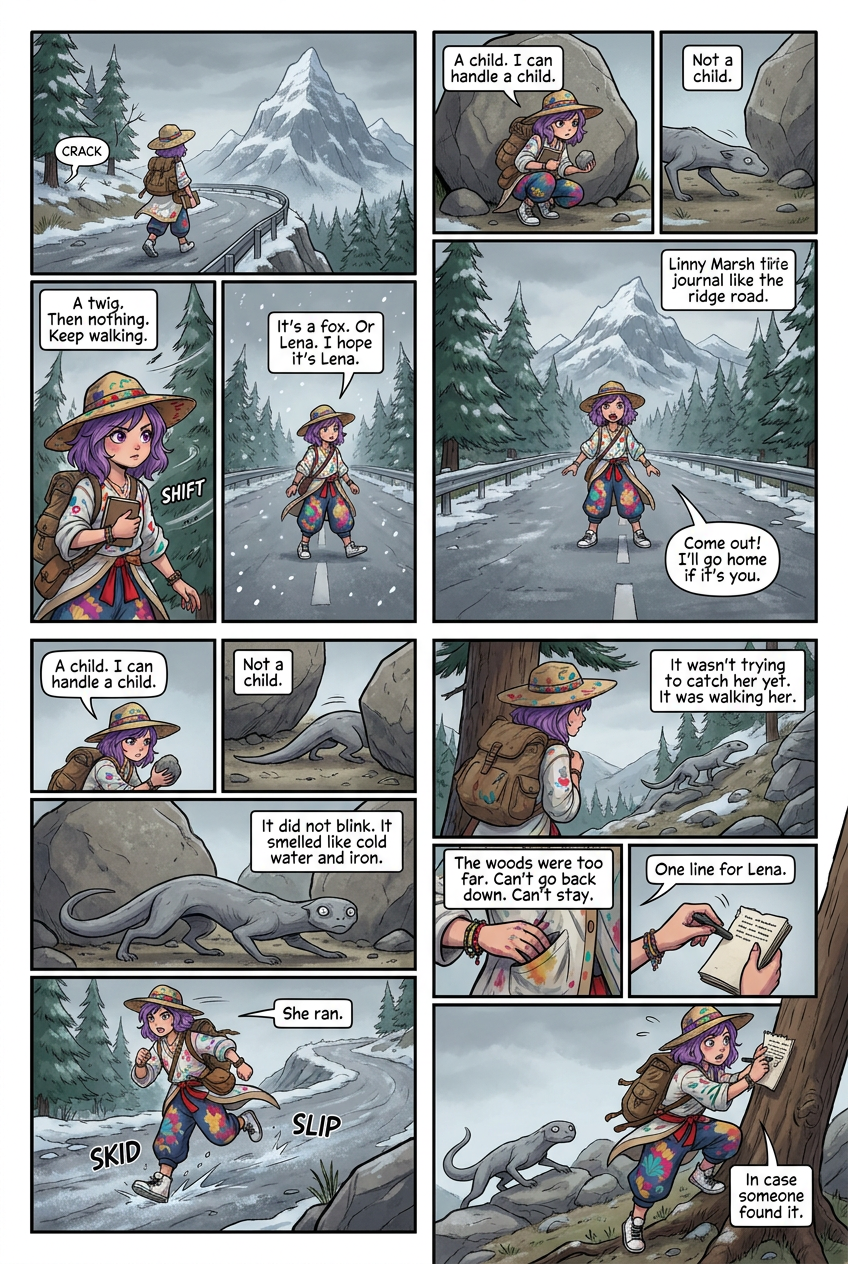
The ridge road climbed through gray light. Linny walked with the bundle on her back and the journal against her chest. She had gone maybe a mile past the last fence when she heard the first crack behind her. A twig. Then nothing. She kept walking. A stone shifted somewhere in the brush. She kept walking. She told herself it was a fox. She told herself it was Lena, come to drag her home. She hoped it was Lena. She stopped in the middle of the road and turned. The path was empty. Pines held the wind above her. Snow dusted their tops where the ridge rose ahead, steep gray stone crowned in white. "Come out," Linny said. "I'll go home if it's you." Nothing answered. She waited a long count. Then she turned and walked again, faster now. The steps started again behind her. Light. Short. She thought of the boy who begged for bread outside the square, small and thin. A child could follow a person for miles without being seen. A child she could handle. A child she could send back with a coin. She stepped off the road behind a boulder and crouched. She set the bundle down. She picked up a fist-sized rock and waited. The steps came closer. Slow. Then quiet. Then a shape moved past the boulder at knee height, and it was not a child. It was long and low, gray as the stone, with a narrow back and a flat head that turned the wrong way on its neck. Its eyes found her before its body did. They were pale and wet. It did not blink. It smelled like cold water and iron. Linny did not throw the rock. Her hand would not move. The thing lifted its nose and drew a slow breath through her, taking her in. Then it stepped once toward her, careful, testing the ground. She ran. She ran off the road and up the slope, boots skidding on frost, the bundle beating against her spine. She did not look back. She did not need to. She heard it on the scree behind her, patient, keeping her pace. It was not trying to catch her yet. It was walking her. She crashed into a stand of pines above the road and pressed her back to a trunk. Her breath tore. Below her the shape climbed without hurry, weaving between rocks. She understood then that it had picked her up long before the first twig. It had let her hear it. The woods were still three ridges off. She could not go back down. She could not stay here. She dug in her coat until her fingers closed on the stub of charcoal and the journal. She pulled the journal out and tore a page. She wrote one line for Lena, in case someone found it. Then she pushed off the tree and climbed.
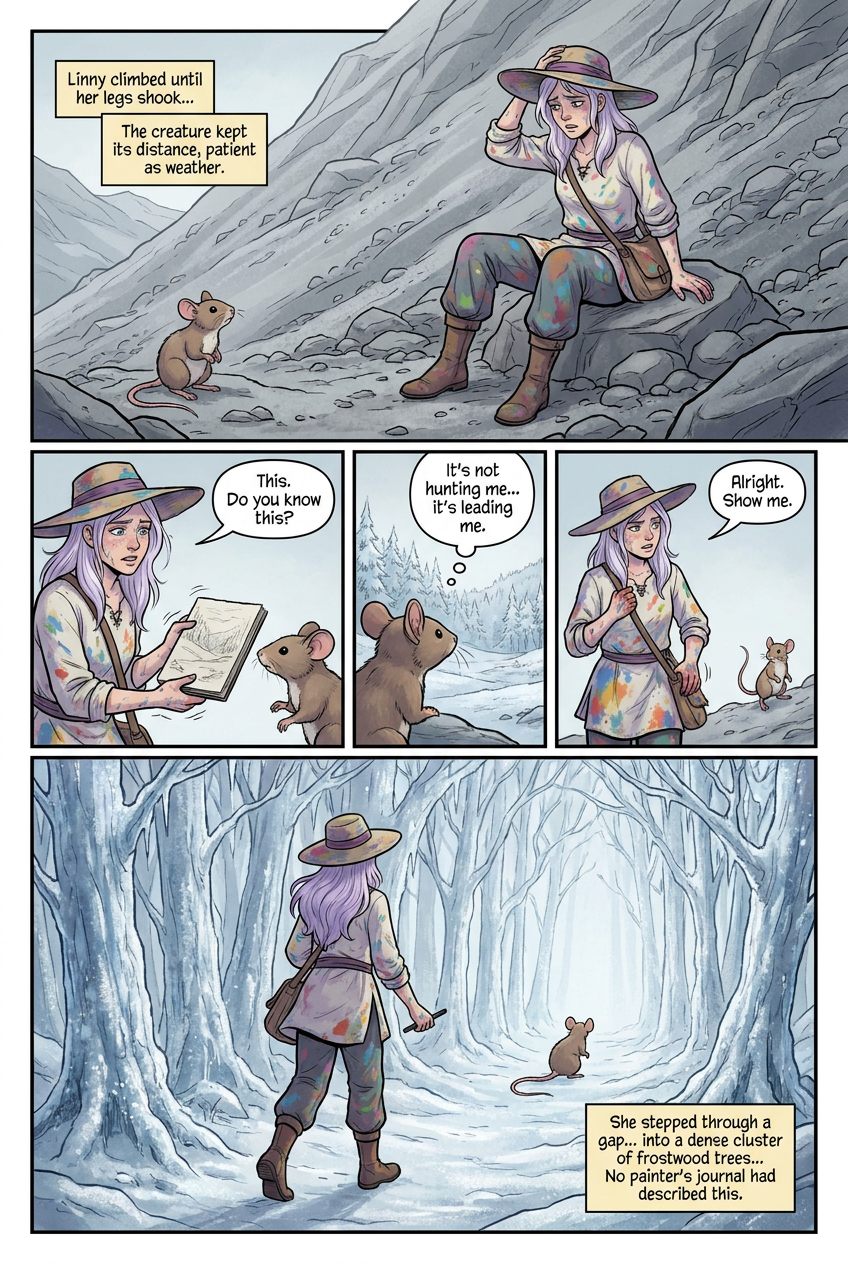
Linny climbed until her legs shook. The creature kept its distance below her, gray against the gray scree, patient as weather. She reached a shelf of rock and stopped because her lungs would not let her go on. The thing stopped too. It sat back on its short legs and watched her with wet, forward eyes. Its ears turned like a cat's. Up close it looked less like a wolf and more like something between a mouse and a house cat, swollen too big. She understood then that it had not lunged. It had walked her up the ridge for an hour and never closed the gap. If it wanted her dead she would be dead. She pulled the journal from her coat. Her hands were shaking. She flipped past the coordinates to the page she had copied from the stolen painter's book — the sketch of the place with the flat, still light. She held it open and turned it toward the animal. "This," she said. Her voice cracked. "Do you know this?" The creature stood. It came three steps up the slope and stopped again. Its nose worked the air above the page. Then it turned its flat head and looked north, off her route, into a stand of frost-bright trees she had planned to skirt wide. It looked back at her. It looked north again. It took another step, deliberate, away from the direction she meant to go. Linny closed the journal. Every rule she had ever been given said run downhill and take her chances on the road. Forge would have said it louder than anyone. He was not here to say it. That was the point of leaving. She picked up her bundle. "Alright," she said. "Show me." The creature moved. It did not hurry. It kept ten paces ahead and looked back at each turn to be sure she followed. Its short legs punched neat holes in the frost. Twice she stopped to breathe and it stopped with her, sitting like a fat gray cat on the stone. The pines thickened. She stepped through a gap in the rocks and into a dense cluster of frostwood trees. Ice sheathed every branch. The canopy above her caught the light and threw it back in small hard pieces. The air smelled of cold sap. She had never seen a wood like this on any map. The creature waited, watching her. Linny set her bundle down and pulled out her charcoal. Her hand was steady now. She had followed a monster off her route and it had brought her somewhere no painter's journal had described. She did not know if she was being led to the place she wanted or away from it. She only knew she was deeper in the woods than she had planned to be by nightfall, and the thing that had herded her here was waiting to see what she would do next.
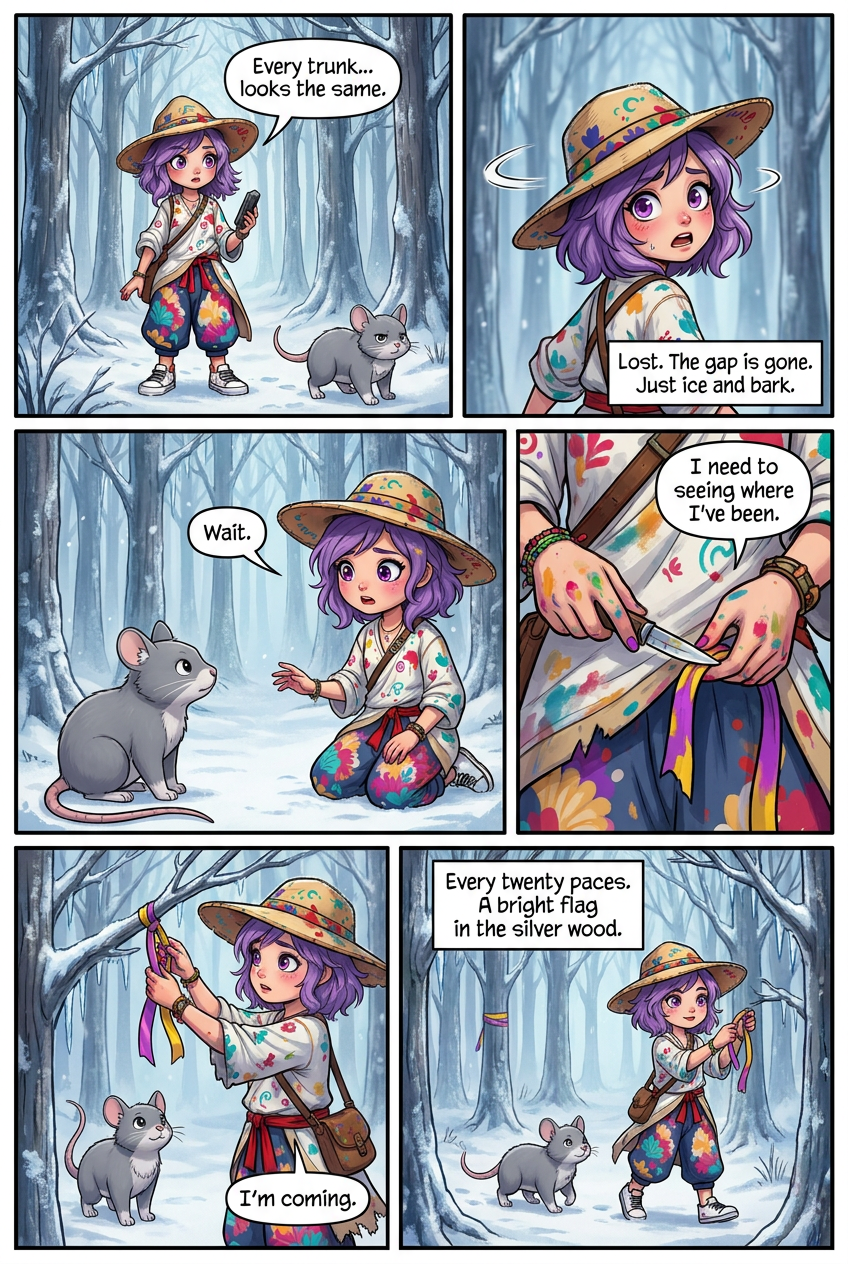
Linny stood in the frostwood cluster with her charcoal in her hand and watched the gray creature watch her. It had led her off her route and into a wood no map had shown her. It would not stay her guide forever if she could not keep up. The trees pressed close. The ice on the branches threw the light back in a hundred small flashes, and every trunk looked like the last. She took three steps forward to test the ground. When she looked back, the gap she had come through was already gone. The trunks behind her looked the same as the trunks ahead. She turned in a slow circle. Every direction was the same silver flare of ice and bark. The creature waited ten paces off. It swung its flat head to see if she was coming. She could not tell it she was lost. She could tell it she needed a moment. "Wait," she said. It sat. Linny knelt and opened her bundle. Rope. Blanket. Journal. Food she could not spare. She had no ribbon, no chalk, no paint that would show on frost. She had her coat. She put the charcoal between her teeth and worked her knife under a seam on the inside of her hem. The stitches she had sewn last spring gave with a small clean sound. She cut a strip of painted cloth the length of her forearm. Purple and yellow. Her own hand had made those marks. She could see them from twenty paces in this light. She tied the strip around a low branch at eye height. It hung bright against the ice. She cut another. She cut a third. The creature stood up. It did not like the stopping. It took a step north and looked back. "I'm coming," Linny said. "I have to see where I've been." She cut until her hem was ragged and her coat was shorter at the front than the back. She counted twelve strips folded into her pocket. She stood and followed the creature, and every twenty paces she tied one to a branch at the height of her own eyes. The cluster went on longer than she thought a wood could. Twice she stopped, looked back, and found her last marker exactly where it should be, a small bright flag between the trunks. Her chest loosened each time. On the twelfth strip the creature stopped. It sat down in the snow and did not go forward. Ahead the trees thinned. Through the last trunks Linny saw a clearing, and in the clearing the light did not move. “This is not the place,” she huffed. The creature laid down. Linny walked into the clearing with a frown. She’d walked all day. It was growing dark and she was nowhere near finding her magical landscape.
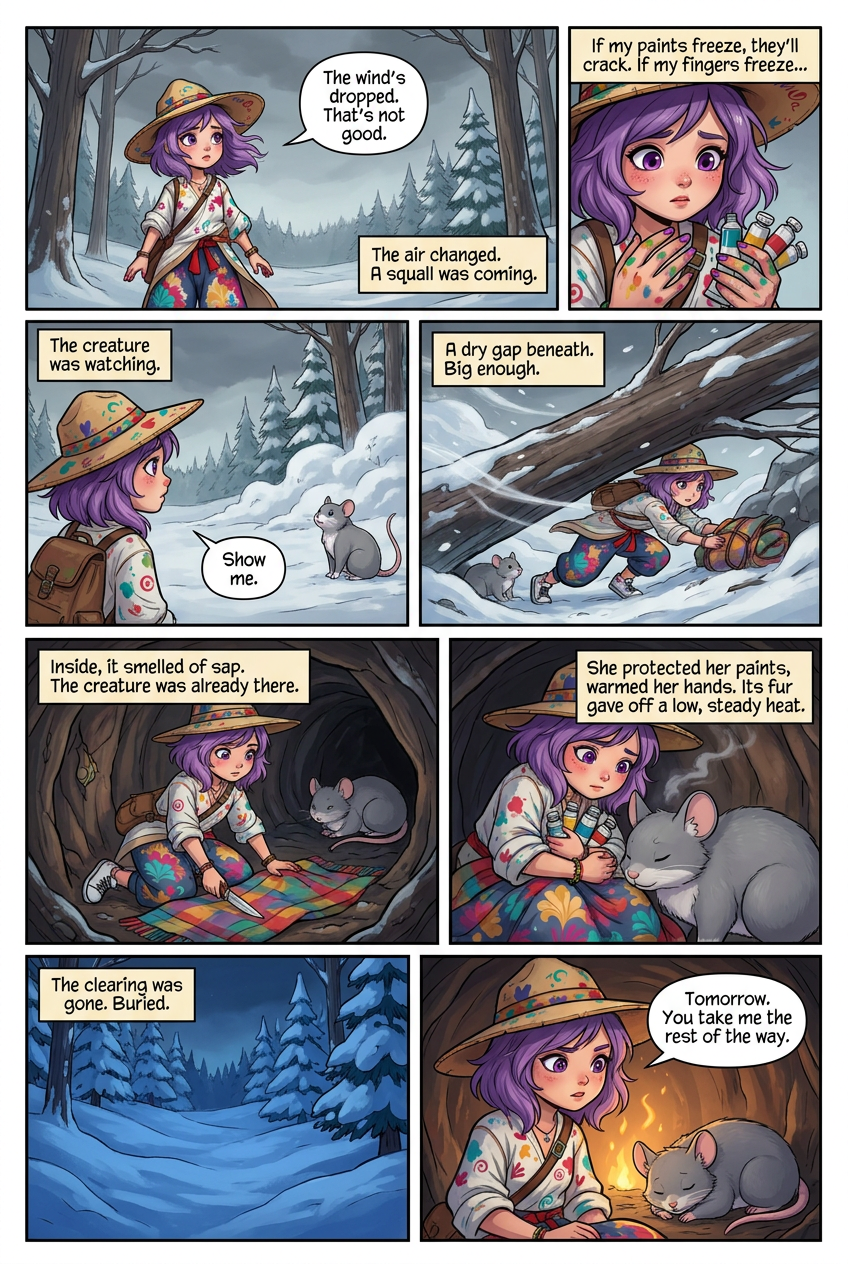
Linny stood in the flat, wrong light of the clearing and felt the air change. The wind dropped first. Then it came back cold enough to sting her teeth. Ice began to tick against the branches behind her. She turned and saw a wall of gray sliding through the frostwood trunks. A squall. She had maybe two minutes. Her paints were in her coat. Her hands were bare. If the paints froze they would crack the tubes. If her fingers froze she could not untie a knot or hold a brush again for days. She needed walls and a roof, and she had neither. She ran back to the tree line. The gray creature was already up, ears forward, watching the squall come. It turned and trotted along the edge of the clearing, low to the ground on its short legs, its long back swaying. It stopped at the base of a leaning frostwood and looked at her. "Show me," Linny said. The creature squeezed under the trunk and vanished. She dropped to her knees and looked. The tree had fallen against another and left a dry gap beneath, floored with old needles. Not big. Big enough. The first hard gust hit her back. She shoved her bundle in ahead of her and crawled after it. Snow chased her in. She kicked it out with her boot and pulled her blanket across the opening, wedging the edge under the trunk with her knife handle. Inside it was dark and close and smelled of sap. The creature was already curled at the far end, watching her with its wet, forward eyes. Its body took up half the hollow. Its fur gave off a low, steady heat. Linny worked fast. She dug her paint tubes out and pushed them under her shirt against her stomach. She flexed her fingers until they hurt. She wrapped her hands in the ragged hem of her coat, the same painted cloth she had cut her markers from. Outside, the squall closed over the clearing. Ice hit the blanket like sand. She pressed her back to the creature's side. It did not move away. Its ribs rose and fell against her spine. She held her hands under her arms and counted her breaths until they slowed. When the wind eased she lifted a corner of the blanket. The clearing was gone. Her twelve markers were gone. Snow lay a hand deep on everything, unbroken and blue in the dusk. The way back was buried. Linny let the blanket fall. Her paints were warm against her skin. Her fingers worked. She was alive, and she was lost. The creature huffed once and settled its flat head on its paws. "Tomorrow," she told it. "You take me the rest of the way." It closed its eyes. Linny did not.
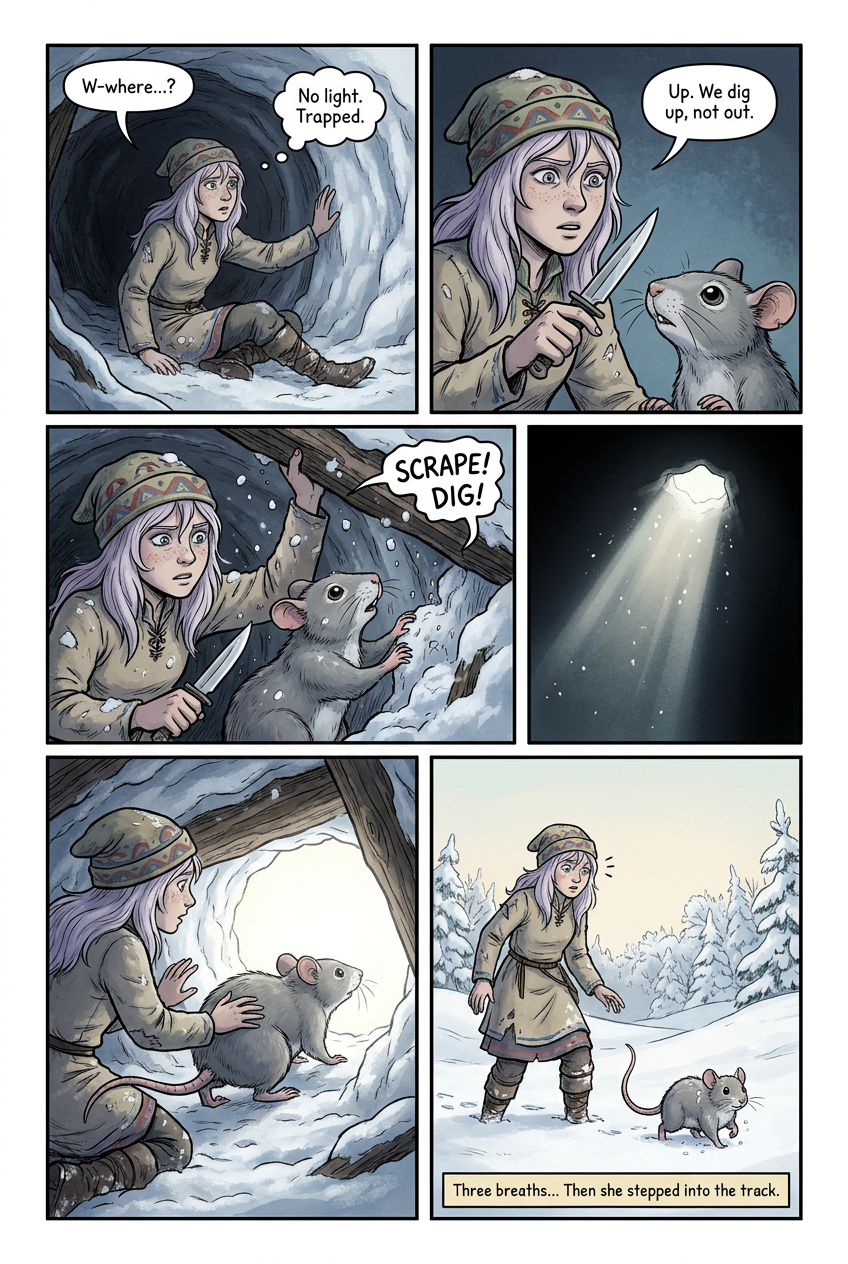
Linny woke to a weight on her chest and no light at all. The blanket she had wedged across the opening was gone—no, it was still there, but pushed inward by a wall of packed snow. She reached out and her knuckles hit cold. The snow had come in the night and sealed the hollow shut. She held still and listened. The creature breathed beside her, slow and warm. Her own breath came faster. The air in the hollow tasted thick. She had felt this once before, under a heavy quilt as a child, and she remembered how quickly a small space could turn against a body. She pushed the blanket. It gave a finger's width and stopped. She pushed harder. Snow crumbled onto her wrist and she stopped, afraid the roof of it would drop on her face. "Up," she said to the creature. "We dig up, not out." It lifted its flat head. Its wet eyes caught the last shred of light leaking through the packed white. She pointed at the trunk above them, where a knot of bark met the fallen frostwood. The creature stared. Linny took her knife from where it wedged the blanket. She reached up along the slope of the trunk and pressed the blade into the snow at an angle, aiming for the side of the drift, not the top. She scraped. Snow fell into her lap. She scraped again. Cold water ran down her sleeve. Her arm shook by the twentieth pass. The air was thinner now. She felt it in her lips. The creature watched, then rose on its short legs and set its front paws against the trunk beside her hand. It began to dig. Its paws moved in short, heavy strokes, faster than hers. Snow piled between them and she scooped it back toward her boots and stamped it flat. A thread of pale light broke through above the knife. Linny put her mouth to the gap and drew a long, clean breath. Her chest ached with it. She widened the hole with the knife handle, then with her fist. The creature squeezed past her and shoved its head through. Its shoulders followed. She grabbed its haunches and pushed. When it was out, she threw her bundle up after it and climbed. Her coat caught on a splinter of the trunk and tore. She did not stop to look. She stood knee-deep in fresh snow, blinking at a white world. The clearing was gone under it. The frostwoods were black posts. The sky was the pale of an eggshell. Her paints were still warm against her stomach. Her hands hurt. The creature shook itself and started off, low-backed, breaking trail with its chest. Linny counted three breaths to steady herself. Then she stepped into the track it made and followed.
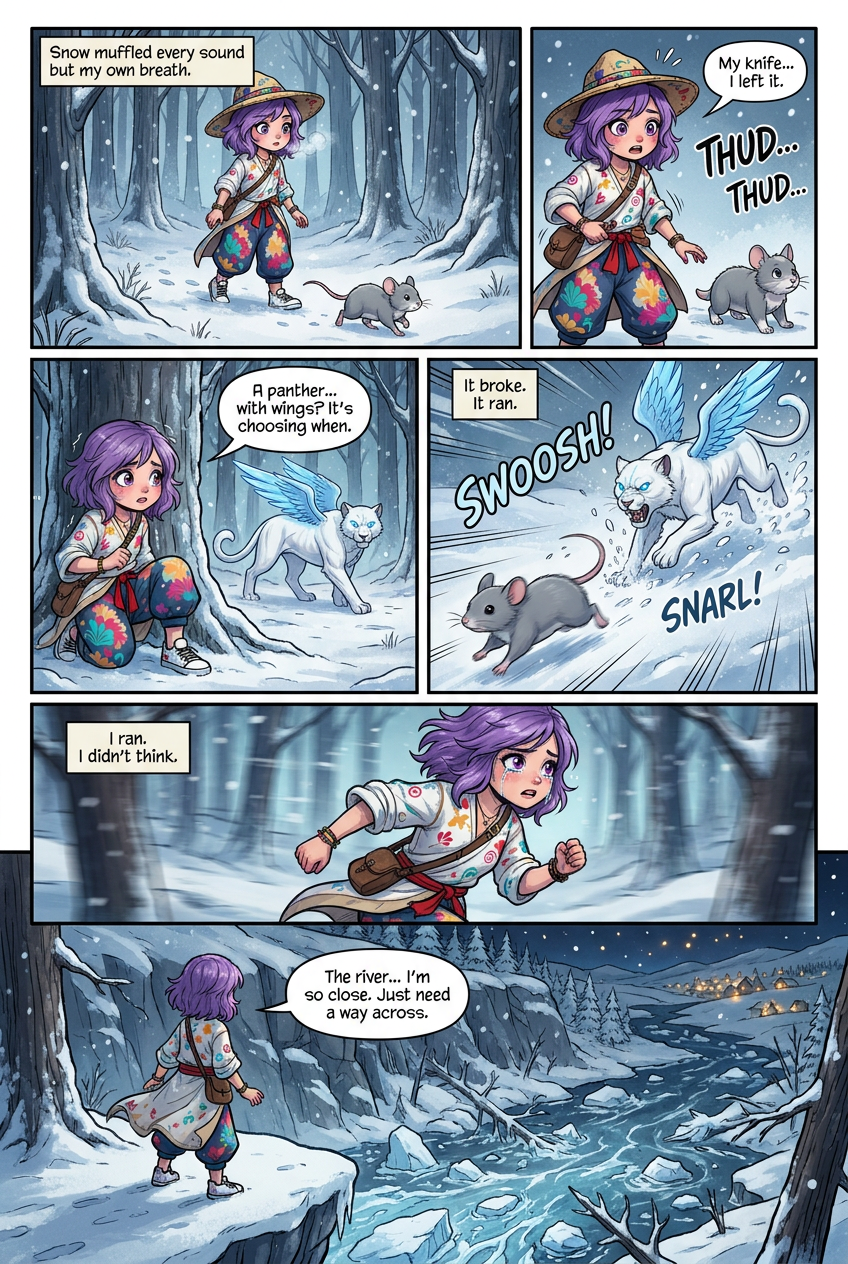
Linny followed the gray creature into a thicker stand of frostwoods. The trunks pressed close here. Ice coated the fine upper branches and made a low shimmer above them. Snow muffled every sound but her own breath. Then the creature stopped. Its ears pushed forward. Linny stopped too. She heard it a moment later—a slow, heavy tread between the trees ahead. Something big. Something that did not care about being quiet. Her hand went to her knife and closed on nothing. She had left it wedged in the snow at the hollow's mouth. She had climbed out and forgotten it. Her stomach dropped. She crouched behind the nearest trunk. The creature crouched with her, low against her boot. She had heard the village talk about what lived past the ridge. She had laughed then. She was not laughing now. Her hands shook inside her sleeves. The trees ahead parted. A white cat the size of a plow horse stepped into the gap. Small blue wings folded tight against its shoulders. Its eyes were a hard, pale blue. It lifted its head and drew in the air. Linny pressed flat to the bark. She had no blade. She had a knife-cut coat, paint tubes warm against her belly, and a small gray animal breathing at her ankle. Nothing that would stop the thing in front of her. The panther took a step. Then another. It moved without hurry, the way the first creature had moved on the ridge road, and she understood it was choosing when. Beside her, the gray creature shifted. Its whole body went tight. Then it broke. It shot out from behind the trunk in a low gray streak, tail flat, and cut across the panther's line of sight. The panther's head snapped around. Its haunches dropped. It sprang. Wings opened once, twice. The panther cleared a low branch and was gone between the trunks, chasing the smaller shape deeper into the cluster. Snow sifted down from the disturbed limbs. Linny did not think. She ran the other way. She ran until her lungs burned and the trees thinned. She did not look back for the creature that had stayed with her since the ridge. She could not help it now. It had bought her this. She stumbled out of the frostwoods onto a lip of open ground and stopped hard. Below her the land dropped off, a raging River of ice chunks and broken trees flowed hundreds of feet down. Lights sparkled just above the trees on the other side. She was so close. She just needed a way across.
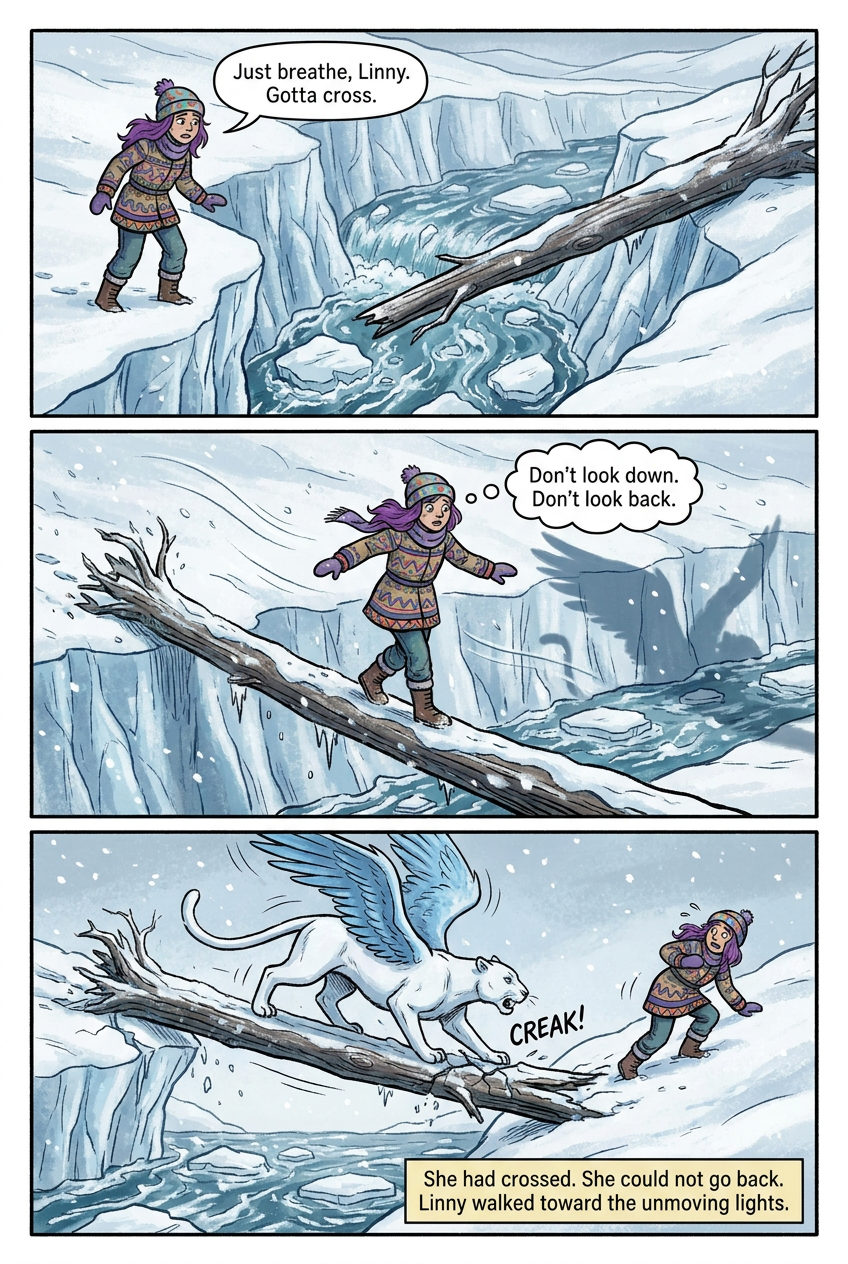
Linny stood at the edge of the ravine and forced her breath to slow. The river below churned with ice and broken trees. The lights on the far side blinked between branches, close enough to count. She could not stay here. The panther would finish with the gray creature and come looking. She had no knife and no plan. She turned along the rim to find a way down or across. She walked upstream first, keeping the drop on her left. The wind cut through the seams of her painted coat. After a hundred paces the ground dropped into a narrower gap. A frostwood had fallen across it. The trunk lay wedged between two clusters of iced trees on either bank, its fine upper branches locked into the shimmering canopy on the far side. Snow sat in a low ridge along the top. She stepped closer and tested the wood with her boot. The trunk held. It was wide enough for one foot at a time. Below, the river ran a long way down. A sound broke from the frostwoods behind her. A low huff, then the crack of a heavy branch. She did not turn. She stepped onto the log. She kept her eyes on the far bark and moved. One foot. The next. The trunk gave a slow creak under her weight. Snow fell from it in soft clumps. She reached the middle and made herself keep breathing. Wind pushed against her hat. She flattened her hand on the wood and kept going. Halfway across, a shadow passed above the canopy on the near bank. She heard wings open. She did not look. She ran the last stretch, arms out, and threw herself into the iced branches on the far side. Fine ice snapped against her face. She caught a limb, then another, and dragged herself down onto solid ground. Behind her the panther landed on the log. The trunk shifted under its weight. It took one step and the wood groaned. It took a second step, and the log rolled off its wedge and dropped. Ice and wood went down together into the river. The panther beat its wings once and hauled itself back to the far rim. It paced there. It watched her. It did not try to cross. Linny sat down in the snow. Her hands were shaking. She pressed them against the warm paint tubes under her coat until they stopped. Then she stood up. The lights were still there, closer now, low between the trees. She could see they were not lanterns. They did not flicker like fire. They held steady and soft, the way the painters had rendered light in that place. Flat. Static. She had crossed. She could not go back. She walked toward the lights.
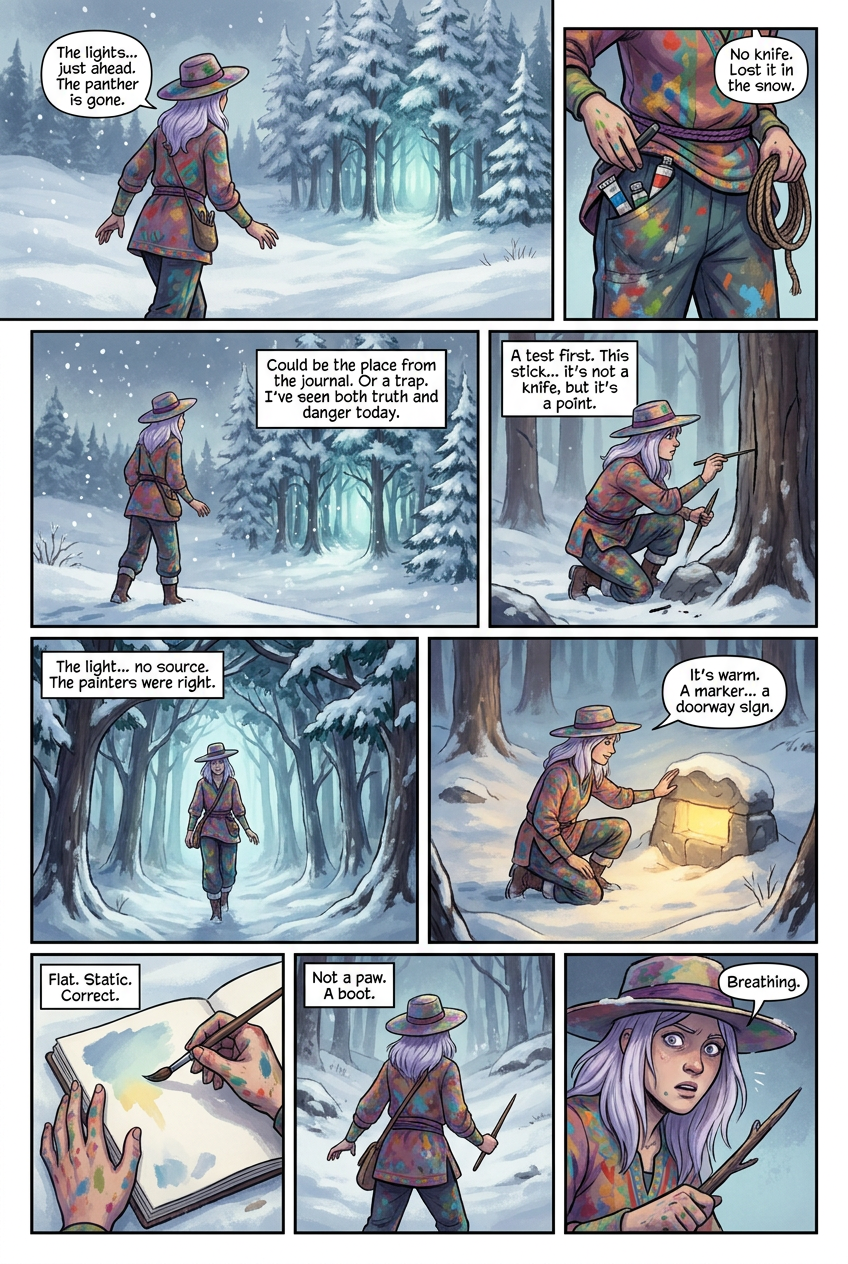
Linny walked toward the lights with her hands open at her sides. The panther's pacing faded behind her. The far bank sloped down through a dense stand of frost-laden trees, their fine icy branches locked overhead into a pale canopy. The lights sat somewhere inside that cluster. She had no knife. She had lost it in the snow when the log dropped. Her pockets held paint tubes, a stub of charcoal, folded paper, and rope. Nothing that would cut. She stopped at the tree line and made herself think. The lights could be the place from the journal. They could also be a trap set by something that knew hungry travelers followed light. She had trusted the gray creature and it had brought her this far. She had also seen a winged panther try to eat her. Both had been true in one day. She needed a test before she stepped under the canopy. She pulled the stub of charcoal from her coat and drew a short line on the nearest trunk. Then she picked up a fallen branch, snapped it against her knee, and sharpened the end on a rock at the base of the tree. It was not a knife. It was a stick with a point. She held it low and stepped in. The icy branches closed over her head. The light inside the cluster was even, cool, and did not move. It came from nothing she could see. It sat on the snow and on the bark without a source. She recognized it. The painters had rendered this exact light and been called liars for it. She walked ten paces. The trees opened into a small clear space. In the middle of the space, a low stone sat half-buried in snow. The light poured up out of the stone like water held still. No lantern. No fire. No wire. It was the light itself. Linny knelt and touched the stone with the back of her hand. It was warm. She almost laughed. She had crossed a river and lost a blade and outrun a cat with wings to touch a warm rock, and it was worth it. This was a piece of the place. Not the whole thing. A marker. A doorway sign. She took out her paper and set it against her knee. She mixed a small square of the light onto the page in three quick strokes. Flat. Static. Correct. Then she heard the snow crunch behind her. Not a paw. A boot. Someone had followed her into the cluster, or had been waiting inside it. She did not turn. She closed her paint tin. She lifted the sharpened stick and set the paper flat under her knee so it would not blow away. Whoever it was took another step and stopped, close enough that she could hear them breathing.
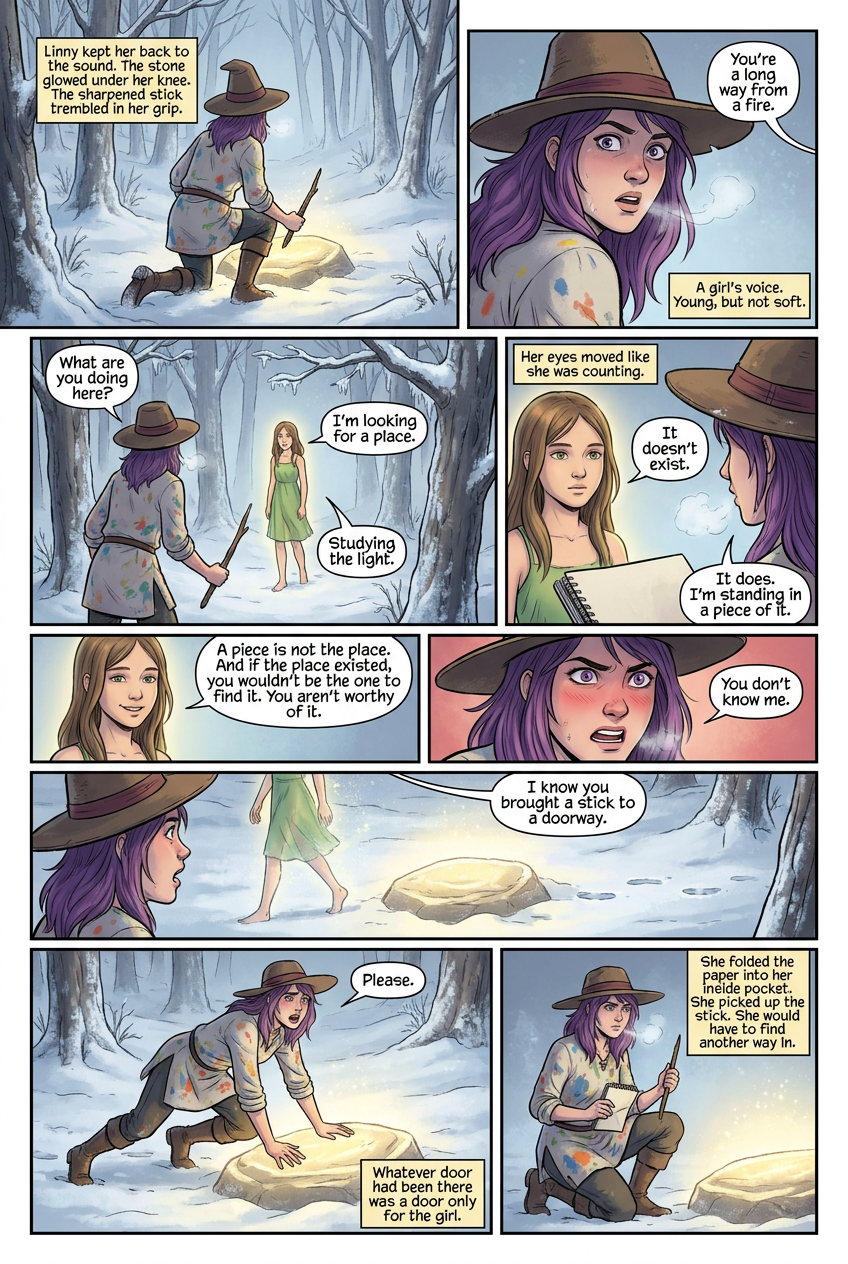
Linny kept her back to the sound. The stone glowed under her knee. The sharpened stick trembled in her grip, but she held it steady. Whoever stood behind her had walked into a grove of ice-locked trees without breaking a twig. That meant they belonged here. She did not. "You're a long way from a fire," a voice said. A girl's voice. Young, but not soft. Linny turned on her heel and rose. The stranger stood five paces off, between two frost-laden trunks. She wore a thin green dress and no coat. Her arms were bare. Her feet were bare. Snow sat on the branches above her and did not fall. She looked warm the way a lit window looks warm from outside. Linny's own fingers were numb inside her painted sleeves. "What are you doing here?" the girl asked. "Studying the light." Linny lowered the stick but did not drop it. "Who are you?" The girl did not answer. She looked at the sketchbook under Linny's knee, then at the stone, then at Linny's face. Her eyes moved like she was counting. "I'm looking for a place," Linny said. "Three painters put it on canvas. They painted the light flat, like this. I came to find the rest of it." "It doesn't exist." "It does. I'm standing in a piece of it." The girl almost smiled. "A piece is not the place. And if the place existed, you wouldn't be the one to find it. You aren't worthy of it." Linny's face went hot. "You don't know me." "I know you brought a stick to a doorway." Linny opened her mouth to argue. The girl walked past her before the words came. She stepped over the stone without looking down. On the far side of it, between one step and the next, she was gone. No flash. No sound. The snow where her bare foot had pressed held the print for a breath, then filled itself in. Linny lunged. She dropped the stick and put both hands on the stone and stepped across it the way the girl had stepped. Her boot came down in snow. Just snow. She tried again from the other side. She walked around the stone. She knelt and pressed her palm flat to the warm surface and said, "Please." The light did not change. The grove did not open. Whatever door had been there was a door only for the girl. Linny sat back on her heels. Her breath fogged. The stone kept glowing, indifferent. She pulled the sketch out from under her knee. The square of flat light was still correct. She had proof now that the place was real and that someone guarded its threshold. She also had proof that the threshold would not open for her. She folded the paper into her inside pocket. She picked up the stick. She would have to find another way in.
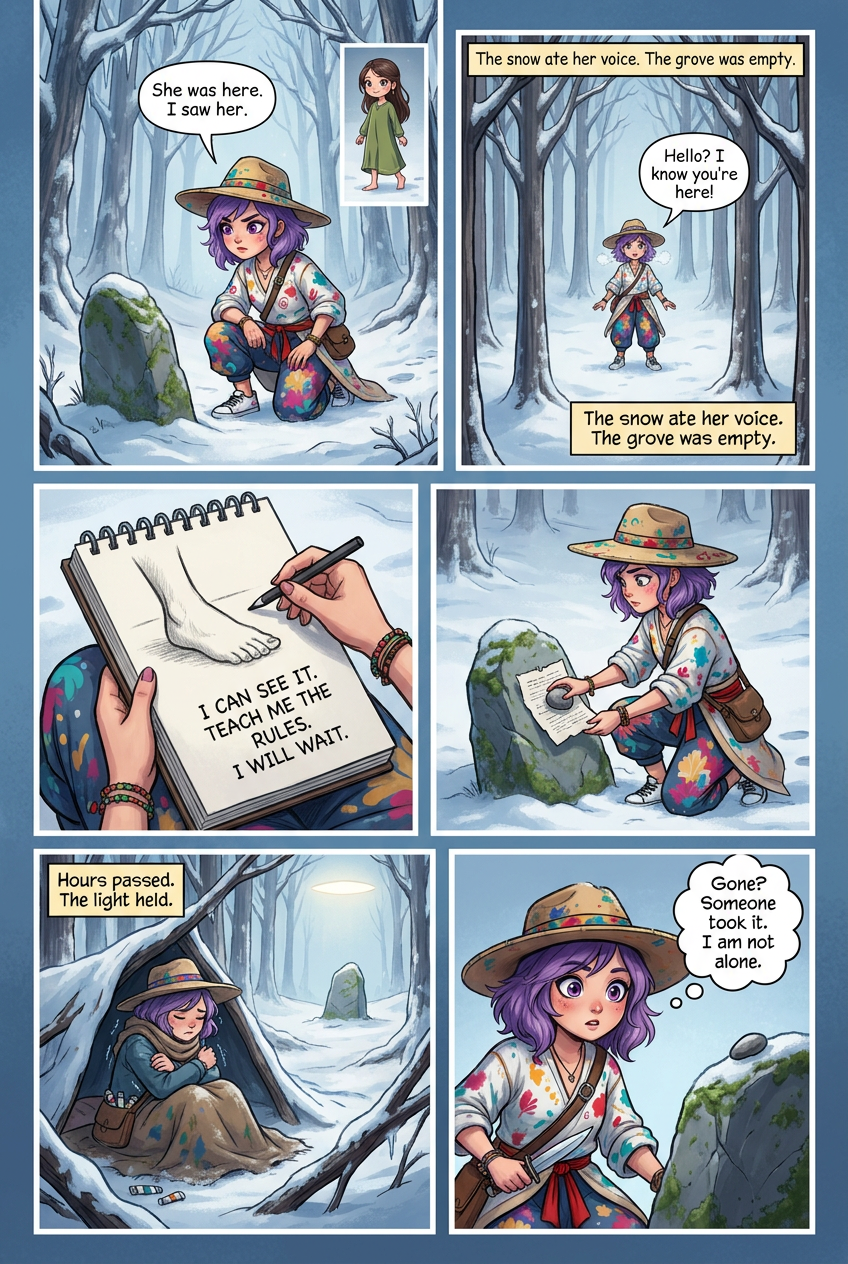
Linny stayed on her knees beside the stone until her legs went stiff. The girl was gone. The grove was empty. She had proof the place was real and proof she could not enter it alone. She needed someone who knew the rules here. She had no one to ask. She stood and turned in a slow circle. Frost-laden trees pressed close, their fine branches locked in ice, the canopy shimmering where the flat light struck it. She counted the trunks. Seven, then eight. Nothing moved. No boot prints but her own. No path but the one she had broken coming in. "Hello," she said. Her voice went nowhere. The snow ate it. She tried louder. "I know you're here. I saw you cross." Nothing answered. She waited a long count. Still nothing. She walked the ring of trees. She looked for a mark, a cut, a scrap of green cloth on a branch. The girl had worn a green dress and no shoes. A barefoot child did not live in a place like this without leaving signs. Linny found none. The snow under each tree lay smooth. She went back to the stone. She pulled out her sketchbook and a stub of charcoal. If she could not call the girl, she could leave something the girl would have to read. She drew the flat light above the stone. She drew the girl's bare foot pressing the snow. Under the pictures she wrote, in block letters: I CAN SEE IT. TEACH ME THE RULES. I WILL WAIT. She tore the page out and weighed it on the stone with a pebble. Then she made a camp. She scraped a hollow between two of the frost-laden trunks where the branches dropped low enough to block the wind. She banked snow against the outside. She unrolled her blanket. She set her paint tubes inside her coat against her ribs to keep them from freezing. She broke a strip of dried meat in half and ate one half. She sat facing the stone. The light on it did not change. It did not dim at dusk. It did not brighten. It only held. Hours passed. Her feet went numb. She stamped them and sat again. No girl came. No creature came. The grove stayed exactly as it had been the moment she arrived, as if her presence made no dent in it at all. When the cold finally forced her to move, she checked the stone. The pebble sat where she had left it. The page was gone. Linny's breath caught. Someone had taken it. Someone had come within arm's reach of her camp and she had not heard a step. She was not alone here. She was being watched. And whoever watched had chosen, for now, not to show themselves. She put her hand on her knife and settled in to wait them out.
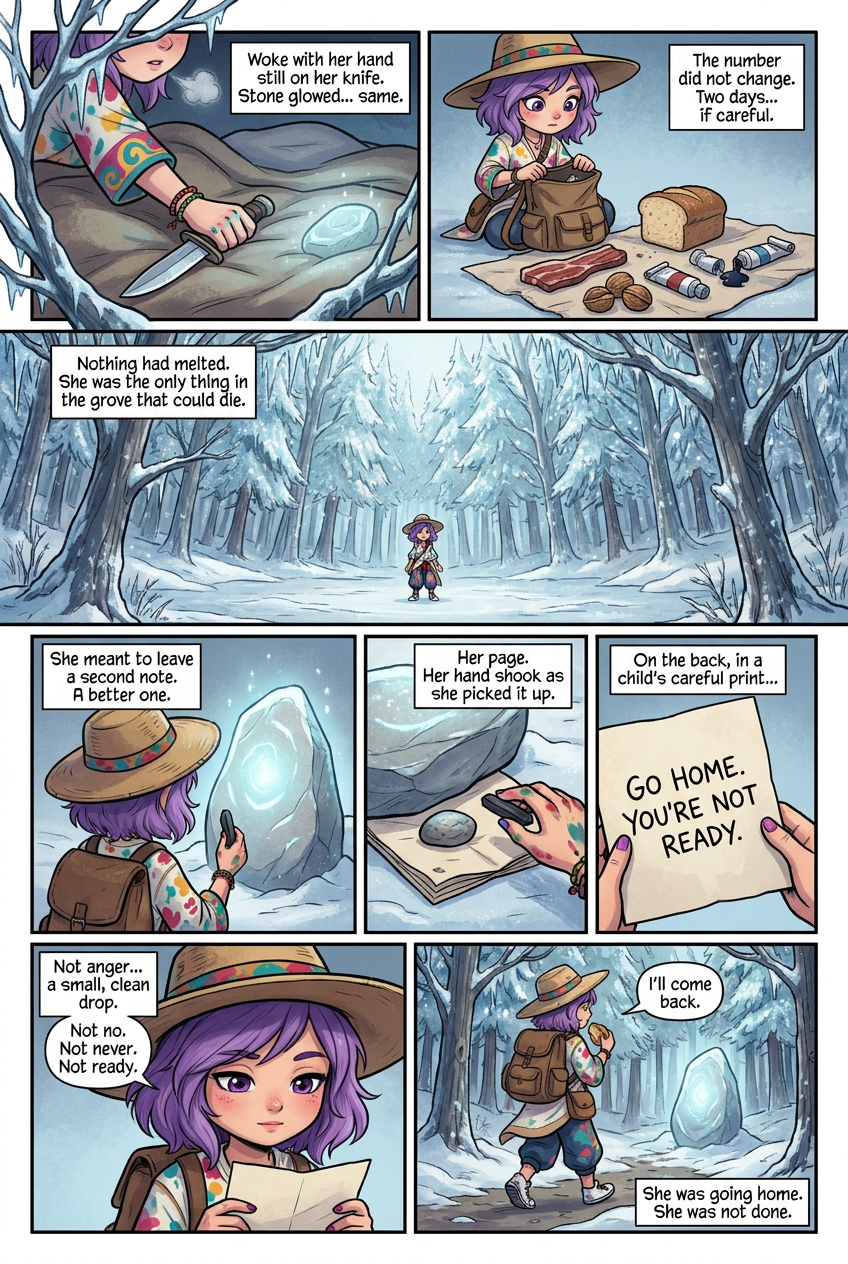
Linny woke with her hand still on her knife. The stone glowed the same as before. Her breath had frosted the wool at her collar. She sat up and checked her pack. Half a strip of dried meat. A heel of bread gone hard. Three walnuts. Two paint tubes she had kept warm against her ribs, and one that had split in the night, the color frozen out of it in a dark bead. Her water skin was ice. She counted again. She always counted twice when the number was bad. The number did not change. Two days of food if she was careful. One if she was honest. The cold was already in her fingers when she tried to work the charcoal. She dropped it twice before she could hold it. She stood and stamped feeling back into her feet. She walked the ring of frost-laden trees again. Their fine branches held ice like glass. The shimmering canopy caught the flat light and threw it back at her, unchanged. Nothing had melted. Nothing had shifted. She was the only thing in the grove that could die. She made herself think it plainly. If she stayed, she would freeze. If she waited one more day for the girl, she would not have the strength to walk out. She went back to the stone. She meant to leave a second note. A better one. She would promise anything. She would offer the paints, the coat, the pockets she had stitched in herself. The pebble was where she had left it. Under the pebble was a page. Her page. The one she had torn out and weighed down the day before. The block letters she had drawn faced up at her: I CAN SEE IT. TEACH ME THE RULES. I WILL WAIT. Her hand shook as she picked it up. The paper was warm. She turned it over. On the back, in a child's careful print, two lines: GO HOME. YOU'RE NOT READY. Linny read it twice. Then a third time. She waited for anger. What came instead was a small, clean drop in her chest, like a stone falling into still water. Not no. Not never. Not ready. She folded the page along its old crease and slid it into the inside pocket of her coat, against the paint tubes. She looked once more at the stone, at the light that would not move for her. "I'll come back," she said. Her voice went nowhere again. That was fine. The answer had already been given. She packed her blanket. She ate the hard bread while she walked, because standing still would cost her fingers. She turned her back on the grove and started down the trail she had broken coming in. She was going home. She was not done.
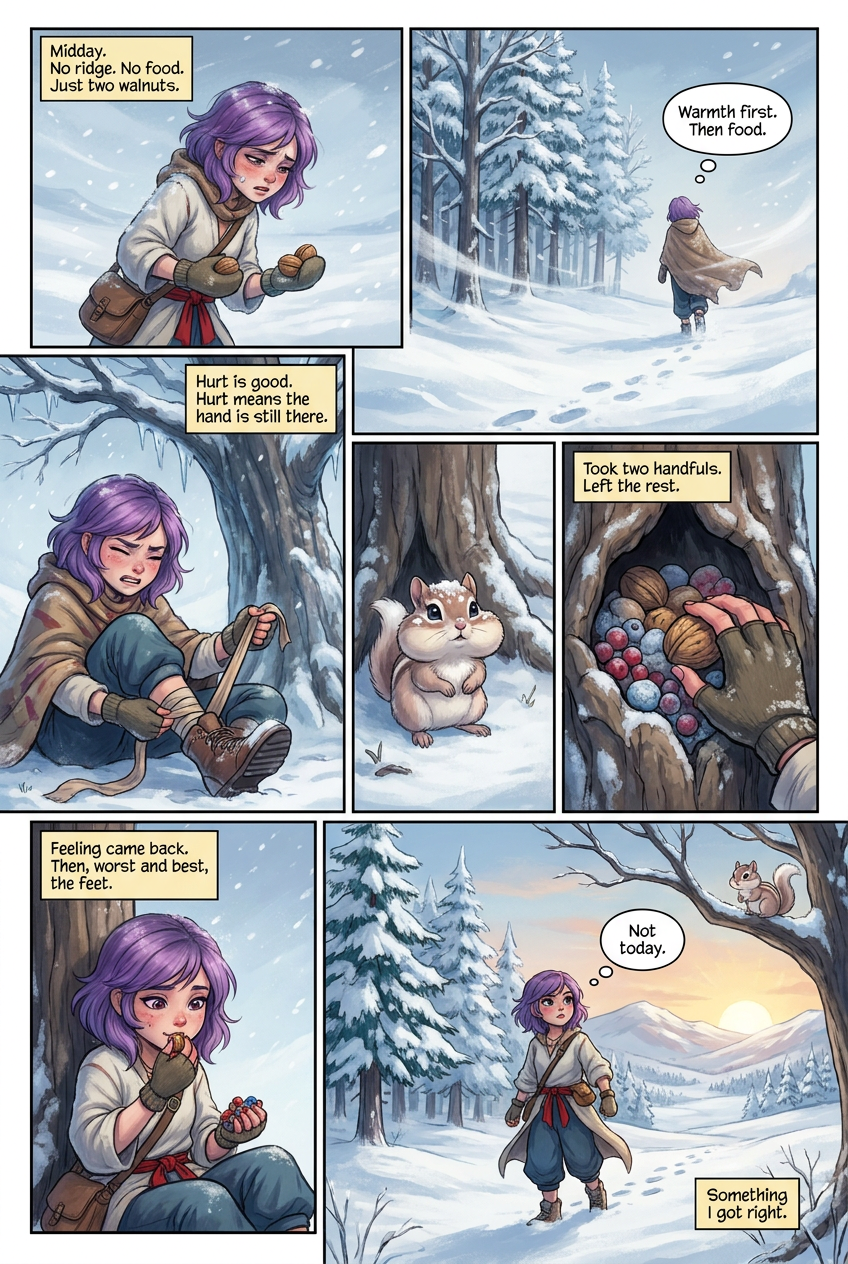
By midday Linny knew she would not reach the ridge. Her toes had stopped hurting, which was worse than hurting. The bread was gone. The dried meat was gone. Two walnuts rattled in her pocket. Her own trail from the way in was buried under new snow, and the wind had scrubbed the branches clean of any mark she had cut. She stopped walking and made herself think. Warmth first. Food second. Direction last. In that order she might live long enough to be lost. She pushed off the open slope into a stand of frost-laden trees. Their fine icy branches met overhead in a shimmering roof. The wind cut off at the trunks. She stood in the sudden quiet and felt her ears burn back to life. She worked fast while her hands still bent. She broke the low dead branches off the lee side of the biggest trunk. She scraped snow into a wall with her boot. She cut two long strips from her blanket, wrapped one around each foot inside her boots, and pulled the wet wool off her hands. She pressed her palms flat against the tree bark until they hurt again. Hurt was good. Hurt meant she still had the hand. Under the tree, in the dry litter where snow had not reached, something moved. A small brown shape with a white belly stared up at her, cheeks packed round. A chipmunk. It had a cache. Linny went still. The animal held. She lowered herself into a crouch and eased her hand along the frozen ground. The chipmunk bolted up the trunk. She dug where it had been. Her fingers found seeds. Then a hollow. Then more seeds, and a lump of frozen berries, and a knot of pine nuts still in their shells. She pulled out two handfuls and stopped. She left the rest. She did not know what winter meant to a thing that small, but she knew what it meant to take everything. She cracked the nuts with her knife hilt against the trunk. She ate slowly. The berries were hard as pebbles and burned sweet when they thawed in her mouth. Feeling came back into her jaw. Then her hands. Then, worst and best, her feet. She sat against the trunk while the light shifted. She counted what she had. Food for a day. Feet she could still walk on. A windbreak of trees she could sleep under if the night caught her short of the ridge. She was not going to die in the frostwood. Not today. She stood up. The ridge was still a long walk south. She fixed the sun over her left shoulder and started down through the trees. Behind her, high in the branches, the chipmunk chattered once. She did not look back. She had taken what she needed and left the rest, and that felt, for the first time in days, like something she had gotten right.
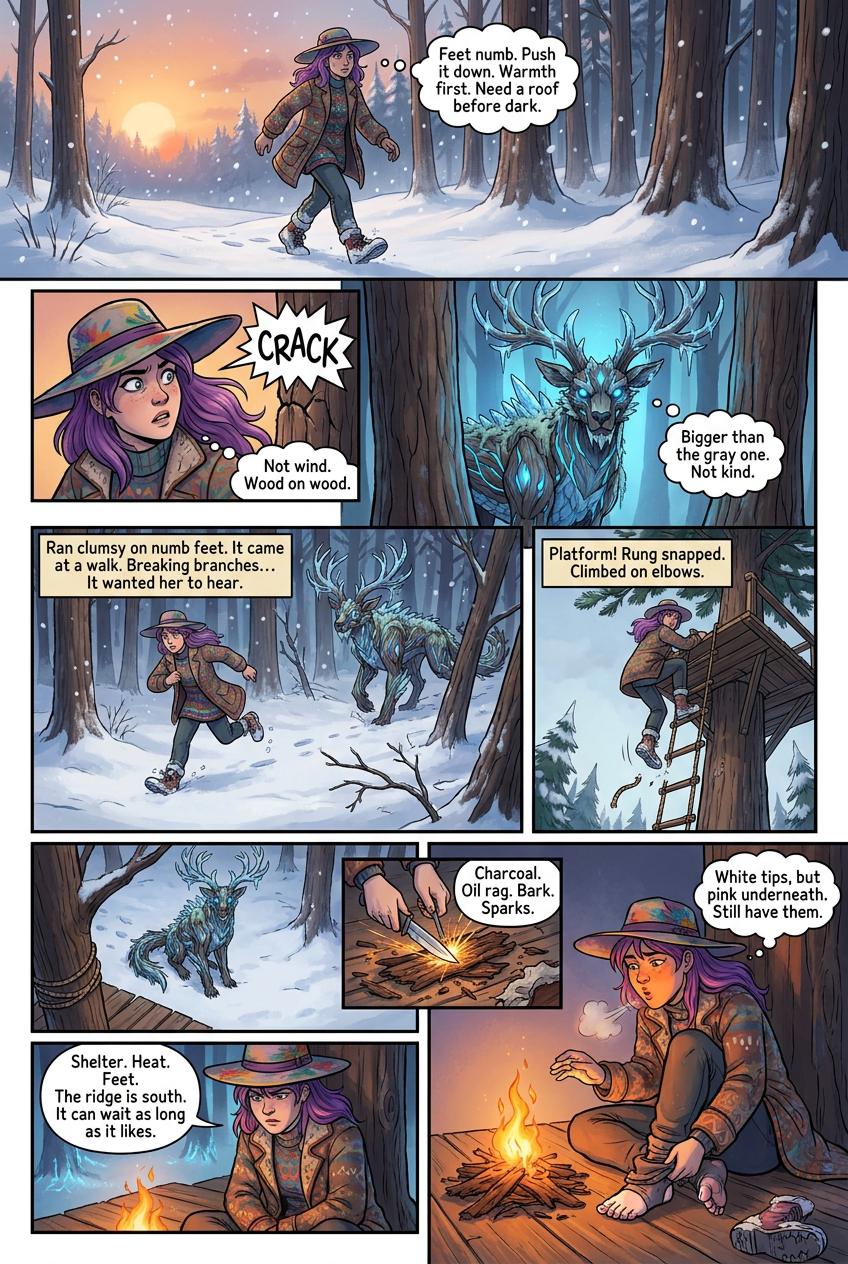
Linny walked south through the trees with the sun over her left shoulder. Her feet stopped hurting again an hour in. She stamped hard at every step, trying to feel the ground. She could not tell if her toes were still there inside the wraps. She pushed the thought down. Warmth first. She had to be under a roof before dark, or she would sit down in the snow and not stand up. A branch cracked behind her. Not wind. Wood on wood, slow and deliberate. She turned. Between two trunks stood a thing built out of the forest. Bark for legs. Antlers stacked with ice. Pale blue light ran under its hide like water under river ice. One eye burned the same color. It watched her without moving, the way the gray creature had watched her, but this thing was bigger and it was not kind. She ran. She ran clumsy on numb feet, slipping, catching herself on trunks. Behind her the wood-thing came at a walk that ate ground. She heard it breaking branches it did not need to break. It wanted her to hear. She saw the stand first as a dark square in the trees. A hunter's platform, old, three boards nailed to a pine, a rope ladder swinging beneath it. She hit the ladder at a run. The bottom rung snapped under her boot. She caught the next one with both hands and pulled. Her arms shook. Her wraps slipped. She got one knee up. A rope frayed and dropped her a foot before it held. She climbed the rest on her elbows and rolled onto the boards. Below her the creature stopped at the base of the tree. It lifted its head. The blue eye found her. It did not climb. It settled on its haunches in the snow and waited. Linny crawled to the far corner of the platform. She dug in her coat pockets. Two stubs of charcoal. A folded oil rag. She broke the rag into strips. She scraped bark off the boards with her knife into a small pile. She stacked her last dry kindling — three twigs and a splinter of pine — over the bark. She struck the knife against a flint stub. Sparks. Nothing caught. She struck again. The rag smoked. She bent low and breathed on it until her lungs hurt. A thread of flame took the bark. She fed the fire twig by twig. Her hands came back first. Then her face. She pulled off her boots and made herself look. Her toes were white at the tips but pink underneath. She had them. She still had them. Below, the wood-thing had not moved. It would wait out the night. Linny pulled her coat tight and fed the fire another sliver of charcoal. She had shelter. She had heat. She had her feet. The ridge was still south, and morning would come, and the thing at the base of the tree could wait as long as it liked.
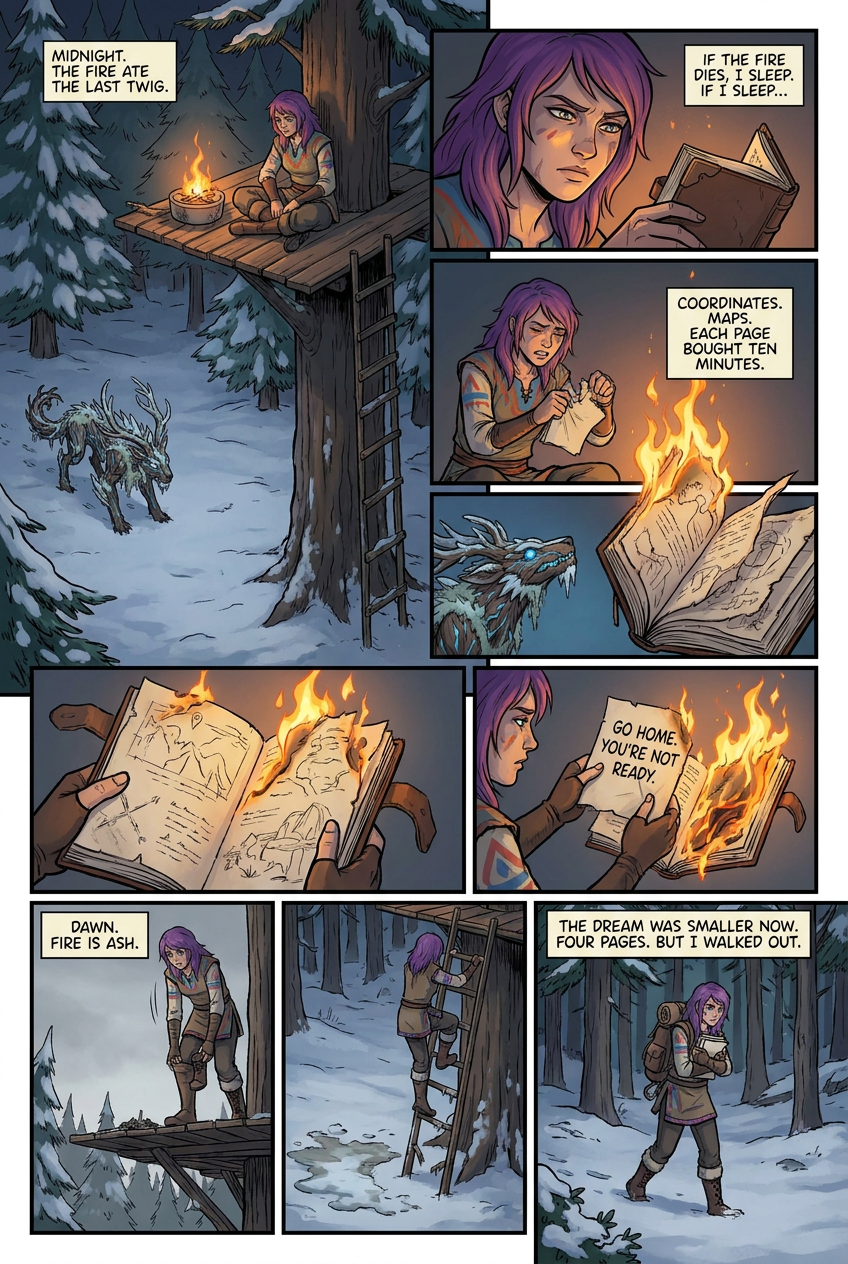
The fire ate the last twig by midnight. Linny watched the flame drop from finger-high to a knuckle. Below the platform, the wood-and-ice creature had not moved. Its blue eye still burned in the dark. If the fire died, she would sleep. If she slept, she would not wake. She checked her pockets again. Empty. She pried at the platform boards with her knife. The nails held. She peeled a strip of bark from the pine trunk beside her and fed it in. It smoked and curled and gave almost no heat. Her hand went to the inside pocket. The journal was there. The stolen one. The one with the sketches and the coordinates and the notes in three different hands. The one she had crossed a ravine for. The one the barefoot girl had told her to go home from. She pulled it out and set it on her knee. She tore the first page slow. It was a margin sketch, not one of the good ones. It caught fast and burned bright. Her fingers warmed. She tore the next. A list of supplies in someone else's handwriting. Then a page of her own, copied from the grove — the warm stone, the light with no source. She fed that one in too. The flame jumped. Below, the creature tilted its head. Ice cracked along its antlers as it shifted. The blue eye did not blink. She worked through the pages one by one. Coordinates. A rough map of the ridge. A sketch she had made of the girl's bare feet on snow. Each page bought her ten minutes. Each page was a step she would not be able to retrace. She kept the last four. The three original artists' notes on where the place lay. The girl's answer on the back of her own: GO HOME. YOU'RE NOT READY. She held those over the flame and did not drop them. The rest of the journal went in. Cover and all. The leather stank as it burned. The fire climbed for a moment and threw her shadow long across the boards. Dawn came gray through the trunks. The fire was ash. Her hands were stiff but they worked. Her feet were still hers. She pulled her boots on and looked over the edge. The creature was gone. The snow at the base of the pine showed no tracks leading away, only a melted patch where it had sat. Linny climbed down the frayed ladder. She folded the four saved pages into her inside pocket and pressed her hand flat against them through the coat. The dream was smaller now. Four pages instead of a book. But she had walked out with it, and she knew the way back began at the ridge, and the ridge was south. She started walking.
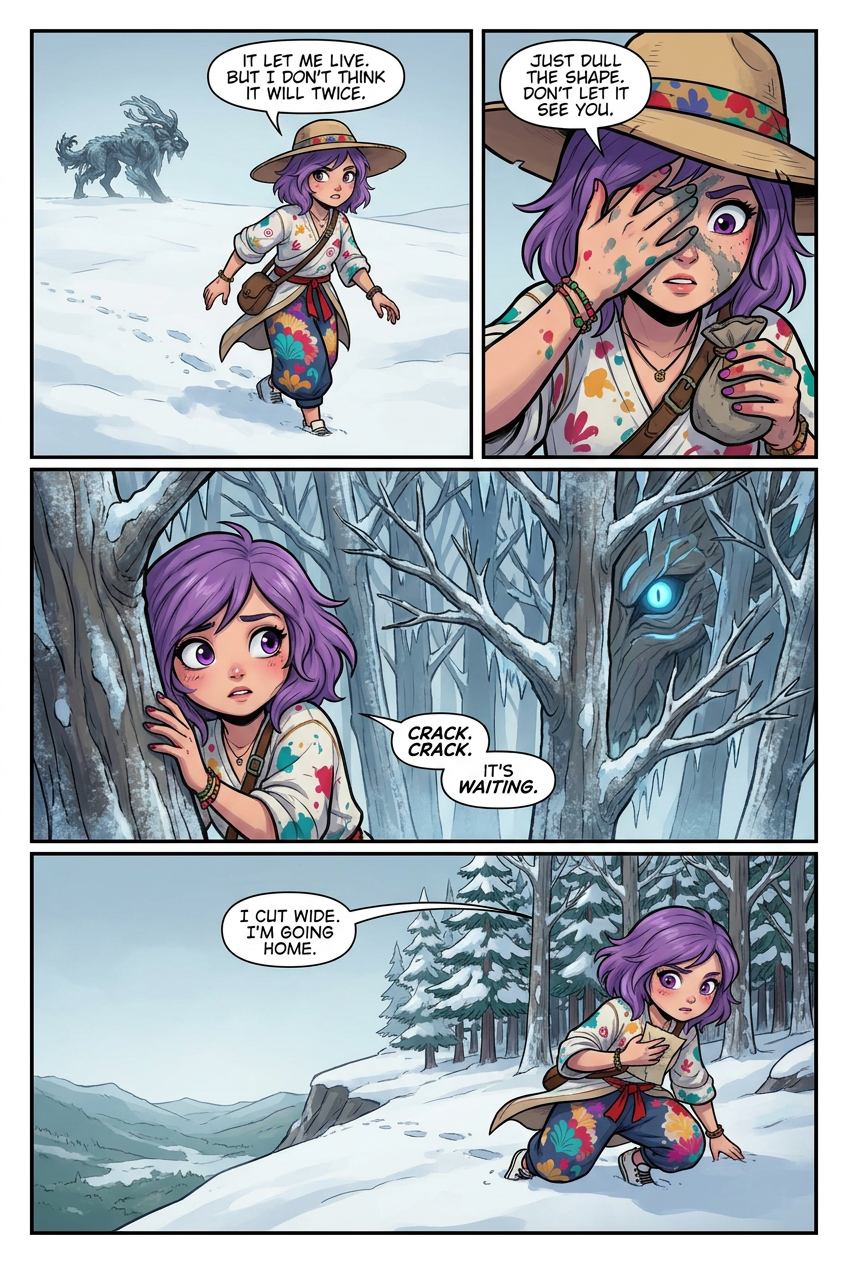
Linny walked south through snow that reached her shins. The ridge lay somewhere beyond three days of forest. Between her and the ridge was the country where the wood-and-ice creature had cornered her. She had seen its blue eye. She had felt it decide not to kill her yet. She did not think it would decide the same way twice. By noon she reached a dense stand of frost-laden trees. Icy branches laced the canopy overhead. The trunks stood close, the snow between them shallower where the boughs had caught it. She stopped at the edge and listened. Nothing moved. That was the problem. In this forest, nothing moving meant something watching. She knelt and scooped a handful of ash from her pocket, the last of last night's fire. She smeared it on her cheeks, her neck, the backs of her hands. It would not hide her scent. It might dull her shape against the bark. She cut a strip from her coat hem and tied it around her boots to muffle the crunch. The coat was down to the lining now. She went into the cluster. She kept to the trunks. She stepped only where a bough had dropped snow, so her prints sank into old falls, not fresh. She did not look for a straight path south. She looked for the path that kept the most wood between her and any open ground. Halfway through, she heard it. A crack, high up. Ice splitting on a branch. She froze against a trunk and did not breathe. The crack came again, closer. Then a third time, farther off. It was moving parallel to her, not toward her. It knew she was in the cluster. It was waiting for her to break south into open snow. She changed her mind. She turned west instead, deeper into the trees, and walked until the light began to fail. The cluster ended at a frozen streambed. She followed the streambed south under the overhang of its bank, where the snow was thin and her prints did not show. She walked past dark. She walked past feeling in her feet. She walked until the trees thinned and she could see, through the branches ahead, the long dark line of the ridge. She crouched in the last of the frostwoods and looked back. Nothing followed. No blue eye. No crack of ice. She had cut wide of it. She had traded a day and half her coat and every step of feeling in her toes, and she had cut wide of it. She crossed the open ground to the ridge at a run. She did not stop until she was over it. On the far side, the wind dropped. The snow was thinner. She sat down against a rock and pulled the four folded pages from her inside pocket and held them. She was going home. She was coming back.
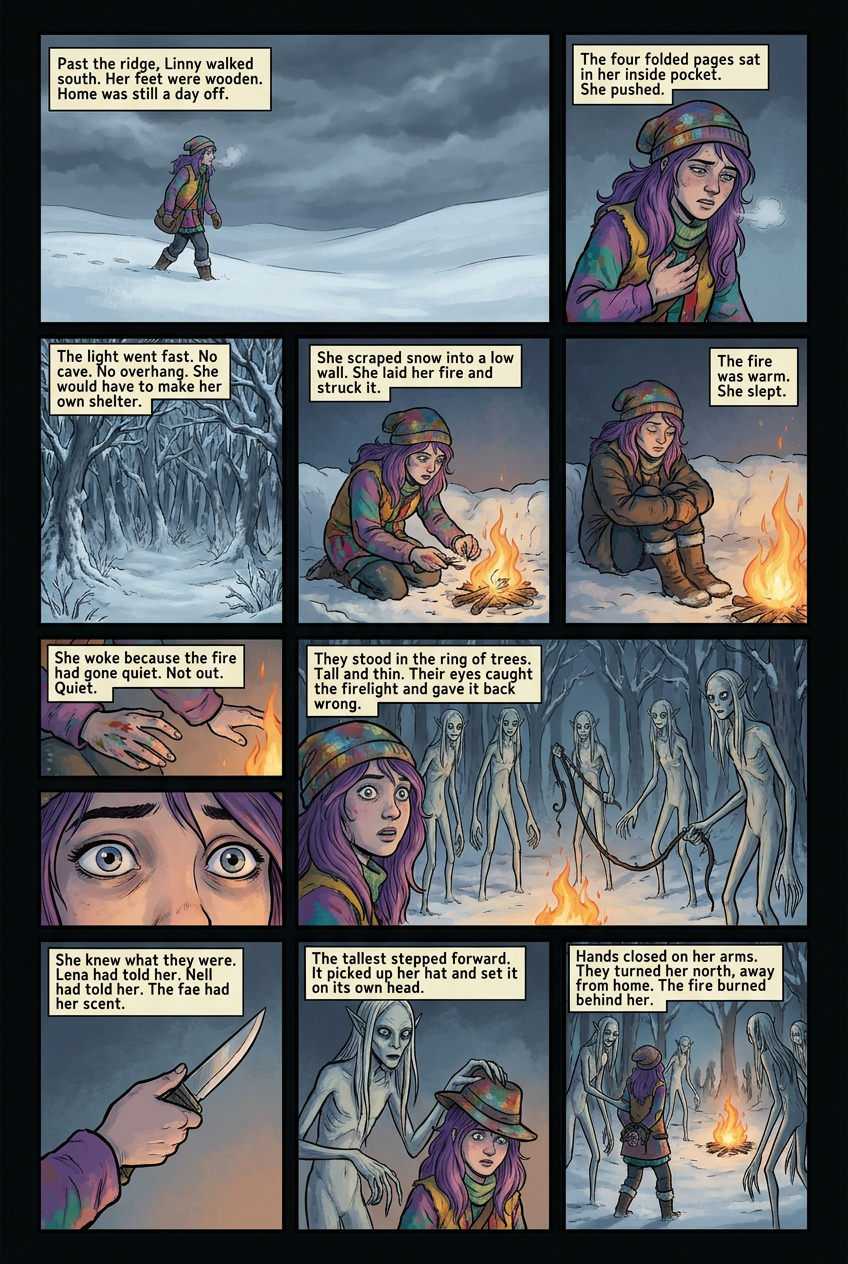
Past the ridge, Linny walked south under a lowering sky. Her feet were wooden in her boots. The four folded pages sat in her inside pocket. Home was still a day off, maybe less if she pushed. She pushed. She had cut wide of the wood-and-ice creature and crossed out of its country. She meant to sleep in her own bed. The light went fast. One moment the snow held a gray shine, the next it did not. She stopped in a small clearing rimmed by frost-laden trees, their icy branches laced tight overhead. No cave. No overhang. No hollow she could dig in the time she had left. She would have to make her own shelter. She broke dead branches from the lower boughs. She scraped snow into a low wall on the windward side. She laid her fire in the center of the clearing and struck it with the last of her flint. The tinder caught. The flame took a branch, then another. She fed it until it stood as tall as her knee. She sat close and pulled her coat around her. She meant to keep watch. She had meant to keep watch every night. Her head dropped once. She jerked it up. It dropped again. The fire was warm. Her feet were finally warm. She slept. She woke because the fire had gone quiet. Not out. Quiet. The pop and hiss were gone, as if something stood between her and the sound. She opened her eyes without moving her head. They stood in the ring of trees. Six of them, maybe more behind. Tall and thin. Long fingers. Faces that were almost faces. Their eyes caught the firelight and gave it back wrong. One held a length of dark vine looped in its hand. Another tilted its head at her the way a bird studies a beetle. She knew what they were. Lena had told her. Nell had told her. The fae had her scent. If she crossed the tree line without Nell, they would take her. She had crossed. She had not thought they would come this near the ridge. She reached for her knife. The one with the vine crouched. She stopped reaching. The tallest stepped forward, over the outer stones of her fire. The flame did not touch it. It bent down and picked up her bundle in one hand. It picked up her hat in the other. It set the hat on its own head. Hands closed on her arms. They were cold and strong and did not bruise. They lifted her upright. The vine went around her wrists in one quick loop. They did not speak. They turned her north, away from the ridge, away from home. The fire burned behind her in the empty clearing. Her four folded pages were still in her pocket. They walked her back into the woods.
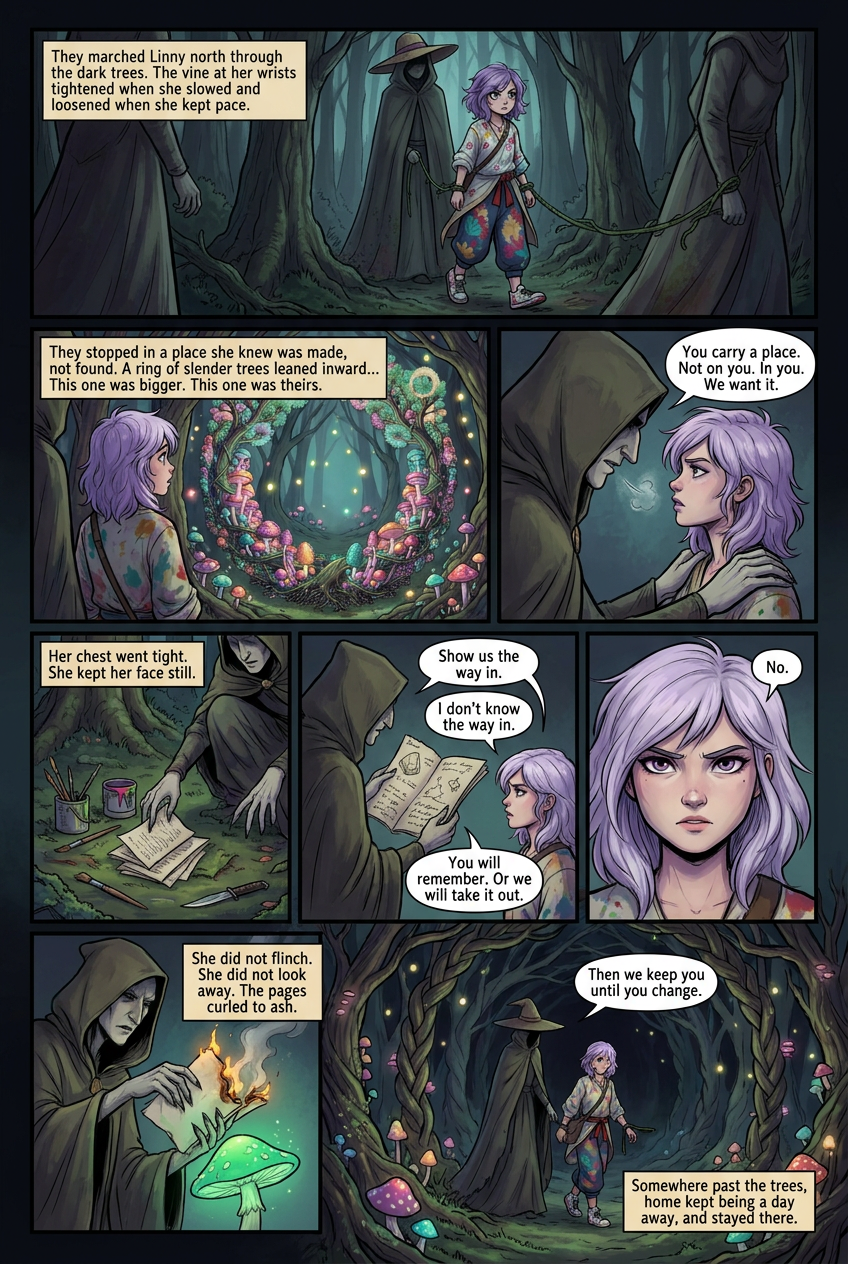
They marched Linny north through the dark trees. The vine at her wrists did not chafe. It tightened when she slowed and loosened when she kept pace. The tall one wore her hat. Another carried her bundle. A third walked at her shoulder, close enough that she felt the cold coming off it like a wall. They stopped in a place she knew was made, not found. A ring of slender trees leaned inward, their branches braided overhead. Mushrooms crowded the roots in colors that did not belong to any season. Small lights hung in the branches without cords. She had seen a smaller ring like this once before, in Lena's story. This one was bigger. This one was theirs. The tall one turned her to face it. It bent close. Its breath smelled of wet stone. "You carry a place," it said. Its voice was soft and even. "Not on you. In you. We want it." She understood then. Not her paints. Not the pages. The grove she had found. The warm stone. The light that was not light. She had walked in it and it had walked out with her, caught in her skin like smoke in cloth. "I don't know what you mean," she said. The one with her bundle turned it over and spilled her things onto the moss. Brushes. A tin of paint. The knife. Four folded pages slid out last. It picked them up in two long fingers. Her chest went tight. She kept her face still. The tall one took the pages. It unfolded them one at a time. It looked at the sketch of the stone, the coordinates, the girl's words. It looked at Linny. "Show us the way in," it said. "I don't know the way in," Linny said. This was true. She had been turned away at the door. "You will remember," it said. "Or we will take it out." She thought of the barefoot girl. GO HOME. YOU'RE NOT READY. She thought of what these creatures would do to that grove if she pointed at it on a page. She thought of Lena, and her father, and the shape of her own house at the edge of the village. She looked at the tall one. "No," she said. It tilted its head. It folded the pages once, twice, and held them over a mushroom cap that glowed pale green. The paper began to smoke without flame. She did not flinch. She did not look away. It watched her not looking away. The pages curled to ash. The coordinates went with them. "Then we keep you," it said, "until you change." They led her through the ring. The braided branches closed behind her. The lights above dimmed to match the dark. Somewhere past the trees, home kept being a day away, and stayed there.
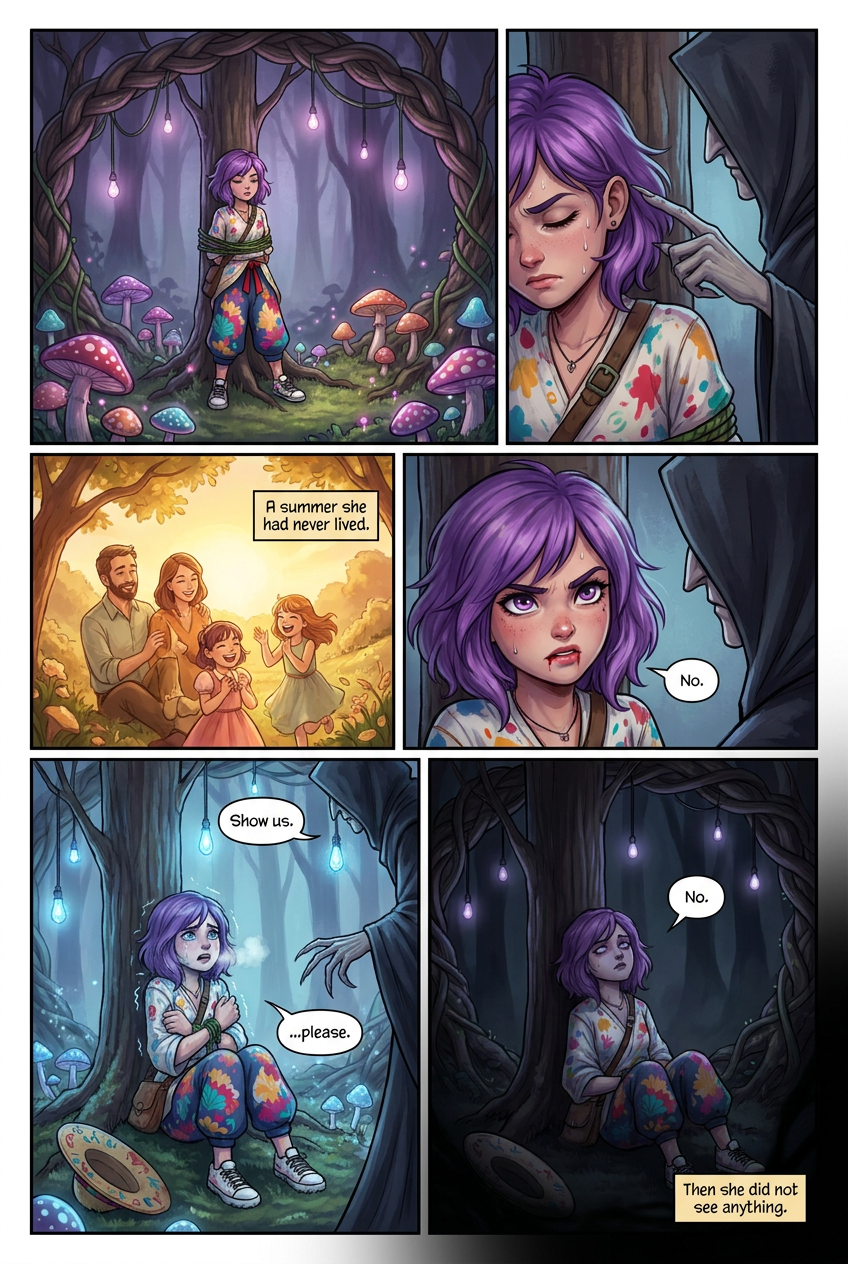
Inside the ring, they tied Linny to one of the slender trees. The vine at her wrists climbed up her arms and pinned her shoulders back against the bark. The braided branches above her closed tighter, and the small hanging lights dimmed to the color of old bruises. The mushrooms at her feet pulsed once, then again, matching a beat she could feel in her teeth. The tall one knelt in front of her. It did not touch her. It pressed one long finger against the tree beside her ear. "Show us," it said. The tree remembered heat. She felt it through her back first, then through her bound wrists. Not fire. Summer. A summer she had never lived. Her mother was there, humming a tune Linny did not know. Lena was small and laughing. Her father stood upright and well. The grove was in the picture too, wide open, and all she had to do was point. She bit the inside of her cheek until she tasted iron. "No." The tall one moved its finger. The summer went out. Cold came in its place, deeper than the woods outside. Her feet went numb. Her hands stopped feeling like hands. The mushrooms pulsed faster. She heard a sound she recognized as her own voice, from far off, saying please. "Show us," it said again. She thought of the barefoot girl. She thought of the warm stone, and the note that said GO HOME. She thought of what the tall one would do inside that place if she gave it a direction. She did not answer. The cold climbed to her chest. Her breath came in short pulls. The braided branches leaned lower. One of the others put her painted hat on the moss at her feet, upside down, like a bowl waiting to be filled. She understood what she was losing. Not the grove. She could keep the grove. She was losing the part of herself that believed she would ever see it again. That part went quiet first. Then the part that believed she would see Lena. Then her father. Then the shape of her own front door. When there was almost nothing left, she found she still had the word. She used it. "No." The tall one straightened. It looked at her a long time. It said something to the others in a language that had no edges. One of them picked up her knife from the moss and turned it in the light. Another gathered her brushes. The cold pushed higher. Her chin dropped. The lights above her went out one by one, like someone walking away with a lamp. The last thing she saw was the ring itself, the trees leaning in, the mushrooms bright at the roots, a perfect wreath closing over her head. Then she did not see anything.
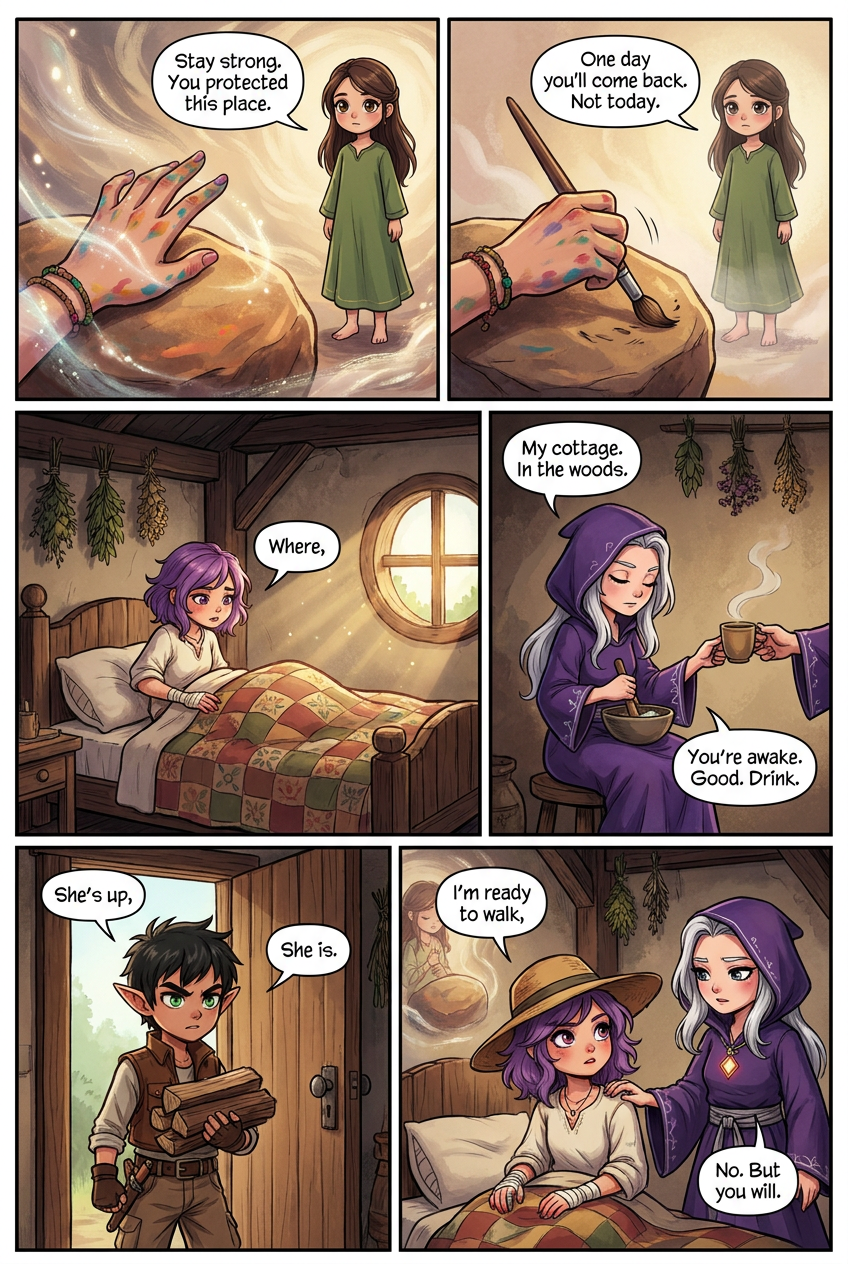
Linny dreamed of the grove. The warm stone was under her hand. The light around it was not flat. It moved the way real light moves, sliding across bark, catching on frost. She had a brush she did not remember picking up. The paint on it was the exact color she had been trying to mix for a year. The barefoot girl stood on the other side of the stone. Her green dress did not stir in the wind. She looked at Linny the way you look at someone who has come back from far away. "Stay strong," the girl said. "You protected this place." Linny's throat would not work. She tried to lift the brush. Her hand was too heavy. "One day you'll come back," the girl said. "Not today." The grove began to thin. The stone cooled under Linny's palm. She reached for the girl and closed her fingers on nothing. She woke. A low ceiling of dark beams. A round window with sun in it. The smell of dried herbs, and something sweeter under that, like warm milk. She was under a quilt. Her wrists were bandaged. Her hands hurt, which meant they were hers again. A woman sat on a stool by the bed. Silver hair over a purple hood. Her eyes were too bright for the rest of her face. She was grinding something in a small bowl and did not look up. "You're awake," the woman said. "Good. Drink." She held out a cup. Linny took it. The tea was bitter and hot. She drank all of it. "Where," Linny said. "My cottage. In the woods." "How." "Someone called me. I came." Linny tried to sit up. The room tilted. The witch set a hand on her shoulder and put her back down without effort. "Not yet. Your veins were open. I closed them." "The tall ones." "Gone from you. Not gone." A door opened at the other end of the room. A young man came in with an armful of split wood. Dark hair. Green eyes that caught the light wrong. His ears came to points. He stopped when he saw her looking. "She's up," he said to the witch. "She is." He set the wood down by the stove. He did not come closer. He watched Linny the way a person watches an animal they have been asked to keep alive. "My sister," Linny said. "Waiting," he said. "At dawn we go." Linny closed her eyes. The grove was already fading behind them, the stone, the girl in the green dress. She held what she could of it. A color. A promise. A door that had not been shut, only closed for now. She opened her eyes. "I'm ready to walk," she said. "No," the witch said. "But you will."
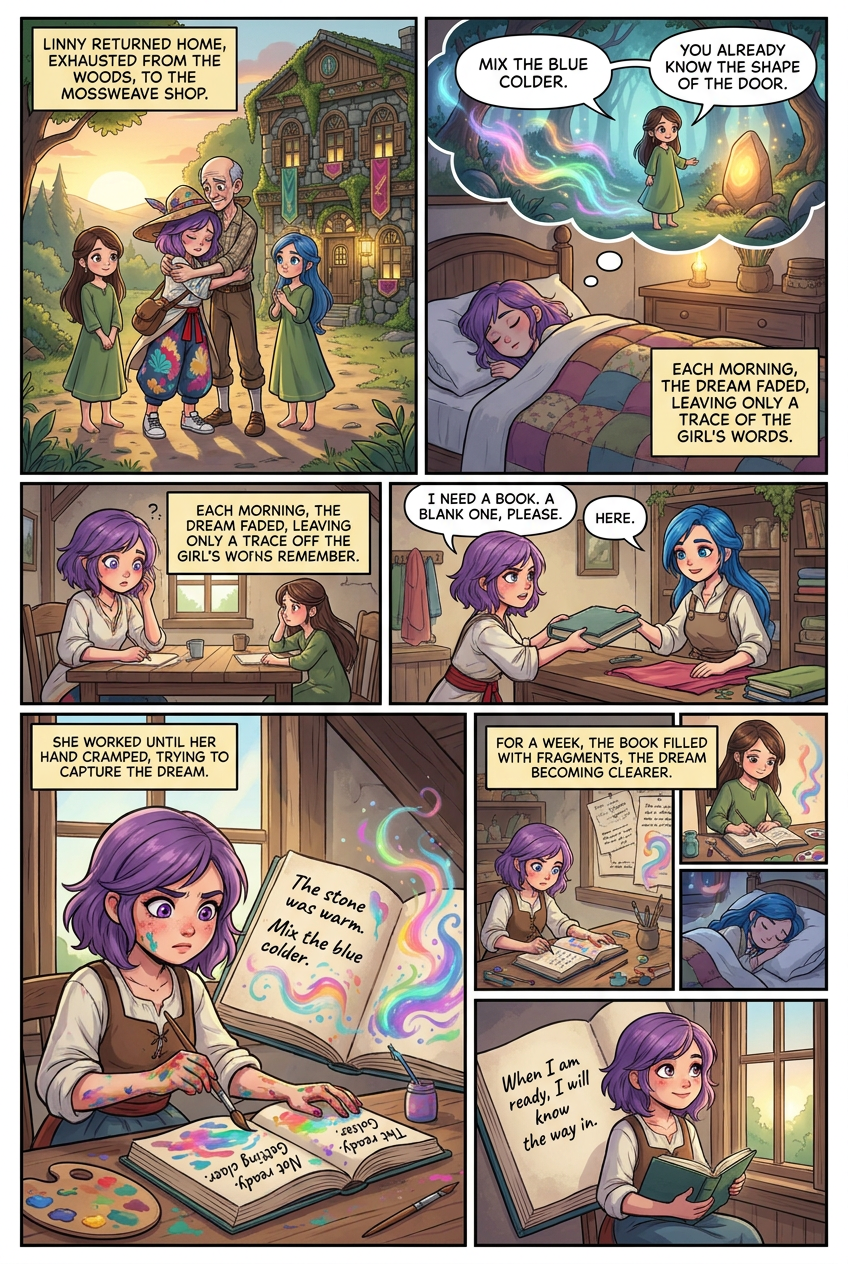
Linny came home with her sister, a strange fae, a little boy, and a fox. The vines along the stone walls of the shop were bright with late sun. Her father was thinner than the woods had left her. She let herself be held. Then she went upstairs and slept for a day and a half. The dreams started the first night. The grove was always the same. The warm stone under her hand. The girl in the green dress on the other side. The light moving the way magical light moves. It sparkled with colors she’d never seen. Whispy and free willed. Every night the girl said something a little different. Once she said, "Mix the blue colder." Once she said, "You already know the shape of the door." Once she only pointed at Linny's hands. Linny woke each morning with the color still behind her eyes. By breakfast it was gone. By noon she could not remember what the girl had said, only that the girl had said it. On the fourth morning she went down to the shop and asked her sister for a blank book. Her sister found one under the counter, cloth-bound, the pages rough. She did not ask what it was for. She put it in Linny's hands and went back to her thread. Linny took the book to the upstairs window. She wrote the date. She wrote, The stone was warm. The girl told me to mix the blue colder. She wrote every line she could still hold from the night before. When the words ran out she opened her paint box and mixed the blue. It was not right. She mixed it again. On the third try the color on her brush matched the color in her head for one breath before the memory slid. She painted that breath onto the page. A curve of frost. The edge of a stone. A bare foot at the corner, half turned away. She worked until her hand cramped. Then she wrote underneath: Not ready. Getting closer. Downstairs a bell rang and someone came in for a fitting. Her sister's voice moved through the floor, calm, working. Her father coughed once and then did not cough again. Linny turned the page. She did this every morning for a week. The book filled unevenly. Some pages were only words. Some were only color. The grove did not come clearer, but it stopped fading. She could hold one detail a day now, and the book held the rest. On the seventh night the girl in the dream did not speak. She only stepped back from the stone and waited, as if to see whether Linny would follow. Linny woke before dawn. She opened the book to a clean page and wrote one line at the top. When I am ready, I will know the way in.
Play your story to life
Storycraft is a mobile game where you create AI characters, craft items and locations to build their world, then discover what direction your story takes. Download the iOS game for free today!
Download for free