

Lovelock's Arc
13 Chapters
Lovelock's dream is building a thriving farm market that showcases her handmade crafts..

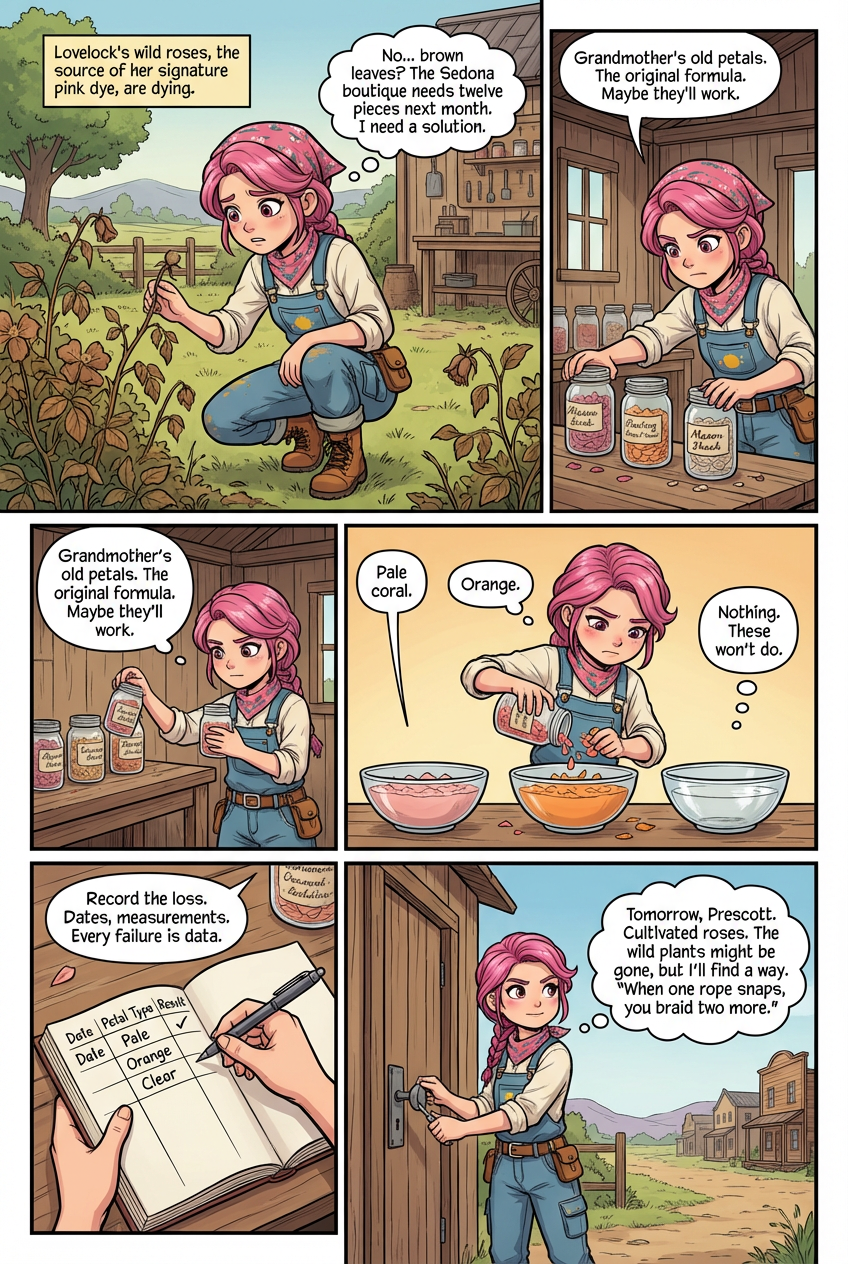
Lovelock crouches beside the wild rose plants behind her workshop, touching brown leaves that should be pink. The stems are drying from the roots up. Without these plants, she can't make the signature dye that keeps her hair bright and her textile pieces selling in Sedona. She walks to the small shack where she tests new plants. Inside, mason jars line a wooden bench. Each jar holds dried petals from her grandmother's collection—the old roses that gave her the formula years ago. She pulls three jars down and arranges them next to empty test bowls. If the wild roses are dying, she needs a backup source fast. The Sedona boutique expects twelve pieces by next month. She crushes petals from the first jar and adds hot water. The liquid turns pale coral, not the deep pink her customers recognize. The second jar yields orange. The third barely colors the water at all. None of these will work. She writes the results in her notebook with exact measurements and dates—losses that have a story get tracked precisely. Lovelock sets the jars back on the shelf and locks the shack door. Tomorrow she'll drive to the botanical supply in Prescott and ask about cultivated roses. The wild plants might be gone, but the farm market she's building depends on her keeping this color alive. She learned long ago that when one rope snaps, you braid two more.
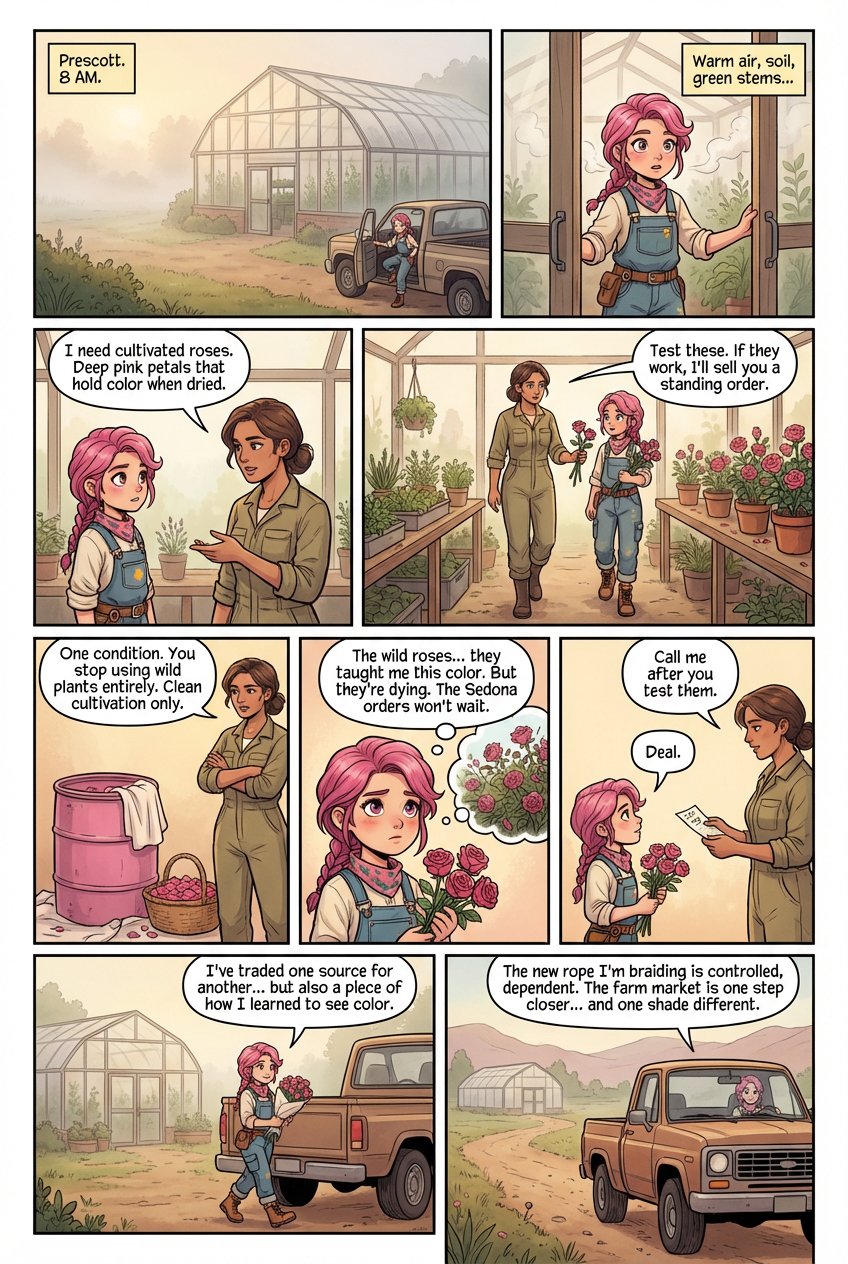
Lovelock parks outside the greenhouse in Prescott at eight in the morning. The windows are fogged with moisture. She opens the door and warm air hits her face, smelling like soil and green stems. A woman in coveralls looks up from a row of seedlings. Lovelock explains what she needs—cultivated roses with petals that hold deep pink color when dried. The woman nods and leads her past tables of herbs to a corner where pink blooms climb wooden stakes. She cuts three stems and hands them over. "Test these," she says. "If they work, I'll sell you a standing order." Lovelock asks about price and timing. The woman crosses her arms. "One condition. You stop using wild plants entirely. I don't supply people who strip the desert and then come here when it runs out." She points to a pink barrel sitting on a wooden table near the door, white fabric draped across it and a basket of fresh petals beside it. "That's my setup. Clean cultivation only. You want reliability, you commit to doing it right." Lovelock holds the stems and thinks about the wild roses behind her workshop, the ones that taught her this color in the first place. But they're dying, and the Sedona orders won't wait. She looks at the barrel, at the neat rows of cultivated plants, at the woman watching her with steady eyes. "Deal," she says. The woman writes down her number and tells her to call after she tests the petals. Lovelock walks back to her truck with the roses wrapped in damp paper. She's traded one source for another, but she's also traded a piece of how she learned to see color. The rope that snapped was wild. The new one she's braiding is controlled, bought, dependent on someone else's terms. She starts the engine and drives back toward Skull Valley, knowing the farm market she's building just got one step closer and one shade different from what she imagined.
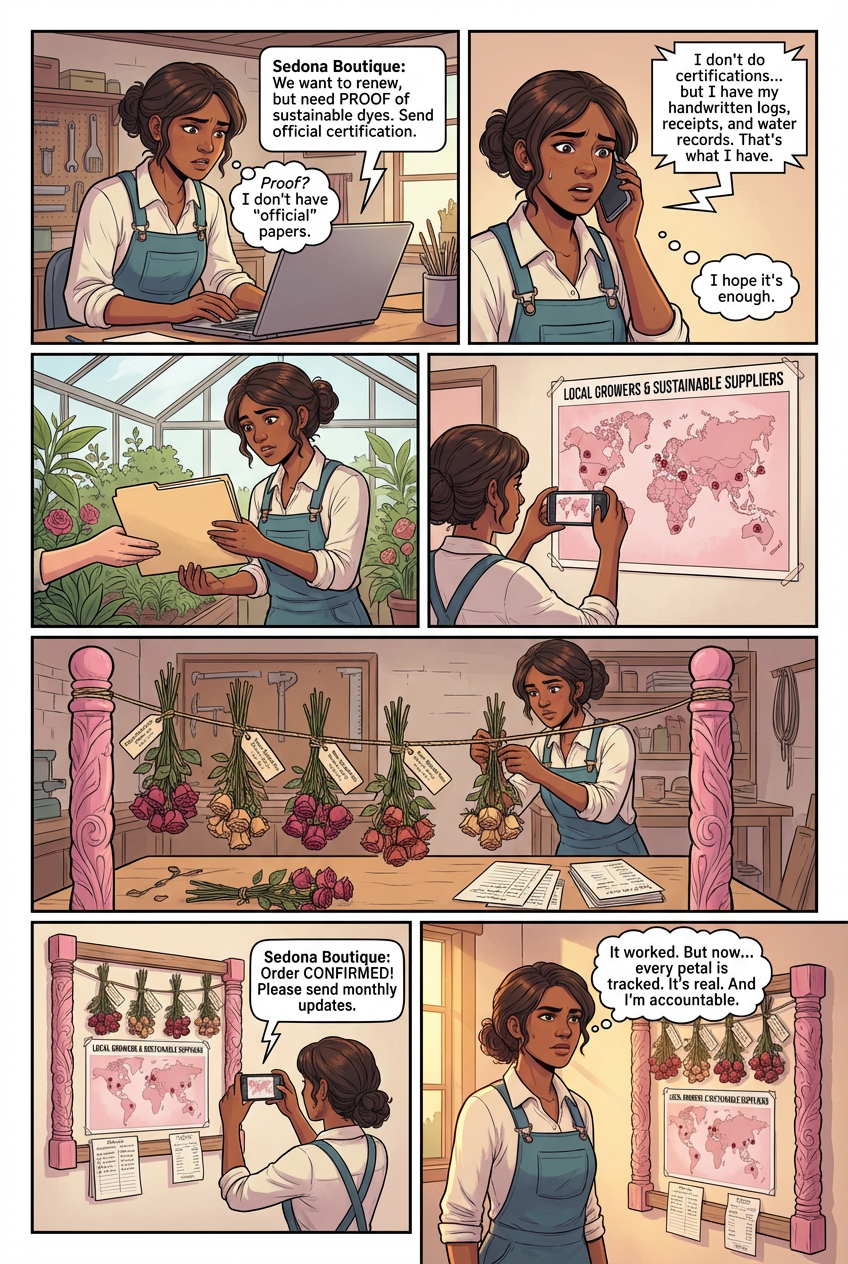
Three days after she drives back from Prescott, the Sedona boutique sends an email. They want to renew the order, but they need proof first. Documentation showing her dyes are sustainably sourced. A scanned certificate, supplier invoices, something official. Lovelock calls the greenhouse woman. She explains the boutique's request and hears silence on the other end. Then the woman says she doesn't do paperwork like that—she's a grower, not a certifier. But she offers something else: a handwritten log showing each rose variety, planting date, and cultivation method, plus receipts for organic soil amendments and water use records. Lovelock asks if that will be enough. The woman says it's what she has. Lovelock drives back to Prescott that afternoon and picks up the documents in a manila folder. On her way out, she notices a map mounted near the door—a pink-tinted guide to local growers and sustainable suppliers across the valley, each one marked with a small rose symbol. She stops and studies it, tracing the network of farms and greenhouses connected by careful sourcing. She takes a photo of it with her phone. Back home, she builds a simple frame from two carved pink posts she bought months ago at a craft swap. She strings twine between them and hangs bundled samples of the greenhouse roses, each one tagged with the variety name and harvest date from the logs. Below the display, she prints the supplier map and mounts it alongside copies of the cultivation records. She photographs the whole setup and sends it to the boutique with a cover letter explaining her shift from wild harvesting to tracked, cultivated sources. Two days later, they confirm the order and ask for monthly updates going forward. The documentation worked, but now she's accountable in a way she never was before—every petal tracked, every source named, every decision visible. She keeps the frame up in her workshop, not as decoration, but as proof that the ropes holding her business are real and can be examined by anyone who needs to see them.
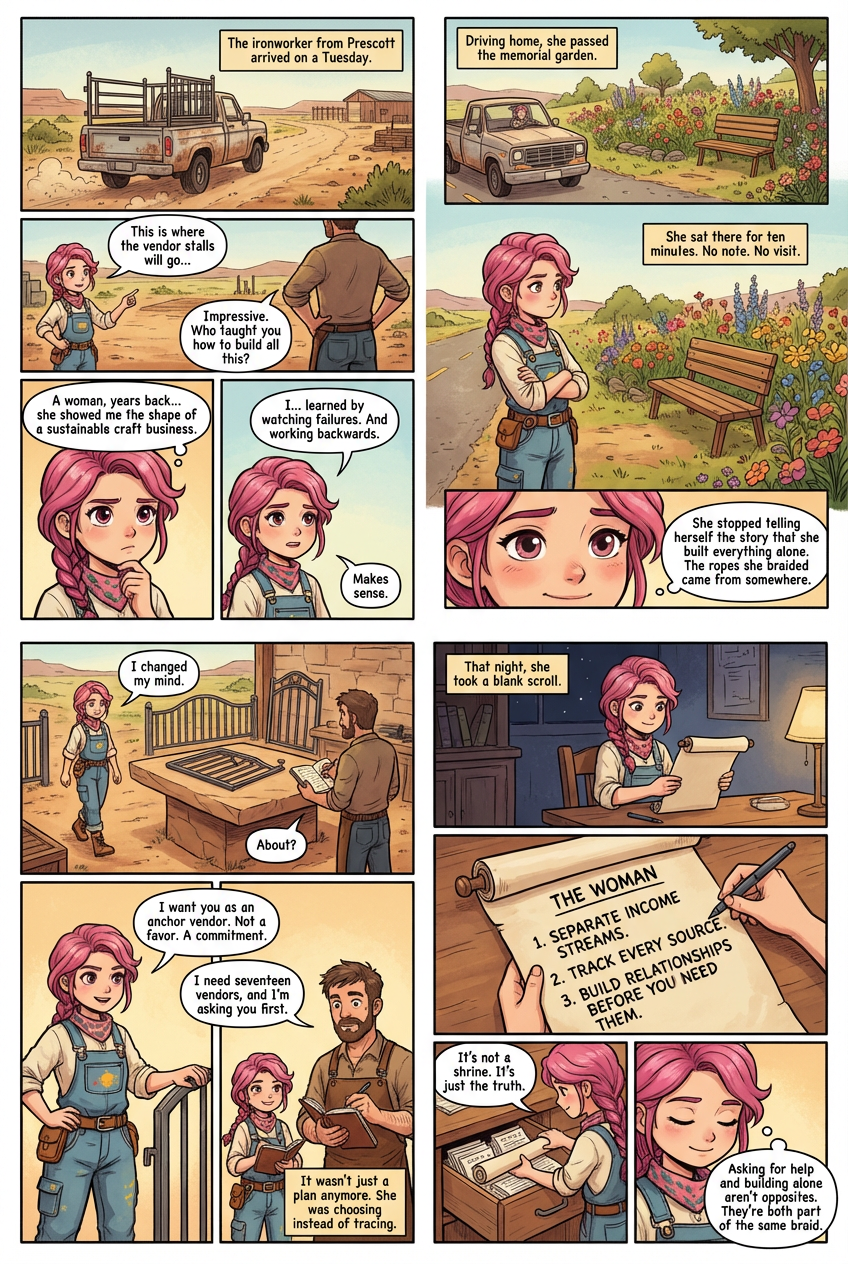
The ironwork artist from Prescott shows up on a Tuesday morning, his truck rattling down the dirt road with three sample gates loaded in the back. Lovelock walks him through her vision for the future market—where the vendor stalls will go, how the flow will work, what kind of signage she'll need. He asks how she built it all—the markets in Prescott, the boutique orders, the resale channels. He wants to know who taught her. Lovelock hesitates. There was someone, years back, who showed her the shape of a sustainable craft business. A woman with a memorial garden full of flowers she grew herself, who sold at three venues and never relied on one stream. Lovelock watched her work for two seasons, asked questions, traced her methods. But when Lovelock tried to thank her later, the woman brushed it off and said she didn't teach anyone anything—people either figured it out or they didn't. So Lovelock tells the ironworker she learned it herself, by watching failures and working backwards. He nods, satisfied. But later, driving home past the memorial garden with its bright blooms and empty bench, Lovelock pulls over. She sits there for ten minutes, staring at the flowers. She doesn't go in. She doesn't leave a note. But she stops telling herself the story that she built everything alone. The ropes she braided came from somewhere, even if the woman who grew them refused to be named. She drives back to the ironworker's setup at the sandstone table where he's laid out his sample gates and half-finished pieces. She asks if he wants a permanent spot when the market opens—not as a favor, but as an anchor vendor. He looks surprised, then asks what changed her mind. Lovelock says she needs seventeen vendors and he's the first one she's asking directly instead of waiting for people to find her. He agrees on the spot and pulls out a leather notebook to write down the terms. As she watches him work, she realizes she just stopped hiding behind the careful networks she built and started claiming what she wants out loud. The market isn't just a plan anymore—it has its first committed vendor, and she put him there by choosing instead of tracing. That night, she takes a blank scroll she bought months ago at a craft swap and writes down the woman's name at the top. Below it, she lists the three lessons she learned by watching: separate income streams, track every source, build relationships before you need them. She rolls it up and tucks it in the back of her bookkeeping drawer, behind the receipts and monthly statements. It's not a shrine or a confession. It's just the truth written down where she can see it when she needs to remember that asking for help and building alone aren't opposites—they're both part of the same braid.
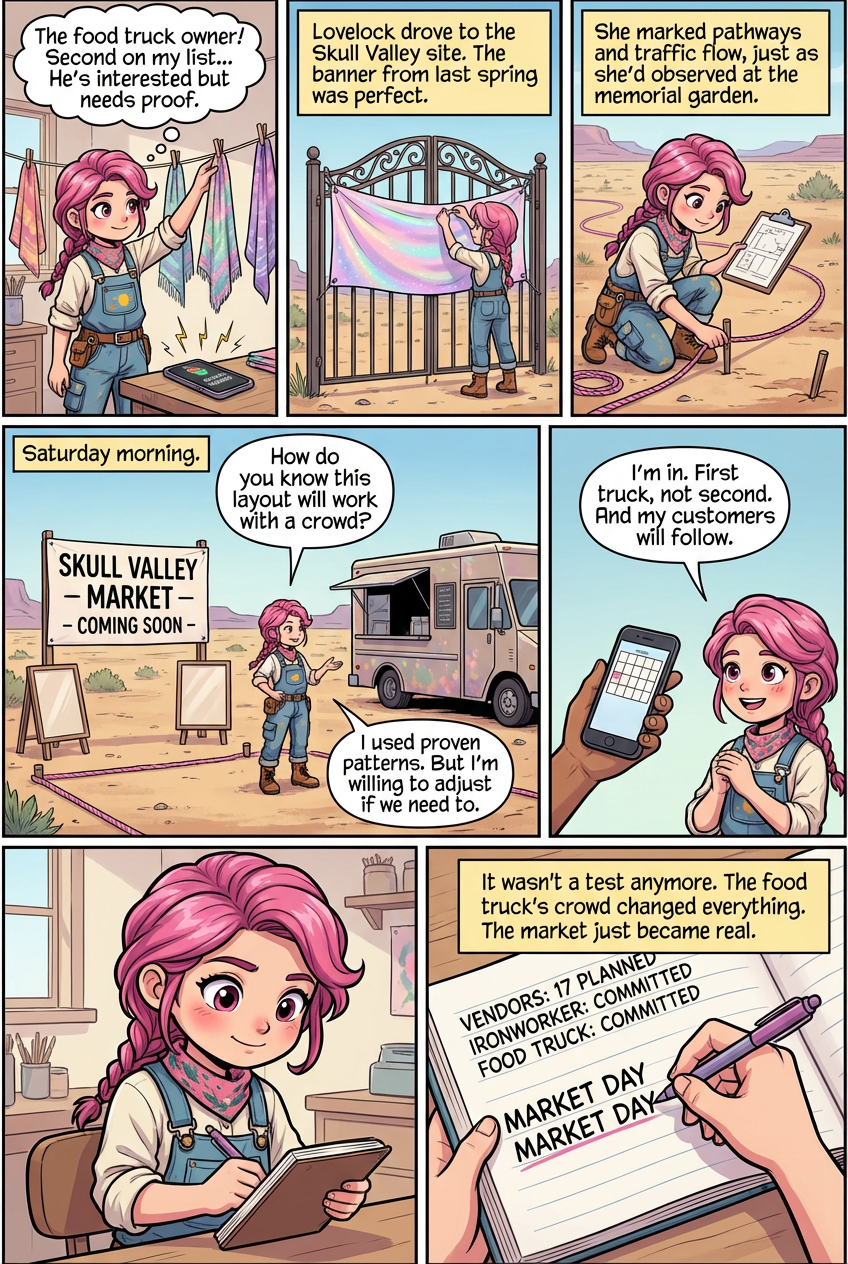
The food truck owner calls on a Wednesday, right after Lovelock finishes dyeing a batch of scarves with the cultivated roses. His name is on her vendor list, second food truck, and his answer is maybe. He's heard about the Skull Valley market idea from someone at the Prescott setup, and he's interested—but only if she can prove the site can handle crowds. Lovelock drives to the market site that afternoon with a roll of pink rope, twelve stakes, and the iridescent banner she dyed last spring using three different rose batches layered over each other. She hangs it on the ironworker's finished gate—the one he left installed as a marker for the entrance—and steps back to see if it catches light the way she needs it to. It does. The pastels shift in the desert wind, visible from the road. She walks the perimeter next, marking pathways with the rope and stakes, measuring traffic flow the way she learned by watching the memorial garden woman manage her own weekend crowds. She takes photos from six angles, then calls the food truck owner and sends them with a message: flow plan attached, entrance visible from highway, room for fifty cars and foot traffic separation. He texts back in four minutes. He wants to see it in person on Saturday. Saturday morning, Lovelock sets up the full simulation. She plants a bright pink events sign at the entrance, positions three of her own display frames where vendor stalls will go, and ropes off the pathways she planned. The food truck owner arrives at nine with his partner, and they walk the site twice—once following the customer flow, once checking truck access and turnaround space. He asks how she knows the layout will work under pressure. Lovelock tells him the truth: she doesn't, but she built it using patterns from venues that do work, and she's willing to adjust after the first real market day if the flow breaks. He looks at the banner still hanging on the gate, at the clean pathways, at the events sign catching morning light. Then he pulls out his phone and adds the date to his calendar. He's in—first food truck committed, not second. And he'll bring his own crowd, he says, because his customers follow him anywhere. Lovelock takes down the simulation after he leaves, but she keeps the banner hanging. It's not a test anymore. It's a promise the site just kept. That night she updates her vendor list: seventeen vendors planned, one ironworker committed, one food truck committed. She runs the numbers with her bookkeeper the next morning and realizes the food truck's built-in crowd changes everything—it means she doesn't need to fill all seventeen slots before opening day. She can start smaller, let the truck draw people in, and grow from there. The market just became real in a way it wasn't before, and Lovelock writes the date in her notebook three times to make sure it stays that way.
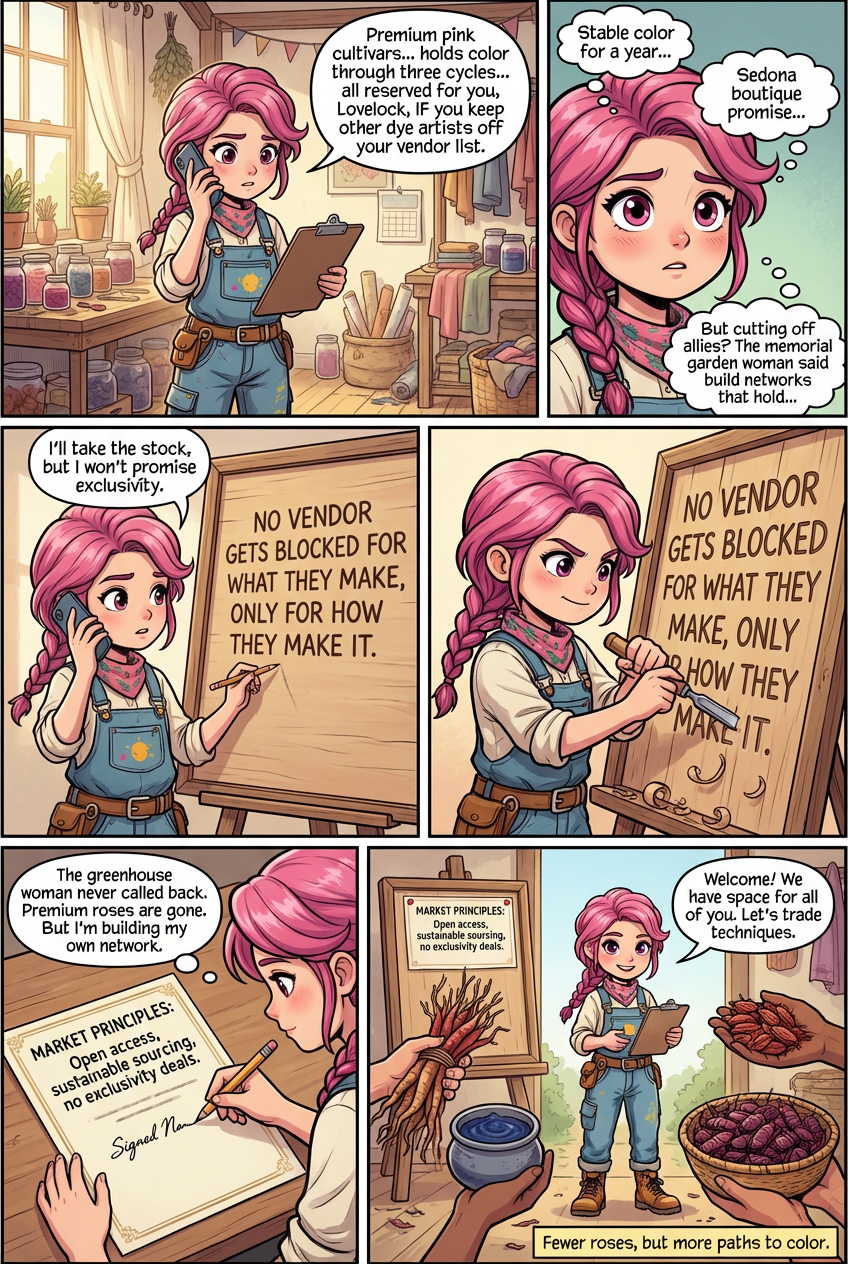
The greenhouse woman calls on Thursday morning while Lovelock is counting inventory. She has premium stock coming in—deep pink cultivars that hold color through three dye cycles—but there's a condition. She'll reserve it for Lovelock, all of it, but only if Lovelock keeps other dye artists off her vendor list. Lovelock holds the phone and counts the cost in real time. The premium stock means stable color for a year, maybe more. It means she can promise the Sedona boutique consistent batches without scrambling for backup sources. But locking out other dye artists means cutting off people who might become allies, who might share techniques or supplier contacts she doesn't have yet. She thinks about the memorial garden woman and the three lessons she wrote down—one of them was about building networks that hold when single sources fail. She tells the greenhouse woman she'll take the stock, but she won't promise exclusivity. The woman goes quiet for eight seconds, then says the offer stands for twenty-four hours. Lovelock hangs up and pulls out the wooden rules board she commissioned last month for the market entrance. She was going to carve vendor guidelines into it—setup times, cleanup standards, the basics. Now she realizes it's also where she'll draw the line on what kind of market she's building. She takes a pencil and writes the first rule directly on the wood: no vendor gets blocked for what they make, only for how they make it. The pencil mark is faint, but it's there. She'll carve it permanent tomorrow, and she'll lose the premium stock because of it. But the market will open with a rule that matches the networks she's been building all along—three ropes braided together, not one rope she has to protect alone. Friday morning she carves the rule into the board with a chisel, each letter deep enough to last. The greenhouse woman doesn't call back. By noon Lovelock writes a letter on cream paper explaining her decision and prints a certificate with the market's opening principles—open vendor access, sustainable sourcing only, no exclusivity deals that close doors on other artists. She signs it and pins it next to the rules board at the site entrance. The premium roses are gone, but three dye artists she met at the Prescott markets contact her by Sunday asking about vendor slots. One of them uses madder root. One works with indigo like she does. The third uses cochineal and wants to trade techniques. Lovelock adds all three names to her list and realizes she just built the supplier network the greenhouse woman didn't want her to have. The market opens with fewer guaranteed roses, but more paths to color than she started with.
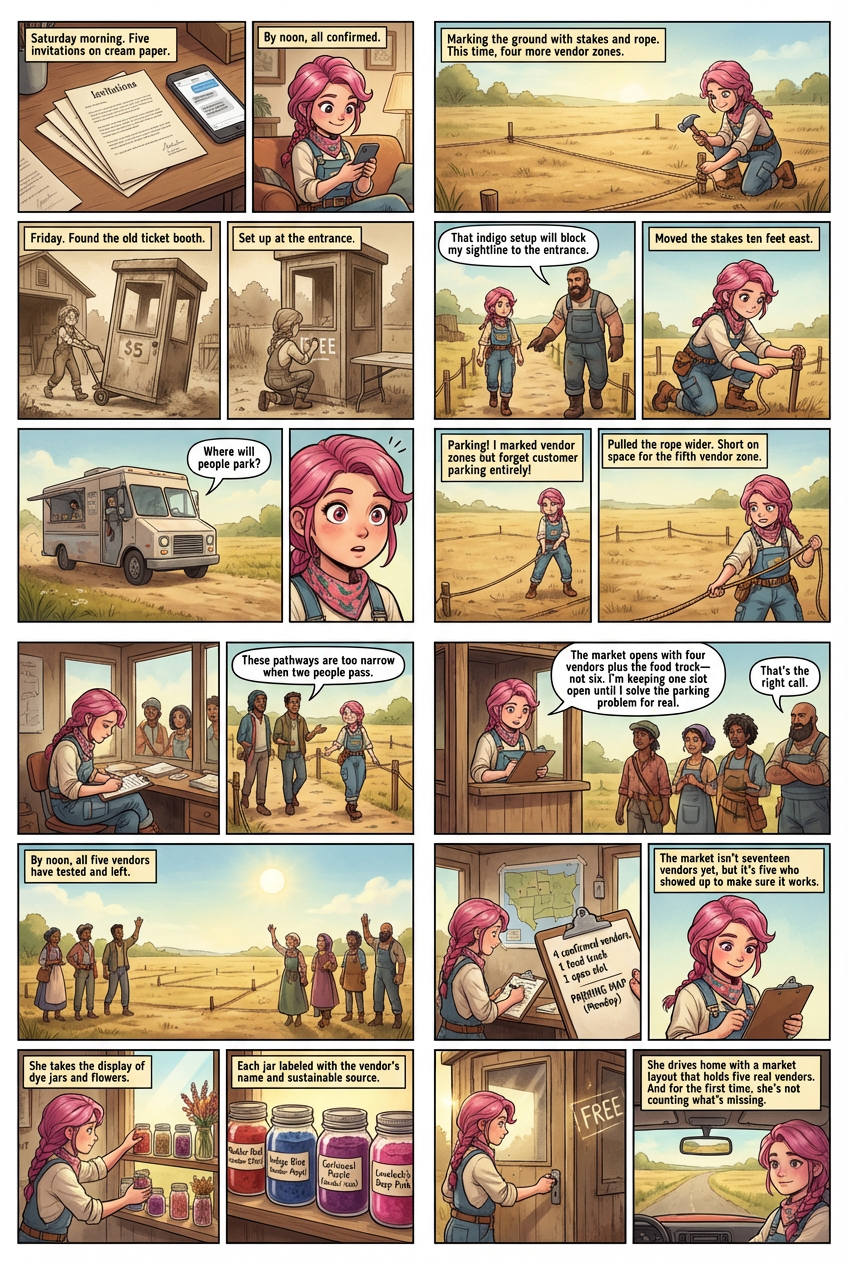
Lovelock prints five invitations on cream paper Saturday morning and texts them out by noon. The ironworker, the food truck owner, and the three dye artists all confirm within two hours. She marks the ground with stakes and rope the way she did for the food truck demo, but this time she adds four more vendor zones. She finds the old ticket booth behind the equipment shed on Friday and drags it to the site entrance with a borrowed dolly. The faded sign still reads $5, which she crosses out and writes FREE in chalk. Inside she sets up a folding table, her vendor map, and a clipboard with five vendor names and their assigned zones. When the ironworker arrives first at eight, she walks him through the full loop—entry point to his zone to the food truck to the three dye artist spots and back. He stops at the second dye artist's location and points out that her indigo setup will block his sightline to the entrance. Lovelock moves the stakes ten feet east and rewalks the path. The food truck owner pulls in at nine and immediately asks where people will park. She realizes she marked vendor zones but forgot to map customer parking entirely. She grabs the stakes from the furthest dye artist zone and ropes off a parking area instead, which means she's down to four vendor spots until she figures out how to fit both. The three dye artists arrive together at ten and spend twenty minutes walking the loop, testing setup times, and pointing out that the pathways are too narrow when two people pass each other. Lovelock pulls the rope wider twice, then realizes she's now short on space for the fifth vendor zone she promised. She sits in the ticket booth and recalculates the layout on paper while all five vendors wait. Finally she erases the fifth zone completely and tells them the market opens with four vendors plus the food truck—not six. The cochineal artist asks if that means one of them is cut. Lovelock says no, it means she's keeping one slot open until she solves the parking problem for real. The ironworker nods and says that's the right call. By noon all five vendors have tested their zones, confirmed their setup times, and left. Lovelock sits in the ticket booth and writes the new layout on the clipboard: four confirmed vendors, one food truck, one open slot, and a parking map she'll finish by Monday. The market isn't seventeen vendors yet, but it's five who showed up on a Saturday to make sure it works. She takes the display of dye jars and flowers she brought for the demonstration and places it inside the ticket booth window where vendors will check in on opening day. The colors catch the afternoon light—madder red, indigo blue, cochineal purple, her own deep pink. She labels each jar with the vendor's name and their sustainable source. This isn't decoration. It's proof that the open-access rule she carved into the wooden board actually built something stronger than exclusivity ever could. She locks the ticket booth and drives home with a market layout that holds five real vendors instead of seventeen imagined ones, and for the first time she's not counting what's missing.
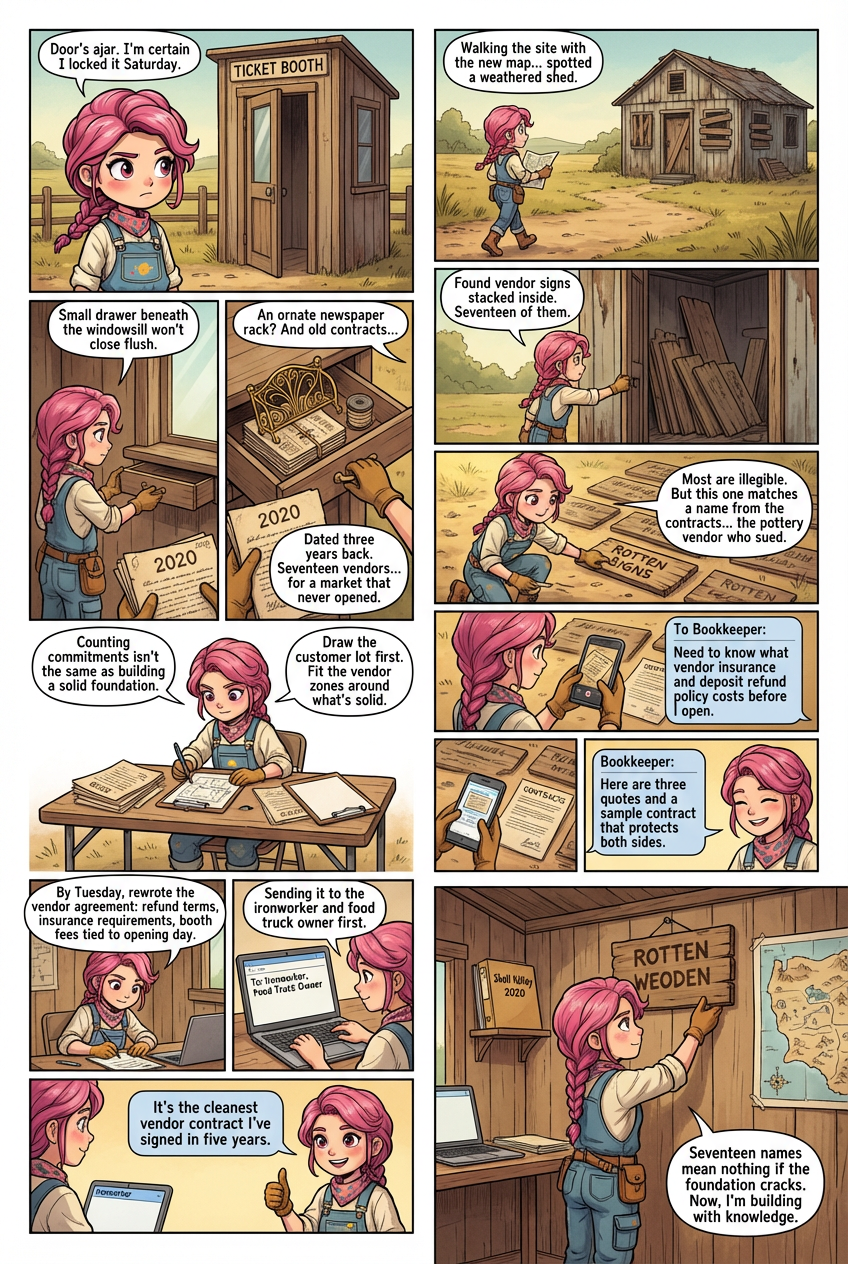
Lovelock returns to the ticket booth Monday morning to finish the parking map and finds the door slightly ajar. She's certain she locked it Saturday. Inside, the folding table is undisturbed, the vendor clipboard exactly where she left it, but the small drawer beneath the windowsill won't close flush anymore. She pulls the drawer open and finds a newspaper rack wedged inside—art nouveau brass curves and ornate panels, too fancy for a ranch ticket booth. Behind it, a stack of vendor contracts bound with a rubber band that crumbles when she touches it. The contracts are dated three years back, signed by seventeen vendors for a Skull Valley market that never made it past opening weekend. She reads through them slowly. Half the vendors backed out before launch. Three sued the organizer for booth fees collected in advance. The food truck pulled out when the parking layout failed inspection. She sets the contracts on the table and counts them twice. Seventeen vendors. Exactly the number she'd written on her first planning sheet before she understood that counting commitments wasn't the same as building something that held. She photographs every page, then locks the contracts back in the drawer with the newspaper rack. The parking map she came to finish sits blank on her clipboard, but now she knows why it matters. She draws the customer lot first this time, then fits the vendor zones around what's already solid. She walks the site with the new map and spots a weathered shed beyond the equipment storage—planks soft with rot, windows boarded up. A rotten arrow sign leans against the entrance, its wood warped and covered in moss. She pulls the door open and finds vendor signs stacked inside, each one labeled with a business name and zone number. Seventeen signs. She carries them outside and lays them in the sun. Most are too damaged to read, but three are still legible. One matches a name from the contracts—a pottery vendor who sued for the booth deposit. Lovelock photographs the signs next to the contracts and sends both files to her bookkeeper with a message: "Need to know what vendor insurance and deposit refund policy costs before I open." The bookkeeper texts back within an hour with three quotes and a sample contract that protects both sides. By Tuesday she has rewritten her vendor agreement with refund terms, insurance requirements, and a clause that ties booth fees to actual opening day, not commitments made months earlier. She sends it to the ironworker and the food truck owner first. The ironworker replies that it's the cleanest vendor contract he's signed in five years. Lovelock files the old contracts in a folder labeled "Skull Valley 2020" and tapes one of the rotten arrow signs to the ticket booth wall where she'll see it every time she opens the drawer. She's still building toward seventeen vendors, but now she's building with the knowledge that seventeen names on paper means nothing if the foundation cracks under them.
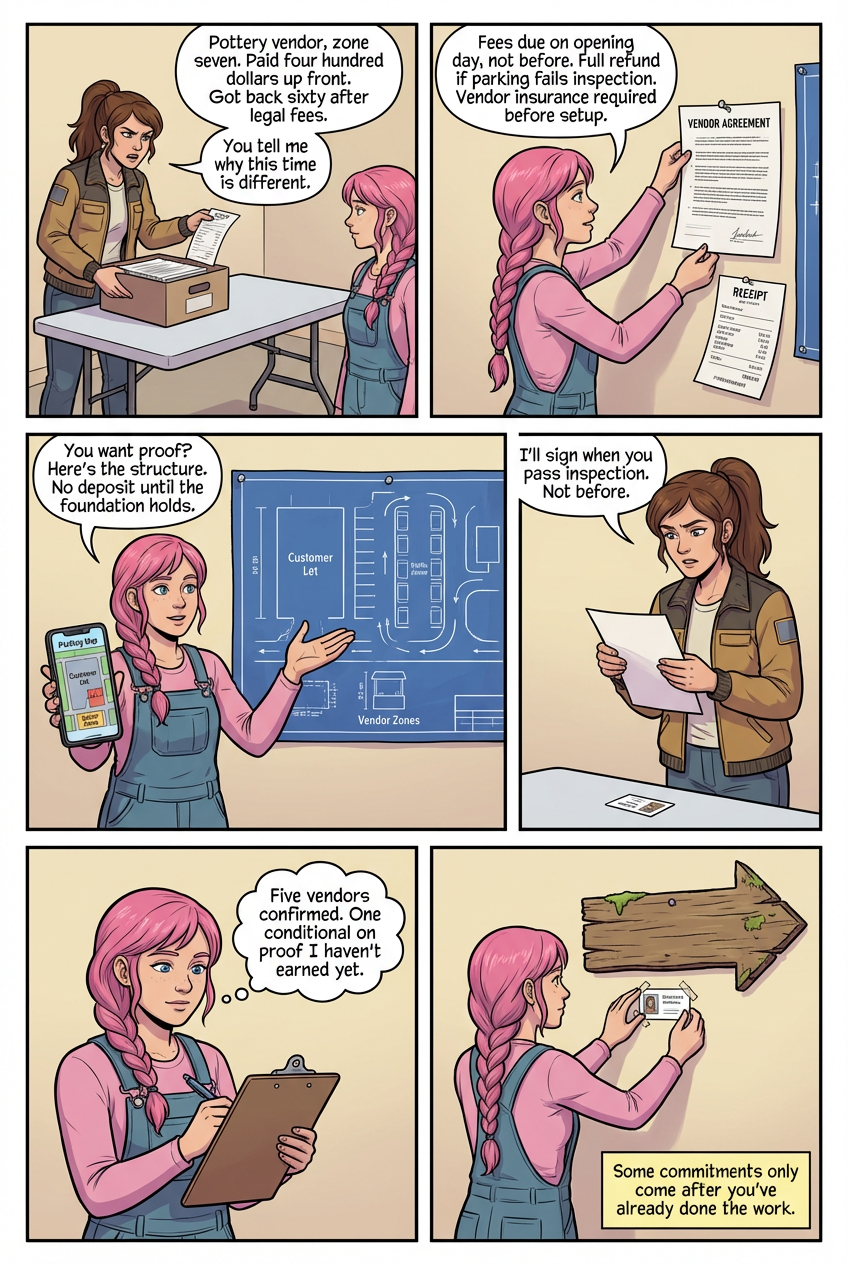
A woman steps around the corner carrying a document box under one arm. She sets it on the folding table without asking and flips the lid open. Inside are contracts, receipts, court filings—all stamped with the same date range as the vendor agreements Lovelock found in the drawer. The woman pulls out a receipt with her business name circled in red ink. "Pottery vendor, zone seven. Paid four hundred dollars up front. Got back sixty after legal fees." She taps the paper. "You tell me why this time is different." Lovelock doesn't answer right away. She unpins the revised vendor agreement from the wall and sets it beside the receipt. "Fees due on opening day, not before. Full refund if parking fails inspection. Vendor insurance required before setup." She pulls out her phone and opens the parking map she redesigned—customer lot first, vendor zones built around solid access. Then she unrolls the blueprints she drew up Monday night, showing booth placement, traffic flow, and emergency vehicle clearance. She pins them to the booth wall so the woman can see the whole layout at once. "You want proof? Here's the structure. No deposit until the foundation holds." The woman studies the blueprints for a long minute, then picks up the vendor agreement and reads it twice. She sets down a business card with her email address and booth dimensions written on the back. "I'll sign when you pass inspection. Not before." She packs the document box and walks back to her truck without waiting for a reply. Lovelock adds the card to her clipboard and updates her spreadsheet. Five vendors confirmed. One conditional on proof she hasn't earned yet. She tapes the pottery vendor's business card next to the rotten arrow sign on the wall—a reminder that some commitments only come after you've already done the work.
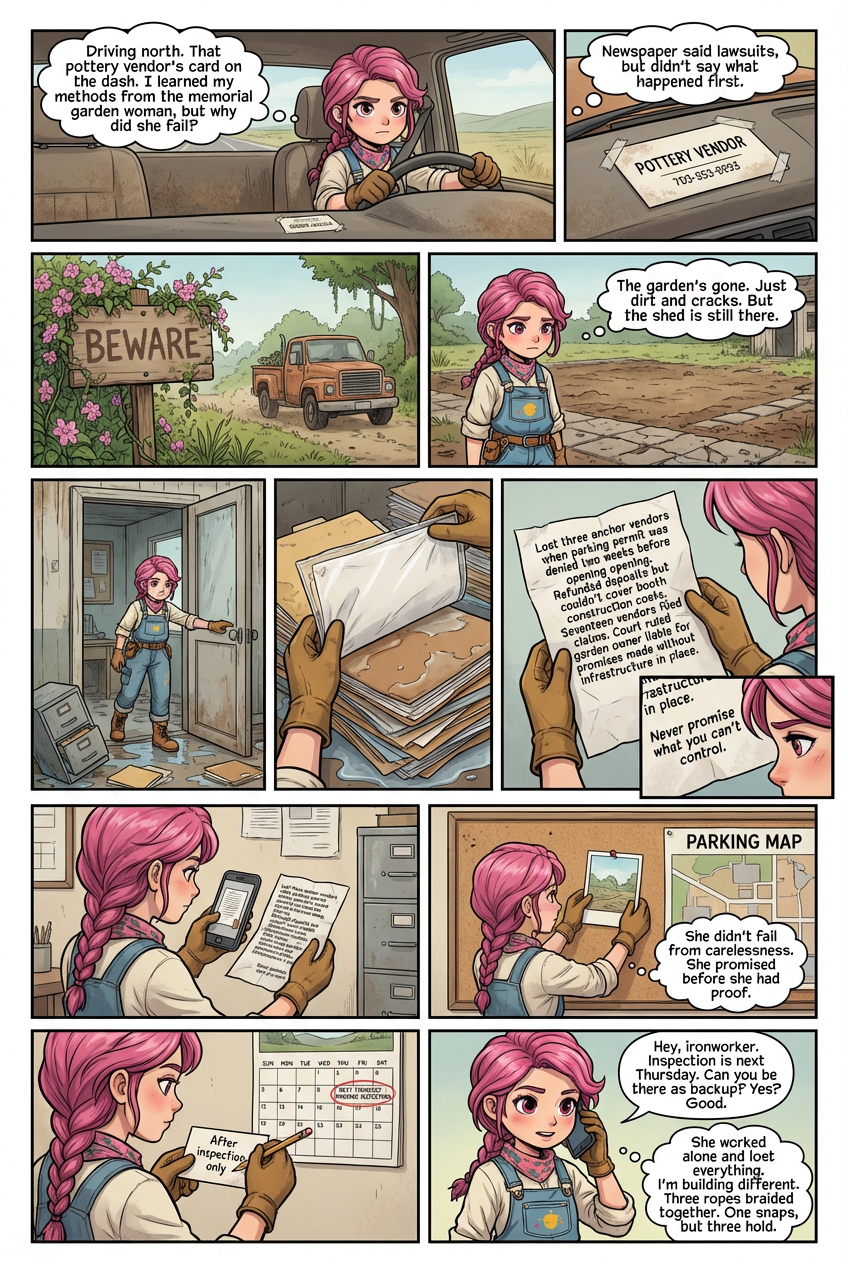
Lovelock drives north with the pottery vendor's card taped to her dashboard. She learned her business methods by watching the memorial garden woman, but she never found out why the garden closed. The newspaper article about the failed market mentioned vendor lawsuits, but it didn't say what happened before that. She finds the property twenty minutes past Prescott, marked by a sign buried in pink vines that says "Beware" in faded letters. The garden itself is gone—just dirt patches and cracked pavers where the beds used to be. But the office shed is still standing, door half-open. Inside, she finds a filing cabinet tipped on its side with folders scattered across the floor. Most are water-damaged, but one folder is sealed in plastic. Inside is a crumpled sheet of paper with handwritten notes: "Lost three anchor vendors when parking permit was denied two weeks before opening. Refunded deposits but couldn't cover booth construction costs. Seventeen vendors filed claims. Court ruled garden owner liable for promises made without infrastructure in place." At the bottom, in different ink: "Never promise what you can't control." Lovelock smooths the paper flat and photographs it with her phone. She drives back to Skull Valley and pins the photo next to her parking map. The memorial garden woman didn't fail because she was careless—she failed because she promised completion before she had proof. Lovelock opens her calendar and schedules the parking inspection for next Thursday. She won't contact the pottery vendor until the inspector signs off. Some commitments are earned by waiting, not by asking. She pulls out her vendor list and marks the pottery vendor's card with a pencil note: "After inspection only." Then she calls the ironworker and tells him the inspection date. He asks if she wants him there as backup. She says yes. The memorial garden woman worked alone and lost everything when one permit fell through. Lovelock learned by watching her build—but she's building different. Three ropes braided together. One snaps, but three hold.
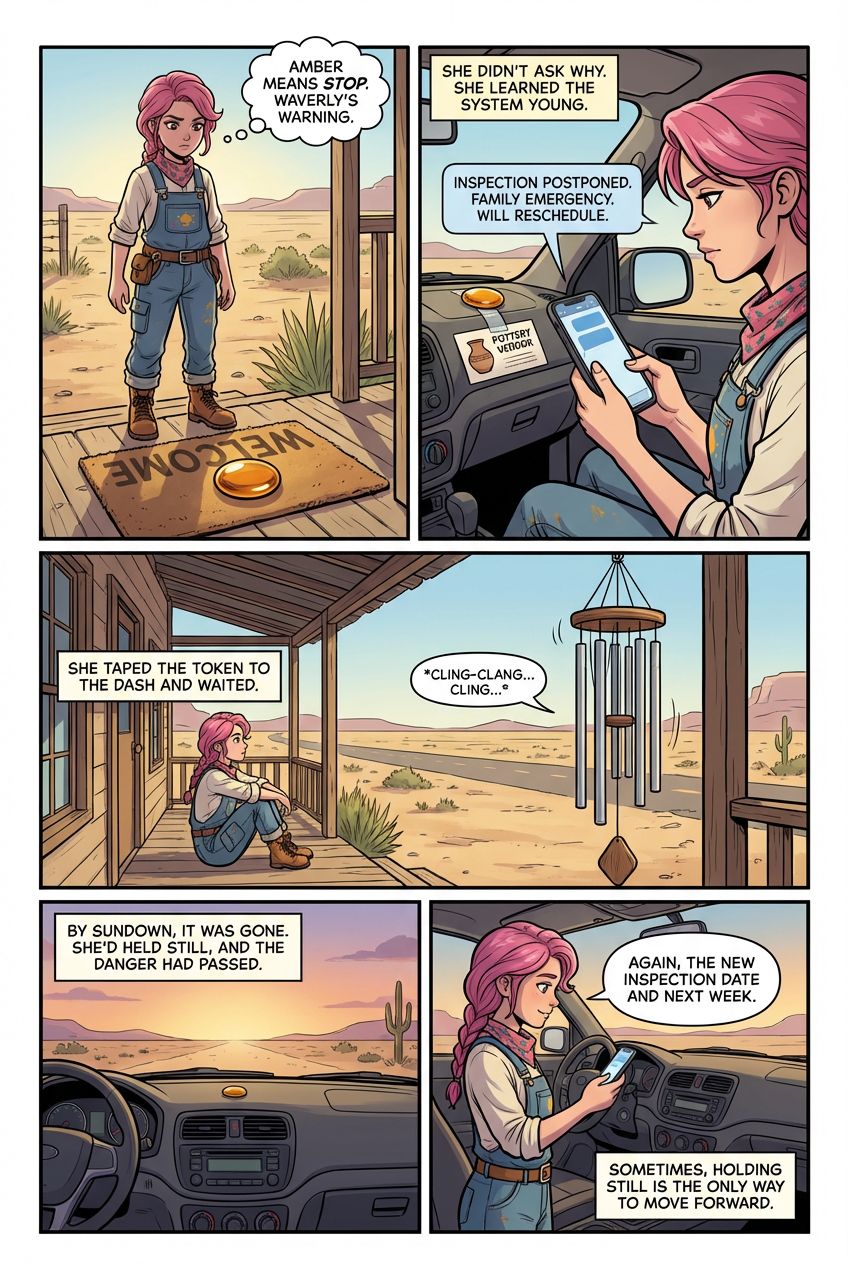
The inspection is set for Thursday at nine. Lovelock wakes up Wednesday and finds the amber token on her porch—smooth glass the size of a quarter, placed dead center on the welcome mat. Waverly's warning. Stay inside. Halt all work. Lovelock picks up the token and turns it over in her palm. It catches the morning light like honey. She texts the ironworker: "Inspection postponed. Family emergency. Will reschedule." Then she calls the inspector's office and moves it to next week. She doesn't ask Waverly what the threat is—that's not how the token works. She learned this system as a kid: amber means stop, jade means safe, and you don't question the difference. She tapes the token to her dashboard next to the pottery vendor's card and sits on her porch watching the road. The wind chimes on her fence post ring soft and low, shifting with the desert air. She counts the hours until sundown when Waverly will retrieve the token if the danger has passed. By evening, the token is gone. Lovelock texts the ironworker the new date and opens her calendar. The inspection is now six days out instead of one. The pottery vendor will have to wait longer, but the memorial garden woman's mistake wasn't waiting too long—it was promising too early. Lovelock closes her laptop and watches the empty road. She built her network by learning when to move and when to hold still. This time, holding still kept her from losing momentum she hadn't earned yet.
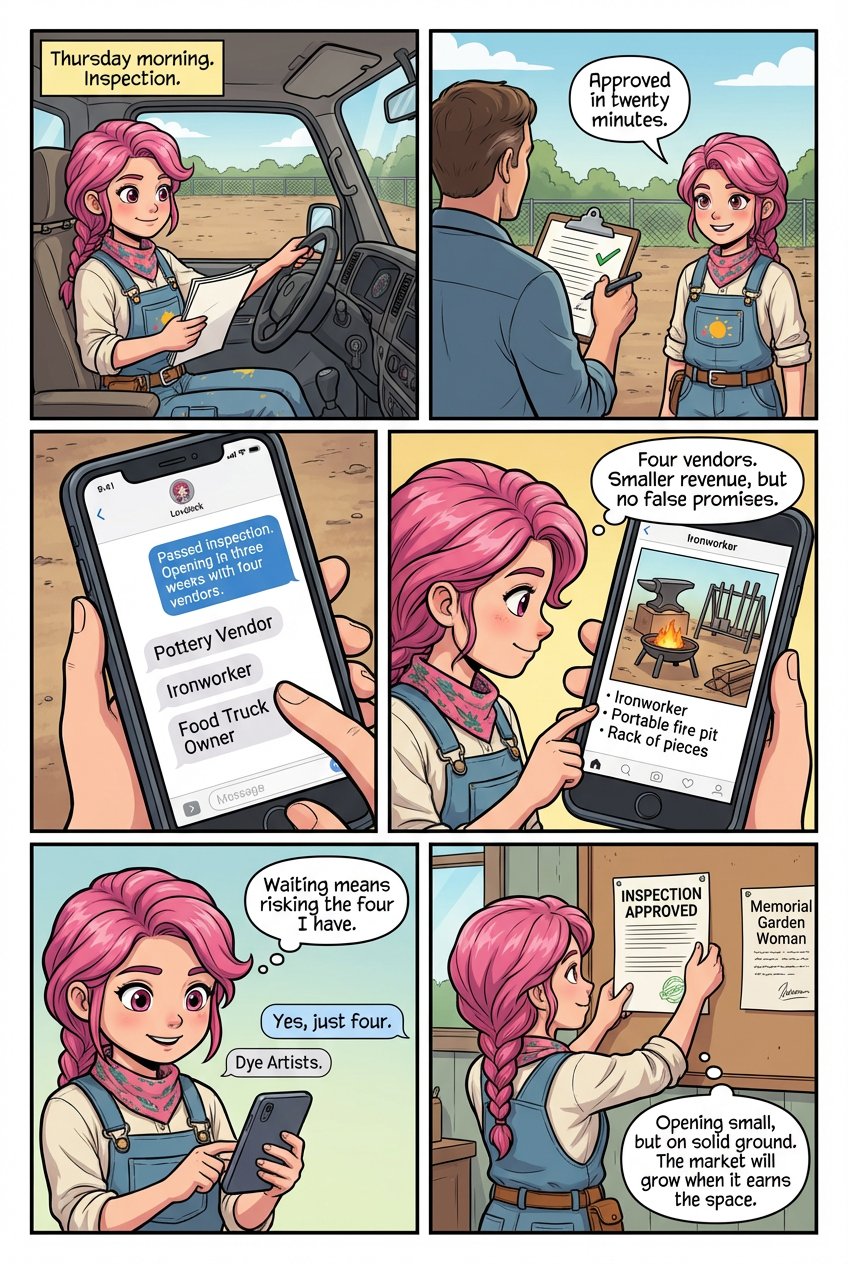
Thursday morning, Lovelock drives to the inspection alone. She brings her revised parking map, the vendor agreement the ironworker helped refine, and photographs of her four committed vendors standing in their assigned zones. The inspector walks the lot with a clipboard, measuring angles and checking drainage slopes. He approves it in twenty minutes. Lovelock texts the pottery vendor first, then the ironworker, then the food truck owner. She writes "Passed inspection. Opening in three weeks with four vendors." She doesn't mention the seventeen she once planned for or the empty slots still marked on her map. The ironworker texts back a photo of his forge setup—anvil, portable fire pit, and a rack of finished pieces he'll bring for opening day. Lovelock saves the image and opens her calendar. Four vendors means smaller revenue than she projected, but it also means no overcommitted parking, no false promises, and no lawsuits if one backs out. She learned from counting ghosts. This time she's counting people who showed up. The dye artists text back within the hour asking if she's still opening with just four spots. Lovelock types "Yes" and hits send before she can second-guess it. She could wait for more vendors, build toward the seventeen she once dreamed of, but waiting means risking the four she already has. The food truck owner needs a launch date to block his schedule. The pottery vendor made her commitment conditional on momentum, not perfection. Lovelock prints the inspection approval and pins it to her wall next to the memorial garden woman's name. She's opening small, but she's opening on solid ground. The market will grow when it earns the space, not because she promised it would.
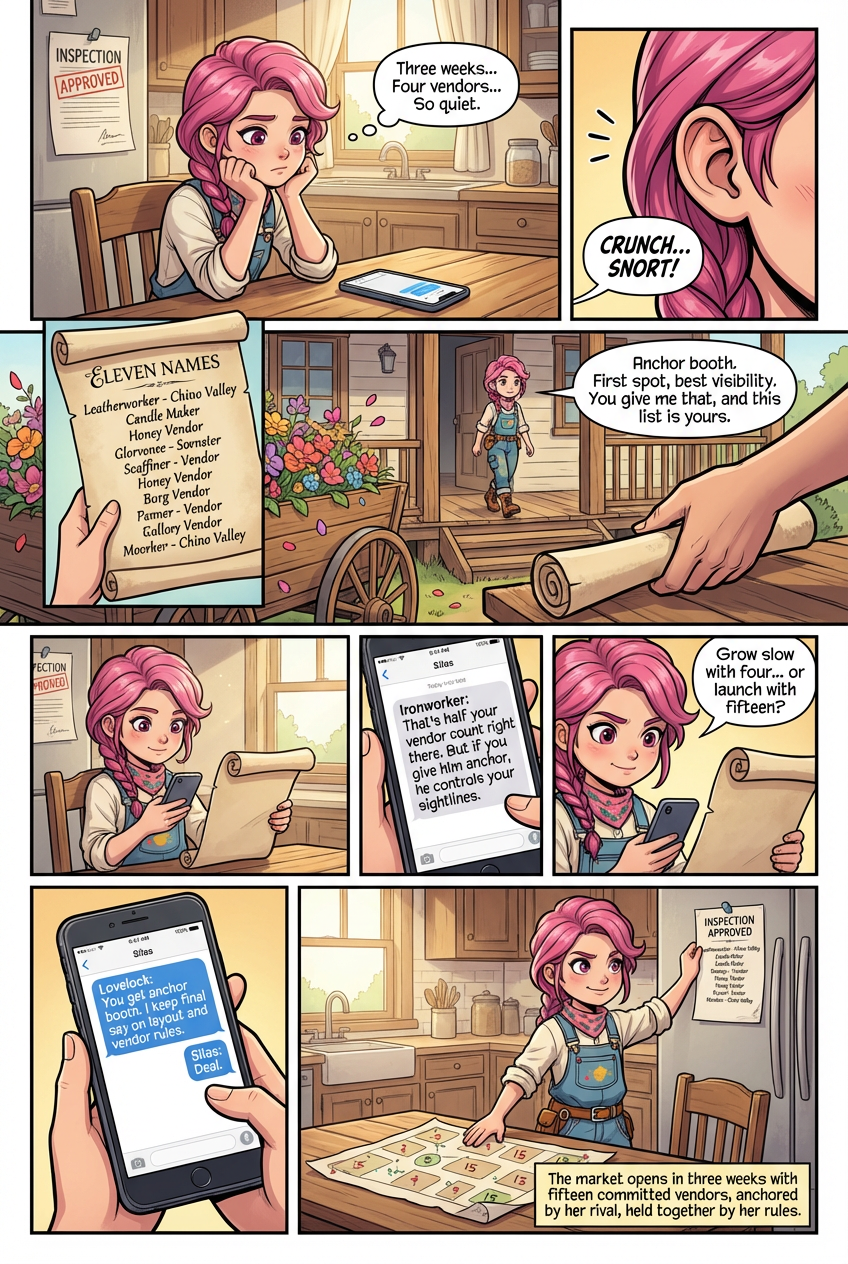
Lovelock sits at her kitchen table Friday morning with the inspection approval pinned to the wall and her phone face-up on the wood. She's opening in three weeks with four vendors, and she's already told them so. The text thread sits quiet. No one's backing out, but no one's adding momentum either. She hears the wagon before she sees it—wheels on gravel, a horse snorting. Lovelock steps outside and finds Silas pulling up in a flower-loaded wagon, petals spilling over the side rails. He climbs down slow, brushing dirt off his sleeves, and pulls a rolled scroll from his coat pocket. He unfurls it on her porch rail without asking. Eleven names in neat calligraphy, each one a vendor contact he's tracked across three counties. "Anchor booth," he says. "First spot, best visibility. You give me that, and this list is yours." Lovelock reads the names twice. A leatherworker from Chino Valley. A candle maker she's heard of but never met. A honey vendor the food truck owner mentioned once. These aren't ghosts—these are real people Silas already knows how to reach. Lovelock takes the scroll inside and texts the ironworker a photo. He calls back in two minutes. "That's half your vendor count right there," he says. "But if you give him anchor, he controls your sightlines. Everyone walks past him first." Lovelock sets the scroll on her table next to the inspection approval. She could open with four and grow slow, or she could take Silas's network and launch with fifteen. She texts Silas back: "You get anchor booth. I keep final say on layout and vendor rules." He replies in thirty seconds: "Deal." Lovelock pins the names list beside the memorial garden woman's lessons and updates her vendor map. She's not building alone anymore, and she's not building small. The market opens in three weeks with fifteen committed vendors, anchored by her rival, held together by her rules.
Play your story to life
Storycraft is a mobile game where you create AI characters, craft items and locations to build their world, then discover what direction your story takes. Download the iOS game for free today!
Download for free