

Luca Moretti's Arc
9 Chapters
Luca Moretti's dream is toppling the corrupt police commissioner who has been quietly hunting his empire for years..

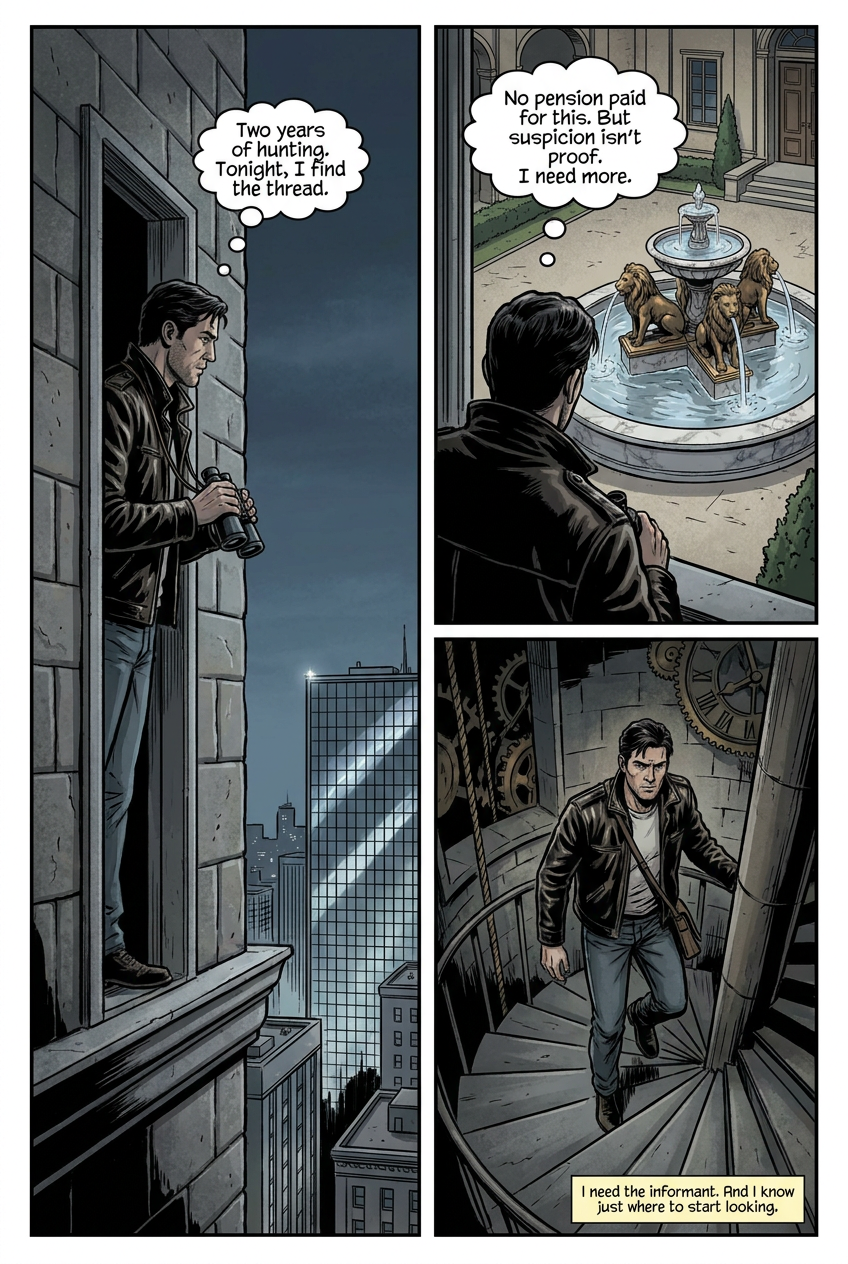
Luca climbed the narrow stairs inside the old clock tower and settled by a slender window. Below, the commissioner's glass penthouse glittered like a stolen coin. Two years the man had been hunting him. Tonight, Luca meant to find the thread that would pull the whole suit apart. He watched. A marble fountain crowned with bronze lions spat water in the courtyard. No pension paid for lions. No pension paid for that skyline glass either. But watching wasn't proof. Luca had a rule. Suspicion was not enough. He could shout about the house and the fountain all night, and every reporter would call it mob slander. He climbed down empty-handed. The commissioner still stood untouched, and somewhere inside Luca's own shop, a mouth was still moving. If he wanted leverage, he would have to find the informant first.
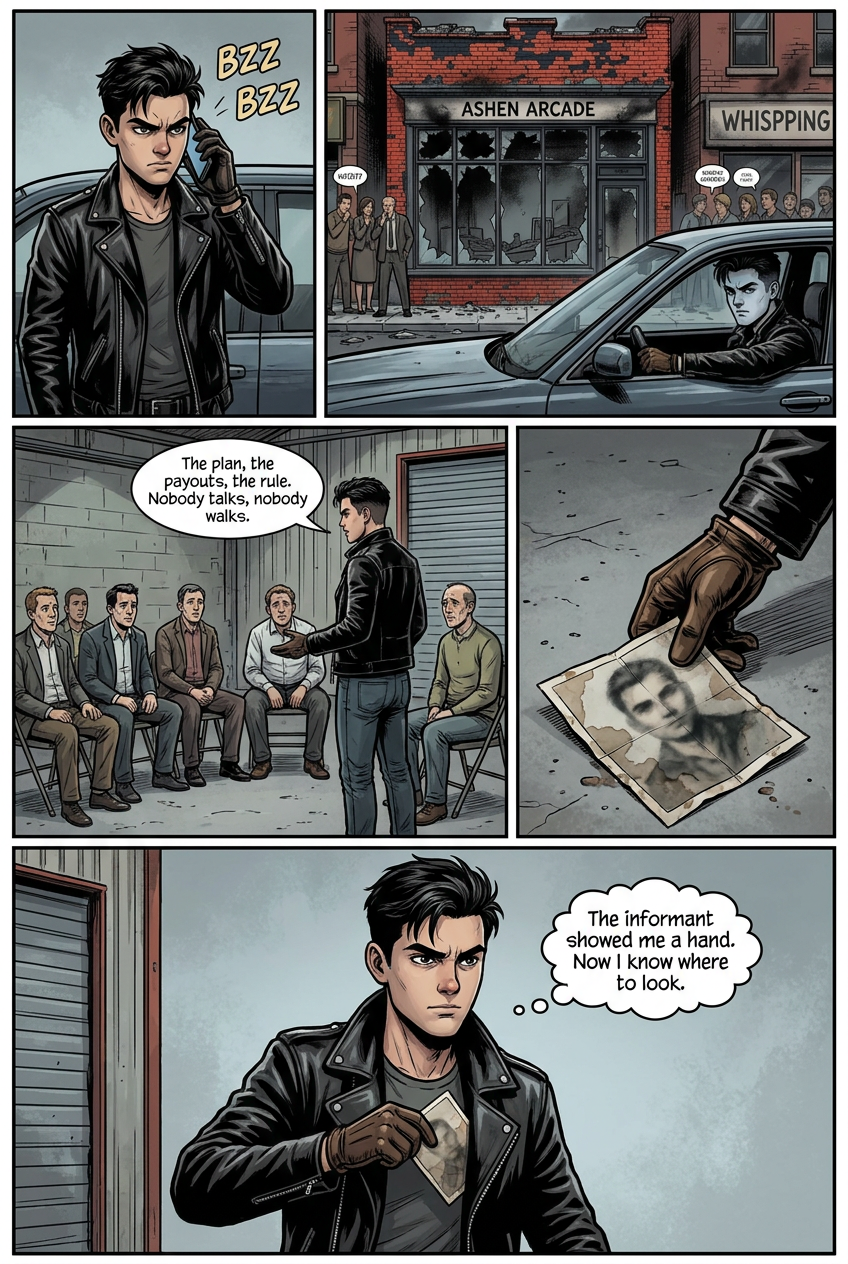
Luca came down from the tower with the informant still nameless. Before he reached his car, his phone buzzed twice. One of his fronts had been hit. The commissioner had moved first. He drove straight there. The brick storefront stood gutted, windows blown to teeth, soot streaking the face of it like dark tears. A small crowd whispered across the street. Luca did not stop. A crowd was a mouth, and mouths fed the wrong men. He pulled his crew into a plain storage garage with a bare concrete floor. Six men, all sweating, all watching the door more than him. Luca spoke flat and slow. No promises. No threats. Just the plan, the payouts, and the rule — nobody talks, nobody walks. He named the lawyer. He named the bail. He let the quiet do the rest. They filed out steadier than they came in. But on the folding chair where one man had sat, Luca found a creased photograph, water-stained, half a face worn away. The man had carried it for years. Leaving it behind was not forgetting. It was goodbye. Luca slid the photo into his coat. The crew was calm for tonight. The informant had just shown him a hand, and now Luca knew where to look.
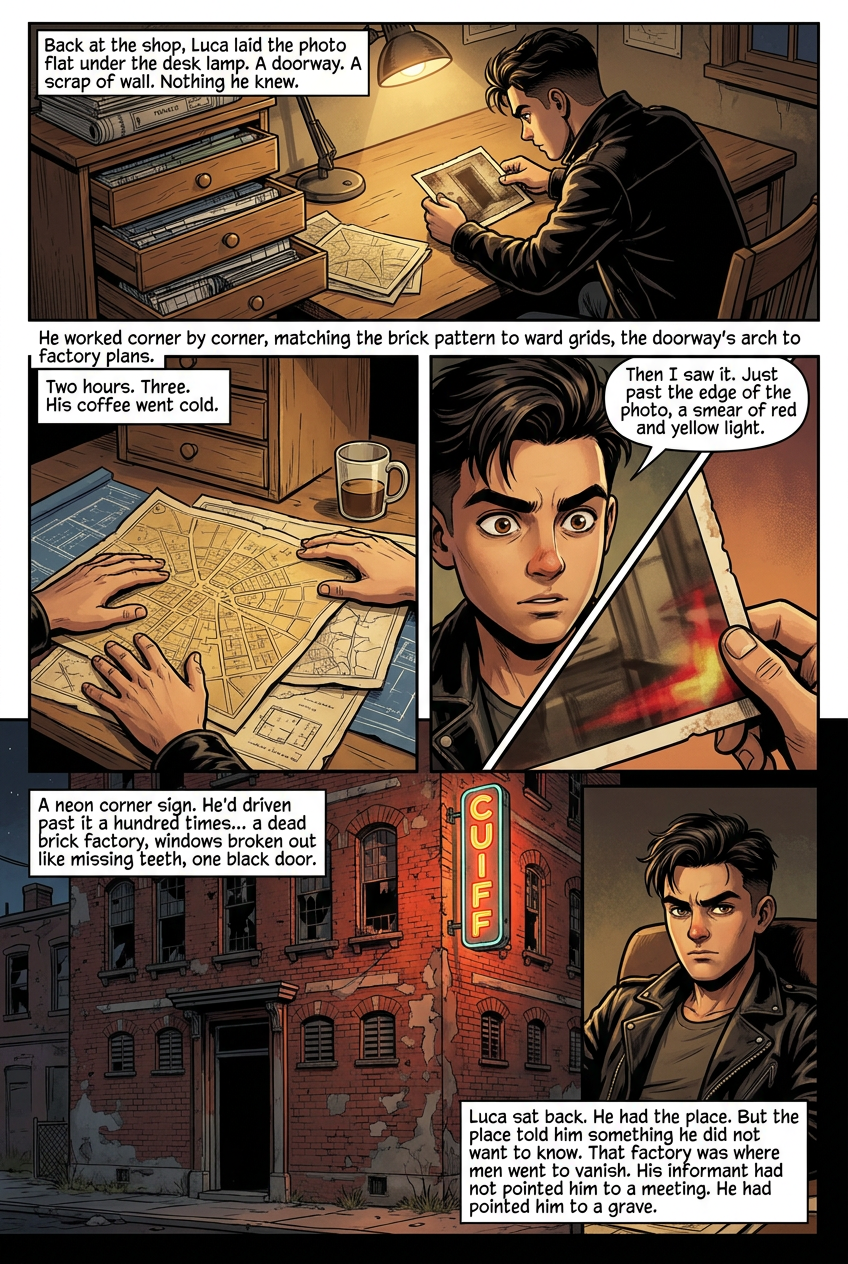
Back at the shop, Luca laid the photo flat under the desk lamp. A doorway. A scrap of wall. Nothing he knew. The commissioner was moving fast, and a wrong guess would cost him the night. He pulled open the wooden drawers where he kept the city in paper — street maps, transit lines, old blueprints stacked thick. He worked corner by corner, matching the brick pattern in the photo to ward grids, the doorway's arch to factory plans. Two hours. Three. His coffee went cold. Then he saw it. Just past the edge of the photo, a smear of red and yellow light bled onto the wall. A neon corner sign. He'd driven past it a hundred times. He laid the blueprint beside the photo and the arched doorway matched — a dead brick factory, windows broken out like missing teeth, one black door. Luca sat back. He had the place. But the place told him something he did not want to know. That factory was where men went to vanish. His informant had not pointed him to a meeting. He had pointed him to a grave.
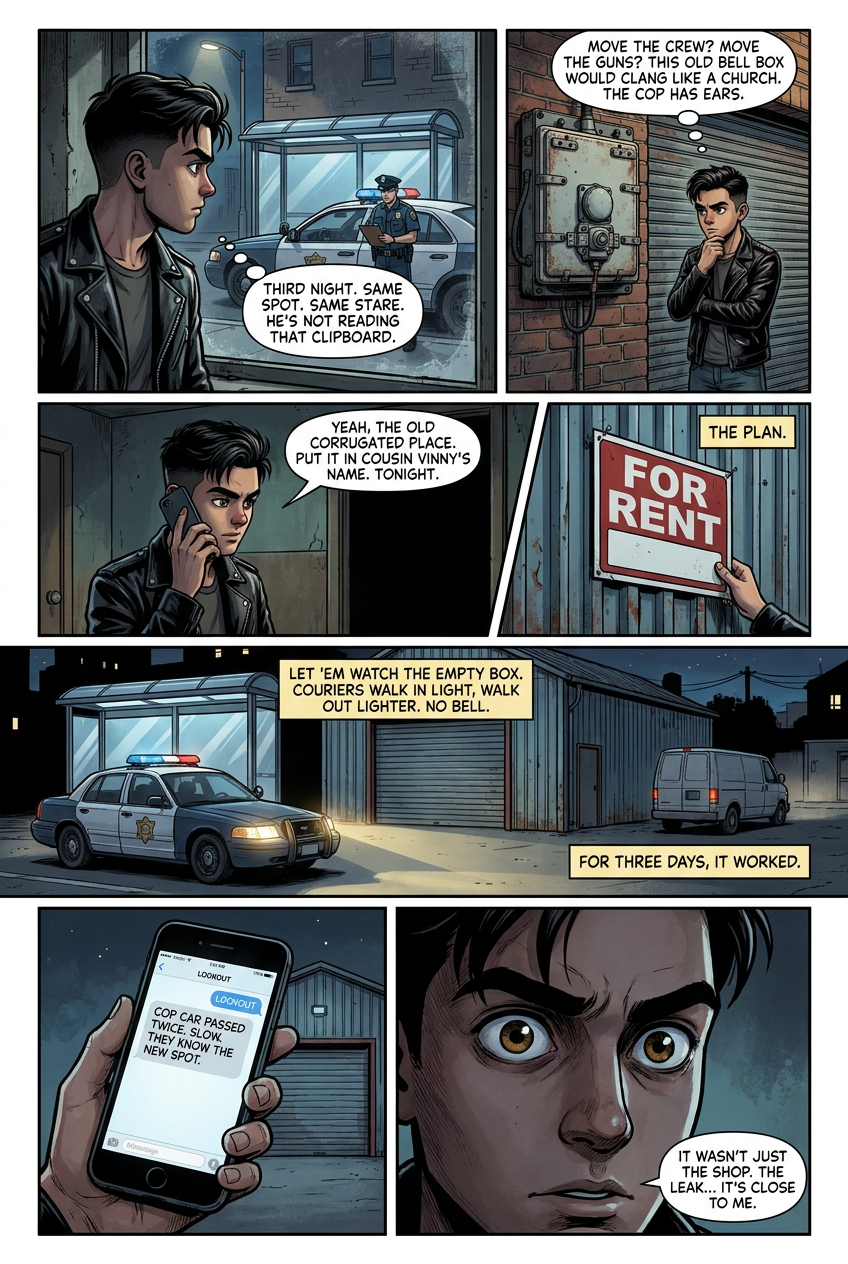
Luca folded the photo into his pocket and stepped out back to check the lot. A patrol car sat across the way, engine low, parked beside a glass bus shelter that had not been there a year ago. The cop pretended to read a clipboard. Luca counted the hours in his head. Third night this week. Same shelter. Same slow stare at his garage door. He walked back inside and killed the office light. Moving the crew was out. Moving the guns was out. Every time his door rolled up, the old bell box on the brick wall clanged like a church on Sunday, and the cop across the street had ears. Luca needed a way to feed his people without feeding the file the commissioner was building. He made two calls from a burner. By morning, a corrugated metal warehouse two blocks over was rented under a dead cousin's name. He had his men drop supplies there instead. Couriers walked in light, walked out lighter. Nothing crossed his garage threshold. The bell stayed quiet. The patrol car kept watching an empty box. It worked. For three days, it worked. Then Luca got a text from the warehouse lookout: a second patrol car had rolled past, slow, twice. Someone had told them where to look again. The leak was not just inside his shop. The leak was close to him.
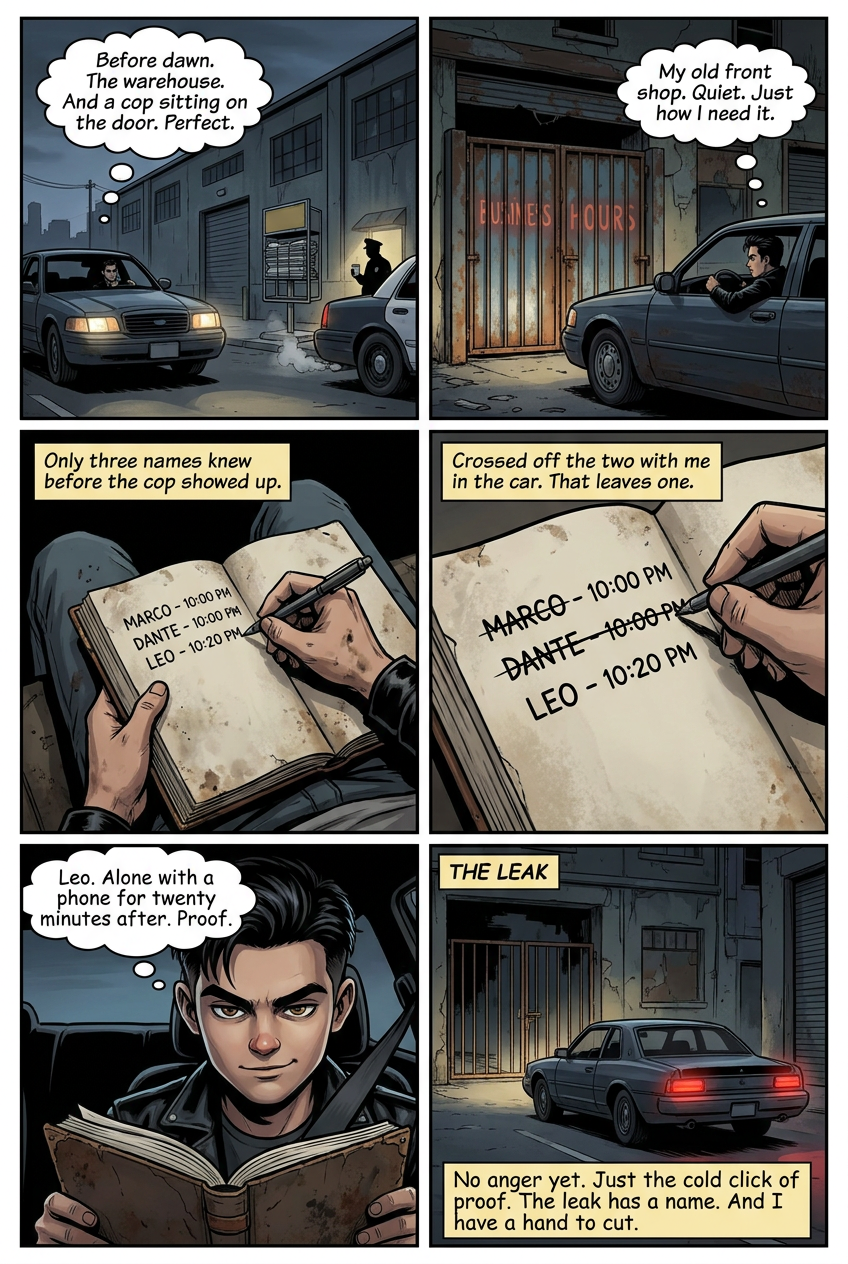
Luca drove past the warehouse before dawn. A newspaper stand stood at the curb, papers stacked neat under a yellow sign. Behind it, the second patrol car idled, half hidden by the metal frame. The cop inside sipped coffee and watched the door. Luca kept driving. He pulled up at the bones of his old front shop. Twisted bars hung where the gate had been, business hours still painted on the rust. He sat in the quiet and pulled a grease-stained ledger from under the seat. He drew six lines. One name per line. Beside each, he wrote the hour he had told that man about the warehouse. Only three names knew before the second patrol car appeared. He crossed off the two who had been with him in the car when he told them. That left one. A man who had been alone with a phone for twenty minutes after. Luca closed the ledger. He did not feel anger yet. He felt the small, cold click of proof landing in place. He started the engine and drove toward the garage. The leak had a name now. The commissioner's net was tighter, but Luca finally had a hand to cut.
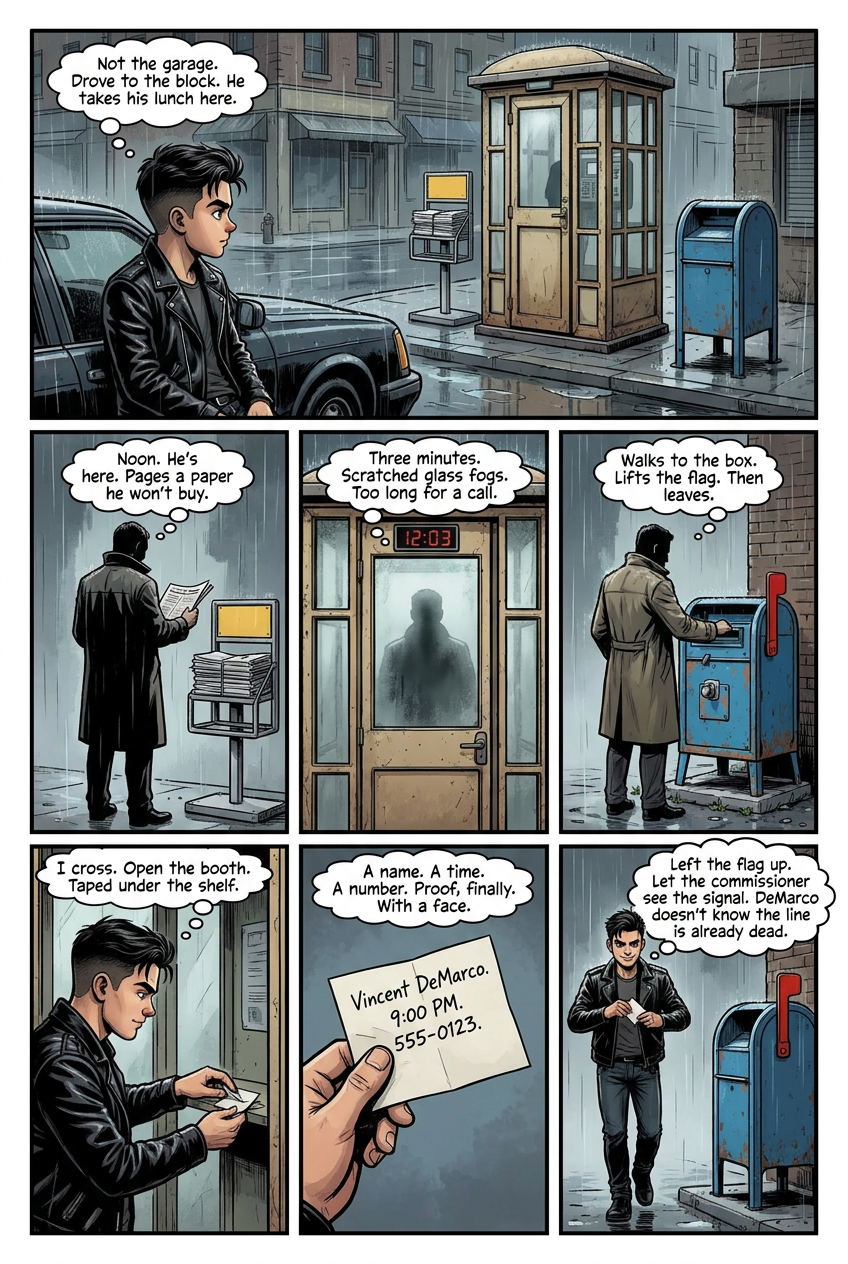
Luca did not go to the garage. He drove to the block where his man took his lunch. He parked across from a battered phone booth wedged between two storefronts. He had watched his man duck inside it twice last month and stay too long for a call to a wife he did not have. He waited. At noon, his man came. He stepped past a newspaper stand, lingered, paged through a paper he did not buy. Then he slipped into the booth. Luca watched the scratched glass fog. Three minutes. The man came out, walked to a blue mailbox on the corner, and lifted the red flag. Then he left. Luca crossed the street. He opened the booth and looked. Taped under the shelf was a folded slip. A name at the top. Vincent DeMarco. Below it, a time and a number. Proof, finally, with a face on it. Luca took the slip. He left the flag up. Let the commissioner expect his report. Let him drive past and see the signal and feel safe for one more hour. Luca walked back to his car with the name folded in his pocket. The rule was kept. He had proof now. And DeMarco did not know the line had already gone dead.
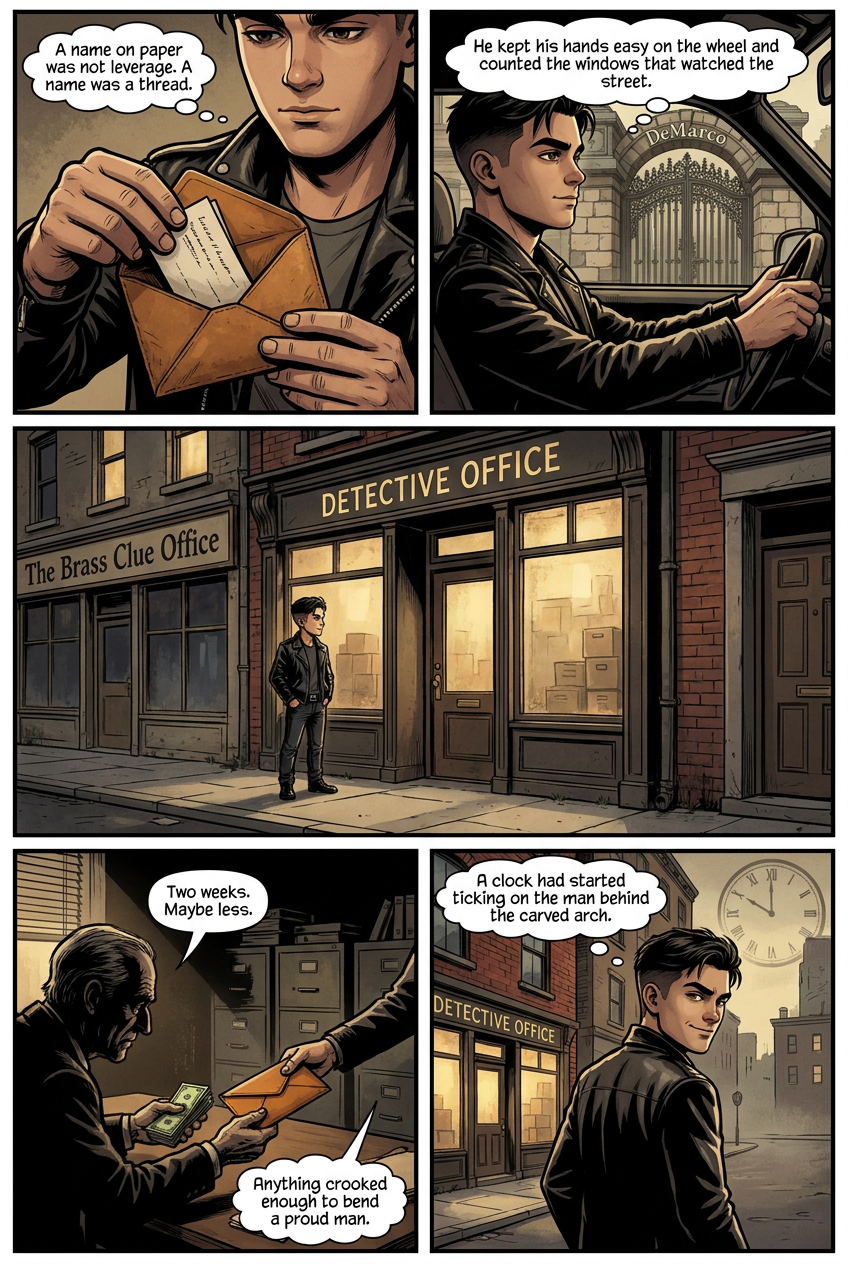
Luca slid the folded slip into a soft leather envelope and pressed the flap shut. The creased thing had carried other men's secrets across the old districts. It would carry his now. A name on paper was not leverage. A name was a thread. He needed something heavier before he pulled it. He drove past the gate that bore the carved name above its iron bars. Stone arch. Spear tips along the top. A man inside who would not break from a knock and a question. Luca did not slow. He kept his hands easy on the wheel and counted the windows that watched the street. He went instead to a narrow brick building with dusty glass and a lit sign. A retired investigator kept files there, the kind no badge would request. Luca paid in cash and laid out what he needed. Bank records. Mistresses. Anything crooked enough to bend a proud man. The old detective took the envelope, copied the name, and gave it back. Two weeks, he said. Maybe less. Luca walked out lighter and heavier at once. He had not approached. He had not burned the thread. He had bought himself the leverage he lacked, and a clock had started ticking on the man behind the carved arch.
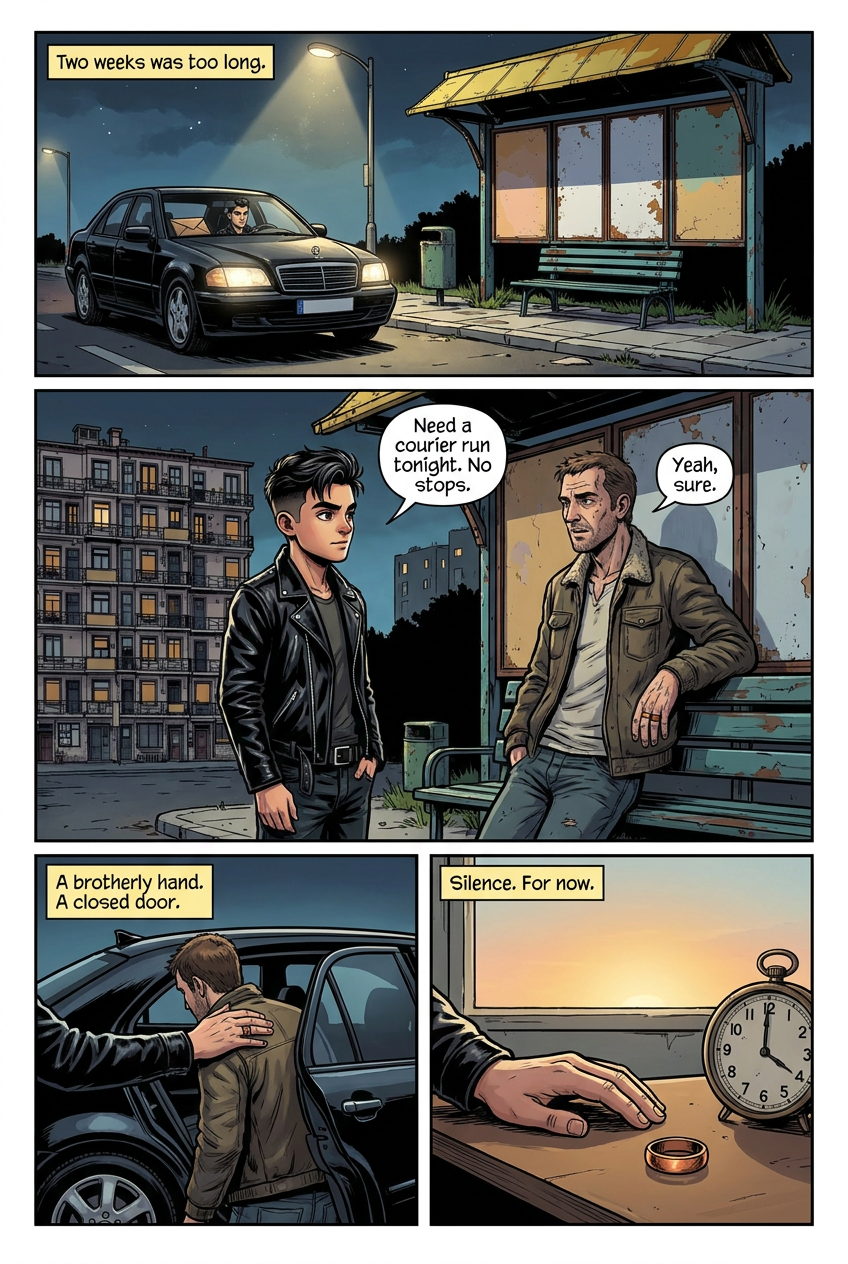
Two weeks was too long to leave a snake in the grass. Luca drove back through the quiet blocks with the leather envelope still warm in his coat. The traitor walked free, trusted, and one careless glance at the dead mailbox would send word to DeMarco. Luca could not move on the commissioner with a leak still breathing behind him. He had to plug it tonight, without spooking the man. He found his man where the man always was — leaning against the weathered bus shelter outside the lived-in apartment block he claimed as his beat. Faded panels. A bench worn smooth. A doorway full of unmarked entries that gave him a hundred reasons to linger. The copper ring on the man's finger caught the streetlight as he lifted a cigarette. Luca had given that ring himself, years ago, etched inside with the city's streets. A loyalty token. The traitor still wore it like a badge. Luca did not accuse. He walked up easy and spoke plainly. He needed a courier run, he said. Tonight. A drop at the warehouse, papers only, no phones, no stops. He watched the small things. The flick of the thumb against the ring. The half-second glance toward the empty bench, where a folded note would have waited. The man smiled and said yes. Luca smiled back and put a hand on his shoulder, warm, brotherly. Two of his quietest men were already in the car. The doors closed. The shelter stood empty behind them. By dawn the ring sat on Luca's desk, scratched map facing up. The traitor was gone — not dead, not yet, but folded away in a room only Luca knew. The line to DeMarco was cut clean, and DeMarco did not know it yet. Luca had bought himself silence. The clock on the commissioner kept ticking, and now nothing inside his own house ticked with it.
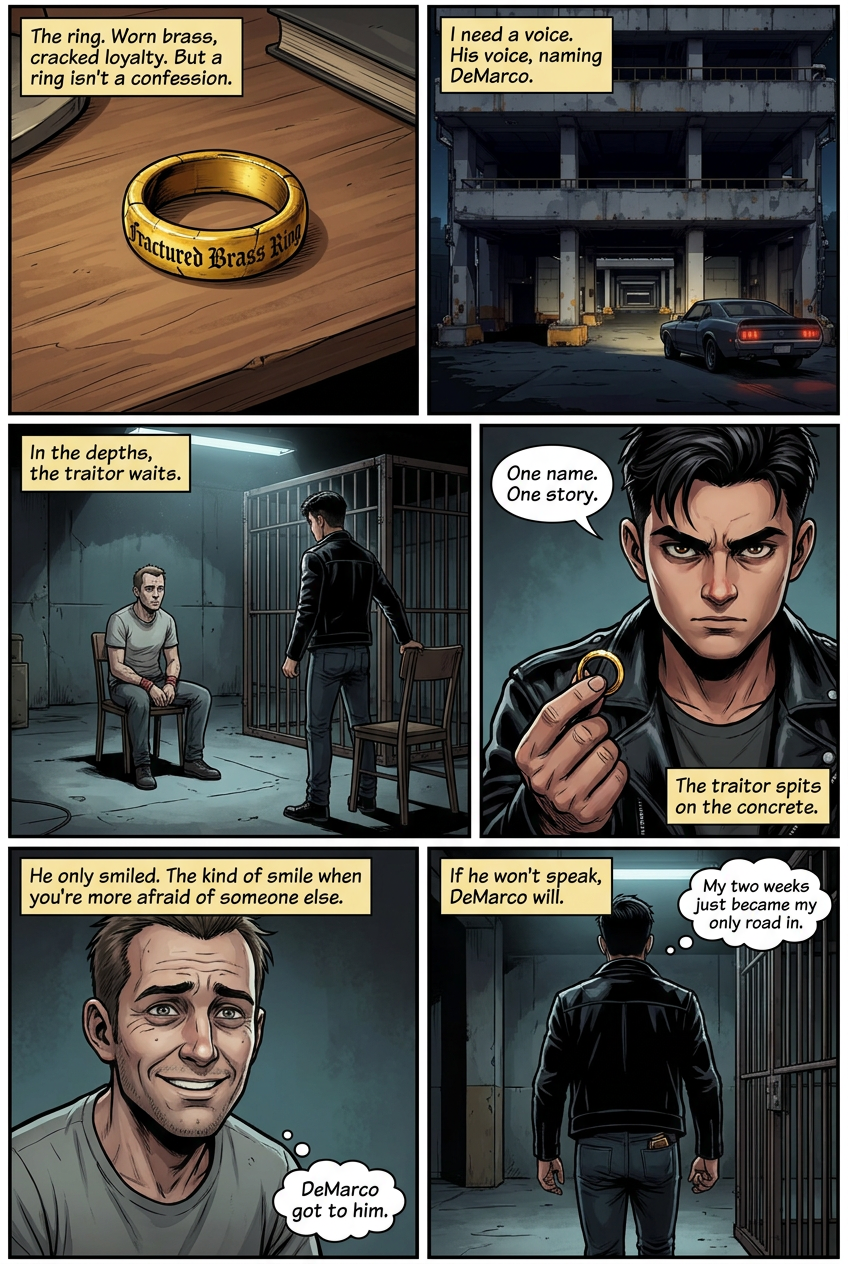
The ring sat on Luca's desk through the morning — a worn brass band with a cracked inscription circling it, the loyalty he had given and now taken back. But a ring was not a confession. Luca needed the man's voice, on tape, naming DeMarco. Without that, the note in the leather envelope was just paper, and DeMarco was still a gate Luca could not open. He drove out to the empty parking garage where the traitor was kept. Broken elevators. Dark lower floors no one walked. In the bottom level, behind concrete pillars, his men had built a heavy iron cage on a poured slab, padlocked tight. The traitor sat inside, wrists raw, eyes flat. Luca pulled up a chair. He set the cracked ring on the floor between them and asked for one name and one story. The man spit on the concrete and said nothing. Luca tried for hours. He offered the man his life. He offered his family safe passage. He laid out what he already knew — the mailbox, the booth, the number — and waited for the crack. The traitor only smiled, the kind of smile a man wears when he is more afraid of someone else than of you. Luca understood then. DeMarco had reached him first, long before tonight. Whatever threat sat behind that fortified gate was bigger than anything Luca could put inside a cage. Luca stood. He picked up the broken ring and slid it into his pocket. The lock clicked shut behind him. The confession would not come — not from this man, not in time. If he could not make the traitor speak, he would have to make DeMarco speak instead. The investigator's two weeks had just become his only road in.
Play your story to life
Storycraft is a mobile game where you create AI characters, craft items and locations to build their world, then discover what direction your story takes. Download the iOS game for free today!
Download for free