

Lumina Opalknight's Arc
11 Chapters
Lumina Opalknight's dream is planting a garden of opal blossoms that blooms only under moonlight and cures any ailment brought to its petals..

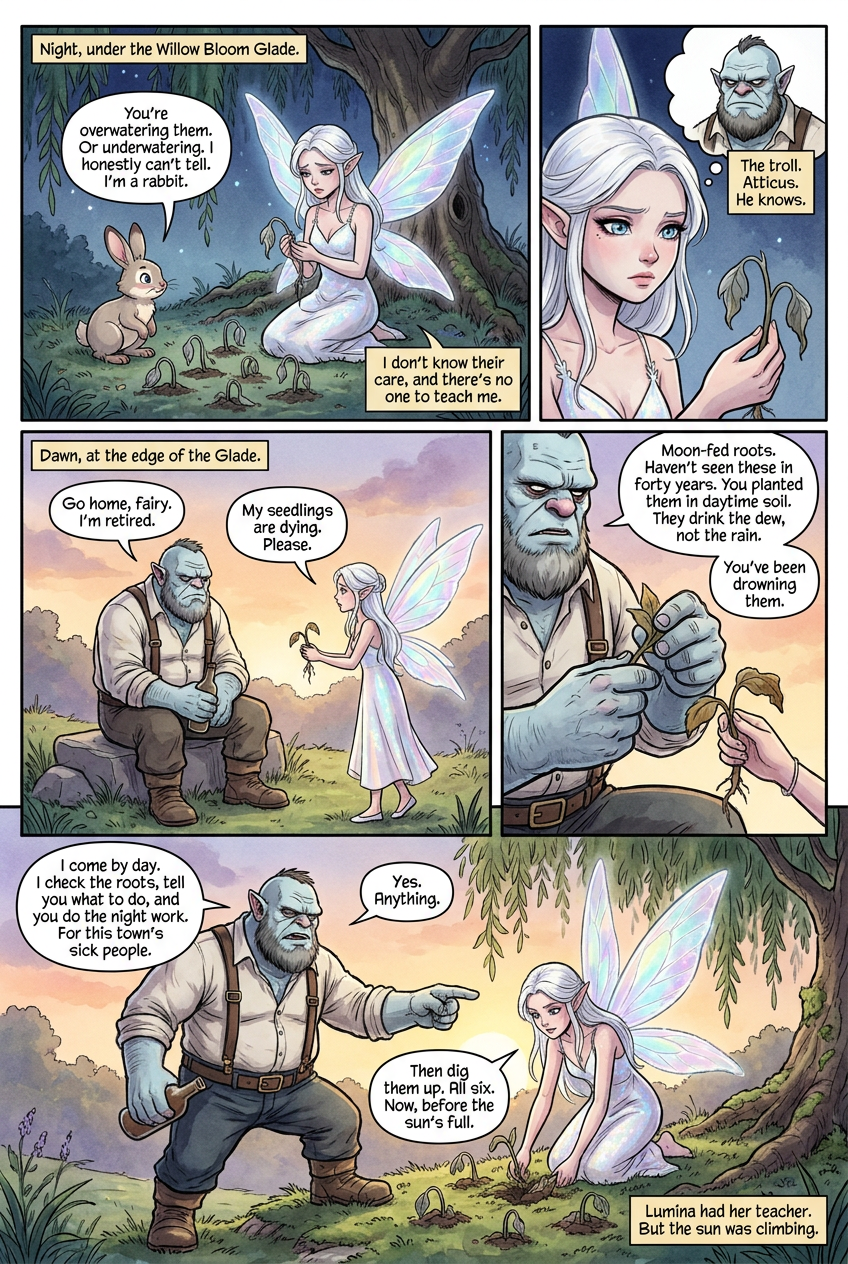
Lumina Opalknight knelt in the dark under the old willow tree and watched her first seedlings die. She had planted them at moonrise, six pale sprouts meant to grow into opal blossoms. The old stories said such blooms cured any sickness laid against their petals. That was why she had come to this overgrown glade, where colorful flowers already crowded the mossy roots. But her sprouts drooped now, their leaves curling gray. She did not know why. Her rabbit sat beside her on the moss, ears twitching. "You're overwatering them," Kofer said. "Or underwatering. I honestly can't tell. I'm a rabbit." "You're supposed to help," Lumina said. She cupped a wilting stem in her fingers. Her opal wings hung still against her back. She had raised these from seed for weeks, and one cold night had undone all of it. "I can't watch them every hour. They bloom at night. They fade by dawn. I don't know their care, and there's no one to teach me." "There's one," Kofer said. "The troll who grew herbs before he quit. He knows every plant in Needlefall." "He drinks all day and yells at children." "He also kept this town alive through two fevers. Ask him." Lumina found the troll at the edge of the glade at first light. Atticus Bridgerton sat on a flat stone, a bottle loose in one huge blue-gray hand. Stubble covered his jaw. He did not look up. "Go home, fairy," he said. "Whatever you want, I'm retired." "My seedlings are dying." She held out a browned sprout. "They only wake under moonlight. By morning they're like this." He glanced at the stem. Then he glanced again, and set the bottle down. He took the sprout in fingers thick as roots and turned it to the light. "Moon-fed roots," he muttered. "Haven't seen these in forty years." He crushed a leaf and sniffed it. "You planted them in daytime soil. They drink the dew, not the rain. You've been drowning them." Lumina's chest tightened. "Then teach me. Please. I can't tend them alone and I can't lose the whole crop." Atticus stared at the glade a long moment. Something in his face softened, then hardened again. "I come by day. Only by day. I check the roots, I tell you what to do, and you do the night work yourself." He pointed the bottle at her. "And I don't do this for thanks. This town's sick people need those flowers. That's the only reason." "Yes," she said quickly. "Anything." "Then dig them up. All six. Now, before the sun's full." He pushed himself to his feet, swaying. "We replant in dew-soil today. Miss the timing and they're dead by noon." Lumina dropped to her knees and began to dig. She had her teacher. But the sun was already climbing the willow's leaves, and six fragile roots hung on the edge of the hour.
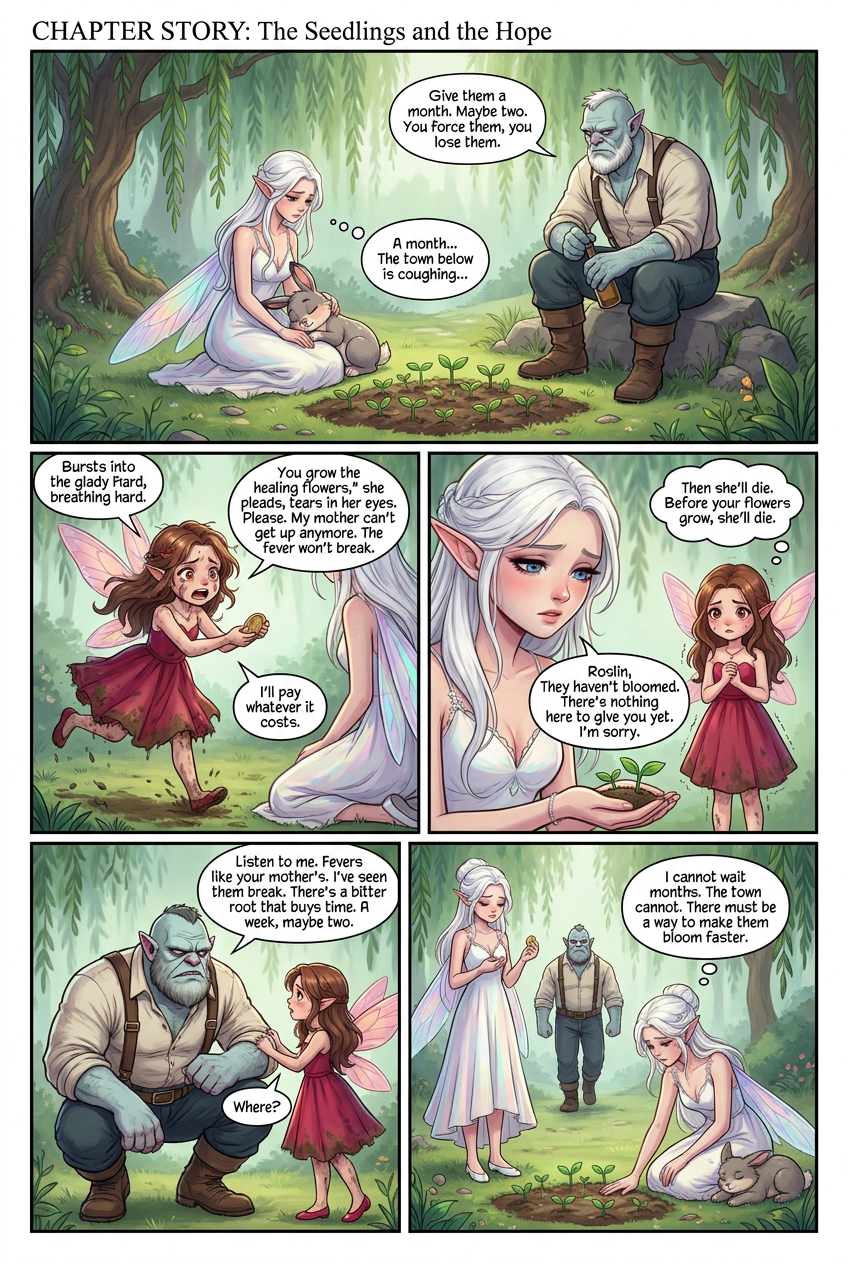
The six seedlings lived. Lumina had dug them up at dawn and replanted them in dew-soil, just as Atticus ordered. Now, three nights later, they stood green and firm under the willow. Not one bloom yet, only leaves. She knelt in the moss and watched them, counting the hours until they might flower. Kofer dozed against her knee. "They're not ready," Atticus said. He sat on his stone in the gray morning light, bottle in hand. The stubble on his jaw looked whiter today. "Give them a month. Maybe two. You force them, you lose them." "A month," Lumina repeated. Her wings drooped. She thought of the town below, of the coughing she heard on the wind. A branch snapped. A small fairy stumbled into the glade, breathing hard. Her ruby dress was stained with mud at the hem. Brown hair stuck to her wet cheeks. She was a child, no older than ten, and she ran straight to Lumina and grabbed her sleeve. "You grow the healing flowers," the girl said. "Please. My mother can't get up anymore. The fever won't break." She pulled a coin from her pocket, one small coin, and pushed it into Lumina's hand. "I'll pay. I run her shop now. I'll pay whatever it costs." Lumina's throat closed. "What's your name?" "Roslin. Roslin Emberwing." The child's voice cracked. "They said you had blossoms. Just one. I only need one." Lumina looked at the seedlings. Green leaves. No petals. She looked at Roslin's face, at the coin in her own hand. She could lie. She could say wait. But the child had run all this way on hope. "Roslin," she said gently. "They haven't bloomed. There's nothing here to give you yet. I'm sorry." Roslin's face broke. She did not scream. She just stood there, shaking, the mud drying on her dress. "Then she'll die," the girl whispered. "Before your flowers grow, she'll die." Atticus set his bottle down hard. He pushed to his feet and crossed the moss. He crouched in front of the child, his huge frame folding low. "Listen to me," he said. His voice was rough but slow. "Fevers like your mother's. I've seen them break. There's a bitter root that buys time. A week, maybe two." He glanced at Lumina. "Not a cure. But time." Roslin gripped his sleeve now. "Where?" "I'll walk you. Show your mother the dose." He stood, swaying only a little, and looked back at Lumina. "You hear that, fairy? Your flowers aren't fast enough. Not for her. Not for the others coughing down there." Lumina closed her fist around the child's coin. She watched the troll lead Roslin down the slope. The seedlings sat behind her, months from blooming. She could not wait months. The town could not. She pressed her palm to the dew-soil. There had to be a way to make them bloom faster.
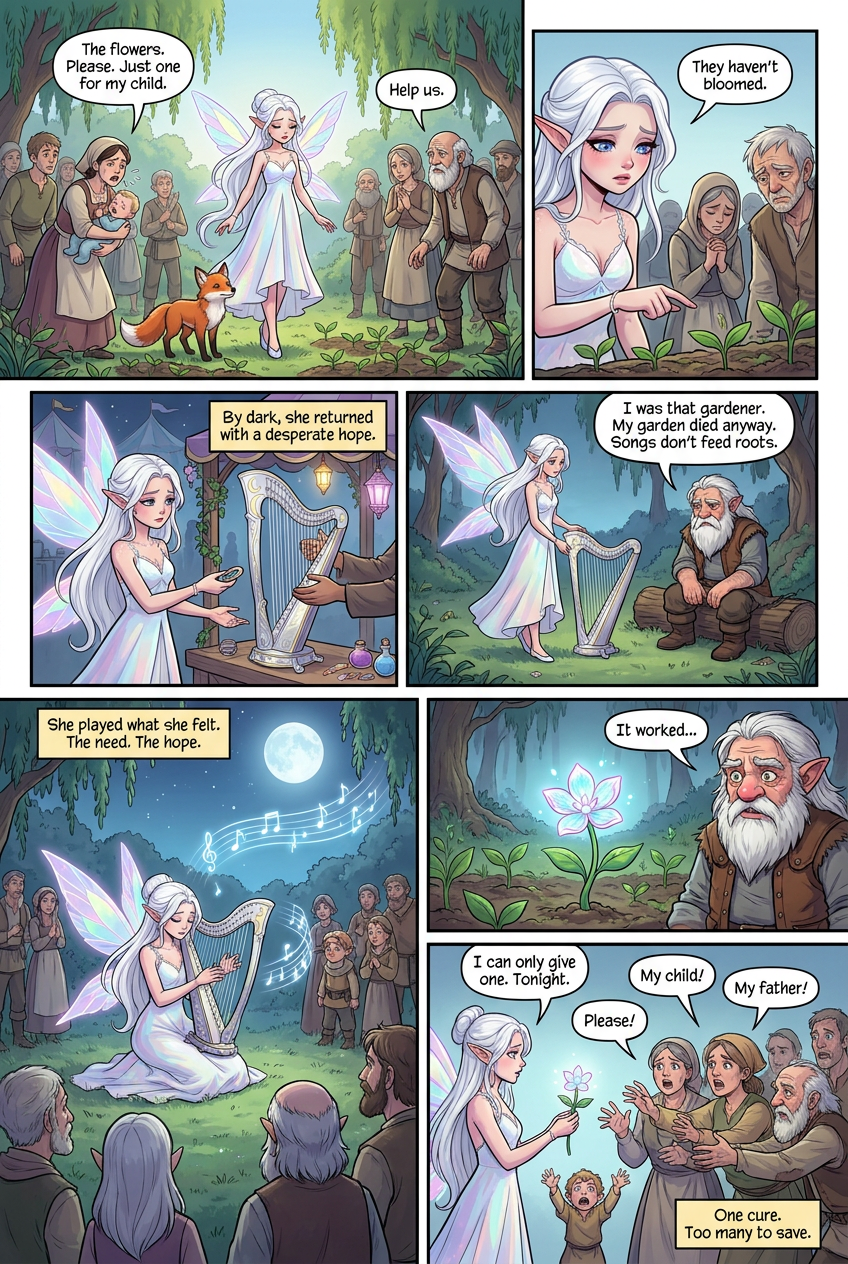
By the fourth morning, the villagers came. Roslin's story had spread down the mountain. A woman with a coughing baby reached the glade first. Then an old man leaning on his son. Then three more, pale and slow, climbing the last stones to the willow. They all looked at Lumina with the same hope in their eyes. "The flowers," the woman said. "Please. Just one for my child." Lumina stood among her six seedlings. Green leaves. No petals. Ten people watched her now, waiting. She could not say sorry ten times. "They haven't bloomed," she began. The old man sank onto the moss. The baby wailed. Kofer pressed against her ankle, ears flat. She needed the seedlings to bloom tonight. She could not force them with hands or heat. Then she remembered the market below, and the harp she had once seen glowing on a stall there. A silver frame, moons carved along its neck, strings that shone like moonlight. The seller had claimed it could stir sleeping things awake. Lumina had thought it a trick. Now she had nothing else. "Wait here," she told the crowd. "I'll return by dark." She flew down to the market, traded Roslin's coin and her own opal ring, and carried the harp back up the slope. A dwarf sat outside the glade when she returned. Silver hair, a long beard, shoulders bent like a man who had given up. He watched her set the harp in the dew-soil. "I knew a gardener who tried music once," he said. His voice was tired. "I was that gardener. My garden died anyway. Songs don't feed roots." Lumina's hands shook. "Then why are you here?" "To see if you'd fail like I did." He did not move to stop her. He only watched. The moon rose. Lumina knelt and played. The strings hummed low, then rose. She did not know the tune. She played what she felt, the coughing below, the child's coin, the ten faces waiting. The notes drifted over the leaves. One seedling trembled. A leaf curled back. Slowly, at the tip of the stem, a bud swelled and split. A single opal blossom opened, pale and glowing, one flower on one plant. The other five stayed green. The crowd gasped. Lumina stopped playing. One bloom. Ten sick people. She plucked the flower with careful fingers. The dwarf stared. "It worked," he whispered. "For me it never worked." Something woke in his tired eyes. Lumina turned to the crowd. Ten hands reached for one flower. "I can only give one," she said. "Tonight." The woman with the baby stepped forward. The old man's son stepped forward. Voices rose, sharp and desperate, each claiming the greater need. Lumina held the single blossom above them. The harp could wake one flower a night. The mountain below held far more than one dying soul. And now every one of them knew she could grow a cure.
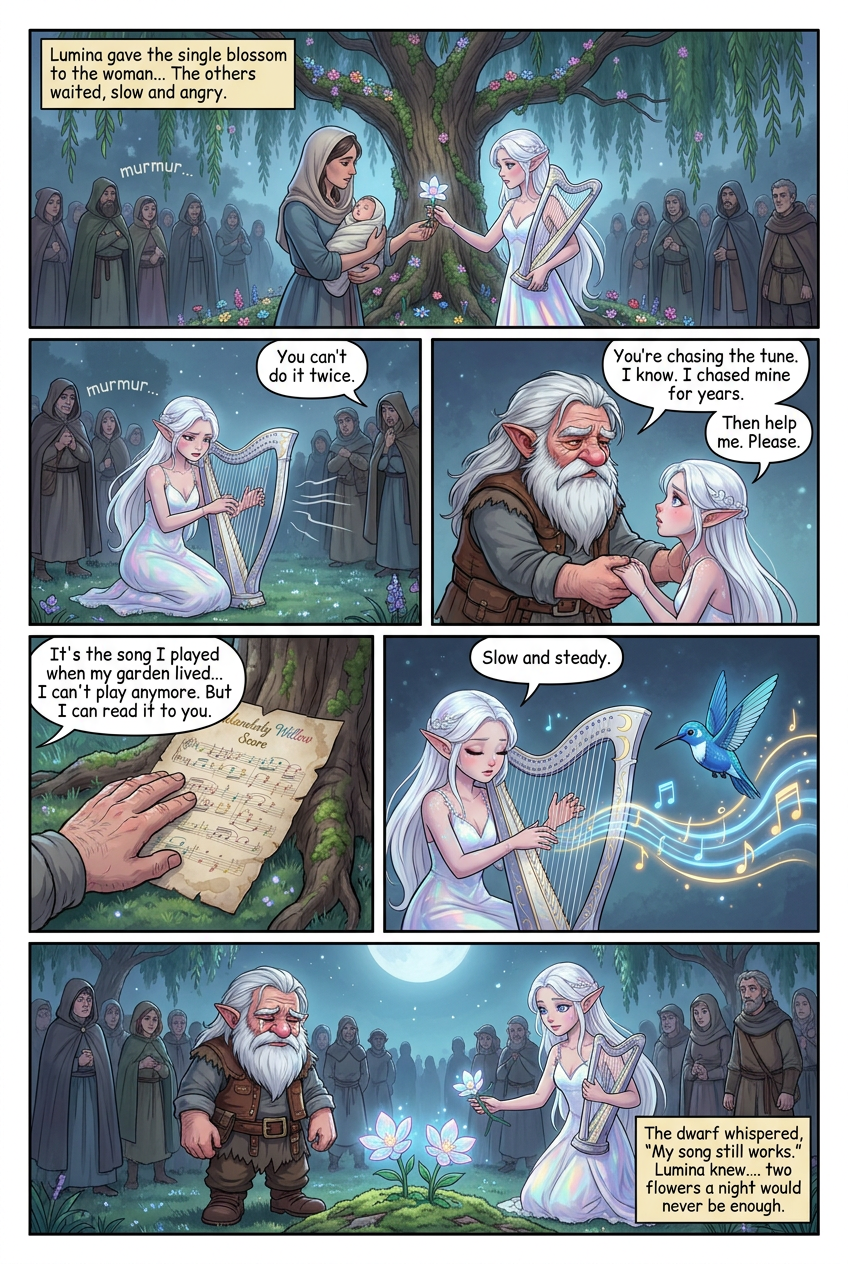
Lumina gave the single blossom to the woman with the coughing baby. The others turned away, slow and angry. But they did not leave. They waited on the moss below the willow, watching her, sure she could make more. The old man coughed. His son glared. Lumina held the harp and knew she had to bloom another flower before the crowd broke apart. She knelt in the dew-soil and played. Her fingers found the strings, but the notes came wrong. Thin. Flat. The seedlings did not stir. She tried again. The same dead sound. Last night the music had come from somewhere inside her, from fear and grief. Now she reached for it and grabbed only air. The crowd murmured. Someone stood up. "You can't do it twice," the son said. "She got lucky once." The dwarf still sat near the willow's roots. He had watched her fail last night, then watched her succeed. Now he pushed himself up and shuffled over. "You're chasing the tune," he said. "You'll never catch it that way. I know. I chased mine for years." Lumina looked up. "Then help me. Please." He stared at the harp a long moment. Something moved in his tired face. He reached into his coat and drew out a folded sheet, brittle and yellow, the creases soft with age. Faded notes ran across it in fading colors. "Melancholy Willow," he said. "The song I played when my garden lived. I kept it after everything died. I don't know why." His voice cracked. "Maybe for this." He smoothed the page against a root. "I can't play anymore. My hands are done. But I can read it to you." Lumina set her fingers on the strings. The dwarf leaned close and named each note, slow and steady. She played them one by one. At first they stumbled. Then they linked, and the melody rose, sad and sweet, the same shape as last night's sound but surer now. A blue hummingbird darted from the willow branches. A small white crescent marked its eye. It hovered by the harp and hummed along, holding the tune when Lumina's fingers faltered. The crowd went quiet. One seedling shivered. A bud swelled and opened. Then a second plant bloomed. Two opal blossoms glowed pale in the moonlight, side by side. Lumina let the last note fade. Two flowers. She could learn the song now. She had the page, the bird, and the dwarf who knew every note. She could bloom them again tomorrow, and the night after. The dwarf stared at the two blossoms. Tears cut down his cheeks into his beard. "It works," he whispered. "My song still works." Lumina plucked both flowers and held them out to the waiting people. But even as they reached, she saw more figures climbing the stones below. Ten had become twelve. Word had spread. Two flowers a night would never be enough.
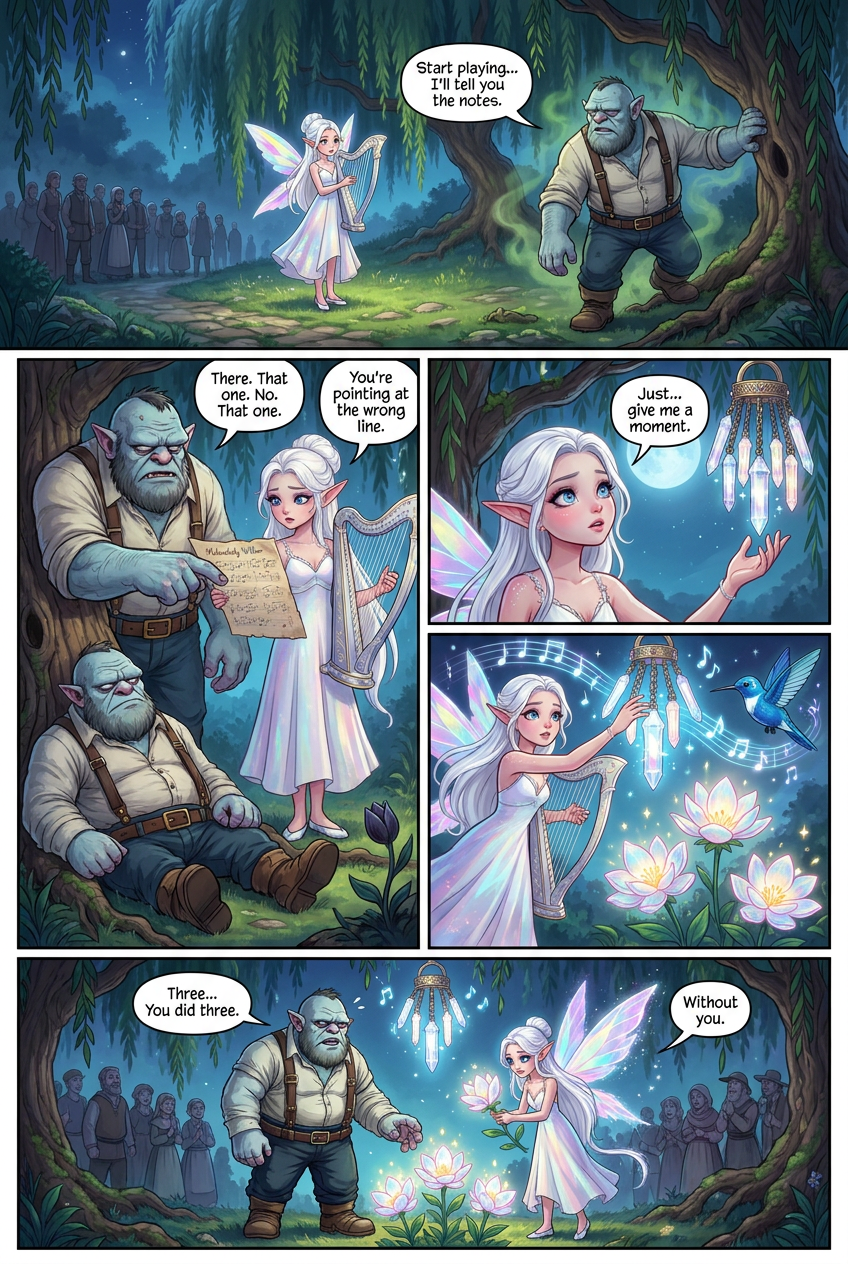
The next night, twelve villagers waited on the moss. Lumina held the moon-harp and watched the path below. She needed the dwarf's music and the troll's hands to guide the notes right. Only the troll knew the seedlings well enough to steady her fingers when the melody slipped. Without him, the crowd would leave empty and angry. Atticus came up the stones late. He was the retired herbalist who had taught her to plant the seedlings, a huge blue-grey troll with a stubbled jaw. Tonight he swayed. He gripped a root to keep from falling. A sour smell came off him. He had been drinking again, hard. "Start playing," he slurred. "I'll tell you the notes." Lumina's chest went tight. "You can't even stand." "I taught you. I can count." He leaned over the sheet music the dwarf had lent her. His finger dragged across the faded notes. "There. That one. No. That one." His hand shook. He named a note, then took it back. The seedlings sat closed and dark. She played what he said. The tune came out crooked. A seedling twitched and went still. The crowd stirred. The old man coughed into his sleeve. "You're pointing at the wrong line," Lumina said. "Am not." Atticus swayed and knocked the harp with his elbow. A string wailed. He caught himself on the willow trunk and slid down to sit. His eyes drooped shut. "Just... give me a moment, elf." He had a soft spot for these sick people. She knew that. It was why he climbed the mountain at all. But tonight the drink had beaten him, and the flowers would die closed if she waited for his hands. Lumina looked at the crystal chimes hanging in the willow branches. Faceted prisms, seven of them, catching the moonlight. An idea struck her. She could not lean on his hands anymore. She had the page. She had the tune inside her now. She pressed her palm to the chimes and hummed the first bars of the song. She fed the melody into the crystals, note by note, the way the dwarf had named them for her. The prisms began to ring on their own. They picked up the tune and held it, steady and clear, no shaking hands to spoil it. The blue hummingbird darted down and hummed along. Lumina played the harp beside the ringing chimes. Two instruments now, one that never faltered. Three seedlings shivered. Buds swelled and split. Three opal blossoms opened, pale and glowing. Atticus blinked awake at the light. "Three," he mumbled. "You did three." "Without you," Lumina said. She was not cruel about it. But it was true. She plucked the flowers for the waiting hands. The chimes still rang softly, holding the song alone. She no longer needed the troll to bloom them. But the drink had shown her something worse. Atticus was failing. And the crowd below had grown to fifteen.
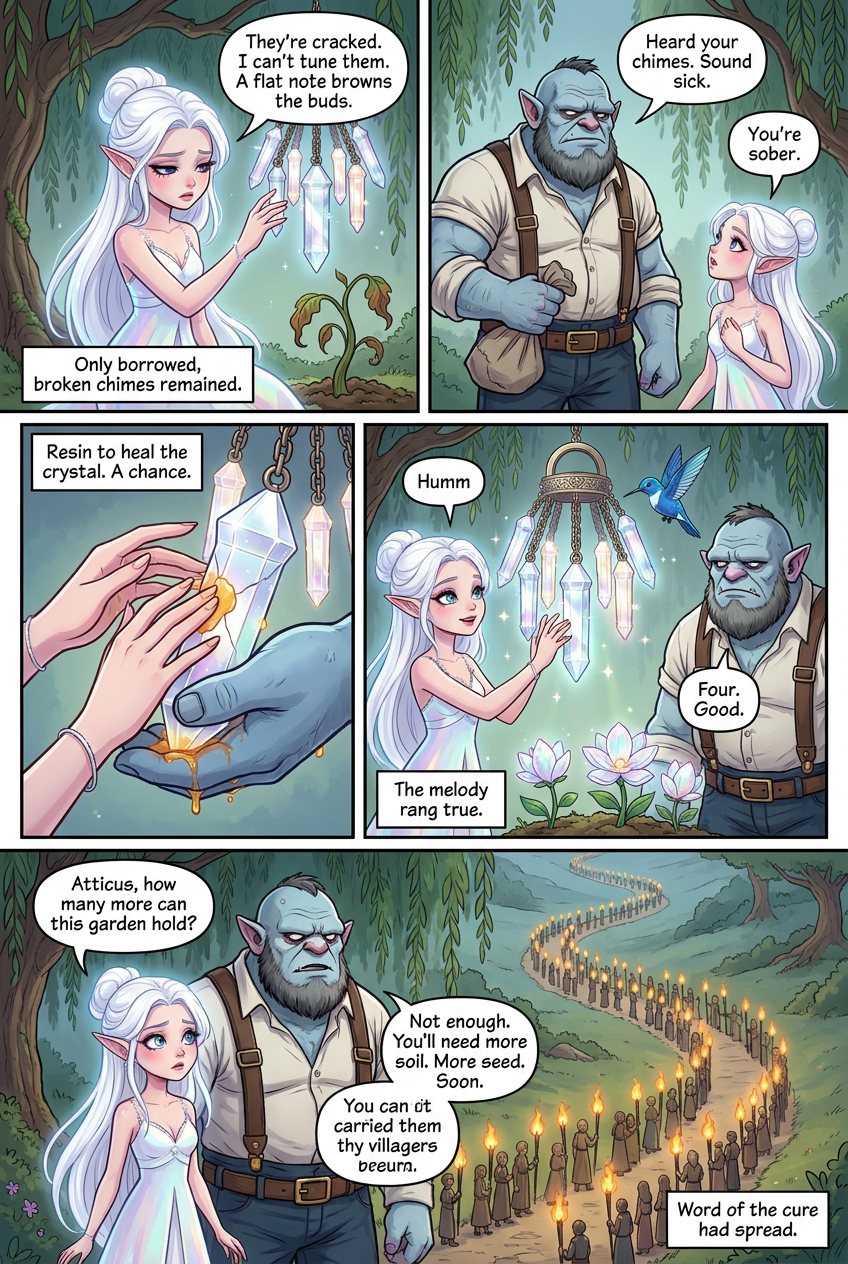
The next night, fifteen villagers waited on the moss. Lumina reached for her own crystal chimes and found them gone. She remembered now. She had lent hers to a healer in the village weeks ago. Only a borrowed set hung in the willow branches, cracked prisms she had found on the market floor. She pressed her palm to them and hummed the first notes. The chimes rang flat. The sound came out dull and muddy. A seedling twitched at the bad note, then its leaves curled brown at the edges. Lumina snatched her hand back. One more sour note could kill the bud instead of blooming it. She stared at the cracked prisms. She could not feed a clean melody through broken crystal. Heavy boots scraped up the stones. Atticus climbed into the glade, the huge blue-grey troll who had taught her to plant the seedlings before the drink took his steady hands. Tonight his eyes were clear. He carried a small cloth bundle against his chest. "You're sober," Lumina said. "Two days now." He knelt by the willow and set the bundle down. His thick fingers worked the knot. "Heard your chimes from the path. They sound sick." "They're cracked. I can't tune them. A flat note browns the buds." She showed him the curled leaves. "I don't know how to fix crystal." Atticus grunted. He unrolled the cloth. Inside lay a fistful of dried resin, amber and hard. "Herbalist's trick. We sealed cracked jars with this. It fills the split and hardens clear." He held a piece to the moonlight. "Might close the crystal. Might not. Won't know till you play." Lumina took the resin. She warmed it between her palms until it softened. Then she pressed it into each crack, working it deep with her thumb. Atticus steadied the chimes so they would not swing. His hands did not shake tonight. The resin cooled and set, clear as the crystal around it. She pressed her palm to the prisms and hummed the tune again. This time the chimes rang true. The notes came clear and bright, no muddy edge. The blue hummingbird darted down and joined the melody. Four seedlings shivered. Buds swelled and split. Four opal blossoms opened, pale and glowing. Atticus watched the light with wet eyes. "Four," he said. "Good." Lumina plucked the flowers and passed them to the waiting hands. But eleven villagers still stood empty. The mountain path below was not empty either. Torches moved on it, a long line climbing toward her glade. Word of the cure had spread farther than the town. More sick were coming than she could ever bloom in one night. "Atticus," she said, "how many more can this garden hold?" He looked at the six seedlings, four now spent. "Not enough," he said. "You'll need more soil. More seed. Soon."
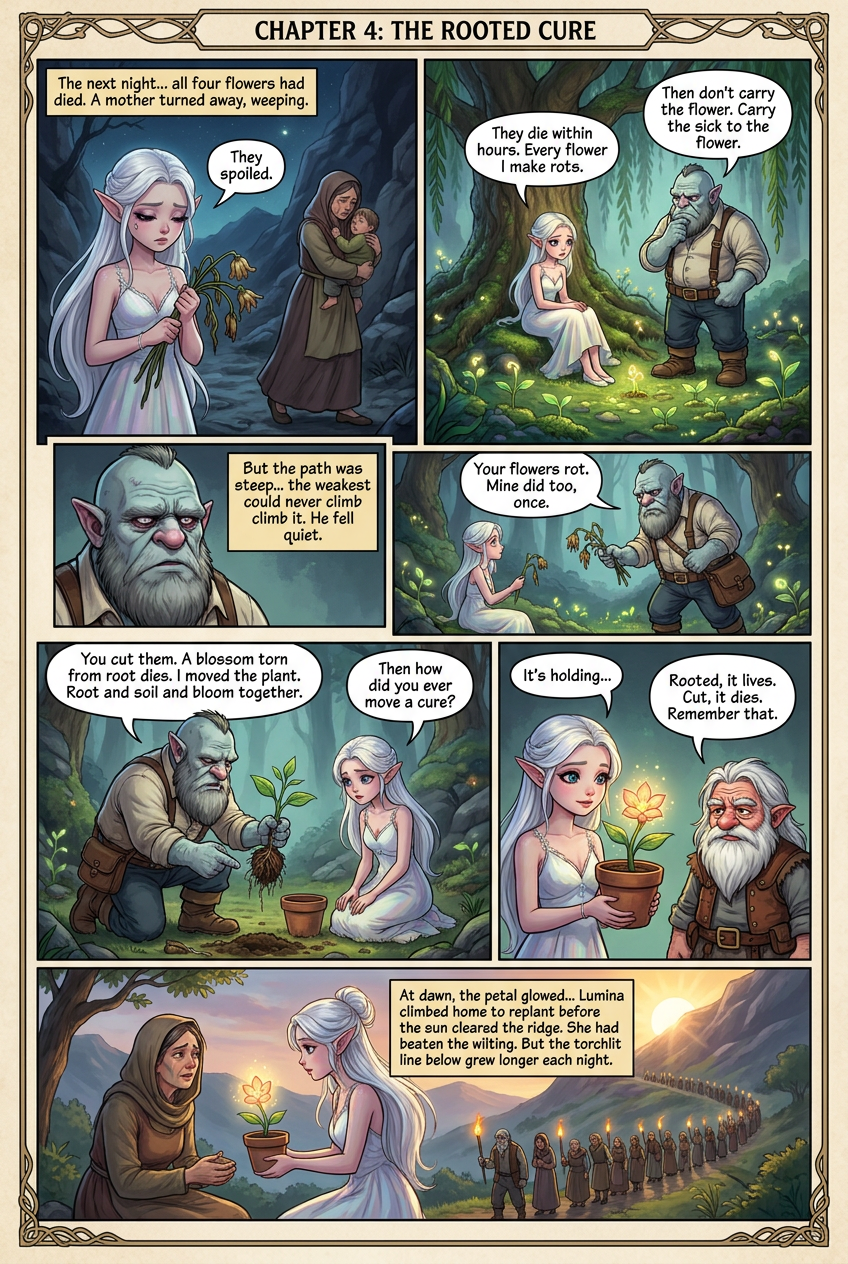
The next night Lumina bloomed four more flowers. She cut them fast and carried them toward the path. Halfway down, the first blossom drooped in her hand. Its glow faded. The petals browned and folded shut. By the time she reached the sick villagers, all four flowers had died. She held out a fistful of wilted stems. A mother turned away, weeping. Lumina climbed back up with nothing given. Atticus waited by the willow. He looked at her empty hands. "They spoiled," she said. "They die within hours of blooming. I can't get them down fast enough." She sank onto the moss. "Every flower I make rots before it reaches a mouth that needs it." The troll rubbed his beard. "Then don't carry the flower," he said. "Carry the sick to the flower." But the path was steep, and the weakest could never climb it. He fell quiet, out of answers. Boots scraped the stones. A dwarf climbed into the glade, silver-bearded and stooped, his shoulders bent like a man carrying a weight only he could see. Lumina knew him. He was the weary dwarf from the market who had once warned her that songs could not heal. He had guided her through his dead garden's song, note by note. He had been a master gardener before some ruin drove him up this mountain to hide. "Your flowers rot," he said. Not a question. "Mine did too, once." He knelt by a spent seedling and touched the soil. "You cut them. That's your trouble. A blossom torn from moon-fed root dies in an hour. It has no water, no dew, no root to feed it." "Then how did you ever move a cure?" Lumina asked. "I didn't move the flower." He pulled a clay pot from his pack and set it down. "I moved the plant. Root and soil and bloom together. Kept alive. A rooted blossom holds its glow for days." He looked at her seedlings. "Lift them whole. Pot them in dew-soil. The sick press the living petal, and it heals while still attached. Then you carry the pot back and replant before sunrise." Lumina stared at the four spent seedlings. She had been killing her own cure with the knife. She dug the first plant free, roots and clumped soil intact, and packed it into the dwarf's pot. She wet the soil with dew from the willow leaves. The bloom held its light. An hour passed. It did not wilt. "It's holding," she breathed. The dwarf nodded once. "Rooted, it lives. Cut, it dies. Remember that." At dawn Lumina carried a potted blossom down to the mother. The petal glowed against the sick woman's palm. The color came back to her face. Lumina climbed home to replant before the sun cleared the ridge. She had beaten the wilting. But one pot cured one patient at a time, and the torchlit line below grew longer each night.
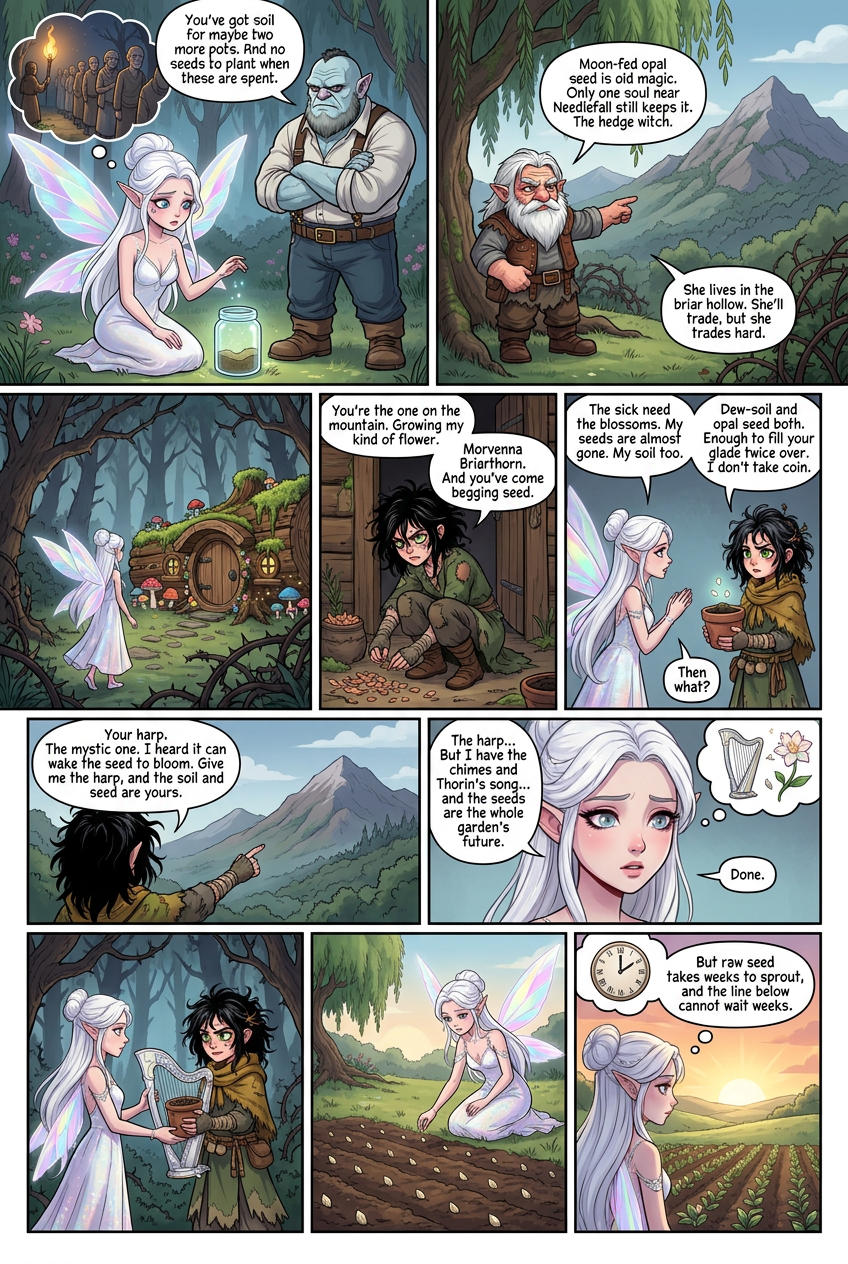
At dusk Lumina knelt by her seedlings and counted her dew-soil. One jar left, half full. Atticus stood over her, arms crossed. His breath was clear now, no drink on it. "You've got soil for maybe two more pots," he said. "And no seeds to plant when these are spent." He nudged the empty seed pouch with his boot. "Feed the whole town? Not with this. You'll be dry in three nights." Lumina's stomach dropped. Every night the torchlit line below grew longer. Now her supply was ending. "Then I need more," she said. "Where do seeds like these come from?" The silver-bearded dwarf spoke from the willow's shade. He had been her guide through his dead garden's song, a master gardener before ruin drove him up this mountain. "Not from any market stall," Thorin said. "Moon-fed opal seed is old magic. Only one soul near Needlefall still keeps it." His shoulders sagged. "The hedge witch. She lives in the briar hollow. She'll trade, but she trades hard." Lumina packed her last pot with soil and hurried down before full dark. The briar hollow was a tangle of thorns around a low fallen log strung with glowing lights. A woman crouched at the door, sorting dried petals into pouches at her belt. Twigs and small orange flowers snarled her black hair. She did not look up. "You're the one on the mountain," the witch said. "Growing my kind of flower." Her green eyes flicked to Lumina's wings. "Morvenna Briarthorn. And you've come begging seed." "The sick need the blossoms," Lumina said. "My seeds are almost gone. My soil too." Morvenna stood. She pulled a small clay pot from a shelf inside the log. It held dark, wet earth and a handful of pale seeds that caught the light like chips of moon. "Dew-soil and opal seed both," she said. "Enough to fill your glade twice over." She held it back when Lumina reached. "I don't take coin. Coin's useless in a briar." "Then what?" "Your harp." Morvenna nodded toward the mountain. "The mystic one. I heard it can wake the seed to bloom. I've grown these flowers thirty years and never once made them open. Give me the harp, and the soil and seed are yours." Lumina's chest tightened. The harp had bloomed her first flower. But she had the chimes now, and the dwarf's song, and both worked without it. The seeds were the whole garden's future. She thought of the mother's face when color returned to it. "Done," she said. She climbed home, fetched the harp, and carried it back down. Morvenna took it in both hands and pressed the pot into Lumina's arms. The seeds were cold and heavy and real. At dawn Lumina spread fresh dew-soil across her glade and pushed the pale seeds in, one by one. Rows of them now, not six. Enough to grow a true garden. But raw seed took weeks to sprout, and the line below could not wait weeks.
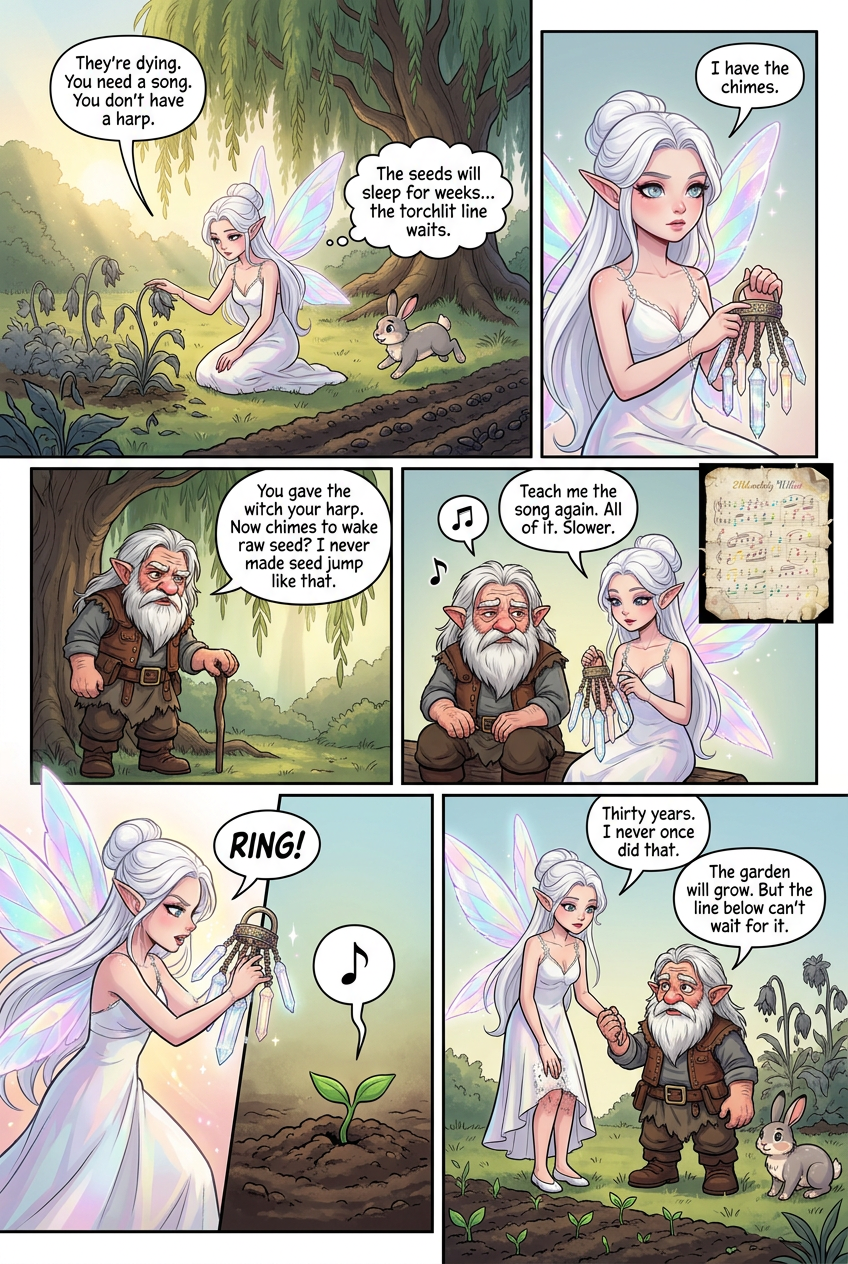
The new seeds sat in their rows, still dark and closed. Lumina knelt in the wet soil at dawn and watched the four bloomed plants from before. Their petals drooped. Their glow had dimmed to a weak gray. She pressed one leaf and felt no warmth in it. The old blossoms were wilting, and she had traded away the harp that first woke them. The seeds she'd bought would sleep for weeks. Below, the torchlit line waited for a cure she could no longer make. Kofer hopped through the rows and nosed a fading petal. "They're dying," the rabbit said. "You need a song. You don't have a harp." "I have the chimes," Lumina said. She lifted the crystal chimes from their hook. But the dwarf's song filled her head, and she remembered the harp's music had done something the chimes never had. It had reached the sleeping seed, not just the bud. She stared at the dark rows. Maybe the chimes could do the same. Thorin came from the willow's shade, leaning on his stick. The old gardener had guided her through blooming before, and grief still sat in his eyes. "You gave the witch your harp," he said. "Now you want the chimes to wake raw seed?" He shook his silver head. "I never made seed jump like that. Only buds." "Then teach me the song again," Lumina said. "All of it. Slower." Thorin sat beside her. Note by note, he hummed "Melancholy Willow." Lumina struck the chimes to match. The true notes rang clear across the wilting plants. She aimed each one at the closed rows, not the fading blossoms. Her arms ached. The rabbit sat still as stone. Nothing moved. Thorin's shoulders fell. "Seed is not a bud," he murmured. "It cannot hear." Lumina did not stop. She played the last verse harder, the way she once played the harp in her first desperate night. A single note hung in the cold air. Then, in the third row, a seed split. A green thread pushed up through the dew-soil. Another cracked beside it. Six sprouts rose, then a dozen, curling toward the fading moon. Thorin gripped her wrist. "Thirty years," he whispered. "I never once did that." But the old bloomed plants still hung gray and spent between the new sprouts. The chimes woke the seed. They could not save the dying flowers. Lumina looked at the tender green shoots. Days, not weeks, now stood between her and a full garden. Yet not one plant could heal a single villager tonight. She stood and brushed soil from her knees. "The garden will grow," she said. "But the line below can't wait for it." Kofer's ears drooped. Lumina wrapped the chimes in cloth. She had traded her harp and won the seeds, and now she had no cure to give the sick who waited in the dark.
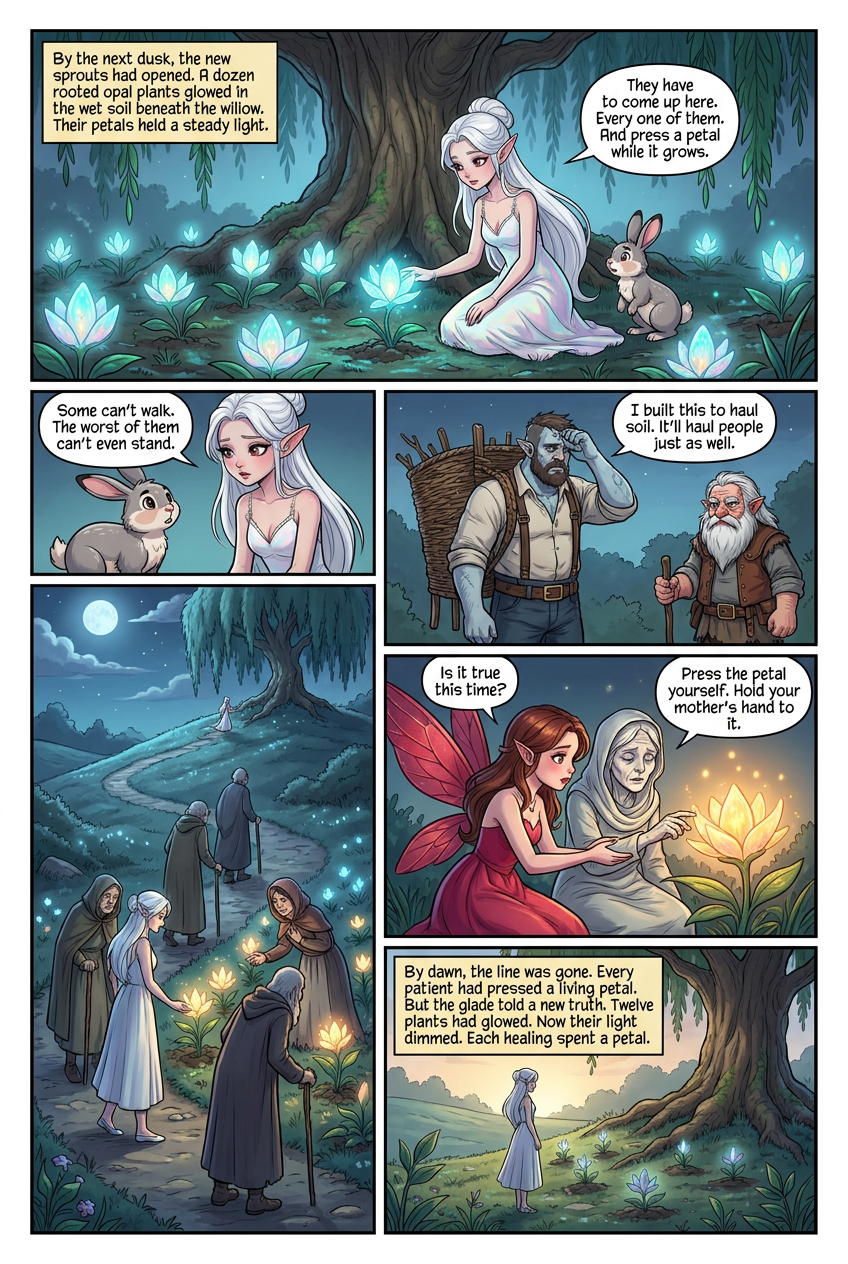
By the next dusk, the new sprouts had opened. A dozen rooted opal plants glowed in the wet soil beneath the willow. Their petals held a steady light. Lumina knelt and pressed one leaf. Warmth answered her hand. The garden lived. But the plants could not leave the soil, and each could heal only one person at a time. The sick still waited far below. "They have to come up here," she told Kofer. "Every one of them. And press a petal while it grows." "Some can't walk," the rabbit said. "The worst of them can't even stand." He was right. Word of the living cure spread fast, and by night the first climbers reached the glade. They came slow, leaning on sticks and each other. One by one, Lumina guided them to a rooted plant. A woman pressed a petal and felt her fever break. A man's cough eased. But then a message came from below. A group at the base could not climb at all. Their families begged. Among them was Roslin's mother, too weak to rise from her bed. Thorin came from the willow's shade, leaning on his stick. The old gardener's shoulders sagged, as they always did. "You can't carry a mountain of sick folk," he said. "And you can't move the plants. Cut petals die in hours." He had taught her that himself, and grief still sat in his eyes. Heavy boots crushed the moss behind them. Atticus climbed into the glade, sober and grim, a wide sled of woven branches strapped to his back. The reformed troll had once been her drunk, sharp-tongued teacher. Now he set the sled down and wiped his brow. "I built this to haul soil," he said. "It'll haul people just as well." Lumina understood. They could not bring the sick to the plants. So they would bring the strong to carry the sick. Atticus loaded the weakest onto his sled. Roslin arrived, breathless, guiding her mother's litter up the last stretch with two neighbors. The child's ruby wings trembled with the effort. "You said you'd have a cure," Roslin said. "Is it true this time?" "Press the petal yourself," Lumina said. "Hold your mother's hand to it." Roslin knelt her mother beside a glowing plant. The sick woman's fingers touched a petal. The light pulsed once, warm and gold. Color returned to her face. She drew a full breath and sat up on her own. Roslin sobbed and buried her face in her mother's shoulder. One by one, through the night, the carried sick reached the plants and healed. Atticus made trip after trip down the mountain and back. By dawn, the line at the base was gone. Every patient had climbed or been carried, and every one had pressed a living petal. But the glade told a new truth. Twelve plants had glowed at dusk. Now their light dimmed. Each healing spent a petal, and the crowds coming tomorrow would find the garden already fading.
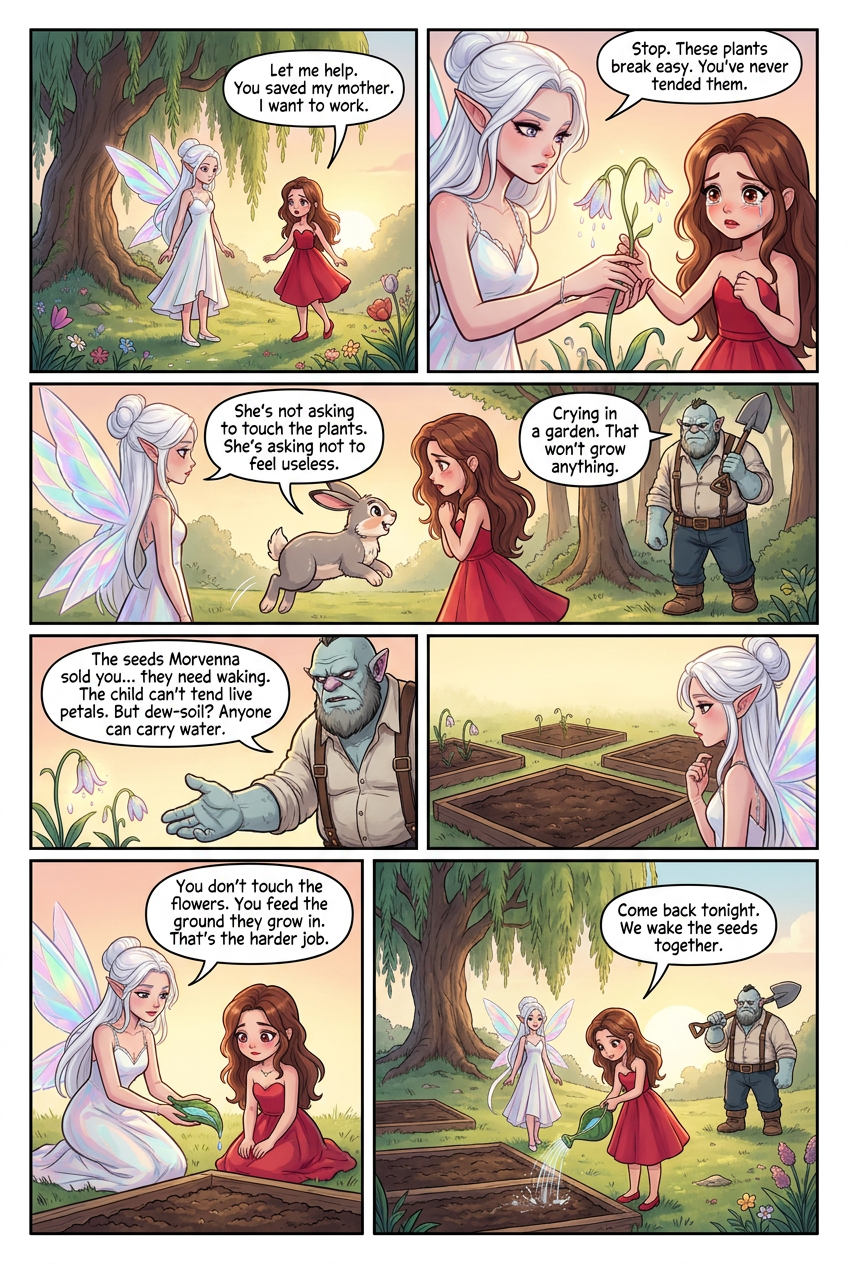
Dawn light touched the willow. The healed had gone home, but Roslin stayed. Her mother rested on the moss, cured and breathing easy. The child watched the dimming plants and would not leave. "Let me help," she said. "You saved my mother. I want to work." Lumina looked at the rows of fading petals. Each plant held only a few glows left. The seedlings near the willow's roots were the youngest and most fragile. One rough touch could tear a stem. "There's nothing safe for you to do," she said. "These plants break easy. You've never tended them." Roslin's ruby wings drooped. She knelt by a plant anyway and reached for a leaf. "I'll be gentle. I helped my mother garden at home." "Stop." Lumina caught her wrist before she touched a bud. "That one's still closed. Press it wrong and it dies." The child pulled back, stung. Her eyes filled. Kofer hopped between them. "She's not asking to touch the plants," the rabbit said. "She's asking not to feel useless." Heavy steps crossed the moss. Atticus came from the tree line, sober, a spade over his shoulder. The reformed troll had built the sled that carried the sick up the mountain. He set the spade down and studied Roslin's wet face. "Crying in a garden. That won't grow anything." "I want a task," Roslin said. "She won't give me one." Atticus grunted. He looked at the depleting plants, then at Lumina. "The seeds Morvenna sold you. Half still sleep in the crate. They need waking, or the garden dies with these." He pointed his thick finger at the fragile blooms. "The child can't tend live petals. But dew-soil? Anyone can carry water." Lumina understood. The blooming plants were too delicate for untrained hands. But the work behind them was not. "Roslin," she said. "Come here." She led the child to the crate of dormant seeds and the beds of empty soil. She showed her how to test the soil for wetness, how to fetch dew in a cupped leaf before the sun burned it off. "You don't touch the flowers," Lumina said. "You feed the ground they grow in. That's the harder job." Roslin wiped her eyes and knelt at the soil. She pressed her palm flat, testing dampness the way Lumina had shown her. "It's dry here," she said. "Then water it." Lumina handed her a leaf-cup. The child ran for the dew and poured it slow. By full morning, Roslin had wet every bed. The dormant seeds sat ready in dark, damp soil. Atticus nodded once and shouldered his spade. "Now they'll take," he said. Lumina looked at the prepared beds. The old plants still faded. But the ground for the next garden lay ready, and she had a pair of small hands to keep it fed. "Come back tonight," she told Roslin. "We wake the seeds together."
Play your story to life
Storycraft is a mobile game where you create AI characters, craft items and locations to build their world, then discover what direction your story takes. Download the iOS game for free today!
Download for free