

Lysander Spark's Arc
5 Chapters
Lysander Spark's dream is charting the lost constellation whose return will herald the rebirth of magic across Foxglove Deep..

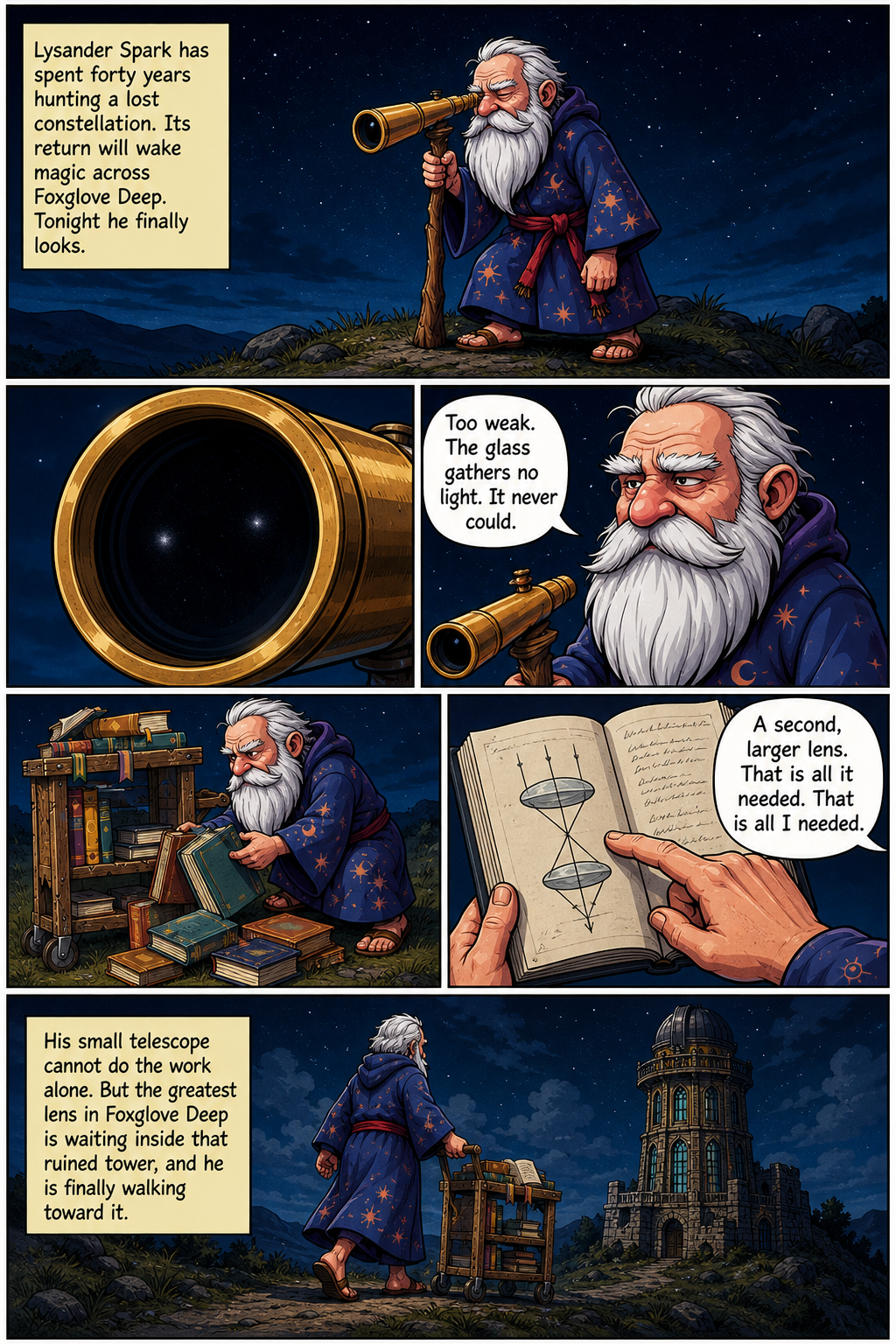
Lysander Spark had counted every star in the northern sky except the seven he needed most. Those seven formed the lost constellation, and old books swore its return would wake magic across Foxglove Deep. For forty years the tall, silver-bearded man had hunted it. Tonight he stood on a bare hilltop and unscrewed the top of his walking staff. The staff came apart in his hands. Inside hid a small collapsible telescope, brass and worn smooth by decades of gripping. He raised the telescope and searched the patch of sky where the seven stars should burn. He saw black. He saw two dim specks, maybe. He could not tell if they were stars or dust in his tired eyes. He wiped the lens on his robe and looked again. Nothing sharpened. The little telescope was too weak. It gathered too little light to catch faint stars, and the constellation stayed hidden behind the dark. Lysander lowered the staff and cursed under his breath. Forty years, and the tool in his hand simply could not do the work. He needed a stronger lens. He needed more glass, more reach, more light. Then he remembered the cart. Halfway down the hill, parked crooked on the grass, waited a shabby little book cart he had dragged from an abandoned reading room years ago. Its frame wobbled on rusted wheels. Its shelves sagged under old star manuals he never finished reading. He hurried down and gripped the handle. One wheel squealed. He pushed the cart under the open sky and began pulling books free. Half the volumes were useless. But near the bottom shelf, wedged behind a cracked spine, he found a slim manual on grinding lenses. Its pages showed how a weak eyepiece could be paired with a second, larger lens to gather more light. He read fast. The diagram was simple. He did not have a large lens tonight. But he knew now exactly what his telescope lacked and exactly how to fix it. Lysander closed the book and looked up the hill. The answer was not more staring through weak brass. The answer was building something bigger. He remembered the great tower that rose past the edge of the deep, the old observatory with its ruined dome and its huge dead lens. People said no one had climbed it in a hundred years. People said the dome was cracked and the stairs half gone. He loaded the manual onto the cart and gripped the wobbling handle. The seven stars would not come to his little staff. So he would carry his weak telescope to the strongest glass ever built in Foxglove Deep, and finish the work there. He started down the hill, the cart squealing beside him, and pointed himself toward the ruined tower.
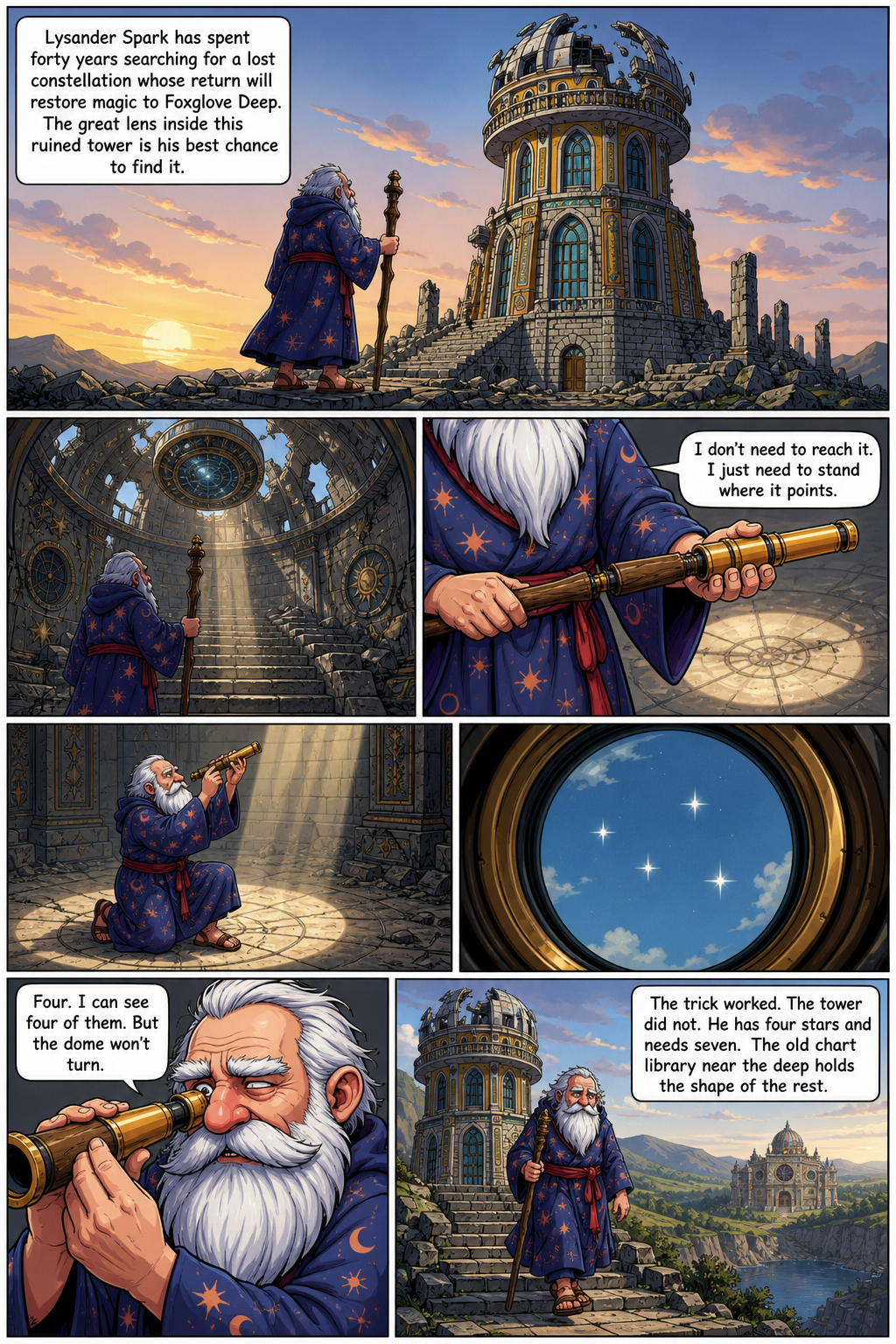
The cart squealed the whole way down. By dawn Lysander reached the tower. It rose from cracked stone, taller than any building he had seen. A domed chamber crowned it, ringed with tall windows. Half the dome had fallen in. He pushed through the door at its base and found the ruin waiting inside. He climbed the stairs until they ended in broken air. Above him, mounted in the collapsed dome, hung the great lens. It caught the morning light and threw it down in a pale disk. The lens was huge, far bigger than anything in his manual. It was also far out of reach. The stairs that once led to it had crumbled to a heap of rubble on the floor below. Lysander stood on the last whole step and stared up. Forty years of work hung there in old glass, and he could not touch it. He tested the wall. The stone was smooth and slick with moss. His hands found no grip. He was too old to climb, and there was nothing to climb. He sat on the step and thought. The manual said two lenses paired together gathered more light. He did not need to reach the great lens with his hands. He needed to line his small one up beneath it. If the light already fell straight down from the dome, he could stand in the beam and catch it. He pulled his staff apart and drew out the small brass telescope. Then he walked to the pale disk on the floor. He knelt in the light and raised his telescope up into the beam. He turned the tube slowly until the two lenses stacked. The image swam, then snapped clear. The great lens fed light straight into his small one. The sky above the broken dome sharpened until he saw stars in full daylight, faint and true. His hands shook. He held the tube steady and searched the patch of sky where the seven stars should burn. He counted. One. Two. Three faint points swam into view, dim but real. Then a fourth. His heart pounded. He had never seen even one of them before. But the dome was small and the beam was narrow. The rest of the constellation sat outside the broken opening, where the great lens could not point. He shifted, and the light slid off his lens. He shifted back and found only the same four stars. The paired lenses worked. The tower did not turn. Lysander lowered the telescope. Four stars. He needed seven. He looked at the fixed dome, then at the great lens locked in one dead angle. He could see the missing constellation now, but only a piece of it. To catch the other three, he needed a chart that showed where the whole shape ran. He remembered the old library of star charts near the deep. He packed his telescope into his staff and started down the broken stairs.
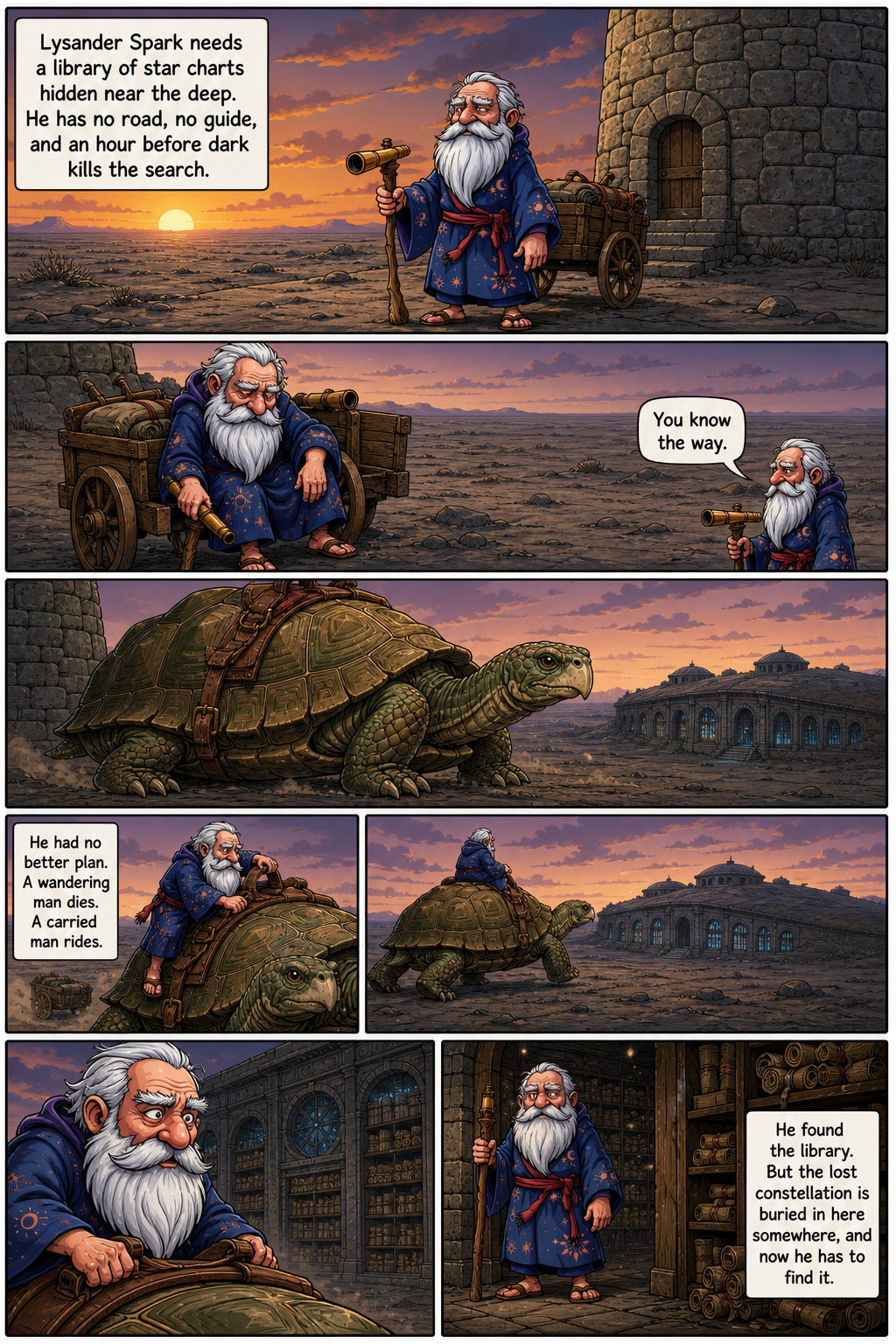
Lysander reached the bottom of the tower and stepped into the open. The land stretched flat and gray in every direction. He knew a library of star charts waited somewhere near the deep. He did not know which way to walk. He turned in a slow circle and saw no road, no marker, no sign. The sun already sat low. If he chose wrong, he would wander until dark and freeze far from any wall. He pulled his staff apart and raised the telescope, not to the sky, but to the ground. He swept the horizon and searched for a rooftop, a wall, anything built by hands. He found nothing but stone and scrub. His arm ached. He lowered the tube and sat on his cart, beaten. Then the ground shook. A slow, heavy thud came from behind the tower. Lysander gripped his staff and turned. A great tortoise plodded into view. Its shell rose as high as his chest, broad and scarred. It stopped a few feet away and fixed one dark eye on him. A worn leather saddle sat strapped across its back. Lysander had seen such beasts before. Old wardens of the deep once rode them between the far places. This one wore its saddle still, though its rider was long gone. The tortoise lowered its head and nosed the dust near his boot. Then it turned and took three slow steps, away from the tower, and stopped. It looked back at him. "You know the way," Lysander said. His voice cracked. He did not truly know that. But the beast waited, and he had no better plan. A wandering man dies. A carried man rides. He left his squealing cart behind. He took only his staff, his manual, and the telescope. He climbed the shell with shaking arms and settled into the old saddle. The tortoise felt his weight, grunted, and began to walk. It moved slower than Lysander could walk himself. But it never stopped, and it never wavered. It carried him past the flat stone and down a shallow slope he had not seen. The path bent around a low ridge. Hours passed. The sun dropped. Lysander wrapped his robe tight and trusted the beast. At dusk the tortoise halted. Ahead stood a long low building, half sunk in the earth. Its roof had caved at one end. Rows of narrow windows ran along its side. Lysander leaned forward and stared. Books. Shelves. The library of star charts, real and close. He slid from the saddle and stumbled to the door. It hung open on a broken hinge. Inside, dust covered ranks of scrolls and bound volumes. He had found it. But the shelves stretched deep into the dark, hundreds of charts stacked without order. Somewhere among them lay the pattern of the lost constellation. Now he had to find which one.
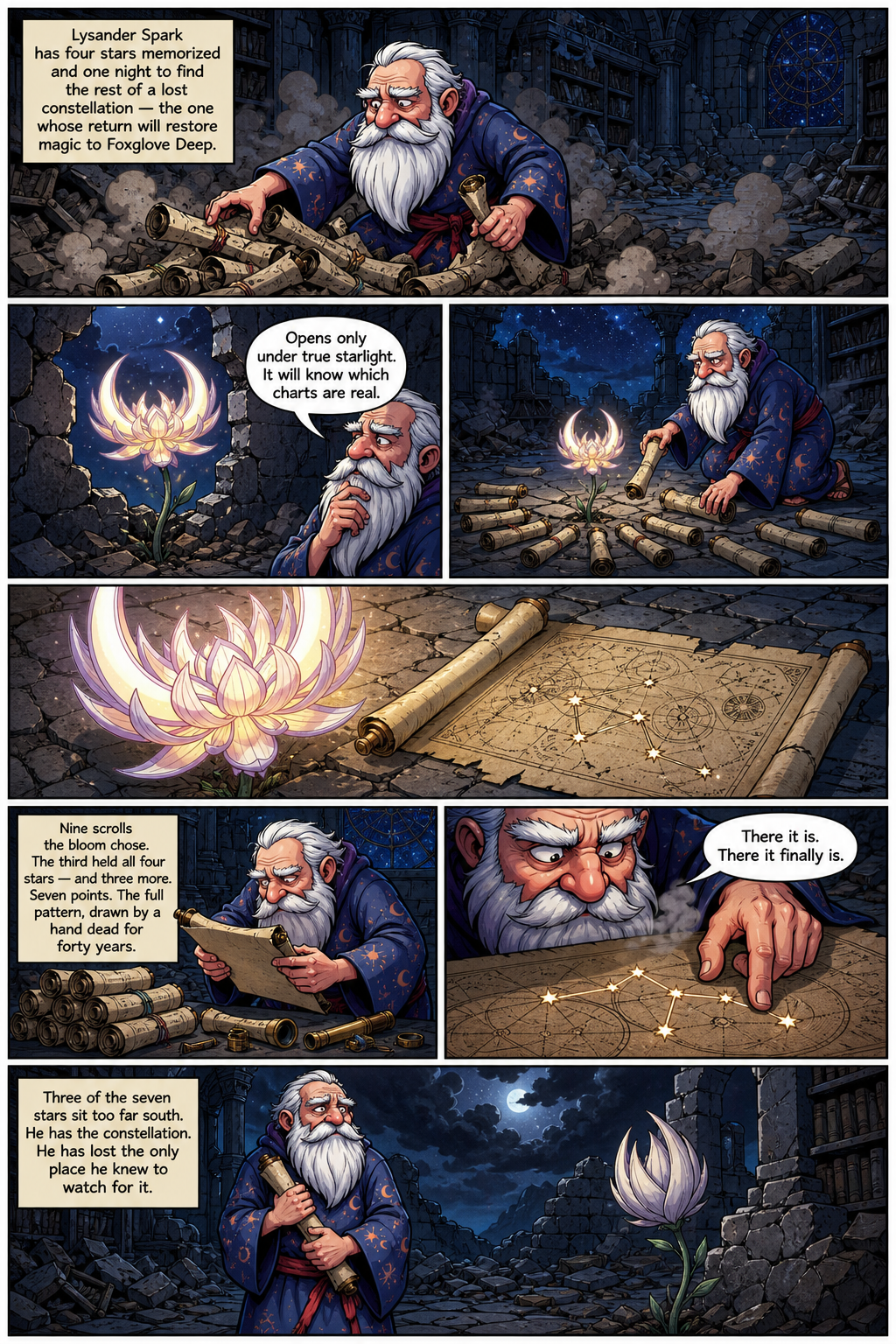
Lysander stood in the dark library and knew the trail would go cold. Somewhere in this heap lay the chart of the lost constellation. But the scrolls sat in a jumbled pile, no order, no labels. He had four stars fixed in his mind and a dying window to find the rest. He could not read a hundred scrolls before dawn. He needed a way to sort them fast. He knelt and dug through the pile. Dust rose and stung his eyes. He unrolled one scroll, then another. Faded ink. Broken seals. No pattern he knew. His hands shook. The stars in his memory would drift by morning, and the pattern would slip away again. Then he saw a pale glow near the collapsed roof. A flower grew from a crack in the sunken wall. Its layered petals shone soft, like light held in cupped hands. Lysander had read of such blooms in his old manuals. They opened only under true starlight and closed against false. He stared at it, and a plan formed. He gathered an armful of scrolls and carried them beneath the broken roof. Above, the open sky showed real stars. He set the bloom on the floor and laid the first scroll beside it. He watched the petals. They stayed shut. He set down the next. The petals leaned and opened wide. He understood. The charts drawn from true sky carried some trace the bloom answered to. The false and copied charts left it dead. He worked fast now. Scroll after scroll passed the flower. Most it ignored. A few made it open. He set those apart in a small, growing stack. His knees ached against the cold stone. Hours slid past. The pile shrank. His true stack held nine scrolls. He unrolled the first and pulled his telescope apart to read the fine marks. Stars, named and placed. He matched them against the four he had fixed at the tower. The third scroll held them all, and three more beside. Seven stars. The full pattern of the lost constellation, drawn by a hand long dead. Lysander pressed the chart flat and traced the seven points with his finger. His breath caught. Forty years, and here lay the shape at last. He rolled the chart tight and held it to his chest. But as he read the marks again, his heart sank. Three of the seven stars sat far to the south, below any line the ruined tower could reach. The chart showed him what he sought. It also showed him he could never see it from where he had come. The flower closed as a cloud crossed the moon. Lysander stood in the gray dark, the chart safe in his grip. He had the pattern now. He had lost the one place he knew to watch the sky. He would have to find another.
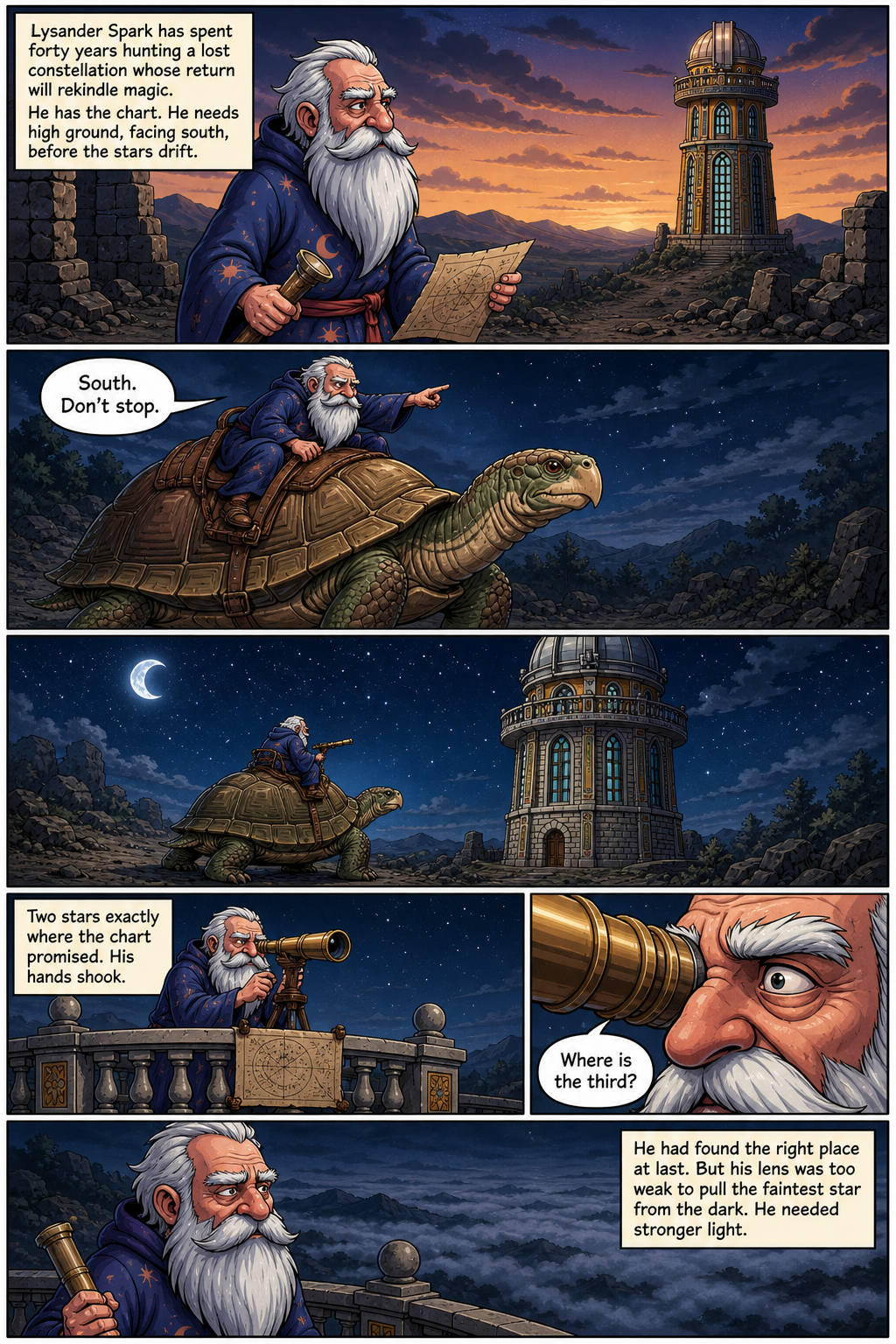
Lysander stepped from the buried library with the chart tight in his hand. The three southern stars burned in his mind. He needed high ground that faced south, high enough to clear the ridgeline. But he knew no such place, and the last light was fading fast. He turned in a slow circle. Ruins. Low hills. Nothing tall enough. Then he remembered his own home. He had left it forty years ago and returned to it a thousand times in his thoughts. A grand tower stood at the edge of the deep, crowned with a domed chamber and rings of tall windows. Its balconies faced open sky on every side. From the top gallery, the southern horizon lay bare. If any place could hold all seven stars in one view, it was there. But the tower stood far off, and night was almost on him. He would never reach it on foot before the stars drifted. His heart sank. Then he heard slow steps on the stone behind him. The old tortoise had waited. It swung its wrinkled head toward the dark path and gestured, the way it had gestured before. Lysander climbed into the worn saddle. "South," he said, and pointed. The beast turned and walked into the falling dark. The ride was long and cold. Lysander held the chart against his chest and watched the sky wheel above him. He fixed the three southern stars in his mind and would not let them slip. The tortoise never hurried and never stopped. Hills rose and fell. At last a shape cut the sky ahead. His tower stood black against the stars, its dome catching the thin moonlight. He slid from the saddle and pushed through the ground door. The stairs climbed round and round. His knees screamed. He did not slow. He passed the bands of tall windows and came out onto the top gallery, breathing hard. The whole south lay open before him. Lysander pulled his staff apart and drew out the small brass telescope. He unrolled the chart on the rail and pinned it with his elbow. He raised the glass toward the low southern sky and searched. There. One faint star, exactly where the chart marked it. He swept left. A second, weaker still. His hands shook. He held his breath and looked for the third. But the glass showed only black. The third star sat too low, too faint for his weak lens to catch. It hung just above the ridge, drowned in haze. He could see two of the three. He could not see the last. Lysander lowered the telescope. From this gallery he could face all three stars at last. Yet his single lens was too weak to pull the faintest one from the dark. He had the right place now. He needed stronger light.
Play your story to life
Storycraft is a mobile game where you create AI characters, craft items and locations to build their world, then discover what direction your story takes. Download the iOS game for free today!
Download for free