

Malak's Arc
4 Chapters
Malak's dream is dismantling the corporation that turned him into a weapon during the wars.

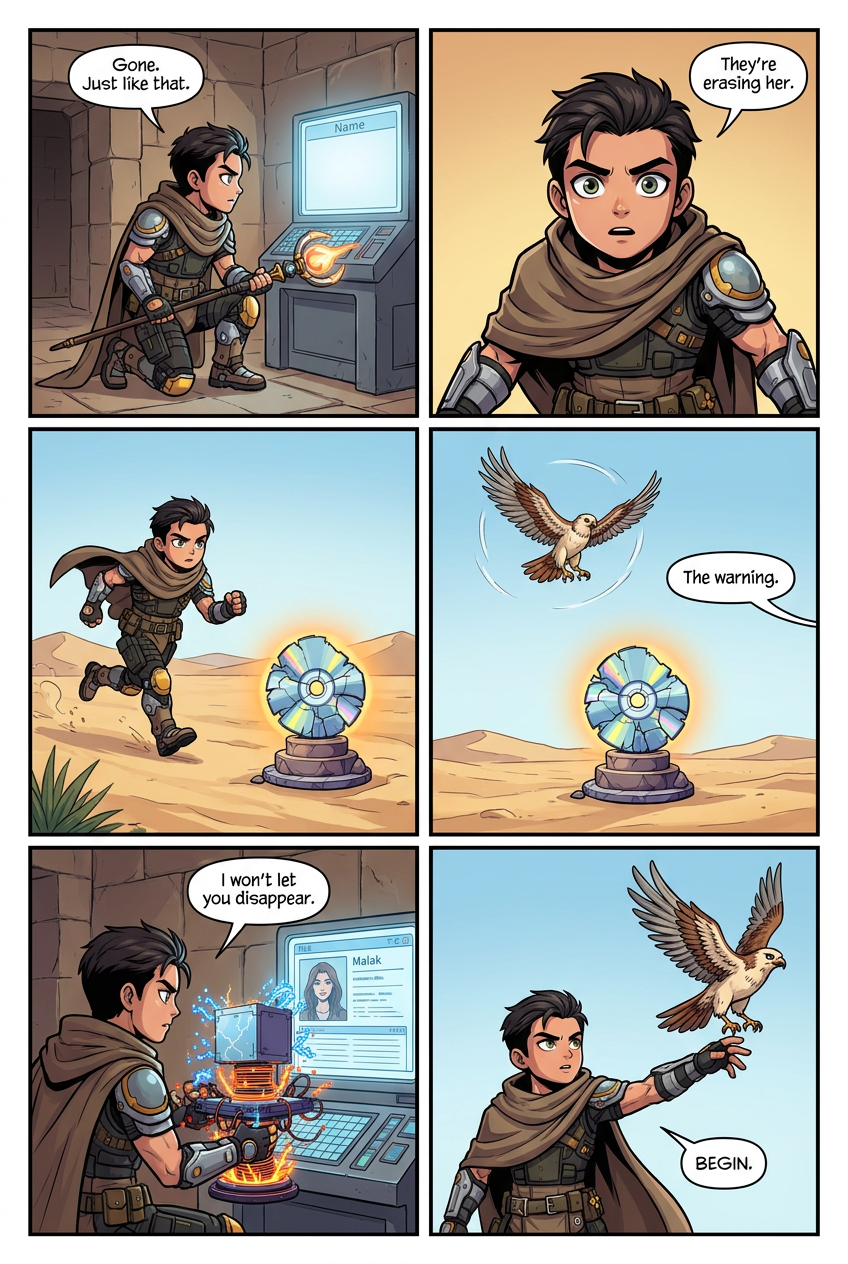
Malak knelt inside the stone labyrinth, his scepter laid across his knees. The hidden walls held the only copies of the records that could end the corporation. He opened her file first, as he did every morning. The screen blinked. Her name was gone. He stood fast. His shawl slipped back as he moved deeper into the chambers. The corporation had begun erasing people from their own crimes. She was the first. He had looked her up. He had found her alive. Now they were trying to make her never exist. Malak ran outside. On the sand sat a cracked disc on a stone base, a marker he had built the day he first read her name. It was warm. A bird of prey circled above it, sharp-eyed, waiting. He had set the marker to warn him. The warning had come. He went back in and pulled the broken floating box from its shelf. Sparks jumped between its coils. Inside its shielded core, he had saved a mirror of her file the night before, by instinct he had not named. He fed it power. Her name returned to the screen. Her photo. Her years. Malak sent the bird out with a coded burst to his three contacts. The message was short. Begin. The erasure had started. He would not wait for the second name to vanish.
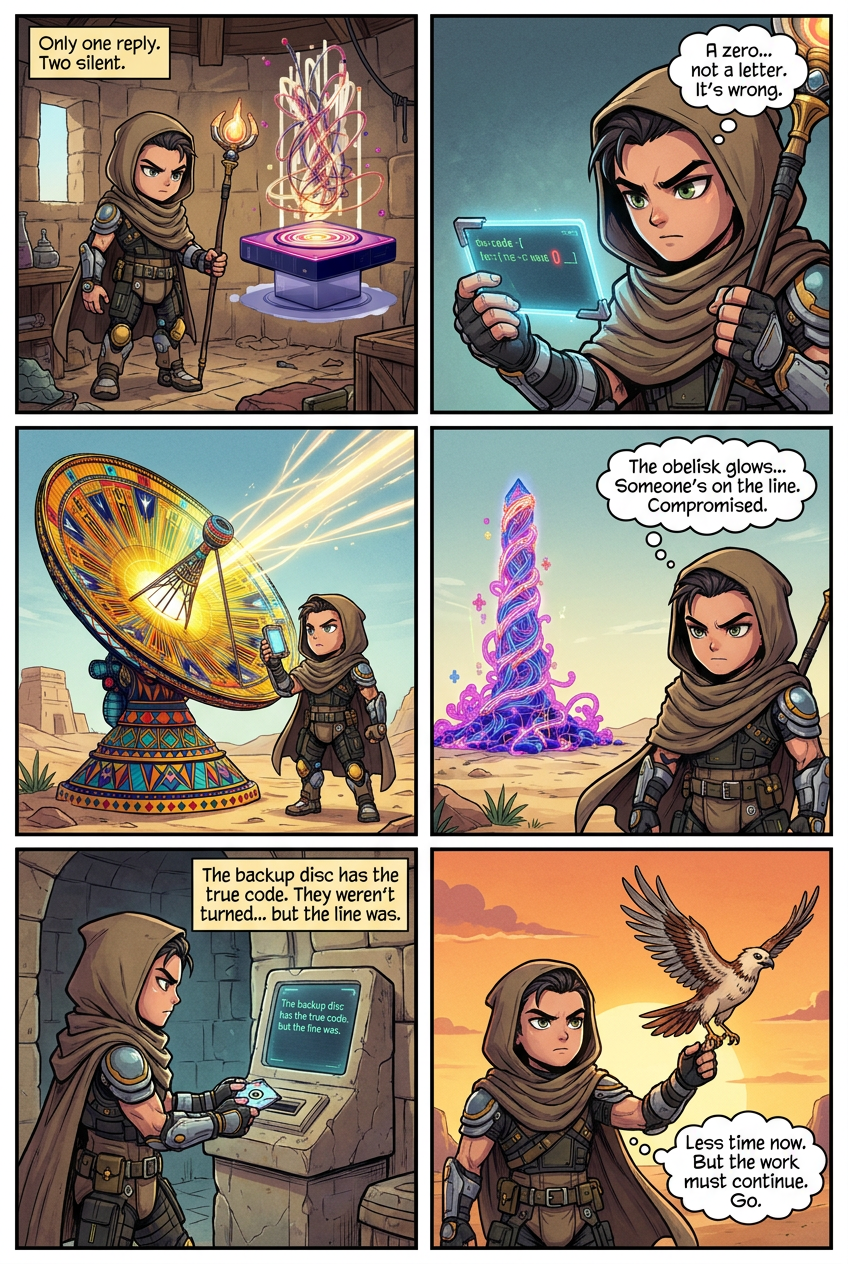
Malak climbed into the small tower of wired coils where he watched for replies. The floating string box hummed above its base. One light blinked. One contact had answered. The other two had not. He read the counter-code on the screen. It was almost right. One character was wrong. A zero where a letter should be. His hand tightened on the scepter. He carried the signal out to the painted dish in the sand. The beam from its center split the code into pieces. He held each piece up to the light. The wrong character had not come from his contact. It had been changed in transit. Outside, the tall neon pillar at the edge of his ground still glowed where the signal had passed through. Someone had touched it. Someone was listening on the line he thought was clean. Malak walked back to the labyrinth. He pulled a cracked disc from the shelf and snapped it into the reader. The backup held his contact's true code. They were not turned. The line was. He shut down that channel. Two contacts left. He sent a new signal through a path the corporation did not know. The bird lifted from the sand and flew. He had less room now, and less time. But the work moved on.
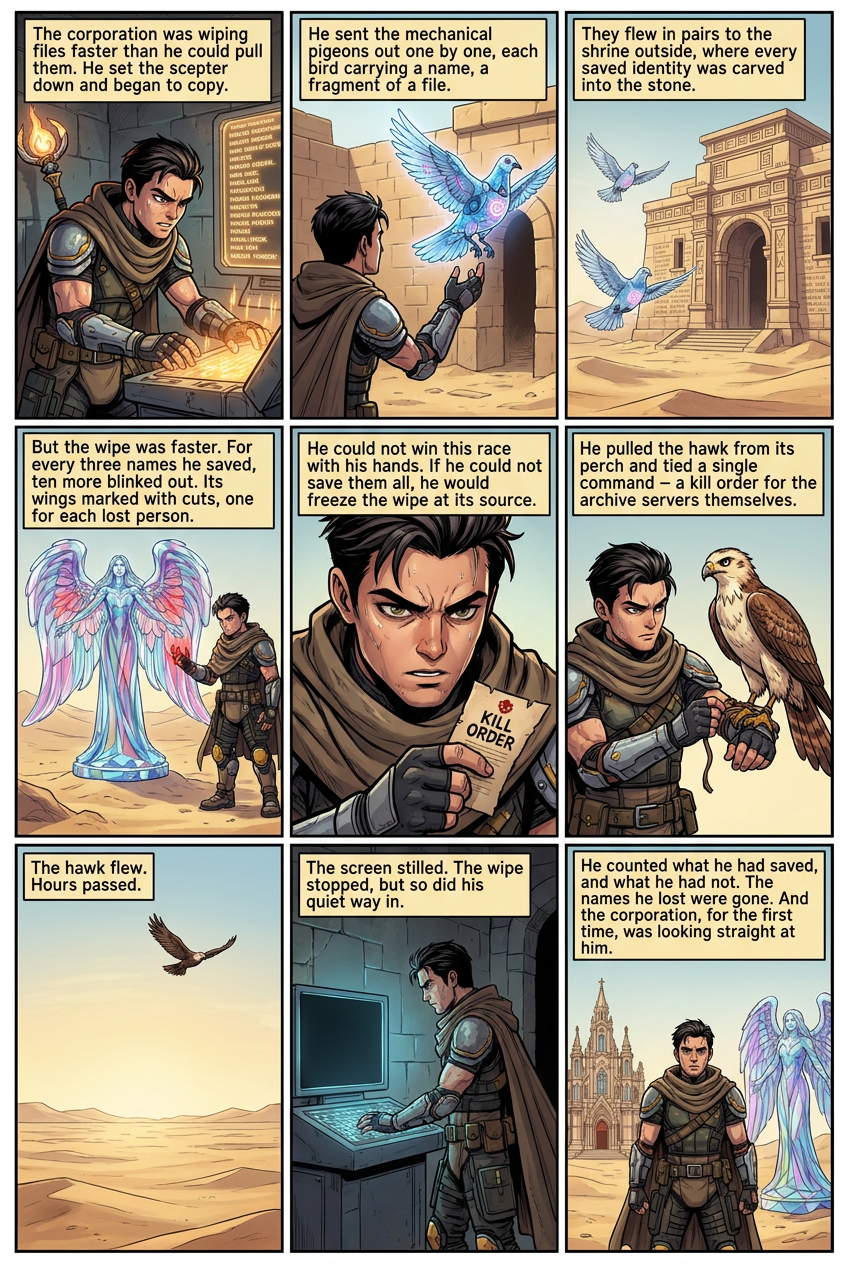
After the new signal flew, Malak returned to the labyrinth and saw the screen flickering. Names were vanishing in rows. The corporation was wiping files faster than he could pull them. He set the scepter down and began to copy. He sent the mechanical pigeons out one by one. Each bird carried a name in its chest, a fragment of a file, a face. They flew in pairs to the shrine outside, where every saved identity was carved into the stone. He worked the keys until his hands shook. But the wipe was faster than his copy. For every three names he saved, ten more blinked out. He walked outside to the tall glass angel that stood at the edge of the sand. Its wings were marked with cuts, one for each lost person. New cuts opened as he watched. Malak stopped. He could not win this race with his hands. He pulled the hawk from its perch and tied a single command to its leg — a kill order for the archive servers themselves. If he could not save them all, he would freeze the wipe at its source. The hawk flew. Hours passed. The screen stilled. The wipe stopped, but so did his quiet way in. The corporation now knew something had reached inside. He stood before the shrine and counted what he had saved, and before the angel and counted what he had not. The names he kept were safe. The names he lost were gone. And the corporation, for the first time, was looking straight at him.
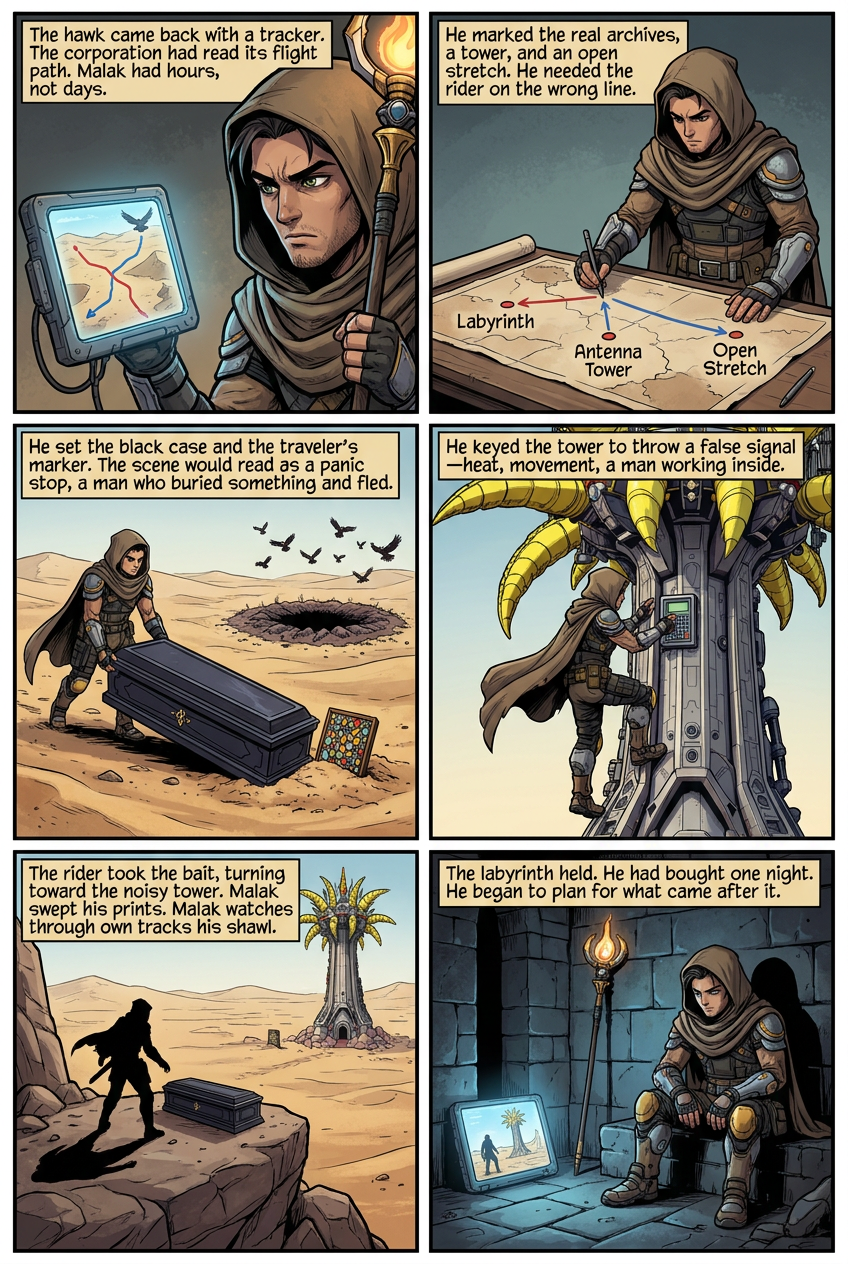
The hawk came back at dawn with dust on its feathers and a tracker on its tail. Malak saw the second shape on the long-range screen, a single rider crossing the dunes in the bird's wake. The corporation had read the flight path and sent a man to walk it backward. If the rider held his line, he would reach the labyrinth before nightfall. Malak had hours, not days. He pulled on the shawl and took up the scepter. He did not run. He pulled a map from the table and marked three points: the labyrinth where the real archives lay, a tower of antennas two ridges south, and an open stretch of sand between them. He needed the rider to commit to the wrong line and stay committed long enough to lose the right one. First he went to the open stretch and dragged a long black case out into the sun. The case was the size of a coffin and drank the light off the sand. He set it half-buried, lid askew, as if someone had started a burial and run. He scattered a board of broken tiles and colored stones beside it, the kind of marker travelers leave to count their dead. Within the hour, carrion birds began to circle a pit he had opened the week before, the bodies inside long past use. From a ridge, the scene would read as a recent grave, a panicked stop, a man who had buried something and fled south. Then he climbed the antenna tower. Its yellow fronds bristled with deflectors in every direction. He keyed it to throw a false signal pattern outward — heat, movement, the shape of a man working inside. He set it to pulse for six hours and climbed down. The tower would shout his presence two ridges from where his presence actually was. He waited on a high rock with the scope. The rider came over the dune near dusk and stopped at the black case. He circled it. He photographed the stone marker. He looked at the vultures, then at the tower throwing its noise into the sky, and turned his mount toward the tower. Malak watched until the rider was committed to the wrong ridge, then climbed down and walked home the long way, sweeping his prints behind him with the shawl. The labyrinth held. The trail south would keep the rider busy until morning, and by morning he would find an empty tower and a hole in the sand. But the corporation now knew the hawk had flown from somewhere near here, and they would send a second tracker, and a third. Malak set the scepter against the wall and opened the screen. He had bought one night. He began to plan for what came after it.
Play your story to life
Storycraft is a mobile game where you create AI characters, craft items and locations to build their world, then discover what direction your story takes. Download the iOS game for free today!
Download for free