

Maniu T's Arc
9 Chapters
Maniu T's dream is founding a school where every child in Letter Land learns to read and write..

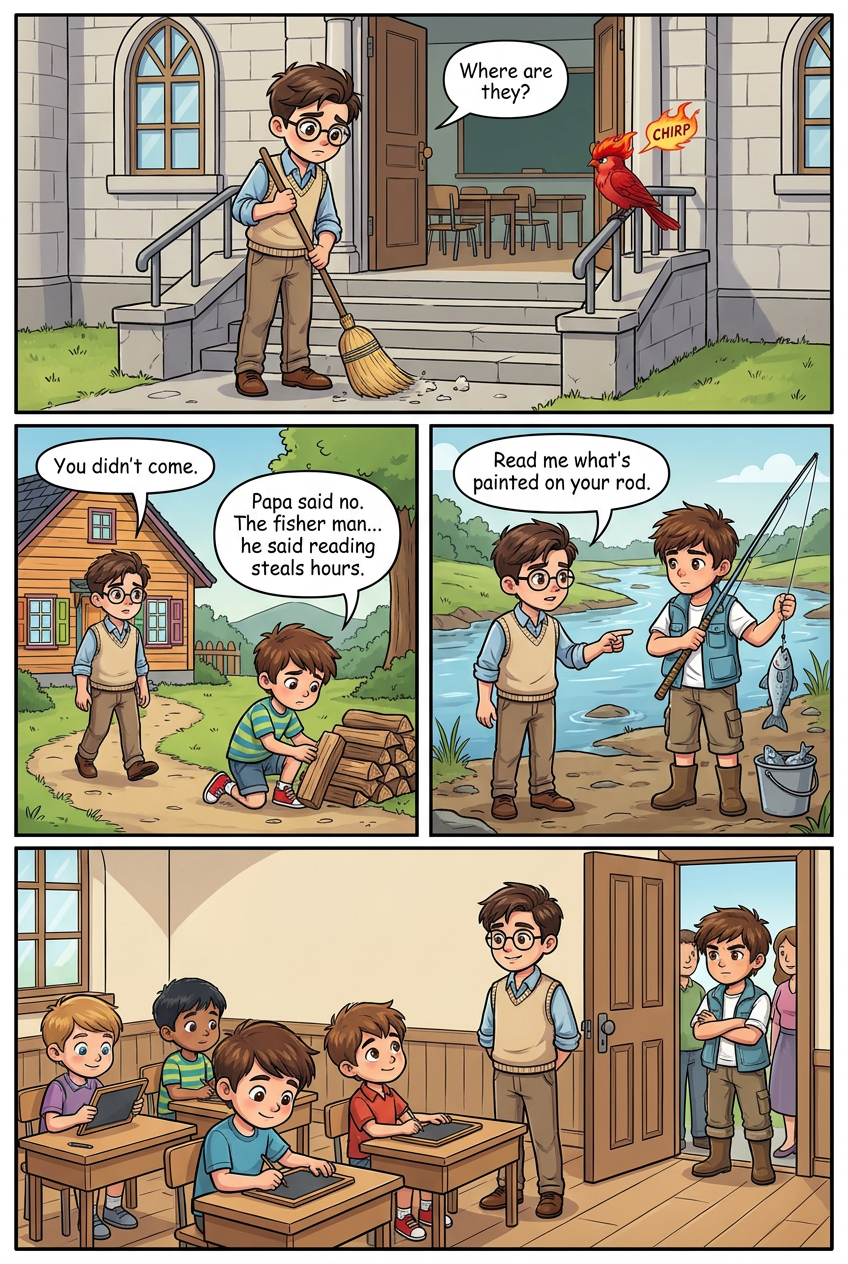
Maniu swept the front step of the castle-shaped school for the third time that morning. The door stood open behind him. Inside, twenty small desks waited in neat rows, each with a slate and a stub of chalk he had paid for himself. It was the first day of classes in Letter Land's first real school, and no children had come. He had spent two years building this. He had painted the letters on the towers by hand. He had walked to every cottage in the valley and promised parents that their children would learn to read. They had smiled and nodded and shaken his hand. A red bird with a flame-shaped crest landed on the railing and watched him with one bright eye. Maniu set down the broom. "Where are they?" The bird tilted its head toward the road. Maniu walked. He passed three cottages before he found a boy in the yard of a warm little house with green shutters. Mark was stacking firewood almost as tall as himself, his striped shirt smudged with bark. He grinned when he saw Maniu, then looked at the ground. "You didn't come," Maniu said. "Papa said no." Mark set another log on the pile. "He said the fisher man came around. Said reading steals hours a boy owes his family." "Which fisher man?" Mark pointed down the path toward the water. Maniu found him on the bank with a long rod and a full bucket. Yes, Fisher was maybe twelve, no taller than the reeds, and he was pulling in a silver fish with the calm of someone who had done it a thousand times. Two younger boys watched him from the mud. Their parents watched from the porch behind. Everyone watched Yes, Fisher. "You've been telling the parents," Maniu said. Yes, Fisher didn't look up. "I tell them what's true. My father can't read. I can't read. My bucket's full. Yours is empty." He nodded at the bucket. "An hour at a desk is an hour a boy isn't feeding his house." Maniu looked at the fish. He looked at the boys in the mud, who were listening to every word. "Read me what's painted on your rod," Maniu said. Yes, Fisher's hand tightened. The rod had letters carved along the grip. He had never asked what they said. "It's your father's name," Maniu said. He had known the old man before the stroke took his voice. "He carved it there so you'd carry it. You've been carrying it for years and never knew." The bank went quiet. One of the small boys stood up out of the mud. Yes, Fisher set the rod down. He didn't speak. He didn't have to. By afternoon, four children sat at the desks inside the castle school. Mark was one of them. Yes, Fisher stood in the doorway, arms crossed, watching. He did not come in. But he did not leave, either, and the parents behind him were waiting to see what he would decide.
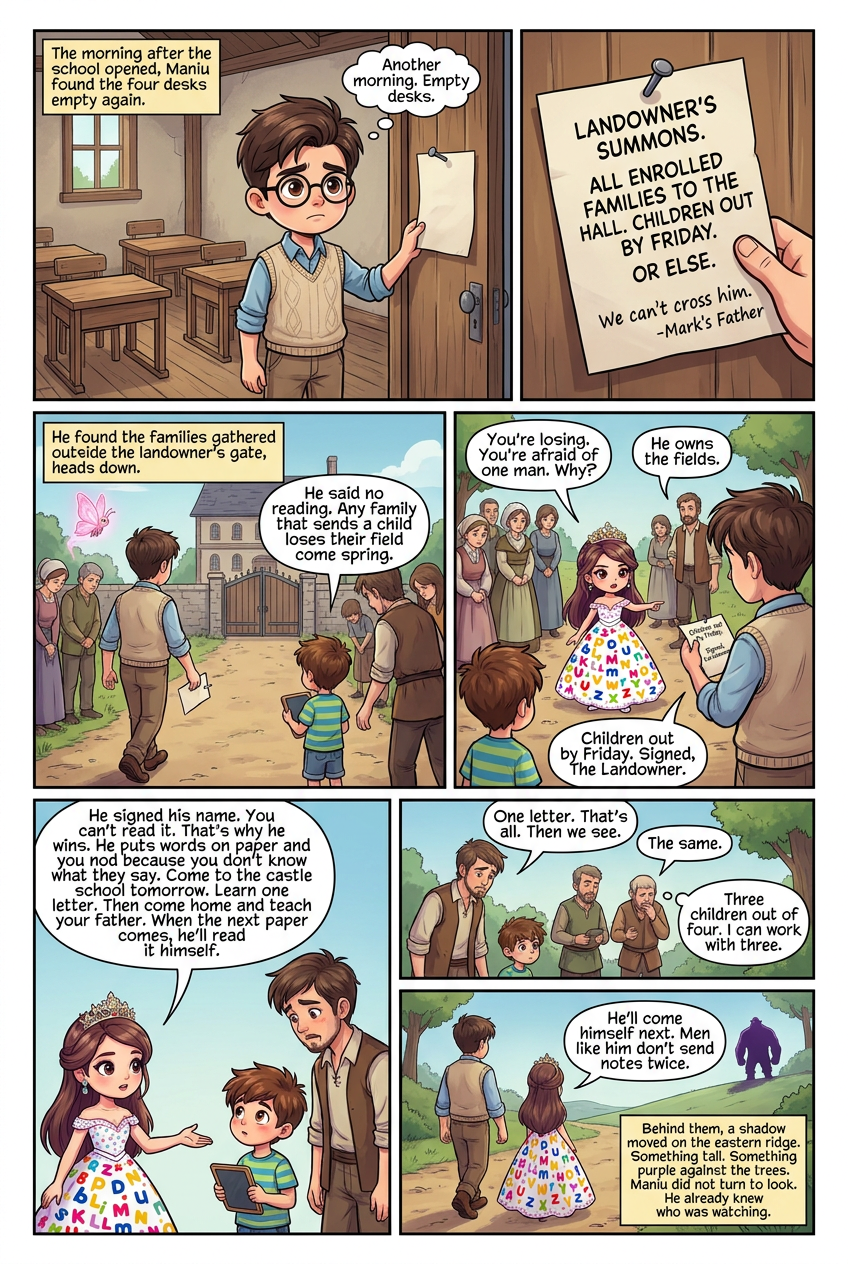
The morning after the school opened, Maniu found the four desks empty again. A note was pinned to the door with a nail. It said the east-side landowner had summoned every enrolled family to his hall. The families had until Friday to pull their children out. Mark's father had written one line at the bottom: We can't cross him. Maniu read the note twice. He walked to the road and started east. He found the families gathered outside the landowner's gate, heads down. Mark stood behind his father, holding his slate like a shield. The other three children clung to their mothers. The landowner had not come out. He didn't need to. His word had already done the work. "He said no reading," Mark's father said. "He said any family that sends a child loses their field come spring." Maniu had no field to threaten and no coin to match. He had a school and a promise, and neither would feed a family through winter. A small pink butterfly drifted past his ear and settled on Mark's slate. Then a voice cut across the yard. "Move." A girl walked through the gathered parents like they were tall grass. Her dress was stitched with every letter of the alphabet, bright and crooked and impossible to miss. A thin crown sat on her head. She was smaller than Mark. She was his cousin from the far kingdoms, and Maniu had written to her twice and never expected her to come. "Princess Letter," Maniu said. "You're losing," she said. She turned to Mark's father. "You're afraid of one man. Why?" "He owns the fields." "He owns the dirt. Not your boy." She pointed at the note in Maniu's hand. "Read it out. All of it." Maniu read it aloud. The threat. The Friday. The signature. Princess Letter looked at the parents. "He signed his name. You can't read it. That's why he wins. He puts words on paper and you nod because you don't know what they say." She held out her hand to Mark. "Come to the castle school tomorrow. Learn one letter. Then come home and teach your father. When the next paper comes, he'll read it himself." Mark looked up at his father. His father looked at the ground a long time. "One letter," he said finally. "That's all. Then we see." Two other fathers muttered the same. The third family turned and walked home. Maniu watched them go. Three children out of four. He could work with three. On the road back, Princess Letter walked beside him. She did not smile. "He'll come himself next," she said. "Men like him don't send notes twice." Behind them, a shadow moved on the eastern ridge. Something tall. Something purple against the trees. Maniu did not turn to look. He already knew who was watching.
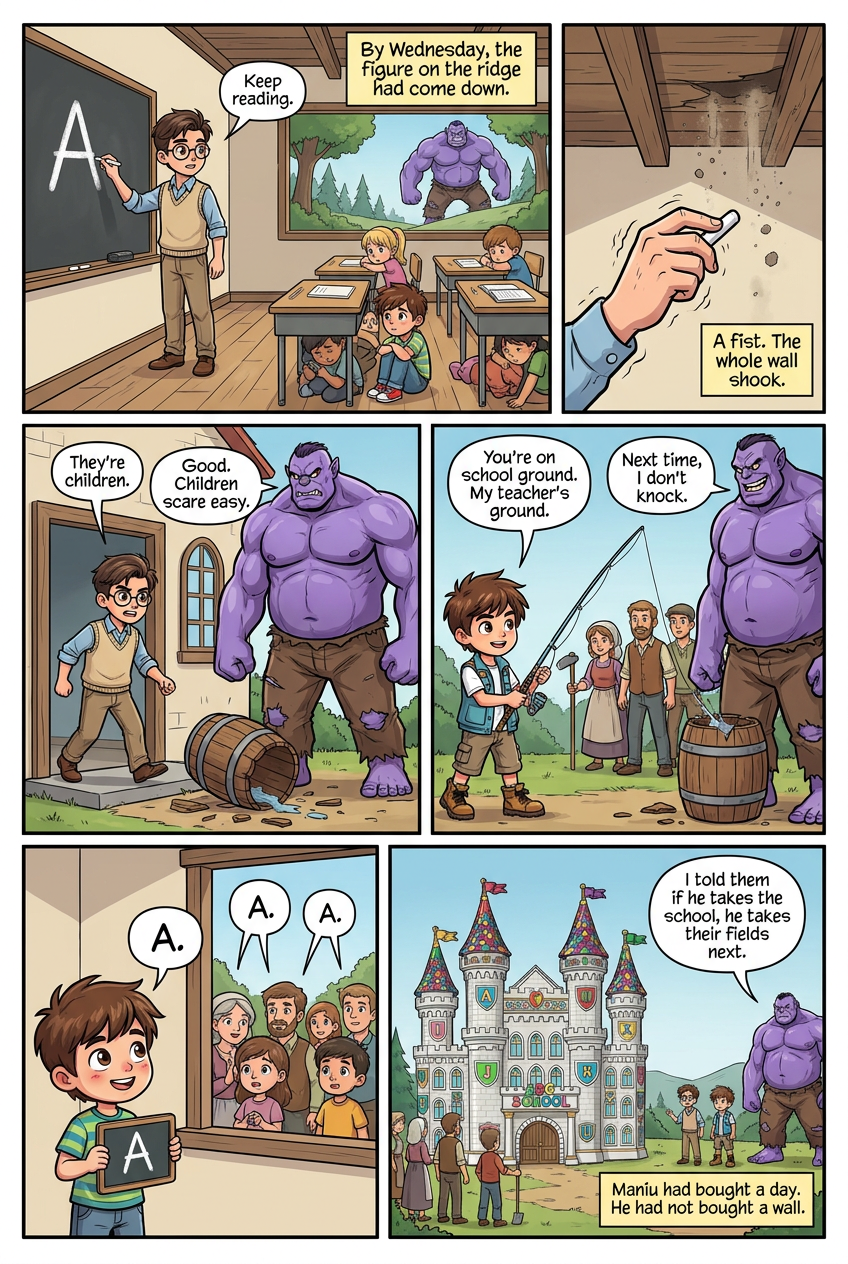
By Wednesday, the figure on the ridge had come down. Maniu saw him first through the schoolroom window, a purple shape moving between the trees at the edge of the yard. The three children saw him too. Mark dropped his chalk. The other two slid under their desks. Maniu closed the shutter, but the shutter was thin wood, and the shape outside was tall as the roof. "Keep reading," Maniu said. His voice stayed level. His hands did not. He wrote a single letter on the board, big and clear. A. "Say it with me." They tried. A knock hit the door. Not a knock. A fist. The whole wall shook. Dust fell from the beams. Mark started to cry without sound. Maniu stepped outside and shut the door behind him. The Mad Man stood in the yard. Purple, bare-chested, twice Maniu's height. He carried no weapon. He did not need one. He kicked over the water barrel and the wood cracked like a dry branch. "Send them home," the giant said. "Today. Or I come inside tomorrow." Maniu's mouth went dry. He had planned for the landowner. A man with papers. A man who could be answered with papers. This was not that. He said, "They're children." "Good," the giant said. "Children scare easy." A voice came from the road. "Hey." Maniu turned. Yes, Fisher stood at the gate with his fishing rod in one hand. The boy who had once talked families out of the school. The boy who now knew his father's name was carved along the rod's grain, because Maniu had shown him. He walked into the yard like the giant was a stump he meant to step around. "You're on school ground," Yes, Fisher said. "My teacher's ground." The giant laughed. Then he stopped laughing, because more feet were coming up the road. Two fathers. Three mothers. A cousin with a hoe. Word had traveled fast in a small place. Yes, Fisher had run door to door while Maniu was still writing the letter A on the board. The giant looked at them. He looked at the schoolhouse. He spat on the broken barrel. "Next time," he said, "I don't knock." He walked back toward the ridge. Slow. Making sure they watched. Maniu let out a breath he had not known he was holding. Yes, Fisher would not meet his eye. "I told them the giant works for the landowner," the boy said. "I told them if he takes the school, he takes their fields next anyway. Might as well stand now." Maniu nodded. He opened the schoolroom door. The three children came out slowly. Mark looked at the smashed barrel, then at the crowd of parents in the yard. He picked up his slate. "A," Mark said. "A," the parents said back. The giant was gone from the ridge. But he had promised to return, and next time he would not knock. Maniu had bought a day. He had not bought a wall.
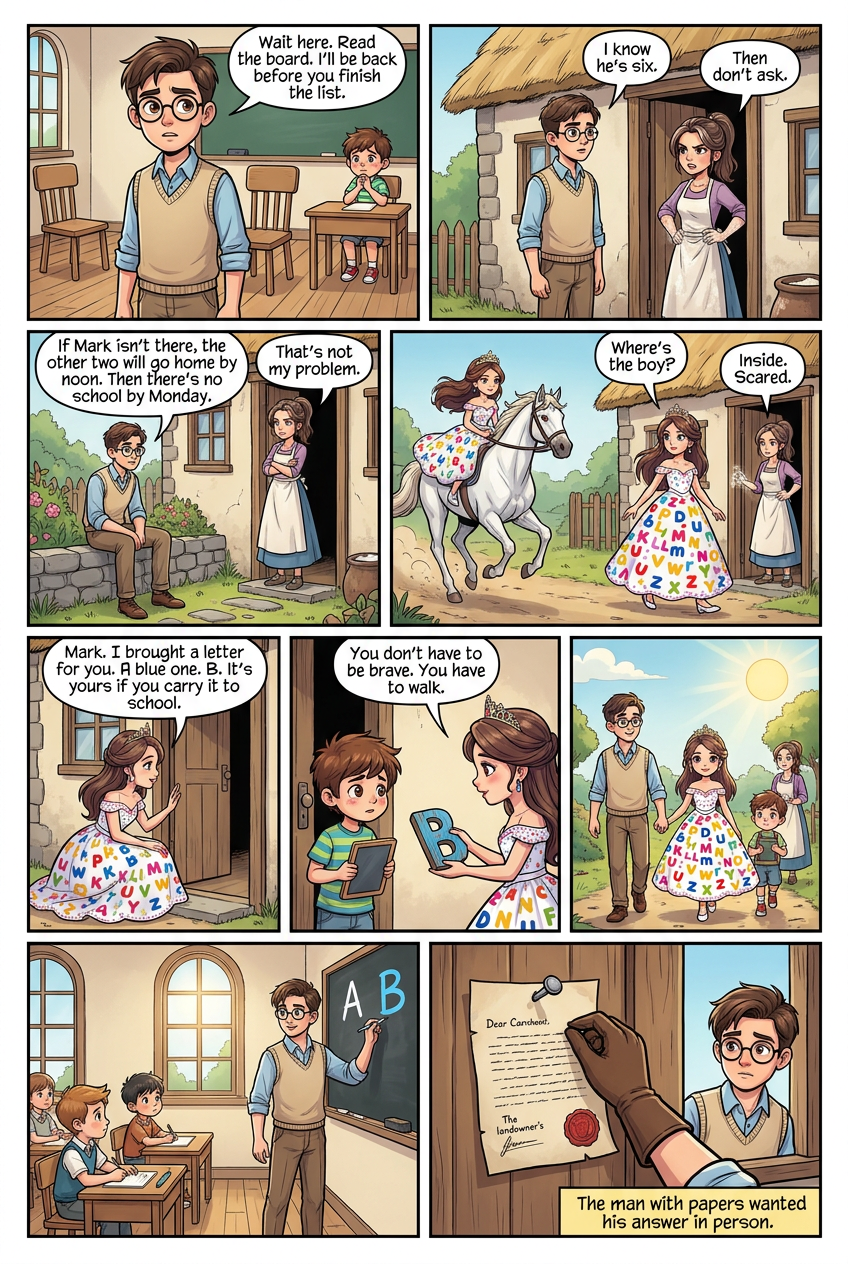
Thursday morning, Mark's seat was empty. So was the seat beside it. Only one child sat in the schoolroom, a small boy with his hands folded tight in his lap. He looked at the two empty chairs, then at the door, then at Maniu. Maniu knew that look. It was the look of a child counting how long before he ran too. "Wait here," Maniu said. "Read the board. I'll be back before you finish the list." He walked the road to Mark's house. The door opened before he knocked. Raina stood in the frame with flour on her hands and her jaw set. Mark's mother. The woman who had stayed when the landowner threatened her fields, and stayed again when the giant came down from the ridge. "He won't come today," Raina said. "He had a bad dream. He wet the bed. He's six." "I know he's six." "Then don't ask." Maniu did not ask. He stepped back from the door and sat on the low stone wall by her garden. He waited. Raina watched him from the doorway with her arms crossed. "If Mark isn't there," Maniu said, "the other two will go home by noon. Then there's no school by Monday. Then the giant wins without walking down the hill." "That's not my problem." "It is. Because next week he comes for your field anyway. You said that yourself, at my yard, with a hoe in your hand." Raina's jaw shifted. She looked past him at the road. A rider was coming up it. A white horse, clean as chalk, and on its back Princess Letter, her lettered dress bright against the dust. She had said she would ride the border towns this week. She had ridden here instead. She swung down without ceremony and walked straight to the doorway. "Where's the boy?" she said. "Inside," Raina said. "Scared." "Good. Scared means he understands." The princess crouched at the threshold and called into the house, gentle but plain. "Mark. I brought a letter for you. A blue one. B. It's yours if you carry it to school." A pause. Then small feet. Mark came to the door holding his slate against his chest. The princess held out a wooden B, painted blue, the edges worn smooth from other hands in other towns. Mark took it. "You don't have to be brave," she said. "You have to walk." Raina put a hand on her son's shoulder. She looked at Maniu. She nodded once. They walked back together. Three students at three desks by the time the sun cleared the roof. Maniu wrote B on the board beside the A from yesterday. That afternoon, a rider from the east side left a folded paper nailed to the schoolhouse door. The landowner's seal. Maniu had held the seat. Now the man with papers wanted his answer in person.
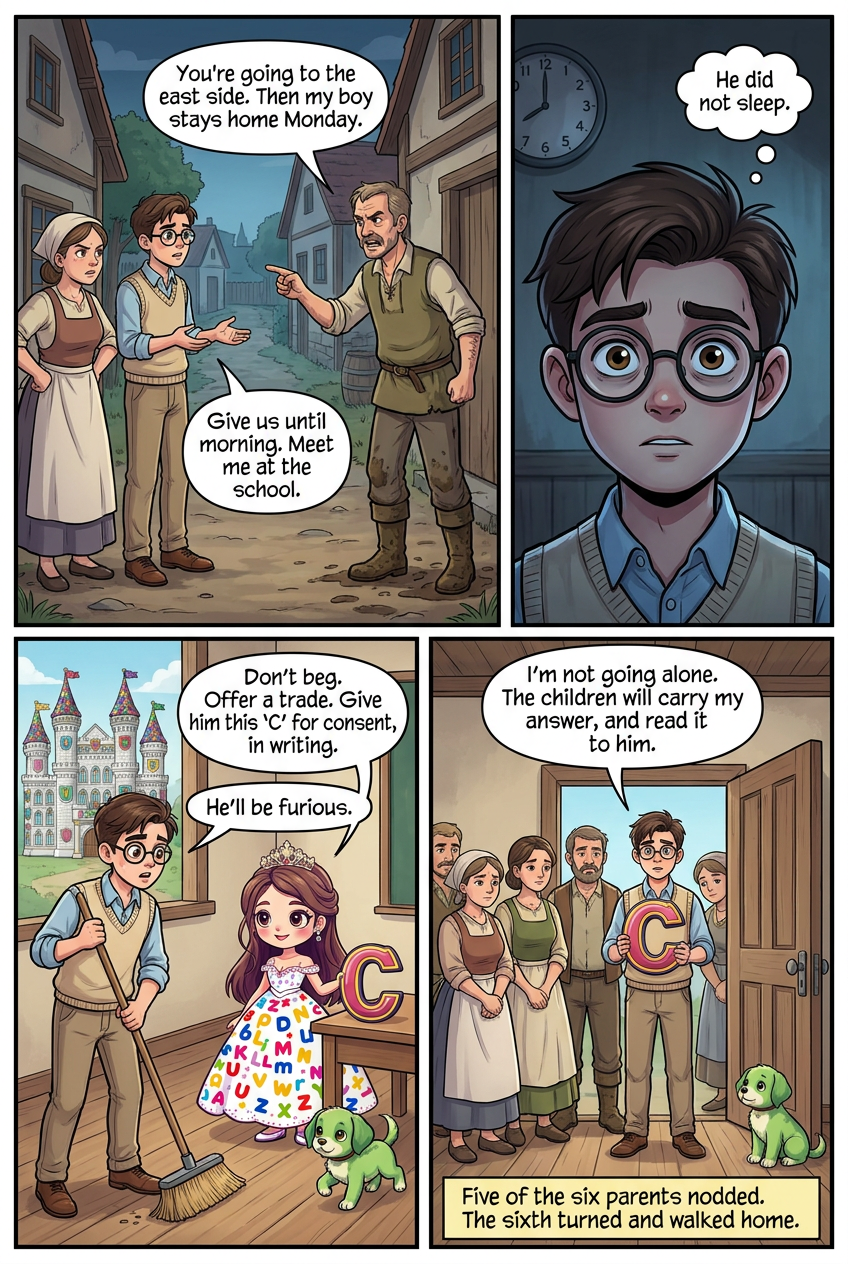
By evening, the folded paper on the schoolhouse door had done its work without being read aloud. Word traveled faster than Maniu could walk. By the time he reached the well, two mothers were waiting for him with their aprons twisted in their hands. By the time he reached his own gate, a father stood there too, boots muddy, mouth tight. "You're going to the east side," the father said. "Then my boy stays home Monday. If the landowner takes you, he takes the school. I won't have my son on his list." "He hasn't taken me yet," Maniu said. "He summoned you. That's the same thing, just slower." The two mothers nodded. One was Mark's neighbor. The other had a daughter who could already write her own name. "Give us until morning," Maniu said. "Meet me at the school at first light. Bring the children. If you still want to pull them after you've heard me, pull them." They went. He did not sleep. At dawn he swept the schoolroom floor and set three chairs in a row facing the door. Princess Letter arrived before the parents did. She tied her white horse to the post and came inside without knocking. A small green pup trotted at her heels, leaf-shaped ears flopping, brown paws quick on the boards. "You look like a man about to beg," she said. "I am." "Don't. Beg loses. Offer a trade." "I have nothing to trade." "You have the answer he wants. Give it in writing. Make the children carry it." Maniu stared at her. She set a wooden letter on his desk. A bold red C, edged in yellow, warm in his hand. "C," she said. "For consent. He wants your answer in person so the village sees you kneel. Send the answer with the children instead. Three students. Three letters. They read it to him at his own gate." "He'll be furious." "He'll be watched. By his own men. By ours. A landowner who strikes a child who just read to him loses every field hand by planting season." The parents came at first light, six of them, standing in the doorway like a wall. Maniu did not sit. He held up the C. "I'm not going alone," he said. "I'm not going today. The children will carry my answer, and they'll read it themselves in front of him. If you won't allow that, pull them now and I won't argue." Silence. Mark's mother stepped forward first. Then the father with the muddy boots. One by one, five of the six nodded. The sixth turned and walked home. Two students left on his roll. Two, and a written answer in a child's hand, and a road east that had to be walked by Monday. The pup sat by the door and watched the road with him.
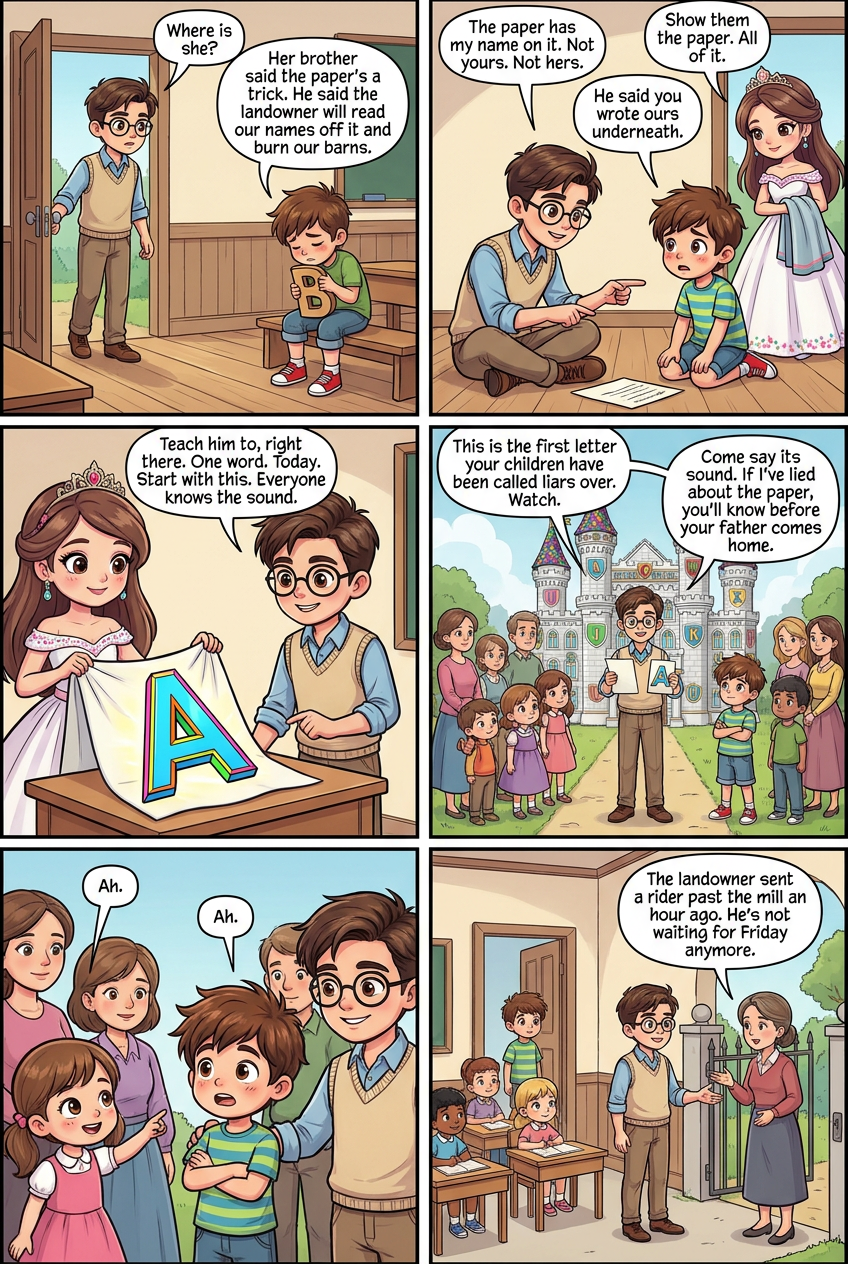
By Wednesday morning, the withdrawn boy had done more damage than the landowner. His father had kept him home, but the boy walked the lane past the school anyway, telling every child he passed that Maniu's letter would get them all whipped. By the time Maniu opened the door, only Mark sat on the bench. The other student's chair was empty. Mark held the painted wooden B in his lap and would not look up. "Where is she?" Maniu asked. "Her brother said the paper's a trick," Mark whispered. "He said the landowner will read our names off it and burn our barns." Maniu sat on the floor so his eyes were level with the boy's. "The paper has my name on it. Not yours. Not hers." "He said you wrote ours underneath." So that was the rumor. Maniu stood. He had until Friday. One boy on a bench was not a school. Princess Letter came through the door with the green pup at her heel and a folded cloth under her arm. She had heard already; news in Letter Land moved on bare feet. "Show them the paper," she said. "All of it. Read it aloud in the lane where the withdrawn boy can hear." "He can't read it back to check me." "Then teach him to, right there. One word. Today." She set the cloth on the desk and unfolded it. Inside was a large bright letter A, blue and orange, edged clean. "Start with this. Everyone knows the sound. Nobody can argue with it." Maniu carried the A and the written answer into the lane. Mark followed with the B. Princess Letter rang the school bell until doors opened up and down the row. Mothers came out with wet hands. The withdrawn boy came too, hanging back by a fence post, arms crossed like his father's. Maniu held up the paper first. He read every word slowly. Consent from the teacher. No names of children. No names of families. Then he held up the A. "This is the first letter your children have been called liars over," he said. "Watch." He turned to the withdrawn boy. "Come say its sound. Just the sound. If I've lied about the paper, you'll know before your father comes home." The boy did not move. A younger girl stepped out from behind her mother and said it. "Ah." Then Mark said it. Then two more children. The withdrawn boy's mouth moved without sound, and his arms came uncrossed. By noon, four children sat on the bench again. The withdrawn boy was not among them, but he stood in the doorway the way Yes, Fisher once had, watching. His mother had not called him home. Mark's neighbor stopped Maniu at the gate that evening. "The landowner sent a rider past the mill an hour ago," she said. "He's not waiting for Friday anymore."
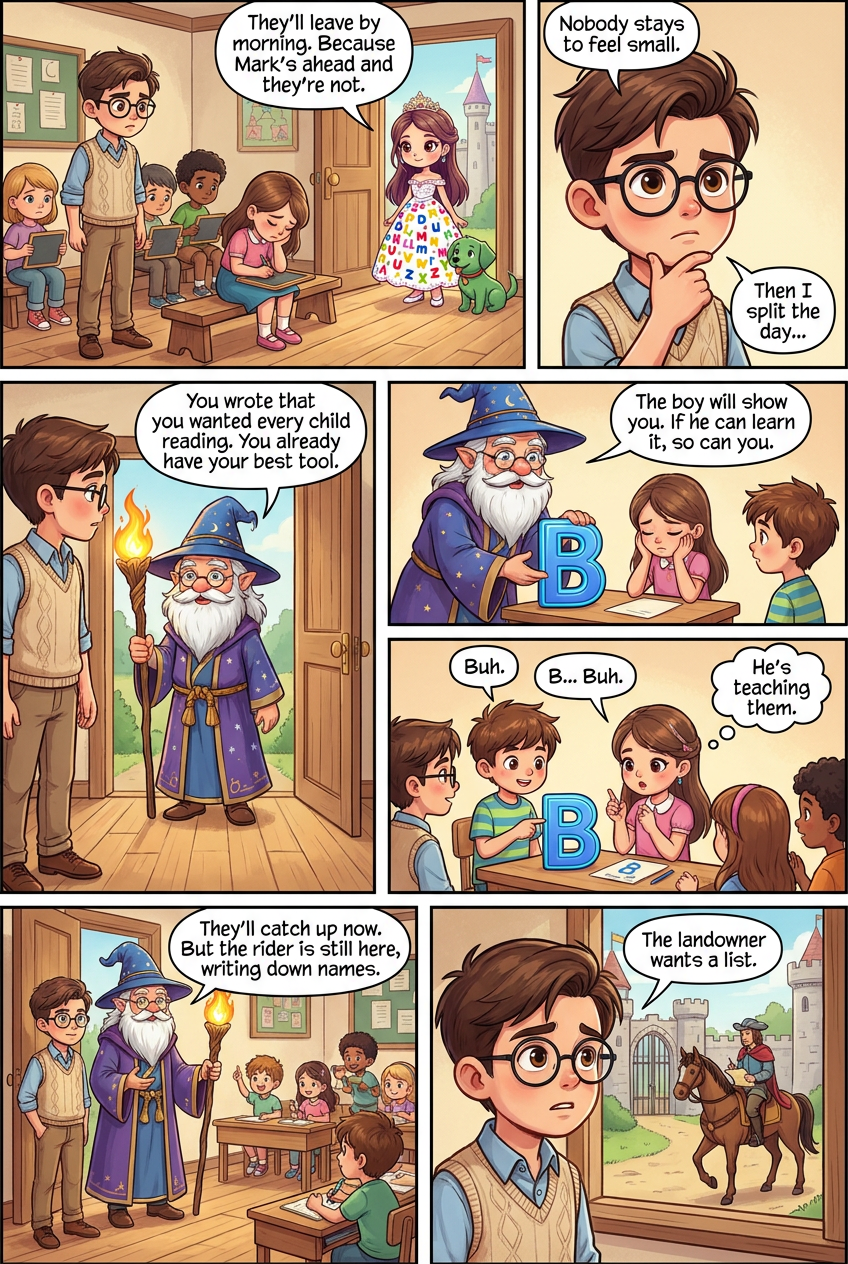
By Thursday, the bench was full again, but the trouble had changed. The four returning children opened their slates and found nothing they knew. Mark had kept coming every day. He could already sound out whole words. The others were still stuck on single letters. A girl put her chalk down and stared at the floor. Maniu saw it plainly. They felt too far behind to catch up, and children who feel stupid go home for good. "They'll leave by morning," Princess Letter said. She stood at the door with the green pup, watching the girl's face. Princess Letter traveled from kingdom to kingdom teaching children letters, and she read a room fast. "Not because they're scared. Because Mark's ahead and they're not. Nobody stays to feel small." "Then I split the day," Maniu said. "Teach them alone while Mark works ahead." "You have one mouth. You can't teach five different lessons at once." The door opened before Maniu could answer. An old man in a star-covered robe stepped in, leaning on a staff that carried a small flame at its top. Maniu had written to him once, years back, and gotten no reply. Mr. Learning had come anyway, on his own time. "You wrote that you wanted every child reading," Mr. Learning said. He looked at the slates, then at Mark. "You already have your best tool sitting right there." "Mark's a student," Maniu said. "Mark knows what these four don't. That makes him a teacher for one hour a day." The wizard crossed to the bench and set a bold blue letter B in front of the stuck girl. "Watch," he told her. "The boy will show you. If he can learn it, so can you. That's the whole trick." Maniu tried it before he could talk himself out of it. He sat Mark beside the girl and gave him one job: teach her the sounds he already knew. Mark hesitated, then pointed at the blue B and said its sound. The girl copied him. She got it wrong. Mark said it again, slower, the way Maniu had said it to him. This time she got it right. By afternoon, the four children were not watching Mark from behind. They were working next to him. Mr. Learning walked the bench, fixing a grip here, a sound there, while Maniu taught the newest letters up front. The gap that had scared them off began to close, one child pulling the next. Mr. Learning stopped at the door as he left. "They'll catch up now," he said. "But you should know something. The rider who passed the mill didn't ride back east. He's still here, asking which families sent children today." He looked at Maniu. "He's writing down names. The landowner wants a list." The girl said the sound of the B again, proud of it. Outside, past the gate, a man on horseback sat writing.
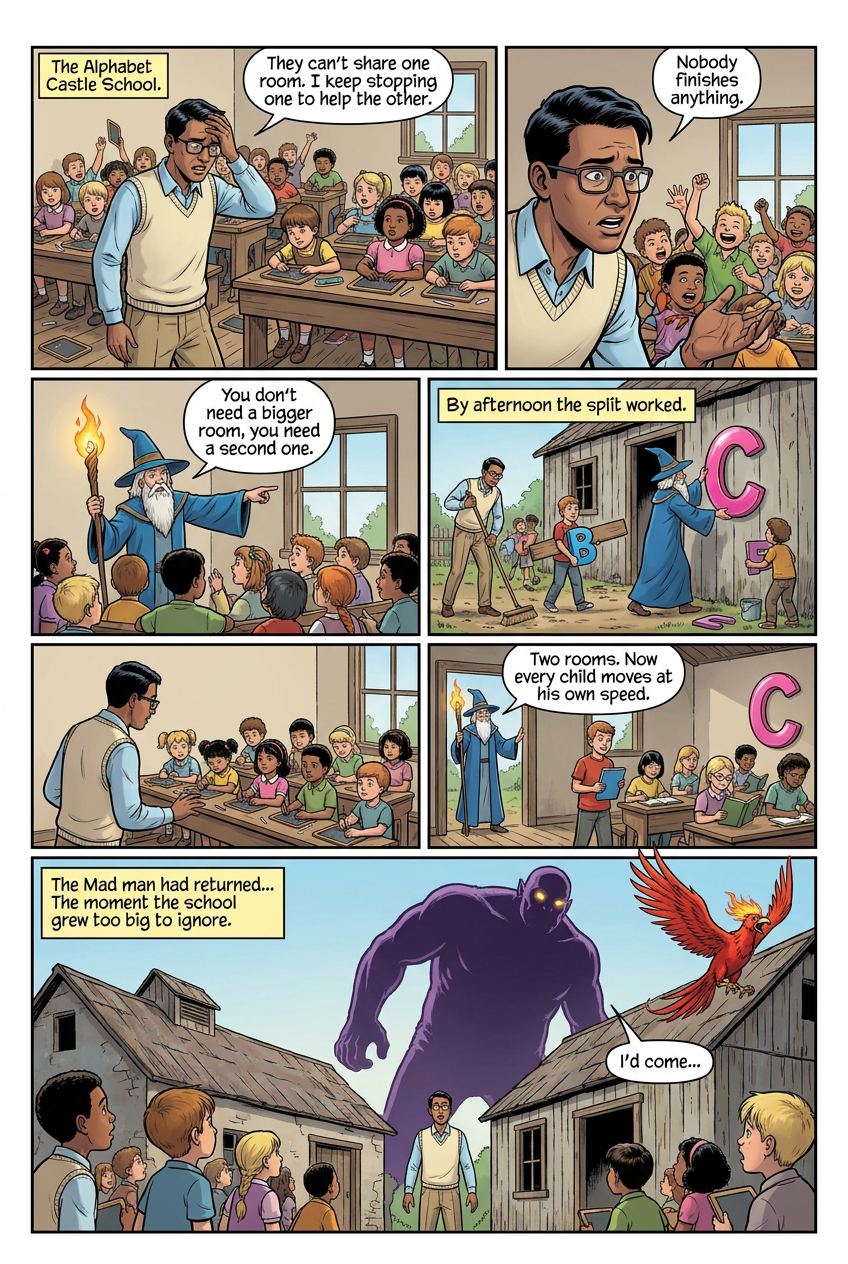
By Monday the room was too full to teach in. Word had spread that Maniu's school was worth defying the landowner for, and more children came than the bench could hold. Mark's group needed quiet to work ahead. The returning beginners needed him up front, sounding out letters. Both groups sat crammed on one bench, elbow to elbow. Every time Maniu started a lesson for one group, the other lost the thread. Slates knocked together. Chalk snapped. Nothing stuck. "They can't share one room," Maniu said. "I keep stopping one to help the other. Nobody finishes anything." The door opened and the old wizard stepped in, his staff flame bright against the gray morning. Mr. Learning had come back on his own, the way he always did. He looked at the packed bench and the frustrated faces. "You don't need a bigger room," he said. "You need a second one." "I have one room," Maniu said. Mr. Learning walked to the window and pointed. Past the gate stood the old grain shed, empty since spring. "Walls and a roof. That's all a classroom is. Move Mark's group there. Give the beginners this room and your full attention." Maniu weighed it. The shed sat close enough to watch, far enough for quiet. He gathered Mark and the three others who worked ahead. "You'll learn in the shed now," he told Mark. "One hour teaching the beginners here, the rest of the day on your own words. Can you do that without me standing over you?" Mark held up the blue wooden B he carried everywhere. "I taught the sound already. I can do the rest." They cleaned the shed together. Maniu swept the floor while the children dragged in a plank for a bench. Mr. Learning set a bold pink letter C against the wall so the advanced group had something to read on. By afternoon the split worked. In the schoolhouse, the beginners had Maniu to themselves, and the letters finally landed. In the shed, Mark's group read whole words without waiting. The stalling stopped. Mr. Learning watched from the doorway, pleased. "Two rooms," he said. "Now every child moves at his own speed." Then the ground shook. A red bird with a flame-crest shot up from the shed roof, screeching. Maniu ran out. The empty grain shed had a shadow across it now. A huge purple figure stood at the ridge, staring down at the new second classroom. The Mad man had returned, exactly as he'd promised, without warning. He'd come the moment the school grew too big to ignore. Maniu stood between the shed and the schoolhouse. He had finally split his lessons. He had solved the crowding. But in doing it, he'd built a bigger school, and a bigger school was a bigger target. The giant took one step down the ridge toward the children.
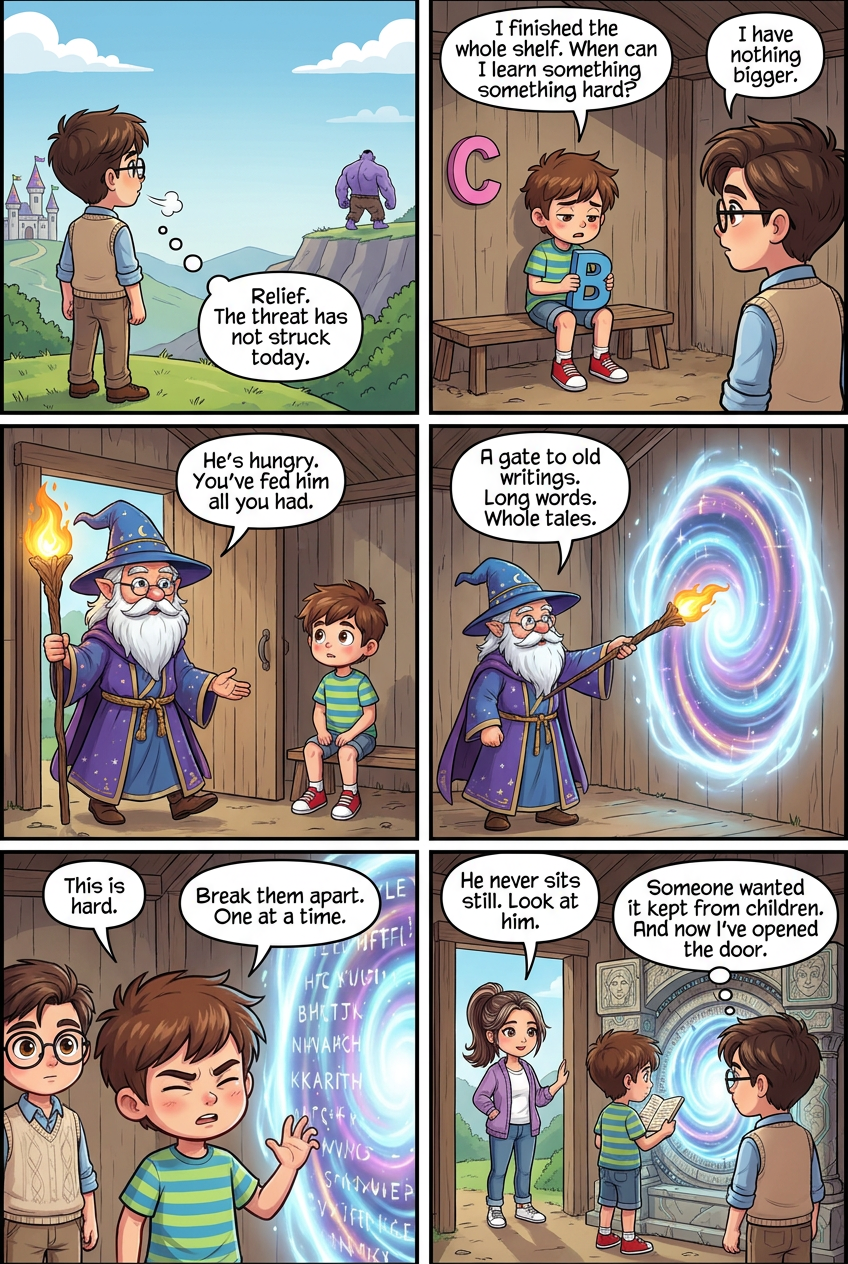
The giant stopped at the ridge and did not come down. Maniu stood between the shed and the schoolhouse, ready. But the purple figure only watched, then turned and left. Maniu let out a breath. The threat had not struck today. The real trouble waited inside the shed. Mark sat alone on the plank bench, his blue wooden B in his hand, staring at the pink letter on the wall. He had read every word Maniu owned. There was nothing new left to teach him. "I finished the whole shelf," Mark said. He tapped the wall. "C. I knew that one before you moved us here." He set the B down. "When can I learn something hard?" Maniu had no harder book. He taught letters and short words. Mark had passed them. If the boy grew bored, he would stop coming, and the other advanced children would follow. The school would shrink again. The door opened and the old wizard stepped in. Mr. Learning came back the way he always did, his staff flame bright. He looked at Mark's empty slate and the boy's folded arms. "He's hungry," the wizard said. "You've fed him all you had." "I have nothing bigger," Maniu said. Mr. Learning walked to the shed wall. He drew a wide loop with his finger. Light gathered there, a ring of stone with old marks carved around a spinning center. "A gate to old writings," he said. "Stories no one in Letter Land has read for a hundred years. Long words. Whole tales." He turned to Mark. "Reading a book is easy. Reading a book that fights back is the real work." Mark stood. He stepped close to the glowing ring and squinted at the carved marks. "These are letters," he said slowly. "But they run together." "Then break them apart," the wizard said. "One at a time." Mark read. He sounded out a long carved word, missed it, tried again, and got it. His eyes went wide. He read another. For the first time in weeks, he was working, not waiting. "This is hard," he said, grinning. Maniu watched the boy lean into the difficulty. The bored slump was gone. He copied the first line onto his slate to keep it. "Teach me to read from this," Mark said. "All of it." Raina arrived to walk her son home. Mark's mother had once kept him from school out of fear. Now she stopped in the doorway and watched him read the ancient marks aloud. She did not pull him away. "He never sits still," she said quietly. "Look at him." Maniu had solved it. Mark had harder material now, enough to hold him for months. The advanced group would stay. But as the ring's light spun, Maniu saw faces carved into the stone frame, figures reaching for the words. Old knowledge had been locked away for a reason. Someone had wanted it kept from children. And now Maniu had opened the door.
Play your story to life
Storycraft is a mobile game where you create AI characters, craft items and locations to build their world, then discover what direction your story takes. Download the iOS game for free today!
Download for free